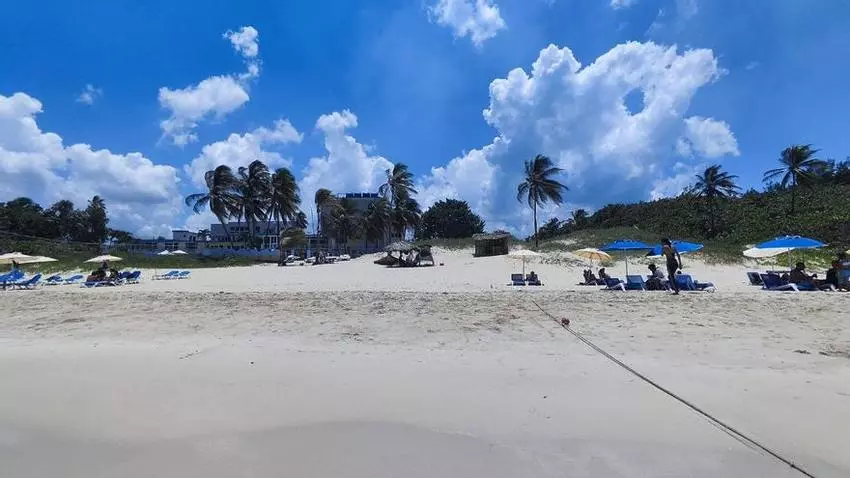
Seven Years Later, Russia Resurrects Its Plan To Modernize the Railway in Cuba

The renovation of the tracks would reduce the travel time from Havana to Santiago from 20 to 12 hours


The train that connects Havana and Santiago de Cuba currently takes 20 hours / Beatriz Pérez/ 5 de septiembre

14ymedio bigger
14ymedio, Madrid, 3 September 2024 — The Russian Union of Railways (RZD) has dusted off its railway renovation agreement with Cuba, neither more nor less than seven years behind schedule. Serguei Pavlov, deputy director of RZD, said this Tuesday at the Eastern Economic Forum in Vladivostok that he plans to sign a contract this year for the modernization of the railway infrastructure in Cuba. The most obvious omission was, precisely, any news about what happened with the previous project.

The plan remains unchanged despite the technological advances that can be expected after all these years. Pavlov told the main Russian press agencies that the company began working on the project after the Russian Council of Ministers published in March a document on cooperation agreements with Cuba, which included the modernization of the railway.

It didn’t take much work for RZD to develop the proposal, since the highlights of the agreement are the remodeling and modernization of the central Havana-Santiago de Cuba line, whose extension is 835 kilometers; the south line 19 de Noviembre-Navajas station, including the Havana node and the Montalvo branch – 166 kilometers; and the Cienfuegos line – Santa Clara and Refinery branch – 77.4 kilometers. In total there are just over a thousand kilometers of infrastructure renovation, of the 12,000 that the Island has, which were already in the original plan. continue reading

Time does not seem to have passed for a plan that remains unchanged despite the technological advances that can be expected in all these years

Although the highlight, for novelty, seems to be the shortening of the travel time between Havana and Santiago de Cuba, which, if fulfilled, would go from 20 hours to 12, the truth is that the 2017 plan already contemplated it, since the peak speed of 120 kilometers per hour (km/h.) was planned.

Those 12 hours that, in the best case scenario, would separate the primary two cities of the Island, are just under the 14 hours that it takes to travel the 1,145 kilometers between Barcelona and Vigo by conventional route; that is, in the few long-distance trains left in Spain that travel at 130 km/h instead of the majority high-speed ones, which connect the main cities at 300 km/h.

Pavlov spoke on Tuesday of an integrated plan that includes the creation of a unified traffic control center and staff training facility, but, once again, these aspects appeared in the 2017 project, which can still be seen on the outdated RZD website.

The Russian state company said it was in contact with the Cuban side and the financial institutions of its country for the allocation of a specific export credit for this project but did not want to give figures. In the previous project, signed in 2019, the amount totaled 1.88 billion euros, but it is expected that the amount will be raised, due to the logical price increase in recent years.

Among the improvements planned by the company is an increase in cargo transport capacity, which would go from 14.7 to 21.6 million tons, while the passenger capacity will grow from 7.8 to 24.3 million people.

It remains to be seen whether or not the project comes to fruition once and for all. The agreement adopted in 2017 and signed in 2019 between the two parties was shipwrecked in 2020, when RZD chose to suspend it.

“Regrettably, we have had to suspend our project of comprehensive modernization of the Cuban railway infrastructure due to economic difficulties and quarantine restrictions on the Island, but we hope to resume the work after the situation has stabilized,” Pavlov himself said in October 2020.

The news came a few days after the executive secretary of the Russian-Cuban Intergovernmental Commission on Trade, Economic, Scientific and Technical Cooperation, Oleg Kucheriáviy, hinted at a massive cancellation of investments in Cuba due to non-compliance by Havana.

The agreement adopted in 2017 and signed in 2019 between the two parties was shipwrecked in 2020, when RZD chose to suspend it

The official told the Russian press that, of the 60 joint projects, only ten were being carried out, and he mentioned at a meeting of the Senate International Affairs Committee that the last session of the intergovernmental commission, which was to be held on the Island, was canceled due to the “silence” and “delay” of the Cuban authorities.

It wasn’t the first bucket of cold water thrown on the project by the Russians. Yuri Borisov, then deputy prime minister of Russia and in charge of economic relations with Cuba – he is currently responsible for the space agency – said after a trip to the Island that Cuban officials had a “Cold War mentality that in post-Soviet Russia” was out of place. “They are complicated businessmen, I’m not going to hide it; the mentality of the past weighs on them constantly. During the negotiations, in the positions they hold, it always appears that they are an outpost of the world revolution and we simply have to help them,” he said.

In this impasse, China arrived to fill the gap left by Russia. In 2022, the Union of Railways of Cuba (UFC) and Beijing Fanglian Technology signed “two letters of intent for the gradual recovery of part of the railway infrastructure.” Among the agreements, a recovery of railway workshops was planned that is being carried out, also with French investment.

Both China and Russia have continued to cooperate with Cuba in respect to rail transport, in particular by sending locomotives. But the new scenario after the invasion of Ukraine, which has relaunched relations between the Kremlin and the Regime, has led to reopening the drawer of lost projects. And the ancient Cuban train continues to chug along.

Translated by Regina Anavy

____________

COLLABORATE WITH OUR WORKThe 14ymedio team is committed to practicing serious journalism that reflects Cuba’s reality in all its depth. Thank you for joining us on this long journey. We invite you to continue supporting us by becoming a member of 14ymedio now. Together we can continue transforming journalism in Cuba.

Political Prisoners Sissi Abascal and Sayli Navarro, Excluded From the ‘Pass’ for 11J Prisoners

Temporary passes are increasingly frequent in Cuban prisons due to the shortage of food, explains Martha Beatriz Roque

The political prisoners Sissi Abascal and Sayli Navarro / Collage/Cortesía

14ymedio bigger14ymedio, Havana, September 2, 2024 — Political prisoners Sissi Abascal and Sayli Navarro were not included in the pass received this Monday by five other women convicted of demonstrating on 11 July 2021, who are serving their sentence in La Bellotex prison, in Matanzas. The activists did not benefit from the possibility of visiting their homes for four days, denounces oppositionist Martha Beatriz Roque.

“Today they gave a pass to five of the women convicted on 11J, but two of them were excluded,” the director of the Cuban Center for Human Rights told 14ymedio. “They have never been given a pass, so it is an absolutely discriminatory exclusion” against Abascal and Navarro, who are also part of the Ladies in White Movement.

The reasons for not being on the list of prisoners who can spend a few days in their homes, in this case from today until Thursday, point to the activism of both women and their membership in several dissident organizations. Also, their constant denunciations and statements from prison could have contributed to not being granted that benefit. Last July, the two opponents held a fast in commemoration of the third anniversary of the 11J demonstrations. continue reading

“They have never been given a pass, so it is an absolutely discriminatory exclusion”

“The events of 11 July 2021 left a trail of those who were arrested, beaten and finally sentenced to years in prison,” Sayli Navarro said in an audio sent to Martí Noticias. The daughter of political prisoner Félix Navarro was sentenced to eight years of deprivation of liberty for the alleged crimes of attack and public disorder. Abascal, for her part, is serving a six-year sentence.

Roque adds that “temporary passes have become increasingly frequent in Cuban prisons.” The reason that the prison authorities grant these passes points to the serious economic crisis that the Island is going through. “In prisons there is less and less food; sometimes the only thing they have throughout the day is a little rice.”

Other reports compiled by 14ymedio show that the supply crisis is more crudely acute in prisons, where prisoners are increasingly dependent on the food that their relatives bring them during visits. Without what is popularly known as “la jaba (the bag),” inmates depend exclusively on the meager standard ration that each time is smaller and of poorer quality .

“When prisoners go out on pass there are fewer mouths to feed,” explains Roque, convicted during the Black Spring of 2003 and currently
on parole. The activist, who is “regulated” and cannot leave the country, warns about the extreme situation experienced by common prisoners and, more seriously, by political prisoners.

“In prisons there is less and less food; sometimes the only thing they have throughout the day is a little rice”

The relief experienced by the authorities for not having to supply a plate of food has not weighed as much, in the case of Abascal and Navarro, as the reprisals against two of the most internationally known prisoners of 11J. In September 2023, the authorities denied Abascal a transfer from a maximum security prison to one of minimum security. Prison managers alleged “indiscipline” and “negativity” on the part of the prisoner.

In conversation with this newspaper, Annia Zamora, Abascal’s mother, said that although a judge is the one who should ultimately approve her transfer to minimum security, the report issued by the prison has a remarkable weight on the decision. “Sissi is currently in a prison uniform in a high security cell. They should have already put her in minimum security in another section of the prison, where the prisoners are in civilian clothes with other benefits, and receive passes every month to go home,” she said.

However, the prison authorities refused to grant the transfer to Abascal, alleging indiscipline: “Lieutenant Colonel Marta Cristina, director of La Bellotex, called Sissi to tell her that they would not change her situation because of her ’negative attitude’ and because she is not participating in political acts or shouting slogans.”

Translated by Regina Anavy

____________

COLLABORATE WITH OUR WORKThe 14ymedio team is committed to practicing serious journalism that reflects Cuba’s reality in all its depth. Thank you for joining us on this long journey. We invite you to continue supporting us by becoming a member of 14ymedio now. Together we can continue transforming journalism in Cuba.
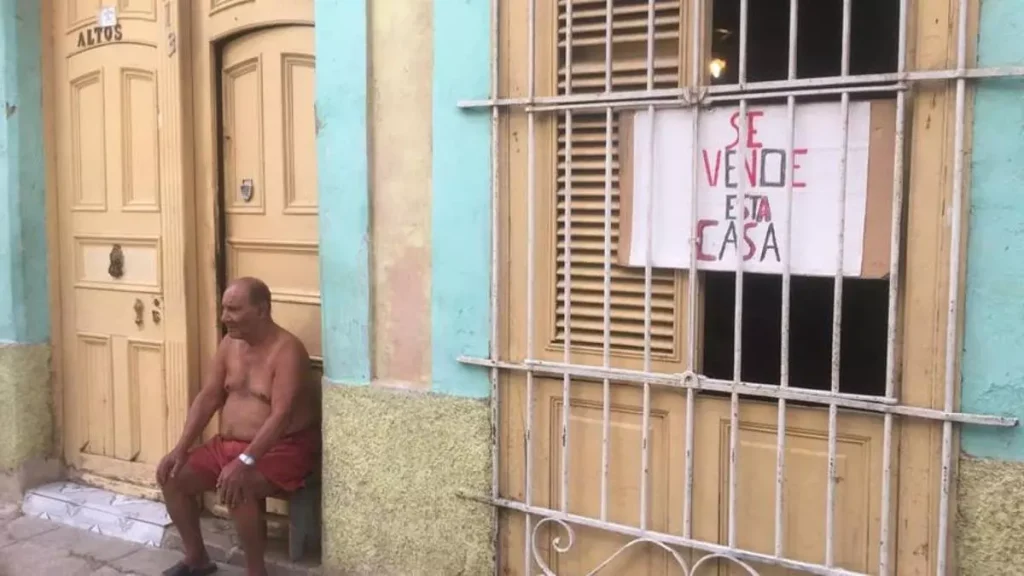
Due to Emigration, Havana Has Lost 15 Percent of Its Population in the Last Three Years

The population flight is increasing the number of homes for sale, but almost no one wants to buy / 14ymedio

14ymedio bigger14ymedio, Madrid, 4 September 2024 — The data of the collapse of the population in Cuba does not give a break. Almost two months after it became known that at the end of 2023 there were 10,055,968 residents on the Island, detailed statistics reveal that Havana lost 15% of its inhabitants in three years and already has fewer than two million residents, a figure it hasn’t had since at least the 1990s. In addition, the other two provinces that exceeded one million inhabitants in 2020, Santiago de Cuba and Holguín, no longer reach that number.

The detailed figures appear in the report “Demographic Indicators of Cuba and its Territories,” whose general features were presented in August by the National Bureau of Statistics and Information (Onei) and were published in full this Tuesday on the institution’s website. In the absence of the repeatedly postponed census, Onei experts proposed a model to approach the “effective population” that is based on the accumulation of at least 180 days of stay in the national territory, both for newborns, deceased and, most importantly, migrants.

The result could not be more discouraging. Each and every one of the Cuban municipalities lost population between the end of 2020 and the end of 2023, bringing the total number of residents on the Island to figures that have not been seen since 1983, when Cuba reached 9,984,591. A year later, it already had 9,571 more inhabitants than at the end of last year. continue reading

Each and every one of the Cuban municipalities lost population between the end of 2020 and the end of 2023

In detail, the general panorama confirms that the western provinces lost the highest percentage of population compared to the eastern ones, predictably because the purchasing power – very necessary to emigrate – is lower in the latter. This means that there are fewer family members and acquaintances abroad, decreasing contacts for leaving and the possibilities of obtaining the required sponsorship from family members in the United States to qualify for humanitarian parole.

Despite this, the decline in population is not a minor thing. Between the dates compared (from the end of 2020 to 2023, although there are data corresponding to each of the intermediate years), Guantánamo lost 5.3% of its population, going from 505,606 to 478,328 inhabitants, the province with the smallest decrease. It is closely followed by Santiago de Cuba, falling from 1,045,631 to 988,655. The decrease is 5.4%, although the fall to less than one million inhabitants has a strong symbolic effect.

The same thing happens with Holguín, which is in fourth position; Granma, with 6%, has the third smallest loss of population; Las Tunas lost 8.1%, and it loses its quality of a province with more than one million residents (1,021,591 in 2020) and remains at only 938,744.

The special municipality of Isla de la Juventud, which at the end of 2020 had a small population of 83,625, has lost 8.9% of its population in these three years, ending up with 76,154 residents.

The middle area of the table, with a population loss of 9.2% and 9.5% respectively, is occupied by the westernmost provinces, Pinar del Río and Artemisa, which currently have around 500,000 inhabitants.

Meanwhile, the group of central provinces loses about 10% of its population. Among them are Camagüey and Matanzas (10.9%) and Villa Clara (11.5%)), which, to a greater or lesser extent, exceeded 700,000 in 2020 and is now well below that figure. Sancti Spíritus (10.3%), Ciego de Ávila (10.4%) and Mayabeque (11.1%) range from 415,714 for the first to 341,568 for the latter. Cienfuegos, which fell from 406,244 to 356,641 residents, is the second Cuban province that has suffered the most demographically.

But nothing compares to Havana, which went from 2,132,183 at the end of 2020 to 1,814,207 three years later, a loss of 15.3%. To put it into perspective, the population of Ukraine fell by 16.6% between 2022 and 2024 as a result of a brutal war. In Havana, the average loss in each municipality is about 20,000 inhabitants, except for those with the smallest number of residents (Old Havana, Regla and Cotorro).

In 2020, the average age of Cubans was 41.4, compared to the current 42.2, while the most common age has risen from 42.8 to 44.1

The analysis of the Onei includes, also with year-to-year tables by municipality, the demographic rates, with the data of births and deaths, which have a much smaller impact than emigration in the final balance sheet. In addition, figures of internal migrations appear, as well as the few foreign immigrants who arrived on the Island in recent years.

Another table gives the distribution of urban and rural population in each of the provinces and municipalities as well, while the last one has the data disaggregated by sex. The last tables of the document are dedicated to analyzing the average age of the population, as well as the median.

As expected, since emigration is higher among young people, the population has aged in these three years. In 2020, the average age of Cubans was 41.4, compared to the current 42.2, while the most common age has risen from 42.8 to 44.1.

Translated by Regina Anavy

____________

COLLABORATE WITH OUR WORKThe 14ymedio team is committed to practicing serious journalism that reflects Cuba’s reality in all its depth. Thank you for joining us on this long journey. We invite you to continue supporting us by becoming a member of 14ymedio now. Together we can continue transforming journalism in Cuba.

A Dozen Cuban Political Prisoners Are at Risk of Suicide

After Yosandri Mulet Almarales’ death, NGOs warn of the risk this kind of prisoner is facing in the island’s prisons

Fray Pascual Claro Valladares attempted suicide last April, after being sentenced to 10 years in prison for demonstrating in Nuevitas, Camagüey. / Documentation Center of Cuban Prisons

14ymedio bigger14ymedio, Madrid, 3 September 2024 — Three “suicidal ideation events”, three self-harming events and six attempts to take one’s own life have been registered by the Cuban Prison Documentation Center (CDPC in Spanish) since January 1, 2024, by 10 Cuban political prisoners (seven men and three women). In a statement issued together with Justicia 11J – both now part of the Initiative for Research and Incidence – following the suicide committed by Yosandri Mulet Almarales, the programs warn of the special risk posed by these prisoners.

The Mexico-based organization recalls that, before Mulet Almarales’ death, “presumably from injuries sustained after a suicide attempt on August 22,” it says in the report, it had already alerted to his situation. Sentenced to 10 years for participating in the July 11 and 12, 2021 demonstrations in La Güinera, Havana (11J), the 37-year-old had already attempted suicide before, in June 2022, in the maximum security prison Combinado del Este.

On August 22, while on leave from the penitentiary center where he was doing forced labor, he threw himself from the Calabazar bridge, in the capital, and on August 26, his family was told the news. The Initiative quotes activist Marcel Valdés, who said that it is not clear how many days he was in the Julio Trigo hospital, where he was taken “apparently alive”, because “the military authorities took over the place”.

For the NGO, in any case, his death “confirms the need to heed the warnings” it has issued “about suicidal ideation, self-harm and attempts to take one’s own life by Cuban political prisoners”. continue reading

Machado Conde, sentenced to 9 years for the 11J, “has been subjected to multiple cases of abuse in prison,” says the NGO, and has attempted suicide several times.

Other prisoners of conscience at risk of suicide listed in the statement are the men Abel Lázaro Machado Conde, Ismael Rodríguez González, Yasmany González Valdés, Fray Pascual Claro Valladares, Daiver Leyva Vélez, Omar Ortega, and the women Mayelín Rodríguez Prado, Yanet Pérez Quevedo and Lizandra Góngora.

Machado Conde, sentenced to 9 years for 11J, “has been subjected to multiple instances of abuse in prison,” says the NGO, and has attempted suicide several times. In May 2023, after one of these attempts, the authorities of Quivicán prison, in Mayabeque province, where he is serving his sentence, “handcuffed him all night by his hands and feet in a corridor”, and last March, he sewed his mouth shut after a beating and several days in a punishment cell.

For Ismael Rodriguez Gonzalez, the CDPC has registered three “suicidal ideation events”. Sentenced to 7 years for the July 11 demonstrations, he also does not have access to his medication in prison, despite having a diagnosis of intellectual disability, suicidal risk and personality disorder.

Meanwhile, last February, Yasmany González Valdés, sentenced to four years for painting anti-government posters on walls in Havana, told his wife that he had thought of taking his own life, after months of abuse in Cuban prisons and the judicial limbo he was going through at the time.

Another person sentenced for the Nuevitas protests, Daiver Leyva Vélez, sentenced to 10 years for sedition, has tried to hang himself on two occasions.

They also documented that Mayelín Rodríguez Prado and Yanet Pérez Quevedo, political prisoners at the Kilo 5 prison in Camagüey province, attempted to take their own lives “in protest against mistreatment” by prison authorities.

Similarly, Fray Pascual Claro Valladares attempted suicide after learning, last April, of his 10-year sentence for peacefully demonstrating in Nuevitas, Camagüey, in August 2022. The Inter-American Commission on Human Rights (IACHR), in fact, granted him precautionary measures in July and denounced that “his suicide attempt was handled with negligence, without receiving the necessary psychiatric care and being punished with isolation”.

Another person sentenced for the Nuevitas protests, Daiver Leyva Vélez, sentenced to 10 years for the crime of sedition, has tried to hang himself on two occasions. Both Omar Ortega, imprisoned in Morón, Ciego de Ávila, and Lizandra Góngora, in Los Colonos, Isla de la Juventud, have told their families of their intention to attempt to kill themselves.

On the other hand, Yosandry Mulet Almarales is the second 11J prisoner to die, according to the organization. Last November, Luis Barrios Díaz, also 37 years old, died after “respiratory complications aggravated by the decision of the authorities not to keep him in a Havana hospital,” according to the Cuban Observatory for Human Rights. The State granted Barrios Díaz an out-of-prison leave of absence only when it considered his death imminent, the Initiative denounces.

Translated by LAR

____________

COLLABORATE WITH OUR WORKThe 14ymedio team is committed to practicing serious journalism that reflects Cuba’s reality in all its depth. Thank you for joining us on this long journey. We invite you to continue supporting us by becoming a member of 14ymedio now. Together we can continue transforming journalism in Cuba.

”Maximum Severity,’ the Key Word of the Cuban Judicial System for Any Crime

Exemplary trials have become a new tool of repression

Yudiel Tomé, criminal case investigator / Capture / Canal Caribe

14ymedio bigger14ymedio, Havana, August 31, 2024 — With a soundtrack worthy of police cinema, Cuban Television presented this week the results of an investigation that led to the arrest of 10 members of a “crime chain” in Matanzas. Aimed at warning the population and using all kinds of narrative resources, the report revolves around a kind of hero of the Ministry of the Interior: Major Yudiel Tomé, criminal investigator of the case.

In the first images, Tomé appears on his desk examining the evidence of the case: photos of several paddocks located in Colón, Los Arabos and Calimete, where the Police have already found several clues: a machete, a rope, a farmer’s boot footprint. “Those involved used weapons and exercised violence on the victims, and also slaughtered animals,” the investigator summarizes.

An officer of the Ministry takes note of what Tomé comes up with, after reviewing the files of the detainees. “But the investigation continues,” he warns. Tomé is not a great speaker and explains the case in front of the cameras with great difficulty. He warned that with the clues uncovered on the ground, the Prosecutor’s Office was asked to issue an arrest warrant against a dozen people involved. They are already in “provisional prison,” the policeman said, “according to their aggressiveness and the seriousness of the facts.” continue reading

Yulelkis Hernández, provincial prosecutor, was much more eloquent about the case and fulfilled one of the functions of these reports: their exemplary character. Hernández said that pre-trial detention was an extraordinary measure, but that the authorities had all the power in the world to apply it, especially if it was requested by the police. The key words, frequent in the official press, is “maximum severity.”

Without explaining the reasons, halfway through the report, Televisión Cubana forgets the case that Tomé is investigating and offers details of another crime: the assault by two young people in the Matanzas Viaduct. “They told us to give them all the valuable belongings we had, they took away our phone, watch, wallets,” says one of the victims, while an officer explains that they immediately “detected” the two suspects, who started running.

Hours later, the victims recognized the robbers in a group of four suspects. They were tried this week, and without revealing their faces, some images of the trial are transmitted. “You can’t lose the citizen tranquility that has been prevalent in this country for years,” Hernández says. “All people who commit these types of crimes will find a severe criminal response,” including life imprisonment.

Exemplary trials have become a new repressive tool in Cuba, although the word that Cuban Television prefers is “preventive.” On August 20, information was published about four trials held in the municipal court of Songo-La Maya, in Santiago de Cuba. The press did not reveal details about the cases, but it did underline its warning character.

“When we make exemplary judgments, we enhance communication so that the message we want to transmit reaches certain recipients,” said Geovanis Mestre, one of the judges of the provincial court of Santiago, interviewed by Sierra Maestra. It is essential, he argued, that criminals learn that the authorities have the livestock in their sights and that the punishments will be severe.

These trials were not chosen “at random,” Mestre said, but because of the “repetition” of the theft and slaughter of cattle in several areas of the country

These trials were not chosen “at random,” Mestre said, but because of the “repetition” of the theft and slaughter of cattle in several areas of the country such as Santiago and Matanzas. At a time when these crimes have been “calling the attention” of the Police, the court decided to turn them into a “behavior of priority in criminal legal confrontation.”

From the massive criminal proceedings of 1959 – not infrequently resolved with the death penalty – to the famous case of Arnaldo Ochoa in 1989, this practice has not lost its validity in Cuba. During the coronavirus pandemic, the Government also held many exemplary trials.

According to the Cuban Observatory of Human Rights, in June 2020 the Police carried out “at least 67 arbitrary arrests,” especially in the provinces of Havana, Santiago de Cuba and Villa Clara, and 74 “repressive actions of another type,” in particular, harassment through police summons.

These arrests were followed by a “wave of exemplary trials” to “intimidate the population affected by the country’s poor economic situation. Several of these processes have been aired by the official media, so that citizens can see how relentless the system can be,” denounced the organization, based in Spain.

Translated by Regina Anavy

____________

COLLABORATE WITH OUR WORKThe 14ymedio team is committed to practicing serious journalism that reflects Cuba’s reality in all its depth. Thank you for joining us on this long journey. We invite you to continue supporting us by becoming a member of 14ymedio now. Together we can continue transforming journalism in Cuba.

Closed for Months, the Coppelia in Cienfuegos Is Now Open a Few Hours a Day, Until the Ice Cream Runs Out

“They limit you to one flavor option and the portion sizes keep getting smaller”

The quality of service at the state-owned ice cream parlor as well as the quality of the ice cream itself leave much to be desired / 14ymedio

14ymedio bigger14ymedio, Julio César Contreras, Cienfuegos, 31 August 2024 — Cuba’s Coppelia ice cream parlors are a stark reminder of country’s current economic crisis. Created shortly after Revolution to provide a sense of prosperity and abundance, the outlets, which can be found in many provincial capitals, used to be sources of entertainment for locals. In the midst of today’s financial difficulties, however, when there is no guarantee that even basic foodstuffs will be available, ice cream has become a luxury. Coppelia’s branches now open only intermittently and, when they are open, offer few options. The Cienfuegos location is no exception.

For months, Coppelia’s metal chairs lay in disarray and its tables sat empty. At the beginning of the year, city officials promised that it would reopen by summer. But June and July came and went without a single scoop being sold. Many lost hope of ever again enjoying a “copa Lolita” (flan with two scoops of ice cream) or an “ice cream salad” (an ice cream sundae).

This week, to the surprise of many, Coppelia reopened its doors. But customers who had hoped service would be as it had been in the past were visibly disappointed. At noon on Saturday, the line of customers waiting to get inside included dozens of people who sought shade in the adjacent covered walkways.

“I’ve been waiting for months to have have chocolate ice cream. We’ll see if that happens. Someone just came out and said the supply is getting low,” reports a tired and hot Yaíma, who is carrying her two-year-old son in her continue reading

arms. She has spent more than an hour in line. Frustrated with the slow service and with people cutting in line, she has several times considered giving up on the idea of a enjoying a cold dessert.

Every scoop costs 12 pesos / 14ymedio

From outside, Yaíma keeps an eye on the waiters, who move from one side of the establishment to the other carrying glasses and bowls of ice cream in their hands. This provides the young mother with valuable information such as which flavors are still on the menu, which have already run out and how agile the waiters are. “They limit you to one flavor option and the portion sizes keep getting smaller,” she observes. “It’s true that each scoop only costs 12 pesos but that doesn’t mean it should be no bigger than a tablespoon.”

When asked about the scoop size, one of the employees replies bluntly, “Each tub generates a minimum of 500 pesos. The more you stretch it, the more money you make.” Ice cream, like so many other products from state-owned establishments, also generates income for the workers. “That man who just left with two plastic buckets is my neighbor. If I can’t buy ice cream for my child here, I’m going to have to pay him 60 pesos for a cone big enough to satisfy our craving,” Yaíma says.

Every day since Coppelia reopened, people pass by my house selling five-liter containers of ice cream for 1,300 pesos,” reports Yuri, a Cienfuegos resident who does not believe this is a coincidence. “Besides the price, which is unaffordable for someone with an average salary, it’s obvious that the resellers and pushcart vendors are getting their ice cream from here.”

[[“The private vendors are doing this now because they know that at any moment the factory could have another breakdown]]

“The private vendors are doing this now because they know that at any moment the factory could have another breakdown or it run out of raw materials,” he explains. While ice cream can be purchased around town in bites, scoops or bulk, it is only being enjoyed by those who can afford it. “Both sellers and customers know that it will run out sooner or later so every one tries to take advantage of the situation in his or her own way,” says Yuri.

According to its schedule, Coppelia is supposed to be open from Tuesday to Sunday. “I passed by at 10:00 AM on Wednesday and it was as quiet as a convent,” he notes. “It all depends on how much ice cream they have on any given day. If they don’t have any, they don’t open.”

By 2:00 PM, Coppelia’s employees announce they have run out of stock. Yaíma and her son were among the last customers to be served but had to settle for one of the less popular flavors. Some of the waiters begin to leave, carrying cases and bags bulging with what they were able to “scrape together” from the bottom of the tubs.

____________

COLLABORATE WITH OUR WORKThe 14ymedio team is committed to practicing serious journalism that reflects Cuba’s reality in all its depth. Thank you for joining us on this long journey. We invite you to continue supporting us by becoming a member of 14ymedio now. Together we can continue transforming journalism in Cuba.

Washing Bottles Instead of Going to Class, the Beginning of the School Year for Many Students in Havana

Child returning from school this Monday on the first day of the 2024-2025 school year / 14ymedio

14ymedio bigger14ymedio, Juan Diego Rodríguez, Havana, 2 September 2024 — Not all Cuban children will start classes this Monday, when the 2024-2025 school year has been inaugurated with great fanfare. In Havana, for the next 15 days, some of them will have to work, either in cleaning, or in gardening, or even in other tasks, in a new kind of “school in the countryside,” one of Fidel Castro’s educational projects abandoned with the arrival to power of his brother Raúl, in 2008.

Tomorrow, for example, in a high school south of the capital, eighth-year students will have to go to a private cleaning-products company “to scrub bottles.” “Why does the school send some children to a private MSME and our children have to go clean for some rich people?” asked Daisy, who lives in Regla.

Daisy’s two children are in high school in the municipality of Regla, and today they began the course “incorporated” in the first destination of the “school in the countryside.” continue reading

“Why is the school sending some children to clean for a private ‘MSME’?”

The general director of Education of Havana, Karenia Marrero Arrechea, had already warned, although without giving details, last week on State TV’s Round Table program, when referring to the “change that we have to achieve in the student” to “link study and work.” “We are starting a school in a different field, where the student feels linked to tasks of impact,” she said, specifying that they would “begin” with three grades: eighth, eleventh and the first of Technical and Professional Education (ETP), in “organoponics” in the corresponding municipality and “on plaques and monuments.”

The phrase evoked by the official still causes chills in the generation of many parents who accompanied their children today on the first day of the school year, and who were sent in the eighties to the fields of tobacco, cabbage, banana, garlic, beans and coffee crops, in Pinar del Río or what are now the provinces of Artemisa and Mayabeque.

“I still have scars from that experience,” recalls María, a 45-year-old from Havana. “I had chronic conjunctivitis; they sent me to the infirmary, and the doctor left us locked up from the outside because he went to a party. They had to pass us food through the windows. I left there apparently recovered, but on the first day back in the field I realized that I couldn’t look at the areas illuminated by the sun.”

When she told the man in charge of the agricultural work what was happening to her, he thought she was lying to evade work. “I had to continue weeding in the furrows for two more weeks. When I returned home my eyes were blurry, and I could no longer look at any white or light-gray objects. I was diagnosed with advanced keratitis, an infection of the cornea. I almost lost vision in both eyes, and it still bothers me to look at any light-colored surface.”

The objective of the so-called “school in the countryside” was none other than to indoctrinate the students

The objective of the so-called “country school,”which was chronologically followed by the “school in the countryside,” was none other than to indoctrinate the students, called to become a “productive force.” Established in the seventies, the first such school was for high school students – seventh, eighth and ninth grade – who had to leave the cities to do agricultural work for a period of 45 days. Later, with the crisis, the “program” was reduced to 30 days and only for teenagers from Havana. The second program was for pre-university scholarship holders, in which a half-day was spent in study and the other half in working in the field.

Why are they now resurrecting these projects, whose eradication was precisely one of the most applauded measures of Raulism? The authorities have not explained it, nor did the teachers in the presentation this Monday, and the parents can only guess. “It seems that it’s due to the problem of school supplies, because coincidentally the children who are being sent to those jobs have not been given the materials,” says Ernesto, with suspicion. He is the father of girls in the same high school as Daisy’s children. “My oldest daughter, who is in eighth grade, doesn’t want to go. She thought it was something voluntary.”

The families are extremely upset, because they have spent a lot of money on uniforms and other school supplies, and now they being asked to supply “adequate clothes” for the work.

Moreover, the state of that school – whose name is reserved for fear of reprisals – is painful, they say. “The teachers themselves warned us that they don’t have the equipment for the computer class, that part of the classes have to be given in another secondary school, and, in addition, they don’t have tables or chairs; everything is broken or dilapidated, even Fidel’s portraits,” says Ernesto. “I myself studied here thirty years ago, and today it looks like another planet.”

Next to the dilapidated building of the Modesto Gómez Rubio school, in San Juan y Martínez, a leaning building serves precariously as a bathroom / 14ymedio

Other educational centers in the capital present the same panorama. In the José Miguel Pérez Pre-University, in the municipality of Plaza de la Revolución, they had not even bothered to give a coat of paint to the facade. The wall looked as unpainted as the gigantic flag that heads the morning assembly, and the hubbub was less than other years. It is clear, at a glance, that there is a reduction in the number of students who intend to study a career, another piece of data that the government ignores. The group of teenagers between 14 and 17 years old deployed in the courtyard had to endure the military voice of the director through the bullhorn.

Outside Havana, the situation is even worse. In San Juan and Martínez, Pinar del Río, little has changed since the passage of Hurricane Ian, which destroyed much of the municipal infrastructure two years ago. “Two years after the cyclone and nothing,” a local resident, whose children go to Modesto Gómez Rubio school, tells this newspaper. This one finally has a roof, “but no bathroom,” and it is still “without electricity, without a floor, without anything worthy of the children,” the same source continues. Next to the dilapidated school building, an outhouse leans precariously serving as a bathroom.

“These are the classrooms in which the children of the tobacco mecca are going to start their school year,” the woman says sarcastically, referring to the municipality, cradle of the most precious tobacco that, however, does not see all the capital that is collected in exports and auctions of Cuban cigars going to better classrooms for their children.

None of this is reflected in the front pages of the official press, which proclaims that “Cuba is celebrating” the return to the classrooms. In those images, there are no schools with cracks in the walls, but well painted ones; there are no malnourished students but ones who are proud and smiling, even posing for selfies taken with their cell phones.

Again, the intention to recover one of the traditional crown jewels of Castro’s propaganda is flagrant. This is clear from the words of the Minister of Education, Naima Ariatne Trujillo, who this Monday was one of the authorities who headed the main act of the beginning of the school year in Santa Clara, and who on national television emphasized the “special fact that our educational system is universal, free.”

A single glipse of realism is observed in the provincial newspapers, specifically in El Artemiseño, which uses an infographic to show the deficit of teachers – 1,845 are missing, 24.3% of the necessary total – and, above all, its main cause: emigration.

Translated by Regina Anavy

____________

COLLABORATE WITH OUR WORKThe 14ymedio team is committed to practicing serious journalism that reflects Cuba’s reality in all its depth. Thank you for joining us on this long journey. We invite you to continue supporting us by becoming a member of 14ymedio now. Together we can continue transforming journalism in Cuba.

Cienfuegos, Cuba, No Longer Deserves To Be Called the Pearl of the South

In Cienfuegos, waste is abundant in the streets and the sewers are clogged / 14ymedio

14ymedio bigger14ymedio, Julio César Contreras, Cienfuegos, 1 September 2024 — Never before had the Pearl of the South – once called that for its beauty – been at such risk of losing this appellation as now. In Cienfuegos, founded by 47 French settlers in 1819 and declared a World Heritage Site, today there is plenty of trash in the streets and the sewers are clogged. You do not have to move to peripheral areas to see the prevailing dirt. It is enough to go through a few central blocks to realize that the work of the Communal Services Company leaves much to be desired.

“The hygiene here is not even a shadow of what it was,” says Antonia, a neighbor of the emblematic Roma hotel, currently reduced to a dilapidated facade. “People are throwing garbage in the corners in disposable straw baskets, bags or whatever they find. All that remains on the sidewalks for days, without anyone worrying about picking up even the waste that accumulates in the sewer,” the woman complains.

According to the 58-year-old Cienfueguera, her nephew, who works as a driver on one of the garbage trucks of Comunales, has told her that “their working conditions are very bad. Many times they are forced to carry out trash collections with their bare hands, because they don’t even have gloves.” Trucks also do not pass with a frequency that allows the city to remain clean, because the “fuel allocated to their business, together with the lack of vehicles, causes cleaning cycles to be missed.”

You do not have to move to peripheral areas to verify the prevailing dirt

In this situation, it is normal that paper, nylon and cans block the city’s sewer system, which barely fulfills its function. The blocked-up sewers can be seen in Martí Park, as well as on Santa Clara Street and the Malecón, says the woman. “It only takes a small downpour for the water to stagnate,” she says.

Garbage workers are forced to carry out trash collections bare-handed / 14ymedio]

Yosvany, another victim of the city’s precarious drainage system, tells this newspaper that a few days ago his house was flooded after a storm. The young Cienfueguero has raised the issue – he says – in all accountability meetings, but no solution has been found for the floods, which occur especially in the lowlands.

“It is very sad to see how trash piles are forming on the shores of the sea with the most unimaginable waste. But even sadder is to realize that the authorities do not seem to care that the people are living in such unhealthy conditions,” he laments. Yosvani is concerned that this unhealthiness will end in an epidemiological crisis that is difficult to contain.

“The People’s Power delegate can only say that he has raised the issue several times with the Government, but for those of us who live in certain places, such as Junco Sur or La Juanita, the garbage is literally in every corner,” he says with concern. “I myself have gone to complain to all possible authorities,” he says.

The neighbors are worried that this unhealthiness will end in an epidemiological crisis that is difficult to contain

“I don’t know if this can be fixed by putting garbage collectors in the neighborhoods or hiring individuals with horse-drawn carts to pick up the waste. It’s intolerable that a province recognized in Cuba for its beauty is today going through this great abandonment,” criticizes Antonia, who returns to the attack against Comunales. In the Pearl of the South you hardly see garbage bins or street sweepers. Beyond the historic center, the city is lost in a tangible filth.

The accumulated waste, the holes in the middle of the sidewalks and the broken roads that coincide in any corner of the city have become an everyday sight. Meanwhile, Antonia says that the smell of the trash piles that surround her home seeps through the door of her house, without asking permission.

Translated by Regina Anavy

____________

COLLABORATE WITH OUR WORKThe 14ymedio team is committed to practicing serious journalism that reflects Cuba’s reality in all its depth. Thank you for joining us on this long journey. We invite you to continue supporting us by becoming a member of 14ymedio now. Together we can continue transforming journalism in Cuba.

Ruin and Neglect, the Latest Images of Havana Provoke Pity Rather Than Pride

Images collected by 14ymedio show a capital city that is filthy and full of beggars

A building in Calle Águila, in the capital, shows serious deterioration in its facade / 14ymedio

14ymedio bigger14ymedio, Juan Izquierdo, Havana, 26 August 2024 – Much has changed in Havana since, in 1837, the French painter Federico Mialhe arrived in Cuba to make his fortune with his brushes. A prosperous and vibrant city, the prints he left, collected in multiple engravings, contrast with those collected by 14ymedio reporters: a capital city that is in ruins, filthy and full of beggars.

However, those who walk through the streets of the city often encounter unusual sights. If, in the nineteenth century, Mialhe captured the moment in which a quitrin carriage carried three refined young men near the Fuente de la India – today in the Paseo del Prado – this paper witnessed a similar scene on Tuesday. Exhausted in the August heat, a family of habaneros in teeshirts and flip flops were enjoying a similar outing.

A family of habaneros passes by in a quitrin carriage on Monday / 14ymedio
Federico Mialhe, ‘El quitrín’, 1853 / Mialhe’s Colonial Cuba

In the background, however, it wasn’t royal palm trees or neoclassical sculptures that were in view, but the outline of a collapsing building and the corrugated iron fencing that contains the debris. The horse itself also didn’t resemble the French one, well harnessed and erect; the twenty first century one has more in common with Don Quijote’s worn out and lean Rocinante.

Even the beggars have changed, although Havana has never been short of them

In Mialhe’s Havana – where his pictures were collected and made public by the exiled collector Emilio Cueto – there were magnificent railings and stained glass windows; in Miguel Díaz-Canel’s Havana the railings are for keeping the burglars out and the windows usually have broken shutters. In place of wide open plazas with habaneros walking out every Sunday, there are deserted streets and rubbish. Rather than looking like a capital city, more than a few areas of Havana feel like a village of the dead.

Even the beggars have changed, although Havana has never been short of them. A famous collection such as the Californian Album, printed in 1850, pictured them in typical creole fashion, smoking tobacco or examining the fruit in the market. At that time, dressed in out-of-fashion dress coats and with long cigars and flasks of rum they were a laughing stock for the continue reading

painter.

A beggar’s hand-truck got stuck in an uncovered drain hole on a Havana street on Monday / 14ymedio
The print “A Defender of the Arts”, from the ’Californian Album’, printed in 1850 / Imprenta de Marquier

Nobody made fun today though, of the beggar who was dragging his cart through the centre of Havana on Monday not far from the offices of Etecsa. Shirtless and bony and carrying bags, he only has one thing in common with the beggars of colonial Havana – his white hat, worn at a tilt like the protagonists of the Californian Album before they offered “solid arguments” with their fists.

If in the 50’s notable photographers like Korda or Jesse Fernández pictured the lights of the city at night, today you can only see it pictured in a power cut.

To see Havana via its images gives one much to think about: in 1762 an illustrator captured the moment when English ships invaded; this year 14ymedio captured the arrival of several Russian warships. In 1847, Eugenio Laplante sketched the dizzyingly vertiginous routine of a Cuban wit; today the official press makes sure to show the failure of the harvest and the precariousness of the power plants.

If in the 50’s notable photographers like Korda or Jesse Fernández pictured the lights of the city at night – the city of Cabrera Infante, Graham Greene or Hemingway – today you can only see it pictured in a power cut. “In Havana, which survives Fidel Castro and his heirs, only the ruins – which retain a certain dignity – allow one to believe in the elegant engravings of the past.”

Translated by Ricardo Recluso

____________

COLLABORATE WITH OUR WORKThe 14ymedio team is committed to practicing serious journalism that reflects Cuba’s reality in all its depth. Thank you for joining us on this long journey. We invite you to continue supporting us by becoming a member of 14ymedio now. Together we can continue transforming journalism in Cuba.

Poorly Stocked and Dirty, Cienfuegos’s Market Square Languishes under State Management

Constant inspections and government actions have scared away vendors / 14ymedio

14ymedio bigger14ymedio, Julio César Contreras, Cienfuegos 24 August 24, 2024 — Upon entering Plaza del Mercado (Market Square), located on Santa Cruz Street in Cienfuegos, one is confronted with a sad, neglected space. In addition to the usual unsanitary conditions, which extend even to the way food is handled, there are the often empty shelves. This is not due to a scarcity of food, though that is indeed in short supply, but because of constant inspections and government actions that have scared away vendors.

“The truth is that what little there is here is of very poor quality,” says Anselmo, a 73-year-old retiree from Cienfuegos. He points to bruised avocados arranged haphazardly on a counter. “They’re asking 60, 70 and even 80 pesos for them but I am not going spend money on something I can’t use,” he says.

“I came to see if they had anything, knowing that there’s not much to buy here, but I didn’t expect it all to be so bare,” Anselmo complains. Most of what little the province gets, he points out, officials allocate to the Calzada open-air market, which is held once a week. At the moment, the only thing for sale at Market Square is rice for 170 pesos a pound and black beans for 320. “You have to be watch the scales very closely because they’re only too happy to shortchange you a few ounces,” he warns. continue reading

“I came to see if they had anything, knowing that there’s not much to buy here,” complains one customer / 14ymedio

Anselmo does not give up. After running his finger through the bills in his wallet, one of the salesmen with whom he has “done business” on occasion approaches him. “Go see the Chinese guy in the house on the corner. He has what you’re looking for. With all the recent inspections, we’ve had to move the ’big ticket’ items to other locations. This here is the window dressing. It’s just a front,” the salesman tells him.

“If the state starts imposing price controls,” warns the salesman,” we’ll take our things and leave if that’s what it takes to stay in business. Unless things change, the place will stay like this: empty.”

A blank menu at the local cafe marks the entrance to Market Square. At 120 pesos apiece, a batch of stale pizzas is the only product for sale. “I wouldn’t eat one even if they were giving it away for free,” says Anselmo.

Anselmo leaves the market but not before announcing, “You have to stiffen your spine or the prices will scare you.” In contrast to the deserted meat counter at Market Square, the “Chinese guy” has fresh hams, pork shoulders and even pig livers. Red meat is also available to “trusted customers” who will not tip off authorities.

The items for sale at Market Square are not even enough for a proper meal / 14ymedio

Having purchased three pounds of pork loin and a pound-and-a-half of pork pieces, Anselmo continues his journey in search of food. “Now it’s off to the farmers market, where the prices are also steep,” he says worriedly.

According to Anselmo, one viable option might to buy directly from farmers, who are also trying to avoid selling what they produce to the state. Many prefer to handle retail sales themselves while others sell to pushcart vendors or other retailers, who are willing to offer them a higher price. “If you deal directly with the farmers, you get a better, fresher product. The problem is transportation. Whatever you save on food costs you spend on travel costs,” he reasons.

After making a stop at the farmers market, Anselmo returns home with two plastic bags that cost him ten pesos. One is for meat, the other for some guavas and a “not too bruised” avocado. Though his total bill comes to more than a thousand pesos, he is disappointed “[It] is not even enough for a proper meal, much less for my 74th birthday party.”

____________

COLLABORATE WITH OUR WORKThe 14ymedio team is committed to practicing serious journalism that reflects Cuba’s reality in all its depth. Thank you for joining us on this long journey. We invite you to continue supporting us by becoming a member of 14ymedio now. Together we can continue transforming journalism in Cuba.

The Unforgettable Journey of Two Havana Women in Search of a Beach

At almost one thirty in the afternoon, Arlena and Carolina finally get their precious sun loungers in front of the Atlántico hotel, and a menu with meals for 3,000 pesos

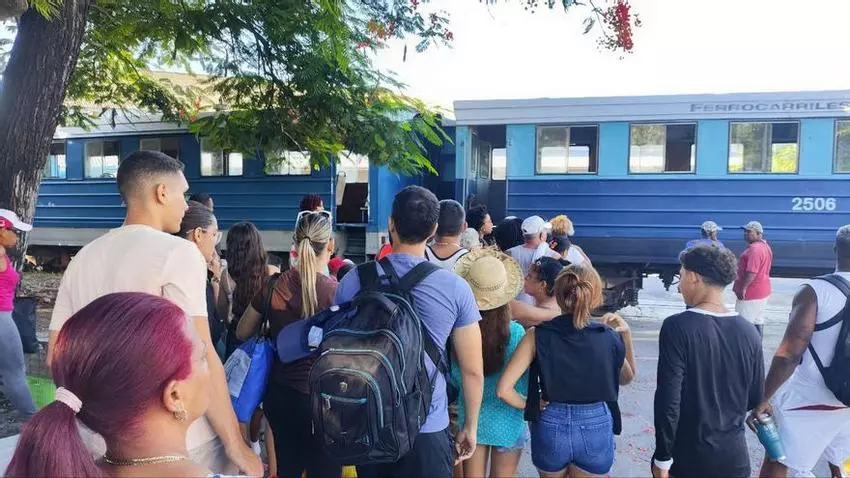
The rickety train arrives when there are just a few minutes left before the appointed time / 14ymedio

14ymedio bigger14ymedio, Juan Diego Rodríguez, Havana, 4 August 2024 — At 1:20 in the afternoon, Arlena was putting her bag on a lounge chair on the beach at Santa María, west of Guanabo. “I’m already in place”, she exclaimed with relief, not knowing that she would still have to wait for the moment she had been looking forward to since 8:40, since she arrived at the Havana train station. It was a private beach where only hotel guests could stay. They set off again.

The Cuban authorities announced at the beginning of July the restoration of the service of this train that leads, for a modest 35 pesos price, to the beaches of the East of Havana during an unforgettable trip of an hour and a half for the scant 25 kilometers that separate the two locations.

Arlena and Carolina decided to spend their first day of vacation on the sea shore this Wednesday, although to do so they had to take a train that, from around the station between Egido and Arsenal, promised to be what it is: a trip suitable only for the most common classes. About 50 people were hanging around the platform, where the smartest ones were trying to do business, as always.

About 50 people were hanging around the platform, where the smartest people were trying to do business, as always / 14ymedio

When the two women arrived at the platform, after a long walk from Luyanó, without a taxi in sight, there was already a cake seller on a bicycle selling the cakes for 70 pesos a piece, and an inflationary peanut vendor, who had gone from charging one peso for a cone to 10. There was also a coffee stand to bravely face the morning, and cigarettes for 400 pesos, although a worker from the Railway Union was giving a warning before the continue reading

Beast arrived: drinking alcohol or smoking is strictly prohibited, under penalty of a fine of 2,000 to 5,000 pesos.

The rickety train arrived just a few minutes before the appointed time. Families with children heading to the beach and passengers heading to Guanabo, as a less recreational destination, are milling around, leaving behind the kilos of garbage that pile up next to the station.

About 50 people were hanging around the platform, where the most astute were trying to do business, as always / 14ymedio

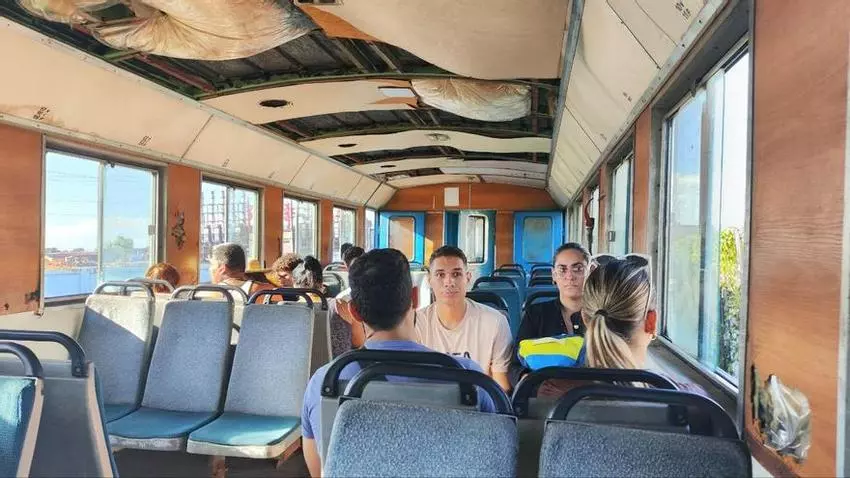
The interior view is not that more encouraging. Looking down, you see torn seats; looking up, you see torn-off roofs in all the carriages. The hard plastic seats are uncomfortable for Carolina, who has been suffering from pain in one leg for weeks, so the two of them change carriages, and settle on the third, which has more comfortable seats. Soon after, they will no longer be able to choose.

After a stop in Guanabacoa and another in Cambute, the train is more than full and the passengers resign themselves to standing among the incessant clatter and noise that serve as a holiday soundtrack.

The cost of the ticket is 35 pesos to the beaches of eastern Havana on a trip of one and a half hours / 14ymedio

“This is going to end up like the trains in India, with people on the roof,” jokes one passenger. Although there are two policemen in the third carriage, discipline is set aside and several people smoke openly, while out the window all you can see is grass everywhere, fields of sweet potatoes and some isolated wooden huts. As Guanabo approaches, a “rare bird” is spotted: cattle.

It’s after 10:40 and the hardest part of the journey is finally over. Or so Arlene and Carolina think, as they walk through the town of Guanabo towards the west, towards the beaches.

When the beach comes into view, businesses multiply, with their escalating prices in sight / 14ymedio

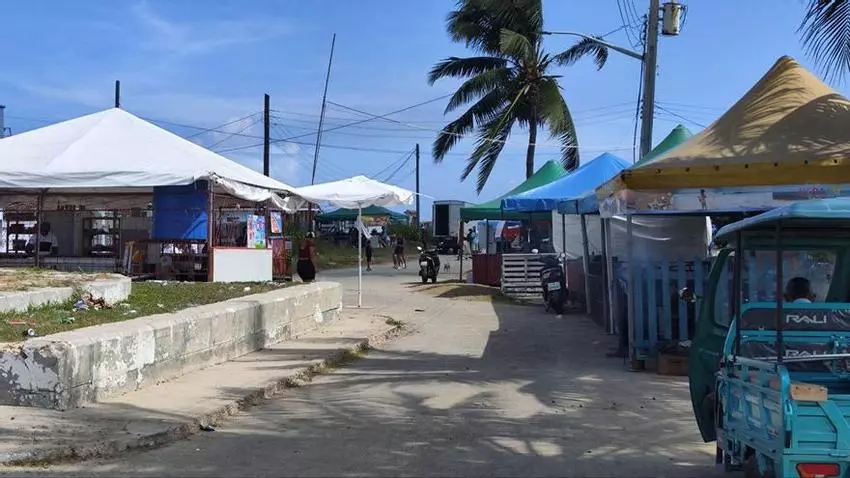
When the beach comes into view, businesses multiply, with their escalating prices in sight. Mamoncillos (Spanish limes) at 100 pesos, pizzas at 170, beer and malt at 200… but the kilometers take their toll on the couple, who are looking for a beach without trash to settle down on, so they end up renting a horse-drawn carriage to smooth out the distance.

600 pesos later, when everything seemed to be going better, there was still one more problem to overcome when the horse-drawn carriage breaks down. “It’s 12 o’clock and I still haven’t placed my butt on the beach,” she laments.  An hour later, they barely reached the promised beach.

The miles are taking their toll on the couple, who are looking to settle down on a beach without trash / 14ymedio

Carolina and Arlena sit on a lounge chair in front of Santa María Beach hours after leaving Havana, but their joy doesn’t last a minute, because they are in the private area and only hotel guests have access to those amenities, just like the water bikes and all the good things they see, so it’s time to pack up again and start walking.

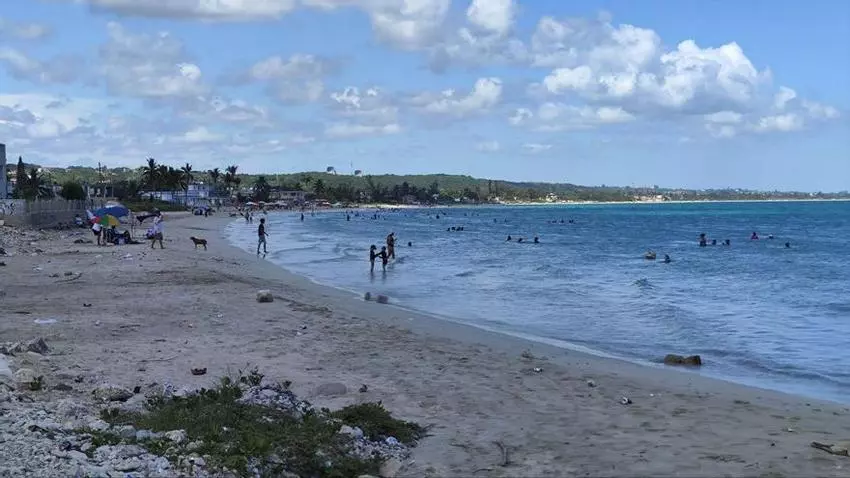
At almost 1:30 in the afternoon, our central characters finally get their precious sun loungers in front of the Hotel Atlántico, and a menu with meals for 3,000 pesos. Two pizzas and a few beers make the long day easier. A line separates the shiny beds of the hotel guests from Carolina and Arlena’s rickety ones, who, at around 2 in the afternoon, finally take their first dip.

A line separates the shiny beds of the hotel guests from Carolina and Arlena’s rickety ones.  At around 2 in the afternoon, they finally take their first dip / 14ymedio

Before 3 o’clock, they are already packing their things for the trip back to Havana. “Are you going to take the train back?” asks a neighbor lying on a sun lounger. “No way!” Carolina is indignant. And they walk away until they catch an improvised taxi that takes them to Santos Suárez.

Translated by Norma Whiting

____________

COLLABORATE WITH OUR WORKThe 14ymedio team is committed to practicing serious journalism that reflects Cuba’s reality in all its depth. Thank you for joining us on this long journey. We invite you to continue supporting us by becoming a member of 14ymedio now. Together we can continue transforming journalism in Cuba.

Canada Publishes an Alert About Dengue Fever in Cuba, ‘Which Can Be Deadly’

The main tourist market on the Island registers a slight drop this year after two previous warnings

Tourists on Obispo Street, in Old Havana (14ymedio)

14ymedio bigger14ymedio, Havana, 1 September 2024 — For the third time in less than a year, the Government of Canada has published a warning, now about the increase in dengue fever, targeting its nationals traveling to Cuba.

The two previous alerts – about the increase in violence and the shortage of basic necessities – had little effect on the arrival of Canadian tourists. Although there was a slight reduction compared to 2023, Canada remains the leading supplier of tourists to Cuba, accounting for 42% of the 1,463,097 travelers who entered the Island in the first half of this year.

In the statement, published on August 26, the authorities explained that “dengue fever is a risk for travelers” and, in some cases, leads to a serious state in the patient, “which can be fatal.” This third alert could have a more powerful deterrent effect than the previous ones and further harm the tourism sector, which has not recovered from the disaster caused by the Covid-19 pandemic. The Canadian government failed to include the Oropouche virus in its risk assessment.

The authorities state that “dengue is a risk for travelers” and, in some cases, leads to a serious state in the patient, “which can be fatal”

The official Cuban figures up to August indicated more than 400 infected with Oropouche in the country. The authorities then recognized that the virus had ceased to “present itself exclusively in rural areas” and mainly affected the population of the cities, “causing a significant increase in the number of cases.” However, according to unofficial data, thousands of patients do not declare their illness, and 14ymedio verified that in Santiago de Cuba alone, where the first cases were reported, dozens of people suffered from the virus. continue reading

Both dengue and Oropouche have been increasing in the number of infections in the country. The reason, in addition to the hot summer and the increase in the presence of mosquitoes and jejenes (gnats), is that there are plenty of foci of contagion in the cities, in particular the mountains of garbage.

It was the US government that gave the alert about the presence of Oropouche in Cuba, and last month it identified 21 people affected on their return from the Island, three of whom had to be hospitalized.

These 21 cases were counted as of August 16, and in most of them those diagnosed showed symptoms between the months of May and July, without any deaths being recorded, the US Center for Disease Control and Prevention reported.

Both dengue and Oropouche have been increasing in the number of infections in the country

Cuba, as a tourist destination, has been on red alert since last October after Ottawa’s warnings, when it advised caution in traveling to the island due to the “scarcity of basic necessities, including food, medicines and fuel.”

In May, the Canadian government stressed the increase in violence, assaults and financial scams, including credit card fraud and the risks associated with ATMs which frequently run out of cash.

Canadian authorities also reported that the Cuban health care infrastructure is critically deficient, with a marked lack of medicines, supplies and equipment, aggravated by insufficient hygiene practices and slow responses to emergencies.

Translated by Regina Anavy

____________

COLLABORATE WITH OUR WORKThe 14ymedio team is committed to practicing serious journalism that reflects Cuba’s reality in all its depth. Thank you for joining us on this long journey. We invite you to continue supporting us by becoming a member of 14ymedio now. Together we can continue transforming journalism in Cuba.

The Putrefaction of Castroism

Poverty is everywhere, along with fanatical sectarianism, from which sexual preferences does not escape

Photo of Rodríguez Street in Havana /14ymedio

14ymedio bigger14ymedio, Pedro Corzo, Miami, 1 September 2024 — Castro’s totalitarianism is immersed in a process of self-demolition regardless of acts against its opponents. The social crisis is very profound, consistent with the ocean of lies and myths on which he built his abusive fiction.

The population’s knowledge of the reality weakens social control and increases the lack of trust in the authorities. People are realizing that they have been deceived and manipulated, which does not satisfy anyone.

For decades, the vast majority of Cubans have suffered political repression; more than half a million citizens have passed through prison with sentences of between one day and 30 years. Thousands of people have been executed by firing squad.

The misery has kept its distance only from the elites. Poverty is everywhere, with the addition of a fanatical sectarianism, from which sexual preferences did not escape.

People are realizing that they have been deceived and manipulated, a reality that does not satisfy anyone

However, the regime, through surveillance and repression, hid everything that could damage the image of peace and tranquility that it sought to present to both Cubans and foreigners, including the social problems.

They did it so well that a popular song in which “Lola” was murdered at three in the afternoon, an atrocious femicide I would say today, disappeared from the radio waves, as did the red chronicles of the press media. continue reading

It was shocking: the media stopped reporting on weddings, baptisms and parties, in addition to murders and street fights, as if the endangered social class was responsible for the mess. Even more, rumors — “las bolas” [the balls] as we called them — were extinguished because they were misinformation, and with that accusation you could end up in prison.

Unfortunately, there was no lack of subjects who believed the stories, since they collaborated in the gestation and development of a complicit silence that hid political abuses and social injustices.

The Castros, by decree, made the public believe that in their paradise there was no domestic violence, no robberies and, even less so, murders, except those that the rulers themselves committed by executing thousands of their citizens for conspiring against them.

Even more, rumors, “las bolas” [the balls] as we called them, were extinguished because they were disinformation, and with that accusation you could end up in prison

It is true that violence in any of its expressions is present in every society. However, in Cuba, as part of the great farce that has been the totalitarian dictatorship, only the most immediate neighbors of the tragedy know the facts.

However, the exaggerated control that the totalitarian system imposed on everything related to information during the last 65 years is breaking at the political and social level, a result that will undoubtedly negatively affect its survival.

The Castro slogan of “Homeland or Death,” as the writer Jose Antonio Albertini points out, was useful for the narrative of a threatened homeland, but the supporters of totalitarianism realize that they no longer have a homeland and that only the dead and the prisoners remain.

The breaking of silence is not the will of the autocrats, but thanks to a new generation of journalists, very different from many of their peers in the early days of totalitarianism, who were silent out of fear or simply believed in the proposals of the false redeemer, the silence has been broken.

It is important and fair to recognize the risks run by those who strive to report from behind the walls of Castroism. They have chosen a difficult path, full of danger, in which the only sure compensation is jail and the satisfaction of fulfilling a duty.

It is an indisputable truth that social tension throughout the country is increasing

If political censorship was effective, social censorship has been even more so. I remember that the press, from time to time, reported a shooting or the capture of a group opposed to the dictatorship. On the other hand, it never reported a murder.

It is an indisputable truth that social tension throughout the country is increasing. Disagreements between neighbors sometimes can end in murder, and, as if that were not enough, social insecurity and a lack of police protection have encouraged robberies with homicides, as happened recently in the town of Ceballos, in Ciego de Ávila.

Social disintegration in Cuba affects everybody and is the sole responsibility of present and past authorities. The Island is an erupting volcano, and, hopefully, the explosion will be political and not social.

Translated by Regina Anavy

____________

COLLABORATE WITH OUR WORKThe 14ymedio team is committed to practicing serious journalism that reflects Cuba’s reality in all its depth. Thank you for joining us on this long journey. We invite you to continue supporting us by becoming a member of 14ymedio now. Together we can continue transforming journalism in Cuba.

Spain Invites Cuban Players To Join Its Team in the Baseball Classic

The Federation of Professional Baseball Players of Cuba launched a call for Cubans who want to play in the World Classic with Spain / Fepcub

14ymedio bigger14ymedio/Swing Completo, Havana, 1 September 2024 — Spain, looking for a ticket to the 2026 Baseball Classic, opened the doors to Cuban players who wish to join its team. The invitation was released this Saturday through the Federation of Professional Baseball Players of Cuba (Fepcube) and “is open to any eligible athlete,” says the Instagram post.

Cubans with the opportunity to play for Spain will be those who meet any of these requirements: “have a Spanish passport, have a Spanish father or mother, be born in Spain or permanently resident in the European country.”

They must also fill out the corresponding application before September 16, the day on which Spain will present a list of 50 athletes, from which it will define the national team that will compete for one of the four tickets available to participate in the Baseball Classic, which will be played simultaneously in the United States, Japan and Puerto Rico. Cuba is located in group A, along with Puerto Rico, Canada, Panama and one more rival to be defined.

The Spanish national team has played two qualifying phases, the first in 2012, which gave it access to the 2013 World Classic, and later in 2016, where it was eliminated. continue reading

The Cuban team that won a children’s tournament in the Dominican Republic / Jit

The promotion of Fepcube generated controversy among users on social networks, who questioned the organization for moving away from its initial objective, which is the formation of a team of exiles and not to contribute to the selection of another country. The organization has not offered a position on this point.

It is not the first time that Spain has incorporated Cuban players into a national team. The current European champion team was formed in 2023 with athletes from the Island. The payroll included pitcher Pablo Guillén and catcher Omar Hernández, who ended up being the event’s leader in home runs and scored runs. Also on the team were pitchers Rogelio Armenteros and Carlos Sierra, fielder Frank Hernández and bench coach Néstor Pérez.

Meanwhile, on the Island, the official media Jit highlighted the triumph of the U-12 children’s team in the tournament that took place at the stadium of the Juan Pablo Duarte Olympic Center in the Dominican Republic, according to Play-Off Magazine.

In the final game, Cuba defeated Venezuela 9-2 and was proclaimed the tournament champion. The official journalist, Boris Luis Cabrera, specified that Asnel Torres and Alfredo Despaigne were recognized with the award for the Most Valuable Player in the final.

The tournament served as preparation for the Cuban team, which on October 19 will take part in the Pan American Championship played in Panama. In this event, three tickets will be at stake for the World Cup in 2025, which will also be based in Panama.

Translated by Regina Anavy

____________

COLLABORATE WITH OUR WORKThe 14ymedio team is committed to practicing serious journalism that reflects Cuba’s reality in all its depth. Thank you for joining us on this long journey. We invite you to continue supporting us by becoming a member of 14ymedio now. Together we can continue transforming journalism in Cuba.

Mexico Receives Cuban Minister of Health and a New Group of 200 Doctors From the Island

1,550 of the 5,000 doctors hired by the López Obrador government have already arrived.

A group of Cuban doctors in the state of Tlaxcala (Mexico) / Cuban Embassy in Mexico

14ymedio bigger14ymedio, Mexico City, 23 August 2024 — the arrival, on Wednesday, of some 200 Cuban doctors at Felipe Angeles International Airport (AIFA), there are now almost 600 specialists from the island sent to Mexico in just 20 days. Two similar groups of 200 and 199, respectively, landed on August 2nd and 8th.

The doctors are met at the air terminal by diplomatic personnel and agents of the National Migration Institute. Afterwards, they are transported in official vehicles to Mexico City, from where they depart to other parts of the country.

According to the agreements signed between the two countries, the Cubans have been hired by the Andrés Manuel López Obrador Administration to fill positions in rural hospitals. These groups that arrived in August will join the 950 doctors that have arrived in the country since 2022, a figure that Mexico expects will reach 5,000, following the extension of the bilateral collaboration agreement, announced at the end of July. continue reading

None of the Mexican authorities made a statement on the matter or officially announced their meeting with the Cuban envoy.

The arrival of the specialists coincided with the Cuban Minister of Public Health, José Angel Portal Miranda’s visit to Mexico. The official met with his Mexican counterpart, Jorge Alcocer, and although a statement issued by the Cuban ministry reported the meeting, aimed at “strengthening collaboration in health matters”, the Mexican media have not reported the trip.

Alcocer is the highest-ranking official to receive Portal Miranda, albeit in a discreet way, a month before President López Obrador hands over power to Claudia Sheinbaum. He was also received at the Mexican Social Security Institute (IMSS) by Alejandro Calderón Alipi, general director of Health Services of IMSS-Bienestar, which is the institution taking in all the Cuban doctors sent to Mexico from 2022.

None of the Mexican authorities made any statement on the matter or officially announced their meeting with the island’s envoy. On the other hand, the Ministry of Public Health assures in its statement that in the meeting with Alcocer, they evaluated the progress of the collaboration in health matters, “which in the last period of work has been strengthened, consolidated and increased, reaching not only the health care area but also the teaching and regulatory field”.

Portal Miranda’s stay has gone by without raising much attention in the Mexican media.

In the same statement, they brag about the actions they have carried out “jointly”, without mentioning any of them, and assure that “the results that have been achieved” are proof of the will to continue working to “promote cooperation in health in different areas”, in spite of “obstacles and limitations”, which they did not provide in detail either.

Cuba’s ambassador to Mexico, Marcos Rodriguez, also alluded in a tweet to talks on the “cooperation of medical specialists” and the “production of medications and shared interests”.

In other activities, Portal Miranda participated in the XI Pan American Conference for the Harmonization of Pharmaceutical Regulation (CPARF), where he ratified Cuba’s “willingness” to “put at the service of the Pan American Health Organization and all the countries of the region, its technical capabilities and experience in the production of medications, biotechnological products and vaccines”.

In his speech, from the central building of the Mexican Foreign Ministry, which served as the venue for the meeting, Portal Miranda said that on the island “in the face of external limitations”, they have learned that the most secure resources they can have are those they are capable of producing on their own.

These claims about the self-sufficiency of medications conflict with the shortage of basic medications on the island, which has already reached a deficit of up to 70%, according to the regime’s own acknowledgement last July.

Even so, his words were reflected in the official press, such as Cubadebate, which on Wednesday stressed that the region must “move out of the technical field and reach public policies that promote regional cooperation and support the right to health for all”.

Statements on the self-sufficiency of medications conflict with the shortage of basic medicines on the Island.

What is a fact is that the rapprochement with the Island shown by the López Obrador Administration, which has included oil deliveries, especially with the crisis unleashed after the elections in Venezuela, will continue with his successor.

Translated by LAR

____________

COLLABORATE WITH OUR WORKThe 14ymedio team is committed to practicing serious journalism that reflects Cuba’s reality in all its depth. Thank you for joining us on this long journey. We invite you to continue supporting us by becoming a member of 14ymedio now. Together we can continue transforming journalism in Cuba.