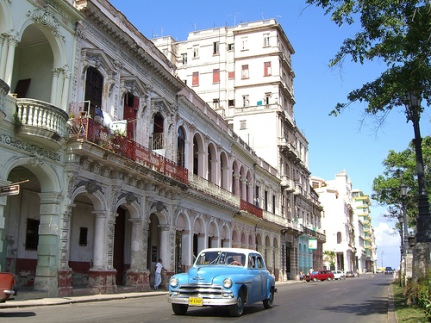
Are There Guarantees in Cuba for Marambio? / Laritza Diversent

Another issue is to certify that the proprietor of the International Network Group(ING) will have his guarantees respected. One of the managers of “Alimentos Rio Zaza,” the private company formed between the Cuban Government and Marambio was the 59-year-old Chilean Roberto Baudrand. He was under house arrest in Cuba and endured strenuous interrogation sessions. In April, he was found dead at his apartment.

The Cuban autopsy, accepted by the family of the deceased, certified that the cause of death was due to respiratory failure combined with the consumption of drugs and alcohol. There is still doubt if the death was due to accidental death or to suicide.

With respect to whether the criminal process against Marambio will take place in part in Chile, I have my doubts. The questionnaire with 21 questions presented to the businessman by the Cuban authorities, is a different process. In this case, his answers are that of a witness.

In the investigation other directors of his companies in Cuba are implicated, accused of paying bribes, embezzling funds and diverting resources outside the country. Marambio was linked to the corruption scandal that involved the director of Institute of Civil Aeronautics of Cuba (IACC) and Major General Rogelio Acevedo. Lucy Leal, director of ING, was arrested and is being investigated.

Cuban procedural law provides that when the witness resides outside the national territory treaties between the two countries, if any, will be observed. If there are no treaties, formal letters through diplomatic channels will be sent, according to international practices.

The proceedings, the summons and the indictment, officially published by the Cuban authorities, are formal procedures, not administrative ones as believed by the lawyers for the Chilean businessman.

September 7, 2010

Marambio: Accused or Witness / Laritza Diversent

The subpoena and indictment prepared by the Ministry of the Interior (MININT) against the 63-year-old Chilean businessman, Max Marambio, has raised innumerable questions. The first of these is what would happen if the close friend of the eldest of the Castros decided to return to the island.

The chances that the authorities would put him in jail, as a preventive measure, are high. The criminal proceeding against him is in its preparatory phase, when the investigation occurs, the legal facts are described, and so on.

They also want to assure that the defendants show up for the day of the trail. Given that “The Fat Man,” as Marambio is known in Cuba, lives outside the country, provisional detention would be the most effective assurance.

Another question is whether Marambio’s attorneys can travel to Cuba and represent him in the investigation being carried out against him. In order to be named as a defense attorney, under the Cuban system, the individual must be part of the process.

This would start when the person is the object of a preventive measure (pre-trial detention, bail, etc.). It means that you must first appear before the instructor (similar to a district attorney) as required and testify regarding the facts alleged against you. After this your attorney is appointed.

The Chilean courts returned the warrant to Cuba, citing errors that prevented their compliance with it. For example, the lack of clarity regarding Marambio’s situation, and whether he is a witness or a defendant.

The note published by MININT in the Official Gazette of the Republic of Cuba, however, expressly lists Max Marambio as the “accused” for the crimes of Bribery, Acts Detrimental to Economic Activity, or of Procurement, Embezzlement, and Falsification of Bank and Trade Documents, and Fraud.

There is no doubt, the businessman is called as a defendant. It’s worth mentioning that Cuban law does not provide for the presence of a lawyer during questioning, nor in the obligation to instruct him in his rights. For example, there is no duty to declare the charges against him, which can be done at any time or as many times as desired.

September 6, 2010

Justice Minister Names Legal Representatives / Laritza Diversent

The Justice Minister Maria Esther Reus González, issued Aug. 6, Resolution No. 215, which names two counselors at the Ministry of Justice (MINJUS), Dr. Diego Fernández Cañizares Abeledo and Attorney Nelia Caridad Aguado López, experts from the ministry, to act without prejudice to its final completion, in the administrative proceeding brought against her, before Second Civil and Administrative Board of the Provincial Peoples Court of the City of Havana by independent jurists.
Attorney Wilfredo Vallín Almeida, president of the Cuban Law Association, a union of dissident lawyers, asked the MINJUS Register of Associations on April 7, 2009, on behalf of his organization, for a certification which the state agency never issued. Reus Gonzales, designated by the Council of State in March 2007, is empowered to direct the operation of the National Registry of Associations, and to guide and monitor government policy on partnerships and foundations.

Counsel Almeida Vallín filed a complaint with the People’s Provincial Tribunal of the City of Havana, regarding its administrative silence before the Appeal submitted to the Minister, which still has not been responded to in accordance with the provision of Law No.54 “The Associations Act.” Last 28 July, the head of MINJUS received a summons from the tribunal requiring her to name legal representatives.

September 9, 2010

The Times of the Cuban Model / Claudia Cadelo

The Cuban model doesn’t even work for us anymore.

The Cuban model was not working for us even when I thought of it.
When the socialist block collapsed the model didn’t work, not even for us.
After much reflection, the Cuban model will no longer be working.
The Cuban model hasn’t worked, not even for Chavez.
Before me, the Cuban model had worked.
What I created as the Cuban model, failed.
The Cuban model will not work for us, not even when Raul makes changes.
It is possible that the Cuban model would not work, not even for us.
That the Cuban model has not worked doesn’t affect my visits to the aquarium.
If the Cuban model worked for us, I wouldn’t have created it.
If the Cuban model would have worked for us, I would have retracted just the same.
The Cuban model would never work.
The Cuban model would have worked in another dimension.
He who has published in Granma that the Cuban model doesn’t work, will be shot.
Work! Cuban model!

Image: Guama

Text from the cartoon:
– HAHAHA… It’s not working!
– Don’t misinterpret.

September 10, 2010

Personal Glasnost / Regina Coyula

I appreciate the support of the commentators. I am not going to stop writing, nor have I thought of moderating the comments, though I appeal, yes, to the good judgment of those who write for more than catharsis.

Several of my readers have asked me.

When I was sixteen I started at MININT (The Ministry of the Interior). I was proud to have been selected. My family, which was completely “integrated” — that is supporters of the Revolution — received the news with great joy. MININT was seen by the revolutionaries as the organism destined to protect the Revolution from danger. Under its rules of compartmentalization — or “need to know” — I worked from 1973 to 1983 in the department of Technical Operations, and from then until 1987 I was an official operative, where I worked in the areas of culture. And until I discharged myself in 1990, I was in “Assurances.”

That was my history there. Like great romances, it was beautiful while it lasted.

September 10, 2010

Philosophy of Hate / Fernando Dámaso

  1. A philosophy of hate has spread across the world like a pandemic which seems to cover everything, calling into question whether humans are thinking beings of superior intelligence. Love has been pushed to the side and must struggle fiercely to show itself, in public as well as private social relations. Intolerance and violent confrontation reign in modern life.
  2. The background of hate has different handholds, from the settling of scores for the discovery and colonization of the New World, to the Crusades to the Holy Land to spread Christianity. Without a doubt there were excesses and faults, but to go hundreds of years later clamoring for revenge is altogether absurd.
  3. The history of mankind and, within it, the formation of the nations, has known intense periods of violence where some ethnic groups and peoples imposed on others, fundamentally due to their greater level of development. Entire civilizations have appeared and disappeared this way, up through our times. Demands for material and moral compensation for events in the long course traveled since the Big Bang are, aside from irrational, also impossible to satisfy. It would be a never-ending story, and nobody could be left out of it, because the responsibility is shared.
  4. It is true that Spain colonized the Americas, but before that the Moors had colonized almost all of Spain. It is true that Europe colonized Asia and Africa, but before that the Ottoman Turks and the Huns, to cite just two examples, invaded Europe, the latter led by Attila even reaching the gates of Rome. It is true, getting back to America, that Spain subjugated the Aztecs and the Incas, but before that these same had subjugated all the surrounding peoples, turning them into vassals or slaves as they built their empires. We see that the culprits are those who prevail.
  5. To set out today, on the basis of these distant events, to fuel passions and hatred and call for political or religious crusades only serves to demonstrate, as Albert Einstein put it, “Two things are infinite: the universe and human stupidity”.

Translated by: Mark B.

Things Have A Soul / Rebeca Monzo

To my granddaughter Isabel.

This was the title of an old Cuban radio show. When I was a child, my grandmother was a fervent listener of that same show, and as I was always at her side, I gave in and also listened to it. That’s why I choose this title for today’s post.

In the year 1968 I was a diplomat in Paris, not as a career, but always in a rush, as had already been happening on my planet for some half a century. Out of the blue one day I was invited to the Elysee Palace, to the French National Festival. As is understandable, such a unique opportunity excited me, but also worried me greatly. We Cubans were, in comparison with the rest of the diplomatic corps, a little more down at the heels.

I had then, to go and visit the most elegant shops of the ‘City of Light’ to choose a dress that would be fitting to the occasion. I chose one from Frank and Fils, one of the most elegant of the time. It’s clear I couldn’t buy it, so after choosing it I kept it in mind and with the greatest of discretion I came away from the window and sketched it out, went back to it to make out the details, until finally my sketch was complete. Then came the best bit. Setting of on a safari trip, from shop to shop, to try to track down a material that would bear the most possible resemblance to the original. Then, buy a good pattern and all hands on deck!

The dress, with the help of a Spanish friend who was very good with her hands, looked beautiful on me. I cut it and sewed it and my friend, with a few impeccably invisible stitches, put in the zipper by hand. It looked pretty but, accessories? The most important was the footwear!

I directed myself to a specialist shop, F. Pinet and I bought myself some Italian shoes by Magli Studio of golden, matte leather, that even today I keep in a perfect state. My then husband loved them when he saw them, but when I told him what they’d cost me, he hit the roof. ‘Don’t grumble,’ I defended myself, telling him ‘If I had gone as far as buying the dress in the shop — and I wouldn’t do that — it would have worked out to be twice as expensive.’

My shoes, whose soles gracefully traveled the red carpet of the Elysee, were those that kept me standing comfortably, the 14th of July 1968, when I shook the hand of General De Gaulle, President of France.

Those shoes have accompanied me in the most important social occasions, of my old life and I still keep them in a perfect state of health and believe me, I’ve never decided to get rid of them, because they’re still good for me or perhaps they’d get a friend out of a tight spot. I learned from a young age, that things have souls.

Translated by: Jessica Burton

September 4, 2010

Lives Condemed Due to Medical Malpractice / Miguel Iturría Savón

Yadima Évora Casales is a 25-year-old Cuban mother from Vista Hermosa in San Miguel del Padron, Havana. She believes she is a victim of deceit and manipulation at the hands of officials from the institutions that “respond” to the interest of the country’s citizens.
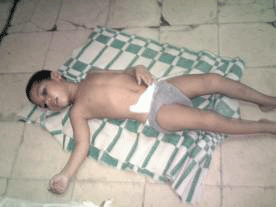
Her tragedy began five years ago when she became pregnant. Since she was healthy no one worried about difficulties in labor. The doctors who examined her did not realize that her uterus–high, narrow and backward–would prevent a natural birth and necessitate a Cesarean.

Since no Cesarean was prescribed consequences were awful for herself and the baby, who suffers from severe hypoxic ischemic encephalopathy which causes spastic quadriplegia (a form of cerebral palsy), according to documents given to Joel L. Carbonell Guilar, leader of the Organization of Human Rights of Free Cubans who recently reported the case to international organizations in the face of the apathy of officials from the Clinic of San Miguel de Padron.

In December 2006, Yadima went to the Hijas de Galicia Hospital with contractions, however, since her due date was January 19th the gynecologists sent her home. She went back on January 23rd with new contractions, she was again sent home because of a lack of beds. Upon leaving the hospital, a family friend who is also a doctor recommended that she return on the 26th, he would attend her during his shift. She returned that day to the maternity ward; five days later she was recognized and monitored by doctors but none of them realized she was past her due date. On the 30th her water broke in front of the attending doctor who recommended she sleep because she was not dilated.

Yadima did not dilate. She cried and the baby struggled to be born. The next morning another gynecologist put her on the monitor and the machines began to make noise. The baby’s heart was failing. The doctors decided to perform an emergency Cesarean. Her baby was alive and cyanotic (his skin was blue due to lack of oxygen). Three weeks later they returned home where Yadima discovered that the child could not hold up his head. “He’ll do it later” the specialists told her at her first appointment.

Four years later her baby requires special care to hold up his head, he does not walk, does not chew or have control of his sphincter and suffers from spasms in his hands and feet. He requires physical therapy and medications that are not accessible to Yadima and her family. Solutions are not available at the local clinics or the Julito Dias and Pedro Borras because the specialists and technicians are being sent on medical missions to other countries.

The tragedy of Yadima and her child, Ernesto Arias Evora, is worse because of their living conditions. They live with 11 family members in a small run down house with dirt floors and cement roof. She requested aid from government organizations such as the Administrative Council and the Housing and Health Directorate. After interviews and visits from officials and social workers who “elevated the case”, she wrote the State Council.

Yadima Evora Casales cannot work and waits for aide. She and her child were victims of medical negligence and are being bounced around by officials that have led her to believe they have solved her problem with a check for 158 pesos a month–the equivalent of 6 cuc, not enough for food and medicine.

This mother asks the government agencies for a wheelchair with head support, a blender to make meals for the child, diapers, a bed and medicine. She dreams of a room with ventilation, a bathroom and a kitchen to ease the plight of her child. She is still waiting.

She was told by Joel L. Carbonell that she must combine her plea with the demand, since article 26 of the Cuban Constitution allows for “reparation and compensation” for damages caused by State agents and officials. She also learned about the rules for the protection of children and youth and the obligations assumed by the island’s government when they agreed to the terms of the Instruments for Human Rights and the Conventions of Children’s’ rights.

Translated by: Lita Q.

September 8, 2010

Broken Promise / Yoani Sánchez

The Revolution Is Working Well. Fight, Work, Advance. Continue Onward! Fidel

I swore never again to speak of that gentleman with the well-trimmed beard and the olive-green uniform who castrated* filled every day of my childhood with his constant presence. I underpin my decision not to refer to Fidel Castro with more than one argument: he represents the past; we need to look forward, to that Cuba where he no longer exists; and in the midst of the challenges of the present, to allude to him seems an unpardonable distraction. But today he once more gatecrashed my life with one of his characteristic outbursts. I feel obliged to focus on him again after his declaration to the journalist Jeffry Goldberg that, “the Cuban model doesn’t even work for us anymore.”

If my memory doesn’t fail me, they expelled many Communist Party members for lesser or similar phrases, and purged innumerable Cubans who served long sentences. The Maximum Leader systematically pointed his finger at those who tried to explain that the country wasn’t working. And not only were the nonconformists punished, but we were all forced to don the mask of subterfuge to survive on an island he tried to remake in his own image. Pretense, whispers, deceit, all to hide the same opinion that the “resuscitated” commander now flippantly tosses out to foreign journalist.

Perhaps it is a fit of honesty, as assaults the elderly when it comes time to assess their lives. It could even be another desperate try for attention, like his prediction of an imminent nuclear debacle or his late mea culpa for the repression of homosexuals which he came out with a few weeks ago. To see him acknowledge the failure of “his” political model, makes me feel like I’m watching a scene where an actor gesticulates and raises his voice so that the public won’t look away. But as long as Fidel Castro doesn’t take the microphone and announce to us that his obsolete creature will be dismantled, nothing has happened. If he doesn’t repeat the phrase here in Cuba, and, in addition, agree not to interfere in the necessary changes, we’re back to square one.

Note:
Yesterday, on hearing the news, I wrote a brief tweet: “Fidel Castro joins the opposition, telling the journalist Jeffrey Goldberg that the Cuban model doesn’t even work for us anymore.” Shortly after a dissident friend to whom I’d sent the same message by text called me. His words were ironic, but true: “If He has joined the opposition, I’m moving over now to the official side.”

*Translator’s note: The original text was dictated over the phone and there was an error in the transcription, hence this correction.

September 9, 2010

A New Feature: Photos From Boring Home Utopics / Orlando Luis Pardo Lazo

Note from the site manager:

The link at the top of the sidebar that says “Cuba in Photos” takes you to the blog “Boring Home Utopics” where Orlando Luis Pardo Lazo — to my mind probably the best photographer working in Cuba today — posts his daily creations.  Another element of the BHU blog is a standing offer to Cubans in exile to take photos of the places that figure strongly in their memories of home, and post them, which has led to some very moving entries. Starting today, in a completely random fashion based on my own taste, suggestions from Orlando, and available time to post them, I intend to start posting periodic samples of BHU’s daily photos.  To see the rest, all you have to do is click on the link.


Photos: Orlando Luis Pardo Lazo
Posted: September 9, 2010

20 Reasons to Doubt / Ernesto Morales Licea

My generation grew up listening to the litany. It wasn’t the only one. It was barely a new one. But I can attest to that: along with a motto I never understood “Pioneers for Communism, we shall be like Ché!”, my legs and my conscious grew up hearing that the country my grandparents had, without a Revolution, was far worse.

The country from the past they assembled in my childish brain never had color. Or better yet, it did: the color of blood. It was a barbarian country, with murderers as rulers and children bruised by pain.

It also had a lot of gray. The images from the past are always gray. Especially, if they were previously passed by an editing cubicle.

On the Island prior to 1959 Cubans did not know happiness. They did not heal illnesses; they did not know orgasms, or sunsets, or chocolate ice cream. They never danced deliriously, nor did they raise world trophies or academic titles.

If Cuban culture is a heritage of the revolution; if sports were never a people’s right; if doctors didn’t heal; if nightlife was nothing but crimes and punishments; if the only Cuban History that exists is the one that tells its wars and its hardships, my country owes its essence and reason for being to a process initiated on January, 1959.

That’s how I was taught. I, the diligent pioneer of Communism aspiring to be like Ché, learned it that way.

But somehow I also learned, by intuition or negligence, to suspect that imperfect past. A handful of books started to do its subversive work inside of me. The flyby information I retained as an antidote against a history that, just like the old saying goes, seemed very badly told.

Just like that, by chance or by destiny, I discovered that the past of my Island had a lot of blood and corruption. But it also had an undeniable splendor.

For example, I learned, that:

  1. The first Latin American nation and third in the world, after England and U.S.A, that had the miracle of the railroads was Cuba, in 1837.
  2. Furthermore, the first trolley that toured the streets of Latin America was in Havana, in 1900.
  3. In 1958, Cuba was the Latin American country with the highest automobile ownership rate. 160 thousand cars circled our streets, one for every 38 people.
  4. The first Latin American doctor to use ether as an anesthetic was the surgeon Vicente Antonio de Castro, on March 11, 1847. With that method he started the era of modern anesthesia for all of Latin America, right from this Caribbean Island.
  5. In the XIX century, the genius Carlos J. Finlay discovered the transmitting agent of yellow fever which decimated populations and instructed prevention and treatment. Had the Nobel Prize existed, this Cuban would’ve won it by far.
  6. In 1955, Cuba was the second country in Latin America where the fewest children died at birth. The rate was 33.4 for every one thousand newborns. For the resources at that period in time, it was a real feat.
  7. The U.N. recognized Cuba as the best country of Latin America in regards to the number of doctors per capita in 1957. We had one for every 957 people, a figure applauded by many developed nations at the time.
  8. In 1942, a Cuban became the first Latin American musical director to receive a nomination for an Oscar. His name: Ernesto Lecuona. Along with Kim Gannon, he was nominated for the statuette for his song “Always in my heart”, before any other Spanish-speaking musician.
  9. The first Latin American woman who sang at the exquisite Scala in Milan, was the Cuban singer Zoila Gálvez in 1946. Her Creole voice still resonates on the walls of that magnificent hall.
  10. And in 1950 another Cuban musician marked a world record not even matched by Elvis Presley or The Beatles. Dámaso Pérez Prado, with the piece called “Patricia” was on the American Hit Parade for 15 consecutive weeks.
  11. The first Cuban peso was stamped in 1915, and its value was identical to the dollar. On many occasions, up until 1959, it rose to surpass the value of an American dollar by a penny.
  12. Despite its small size, and that it only had a population of 6 million people, my country occupied the 29th position among the strongest economies in the world in 1958. I haven’t been able to find comparable data for today. I think only a sick keeper of statistics would dare to specify what position we are in now.
  13. In 1940, Cuba approved the most advanced of all Constitutions in the world at the time. It was the first in Latin America to recognize women’s vote, equal rights between sexes and races, and the right of women to work.
  14. In 1956 the U.N. recognized Cuba again, this time as the second country in Latin America with the lowest illiteracy rate (only 23.6%). At the time, countries like Spain, Venezuela, Brazil, Peru, Guatemala, and Dominican Republic had a 50% rate.
  15. In 1954, Cuba had one cow per person. It occupied the third place in Latin America (only outnumbered by Argentina and Uruguay) in the consumption of red meat per capita.
  16. In 1922 Cuba inaugurated the radio station PWX. It became the second nation in the world to do so, and the first nation in the world to broadcast a music concert and present radio news.
  17. Also, the first woman broadcaster in the world was a Cuban: Esther Perea de la Torre.
  18. And if we talk about television, we were the second country in the world to formally broadcast television. The biggest stars in all of America, who didn’t enjoy such progress in their countries, came to Havana to act before the Cuban cameras.
  19. The first Olympic Champion that Latin America had was a Cuban: the fencer Ramón Fonst, in 1900.
  20. The first Latin America who won a world chess championship was the Cuban Jose Raúl Capablanca, who, at the same time, was the first world chess champion born in an under-developed nation. This genius won every world tournament between 1921 and 1927.

So, to recontextualize a poem by León Felipe, I say I don’t know a lot of things, it’s true. I only tell what I have seen.

But when I learned how to read, how to listen to the elderly; when I learned to look behind the blank pages, to doubt the smiles of the powerful, and to think about my Homeland without that gray color many have hung on its past, I also think I started to doubt the colors of the present.

Translator: Angelica Betancourt

September 9, 2010

The Association of Ideas / Regina Coyula

One of the best things I’ve gotten out of my blog is a renewed interest in my surroundings and a bit beyond, and that’s come with a need for me to study up. First, all the mysteries of WordPress, my blog’s support platform, as well as, and still, a lot of reading about the Internet. I think this collaboration among advanced users to create such helpful programs for which you don’t have to pay is fantastic! Free software, the response of Internet users to the Microsoft monopoly (I don’t know about the other giants). And one thing led me to another: I’d like a government for my country like those online collaborations in which all interested parties improve the functionality of the programs, that marvel of transparency that is open source code. I’m tired of hearing so much, “no, you can’t”, “no, you shouldn’t”, “it’s not the right moment”… secrets, secrets, and more secrets, a mountain of secrets under which we’re entombed.

Translated by: Yoyi el Monaguillo

September 8, 2010

Goodbye, Granny / Miriam Celaya

Since I am not always home when the news comes on, and taking into account that information is an integral and offshoot component of one’s opinion, a few years ago I negotiated with a kind neighbor for the possibility of getting a secret subscription to the newspaper Granma. For a long time she has been friends with man who brings her the newspaper each morning. Cuban readers probably know that a clandestine subscription consists in coordinating with one of those retired old men who, in order to round out their meager pensions, agree to hoard the newspapers as they arrive at the newsstands, after having arranged with the official salesperson –the intermediary, who reserves a fixed number of papers each day- so that, for the modest monthly fee of 30 pesos (regular currency, of course) you can get one or another pastoral letter of the communist party which, with a different name and printing, repeat more or less the same thing.

Thus, the benefit is mutual: the newsstand vendor gets a little extra money by offering the reseller a newspaper, whose selling price is 20 cents, at 40 or 50 cents; the reseller, who often has a significant number of regular customers, gets a steady and modest profit without having to walk up and down the streets, in the rain or under the sun yelling: “Granma, Granma!” as happens with other unfortunate resellers; while we, those who have “subscriptions” are guaranteed to get, on a daily basis, a few printed pages that serve several purposes: sometimes they are useful to try to guess what are the other elders are up to (the ones in olive green, who do not have to sell newspapers to survive), the paper occasionally turns into material basis for critical analysis, to measure with any degree of accuracy the magnitude of our national disaster, or it’s useful for wrapping fish waste and other domestic detritus. It is an amusing paradox that, in this corrupt insular unreality, even Granma lends itself to shady business; the official organ of the single party feeds the list of contraband goods, possibly with the highest rate of incidence of crime, considering that some of us can afford to spend on the purchase of a daily newspaper, on the other hand, few times a year do we allow ourselves the excess of buying beef.

But today I have finally decided to quit. I’m sorry for the nice old man who has kept to his promise of bringing me my new Granma, on time and for such a long time, without missing a single day, except Sundays, when Granma is not published and I get, instead, Juventud Rebelde (Rebel Youth). I’m sorry, in addition, because I will have to adjust my agenda and to try to watch at least some of the airing of the news broadcasts, but, definitively, in recent times, Granma (Granny) has completed its metamorphosis and has managed to absolutely become a newspaper without any news, a hard copy of disinformation and delusions. Each edition competes successfully for being worse than the previous one. Now, as if it weren’t enough for an anemic newspaper to fill large areas with the usual messianic delusions full of dark omens, they have started to publish, in several pages, three times a week, the pile of more than 800 editorial pages that (they say) Mr. F. wrote, although the first edition remains gathering dust, waiting for buyers in more than one bookstore in the city.

The “Granny”, frankly, might be of great interest to psychiatrists, mediums, gurus and other specialists, but not to me. I won’t allow such a burden of negative energy. Thus, I give up the “privileges” of my illegal subscription and close down my last link with the persistent miasma of the past: I personally shut down the Granma. Farewell forever, Granny!

Translated by: Norma Whiting

September 6, 2010