The Cuban Customs Office Confiscates Parcels Addressed To Dissidents / Laritza Diversent

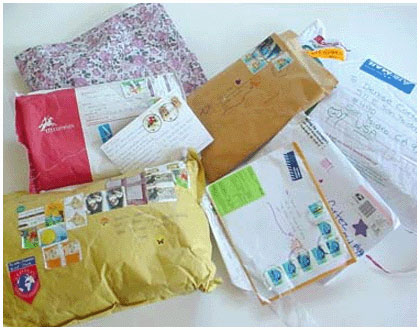
In recent times the postal parcels from overseas sent to Cubans who publicly express disagreement with the government are being confiscated. The Post Customs, an entity belonging to the General Customs of the Republic has been using the seizures of shipments originating from foreign countries as a filter applied to the dissidents.

My own case can serve as an example. In less than two months they confiscated two parcels sent to me from the United States. I was notified of the most recent of these on August 13th by means of Confiscation Order No. 1209 from the 29th of July and a document of Retention and Notification, both signed by Danny Samanda Rivero, a Customs Control inspector.

If this happens once, it could be a coincidence. The second time it could be seen as an act of cruelty. But if the same thing also occurs to other persons sharing your political views then it is a case of state policy. A subtle way to punish those who dare question the system.

Undoubtedly, the administrative measure has a political background. The list of the affected ones includes Yoani Sánchez, Silvio Benítez, Dania Virgen García, Ubaldo Manuel León, Yusnaimy Jorge, Aini Martín, Vladimir Alejo y Julio Beltrán Iglesias, among other opponents of the regime.

According to inspector Samanda Rivero, the content of the package addressed to me “put the general national interest at risk.” He ordered the confiscation invoking Resolution No. 5-96 of the Head of the General Customs of the Republic. The first confiscation on June 8th was effected by Confiscation Order No. 978. Raimundo Pérez García, a Customs Control inspector, seized the parcel using the same argument.

The Resolution No. 5 of the General Customs, effective since 1996, allows the application within the country of the Convention for the suppression of the circulation of, and traffic in, obscene publications. Furthermore it bans the sending of “any object with content considered to be contrary to the morality, the proper conduct or the general interest of the nation.” Moreover, it stipulates that the confiscated goods are to be turned over to the Interior Ministry.

In both confiscation orders enforced against me the inspectors Pérez García and Samada Rivero failed to explain how those imported items “affect the general interest of the nation.” The two confiscated packages contained something like: an MP3 player, a photo camera, pencils, ballpoint pens, pencil sharpeners, notebooks, wax crayons, balloons, toilet soap, disposable razors, deodorants, plasters, toothbrush and toothpaste. All of these are products sold in state and convertible peso shops on the Island.

At the end of July I lodged an appeal before the Head of the Posts Customs requesting the first confiscation order be overturned. Dated August 17th I was notified of the Appeal Resolution No. 231 of 2010 that dismissed my claim.

The official, Raúl Gómez Badía, the highest authority of the institution deemed the measure imposed by inspector Pérez García appropriate. After having exhausted all available administrative remedies my next step will be to assert my rights before the courts.

Although the “new customs offensive” may have another objective. To destroy the hesitant attempts to reestablish the communications between Cuba and the United States. The confiscated goods were sent to me from the northern country by the Universal Postal Service agency of the Office of International Exchange.

On September 17th 2009, Cuban and United States representatives initiated talks in Havana that envisioned the resumption of direct postal services between both countries. At the end of the meeting that took place under much secrecy the Cuban delegation issued a statement.

It´s worth making it clear that the majority of Cubans don´t think highly of the customs services, above all of those at the airports. A proof of this is the video Abuse at the Cuban Customs by the acclaimed composer and singer Cándido Fabré.

Laritza Diversent

Translated by: undef@rocketmail.com

August 31, 2010
The United States: A Necessary Enemy / Iván García


Fidel Castro loves to make references to the numerous economic, paramilitary, and political aggressions of the 11 administrations that have been through the White House throughout these 51 years the strong-man of Cuba has been in power.

The United States is far from being the ideal neighbor. In the first 40 years of the revolution, it unleashed a ferocious campaign of assaults on Castro. It was an all out fight with all the ingredients. Dirty war, economic pressure, and anti-government propaganda.

But Castro is no saint either. Strengthened by more then 20 million rubles that Moscow granted him, he served as the Russian’s aircraft carrier in the Caribbean. In October of 1962, he made the unfortunate decision of accepting 42 intermediate- and medium-range nuclear missiles equipped with nuclear warheads, strategic bomber aircraft, and 43,000 Russian soldiers on Cuban territory.

He financed numerous guerrilla groups in Latin America and Africa, including some that, years later, have degenerated into terrorist gangs such as the FARC in Colombia and Shining Path in Peru.

On top of provoking the thunderous collapse of the Cuban economy, with his absurd plans and his method of managing the country as if it were his own private estate, the extraordinary comandante maintained military troops thousands of miles away from this island.

He acted as if possessed by a tropical Napoleon complex. Cuba got involved in the civil wars of Angola, Ethiopia, and Somalia. The consequences of our participation in those conflicts have yet to be written about.

During the Cold War, Cuba and the United States maintained a mutually irritating political rivalry. As a center of global power, Washington didn’t want to allow an openly Soviet military presence and, on the part of the government in Havana, support for insurgencies around half of the planet .

After Khrushchev withdrew the missiles, the now vanished USSR maintained troops on the island and a base for electronic spying on North America.

With the fall of the Berlin Wall in 1989, Cuba lost its steam. Once the pipeline of Russian rubles was sealed up, we entered into a period of economic poverty. The Americans plopped down on a recliner to await the fall. But against all winds and tides, Castro resisted.

Now, the world isn’t the same. Even Hugo Chávez and Evo Morales reached power through votes, not through bullets. Ernesto Guevara’s theory of “Revolutionary Focalism” has been tossed into the sack of obscurity. The theater of action presents a new design.

The elderly warrior that miraculously escaped death in July of 2006, has reemerged, transformed into a kind of international guru, predicting catastrophes and lending credence to any old incendiary conspiracy theory.

Only on the immigration issue is Cuba a national security problem for the United States. A hypothetical internal crisis could unravel whereupon thousands of people would hurl themselves into the sea on any floating object to escape the island. The White House is the most interested party in the Cuba situation not getting out of its government’s control.

In spite of Castro’s anti-yankee discourse, today the United States is the island’s fifth trading partner and first in foodstuff sales. We hear talk of the ban on travel from the United States to Cuba being lifted. The embargo is an absurdity. In the foreign currency stores they sell Coca-Cola and Dell computers, among other products.

The biggest of Cubans’ problems don’t come from the North. The enemy sleeps among us at home. Rampant corruption and economic inefficiency are, among others, the causes the nation is treading water neck-deep. Fidel Castro attempts to blame the gringos for many of our calamities, but sensible people here believe that bad governance and the system’s inoperability are the most responsible.

On top of being a current minor evil, the United States contributes financial liquidity to Cuba: 100 million dollars annually by way of family remittances and 50,000 Cuban-Americans who travel to the island every year and spend dollars at full throttle.

But it’s always easier to pin the blame on the same old lifelong villain. If the United States hadn’t existed, Fidel Castro would have invented it.

Iván García

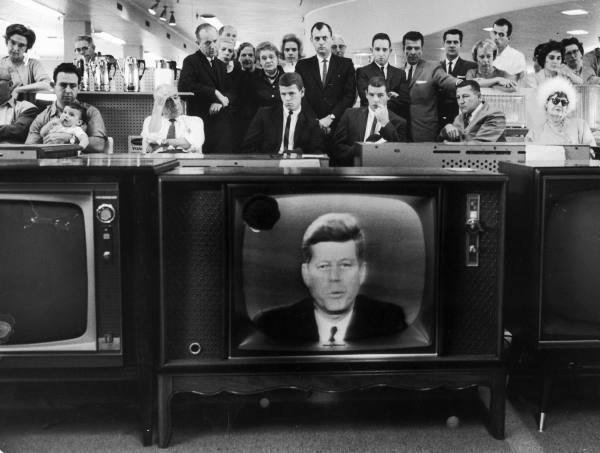
Photo: Ralph Crane, Life Magazine, October of 1962. In a store in Los Angeles, people follow the news of the naval blockade against Cuba authorized by Pres. Kennedy during the Cuban Missile Crisis.

Translated by: Yoyi el Monaguillo

August 31, 2010

Prison Diary (5) (Mother) / Ángel Santiesteban

Photo: AP

She enters the room in search of her son; on the previous visit they told her he was in the punishment cell for indiscipline, he would be there for twenty-one days with half rations of food and no sun; so, to see him, she would have to come back the next month.

Now, she searches through the dozens of prisoners with their families without finding her son; it’s impossible not to recognize him, the guards must have been wrong to let her enter the visiting room. She goes to the door to ask the officers; her son isn’t there. They insist he is and show her his photo on the card everyone has for identification.

The mother returns to the room and patiently searches, one by one. Coming to the last one without finding him she starts to cry, but understands that she’s losing time and later the guards won’t take it into account, so she overcomes her nervousness and starts to search again, also fruitlessly.

When she returns anxiously to see them the guards fly into a rage, they tell her son is there, that if she didn’t raise him, find the person who did to show her where he is.

She prefers to keep quiet, without clarifying that she raised her children alone and never had anyone to help her. And she looks again at each face. When she searches and doesn’t find him, she ashamed to bother the sergeants one more time.

In the room, there is only one boy who is sleeping, alone, with his face hidden in his arms, but as much as she looks at him there is nothing to indicate he is her son. The shaved hair, too small head, skinny arms, very white skin and narrow back. Her son is tall and strong. Still, she notes that all the prisoners are with their families and he is not. She approaches him, heartbroken, despite knowing that he needs to sleep.

Fearfully, she touches his shoulder; the boy raises his head and hugs her.

September 1, 2010

HIP HOP 2010 in ALAMAR…! / Orlando Luis Pardo Lazo

EL HIP HOP DEL 2010 EN ALAMAR…!, originally uploaded by orlandoluispardolazo.

This Thursday, September 2, 2010, at 3:00 in the afternoon, irremediably

or enviably, the Alamar Siberia will return to the site where

OMNI ZONA FRANCA plus 26 Cuban rappers will throw themselves in an

independent way on the only theme that UNITES EVERYONE which without a doubt will be the Hip

Hop of the Year (no danger no tricks). The audiovisual chronicle will be on

www.twitter.com/OLPL and in my blog POST-REVOLUTION MONDAYS

(www.orlandoluispardolazo.blogspot.com).

August 30, 2010

P350 AND LET’S GO…! / Orlando Luis Pardo Lazo

A MAGAZINE OF CEMENT PAPER

Orlando Luis Pardo Lazo

(more photos later in BORING HOME UTOPICS)

A free magazine can be invented over the dusty cartridge of an empty cement sack, opened.

In fact, freedom can be just that: a recycled powder, a remnant, with the rhetoric of its aired texts, without more design than that of a pragmatic parchment.

And the gates of the fringe theater group EL CIERVO ENCANTADO (5th and D, Vedado) served as coliseum for this somewhat eccentric experience: to cut up a cement sack and construct a personal magazine, live (Made in Omar Pérez + Yornel) by means of collage, cut-up, and cut & paste (preschool techniques borrowed by intellectuality).

This past July’s Saturday the 31st, the late night of El Vedado had in that corner a breather from the police oppression that smolders our avenues, on the hunt for an identification card or an island beating (under the digital cameras hanging from lampposts, perhaps by their necks).

“P350”: that’s the name of the Cuban Portland cement and it’s also a magazine that already accumulates a few collection bags.

Concrete creativity. In a special space where the prize-winning filmmaker Enrique Pineda Barnet fits right along with the censured performer Luis Eligio Pérez (from OMNI ZONA FRANCA). Even I.

The fossilized functionaries of the Ministry of Culture never peek their naphtha noses around there. They’re afraid of the democratic nobility and the enchantment of a theatrical stag. It’s just that they have quinquennials of experience closing down editorial projects, from El Puente, to Pensamiento Crítico, even Albur y Diáspora(s). It’s time that they retire or resign from some of their subcommitments of second-fiddle censor.

But P350 will be hard to fetter. The artists Omar Pérez and Yornel simply do not distribute it. They make it and then they exhibit it, carrying their cartons from home to home, like construction snails. Besides, they don’t even do it themselves, but they invite any creator to get in there and get their hands dirty so they can become smeared in the liberty of authorship. Do it yourself…!

P350 is a magazine that, as it gets stronger, like the original cement of its buttress, I’m sure will stick on the throats of more than one Cubanesque hooligan of guayabera and bureau.

Translated by: Joanne Gómez

August 3, 2010

When A Friend Leaves / Rebeca Monzo

Painting on silk, by Rebeca

It’s very sad, indeed it is! They leave you a tremendous emptiness and you feel as if something broke inside of you.

In all parts of the world friends come and go, because they travel. They’re lost for a time and then reappear, they call you on the cell phone, you send them messages, they reply. But, here “on my planet,” when a friend leaves, it’s as if something died inside you. You know you won’t see them again in many years, maybe ever. You also don’t have a cell phone to call him or her, never mind the Internet, facebook, and all those marvelous things not at the disposal of the immense majority of us.

In my case, in particular, almost all my friends have gone away on me, but since I’m so stubborn, I make new ones. It’s not an easy thing. Above all, they have to speak your language (as you know), otherwise it’s very difficult to converse.

A few years ago one of my most beloved friends left me. We wrote letters to each other for a while, we dreamed of sitting down together over a cafecito to chat here at home, or at the Versailles*, it didn’t matter to us. My friend died and we never got to fulfill that dream.

Now, a great friend of ours has just left. We’re happy for him, but he’s left behind a tremendous emptiness.

This situation has been going on continuously now for half a century. Too much time! When they say goodbye, because they’re going to travel, it’s about time for families and friends not to have to leave us with that bitter taste in our mouths and that terrible sensation in the pit of our stomachs.

*Translator’s note: Rebeca is referring to the Versailles Restaurant, a now legendary and iconic dining institution among Southern Florida’s Cuban community; located on Calle Ocho (8th Street) in Little Havana.

Translated by: Yoyi el Monaguillo

August 30, 2010

Of “Patriots” and Citizens / Fernando Dámaso

In my childhood and adolescence, personalities from the war of independence were the ones they called patriots and, in its most general sense, all those who took part in it in one way or another. With the passing of years, the word fell into disuse, and was sometimes applied, rather ironically, to some politician at election time.
<ol>
<li>From the beginning of the sixties it was taken up again, and started to be used with athletes, artists, professionals, et cetera, who experiencing some success abroad, chose not to stay there and returned to their homeland.</li>
<li>Recently, different authorities in the field of education are proposing once again that the first job of education is to form ever more prepared patriots.</li>
<li>I beg to differ: I believe that the principle job of the family, of education, and of society, is to form citizens. When I write citizens, I am referring to people with moral principles, ethics and civics, capable of fulfilling their duties and exercising their rights. These people, unfortunately, are now in the minority, an important cause of the deterioration of our social existence.</li>
<li>In place of a country of patriots and heroes, I prefer one of citizens.</li>
</ol>

August 13, 2010

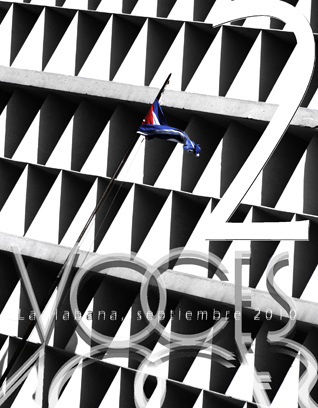
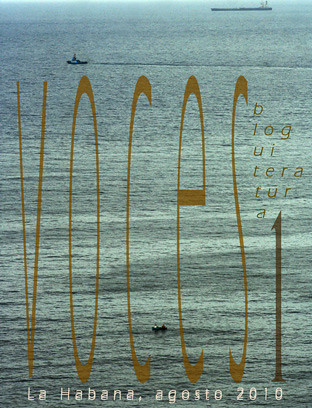
VOICES / Orlando Luis Pardo Lazo

VOCES, originally uploaded by orlandoluispardolazo.

VOCES IS NOW A REALITY

A document circulates Havana, it surrounds it.

It’s VOCES 1.

A dossier of dissimilar discourse, in and out of Cuba.

A score of writers, and a window for looking in and out of Cuba.

Voices of change and continuity, swift to the point of the implausible.

Unedited and recycled, unheard on paper as well as on screen.

East of Eden. More loquacious than leaders of nothing, marathon runners of the

rhetorical resistance. Facing the crude body, without political

fibbing, pedaling between the spiritual and the stupid, reporting at the

foot of the horde, fictioning the black holes of a sinking vessel

in its nonsensical notion of nation.

Ways of narrating our unideological idleness at the height of the 21st century.

Ways of reformulating everything for the thousandth time. Endemic

enthusiasm of those of us who want to gain if not a voice, at least a

throat.

Future acknowledgment. Meetings of post-Cuban cultures. More a collage

than a choir. Binnacle of bits. Next to last papers. More art of hope

than of expectancy. Bullet-in of blogiterature.

Welcome to VOICES as a lucid reader. We also await you inasmuch

author at the edge of all authority.

Translated by: Joanne Gómez

August 5, 2010

THE IMMIGRANT / Fernando Dámaso

The cubicle was permeated with a strong odor of antibiotics. On the pole hung two hundred and fifty grams of blood plasma and two vials of serum, attached by thin plastic hoses that ended in his chest and arms. The oxygen cylinder was connected to his nose through a tube, trying to east his strangled breathing. His nose also had a drain hose discharging into a bottle hanging on the left-hand bar of the bed. Another hose coming from his abdomen drained urine into a bottle on the floor.

Every so often nurses checked on the jars and hoses and took his pulse, measuring his heart rate. In the next bed, an elderly man operated on for ulcers, emitted rhythmic moans from a state of drowsiness. The guy opened his glazed eyes and looked, lost in the morning of the accident between the crash and the screeching of brakes, searching the Asturian mountains for the wolves who preyed on the unsuspecting sheep. From time to time he raised his left arm, looking for his hand, and tried to scare away the hawk that, flying high, also searched for easy prey. The sheep pushed in around him, one against another, and he, the child-shepherd, stroked their woolly backs, giving them confidence.

The first heart attack surprised him in the morning. It was a hot blow tearing into his chest. He pressed against the sheep and merged with them. He wanted to avoid the wolves’ bites and raised his left arm again, fending off the sharp teeth. He felt the wolf move off, after biting him. The sheep stopped their bleating. The nearby olive grove wafted well-known odors his way, and the cold mountain wind ruffled his hair. He pressed the blanket against his chest. The nurse came and moved his arm.

“Careful,” she said, “you’ll disconnect the transfusion.”

Again the sheep surrounded him. He started to remember that old melody that, at night, when he returned home, he used to sing to scare the wolves away. From the church came the procession, carrying the virgin dressed all in white. María Isabel carried the ring and sat on the garden bench, stretching her legs. He looked at her and smiled. She hid her face.

The nurse felt his chest and again adjusted the drops falling from the bottles of serum.

In the distance was the roar of the guns. The sheep became frightened and ran from side to side. He tried to stop them. Then the second heart attack came. He felt his chest was on fire. He saw the doctor’s face bending over him. The boat rocked him on the waves and he was dizzy, feeling like he wanted to vomit. He clung to the railing. The doctor beat on his chest. The hawk launched itself at its prey. He raised his arm once more, trying to scare it, but he couldn’t. Then he began to feel like a speck of earth floating on the mountain air.

August 11, 2010

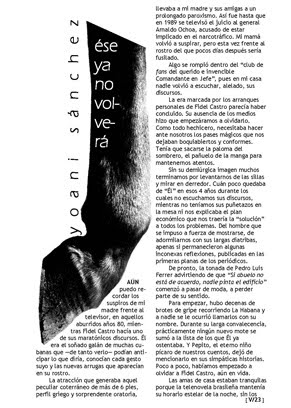
TAKEN FROM VOCES 1 / Yoani Sánchez / Posted by Orlando Luis Pardo Lazo

That one will not return

Yoani Sánchez

I CAN STILL remember my mother’s sighs in front of the television, during those boring eighties, while Fidel Castro gave one of his marathonian speeches. He was the dreamy stud of many Cuban women who—from seeing him so much—could anticipate what he would say, they knew each of his gestures, even the new wrinkles that appeared on his face.

The attraction which that peculiar countryman of more that six feet, Grecian profile, and surprising oratory generated, took my mother and her friends into a prolonged paroxysm. It was like that until, in 1989, Arnaldo Ochoa’s trial was televised. He was accused of being involved with drug trafficking. My mother sighed once again, but this time opposite the face of the one who would be executed in a few days.

Something was broken within the “fan-club of the beloved and invincible Commander-in-Chief,” because in my house, nobody again listened stupefied to his speeches.

The age marked by Fidel Castro’s personal tantrums seemed to end. His absence in the media made us begin to forget him. Like every sorcerer, he needed to perform his magical moves for us, leaving us widemouthed and contented. He had to take the rabbit out of the hat and the scarf out of the sleeve in order to keep our attention.

Without his demiurgic image many of us ended up leaving our chairs and looking around. How little remained of “Him” in those four years during which we did not hear his speeches, when we didn’t have his punches on the table and his explanations of how the economic plan would bring the “solution” to all problems. Of the man who imposed himself with the strength of his presence, of the lulling us with his long diatribes, some unconnected reflections barely remained, published on the front pages of newspapers.

Suddenly, Pedro Luis Ferrer’s tune, warning us that “If grandpa does not agree, nobody paints the building” began to go out of style, to lose part of its meaning.

For starters, there were dozens of flu outbreaks going around Havana, and nobody thought of calling them by his name. During his long convalescence, practically no new nickname was added to the list of the ones He already held. And Pepito, the eternal rascal of our jokes, stopped mentioning him in his funny stories. Little by little, we had begun to forget Fidel Castro, even while he was still alive.

Homemakers were calm because the Brazilian soap opera kept its stellar nighttime time slot, without the delays that the Great Orator caused. The sports coaches felt lighter since they didn’t have to listen and follow his advice; meanwhile the meteorologists got startled, in the middle of a hurricane, when remembering the precise and irrefutable forecasts of the Expert in Chief.

The ministers, on their part, began to wonder if they had to make decisions for themselves, of if Raul Castro would inherit all the cabinet positions that his brother held. All of them, to some large or small degree, had stopped feeling the huge olive-green weight on his shoulders.

That sensation of lightness came about because since July, 2006, the Commander had not shown himself alive in front of them. All that time he did not give a speech or attend a public event. Neither did he approve a new law nor champion the sports delegations that traveled to international competitions nor sponsor the formal decorations to the presidents that visited the country. He was conspicuous by his absence in the numerous congresses celebrated and in the inaugurations of the new health centers. He practically did not utter any political opinion over how things had to be done in the country. Ultimately, he did not act like Fidel Castro.

And then he returned, like a blabbering elder with shaky hands that had nothing to do with that once well-built military man of Grecian profile, who from a plaza, where a million voices chanted his name, proclaimed laws that hadn’t been consulted with anyone, pardoned death penalties, announced executions or proclaimed the right of revolutionaries to make revolution. Little is left of the man who for hours took over television programming and kept an entire nation on the edge of their seats.

The great improviser of other times assembles now in a little theatre with an audience of young people, to read the summary of his last reflections—already published in the press—and instead of inducing that old dread that made the bravest tremble, he provokes, at best, a tender compassion. A young journalist asks an indulgent question and publicly bids him for a wish: Would you let me give you a kiss? What of that abyss that no audacity dared jump?

We had begun to remember him like something of the past, it was even a noble way of forgetting him. Many were willing to forgive his mistakes and failures in order to place him in some cindered pedestal of 20th century history, where his face—photographed in his last best moment—already appeared next to the illustrious dead. Suddenly he has come out to lewdly exhibit his ailments and announce the end of the world, as if he wanted to convince us that life after him will lose all meaning.

During recent weeks, he who once was called the One, the Highest Leader, the Horse, or with the simple personal pronoun HIM, has presented himself to us stripped of his former charisma, to confirm that the other Fidel Castro—fortunately—will not return again, even if this time, he makes the news again.

Translated by: Joanne Gomez

August 9, 2010

Other Steps / Fernando Dámaso

1. When we speak of solving the economic problems that overwhelm us, the road ahead appears complex and intricate. It has grown too much invasive marabou weed over the years and clearing it is no easy task. The solution is not to open narrow paths that, ultimately, are difficult to navigate and close up again with the first rains.

2. The solution is to open wide avenues where initiatives and work that will produce wealth for all Cubans can take hold, freed from the bureaucratic patronage that has produced nothing.

3. Public ownership in some key spheres, cooperative ownership, and small- and medium-sized individual ownership, without limitations, must become real factors in our development. The balance of each one will be determined over time.

4. It is time to abandon old and obsolete formulas that have failed everywhere, and face reality with ways and methods that correspond to the integrated and globalized world. It means taking no steps backward, only moving forward.

August 10, 2010

Taking Note / Regina Coyula

A few days ago Fidel met with the panelists of the television program Mesa Redonda (Round Table)* and he encouraged them to pose more difficult questions to him, as if he were a student well-prepared for an exam. The week ended, and a printed version of the encounter ran in the newspaper Granma, but I was left waiting for the broadcast of Mesa Redonda in its normal television time slot. There are various speculations: it has called the attention of those who notice these kinds of things, that they haven’t televised the meeting; there are even those who think that censorship has been imposed upon “Him.”

In his latest writings, customarily titled Reflections, Fidel offers his opinions on a book about world governance, and with his habitual process of copying and pasting, he gives us some very long quotes from the book in question by an author named Daniel Estulin, which leads me to ask myself, wouldn’t it just be simpler to have the book published in Cuba so that no one has to read it to us? This could be arranged if Fidel, who has even invited the writer to Cuba already, were to divert a portion of the 500,000 copies of La victoria estratégica (The Strategic Victory), the first of his books dedicated to the struggle against Batista, to make a modest print run of this other book that has inspired so much enthusiasm in him!

*Translator’s note: Mesa Redonda is a weekly current events/debate roundtable discussion program. Before taking ill, Fidel Castro was an almost permanent fixture, along with other rotating guest panelists (depending on the week’s topic) and the program’s regular panelists and moderator.

Translated by: Yoyi el Monaguillo

August 31, 2010

Cuba’s Theatrical Metaphors / Miguel Iturria Savón

A friend from Miami told me over the internet last Friday, that in July he saw two theatrical works representing the island in festivals in the United States, “where there is a real invasion of Cuban artists, including orchestras, troubadours, reggaetoneros, and dance and theater groups, almost all very good, although some are irritating due to the ambivalence of their music or the statements they make, not thinking that here there are no issues of ‘enemy propaganda’ or ‘ideological diversionism’.”

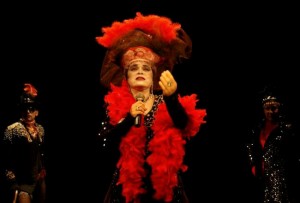
The theater groups representing Cuba in the United States were El Público and Buendía, both revitalizing collectives due to their way of making and conceiving of theater. The former performed The Bitter Tears of Petra von Kant, shown as part of GLBT Performing Arts Theater’s “Out in the Tropics,” at the Colony Theater of Miami Beach. The latter performed their versions of The Visit of the Old Dame and Charenton, premiered in Havana and seen now at the Latino Festival of Theater, organized each year by the Goodman Theater of Chicago, from where they went on to perform at the Manuel Artime Miami stage.

I won’t tackle the three proposals, whose focuses, montages, and spell-casting strategies reveal the plurality of Cuban theater, marked by universal and local themes, austere stage settings, and dialogue that implicates the audience, whose eagerness is visible in Havana’s halls.

I’ll focus on The Visit of the Old Dame, a cruel and stark comedy rewritten by Flora Lauten (director) and Raquel Carrió (adviser) based upon the original by the German author, Friedrich Durrenmatt. The original plotline is preserved, but with a smaller cast that condenses characters and changes some details of language and narrative style, which suits its proximity to our Cuban reality.

With The Visit of the Old Dame, Buendía offered a theatrical metaphor of Cuban daily life, marked by confinement, misery, and intolerance. After decades of exile, now wealthy Clara Zajanin returns to the impoverished town of Gula, where she’s received as a prodigy child and future omen. She evokes her shadowy and frustrated past, the betrayal of a young-lover-turned-town-mayor, who will be the target of her vengeance, while the townspeople who once detested her now flatter her in hopes of loans and other favors.

Such an expansive scenic view would seem a pretext to create a dialogue with the public about the problems that erode human existence, recreated by the magic of theater, with excellent performances, live music that enhances the nostalgia in Martha Strada’s mythical voice, and illuminating references to the island’s context. For Buendía‘s cast, it’s as if foreign plays serve to support our imaginariums and utopias, the way to deal with that which is mythic and ordinary and to polemicize the present and future.

There’s an overflow of charm and splendid performances upon that altarpiece of scenic passions, where comedy wins the bout over tragedy and the masks reveal something of the mythic and the ordinary, without evading the problems of the present and future.

Those of us who follow the island’s theater scene know that Buendía Theater, founded in 1986 by the actor and professor Flora Lauten, is grounded in an intelligent selection of works, whose versions reach the public and speak to them of the issues, challenges, and circumstances that can move their lives.
The favorable reception by the public and critics in Chicago and Miami of The Visit of the Old Dame and Charenton, Buendía‘s recent works, will likely stimulate the further creative research of this drama collective, with their headquarters in the Coptic church on Loma and 39th Streets, in Havana’s Plaza municipality, where their sessions are held, along with their Research Workshop and Center for the Education of Actors, Directors, and Technicians.

Translated by: Yoyi el Monaguillo

August 16, 2010