September 4, 2010
English Translations of Cubans Writing From the Island
September 4, 2010
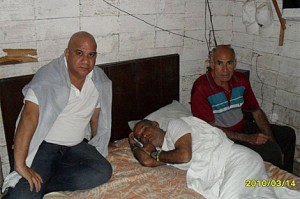 On Tuesday, June 15th, I ran into Juan Juan Almeida in the International Legal Office on 21 24, El Vedado. As we said goodbye, he told me he was starting a hunger strike on that day demanding the exit permit to continue his medical treatment outside Cuba. I visited him twice at his apartment on 41 and Conill before August 23rd, when he suspended his fast at the request of the Archbishop of Havana, who interceded on his behalf before General Castro’s government.
On Monday, August 23rd, Juan Juan seemed like the shadow of his shadow. In 69 days he went from 230 to 150 pounds. If it were not for his lucidity and good humor, I would have thought I was in the presence of a zombie. We talked for 20 minutes and I left before the arrival of his sister Glenda, who lives three blocks away and was keeping an eye on his hardships.
As I walked along Tulipán looking for the bus that would take me home, I thought again about this striker: extraordinary, cheerful, making jokes, the enemy of any type of inflexibility, able to listen even to the delirious fantasies of the State Security agents who have been breathing down his neck since he lost the protection of his father, a comandante of the revolution with an artistic vocation and a passion for power.
During his hunger strike, Juan Juan made statements to the foreign press accredited in Cuba, spoke with several bloggers and independent journalists, went out with signs to public places two or three times, received friends and people who oppose the regime, was the subject of controversy and attacks and political asylum proposals from governments in Europe and America.
For a great part of the world it is difficult to understand that a man would begin a hunger strike because he is not allowed to leave his country to continue the treatment he was receiving in Europe. It has a certain logic, since adults decide what to do with their lives, except in the case of Cuba and North Korea, where the State attributes to itself the authority to decide who enters or leaves the country.
For a segment of Cubans in exile, Juan Juan Almeida is loathsome due to his paternal origin. He has Castroism’s stamp of origin; he was educated as an officer of the Minister of Internal Security in the former Soviet Union and practiced his profession until he fell into disgrace. Perhaps he´s not forgiven for the publication of a book in which he satirizes his own life and the errors and horrors of the demigods who took hold of power and devour their own children.
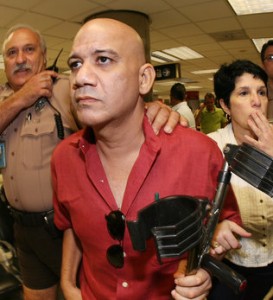 I don´t think he worries much about the conflicting opinions of those who judge him through a political lens. Juan did not distance himself from the power circle in order to climb in the opposition. As I listened to him on Monday, August 23rd, I thought that this charismatic and cheerful down-to-earth Cuban believes more in the smile and the handshake of those who greet him than in all the slogans and hallelujahs he heard since he was born.
P.S. Congratulations, Juan Juan! We are all happy for your liberation
Translated by: Espirituana
August 27, 2010
While Bill Gates, Warren Buffett and other multimillionaires develop a campaign to donate at least 50% of their fortunes to social sectors, the government of General Castro accelerates the end of the benefits granted to the Cuban people during half a century of promises and State domination.
To the extent that the ship of totalitarianism wobbles, the promise of giving is substituted by the one of taking away. In the end, the “gratuidades” (free services), “precios subvencionados”(subsidized prices) and subsidies for the elderly and disabled can be spared. However, the ideological battles, the apocalyptic prophecies of the former ruling chatterbox and the catalog of prohibitions that prevent citizens from unleashing their own initiatives and living from their own efforts without governmental guardianship, remain.
Yes, it is time to put an end to the egalitarian illusion; we have had our fill of utopias, offerings, miseries and disinformation. But it is also time to eliminate the state monopoly over the means of production, commerce, agriculture, transportation, fishing and other areas of the economy and society, which are blocked by the concentration of power in the one party and its chieftains who hold on to power.
Whose idea was it to regulate individual consumption of food, the clothes we wore, the toys that our children could receive, or to let a ministry decide the prices of articles? How is it possible that a network of government officials imposes the will of a uniformed chieftain on millions of people, or that the parliament unanimously approves “the leader’s proposals”?
If the methods of distribution are no longer sustainable and it is necessary to drain the swamp, we have to clear the obstructed flows and normalize relations between those who create wealth and those who administer it. The law that favors one side only will not solve the problems. If the obsolete productive and commercial structures in the hands of Father State are not privatized, we will continue to be bogged down.
Now there is talk of eliminating the subsidized cigarettes we have had since 1971, but let us remember that someone raised prices from 5 and 10 cents per pack to 8 and 10 pesos. Maybe it was the same people who raised the prices of rice, beans, chicken, pork and other staples included in the ridiculous Ration Book, which is in the same process of extinction as the regime that instituted it.
The end of subsidies should not imply an increase in poverty. People work because of their needs, not because of slogans. If the monopolizing state lacks the raw materials to produce and cannot – or doesn’t want to – pay workers what is necessary to live on, it will have to steer the situation through decentralizing changes and maneuvers. To pay with the devalued national currency and sell in foreign currency is equivalent to taking people for fools.
It is not a question of offering people a “Dinner for Idiots” nor of excluding those who need protection. Let the waters flow to drain the swamp. The rest will come little by little.
September 2, 2010
 As in medieval times, when music, painting and other artistic expressions were under the wing of the Catholic church, in Cuba culture is sponsored by the State. But artists don’t knock on the doors of cathedrals nor present their projects to the despot, since there is a network of institutions that rule and control film, the performing arts, the plastic arts, books and literature, architecture and even the media.
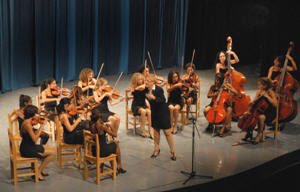
I was thinking of the subjection of culture to the State on Monday, August 23rd, as I enjoyed the concert offered by Zenaida Romeu and her Camerata before the power elite, in honor of the 50th anniversary of the Federation of Cuban Women, created by the former First Lady to empower the females of the country.
Zenaida’s words as she presented each piece caught my attention. With delicacy and precision she spoke of music as an expression of liberty. I suppose that General Castro and his entourage did not notice that detail. Enveloped in the interpretive magic of these women, they were not attentive to these subtleties.
Many of our creative people sometimes act on stages that reaffirm the relationship between art and power. The Universal Hall of the Armed Forces, the steps of the University of Havana, the Plaza of the Revolution or the Black Flags Park on the Malecón, in front of the United States’ Interests Office, are only some of the ritual places.
It is almost impossible to control the manifestations of art and literature, since creation is a natural need of man as a social being. The predominance of the State can achieve, at most, that an intellectual elite, docile and well-trained, direct culture toward political ends.
With the revolutionary process started in 1959, culture continued its march, but its rhythm was changed. In half a century of messianic populism, several components of daily life and tangible and spiritual elements of the social dynamic were altered. There are reversible damages and representative faces of “revolutionary art”.
Upon the disruption of the social order, the sociopolitical scheme was changed. The association with the socialist model led by the former Soviet Union made way for the development of official organizations that monopolize each area of artistic creation. The Instituto Cubano del Libro (Cuban Books Institute), the Centro Nacional de la Música (National Music Center), the Instituto de Arte e Industria Cinematográfica (Institute of Film Arts and Industry), the Consejo de las Artes Escénicas (Performing Arts Council), the Instituto de la Radio y la Televisión (Radio and Television Institute), the Centro de Artes Plásticas y Diseño (Plastic Arts and Design Institute) and other groups direct the artistic production according to political and government interests.
The commissaries dictated standards, demanded fidelity, and imposed mass culture through control of the radio, film, education and the media; but the creative universe of the island went into crisis around 1990, with the fall of the socialist allies that provided the resources for the country, accelerating the exodus of artists to other countries. But the bureaucratization of culture was maintained, intent on tying the creators to the network of State centers that instituted censorship and submission through awards, publication, recordings and travel, favoring opportunists and excluding those who defy the doctrine of the power holders.
Many public shows take place in this context of political schemes, as in the times of praising and singing to the Lord, when music and other artistic expressions revolved around the cathedral and the artists were dependent on generous patrons.
Translated by: Espirituana
August 29, 2010
The 58th edition of “Poland Today”, a periodical written and edited by the Polish Embassy in Havana, is already in libraries and national institutions. It is structured in specific sections such as current events, culture, politics, the Man and society, economics, science and Polish cooking. It is published three times a year, the 58th edition is the second of 2010.
In the January-March issue we learned about the celebration for the 200 year anniversary of Polish composer and pianist Frederic Chopin (1810-1849) who is considered one of the greatest creators of music for the piano of all time.
As part of the festivities honoring the musician, the Wielki-Opera Ponznan theater put on a show titled “Waiting for Chopin” at the San Felipe de Neri church. The show is inspired by the desire to visit and present little known works of the composer; his poor state of health prevented him from traveling to many countries.
The performance also welcomed the exhibit titled “Chopin in Cuba” which includes nine portraits of the artist by nine contemporary Cuban painters. The exhibit had already been shown for the first time at the Amadeo Roldan Theater during Frank Fernandez’s concert, which inaugurated the Chopin Year in Cuba.
The Numismatic Museum was able to present the “Numismatic Exhibit” due to a loan from the Polish Mint. The exhibit included the institution’s most interesting coins. One could see coins from Poland, Russia, Armenia and Andorra. The exhibit also included one of the smallest coins in the world, which weights a mere gram and holds a portrait of Frederick Chopin. Other novelties included pieces with encrusted amber and other precious metals and some that depict reproductions of famous paintings from Van Gogh and Leonardo da Vinci.
From the April-June edition of the bulletin we also learned about projects for public buildings in Poland, whose advanced technological design will make them paradigms of reference in the cities where they are erected.
In this latest edition, much to the dismay of Caribbean male chauvinism, we found out about an activist for male rights. This person has a unique way of making his claims. With a long beard and a machista attitude, without being a homosexual or a transvestite, he dresses in a petticoat and high heels, even inside his home. And so he makes fun of the stereotypes associated with the male gender in society.
The relationship between Poland and Cuba can be traced back to the 19th century. Let’s remember that Carlos Roloff from Poland participated in our independence struggles and reached the rank of general. Later, when the Republic was formed he was conferred Cuban citizenship.
In keeping with this historical precedent, every year Poland organizes a week of cinema in Cuba which includes exhibits, conferences, theater workshops and other events. Their socio-cultural projects are a valuable contribution to the development and consolidation of civil society in our country.
Translated by: Lita Q.
August 31, 2010
As if cutting a cake before it is even baked, our government has extended to 99 years the right of foreign investors to use our land. Pieces of this nation will pass into the hands of those who hold foreign passports; meanwhile local entrepreneurs are granted the use of agricultural land, in usufruct, for a mere ten years. The Official Gazette speaks of the “real estate business” when we all know that land — our land — is not available to Cubans who would like to acquire a small sliver on which to build.
Another recent surprise has been the announcement of the creation of several golf courses throughout the island. With the objective of promoting classy tourism, they will open the greens and manicured lawns, surrounded by luxurious amenities. When I told a friend about the coming of these expanses for entertainment, the first thing she asked me was with what water are they planning to maintain the green freshness of the grass. She lives in a neighborhood where such provisions only come twice a week, and to her, the thought of water pumps spraying the precious liquid between one hole and another is a painful one. You’ll have to get used to it, my friend, because the abyss between the dispossessed citizens and those who come from abroad with bulging wallets…
I can already imagine the rest of the movie: to work on one of those golf courses will be a privilege for the most trustworthy; men in suits and ties, microphones attached, will be stationed all around to keep watch and ensure that locals cannot enter and… live and learn… the most prominent and faithful servants will also have their turn with the stick to complete a round with the ball. Hence, they are in training for that morning they plan to enjoy, when they will be on the golf course in their bermuda shorts while we look on from the other side of the fence.
September 3, 2010

Image: “Your passport, citizen” by Erick Perez Jorge Mota
Following the universal law of Cuban telephone lines, after the downpour on Wednesday my phone died. “No line,” was the post-mortem note, in English, on the little handset screen. On Thursdays we reported the outage several times because, as the experts say, the more reports that are made about the same break, the faster ETECSA will come.
On Friday I canceled all my plans and prepared to wait for the technician. Hours passed: I read, I wrote, I scrubbed and cleaned, I didn’t talk to anyone all day and had time to speculate. I came to the conclusion that there was a high percentage of probability that the technician who services me also has a small job with the Department of State Security (DSE). At six in the evening my theory became an absolute certainty. I went out and called the users-service-line to ask them to tell me, if not the hour, at least the day my repair is scheduled for: “I’m sorry, we do not have that information, it could be any day between eight in the morning and four in the afternoon.”
Anticipating that the wait could be extended to September, I tried to cover the month of August in morning and afternoon watches with my friends. If I had to leave home for some emergency, I had to call my mother so she could rush over and not leave the house empty. Life is like that, you just have to wait longer than expected and stop looking for the guy to turn up.
My and Ciro’s time was the most affected, of course. I told him about my theory of the technician moonlighting for the DSE, and he looked at me with that face he makes when he thinks I’m being paranoid. There are those in Cuba who think everyone is from State Security, even if it’s proven otherwise.
I was wrong. Saturday at eight-thirty in the morning the man in question showed up. He didn’t give us time to make bets about his Security origins. He looked terrified, poor thing. He came in and before saying “Good morning,” he asked, “Do you have a modem connected?”
The little box for my phone line is in the bedroom, behind the bed. He was tinkering with it under my scrutinizing gaze. It looked like he didn’t put a microphone in it, but one never knows. Either way, the things I talk about in bed are inconsequential. He said the problem wasn’t in the box and that he would have to make a sketch of all the wiring in the house. I put on my I-don’t-think-so face when Ciro’s voice came from the living room, “It’s already fixed.”
We left the bedroom. I started to feel guilty toward the guy. At the end of the day, he had fixed my problem and my cogitations, I thought, seemed as fantastical as the reflections of comrade Fidel.
“Would you like a coffee?” I asked, with the idea of lowering his guard.
I couldn’t get to the kitchen because he decided to make a call.
Previous position: On guard!
I stood a few inches away with the obvious intention of overhearing what he was saying. I didn’t understand a thing. I think he used slang and hung up quickly. I must have been staring, I was really surprised. How is it possible that one can’t understand someone speaking Spanish less than a yard away in a quiet atmosphere? With the satisfaction of having been proved right, and the discomfort of having a security agent in the room, I went to put the coffee on. He started a conversation.
“Did you see the Roundtable show yesterday?” he asked Ciro.
“Our TV is very bad.”
“A man talked about the global economic collapse.”
But Ciro was not intimidated, “Well, according to Karl Marx, in the future there will be no money, no leaders.”
The guy was a little disconcerted. I put his coffee in front of him and didn’t say a single word.
“There will always be leaders.”
“ Really? What do you call the president of Sweden, or Denmark or Finland?”
That was the last thing I caught. I didn’t want to be a part of it, although it was cracking me up. Suddenly everything had become extremely hilarious. He drank the coffee quickly and left. We made bets later, which are ongoing: State security or not State security?
September 2, 2010
“Our daily bread”, as they call it, will no longer be on the ration booklet, nor will it cost the current five centavos; as the cause of hypertension and weight gain, those who want to — and can, will have to buy it for 80 centavos. Whereas before you’d spend one peso and 50 centavos monthly per person on bread, now you’ll spend 24 pesos for the same amount. Cigarettes, those survivors of an era when smoking was a pleasure, were only alloted to those born before 1958, and since they cause cancer, they’ll also be withdrawn from the rationing system. Even coffee, where blended coffee for 10 centavos per four-ounce pack was switched out on us for a supposedly purer coffee at five pesos for the same pack, now it’s also rumored that it will be decreased in the libreta de abastecimientos (national ration booklet of supplies), due to its effects on insomnia and gastritis.
There is a manifest concern on the part of Papá State for the health of us all. If you doubt it, just keep going and check these facts:
At three years of age they take away baby food, whose sugar content predisposes you to diabetes. At age seven they substitute soy yogurt for milk, the cause of excess calcification. At age 13, the monthly quota of picadillo (ground beef), which was instituted some two years ago as a result of a national study on the size and weight of our children, but it turns out it could lead to gout, so, along with the soy yogurt, it is also taken away.
Now they have decreased the allocations of sugar and salt, poisons, as we all know. They don’t offer red meat on the ration booklet; only soy and dark meat picadillo, and you can find chicken and sometimes mackerel.
All of that and more can be found in the foreign currency stores, but the government is interested in the health of the people, not the health of sturdy tycoons bursting with CUCs (the acronym for convertible pesos). We’ll all die healthy.
Translated by: Yoyi el Monaguillo
September 2, 2010
The small blue circle was widening and growing until it ended up totally enclosing him. At first his feet and hands remained outside of it, now his whole body was inside the circle. He barely managed to keep his head outside, in a tenacious battle that he knew, if he lost it, if would all be over. Bystanders watched, some sympathetically, others indifferent, but no one stopped to help him or to hurt him. So he spent two nights and two days. It was the afternoon of the second day. It was always easier in the morning, as long as he didn’t get too burnt by the sun, or find the air too thin. The circle stretched at times, giving the sensation that he might be able to break it, but it only lasted an instant, and then it would immediately contract, squeezing even harder, trying to take in even his head. It was a terrible battle.
It had all started suddenly. he was walking, like every night, returning home, when he felt something trap his feet. He tried to keep his balance but he couldn’t, as he fell to the ground. From that moment he never stood up again. The circle tied his feet, after covering his ankles and then his knees. He fought that night and all the next day, and kept the circle from advancing further. Only in the morning of the second day did the circle manage to capture his arms. He was dirty and his clothes were torn, but he held his head erect, outside the circle. He tried to fill his constricted lungs with air and to not close his eyes, convinced that if he did he would be defeated. Just then he saw a child come running. In his right hand was a carnation and his face was one huge smile, the greatest he had seen in all his forty-eight years. He tried to warn him with a gesture of his face, to show the danger, but he failed. The child kept coming, and when he was near enough, he kissed his cheek and then dropped the carnation into the circle. Everyone was shocked. The circle stretched in one sudden movement, but this time it didn’t contract again, but broke into pieces, which in turn fell apart and disappeared completely. The man felt that his body was free again and looked around for the child among the crowd that was beginning to gather, but he couldn’t find him. He saw, however, that all the people around him had a small blue circle on their left legs, reaching up to their ankles.
August 16, 2010
 To my granddaughters abroad.
One cold night in November, I was awaken by the cry of a kitten. I tried to tell myself, “calm down, tomorrow you will see where it is”. Impossible, I could not find sleep.
I covered myself with a sweater, grabbed a lantern and conquering my fears, climbed down from the third floor to see what was happening around the building. I found nothing, but the cries continued, becoming stronger every time.
I went up the stairs and awoke my husband so he could help me look through our garage. We searched through all the artifacts we have accumulated with our neighbors, until, finally, we saw a pair of flashes behind a car tire that then disappeared. I ran up the stairs and heated up some milk in a bowl. Soon, a tiny black cat with white paw tips appeared with a bright star on its forehead, like a proud steed. It devoured the milk immediately and the cries ceased. We returned to our apartment so that early in the morning we could feed the kitten again and try to get it used to us.
Soon we confirmed one more time that “love enters through the kitchen”. In the following days we repeated our operation until the kitten began to trust us. We discovered that it was a she, thus she needed even more protection. Just like in “El Principito“, we were domesticated by a black cat which we named Wampy. We removed her fleas. At seven months we neutered her, protecting her further. Soon that tiny animal won all of the neighbors’ affection, who have become her god-parents. Our relationship with them, which used to be very severed, improved since her appearance. Even though the cat is ours–we are responsible for feeding her and visits to the vet–she spends hours visiting with our neighbors, who narrate cat stories as if they were referring to a young family member
Translated by: Lita Q.
August 7, 2010
There are a few journalists on the TV News Broadcast that seem to be the only ones authorized to do critical reporting, whether it be about a construction site or about a hospital.
On last Tuesday’s nightly news, the source of indignation of one of these reporters was the distribution of agricultural products on behalf of the designated entity known as Acopio. The camera panned an impressive amount of deteriorated or rotten agricultural products. But the best were the interviews. The farmers were protesting because Acopio had told them that they could not continue harvesting; the executives told them there are problems with transport, and here comes the best part, they added that the market is saturated.
Since the state-run market is not regulated naturally, the saturation of products is caused by the high prices.
I watched the report. The agricultural products… us… and always a boss with justifications.
Translated by Raul G.
September 1, 2010
They say that comparisons are never good. This can be very true, because the comparison almost always ignores the notion of time and space. Each phenomenon should be seen in the context within which it manifests itself. But there are similarities, it can’t be denied.
Again listening to the shortwave, I hear the sad news: After three months on a hunger strike, defending his land and his rights, the 49-year-old farmer Franklin Brito has died in a military hospital in Caracas.
Immediately, without any intention on my part, it calls to mind Orlando Zapata Tamayo, who died in similar circumstances.
How can the government of a country that considers itself democratic, prosperous and just, be so awestruck by the politics of my planet, that it would try to imitate it in every way, despite the visible results? Now, going even further, it has let the father of a family die of hunger simply for asking that justice be done.
If these are not similarities, please, tell me about it.
August 31, 2010

As I look at a map of Cuba, I can’t help but wonder about how, in the 21st century, an island that is so close to the country which exhibits the greatest digital advancement, can be traveling in the opposite direction. From Villa Clara to the tip of Maisi there are only two hotels which offer internet service for Cubans who do not have foreign passports, in other words for Cubans with ID cards. These locations are found in Santiago de Cuba and Guantanamo, and their rates are 6 CUC per hour. They have very low connectivity and some sites, which the government considers harmful, are blocked.
The attentive receptionists in the famous tourist spot of Guardalavaca in Holguin explain to me that in all the dozens of hotels and Bungalow Villas of my province I do not have the opportunity to connect to the internet if I’m not staying in these lodges. But, if I were to be checked in to one of these resorts, with the magical passport and foreign residence card, I’d have to pay no less than 50 CUC for just one day.
There is also no luck in the hotel chains known as Club Amigos, Las Brisas, or Costa Verde, which are symbols of international hostels which particularly exclude Cuban citizens from any rights to enjoy warm sands, computer rooms, or basic cafeteria services.
Every city on the island has Points of Tele-Selection with the ETECSA companies. They are commercial offices which also reserve the right to only admit people who possess some documents that prove foreign citizenship or residence. However, about a little over a year ago they opened a locale which has proven to be surprisingly busy. In them, you can see a long line of guys and girls who await their turn to exchange e-mails with foreign friends whom they have met in the hotels previously mentioned.
Let me explain: For 1 CUC they are allowed to open an e-mail account from a national server that will not have well known extensions like g-mail or yahoo, but which will have the .cu extension, from which they will only be able to read and respond to their almost always flirtatious remarks. There, they cannot use any sorts of devices like flash drives or CDs. For 0.50 cents CUC they can spend an hour trying to exchange messages with the outside world under very strict vigilance on the part of the information functionaries which ETECSA and the G2 position there to watch over the users. Those girls could pass with their foreign boyfriends and friends to hotels, make them spend a fortune on internal services, but when they leave, they have to return to the tourist apartheid.
The game is tight, as the saying goes. Now, Cubacel holds the right to allow, or not to allow, people to use Twitter through cell phones in Cuba. Those of us who are nonconformists and chose to protest, are also bound to lose this time around.
Translated by Raul G.
September 1, 2010
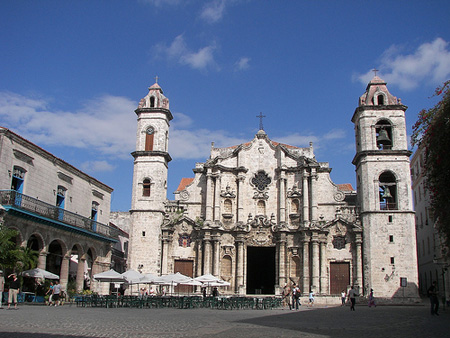
The dialogue between the government of General Raúl Castro and the top hierarchy of the Catholic Church continues to generate discussions between different opposition groups and the independent civil society sectors. It was expected that half a century of stagnation would bring, as its first consequence, the creaking of rusty hinges when trying to turn on any mechanism of this old obsolete machinery, as it also seems logical that, since it’s been going in reverse, now it’s really hard to move forward.
It is not easy to search and find consensus in a country orphaned of civility and freedoms for such a long time. Most Cubans today have never participated in genuine elections, we have not been activists in a real political party, we have no unofficial places for public debate, we have no free access to information and communications, nor have we enjoyed any the benefits of democracy, but the worst part of all of that is that we haven’t been free. Just like fearful and ignorant slaves, there are those who would not even know what they would make of their lives when the day comes when they have the freedom to fully put their lives in order. That is Cuba’s sad reality, inherited in great measure from 50 years of dictatorship, but also because of 400 years of history that show what costly results triviality and irresponsibility can have on a country.
The moment Cuba is living through has peculiar elements that mark a before and an after. Each analysis can take what it considers a landmark as a guideline, whether the accumulation of elements in the overall socioeconomic and political crisis, the struggle of dissent within the country, the death of Orlando Zapata Tamayo, the hunger and thirst strike of Guillermo Fariñas, the sustained and courageous action of the Ladies in White, and the increased activity of alternative journalism in all its forms, among other factors, and others that may be unintentionally omitted here. This “before and after” could assume any of these factors, seemingly isolated, as a reference point; however, the pulley that has come to unite some pieces and has helped initiate the rotation of the mechanism has been the Catholic Church. That is a fact.
Just as circumstances present themselves -or how they are broached from all the factors that have had an influence on them- I think that now it is more realistic to weigh the indisputable: changes are taking place and the mediation of the Catholic Church is an important factor in this. Thus, far from taking note of idealistic solutions intended to satisfy the vanity of one or the other opposition leader or overestimating the importance of sectors of the emerging civil society (in which in my own activity as a blogger is included) and, at the same time, without denying the validity of all elements in their own performance, I prefer to take into consideration how positive the Church’s role in this process can be, and how much it could contribute
Some people criticize the mediation in the figure of Cardinal Jaime Ortega, alleging he has never supported the opposition, never visited the prisoners or delivered against the excesses of the dictatorship, which is not fully consistent with reality (let’s recall, for example, the famous pastoral letter “The Motherland Belongs to All”, a document that had great resonance in 1992). As for me, I am not –nor anything of the sort- a fan or even an admirer of His Eminence, but such disqualification could also be applied to the vast majority of the Cuban people, accustomed to fearfully look the other way in the presence of an act of civic courage or in the actions of repressive forces against defenseless citizens; the list of those who can attest to this experience would be endless, both inside and outside Cuba
On the other hand, those who disqualify the Church as a mediator today seem to forget how, throughout all these years, even though most Cubans applauded (we applauded) in the presence of speeches and stages, while religious belief was an unforgivable taboo, while the religious of any tendency were excluded and condemned, and while all of society galloped towards the loss of moral and human values, the Catholic Church was a bastion of solidarity among Cubans of sincere faith, a space for the conservation of the best values, a veritable hive where the work in support of families, Cuban culture, and in upholding its principles under very adverse conditions never stopped. The Cuban Catholic Church was a hotbed of resistance against the communist totalitarianism of this dictatorship from the very beginning, before any of the opposition parties we know today, and it was tolerant and inclusive, while in Cuban society intolerance and exclusion were being imposed.
Many parishes have been carrying the discourse of resistance that few dared to listen to, and much less to speak of, and they have established themselves as promoters of many areas of education, social and academic exchanges and of formation of values. The Catholic Church has been working quietly and patiently for the reconciliation of the Cuban people, while the regime -and others- have dedicated themselves to turn us one against the other. To deny this would be not only an injustice, but also a fallacy.
It is clear that the Church is not a perfect institution and that it does not represent all of us in everything, it has also committed errors and even injustices, but it has also offered its space as a refuge amid the storms. If not, let the Ladies in White, who go to the church of Santa Rita every Sunday say it, let the Cubans who have found the support, charity and solidarity they were missing say it, let the thousands who are gathering spontaneously in the Churches in Cuba to receive, in her pilgrimage throughout the Island, the Patron Saint of Cuba, Our Lady of El Cobre, able to gather, because of their unique status as Cubans, believers and non-believers in the simple avocation of their love for Cuba say it. What other institution in this country would be capable of that? I’m not a believer in the least, I am barely an agnostic, forged in the strictest atheism, who has overcome the denial and pretends to be fair. In addition, since I wish the best for Cuba and Cubans, I support anything that helps to break down the wall.
That’s why I ask those who now oppose the mediation of the Church (I speak of the institution, not its leaders) and who, in addition, accuse her of being “a traitor to the people,” “opportunistic” and other similar epithets, to mention the reasons and accusations to expose to public opinion objectively, who they consider to be the stakeholders they feel might be sufficiently consolidated in Cuba, with the prestige and permanence needed to represent a large portion of the Cuban population, what programs these actors are proposing for change and the phases for transition.
Let those who oppose the Catholic Church-Government dialogue state if they believe that the people can delegate, right now, with full knowledge of cause, in any of the opposition parties and independent civil society groups beyond the sympathy that our struggle for democracy might stir. But above all, let’s be realistic: the Cuban crisis is not going to be resolved in the short term, a transition is a long and complex process to which actors are incorporated as they gain influence and prestige in national public life. Rather than struggle for a position or a prize, it’s time to take advantage of venues that are opening up, and to support actions that promote positive changes in order to be able to enhance the discourse of the current opinion leaders and the emergence of new ones, the birth of new ideas, civic forces and of comprehensive proposals in which we all may participate (including those who, until now, have not participated). Let nobody think that it will be easy, but let’s not make it any more difficult.
Translator: Norma Whiting
August 31, 2010
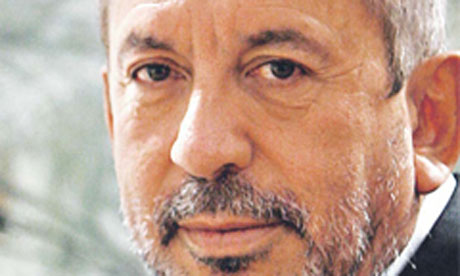 Chilean businessman Joel Max Marambio Rodríguez faces a deadline of August 23rd to appear before the Inspector from the Ministry of the Interior (MININT), Lieutenant Colonel Francisco Miguel Estrada Portales. If he does not appear before the time runs, the criminal proceedings initiated against him could proceed to a final judgment of guilt.
How does an intimate friend and protegé of the elder Castro reach this point, managing the business of a holding company that moves more than 100 million dollars a year? Why would a friend of the revolution for more than 40 years become its adversary?
There are still many unanswered questions, some of which will be answered in the course of the trial, where the Chilean businessman will apparently be tried in absentia and evidently he holds the key to the box of secrets. Marambio, age 63, a former bodyguard of ousted President Salvador Allende and former friend of Fidel Castro, is accused by the Cuban government of the crimes of bribery, acts detrimental to economic activity or employment, embezzlement, falsification of banking and commerce documents, and fraud.
 The businessman, owner of International Network Group (ING), was a partner of the Cuban state in the joint venture “Río Zaza Foods,” specializing in the production of juices, dairy products, and alcoholic beverages for the Cuban market and abroad. In late 2009, the Auditor General, a state body subordinate to the State Council, chaired by Army General Raul Castro, began investigating the leftist entrepreneur’s businesses on the island.
Unofficially, he was linked to a corruption scandal involving the deposed director of the Institute of Civil Aeronautics of Cuba (IACC) and Major General Rogelio Acevedo.. Max Marambio and his brother Marcel, were also partners of the IACC in the Sol y Son tourist agency. Several directors of the company were arrested, accused of paying kickbacks, misappropriating funds, and diverting resources abroad. Lucy Leal, executive director of ING, was arrested and is being investigated.
Authorities have not officially said anything about the scandal. In April, however, they acknowledged that Marambio’s companies were under investigation, when one of the managers of Rio Zaza Foods, the Chilean Roberto Baudrand, age 59, under house arrest and being subjected to interrogation, was found dead in his apartment. The Cuban autopsy, accepted by the family of the deceased, said the cause of death was respiratory failure combined with the consumption of drugs and alcohol.
Marambio, known in Cuba as “The Guaton” (the fat man) was summoned and questioned by Inspector Estrada Portales, in late April and early August. The officer is in charge of the investigation. The summonses were published by means of two MININT notices in the Official Gazette of the Republic of Cuba, the agency that discloses the laws and governmental acts on the island. To date, he has not appeared.
The Summons was issued on July 19. In it, the MININT inspector summoned the Chilean businessman to appear before him on the 29th, warning him that if he did not appear on the date indicated, an indictment would be issued on August 3. Officer Estrada Portales ordered the police agencies and State Security to search for, apprehend, and present Marambio within 20 days.
The summons expires on August 23rd. If the deadline passes without his appearance or presentation, he will be declared in default. In the case of crimes against the fundamental political or economic interests of the nation, the Cuban judicial system provides that proceedings against a defendant declared in default can proceed to a final decision.
The judicial system in Cuba offers few safeguards for defendants. The criminal case against him is in the preparatory phase, when pretrial proceedings are conducted. If Marambio returns to the island he is most likely to end up in jail, as a precautionary measure to secure his appearance. Until then, he cannot appoint a legal representative for his defense.
Everything seems to indicate that the legal route will be the means of settling accounts. The publication of the summons and indictment in the Official Gazette of the Republic of Cuba is a formal requirement. The island’s government does not intend to pursue the businessman internationally.
The aim is to declare him in default and try him in absentia. In that case, he could appoint a lawyer. He could also appear at any time and revoke the declaration. He could even void the final judgment against him and be heard in a new trial. Marambio could be a time bomb for the Castro brothers. For what he knows and for what he has been quiet about. We suspect he will not return.
Iván García y Laritza Diversent
Translated by: Tomás A.
August 23, 2010