The team, led by Alexander Urquiola, failed against Curaçao, in the Bahamas / Jit / Giovanni Martínez
14ymedio/Swing Completo, Havana, 28 October 2024 — Island baseball continues to add disappointments. Curaçao beat Cuba 2-1 this Sunday at the Andre Rogers stadium, in Nassau, capital of the Bahamas, and thus took away the possibility of competing for the gold medal in the Caribbean Cup. “Without a doubt, it is another major failure in the international arena,” published the specialized media Pelota Cubana USA.
italics
The same publication detailed that despite the fact that the selection, led by Alexander Urquiola, was made up of several young figures, “many with inexperience in Cuban teams, it was not a tournament to be left out of the title discussion.”
The defeat against Curaçao shows that the sport, once king on the Island, “requires work, resources and above all respect,” warns Por la Goma in its Facebook post. “We should have removed the blindfold a long time ago,” emphasizes journalist JuanK. continue reading
The same publication specified that while the Provincial Series are suspended in Cuba, there is a lack of balls for practice from the lower levels, and they stopped “two months ago paying the players their salary of 3,500 pesos.” In Curaçao “they play baseball all year round,” and they have a professional league and lower categories.
In addition, the author urges, we must stop thinking that the rival teams “do not have the same history” as the Island: “We must understand that history is not lived, and that while we are analyzing how to create a National Series, all the other countries are preparing and inserting themselves more every day into the world elite.”
The Cuban baseball team during their performance against Curaçao at the Andre Rogers stadium / Jit / Giovanni Martínez
The official media Jit pointed out that two “failures” – the games lost against the Virgin Islands and Curaçao – led the national team to the match against the Dominican Republic for the bronze medal.
The defeat against Curaçao was taken by José Ignacio Bermúdez after allowing two runs and scoring four opponents. For his part, Randy Martínez, from Pinar del Río, got outs without allowing hits, one of them thanks to a strikeout. The hope for Cuba in the Bahamas is the bronze medal.
As for the U-12 team, this Sunday they defeated Panama 5-1 in a match played at the Rod Carew stadium and got a third place in the Pan American Championship.
Prensa Latina highlighted the offensive actions of Humberto Alfonso and Alan López, both with a couple of trailers, and Alex Batista. Also, Barrero hit a single and double, and victory was credited from the mound.
Translated by Regina Anavy
____________
COLLABORATE WITH OUR WORK: The 14ymedio team is committed to practicing serious journalism that reflects Cuba’s reality in all its depth. Thank you for joining us on this long journey. We invite you to continue supporting us by becoming a member of 14ymedio now. Together we can continue transforming journalism in Cuba.
14ymedio, Havana, 28 October 2024 — A Colombian woman linked to a Cuban migrant trafficking network was sentenced this Sunday to four years and two months in prison. Gloria Milena Álvarez Quinchía will also have to pay a fine equivalent to 1,383 dollars.
According to the evidence provided by the Attorney General’s Office, Álvarez Quinchía took advantage of her work in a hotel in Medellín, Antioquia, to facilitate the lodging of irregular migrants, mainly Cubans, on their route to the Gulf of Urabá, from where they continued to Panama and then to the United States.
The Specialized Directorate against Human Rights Violations, which led the investigation, pointed out Álvarez Quinchía as the one in charge of operating the logistics to host and facilitate the land transport of irregular migrants to Capurganá, in the department of Chocó.
Coyotes charge between 150 and 350 dollars for each migrant for taking them in speedboats from Capurganá to Panama, through the Darién jungle, in search of the American dream.
Álvarez Quinchía was arrested in May 2022 along with 10 other people allegedly involved with a network of coyotes. According to official data, up to August of this year the illegal entry of 273,142 people into Colombia was recorded. continue reading
Some migrants sleep on mattresses on a street in Turbo; the photo is from June of this year / EFE
Coyotes exploit several routes for migrant trafficking. Among them is the Darién jungle, through which as of May more than 70,000 migrants had crossed on their journey to the United States.
More than 520,000 migrants crossed the Darién in 2023. Venezuelans (328,667), Ecuadorians (57,222), Haitians (46,558) and Chinese (25,344) “were the most recurrent nationalities to cross,” according to data from the Panamanian Ministry of Public Security.
Illegal trafficking is quite profitable, and in Colombian regions such as Necoclí, Turbo and Acandí, the coyotes use boats for transport. The New York Times reported that migrants pay $40 for a boat ride from Colombia to get to the rainforest.
“A guide that takes you along the dangerous route when you start walking: 170 dollars. Someone who carries your backpack in the muddy hills: 100 dollars. A plate of chicken with rice after a day of laborious climbing: 10 dollars. Special packages with everything included to make the risky effort faster and bearable (with stores, boots and other basics): 500 dollars, or more,” published The New York Times in 2023.
Translated by Regina Anavy
____________
COLLABORATE WITH OUR WORK: The 14ymedio team is committed to practicing serious journalism that reflects Cuba’s reality in all its depth. Thank you for joining us on this long journey. We invite you to continue supporting us by becoming a member of 14ymedio now. Together we can continue transforming journalism in Cuba.
A report by the Spanish newspaper ’El Debate’ points out several findings by the Bolivian Prosecutor’s Office
Morales is being charged with the crimes of statutory rape and human trafficking / EFE
14ymedio, Mexico City, 28 October 2024 — A group of Cubans with diplomatic passports guarded a house in La Paz where former Bolivian President Evo Morales allegedly sexually abused underage girls. This was revealed by El Debate on Monday, in a report presenting several pieces of evidence of the investigation that judicially corners the former president.
According to the Spanish online newspaper, it is a residence where Morales supposedly claimed to have undergone some unspecified medical treatment and that in reality, it was a cover. “The house was guarded by people who claimed to be Cuban doctors”, says El Debate, but, according to the investigation by the Bolivian Prosecutor’s Office, ‘they were Cubans with diplomatic passports who were discharged from the Embassy’ of the island.
Another exclusive of the report is a series of photographs showing Noemí Meneses Chávez, one of the teenagers with whom the former president had relations, crying and with bruises on her body. This would prove, according to the newspaper, that high-ranking police officers stopped an investigation against Morales for physical violence. continue reading
According to the Spanish digital newspaper, it is a residence where Morales allegedly claimed to have undergone some medical treatment
The case of Meneses Chávez, now 23 years old, was discovered by chance in July 2020, during a routine control. The young woman was, together with her sister and a driver, on board an official vehicle of the Government of Cochabamba that had been stolen several years earlier.
They discovered in her phone, seized by the police, messages exchanged with Morales that showed that the two had been in a relationship since she was a minor. In addition to the written material, they also found dozens of photographs where Evo and “La Noe,” as he referred to her in private, pose together in a multitude of everyday situations typical of a couple.
Another case involving Morales being investigated for human trafficking and rape is that of Cindy Sarai Vargas Pozo, who was declared missing last week along with her daughter – allegedly fathered by Evo Morales and now eight years old.
The main evidence in this investigation is the baby’s birth certificate, dated February 8, 2016, at 11:12 a.m. in Yacuiba, southern Bolivia. The document reflects that Juan Evo Morales Ayma, the former president’s full name, acknowledged being the girl’s father.
Vargas Pozo met Morales when she was only 14 years old when she was part of the controversial “youth guard” of the Movimiento al Socialismo (MAS), the former president’s party, consisting only of minors.
In addition to the residence guarded by the Cubans and the presidential plane itself, on occasions the minors were taken to the Mamá Diablo bar
In addition to the residence guarded by the Cubans and the presidential plane itself, the minors were sometimes taken to the Mamá Diablo bar, also in the Bolivian capital, where they were forced to consume alcohol, according to the testimony of a former bodyguard of Morales, reported by El Debate.
This source stated that Morales ordered the bar closed to ensure his privacy and that of his companions, about whom he did not provide their identities or further details. The person in charge of making these arrangements was Patricia Hermoso, who served as Morales’ chief of staff during his last term in office, according to the testimony of the former collaborator of his security team.
Other Bolivian politicians authorities have stated participated in the abuse network led by Morales include former vice-president Álvaro García Linera, former ministers Carlos Romero, and Sacha Llorenti, as well as Andrónico Rodríguez, president of the Senate, and Senator Leonardo Loza.
Since early October, when the Attorney General’s Office announced that it would resume investigations against Evo Morales, his supporters have led more than 20 consecutive days of protests and blockades throughout the country.
The former president was shot at on Sunday, in an incident in which his driver was injured. On Monday, Morales blamed the incident on President Luis Arce and accused him of trying to “eliminate” him to wipe out the MAS.
Meanwhile, the president of Mexico, Claudia Sheinbaum, expressed her solidarity on Monday with the former Bolivian president. Morales was welcomed as an asylum seeker in 2019 by the government of her predecessor, Andrés Manuel López Obrador, after Morales’s forced resignation due to his involvement in electoral fraud.
“We condemn it, our solidarity with Evo Morales and always a call to avoid violence. Let it be peace and political definition. Our condemnation, our solidarity and always the pursuit of peace and non-violence,” Sheinbaum said at a press conference.
Translated by LAR
____________
COLLABORATE WITH OUR WORK: The 14ymedio team is committed to practicing serious journalism that reflects Cuba’s reality in all its depth. Thank you for joining us on this long journey. We invite you to continue supporting us by becoming a member of 14ymedio now. Together we can continue transforming journalism in Cuba.
A resident of San Antonio del Sur confronts Díaz-Canel: “They left us alone”
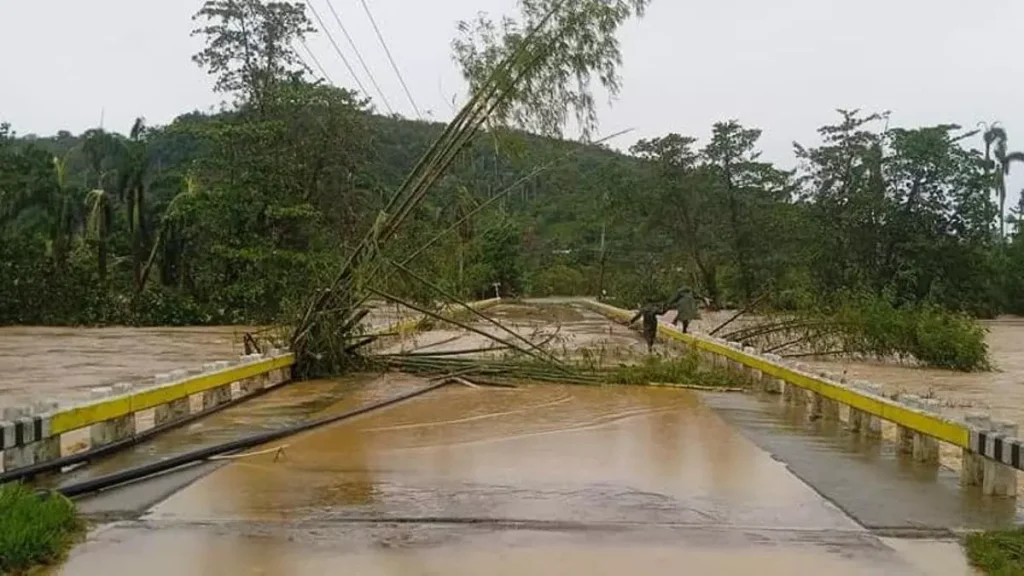
From the afternoon to the night, between Sunday and Monday, the dams in Guantánamo overflowed / Facebook/Daniel Ross Diéguez
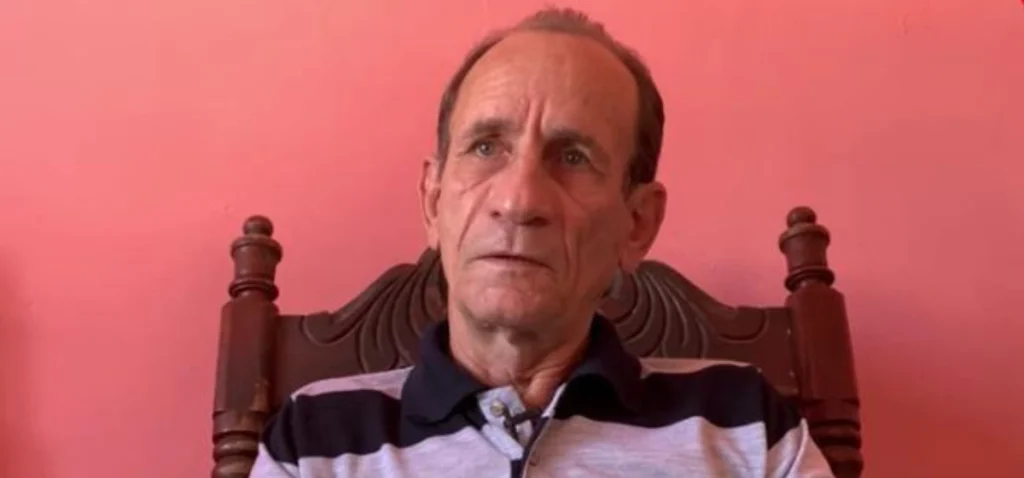
14ymedio, Havana, 24 October 2024 — Four days after the passage of Hurricane Oscar through northeastern Cuba, there are communities that are still isolated, and it has not been possible to determine a total account of the number of victims. Everything points to the Government’s negligence as one of the causes of the tragedy. “The Defense Council of San Antonio del Sur was not activated in time, and they did not know what they were facing. They were surprised by the overflow of the dam in the middle of the night. The current number of missing people could have been avoided,” says filmmaker Daniel Ross Diéguez, from the city of Guantánamo, in a Facebook post.
At the local government headquarters of the Popular Power, he sent an audio to his friends to which 14ymedio has had access. There is a list of the inhabitants of the municipality of Imías, which remains isolated this Thursday. “The only communication comes from those who went on foot to see what happened,” explains the visual artist, who is also trying to locate several relatives.
“They took notes and put down the names of those who are alive and sent them with someone,” he says. “And so they censor the map of the disappeared.” According to the artist in the same audio, there are 76 missing but there could be more. “The figure is large,” because the coastal municipalities of San Antonio and Imías have a large population. “Many who were able to return say that they saw people climbing the mountains, and we have to start looking for them.” continue reading
According to the artist in the same audio, there are 76 missing but there could be more
In the same message, Ross Diéguez criticizes: “There are immediate things that could have been done and were not done, and others that were done too late.” According to his story, days before Oscar’s passage it was reported that its intensity was decreasing, and after the collapse of the electro-energy system on Friday, since there was no connection or news, the inhabitants of those communities were left with the idea that it would not be serious.
“Those people unfortunately didn’t know anything for three days and suddenly began to see a wall of rain.” They realized, at dawn, that water was flooding the houses. Those who could took refuge on the upper floors.
Ross Diéguez explains that the geography of Guantánamo, with thousand-meter high mountains that act as “cloud harvesters,” had a lot to do with the catastrophe. “When a hurricane passes, it retains water and weakens very slowly because it’s hot, and this generates three times the rain that it already brings,” he explains. And so it happened: from the afternoon to the night, between Sunday and Monday, the dams overflowed.
According to the official press itself, the Los Asientos reservoir, in San Antonio del Sur, “overflowed with 17.5 million cubic meters of water.”
“Uunfortunately, the Defense Council could not be activated because there was no electricity,” Ross Diéguez continues, and the Armed Forces (FAR) “were not intelligent.” They could have used a radio that “does not need internet or a connection,” to warn of the dam’s overflow, but they didn’t have one. Nor did they think of reserving fuel to send a vehicle and warn these towns. “People didn’t know what it was; they didn’t understand what was happening to them. Lives could have been saved.”
So far, the official calculation is seven fatalities, six in San Antonio del Sur – including a five-year-old child – and one in Imías.
“We used to complain before, but we had no idea how lost this Government is”
This Thursday, the FAR claims to be chartering helicopters to bring food to areas without access. The shortage of food and the poor organization are also denounced by Ross Diéguez. “There was rice and other food in warehouses that they did not distribute at the time, and it spoiled. “One wonders why they didn’t give that in advance also, if we were starving. Here they still owe* September’s rice,” he claimed.
“We used to complain before, but we had no idea how lost this Government is,” concluded the filmmaker, who recalled the number of crops lost in the Caujerí Valley, “where more fruit is grown in Cuba, where more food is contributed,” he noted, “and not just for export.”
This Thursday, the newspaper Venceremos gave a devastating account of the losses. About 75,000 cans of coffee were lost in Maisí. “All coffee plantations suffered the hurricane’s impact, with damage of different magnitudes,” says the official newspaper, which documents “significant damage” to yams, malanga, cassava, beans and, above all, bananas.
More than 70% of the banana plantations and 3,502 hectares of cocoa in Baracoa “suffered damage, from mild to strong,” as did the 481 hectares of coffee. Another crop that suffered great damage was coconut, in the Güirito-Mata-Guandao basin, “with the collapse of a considerable number of plantations and the loss of production.”
The situation is such that the Central Bank of Cuba has made public several account numbers – in the Banco de Crédito y Comercio (Bandec), in the Banco Popular de Ahorro (BPA) and in the Banco Metropolitano – to receive donations, in pesos, for the victims. “Transfers can be made through electronic payment channels: ATMs, Transfermóvil or by depositing cash at any bank branch,” it says in a statement.
For his part, Miguel Díaz-Canel could clearly hear the summary of what happened in these territories from the mouth of one of its inhabitants, during his official visit to San Antonio del Sur. “They didn’t take all the measures to evacuate us; they left us alone there,” a man reproached him, kind but desperate.
“Who left them alone?” the president asked with a frown, stuttering before the citizen who dared to confront him. “The Government,” replied the good neighbor. “There was no one to rescue us.” The man had to help remove, he said, up to 29 children who were refugees in a school, along with the rest of the population. Díaz-Canel tried to explain: “They took all of you to the school precisely because of the evacuation; what happened is that the phenomenon was worse than expected.” The man insisted that they were left without any equipment to evacuate people “in case the river got in.” The president settled the brief dialogue by promising, “We’ll investigate that.”
*Translator’s note: “Owe” refers to not having distributed the rice sold through the State rationing system, almost certainly because the bodegas (ration stores) had not received the rice.
Translated by Regina Anavy
____________
COLLABORATE WITH OUR WORK: The 14ymedio team is committed to practicing serious journalism that reflects Cuba’s reality in all its depth. Thank you for joining us on this long journey. We invite you to continue supporting us by becoming a member of 14ymedio now. Together we can continue transforming journalism in Cuba.
His return could cause a new inclusion of Cuba on the list of countries that do not cooperate with Washington’s anti-terrorism efforts
Luciano Marín Arango, alias ’Iván Márquez!’ in a 2018 image / EFE / Leonardo Muñoz
14ymedio, Havana, 26 October 2024 — Cubans got used to the face of Iván Márquez – the nombre de guerra of the Colombian Luciano Marín Arango – for his presence in Havana as a negotiator for peace, on behalf of the Revolutionary Armed Forces of Colombia (FARC). Now, however, he will not be able to return to the Island, whose authorities – according to the newspaper Semana – claim that receiving a fugitive from justice could bring diplomatic complications with Washington.
Havana, explains the Colombian newspaper without identifying its source, “let it be known” that Márquez’s return, with arrest warrants from the US Department of State, may cause a new inclusion of Cuba on the list of countries that do not cooperate with Washington in its anti-terrorism efforts. Cuba was taken off the list last May.
Márquez was supposed to participate in the second cycle of peace talks between the Colombian Government and the Second Marquetalia – one of the dissident movements of the FARC, which did not adhere to the peace agreements signed in 2016, in which Márquez was one of the most visible faces. His whereabouts are unknown, and there are rumors that he is dead or that he took refuge in Venezuela. continue reading
Márquez was supposed to participate in the second cycle of peace talks between the Colombian Government and the Second Marquetalia
Before the claims to clarify the situation, Otty Patiño, High Commissioner for Peace of the Colombian Government, assured Semana on Wednesday that it is “speculation” to state that Márquez is dead, but he did not dare offer a “a definitive confirmation” that he is alive. “No one has seen him nor has he talked to the leader of the Second Marquetalia,” he said, citing a source “close to Márquez’s circle.”
The Second Marquetalia and the Government of Colombia agreed to advance the dialogue in Havana this month due to the demonstrations that have been held in the country “to express the need for peace to be based on territorial considerations,” said Bishop Héctor Henao, who participates in the dialogues representing the Episcopal Conference. Henao said that the first cycle of dialogues had given positive results and achieved a de-escalation of the conflict, an objective that they now hope to deepen.
Márquez, who took up arms again in 2019 and assumed the leadership of the dissident guerrillas, was said to have fled to Venezuela during Iván Duque’s mandate. Gustavo Petro’s Administration has denied having information about him, a fugitive from justice since he declared himself an insurgent.
During the negotiations, the official Cuban press presented Márquez as the main spokesman and the leader of the FARC abroad. Communist since his youth, he studied in the Soviet Union and joined the guerrillas in 1977, where he held several positions. He participated in the peace agreements discussed first in Oslo and then in Havana, and refused – after signing in 2016 – to occupy a position as a congressman. The FARC were guaranteed, to become a political movement, five seats in the Senate and as many others in the House, for two sessions.
In 2018, Márquez settled in southern Colombia, without the escorts that the Government had assigned to him for his protection. The following year, he regrouped with several dissident leaders and declared the beginning of the Second Marquetalia, “a new stage of struggle” against the “crooked State” that took away their weapons.
Duque, during his mandate, said that Márquez was counting on the protection of Nicolás Maduro
Duque, during his mandate, said that Márquez was counting on the protection of Nicolás Maduro. Caracas has never confirmed the presence of the guerrilla in Venezuela, but in 2019 it confirmed that its doors were open. In 2022, Márquez suffered an attempted assassination. Since then, rumors about his death have not stopped circulating.
Márquez is wanted by Interpol and Washington, which is offering ten million dollars for information leading to his capture. He is also accused by the Colombian Prosecutor’s Office after having committed violent acts in recent decades, and the Supreme Court of Justice sentenced him last March to 41 years in prison for homicide and terrorism.
Last May, Márquez surprisingly reappeared in a video supporting the Constituent Assembly proposed by Petro. According to several sources, Petro wanted Márquez to participate in the Havana peace talks this year. No high-ranking official of the regime has confirmed, for the moment, if he will be able to return to Cuba.
Translated by Regina Anavy
____________
COLLABORATE WITH OUR WORK: The 14ymedio team is committed to practicing serious journalism that reflects Cuba’s reality in all its depth. Thank you for joining us on this long journey. We invite you to continue supporting us by becoming a member of 14ymedio now. Together we can continue transforming journalism in Cuba.
On each trip the ‘mules’ make a profit of 200 dollars after investing 1,000 in the purchase of clothes
Mexican merchants have refined their sales strategies for “hooking” Cuban buyers.
14ymedio, Yankiel Gutiérrez Faife, Camajuaní/Cancún, 26 October 2024 — Daniela’s passport is a record of her visits to Venezuela, Serbia and Russia. This particular “silk road” – she has worked as “mule” on and off for years – now leads to México, a country that only opened its doors to her after an arduous, convoluted process. Two friends — Illiana and Lucía — accompanied her on a Viva Aerobús flight. When they got to Cancún, they were met by Ramiro, a 62-year-old Mexican who took them to a hostel whose name could not have been more ominous: La Cubana.
The name is no coincidence. Nor is the swarm of taxi drivers who harass newly arrived passengers at Terminal 2 of the Cancún airport. They are on the lookout for Cubans who have come here come to shop.
“Bus to downtown Cancún for only 150 pesos,” someone shouts. “We’ll take you to the hotel in a new Mercedes,” another adds. The onslaught is incessant and the network of businesses surrounding the airport – lodging, transportation and food – is still growing. Cubans who come here to shop do so because they can. And the Mexicans know it.
In fact, the first thing Daniela had to prove to the Mexican embassy in Havana was that she was financially solvent. The process is cumbersome and scheduling an appointment usually takes awhile. She was lucky, however. Or at least she thinks so. She signed up in late November 2023 and did not hear back until September 6, when she got an email with the date and time of her interview.
“I don’t even remember signing up,” she now says. She had deleted the file from her mental datebook. Assembling the required documents was also a challenge. The bank statement, title to her house and photos arrived on September 12, just in time. continue reading
Daniela’s trip can be described in three significant numbers: 290 dollars, the cost of her flight; 23, the weight in kilograms that she was allowed to bring onto the plane; and 10, the capacity (also in kilograms) of her handbag. For a trip like this it is essential to know these figures. And you must have a clear plan so as to avoid unforeseen circumstances.
The merchandise is cheap, perhaps even attractive, but rarely of good quality / 14ymedio
A three-night stay in a shared room with private bath at La Cubana cost them 500 Mexican pesos per person, or about twenty-five U.S. dollars. They contacted Ramiro several days before arriving after seeing an ad on Facebook. He turned out to be a good host, which they could tell from their first first meal, consisting of rice, pork and salad. But like everything in Cancún, kindness comes at a price. The meal cost Daniela and her friends an additional 120 pesos, plus 5 pesos for coffee and 20 pesos for a bottle of mineral water in the room’s fridge.
With no time to spare, the three women set out to explore the shops in the immediate vicinity of the hostel. These amounted to a handful of shops with little room to spare or regard for aesthetics, scattered along Uxmal Street. However, this is where you can find everything that Cuba lacks. With the air conditioning turned up to full blast, each shop contains mountains of clothing, equipment and household items.
The merchandise is cheap, perhaps even attractive, but rarely of good quality. But the Cubans are here to find good deals. They say hello, ask questions, get to know the vendors and drive a hard bargain. They leave loaded with bags full of sweaters, jeans, underwear, socks, handbags and tennis shoes. Everything is counterfeit but so what?
After living under Castro rule for nearly seventy years, Cubans are hard to impress, though Mexico often can. “We got into a car at Plaza of the Americas,” says Daniela. “The driver told us his name was Yamil. He said he could get us work and Mexican residency.” The women took it as a joke and laughed hysterically. They got out at a shoe store run by a Cuban who told them they had risked their lives by accepting a ride from that “friendly driver.”
“It turns out he was a very influential narco-trafficker in Cancún,” says Daniela. “We would never have imagined we were talking to someone like that.”
Mexican merchants have refined their sales strategies for “hooking” Cuban buyers. One is to play reggaeton at full volume, which lends a certain liveliness to their stores and attracts customers. Prices vary and, if a mule is naive, she or he will take the bait before finding the best value for the money.
Cubans are here to find good deals. They walk in confidently, say hello, ask questions, get to know the vendors and drive a hard bargain / 14ymedio
In just one afternoon, Daniela and her cohorts added to their inventory eight pairs of Crocs at $3.70 a pair; five pairs of Nike tennis shoes ($6.50); ten hair dyes ($1.30) and three men’s shorts ($3.10). The Crocs are not Crocs and the Nikes are not Nikes but in Cuba they can be sold as such.
Browsing through the shops in Cancún, they came across a business called El Cubano. It is run, of course, by a Cuban determined to honor certain tenets of his island. He is expected to play loud music and to know how to get things done. Elier was born in Güira de Melena, a town in Artemisa province, and emigrated to Cancún two years ago. His store now carries items he picked up in Belize.
“All you need to cross the Mexican border into Belize is a permit. From there, you can send your purchases to Cancún through an agency. It only takes 24 hours,” says Elier, a goldmine of tricks the mules can use. The Cuban emigré had no idea what life was like in Mexico but thought staying here was a good idea. Other Cubans have followed suit. “This could be called Little Havana, like in Miami,” he jokes.
“With their suitcases packed with goods they plan to sell in Cuba – now a wasteland after the nationwide blackout – Daniela, Iliana and Lucía returned to Havana. A forty-minute flight might seem short but the stress makes it feel long and overwhelming. At any moment, using any pretext, Cuban customs officials could confiscate their cargo.
“Sometimes they bully you. Other times they extort you or open your suitcases,” complains Daniela. Once the three women get past the “sharks” at the airport, each item in the suitcases must be inventoried, priced and advertised. To figure out the retail price of each article, Daniela used to multiply by three. For example, a pair of pants that cost $10 in Cancún could be sold for $30 in Cuba. But now, Daniela laments, the profit margin is lower. She now only multiplies by two. The pair of pants that used to go for $30 now drops to $20 – 6,500 pesos at the informal exchange rate. On the other hand, they sell faster.
After selling what she brought back from Cancún, Daniela grossed 1,220 dollars. From that, she had to subtract $610 for the cost of the merchandise, $290 for the cost of the flight, $50 for local transportation in Mexico and $25 for lodging. Though that left her with only $220 to spare, she is satisfied. “I think $200 in profit is enough,” she says.
Cuban emigrés living in Cancún make their living by selling clothing to “mules.” / 14ymedio
There is no shortage of customers. Some think they can use what they buy. Others will resell every item they acquire. Daniela may be just one link in a retail chain whose limits no one can fathom.
Daniela may be just one link in a retail chain the extent of which no one can fathom.
The Achilles heel of this business is that no one is willing to pay full price. Everything is purchased in installments and the process can sometimes take a month or more. “This is the life of a mule,” Daniela grumbles, “The money comes in drop by drop.”
____________
COLLABORATE WITH OUR WORK: The 14ymedio team is committed to practicing serious journalism that reflects Cuba’s reality in all its depth. Thank you for joining us on this long journey. We invite you to continue supporting us by becoming a member of 14ymedio now. Together we can continue transforming journalism in Cuba.
Phosphorescent vests, rechargeable headlamps, flashlights or even traditional oil lamps are used to move around the city
At night and seen from above, the city is an expanse of darkness / 14ymedio
14ymedio, Mercedes García, Sancti Spíritus, 26 October 2024 — A couple crosses paths with a friend on one of the main streets of the Kilo 12 neighborhood in the city of Sancti Spíritus. They can barely see each other, because the lack of public lighting has forced the young man, who runs into them head-on, to wear “a miner’s headlamp.” When the man greets them they are dazzled by the light that, in the midst of absolute darkness, leaves them, for a few seconds, disoriented and stumbling over the holes and cracks on the sidewalk.
“People have already given up on the street lighting,” the woman admits. “If we get used to having electricity inside our homes only a few hours a day, then what happens when we have to go outside at night?” she asks this reporter. “What most people do is stay home, but we go to eat at my mom’s house two or three times a week, and we have to walk back because there is no transportation at that time.”
Phosphorescent vests, rechargeable headlamps, flashlights or even traditional oil lamps are used to move from one point to another in the city, to avoid stumbling into a pothole or breaking a leg after falling into an uncovered sewer. Some are guided by the light coming from houses that are are lucky enough to have electricity at that time, and others take advantage of the headlights of vehicles that pass to detect the nooks and crannies of the road in front of them. continue reading
Some are guided by the light coming from houses that are lucky enough to have electricity
“My brother sent me this miner’s headlamp, and it helps a lot,” Susy, a 42-year-old resident near the historic center of Espírito, told 14ymedio. “I use it if I have to go out at night, but also in the house to scrub my floor during the blackout, make food or wash my daughter’s uniform for the next day of school.” When the light is placed, clinging with elastic bands to her head, Susy acquires a strange appearance and knows it: “I’m like a firefly; I carry my own light.”
Without public lighting, residents in the city of Sancti Spíritus have come to the conclusion that everyone must provide his own light when going out at night. A long time ago, like the rest of Cubans, they gave up depending on the ration system’s basic family basket for food; they stopped waiting for the Electric Union to supply them with constant energy in their homes; they said goodbye to a Public Health system that guaranteed them everything from medical sutures to painkillers, and converted their kitchens to the use of coal or wood, tired of waiting for stability in the sale of propane.
On the list of orders that Susy has sent to her brother in Jacksonville, Florida, she has added two new miner’s headlamps: “one that can be adjusted for a smaller head, like my daughter’s, and another for my husband who leaves at dawn for work and really needs it.” At night and seen from above, the city is an expanse of darkness where tiny little lights move around. Each one is a person who is going somewhere.
Translated by Regina Anavy
____________
COLLABORATE WITH OUR WORK: The 14ymedio team is committed to practicing serious journalism that reflects Cuba’s reality in all its depth. Thank you for joining us on this long journey. We invite you to continue supporting us by becoming a member of 14ymedio now. Together we can continue transforming journalism in Cuba.
The figures, carved from guayacán and ebony, were created between the 13th and 17th centuries
Los Buchillones is also the most significant archaeological site of Indo-Cuban art
14ymedio, Xavier Carbonell, Salamanca, 26 October 2024 — It took almost 30 years for more than 150 pieces of indigenous art from the Los Buchillones site, in Ciego de Ávila, to be described and dated correctly by archaeologists. The merit, however, does not really go to the historians of the Island but to the University of Toronto, Canada, and the Royal Ontario Museum, who were in charge of the scientific study of the figures.
Despite the importance of the discovery, which greatly enriches the vision of pre-Columbian Cuba, the official press has hardly mentioned it. Last Thursday, however, ’Invasor’ explained the controversy over the pieces found in 1995 in Los Buchillones, which had been incorrectly attributed to “groups of farmers and ceramicists.”
Thanks to the scientists of the Isotrace university laboratory, it is now known that the figures, crafted in guayacán [lancewood] and ebony, were created between the 13th and 17th centuries of our era, more precisely between 1220 and 1690; the community remained there after the Spanish Conquest. That, the specialists add, was the “peak moment for ceramics.”
Nor were they created, as was thought, in Los Buchillones, but rather in another settlement located 500 meters from there, in an old salt flat known as La Laguna. This was suspected by Cuban scholars and fans of archeology, explains ’Invasor,’ since many of the pieces had marks that showed that they had been taken from the bottom of the sea or a river. continue reading
As for the typology of the figures, they correspond to the artistic forms that are known from the Tainos. They are ’cemíes’ – gods, ’dujos’ or ceremonial stools, spatulas and trays. Few of the Greater Antilles have so many representative pieces of indigenous art, and in the Cuban context, it also marks a milestone: Los Buchillones is the most significant archaeological site of Indo-Cuban art.
Ebony bowl found in the deposit / Patrimonio Ciega de Ávila / Facebook
Of the sculptures, eight stand out, whose characteristics help to better understand the imaginary and everyday life of the Tainos. They are dark in color, carved in guayacán and ebony wood, whose height ranges between 10.5 (4.1 inches) and 34 centimeters (13.4 inches). You can see in some of them the head and limbs – with emphasis on the male and female genitals – of a divinity, and others are in the form of sexless animals.
They are, judging by their shape and careful symmetry, idols linked to fertility, and that is the name that the most remarkable sculpture has received, 18 centimeters (7.1 inches) high, and of which ’Invasor’ provided a sketch. In addition to sexual symbolism, it contains elements – the representation of a skeleton and a kind of halo, in the manner of Catholic saints – that refer to the passage from life to death and to the notion of time that the Taínos possessed.
It is believed that the vases and bowls also have a ritual character and were used by the Taínos in their religious ceremonies. According to ’Invasor,’ the Canadian specialists recommended “developing a stylistic study of these objects” and continuing the investigation, headed by Cuban archaeologist Jorge A. Calvera Rosés.
Only fragments of Cuba’s indigenous past remain. The few archaeological studies that have been published in the country have given little clarity about the different groups that formed the Indo-Cuban area, and most Cubans have erroneous or outdated notions about their lives, customs and rituals.
A decisive step to understand the religion of the Taínos was taken, in 1947, by the Cuban ethnologist and polygrapher Fernando Ortiz with his book, ’El huracán, su mitología y sus símbolos (The Hurricane, its Mythology and Symbols). Published by the Economic Culture Fund and impossible to obtain in the the Island’s bookstores – it is rare, even in the libraries – Ortiz’s meticulous study of several pieces similar to those found in Los Buchillones allowed us to understand the sacred universe of the Taínos.
Ortiz’s meticulous study of several similar pieces allowed us to understand the sacred universe of the Taínos / Patrimonio Ciego de Ávila / Facebook
Ortiz focused his research on a set of enigmatic sculptures, formed by a human trunk with a head and another creature in its chest with arms crossed in an X. Although the shapes of the “curious figurines” were variable, these elements were the common factor and pointed to a sacred conception of the hurricane, the Father of Winds for the Taínos.
His conclusion was that the idol of the hurricane was “the most typical figure in Cuba,” since he had not found specimens on any other Caribbean island. To explain it, he composed a work that seeks the traces of the cult of the hurricane from Hindu swastikas to Andalusian dances, describing a mythical itinerary practically virgin in Cuban historical studies.
Despite the shortcomings, the field of Indo-Cuban studies offers the researcher a terrain full of novelties and a whole bibliography of pioneers such as Ortiz, who in his time reached the height of classical mythological studies like James Frazer and Joseph Campbell. His personal collection, absorbed – with little care – by the National Library and other state institutions, is a good starting point for the researcher.
“Every archaeological object is in itself a search for an intelligible expression. It is a dead and unearthed being to which its name and life must be returned,” Ortiz then said, before, effectively, giving meaning to his discovery. The more than 150 pieces of Los Buchillones continue, as predicted 100 years ago by Ortiz, in search of someone who knows how to speak in their “own language.”
Translated by Regina Anavy
____________
COLLABORATE WITH OUR WORK: The 14ymedio team is committed to practicing serious journalism that reflects Cuba’s reality in all its depth. Thank you for joining us on this long journey. We invite you to continue supporting us by becoming a member of 14ymedio now. Together we can continue transforming journalism in Cuba.
Beatriz Luengo, co-author of the 11J anthem and wife of Yotuel Romero, talks about the documentary with ’14ymedio’
The film has managed to extend its time in theaters / 14ymedio
14ymedio, Madrid, 27 October 2024 — To finish the documentary Patria y Vida: The Power of Music, its director, Beatriz Luengo (b. Madrid, 1982), says that her parents – she is the daughter of a carpenter and a pharmacy assistant – had to lend her money. This is one of the examples she gives to defend herself from the attacks that usually criticize her and her husband, the Cuban Yotuel Romero, also co-author of the song that became an anthem of freedom, charging that they do all this for money. “There are many things I can do in my country, which I have earned with my 20 years of work effort. The cause of Cuba is not defended based on money,” she said.
Despite the couple’s fame and the repercussion of the song, which won two Latin Grammys, the industry turned its back on this project. Today, nine days after the film’s premiere, having filled 25 theaters throughout Spain, they are extending the run in theaters. The industry overlooked them, but the people did not.
At the end of the interview with 14ymedio, a young man, whom we had not noticed, approaches us. He was a fan of Luengo and knew nothing about the song or the film and promised to go see it this weekend. It is very easy to be infected by the passion that the artist transmits.
14ymedio: So Patria y Vida [Homeland and Life] was born in a kitchen?
Beatriz Luengo: Yotuel always carries a coin from Cuba that is dated 1953 and says ‘patria y libertad‘ (homeland and freedom). It was given to him by his father, who passed away in 2018. We were cooking, he took his wallet out of his pocket and we saw that it was falling apart. As he took the coin out, so as not to lose it, we started looking at it. I know he always carries it, but I had never looked at it before. I see “patria y libertad” and I tell him: oh dear!, Yotuel, do you remember the first time I went to Cuba, that “patria o muerte (homeland or death)” was all over the place and I was so shocked?
You arrive in a country like Cuba -I explain here to people who have no context- and since there are no advertising posters, everything is publicity about the revolution, everything is that “Patria o muerte” (Fatherland or death). What you feel, as you get off at the airport and you see that, is “Be continue reading
careful, either you are with my way of thinking or you are not going to do well here.” So we started that conversation. The Cuban personality is a great contrast to the “Patria o muerte” slogan, I told him. And also, what a pity, because what a country should advocate is for life, that you have a homeland and have a dignified life.
We also pointed out the difference between the O [or] and the Y [and]. Yotuel says the O is egocentric, either you or me, and that Y is inclusive: you and me, your thought and mine, your sex and mine, your race and mine. Suddenly we said “patria y vida,” we went to the piano we have in the living room and started to create this song. We have always been very concerned, as artists, about adding, the exercise of bringing together, because I believe that the strategy that has worked best for the regime has been to divide and conquer, a very old war strategy.
This was the idea: a united vision of art that broke that dynamic of “divide and conquer”
Inviting Maykel Osorbo, Luis Manuel Otero Alcántara and El Funky, we also did this exercise, as well as Descemer Bueno and Gente de Zona, who have a very loud voice in the world. Although they are from very different genres, we felt it was important to have a single voice, that of the Cubans. And this was the idea: a united vision of art that broke that dynamic of “divide and conquer”.
14ymedio: A friend who participated in the 11 July 2021 [Island-wide protests] asks me to ask him if they imagined that this song would “ pump up the blood in our veins in such a way that we all took to the streets and ate our fear”. Did they ever think this would become an anthem?
Beatriz Luengo: We never imagined this would happen, because Yotuel had so many protest songs and nothing happened…. He was always releasing songs for Cuba, along with the songs he was releasing with his team, and his team didn’t even put them on the agenda. But Yotuel said: I’m going to keep making songs for Cuba; the day I don’t make a song for Cuba, I won’t be myself. The documentary tells of this twofold difficulty: the issue of Cuba and what the regime is and the difficulty within the industry. It is very important to know this: you get to a platform and say “I have this song with these artists” and they tell you – Yotuel’s manager says it in the documentary and I was very grateful that he was sincere – well, you are going to make a collaboration with some guys who do not have a profile on Spotify, a song about Cuba, a minor tune, a protest rap song, there is no playlist, no streaming platform is going to support us.
If we had been told that Patria y Vida was going to be a viral phenomenon on TikTok, we would have laughed. When it started to go viral on TikTok, we couldn’t believe it. The same platforms that one day rejected us, began to pay attention to us. People can see how we have also confronted an industry that has stopped looking at this kind of subject matter since the numerical algorithm came into existence. Because in the last century, there was more room for songs with a social topic. Sam Cooke with Martin Luther King, Billy Holliday with Strange Fruit, or Scorpions with the fall of the Berlin Wall, Bob Marley, John Lennon…
In the documentary, there is an image that makes people cry. On the day of the release of the song, only the very brave YouTubers wanted to cover the release of the song, and you see the guys connected to a live stream, like any kid anywhere in the world, and suddenly the electricity is cut in the whole island and the internet is cut. On the screen you see the whole of Havana going dark. The people in the cinema at that moment say: “ Holy shit.” It’s something you can’t expect. When the power comes back on, you see Luis Manuel Otero Alcántara in the neighborhood of San Isidro, on a corner with people singing the song loudly.
Not a day goes by that I don’t cry about 11 July in the documentary, because the whole room cries, because everyone sees the freedom, they feel part of it
That image reminds me of Yotuel crying at three in the morning. At that time I was in the last days of my pregnancy, I wake up feeling sick and I find Yotuel crying like a child on the couch, “Look, mami, look!” We were petrified, we didn’t even know what to say. Already on 11 July, I don’t want to tell you, it’s something that still freezes my blood with shock. Imagine how many times I have seen the documentary, because there is not a day that I don’t cry about 11 July, because the whole room cries, because everyone sees the freedom, they feel part of it. That is the magic of the documentary. I didn’t want to tell a point of view. I want people to ride on that emotion. You are not seeing an external feeling and analyzing it from the outside; you are inside, with the Cubans, in the demonstration, you are with that lady in Old Havana who pulls down her mask and says “patria y vida.”
14ymedio: Before 11 July, what was the realization of what that song meant, they saw some power in it, and they immediately started a pathetic war of songs. How did you live those months before 11 July?
Beatriz Luengo: Well, the first thing that was very crazy was Díaz-Canel posting “patria y vida.”
14ymedio: They said it was a phrase pronounced by Fidel Castro.
Beatriz Luengo: There were two or three tweets by Díaz-Canel, with the hashtag #PatriayVida. As if trying to make the song their own, it was very surreal. Then, of course, they realized that there was no way. Then came the 62,000 millennials, then a song of some policemen rapping, and then they included some children. This was also sad. When I saw those children, like attacking, I felt very sorry for them, because in the end children are the great victims of all this suffering.
In a key part of this documentary entitled “The true story, not the one incorrectly told,” Jade, Maykel’s daughter, appears. And starting with Jade, people get emotional and get goosebumps, especially when she sings: “The chicks say ’peep peep peep peep’ when they are hungry when they are cold.” She sang it as just another little girl who sings that song, as we have all sung it, but it makes people cry because when you come from where you come from, from the images you see, and that little girl sings that, the song takes on a different meaning and brings tears to your eyes.
A beautiful, brave girl, whose father is imprisoned, a man who has done nothing criminal, that the International Courts have already said the trial of Luis Manuel and Maykel makes no sense, they were sentenced without a defense lawyer, without witnesses, they are in maximum security prisons. This week we visited Father Angel, trying through the Church to send food and toiletries for Maykel and Luis Manuel, and the Church cannot help us either.
14ymedio: Why can’t it help them?
Beatriz Luengo: They have told us that they cannot help, that it is a sensitive issue. That is what we have been told.
14ymedio: Another who also immediately used Patria y Vida as a slogan was José Daniel Ferrer, also in jail and without a trial.
Beatriz Luengo: It is terrible what happened to José Daniel, he is also in the documentary. He is a brave man and he alone deserves a documentary.
The couple decided to premiere the film in Spain “so that the media would have the opportunity to see what is happening on the island” / 14ymedio
14ymedio: Why do you think that after so many years, with so much information available, the reality of Cuba is still distorted, especially in Spain?
Beatriz Luengo: Look, I am glad you asked me this question. The reason why we decided to premiere here, which is the most difficult country, is because it was necessary so that the media would have the opportunity to see what is happening on the island, to publicize it. What is going to change the context of the island is the people making noise. On Monday the media already covered us, in about eight newspapers, because the news was the surprise of the Spanish film Patria y Vida because nobody believed in us.
Every person who decides to go to the cinema is a contribution to something that has to make noise because that is our purpose. That is, to cover not just us, but also what is happening in Cuba from different points of view, because in the end it is always the same, it comes down to repression. This is the first thing. Indeed, here people are looking the other way because Cuba was romanticized at a certain moment and people live in that romanticization.
The other day a person said to Yotuel, and I am sure that the person was not saying it to offend him: “I went to Cuba and it was amazing, it’s like traveling to the past,” and Yotuel said: “Cubans don’t want to live in the past, Cubans want to live in the present.” That bothers Yotuel a lot, as it bothers him to see actors who go and take a picture riding in an almendrón (vintage American car) with a mojito, or singers, and say how beautiful Cuba is, how beautiful the people are, getting into a car which ordinary Cubans have no access to and drinking a mojito that is worth a doctor’s salary.
14ymedio: What was your first contact with Cuba?
Beatriz Luengo: As soon as I arrived with Yotuel in Havana, at the airport. I was carrying several suitcases because I was bringing gifts for Yotuel’s family. It was the first time I was going to see them, I was going to meet them, I had about three suitcases and two of them were little things for the people. And Yotuel was carrying a suitcase. Just passing through the police checkpoint, how they treated me, how they let my suitcases through with absolutely no problem, “Welcome to Cuba,” and how they mistreated Yotuel… As soon as we got in, they put him in the police area, they held him for an hour, they opened his suitcase.
What do the people of Cuba not see and what does the documentary show? That in one day the whole world talked about them and that if they had stayed in the streets, today we would be talking about freedom
14ymedio: Knowing who he was, that is, recognizing him?
Beatriz Luengo: Yes, Yotuel, as the film also shows, started rapping in the 90’s. He went to Paris, founded Orishas and Orishas was very successful. Then the government wanted Orishas to do concerts and they refused to sing for the dictatorship, so they were banned in Cuba. Yotuel also here, in the media, always said “Freedom for Cuba,” “Cuba needs a democracy,” so he was not welcome. Yotuel, who is an only child, had his mother, who was not allowed to leave Cuba. One of the times we managed to get my mother-in-law to come, but not my father-in-law. Whenever I have gone to Cuba it has been to see his family, which we could not bring with us.
We would arrive and all the time the feeling was “You are not welcome here.” They put people to watch us, they would come everywhere with us and it was very uncomfortable to feel that we had people watching us.
14ymedio: Luis Manuel in jail, Maykel in jail, José Daniel in jail. Is there any hope? How do you see the future of Cuba? What has to happen? It seemed that 11 July was it, and suddenly all that vanished with repression and fear.
Beatriz Luengo: I believe that there is a reality that was not told to the 11 July demonstrators. If you go out into the street, they cut off the Internet and all you see is repression against those who demonstrated, you don’t go out again. Now, what did the Cuban people not see and what does the documentary show? That in one day the whole world talked about them and that if they had stayed in the streets, today we would be talking about the freedom of Cuba. Because it is an ideological war. There has been a lot of support for the idea that Cubans are fine, that they are happy, and 11 July broke that idea. We are only artists, musicians, a small contribution, but I do believe that in this ideological war, it is very important that Cubans here make noise to break this attitude in Spain of looking the other way when it comes to Cuba.
When people take to the streets, then the world really starts to watch. I feel that also the people on the island when they see the documentary, will see a side that they did not see before, the international repercussion that their bravery generated. I hope that this will help them to go out to the streets. Because what is true is that everything has to be activated from within. It is the Cubans who have to fight for their own freedom, like any other country; it is they who have to light the fuse.
14ymedio: Would you return to Cuba if freedom were achieved?
Beatriz Luengo: Of course, we would take the first flight. Besides, look, Celia Cruz’s manager, Omer Pardillo, told us that she used to say all the time that she was going to return to a free Cuba and that when she arrived in Havana a double-decker bus would be waiting for her, one of those buses with no roof on top, to go singing her songs from the airport to Havana, that she did not want to waste a second in a car, that she wanted to go singing. I hope we can fulfill Celia’s dream. Then Yotuel pours cold water on my idea and tells me: “Mami, that bus does not exist in Cuba.”
Translated by LAR
____________
COLLABORATE WITH OUR WORK: The 14ymedio team is committed to practicing serious journalism that reflects Cuba’s reality in all its depth. Thank you for joining us on this long journey. We invite you to continue supporting us by becoming a member of 14ymedio now. Together we can continue transforming journalism in Cuba.
Pedro Albert Sánchez, a 68-year-old Cuban political prisoner.
Cubalex, 25 October 2024 — Pedro Albert Sánchez, a 68-year-old Cuban political prisoner, is in a delicate state of health after starting a hunger strike on 20 October in Havana’s 1580 prison. This act of protest, motivated by the violence he denounces in the country, represents a serious risk to his physical health.
In a telephone call facilitated by Martí Noticias, Sánchez told his wife that he had stopped eating from Sunday night, after having survived for 39 days on provisions provided by his family. His health has been further damaged by an outbreak of flu in prison, which has given him a fever and a headache.
Albert Sánchez suffers from prostate cancer, a condition that aggravates his already fragile state of health, which has deteriorated due to previous hunger strikes and protest actions during the time he has been imprisoned. His family has been requesting extrapenal leave since May due to his delicate condition, but has yet to receive a response from the authorities.
Lack of adequate medical care, shortage of essential medicines, precarious living conditions in prison and insufficient food could cause a progressive deterioration in his health and aggravate his situation with further complications.
Castroite totalitarianism accumulates an unparalleled level of evil regarding imprisonment in our hemisphere.
Díaz Bauzá landed on the shores of Caibarién on October 15, 1994 / Instagram
14ymedio, Pedro Corzo, Miami, 27 October 2024 — I regret to be forced to write again about the immortal Cuban political prisoners, the best and most glorious proof – after the firing squad, the dead in combat and the missing – that a broad sector of our people refuses to live under totalitarianism.
Miguel Díaz Bauzá is a worthy example of Jose Martí’s statement: “When there are many men without honor, there are always others who have in themselves the honor of many men.” Being outside Cuba, far from the traumatizing experience of living under oppression, he decided, together with a group of comrades, to leave for the island to bring freedom to his compatriots, organizing an armed uprising against Fidel Castro’s dictatorship.
It is fair to say it because honoring honors. Many Cuban exiles have abandoned their family life and possessions, risking everything to land in Cuba to fulfill their duty to fight for freedom and human dignity. Heroism has not been lacking, as the writer and former political prisoner Jose Antonio Albertini affirms.
The living conditions of political prisoners are inhuman, those imprisoned for common crimes are not any better
Díaz Bauzá arrived on the shores of Caibarién on October 15, 1994, together with the martyr of the country Armando Sosa Fortuny, who died in prison after serving 44 years in two terms. Sosa Fortuny entered Cuba twice clandestinely, in 1960 and 1994, and died in 2019. continue reading
Castroite totalitarianism accumulates an unparalleled level of evil regarding imprisonment in our hemisphere. The living conditions of political prisoners are inhuman; those imprisoned for common crimes are not any better.
The number of people who have served more than 20 years in prison under brutal conditions is striking, with Mario Chanes de Armas who reached 30 years, today surpassed by Díaz Bauzá, who reached more than 30 years with his two sentences, a term invented by the Cuban prison authorities to try to destroy the dignity of these brave men.
Many prisoners served their sentence facing year after year the repressive acts of the regime’s henchmen and challenging the authorities, so that when the time came for their release they were not released, having to serve months and even years in prison due to the administrative disposition of the Ministry of the Interior, at the whim of a high-ranking official or through a trial as spurious and unjust as all those carried out by the dictatorship. These prisoners began to be known as the “reconvicted” among their fellow inmates.
The regime could not tolerate the rebellious behavior of many men and women, so, violating its own laws, they “recondemned” them.
It is unacceptable that Díaz Bauzá, 81 years old, has served 30 years in prison and is still in jail. We must not remain silent in the face of such cruelty and we must denounce the false pretext of a new sentence of 25 years for having participated in a violent incident in one of the many dungeons of the tyranny.
Many prisoners served their sentence facing year after year the repressive acts of the regime’s henchmen and challenging the authorities
Those who know him affirm he is a man of honor with a deep sense of justice. Angel de Fana, a former political prisoner for 20 years, with whom he speaks relatively frequently, says that the prisoner is not willing to make any kind of concessions to get out of prison, despite the decades that have passed and his poor health condition, which is why medicines have to be sent to him from overseas.
Díaz Bauzá is one of the people who has been in prison the longest for political reasons in the continent, a painful distinction that the totalitarian dictatorship intends to extend until 2032, which would make him serve 38 years in prison. The behavior of the Cuban dictatorship against Miguel Díaz Bauzá is the reiteration of evil, injustice and abuse of absolute power against those who want freedom and citizens’ rights on the island.
The Cuban regime’s perversion has no equal. Poverty and the violation of citizens’ rights reign from one end of the island to the other. Crises follow one after another in these six-and-a-half-long decades leaving a severe impact on the citizens.
Translated by LAR
____________
COLLABORATE WITH OUR WORK: The 14ymedio team is committed to practicing serious journalism that reflects Cuba’s reality in all its depth. Thank you for joining us on this long journey. We invite you to continue supporting us by becoming a member of 14ymedio now. Together we can continue transforming journalism in Cuba.
The funeral service was held at the El Sauce Cultural Center in Havana
His followers burst into applause and sang some of his songs / Cuban Institute of Music / Facebook
14ymedio, Havana, 26 October 2024 — Dozens of people went on Friday afternoon to the state-owned El Sauce Cultural Center in Havana, to say goodbye to the Cuban reggaeton singer José Manuel Carbajal Zaldívar, known as El Taiger, who died at the age of 37. Although the ceremony was held only for the artist’s relatives and acquaintances, as reported on social networks by the Cuban Institute of Music, 500 followers accompanied the funeral procession to the Colón Cemetery, where his ashes were deposited.
During the tribute, the urn was placed on a table surrounded by wreaths next to his portrait, along with a Cuban flag and some candles. Behind, a screen projected images of the reggaeton singer. In one of them he was seen with his arms crossed next to a message that read: “El Taiger, the emblem of a country forever.”
After the tribute, the urn was taken to the cemetery, and when it was deposited in the family vault, the artist’s followers burst into applause and sang songs by the musician. The funeral procession led by his family and friends was accompanied by a group of admirers who left flowers in farewell.
The urn was taken to the cemetery, and when it was deposited in the family vault, the artist’s followers burst into applause and sang songs by the musician
The Havana necropolis, hit by vandalism, and now with El Taiger’s ashes in a colorful container, is unleashing the concern of his followers, who fear that his remains may be desecrated or stolen. continue reading
The ashes of the musician, who died on October 10 in a Miami hospital after remaining unconscious for days, arrived in Cuba on Thursday in a black bag from the Miami Memorial Plan funeral home carried on her shoulder by Teresa Padrón, the singer’s manager .
In a brief text published on social networks on behalf of the relatives of El Taiger “and Cuban cultural institutions,” the Cuban Institute of Music thanked the crowd for their displays of admiration and respect “expressed by our people in the face of the hospitalization, death and funeral ceremony for the young Cuban musician.”
In the Havana necropolis, hit by vandalism, the colorful container with his ashes is a source of concern to his followers
The Cuban Government rarely grants the use of a cultural space to pay tribute, especially to figures that are “uncomfortable” for the official cultural world. This time, however, the willingness of the authorities was the finishing touch on a series of acts of solidarity with the singer, whom the official press described as a “victim of a society as violent as the American one.”
The acts of support by the ruling party included extensive coverage of the case since El Taiger appeared in the back of a van with a bullet in his head, next to a few gallons of gasoline, on October 3, near Jackson Memorial hospital, in Miami.
The investigations in Miami to clarify his murder are still ongoing, and recently the chief of police, Manuel Morales, stated that the crime could be solved very soon because they have new evidence of what happened. “At this time we are not ready to discuss that level of detail of the investigation,” he said in an interview with Univision.
Translated by Regina Anavy
____________
COLLABORATE WITH OUR WORK: The 14ymedio team is committed to practicing serious journalism that reflects Cuba’s reality in all its depth. Thank you for joining us on this long journey. We invite you to continue supporting us by becoming a member of 14ymedio now. Together we can continue transforming journalism in Cuba.
Unicef donates 1.5 tons of medicines to Cuba for those affected by Hurricane Oscar
Many parishioners offered their homes to welcome the victims / Facebook / Methodist Church of Guantánamo
14ymedio, Havana, October 26, 2024 — A first donation of 1.5 tons of “medicines and consumable material” from Unicef arrived this Saturday in Havana to be delivered to the victims of Hurricane Oscar, which left seven dead in the eastern province of Guantánamo. The UN fund estimates that this aid will serve to support the medical care of some 140,000 people, “especially pregnant women, children and adolescents.”
The organization’s representative in Cuba, Alejandra Trossero, said that the objective is “to contribute to national response and recovery efforts in the most affected areas, especially so that children and adolescents and their families in Guantánamo have basic services.”
The donation is made up of kits that include analgesics, antipyretics, antibiotics, antifungals and other supplies for medical emergencies. Likewise, UNICEF said that, with the support of the Directorate General of Civil Protection and European Humanitarian Aid Operations (ECHO), it was able to secure “1,000 roofing sheets, 680 metal roofing purlins (braces), and 4,700 screws” for the reconstruction of 74 affected schools in the eastern province.
The Methodist Church of Guantánamo recently published images of its members helping residents in the most affected municipalities of the province after Oscar and the heavy rains that hit this Friday. It also announced that it would welcome 65 evacuees, who will be transferred to parish homes, and it has gathered donations to distribute among the victims.
Compared to the wave of solidarity with the eastern provinces, including from the exile community, the regime’s performance seems weak. After San Antonio del Sur, Maisí, Imías and Baracoa were devastated and isolated, it took the authorities two days to reach the municipalities, and actions to continue reading
accelerate the recovery have been scarce. In the official press and social networks, however, there has been no lack of voluntarism from leaders like Miguel Díaz-Canel and Manuel Marrero, but so far, it’s just been words.
Oscar entered Cuba on Sunday as a category 1 hurricane (out of 5) on the Saffir-Simpson scale, very close to the coastal city of Baracoa, and became a tropical storm before leaving on Monday through an area near Gibara, in the province of Holguín. So far, the authorities have not been able to give a definitive account of material and human damage in the area, due to the difficulty of access after heavy flooding in those localities, where there are dozens of missing people. It is feared that the death toll will be higher.
There are still isolated areas where the storm damage was severe
There are still isolated areas where the storm damage was severe, with accumulations of rainwater that caused runoff from the mountains, flooding and landslides, preventing access to the groups of rescuers.
According to Unicef estimates, the affected population amounts to 149,693 people, of which 32,600 (22%) are children. On Friday, the Cuban authorities began to evacuate the inhabitants of the eastern municipalities of Baracoa (Guantánamo, 80,000 inhabitants) and Moa (Holguín, 70,000 inhabitants), after heavy rains were recorded in the last few hours.
*The principle of relying on voluntary action (used especially with reference to the involvement of voluntary organizations in social welfare) – Oxford Dictionary
Translated by Regina Anavy
____________
COLLABORATE WITH OUR WORK: The 14ymedio team is committed to practicing serious journalism that reflects Cuba’s reality in all its depth. Thank you for joining us on this long journey. We invite you to continue supporting us by becoming a member of 14ymedio now. Together we can continue transforming journalism in Cuba.
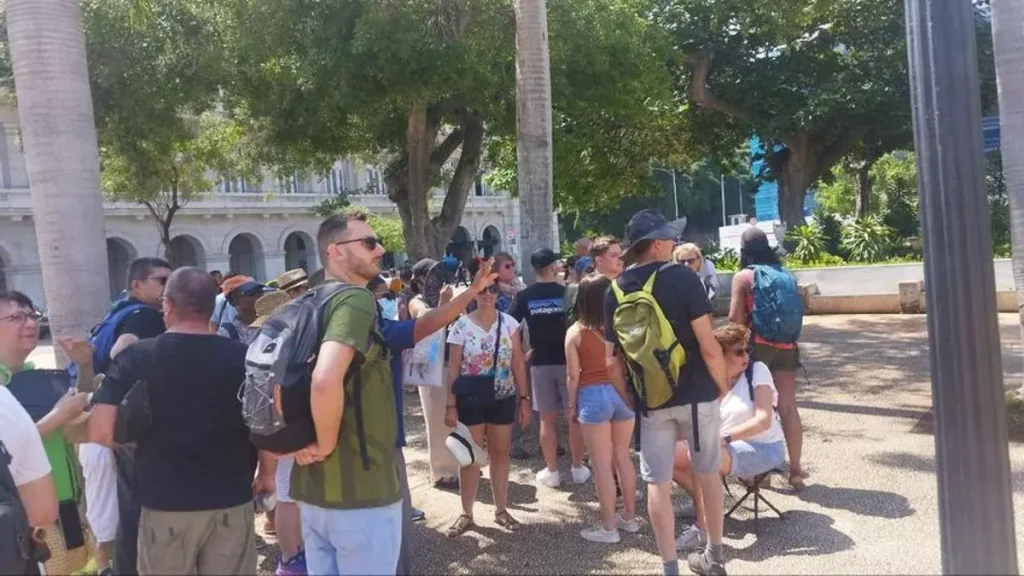
Canadian tourists in Havana’s Central Park / 14ymedio
14ymedio, Madrid, 23 October 2024 — “Affordable prices, magnificent beaches, a popular destination and ignorance. These are the reasons why Canadians to continue going to Cuba,” says Manon Girardin, deputy director of the Canadian travel agency Voyages CAA-Québec. Her company is among those which aren’t buying into the message of a safe, idyllic tourist destination that the Cuban regime and its publicists are trying to sell.
“The risk that customers will be disappointed is high, especially for those who ignore — or choose to ignore — the problems the country is facing. That’s why we have a few caveats when we are talking about travel to this destination. If you want to go, you have to know what you’re in for so you can accept whatever comes and not be disappointed,” she says in an article published in the travel section of Le Nouvelliste, a Quebec newspaper. The article asks the question, “Who still wants to travel to Cuba?”
With September’s tourism figures soon to be released, it is no secret that the number of Canadian visitors to Cuba fell in August to 665,871, 1.5% less than the same month last year. Canada continues to be Cuba’s main source of overseas tourists but all indications are that growth here has long since peaked. Russia, Mexico and Argentina are now the countries that look the most promising. continue reading
“The risk that customers will be disappointed is high, especially for those who ignore — or choose to ignore — the problems the country is facing”
By the first of September, 1,608,078 tourists had arrived on the island, 58,290 fewer than the same period in 2023. The news could not have been worse, especially for a regime that has invested all it had in this sector. Figures for September and October, which are traditionally slow months, promise to be even worse. The nationwide blackout on October 18 and the effects of Hurricane Oscar, which struck a few days later, have raised fears that November and December, usually Cuba’s busiest tourist season, will be disastrous.
“Generally, the price is much cheaper than in other nearby destinations. A colleague is going to the Dominican Republic and the cost of her all-inclusive package is now more than $3,000 (about $2,166 USD) for one week in February. Cuba would never be that expensive,” says Girardin, who warns potential travelers that you get what you pay for and recalls one of her agency’s recent trips to Cayo Largo.
“Passengers couldn’t shower for several days because the hotel didn’t have water,” she says. In that instance, the Canadian company Sunwing took steps to prevent shortages by stocking local food and drinks onboard to meet passengers’ needs. This was the only way the group was able to have things like imported alcoholic beverages, though not everyone was so lucky.
On Tuesday, the Canadian government updated its travel advisory for Cuba. Like most national governments, Ottawa issues recommendations and warnings that would-be visitors to other countries can consult to find what kinds of precautions they should take and whether or not to avoid all travel to a particularly dangerous destination at all. Except for periods marked by specific weather events, Cuba had been on the Canadian government’s green threat level until October 2023, after which it moved to the yellow level, where it has remained ever since. The reason: the shortage of some basic goods including food, medicine and gasoline.
Yesterday, Canada raised it warning level for Guantánamo y Holguín provinces to orange, recommending that people avoid non-essential travel there due to the aftermath of Hurricane Oscar
Fortunately, some regions of the country remain in the green zone, meaning visitors need only take normal precautions when traveling there. These include Havana, Jardínes del Rey, the resort towns of Varadero, Cayo Largo, Jibacoa, Marea del Portillo, Playa Ancón and Playa Santa Lucia. Yesterday, however, Canada raised it warning level for Guantánamo and Holguín provinces to orange, recommending that people avoid non-essential travel there due to the aftermath of Hurricane Oscar.
This is not the only blow to one of the country’s key economic sectors, which is now in its high season. In an interview with LCN on Tuesday, François Laramée, a Quebec travel agent who was in Varadero during the blackout, could not have been more blunt. “It was time to leave because it was pathetic,” he said in Quebec, where he arrived on Tuesday after an overnight flight.
Laramée, who until now thought of Cuba as “a second home,” said that, when he got to his hotel, there was no electricity. “Even staying at a five-star hotel was a disaster.”
After his own personal experience, Laramée encouraged the forty people who called his agency on Tuesday morning to ask about travel to Cuba not to go for the time being. “I told them they should wait till next month while things are recovering,” he said. “Even the local staff, who are often friendly and affectionate, are exhausted. Really, it was no fun at all.
“Even the staff, who are usually friendly and caring, were exhausted. It really wasn’t fun at all”
Laramée recommends that Canadians eager for a beach vacation opt for Mexico or the Dominican Republic instead.
There was an incident this year that caught the attention of the world’s press and may have contributed more to the drop in Canadian tourism to Cuba than Ottawa’s warnings. Faraj Allah Jarjour, a visitor from Montreal who died in Varadero last March, was buried in a town north of Moscow after being mistaken for Ilya Neroev, a Russian visitor who also died on the island. The men’s bodies were accidentally switched by the Cuban officials, a mistake that came to light only after Jarjour’s family realized they had been sent the wrong body.
For Caroline Tétrault and her husband Christian Maurais, a couple from Quebec, their Cuban vacation turned into a nightmare after Tétrault’s appendix burst and she developed a case of peritonitis. In an interview with Radio Canada, Maurais described the perilous conditions of the hospital in Villa Clara where his wife was treated. While praising the professionalism of the medical staff, the experience changed their minds about returning to the island. “Unfortunately, we are done with Cuba. I am sure the world is full of other very beautiful places to see,” said Maurais.
____________
COLLABORATE WITH OUR WORK: The 14ymedio team is committed to practicing serious journalism that reflects Cuba’s reality in all its depth. Thank you for joining us on this long journey. We invite you to continue supporting us by becoming a member of 14ymedio now. Together we can continue transforming journalism in Cuba.
He also supported the concept of the “New Man” defended by Che Guevara
After Ratzinger’s retirement, Pope Francis received Gutierrez at the Vatican in a kind of official rehabilitation. / Archbishopric of Lima
14ymedio, Havana, 25 October 2024 — Peruvian priest Gustavo Gutiérrez, an admirer of Fidel Castro and father of Liberation Theology – a theoretical-religious approach that sympathizes with Marxism – died Tuesday in Lima at the age of 96. Involved in multiple controversies, he was criticized by the Vatican but rehabilitated in 2013 by Pope Francis, who after learning of the death defined him with an enigmatic expression: “he knew how to be silent when he had to be silent.”
Indeed, Gutiérrez was not the most publicized theologian of his time – if compared with others in his context, such as Camilo Torres, Leonardo Boff or Frei Betto, the latter an inveterate apologist for the Cuban regime – but he did lay one of the most important theoretical foundations for Liberation Theology, collected in his book of the same name, published in 1971.
In those pages, Gutiérrez praised the Cuban Revolution and applauded the measures taken by Fidel Castro, in whom he saw a leader who had reconciled the Marxists and Christians of his country. The leader had endowed tropical communism with a “solid and proper theory,” full of “historical realism,” and which could serve as a model for other movements on the continent.
He also subscribed to the concept of the “New Man” defended by Ernesto Guevara, in which he recognized a Christian inspiration, and recommended following the opinions of the Argentine to sustain “the effort of liberation continue reading
of Latin American man” that Cuba, according to Gutiérrez, was leading.
He suggested that, on the island, Fidel Castro had been right to point out a common enemy of Christians and Marxists
He suggested that, on the island, Fidel Castro had been right to point out a common enemy of Christians and Marxists – the capitalist “oppressors” – against whom they could take up arms, as Torres, a Colombian priest and guerrilla, had done. Gutierrez cited a 1969 speech by Castro in which he called Torres a “symbol of Latin American revolutionary unity.” During the decade in which he uttered those words, the leader had persecuted and imprisoned dozens of the Catholic religious and “put in check” the Episcopal Conference, which was critical of its rapprochement with Soviet communism.
The reality of the island – which Gutiérrez ignores or pretends to ignore in his book – is also not present in his account of “subversive priests,” who denounced the dictators of the region or supported the opposition militias. Several Cuban priests, who ended up imprisoned and then expelled from the country, played the same opposition role, supporting the militia uprisings in the Escambray or the invaders of Playa Girón (Bay of Pigs).
With the passage of time and the formal condemnations of the Vatican – Francis’s predecessor in the papacy, Joseph Ratzinger, was one of his most famous opponents as prefect for the Congregation for the Doctrine of the Faith – Gutiérrez moderated his speech and passed to a secondary plane in public. Ratzinger signed a series of documents condemning the attachment to communism of Liberation Theology, and warning the priests about the “deviations” of their approach, for resorting, “in an insufficiently critical way” to “concepts taken from various currents of Marxist thought,” disguised as a “preferential option for the poor.”
In 2013, when Ratzinger – who had become pope under the name of Benedict XVI – had already retired, Francis received Gutiérrez at the Vatican in a kind of official rehabilitation. In public speeches, years later, he declared that Liberation Theology had been “a positive thing” in Latin America. He mocked the fact that several books of condemnations by the Vatican contained “80% of their notes in German” – an allusion to Ratzinger’s language – and that the Latin American “telluric path” was ideologized according to European parameters.
Unlike in other Latin American countries, Liberation Theology failed to take root in Cuba. Castro’s persecution of Catholic communities since the first decades of the Revolution meant that, on the rare occasions when Latin American missionaries sympathetic to this doctrine tried to spread it on the island, they found an audience that was very unreceptive to the Marxist approach.
Betto, author of the interview ’Fidel and Religion’, is a systematic defender of the Cuban Government
Another factor that influenced the rejection of Liberation Theology in Cuba was the caution that the Episcopal Conference took in the reception of missionaries enthusiastic about Marxism. However, important figures within the doctrine never renounced their old enthusiasm for the Cuban Revolution and several, such as Betto and Boff, have remained close to Havana. Betto, author of the interview ’Fidel and Religion’, is a systematic defender of the Cuban government and a columnist in its main propaganda media.
After his death, Gutiérrez’s detractors and admirers have offered their opinions on his life and work. Many have even tried to disassociate it from its Marxist theoretical roots. Boff said this week that it was an unfair “accusation” against the Peruvian priest, and that Francis had offered him “apologies” on behalf of the Catholic hierarchy for the “sufferings he endured in life.”
Gutiérrez was born on June 8, 1928 in Lima. He studied medicine and the humanities, and was ordained a priest in 1959. He belatedly joined the Dominicans in 2001 – an order from which other liberation theologians, such as Betto, come – and founded the Bartolomé de las Casas Institute in 1974.
He received a solid theological training in Louvain (Belgium) and Lyon (France), and was a professor at several prestigious universities, such as Cambridge, Harvard and Comillas. He was a pupil of important theologians and intellectuals of the time, such as Yves Congar and Henri de Lubac, and had contacts with Karl Rahner, Hans Küng and Jürgen Moltmann. In 2003, Gutiérrez received the Prince of Asturias Award for Communication and the Humanities in Spain.
Until this Friday, only the Cienfuegos newspaper 5 de Septiembre, among the newspapers of the Communist Party of Cuba, had reported the news of his death.
Translated by Hombre de Paz
____________
COLLABORATE WITH OUR WORK: The 14ymedio team is committed to practicing serious journalism that reflects Cuba’s reality in all its depth. Thank you for joining us on this long journey. We invite you to continue supporting us by becoming a member of 14ymedio now. Together we can continue transforming journalism in Cuba.