The shabbily dressed old man leaned the container over the sidewalk and used a long wrench as lever.
An older man in shabby clothes laid the blue plastic container on the sidewalk and inserted a long key between the metal support and the base, like a lever / 14ymedio
14ymedio, Juan Diego Rodríguez, Havana, 30 December 2024 – What possible domestic use can a wheel from a garbage bin have? The enigma is difficult to solve in a country overwhelmed by multiple needs, but the answer, judging by the wave of robberies that has crippled more than a few garbage containers in Havana, must exist. Local authorities have denounced the situation. To no avail. The dismantler – or the gang, as some speculate – is still at large.
The operation, however, is not carried out clandestinely or at dawn. Anyone who walks through the streets of Havana can, in broad daylight, witness how a bin is stripped of its four wheels. A reporter from 14ymedio witnessed how an older man, shabbily dressed, laid the blue plastic container on the sidewalk and inserted a long key between the metal support and the base, as a lever.
It only takes a little muscle – although, to be honest, the old man is pure skin and bones – for the wheel to come loose and fall into a bucket. Passersby hear the dull thud of it falling, but no one bats an eye. When someone else “makes the decision,” the law of the street dictates that they keep quiet and keep walking. No one knows how much that wheel is worth when the old man sells it to a customer to build a wheelbarrow that will be used to carry water or other products, but everyone understands that his “beans” depend on it. continue reading
It should not be forgotten that when a wheeled container overflows onto the street, it reveals that it is not only humans who are interested in waste.
The Cuban crisis has generated a whole catalogue of “garbage people”: divers who fish for recyclable junk and often food; scavengers who go hunting for historic plaques, park benches and any piece of metal within reach; businesspeople who know what use to give to the most unusual pieces – like the wheels of the container – and to whom it is best to sell them; and beggars whose world is garbage, because they depend on it daily to eat, dress and breathe.
For them, Havana’s garbage has layers, geography, chronological order, flora and fauna. It should not be forgotten that when a container without wheels overflows onto the street, it reveals that it is not only humans who are interested in waste. Dogs, cats, rats and even birds stop by to look for what they need.
In daily contact with this world, the workers of the Communal Services also suffer from the “hobbling” of the trash bins. This Saturday, three employees were trying to move an empty container. The maneuver could not have been more laborious. As if glued to the asphalt, the hulk filled with waste remained motionless.
No one in Havana remembers the old cha-cha-chá that best describes it, sung in Cuba long ago – ironically – by the Mexican duo Hermanos Castro: “Hide, because here comes the garbage! Hide, gentleman, because they’re taking what’s good for nothing.”
____________
COLLABORATE WITH OUR WORK: The 14ymedio team is committed to practicing serious journalism that reflects Cuba’s reality in all its depth. Thank you for joining us on this long journey. We invite you to continue supporting us by becoming a member of 14ymedio now. Together we can continue transforming journalism in Cuba.
Her list of achievements includes 40 other gold medals won at the Paralympic Games, World Championships for the Blind, Parapanamerican Games, World Championships and several Grand Prix.
The Santiago native has had to overcome limitations, ailments, injuries, as well as “training countless times while enduring pain.” / Calixto N. Llanes
14ymedio, Havana, 26 December 2024 — Omara Durand is a legend of Cuban para-athletics. The official media has given her the epithet of goat Greatest Of All Time). No one disputes that she is the greatest of all time. She won Paris 2024 with gold medals in the 100-meter dash by stopping the clock at 11.81 seconds, and she also did it in the 400 meters (53.59 seconds) and in the 200 meters (23.62 seconds) in the T12 category for people with visual disabilities.
Durand, who said goodbye with a kiss on the track at the Stade de France on 7 September, also won the treble in the 100m, 200m and 400m at the Paralympics in London 2012, Rio 2016 and Tokyo 2020, for a total of 11 gold medals. Her record includes 30 other gold medals won at world championships for the blind, Parapanamericans, world championships for the disabled and several Grand Prix.
The athlete, who lives in the Chicharrones neighborhood in Santiago de Cuba, decided to retire in the French capital as she wanted: “the best female athlete in the history of the Paralympic movement.”
Between nostalgia and tears, the multi-champion, who has done nothing but run since she was seven years old and has put the Island on the top of the podium, acknowledged that she has “reached her finish line” at “the time to say enough” and put an end to the sacrifices. The Santiago native continue reading
has had to overcome limitations, ailments, injuries, as well as “training countless times enduring pain.” Among her first objectives is to undergo eye surgery.
The athlete has shown that the word disability does not exist as an obstacle. “A human being gets to where he wants, as long as he sets his mind to it.”
Durand’s strength was vital in her recovery from the 2019 World Championships in Doha. The parathlete swept the 100-meter events in 11.48 seconds, the 200 meters in a new record of 23.03 seconds and the 400 meters in 53.05 seconds. However, she came out “destroyed” and ended up in an operating room. Although she recovered and returned to the track, she has confessed that this was the moment that led her to make the decision to say goodbye in Paris 2024.
Although the island claims that sports for the disabled are an exemplary topic, the reality is that, as in all disciplines, there are limitations. The sprinter has suffered on more than one occasion from a lack of resources to attend international events such as the Diamond League for people with disabilities.
“We need to make more progress,” Durand said in an interview with the SEMlac Cuba website. “We have to focus on doing many things so that sports for people with disabilities in Cuba are diverse, so that more sports can be practiced, and more Paralympic games can be taken to multidisciplinary games, but this requires a lot of willingness and a lot of work.”
Omara Durand has shown that the word disability does not exist as an obstacle. “We are human beings and a human being gets where he wants, whenever he sets his mind to it.” Although she accepts that along the way she has come across people who “have a disability in their hearts,” she does not limit herself. The place she leaves vacant will be very difficult to fill; today on the Island there is no athlete who will raise her hand; with her retirement, difficult times are coming for Cuban sport.
___________
COLLABORATE WITH OUR WORK: The 14ymedio team is committed to practicing serious journalism that reflects Cuba’s reality in all its depth. Thank you for joining us on this long journey. We invite you to continue supporting us by becoming a member of 14ymedio now. Together we can continue transforming journalism in Cuba.
’The Horseshoe Colossus’, as he is known, won his fifth Olympic gold medal in Paris 2024 and avoided Cuba’s debacle
Since the defeat in Athens 2004, Lopez has had 21 consecutive victories in the Olympics, 108 points in favor and seven against. / EFE-Miguel Gutiérrez
14ymedio, Havana, 26 December 2024 — The best exponent of Greco-Roman wrestling is Cuban. Mijaín López, at age 41 and against the odds, won his fifth consecutive gold medal at the Paris 2024 Olympic Games after defeating the exiled Yasmani Acosta, who competed for Chile. The feat of the Horseshoe Colossus surpassed that of the Americans Carl Lewis, Michael Phelps, Katie Ledecky, Alfred Oerter, the Dane Paul Elvstrom and the Japanese Kaori Icho, all with four gold medals.
The French capital also served as the venue for the athlete’s retirement. López did so with a ritual before the astonished gaze of the spectators at the Champ de Mars stadium, in front of the Eiffel Tower. The 130-kilogram human giant took time to walk around the mat, go to the center, kneel and kiss the mat. He took off his boots and left them in the center.
López’s feat on August 6 was a relief for Cuban officialdom. Cuba was ranked 39th in the medal table until then. The island attended the summer competition with 62 athletes in different disciplines, the smallest delegation since Tokyo 1964. In addition, a group of 21 athletes represented other countries and two more were part of the exile team.
The regime has hung on to the athlete’s achievement, as Fidel Castro did in his time with the achievements of the athletics icon Alberto Juantorena and the boxer Teófilo Stevenson.
Cuban sport – including Olympic sports – is collapsing. In Beijing 2008, the island was ranked 19th in the medal table, in London 2012 it was 16th, in Rio de Janeiro 2016 it was 18th, in Tokyo 2020 it was 14th and in the French capital it reached 32nd place with nine medals. However, the debacle has continue reading
not reached Mijaín López. The Communist Party activist and deputy of the National Assembly, who has dedicated several of his conquests to Fidel Castro, took on the fight. Since the defeat in Athens 2004, he has had 21 consecutive victories in the Olympics, 108 points in favor and seven against.
The regime has latched onto the athlete’s achievement, just as Castro did with the achievements of athletics icon Alberto Juantorena, boxer Teófilo Stevenson and the women volleyball players known as the Morenas del Caribe. “You have shown that you have the lineage of a gladiator, a warrior, and also an exemplary Cuban and revolutionary,” Cuban President Miguel Díaz-Canel told the five-time champion via video call after he set the medal record.
López, who cut his teeth in his native Herradura carrying boxes of fruit and disdained boxing because he preferred hand-to-hand combat, was sent off to applause at the Campo de Marte stadium, although his happiness was overshadowed by a cry of “Patria y Vida” (Homeland and Life) that came from the stands, the anthem of the nationwide protests in Cuba since 11 July 2021. “Esos son unos peste a cu…,” the athlete replied.
Months earlier, at the Bicentenario Cerrillos stadium, during the Santiago de Chile 2023 Pan American Games, the controversial defense of his ideals led Mijaín López to attack Cuban migrant Damián Montes de Oca Iglesias for waving a flag with the legend: “Freedom for Cuba.” The police had to intervene to remove the assaulted person from the scene. Despite the fact that there was a complaint and videos against the athlete, the Chilean Prosecutor’s Office dismissed the case on the grounds of “lack of evidence.”
____________
COLLABORATE WITH OUR WORK: The 14ymedio team is committed to practicing serious journalism that reflects Cuba’s reality in all its depth. Thank you for joining us on this long journey. We invite you to continue supporting us by becoming a member of 14ymedio now. Together we can continue transforming journalism in Cuba.
On Monte Street, the smell of improvised chicken coops spreads through the nearby houses and gives the neighborhood a certain rural touch
Chickens on a balcony on Monte Street, in Havana, this Friday / 14ymedio
14ymedio, Natalia López Moya, Havana, 28 December 2024 — Cubans have stopped wondering if this crisis is worse than that of the 1990s. The blackouts, food shortages and lack of fuel for public transport during the Special Period — in the 1990s, after the fall of the Soviet Union and the loss of its subsidies to Cuba — have now been surpassed in duration, severity and limitations. The breeding of animals at home like chickens and pigs for eggs and meat has also returned.
On Monte Street, one of the most populated and poor arteries in Havana, no one is surprised anymore if they see a couple of chickens on a balcony, guarded by a cat ready to meow an alert against any attempted robbery. Separated from the abyss by the rusty irons of a fence, the birds look down at the traffic, peck some grains of rice and are unconscious of the casserole that awaits them. The smell of the improvised chicken coop spreads through the nearby houses and gives the neighborhood a certain rural touch.
“We’re back in that time when they sold chicks so you could raise them for food,” remembered a seller of matchboxes, instant glue and other paraphernalia. From her strategic position in a doorway on the central street, the woman knows everyone’s business in the area. “In that house they were raising a pig in the bathroom,” she explains and points to a tiny room, with just a small window to the street, on the first floor. “You could hear it and smell it.” continue reading
“Even if I’m starving, I won’t do that for anything in the world,” said a potential customer
“Even if I’m starving, I won’t do that for anything in the world,” said a potential customer who looked at some shoelaces for sale, asked the price of some plumbing pieces and checked the flavors of the instant soda packages. “My family and I raised a pig 30 years ago and in the end got attached to the animal and couldn’t kill it,” he explains. “It escaped from the bathroom where we had it locked up and went to sleep in our bed. Finally we had to sell the pig to a cousin because we didn’t have the heart to sacrifice it.”
With their white plumage, blackened by the soot that rises from the street, the two chickens on the balcony continue to peck stubbornly at the floor and in the cracks of the unpainted facade. “In addition, fattening an animal requires food, and if it’s hard now to get food for humans what is left for them? At least in the 90s you could find something to feed them,” said the man, who in the end leaves without buying anything. Comparisons with current times have ended up turning the 1990s Special Period into a longed-for time for Cubans. Better to avoid parallels.
Translated by Regina Anavy
____________
COLLABORATE WITH OUR WORK: The 14ymedio team is committed to practicing serious journalism that reflects Cuba’s reality in all its depth. Thank you for joining us on this long journey. We invite you to continue supporting us by becoming a member of 14ymedio now. Together we can continue transforming journalism in Cuba.
The high cost of tickets between both nations, around $1,500 per person, discourages travel
Ambassador Hua Xin reported on the measure in a congratulatory message to the regime on the 66th anniversary of Fidel Castro’s triumph in 1959 / Chinese Embassy in Cuba
14ymedio, Havana, December 28, 2024 — The Chinese Embassy in Havana announced this Friday that Cubans who wish to travel to the Asian country will be exempt from paying the fees of the visa procedure from January 1. Payment will be maintained, however, if any procedure at the diplomatic headquarters is urgently requested.
The measure is taken in the midst of a climate of rapprochement and growing economic interest of China, whose citizens, since last May, do not need a visa to enter the Island. It is, according to the embassy, a “New Year’s gift” to Cubans.
The change, however, will probably have very little influence on the number of Cuban travelers to China. Nationals of the Island need to have a transit visa for most airports in Europe and other parts of the world that act as a bridge between Cuba and China. The high cost of tickets between the two nations, which are close to $1,500 per person, also discourages travel.
The change, however, will probably have very little influence on the number of Cuban travelers to China
Ambassador Hua Xin reported on the measure in a congratulatory message to the regime on the 66th anniversary of Fidel Castro’s triumph in 1959. “This year, China and Cuba have witnessed frequent exchanges and fruitful cooperation,” said the diplomat, who highlighted Cuba’s union with the BRICS group of countries as the starting signal to provide more economic aid from Beijing.
He referred to “several important projects,” including the steady shipment of solar panels, guarantors of the “bright future” that Hua Xin predicts for an Island that has concluded another year of energy crisis. “Chinese assistance materials have arrived in batches; photovoltaic parks have been continue reading
built with Chinese help; direct flights between the two countries have resumed; and more and more Chinese tourists are seen on the streets of Havana,” he added.
In his message, which he read in English in a video on his X account, Hua Xin, for his part, gave details about his life in Havana. “I have made many Cuban friends and visited many places. I have been deeply impressed by the hospitality, kindness, diligence and patriotism of the Cuban people.”
Hua Xin, ambassador since last June, has been one of the architects of the growing rapprochement between Beijing and Havana
Hua Xin, ambassador since last June, has been one of the architects of the growing rapprochement between Beijing and Havana. In addition to managing China’s aid to Cuba, he has been interested in participating in the media life of the Island. Earlier this month, he wrote an opinion piece in Cubadebate that contained his diplomatic approach to the country.
For Hua Xin, Cuba must find its place among China’s international allies to contribute to the world’s economic transformation designed by Xi Jinping. “China and Cuba are good friends, good comrades and good brothers, and they are working together to build a China-Cuba community of shared future,” he wrote. The cooperation is based, he said, on “biotechnology, renewable energy, communications and other fields.”
“China is willing to work with Cuba,” is a phrase that he constantly repeats in his speeches, meetings with the authorities and public messages.
At that time, the minister announced the visa exemption for Cuban citizens with ordinary passports
China will be the guest country, next year, of the 42nd edition of the International Tourism Fair of Cuba (FITCuba), the main event of this sector on the Island. The Minister of Tourism, Juan Carlos García Granda, explained then that the invitation was part of the promotion of relations and tourism between the two countries.
At that time, the minister announced the visa exemption for Cuban citizens with ordinary passports
The greatest evidence of the rapprochement in recent months has been the sending of solr panels from the Chinese company Hangzhou Duojia Technology. Its president, Qiaoming Huang, told Reuters earlier this month that solar panels are “the definitive solution” for the Cuban energy debacle. His argument was indisputable: “In this country there is plenty of sun.”
Translated by Regina Anavy
____________
COLLABORATE WITH OUR WORK: The 14ymedio team is committed to practicing serious journalism that reflects Cuba’s reality in all its depth. Thank you for joining us on this long journey. We invite you to continue supporting us by becoming a member of 14ymedio now. Together we can continue transforming journalism in Cuba.
Miguel Coyula and Lynn Cruz talk about their ‘Chronicles of the Absurd’, a film that won awards abroad and was censored in Cuba
Coyula and Cruz with the important award received in Amsterdam. / Jorge Fernández Era/14ymedio
14ymedio, Jorge Fernandez Era, Havana, 28 December 2024 — In a film scene marked by censorship, it has become common for filmmakers to turn to alternative venues to exhibit their films. I went to one of them, the home of director Miguel Coyula and actress Lynn Cruz, to see the documentary Crónicas del absurdo [Chronicles of the Absurd], winner of the Best Film award in the Envision competition, at one of the most important festivals in the world: the Amsterdam International Documentary Film Festival. We talked about the reality that the film draws on that December afternoon.
Jorge Fernandez Era: The Havana Film Festival ended a few days ago. It seems that the event is still “alive.”
Miguel Coyula: I always send my films to Cuban festivals so that there is a record of them being rejected. There are filmmakers who, out of principle, do not do so, but when you are sure of what you are saying, your work should ideally be shown everywhere. The premises of my last four feature films would never have been approved by the ICAIC (Cuban Institute of Cinematographic Art and Industry). So, the only way to function is to be outside of the institutions.
When there is such a long list of taboo subjects – you cannot make a film where you directly touch on the figure of Fidel, or a corrupt doctor or primary school teacher, or a policeman or soldier – there are filmmakers who believe they are making independent films while making pacts with the ICAIC, where the scripts have to be approved according to Decree 373, which dictates that the content has to be within the “climate of creative freedom continue reading
permitted by the Cuban Revolution.” The institution itself gives you your “independent filmmaker” card.
Independent cinema has to be uncomfortable. It’s not independent because you finance it out of your own pocket. / Jorge Fernández Era/14ymedio
Independent cinema has to be uncomfortable. It is not independent because you finance it out of your own pocket, but because of its content and form.
Lynn Cruz: I had heard that the event was very politicized. The point is not to close doors, not to eliminate spaces, but to use those spaces as a forum. And, as a filmmaker, having a film at the Festival also means having a platform, being able to express your political ideas.
The Festival lives on because it happened, it will continue to happen. What is worrying is the cinema that is made, which wants to fit into those spaces because of the few opportunities filmmakers have to exhibit their works.
Jorge Fernandez Era. Along with the deterioration of the political, economic and social situation of Cubans, the exclusion of different voices is returning. What is the role of the intellectual community, of yourselves, in times like this?
Lynn Cruz: There is a certain exhaustion. The “sit-in” of intellectuals in front of the Ministry of Culture on November 27, 2020, happened. Then there were the massive protests in July 2021. It is as if everything is condensed in time and happens more quickly. Before, it was more or less every ten years that a group of dissidents would emerge and confront the system. The power does its cleaning, the people leave the country. Unfortunately, nothing lasts.
Miguel Coyula: It happens with filmmakers too: they make their first feature film – it’s a curious country, new artists emerge all the time – and then they leave. You can’t see their trajectory on the Island.
Trying to make your work outside of Cuba is much more complicated. That happened to me when I made Memorias del desarrollo (Memories of Overdevolpment), a film that critically analyzes the Revolution. “I have to film the scenes in Cuba,” I told myself. I discovered from the United States that all the oddities here are fertile ground, ideal material for working on dystopia. We live it every day, in a way that many foreigners cannot understand if they do not spend time living in Cuba. I needed to be in the conflict zone; I did not feel comfortable making a critical film about my country from outside.
The kind of cinema I am interested in making is the kind that goes to the darkest areas of the society in which one has to live.
The kind of cinema I am interested in making is that which goes to the darkest areas of the society in which one has to live. As they say in Elpidio Valdés: “The fire is here.”
Lynn Cruz. Reality is changing: what you saw one way a month ago, you now see in a different way. The country is changing at a dizzying pace, both for the better and for the worse – almost all of it for the worse – but you can’t understand it properly if you’re not there.
Miguel Coyula. In Chronicles of the Absurd there is a quote from [Fidel Castro’s] Words to the Intellectuals – curiously, as in the film, what is preserved is the audio– that is chilling: “The most revolutionary artist would be the one who was willing to sacrifice even his own artistic vocation for the Revolution.” It is terrible.
Jorge Fernandez Era. You have insisted on the clandestine nature of the recordings that support the film. How are you doing with the clandestine nature?
Miguel Coyula: I have always been outside the system. Lynn did work at the ICAIC. That is why in Chronicles of the Absurd I found it much more interesting that she was the protagonist, so that the process of erasing the person from the cultural life of the country could be seen gradually.
The way I film has always been the same, even when I have done so outside of Cuba. My first film, Cucarachas rojas, and Memorias del desarrollo were filmed largely in the United States. For economic reasons I had to make them the same way. It is, as they say, “guerrilla cinema.”
Chronicles of the Absurd, as Orwa Nyrabia, artistic director of the Amsterdam International Documentary Film Festival, said, is in some way a chronicle of the ten years we spent making Blue Heart, of many of its obstacles and of what it means to operate outside of institutions.
Lynn Cruz. The underground in Cuba is linked to the black market, and the cinema we make is similar. We are not magicians: we exist because there is a fracture in a society in transition, where what was previously, in theory, “for everyone” is being privatized.
The clandestine in Cuba is linked to the black market, and the cinema we make is similar. / Jorge Fernández Era/14ymedio
In the midst of this economic chaos there is a place for us, otherwise you cannot exist. And clandestineness is not thinking that what we do is not known, but that the conditions exist for this cinema to emerge, and we must try to do it while we can. We do not know what the future of ourselves will be, because we do not know what the future of this country will be.
Miguel Coyula: In Corazón azul [Blue Heart] some actors left the project. You know from the start that if you’re going to spend ten years making a film, it’s not just because people are intimidated by security, but because reality and the interests of those people change.
Lynn Cruz. Chronicles of the Absurd is a dark making of the film Corazón azul, of how all those things were happening while we were filming. In some way it also connects with my book Crónica azul. We had to deal not only with creative and economic obstacles, but also with political persecution. Of course, each person has his or her own way of dealing with that. It is reality that condemns you to politics. Everything, absolutely everything, is politicized, because it is a totalitarian system and, in addition, you are making a film that questions that reality.
Miguel Coyula. The structural idea of Chronicles of the Absurd, in its ten chapters, fluctuates in situations that have to do with the absurd. It is a precept that goes beyond politics, but in the context of Cuba it is impossible to separate it. That explains the quote from Virgilio Piñera at the beginning of the film: “If Kafka had been born in Cuba, he would be a costumbrista* writer.”
According to the media he directs on social networks, it was Constantin himself who informed of his release in a phone call from outside the detention center of the Ministry of the Interior, located in the municipality of Arroyo Naranjo. This same December 26, according to a previous publication of La Hora de Cuba, the journalist had been scheduled to have an oral hearing in the Provincial Court of Havana, corresponding to an appeal of habeas corpus filed in his favor by his relatives. Instead of being transferred to trial, however, he was released.
The day before, December 25, the authorities had denied him the transfer to Camagüey, where he lives. Neither Constantin nor La Hora de Cuba has provided more details of what happened this week in El Vivac, from where he has been able to make phone calls. continue reading
Instead of being transferred to trial, however, he was released
In one of them, on Monday, he declared that he dedicated “his Christmas to all the political prisoners of Cuba, without exception,” especially to Félix Navarro, his daughter, Sayli Navarro, and Sissi Abascal. In addition, he thanked the messages of solidarity that have asked for his release on social networks.
That same day, a collaborator of La Hora de Cuba had approached the detention center to find out about Constantin and bring him toiletries, but the authorities refused to provide the visitor with any kind of information and to receive the objects. They said that Constantin would have “the visit” this Thursday, the day he was finally released.
The journalist from Camagüey was arrested last Thursday, on the eve of the “march of the fighting people” organized by Miguel Díaz-Canel in response to Cuba’s maintenance on the US list of countries that sponsor terrorism. That same day he was interrogated by six State Security agents who told him that he would be transferred to Camagüey “according to the availability of fuel from the Ministry of the Interior.”
Translated by Regina Anavy
____________
COLLABORATE WITH OUR WORK: The 14ymedio team is committed to practicing serious journalism that reflects Cuba’s reality in all its depth. Thank you for joining us on this long journey. We invite you to continue supporting us by becoming a member of 14ymedio now. Together we can continue transforming journalism in Cuba.
Amnesty International said that the regime uses four tactics “to suppress dissent”
Image of the arrests of 11 July 2021 /14ymedio
14ymedio, Havana, 27 December 2024 — The organizations Prisoners Defenders (PD) and Consorcio Justicia denounced to the United Nations a “scandalous repressive escalation this quarter against peaceful demonstrators” throughout Cuba. In a report published this Friday, they point out that between October and November, there have been at least 216 people arrested in the country in an “indiscriminate and arbitrary” manner.
The document presented to the international organization indicates that the freedoms of association, assembly and demonstration on the Island are prohibited by a legal framework that runs through the Constitution, the Criminal Code and the Law of Associations to “multiple legislative rules” that “criminally make it impossible to exercise the least of these rights.”
Presented before the Mandate of the UN Special Rapporteur on the rights to freedom of peaceful assembly and association, the complaint highlights how the Constitution itself, far from guaranteeing freedoms, “acts as a blank law* (a legal concept that subjects one rule to another leaving arbitrariness open), where it subjects these alleged rights to lower norms that proscribe them, and where there is no court of constitutional protection for legal norms that, flagrantly, contradict fundamental rights.” continue reading
There is also a “remarkable absence of freedoms for political association, in a Cuba where, by law, only the Communist Party can exist”
Likewise, it explains that the Law of Associations makes it impossible to “register an association without State approval,” so the Government “is the only entity that has the power to create organizations in the country.” In that way it can control the population while simulating an environment of guaranteed rights for civil society.
There is also a “remarkable absence of freedoms for political association, in a Cuba where, by law, only the Communist Party can exist,” the text adds.
This regulation, the report emphasizes, has made it possible to suppress any attempt at mobilization that, in turn, has skyrocketed in recent months due to prolonged blackouts and shortages of all kinds.
Between October and November, PD registered 48 new political prisoners, 34 (71%) of whom belong to the civilian population, with no known affiliation or political activism. In the complaint, the organization says that the criminal proceedings against these people are “fabricated.” In most cases, they are accused of public disorder: 18 in Villa Clara, five in Santiago de Cuba, three each in Ciego de Ávila, Granma and Camagüey, and one each in Pinar del Río and Sancti Spíritus.
PD also points out that there are currently 1,153 political prisoners in the country, and since the nationwide protests on 11 July 2021, more than 1,790 innocent people have suffered political or conscientious imprisonment on the Island.
It also indicates that among the political prisoners there are 650 with serious medical pathologies and 70 who suffer from serious mental health disorders, without access to adequate medical and psychiatric care.
In a statement, the organization said that police authorities use “short arrests” as a “control and intimidation tool”
Amnesty International (AI) said that the regime uses four tactics “to repress dissent.” In a statement, the organization said that law enforcement authorities use “short arrests” as a “control and intimidation tool.”
For the NGO, having a person under arrest for a few hours or days “sends a message of terror to those who dissent.” That practice has become more visible in recent weeks, with the arrests of dissidents such as Berta Soler, leader of the Ladies in White, and the independent journalist Henry Constantín, who was released this Thursday after seven days of arbitrary imprisonment.
Likewise, AI pointed out that internet cuts are used “to silence protests.” In many cases, they are selectively applied to activists, who “see their internet service interrupted several times during the year.”
Another tactic is the criminalization of opponents who express themselves freely. AI remarked that “they are criminally prosecuted if they do not give up in their fight for respect for human rights.”
Finally, it highlighted that people who raise their voices against the Government are fired from their jobs, a tactic designed to “punish dissent and force conformity.”
*Translator’s note: printed legal form with blanks to be filled in depending on the circumstances.
Translated by Regina Anavy
____________
COLLABORATE WITH OUR WORK: The 14ymedio team is committed to practicing serious journalism that reflects Cuba’s reality in all its depth. Thank you for joining us on this long journey. We invite you to continue supporting us by becoming a member of 14ymedio now. Together we can continue transforming journalism in Cuba.
Cubans were the nationality that most asked for refuge in Brazil in 2024
In Uruguay, the number of Cuban children enrolled in public schools has increased sevenfold since 2018
Cuban migrants in Suriname, in December 2020, waiting for Guyana to open its border to continue their journey to the United States / Facebook/Lien Liyan
14ymedio, Madrid, 27 December 2024 — Cuban migrants no longer look only to the north. The route to the United States has lost popularity this year, while Brazil and Uruguay have become the new magnets. In November, there was not a single national of the Island among the beneficiaries of the parole granted by Washington, and there is a decrease in detainees for illegally entering from Mexico, according to the most recent data from US Customs and Border Protection.
The executive order signed by the outgoing president, Joe Biden, to restrict access to asylum for those who enter the country illegally, which came into force in June, as well as the promise of the president-elect, Donald Trump, to eliminate parole and carry out mass deportations, tend to discourage Cubans who intend to emigrate. The exodus, however, does not stop, as confirmed by the official statistics themselves.
Where do the Cubans who don’t go north go? According to the migration figures offered recently by some countries, most of them go south. Brazil, in particular, received this year the largest number of Cubans in its history: almost 19,700 between January and November, according to a report published last Friday by Folha de Sao Paulo. Of them, the vast majority (19,100) asked for refuge, and another 678 entered by “other ways.”
The numbers, which do not yet include December, far exceed those of past years. In 2023, there were 13,100 Cubans, and in 2022, 7,600. In November, the number of asylum requests in Brazil by Cubans (2,700) surpassed for the first time Venezuelans (2,200), who until now were the nationality that requested it the most. continue reading
More than 50% of these migrants, the local newspaper continues, arrive in Brazil through the states of Amapá and Roraima, after setting foot on Suriname, Guyana and French Guyana
Folha also reports that the entries far exceed those of the time of the Mais Médicos program, between 2013 and 2018, in which there were 8,471 Cuban health workers.
More than 50% of these migrants, the local newspaper continues, arrive in Brazil through the states of Amapá and Roraima, after setting foot on Suriname, Guyana and French Guiana, either by plane – to the Surinamese capital, Paramaribo, and then to the Guyanese, Georgetown -, or by crossing from Suriname all of French Guyana, by land and boat, until they reach the Brazilian municipality of Oiapoque.
For some Cubans, says Folha, “Brazil is seen as welcoming and a good place to find work, especially in the informal sector.” With the request for refuge, in fact, they are given a document that allows them to work and have access to the Brazilian public health system.
But, the newspaper also points out, “not all Cubans have their final destination in the country.” A minority continue on a route through seven countries and dangers such as the Darién jungle, between Colombia and Panama, or organized crime in Mexico, to the United States. This year, 735 Cubans passed through the Darien, a considerable figure despite not even coming close to the 17,000 Cuban migrants in 2021.
Many more continue on to Uruguay or Chile, “which are more stable and secure societies and where Spanish is spoken.”
In Uruguay, for example, the number of Cuban children enrolled in public schools has increased sevenfold since 2018. With 1,541, they are the most numerous nationality after Venezuelans (1,776), according to the most recent report of the National Administration of Public Education (Anep), out of a total of 6,492 students who were born abroad.
Anep points out that Uruguay “has a regulatory framework that protects the right to migration and the protection of the rights of the migrant population; in particular, access and integration into the educational system.”
According to the 2023 Uruguayan census, Venezuelans, Argentines and Cubans, in this order, are the foreigners who have settled the most in that South American country in recent years.
Translated by Regina Anavy
____________
COLLABORATE WITH OUR WORK: The 14ymedio team is committed to practicing serious journalism that reflects Cuba’s reality in all its depth. Thank you for joining us on this long journey. We invite you to continue supporting us by becoming a member of 14ymedio now. Together we can continue transforming journalism in Cuba.
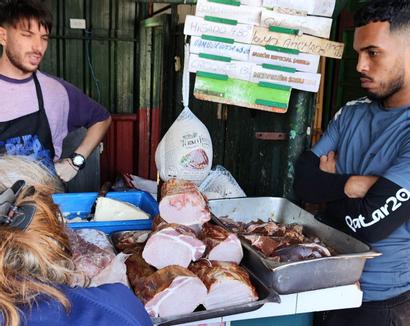
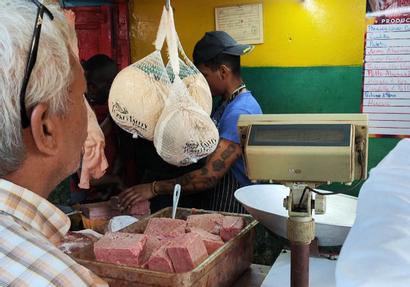
Sale of meat in the market of 17 and K, in El Vedado, Havana, on December 24, 2024 / 14ymedio
14ymedio, Natalia López Moya, Havana, 24 December 2024 — Turkey breasts from Minnesota, pork loins and legs that say “Made in USA” on the label, chickens raised in Brazil and pieces of impeccable beef fed with grass from the Iowa plains. A few hours before the Christmas Eve festivities, the platforms of Havana’s markets are mostly stocked with imported products, in a country where agriculture and livestock have reached rock bottom.
In the market on Tulipán Street in Nuevo Vedado, previously managed by the Youth Labor Army (EJT), of which only the name remains, the sellers announce this Tuesday pieces of pork at 1,000 pesos a pound, “clean, with little fat and without skin,” clarifies a smiling young man behind the counter. To convince the undecided customers, faced with the high prices, he emphasizes that the pieces “are yumas, no cubiches [foreign, not Cuban].” A few feet away, the packages of the Turkey Valley Farms brand display breasts “ready to put in the casserole or in the oven,” according to another employee. Each of the pieces is around 6,000 pesos.
A few feet away, the packages of the Turkey Valley Farms brand display breasts “ready to throw in the casserole or put in the oven,” according to another employee / 14ymedio
Cut into cubes, for those who have fewer resources, in the market on 17th and K streets, once also in the hands of the EJT, minced chicken was also being sold. Despite not having the colorful packaging of the turkey or the appetizing presence of pork legs, the label that accompanies the product says it comes from the United States. Tired of the adulterations and the bad taste of animals raised with remains collected from the garbage or with fishmeal, those Cuban diners who can afford the dinner of this December 24 opt for animals born and slaughtered outside the Island.
To complete the panorama of the foreign, a bag of rice with the label of a Turkish company rests next to others of corn flour from Spain and some packages of sweets that make clear their Mexican or Panamanian origin. The dried spice packets from Goya and Iberia have also displaced the fresh cilantro continue reading
of other years, the wild oregano that was added to the black beans, and, instead of the Creole sour orange to smear on the pork, a mojo of the Badia brand monopolized the looks and longings of those who passed by.
Cut into cubes, for those who have fewer resources, in the market on 17th and K streets, minced chicken was also being sold / 14ymedio
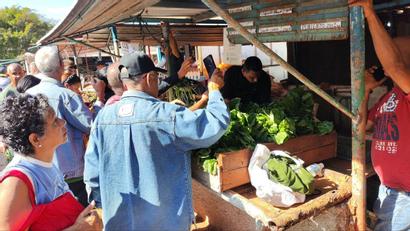
Of course, next to the butcher’s area, the platforms with yucca and lettuce exhibited only national goods. As soon as you saw them, you could tell they were coming from the yard. Some stunted cassava, full of dirt, attracted numerous elderly people who, with their bags hanging from their shoulders, formed a line at full speed. The leaves of the vegetables were beginning to get musty but, most likely, the vast majority will be sold before the sun sets.
Despite the inflation and the hard year that is coming to an end, many try to guarantee tonight’s family meal. As if of a spell to leave hardships behind, people are trying to rescue a certain festive atmosphere and the greeting that is most repeated in the streets says: “Merry Christmas.”
As the hours pass, the sorcery that some habaneros use to prepare their tables for tonight is more like an exorcism to expel the demons from the national debacle. It will also be accomplished with the foreign food that came from outside the country.
Despite the inflation and the hard year that is coming to an end, many try to guarantee tonight’s family meal / 14ymedio
Translated by Regina Anavy
____________
COLLABORATE WITH OUR WORK: The 14ymedio team is committed to practicing serious journalism that reflects Cuba’s reality in all its depth. Thank you for joining us on this long journey. We invite you to continue supporting us by becoming a member of 14ymedio now. Together we can continue transforming journalism in Cuba.
Cuba says goodbye to a man who, with the tools of the painter and the journalist, made courage the main fuel of his work
Born in Sagua la Grande, Villa Clara, in 1948, César Leal graduated from the National School of Plastic Arts, Havana, in 1968 / Facebook
14ymedio, Havana, 24 December 2024 — This Monday the Cuban painter César Leal Jiménez died in the town of Regla, Havana, according to the artist Jorge Mata on his Facebook account. The 76-year-old creator had announced this Sunday that he was suffering from a urinary tract infection that forced him to stay in bed.
“We talked on some occasions and shared opinions about the networks and the importance of following at the foot of the cannon, with our pedagogical and artistic works,” Mata commented in an emotional publication. “Leal has been a constant and very private artist. Unfortunately, his work is little disseminated and recognized, although in the guild he is respected.”
Born in Sagua la Grande, Villa Clara, in 1948, César Leal graduated from the National School of Plastic Arts, Havana, in 1968. Later he also studied Journalism and worked as a teacher in three educational centers dedicated to artistic teaching on the Island, including the Academy of San Alejandro.
“We talked on some occasions and shared opinions about the networks and the importance of following at the foot of the cannon, with our pedagogical and artistic works”
The Provincial Center for Plastic Arts and Design of Havana joined the mourning for the death of the creator and cataloged Leal as “a pillar in the art world.” The official entity recognized “his exceptional talent” and “his work, marked by a deep sensitivity and a unique vision.”
Throughout his fruitful career he won countless awards, such as the Young Latin American Painting Award, in 1966, in Mexico; two years later he won one of the awards of the Salón de Mayo, in Paris, France and, in 1980, continue reading
obtained the maximum recognition of the Salón Quinquenal Carlos Enríquez. His work “Sequence in One” is part of the permanent collection of the National Museum of Fine Arts and is currently on display there.
With a work that distinguishes him among the artists of his generation, Leal was a deep scholar of the history of art and its multiple manifestations. In his paintings, human forms are combined with countless contexts and situations to express the overwhelming lack of freedom and the sharp scissors of the censors.
With a very critical look at the current Cuban situation, Leal recently turned his social networks into an open window to his study, where he painted tirelessly, and to his work in the community of Regla to teach the first steps of the plastic arts to children and young people. He also observed the deterioration of life in his community and the country.
Through his artistic work and his Facebook posts, he denounced the controls on creators that have intensified in recent years in Cuba. He also spoke about the inflation, the crisis of basic services and the constant blackouts. He expressed his regrets over the economy and the suffocation of civic freedoms that have led so many young people and artists to emigrate from the Island.
With a work that distinguishes him among the artists of his generation, Leal was a deep scholar of the history of art and its multiple manifestations
His sympathy for the independent press was a constant. In 2004, he collaborated with the birth of the digital magazine “Consenso” and shared with his editorial team many of his pieces to be used in the design of the digital site. His paintings, with bureaucrats curtailing thought, mouths sewn shut to show disrespect for the right to free expression and figures that managed to sneak between the bars marked the visual imprint of that magazine.
With the death of César Leal, Regla loses one of her most important artists; Havana loses an adopted son who portrayed the hardness of his daily life but also the potential of his people; and Cuba says goodbye to a man who, with the tools of the painter and the journalist, made courage the main fuel of his work and freedom the model best expressed through his brushes.
Translated by Regina Anavy
____________
COLLABORATE WITH OUR WORK: The 14ymedio team is committed to practicing serious journalism that reflects Cuba’s reality in all its depth. Thank you for joining us on this long journey. We invite you to continue supporting us by becoming a member of 14ymedio now. Together we can continue transforming journalism in Cuba.
García Granda predicts only 2.6 million international travelers to Cuba by 2025, after five years of failed forecasts
According to the minister, for the first time insecurity is perceived in tourism to Cuba / EFE]
14ymedio, Madrid, 17 December 2024 — As has already happened with the sugar industry, the Government presented on Monday a projection of declining tourism. The strategy – premeditated or not – consists of underestimating the annual forecasts, even if in the end the results are even worse than the official forecasts. For 2025, the authorities of the sector are forecasting 2.6 million tourists, 18% more than than the 2.2 million they announced, Minister Juan Carlos García Granda said before the National Assembly.
Let’s review the sequence. Excluding 2020, when the pandemic forced the closure of airspace in much of the world, Cuba projected a recovery of tourism for 2021, when 2.2 million international visitors should have arrived. The figure was modest if you take into account that in 2019 – the last year before Covid – 2.4 million people visited the Island, but evaluating the pandemic was expected to be complex, and it was estimated that Cuba would receive only half as many as two years ago. Only 573,944 tourists arrived, 61% less than official forecasts.
The desire to travel and the savings achieved in the pandemic strongly reactivated the sector, and García Granda was encouraged enough to say that by 2022, 2.5 million international travelers would arrive on the Island. Manuel Marrero, who before being prime minister was the strongman of Tourism in Cuba, warned in May that Cuba would have to wait one more year for the improvement, but no one listened to him until, almost at the end of 2022, the ambitious forecast was reduced to 1.7 million, and the total reached 1,614,087 foreign visitors. continue reading
The desire to travel and the savings achieved in the pandemic strongly reactivated the sector, and García Granda was encouraged enough to say that by 2022, 2.5 million tourists would arrive
For 2023, an optimistic forecast was made again: the goal was 3.5 million tourists. But the monthly data made it clear that it was not going to be reached, and the final figure remained at 2.4 million. Despite the fact that the data were very far from the projections, at least they improved, but 2024 has been a disaster.
The latest available data, for the month of October, indicated that 1,844,917 tourists had arrived. The forecast at the beginning of the year was to achieve 3.2 million for the 12 months, lowered to 2.7 million this September. Yesterday, García Granda – in an unexpected twist – spoke of a forecast that had never been cited in public. “It was proposed to reach 4.3 million visitors taking into account the frequency of international flights entering the country. This was only fulfilled by 62%,” he said, according to Cubadebate, although the accounts indicate that it would be 51 percent.
The official press finally admits that 2024 represented “a decrease compared to the previous year and for the first time since the pandemic,” something that the independent press and economists have warned about since at least April, when the data began to worsen with respect to the same month of the previous year.
García Granda said on Monday that it is necessary to “perfect a closed financing scheme and ensure compliance with standards throughout the country’s tourism system. This is essential for the recovery of the sector. We must present a decent tourist product, which stimulates demand,” he said, ignoring that the problems of tourism are not of the sector itself, but of the country.
In a scenario of shortages affecting even the best hotels, the authorities have made it easier not only for Meliá to have an import company to obtain what it cannot get on the Island, but also Vima, the Galician food company, would have privileges. “It was approved for Vima and Meliá to have import companies and carry out wholesale trade, so they can supply the tourist facilities directly,” the minister said on Monday.
As if he wanted to hide from the criticism of the exaggerated investment in hotels made by the regime, García Granda stressed that this year “no new investments have occurred, only works that are already in progress”
As if he wanted to hide from the criticism of the regime’s exaggerated investment in hotels, García Granda stressed that this year “no new investments have occurred, only works that are already in progress.” Be that as it may, the official data speak of an economic imbalance towards the tourism sector. Between January and September, 64,973.3 million pesos (2,707 million dollars, at the official exchange rate for the State) were invested in the sector, 4.6 times more than the sum for Agriculture, Education and Health. In view of the results, it is indisputable that resources are being directed unproductively.
The minister also mentioned the impact of the high cost of aviation fuel on tourism. Two weeks ago, the Island was about to plunge into chaos after having to suspend and modify air routes due to lack of fuel. The alert could have been canceled just a day later by managing to finance a load and guarantee the A-1 Jet until at least January, but the scenario does not engender confidence in the airlines. A week ago, the German airline Condor announced that it has been suspending summer routes since May, the first time since 1990.
García Granda also mentioned that emigration and the lack of jobs tourism generates does not help to raise the sector, as well as the blackouts and meteorological disasters. But he also cited a novel factor: growing insecurity is having an effect. “Since the beginning of 2024, there has been a downward trend in Cuba’s security perception index,” he admitted. Warnings by some of the main Canadian and European providers of tourism increased as problems grew in Cuba, with notices to clients about shortages of food and fuel, diseases and blackouts.
“When there are resources, rice and grain are prioritized, but currently there is no funding”
In the same session of Parliament, Minister of Internal Trade Betsy Díaz Velázquez together with Tamara Valido Benítez, explained the problems with the “basic family basket.” Generalities and empty words abounded, such as “the population longs to hear possible solutions,” “high prices are daily concerns,” “attention to the population’s approach is an indicator of efficiency,” and so on.
The only concrete information that slipped in was the absolute lack of funding to guarantee a basic basket that has already been killed punctually every year, without being buried. “Every day we evaluate how to incorporate food, what is imported and donated, and also how to distribute it. When there are resources, rice and grain are prioritized, but currently there is no financing,” the minister said. “We must get all forms of management incorporated,” although many that are already private are starting to close because of the ban on importing and because they refuse to sell to the State.
Translated by Regina Anavy
____________
COLLABORATE WITH OUR WORK: The 14ymedio team is committed to practicing serious journalism that reflects Cuba’s reality in all its depth. Thank you for joining us on this long journey. We invite you to continue supporting us by becoming a member of 14ymedio now. Together we can continue transforming journalism in Cuba.
Through the messaging app, this teacher by profession was in charge of making the daily list of buyers and establishing strict instructions
Esther Lilian Pérez Trujillo jealously guards her social networks, but she does give away one thing: she is a teacher by profession. / X/@EstherLilianPr2
14ymedio, Havana, 25 December 2024 — Before the government acknowledged the magnitude of the energy crisis in the country – through the mouth of Minister Vicente de la O Levy the first time, in March, after mass protests in Holguín due to blackouts – Cubans had been aware for months of the lack of fuel due to rationing and the kilometer-long lines at gas stations.
In order to put things in order, the government of the municipality of Guanabacoa, in Havana, had a list of customers drawn up during the fuel crisis in June 2023, which, after being abandoned for a while, was reactivated a few days before the announcement of the increase in fuel prices, scheduled for February 2024, although it finally came into effect a month later .
Customers of the Los Paraguas and Corral Falso service centers, who were on the previous list, were told to sign up for separate Telegram groups to stay up to date with information about turns to purchase gasoline or diesel. Through the messaging app, the person in charge of making the daily list of buyers and establishing strict instructions was simply called Esther. continue reading
“This is not anarchy, it is line control, avoiding hoarding, profiteering, and line-huggers”
Esther demanded names, surnames, ID card numbers, vehicle license plate and a phone number, and she mediated severely in the event of a brawl. “This is not anarchy, it is line control, avoiding hoarding, profit, line-jumpers, etc.,” she used to say. During a visit to these gas stations in Guanabacoa, this newspaper confirmed how her iron fist also worked in person and managed to find out her full name: Esther Lilian Pérez Trujillo.
Following an initial report published by 14ymedio on her work, Pérez Trujillo reacted by saying in her Telegram groups: “They are watching,” while scathingly commenting on a photo with this newspaper’s note: “In addition to indiscipline and so on, subversion.” By then, the gas station boss had launched a crusade against the “doubles” – people registered several times on her client list – and had strengthened her authority by claiming, once again, that she was a “public servant.” The official even allowed herself to criticize the new rules for fuel distribution established in February.
The example of the organization of the Guanabacoa service stations was first extended to Tángana, in El Vedado, and then to the rest of the gas stations in the municipality of Plaza de la Revolución, last November. Once again, Esther reviewed the rules: only 40 liters of fuel per vehicle, a full tank per motorcycle and 20 liters per customer, with prior authorization, for generators.
Pérez Trujillo jealously guards her social networks, but she lets one thing slip through: she is a teacher by profession, and has taught in centers in the municipality of Guanabacoa itself. Her poise and spelling skills are evident as she commands the lines for Cupet with an iron fist.
____________
COLLABORATE WITH OUR WORK: The 14ymedio team is committed to practicing serious journalism that reflects Cuba’s reality in all its depth. Thank you for joining us on this long journey. We invite you to continue supporting us by becoming a member of 14ymedio now. Together we can continue transforming journalism in Cuba.
The opposition leader’s record, like that of her sister, includes beatings, threats and solitary confinement.
Garrido served three years in prison for contempt and attempted murder. / Screen capture
14ymedio, Havana, 24 December 2024 – When Angélica Garrido left the El Guatao women’s prison last July, after serving a three-year sentence for protesting on 11 July 2021, what she considered her “normal” life had completely changed. Her children had grown up, her parents died without seeing her free, and her sister María Cristina was still in prison to serve the remaining four years of her sentence.
“I have just completed three years of an unjust sentence for crimes fabricated by State Security. I leave my soul, my heart and my spirit with my sister María Cristina,” said Garrido as soon as she left the prison in a video posted on her social media. The opposition leader also vindicated the rest of the political prisoners and “victims of this ineffective and tyrannical system that has kept the people in constant misery and repression.”
Several months passed without any news from Garrido until last November, when the activist once again appeared in the headlines of the independent press for her trip to Brussels to participate in the Transatlantic Parliamentary Forum for a Free Cuba. “I have come today to raise my voice for them and also for my people, who are dying in silence,” she declared in reference to the Cuban prisoners detained for protesting or dissenting from the Cuban regime.
In front of a group of European Deputies and politicians from the United States, Canada and several Latin American countries, Garrido recounted her arrest, without omitting details, in San Antonio de las Lajas (Mayabeque province). She also spoke of the mistreatment suffered in prison and the other side of repression, which is almost always ignored: “Our children have psychological scars from the arbitrary arrests that were made in front continue reading
of them. My parents died in the first year that my sister and I were in prison, they were very adult people and they could not bear so much pain and so much injustice and they died.”
Nor did Garrido forget her sister, and that month she presented a book written secretly by María Cristina.
Nor did Garrido forget hrt sister, and that month she presented a book written secretly by María Cristina and smuggled out of prison on small pieces of paper with the help of friends. Voz capilar is for the activist a testimony and another promise that she will not remain silent while stories like hers are repeated. “Unfortunately, every day they spend in prison has repercussions on their lives, their health, because they are victims of repression, of torture, because they are already feeling the consequences of these three years in prison,” she argued in Brussels.
Garrido served three years in prison for contempt and assault, which was confirmed by the Mayabeque Provincial Court, ratifying the sentence imposed in the first instance and after rejecting an appeal. But she never bowed her head. The sisters frequently denounced torture and staged several protests, such as the one in September 2022, when they refused to wear the uniform of common prisoners and began a hunger strike.
Garrido’s record, like that of her sister, includes beatings, threats and solitary confinement in a punishment cell, but the opposition member says that her determination, far from diminishing, grew during her time in prison. “It is forbidden to lose heart, my brothers, for the country looks upon us proudly.”
____________
COLLABORATE WITH OUR WORK: The 14ymedio team is committed to practicing serious journalism that reflects Cuba’s reality in all its depth. Thank you for joining us on this long journey. We invite you to continue supporting us by becoming a member of 14ymedio now. Together we can continue transforming journalism in Cuba.
The woman made visible a phenomenon that is increasing: the exile of officials from the Island to the United States
González Pedraza is in prison awaiting a ruling to obtain refugee status in the US. / Facebook
14ymedio, Havana, 24 December 2024 — On May 30, days after sentencing four young Cubans to three and four years in prison for throwing Molotov cocktails at property owned by regime officials in November 2022 in Villa Clara, Judge Melody González Pedraza appeared in the United States. She arrived at Tampa Airport in Florida thanks to Humanitarian Parole; but there she was denied entry into the country and decided to request political asylum.
Since then, the judge has been waiting in prison for a ruling to obtain refugee status. Her militancy in the Communist Party and that decision, with which she snatched away years of freedom from four young people, earned her a place on the white-collar repressors list of the Foundation for Human Rights in Cuba.
Last July, in an interview with Diario de Cuba, González Pedraza attempted to distance herself from the ruling and said she had received instructions from the president of the Provincial Court of Villa Clara and the president of the Security Chamber to condemn Andy Gabriel González Fuentes, Eddy Daniel Rodríguez Pérez, Luis Ernesto Medina Pedraza and Adain Barreiro Pérez for the crime of attack. continue reading
“But the order I received was that the evidence from the Prosecutor’s Office was sufficient and had more value. The provisional detention should be maintained and they should be punished.”
“They gave me precise instructions; I argued that the defense lawyers had presented a group of important evidence, especially witnesses. But the order I received was that the evidence from the prosecution was sufficient and had more value. The provisional detention should be maintained and they should be punished,” she declared. Following these statements, the Cuban Observatory of Human Rights requested the acquittal of the young men, which was denied.
González Pedraza made visible a phenomenon that is on the rise: the exile of officials from the island to the United States. In the last year alone, at least 115 have entered the US. The figure was released last August by the Foundation for Human Rights in Cuba, which indicated that it has identified more than 1,000 people with histories of repression on the island who live in the United States.
Another case was that of Rosabel Roca Sampedro, the former prosecutor responsible for sentences of up to four and a half years in prison for “attack and contempt” for four protesters from Camagüey during the Island-wide protests of 11 July 2021.
Also on the list is Liván Fuentes Álvarez, president of the Municipal Assembly of People’s Power on the Isle of Youth between 2019 and 2022, who was denied entry by the United States immigration authorities last May after revoking his humanitarian parole. On social media, he showed himself to be a staunch defender of the regime, as evidenced by official images alongside President Miguel Díaz-Canel.
A more recent case was that of Manuel Menéndez Castellanos, former first secretary of the Communist Party in Cienfuegos, who was “coordinator of the Coordination and Support Team of Commander in Chief Fidel Castro.” Last August, he managed to enter the United States. He arrived at Miami International Airport – seeking to go unnoticed – in a wheelchair, wearing a mask and a cap.
COLLABORATE WITH OUR WORK: The 14ymedio team is committed to practicing serious journalism that reflects Cuba’s reality in all its depth. Thank you for joining us on this long journey. We invite you to continue supporting us by becoming a member of 14ymedio now. Together we can continue transforming journalism in Cuba.

 14ymedio, Juan Diego Rodríguez, Havana, 30 December 2024 – What possible domestic use can a wheel from a garbage bin have? The enigma is difficult to solve in a country overwhelmed by multiple needs, but the answer, judging by the wave of robberies that has crippled more than a few garbage containers in Havana, must exist. Local authorities have denounced the situation. To no avail. The dismantler – or the gang, as some speculate – is still at large.