Collecting a Pension in Manzanillo Is a Real Obstacle Course for Retired Cubans

“I worked like a beast and now I look like a beggar, following officials month after month to get paid what they owe me,” complains Orestes

When the collection dates approach, the place is filled with retirees who wait patiently, sometimes all night, to receive their pensions / 14ymedio

14ymedio bigger14ymedio, Carlos A. Rodríguez, Manzanillo, Granma Province, 25 February 2025 — 14ymedio, Carlos A. Rodríguez, Manzanillo, Granma Province, 25 February 2025 — When he worked for the State, Orestes was happy when the payment dates were approaching. However, since he has been retired, the end of the month makes him worried at the prospect of banks without electricity and ATMs without cash in Manzanillo (Granma province). The obstacle course exhausts him before he even sets foot in the street to receive his pension.

Retirement, he says, is not a gift or a work of charity from the State. It is remuneration for the years he worked, for his contribution to society, which belongs to him. Orestes knows this very well, and that’s why he’s indignant that he has to go on an odyssey to receive his pension. “I worked like a beast and now I’m a beggar, going after the officials month after month so they pay me what they owe,” complains the manzanillero from outside the Post Office where he receives his pension.

When the collection dates approach, the place is filled with retirees who wait patiently, sometimes all night, to be paid their pensions. Orestes himself has experienced the despair of standing in line, which he almost always has to do for several days to finally obtain a few thousand pesos.

Orestes himself has experienced the despair of standing in line, which he must almost always do for several days to finally obtain a few thousand pesos / 14ymedio

At almost 70 years old, Orestes hides a catheter under his shirt and belt, just as he hides his everyday hunger and fatigue. He almost never has money to buy a snack, but even if he did, he couldn’t afford it. He spends every peso he receives each month on food and medicine. If it weren’t for the fact that he has no other option, he says, he would think that the hardships he goes through to get his pension are not worth it. continue reading

“This time I was lucky and can get paid on the third day. I almost always have to come four or five times because the power goes out, the connection goes out or there is no cash. Every day I dedicate to this – he laments – is a lost day.”

Orestes remembers the time when postmen brought the pensions to the homes of retirees, but with the lack of staff and “bancarización” [banking reform] now even that doesn’t happen. “Today they opened the Post Office around nine because there was no power, and at eleven they had to stop because they only had 1,000 peso bills. There were more than 50 people left, and we had to wait until a girl showed up with a money box and smaller bills,” he explains, still not being able to enter.

The situation is repeated at each of the collection points in the municipality / 14ymedio

The people in line complained, he says, but calmed down when the payments restarted, although the anguish did not disappear. Now, he claims, “they fear the imminent blackout after so much delay.”

On the same days and in the same line, Orestes has met many retirees like himself, and he has seen and heard everything: a woman fainted from fatigue in line; a housewife who does not have enough money even though she receives 7,000 pesos and remittances; people who, to collect their pension, must leave their sick relatives alone for hours.

The list goes on, and the situation is repeated at each of the collection points in the municipality

Being in the same line on the same days, Orestes has come to meet many retirees like him, and he has seen and heard everything / 14ymedio

In bank branches such as Bandec’s, the “desperate people,” the retirees who lengthen the line, sleep there the night before to try to collect. That, warns Orestes, “is if the cashiers have cash and the electricity does not go out.”

The discomfort, notes Orestes, spreads quickly in the lines, as the retirees are exhausted by the ordeal they suffer to collect their meager pension. “I gave my youth and my life to this process. I never thought I would regret it, but it’s one disappointment after another,” he says, throwing up his arms in despair.

Above all, he remembers the years he was an employee of the State: “I worked in Minas del Frío, lived there and was a bricklayer in the construction of the Camilo Cienfuegos School City, in the Caney de las Mercedes in the Sierra. That’s why I was proud when I heard people talking about the leaders and the military as the historic generation of the Revolution. I am also the historic generation! Without me and others like me they wouldn’t have built this shit!”

Translated by Regina Anavy

____________

COLLABORATE WITH OUR WORK: The 14ymedio team is committed to practicing serious journalism that reflects Cuba’s reality in all its depth. Thank you for joining us on this long journey. We invite you to continue supporting us by becoming a member of 14ymedio now. Together we can continue transforming journalism in Cuba.


The Crisis of Medical Oxygen Continues To Suffocate Cuban Patients

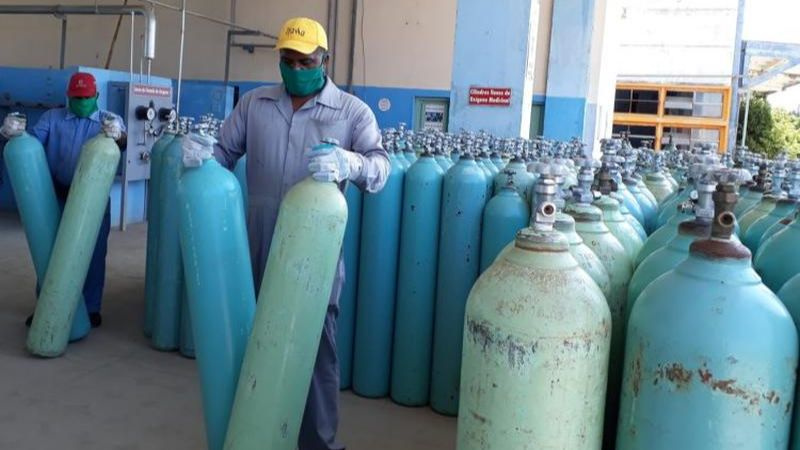
With so many chronic patients without an official supply, the demand for oxygen in informal trading networks has also skyrocketed.

The problem also affects hospitals where restrictions affect people admitted. / Prensa Latina

14ymedio bigger14ymedio, Natalia López Moya, Havana, 21 February 2025 — Technical problems at Cuba’s main plant for producing medicinal oxygen have been prolonged and are threatening thousands of patients. Until a few weeks ago, the main problem was with chronically ill patients who needed oxygen at home. Now, the shortage has spread to polyclinics and hospitals, according to several testimonies compiled by 14ymedio.

At the Angel Machaco Ameijeiras polyclinic in Guanabacoa, Havana, on Friday there was only one oxygen tank, and the line of patients, referred from other hospitals, was long. “I brought my son with severe shortness of breath and although children have priority, they couldn’t treat him because there is no mouthpiece,” the boy’s mother explained to this newspaper. “What was left of the tank wasn’t enough for even four more people, the nurse told me, and there were three times that many waiting.”

The woman decided to travel to other municipalities, but in several clinics she found the same answer: “There are none.” Finally, they recommended that she go to a care center in the municipality of Cotorro where they recently received a donation of an oxygen concentrator. “They were only providing service to children because they say they cannot cover all the adult patients who arrive.” continue reading

“The remaining supply was not enough for four more people, the nurse told me, and there were three times that number waiting.”

The OxiCuba SA plant, located in the municipality of Cotorro, has barely produced anything since last December, plagued by technical problems and a lack of investment. From this plant, the gas is sent to different destinations, especially to the Guanabacoa industrial plant where it is bottled and distributed to patients who need it. The plant’s service phone has not answered customer calls for days.

At the Reinaldo Pi Mirabal polyclinic in San Miguel del Padrón, oxygen has also been restricted to child patients only this week. The same is happening at the Mario Escalona polyclinic in Habana del Este and others located in more central municipalities. The problem is also affecting hospitals where the restrictions affect those admitted.

“In January they warned that the factory that fills the tanks in Guanabacoa was broken,” says the companion of a patient who has been admitted for weeks at the Dr. Miguel Enríquez Hospital, La Benéfica. “The little that has arrived is reserved for those who are more seriously ill, but I have seen people have tremendous scares, because they start to run out of air at night and there is nothing for all this.”

Even the health centres in El Vedado are not spared from the debacle. This Tuesday at the Borrás-Marfan Pediatric Hospital on Calle 17, there was only one oxygen tank left and the line to use it could take up to three hours. “All the others were empty,” complains Niurka, 41 years old and mother of a chronic asthmatic daughter. The woman, who also suffers from the disease, says that last weekend she had an attack and went to the Emergency Corps at Calixto García.

“There was no oxygen at all. The doctor who treated me, a foreign student, told me that many surgeries were paralyzed because there is not even enough to give to patients in the operating rooms.” Until a few months ago, Niurka had to carry salbutamol, bought on the black market, to be able to apply sprays that help her get through the crisis. “Now it seems that we will have to carry the oxygen and later even the chair to sit on.”

“There was no oxygen, the doctor who treated me, a foreign student, told me that many surgeries were paralyzed because there is not even enough to give to patients in the operating rooms.”

Antonio Quintana Bonachea, a patient with chronic obstructive pulmonary disease and resident of the municipality of Cotorro, has not received a new oxygen cylinder since last December. Tired of calling the service number demanding a response, he has had to ask for help from his followers on the Facebook page where he talks and discusses life in Cuba.

“Fortunately, an exiled follower found out about my need and sent me an oxygen concentrator that his late mother used. I just received it and I am looking for information on how to use it correctly. It is a help that I am very grateful for due to the instability of the service,” he tells this newspaper.

With so many chronic patients without an official supply, the demand for oxygen in informal trading networks has also skyrocketed. In just a few weeks, prices have gone up. “I’m selling a large oxygen tank, full and with all the accessories for 50,000 pesos,” reads one of the many Facebook groups for buying and selling in Havana. After a few minutes, the ad had accumulated a dozen messages asking for information to search for the product. “Sold, I don’t have any more,” the seller posted shortly after.

____________

COLLABORATE WITH OUR WORK: The 14ymedio team is committed to practicing serious journalism that reflects Cuba’s reality in all its depth. Thank you for joining us on this long journey. We invite you to continue supporting us by becoming a member of 14ymedio now. Together we can continue transforming journalism in Cuba.

With Blackouts and No Teachers in the Schools, Cuban Education Has Become ‘Optional’

Severalschools have reduced their hours and only offer classes in the mornings or from Monday to Thursday.

Elementary school children arriving at school /14ymedio

14ymedio bigger14ymedio, Juan Diego Rodríguez, Havana, March 2, 2025 — Dayma has not sent her daughter to school on Fridays in the municipality of Placetas, Villa Clara, where she is in third grade. According to 14ymedio, it is not because the girl is sick or because there is a new “complication,” but because the primary school itself has established that school days are only from Monday to Thursday.

She doesn’t know if the order came “from above,” but since the announcement, her life has turned upside down. “Every week I have to juggle to see who stays with her because if I stop working, we don’t eat. And at ten years old, I can’t leave her alone,” says the mother.

Hiring someone to pick her up from school and take care of her until she gets home from work is not an option either. The service is not cheap, and, with her daughter’s frequent outings at noon – when classes are suspended – it becomes more expensive.

On top of this, she argues, she works in the provincial capital, Santa Clara, which makes it difficult for her to take care of her daughter during working hours. Although she has tried to look for a job in Placetas, for now she cannot leave her only source of income.

Dayma confesses to this newspaper that she is “distraught” with the operation of the school: “I don’t know of any other programs, but my daughter barely has classes.” continue reading

According to the mother, the girl has not had a steady teacher since the school year began

According to the mother, the girl has not had a steady teacher since the school year began, and, due to the lack of staff, many subjects “have been left hanging.” “The other day I took her a little late because I had a medical shift, and when I got to the classroom there were only two children, of the 20 in the group. The parents had not sent the rest of them,” she says worriedly

In addition, the primary school has not had a director for at least two years. The teacher who held the position got sick and gives orders from her home, but she is never at the school “nor does she have the authority to demand anything if she herself does not go.” On several occasions, attempts have been made to “cover the gap,” says Dayma, but no other worker will step forward: “No one wants to get into that mess.”

“I know that things are difficult with the blackouts, lack of food and the situation of the teachers, who have their own problems. Sometimes I don’t want to send my daughter to school, because I feel it’s a waste of time and they only go hungry without doing any work. If things continue like this, they won’t learn anything,” she admits, and adds that even in Santa Clara many of her co-workers have complained about the same thing.

Carmen, a resident of the Luyanó neighborhood, in Havana, has a similar experience. Mother of a seventh-grade teenager, she has had to manage so that her son, at home, learns what they don’t teach him in school.

At the rate they’re going, the woman believes that only the most intelligent and those “with parents who force them to study” will be able to graduate

“At the beginning of the course they said that they would teach all day, but my son only goes in the mornings and often returns at ten or eleven saying that the teacher wasn’t there or that a shift was suspended,” she says. Other times, she points out, “they go in the morning and the teachers don’t come, so they leave them there for three hours, fulfilling a schedule, but without giving classes,” she complains.

Following the death of Jonathan Oliva, the 12-year-old boy who drowned during the floods last Monday in the capital, the schools of the municipality have tightened the measures, says Carmen. “Now they require the boys to also go in the afternoon, but they are not doing anything. In the end, without teachers and resources, they will not be able to maintain that system,” she predicts.

At the rate they’re going, the woman believes that only the most intelligent and “those with parents who force them to study” will be able to graduate. The most backward, she says, have no chance: “If they pass the year it’s because the school approved them so as not to have a bad record.”

Alarmed by the situation in the schools, both mothers agree that education on the island is far from demanding and controlled. “At any time you can meet a group of pre-university boys, or of any classroom , on the street. And it’s not that they ran away, but because they were released when classes were suspended,” Dayma criticizes.

If before these situations were only seen on days when the energy crisis forced the closure of schools and certain workplaces – as the Government did two weeks ago – now, the mother says, “it seems that education in Cuba is optional.”

Translated by Regina Anavy

____________

COLLABORATE WITH OUR WORK: The 14ymedio team is committed to practicing serious journalism that reflects Cuba’s reality in all its depth. Thank you for joining us on this long journey. We invite you to continue supporting us by becoming a member of 14ymedio now. Together we can continue transforming journalism in Cuba.

If You Don’t Live Near a Private Bakery, You Won’t Get Breakfast or a Snack in Matanzas, Cuba

State-owned companies have not received flour in the last three weeks to make bread for the rationed market

Iván Castro Rodríguez, director of the Food Company, confirmed to local media the lack of flour in the Matanzas territory. / Castro Rodríguez/TV Yumurí

14ymedio bigger14ymedio, Julio César Contreras, Matanzas, 27 February 2025 — The Provincial Food Company in Matanzas has only confirmed what had been the main topic on the streets of the city for more than three weeks. When the state entity announced on Tuesday that there was no flour to make the rationed bread for the market, the supply of the food had fallen dramatically and its price had skyrocketed.

“This official information was expected because the bread situation is critical in this province. No one is safe, there are problems in the municipalities and problems here in the city,” a resident of the Versalles neighborhood told 14ymedio. He went to the area around the Parque de la Libertad on Wednesday in search of bread.

The day before, Iván Castro Rodríguez, director of the Food Company, confirmed to local media the lack of flour in Matanzas territory. The official added that, despite the fact that “different efforts” had been made to resolve the situation, up to that moment they had not been successful.

“This official information was expected because the bread situation is critical in this province. No one is safe, there are problems in the municipalities and problems here in the city.”

Initially, the news excluded the collapse, but in reality the city has been suffering from such problems for almost a month and in the last week the state bakeries have not been able to guarantee the daily ration. “They sell it one day yes and one day no, sometimes two or three days go by when there is none,” explains Ramona, a retired resident of the Peñas Altas continue reading

neighborhood.

“Those of us who are having the worst time with all this are those of us who live furthest from the MSMEs,” says the woman. “Most of the street vendors who come here resell the bread that the workers at the state bakeries give them to sell on the street.” If there is no flour in the official establishments, the network of merchants who walk or cycle through the streets collapses.

“We are committed to restarting full production as soon as the flour arrives,” said Castro Rodriguez, but the Matanzas residents are preparing for a long absence of the product. “This is going to take a long time and that is why they have made this announcement now, to silence people because there is a lot of popular discontent,” Ramona said.

“A bag of soft bread, if you can find it, now costs between 300 and 350 pesos in private shops, and medium-sized loaves of bread are already going for 150 pesos,” complains the pensioner. “The further away you live from the few MSMEs that still produce bread, the more expensive it is.” The lack of the product affects not only breakfast at home and school snacks, but also affects other daily meals.

“It’s not just that it’s more expensive, it’s that we can’t guarantee having it, so we have to make do with what we have.”

“With rice being so expensive, in my house what we often eat at night is bread with something,” explains a mother who came to pick up her son outside a primary school at midday on Wednesday. “Bread is a support because it goes with everything, you can put anything in it.”

In the city center, tourists are not immune to the bread shortage. A restaurant near the boulevard has replaced the bread that accompanied one of its most popular starters with plantain chips. “It’s not just that it’s more expensive, it’s that we can’t guarantee to have it, so we have to make do with what we have,” explained an employee to a customer who was surprised when he saw some slices of fried plantain next to the cheese and ham chips. Other menu items, such as the Cuban sandwich and the hamburger, were also not “coming out” due to the lack of bread.

On a nearby corner, a vendor selling bread and cookies barely lasted a few minutes between hawking his wares and emptying the box he was carrying on his bicycle. When there is no bread, alarm bells go off and in Matanzas people sense that if the star of the snacks, breakfasts and starters is absent, it is because “things are bad, really bad,” according to Ramona.

____________

COLLABORATE WITH OUR WORK: The 14ymedio team is committed to practicing serious journalism that reflects Cuba’s reality in all its depth. Thank you for joining us on this long journey. We invite you to continue supporting us by becoming a member of 14ymedio now. Together we can continue transforming journalism in Cuba.

The Chinese Solar Parks Arrive, the Turkish ‘Patanas’ Leave and the Blackouts Continue

 20 photovoltaic plants are needed to replace the more than 400 MW lost with the closure of five floating power plants

The ’Suheyla Sultan’ floating power plant in the port of Havana, this Friday / 14ymedio

14ymedio bigger14ymedio, Havana, 28 February 2025 — With great enthusiasm the Cuban authorities boasted a week ago of having synchronized the first photovoltaic park in Havana, named Escuela de Enfermería, to the national electrical system (SEN), which will provide the country with 35,000 megawatt-hours (MW/h) per year. They plan to install 55 photovoltaic parks with Chinese technology before the end of this year, and this Friday, the Cuban authorities announced the inauguration of the second one. It is named Alcalde Mayor, is located in Cienfuegos and has the same generation capacity as the first of 21.87 megawatts (MW).

A report in the newspaper 5 de Septiembre reiterates what Cubadebate said about the synchronization of the park in Havana, that the operation of the Alcalde Mayor, in the municipality of Abreus, Cienfuegos, will allow an annual saving of 8,500 tons of diesel. Also, it is anticipated that in the coming months the province will have two other facilities of the same type: La Yuca, also in Abreus, and Mal Tiempo, in Cruces, with the same capacity, which will be added to another 18 MW already operational and from smaller parks.

However, the speed with which progress is being made in what the regime has called “a change of energy matrix” by betting on solar energy with the help of China, does not seem to be enough to end the blackouts on the Island, neither in the short nor in the medium term. Above all, it does not take into account something to which the Government has given minimum publicity: the departure of the Turkish floating power plants from Cuban ports. continue reading

The loss of floating power plants, says Piñón, “puts the reliability of the SEN at risk this summer”

Sold at the time to public opinion as an energy solution, there were eight of those patanas in the country, but today there are only three , all of them in Havana, as announced by the Minister of Energy and Mines, Vicente de la O Levy, in December. One of them, the Belgin Sultan – which suffered a fire five months ago that left two workers dead and another six injured – is simply a service ship, so, for electricity generation purposes, there are only two, which produce when they have fuel for their engines. The Suheyla Sultan, has a capacity of 240 MW, in Tallapiedra/Melones, and the Erol Bey, provides 63 MW, in Regla.

When the Cuban government ran out of money to pay the rent to the Turkish company Karadeniz, the other floating power plants, reports the energy specialist of the University of Texas, Jorge Piñón, went to Ecuador (Erin Sultan), Guyana (Ela Sultan and Baris Bay) and the Dominican Republic (Esra Sultan and Irem Sultan). “It would take 20 solar parks of
those that are currently being installed (of about 20 MW each) to cover the loss of more than 400 MW of generation of the five patanas that have left Cuba,” Piñón explains to 14ymedio.

The expert recalls that, according to the National Bureau of Statistics and Information (Onei), the contribution to the SEN of these floating units “was important in the total generation of the National Electric Union (UNE).” Specifically, 2,591 gigawatt-hours (GWh) in 2022, 14% of the total, and almost double in 2023, 4,494 GWh, 23% of the total.

The loss of floating power plants, says Piñón, “puts the reliability of the SEN at risk this summer,” the season of highest energy demand in Cuba.

Alcalde Mayor photovoltaic park, inaugurated this Friday in Abreus, Cienfuegos / 5 de Septiembre

Although the specialist says he recognizes and applauds that the Escuela de Enfermería “was built on schedule,” he believes that the objectives of the Cuban regime for this 2025 “are pharaonic.”

Enumerating the details of the government plan – from January to June, 27 solar installations with 590 MW of power, and from July to December, 28 with 610 MW of power; that is, 55 at the end of the year with 1,200 MW – Piñón calculates that this means completing in just twelve months 60% of the goal established for 2030, 92 parks with 2,000 MW of power.

“I wish them good luck. Perhaps they learned from the booklet that the Chinese read to Díaz-Canel and from his lessons,” says the expert, referring to the trip that the Cuban president made in November 2022 to China. Díaz-Canel himself then let drop the conditions set by his Chinese counterpart, Xi Jinping, by declaring: “Our commitment must be fulfilled well; we must do things well, take advantage of opportunities, be efficient, not waste resources, and ensure that investments have an adequate return. We must be increasingly serious and more effective also in the projects we propose to continue expanding cooperation.”

In this regard, Piñón, who has 30 years of experience in the private energy sector, emphasizes: “The biggest obstacle Cuba has in finishing its projects is its lack of project management, not the embargo, nor the lack of financing or technology. Management, management and management.”

Thus, according to the specialist, the decision of US President Donald Trump to revoke Chevron’s license to produce and export oil from Venezuela can paradoxically benefit Cuba.

Chevron contributed to the increase in Venezuelan crude oil production, which reached almost one million barrels a day (bpd) last December, far from the three million bpd of 25 years ago but more than double that in 2020. Piñón believes that the state oil company Pdvsa will try to maintain current production to avoid the closure of wells – the process of reactivating them is very expensive – and, therefore, will have more crude oil available for Cuba. “It is very possible that, in the coming months, Pdvsa will return to the average of 55,000 bpd, as in 2023.”

On the other hand, the other major fuel supplier to Havana, Mexico, will probably have to reduce its deliveries of crude oil and gasoline – it is not clear whether they are donations or barter for the shipment of Cuban doctors – to reduce the debt of the state-owned Pemex. This Wednesday, the Mexican Chamber of Deputies voted an amendment to the Hydrocarbon Income Law to reduce the tax burden of the state-owned Petróleos Mexicanos (Pemex), according to the Spanish agency EFE.

The initiative, supported by the official majority, establishes a new tax regime called Oil Law for Wellbeing, with the aim of remediating the finances of the state company and promoting its competitiveness in the energy sector.

Meanwhile, the electricity deficit expected this Friday once again exceeds 1,500 MW, the usual in recent weeks. For a demand of 3,250 MW there is an availability of 1,695 MW, and a real affectation of 1,695 MW is expected late evening during peak hours. It is lower than the maximum recorded on Thursday, 1,719 MW, which is dangerously close to the 1,800 MW that, last September, caused the SEN to collapse.

In the UNE statement today, there is no mention of the Turkish patanas. This newspaper verified that of the 12 engines of the Suheyla Sultan, three are off, since its chimneys do not emit smoke, probably due to lack of fuel. The Regla floating power plant is working, although it could not be verified if all eight of its engines were on.

The report does offer, again, an inventory of all the broken or in-maintenance plants: unit 5 of the Mariel CTE, the 1 and 2 of Santa Cruz, the 5 of Nuevitas, the 3 and 4 of Cienfuegos, the 5 of the Renté and units 1 and 2 of Felton.

The Government’s hopes for this weekend reside in the Lidio Ramón Pérez thermoelectric power plant, in Felton, in Mayarí (Holguín). The official press has announced that the recovery of block 1, which stopped unexpectedly on February 11, is imminent, but it has not yet happened.

Translated by Regina Anavy

____________

COLLABORATE WITH OUR WORK: The 14ymedio team is committed to practicing serious journalism that reflects Cuba’s reality in all its depth. Thank you for joining us on this long journey. We invite you to continue supporting us by becoming a member of 14ymedio now. Together we can continue transforming journalism in Cuba.

Donald Trump’s Authoritarian Threat

Contemporary autocrats prefer to manipulate rather than abolish elections / EFE

14ymedio bigger14ymedio, Karel J. Leyva, Montreal (Canada), 1 March 2025 — When we think of the imposition of an authoritarian regime, the image that usually comes to mind is that of an army seizing power, leaders overthrown and freedoms immediately suspended. In today’s world, however, authoritarianism is less and less imposed abruptly. The preferred style of autocratic leaders is to gradually erode democratic institutions. This allows them to concentrate more and more power while maintaining a democratic façade.

As Harvard political scientists Steven Levitsky and Daniel Ziblatt show in their book How Democracies Die, contemporary autocrats prefer to manipulate rather than abolish elections, to control parliaments rather than shut them down, to favour the press that supports them while silencing the press that denounces them. Oxford political scientist Nancy Bermeo describes this phenomenon as “autocratic coups”, to distinguish it from traditional “coups d’état”.

The evidence is everywhere. Viktor Orbán (the same man whom Trump proudly pointed to as an example of the support he has among foreign leaders, praising him as “one of the most respected men” and celebrating his intelligence) has turned Hungary into a full-blown autocratic regime. Erdoğan has manipulated elections, purged institutions and imprisoned journalists in Turkey.

Vladimir Putin, the great poisoner, has stung the opposition in Russia in every conceivable way, while continuing to hold elections. Chávez and Maduro in Venezuela, Ortega in Nicaragua, Duterte in the Philippines, Modi in India and Bukele (the “coolest dictator”) in El Salvador have employed continue reading

similar tactics: capture of the judiciary, pressure and harassment of journalists, illegal surveillance mechanisms, and persecution of critics.

Whatever techniques each chooses (some poison, others imprison or exile), the result is always the same: a gradual weakening of democracy and a docile state at the service of one man, or a political elite.

Donald Trump has shown tendencies that align with several of the tactics used by these authoritarian leaders

Donald Trump has shown tendencies that align with several of the tactics used by these authoritarian leaders, albeit in a context where institutions are incomparably stronger and have so far offered resistance. Like Maduro after the 2015 parliamentary elections, Trump has sought to undermine the legitimacy of electoral processes. His refusal to accept defeat in 2020, his insistence on electoral fraud without evidence, and his attempt to reverse the results reflect tactics of political manipulation. Added to this is his central role in the assault on the Capitol on 6 January 2021, an unprecedented and direct attack on the heart of American democracy.

Most recently, in July 2024, at a rally in Florida, Trump declared that, if re-elected, in four years, there would be no need to vote again: “We will have fixed it so well that you won’t need to vote,” he told a crowd of Christians. Remember dictator Fidel Castro’s “elections for what?” Well, that.

Trump has not only expressed his intention to use the state apparatus to punish his critics, he has begun to do so. In his first days in office, he has used his power as commander-in-chief to attack his enemies inside and outside the government. He has announced the restructuring of the Kennedy Center’s board, appointing himself as chairman of the board, with the aim of reshaping the cultural arena and security policies to suit his agenda.

In an attempt to control institutional memory and government transparency, Trump removed the national archivist, a traditionally non-partisan figure, thus weakening institutional oversight and facilitating the consolidation of his unaccountable power. For the time being, it is his secretary of state, Marco Rubio, who assumes the position, while the guardian of former Republican president Nixon’s legacy, Jim Byron, has been appointed Senior Advisor at the National Archives. This position gives him a role in the management and oversight of historical and government documents, which has raised concerns about possible interventions in their preservation and public access.

Not only that, Trump has vowed to use the Justice Department against his opponents, which is characteristic of dictators like Chávez, Maduro and Ortega. He has expressed his desire to prosecute critics and opponents, including journalists and members of the deep state. Like Duterte or Modi, Trump has used aggressive and polarising rhetoric, presenting himself as the defender of the “real people” against corrupt elites, immigrants and political opponents.

Trump has vowed to use the Justice Department against his opponents, which is characteristic of dictators like Chávez, Maduro and Ortega.

And what about his attitude towards the press, the cornerstone of any democracy? Well, Trump has tried to undermine its credibility, calling it the “enemy of the people” while celebrating only media that fawn over him. He is unlikely to gain control of the press like Orbán or Putin, but like them he has encouraged disinformation and media polarisation. Suffice it to think that during his first presidency Donald Trump made more than 30,500 false or misleading claims, according to the Washington Post’s Fact Checker analysis. Most recently, he has vetoed the Associated Press (AP) news agency from his press conferences and from access to the Oval Office and Air Force One.

Not only that: he has just taken direct control of the press pool covering the president, displacing the White House Correspondents’ Association. In other words, he will now be able to select which journalists have access and which do not. This has obviously set off alarm bells about press freedom and reflects a common pattern of authoritarian leaders: silencing and punishing the press that criticises them. To put it another way, only media that support their narrative will be allowed to ask questions or report from the White House.

His strategy of media control has been documented by Maria Marron in Misogyny and Media in the Age of Trump. The book shows that Trump has followed the same pattern as modern autocrats: discrediting truthful information while flooding the public space with propaganda. His social media presence and his use of inflammatory speeches have enabled the radicalisation of his base. Politics seems to be reduced to unconditional loyalty to his figurehead. Only authoritarian leaders make loyalty an absolute requirement.

None of this should come as a surprise. After all, political science studies have shown Donald Trump’s authoritarian profile, as well as that of many of his white voters. To mention just one example, a study by Jonathan Knuckey and Komysha Hassan showed that authoritarianism was a determining factor in support for Trump during the 2016 presidential election. Using data from the American National Election Studies, the authors found that white voters with authoritarian tendencies were significantly more likely to support him, regardless of their educational level. The article concludes that Trump’s campaign not only activated authoritarianism as a key criterion in the voting decision, but did so like no other campaign that has been studied.

Now, if there is one thing authoritarian leaders share wholeheartedly, it is the use of fear as a political weapon, something viscerally antithetical to liberal democracy. Liberal democracies may take different forms, but they all require individuals to be able to live without fear of government. It is precisely fear that has allowed dictatorships like Cuba’s to violate rights, destroy the dignity of citizens, divide them into loyalists and enemies, and even condemn them to misery. Fear paralyses, demoralises, outrages.

If there is one thing authoritarian leaders share wholeheartedly, it is the use of fear as a political weapon, something viscerally antithetical to liberal democracy.

The truth is that many Latinos who voted for Trump now not only regret it, but live in a permanent state of terror. Their family members are at risk of raids, expedited deportations and even confinement in Guantánamo without due process, measures that are more reminiscent of totalitarian regimes than liberal democracies. They live in fear of going out on the streets, going to the markets or working in the strawberry fields. Note that Trump’s anti-immigrant rhetoric, which criminalises Latinos, has direct consequences on the perception of the Latino community by so-called “real Americans”. Those with nativist instincts do not know whether the person in front of them has papers or not, so they discriminate or harass them equally.

In addition, a part of its Latino electorate has been affected by the elimination of Humanitarian Parole, [SEE ALSO] which allowed reunification with family members who were given a chance to escape totalitarian regimes. More than a few fear for their fate. And this is not to mention the fear that some are afraid to speak out publicly against Trump, and even feel compelled to praise him, in order to avoid criticism from the fanatics who once applauded Fidel Castro and now applaud Trump, no matter how much damage and suffering results from the narcissism and megalomania of both.

But it is not just immigrants that are affected by fear. The American scientific community has been under attack with funding cuts and censorship. Feeling anxious and distressed, some have begun to turn to their Canadian colleagues for help. Clinics and community health centres have closed and essential educational programmes have been defunded. Federal employees describe a climate of “fear” and “chaos” as they face a barrage of executive orders from Donald Trump and threats to their jobs from the Office of Personnel Management, now controlled by billionaire Elon Musk.

As The New York Times warns in its editorial Standing Up to Donald Trump’s Fear Tactics, Trump has used fear as a tool to intimidate opponents and deter resistance in Congress, the judiciary, the business sector, higher education and the media. His aim is to make the cost of challenging him intolerable and thus reduce the limits on his power. Is this not, after all, the aspiration of every authoritarian leader?

The question is not whether Trump will try to consolidate his power, but whether democratic institutions will be able to resist his advance.

Many Americans, used to living in a system where, regardless of the party in power, they always felt exempt from the fear so characteristic of dictatorships, no longer feel safe. The question is not whether Trump will try to consolidate his power through authoritarian strategies, but whether America’s democratic institutions will be able to resist his advance.

And, as with that barn wall in Animal Farm, the rules may continue to change bit by bit, until, when citizens finally realise, the democracy they thought they were protecting will be gone and MAGA will by then be an acronym for Make Authoritarianism Great Again.

Translated by GH

____________

COLLABORATE WITH OUR WORK: The 14ymedio team is committed to practicing serious journalism that reflects Cuba’s reality in all its depth. Thank you for joining us on this long journey. We invite you to continue supporting us by becoming a member of 14ymedio now. Together we can continue transforming journalism in Cuba.

Police Guard the Tribute to the Child Who Died During the Havana Floods

  • The 12-year-old boy lived on Fábrica Street in Luyanó, where dozens of neighbors gathered to show their condolences to the family.
  • The provincial government maintains that it cleaned the sewers, despite evidence to the contrary
Jonathan Oliva was 13 years old and was returning from school when he was sucked into a sewer. / Facebook

14ymedio bigger14ymedio, Havana, 25 February 2025 — Jonathan Oliva, 12 years old, was sucked into a sewer on Monday, February 24, in the Luyanó neighborhood, during the floods that occurred in Havana, and was found lifeless on Tuesday afternoon. The news was confirmed by the official reporter Lázaro Manuel Alonso, who specified that he lived on Fábrica Street, between Herrera and Santa Felicia, in the municipality of Diez de Octubre.

Heavy rains combined with poor sanitation caused sewers to collapse in several places, despite authorities claiming late in the afternoon that they had carried out “preventive work.”

Jonathan Oliva, also known as Papito, the son of Roly and Yami, was returning from school “when he found himself in the middle of a flood on his way home,” according to Radio Caribe. “Without realizing it, he was fatally sucked into the sewer. In a matter of seconds it was too late.”

Following article: 1 March 2025:

Police Guard the Tribute to the Child Who Died During the Havana Floods

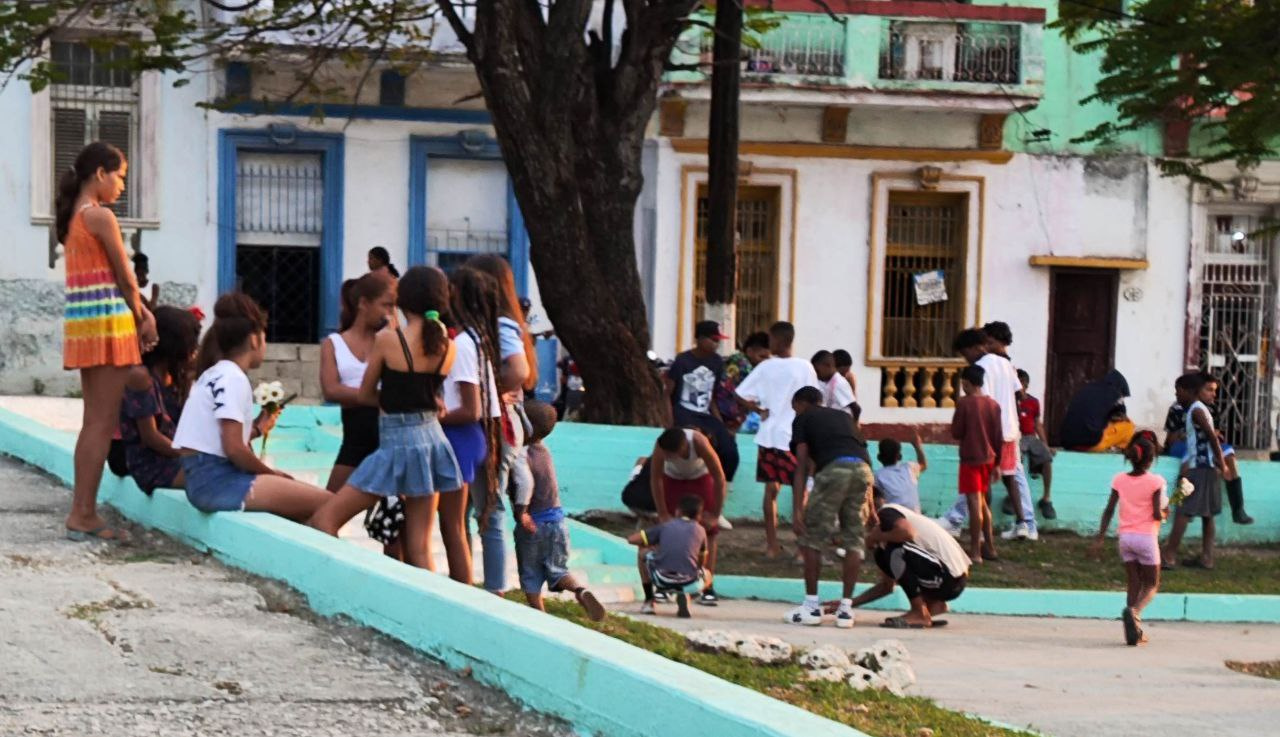
Most of the people who came to the park were teenagers. / 14ymedio

14ymedio, Juan Diego Rodríguez, Havana, 1 March 2025 — The call for the farewell began to circulate on social media and WhatsApp on Thursday: “The tribute will be tomorrow at 5:00 p.m. in the Fábrica park in honor of Jonathan. Everyone needs to bring a candle or a flower to fill the staircase,” repeated the messages about the ceremony to say goodbye to Jonathan Oliva, the 12-year-old boy who drowned on Monday after being sucked into a sewer in Havana.

On Friday at the time of the gathering, dozens of teenagers and neighbors gathered in the park on Fábrica Street, in the Luyanó neighborhood, the same one where Oliva’s family lives, in the municipality of Diez de Octubre.

Some children are carrying flowers in their hands. At first there were few people with candles, because they are quite expensive, one of the residents who was in the park told this newspaper: “They cost 100 pesos each.”

Among the groups of teenagers and children, comments about the tribute were also heard: “I brought a rose. A flower for another flower.” / 14ymedio

Among the groups of teenagers and children, comments about the tribute were also heard: “I brought a rose. A flower for another flower,” said a girl while showing the offering to her group of friends.

The gathering did not go unnoticed by the regime, especially after the official responsibility was pointed out for their not carrying out the cleaning of the sewers in time, to avoid flooding, and for not having suspended school that day despite the warning from Civil Defense of severe local storms.

Starting at least by 4:00 p.m., several plainclothes officers and others from the motorcycle police were patrolling the park. According to what 14ymedio confirmed during its visit to the site, at least four police cars and two State Security vehicles were in the area, in addition to several security officers sitting on park benches or standing on corners.

Since at least 4:00 p.m., several plainclothes officers and others from the motorized police patrolled the park. / 14ymedio

The otherwise quiet tribute ended in the evening with teenagers lighting candles and placing flowers in Fábrica Park.

Oliva’s body was found in Havana Bay a day after he disappeared. That same Tuesday, his family held a funeral and a religious ceremony at their home, where they took the boy’s coffin.

Dozens of neighbors gathered around the house , closely watched by a strong police operation. From inside Oliva’s home, according to what 14ymedio was able to verify, cries and screams could be heard.

The buses that normally pass by the house had also been diverted and the presence of uniformed officers and State Security agents was visible in the area. “The atmosphere is quite tense, people are silent because there is a lot of pain in the neighborhood,” an elderly woman who did not know the boy personally, but who went to the family home to offer her condolences, told this newspaper.

This Friday, the pain was still palpable in the spontaneous tribute that the residents of Luyanó paid to the child.
____________

COLLABORATE WITH OUR WORK: The 14ymedio team is committed to practicing serious journalism that reflects Cuba’s reality in all its depth. Thank you for joining us on this long journey. We invite you to continue supporting us by becoming a member of 14ymedio now. Together we can continue transforming journalism in Cuba.

The Disaster of Cuban Sport Is on Display at the International Sports Fair

The sports fair exhibits the balls, rackets, nets and bats that the athletes of the Island lack

On Thursday, the last day of the event, the Fair opened to all types of public, not just athletes. / 14ymedio

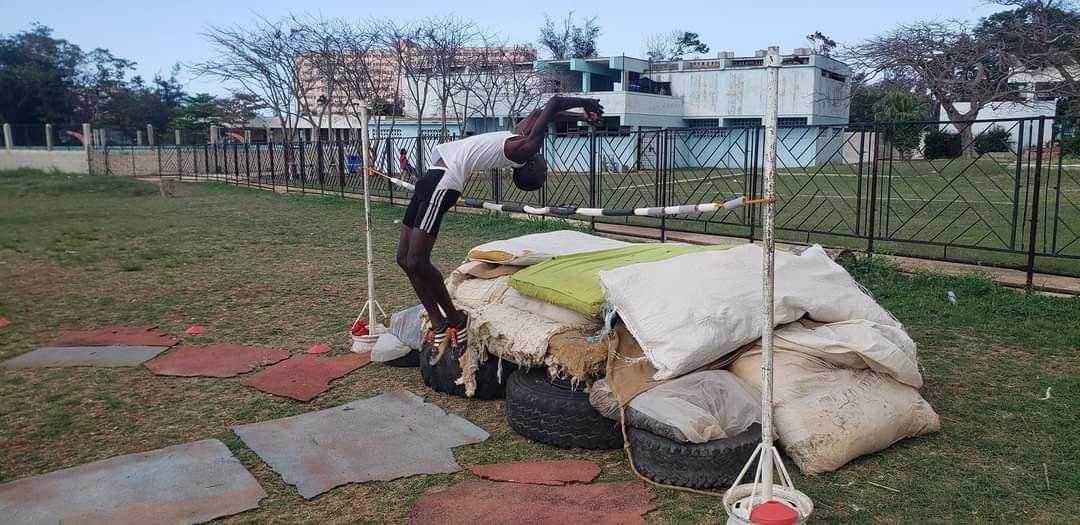
14ymedio bigger14ymedio, José Lassa, Havana, 1 March 2025 — A young man with patched-up sneakers, doing a pirouette to land between old mats and jute sacks: this and many other images sum up the divorce between the International Sports Fair in Cuba and reality. The event concluded this week at the Coliseo de Ciudad Deportiva, in Havana, leaving a bad taste in the mouths of coaches and athletes who have been demanding supplies for months for decent training.

For many of those present – most of them linked to the world of sport – the Fair was “a circus” designed to promote the sector’s links with MSMEs or with foreign companies dedicated to the sale of sporting goods. Rogelio, a former coach interviewed on site by 14ymedio , illustrates this with an example.

“In my province, when a small business was interested in making the clothing for the athletes of the Eide (Sports Initiation School), the answer was negative. So, what Fair are they talking about?” he asks.

Housed in several pavilions inside the Coliseum, some 92 entities participated in the Fair. / 14ymedio

On Thursday, the last day of the event, the Fair opened to all types of people, not just athletes. Recreational activities were held, with music, food sales, an agricultural fair, domino tables and even a promotional entertainer. Success was limited and people, listless, tried to keep up with the pace demanded by the entertainer under the midday sun.

Several barefoot children also ran around the Ciudad Deportiva tracks.

At the bottom of the coverage by Jit, the official specialized media that reported on the event, a user asked the question: “What is on display at this Fair? The disaster of Cuban sport?” The reader underlined the incoherence of celebrating with great fanfare a sector where every level, from the student to the professional, suffers a “clear deterioration.”

Several barefoot children also ran around the Ciudad Deportiva tracks. / 14ymedio

Packed into several pavilions inside the Coliseum, some 92 entities – 15 foreign and the rest national – participated in the Fair. Of the Cubans, 26 continue reading

were private companies with a stand dedicated to exhibiting their products. The greatest interest was not in the sale of sports equipment, but rather in a small/medium-sized company that sold honey.

Another attraction was the presence of glories of sport on the island, such as Javier Sotomayor – recently involved in a financial scandal with the Cuban treasury from which he has tried to disassociate himself – who posed for the cameras of his admirers.

The Inder (National Institute of Sports, Physical Education and Recreation) Marketing and Importing Company displayed balls, rackets, nets and bats that its athletes do not have. From the state-owned Acopio are fruits and vegetables that have not reached the provincial Eide canteens for years. In other booths, sports shirts and suits were sold for between 3,000 and 5,000 Cuban pesos.

Next to the Ciudad Deportiva fairgrounds, another ironic image: that of the Cuban National Circus, another symbol of what propaganda once presented as an “achievement” of the Revolution.

____________

COLLABORATE WITH OUR WORK: The 14ymedio team is committed to practicing serious journalism that reflects Cuba’s reality in all its depth. Thank you for joining us on this long journey. We invite you to continue supporting us by becoming a member of 14ymedio now. Together we can continue transforming journalism in Cuba.

Nicaraguan Freemasonry Follows in the Footsteps of the Cuban by Bending to the Ortega Regime

It is a small fraternity, but the Sandinista leaders want to dismantle it

Nicaraguan Freemasonry has not had an easy history / Grand Lodge of Nicaragua / Facebook

14ymedio bigger14ymedio, Juan Izquierdo, Havana, 2 March 2025 — Cuba is not the only country where the relationship between Freemasonry and the Government is problematic. In Nicaragua, where the regime of Daniel Ortega has withdrawn the legal identity of more than 5,600 organizations, including Freemasonry, the fraternity has begun a laborious rapprochement with the Government. Its strategy: bend, allow former Sandinista politicians to occupy high positions and criticize the Freemasons who ask for “full democracy” for the continent.

The last episode of the controversy occurred on February 17, when the Inter-American Masonic Confederation (CMI) – a historic coalition of 94 fraternal organizations in 26 countries – met with the secretary of the Organization of American States (OAS) to discuss the deterioration of democracy in the region.

Rather than ingratiating themselves with Ortega, an ally of Nicolás Maduro and defender of his legitimacy after the 2024 elections, the highest Masonic authorities in Nicaragua expressed their indignation and resigned “unilaterally and irrevocably” from their membership in the IAMC.

“Breaking with the CMI is very serious: Nicaraguan Freemasonry has just harmed itself.” This is the assessment of Hiram, a Mason based in Managua who talks with 14ymedio about the schism, the State infiltration in Freemasonry and the regional situation – including the Cuban ups and downs – of the fraternity.

“Every Freemasonry is like a country: the Grand Master is the president; he has a secretary, chancellor, provincial and municipal lodges that are like departments and ministries. To break with the CMI is to isolate yourself, even for a small masonry.” continue reading

According to Hiram, Nicaraguan Freemasonry, burdened by exile, has fewer than 200 members. “And of those, many continue to leave.” The figure is minimal when compared to that of regional Masonic powers, such as Cuba, which currently has about 20,000 initiates and which, almost 10 years ago, had more than 27,000.

The letter of the Nicaraguan Masons, spread through internal channels of the fraternity, was initialed by the leaders of the Grand Lodge and the 33 degree Supreme Council – the two highest authorities in the country – and the Chapter of Freemasons of the Royal Arch, another high institution.

They protested against the “dangerous” meeting of the CMI with Luis Almagro, secretary of the OAS, “an organization that has long lost regional credibility.” According to the text, the CMI carried out an illegal and anti-Masonic act by asking the OAS “to intervene in the sovereign Bolivarian Republic of Venezuela.”

Maduro is the “constituted authority,” they argued, and not recognizing him shows a “lack of vision,” encouraged by the OAS. This organization, in turn, serves “the imperial interests of the United States of America,” they insisted, unravelling in concrete insults against the “tentacles” of Donald Trump’s Administration.

The decision was made to “cut all ties” and abandon its membership status. Indeed, the Grand Lodge of Nicaragua is no longer on the official membership list of the CMI, although the Nicaraguan flag remains on the logo.

In reality, the Open Letter to the Society – published by the CMI on its social networks and signed in Washington on February 14 – was limited to demanding “unity, action and commitment” towards Venezuela. They demanded “dialogue and joint action” from the Masons and the OAS to guarantee the restoration of democracy in the country.

None of the Nicaraguan or Venezuelan Masons signed the letter. Nor did any Cuban Mason.

“The CMI letter was born in the heat of the Venezuelan elections, in July of last year,” Hiram explains. “Venezuela’s Freemasons – some opponents of Maduro and others not – were going to demonstrate against the result, and the CMI asked them not to risk it and to write their own statement. At that time the Nicaraguan Masons also protested.”

In 2023, Ortega declared that Nicaragua was leaving the OAS, which the Foreign Ministry called “an interference organization of the decadent unipolar and hegemonic government” of the United States. Relations with the organization had been soured since 2018, when the regime repressed popular protests and imprisoned hundreds of demonstrators.

“What do the Masons demonstrate in this whole story? Why do they ingratiate themselves with the dictatorship?” asks Hiram

“What do the Masons demonstrate in this whole story? Why do they ingratiate themselves with the dictatorship?” asks Hiram. “The Government doesn’t care about Freemasonry. Last year, both the Grand Lodge and the Supreme Council were left without legal identity. Despite that, those who go along with it, including several former Sandinista politicians, are all trying to get closer to Ortega.”

Nicaraguan Freemasonry has not had an easy history. Many Freemasons, Hiram reflects, continue to talk about “Somoza’s Masonic betrayal of Sandino.” Both leaders, the revolutionary Augusto César Sandino – who died in an ambush in 1934 – and Anastasio Somoza, dictator for several terms, were Freemasons.

It was the National Guard, led by Somoza, that was responsible for Sandino’s death. Since a Mason is forbidden to kill another Mason, Sandino’s death violated the ethics of the order. “That’s why the Government has always alluded to Somoza’s ’masonic betrayal’ of Sandino,” says Hiram. It is a symbolic stain on the order that Ortega’s propaganda has been able to take advantage of.

“In my opinion, the Government has never launched a large-scale infiltration of Freemasonry,” he says. “But there are senior officials, such as the signatories of that letter, who try to hijack it for the Government. There are the historical toads (snitchers). There are few opponents left, but there are some of Ortega’s boot lickers. They want to convert the Lodge into a [political] party.

“But there are high officials, like the signatories of that letter, who try to hijack it for the Government”

The recent crisis of Cuban Freemasonry – still active – after the theft of 19,000 dollars from the office of the Grand Master, who tried at all costs to remain in power, was commented on in the Nicaraguan lodges. “We said, What is happening in Cuba? Why did a Grand Master leave the country in 2023? Why was that money lost? It was embarrassing, it seems incredible. But there was never a larger debate, just hallway comments,” says Hiram.

Due to its secret character in the 19th century, Freemasonry contributed to forging independence movements and fighting against dictatorships on the continent. Aware of that organizational power, regimes such as the Cuban, Venezuelan and Nicaraguan have done everything possible to dismantle it, or at least keep it at bay.

For Hiram, this libertarian sense is the DNA of the fraternity, which has been immune to all dictatorships, both external and internal.

Translated by Regina Anavy

____________

COLLABORATE WITH OUR WORK: The 14ymedio team is committed to practicing serious journalism that reflects Cuba’s reality in all its depth. Thank you for joining us on this long journey. We invite you to continue supporting us by becoming a member of 14ymedio now. Together we can continue transforming journalism in Cuba.

Cuba Lost More Than 300,000 Inhabitants in One Year, Confirms the Government

The regime gives the figure of the current population of the Island: just over 9,700,000

“We are an aging country, so the strategies and actions being implemented are still insufficient” / 14ymedio

14ymedio bigger14ymedio, Madrid, 21 February 2025 — It has been known since last July, as the Government itself acknowledged, that Cuba’s population had dropped below 10 million. However, until this Friday, they had not disclosed the exact figure. The number of inhabitants on the Island as of December 31, 2024, according to Juan Carlos Alfonso Faga, deputy head of the National Office of Statistics and Information (ONEI), was 9,748,532—more than 300,000 fewer people than the previous year (10,055,968), the official specified.

He also indicated that more than a quarter of the Cuban population is 60 years old or older, and that the elderly are the only demographic group that has grown in recent years. By the end of 2023, for example, as revealed just three months ago, this age group accounted for 24.4% of the population (2,452,489), one percentage point more than the previous year and nearly five compared to 2016 (19.8%), when it was already considered high. Furthermore, over the past 20 years, the increase has been 9.7 percentage points.

Adding to these dramatic figures is the fact that only about 71,000 births were recorded last year, ’the lowest number in decades,’ they conceded.

About 71,000 births were recorded last year, ‘the lowest number in decades’

In light of this situation, the authorities gathered in the governmental commission on the subject, presided over this very Friday by Prime Minister Manuel Marrero, expressed that ’implementing strategies’ for the Demographic Dynamics Program is ’a priority.’ One of these strategies is the establishment of ’fertility programs and the maternal and child continue reading

program.’

In this regard, Marrero asked the ’state business organizations’ to create childcare facilities ’according to the demand of their own workers.’ ’It cannot be that the central government has to be using the Ministry of Education’s budget to make investments for this purpose, when these are mothers who are employed, generating wealth, working with the State, in these business organizations that should be the ones executing these investments,’ lamented the Prime Minister.

In the meeting, which was echoed by the Canal Caribe news program, it was also revealed that not all of the budget allocated to social public policies has been executed. Referring to this, Marrero called for ’discipline’ and exclaimed: ’How is it possible that we have money and do not spend it?’

Nevertheless, they acknowledged: ’Although work is being done on different programs aimed at addressing the needs of the elderly, we are an aging country, so the strategies and actions being implemented to protect the nation’s demographic dynamics are still insufficient.’

’How is it possible that we have money and do not execute it?’

The post by pro-government journalist Lázaro Manuel Alonso spreading the news was immediately filled with comments full of bitter humor. “I would like to know where the rations are for the almost three million missing people,” wrote Yariel Abrahante Jiménez, to which D Jorge Daba responded: “Simple, the shipment of rice from December, January and February arrived, and now the three million missing people show up.”

Others are simply asking for explanations. ’And how are they going to solve the issue? Soon we’ll be back to six million again,’ says Erick Sánchez, alluding to the population figure from 1959, at the triumph of the Revolution.

What was not mentioned at any point in the official media are the causes of the dramatic population decline, which specialists like Juan Carlos Albizu-Campos view as close to an ’implosion.’

This Cuban economist and demographer published a study last July estimating that Cuba had lost 18% of its population between 2022 and 2023, mainly due to migration. Albizu-Campos’s figures were more pessimistic than the Government’s (8.62 million inhabitants), but they align with the fact that many emigrants who left less than two years ago are still counted as residents on the Island.

In any case, the figure is also explained through many additional indicators, such as the increase in child poverty, the rise in maternal mortality, the decline in life expectancy, or the surge in teenage pregnancies.

Translated by Gustavo Loredo

____________

COLLABORATE WITH OUR WORK: The 14ymedio team is committed to practicing serious journalism that reflects Cuba’s reality in all its depth. Thank you for joining us on this long journey. We invite you to continue supporting us by becoming a member of 14ymedio now. Together we can continue transforming journalism in Cuba.

Million-Dollar Waltz at the Habanos Festival, Supposedly for the Cuban Health System

The humidor auction that closed the event raised $17 million

The closing gala was enlivened by the legendary group Earth, Wind & Fire. / EFE

14ymedio bigger14ymedio, Juan Izquierdo. Havana, 1 March 2025 — Two cedar drawers one atop the other, a giant Indian head – the Cohiba Behíke logo – and white squares on black varnish: this is the humidor auctioned this Friday for 4.6 million euros (4.7 million dollars) during the closing gala of the Habanos Festival. Never before had so much been paid for a cigar storage unit, whose exclusivity is based on a detail that the official press did not mention: the signature of Miguel Díaz-Canel.

Six other humidors – valuable but not signed by the president, a tradition established by Fidel Castro – were auctioned off during the dinner, for a total of 16.41 million euros (17 million dollars). They represented the major cigar brands: Cohiba, Montecristo, Romeo y Julieta, H. Upmann, Partagás and Hoyo de Monterrey. According to some media the buyer, who was not identified, is Chinese.

The money, the official press insists  goes to the island’s health system. In light of the Cuban health debacle and the total crisis in the country, few can believe this mantra that is repeated at each Festival.

Díaz-Canel was at the dinner, but unlike last year, there were hardly any photos circulating of him smoking among the guests or signing the humidor, gestures that caused great controversy at the last edition of the Festival. Also at the dinner were the Prime Minister, Manuel Marrero, and other members of the top brass of the regime. continue reading

The auctioned piece of furniture was not the only record broken by Habanos SA – the Cuban tobacco monopoly, shared by Cuba and Spain – which announced at the beginning of the week that it had had revenues of 827 million dollars in 2024, 106 million more than the previous year.

The auction which, in the past, Castro served as host of millionaires and sometimes served as auctioneer, is the most eagerly awaited event of the Festival, attended by tycoons and fans from around the world. Some of its participants were the first, albeit very discreet, guests of the new luxury hotel Iberostar, in the 42-story K Tower on 23rd Street, opposite the decaying Coppelia.

The closing gala – with entertainment by the legendary group Earth, Wind & Fire – was overshadowed, however, by the “intermediate” dinner that Habanos organized at the Capitol on Wednesday to present another luxury vitola, the H. Upmann Magnum 50. The adjectives that the company used to describe the event left no doubt about its character: “exclusive, refined, exquisite.”

The Salon of Lost Steps, once a place of debate and reflection on the Republic, was filled with 600 guests in tuxedos, overwhelmed by the play of light. No colored lights were spared on the dome of the Capitol, nor on the also gold-plated statue of the Republic, cast in 1928 by the Italian sculptor Angelo Zanelli.

“The place is the seat of our Parliament and is now used in images that resemble some kind of brothel from the 1950s”

The pro-government journalist and professor at the Faculty of Communication at the University of Havana, Ana Teresa Badía, harshly criticized the display. “What was the intention this Habanos Festival meant to convey? In a world in which the construction of public opinion is increasingly symbolic, this is very wrong. A serious error in political communication that buries the ideology that Cuba has defended. The place is the headquarters of our Parliament and now it is used in images that resemble a kind of brothel from the 1950s,” she wrote on her Facebook profile.

The painter Hermes Entenza, for his part, wrote: “The Habanos Festival, where glamour becomes ridiculous and extravagant, where the working people, who look at the building in dismay, do not even have cigarettes to smoke. Cuba in the Capitol, Cuba imprisoned by itself, moaning in the dark and feeling the walls of the beautiful building rumble to the sound of the empowered who have raised this movie to the level of a horror film… You have to have a very perverse mind to applaud this revelry.”

The immoderation marked both the making of the humidors and the vitolas. This was underlined by David Savona, director of Cigar Aficionado – the most recognized magazine in the sector – who was present at the Festival, who described step by step the hours it took him to finish the Cohiba Behíke BHK 58, the star of the night.

While the cigars and lights were lit in the Capitol, the country’s electricity deficit was 1,641 megawatts (MW). On Friday, while the multimillion-dollar auction was taking place in Pabexpo, west of the capital, the shortage was 1,625 MW. This Saturday, when the guests announced their return home with “cigars as gifts,” they left an Island submerged in blackout and with a deficit of 1,575 MW.

____________

COLLABORATE WITH OUR WORK: The 14ymedio team is committed to practicing serious journalism that reflects Cuba’s reality in all its depth. Thank you for joining us on this long journey. We invite you to continue supporting us by becoming a member of 14ymedio now. Together we can continue transforming journalism in Cuba.

With the ‘Instability’ of the Family Basket, Cuba’s Ration Stores Run Out of Cash

The function that allows customers to receive money with a QR code linked to their bank account is thus lost.

Businesses that request the extra cash service do not receive money in advance by the bank to put it into the hands of customers / 14ymedio

14ymedio bigger14ymedio, Madrid, February 28, 2025 — The Government must have thought “for big problems, big solutions” when it invented the “extra cash” service. The long lines at the banks, the lack of cash in the branches, the blackouts that shut down the ATMs and the disconnections that prevent card payment were going to be solved with this alternative. The concept is simple: the customer goes to one of the affiliated establishments, scans a QR code and makes a transfer of money to the premises, which – once the validity of the operation is verified – gives him cash: the panacea for rural areas.

More than three years later, the idea, which never prospered as expected, fails to work worse than ever. “If the stores and government establishments don’t collect money, you can’t withdraw money. The last thing they told me in the grocery store is that they are saving money to pay their workers. The rest of us have to sleep in front of the bank to withdraw 2,000* pesos, assuming there is money and electricity,” says a woman from Nuevitas.

Businesses that request the extra cash service do not receive money in advance by the bank to put in the hands of customers but rather depend on what they collect themselves. The 2021 measure was designed for ration stores, points of sale for propane and pharmacies, although later Correos [post offices], Casas de Cambio [currency exchanges], Cupet [gas stations] and other state-owned companies have been able to take advantage of it. The incentive is basically null, since the bank pays the premises a continue reading

commission of 0.5% of the balance of the day and a peso for each operation carried out, but – in return – it is doing the job of a cashier.

The official press of the provinces has dedicated some sporadic reports to the disappointment of this service

The official press of the provinces has dedicated some sporadic reports to the disappointment of this service, which has been progressively reduced. In December, the Central Bank of Cuba announced that the amount of 5,000 pesos without limit of operations, that was in force until that moment, was drastically reduced: 6,000 pesos, but only once a week.

The Government has not given up on the service but admits that it has been increasingly limited, as indicated by the report published this Friday by the State newspaper Granma. The article gives both praise and criticism to the extra cash service, based on cases in two provinces: Villa Clara, where the project progresses properly, and Granma, where it is shipwrecked without hope of rescue.

Juan Miguel Cabrales Perdomo, director of Development of the Commerce Business Group in the eastern province, says that of the 862 extra cash services that were initially enabled in the Commerce network, there are not even 400 that continue to work. For the official, the reason is very clear: the shortage of products for the rationed family basket leaves the coffers of the ration stores empty.

“Regardless of the fact that the majority of ration stores sell industrial products and other items, the most money they collect is from the sale of products for the family basket, which today do not have stability and arrive in fractional form. What happens as a result? The ration store requests extra cash, but there is none,” he tells the official newspaper of the Communist Party.

Cabrales Perdomo says that it was a good idea and was born “as an alternative to the lack of cash,” but “the situation has been changing.”

The provincial management of the Bank of Credits and Commerce (Bandec) indicates that there are 1,298 premises with the service, but the requests have stopped due to “lack of interest of some agencies, given the limitations they have with the existence of cash.”

However, the bank states that the increase in electronic payments is also behind the reduction in available cash and gives the electricity company as an example. Last year, 85% of the billing was through the bank, the company says, so the little money in cash they have left is for paying the workers and not for the public that requests it. “For me, the extra cash service has been a very comfortable and effective option, but for some months, withdrawing money that way has become an impossible mission,” said a customer. She told Granma that she used to withdraw cash from the gas company and that she would be an example of this type of case, since payments for electricity are most often done by bank, as the authorities have stated numerous times.

Apparently to alleviate the situation, the report addresses the case of Villa Clara, where 2,243 premises offer the service

Apparently to alleviate the situation, the report addresses the case of Villa Clara, where 2,243 premises offer the cash service. In this way, the residents of the province obtained 815,425,000 pesos (about 2.4 million dollars at the informal exchange rate), an amount that, without the comparative data, was much higher than that of the previous year. Specifically, Santa Clara ostensibly excelled, with 257,210 extra-cash operations (45% more than the previous year), worth 681 million pesos.

According to the newspaper, the abysmal difference between the two provinces is due to the fact that the administrators of the establishments of the Commerce of Villa Clara carried out very adequate informative work, which has promoted adherence to the program. The merchants managed to pocket 3,745,000 pesos in commissions, “nothing negligible,” the report considers, although it is the equivalent of 11,000 dollars among more than 2,000 establishments.

The report also addresses the corruption that can occur in this service, although the Commerce director assures that everything is under control. “We have had some cases of people trying to take advantage of this facility for personal purposes or to favor others, which have been detected and neutralized immediately, thanks to the vigilance that we carry out every day on this matter, and to our close relationship with the banking system, which can trace and record all the operations,” he emphasizes.

Translator’s note: The peso/dollar exchange rate is quite volatile, and varies even on the same day in different places based on different exchange scenarios. That said, today 1 Cuban pesos is worth roughly 4.2 cents US.

Translated by Regina Anavy

____________

COLLABORATE WITH OUR WORK: The 14ymedio team is committed to practicing serious journalism that reflects Cuba’s reality in all its depth. Thank you for joining us on this long journey. We invite you to continue supporting us by becoming a member of 14ymedio now. Together we can continue transforming journalism in Cuba.

With More Than a Thousand Political Prisoners in Its Jails, the Cuban Regime Denounces the Decline in Rights in the West

Cuban Foreign Minister Bruno Rodríguez regrets the advance of “conservative and neo-fascist platforms”

Bruno Rodriguez at the opening of the United Nations Human Rights Council on Monday. / EFE

14ymedio bigger14ymedio/EFE, Geneva, 24 February 2025 / Cuban Foreign Minister Bruno Rodriguez expressed alarm at the rise of “neo-fascism” globally and the retreat of policies supporting vulnerable groups in the West, speaking at the opening of the United Nations Human Rights Council in Geneva on Monday.

“We observe with great concern the advance of conservative and neo-fascist platforms, and how in developed countries we are experiencing a decades-long regression in fundamental rights, including women’s equality, sexual and reproductive rights, the rights of Afro-descendants, of ethnic minorities and of migrants,” he said.

“The right to life is in grave danger. The United Nations Charter, international law and multilateralism are being threatened, while attempts are being made to impose economic coercion and political subversion as methods of international relations,” warned Rodríguez.

“The United Nations Charter, international law and multilateralism are being threatened, while attempts are being made to impose economic coercion and political subversion as methods of international relations”

In this context, the minister called on the United Nations Security Council, which on Monday opened six weeks of debates on crises and conflicts in the world, to “advocate more strongly for a fair and democratic international order that guarantees peace and balance in the world.”

Cuba’s foreign minister also pointed to the United States, which withdrew from the Human Rights Council with the inauguration of Donald Trump as president, for being “an active accomplice to the Israeli genocide in Gaza” and for its decades of maximum pressure on Cuba through the blockade*. continue reading

Rodríguez also stated that recently “copious evidence has been released about the US practice of allocating millions of dollars from the federal budget through entities such as USAID to finance organizations, media outlets, artificial intelligence laboratories and technological platforms that use the protection of human rights as a facade.”

“In reality, they respond to the legitimate political objectives of that government. This is a serious and pertinent matter for this Council and its mandate, as it demonstrates the double standards and opportunism with which the issue of human rights has been used to subvert sovereign governments,” he said.

The opening of the 58th session of the United Nations Human Rights Council coincided on Monday with the third anniversary of Russia’s invasion of Ukraine, which was the focus of UN Secretary-General Antonio Guterres’ speech. “Eighty years after the end of the Second World War, the war in Ukraine is a grave threat not only to the peace and security of Europe, but also to the very foundations and fundamental principles of the United Nations,” he said.

The opening of the 58th session of the United Nations Human Rights Council coincided on Monday with the third anniversary of Russia’s invasion of Ukraine.

Cuba has not commented on this matter, in which it has always sided with Russia, calling the invasion a “special operation.” As of 31 January 2025, there were a total of 1,150 political and prisoners of conscience on the island “suffering judicial sentences or restraining orders,” according to the organization Prisoner Defenders.

Like that organization, the human rights NGO Amnesty International has denounced that the Cuban regime, which committed itself in January to release 553 prisoners, and has incurred in a multitude of “irregularities” and “lack of transparency” in the process .

According to the NGO, 172 prisoners have been released and another nine have received some change in their legal status, with most of these being participants in the anti-government demonstrations of 11 July 2021 (11J). Prisoners Defenders, for its part, estimates the number of political prisoners released to be 200, and added that it has accredited some common prisoners who have also been released.

Translator’s note: There is, in fact, no US ‘blockade’ on Cuba, but this continues to be the term the Cuban government prefers to apply to the ongoing US embargo. During the Cuban Missile Crisis the US ordered a Naval blockade (which it called a ‘quarantine’) on Cuba in 1962, between 22 October and 20 November of that year. The blockade was lifted when Russia agreed to remove its nuclear missiles from the Island. The embargo had been imposed earlier in February of the same year, and although modified from time to time, it is still in force.

____________

COLLABORATE WITH OUR WORK: The 14ymedio team is committed to practicing serious journalism that reflects Cuba’s reality in all its depth. Thank you for joining us on this long journey. We invite you to continue supporting us by becoming a member of 14ymedio now. Together we can continue transforming journalism in Cuba.

“There Is No Bread, There Is No Flour”: The Omnipresent Poster in Havana’s Shops

Shortages affect both the rationed and informal markets

A bakery in Havana announces on an improvised poster that it is not selling bread / 14ymedio

14ymedio bigger14ymedio, Natalia López Moya, Havana, 28 February 2025 — In La Timba the mornings are too quiet. In that poor neighborhood that extends a few meters from the Plaza de la Revolución in Havana, the proclamations of the street vendors who sell bread have not been heard for days. The absence of their voices is a terrible sign in a city where many bakeries have displayed the “There is no” sign due to the lack of flour that has sunk the production of this basic food.

“There is some, but you have to do a lot to find it,” says a retiree who this Friday walked from the Luyanó neighborhood to Central Havana. “I went to several private businesses, and they say they are not making bread, that they don’t know when they will sell it again.” In at least two of these MSMEs, employees explained that the current shortage is due to problems with the supply of flour after the offensive that the authorities unleashed against informal sellers and illegalities in the sector, in the capital and also in the provinces, especially Matanzas.

An open secret is that much of the bread sold by street vendors is made in the same bakeries that make the rationed bread. The raw materials that guarantee 60 grams per consumer per day are being diverted and become a product that economically supports a wide network of bakers, administrators who turn a blind eye, and informal sellers. These days, the official media have warned in several provinces that the State does not have enough flour to guarantee that daily quota, a shortage that has also put the black market in check.

“I went to several private businesses that say they are not making bread and don’t know when they will have it for sale again”

Private producers are also experiencing difficulties. “The price of flour has gone up, which forces us to raise prices or cut production,” Samuel, a young baker who works in a private candy store where they also make cookies, breads and the popular breadsticks, explains to this newspaper. “In continue reading

February of last year, if you bought by quantity, a 25-kilogram bag wasn’t even 30 dollars, but now it’s a miracle if you can find it under 40.”

“We had to stop selling bags of bread because there was one complaint after another. We had one that contained eight bread rolls at 200 pesos because they were big, but the people who came in treated us like scammers,” he explains. Finally, “we couldn’t even continue at that price, because buying quality flour and selling at that price only gives us losses.”

Samuel points to an increase in State controls as part of the problem. “Some inspectors arrived at the bakery and started handing out fines before even entering. They fined us thousands of pesos because we had a sign outside with the prices, and they said No, it has to be inside. Then they came in, and because there was a bag with a little flour that we had transferred from a sack and did not have the origin on the outside to compare it with the invoice, they added 8,000 more pesos to the fine.”

The result was that they stopped making not only bread but also panettone, puff pastry and any other type of dough made from flour. “Now we are only making cremitas de leche (milk caramels), guava bars, custard and coconut macaroons.” Of course, the large sign with “There is no bread, there is no flour” has been placed inside the business, on a counter with empty shelves behind it.

Translated by Regina Anavy

____________

COLLABORATE WITH OUR WORK: The 14ymedio team is committed to practicing serious journalism that reflects Cuba’s reality in all its depth. Thank you for joining us on this long journey. We invite you to continue supporting us by becoming a member of 14ymedio now. Together we can continue transforming journalism in Cuba.

The Cuban Regime Releases Five Other 11J Political Prisoners

Following the resumption of releases this week, nine opposition members have been released from prison

As of Friday, there have been 219 releases of political prisoners / Niurka Rodríguez García / Facebook

14ymedio bigger14ymedio, Havana, 28 February 2025 — Five other Cuban political prisoners – Yunaiky de la Caridad Linares Rodríguez, Andy Alexis Martín Pérez, Luis Armando Cruz Aguilera, Lázaro Antonio Rodríguez Jerez and Abel Lázaro Machado Conde – were released this Friday. After stopping the releases in January, the Regime resumed them as the result of a negotiation with the Vatican. All the prisoners had been arrested during the popular protests of 11 July 2021 (11J) and given sentences of up to 10 years.

Martín Pérez received the prison benefit yesterday afternoon, when the release from prison of four other political prisoners was also announced: Iván Mauricio Arocha Arocha, Ohaurys Rondón Rivero, Brusnelvis Adrián Cabrera Gutiérrez and Yaquelin Castillo García.

According to the organization Justicia 11J, Martín Pérez – father of five children and a “ponchero“* by profession – was arrested in Colón, Matanzas. After his arrest, he was prosecuted by a military court, and the prosecutor asked for 22 years in prison for sabotage, robbery with force and public disorder.

Linares Rodríguez, for her part, was the first person released from prison this Friday, and according to CubaNet was put on parole. The 27-year-old – she was 24 at the time of the demonstrations – was arrested in Havana and “was incommunicado for two days,” Justicia 11J clarifies. continue reading

For her participation in the Toyo corner protest, which left the iconic image of the overturned patrol car, she was accused of sedition

For her participation in the Toyo corner protest, which left the iconic image of the overturned patrol car, she was accused of sedition; the prosecutor’s office requested 17 years in prison. The sentence was 10 years, and after an appeal by the family, it was reduced to eight, which she served in the Women’s Prison of the West, also called El Guatao, in the capital.

Yunaiky [Linares Rodríguez] suffers from thyroid problems, and during her confinement she reported that she did not receive medication. On several occasions she was taken to a punishment cell after she demanded that her rights be respected. Her helplessness and pain for the injustices she endured in prison led her to self-harm,” said Justicia 11J.

During her time in prison, her mother, Niurka Rodríguez García, carried out a very intense activism for the cause of political prisoners and tirelessly reported the violations of the rights suffered by Linares Rodríguez and other women prosecuted for their participation in the historic demonstrations.

The releases were negotiated between the Vatican and Havana, which promised the release of 553 prisoners throughout 2025, allegedly to show the “spirit of Jubilee” and the humanism of the Cuban Government. The statements, made at the beginning of the year, coincided with the decision of former US President Joe Biden to remove the Island from the list of states that sponsor terrorism.

After the arrival of Donald Trump at the White House on January 20, Cuba was again included on the list, and the releases stopped. Until that moment, about 200 political prisoners had left Cuban prisons – more than 30 of whom had already finished their sentences – along with others, common prisoners.

After Donald Trump’s arrival at the White House on January 20, Cuba was again included on the list, and the releases were stopped

With the most recent five, there have been 219 releases of political prisoners, but this not guarantee their acquittal. They are on conditional parole.

Mike Hammer, Special Envoy for the U.S. Embassy in Havana, arrived on the Island shortly before the releases began and, since then, has been involved with activists, political prisoners and opponents.

This Friday, the diplomat posted on the Embassy Facebook account: “On my second visit to Matanzas, I met with Maibel Gelin and Alexey Rodríguez, parents of political prisoner José Alejandro Rodríguez Gelin, and with Rosemery Bello, wife of political prisoner Yasmany Porras. We join their request for the release of their relatives and other political prisoners.”

One day before, he visited former political prisoner Samuel Pupo Martínez and his wife Yuneisy Santana González, who thanked the diplomat for their interest in the Cuban opposition and for the testimonies of those who have been imprisoned for political reasons.

In recent weeks, Hammer visited other opposition figures such as José Daniel Ferrer, who was also released from prison as part of the agreement; the leader of the Ladies in White, Berta Soler; the dissident Martha Beatriz Roque, who was hospitalized; Félix Navarro; and the teacher and activist Bárbara Alina López in Matanzas.

*Translator’s note: Someone who repairs flat tires

Translated by Regina Anavy

____________

COLLABORATE WITH OUR WORK: The 14ymedio team is committed to practicing serious journalism that reflects Cuba’s reality in all its depth. Thank you for joining us on this long journey. We invite you to continue supporting us by becoming a member of 14ymedio now. Together we can continue transforming journalism in Cuba.