The Cuban Regime Is Rehearsing a “People’s War” While the Police Brutally Repress Protests

Díaz-Canel says the frustration caused by the prolonged blackouts is “understandable,” but “there will be no impunity for vandalism and violence.”


Student stronghold in Cienfuegos. / September 5 (Newspaper)

14ymedio bigger14ymedio, Havana, March 14, 2026 —  On the same day as yesterday, Friday the 13th – which ended with a teenage protester injured, according to videos circulating on social media, by a police shot during the massive protest in Morón – the Cuban government was carrying out military exercises and civilian mobilizations throughout the country, celebrating National Defense Day; and preparing the military indoctrination of the youngest citizens.

President Miguel Díaz-Canel took almost 24 hours to react to the riots in Morón, and he did so with a tweet in which he described the discomfort caused by the prolonged blackouts in our people as “understandable,” but added that “there will be no impunity for vandalism and violence.”

Just hours after publicly acknowledging talks with Washington to “carry out actions for the benefit of the people of both countries,” the Cuban president, in his capacity as president of the National Defense Council, visited the Western Army General Staff to be briefed on the plans for ” the war of the entire people ,” which have been reinforced since January of this year due to the regime’s fear of a possible US military intervention.

In every province, preparatory exercises were organized as part of this defensive strategy, which integrates armed forces, reservists, and civilians, always emphasizing the same rhetoric about the common enemy: Yankee imperialism. Although the official media triumphally insist on these celebrations as if they were large-scale events, the images published by the same state newspapers show faces of disinterest and discouragement among the participating civilians.

In Cienfuegos, the Deputy Minister of the Revolutionary Armed Forces (FAR), Joaquín Quintas Solá, supervised exercises that included the evacuation of children from a daycare center to shelters set up for wartime and visited the so-called “student bastion,” exercises in educational centers that prepare the youngest for military strategies.

According to the newspaper 5 de Septiembre, Quintas Solá emphasized the importance of these activities with students where they “exchange information about advances in science and military techniques, talk with combatants, learn about active military service, listen to the experiences of girls in their continue reading

voluntary female military service and about training at the Camilo Cienfuegos Military School.”

The so-called “student bastión,” which aims to indoctrinate minors, was also implemented in provinces including Las Tunas and Artemisa with visits to military units, weapons training, and shooting exercises. These activities reinforced the students’ obligation to perform active military service, seeking to strengthen “patriotic-military education” and “foster an interest in military careers among young people.”

Other provincial media outlets enthusiastically covered the day’s celebrations. In the province of Camagüey, according to the newspaper Adelante, the day “reaffirmed the determination of the people of Camagüey to prepare themselves in the midst of an unconventional warfare scenario.”

The contradictions of this Friday the 13th reached their peak with the police repression in the protests in Morón

In Holguín, municipal defense councils organized rifle assembly and disassembly drills and live-fire exercises. The president of the Provincial Defense Council, Joel Queipo Ruiz, “emphasized the importance of this training in these times, given the complex global situation and the manifestations of imperialism in the region,” according to the newspaper ¡Ahora! [Now!].

In Granma, the president of the Provincial Defense Council, Yudelkis Ortiz Barceló, stated during military training that “the fundamental priority in the current scenario of economic warfare and threats is to intensify the defense of the country, food production and local self-sufficiency.”

This militarization of young people and the mandatory military tactic of “war of the whole people” that involves preparing civilians for armed conflict, is very out of place in the current situation of a population that every night publicly protests the structural crisis of the system and cries out “Bring on Trump!” and “Freedom!”

The contradictions of this Friday the 13th reached their peak with the police repression in the protests of Morón, where the abusive beatings of teenagers reported on social networks, the shots that can be heard in the videos released and the alleged bullet wound of a young protester, accentuate the incredulity at the tiresome rhetoric of national defense.

______________________

COLLABORATE WITH OUR WORK: The 14ymedio team is committed to practicing serious journalism that reflects Cuba’s reality in all its depth. Thank you for joining us on this long journey. We invite you to continue supporting us by becoming a member of 14ymedio now. Together we can continue transforming journalism in Cuba.

Cuban Foreign Trade Minister Confirms Cubans in the US Will Be Able to Invest in Private Businesses on the Island

Miami-Dade County Tax Collector Dariel Fernandez called the Cuban government’s announcement a “desperate maneuver by the dictatorship to try to save itself.”

On Monday, Pérez-Oliva presented the measures that open up investment opportunities for Cubans living abroad. / Screenshot

14ymedio bigger 14ymedio, Havana, March 16, 2026 — Cuba’s Minister of Foreign Trade and Foreign Investment, Oscar Pérez-Oliva Fraga, said this Monday that the Government will allow “Cubans who reside abroad even without holding effective residence in Cuba and, based on the category offered by the Cuban migration law called ‘investors and businessmen’, to participate in or own private companies” within the country.

Pérez-Oliva spoke in an interview broadcast on Cuban State TV’s Mesa Redonda [Round Table] program this Monday, after previously giving statements to the foreign press on the subject. In his remarks, he indicated that emigrants will be able to “partner” “with Cuban private companies.” He clarified that this does not refer only to small businesses; it can include infrastructure and large private and state-owned enterprises.

“The doors of our country are open to Cubans abroad,” he emphasized, repeatedly stating that “there are no limitations” for Cubans who want to invest.

He also spoke about the participation of these Cubans in the country’s financial and banking system, something that was not permitted until now. This strategy will allow them to serve as “support for other productive or service sectors.” Furthermore, the emigrants will be able to “open and operate foreign currency bank accounts in Cuban banks. They will be able to do so in the same way as any person or institution residing in our country,” he added.

“The doors of our country are open to Cubans abroad.”

The topic was first reported by El Nuevo Herald on Saturday , and on Monday, in an interview published by NBC News, Pérez-Oliva shared details about the anticipated reform, which was to be announced that same day. “Cuba is open to having a fluid commercial relationship with U.S. continue reading

companies and also with Cubans residing in the U.S. and their descendants,” declared the deputy prime minister and great-nephew of Fidel and Raúl Castro.

Pérez-Oliva stated in the interview with the US television network that “this goes beyond the commercial sphere,” and added: “It also applies to investments: not only small investments, but also large ones, especially in infrastructure.”

At the same time, the deputy prime minister did not miss the opportunity to point to the US embargo as the origin of all evils: “The US blockade*, the policy of hostility against Cuba, is undoubtedly an element that affects the development of these transformations.”

Currently, many private businesses in Cuba receive informal financing, through remittances from relatives abroad, especially from the US, something that the reform would explicitly legalize.

Pedro Monreal has warned that the reform could lead to new inequalities within the country’s private sector itself.

Regarding the expectations generated by the details of this measure, Cuban economist Pedro Monreal has warned that the reform could cause new inequalities within the country’s private sector itself and has doubts about the way it is conceived by the State.

“Foreign investors enjoy tariff, tax, and foreign trade benefits, as well as a business structure that private micro, small, and medium-sized enterprises (MSMEs) lack,” Monreal points out. This would imply that Cubans residing abroad could enjoy legal and economic advantages over private entrepreneurs within the country.

The specialist posted on his X profile this Monday: “What the Cuban government announces today will not be attractive to many emigrants if it is limited to providing ‘a space for participation in the country’s economic and social development.’ It should go much further: establishing rights and guaranteeing mechanisms to implement them.”

Private business owners in Cuba have expressed similar concerns. Engineer Yulieta Hernández Díaz, executive director of the Pilares Construction Group, which provides services on the island, stated in a social media post that the problem lies not in who invests, but in the conditions under which that access is organized.

If investment is managed within an opaque system, without clear rules, without a level playing field and without transparency, it does not create development, but rather distortion and inequality.

“If investment—whether foreign or from the diaspora—is managed within an opaque system, without clear rules, without a level playing field, and without institutional transparency, what is created is not development, but distortion and inequality,” warns Hernández, adding: “Cuba needs a framework that guarantees equity, transparency, and coherent public policies, allowing all economic actors to grow and develop.”

The EFE news agency, for its part, states that, according to its sources, the possibility of facilitating the purchase of real estate on the island for Cubans residing abroad is being studied, especially for those who left the country before the 2013 immigration reform.

“It’s historic,” Cuban-American businessman Hugo Cancio told EFE when asked about the reforms. “It could be the beginning of the dismantling of the US economic embargo against Cuba,” he said.

Cuban economist Tamarys Bahamonde tempers expectations: “The impact will be greater or lesser depending on the conditions and context surrounding the authorization of these investments,” she says. “Success will depend not only on how Cuba designs and implements it, but also on the flexibility offered by the US,” she added.

The measure has also generated rejection among sectors of the Cuban exile community in the United States. Miami-Dade County Tax Collector Dariel Fernandez issued a formal statement this Monday in which he described the government’s economic opening as “a desperate maneuver by the dictatorship to try to save itself.”

“In a moment of clear desperation, the same regime that confiscated property, expelled families, and destroyed the future of generations of Cubans wants those same exiles to return and invest their money in the system that oppressed them. The dictatorship is not seeking reforms. It is seeking to survive,” the statement reads.

Fernández calls on Cubans abroad and foreign companies not to invest in the island until there are political freedoms. “The solution for Cuba is not doing business with the tyranny,” he states, insisting that the priority must be “the end of that regime” before any economic opening.

_________

*Translator’s note: There is, in fact, no US ‘blockade’ on Cuba, but this continues to be the term the Cuban government prefers to apply to the ongoing US embargo. During the Cuban Missile Crisis the US ordered a Naval blockade (which it called a ‘quarantine’) on Cuba in 1962, between 22 October and 20 November of that year. The blockade was lifted when Russia agreed to remove its nuclear missiles from the Island. The embargo had been imposed earlier in February of the same year, and although modified from time to time, it remains in force.

______________________

COLLABORATE WITH OUR WORK: The 14ymedio team is committed to practicing serious journalism that reflects Cuba’s reality in all its depth. Thank you for joining us on this long journey. We invite you to continue supporting us by becoming a member of 14ymedio now. Together we can continue transforming journalism in Cuba.

Matanzas Under Siege Amid the Appearance of Posters Against the Regime

State Security harasses an evangelical pastor for allowing “subversive ideas” in his congregation.

Etecsa center in Peñas Altas, where they are paying one thousand pesos per shift to trusted individuals to keep watch / 14ymedio

14ymedio biggerPablo Padilla Cruz, Matanzas, March 17, 2026 – The “City of Bridges” does not sleep, not because of the bustle of its cultural life or the flow of its rivers but because of the weight of a security operation that reveals an unprecedented institutional vulnerability. Following the appearance of a sign in the central Playa del Tenis where the word “Communism” was intertwined with a Nazi swastika, the repressive apparatus in Matanzas has gone on maximum alert, revealing that, for the regime, a can of paint is now more dangerous than a weapon.

Less than 72 hours after the protests in Morón and just one day after the incident at Playa del Tenis, Matanzas woke up militarized at its key points. The speed with which State Security agents covered the anti-communist graffiti was not enough to contain the paranoia. According to internal sources, the security perimeter has expanded to public buildings and strategic locations, attempting to shield a normality that exists only in official discourse.

The fear is not only of crowds but of symbols. The appearance of posters with the word “libertad” [freedom] in the neighborhoods of Naranjal and Los Mangos has triggered a disproportionate response that combines worker coercion, technological sabotage, and religious persecution.

The appearance of posters with the word “libertad” [freedom] in the neighborhoods of Naranjal and Los Mangos has triggered a disproportionate response that combines labor coercion, technological sabotage, and religious persecution

The escalation of tension reached a critical point this Sunday, March 15, when surveillance shifted from walls to religious institutions. In what worshippers describe as “an assault on faith,” an evangelical pastor in the city was the target of a violent repressive operation as he prepared to carry out his pastoral duties.

Eyewitnesses reported that State Security agents intercepted the religious leader, accusing him of allowing “subversive ideas” to filter into his congregation under the cover of the social crisis affecting the province. This attack is not isolated; it is part of the dictatorship’s strategy to decapitate any figure with moral leadership who could continue reading

channel public discontent. The detention or harassment of the pastor, whose name is withheld for fear of further reprisals, confirms that the regime now fears not only paint on walls but also words from the pulpit.

Image of the place where the evangelical pastor was arrested on Monday morning / 14ymedio

The telecommunications company Etecsa, an enforcement arm of digital control on the Island, has turned its workers into ideological custodians. According to employee testimonies, management has formed “shock brigades” made up mostly of members of the Communist Party of Cuba (PCC).

Despite the collapse of the national electric system (SEN), these brigades remain on guard at bases and telecommunications antennas. “Each antenna will now have reinforced guards,” said a worker speaking on condition of anonymity. The fear is twofold: physical attacks on the facilities or the use of these structures as canvases for public discontent.

Even more alarming is the confirmation of a mass disconnection protocol. Yesterday afternoon, a “drill” left the city without internet access or landline service for two hours. The order is clear: at any sign of protest or anti-communist action, the city must be cut off to prevent the contagion effect that social media facilitated in July 2021.

The most surreal symptom of government fear is visible in commercial areas. Places that have remained closed and abandoned for months are now lit by rechargeable lamps and guarded by civilian personnel linked to the PCC.

In the Peñas Altas neighborhood, the former Mercado Ideal, turned by neglect into a public urinal and out of service since the pandemic, is now a strategic target. Local residents confirm that the government is paying one thousand pesos per shift (from 7:00 PM to 7:00 AM) to trusted individuals to guard the ruins.

“That place has been abandoned for a year, no one has taken care of it. The fact that they now spend money to guard it only shows they are more afraid that someone will paint a sign there than that someone might steal something that no longer exists”

“It’s absurd,” said a local resident. “That place has been abandoned for a year, no one has taken care of it. The fact that they now spend money to guard it only shows they are more afraid that someone will paint a sign there than that someone might steal something that no longer exists. The fear is of ink, not vandalism.”

The deployment in Matanzas reveals a government that knows it is being watched and rejected. The mobilization of PCC members to guard empty buildings, the repression of religious leaders on a Sunday of worship, and the preparation to cut off national communications are tactics of a power that has lost consensus and retains only force. While State Security rushes to erase posters, the reality of the province is laid bare: a city where the government watches the shadows, fearing that any wall or any voice might tell the story of an ending already felt in the streets.

Translated by Regina Anavy

______________________

COLLABORATE WITH OUR WORK: The 14ymedio team is committed to practicing serious journalism that reflects Cuba’s reality in all its depth. Thank you for joining us on this long journey. We invite you to continue supporting us by becoming a member of 14ymedio now. Together we can continue transforming journalism in Cuba.

Experts: The Government’s Measures Are Stopgaps and Will Not “Resolve or Correct the Multiple Crises”

In addition to facing legal obstacles on the Island and in the U.S., it will be necessary to create guarantee mechanisms for potential investors.

The La Carreta restaurant, in the heart of El Vedado, in Havana, belongs to a Cuban American even though the law until now prohibited it / 14ymedio

14ymedio bigger14ymedio, March 17, 2026 – MADRID / The ball is in the U.S.’ court about whether it will respond or not to the changes announced this Monday by Cuba’s deputy prime minister, Oscar Pérez-Oliva, in several interviews with U.S. media and the Island’s official outlets. As the Minister of Foreign Investment and Foreign Trade himself has admitted, the announcements will come to nothing if Washington does not make a move, since embargo legislation prevents it. “The United States blockade is, without a doubt, an element that affects the development of these transformations,” the official stated.

“For Cuban residents in the U.S., the proclamation of an official Cuban measure is not enough. The approval of that government would be essential, along with the modification of restrictions on investments in Cuba, without requiring a specific license from the Office of Foreign Assets Control (Ofac),” economist Pedro Monreal, based in Madrid, said on his X account.

The expert highlights a factor on the Cuban side that creates an inexplicable gap. The expansion of the private sector through emigrant investment “is based on a legal limbo,” he recalls, since “there is no current legislation published in the Official Gazette continue reading

that allows residents abroad to be partners or owners of small and medium-sized private enterprises.” The regulation was approved by Parliament in July 2024 but has never come into force.

“There is no current legislation published in the Official Gazette that allows residents abroad to be partners or owners of small and medium-sized private enterprises.”

“Even if both legal obstacles were resolved and assuming basic guarantees were adopted—legal stability, currency exchange facilities, and protection against expropriation—additional guarantees would be needed for foreign investment and small business modalities,” Monreal adds. In his view, this implies creating an independent and accessible dispute resolution mechanism (strengthened or hybrid national arbitration), a guarantee fund or insurance against political risks, and direct access to foreign trade and international banking.

This would entail, it is suggested, the creation of one or several Chambers of Commerce for private actors, transparency in authorization processes, a digital one-stop shop for emigrant partners, and commitments of non-retroactivity with a long grace period. “Without a legal framework with basic and additional guarantees that builds trust, many emigrants will prefer to continue sending remittances instead of investing directly, but that type of guarantee does not appear to be on the radar. One should not sell the bear’s skin before catching it,” he concludes.

His is not the only voice pointing out how premature the announcements are on their own. Ricardo Torres, author of Cuba Economic Review, told EFE that if Havana’s “intention” is to “send a signal, then it’s not bad.” However, from a technical standpoint, he says the proposals outlined are partial, incremental, insufficient, late, and heavily bureaucratic.

“None of these measures will change the state of affairs,” he adds. In his opinion, in addition to opening the economy and “creating institutions and regulatory capacity,” “a very strong signal would need to be sent that the paradigm has changed,” which would even imply changes in political leadership for reasons of “credibility.” On the table, according to several U.S. media outlets, is the departure of Miguel Díaz-Canel, demanded by the U.S., which, however, is not asking anything regarding the Castro family, according to sources from The New York Times and USA Today.

Tamarys Bahamonde, a Cuban professor at the City University of New York, has also weighed in, stating that Cuba does not need stopgaps but “medium- and long-term” policies to “resolve or correct the multiple crises” it faces. “Cuba now needs transformations so deep that speaking only of reforms is very limited. Cuba needs real changes in the economic, social, and political spheres,” she emphasizes.

In her opinion, these needs require “solid investors” capable of waiting for medium- or long-term returns, and she calls on the White House to begin lifting sanctions. “The experience of Venezuela and Iran has taught us that Washington’s objective is not democratization and regime change but economic-financial expansion and control,” she underscores.

“The experience of Venezuela and Iran has taught us that Washington’s objective is not democratization and regime change but economic-financial expansion and control.”

In her view, there is a clear loser: the people are bearing the full pressure of this tug-of-war. “They do not deserve this; they are the ones suffering,” she states.

The Spanish agency EFE also spoke with economist Pavel Vidal, a professor at the Pontifical Xavierian University in Cali, Colombia, and head of the Cuban Observatory of Currencies and Finances (Omfi). “The Cuban economy requires a broad stabilization and liberalization program that includes a new strategy of international integration, allowing it to generate exports to pay its debts and begin investing in a productive infrastructure that is practically in ruins,” he emphasizes. He adds that “much more is needed to show willingness for change and to build trust,” especially since the effects are minimal if sanctions are not eased and the oil blockade is not lifted.

Miguel Alejandro Hayes, of the Institute for Research on the Caribbean Basin, believes the reforms are not ambitious enough for Washington’s expectations, as they amount to little more than a “tactical readjustment” given the circumstances.

“The current model and its managers have demonstrated a structural inability to generate the resources needed to overcome the current situation,” he states. In his view, it is necessary to secure “international financing” and implement “a macroeconomic stabilization plan grounded in the restoration of infrastructure,” a key element for enabling large-scale sustainable growth.

The consulting firm Auge, which on its Telegram channel sees the new measure as a “clear” opportunity has been more positive with the uncertainty. “There is a flow of capital and knowledge outside the Island seeking to land in productive projects within the country. For the Cuban private sector, this means potential access to financing and strategic partners,” they state.

However, they also stress that “the challenge is implementation: having the measure published is not the same as having the investment carried out. Viability depends on proper migration classification, obtaining specific licenses, and legal structuring to protect both parties. It is not just about measures but about knowing how to take advantage of them in the context of each business. The theory, which is not yet directly written into regulations, requires well-guided practice.” The consulting firm has not missed the opportunity and offers its experience and analysis to Cubans both inside and outside the Island.

Translated by Regina Anavy

______________________

COLLABORATE WITH OUR WORK: The 14ymedio team is committed to practicing serious journalism that reflects Cuba’s reality in all its depth. Thank you for joining us on this long journey. We invite you to continue supporting us by becoming a member of 14ymedio now. Together we can continue transforming journalism in Cuba.

Cuba Wakes Up With the Electrical System Connected From Pinar Del Río to Holguín

Guantánamo, shaken by a magnitude 6 earthquake early this morning, while Granma and Santiago de Cuba remain outside the National Electric System (SEN)

The rains helped cool Havana overnight and into the morning this Tuesday, in the midst of a general blackout. / 14ymedio

14ymedio bigger 14ymedio, Havana, March 17, 2026 – The reconnection of Cuba’s national electric system (SEN) is progressing very slowly, and by 8 a.m. this Tuesday, 18 hours after the grid collapse, it was possible to link the system from Pinar del Río to Holguín. The three easternmost provinces are still operating with microsystems while awaiting the startup of the Felton thermoelectric plant to achieve full integration of the SEN.

In the morning, 38% of Havana had electricity, totaling 332,926 customers, and 40 hospitals had power. The vice prime minister, Inés María Chapman, reported that the absolute priority is water supply, which was affecting hundreds of thousands of people in the capital, with three pumping stations restored. The weather helped ease the situation overnight, with slightly cooler temperatures in the capital and early morning rain, which intensified in the morning and helped people get through the night without air conditioning or fans.

Meanwhile, in the east, panic was widespread, as the darkness was compounded by an earthquake a few kilometers from Imías, in Guantánamo. The tremor, with a magnitude of 6, struck at 12:28 a.m. this Tuesday and had several aftershocks, according to O’Leary Fernando González Matos, director of the National Center for Seismological Research, who warned that the situation would be monitored and urged the population to “stay informed through official media” during the blackout. “The east is collapsing with the tremors and in darkness. It’s a curse,” lamented a user on social media. continue reading

From the newsroom of 14ymedio, most of the lights visible before dawn came from Havana’s ministerial district. / 14ymedio

Most reports on social media indicate that the earthquake was felt very strongly in areas near the epicenter, as well as in neighboring Santiago de Cuba, although no serious damage is known, and some residents reported having connectivity through Nauta Hogar and some electricity. “I was exhausted; the bed shook, and the noise woke me up. It’s the biggest earthquake I’ve felt in my life,” one user said. “The tremor was extremely strong; the movements were felt continuously. The electrical cables swayed like a kite. It sounded like a train moving forward dragging houses. Neighbors went out into the streets, others were sleeping and didn’t even notice. We’re waiting for aftershocks; damage is unknown; only comments and experiences remain,” added another.

In Santiago, where the tremor was also strongly felt, a microsystem remains in place using the Santiago Este and Pavón engines to supply healthcare centers.

If the good news of the night was the startup of the 10 de Octubre thermoelectric plant in Nuevitas, Camagüey, whose Unit 6 began contributing about 80 megawatts (MW) to the system after receiving external power, by morning, Unit 8 in Mariel, Unit 3 at Carlos Manuel de Céspedes, and the Antonio Guiteras plant were in the startup process, with the latter ready to begin ignition.

“Power may come and go in circuits that have already been restored while the system stabilizes,” authorities in Camagüey warned last night.

In Sancti Spíritus, according to sources from 14ymedio, security was at its highest last night, with surveillance at institutional buildings and mobilization at workplaces due to the risk of spontaneous demonstrations, although some employees resisted complying with the requirement. At this time, 71,221 customers have service, although authorities warn: “It is important to note that some circuits were restored and then affected again, although they did not include vital services,” all in an effort to balance the system.

Sancti Spíritus on Monday night, in the midst of a total blackout. / 14ymedio

In Matanzas, progress was theoretically broader, with 21% of the population – nearly 67,000 users – having service, including some areas of Cárdenas and the historic center of the provincial capital. Authorities there announced the sale of prepared food, water distribution via tanker trucks, and the “use of amateur radio systems to maintain communication between municipalities.”

In Villa Clara, there are 48 MW available at this time, and all municipalities have some electricity, except Corralillo and Ranchuelo. Hospitals in Santa Clara, Sagua la Grande, Caibarién, and Placetas have power, as do the Palmarito and Minerva-Ochoíta water systems, which are operational. The provincial electric company warned, however, that there will be no rotation of circuits until the major thermoelectric plants are synchronized.

In Las Tunas, reconnection occurred at 1 a.m., with 25 MW available at dawn. The official press emphasized that “for the first time in months, the fuel oil (Delicias) and diesel (Las Tunas) plants were synchronized simultaneously,” sending power toward Holguín to support the startup of the Felton thermoelectric plant.

In Holguín, where this plant is located, the connection was achieved after 6 a.m., with service in several circuits and illuminated areas in Mayarí, Nipe, Báguano, and Banes.

As happened during the last disconnection of the SEN, which left two-thirds of the Island in darkness two weeks ago, the lack of oil is complicating the initial startup of all systems, although most of the population can no longer distinguish between a general outage and a scheduled blackout due to shortages. “This can’t be endured anymore. Please, all of you leave, because none of you fulfill the responsibility of guaranteeing basic services to the people,” cried a woman from Guanabacoa on social media.

The causes of this outage are, this time, more unclear than usual. The general director of Electricity at the Ministry of Energy and Mines, Lázaro Guerra, told state television that the causes are under investigation and that “all system parameters are being analyzed” to identify what happened.

“So far, all parameters are normal,” he added, and noted that “no issues were reported in the generating units that were in service at the time of the blackout.”

Translated by Regina Anavy

______________________

COLLABORATE WITH OUR WORK: The 14ymedio team is committed to practicing serious journalism that reflects Cuba’s reality in all its depth. Thank you for joining us on this long journey. We invite you to continue supporting us by becoming a member of 14ymedio now. Together we can continue transforming journalism in Cuba.

Trump Insists It Would Be a “Great Honor” For Him to “Take Over Cuba”

“They have good land. They have beautiful scenery. It’s a beautiful island,” the Republican said.

US President Donald Trump in a photograph taken on Monday, March 16, 2026. / EFE/ Aaron Schwartz

14ymedio biggerEFE/14ymedio, Washington, March 16, 2026 – US President Donald Trump said on Monday that it would be “a great honor” for him to “take over Cuba,” amid tensions between the two countries over the energy embargo against the island.

“Taking Cuba, that would be a great honor. Taking Cuba, taking Cuba in some way, yes. Whether it’s liberating it or taking it. I could do whatever I wanted with it,” he said at a press conference at the White House.

The president reiterated that his administration is holding talks with Cuban authorities and described the island as “a failed nation. They have no money, no oil, nothing.”

“They have good land. They have beautiful landscapes. It’s a beautiful island,” said the Republican, who boasted of having Cuban friends who became millionaires in the United States.

“Fidel Castro was a very violent leader. His brother is a very violent leader. Extremely violent. That’s how they governed. They governed with violence.”

“[Fidel] Castro was a very violent leader. His brother is a very violent leader. Extremely violent. That’s how they governed. They governed with violence,” the president added at another point. continue reading

The Republican president has threatened in recent weeks to take control of the island, whether in a “friendly” or hostile manner, and has repeatedly said that the government in Havana “will fall very soon” because the country “is in ruins,” affected by the oil embargo imposed by Washington last January.

Trump said on Sunday that an agreement with Cuba could be reached “very soon,” adding that his administration’s attention would be focused on the island once the conflict with Iran was over.

“Whether I liberate it or take it. I could do whatever I wanted with it.”

“Cuba also wants to reach an agreement, and I believe that very soon we will reach an agreement or we will do whatever is necessary,” he said.

“We are talking with Cuba, but we are going to deal with Iran before we deal with Cuba,” he clarified.

Last week, Cuban President Miguel Díaz-Canel confirmed that they are in talks with the US to “seek solutions through dialogue to the differences between the two governments,” something that Trump had already suggested, but which the “sala” had denied.

Cuba began the week with another national blackout, the sixth in the last 18 months, as part of the deep energy crisis it has been experiencing since 2014, a situation that has worsened in the last three months with the oil blockade imposed by the US that is completely paralyzing the economy and triggering social unrest.

______________________

COLLABORATE WITH OUR WORK: The 14ymedio team is committed to practicing serious journalism that reflects Cuba’s reality in all its depth. Thank you for joining us on this long journey. We invite you to continue supporting us by becoming a member of 14ymedio now. Together we can continue transforming journalism in Cuba.

The U.S. Conditions an Agreement With Cuba on the Departure of Díaz-Canel, According to The New York Times

Two officials told the newspaper that the president should resign, but they leave the subsequent steps in the hands of the regime.

The proposal would involve removing Díaz-Canel, but not necessarily modifying the structure of the current political system. / Estudios Revolución

14ymedio biggerEFE (via 14ymedio), Washington, D.C., March 17, 2026 – The administration of the President of the United States, Donald Trump, has raised the possibility that the Cuban leader, Miguel Díaz-Canel, will step down from power as part of contacts between officials from both countries about the future of the Island, according to The New York Times (NYT).

According to two officials cited anonymously by The New York Times, U.S. representatives have indicated to Cuban negotiators that the president should resign, although they have left the subsequent steps in the hands of Cuban authorities.

The proposal would involve removing Díaz-Canel, but not necessarily modifying the structure of the current political system, according to the newspaper.

The cited sources added that, for now, Washington is not pushing for measures to be taken against members of Fidel Castro’s family, who continue to be influential figures within the country’s power structure.

Some U.S. officials believe that the departure of the head of state could facilitate structural economic changes that, in their view, Díaz-Canel would be unlikely to support. continue reading

Some U.S. officials believe that the departure of the head of state could facilitate structural economic changes that, in their view, Díaz-Canel would be unlikely to support

Trump stated this Monday that it would be “a great honor” for him to “take Cuba,” amid tensions between the two countries over the energy blockade against the Island.

The Republican president has threatened in recent weeks to take control of the Island, whether in a “friendly” or hostile manner, and has repeated

Spain Will Send Photovoltaic Panels and Humanitarian Aid to Cuba for 5,000 People

The kits will be purchased directly from small local cooperatives on the Island to support local production.

Archive image of the arrival in Cuba of a shipment of Spanish humanitarian aid / EFE / Rolando Pujol

14ymedio bigger14ymedio /EFE/, Madrid, March 16, 2026 – The Spanish Agency for International Development Cooperation (AECID) is preparing to provide food and medicines to 5,000 people in Cuba, where the humanitarian situation has deteriorated as a result of the severe energy crisis affecting the island. About twenty photovoltaic panels will also be sent.

Specifically, according to the agency in a statement, a new aid package will be launched that includes 1,000 food kits and hygiene kits intended to cover the basic needs of about 5,000 people. These kits will be purchased directly from small local cooperatives in Cuba, helping to support local production.

In addition, the agency, which depends on the Ministry of Foreign Affairs, will send between 15 and 20 photovoltaic panels of 12 kW each to support the energy needs of social centers, such as schools or senior centers, benefiting approximately 15,000 to 20,000 people.

AECID emphasized that various international organizations have warned that the shortage of fuel and energy has reduced the operation of critical infrastructure, although it did not at any point mention the blockade on fuel shipments from Venezuela imposed by the United States, which has ultimately worsened a situation that was already complicated. continue reading

AECID will activate its emergency agreement with the Spanish Red Cross, valued at 160,000 euros, in order to contribute to the supply and installation

According to the agency, barely 500 health centers remain operational for emergencies, and millions of people have problems accessing drinking water and sanitation, with 4.5 million at risk of food insecurity.

Under these circumstances, Spain maintains close coordination with the Directorate-General for European Civil Protection and Humanitarian Aid Operations of the European Commission (ECHO), and with humanitarian actors present in the country to identify new opportunities for support that would expand assistance to the affected population, AECID assured.

In addition, AECID will activate the emergency agreement with the Spanish Red Cross, valued at 160,000 euros, in order to contribute to the supply and installation of photovoltaic systems in medical facilities, in collaboration with the Cuban Red Cross.

This new package adds to the one million euros announced last month to support the response of international organizations in the areas of food and essential medical supplies. That contribution has been channeled through the World Food Programme (WFP) and the Pan American Health Organization (PAHO).

Translated by Regina Anavy

______________________

COLLABORATE WITH OUR WORK: The 14ymedio team is committed to practicing serious journalism that reflects Cuba’s reality in all its depth. Thank you for joining us on this long journey. We invite you to continue supporting us by becoming a member of 14ymedio now. Together we can continue transforming journalism in Cuba.

Mexico Sends the Final Shipment of Nearly Three Million Books Financed for Cuba

The former president Andrés Manuel López Obrador reappears to ask people to deposit “whatever they can” into a bank account to help the Island

Mexico has funded the production of more than 22 million textbooks for Cuba. / Mexicans Against Corruption and Impunity

14ymedio bigger14ymedio, Havana, March 15, 2026 — Mexico delivered last January the final 2,992,844 copies of the 7,105,878 books promised and financed by the Government of Claudia Sheinbaum. According to the organization Mexicanos Contra la Corrupción y la Impunidad (MCCI), the shipment sent on January 7 was valued at $3.8 million, with a unit price of $1.30 per volume. 

MCCI denounced the lack of transparency of the current administration for attempting to conceal that the books were destined for Cuba. The contract states “the acquisition of 7,105,878 copies of 144 educational materials for the improvement of the National Education System,” but never mentions Havana as the final destination. 

State coffers were drained of $10,104,587, which adds to the $22 million spent by the administration of Andrés Manuel López Obrador (2018–2024) for 15 million copies. 

The material left from the port of Veracruz and, according to data verified by MCCI from customs records reported by the authorities themselves, its destination in Havana was Editorial Pueblo y Educación, which used to print Cuba’s textbooks.  continue reading

The material left from the port of Veracruz and, according to data verified by MCCI from customs records reported by the authorities themselves, its destination in Havana was Editorial Pueblo y Educación

The investigation reveals agreements and 13 shipments between 2023 and 2025 to supply books to Cuba through the Comisión Nacional de Libros de Texto Gratuitos (Conaliteg), a decentralized public body coordinated by the Secretaría de Educación Pública, headed by Morena politician Mario Delgado, whose purpose is to print, acquire and distribute free educational materials for Mexico’s national education system. The process also involves Impresora y Encuadernadora Progreso (Iepsa), responsible for producing the books. 

Governments of the so-called Fourth Transformation (4T) have spent more than 576.8 million pesos (almost $33 million) on printing nearly 22 million textbooks for the Island, MCCI reported, noting that this figure does not include maritime shipping costs to Cuba. 

Mexico’s support for the Cuban regime has also extended to oil supplies, the hiring of doctors and teachers, scholarships for students on the Island, and financing for projects run by the Cuban state company Neuronic. 

Neuronic, which is also the regime-controlled company responsible for managing the funds and salaries that Mexico pays to Havana, received $29,938 in 2023 from the López Obrador government for research projects, mainly related to Alzheimer’s disease, and contracts with the Mexican company Birmex worth $5,880,398. 

López Obrador himself appears on the front page this Sunday of the official Cuban outlet Cubadebate, having briefly ended his public retirement to ask for help for the Island.

“It hurts me that they seek to exterminate, because of their ideals of freedom and defense of sovereignty, the brotherly people of Cuba,” the former president wrote, adding that “to those who say it is someone else’s quarrel, I remind them of what General Lázaro Cárdenas said during the Bay of Pigs invasion: ‘It is not right to preach indifference toward their heroic struggle, because their fate is ours.’” 

The man who promoted sending millions of dollars to the Cuban regime through various agreements has now called on supporters to deposit whatever they can into Banorte account number 1358451779 of the civil association Humanidad con América Latina

López Obrador himself is featured on the front page of the official Cubadebate this Sunday, having put his public retirement on hold to ask for help for the island.

The account, she explained, was opened by citizens, writers, and journalists “to buy food, medicine, oil, and gasoline, and to help the Cuban people. Let everyone contribute what they can!” The initiative was promoted by writer Laura Esquivel and painter Carlos Pellicer—nephew of the poet of the same name—and others, including Elena Poniatowska. 

The signatories expressed their rejection of the US government under Donald Trump and its threat to impose tariffs on those who supply Cuba, which they consider an illegal, inhumane, and unjustified measure. They stated that this “latest escalation jeopardizes access to essential goods and services for the island’s inhabitants, harming their right to a dignified and healthy life.” Furthermore, they asserted that it restricts the freedom of other countries to decide on their trade, cooperation, and exchange relationships with this nation.

The letter stressed that respect for and sovereignty of countries – which originally and always resides in the people – must continue to be the cornerstone of coexistence between nations and of aspirations to achieve a more just and peaceful world.

Cuban President Miguel Díaz-Canel was quick to express his gratitude to López Obrador, whom he called brother. In a message on his social media accounts, he stated that he would never tire of “thanking Mexico for its generous solidarity and support of the heroic resistance of the Cuban people” and reaffirmed his “decisive support for strengthening this deep friendship” between Cuba and Mexico.

Meanwhile, the Cuban ambassador to Mexico, Eugenio Martínez , thanked López Obrador for the gesture and took the opportunity to express the “admiration” of the Cuban people, who “feel accompanied by the Mexican brothers and sisters who have confirmed that they are dignified and just in the face of the crime that the US commits against the Island.”

Translated by GH

______________________

COLLABORATE WITH OUR WORK: The 14ymedio team is committed to practicing serious journalism that reflects Cuba’s reality in all its depth. Thank you for joining us on this long journey. We invite you to continue supporting us by becoming a member of 14ymedio now. Together we can continue transforming journalism in Cuba.

Raúl Castro, Behind Bars!

The two Castro brothers committed crimes against the democratic countries of the hemisphere and directly against the United States on countless occasions.

Raúl Castro was the most loyal and efficient operator that Fidel had throughout his malevolent existence. / Cubadebate

14ymedio bigger14ymedio, Miami, Pedro Corzo, March 15, 2026 – It would be something like divine justice if the chief prosecutorial figure of Castroist totalitarianism were prosecuted by a U.S. court, considering that Raúl Castro was the most loyal and efficient operator Fidel had throughout his malevolent existence.

The two committed crimes against the democratic countries of the hemisphere and directly against the United States on countless occasions, such as the shootdown over international waters of the planes of Brothers to the Rescue, which caused the deaths of four activists: three U.S. citizens and one resident.

Indeed, we view with great satisfaction that the Attorney General of Florida has initiated an investigation into the downing of the two aircraft, a crime that would not have occurred if Raúl Castro, who at the time was Cuba’s minister of defense, had not authorized it. Furthermore, we suggest to the authorities that it would be very appropriate to bring to light the other crimes in which the executioner of Loma de San Juan was involved.

In 1993, Raúl Castro was investigated by another Florida jury for involvement in drug trafficking activities

For example, in 1993, Raúl Castro was investigated by another Florida jury for involvement in drug trafficking activities. However, the investigation was closed due to a lack of political will on the part of the Clinton administration. Raúl was also accused of being the leader of a conspiracy aimed at introducing tons of cocaine into the United States, with Cuba serving as the platform. continue reading

The Castro brothers supplied weapons and explosives to extremist groups, fostered espionage networks such as the Wasp Network, and seduced several U.S. officials into spying against their own country. Let’s not forget that the Castros are counted among the pioneers in organizing, with the backing of a government structure, the introduction and distribution of narcotics within the territory of the United States.

On the other hand, the system both brothers imposed in Cuba implemented a campaign of subversion and terrorism that affected the entire hemisphere, with repercussions in this country, including the assassinations of U.S. government officials, among them Dan Mitrione in Uruguay and Ambassador to Guatemala JohnGordon Mein, executed by subversive groups trained and supplied by the Castroist system.

A Castroist agent named Manuel Hevia Cosculluela provided information about Mitrione to the Tupamaros, the terrorist group that carried out the crime.

The case of Mitrione was the most scandalous. A Castro agent named Manuel Hevia Cosculluela provided information about Mitrione to the Tupamaros, the terrorist group that carried out the crime.

A sector of the Cuban exile community has always supported the international prosecution of the brothers Fidel and Raúl Castro, an effort that has produced no positive results because, despite the evidence, no government has shown the political determination to prosecute these criminals.

Raúl Castro, aside from being an executor, served as the prosecutor in all the major judicial proceedings carried out by Castroism. He orchestrated a spurious trial that ended in the 71 executions at Loma de San Juan on January 11, 1959, in Santiago de Cuba, and he performed the same role in the trial against Huber Matos and his companions in December of that same year.

Another trial in which he assumed the role of prosecutor, closely resembling Robespierre, was the case of the so-called “micro faction” in 1967.

It is appropriate to recognize that the bloodiest purge of Castroism took place in 1989 with the Ochoa case

That episode was an enormous scandal. The accused, more than thirty people, were sentenced to various prison terms, including one man who became deeply aware, perhaps more than most, of the damage the new system would cause the Cuban people: Ricardo Bofill Pagés, who years later, while in prison, would lay the groundwork for promoting new forms of struggle against totalitarianism.

The constant internal conflicts within Castroism, which were genuine fights among hyenas, led to the dismissal in 1968 of Ramiro Valdés, the once all-powerful and bloodthirsty minister of the interior, apparently as a result of his rivalry with the brother of the pharaoh. Nevertheless, “Ramirito” was irreplaceable in his role as a hardliner, which is why he has never ceased to be among the most notorious executioners of the system.

It is appropriate to recognize that the bloodiest purge of Castroism, aside from the numerous and unexplained deaths of generals and doctors in recent years, took place in 1989, when General Arnaldo Ochoa and three other high-ranking officers of the armed forces were sentenced to death and executed by firing squad.

Unfortunately, the Cuban people are not in a position to judge their executioners, so let us hope they will be prosecuted by our friends.

Translated by Regina Anavy

______________________

COLLABORATE WITH OUR WORK: The 14ymedio team is committed to practicing serious journalism that reflects Cuba’s reality in all its depth. Thank you for joining us on this long journey. We invite you to continue supporting us by becoming a member of 14ymedio now. Together we can continue transforming journalism in Cuba.

Havana Chronicles: The Constant Walker and the Paralyzed City

Now you can find out who has family abroad and has sent them a rechargeable lamp, who bought a generator that hums when it starts up, and who achieved their dream of owning a solar panel.

I enter soaking wet and apologize to the other travelers, whom I inevitably splash. / 14ymedio

14ymedio bigger14ymedio, Yoani Sánchez, Havana, 17 March 2026 — I leave early. Dawn is my ally because I know Havana wakes up later and later. This Tuesday, there are additional reasons to stay in bed: the city is paralyzed because the National Power System went down yesterday afternoon. Offices have closed, the electric tricycles that transport passengers have run out of battery power, and internet access is a mere whisper, only available on a few very central corners or by climbing to higher ground.

Last night the darkness was profound, but the city no longer looks like it did during the Special Period, when the blackouts would hit and people wouldn’t even have candles. Now you can tell who has family abroad and has sent them a rechargeable lamp, who bought a generator that hums when it starts and fills the building with the smell of burning fuel, and who achieved the dream we all long to fulfill these days: a solar panel.

On the 15th floor of that building, it’s clear they have resources. The whole living room is lit up, and I even notice a television on. Over here, however, the 12-story building on the corner is quite dull. They’ve always been the poorest in the neighborhood because those apartments weren’t given to members of the Ministry of the Armed Forces, nor to pilots, and certainly not to foreign affairs employees. They were workers for an institution with fewer privileges, and even today, they bear more burdens of poverty than the rest of the community.

I go to bed early because there’s not much to do at night without electricity. No one in my neighborhood has parties anymore.

I go to bed early because there’s not much to do on nights without electricity. No one in my neighborhood has parties anymore. Before, there were rumbas on Saturdays, drumming for the saints that lasted for hours, and the get-togethers we used to have in our apartment, even though all the guests had to climb the 14 flights of stairs because of the power outage. But not anymore. Now nobody’s in the mood for celebrations. There’s a feeling of mourning everywhere, but this funeral drags on too long, and it seems like the deceased refuses to be buried.

I wake up, gulp down my unsweetened coffee, and head out. I walk down Ayestarán Street. A man follows me for a few blocks, but I can’t tell if he’s with the political police or a stalker. I speed up and lose him, while I’m inspired by the story of a skinny, hungry, and tenacious marathon runner. His face is not on any banknotes, he doesn’t receive any official tributes, but I remember him every day of my life. My family calls me “Andarina Sánchez” to tease me about our similarities. We’re both adept at the same language: walking; at a way of knowing the world: traversing it on foot.

I love persevering people, and Félix de la Caridad Carvajal y Soto—mailman, billboard man, and athlete—embodies the perseverance I try to emulate every day of my life. So, thinking of Andarín Carvajal, I venture into Los Sitios. A grandmother has taken her grandson to elementary school, and the principal tells her no, she has to take him back home because “there are no classes today; the teachers couldn’t come because they don’t have electricity or water at home.” I see a pout on the little boy’s face, and it saddens me. I’ve always been “punctual”; a canceled school day was a tragedy for me.

I progress on to the ruins of the ISDi. I continue along Belascoaín until I turn onto Zanja. An elderly woman grumbles, annoyed by the lack of electricity, and suddenly bursts into a shout: “But the communists do have electricity!” It’s just the two of us on that stretch of street, but she shouts that phrase again with a rage that makes her hair shake and her chin tremble. It starts to rain. Just what I needed.

They say that when Andarín Carvajal arrived in St. Louis, USA, to compete in the Olympic Games, he showed up at the starting line wearing long pants and the boots he used as a mail carrier. Today I went out without an umbrella and in a dress that has left my legs at the mercy of the mosquitoes. Big mistake. I can’t afford to let dengue fever cross my path again. The last time it almost killed me. I couldn’t sit down for weeks because of the pain. Just remembering it makes me shudder.

People talk about hard, unadulterated politics. There’s no time for everyday conversation; we’re all walking parliaments.

Near Galiano, a pedicab driver is explaining to another that “Marx was a lazy bum and never worked a day in his life.” In a city without electricity and almost no public transportation, I’m constantly surprised by the topics people discuss. And no, it’s no longer the weather or how bad the asphalt is. People talk about hard, unadulterated politics. There’s no time for everyday conversations; we’re all walking parliaments, all of us have graduated as leaders and orators these days.

I’m walking through Fraternity Park when the downpour announces, “Here I am.” I try to catch one of the electric tricycles that make the trip back to my house, but there aren’t any. After waiting a long time, one finally appears in the rain. It’s missing a passenger, and the driver asks me for 300 pesos to Boyeros and Tulipán. I get in, soaked, and apologize to the other passengers, whom I inevitably drench. Andarín Carvajal would have already stripped down completely naked and continued walking along Reina Street and then Carlos III, on his way back. But today I haven’t been a good disciple of the tireless adopted son of San Antonio de los Baños.

As I get off the tricycle, I wish the other passengers a good day—”if that’s even possible under these circumstances,” I add. A chorus of indignation erupts. A young man dressed as a firefighter raises his voice even more, saying, “In this country, I don’t see that happening.”

________________

Havana Chronicles

What Does Collapse Smell Like?

The Death Throes of ‘Granma’, the Mouthpiece of a Regime Cornered by Crisis

The Anxiety of the Disconnected Cuban

One Mella, Three Mellas, Life in Cuba Is Measured in Thousands of Pesos

It Is Forbidden To Leave Home in Cuba Today Because It Is a “Counter-Revolutionary Day”

Vedado, the Heart of Havana’s Nightlife, Is Now Converted Into a Desert

Havana, in Critical Condition

______________________

COLLABORATE WITH OUR WORK: The 14ymedio team is committed to practicing serious journalism that reflects Cuba’s reality in all its depth. Thank you for joining us on this long journey. We invite you to continue supporting us by becoming a member of 14ymedio now. Together we can continue transforming journalism in Cuba.

The Cuban Regime Confirms Talks With the United States

Miguel Díaz-Canel says the goal is to “identify areas of cooperation” and “concretize actions for the benefit of the people of both countries.”

On the right, Raúl Guillermo Rodríguez, alias ‘El Cangrejo’ (The Crab), grandson of Raúl Castro, present at Miguel Díaz-Canel’s appearance. / Screenshot/Canal Caribe

14ymedio bigger14ymedio, Madrid, 13 March 2026 — Cuban President Miguel Díaz-Canel confirmed on Friday conversations with the US government to “identify areas of cooperation” and “define actions to benefit the people of both countries, to confront threats and guarantee peace and security in both nations and also in the region.”

The leader made these remarks in a room where Raúl Guillermo Rodríguez Castro, Raúl Castro’s grandson and presumed mediator of the talks, was present, according to leaks from the US press in recent days. Also present was another family member, Oscar Pérez-Oliva, great-nephew of Raúl and Fidel Castro and Deputy Prime Minister and Minister of Foreign Trade and Foreign Investment. Also seen in the room were Foreign Minister Bruno Rodríguez, Interior Minister Lázaro Alberto Álvarez Casas, and Army Corps General Roberto Legrá Sotolongo, among other high-ranking officials.

Díaz-Canel emphasized that the talks began inspired by the spirit of the Revolution and led by Raúl Castro. “And by me,” he stressed, in a context where there has been speculation that the president is being sidelined not only by the Trump Administration, but also by the regime itself.

“These conversations have been oriented toward finding solutions, through dialogue, to the bilateral differences we have between our two nations. There are international factors that have facilitated these exchanges,” the president said. continue reading

“These conversations have been oriented toward finding solutions, through dialogue, to the bilateral differences we have between our two nations.

For weeks, the contacts—which US President Donald Trump began mentioning in early January—have been denied by members of the regime, who limited the dialogue to the usual exchanges on security and immigration. Díaz-Canel alluded to this, saying that “it has not been, nor is it now, the practice of the leadership of the Cuban Revolution to respond to speculative campaigns on this type of issue.”

According to his version, the issue is very sensitive and is being handled with “seriousness and responsibility, because it affects the bilateral ties between the two nations and demands enormous and arduous efforts to find a solution and create spaces for understanding, which will allow us to move forward and move away from confrontation.”

Díaz-Canel insisted that “in the exchanges that have taken place, the Cuban side has expressed the willingness to carry out this process, on the basis of equality and respect for the political systems of both States, for sovereignty, and for the self-determination of our governments,” taking into account “reciprocity” and “adherence to International Law.”

In a press conference following his initial remarks, during which not a single question was posed regarding the dialogue with the United States, Díaz-Canel addressed the severity of the energy situation. The president stated that no crude oil tankers have entered Cuba in the last three months—despite reports indicating that the Ocean Mariner entered Cuban waters on January 9—and that the situation has worsened, particularly in March. Until then, Cuba had been operating with rationed crude oil, which was injected into the engines at the Moa and Mariel refineries, but that supply is exhausted. Aside from this, the only sources are thermoelectric plants—fueled by domestic oil—Energás, and solar power. He said that solar power sometimes provides up to 53% of the energy, but not all of it can be utilized, partly due to the necessary adjustments to balance the system. “There are 1,400 megawatts [of fuel] that cannot be used,” he lamented.

The president praised the workers of the Cuban Electric Union for their continuous efforts, as well as the population, whose daily services such as water, communications, and healthcare are affected. He also criticized those who “criticize” the situation. “The magnitude of the problem is so great that it cannot be seen,” he said, before listing the countless stopgap measures that have been implemented to alleviate the situation, from coal to solar panels in numerous locations. He also announced future photovoltaic parks, the progress of the supertanker construction in Matanzas, the increase in domestic crude oil production, and the commissioning of thermoelectric units by the end of the month.

Díaz-Canel also addressed the situation at universities this week, which has seen protests by several students demanding reforms. The president only made reference to the controversial hybrid learning model and, after acknowledging that the academic year could struggle to progress under these circumstances, rejected the idea of ​​ending classes altogether. “What are we going to do, throw in the towel?”

The decisions will be announced on Monday in an appearance by Pérez-Oliva on a television program, which he said, though not entirely certain, could be the Mesa Redonda (Round Table) program.

When asked about Cuban-Americans who reportedly want to invest in the country, Díaz-Canel stated that a series of measures have been taken to ease current bureaucratic barriers and facilitate these practices. The decisions will be announced on Monday during an appearance by Pérez-Oliva on a television program, which, he said without complete certainty, could be the Mesa Redonda (Round Table) program.

At the press conference, there was also talk about donations from third countries and the interception of the Villa Clara boat: “In the investigation, everyone has admitted that they fired on our border guard service and have provided very important details that will be given below about who recruited them, who trained them… And they have given the names,” he said.

Only at that point did Díaz-Canel refer to Washington again, announcing that an FBI delegation would soon arrive on the island to investigate the case. “Yes, there is cooperation,” he affirmed.

Before concluding his remarks, in order to depart for “defense activities,” Díaz-Canel addressed the announced release of 51 prisoners, a process the Vatican confirmed its participation in on Friday. The president, aware that this would be interpreted as a concession to the United States, emphasized that the decision was made independently. “Now, prepare for the intoxication,” he added.

______________________

COLLABORATE WITH OUR WORK: The 14ymedio team is committed to practicing serious journalism that reflects Cuba’s reality in all its depth. Thank you for joining us on this long journey. We invite you to continue supporting us by becoming a member of 14ymedio now. Together we can continue transforming journalism in Cuba.

Cuba’s National Electrical System Collapses Completely

The UNE says that no breakdowns were reported at any of the thermoelectric plants that were operating at the time the system was disconnected.

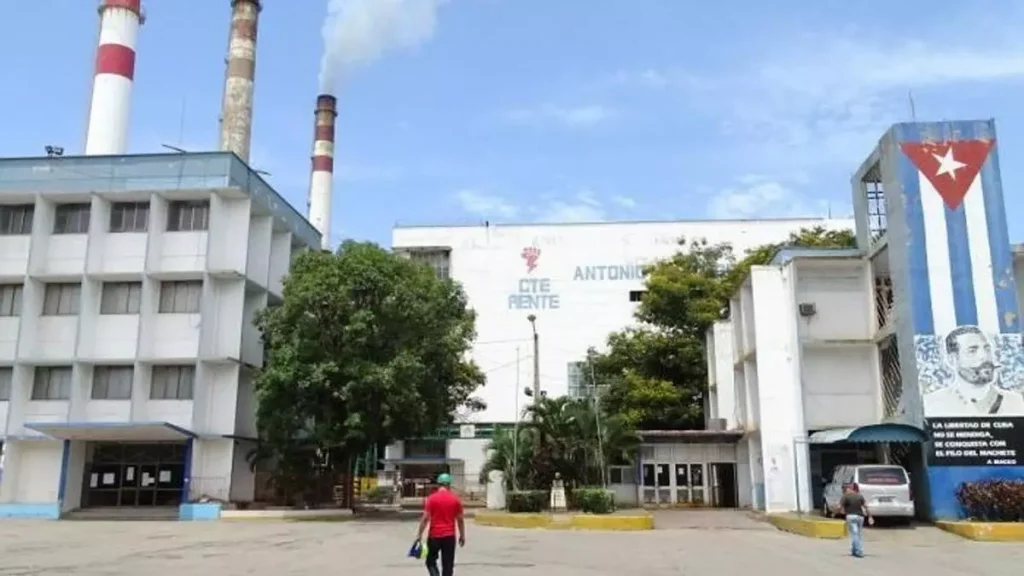
Archived image of the CTE Antonio Guiteras, in Matanzas. / Granma

14ymedio bigger14ymedio, Madrid, March 16, 2026 — A total shutdown of the national power grid (SEN) on Monday left the entire country in a simultaneous blackout around 2:00 PM. The Cuban Electric Union (UNE) reported the incident in a brief statement published on the Havana Electric Company’s Telegram channel, indicating that they were beginning to “implement restoration protocols,” but without providing any further explanation.

In the capital, the power went out in a strange way. “It was like turning off, turning back on, and then immediately turning off again,” said a resident of Nuevo Vedado. Residents in other provinces also reported the sudden power outage.

An hour later, in another message, the state-owned company detailed that no breakdowns were reported “in any of the thermal units that were operating at the time of the SEN disconnection.” It was precisely a breakdown at the Antonio Guiteras thermoelectric power plant (CTE) in Matanzas that caused the partial blackout on March 4, which left two-thirds of the country without power, from Camagüey to Pinar del Río.

“It was like turning off, turning on, and then turning off again immediately,” says a resident of Nuevo Vedado.

Monday’s outage was the first total collapse of the National Electric System (SEN) so far in 2026, and the sixth in a year and a half on the island. Between late 2024 and early 2025, five nationwide or regional blackouts were recorded, some caused by failures in key units and others by extreme generation deficits, which forced the shutdown of entire blocks to prevent further damage. On several occasions, the total collapse of the SEN left the country in darkness for hours, with restoration processes slow and phased by microsystems.

The recovery after the March 4th disaster was difficult, due to the lack of fuel – exacerbated in these two months of an oil blockade – which is necessary to operate continue reading

precisely those microsystems or “microislands” to serve specific areas.

Shortly after 3:30 in the afternoon, UNE reported that “microsystems in several territories” were beginning to operate, and twenty minutes later, they assured that the Energás plant, operated with the Canadian company Sherritt in Boca de Jaruco, already had “a generating unit in service.”

As is usual in similar situations, the authorities said that “the restoration will be done gradually as conditions in the National Electric System allow.”

The Mesa Redonda [Round Table] program announced that the interview with Oscar Pérez-Oliva Fraga would take place at 7:00 pm

The prolonged power outages since the most recent partial system failure, which have lasted more than three days in some areas, have reignited the flames of indignation across the island, which awoke this Monday after its tenth consecutive night of pot-banging protests. The climax of these protests occurred last Friday in Morón (Ciego de Ávila), where dozens of residents took to the streets chanting “Freedom.”

The march traveled through different areas of the city to the rhythm of banging pots and pans, reached a police unit and ended in front of the headquarters of the Communist Party of Cuba, where the protesters stormed the building, threw furniture and banners into the street and lit a bonfire in the middle of the public road.

Several people have been arrested for what the regime considers “acts of vandalism,” and security forces have been deployed across the country with the order of “zero impunity.”

The Mesa Redonda program announced that the interview with the Minister of Foreign Trade and Foreign Investment, Oscar Pérez-Oliva Fraga , announced last Friday by President Miguel Díaz-Canel, will take place at 7:00 pm, an unusual time, likely due to the total power outage. It is expected that during the interview, the Vice Minister, who is also the great-nephew of Fidel and Raúl Castro, will provide details about what he already confirmed to NBC News: that Cubans abroad, including those residing in the United States, will be able to invest in private businesses on the island.

Translated by Regina Anavy

______________________

COLLABORATE WITH OUR WORK: The 14ymedio team is committed to practicing serious journalism that reflects Cuba’s reality in all its depth. Thank you for joining us on this long journey. We invite you to continue supporting us by becoming a member of 14ymedio now. Together we can continue transforming journalism in Cuba.

Fábrica de Arte Cubano Defies Censorship With a Body-Tattoo Performance

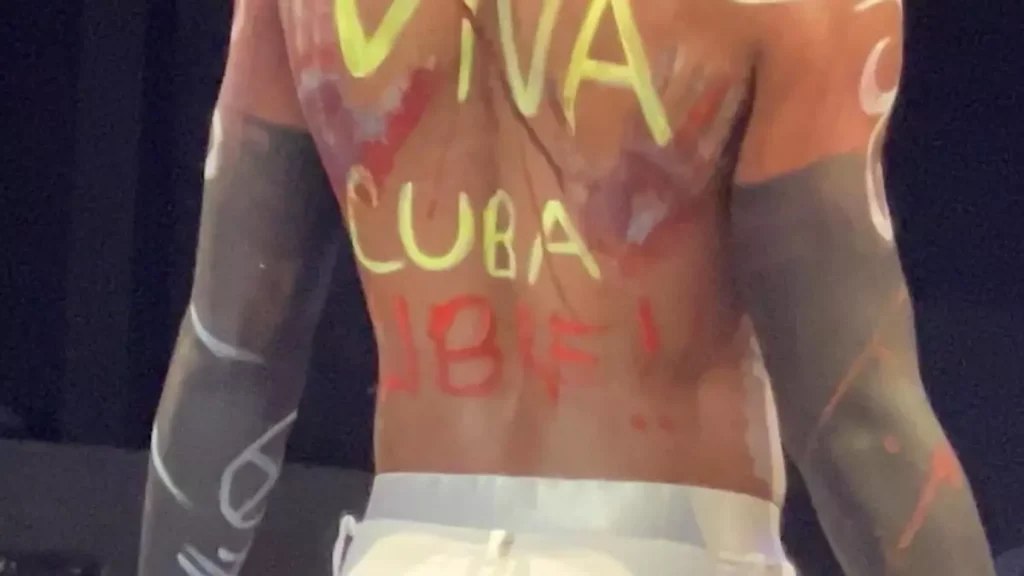
“Viva Cuba Libre” and “D-C singao” feature prominently on the back of the protagonist

“Viva Cuba Libre”, en una sesión de ‘body painting’ de este 15 de marzo de 2026 en la Fábrica de Arte Cubano (FAC), en La Habana. / 14ymedio

14ymedio bigger14ymedio, Darío Hernández, Havana, 15 March 2026 — Nothing suggested that the Lienzo Vivo event this Saturday at Fábrica de Arte Cubano (FAC) would be anything more than a gathering devoted to the art of body tattooing. But the invitation for the audience to take part in a body-painting session, led by artist Indira Bazail, turned it into a clearly political expression.

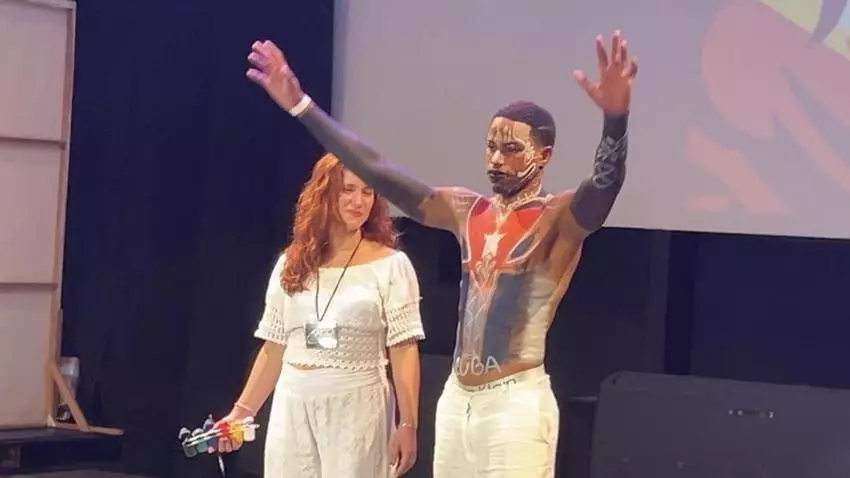
Standing before the bare torso of a young man, whose face was painted with the Cuban flag and whose back bore the words “Long Live Cuba!”, the presenter, Yoel Arturo Salazar Ponce, encouraged the audience to complete the “living canvas,” appealing to “freedoms.” “Because we all deserve, and always will deserve, to be happy and free,” he said, before announcing the surprise that the young man’s back would serve as a “free space” on which to write whatever they wished.

Artist Indira Bazail and the young man who served as her “canvas” at the Cuban Art Factory. / 14ymedio

“Libre” (“Free”) was the first word written, completing the slogan that was already there. Then, above it, came “D-C singao*,” referring to the insult directed at Cuban president Miguel Díaz-Canel — a phrase that has led to prison sentences for people who have shouted it or written it on public posters.

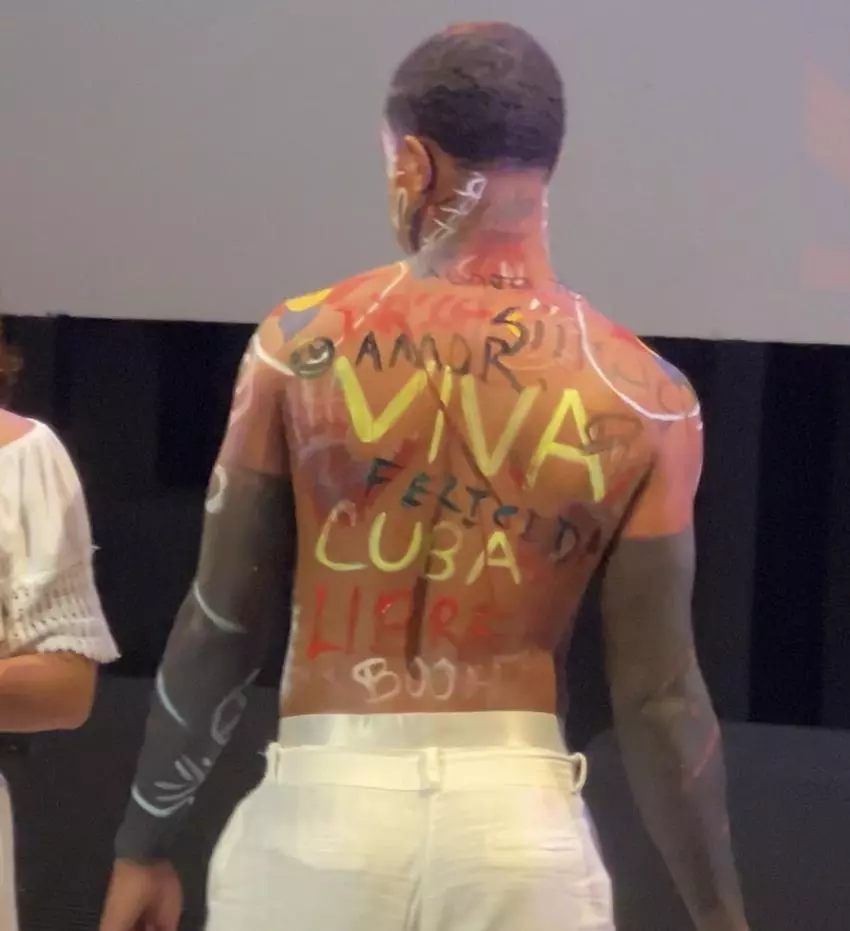
“Down with everything,” “DC singao,” “Love,” “Long live free Cuba,” the words on the “living canvas.” / 14ymedio

“Be free, because art leads the hand and the mind must be free,” the performance’s host continued to encourage. Someone added, “Down with everything,” to the neckline. Finally, a girl wrote, “Love.” The host congratulated her: “Love is the force for everything.”

As the crowd painted slogans on the young man’s back, “Toxicity ” by the American alternative rock band System of a Down played. The song, whose chorus shouts the word “disorder,” has a passage that perfectly captures the current state of Havana, shrouded in smoke from burning garbage and plagued by long blackouts: “Somewhere between sacred silence and sleep, more wood for their fires, noisy neighbors, waking dreams with a flashlight hit by truck headlights, eating seeds as a pastime, the toxicity of our city.”

This is not the first time the FAC has defied censorship. Last November, the venue went ahead with a tribute to Celia Cruz on the centenary of her birth, a tribute that had been censored a month earlier

That earlier decision by the National Center of Popular Music had been heavily criticized by members of the cultural community both inside and outside the island. Rosa Marquetti, a specialist on the life and work of the “Queen of Salsa,” said the “ban” on the tribute planned by the group El Público together with FAC added “one more chapter to the history of censorship and the use of political-commissar methods in Cuban culture.”

Translated by GH

*Translator’s note: “Díaz-Canel singao” is shouted and appears as graffiti. ‘Singao’ rhymes with Díaz-Canel, and is an epithet variously translated as ‘motherfucker’, ‘bastard’ and similar terms.

______________________

COLLABORATE WITH OUR WORK: The 14ymedio team is committed to practicing serious journalism that reflects Cuba’s reality in all its depth. Thank you for joining us on this long journey. We invite you to continue supporting us by becoming a member of 14ymedio now. Together we can continue transforming journalism in Cuba.

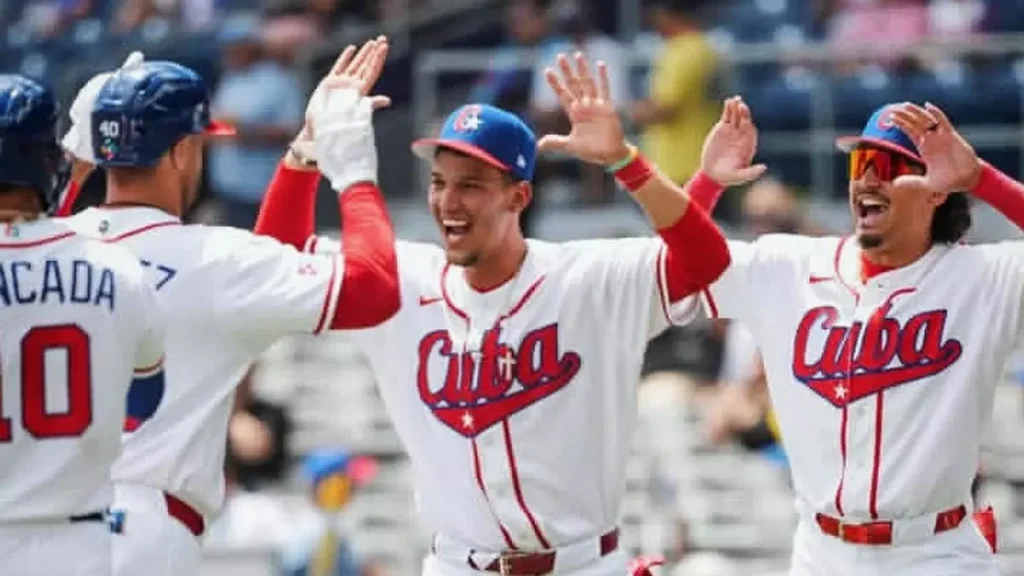
What Does Cuba Need to Shine Again in the World Baseball Classic?

The privatization of sports on the Island, with the injection of capital that would entail, seems to be the only solution.

During the group stage, Cuba had the third-worst team batting average at .168, surpassed only by Czechia’s .167 and Brazil’s .130. / Instagram/Ariel Martínez

14ymedio bigger14ymedio, Matanzas, March 15, 2026 – Cuba’s baseball team recorded its worst performance in World Baseball Classic history by failing to advance past the group stage in the 2026 edition. The team managed by Germán Mesa finished third in Group A after starting with two victories against Panama (3–1) and Colombia (7–4) and ending with losses to Puerto Rico (1–4) and Canada (2–7), the latter with too many defensive errors in a key game for qualification to the quarterfinals.

Without a doubt, the lack of hitting limited the chances of victory for this Cuban squad. With bat in hand during the group stage, Cuba had the third-worst team batting average at .168, only by the Czech Republic’s .167 and Brazil’s .130 were worse.

In terms of on-base percentage (OBP), the Cubans ranked fourth worst at .277, behind Israel (.261), the Czech Republic (.230), and Brazil (.217). To make matters worse, together with the Czechs they were the third team that struck out the most, with 41 strikeouts, a negative statistic in which Great Britain (44) and Brazil (50) occupied the top spots.

Given this scenario, in which Cuba hit rock bottom on the biggest stage of international baseball, a series of reforms will be needed when assembling the representatives of the Four Letters for the next World Baseball Classic.

A first step would be to eliminate internal political restrictions that prevent access to the best available players

A first step would be to eliminate internal political restrictions that prevent access to the best available players. Although Cuba already calls up players from the U.S. Major League system, there is still reluctance to reintegrate players who have defected from sports delegations abroad, such as Lourdes Gurriel Jr., José Iglesias, and Aroldis Chapman, among others. In addition, players born outside Cuba but of Cuban descent who are willing to represent the Island are not included either. That was the case of Cuban American Zach Neto, whose father told 14ymedio that he wished to play in the Classic for Cuba but was not continue reading

allowed to.

As for athletes who left contracts under the control of the Island’s sports authorities, there is also no guarantee that all of them will be readmitted. Although Yariel Rodríguez was allowed to pitch again in a Classic after abandoning his contract with the Chunichi Dragons in the Japanese League, it was never clarified whether other baseball players in the same situation such as Oscar Colás or Julio Pablo Martínez would be allowed to wear the uniform of the Four Letters again.

Experience at the highest level of Major League Baseball (MLB) is not only needed among players, but also within the coaching staff. Having coaches familiar with organized baseball in the United States is vital to strengthen the team project and encourage the top stars to take part. Above all, Cuba needs to appoint a general manager who can operate in the United States, negotiate each player’s availability with the organizations, and meet face to face with the potential stars of a future roster. In that regard, it may be necessary to take lessons from other Caribbean baseball powers.

Last but not least, it is essential to restore the strength of the local baseball championship. In 2006, Cuba managed to finish as runner-up in the World Baseball Classic using only players from its National Series. However, over time, the massive exodus suffered by the country, its decline across all branches of the economy, and its political and social collapse have contributed to the deterioration of the state-run sports structure. Government funds have lost the capacity to sustain the training of high-performance athletes and to turn domestic tournaments into a spectacle.

For nearly seven decades, since the rise of Castroism to power, Cuban sports have suffered excessive government interference for propaganda purposes and have been stripped of professionalism. Today, the privatization of sports in Cuba, with the capital injection it would bring, appears to be the only solution to prevent national passions such as baseball from dying through neglect. And perhaps, to correct the taboos that persist in our sport, it will be necessary to correct the political system that gave rise to them.

Translated by Regina Anavy

______________________

COLLABORATE WITH OUR WORK: The 14ymedio team is committed to practicing serious journalism that reflects Cuba’s reality in all its depth. Thank you for joining us on this long journey. We invite you to continue supporting us by becoming a member of 14ymedio now. Together we can continue transforming journalism in Cuba.