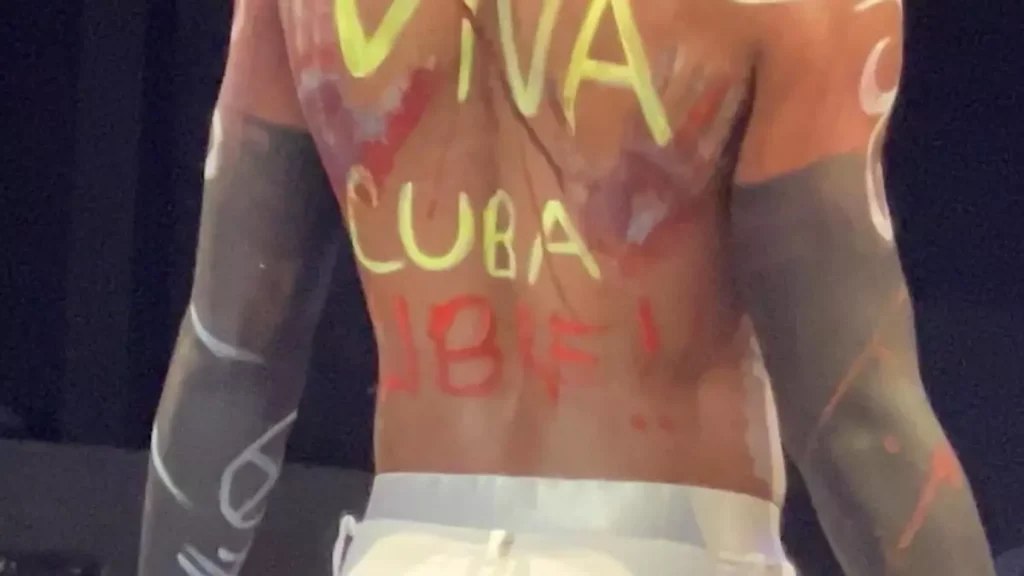
“Viva Cuba Libre” and “D-C singao” feature prominently on the back of the protagonist
 14ymedio, Darío Hernández, Havana, 15 March 2026 — Nothing suggested that the Lienzo Vivo event this Saturday at Fábrica de Arte Cubano (FAC) would be anything more than a gathering devoted to the art of body tattooing. But the invitation for the audience to take part in a body-painting session, led by artist Indira Bazail, turned it into a clearly political expression.
Standing before the bare torso of a young man, whose face was painted with the Cuban flag and whose back bore the words “Long Live Cuba!”, the presenter, Yoel Arturo Salazar Ponce, encouraged the audience to complete the “living canvas,” appealing to “freedoms.” “Because we all deserve, and always will deserve, to be happy and free,” he said, before announcing the surprise that the young man’s back would serve as a “free space” on which to write whatever they wished.
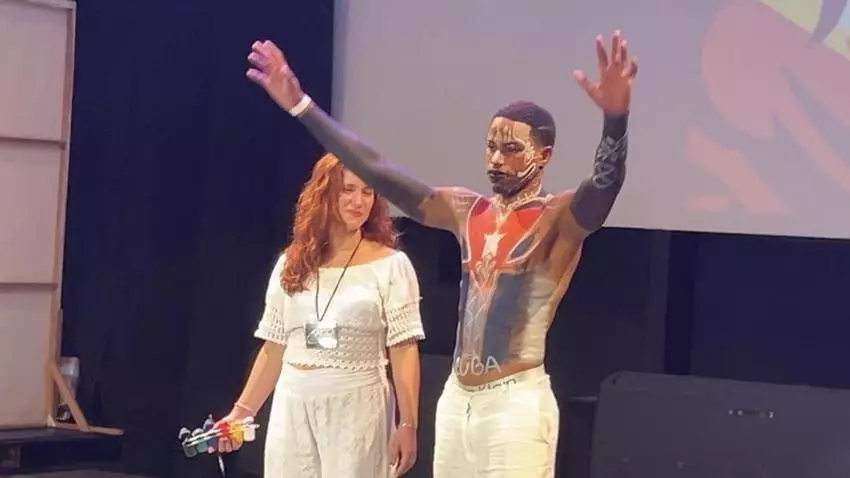
“Libre” (“Free”) was the first word written, completing the slogan that was already there. Then, above it, came “D-C singao*,” referring to the insult directed at Cuban president Miguel Díaz-Canel — a phrase that has led to prison sentences for people who have shouted it or written it on public posters.
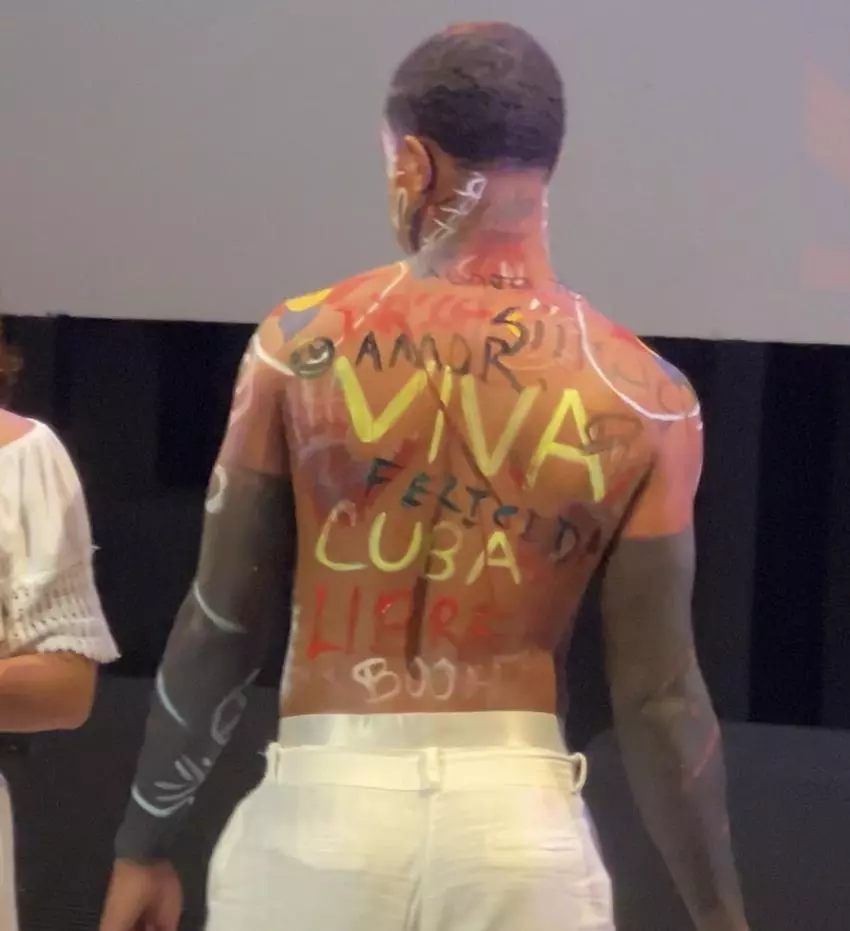
“Be free, because art leads the hand and the mind must be free,” the performance’s host continued to encourage. Someone added, “Down with everything,” to the neckline. Finally, a girl wrote, “Love.” The host congratulated her: “Love is the force for everything.”
As the crowd painted slogans on the young man’s back, “Toxicity ” by the American alternative rock band System of a Down played. The song, whose chorus shouts the word “disorder,” has a passage that perfectly captures the current state of Havana, shrouded in smoke from burning garbage and plagued by long blackouts: “Somewhere between sacred silence and sleep, more wood for their fires, noisy neighbors, waking dreams with a flashlight hit by truck headlights, eating seeds as a pastime, the toxicity of our city.”
This is not the first time the FAC has defied censorship. Last November, the venue went ahead with a tribute to Celia Cruz on the centenary of her birth, a tribute that had been censored a month earlier.
That earlier decision by the National Center of Popular Music had been heavily criticized by members of the cultural community both inside and outside the island. Rosa Marquetti, a specialist on the life and work of the “Queen of Salsa,” said the “ban” on the tribute planned by the group El Público together with FAC added “one more chapter to the history of censorship and the use of political-commissar methods in Cuban culture.”
Translated by GH
*Translator’s note: “Díaz-Canel singao” is shouted and appears as graffiti. ‘Singao’ rhymes with Díaz-Canel, and is an epithet variously translated as ‘motherfucker’, ‘bastard’ and similar terms.
______________________
COLLABORATE WITH OUR WORK: The 14ymedio team is committed to practicing serious journalism that reflects Cuba’s reality in all its depth. Thank you for joining us on this long journey. We invite you to continue supporting us by becoming a member of 14ymedio now. Together we can continue transforming journalism in Cuba.