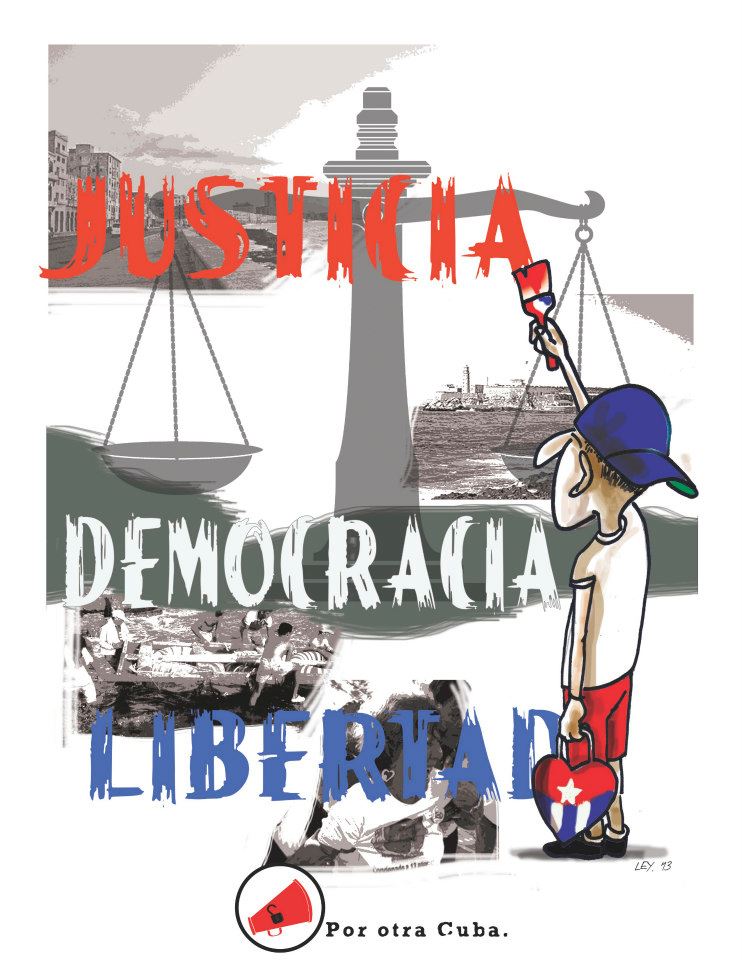
For Another Cuba / Ley
English Translations of Cubans Writing From the Island


Translated by Karen González
Nicolasa Guillén, Virgilia Piñera, Regina Pedroso, and Josefa Lezama Lima leave to go to paradise for a week. However, upon getting there they find out that, in fact, they have arrived at the steps of a ramshackle hotel for writers where they must imagine that they’ve arrived at paradise.
In addition, they are forced to pay an astounding amount to stay there, and among the guests sharing paradise with them, there were infamous writers from many countries whom they always intuited to be literary disgraces.
Astonished, they looked at each other. Of course they could not quit. A week would go by quickly in paradise, said Nicolasa, who held the sign of “I am in charge here, and it will be done as I consider prudent.”
Nicolasa Guillén, Virgilia Piñera, Regina Pedroso, and Josefa Lezama Lima stayed in ramshackle rooms, and that night, after a derisory dinner, they received an invitation to a literary gala where they would have to gulp down lectures delivered by several of those other, infamous writers.
Virgilia Piñera said that she would rather have a drink at a nearby bar. Nicolasa could not prevent it, for she too wanted to escape, but could not on account of her simulated officiality. The others, who wanted to demonstrate their fidelity to her under any circumstance, also stayed.
And so they slept pleasantly while their colleagues read somniferous poems.
Pleasantly? No.
While the reading took place, Nicolasa dreamed that in one of the streets of paradise she found a man who ate books by Cuban authors. They taste horrible, the old man said while chewing on a recently published novel. The worst ones are those by Nicolas Guillén, too coarse, as if the most artificial condiment was the author’s very name.
When Nicolasa tried to reprehend the book eater, twist his neck, she woke up with her hands wrapped around the neck of a Costa Rican poet.
Regina Pedroso dreamed that she had committed suicide six times. Without success, or successfully, depending on your point of view. They were eccentric suicides. One of them consisted of living as a regular citizen in her own country. A voice inside the dream rumored that that oneiric episode was too exhausting, that no punishment could prove to be so drastic as that one.
She woke up startled, believing she was in her house, living and dying the suicide as the final punishment of her days. Then, relief ran through her for a few seconds.
PLEASE CONTINUE READING THIS STORY IN SAMPSONIA WAY MAGAZINE
The publication of this story is part of Sampsonia Way Magazine’s “CUBAN NEWRRATIVE: e-MERGING LITERATURE FROM GENERATION ZERO” project, in collaboration with Orlando Luis Pardo Lazo, and a collection of authors writing from Cuba.
The Cuban Legal Association, through several of its specialists, legally dismantle in this video the farce mounted against the writer Angel Santiesteban-Prats, who is currently serving a prison sentence in a high-security Cuban jail.
Here are analyzed, from the perspective of the law, the numerous legal and procedural and police violations perpetrated by the Cuban dictatorship to silence the powerful critical voice of the literary laureate, who since he is already known internationally, was sentenced to five years of imprisonment, in a trial rigged by the Cuban political police, condemning him with impunity and shamefully for a crime he did not commit.
It’s one more proof of the impudence, arrogance and lack of humanity of the Castro dictatorship when it comes to suppressing those who dare to exercise their right to express themselves freely, the only “sin” committed by Angel Santiesteban.
(Video is in Spanish)
Note: On the date when this video was edited in Cuba, Angel was on a hunger strike but now no longer is.
Translated by Hombre de Paz
7 May 2013

My grandmother made a living washing and ironing for others. When she died, in her mid-eighties, she only knew how to write the three letters of her name: Ana. For her whole life, she worked as a maid for a family, even after 1959 when official propaganda boasted of having emancipated all servants. Instead, many women like her continued to work in domestic service but without any legal security. For my sister and me, Ana spent part of her days in “the house on Ayestarán Street,” and we never said out loud that she was paid to clean the floors, wash the dishes and prepare the food there. I never saw her complain, nor did I hear of her being mistreated.
A couple of days ago I heard a conversation that contrasted with the story of my grandmother. A plump lady dressed in expensive clothes was telling her friend — between glasses of white wine — how she behaved with her young domestic. I transcribe here — without adding even a word — a dialog that left me feeling a mixture of revulsion and sadness:
– From what you tell me, you’re lucky.
– Yes, I really can’t complain. Suzy started with us when she was 17 and she just turned 21.
– Now we’ll see if she gets pregnant and you have to throw her out.
– No, she’s very clear on that. I told her that if she gets pregnant she’ll lose her job.
– Yes, but you know, “the fox always returns to its den.” So maybe she’ll run after some man from the village where she was born.
– No way! She won’t even go to that “den” on vacation. Imagine you didn’t have any electricity, the floor of her parents’ house is dirt, and the latrine is shared by four families. – – It’s like the heavens opened up for her since she’s been with us. All she has to do is what I tell her, that’s all I ask.
– That’s how they start, but later they start thinking things and ask for more.
– So far we’re doing fine. She has Sunday afternoons off to do what she wants, but she has to come home by midnight. Most of the time she doesn’t even go out because she doesn’t know anyone in Havana. It’s better that way, because I don’t like the bad influences.
– Yes, it’s really bad out there. These country girls do better not to even go out because if they do they learn a few things.
– They learn more than a few things. Because of that I even monitor her phone calls. I don’t want her to learn what she doesn’t need to know.
– And that boyfriend you told me she had?
– No, that didn’t continue. We made it clear that we didn’t want men visiting our house. And she, really, has no time to be falling in love, my children take a lot of time. Taking them to the park, their homework after school, they like to paint before going to bed, she has to read them a story, they don’t like to watch movies alone. Poor thing, when it’s time to fall into bed she must be dead on her feet.
– Woooow… you’re sitting in the catbird seat. I haven’t had any luck. Every time I hire one, they don’t last even a month.
– If you like I can introduce you to Susy’s younger sister, she seems very serious.
– How old is she?
– Fifteen, so you can train her like you want.
– Yes, give her my phone number and have her call me. Oh, and make it clear, I’ll buy everything: clothes, shoes. But if she leaves one day, she’s not taking even a pin from my house. Make that clear! Because they get a big head and it’s hard as hell to deflate it!
The two women continue talking as the wine bottle passes the half-way mark. I overhear a rant about her husband’s more than 60 pairs of shoes. They laugh and I feel my stomach knotting up in a familiar way, with the accumulated anger abusers provoke in me. I go outside for a little air and see the “matron’s” car. It has green Army-issue license plates that stands out against the shiny metallic gray body. It’s the new aristocracy class, the olive-green royalty, lacking scruples and modesty. I spit on the windshield, for Susy, for Ana, for me.
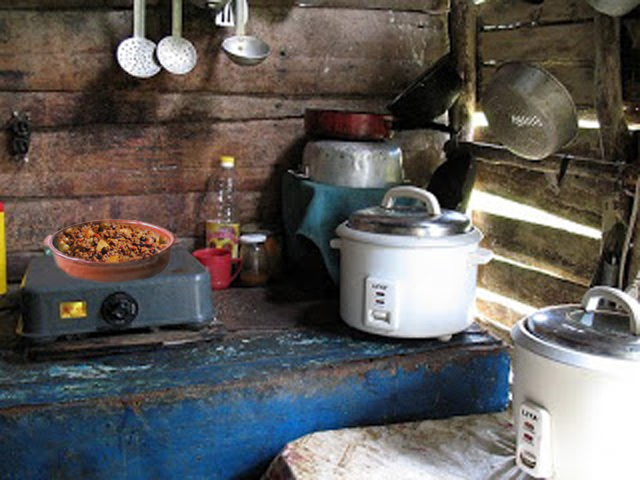 HAVANA, Cuba, August, www.cubanet.org — Perhaps at the moment the reader reads this, it will have been twenty years since the beginning of the Special Period, the major event to befall Cuban history in the last century.
It began in August of 1993 when the former secretary of the Council of Ministers, Carlos Lage, announced that the Cuban economy had hit rock bottom and with it all of our precepts and attitudes. Store shelves began to empty. The value of the Cuban peso relative to the dollar turned once again into a joke, becoming both a dream and a nightmare simultaneously.
Having dollars was treated like a contagion. All individually held dollars were decommissioned. Some people received long prison sentences for their possession. Though it was decriminalized in 1994 as a result of popular pressure stemming from the “Maleconazo,” or the Malecon uprising, paradoxically some of those sentenced remained in prison because they committed crimes endemic to prisons during their incarceration.
In those days George Washington’s green face journeyed hand to hand with extreme urgency, with stealth, with fear, hidden in socks or shoes, behind toilets tanks or imprisoned inside underwear. You had to find a foreigner willing to buy the prohibited goods for you in hard-currency stores.
To use a colloquial term, we could say that many Cubans became rats. They ate garbage, rummaged through trash cans, scarfed down pizzas topped with melted condoms instead of cheese and ate “steaks” breaded with towel mops, according to urban legends of the times. The level of predation reached extremes. Dogs, cats, buzzards, wild cuckoos, moray eels. Even the lionfish, a strange species from the Indian Ocean that dared to go near the edge of a country engaged in a pitched battle for survival. It was made extinct.
Homelessness multiplied, along with madness and suicides. The disease of alcoholism began to grow and take root in society as a means of escape from paths with no exits. The high cost of living forced fathers, who could not buy good rum to help them forget their problems, to drink alcohol from the pharmacy. There appeared a clandestine manufacturing system to produce bootleg atrocities with names such as train spark, gualfarina and calambuco. These frustrated drunkards — those with neither strength nor character nor incentives to educate their children — neglected them. They in turn lost any hope for a future at an early age and followed their fathers down the road of alcoholism, sealing their fates.
Some called them the Ground Soy Generation. They caused statistics for swindling and petty theft to shoot up astronomically. Shady dealings and illicit sales increased. The state imposed two currencies: a weak one it used to pay salaries and a demeaning one it used to sell things. Suddenly everything on the black market had a very high price. A used fish tank went for eighty pesos and a pound of rice for fifty-five. Inflation.
In the countryside a pile of clothes would be traded for a mutton, a pair of boots for a hog. Many individuals travelled in caravans through the fields of Pinar del Río like zombies, trading soap and detergent for rice and vegetables. Barter.
Before the farmer’s market opened in Marianao in 1994, you had to get in line the night before to buy meat when someone in the neighborhood slaughtered a pig.
To board a city bus, actual storylines from tragic films were re-enacted. Cooking oil intended for the production of breads and sweets ended up for sale on the black market. The same thing happened with salt, sugar and anything else that could generate money. The most sought-after jobs were those where one could steal or load up on food. Jineterismo* revolutionized the conception of the family. Travelling overseas became one of life’s necessities.
Getting a job in a workplace related to tourism suddenly had a price. A gas station attendant: three-hundred dollars. A salesclerk in a hard-currency store: two-hundred. A cook: one hundred. The different ways for dealing with the crisis — between those who had access to dollars, now called CUCs, and those who had to be inventive to get them — created a divide in the Cuban identity.
In 1997 former secretary Lage said in a public appearance that the Cuban economy had finally hit bottom and was starting to improve. Later Machado Ventura and Marino Murillo repeated this many times, but in reality people still waited for a miraculous upswing. Today half of working-age men — those being called upon to bring about the recovery — “work” while seated on stools in the doorways of their houses selling sweet snacks made by self-employed workers using materials stolen from the state or brought in from overseas by smugglers.
We deserve a medal for pawning ourselves in order to survive those ridiculous twenty years.

Frank Correa, born in Guantánamo in 1963, is a storyteller, poet and independent journalist. In 1991 he won the Regino E. Boti, Ernest Hemingway and Tomás Savigñón prizes for his short stories. He has published a book of stories called La Elección. beilycorrea@yahoo.es
From Cubanet August 9, 2013
*Translator’s note: Sometimes translated as “hustling,” it is a category of illegal or quasi-legal economic activities related to tourism in Cuba that often involves prostitution.
13 August 2013

HAVANA, Cuba, August, www.cubanet.org.- Similar to the theme of Steven Spielberg’s movie Minority Report, where someone is imprisoned for crimes they had not yet committed but it was assumed they might commit, the Cuban Criminal Code devotes several articles to “the state of danger and measures of security.”
An index of pre-criminal dangerousness is practically nonexistent in the world. It translates to applying a coercive measure in the present for something a person “might do” in the future. People call it “the law of dangerousness.” It’s common to hear, “They applied ‘the danger’ to him.”
Vicente Rodriguez is a former political prisoner who knows the law for having suffered it firsthand. “Both men and women who are sentenced under the law of dangerousness, when they get to prison, are sent to the galleries for 21 days. After that time they are sent to Prison 1580 or other so-called State ‘settlements’,” he says.

According to Rodriguez, in these “settlements” the prisoners work from Monday to Sunday, “Building buildings for people in the Ministry (of the Interior), and other State interests. And with a minimum wage. The prison has these ‘minimum security’ camps for those charged with ‘danger.’ The ‘danger’ (law of dangerousness) is minimum offense. As it’s not a crime, you go to prison with a job. As an imprisoned worker.”
Rodriguez says that the law is, “Nothing more than a justification to find a workforce.” If the prisoner has a good attitude, it’s possible that a sentence of two years will result in parole after eight months, or a four year sentence is served in just two years. Analyzing the phenomenon, it doesn’t seem convenient to leave the barracks empty. “So if 25 are set free, 25 have to come in. To do the work,” Rodriguez adds.
“A good share of the buildings built after 1959, have been built by prisoners. Alamar, Barlovento, buildings in Guanabacoa, in Cotorro the CIMEQ hospital,” says Rodriguez, who claims to have been in the latter when it was held in Valle Grande in 1983. “There are brigades they take out and they give them incentives, such as passes to visit their family every 45 days. If you work hard in the time you’re working, you get a five-day pass, not three. The slaves are right here.”
In a prosecution for dangerousness, “The person has no right to defend himself, he has a lawyer who is decorative. It seems that the trial is already over, you’re penalized because ‘the factors’ [the investigator/prosecutors] say that you have to be deprived of your freedom for two years.”

To remove the law of dangerousness from the Penal Code, it is necessary that the state respect human rights and particularly the right of every person to be presumed innocent until proven guilty.
It’s worth mentioning that in the world there is a post-criminal dangerousness index, where if a person commits a crime and is found to be mentally unstable, and so cannot serve a sentence but is potentially dangerous; it is as if they had already committed a crime as it is feared they will continue to violate the legal well-being of the society. In that case, a measure is taken such as placement in a hospital.
Writer Ángel Santiesteban has fallen through the net
Recently, the writer Ángel Santiesteban was transferred from prison 1580, where he was serving a sentence of five years for alleged domestic violence — which the artist denies — to one of these “settlements.” As explained above, it is likely that the author of the blog The Children Nobody Wanted will be used as a construction worker.
Through third parties, his blog is still active from prison, so through him we could learn about the forced labor caps which are so similar to the notorious Military Units to Aid Production (UMAP)*, implemented by the Castro regime its early years.
*Translator’s note: UMAP was a set of forced labor camps where people the regime considered “anti-social” or “counter-revolutionary” were incarcerated, including homosexuals, religious believers, and others.
16 August 2013
From Cubanet
 Never has the life or death of one man awakened such dissimilar expectations. Fidel Castro, who turns 87 on August 13, has been given up for dead so many times that when death does come for him, many will believe it’s a joke.
Castro, aware of the countless times he has cheated death, has woven a legend around himself. After the 1953 assault on a military barracks in Santiago de Cuba, several newspapers of the time published the news of his demise.
The military escapade of trying to take a military fortress with a troop of inexperienced amateur soldiers armed with dove-hunting rifles ended, of course, in a complete rout.
Most of the young assailants were killed in battle or executed by the repressive forces of the Fulgencio Batista regime. In those days, the life of Fidel Castro wasn’t worth much.
But the 26-year-old lawyer, born 500 miles east of Havana on a farm in the Birán region of Holguin, managed to avoid being executed by a bullet to the head thanks to Lieutenant Sarria, a Republican Army officer who saved his life.
Then in prison, according to the official history, they tried to poison him.
When on December 2, 1956 he landed with an army of 82 men on the beach at Las Coloradas, a rugged area infested by swamps, Batista’s Air Force, which was aware of the landing site in advance, made target practice of the bewildered guerrillas.
Everyone gave Fidel Castro up for dead. They were so sure of his death that the troops shut down their actions against the guerrilla. Once again the “subversive one” had escaped death.
You already know the story. He regrouped with the survivors of his band, and with the help of peasant farmers, the inefficiency of the army, and collections of money and weapons from political parties opposed to Batista, he managed to seize power in January 1959.
Two years earlier, in the Sierra Maestra, he escaped by a complete miracle. His right-hand man, who slept 15 feet from his hammock, was an Army plant. But the guy lacked the guts to kill him, as had been planned. The “traitor” was caught by the guerrillas and executed.
Once in power, he was left unscathed by various attempts conceived by former comrades-in-arms, a German lover, the CIA, and anti-Castro exiles. He exaggerates this. He says the U.S. special services tried to kill him more than 600 times.
Castro and the official media aggrandize everything, from production statistics to attacks on his life. What is documented is that at least twelve times the CIA and opposition groups planned to kill him.
On a visit to Chile in 1973, an anti-Castro commando was about to execute him. A gun fastened to a television camera was pointed at his head. But without a safe path of escape, the organizers decided to abort the attempt.
On Monday, July 31, 2006, when Carlos Valenciaga, his personal secretary, announced that due to serious health problems Fidel had delegated power to his brother Raul, the government began to prepare his funeral ceremony, and on a massive mountain in the Sierra Maestra they urgently built a monumental tomb.
From that date, the international press has had his obituaries at the ready. A foreign reporter told me that his agency had sent him to Havana for the sole purpose of reporting the day of death of the leader of the revolution.
Until then, he was asked to maintain a low profile while waiting for the big news. He has now lost count of the number of times Castro has been “killed” in Florida.
Seven years after Fidel Castro’s retirement for health reasons, Cubans barely speak of the former president. No one on the street takes seriously what he says or writes. He’s like a grandfather with dementia who in his lucid moments likes to tell tales of his epic exploits.
After arriving in “death’s waiting room,” as he confided to a journalist from the Mexican newspaper La Jornada, he has dedicated himself to: prophesying the end of the world after a nuclear war; alerting the world to an alleged conspiracy by the Bilderberg Club; and investigating the moringa, a plant that, in his opinion, “could save the starving Third World.”
To this day, on television roundtables and news reports, any crazy pronouncement by the Commander-in-Chief is read in a serious tone. Today, more than ever, you can see in the state media his cult of personality.
In celebration of his birthday, songfests, sports marathons, and book releases are anticipated. But due to the daily grind of hardship without letup, a broad segment of the public does not have pleasant feelings toward its former top leader.
They blame him for the delays, the shortages, and the precarious standard of living in the country today. They see him as a distant ship sailing toward the horizon. Few ask anymore what it will be like the day after his death.
And the direction taken by the General suggests that the legacy of his brother will endure after his physical disappearance. Predictions about the future of Cuba are bleak.
For many on the island, at a time when the developed world remains embroiled in a financial and political crisis with no end in sight, the desired democratic change seems unlikely.
All they can see in the picture is more Castroism. Without Fidel Castro.
Iván García
Photo: Fidel Castro during the presentation of the book Warrior of Time, by Cuban journalist Katiuska Blanco, in February 2012. Taken from El Nuevo Diario de Nicaragua.
Translated by Tomás A.
13 August 2013

Music and miracle
[youtube=http://www.youtube.com/watch?v=-F2t6SYMU4o&w=560&h=315]
15 August 2013
My friend Victor gave me a lovely poem.
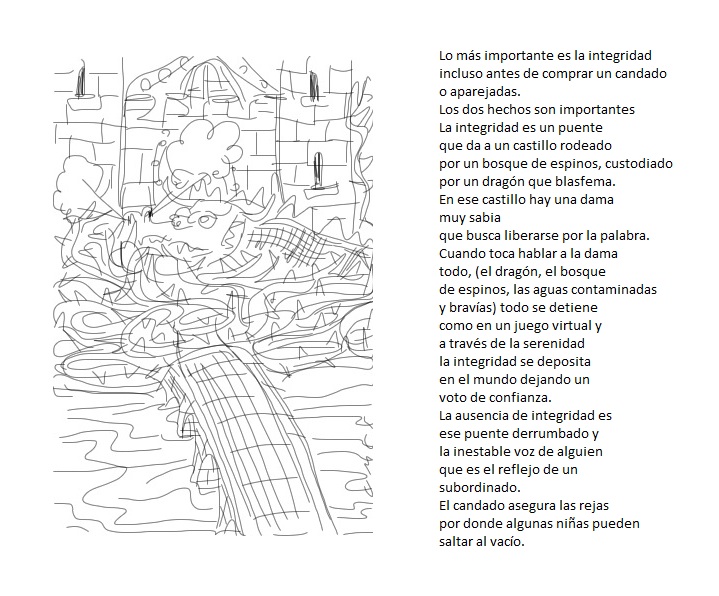
The most important is integrity
even before buying a padlock or
pullys.
Both facts are important
Integrity is a bridge
that leads to a castle surrounded
by a forest of hawthorns, in custody of
a blasphemous dragon.
In this castle there is a woman who is
very wise
who tries to liberate herself with words.
When it is the woman’s time to talk
everything (the dragon, the forest
of hawthorns, the contaminated
and wild water) everything hesitates
like a virtual game and
through the serenity
integrity settles
in the world leaving a
vote of confidence.
The absence of integrity is
this bridge demolished and
the unsteady voice of someone
who is the reflection of a
subordinate.
The padlock secures the gates
through which some girls might
leap into the emptiness.
16 August 2013



Junko Tabei
Womanhood and motherhood is a blessing. As women we are faced with many challenges in any part of the world despite the indisputable social advancements in the past decades, but one forgets when one fights to support* a family, including if you live in a country like Cuba, wretched thanks to the decision of a group of people; where on top of that everything is organized in such a manner that the difficulties and challenges are constant however planned the life you lead is. The matter is complicated much more if you are poor. Now maternity is not so fun, even though you bear it with that “the children didn’t ask you to bring them to Cuba.”
You can still be happy with three requisites: woman, mother and poor. The hair really starts to get knotted with the fourth requirement: to be black.
Everything gets complicated.
Cuba, the beautiful and racist island of the Caribbean, where it is natural to be black and poor.
If a black woman dresses well and has money, many Cubans probably believe she is a well-known artist or athlete. She’s not one of those? Weird! Does she have a foreign husband? Of course! In these cases it is recommended that one gets used to the title “girl from the streets with luck,” even though she is more demure than an angel and with more merits than a Nobel Prize. Through these reflections the Japanese Junko Tabei arrived, born May 23, 1939, in the prefecture of Fukushima. She became the first woman to reach the summit of Mount Everest, on May 16, 1975.
I am convinced that we need the courage and tenacity of this incredible mountain climber. So we, the Cubans of African descent, can occupy the place we deserve in Cuban society with full rights. And these places must be conquered with much sacrifice. This respect to which we aspire is as steep as the will of Junko Tabei. If the goal is not as high as Everest, we will lose our way. In reality there are very notable Cubans of African descent, even though nothing changes. Inevitable we have to follow the route of Junko Tabei. Without sparing strength, without receiving applause. Struggle with faith against the eternal blizzards, the intolerable exhaustion…and the habit of always seeing ourselves as so humble, so conflicted.
8 August 2013
 The possibility of getting a place for a child in a childcare center in Cuba has become a real search for the impossible. The small capacity in these nurseries, the bad food, and the reduction in the requirements of admission for women who work in the ministries of Public Health and Education make many see that goal as a chimera.
The childcare centers and kindergartens were implemented at the beginning of the ’60s, so that Cuban parents could work without worrying about the care of their kids. But in the last years, these educative centers have been converted into something exclusive, above all in some interior regions of the country where approximately one exists in each municipality.
Without the syndicate’s recommendation, the support of the Federation of Cuban Women and other sources that have leverage, it’s impossible to obtain a space in these places.
Mildred Sánchez, a nurse who resides in the coastal municipality of Antilla, in Holguín Province, could never put her kids in a childcare center since she had not graduated.
“The solution now are the girls who haven’t gone to university and don’t have work, so they take care of children,” says Mildred.
These youngsters “take care of children less than one year because the mothers have to work, and they go with them and take care of the babies. Here on my block live two 16-year-old girls who are taking care of babies, one has three babies in her house and the other has four,” she affirms.
The alternative of private nurseries first passed by the rigor of state inspectors,
who fined those who ran them, until the last attempts at reform included them as a mode of “self-employment.”
In the capital, an employee of these nurseries can earn a salary of almost 40 CUC a month, and, in addition, they are guaranteed a free lunch.
In Antilla, where Mildred lives, there is a childcare center, divided into two parts, “one in front of the other. They are the private homes of people who have emigrated from the country,” Mrs. Mildred Sánchez concludes.
Yanisleidis Rodríguez, a mother in Havana, is a worker and a dissident at the same time. She has a black mark against her, and it would be impossible for her to get a place in a childcare center. “Before being in this (she is referring to the opposition), I didn’t have the right, and now I have even less,” she remarked. She has two children, one who is 7 and another who is 4.
“To think that I worked in Provincial Education and even so they wouldn’t give me a place for my children. There with me were mothers who spent many years working in Education and had to pay a person to take care of a child so they could work,” she indicated.
Corruption has penetrated this sector, as Yanisleidis recounts, who asserts that mainly being a director or having a good recommendation makes it possible to obtain the precious placement for a child in these places.
The concern over enrollment for the children of Yuliet Pérez, a resident in Pinar del Río and an ex-worker at the Provincial Hospital Abel Santamaria, came up against a concrete wall.
“When I had my first girl I asked and never got a reply,” she says, and she adds that neither were there careers for educators in childcare centers, which also affected the availability of these services.
From Havana, the independent journalist Álvaro Yero Felipe denounced on the Digital Spring website that “six workers in a childcare center in the Arroyo Naranjo municipality sent a letter to the National Director of the Ministry of Education in Havana, where they accused the administration of the center of diverting food and economic resources and materials meant for the children,” said the publication.
Yero reported that the incident took place in the Luxil childcare center, located in Arroyo Naranjo, and the letter related the diversion of “resources that the government received from foreign humanitarian organizations for the children who are boarding there, under state authority because they don’t have families.”
The children are under state custody, and their principal support is the agency of security and protection, SEPSA, and they are not older than five years of age.
Translated by Regina Anavy
25 June 2013

They don’t have their own places, but they flourish everywhere. They lend money at interest, facilitate loans, and charge the same in cash as in goods and services. They are the new moneylenders. After being stigmatized for decades, these banned bankers have returned without licenses or pity. They offer everything from small amounts to thousands of convertible pesos, although the latter is only for very reliable clients. They operate in areas they know well; they know how much their neighbors make in wages, whether they receive remittances from overseas, or if they have some other source of income. Starting with this information, they distinguish between those who will be “good for it” and those who won’t. Although there can always be surprises. The great nightmare of these “usury experts” lies in the customers’ intentions to board a boat and be smuggled out of the country, without returning to them what is theirs.
Other situations can be resolved with pressure and threats. When a debtor is overdue in his payments, the lender feels that the time has come to teach him a lesson.
Edward was watching television last Saturday when they knocked on his door. Two burly men pushed past him into the house and one of them hit him in the face with his fists. They took the stereo and left, but not before warning him, “You have 72 hours to pay back El Primo… if you don’t, we’ll be back and we won’t behave so nicely.” The victim could not go to the police, because, from the beginning, he preferred illicit credit, without possible complications. He spent the next three days selling some of his home appliances and going into debt to friends so that he could repay the loan. He also prayed a little that El Primo and his henchmen might be raided for the great number of crimes they commit.
María, however, obtained a loan of 10 thousand pesos from the Metropolitan Bank. She needed to fill out endless forms and present written evidence of her employment. She planned to use the money for construction materials to remodel her old house. She felt satisfied to have gotten the sum legally, although now any paperwork she fills out includes the information that she is in debt to the State. Others, who could not meet the requirements, had to accept the conditions and interest rates of their neighborhood moneylender. More than one client has had to pay with favors from her own body when the repayment date has come and gone; more than one family has had to deliver a refrigerator or a car, because an irresponsible member thought to ask for money they could never repay.
As necessary as he is slandered, the moneylender is just one link in the illegal financial chain of our reality. Cautious when giving, implacable when collecting.
15 August 2013