The School Fraud Epidemic in Cuba / Ivan Garcia

1-FRAUD-ESCOLAR-620x330Josuan, 16 years old, a second year high school student, narrowly missed involvement in a notorious fraud case.

“A week before the news was published in the newspaper Granma, a fellow classmate and me, we thought about purchasing the math final exam for $12 CUC.  It was an open secret that the exam was already circulating around Havana.  The tests and grades is normal”, says the student from Havana.

On June 27, the Granma newspaper, Communist Party organ, acknowledged the existence of a massive fraud.  A person who works at the printer where the 11th grade exams were reproduced, along with two teachers from the Arroyo Naranjo town, were accused of “removing an exam with lucrative intent”.

According to some students, the tests were being sold for between $10 and $15 CUC.  Although the news was highlighted in the official newspaper, school fraud in Cuba is symptomatic.  It’s a national epidemic.

Let’s examine the cause of school fraud and its variants.  Between 1970-1990, fraud was never a lucrative business.  It was a procedure to consolidate and showcase the image that Fidel Castro liked to sell of the Cuban Revolution.

For Castro, success was a question of statistics and numbers.  At the beginning of his political discourses, without pause and from memory, he would recite a long list of numbers, attempting to demonstrate that the Revolution was superior to any other government that existed prior to 1959.  From the low infant death rate, to  the thousands of doctors graduated annually, to the millions of professionals formed “thanks to the Revolution”.

Education was one of the jewels in Castro’s crown.  With the objective of maintaining the enchantment of the statistics which were going up, education at all levels lost many integers.  The teachers were not judged by the quality of their classes.  They were “measured” — a jargon used in those years to indicate the number of students who moved up to the next grade.

It was when the education fell into “passing”.  Every year, 100% of the students, perhaps some with serious limitations would move up to the next level.  It was then, that the fraud was almost consensual.It was disguised in many ways.

Money was not the reason.  The teacher who would police the classroom while the students took the exam would leave them alone for fifteen minutes.  Enough time for the students to check their answers with the rest of their classmates.

Sometimes fraud was brazen.  A teacher would calmly copy with white chalk the answers on the blackboard.  Another way: the day before the exam, a review, the teacher would expose the whole exam to the students.

It was a time in which we were useful numbers to keep Castro’s propaganda afloat.  These waters have now been muddied.  Cyclically, the official press has denounced notorious cases of fraud, which freely occur in middle and high schools.

With the advent of the “Special Period”, the country got hit with a stagnation economic crisis that has now lasted 22 years.  Salaries are now jokes in bad taste.  With the loss of value of the Cuban peso, the quality of teaching has fallen even lower.  Thousands of teacher left for exile or deserted to better paid trades.

It’s common to see a former teacher selling ice cream or cleaning floors in a five-star hotel.  Poverty — with too many teachers without vocation or knowledge — into which public education has now sunk, has caused teachers to use tests in lucrative ways.

This happens from elementary to high school.  “For 100 Cuban pesos weekly, the deputy director of a school, reviewed material with the kids before the final exams.  On that exam, was all the material she reviewed”, said the father of a student.

But if you want to see fraud in a larger scale, visit the night schools or trade schools.  “At the school where I go to get my high school degree, for 5 CUC they sell the final exams.  It’s barefaced.  If you don’t have money, they accept gifts like a perfume or a Lebron James shirt”, said a young man.

About the gaps in grammar or simple arithmetic of the students who start college, a college professor said: “They come with notable deficiencies.  They do not have the basic mathematics knowledge and show major orthographic blunders.  Geography or History, before taking the exams, they learn the lessons punctually”.

Those blunders in school education, are one of the signs of thousands of mediocre teachers and professionals.  90% of Cuban doctors that attempt to revalidate their degrees outside the island fail.  The same happens with civil or telecommunications engineers.

Cuba is a nation of high educational indices; to talk about quality that’s another thing.

It’s rare for a student born after the Castro Revolution not to have engaged in fraud.  If you never did it, raise your hand.

Ivan Garcia

Picture – Taken from Marti News

Translated by – LYD

28 September 2013

Much Adrenaline / Regina Coyula

My neighborhood, a quiet residential one before the process of “updating the model,” has undergone a remarkable commercial transformation. In fewer than four blocks, not counting cut-rate cafeterias, you can find: an Indian food restaurant, another with creole cuisine, another Chinese, and another with international cuisine; three billiard rooms, an English school, and three gyms (the best being the newest and most expensive). I don’t have to walk any further to include a very nice store, a bakery and a spa. But they have just opened, closer to me than the Acapulco, a 3D cinema, called Adrenalina, and as part of Rafa’s twentieth birthday celebration, we went there this past weekend to see World War Z.

The film is forgettable, despite Brad Pitt and 3D. What impressed me was the theater. Located in the vast basement of the house that belonged to Mariano Rodriguez, the painter’s former studio has a room with comfortable seating for twenty people, arranged in tiers, a twelve-foot screen, surround sound, air conditioning, and a small VIP room for six people, with a three-foot screen.

The lobby is tastefully understated. Over the counter, where they will soon be selling cold cuts, is a photo of the painter with his beloved dogs. For now, they only sell popcorn and soft drinks, not included in the price of the movie; no alcohol because the business license is for children’s entertainment.

I saw the 3D, and the truth is I can live without it; I will not return to pay three CUCs for a ticket. It is very good for business. Ultimately the owners and employees emerging during the heat of the update will benefit from the burgeoning middle class, bourgeoisie, or whatever you call those who make up most of the clientele of these places. And who knows what will happen with these customers and with these developing private entrepreneurs: they now have money, maybe tomorrow they will also want democracy.

4 October 2013

Baby Ounces / Yoani Sanchez

He has sewn a double lining into the bottom of his pants. Big enough to hold the milk powder he sneaks out of the factory. So far he’s never had any problems, but every now and then they bring in a new guard and he avoids taking anything home for a few days. His work at the Dairy Complex has never been professionally interesting to him, but he wouldn’t exchange it for any other. To his place as a packer he owes his daughter’s quinceañero celebration, the new roof on his house, the motorbike he rides around the city. He has a job envied by many. An occupation someone with just a sixth grade education can do, but one coveted by academics, experts and even scientists. It’s a workplace where you can steal something.

Ingenuity and illegality are combined when it comes time to make a living. Hoses rolled up under a shirt carry alcohol out of the distilleries. Cigar rollers calculate when the security camera looks away to slip a cigar under the desk. Bakers add extra yeast to make the dough rise disproportionately so they can resell the flour. Taxi drivers are experts in fiddling with the meter; clerks steal a little bit from each tube of liquid detergent; farmers add a few small stones to each bag of beans… so they weigh more. Creativity in the quest of embezzling the State and the customer stretches across the island.

However, of all the elaborate and clever ways to “struggle” that I have known, there is one that stands out as remarkable. I heard it from a friend who gave birth to an underweight baby at the Havana maternity hospital. Both the child and the mother had to stay in the medical center until the baby gained almost a pound. The process was slow and the new mother was desperate to go home. The bathroom had no water, the food was terrible, and every day her family had to make great sacrifices to bring her meals and clean clothes. To top it off, my friend looked at the other low birthweight babies and they were putting on ounces rapidly. She expressed her desperation to another patient who responded, laughing, “Boy, are you stupid! You don’t know that the nurse sells the ounces?” That lady in the white coat who walked the halls every morning charged for entering a higher weight into the medical record. She was selling non-existent baby ounces. What a business!

After hearing that story, nothing surprises me any more, I am never shocked by the many ways in which Cubans “struggle” for survival.

4 October 2013

Our Daily Bread: Stolen Today / Reinaldo Emilio Cosano Alen

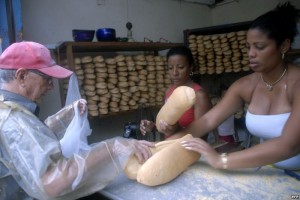
AF5EEA4D-E0C1-46B3-A1F0-5627C44CB3DA_mw800_s-300x200HAVANA, Cuba, October, www.cubanet.org – Part of the population of Guanabo, east of Havana, spent two days without bread — an essential food in the current Cuban diet — being available off the ration book, because of a quarrel among bakers, including injuries and the breaking of the gas lines to the ovens, which needed to be repaired and interrupted production.

“Several police officers quelled the war between the bakers. The injured were treated at the polyclinic. It was learned through statements from the contenders that the fight started because some bakers stole wheat flour from others,” says Isabel Torres, a customer who couldn’t buy any bread because the fight broke out just as she arrived.

But the flour didn’t belong to anyone but the State bakery, just like the oil, salt, yeast, fuel, the ovens, and even the water, though these ingredients are often appropriated. Corrupt practices extend to almost all bakeries — not to be absolute — including the illicit sale of the flour and oil.

What was the private reason for the conflict?

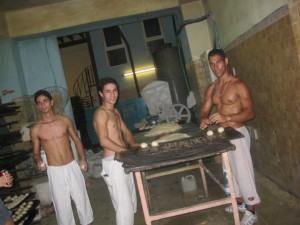
26447_413518626671_705961671_5119970_5240098_n1-300x225The Administration of the State bakeries and dessert shops have the custom of authorizing (illegally) the bakers and other employees to take home two pounds (loaves) of bread at the end of the day. They took them or, without having paid for them, sold them right from the bakery. In addition, they fabricated a collective plot for another quantity of bread to sell for their own profit, using raw ingredients to their advantage. They claim this profit is a supplement to their low wages. The consequences are that the “official” bread is low quality and underweight, and too expensive at ten Cuban pesos.

The State dairies also authorize the milkers to take two liters of milk. But, bakers or milkers, are they honest in not exceeding their assigned quotas of bread or milk? Not on your life!

For decades citizens have complained at neighborhood meetings with representatives from the government and the Communist Party about the terrible quality and low weight of the bread. It has also been denounced in the official press, but in response there are only momentary solutions, excuses, and hopes for improvement.

How is it that the government authority is incapable of definitively solving such an old social problem? That is the point. People are tired of eating — sometimes as their principal food source because of the shortages — their daily ration of Anti-Bread.

The six bakers could face trial for brawling and labor indiscipline. That is, if there is a trial. Otherwise, as sometimes happens, it will all stay in the family with administrative reprimand and conciliatory talk, “Gentlemen, nothing happened here!”… because they have to preserve the image of the business in order to continue stealing.

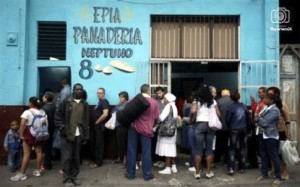
cuba-panaderia-300x187It’s common to find bakeries with “under the table” staff, off the payroll, whose salaries are determined by the suction of the illicit profits.

An inscription in big letters at the bakery on Neptune near the corner of Belascoain, in Havana, says the same thing as at every other bakery in the country, “We work for you!” For who?!

Christ commanded, “Distribute the wine and bread!” Biblical bread that should be of good quality, without the subtraction of ingredients because the story does not include a popular protest about the bad quality of the food. Do we have to go back to ancient times to some day eat good bread?

By Reinaldo Emilio Cosano Alén, cosanoalen@yahoo.com

From Cubanet

3 October 2013

Coach Drivers’ Protest in Puerto Padre Makes the Government Give In / Alberto Mendez Castello

PUERTO PADRE, Cuba, October 1, 2013, Alberto Mendez Castello / www.cubanet.org.- A group of coachmen demanding their right to travel on the road protested this morning, near the municipal government headquarters here.

The demonstration was strong, but not violent, as the protestors gathered on Libertad Avenue and Angel Ameijeiras. Parked on this street, the line of horses and coaches extended more than two blocks. The last vehicles were parked in front of the Municipal Committee of the PCC (Communist Party of Cuba ).

Their drivers were waiting for an answer at the gates of Government.

The demonstrating drivers serve the route between the Bus Station and Guillermo Domínguez Hospital. They are the only transport here that goes to the city hospital. The local authorities had banned their use of the road as of last year, alleging damage to the pavement by the hoofs of the horses and the traffic hazards on a winding curve. To serve their route after the ban, the drivers were diverted via a recessed side road and a bridge in disrepair.

Given the demands of the coachmen, the authorities had promised to repair the bypass road. But only one bulldozer worked the trail, leaving it equally impassable.

Unfulfilled promises from the highest political and administrative authorities of the municipality led the drivers to ignore the ban and to continue using the road. But on Monday the police began to impose fines on the drivers. The reaction was to paralyze transport by taking their coaches to go complain to the government.

The Government’s response was not long in coming: from now on and until the problems of the bypass route are solved, they can continue traveling down the road.

Having achieved their demand, the protest of the drivers in Puerto Padre ended before  noon.

1 October 2013

From Cubanet

In Treble Clef* / Rosa Maria Rodriguez

The killer sun that perches over Cuba every year hit me harder this August because I had to go several times to the branch of ETESCA in Casino Deportivo to use the online navigation room there.  It is two kilometers from my house and there is no way to get there except on foot, with the heat from the asphalt under my soles and the midday sun burning my skin.

Private taxis charge two CUCs or the equivalent in Cuban pesos to transport someone from Monaco there.  At that location there are only three sad little machines for a population of several thousand inhabitants. One of the two gatekeepers — the plump “nice lady,” who at times dozes off in her chair from boredom — takes reservations and watches over the three spots while the neighbors from the buildings across the street rest in their homes, perhaps in order to combat the drowsiness that every so often makes her nod off.  So in addition to waiting and fighting with the line of people, you must also “take a number” from the drowsy caregiver.

The saddest thing is when it urges you to connect yet you discover that you have no credit left on a card that costs $4.50 CUCs per hour and that is only valid for a month.  If your purchase happens to coincide with a special discount on telephone service that the company — the only one in Cuba — offers, it becomes a really irritating problem.  The special offer leads to demographic congestion at the entrance, sidewalk and flowerbeds of the store location because the employees inside make you wait in the sun, yes, the tropical sun.

It is outrageous that the store’s online customers must suffer these and other obscene indignities, which force them to have to type an incredible number of words per minute. If you go on sale days, you are reduced to waiting in a single line for everything, even though refilling the card is a simpler and quicker transaction than the tell-me-your-life-story process required for a telephone service contract.

This summer pentagram coincided with the school vacations.  Wherever one went everything was full, and that cyber place could not be an exception.  One resting his rear in front of his computer somewhat tired and frustrated by the wait and also from having to endure the heat and the network administrator disabling the right click, making it impossible to “copy and paste.”  That is to say, that although one brings a post previously written, you have to transcribe it onto their machines and consume more connection time.  The speed is that of the oxcart, maybe because of the incapacity of the computer or the spy programs that they install on the server to monitor what the users do and write.

This September I returned and everything continues more or less the same.  As far as what individuals may have at home, no one loses hope in spite of the blockade on computers and information — among many others — by the Cuban authorities. Never mind, it seems we still have to “tiptoe” to navigate barefoot on the hot asphalt of a dictatorship with an exhausted political discourse, but that still keeps an iron grip on many aspects of national life.

*Translator’s note: A play on words; in Spanish “the key of sun” is “treble clef.”

 Translated by mlk

24 September 2013

The Sky Over Havana / Jorge Alberto Aguiar Díaz (JAAD)

sexto aguiar 2
El Sexto
—I’m dying, damn it, and you’re going to die alone on this shitty island! —she shouted at him.

Then she hit him. Violently. It split open his lips and nose. It left him collapsed against the wall.

—Tell me, faggot, why don’t you hit me back?

She spat on him. He became still. Looked up. Then he saw the sea. Dawn.

She talked about her money. He wanted to go down to the reefs. Get his feet wet, wash off the blood. She talked about the honeymoon in Japan, about the permanent visa to the United States, about dual citizenship, about her rich and powerful family in Venezuela. He wanted to get his feet wet. To sleep. Maybe even sleep under the water, in another world.

A policeman walked up the sidewalk across the street. He stood waiting. She saw him.

—What if I were to say that you were hurting me? What do you think about that? What can happen to you for conning and taking advantage of a tourist?

He also saw the policeman. A second. He looked at the sea again. What would happen then? A starving Cuban and a tourist from the First World. Who would believe him? And when the police asked why she attacked? What could he say? The real answer was so unlikely that it would get him locked up in a prison cell. He leaned against the wall. In the distance he heard a ship announcing its entry into the bay. The policeman remained on the sidewalk. She attacked me because she wants me to marry her and go back to her country, he would answer. “And I do not want to,” he thought. Everyone was going to taunt him, the police and his friends, when they heard. His wife and his mistress, of course, they wouldn’t believe anything.

—Tell me. What if I call the police?

He did not answer. He was breathing anxiously and with some difficulty. I forgive you, Ana Marina, he thought. He recalled her naked, moaning with pleasure. Always laughing. He recalled her long, beautiful, black hair. He turned his face to see her one last time. Stunning and pallid. With her hair swept up under a scarf.

—It’s all the same to me —he said—. If you want to, kill me. I am free, Ana Marina, free.

Before closing his eyes, he heard a seagull in the distance and smiled.

He woke up. Once again the view of the sea from his window in that little room in Malecón. A piece of sea and a window. He had nothing else. A dirty mattress, a typewriter, a few pesos to buy rum and get drunk. He thought of Ana Marina. She would arrive from London at noon at the latest. But at least he was going to eat well for a week. He also needed to get out of this slum filled with prostitutes and criminals.

He looked at the blank page. Not a word. To write is to destroy oneself. He stood up. He had to forget his hopes of being a writer. He looked down the avenue—still deserted at dawn. He yawned. Hunger. Tiredness. Ennui. The entire early morning to write at least one page. No novel, no money, and no hope. What could he do? Wait. But wait for what? Nothing. Only wait. Waiting is enough. He thought of Ricky, of Kimani, of El Bolo. His friends were determined. That night they would launch into the sea on a raft. Such an irony. Some arriving by plane in first class and others escaping in rustic rafts.

A shout threw him out of his tired state. It was the neighbor. Once again fighting with her husband. Every day, the man arrived from the street at this hour and beat her. A mulatto ex-convict who made her whore for a dollar at the corner of Monte and Cienfuegos. Why not write those stories that he saw every day? Why not write about his rafting friends? Why not write about Ana Marina?

He took out the letters he had sent to her in the last six months. He wanted to reread them. Something was wrong. He never spoke of leaving the country. She, however, had phoned him three days before to say: I’ll come get you. We will get married, and I will get you out of Cuba in less than a month. I love you.

He looked at the letters. He recalled her naked. He remembered her beautiful, long hair. He thought he would like to make love to her in the middle of the city, behind the wall of the Malecón, on the reefs. But this marriage and escape puzzled him. What about his wife? And his lover?

He opened a letter. He began to read. In the distance, he heard the siren of a ship.

They had met on Obispo Street. She had gone to a bookstore looking for the books of Carpentier, Lezama, and Reinaldo Arenas. They had discussed literature. They had talked about their lives. No timidity, no hypocrisy, no repression, no guilt. They had liked each other at first sight. An hour later they were thinking that they had known each other all their lives. She got too drunk and he loved her voluptuous body, her hair, her way of speaking, her age. “I go crazy for both young and mature women,” he confessed. She had turned forty-five, ten years his senior. He spoke then of his wife who was nearly fifty and his lover of eighteen. The flower and the fruit of life.

Ana Marina invited him to a bottle of rum. She lived every moment as if it was her last. “You are a person sick of words and I am sick of life,” she said walking down Obispo, searching for the sea and Plaza de Armas.

The dealers offered them everything. Cigars, inexpensive luxurious food, rum, aphrodisiacs. Anywhere you could go, a huge black man showed up, selling any good, suggesting women, grabbing his own balls. They walked slowly, seeing everything and talking about what we always talk about: Government, human rights, the difficulties of traveling abroad, poverty, hunger, child prostitution.

The heat made them both sweat and her nipples were visible through her shirt. She put her hand under her shirt to dry them and he wanted to bite her there, like an animal, and pounce on top of her. Ana Marina’s eyes looked with longing, discovered an untamed instinct. “I would like to dry off your sweat,” he said as they sat in the park. “And I would like you to dry me off,” she said.

That night was spent in the small room in Malecón. They endured the heat, the bad smell and the filth of the overflowing toilet in the middle of the slum’s hallway, the shouts and fights of neighbors over a lack of water. He opened the windows and entered her forcefully. He grabbed her by the waist, bit her back and they looked out at the sea. In the distance, they heard a seagull and a ship announcing its arrival to Havana.

READ THE REST OF THIS STORY IN SAMPSONIA MAGAZINE HERE—

Translated by Zach Tackett

The publication of this story is part of Sampsonia Way Magazine’s “CUBAN NEWRRATIVE: e-MERGING LITERATURE FROM GENERATION ZERO” project, in collaboration with Orlando Luis Pardo Lazo, and a collection of authors writing from Cuba. You can read this story in Spanish here, and other stories from the project, here.

Conference for Over-40s in the Casa de las Americas / POLEMICA: The 2007 Intellectual Debate, Isbel Diaz Torres

Yes, it would appear that the themes discussed yesterday at the Casa de las Américas [an institution in Havana to promote inter-cultural links with other countries <transl.>] were not of interest for the future of Cuban culture and thought. It seems like they were trying to mend fences (with every justification) with some of the victims of a period which was not just grey but invisible.

For many like me, knowledge of this part of our cultural history is limited to commentaries about some benchmarks and readings between the lines in essays and spaces such as those in magazines like Temas or Criterios. Nevertheless, the youngest artists, researchers, and intellectuals in general who wanted to attend had to be content with the iron barriers which were put up at our beloved Casa. “There isn’t space,” they said, and it was certainly true: there was no room for us in that coterie.

The sad thing in all this is that perhaps it would not have been like that, it is very possible that if they had asked our Desiderio if that was the auditorium he had in mind for his cycle of conferences, the reply would have been in the negative. And it isn’t because those who got in did not deserve to do so, but because those of us who were stuck outside would have had the right to attend as future makers of Cuban culture.

There are those who think that it was all just a problem of organisation, there are those who are more suspicious, but the fact of the matter is we couldn’t get in. How many invitations intended for members of the  Asociación Hermanos Saíz, did not go out from the National Council? Why did the UNEAC [Writers and Artists Union of Cuba] manage the entire organisational process, helping themselves to  an enormous quota? And what about the University of Havana? It’s very possible that half of the people who were inside, if they hadn’t been expressly invited, would have remained in their houses, and that is not as innocent a speculation as you might think. How concerned must they be about Cuban history and culture to go to such major and controversial conferences as are arranged by the Centro Teórico-Cultural Criterios [Criterios Theoretical-Cultural Center] and confront the faces of those who usually get in, the stares of those who yesterday were among the chosen?

Fortunately, deep-thinking people were also up there, people who, apart from their artistic merits, have always been in the habit of expressing their opinion, debating, confronting, being heretical. But that isn’t enough: we should also be there, and that doesn’t seem to me to require any more justification. One of those people excluded said that maybe it was better for us to be outside instead of inside, maybe we were playing our own particular part in the history; maybe, I would now say, we were demonstrating that that is not just about the past but also about our difficult present.

I welcome the entry of this debate into the schedule of the Cuban intellectuals, those who suffered the “Pavonato“, those of us who now gather the fruits of those injuries and perhaps confront others of a similar nature. I am confident that the seats at the upcoming conferences in this cycle will be available for those of us who are interested in listening so as to know what to do about the future of our culture. continue reading

Lic. Isbel Díaz Torres

Writer, member of the Asociación Hermanos Saíz

Wednesday, January 31, 2007.

CONFERENCE FOR THE UNDER-40S

OK, as you must know by now, there has been a Conference for the youngsters … or conferences … or, the workshop “The Cultural Policy of the Revolution”, as it was put on the invitations distributed by the Centro Teórico-Cultural Criterios and the Asociación Hermanos Saíz.It took place last Friday (February 23rd) at 2 pm in the ISA. [University of Arts of Cuba]

Who was invited? Well, although I don’t have the figures, there were plenty of people there, the great majority youngsters. Intellectuals from every branch of the arts, researchers, writers, from the AHS (higher-ups and ordinary members), students from the University, and creative people from many provinces of the country. Perhaps this time too they didn’t achieve an ideal auditorium, in order to generate a real debate, but I think we can agree that that’s a really difficult task. But, as Alain Ortiz said,  ”the significance of the meeting lay in its multigenerational representation”.

I have conflicting impressions of this. On one side I feel satisfaction at having been a part of this debate, at having had the opportunity to speak freely, like many other young people there, and at having discussed topics which cannot be put off regarding our culture and politics. As has happened more than once, it is gratifying to feel that Abel listens to us and takes us into account. But, on the other hand, I also feel, as do some of my friends right now, that there is no confidence in any immediate solution to many of the questions which were put, and that, at the end of the day, that is what really matters. The tone of excusing the situation on the part of  Iroel Sánchez (Director of the Cuban Book Institute) and at certain times of Abel himself was somewhat discouraging. We young people are in a hurry, that’s for sure. Many of the things we are asking for we should have had yesterday, and without waiting in hope that perhaps they will give it to us tomorrow.

Nevertheless, I want to be optimistic, “miracles are slow in arriving” as Silvio says, but we can see the lights on the horizon. This process which has been unleashed is irreversible, in my judgement, and I feel that the Revolution is plagued by rich contradictions, which will become more marked if we are successful in taking advantage of them. I am not talking about opportunism, but about not leaving those issues we are concerned about locked away in the filing cabinet and insisting that they are addressed and resolved. I feel that much of what we are now suffering is truly due to the fact that the injuries were not healed at the time they were inflicted. It’s like trying to conceal a piece of meat under the mattress: the putrefaction and bad smell will come out in time. That time is now. Tools such as the web and emails are in our favor, silence is impossible.

Up to this moment I haven’t noticed that this workshop has had any impact; neither in the national press, nor in emails. That worries me a lot, because I think it was a profitable debate, some ground was gained. Are we only interested in obtaining an emotional release by complaining about our misfortune, or do we want to really structure this debate? It is essential that we are fully aware of what we are doing. I am not talking about a plan of action, or anything like that; we all have our own ideas and important differences. But the desire to renew things, to be truly revolutionary, must not be lost after a short period of high spirits, but it should become part of our daily lives.

For the moment, here I  publish my words in the “meeting with the young people”. The text was short, in accordance with the moderator’s request to not go over three minutes, but “I have said what I wanted to on time and with a smile”, and, above all, very honestly, which is the important thing.

Instituto Superior de Arte, Friday, February 23rd, 2007

Hello everybody.

I have an insistent thought over and over in my mind, which started when this avalanche of emails and statements first invaded the Cuban intellectual world. The question is: Will all of this make any practical sense?

What is a Cultural Policy? Does a “Cultural Policy” decide which works are aesthetically worthy, and which aren’t? Will it help me to understand whether rock is better than timba [a style of Cuban dance music], whether performance is better than landscape painting, if our own writers are better than foreign ones, if reggaeton is erotic or pornographic? Is a “Cultural Policy” something which helps black people? Gays? Provincial artists?Is that what it is? Is it something you write into the Constitution of the Republic, or put in decrees, or which you download as “guidance from higher organisations” in meetings of the Party or the UJC? [Young Communist League]. Does a “Cultural Policy” tell you what is revolutionary and what is counter-revolutionary?

In my opinion, the Cuban Cultural Policy, so tied up with the spheres of power, and very often more than tied up, subordinated to the apparatus of state, fortunately has not been immovable, but has moved in parallel with the development of this nation. Many times it has remained at the mercy of orders remote from the culture itself: international situations, “defining moments”, hare-brained ideas, which, in the mind of some executive committee become transformed into laws, etc. There have been moments of greater or lesser permissiveness, sometimes of tolerance and, why not?, also of real understanding. But is that what we really need now: to be grateful for the arrival of a moment of greater tolerance? To sing a Requiem to Social Realism and a Hallelujah to postmodernism? I think that would be a frivolous attitude on our part.

Since I was a kid, I have been taught that true transformations, or at least the most necessary ones, are those which spring from the roots of evil things. Later on I learned for myself how difficult they are, since they presuppose, above all, identifying the evils; which requires a strong dose of wisdom, detachment and love. But who wants easy tasks? We need true transformations and for that we have to “think Revolution”. This doesn’t just have to do with the world of the arts or the intellect, but all of society, all the country, of the Revolution.

Cuban society is a society of fear, as well as other more comforting descriptions which could be applied. It’s possible that a similar name could be applied to other societies right now, where forces which are superior and invisible determine the destinies of their inhabitants, which might be a sign of the times, but at the end of the day we are responsible for our society, for our Revolution. I don’t have the theoretical tools in order to demonstrate that fear has been established in our country, but names such as “Pavonato”, “Five Grey Years”, “Secrecy”, “Mystery Syndrome”, will give you an idea of what I am talking about. A process as sad as this for this nation’s soul cannot be shaken off that easily; the bruises they were showing following my message “Conference for the over-40s” showed me how far we still are from having left the disastrous influences of fear. The censors are there, they exist, they occupy positions from where they can harm us. When will they be recognised as counter-revolutionaries? When will we have a television which reflects our society with its contradictions, instead of investing time and money in inane slots for self-glorification. When will we have daring and inquisitive journalists? Why does nobody over there on the outside know we are here saying these things?

The cultural policy we need is one which encourages the exercise of criticism wherever it comes from; one that, from a position which is ecumenical and non-paternalistic, embraces creative activity; one that does not have “The Institution” acting as its headquarters, even when “The Institution” supports the creator, but that its guiding light is in the cultural activity itself; one that teaches us how to converse.

We need both old and new (but distinct) streams. We cannot give ourselves the luxury of letting names like Gramsci, Trotsky, Varela (to mention a few) be only known in intellectual circles and totally alien to Cuban knowledge  and practice.On the other hand, we young people cannot continue waiting for others to design spaces for free expression, for criticism, the power to generate these spaces  and multiply them lies in our own hands.

GIFTS (The right human time, 1962 Herberto Padilla)

(…) And nevertheless, you had things to say:
dreams, desires, journeys, agonizing resolutions;
other voices (or, another voice) did not distort
your great love nor your true angers.

Isbel Díaz Torres

Translated by GH

Link to original post
31 January 2007

28 September / Luzbely Escobar

IMG_4076 IMG_4082 IMG_4083

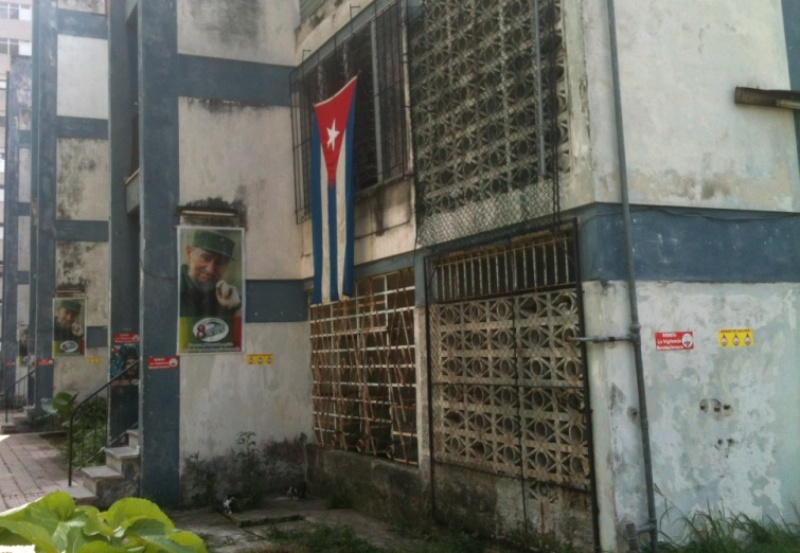
In recent weeks Cuba’s official media has been trying to constantly bring the figure of Fidel Castro to the foreground. Again I hear “this idea was our commander-in-chief’s” or simply “our beloved commander-in-chief…” Recently to celebrate September 28th* the blocks were bedecked with posters of his figure. Like a multi-colored flag his face was repeated over and over in every one of the Committees for the Defense of the Revolution (CDRs) in the area where I live.

I don’t like it.

*Translator’s note: The founding of the Committees for the Defense of the Revolution is celebrated on this date.

30 September 2013

The Lopez Serrano / Fernando Damaso

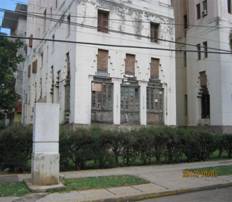
The López Serrano building, a work of Mira and Rosich, architectural jewel, constructed in 1932 and located at No. 108 13th between 11th, L and M in Vedado, has suffered a progressive deterioration for years, with the authorities doing absolutely nothing to stop it.

Looking around its exterior is to discover doors closed and boarded up and the glasswork in ruins, chipped walls, gardens turned into trash dumps, sewer water, and everything conspiring against its existence and its inhabitants, in a display of a complete lack of respect for the city and its citizens.

It’s noteworthy that next to it is the Camilo Cienfuegos clinic, operating in hard currency, and a few yards away on 15th and Linea between L and K, the residence occupied by the National Headquarters of the Committees for the Defense of the Revolution (CDR), both of which received continuous maintenance, including frequent painting, as if these

The Lopez Serrano

facilities are more important and valuable than the Lopez Serrano building. It seems there are abundant resources for these types of institutions — collection points for hard currency and politically-ideologically focuses– and scarce resources to save our architectural patrimony.

We need to firmly demand that the authorities  repair and maintain this property, which gives an appearance to the city and makes it unique, before a group of  complacent architects declare that its structural problems were caused by construction errors, and approve its demolition, something that has happened repeatedly (the Alaska Building at M

CDR National Headquarters

and 23rd and the Pedro Borras Astorga Hospital in the block of G Street, 27th, 29th and F, also in Vedado). We can not continue to allow these types of buildings to disappear, leaving us with a tiny little park in the space where they were, waiting for better times. Architecture is also an important component of national identity.

2 October 2013

Moscow 2013: Cuba, Worse Than Expected / Ivan Garcia

Cubano-gana-oro-Mundial-Moscu_PREIMA20130818_0117_31In spite of the absence of giants from track and field like the Kenyan David Rudisha, the Jamaican Yohan Blake, the Cuban Dayron Robles and the Croat Blanka Vlasic, the Track and Field World Championships which took place August 10 to 18, was not a disaster.

Tyson Gay, Asafa Powell and Veronica Campbell-Brown were banned from competition for having used controlled substances. Although they weren’t world-class athletes, the times and scores were significant.

And when headline names compete like Usain Bolt, Mo Farah, LaShawn Merritt or athletes in the style of Yelena Isinbayeva, Shelly Ann Fraser-Pryce or the runners from the depths of Kenya and Ethiopia, there is a guaranteed show.

It’s a pity that the Muscovites weren’t enthused by this distinguished group of giants.  Or they’re not interested in track and field, the tickets were sold at astronomical prices, or they preferred to stay in their dachas during these hot August days.

Of the 14 editions of the Track and Field World Championships, it was the least attended by the public.  The International Federation of Track and Field should take note.  And set aside shady deals lacking in transparency when it’s time to designate a host site.

Super sized athletes like to compete with full stands.  And the notable empty spaces in the gigantic Luzhniki stadium demonstrated that not everything is done with voluminous wallets, juicy commissions and extra-curricular lobbying.

Russia, which hopes to recuperate its lost greatness, bet on launching an offensive on all fronts.  From their platform in the Security Commission of the United Nations, to throwing the house out the window and grabbing first class sports events.  The new type of dictatorship invented by Vladimir Putin, with repression of dissidents and homosexuals through laws or simply busting them with sticks, he initiated a media offensive to wash its totalitarian face.

They will be a host site for the Winter Olympic Games (Sochi, 2014) and the next World Swimming Championships (Kazan, 2015).  And they are discussing a place for the Summer Olympics of 2020.  Only the myopia or corruption that envelops the maximum agencies for global sports, gets around the fact that a country that doesn’t respect democratic play should never be host to world events.

But back to the point. Despite the frigidity of the spectators, on the sports side, Moscow 2013 was a success.  In nearly all the competition events better times and season records were achieved.

In the case of those who competed from our island, this is a pending subject. For years now Cuban athletes, with exception of Pedro Pablo Pichardo, Yipsi Moreno y Omar Cisneros, haven’t gotten the best results in their most important events.  We have to check the methods, something is wrong with the technique and strategies.  The best marks are obtained in the first few months of the year.

Of course, to sweep the house you have to switch the furniture.  The work of the Cuban Federation of Track and Field is awfully bad.  This was confirmed by a source that would rather stay anonymous:

“You can’t obtain big results when the attention to the athletes is shameful.  You could make an extensive list of the athletes that have left the country or simply have stopped competing due to lack of support from the authorities.  It is an authentic cartel of the immoral.  Corrupt to no end.  Look at the Panamerican Stadium where the stars of track and field train; it is a shame.  The gymnasium is disgusting.  The boards are not working; the food and the working conditions are deplorable.  Yargelis Savigne, Aliecer Urrutia and others have decreased their performance due to the lack of support and training.  The best Cuban trainer, Santiago Antunez, had to retire.  The Commissioner Jorge Luis Sanchez is a straw-man.  It is the despotic Alberto Juantorena is who pulls the strings of track and field in Cuba.  If they aren’t charged with corruption or fired, in a few years we won’t have any great athletes.  The material and talent are there, but there is lack of direction in accord with the new times that shine.”

Three years ago, the pole vaulter Lazaro Borges, in second place at Daegu 2011, and Yarisley Silva who won bronze in Moscow 2013, didn’t even have a pole vault to train or compete.  If they hadn’t had high-caliber results, today they would be completely unknown athletes.  The mentality of the Cuban government has always been “put the cart before the horse.”

If athletes don’t show results, there is no guarantee of physical or monetary resources.  This sewer of bandits that the island track and field federation has become is the genesis of the poor showing at the world competition in Moscow.

Is the second worse result since 1987.  Now we are in 23rd place with two bronze medals and one silver.  This is not a matter of medals.  I repeat, the majority of the athletes didn’t achieve their best marks of the year or their personal bests in the tournaments.

The complacency of the official press and the mendacity of the leaders will attempt to cover the sun with one finger.  But something must be done if we want to come back to first places; and that something can’t be done the way that the unpopular Alberto Juantorena is doing with jewels of the track like Dayron Robles.

The sports authorities of the island need to “really” look at their calendars.  We are living in the 21st century.  If they don’t change strategies, with their absurd rules and silly speeches they will bury what little is left of Cuban sport.

Changing topics; Jamaica stole the speed show.  They took six gold medals.  What happened to Usain was to be expected.  He is unrivaled; he comes from a different galaxy.  Seriously, they should take into consideration to retire him with honors and keep the videos of his performances for future generations of runners.

It can’t be fun to compete against yourself; that’s why I saw, a very serious Bolt.  If new rivals don’t emerge the guy will get bored.  He won, but he lacked the Caribbean and reggae spark.  With the gold of the 4×100 relay, Bolt will surpass athletes like “Pato” Johnson and Carl Lewis in their number of medals.  Until proved differently, he is the greatest runner in history.

From his same country Shelly Ann Fraser-Pryce is not too far behind.  She started better than anyone else and surpassed the three American runners.  In speed, Jamaicans have a dynasty; ones leave and new ones show up.  In the short runs Jamaica runs against Jamaica.

Another one that imprinted his name in Gothic letters was Mo Farah.  Running is his natural state.  He did double in 5 and 10 thousand meters.  He has a final sprint that any 400 meter runner would envy.  He’s not only a pride to the world but for Cuba too.  His trainer, Alberto Salazar is Cuban.

Watching experts like Salazar or Ivan Pedroso, who train the world champion in the triple jump, the French Teddy Tamgho — who marked 18.04 on the August 18th Moscow afternoon, the best in the last 15 years — we can see what can be done when you have the drive and resources to display the athletes’ qualities.

Russia showed its condition of host and took the first place among countries.  Isinbayeva showed her grandiosity despite certain statements made to the press.

The Cuban delegation showed a display of new blood like Pedro Pablo Pichardo, Omas Cisneros and Yarisley Silva.  One must be careful with some of the ages of the cadets and youths that competed in Moscow.  This wasn’t their world championship but it served its purpose.

The sickness at the heart of track and field in Cuba is the same as the regime, it is systemic.  Is not due to lack of talent; but rather due to the rules of the game.

Photo: With his silver medal, Pedro Pablo Pichardo (born Santiago de Cuba, 1993) gave Latin America its sixth medal in Moscow 2013. Pichardo was beaten by Frenchman Teddy Tamgho, who since 2011 has been coached by the Cuban Ivan Pedroso, quadruple world long jump champion and Olympic gold in Sydney 2000.

 Ivan Garcia

19 August 2013

A Leak of Advanced Age / Rebeca Monzo

Twenty-eight years ago, when Patricia was pregnant, she was treated at González Coro Hospital, the former Holy Cross Clinic, on 21st Street between 4th and 5th in Vedado. In those days it was the desire of every mother-to-be to be treated there since it was the place with the most prominent specialists. Among the last such facilities to have been built in the 1950s, it also had not yet deteriorated as much as its counterparts.

At the time my friend noticed that in the Obstetrics and Gynecology waiting room there was a leak coming from the dropped ceiling under which a towel and bucket had been placed to catch the splashing water. Back then, this could be “overlooked” since it was logical to assume it was only a temporary situation. At least that is what she thought.

Twenty-eight years have passed and my friend recently returned to the same waiting room, this time with her daughter, who is now expecting. Imagine her horror when she saw that the same old leak, which had been her constant companion during the nine months of her pregnancy, was not only still there but had grown to be much bigger. It is now almost a waterfall, like the one at Soroa*, and a large part of the dropped ceiling has been destroyed. The bucket currently used to catch the water is much bigger and the towel is no longer large enough to contain the splashes forming a giant puddle around which the medical personnel and patients must navigate, subject to the obvious risk of slipping and falling.

It seems to me that, with all the money invested over the last twenty-eight years in buckets and towels, they could have — if they so desired — fixed the  problem in the dropped ceiling, as they should have, and thus avoided the risk of an accident, which in the case of a pregnant woman could be fatal. Who are the officials responsible for correcting this situation? It is perhaps the hospital director? Might it be members of the National Assembly. What is quite clear to me is that it is certainly not the doctors or patients who are responsible for fixing this problem. I am also convinced that, if no one complains, this unfortunate situation will continue until one day the waiting room is closed, then the clinic, then the whole floor and finally the hospital, as we have seen happen with other such facilities.

 *Translator’s note: A site in Cuba’s Pinar del Rio province.

1 October 2013

The General Gains Time / Juan Juan Almeida

To the President of the Councils of State and Ministers of the Republic of Cuba, the words freedom, prosperity, love and family are plain and simple “persuasion” that, when it comes time for manipulation and pressure, have more of an effect than fear. He didn’t lie last Friday when, in feverish runaway of egotism and pride, he publicly revealed during one of the plenary sessions about the recent closure of the Eighth Congress of the Committees for the Defense of the Revolution (CDR), “We must change the methods of struggle, but not the combat.”

Developing objective. The law has allowed it; and his immorality facilitates it.

With the rise of self-employment, the General has managed to entertain the illusion that some sectors traditionally repressive and, in a parallel way, has managed to gain the appreciation of some who, with money (ill-gotten or not) today see the chance to feel and present themselves as successful businessmen.

Changing the immigration law was a smart move, and internationally applauded. By itself, it alleviates state inefficiency, opens the social valve opens and results in good income. And along with the new form of repression, more surgical, that no longer seeks to imprison but rather to crush the internal opposition and civil society to the point of exhaustion, it has become an essential weapon, Because following a simple logic, the most notable figures in the opposition, on traveling and comparing, will relocate outside or keep on traveling until they disappear from the national scene.

Some unwittingly, and others very reluctantly, are transmuted into spokespersons  in a well-calculated government move that shows a false but convincing transformed vision of this “Raulista” Revolution which, in order to gain territory as part of the same combat using different methods; instead of sending soldiers, today it signs business and/or bilateral cooperation agreements with various countries in the world, where it then sends a very opportunistic invasion of Cuban doctors who, with admirable sacrifice and laughably remuneration, take on the noble labor of returning smiles to those who lost the teeth.

In short, like I was taught one day by my late grandmother Rosario, who could not write but was very successful with pithy sayings, “Beware of those who always boast of wearing a cross on their chest, because they carry the devil in what they do.”

Personally I think that, lacking an element of surprise, the only thing capable of robbing the slant-eyed pro-Russian President of Cuba of his dream, is the regional situation. To wit, Venezuela, for fuel; and the convenient peace talks between the FARC and the Colombian government in Havana, in temporary recess, which should continue as of October 3rd.

The General, like any military strategist, knows that the more prolonged these dialogs are, the smaller the maneuvering room for the Colombian government to negotiate. And, if the FARC guerrilla group is converted into a political force capable of participating in presidential elections, by diving “magic” it could win and change the balance of forces on a regional map extending the influence of Cuba in the area.

Then, what they once did with weapons, they could solve with agreeable words, firm handshakes, and seductive female company. Trained and ready to dance and kiss. Actually, they are very effective methods, but nothing new.

1 October 2013

Ignorance Hurts / Cuban Law Association, Osvaldo Rodriguez Diaz

Osvaldo Rodríguez Díaz

Guided by low-flying vultures, three young men, who moments before had been cutting wood on the mountain in order to build a fence, found the remains of a cow, which 24 hours earlier had been stolen and killed by unknown rustlers.

Though they could smell the odor of meat exposed for a long time in our hot climate, the newcomers felt that it could be useful for their dogs, or perhaps with some treatment, for their own consumption. With their tools they then proceeded to cut the bones along with the remaining meat and hide.

The task was interrupted by the police, who arrived with the animal’s owner, who already knew where the animal had been slaughtered, having found it before youngsters had, also guided by the birds of prey.

At noon it was decided to incinerate the remains of the animal and what the three boys had cut up, necessitated by the state of decomposition.

Not knowing who the perpetrators were and powerless to discover their identity, the police took the three young men as defendants to the police station. Because one of them was a soldier, it was decided that the case would be transferred to military jurisdiction, unfortunately for the three.

Over three months passed before it was presented to the regional Military Court based in La Cabaña. Do not be shocked:

– Acquisition of beef slaughtered illegally, under Article 240.1.3 of the Criminal Code, and

– Illegal Possession of Weapons, under Article 214 of the Criminal Code, both accomplished.

The latter charge, perhaps to justify the prison sentence, which exceeded the minimum limit for the first offense, which was charged from the outset.

The penalty imposed was six months imprisonment for both offenses, or three months for each one.

The incorrectness of these sentences is beyond absurd. To claim that a rotting carcass, which had to be incinerated, has the same character as meat fit for human consumption, as required by law, is extremely unjust.

Further, to treat the woodcutting tools used to cut bones as illegal weapons is breathtaking to any jurist. There is no known way to relate and illegally connect the two offenses, one a crime against public order, the other a crime against the economy.

How do these inexplicable things happen?

Someone should review these cases of clear judicial blundering.

The saddest thing about this story is that the people in court reacted with happiness, considering the sentence appropriate because, as the prosecutor explained, they had already served three months of the six, and had almost become eligible for probation.

Will they give it to them?

30 September 2013