Chile and Death and Cuba and Love / Orlando Luis Pardo Lazo

Ipatria, Alamar, a Vulture, the Night, and Me

1. There are exiles who bite and others like a consuming fire

We met in the Martyrs of Alamar mortuary. Her father had died that afternoon, I’d come in to drink no less than ten coffees on the cheap. I needed them to ease my anxiety, ease my anxiety, ease my anxiety. My nights were long, too long to endure. Blind tunnels until little after dawn, when I managed at last to find myself in a park; only so a swarm of uniformed children could jostle me next, blowing to smithereens my only winks of the day — the week, the month, or perhaps the millennium. Of course, on that first Friday she didn’t call herself Ipatria yet. I saw her sitting like a mortal, alone in the ’Ch’ chapel, scarcely a few feet from the cafeteria where my nerves overloaded. Not even her dead father accompanied her between the candles and the blackout. Afterwards I learned that she herself had ordered a second and a third and a fifth and a tenth autopsy: Ipatria distrusted or “no, now I don’t distrust“, she would confess to me afterward: “now I’m very sure of what’s happening …” The absence of a casket was the first thing that caught my attention. Then her foreign black hair, falling into neglect on her bird-like shoulders: her immobile ebony hair, or of araucaria or cypress. And then it was her chapped voice, prickly, when she called me without looking at me, bluntly: “Come here” (like to a dog). And I went toward her (like a dog), thus ruining forever my somnambulatory routine, for the first time obedient in the anarchic midnight of a worker’s cemetery called Alamar. “Sit“, she ordered, and put me in front of her face. She had extremely black eyes, even more so than her hair: from a nightless night, starry and tattered, and I adored that tiny little bit of shadow in her pupils between terror and blackout. “Do you come from abroad?”, she asked me. “From where, outside?”, I asked her. “From the Cuban night“, she said to me. “I suppose so“, I told her. “And have you seen it? Did you hear it?“, she shook me. “Seen and heard what?”, I withdrew from her attack. “You freak!“, she pushed me until I nearly fell to the ground: “The wingbeat of the vulture, what else could it be?” Then she made a grimace and hid her face: she was horrified to have spoken more. She pretended to cry but neither did she manage to do so. She looked at me with hatred, as if I’d betrayed her secret. I managed nothing. I liked to imagine her crazy from the beginning. “Please“, I calmed her: “there have never been vultures in Alamar“, and I grabbed her by the belt. “Or they went extinct at the beginning of the Revolution“, and I gave her a hug. Blindly. She trembled. Her vibrations transmitted themselves to me. I trembled too. We looked like a pair of epileptics waiting for the casket in which one of the two of us was going to lay down. Then she took her hands from her face and separated me from her body. Her voice returned to being prickly, sliced up, and she dismissed me without looking at me, bluntly: “Split” (like to a dog). So I turned, for the second time obedient (like a dog) and began walking down the hall, returning to the mortuary’s cafeteria where, in spite of the triumphal lack of electricity, the custodians still insisted on straining their coffee. Black smoke inside a bigger cloud of smoke. To be sure, that first Friday Ipatria never called herself by that name. That December 3rd I left her without knowing her name, a terrible key to penetrating her head, to sneak inside her brain, lightly scratched by the sandpaper of Chilean history and its tyrannies: wet waiting room to her now dried up sex through so many tears repatriated in Cuba.

2. Timid herds galloped, devouring the streets, dressed in terror and shadow

The second night was in a tan M -1: pink tin can metrobuses rolling even in a full blackout. She was seated on the steps to the rearmost door, her knees contained by the circle of her hands and the tangle of her hair, in which that night a flower was sunk like an explosion of white. It looked like a fistful of petals with a pistil: a marpacifico, I thought. Although I realized right away it was not: “it’s not alive, moron“, she ridiculed me, “it’s just a piece of plastic, Made in Chile, wholesale.” I kept staring at her for the next couple of stops of the M-1, during three or perhaps thirteen kilometers of the Via Blanca, remembering her again in the funeral home, meeting her again for the second Friday in a month. When the Metrobus started to pant up Cojimar Hill, I dropped next to her on the seats: among bags, lit cigarettes, farm animals, calves, or on barbs. “I’m Sagis“, I ventured. She looked at me, perhaps remembering me from another time in the funeral home, or recognizing me for the second Friday in the millennium. Then she smiled. “Sagis is a name for a mutt, not for people,” and she aimed at me with her left index finger, a long gun complete with bayonet of a fingernail painted white, a petal no less artificial than her imported flower. “My real name is Salvador,” I admitted. But she was unsatisfied: “Salvador is much worse.” And she turned serious: “Surely you were born after ’73.” Her guess left me gob-smacked. “Almost,” I confessed, “December 10th, 1973: I suppose today is my birthday,” and I felt ridiculous in my pathos. Luckily, she looked at me compassionately. With patience. And she returned to smiling for me. Between the kicks from the crowd shone something even more beautiful than the nonexistent box at the chapel. Night was falling. I’d now gone through seven dawns without sleeping since that one in which I bumped into her. Back then I thought I would not see her again — perhaps due to my stupid habit of continually circling the Martyrs of Alamar mortuary, as if her father could die twice in a week and through a paranoid cascade of autopsies. There was an infernal noise under our feet, including white smoke from the motor. I couldn’t stop looking at her while she lectured me: “In December of ’73 I too had had your name, but I was born a few months before“, she shrugged her shoulders, as if they were wings. “Our parents were obsessed with the presence or the presidency of some Salvador,” she said for fright effect and public entertainment in the shadows of the Metrobus. And I loved her vocabulary of political evangelism so much that … I don’t know … the vehemence of her brilliant oratory cast a spell on me. I managed to tell her how much I’d been intrigued by our purely random encounters, and that I didn’t want to lose her again. Because, from that point on, I slept less and as a consequence, my anxiety was worse, my anxiety was worse, my anxiety was worse. “Happy birthday and goodbye, old man“, she gave me a kiss on each cheek. And next she told me no, that it was not possible for me to see her and that she deeply regretted it, but she repudiated coincidence and fate, and I exactly embodied coincidence and fate: which was too suspicious for her intuition. “A power with memory could use anyone to detect you“, she said. She distrusted. Or not, no longer mistrusted: “now I’m not sure what happened,” she said in a whisper.  And my ignorance did not guarantee my innocence: that someone from the military junta, for example, might be handling me like a civilian puppet. With me she could never be safe: “I’m very sorry, whether you be Sagis or Salvador, you are too innocent to be not guilty” was her conclusion. “But safe from what?“, I became impatient. And now she almost looked at me with compassion. “Please, safe from a motherland: from Alamar, from a vulture, from the night, and from you“, she told me, and jumped with the door half-open, still stopping our M-1. She escaped from crevices, among the echos of her own enumeration. Like one of the vermin of the night, angelic and frightening creatures, without giving me time to act: to hunt her and really threaten her with death, to see if the she really reacted to me. I looked outside for an instant. I saw her running. I saw her back about to take off, silhouetted against a lunar landscape in permanent revolution. We were in the old Chilean neighborhood: a wasteland even more deserted than the rest of Alamar and perhaps the rest of the country. Chile, Cuba, Santiago de la Habana: how can you tell the difference under the dead gaze of unlove? Besides, no one ever got on or off at that bus stop, out of fear of the legends that, for more than ten years, laid waste to those buildings through sudden repatriation: clandestine mass flight without apparent cause, that made Cuban Chileans invisible in just a few days at the end of the 80s. In Chile democracy finally returned and no one wanted to continue living in Revolutionary Cuba. continue reading

 3. They extracted the shadow from the shadow, drew a wind with fangs

Nonetheless, the following Friday I got off right there, after all my cheap coffees in the Martyrs of Alamar.  I needed to see Ipatria, if only to lose her again. Her turf was a rocky desert of high salinity, between dirty nondescript buildings and faded walls: on all of them was the same old blind man, in a suit and tie, but wearing a hard hat and, in his left hand, a machine gun pointing skyward, as if signalling surrender or perhaps actually surrendering.  I crossed the basketball court laid waste from the 11th School Festival.  I crossed the overgrown baseball diamond next to where the drug dealers ply their wares.  And I crossed the ghetto deserted by the Chileans at the end of the 80s, who returned in a stampede to their continental island bounded by the Atacama Desert, the Antarctic ice, the Andes ridge, and the voracity of the Pacific.  Without gas, without light, without telephone, nor identity documents; expecting the denouncement that would return them to their province of birth, like springs, to reorganize their teeming families and relocate to the capital between mouthfuls of prú and drum beats.  Then I bumped into her. Ipatria remained immobile, addressing no one in a loud voice: making speeches, sitting on the shoulders of that old salt-corroded bust, at which we all poked fun as children, without having to ask one’s later adult self what kind of lonely that guy would have to be. The lack of lighting reduced them both to a shadow puppet: the statue standing, Ipatria sitting on top, reciting — straddling the statue — what seemed like verses. She broadcast them without noticing the absence of her public. I paid attention: “In the deepest region of the motherland“, with me still getting closer to the pair, “where the puma growls and the condor cries“, her fingers as tense as claws, “injured by iron and dust“, I stopped next to the pedestal, “the rocks, the dead, the urns“, she covered the eyes of the bust and held it by the chin, “covering themselves in dust and black roots”, as if protecting it from the truth or seeking to be protected by it, “while the flag is hung between two buildings“, I noticed that her block was escorted by two vandalized buildings, “and inflated their cloth like an ulcered belly, a teat, or a circus tent“, and then Ipatria curled herself up on the corroded head of the martyr as if she were finally going to give it birth or perhaps abort it. I applauded, solemnly, trying not to appear sarcastic. I was fascinated by the staging, and also by the right angle at which her legs opened on the statue’s metallic nape, be it copper or brass. It looked like she was determined, because she attacked me right away. “I was waiting for you, Sagis or Salvador, and getting used to a persecution is the same thing as letting myself be trapped“, she said between rage and complaint, “so it seemed to my father and, you know, the consequence was fatal“. I didn’t understand and it wasn’t even important that I understand; the facts were enough for me. We were there by coincidence: wasn’t it perfect? “No, first it’s pathetic, and afterward it’s very dangerous“, she despaired, “You don’t know anything and it’s not important that you know“. “Life is today“, I justified myself with a sureness I didn’t have. “Look, moron“, her voice split out, “they killed our parents, they killed our children, they killed the streets, the trucks, the silent earth” — they seemed like verses to me again — “they killed those who are, those who know, those who feel, they killed the house, the casket, the president’s forehead, they’re going to kill me and I don’t care … what could it matter to you?” By my expression, it was obvious that it meant nothing. “They’re already here!“, she yelled, on the edge of hysteria. “Power tracks us by telepathy. From the Elqui Valley they know everything: from that spiritual center they smell us like rats until they crush our memories first, and the rest of the head afterward. It’s a holocaust from an eyedropper.” For me that was enough. I exploded “But who are they? Fuck!“, I slugged the bust and I grabbed it by the calves, trying to drop her from that insane platform by force of sanity. She meant to defend herself with that look of hers so vacant of chaos and significance; but it didn’t matter to me any more. With a tug I knocked her down, and with the momentum from the fall, we rolled around on the gravel of what, ten years before, well could have been the luxurious garden of some uppity-up in the Chilean Communist Party. We stood at the feet of a trunk with a memorial plaque — it was an imported poplar planted in 1970-something, I read through the rusty metal, by some I-don’t-know-who antifascist poet, even if the monument were only a plaque on a stump. “What’s happening with you, nut?” She kept silent. “What’s up with you, Ipatria?” She kept silent. “What’s happening with you, my love?” She kept silent. And then I jumped on her hips and planted myself there. And I shook her like a rabid animal, trapping her under my weight and moving myself almost at top speed against a resistance that, at the end, never came up: she always maintained her silence. I had an obscene erection that I couldn’t hide, but the more I knelt the more my lump between her legs grew. I went to kiss her on the mouth and she spat at me. I yelled “What the fuck is happening with you, whack job? Does torture panic you?” Ipatria gritted her teeth, I loved her absolute vulnerability. I felt like fucking her right there. “What’s wrong? Isn’t betrayal better after making love?” And then, at last, she reacted: she simply fainted. That was the triumph of her defense, and also my humiliation as an imbecilic national executioner. I lost my erection and my muscles all relaxed, so did my brain; saturated with greed, shame, and funerary coffee. I felt ashamed: I blamed myself. I could have run, but shame paralyzed me. I realized the only whack job in those Friday scenes had been me, that I almost destroyed the only one who looked at me even once during those insomniac nights. I wanted to sing to her, beg her forgiveness; and I sang to beg her pardon. I whispered some nursery rhymes to her, as tender as they were theatrical: they were the only ones I knew, although with mistakes: “Give me your hand and we’ll dance, give me your hand and you’ll love me”, I sang for Ipatria, as out of tune as I couldn’t avoid: “because we’ll be in the dance as a horror and nothing more“. A bird passed over us and squawked – or maybe it was a bat: how could I tell the difference in a half-blackout? It was scary, too. I stopped singing and I sat by her side hoping she’d come to. I was afraid she was suffocating, and I gave her a mouth-to-mouth respiration from the bottom of my lungs. Ipatria started to breathe better, she recovered the discolor of her perfect skin, and in a little bit she was conscious again, almost hugging me. Her long shawl of white cloth, like nylon, was precious to her. She seemed like a bird of prey who they’d made fly until she fell, exhausted. She had drool around her mouth that she took off, and drew back a lock of hair that was hiding her eyes. She looked at me with a hidden peace. Her forehead was sweaty in spite of the cold. Could she be epileptic? And then I don’t know if she gave me an order or begged me: “Sagis or Salvador, take me to the beach now“. And I carried her to the shore: the sterile eroded limestone of La Playita de los Chilenos. The moon came out from between the roofs and rebounded right away to its zenith, through clouds of ruby-red cotton wadding. I kneeled with Ipatria in my arms, that’s what Ipatria would call it at last, incapable of throwing her into the water and me with her, washing away her panic and my anxiety. I carefully deposited her to where the foam came up. The shadow of that stupid bird followed us all the time — it had a very long neck, like a cannon, and circled in ever-widening circles in a counterclockwise direction until its turns faded into the dawn, thus marking the end of that Friday the 17th that would never become Saturday in my memory. I went to kiss Ipatria on the mouth. It was barely a touch, or even less, a premonition. Her breath was warm and gentle, but also very deliberate and cold, without paradox or contradiction. I smelled strange fermented fruit. I extended my hands in a farewell gesture, but in reality I was asking that, at least for just one night, neither of us would say goodbye. But I saw her smile without moving a single muscle in her face; something sinister that made clear, without the need for words, that her body was telling mine that I shouldn’t follow her there, that I wouldn’t follow her.

 4. I stopped at the chapter of your heroes, in a loud voice I read out the page of your wines.

The 24th was our worst night. The glow of so many bonfires by the block, uselessly pushing back against the blackout moved me: the anguish froze on my cheeks and wouldn’t let me participate in that spectacle. I was walking underneath the blind traffic light of Via Blanca (White Way) — which had become “Dark Way” by then — and thought about Ipatria’s fate a week before: a limp cat between my arms and the limestone, as tense as a lyre untuned from music and from dread, with fists and face twitching from who knows which nightmare, half insurgent and half official. In the traffic stand a cop was snoring, only lit by a candle and using a red-lettered newspaper in place of a blanket: “El Mercurio”, I could read. On his little battery-powered radio he was still mis-hearing a baseball game. From the National Stadium, the only place with lights in the neighborhood, the Metropolitans were losing, as usual, by an embarrassing score. The sportscaster was talking about “one last chance for the capital’s Red hope” and I followed at length towards Siberia, Alamar’s ground zero: by this time I wanted to return to my hiding place before midnight could so sadly surprise me in the middle of the people’s Christmas Eve. They’re here! I was remembering Ipatria’s babbling just seven nights before, * where “they” were the “provocateurs of the VOP and the MIR, and the cadavers from El Caluche** resuscitated at Villa Grimaldi, and the Coachman of Death giving a ride to the Radical Agitators and those of Plan Z and Plan A hand-in-hand with the mummies of the Concertatión and the Chicago Boys of Senator Vitalicio, and the monks from Colonia Dignidad, and those of the Right Province, and those of Fatherland and Freedom, and the Mechanics’ School”, I told myself, “and the vultures from the tacnazo and those of the tancazo“,*** until it was literally impossible to retain so many names, aliases and last names picked out from her moon rock teeth: “Veaux, Mongliocchetti, McAntyre, Lotz, von Schouwen, Ayrwin, Edwards, Salvattori and Superonfray”, among so many of the Broken or Red Spring * — I now didn’t understand very well –  in what seemed to be another nursery rhyme in  the style of “give me your hand and you’ll kill”. But neither was there anything to understand in Ipatria, who perhaps would never call herself by that name. It was enough to breathe her ketonic breath to understand the desperate brilliance of her nerves, as long and fragile as her extremities. And so cold. On that Friday the 24th, the darkened buildings looked like hillocks from the Jurassic Era: elemental geometry without memory nor amnesia. A half block before reaching my shelter, I saw her, seated on the curb, underneath a banner proclaiming faith in, or at least fidelity to, the future. She was shaven clean bald, and apparently waiting for me. I recognized her right away: the languid color of her skin gave her away, like a neon explosion imported from some cyanotic Patagonian peak. I felt euphoria on seeing her: an irrepressible joy in half step or half silence. And I laughed, arriving at a jump in front of her, who responded with a serious air — as if our luck meant nothing precisely because it meant so much. Thus, for the first and only Friday, I could review the neurotic map of her handwriting. Ipatria had written: “a bird given to intemperance turned into a soft forest and nothing — neither wonder nor doubt nor even the night destroyed that air.” It was beautiful. I grabbed her. I meant to give her a hug. Smell her pores. Maybe she’d pass a part of her beautiful madness to me: mine was so impoverished that … I felt her cold hand in my even colder hand in which I held hers, a lonely couple on a curb in Cuban Siberia. With my forehead I caressed her bony head, and it seemed to me that her Andean skull could well explode like a grenade: pieces of skin between chunks of the facades of the Alamar. It was obvious that there was nothing left to us. Nor anyone. And that it was never going to be our last Friday to have our paths cross by chance in a workers’ dormitory called La Habanazar. Then I issued a challenge and a prophecy: “Next Friday I’ll wait for you in block Ch-73″, and I blew her a kiss almost touching my mouth. I drew in her fetid and sick-sweet breath, like the asthmatic breath of the 666 volcanoes that cut Chile off from the rest of America: from the remains of America. And she stopped in a jump, and supposedly, from another jump she left, devoured by the incipient dawn and my indecision bordering on indolence: she was always leaving and me never daring to leave anything, although there weren’t more than the three syllables of that word — I-pa-tria

[* Translator’s notes: The author is taking us on a single-sentence tour through the 5-year period of Chilean history that ended with the Chilean coup d’état in which General Pinochet violently overthrew President Salvador Allende on 11 September 1973. The names of people, places, and events we see here would be familiar to any student of modern South American history. Readers are encouraged to study this history for themselves. The final allusion to the “Broken or Red Spring” is a Spanish-language play on words: “red” (Sp: roja) and “broken” (Sp: rota) are ways, in the author’s view, of describing that Spring in which the coup took place. Readers are reminded that Spring in the Southern Hemisphere begins in September. This entire passage was seriously re-flowed during the act of translation; the original insists on breaking up the double-quoted portions with the phrase “I told myself” … all of these, except the first, were simply dropped from the translation, allowing the historical narrative to be seen as one giant run-on sentence. Putting those little clauses back in wouldn’t have aided understanding at all.

** El Caluche is the subject of a modern Chilean myth in which El Caluche is the name of a ghost ship, manned by the dead. A feature of the myth is that those who sight her shall soon die and become part of her crew.

*** El Tacnazo and El Tancazo, while near-homonyms in the Spanish language, were very different insurrectional events that took place in Chile in 1969 (el tacnazo) and 1973 (el tancazo). The earlier event was named after the regiment in whose ranks the insurrection broke out, and the later event was so named because it involved tanks attempting to surround government buildings in the Capitol. Neither putsch succeeded.]

 5. But blood was a tree dressed up in stone. But the hand was a wing born in stone. But night was a fire put out by stone.

She took the belt and hitched it to her hip, naked. Then she hung the sharp blade to her left and adopted a comic pose of a 21st Century knight (a “bland gentleman”, according to her), solemnly announced that “my country is the English sword of America” and began to march in the style of a Republican cadet. She went from one wall to the other of her room, opening her legs at a right angle, like military gardening shears. I could only watch, without interfering with that malevolent alef. I saw her tense muscles pulling the skin white and her sex invisible in the middle: she was shaved with cytostatic precision. I saw her breasts, two double-tattooed circles on each side of her sternum. I saw the tip of the naked metal brushing flush with the ankle, scraping a crossword of cuts that decorated the top of her foot, the beading cuts dripping blood onto the cold tiles. I saw her and she saw me, too, shivering: all at once puppets and puppeteers, without altar nor vestments. And I saw the impossible speech with which neither she nor I would arrive to describe everything: a molecular scene at the disposition of no viewer, in or out of his Island apartment. For the story of us two wasn’t public yet, perhaps the “public” for whatever story had always been just that: a comforting illusion. We were in her room, on a twelfth floor indistinguishable from all other 12th floors in the Chilean district: since 1989, a secret suburb inside Alamar. She waited for me seated on the stairs and invited me to come up with a gesture. I followed some 18 inches behind her, on the stairway erased by the pristine blackout: a State bonus for that 31st day on which ended the month, the year, the century and the Millennium, too. I followed her footsteps and the phosphorescent white of her blanket: a ghostly cataract like the vestige of a flower, or a bird that no one ever dared to name. She pushed the door open and we went in: it had been ajar. “Do you believe now, Sagis or Salvador?“, she seemed pleased with the alleged proof: “They were here, surely they stole the stationery“, and she fled just to return right away with a large pile of candles. She lit them, one by one, for five or fifty or five thousand minutes until their smoke nearly choked us. I started coughing ridiculously and she led me to the balcony. I breathed. Deep, deep, deep.
And from there I noticed that there was no furniture inside, except the TV or a shadow without legs pretending to be a TV: the floor, walls and ceiling seemed to be props, removable tools to allow the house to float from time to time in the air. From my height I saw our own shadows cast across the vacuum, I felt the warm glow of candles on my neck. The cold of a year’s-end leaning over the edge of the planet was slapping me in the face. Ipatria had stripped without a word and was sitting on the stair rail. Her imbalance scared me, and I tried to hold her up if even by a heel; but she rejected me with a kick she’d have given a toy, and on contact, I noticed the seal — or perhaps a spur by now — growing on her left ankle. There Ipatria was whole to me, transparent more than naked. Now it was just a question of reading her into my restlessness and heartbreak: the encyclopedia of vertigo and shipwrecks. The only life form on the landscape were the luminaries with batteries in the National Stadium, where the Metropolitans were still surely playing losing baseball. Ipatria pointed out the stadium for me: “How many swarms of bodies will fit in there?” “Not a single one,” I told her, “they compete because of radio and television“. “You trust your ignorance too much, Sagis or Salvador,” she ignored the irony, “but sooner or later, by reason or by force, even Cubans are going to wind up in that stadium.” It was then that she armed herself with belt and sword. She hitched it up to her hip and hung the blade to the left. She made a joke about the obscure legends of an “Andean gentleman” who wandered around without feet or eyelids from one end of Chile to the other; according to mothers who brought him up in order to frighten their children, and then Ipatria spoke to me of hers: “It’s the moon that sucks my body“, she claimed while walking away. “Half shadow, half scream, ascending in a spiral among thick liquids that leave their scent on me“. She looked at me proudly, her lips a tight line, barely suggestive, like the mound between her legs. “Those are my mother’s verses, moron,” she faced me squarely, “My mother said all the world’s words before I did.” And she told me details about that woman, her mother the martyr, as she turned to walk the room in circles: her legs, a pair of scissors bisected by her sex; by candlelight, her bloody ankles simulated a paleolithic television studio. “This sword is my English motherland in America“, she repeatedly perverted the phrase, sitting on the stair rail once more. I got as nervous as before, but didn’t try to steady her this time. Ipatria crossed both legs over the sword and stroked her crotch with the casual edge of the blade. She moved the sword this way and that, in an ever straightening and speedy embrace each time. Finally, she sunk it hard — yet meekly — into her sex, and shouted “This was the last thing my mother felt: the cold of the militiamen inside her!” She was insane, and I didn’t understand her, nor did I pretend to. I was crazy too; and what of it? I still wanted her just the same in spite of her insanity and my indolence, in whatever order and in none. I had a clinical erection, like I did in the mortuary while listening to the wailing of the mourners for the martyrs of Alamar. Like the night with the statue. In a fit of pure action, I picked up her clothes and gave them to her: I wanted to say something with some kind of gesture; but I still couldn’t imagine what or how. She should see me converted into my own kind of beast, maybe. That she should know painfully real things about me. That she should not expel me this Friday into a popular loneliness that overflows everything out there, undermining my resistance to die*. That she should love me, I suppose, until I could recover to love her, supposing I could resuscitate her afterwards. That she should drink of me and make me burst, the very shitty imported Made in Chile 1973, the very angelic condemned in vengeance by her country’s intelligence agencies. That she should feed herself on my coagulated liquids and of my insomniac flesh now at a flash point like a presidential palace. That she should be a little of me, and I a little of Ipatria, forever. I don’t know. Sometimes mere language doesn’t suffice. But she didn’t seem to notice it, no reaction at all except to smell my bag of shoes and clothes during America’s most eternal minute, before launching it into a parabola free-fall over the railing, where I saw it floating uselessly in the sea breeze only to be swallowed twelve floors below by gravitational force. “My mother flew just like that“, she pointed out with her left index finger, “and so the little dogs made her fly on top of the sea, and since that September spring, nobody ever saw her again,” she said, raising her eyebrows. So she and her father became a little more orphaned, across the mountainous coastline, into a plain populated by insufferable cowboys with a pessimistic air about them. And from there they got on a carousel of exiles that would unload right there on the 12th floor in block Ch-73. Ipatria threw herself off the rail she was seated on, sword in hand, and hauled me inside the room, finally falling over the footless chassis of the television — which wasn’t a television at all, but rather a suitcase — a casket made of poplar or perhaps an araucaria**. “My parents’ portable revolution is a total prisoner here: this is the most sought-after file of the 1980s“, Ipatria smiled and got on top of me. She straddled my body and put a hand on my neck. She arced her legs and pinned me, like she’d done in a previous scene with the mute metal. In fact, her muscles were still bleeding as if from an eyedropper. She used a hand to push my pelvis, moving cleanly in and out of me, penetrated dry and hard until well below and inside. I intended no movement at all; it was so exciting to contemplate its inert execution that … Besides, she had a desperately beautiful body. Besides, I didn’t know her as well as I ought to have, and it had been a long time since anyone had even approached my body without fixing a price first. Then the wood underneath my butt creaked, and the suitcase suddently gave way with the cry of a bird of prey. We knocked each other over, rolling with the explosion, body to body. The floor was icy, driven, and a cold shiver ran through my feet to my rib cage. In one of our turns, I’d pushed her stone-smooth head to one side, and it was then that I saw it. I let out a panicked squeal, like a bird: “THERE!” And she jumped on my neck like a baby “There what, Salvador? There who, Sagis? There where, please?“, and in the roughness of our tumblings her sword sliced my leg. I doubled over in pain. I opened my mouth in the shape of a letter ’O’, perhaps in the shape of a zero, but I couldn’t utter a syllable between such an image and such impossibility. “There! A bird, or whatever I know“, I said after a while, disengaging her from my windpipe so I wouldn’t choke out from her hysteria. I meant to stop, and what’s more, my cut-up knee stopped me. I looked more closely, and in effect, it would have had to have been a giant bird or its silhouette in the same pose as Ipatria struck on the baluster. Perhaps it was the specter of her martyred mother, I don’t know. It doesn’t interest me. The certain thing was that Ipatria was angrily bouncing against my throat, a girl from the docks reduced to a base of sheer dread. So I had to hit her in the face, and as I was reacting without thinking, I tried to push her away from me as far as I could, like someone who launches a bullet or a ball into the infinite. And with that motion, I felt that I was getting rid of something I didn’t know how much it would depopulate me on the inside later. Ipatria wound up off of me but with too much inertia for the top of the balcony, as if she were another bag of shoes and clothes — as if she were her poetess mother some three or thirteen decades prior, launched at the rim of the Antarctic from a National Army gunship. Or as if Ipatria were the shadow of that bird, who, also without opening its wings suddenly allowed itself to fall from the sky: the two bodies were already almost over the edge of the baluster that already wasn’t containing the vacuum on the other side, and were swallowed in the blink of an eye by New Year’s Eve lit only by the light from the candles burning in her apartment and the baseball stadium’s towers, where the Metropolitans still weren’t growing bored of losing by a denigrating score. I remained a half-hollow pit of a room. My open pit of a knee wouldn’t permit me to climb up onto the balcony for a peek, but the imminent date change didn’t impress me, either: from nineteen ninety-nine ninety something to two thousand zero, the zero decade. I almost convinced myself that on that Friday the 31st nothing at all happened;
except the description of the countless objects that the suitcase had scattered on the tiles when it broke. They were icons of the worldwide lie by which Ipatria’s parents had sanctified themselves: banners, posters, clippings headlines, photos, flyers, brochures and books, bonds, tickets and badges, stickers, among other, harder to identify, objects. Luckily, having that splintered paraphernalia run across my sight calmed me: I assumed that the entire December had been scrupulously real, and that justified even more its believable irreality … starting with that three-syllable name that I had just launched into the Chilecubana void of Alamar — I-pa-tria. My sight became cloudy, I felt cold, my muscles ached, and I was sick to my stomach. Afterward, I only felt like sleeping and not waking up until the next twentieth century. It was absurd, was she bleeding me with an eyedropper, like Ipatria’s muscles and her left foot? Or was I cheating with my head scratched by the sandpaper of this story, so that I wouldn’t have to return to La Siberia nor to the Martyrs of Alamar?

[Translator’s notes:

* Here, the author uses the word “sobremorir” as a word play on “to survive” (Sp: sobrevivir, whose etymology works out to “sur+live”, but what he means is “to sur+die”. This author engages in this kind of word play often; it’s one of his distinguishing stylistic attributes.

** The species aracuaria is a kind of (conifer) tree that translates into a “monkey-puzzle” tree in English. Using its translation would have interrupted and distracted from the flow of the story, so it wasn’t done.)

I breathed. Deep, deep, deep. I even had to go over America’s heart attack dawn until I located a clinic where someone could wish me a “happy new year” before feigning interest in my cut. I even had to drag myself up the twelve flights of stairs floor by floor before finding my clothes carpeting the ruins of a garden down there, below, or perhaps sheltering the mortal nudity of the bespectacled statue: pitted by red oxides, but brandishing a machine gun as a warning. I even had to exorcise the dead look of unlove without pathetic rhetoric: that ancient anguish that — like so much sediment — gathered in layers on my cheeks and in my trachea, paralyzing any act of closeness with someone who wasn’t me. I even had to flee that neighborhood, already thinking that in my next Friday’s session, at the edge of some weeks as long as my nights, too long to overcome: blind tunnels until a little after dawn, when with her at last I end up in a park, only so a pack of uniformed kids might jostle me right away until shattering my little sleep and disperse my anxiety, disperse my anxiety, disperse my anxiety. I even had to decide if Ipatria had been her real name, or if the word merely had been free in my mind for the next someone who might appear or disappear. Even …]

Translated by: JT

12 August 2013

Snow White and the Seven Little People of Short Stature / Rebeca Monzo

Photo Orlando Luis Pardo

Last night, once again enjoying the Spanish silent film Snow White, directed by Pablo Berger and masterfully played by Maribel Verdú, winner of several Goya Awards, an article published on Friday 25 of this in the newspaper Granma came to mind, where the journalist Castaño Salazar, suggested with great seriousness that is time to stop using “dwarf” to refer to people who have osteochondrodysplasia, the disease that shortens the extremities and spine, and to call them “people of short stature.”

I find this a very good idea and I totally agree, it is not healthy to use terms that mark differences, when this is done with a sense of separatism, derogatorily or in jest, whether it is about race, stature, disability or simply ideology. The human being is one, whatever their physique or way of thinking, what counts is what is inside of him, his moral, civic, ethical and intellectual values .

Those who now ask us and engage a crusade to get us to remove the term “dwarf” from our vocabulary the term, as valid as “giant,” both present in the Spanish language without any pejorative connotation, but simply to name a person of short or tall stature, are the same ones who for years have considered the word “tolerance” to be dangerous, and who even today continue to use, in a disparaging what, the word “dissident.”

They are the ones who created the UMAP (Military Units to Aid Production) network, within which they concentrated all the people then considered “different,” and also forbade us to listen to the songs of the Beatles or the glories or our own singers such as Celia Cruz and Olga Guillot, who are still prohibited in our media today, considering them ideologically harmful.

Now if we apply the absurd proposal, then any mother or grandmother reading the story of Snow White to their children or grandchildren would be forced to change the title and text to refer to the “dwarfs” as “little people of short stature,” or Gulliver would not be in the country of the dwarfs, but of the “achondroplasia,” and even to read our Apostle Jose Marti, we would have to change the text , when he says in his beautiful poem dedicated his son: “For a dwarf prince this party is held…”

Gentlemen, let us be more sensible and not fall back on extremism and devote our efforts, energies and work to improving the lives of our citizens, leaving these idiomatic subtleties to our academic language specialists and the United Nations who have the money and personnel to devote time to these issues.

27 October 2013

Yoani Sanchez at Stanford University – Live Stream – TODAY

7964-small_Yoani_2Yoani Sanchez from Stanford University: LIVE STREAM

Reporting from Cuba: How Pixels are Bringing Down the Wall of Censorship

Program on Liberation Technology Special Seminar


Date and Time:

MONDAY, October 28, 2013, 4:30 PM – 6:00 PM

(California Time Zone: Havana Time will be 7:30 to 9:00 PM)

Speaker: Yoani Sanchez – Blogger “Generation Y”, Journalist and Publisher in Cuba

A livestream will be available for this event. To watch please click here

Co-sponsored by the Association for Liberation Technology, the Center for Latin American Studies and the Stanford Human Rights Center 

Yoani Sánchez was born in 1975 in a tenement in Central Havana and, on starting school, she proudly put the Little Pioneer scarf around her neck, vowing to “Be like Che!” Fourteen when the Berlin Wall fell, her adolescence was marked by what Fidel Castro called “a special period in a time of peace,” a time of terrible scarcity and broad disillusionment.

At the University of Havana Yoani’s incendiary thesis, Words Under Pressure: A Study of the Literature of the Dictatorship in Latin America, eliminated the idea of an academic career. Already married—to Reinaldo Escobar, an ousted-journal­ist-turned-elevator-mechanic—and a mother, she cobbled together a living as a Spanish teacher and tour guide. In 2002, Yoani decided to emigrate, but in 2004 she returned to Cuba. “I promised myself that I would live in Cuba as a free person, and accept the consequences,” she said. All of her work since then has been a keeping of that promise.

Yoani launched her blog, Generation Y, in April of 2007; later that year a Reuters article brought her to the attention of the world. In 2008 she won Spain’s Ortega y Gasset Prize for digital journalism and Time magazine named her one of the 100 most influential people in the world. Recognition and awards followed, including an interview with Barack Obama, posted in her blog, and nomination by the Norwegian government for the 2012 Nobel Peace Prize.

Yoani is now the journalist she always wanted to be, one deeply immersed in technology. She started The Blogger Academy in her apartment in Havana and runs frequent courses in Twitter. She has published a manual on WordPress, and she works as a correspondent for Spain’s El Pais newspaper. Yoani plans to launch a newspaper in Havana, and is currently working toward that goal.

A livestream will be available for this event. To watch please click here

A Burden, For What? / Michel Encinosa Fú

Artwork by El Sexto
Artwork by El Sexto

Daniela killed herself. She burned her brain; this is what I’m referring to.

In the bathroom of the theatre, they said. When the power went out. She broke open an outlet, grabbed the cables, and peeled them back with nail clippers. After, she stabbed her skull with scissors twice, then put the cables through. Into her brain. They say that this doesn’t hurt, and neither does a quick bite to the brain. Then she sat on the toilet, they said. And when they turned the electricity on again, the voltage and the amps came and went as they desired. You should’ve seen it, they said. You could see into her skull through the holes in her head, can you believe it? And her underwear was wet. And all of her makeup was still intact. Daniela wasn’t one of those fairy faggots that cried, they said. But she’s the one that pissed herself, they said.

None of them were there, but they keep talking about it. And I believe them. I thank them, and I walk down the sidewalk in the shade because the red-blue police carnival is already driving me crazy. It’s a beautiful day. A little bit of sun, little clouds, an incredible transparency.

“Hey, they told me that a crazy chick killed herself in there.” Gloria jumps toward me, with her eternal smell of trash. “Were you there? How was it? Hey, what the fuck are you laughing at?”

“It’s a beautiful day,” I said dodging her hand trying to grab my arm.

“That happened because someone wanted it to and he pressed a few buttons in his office.”

It’s true. It’s horrible. It’s like remembering that my stomach is full because a calf was butchered a few days ago. No. It’s worse than that. It’s like being the butcher who dismembered the calf. Gloria insists: “How was it? Was it because she was having an affair? Or did they tell her she had AIDS? Tell me you faggot.”

“It’s not important to you,” I said. “Stick your tongue up your ass.”

She spits on my feet and heads toward the mountain of trash that spills over the buildings’ trash bins. I stare for a few seconds while she begins to sniff, to rummage, to salvage. I’m tired of looking at it. Every day the same corners, the same trash bins. This is Gloria of the neighborhood. She who eats what you shit. She who wears anybody’s clothes. She who collects cigarette butts at the bar. She who enjoys this city as a free supermarket. You know, Jesus, so young…

Broken spandex over her butt. Tan skin with no cellulite. Skinny and harsh body. Spiked and ashy hair. So young. I turn my back and I continue toward Barcelona St. I walk around the Capitol. I continue going down toward Brazil St., until I catch a glimpse of the bay in the distance. I walk, contemplating my shadow which walks ahead of me, until there’s no shadow to think about. At some moment, I don’t know when, the whole sky was cloudy. I tend to be slow at noticing these kinds of things.

People always told me, “Don’t go around breaking girls’ hearts. And certainly not the hearts of young girls. The younger, the worse.” Ten years ago, Daniela was seven years old and I was seventeen. Ten years ago, we were both hungry. Like siblings, we slept in the same bed in our poor building lot; it was her fault that I was late to discover nocturnal masturbation, serene and solitary. But I never reproached her. I never reproached her for anything. Not for her slaps or for her tantrums from her nightmares. Instead, I said to her:

“Imagine that, Dani, my dove. Can you imagine? Harley Davidson. You know what a Harley Davidson is? A bike like the one uncle Patricio has. But bigger, like a sofa. And you and I on her, on the road, can you imagine? On a freeway like in the movies, you know, Kansas, Arizona, Omaha, Salt Lake City, sun, big sky, straight, always straight, into the cloudy horizon, into the horizon where lightning always falls, you know, can you imagine, my dove? You see the bolts cut the air, but the motor of the Harley won’t let you hear the thunder, and then you go ahead and it never rains, because the clouds are running from us, and there is almost no weed, and all is quiet, the motor of the Harley, and you laughing, and I accelerating and accelerating, can you imagine?”

“Yes,” she answered, “and we’ll do that one day?”

“Just as I said it, my dove, one day, one day we’ll do all of that.”

Yuri sometimes came. He listened to us for a while and then left. Yuri was a very boring older brother, because he was never hungry. He left the university to sell marijuana and PC components. Yuri was the one who pushed mom to send me to the weekday boarding school. “We’re very cramped here,” he said. “My clients come here, they see all of these people, and then they get nervous.”

After, somehow Yuri found a husband for mom so she could leave too. “And don’t you worry about me taking care of Dani. She’ll be better fed and attended to with me than she was with you two.”

Mom left under pressure. I can’t blame her. I left feeling pressured. Daniela never forgave me. Seven years. Daniela was seven years old when I broke her heart, and she never sent it for repair. She started liking the bubbling of her broken teapot. Dandling it through the nights, she put a different rhythm in her life.

When I came to visit, I laid beside her, just like before, and I talked to her about the festivals at the Dunlop curve, during Mardi Gras, and in San Francisco. “Quit talking shit,” she said to me, and turned to the other side. Yuri sometimes came, and he looked at us like we were pathetic.

Yuri is sitting at his desk, alone. The Sergeant is standing up, leaning on the wall, smoking. But he doesn’t count. Yuri builds a domino wall. He knocks it down with his finger:

“I’ve already heard.”

I sit in front of him, gather some dominos, and make them look like Stonehenge. These type of things always intrigued Daniela. Dolmens, menhirs, whatever. Neolithic drunkenness, all of that shit.

“We have to move on. You heard me, Omaha. You have to get rid of the burden,” he says, as he raises his head. “What do you got there?”

A man enters the room pushing a child ahead of him:

“You can stay with him tonight, but tomorrow I’ll be here early to pick him up. Give me the usual.”

“And what’s the rush?” Yuri measures the boy with his eyes, and the boy smiles at him.

“He’s my sister’s nephew. So that’s the hurry. The usual, I told you.”

The man leaves. Yuri gets up and tells the child:

“Come here.”

I follow them. In the back room, Yuri sits the boy on the bed, and puts a ham and cheese and TuKola soda in front of him, on a small table. For a while, Yuri watches how he eats and drinks, and then he gives him a Nintendo DS.

Artwork by El Sexto“I hate it when they bring them to me like this,” he comments. “They don’t even last for a night.”

I shrug my shoulders and return to the living room. The Sergeant is in front of the table, roughly groping a domino. He blinks like a boy in trouble, drops the domino, and returns his three hundred pounds of muscle and fat to his spot.

I put any DVD into the player and throw myself on the couch. It turns out to be Wesley Snipes, with glasses and a sword. Just what I need. It begins to rain outside.

TO READ THE REST OF THIS STORY AT SAMPSONIA WAY MAGAZINE, CLICK HERE.

Translated by Alison Macomber

The publication of this story is part of Sampsonia Way Magazine’s “CUBAN NEWRRATIVE: e-MERGING LITERATURE FROM GENERATION ZERO” project, in collaboration with Orlando Luis Pardo Lazo, and a collection of authors writing from Cuba. You can read this story in Spanish here, and other stories from the project, here.

Tulipan 14 / Lilianne Ruiz

We walked down Tulipan Street toward Calzada del Cerro. Victor had said that Manual Sanguily, who I only remember from story books in elementary school, had lived at No. 14 Tulipan and received Maceo there. Tulipan is not that long of a street. After Calzado del Cerro it ends at another street called St. Teresa.

The house was the most beautiful there, despite being in ruins. Luz took photos.

It was then that the lady sitting in the destroyed doorway called out to us. I think she was anxious to tell her story. She let us enter her home, in what would have been, before, one of the rooms in the mansion, and let us take photos. The roots were hanging from the ceiling. That was impressive. The same vitality of the house, where the seeds prospered, is what led to its end.  But with people inside, who have nowhere to go.

And to our surprise, people are convinced that this is the same house we were looking for, Sanguily’s house.

Victor works wonders. He invented a XIX century periodical, he prefers to call it an apocryphal libel. And on page 2, there is stamped an image of the house, the house in the resurrection of the image. Great, right?

See related story of visit to the house here.

25 October 2013

Sanguily! Get Me Out of These Ruins! / Lilianne Ruiz

HAVANA, Cuba, October 2013, www.cubanet.org – Amid the ruins, the people living in No. 216 Tulipan, in El Cerro, are convinced they inhabit the same house where Manuel Sanguily lived.

“Sanguily lived here. On the terrace he had coffee with Maceo,” they’re heard to say, excited.

Beyond the myth or the truth, the house is falling to pieces with its inhabitants inside.

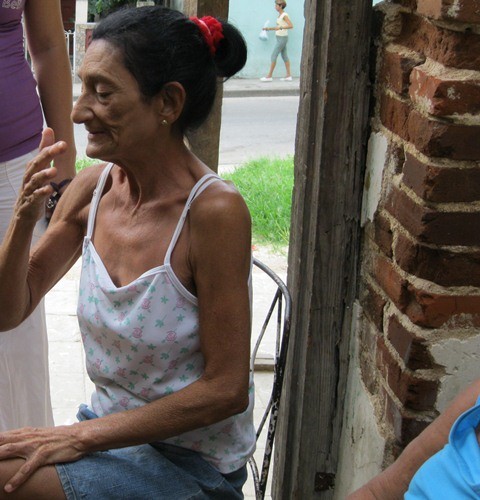
Leonila Mirtha Cruz is 61 and was three when she moved into the house. “My grandmother was the rent collector for the rooms.” Her eyes light up when she says, “Indeed, I know the history of this house.”

When it rains she leaves the one room to which her ownership has been reduce, and takes cover with a nylong bag under the eaves of the house across the street, until the rain passes.

If there isn’t too much water, she puts the bed in the corner by the door into the room, where there is still a good piece of roof and falls asleep there listening to the sounds of the stones falling in the false ceiling. “The only place that doesn’t get wet is this little corner.”

Cruz explains the reason for the falling fragments of the roof:

“What I have up there is a grove of trees. A yagruma, a paradise tree, a capuli, and the roots grow at night.”

The roots hang down through the roof and the walls of the abode. Even more than its extravagance for the perception, the growing vegetation of the house, which retains the majesty of the ninetheenth century, contains the exact path to its end.

Uninhabitable patrimony

With the imminent danger of collapse, the house has a demolition order, but the authorities haven’t offered a way out other than eviction.

Cruz relates that, years ago, “they gave homes” to some families living in the rooms of the old mansion. But the bad luck of not having been on this list is to blame for her being alone. Her children left as rafters in 1994 and she hasn’t heard from them. “They left because they couldn’t take it any more,” she says.

According to her account, the house was to be declared a heritage site in 1979. On that occasion, they were told the property couldn’t be touched.

“I’m content with a tiny little room like this,” she says, bringing together the tips of her index finger and thumb. And she adds, “Sometimes I tell myself it’s better to live in a cardboard box, because it’s less dangerous. Living here, a stone could fall on you and kill you. When the dead person has no one to mourn them, it’s worse.”

To shake off the sadness that has overcome her for a moment, Cruz says impishly, “Sanguily, get me out of here please. Find me a better room.”

“A coffin is cheaper”

In another room of the house a family of three gneerations lives together. The children, 10 and 11 years old, were bornthere. When the roof collapsed, they built a small house of roof panels and shingles inside the room.

The two children attend school. The clothesline with clean clothes and a few pots and pans, give a homey touch that speaks of humanity, which resists misery.

The children’s grandfather tries to fix a chair, straightening some nails with a table knife. He breaks the silence, “We have asked for help to fix the house, but it seems a coffin is cheaper.”

He points to the street, “The bosses come by here, the Housing boss, the Sector (police) boss. They say they’re going to tear it down, but without telling people where they’re going to take them.” He concludes, sadly, “This is abandonment, and they treat us as if we were animals.”

Tulipán 14

According to historic data, Manuel Sanguily received Maceo in the No. 14 Tulipan house on the latter’s visit to Havana. Both had fought in the Ten Years War.

In the pause before the War of ’95, specifically in 1889, they organized gatherings at this house, where the patriots discussed the future of Cuba. Sanguliy was considered by Maceo to be the exemplary figure of democracy.

With urban growth, the street numbering changed on Tulipan. What was once No. 14 Tulipan, now might be No. 216. But they no longer speak of democracy there. Its inhabitants are content to have survived the last downpour.

Lilianne Ruíz

See related story of the “1889 Newspaper with a photo of the house” here.

From Cubanet, 23 October 2013

With Salt and Pepper / Fernando Damaso

The Cuban cartoonists, who publish their cartoons and works in the official media, seem to have signed an agreement, by which eighty percent of their satirical darts are directed against the empire and its lackeys, and the other twenty are partitioned between the treatment of general topics (peace, war, hunger, climate change, etc.), that does make anyone cringe, nor cause them personal problems or complicate their existence, plus some things and cases about irrelevant administrative leaders, bureaucrats, service employees, and so on.

"Liborio" - a character similar to "Uncle Sam"

“Liborio” – a character similar to “Uncle Sam”

Never has any politician at any level been touched with so much as the petal of a rose, although they have systematically demonstrated their ineptitude and incapacity to fill the jobs they occupy. They seem to be included in some clause of untouchables, together in a signed agreement. It is often said that political satire has been and is an important part of humor because it is a thermometer of politicians’ rights and wrongs.

In Cuba it was like this until the liquidation of freedom of the press by the new regime. The Liborio character created by Roberto de la Torriente, later the Bobo (Fool) character created by Eduardo Abela, and later, in the fifties, Loquito (Wacko) by Rene de la Nuez, showed, with salt and pepper, what was going on in our national life.

Bobo

Bobo

Other cartoonists did the same, having among the characters in their cartoons and work all the public figures, from the president of the day down to minor figures. Then, political humor was not persecuted nor punished. To review the thousands of caricatures published during the years of the Republic, is to take an interesting and instructive tour through this part of our history, which is impossible with the most recent, where reality has been kept hidden and distorted by spurious ideological interests.

Loquito

Loquito

To be able to do this, we have had to turn to publishers outside of Cuba, for the magnificent Cuban comedians living abroad.

Now that some pro-government journalists have dared to respectfully request a loosening of the current secrecy, it would also be advisable for some of these humorists to ask, also respectfully of course, to be allowed to reflect, from the humor side, the sad national reality and the many responsible for it.

26 October 2013

Two Currencies, Two Realities / Yoani Sanchez

The lady counts the coins before leaving home: she has fifty-five cents in convertible pesos. It is the equivalent of a full day’s pay and barely fills a corner of her pocket. She already knows what she is going to buy… the same as always. She has enough for two chicken bouillon cubes and a bar of bath soap. So eight hours work is just enough to flavor some rice and work up a few suds in the bathroom. She belongs to that Cuba that still calculates every price in national currency — the Cuban peso — a part of the country that doesn’t receive remittances, has no special privileges, no family abroad, no private businesses, nothing going on under the table.

Just before arriving at the store to buy her Maggi cubes, she stops to stare at those drinking beer at a snack bar. Every can of this refreshing drink is the equivalent of two days’ pay. However the place is full, packed with couples and groups of men who talk loudly, drink, try some of the food. It is the other Cuba, with hard currency, with relatives abroad, with their own businesses or some other illicit source of income. The abyss between the two is so great, the divide so major, they seem to be running in parallel, never touching. They have their own fears, different dreams.

When the beginning of a timeline to eradicate the dual currency was announced this week, the two countries that converge on this Island reacted differently. The Cuba that lives only on its miserable wages felt that finally they had started to put an end date to an injustice. They are those who cannot even have a photo taken on their birthday, pay for a collective taxi, nor imagine themselves traveling anywhere. For them, any process of unifying the currencies can only bring hope, because it couldn’t be any worse than it is now. The other country, in convertible pesos, received the news with great caution. How will the exchange rate change relative to the dollar or the euro? How much will the buying power of those who live better today be devalued? Their thoughts were pragmatic.

In a society where the social abyss is increasingly unfathomable and economic inequalities grow, no measure helps everybody, no relaxation will make life better for each person. Twenty years of monetary schizophrenia have also created two hemispheres, two worlds. It remains to be seen whether a simple change of banknotes can bring closer these two countries that comprise our reality, these two dimensions. If it can make it so that the lady who — almost always — eats rice flavored with a little soup cube, can one day sit down in a snack bar and order a beer.

The post Dos monedas, dos realidades appeared first on Generación Y – Yoani Sánchez by

26 October 2013

First Report of the Advisory Group / Cuban Civil Society Advisory Group

A brief summary of topics that describe the situation of Cuba in late 2013 could be summed up in two words: reform and repression.

The reforms have been directed mostly in the right direction, but in a superficial way and excessively slowly. In addition to trying to alleviate an economic situation caused by years of volunteerism and contempt for the most basic economic laws, the reforms try to formalize the assignment of minimum space to entrepreneurs who were already earning from the illegal activities, perhaps so that they don’t feel incentives to leave the country or join the opposition.

 The repression has been characterized by increased brief and arbitrary arrests and systematic maintenance of the acts of repudiation in which a portion of the population is driven by pressures and incentives to attack and insult to other citizens who peacefully express their disagreement with government policy. This undoubtedly constitutes incitement to commit acts that qualify as hate crimes. One of the objectives of repression is to isolate and terrorize malcontents who have not yet dared to cross the fuzzy line between loyalty and opposition.

A Reform to Delay “The Change” and Encourage Entrepreneurs

The list of the substantive reforms implemented by President Raul Castro since he formally took over the country in early 2008 is well-known:

Access to cell phone, permission to stay in hotels, buying and selling of cars and houses, expanding the list of jobs allowed to the self-employed, expanding the leasing of land under the concept of usufruct, the abolition of the exit permit and the concept of Final Exit, opening the Nauta network for connecting to the Internet, the so-called non-agricultural cooperatives, the ability to hire labor, the tacit acceptance of professionalism in sports, and other measures of greater or lesser importance. All of this could raise a wave of optimism to make people believe that the changes could ultimately anticipate The Change.

The limit that hampers this platform of changes is that it doesn’t touch the essentials. By not explicitly accepting private ownership of the means of production, nor merchant activity in the broadest sense, it impedes the emergence of small and medium businesses that would generate the appearance of a middle class country. It lacks a political commitment to make it clear that prosperity will not be criminalized. The decision not to allow the concentration of ownership, clearly raised in the Guidelines of the 6th Congress of the Cuban Communist Party, leaves a very narrow framework and becomes a straightjacket for the development of the nation to emerge from the exhausted paths of socialism.

The country’s economy remains a stronghold of State decisions, especially foreign trade, industry and banking. The debts between companies, inflated payrolls, lack of productivity, lack of diversity, the absence of initiative, are still hallmarks of what is known bureaucratically as the “State sector.”

Moreover, the dual currency, the lack of a living wage, excessive taxation, the unaffordable prices of staples, and widespread corruption create an atmosphere of mistrust and insecurity that drives away potential foreign investors.

As long as there is no sound legal basis that enshrines the right to property and provides guarantees to domestic entrepreneurs, the reforms will seen be with suspicion and mistrust, as mere instruments to gain time and to keep the ruling elite in power. However, these reforms have no significant effect on the life choices of the population. The fact that around 400,000 Cubans are engaged in self-employment and no longer depend on the State, opens sociological perspectives that were unthinkable just a decade ago.  continue reading

In this dynamic of reform and repression, self-employment is seen from the more radical sectors of officialdom as a necessary evil, far from the utopian aspiration of the “New Man”; a noxious weed that the 1968 Revolutionary Offensive of 1968 tried to eradicate and that now resurges as a new class to emphasize the inevitable inequalities. Paradoxically, from the most radical opposition sectors, the self-employed are often described as “complicit with the dictatorship,” people who neither protest nor collaborate with any opposition activities, in order to keep their businesses afloat. Indeed, with their lights and shadows, the self-employed are the most dynamic sign of this time. Their existence and growth belies all the political discourse of half a century.

In mid-2013 , as part of these reforms, the Cuban government announced the opening of 118 Internet access points throughout the country. Under the name of Nauta, the new service includes email and browsing at prices ranging between 1.50 Cuban Convertible Pesos (CUC) and 4.50 CUC per hour of connection time. The measure, insufficient but welcome , enabled more than 100,000 Cubans to become users of this service in just two months. However, such flexibility does not live up to expectations for the fiber optic cable between Cuba and Venezuela. The majority consulted on this issue said they had hoped to allowed Internet access, without ideological considerations and priced in Cuban pesos (CUP), from home.

Still, one can speak of an increase in new connectivity alternatives promoted by the development of technology rather than by government permissiveness. The emergence of wireless file sharing; the consecration of USB flash memory as a mechanism for transferring information; the so-called “combos” or “packages” of videos circulating in the self-employment market; and the illegal satellite dishes to pick up the television signals from nearby countries, among others, are some of the parallel paths used by the Cuban population to access news, documentaries, digital books and information taken from websites.

The official media have opened some spaces for criticism and debate in the last five years. Among these are the letters to the editor pages of the newspaper Granma. Analysis segments have also appeared on national television news programs, pointing to an intention to approach the reality but without mentioning either the lack of legitimacy of the rulers or the infeasibility of the system. Consequently, there remains a strict Party monopoly on the mass media. There have been no legal advanced with regards in allowing the existence of a press not associated with the Communist Party. However, in the last five years, there has been a great increase in the number of websites, newsletters, periodicals and blogs created without official permission and from the critical sector.

Repression as a Means of Control of Citizens Without Rights

The main unresolved issue of the so-called Raulista reforms is in the field of political and social rights. Freedom of expression and association are the most violated, but the effects on freedom of religion also persist and, despite modest advances, signs remain of discrimination with regards to race, gender and sexual preferences.

Members of the Ladies in White, members of the Patriotic Union of Cuba, the activists of the Citizen Demand For Another Cuba – demanding that the government ratify the United Nations covenants on rights – and numerous independent journalists and librarians, have all been victims of police harassment. There have been verbal aggression, threats, beatings and abuse of all kinds. According  to data documented by the Cuban Commission for Human Rights and National Reconciliation, since January of this year to the date of this report, arbitrary arrests are hovering around the 4,000, data to which must be added to the 12,800 cases reported since 2010, the year the release of political prisoners from the 2003 Black Spring began.

The spiritual life of the Cuban people, rich in nuances and traditions, was terribly damaged by decades of official imposition of atheism. Only after 1991 were there signs of some tolerance, but rigid control exercised from the Office of Attention to Religious Affairs of the Cuban Communist Party was still maintained. This entity, despite being legitimized as a partisan branch, exercises governmental functions over religious hierarchies or fraternal associations, regulates permits for repairing churches, the import of goods, the licensing of bank accounts and other administrative functions, whose main purpose is to put political conditions on the development of spiritual life.

The issue of racial discrimination in Cuba cannot be reduced to a simple comparison with the times before the Revolution. In conflict with partisan agreements and ministerial resolutions, the Cuban prison population remains predominantly black and the same can be said with regards to people with less income. Prisoners are also those who are less likely to have a presence in academic, scientific, diplomatic and political environments. In the media, in commercial advertising (rare, but it does exist) the presence of racial diversity does not match, or even come close, to the mixture that defines us.

With regard to discrimination based on gender or sexual preference, it should be noted that the role of masculinity remains predominant, with a discourse in which virility is expressed as a virtue. There is only one authorized women’s organization that functions in the classic way of being a mechanism to impose on women whatever is convenient for the State according to the circumstances, whether with regards to work or breastfeeding. Only in recent years, timidly and late, have they been promoting acceptance of diversity of sexual preferences, but it is recognized that these proposals come not from within the LGBT community, government institutions dictate what should be done and how far it should go.

The national educational system, taken over by ideology, turns the most innocent elementary school reading class into political indoctrination that parents cannot prevent. The motto that “the universities are for revolutionaries” is not a simple slogan of a student organization, but official policy. Even today there are cases of university students expelled with no recourse for political reasons and many more who are forced to wear a mask of simulation to finish their studies.

Citizen Responses to Reform and Repression

In all this time, neither alternative civil society nor political opposition groups have managed to articulate an effective response against the deficiencies of the reforms or the excesses of repression. The Party-Government that rules the destiny of the country, or at least tries to lead it, had a platform no longer based on ideology but rather a single chorus, repeated endlessly: Order, Discipline, Demand. In the midst of a panorama of deterioration and loss of ethical and moral principals, the delayed struggle to rescue these values is now an indissoluble part of the government slogans. This battle is the result of a hijacking of the discourse of the opposition, and the same can be said for the migratory reform and most of the measures taken by the government, applied, that is, in a superficial media-focused way, without the depth proposed by the opposition.

The challenge now for civil society and the peaceful opposition is not to deny the existence of these reforms, but to take advantage of them in creative ways. It is not about uncritically applauding them, but exposing their inadequacies and unmasking their traps, which are many. Only peaceful citizen resistance can confront the repression: the timely and accurate denunciation of every event in solidarity with those who can make sure your message is heard by others.

There is great diversity among the projects undertaken Cuban civil society and a slight but growing tendency to find common ground, although in principle there can be only minimal consensus. Among these the most important are the need for respect for all the issues listed in the Charter of Human Rights, the call for democracy, full respect for the plurality of opinions, and renunciation of violence.

This first report, which doesn’t pretend to cover everything, is a modest attempt to understand problems from a shared perspective, and is an invitation to debate and find solutions.

16 October 2013

Imposed Pause / Rosa Maria Rodriguez

Dear cyber-accomplices and visitors in general:

My writings reappear now that circumstances allow me to return to publishing. It has been more than fifteen days — I don’t know if it was a technical problem or one of censorship — that I haven’t been able to administer the blog. Now, thanks to a friend, we resolved the problem and I’m going to continue my democratic psychotherapy, draining my freedom of conscience through the blog.

My apologies for the outdated texts; it’s as I said once before, I want to express my opinion or position vis-a-vis certain topics.

My respects to everyone always,

Rosamaría

24 October 2013

Solidarity / Regina Coyula

The issue of solidarity among artists is complicated. Each guild has its own characteristics. A case that comes to mind is that of the painter Bejerano, who lost a lot of solidarity; I remember there was even mention of a maneuver by the CIA and the Miami mafia before Bejerano was declared guilty.

Angel Santiesteban

Angel Santiesteban

In the case of the writer Ángel Santiesteban, the immense majority of his colleagues within the guild in Cuba preferred to look the other way; only the Ladies of UNEAC — the Cuban Writers and Artists Union — joined forces to turn him into a negative symbol of the campaign against violence against women (no one dared to defend his innocence, but I say they could have at least asked for a fair trial).

Robertico Carcassés divided opinion within the musicians, angry voices in favor of his requests for few, although some hit a high note; the majority of those who scolded him did it not knowing how to find where along the space-time curve they should position themselves on the “updating of the socialist model.”

Robertico Carcasses

Robertico Carcasses

But far beyond the déjà vu of those twenty (?!) years known as “The Five Grey Years,” things with Robertico soon returned to normal; it’s that he raised questions like they fell from the tree, so to speak, which — save the one about the girl María, who nobody knew who she was, and the evil thoughts related to another thing — almost the whole world thought it good that he asked, even those who don’t have a permission letter to buy a car.

Miguel Ginarte

Miguel Ginarte

I was surprised by the reaction around Miguel Ginarte, accused of corruption, embezzlement or whatever crime “of-the-day” thought up by the Comptroller General of the Republic. The actors guild, through the social networks, has been set in motion; Ginarte is so beloved, that he’s considered a priori an object of dark manipulation, when those of us who live in Cuba know how thin the line between legality-illegality usually is, so much so that sometimes just an out-of-place comment is transposed; and an unwise comment from Ginarte (close friends with his neighbors as was common knowledge — and well-regarded in the area of his little farm), could cost him the hard times he’s now experiencing.

25 October 2013