Teaching with Humor / Yoani Sanchez

Espabilao, the latest offering from the Quimbumbia team

I had a long discussion with a friend about the genius or lack of same of a certain political personage. He insisted that the power to quote extensive passages of text and to remember dates and the names of historic figures, was evidence of his brilliance. But, I pointed out to him, I’ve never heard him make a joke, nor deliver a well constructed irony. He lacks humor, I concluded, and humor is evidence that a person has a superior intellect. I have always believed that bringing a smile to others is more difficult than generating fanaticism in a multitude. Not only in the case of public figures, but also in education. To teach in a fun way can foster better connections with students. We tend to remember better what we have learned while entertained, versus through weary predictability.

This is the case with the knowledge of computer security that comes to us through the new videogame game Espabilao. Quimbumbia, its group of Cuban developers, has made this incredibly instructive amusement available to the citizens of the Island. It is the story of Pix, a robot, who must protect the personal data that his naive owner, Ale, has left scattered around the Internet. The protagonist’s tasks focus on improving the strength of passwords, detecting, in time, websites that could capture private information, and eliminating navigational hazards. A story told with humor and cleverness, but also with years of knowledge accumulated by internauts, digital activists and cyberspace users. Learning through cunning and seemingly playful challenges, but deriving much needed and serious results.

After coming to know the Quimbumbia project and Espabilao, its latest offering, I now have another element to convince my skeptical friend. “You see,” I will tell him, “sharpness doesn’t have to be so boringly serious, nor does teaching have to make you want to yawn.” Probably he will carry on with his examples of pompous orators and statistics that overwhelm the statisticians. I, however, prefer the approach practiced by Pix… the laughter that accompanies it teaches us and leaves what we learn indelibly etched in our memory. Humor, I continue to believe, is the most complete display of human genius… which is why the mediocre and the authoritarian are so bad at it.

The post Enseñar con humor appeared first on Generación Y – Yoani Sánchez.

26 November 2013

My Dear Lovers, Parents and Grandparents / Orlando Luis Pardo Lazo

Like every self-respecting homeland, ours is a cruel cemetery.  One by one we go diminishing the men and women who marked history, those who really shone in Cuba’s history with an intensely personal light, a history of the heart that hurts and hardly forgets: the intimate history of the soul of what a nation has lived, a whispering and secret dream.  Not that other shouted demagogue, half combative and half mini-populist, that’s even accented with “Revolution” for a mafia-like elite, an amazing alloy of barbaric foundational peasants and last-minute upstart bourgeoisists.

Like every self-respecting totalitarianism, we had strict schedules, which would still be retained throughout the country if not for the fact that socialism had the late decency to kill itself, never to sprout again.  At least not in Cuba.  And one of those schedules involved the dawns of the saddest Sundays in the world, Sundays lost forever on an Island that now only exists in our imagination which fades them out one at a time.  You know, I’m talking about the Silent Comedy, by Armando Calderón.

Never said better, because the Silent Comedy didn’t even remotely match the longevity of Charlot of the 1910s with the First National, the Keystone Comedy Film or the Mutual Film Corporation.  Nor the classics of Buster Keaton, nor much less El Gordo y el Flaco, among other silent geniuses still anonymous in my infantile ignorance which never grew up.  The Silent Comedy we attended, marveling, in that disappeared Cuba, on our soviet TVs with horrendous quality, was a work and a grace of its unique author, a man in suit and tie named Armando Calderón, sometimes with a primitive digital watch puncturing his side.

The “man of 1000 voices” really had many more than a thousand.  His vocal range, of a scarce phonic shade, was incredibly endless.  With his unique bipolar register of damsel in distress or a freed thug, this old man never narrated with the same voice twice in one episode, which he edited almost randomly, manipulating the tapes that were rotting in the archives of a system that had the money to make a soldier babble in heaven, but not to take care of the treasure that is universal patrimony.

To top talent when compared to today, where no Cuban speaker is able to speak a phrase without reading it in an overacting way (the worst example of which would be the simian Serrano hired by NTV), Armando Calderón recorded his madness live, the jeering at merengues and old cars among the neighbors of the Calle de la Paz, the languid art-nouveau girlfriends, the rascals and policemen, all an anachronistic chronicle of that utopia called the United States of America, nothing less than a little despotic country where single-party communism sanctions you forever if “you maintain correspondence with family abroad” and you don’t confess it in every professional or academic interrogation.

Every Sunday, like in the song by Carlos Varela, the sun rose in another city.  A poverty-stricken city like once-ruralized Havana, but where even the sense of film adventure allowed us to breathe.  Our gods, like in another song by the same folk singer, were Charles, Cara de Globo, Soplete, Barrilito and Barrilón, the fat Matasiete, Pellejito, the Conde de la Luz Brillante and the inevitable charleston.

Armando Calderón wasted himself away before our eyes and we didn’t realize it. He howled, rattled tin plates and bottles, blew his harmonica and sometimes only the air of a siren, rattled fences that had collected in some project, shot gang-gang shots, feigned breaths of orgasms before anyone in his pipsqueak audience had had one, clicked his practiced tongue at all kinds of trades of republican capitalism, while his everlasting suit wore itself out and his tie hung like a bad hangman’s noose.

Our Renaissance gentleman who made himself a ringbolt on camera, lacked the British funding for the future series The Storyteller, but nevertheless, in terms of creative motivation, he had nothing to crave.  Still, the most mediocre and repressive of the Cuban cultural institutions, one which, from the beginning, put its antennas in the hands of the Chief Hegemon of our History, gave itself the luxury of sanctioning him more than once, perhaps so he would finally mummify himself and depart to grieve in silence, which this dumb magician was responsible for.

His era had technically ended: color transmission in Cuba was beginning, after a humiliating delay for the #2 nationwide television program in America.  Being dumb teenagers, we could no longer tolerate another second of even the best film photography.

Whether it was the alcoholifan at the bar or cancer in his vocal cords after decades of force, we simply did not realize his metamorphosis.  The owner of our local divine Comedy watered himself down to one of his dead characters throughout almost a century, but life then was eternal for my generation, and the destiny of the early Sunday morning wasn’t important to us, not a shred to his beloved lovers.

Listen to the silence of the bugle.

18 November 2013

Prison Diary LXIX: Camilo, Henchman of a Regime That is a Member of the United Nations Human Rights Council / Angel Santiesteban

Camilo, the dictator’s henchman

November 8 marked a year since our peaceful demonstration in front of the Acosta Police Station (Unit 1), demanding the release of Antonio Rodiles, Yaremis Flores and Laritza Diversent.

After the corresponding beating and arrest, while they led us to our respective cells, distributing us around the city (divide and conquer?), the henchman Camilo, a State Security official, assured me that I would be sentenced to five years in prison.

Eugenio Leal, who was with me in the patrol car, heard him from inside the car, and everything that happened a month earlier at the Provincial Court determined this same sentence, of course, everything would have been understandable if we restrict ourselves to saying that the trial was in Courtroom 1 at State Security at their special site at Carmen and Juan Delgado.

I assured the official Camilo that from my part I wasn’t scared, but when the moment came to pay for his abuses and atrocities, I hopes he would behave with dignity, as I did. Then he smiled with characteristic cynicism. “When I’m touched, you will already have been touched,” he said, brimming with sarcasm.

While the wait for my imprisonment wore on, I had the opportunity to leave the country and avoid the agony, but my need is to continue, and I preferred to be imprisoned here rather than free in Miami.

Shortly I will have served nine months in prison, I corroborate my decision, and I will continue to try to be helpful in prisons where I have been locked up. Never before had I felt that I could help safeguard the integrity of persons, in this case the prisoners who are in the barracks with me, I have maintained the level of denouncing the injustices the guards have been committing.

What the official Camilo did not know is that with his response he accepted that the dictatorship will pay for its excesses, except that, like the human beasts that they are, they are unable to act with decency, that’s impossible for them given the job they have to perform. Meanwhile, they are going to live as best they can, they receive gifts and awards from the regime to maintain the level of immorality, which also they enjoy committing, but we all know that justice will come, then we will look at those criminal eyes covered in tears, justifying the orders that they fulfilled, and next to them they will see those who pushed them to commit their fascist acts.

For now they continue to laugh but, ultimately and unfailingly, justice will be done.

Ángel Santiesteban-Prats

Lawton prison settlement. November 2013

Translated by: Shane J. Cassidy
25 November 2013

Angel Santiesteban’s Right To A Pass Violated By Regime Which Is A Member Of The Human Rights Council / Angel Santiesteban

As expected, Raul Castro, the second emperor dictator of the tropical Communist Nazi dynasty, recently recognized by the UN Human Rights Council with a seat in the “distinguished” set of toilets that make up the guardians and safeguards of each other, has debuted such a “deserved” honor by violating the rights of prisoners of Lawton prison settlement where Angel Santiesteban-Prats is unjustly caged.

Yesterday, Friday November 22nd, all prisoners were awaiting their coveted pass which they receive every 27 days, and Angel every 60 days, as he is subject to a different regime for not going to work like the rest of his teammates. On the day and time appointed, simply and without giving any explanation, they were informed that there was no pass.

It is not the first time since Angel has been in this settlement that they have violated the rules concerning the treatment of passes. Having nullified this one, the next will be in 2014, and they will have been 120 days without a pass, again violating their rights.

Violating the individual rights of ordinary citizens has been rife in the Cuba of the “Revolution” for 54 years, and rape in prisons and the concentration camps is not only common, but also is an everyday enjoyment for thousands of servants and lackeys who work sadistically fulfilling orders from above.

Sonia Garro, Ramón Muñoz, El Crítico (The Critic), Armando Sosa Fortuny, Marcelino Abreu Bonora, Roilan Alvarez Rensoler are just some of the human beings who, along with Angel, make up the painful and shameful list of over a hundred political prisoners who are locked in Castro’s concentration camps, many of them in serious danger of death on hunger strike, and all unjustly imprisoned, with unfair trials or no trials, all with false charges, tortured, abused, humiliated, simply for the “crime”  of expressing themselves and desiring a free and democratic Cuba.

The UN Human Rights Council miserably endorsed the existence of the dynastic dictatorship that has, for more than half a century, been oppressing the Cuban people, and in giving it a “toilet” honor among the “illustrious” it endorsed the systematic violation of human rights on the Island, setting a dangerous precedent for the community of nations.

Angel did not leave on a pass yesterday in Havana. I wonder if today they will already be preparing for Dec. 10 in Geneva, a tribute to the Five Spies* and if they will denounce the “serious” abuse of the American government which they will repeat at the weekly rant?

Dictator Castro, even having his delegate in the UN Human Rights Council and to show his “power” in such sad maneuvers such as “Bastion”, if it is necessary to cage a writer for what he writes, and to strip a few brave women who carry gladioli as a weapon, there should be no doubt that his place in history has already been secured: a coward and a despicable loser and murderer.

The Editor

*Translator’s note: A reference to the five State Security agents — lauded as “The Five Heroes” in Cuba — imprisoned in the United States (one of whom, having served his sentence, is now back in Cuba) for spying and related crimes.

Translated by: Shane J. Cassidy
23 November 2013

The “Forbidden” and the “Mandatory” / Miriam Celaya

Rafters - Picture from the Internet

Rafters – Picture from the Internet

In numerous conversations with Cubans, émigrés as well as those “on the inside” (I share the experience of living every day under this Island’s sui generis [unique] conditions with the latter) surfaces a phrase, coined through several decades, whose credibility rests more on repetition by its own use and abuse in popular speech than on reality itself. “In Cuba, whatever is not forbidden is mandatory”.

I must admit that the former is true enough. If anything abounds in Cuba it’s prohibitions in all its forms: those that truly are contained in laws, decrees, regulations and other provisions of different levels, all aimed at inhibiting individuals and controlling every social or personal activity, what the coercive nature of the system imposes on us, even if not legally sanctioned, (for example, male students can not wear long hair, music of any kind may not be broadcast through radio or TV, people may not gather in certain places, etc.) and those we invent, that is, the self-imposed prohibitions of people who since birth have been subjected to fear, indoctrination, permanent surveillance and to the questionable morality of everyday survival that forces one to live thanks to the illegalities, that is, violating injunctions established by the government beyond common sense. It is natural that transgressions abound most wherever greater number of taboos exist.

Now, the “mandatory” is another matter. It is rather about a total legend that, be it through ignorance or for another number of reasons (irrational at that) it’s a legend that serves many Cubans to unconsciously justify their behavior and to embed themselves in the civic mess that is choking us. The list of “obligations” would be endless, but some of the handiest can be summarized as follows: belonging to organizations that are pure pipe dream, such as the Committees for the Defense of the Revolution, the Federation of Cuban Women, Territorial Militia Troops, Cuban Workers Central, Pioneers Organization, High School Student Federation, University Student Federation, etc., all of them with payment of dues and attending different rituals according to the agendas, also supposedly of a “mandatory” nature.

But many Cubans seem to consider it mandatory to vote for the Delegate, attend meetings and accountability meetings, to shout slogans, sing the National Anthem, salute the flag, honor the martyrs of the revolutionary calendar, to sign political commitments, other documents and a very long list.

Actually, there is the assumption that failure to comply with these “obligations” would result in some reprisals, such as the loss of one’s job, our children not being accepted in some study centers, not being eligible for certain child-care or semi-boarding services for children of working mothers, etc.. However, many of us have found from experience that none of the above mentioned is in truth mandatory, but it constitutes the general answer to the fundamental prohibition that weighs over this nation: it is forbidden to be free.

Oh, Cubans! If ever the courage that drives so many to brave the dangers of the sea in an almost suicidal escape, to create a new life away from here, to survive in such precarious conditions inside, and to succeed against all obstacles outside of Cuba, could be turned into overcoming the fear of the regime, how different everything would be! If so much energy could be directed towards changing our own reality, we would make the world of prohibitions disappear in no time, that world that has kept us in chains for half a century, and we would stop feeling compelled to be slaves forever.  It is not mandatory, but it is also not prohibited.

Translated by Norma Whiting

25 November 2013

A Repentant Former Gunman / Michel Iroy Rodriguez

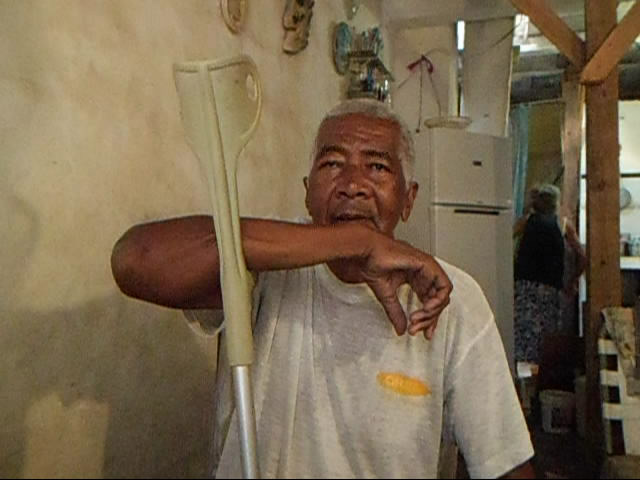
Havana, Cuba, November 2013, www.cubanet.org.  — Juan Lazaro Avila Herrera, physically impaired (his right leg is lame) regrets having belonged in his youth to a firing squad at the La Cabaña Fort.

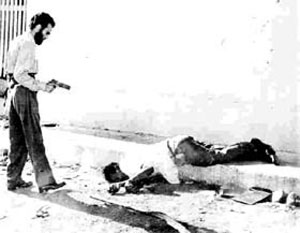
When he served in the Association of Rebel Youths, at only 18 years of age, he was attracted to belonging to the firing squads.  He remembers that along with him, a group of 23 youths, aged between 16 and 20, were captivated.

According to him, sometimes the executioners seized rings and other items from the people shot.

Once he was accused of counterrevolution and taken to the Principe prison.  He says that during the trial he was so scared that he defecated in his pants.  He thought he would be shot, but he was absolved. In spite of that, after he left jail, for a week he had to go sign in every day at a police unit.

“I was infiltrated into a counterrevolutionary band and participated in several operations.  In one of them I arrested a priest, from whom we confiscated in the basement of the church explosives and weapons plus a map where the places were marked that would be blown up,” he recounts.

He says he is remorseful for having been at the point of killing a man named Jose Diaz when he arrested him in his home, where they took him with 14 AKs and several Makarov pistols.  “I put the pistol to his forehead and squeezed the trigger. If I did not kill him it was because the weapon jammed,” he said.

He served as investigator for the Ministry of the Interior (MININT) in the Guanabacoa police unit, dealing with cases of car theft and rape in the area of the beaches to the east of the capital.  He remembers that one time, when he was investigating a case of the rape of a young girl of 12 years of age, he was outraged and beat the arrestee he was interrogating with the butt of his pistol.

Avila also belonged to the Merchant Marine. He says he has transported weapons and sugar to several countries, among them Angola, Nicaragua and Honduras.  He says that in this latter country, 10 thousand tons of sugar were sent once, which were not for the Honduran people but were transported to a North American boat which was found lying alongside his boat.

“It was a mistake to have dedicated almost all my life to the Revolution. I ask myself all the time what did I fight for,” he told this reporter.

Avila Herrera retired with a pension of 279 Cuban pesos (slightly more than $10 US).  He lives in a dwelling that is a hallway with kitchen and bath. He decided to tell his story to the independent press because he is very disappointed in the government he served and for which he was willing die and kill.

Michel Iroy Rodriguez, yeikosuri11@gmail.com

Cubanet, November 21, 2013

Translated by mlk

Mummies Against Prostitutes: The Last Revolutionary Combat / Jose Hugo Fernandez

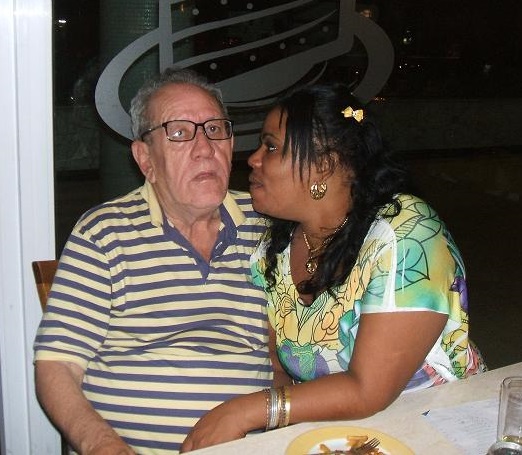
Havana, Cuba.  November, www.cubanet/org — The prostitutes of Havana never inspire as much pity as when we see them accompanied by those mummies of European and US Stalinism who today constitute their VIP clientele.  Really you have to have a heart of stone not only to go to bed with such a stinky and gassy old fogy but even to barely endure his proximity.

As soon as they disembark on the Island, without shaking off the dust of the road, these old gentlemen feed their spirit going to the Plaza de la Revolution and the Che sanctuary in Santa Clara.  Then, invariably, it is time for dessert.  So they get naked in Obispo Street in Havana, around Central Park or on La Rampa, in pursuit of our little hookers, the last flashes of the beacon of America.

“What a waste, buddy,” exclaim the gentlemen from around here on seeing them bargaining, while the women whisper, teasingly, and the oldest ones are scandalized at “the turns life has taken here.”  But they continue on their way, business as usual, confident, it seems, that they have left respectability in safekeeping, beyond the sea, along with their ancient wives.

If it were possible to take into account decency or common sense when dealing with this wildlife, you would have to ask why, at least, they do not attempt to take the prostitutes to some place apart, where they would be waiting for them without the need to expose themselves so boldly to absurdity and ridicule.  But that’s not how they are.  It is obvious that they have resolved to enjoy as God commands their last revolutionary orgy, now that only the devil knows the sacrifice that it cost to organize it, gathering for years the remnants of their salaries as retirees.

What a pity that there are no statistics that reflect how many casualties the worldwide revolution has suffered as a consequence of the heart attacks provoked by these encounters between the mummy veterans and our mud blossoms of the Fidelist legacy. In any case, they would say they’d died for socialism, if they managed to say anything, before shutting their trap, in the end, forever.

“Old age is an incurable disease,” Terentius warned us.  But it may be that he was not right, at least in this situation.  I believe that my grandmother was more accurate, and did not agree that people lose shame as they age because now nothing matters to them.  He who has no shame in old age — she used to say — never had any.

José Hugo Fernández

Cubanet, 21 November 2013

Translated by mlk.

A Gift from Pinar del Rio on Padre Felix Varela’s 225th Birthday / Intramuros, Yoandy Izquierdo Toledo

I remember every November 20th for a special reason (besides being the birthday of a dear aunt, and of a friend): on this day the Cuban nation gave birth to one of the preeminent pillars of our founding history, Father Felix Varela.
“The complete patriot,” as Martí called him, knew how to merge science and conscience in order to carry out the difficult art of showing the way toward freedom and social justice.

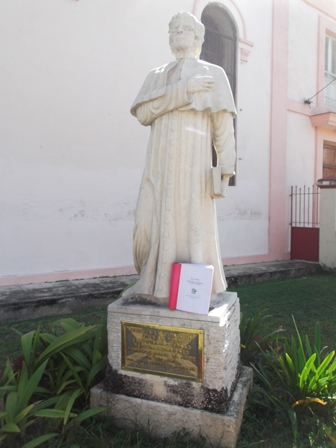
Pinar del Rio has the only full-body statue of Varela on the island, located on the grounds of the Cathedral. The work, done in marble from San Juan y Martinez by the sculptor José M. Pérez Veliz, shows us Varela in a walking position, looking into the distance, like someone watching over the fate of the city and the nation. In his left hand he holds his greatest work, Letters to Elpidio. About Impiety, Superstition and Fanaticism. He seems to be telling us from its pages: “Dear ones, never be arrogant with the weak or weak with the powerful.”

Twenty years after the founding of the now-defunct Center for Civic and Religious Training (CFCR) in Pinar del Rio, and seven years after the unveiling of this sculpture, we members of the Coexistence team, the successor to the work of the Center and its magazine Stained Glass, made a pilgrimage to the foot of this wonderful work in order to offer of our project of ethical and civic education – an edited volume of Coexistence Issues, containing courses taught by CFCR from 1993 to 2007.

Inspired by the Varelian maxim that “There can be no homeland without virtue,” we offer this book as a continuation and application of the legacy of the first one who taught us to think. It is a gift from Pinar del Rio to the Father of our culture.

Yoandy Izquierdo Toledo (Pinar del Río, 1987).

Diplomate in Microbioology, Manager of Coexistence Issues, Resides and works in Havana.

21 November 2013

Of Dubious Origin / Reinaldo Escobar

Wandering along San Lázaro Street, I encountered a man with a wheelbarrow. It was just when I needed a friend to move two bags of sand to the home of a relative. His human-powered vehicle was a hybrid of scooter and a wheelbarrow, constructed with huge roller bearings, but instead of four he only had two on the front; the bottom was a structure made from rebar covered with a kind of mesh used in chicken coops.

After agreeing on a price, we walked the seven blocks separating us from the site where they sold building materials. On the way, I noticed that his wagon wasn’t empty, but contained two objects difficult to define.

“And what have you got there?”

“Aluminum, to sell as raw material.”

“But what are those aluminum things?”

“Now they’re junk but they were gas meters.”

“Oh! I get it! Surely this is part of the plan to replace the old meters with newer more efficient ones… and how did you come by these old meters?”

“These aren’t old, they’re new. Can’t you see they’re aluminum. What happens is I smash them with a sledgehammer to make them unusable, and then they accept them from me as raw material.”

For a moment I ran out of questions, in fact even out of words. Finally we put the two bags of sand on the vehicle and retraced the seven blocks to the home of my friend’s relative. Before leaving I asked him,

“And what happens if the police catch you with the smashed meters?”

“I don’t know. They’ve never caught me. Surely they would tell me something about I’m transporting objects of dubious origin. But what’s that got to do with it? Your sand is of dubious origin and I myself have no official address here in Havana so I am also of dubious origin. Come on, man, are you going to tell me there is something in this country that isn’t of dubious origin?”

25 November 2013

Are Private Small Business Owners the Scapegoats? / Gladys Linares

LA HABANA, Cuba, November, www.cubanet.org – To us, the most interesting part of the National Television News is the weather report. “There is no use in watching the news,” says Julio, an octogenarian neighbor, “just to hear that the whole world is screwed up and in Cuba everything is going very well”.

After a speech on July 7th, 2013 by General Raul Castro Ruz, first secretary of the Central Committee of the Cuban Communist Party and president of the Councils of the State and Ministers, a speech in which he criticized the Cuban people’s loss of values and the chaotic situation of the country, the news started transmitting on Tuesdays a series of reports titled “Cuba Says”.

The one aired this week has given rise to a series of commentaries among the people, for example, that the large amount of inspectors imposing high penalty fees and suspending licences is part of an arranged operation, without doubt created against the private small business owners, because in the State’s good service centers everything seemed to be too organized: employees wearing uniforms, talking about hygiene norms… for many it was obviously staged.

A neighbor was commenting: “Before giving the private owners the licenses to process and sell food products, they were inspected by Public Health, because that is what happened to my son before he could open the restaurant. How is it possible that right after they get closed because they don’t meet the requirements?”

“They are clipping their wings, it’s not like they are becoming rich with their businesses”, another man says, “They are not fooling anybody: they gave out all those licenses to mask the massive layoffs in 2010, but as always, that’s a way to keep them in check and controlled”.

The lack of hygiene in the state centers where they process and sell food products is nothing new, unfortunately. Just to give an example, the bread that people eat daily, is left on a counter for hours, full of flies. The same employee handles the bread, money, and writes down on the food booklet with his bare hands. When the bread is covered we all know it is because an inspection is due. They deliver the bread to the so-called Paneras — where the bread is sold but not baked — transporting the bread in carts pulled by horses, a cart or a bicycle cart, and it is stored in open boxes, made out of plastic, wood or woven baskets.

People prefer the service of privately-owned cafeterias because of the quality of the products, the speed and quality of customer service that most of them offer, while in state-owned cafeterias the menus are very limited, and many times flies are part of the menu. Even the more expensive establishments, like some of the pastry chain Sylvain, have missing glass on the counters and flies have free access to the pastry.

The cockroaches find a home in hospitals, urgent care facilities, and doctor offices, but also in food processing establishments: lunchroom, bakeries, and restaurants of selling in the national currency, the Cuban peso, or in CUCs, the Cuban Convertible Peso. This is the case of Plaza Carlos III or the cafeteria in La Rampa Movie Theater.

In the “bodegas”, where food rations distributed by the State are sold, rats are also found camping, that is why some employees have a cats in these establishments, hidden from the view of the customers. A neighbor was telling me how she didn’t dare to buy the rice last month, because she saw how the seller killed a mouse inside a rice bag and he didn’t even bother to throw it away.

The lack of concern on the part of the Government about the lack of hygiene is detrimental to the health of the population. The water pollution, the bugs in the trash that is not picked up for days, and other ills, are some of the consequences. People need their problems to be addressed with a real solution, instead of drawing attention away from them and using the small business owners as scapegoats.

Gladys Linares

Cubanet, 21 November 2013

The Future, Questions and Predictions to Break / Yoani Sanchez

Tag cloud about Cuba’s future

Ten prognostications, ten failures, ten predictions that did not even make it to a dead letter. This is what a Decalogue of possible future prognostications — personal and national — that would have been made in 2003 has been reduced to. Such that, knowing the twisted paths events take, today I am trying to imagine the surprises in store for us in the next decade. I know — at least I know this — it will be difficult, very difficult times are coming for everyone. To forget, as we go to bed one night, the huge problems we do indeed have, and pretend we will wake up to another day, isn’t going to happen. It’s very naive to believe we can shake off this totalitarianism and all that will result from it. It’s not going to happen, new problems and new challenges will begin. Are we prepared for them?

Are we prepared for a society where the responsibility lies with us and not with the State? A country where we can choose a president, but where he could perhaps turn out to be corrupt, a liar, an authoritarian? Are we capable of realizing, in that case, that we voted to name a “father,” rather than a public servant who answers to us? How long will it take for us to lose our suspicions about everything that contains the world “social” or about the unions, who today are simply transmission poles for the powers-that-be to the workers? Are we ready for tolerance? Can we live together peacefully with those of other political viewpoints and ideologies who take the microphones and propose their programs? Will our inexperience, perhaps,l launch us into the arms of the next populist? Are we aware that we will experience a Cuba where, most likely, there will be a lot of nostalgia for the Castro regime? What will we do if, instead of real change, those who are now part of the Nomenklatura exchange their olive-green uniforms for the suits and ties of entrepreneurship?

How will we react to immigration? Right now we only know the phenomenon of those who leave and also those visitors who — briefly — come as tourists to our land. However, we must know that if we manage to build a prosperous country, others will come to stay. How will we receive them? What will be the effects of so many years of shortages and rationing on personal consumption? Will families put themselves deeply in debt buying everything they see on TV? How will we resolve the dilemma of State property versus privatization? Will it be possible to maintain the extensive educational and hospital infrastructure throughout the country, while improving its quality, breaking the bonds of ideology, and paying employees dignified salaries? What will happen to the enormous governmental and official apparatus, whose costs fall on our shoulders to an extent we can barely conceive of?

As you can see, rather than certainties, I only have questions. Questions that haunt me when I speak of the future of my nation. At least some things are clear to me: I will be in Cuba, I will do everything I can to help my country and will try — through journalism — to dispel many of these doubts or to amplify them until someone responds.

The post El futuro, preguntas y vaticinios por romper appeared first on Generación Y – Yoani Sánchez.

Teacher Dismissed from Job for Reporting Fraud / Roberto Jesus Quinones Haces

GUANTÁNAMO, Cuba, November, www.cubanet.org – Alain Lobaina Laseria is a mathematics graduate and worked in the Pedro Agustín Pérez Basic Secondary School in the municipality of El Salvador in Guantánamo. However, he has been dismissed from his employment for reporting failures and irregularities related to the education system.

When one teacher at the school went to complete a work mission to Haiti and another transferred to a polytechnic, Alain, who until that point had worked as a tutor, had to teach mathematics and physics to eighth grade students.  Upon receiving the groups he carried out an examination to check the students’ knowledge and the results were disastrous.  In one of the groups no one passed and in the other, from 72 students, only 7 passed.

As the course advanced Alain noticed that the students level of knowledge was extremely low. After carrying out the second test in mathematics, he failed 8 students because they had handed in their exam papers almost completely blank. After reporting the results, the teacher in charge of the grade carried out an analysis and threatened him, saying that he could not fail those students. From that moment onwards his situation in the school became very difficult.

Then he decided to write, under the protection of Article 63 of the Constitution of the Republic, a letter to the government and the municipal Party in which he reported the fraud that had been committed in the school and how he had been pressured to pass 100 percent of the students.

Furthermore, as a response to the public call to the highest levels of government and the Party to combat corruption and all kinds of violations, Alain reported other cases of fraud committed in Polytechnic No. 2, in the San Justo neighbourhood, in the Vocational Computing Polytechnic, in the Pre-University Vocational Institute of Exact Sciences and in the educational centres of the city of Guantanamo.

Shortly after Alain sent his letter, the Provincial Director of Education turned up at the school and read it in front of all the workers.  The purpose of discrediting him in front of his colleagues and making an enemy of him was made clear through the following warnings: “All of this school’s workers can be involved in this….this letter cannot be published in the Venceremos de Guatanamo Newspaper…and we will not tolerate a Gorbachov here in El Salvador”

In the final test, Alain failed various students, being the only teacher who didn’t promote 100 percent of students. In the re-evaluation test he caught a student copying the exam responses from a cheat sheet and reported the incident to the school administration. However, all he achieved was to have the school principal, Angel Velazquez, the secretary of the Party named Leticia, the municipal education teacher leader and the secretaries of the UJC (Young Communist Union) and the trade union reprimand him as if he were the guilty one.

Although Alain was opposed to the fraudulent student sitting another re-evaluation test, the aforementioned people agreed to allow it and they never investigated to find out how, suspiciously, the boy obtained the correct responses to the exam.

Upon starting this school semester, the principal of the school cancelled Alain’s work contract.  All this has occurred after the Granma Newspaper has repeatedly denounced academic fraud and the radio program “Speaking Clearly” of Rebel Radio and the television program “The Roundtable” have adopted similar positions.

Roberto Jesús Quiñones Haces

Cubanet, 19 November 2013

Translated by Peter W Davies