The Rice Boobytrap / Rosa Maria Rodriguez

Image Courtesy of Wikipedia.org

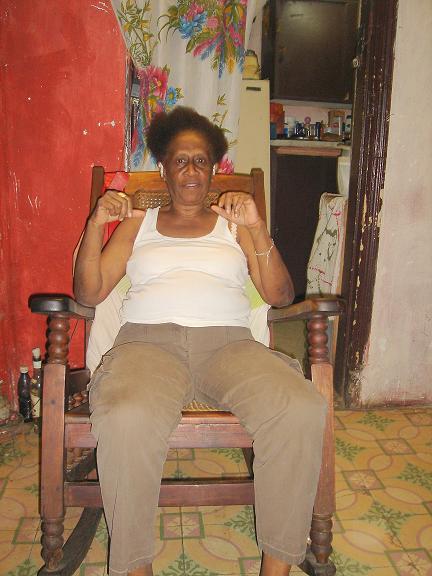
Count on earthworm remains, bits of assorted garbage, tiny jaw-breaking pebbles, and the odd piece of moon rock mixed inside the minute ration of the people’s rice being offered by the State; this is the quota for December which was released for sale November 30 in the bodegas (ration stores) in Vibora and everywhere else.  Go figure why the government chose December — a time when many families celebrate various Christmas or New Years gatherings and meals — to get rid of a large portion of dirty and off-color rice more fit for bird than human consumption.  All that the store manager at my “designated” bodega could say was that the grain crop available was from Pinar del Río (West of Havana) and was the only rice supply being distributed to consumers in the Tenth of October (Diez de Octubre) municipality of Havana.

I went to another local bodega and got the same song and dance.  My gripe upset a neighbor to the degree that I got scolded for taking a stance.  I was soon reminded how some brownie point seeking official would be chomping at the bit for the opportunity to nag us for hours on end — and pep-rally style — about the great job the State does for the people by providing free rice.  Beyond that, we would also get some impromptu group shouting slogans thanking the Department of the Interior for poultry, pig or any other State farm for giving us such piss poor quality products.  Fine.  But nearly inedible State products are unnerving: Cuban family members trying to put decent food staples on the table are forced to endure unbelievably time-consuming and exhausting hardships just to make a meal edible.

Most exasperating of all: Why can’t rice ever be “deregulated” so restrictions can be lifted and we can buy whatever we would like or can afford to pay?  Instead, like helpless slaughterhouse pigs, we always get the same condescending mantra: “Eat the stuff or eat the stuff.”  For consumers, the outrage ultimately becomes subsumed in listless apathy — or oddly enough — a pact of collective silence when the State decides to run roughshod over our rights.  Almost imperceptibly, people do murmur. Many are alarmed the local rice crop might suffer the same fate as our potato production when a substantial Cuban government subsidy to Bolivia all but eliminated potatoes from our sight for most of 2013.

An elderly neighbor tried to console me by saying, “Listen: If you cook it, it’ll taste O.K.”  But honestly, after wasting three whole hours sifting and washing rice to clean the grain, I could care less about the flavor, the quality, or whatever the rice’s appellation of origin might be.

Translated by: JCD

3 December 2013

Elderly Protest Lack of Medical Specialists in Santa Clara / Yesmy Elena Mena

SANTA CLARA, Cuba, 13 December 2013 Yesmy Elena Mena / www.cubanet.org.- Yesterday morning, at the 20th Anniversary Polyclinic, a group of elderly patients protested before the clinic management because of the cancellation of clinic hours, according to Adelaida Salazar Reyes.

Salazar Reyes, 68, lives on San Miguel Street in this city. She reported that for the second time the cardiology clinic at the 20th Anniversary Polyclinic was cancelled because of lack of specialists.

The nurse who worked alongside Doctor Carlos Torres, whose clinic it is, told the patients that he will not be working this coming year, according to Mrs. Reyes.

Edilio Llanes Fonseca, affected by the situation, told this newspaper that the center’s management responded, “There are no doctors.”

This reported called the Office of Municipal Health and was able to talk to Dr. Ana Maria, who works as a secretary to the director, Juan Jose Pulido, who was in a meeting, but the secretary said she don’t know anything about the matter.

The Cuban government, in its State policies, states that Cuba is a medical power and guarantees medical care in every corner of the island.

The 20th Anniversary Polyclinic is located on San Cristobal Street at Jesus Menendez, in the Raul Sancho neighborhood, Santa Clara, Villa Clara.

Cubanet, 13 December 2013

Girl Forced to Paint a Boat With the Five Cuban Spies / Rosa Maria Naranjo

HOLGUIN , Cuba , December 16, 2013 , Rosa Maria Naranjo Nieves / Cuban Community Spokespeople Network / www.cuabanet.org.-  On Tuesday 10 December, Human Rights Day, at Pedro Rogena Camay elementary school, in Holguín, Tahimí Miranda Rodríguez, age 7, was forced by her teacher to paint a boat with the name of the five Cuban spies prosecuted in the United States, and to include a heart that said “They will return.”

The teacher threatened the child that if she did not paint the boat and take it to her mother as a gift from the school, she would earn bad marks in her drawing class.

The child had been transferred from Paquito Gonzalez Cueto school, located in between Cable and Aricochea Miró, also in the provincial capital, because the teacher Yolennis Amaguer had attacked her with her fingernails.

Tahimí is the daughter and granddaughter of Ladies in White. Her grandmother is Maidolis Leyva Portelles and her mom is Adairis Miranda Leyva, both residents of No 307 Libertad Street, between Colosseum and Peralejo.

16 December 2013, from Cubanet

Obama – Raul Handshake Overlooked On The Island / Ivan Garcia

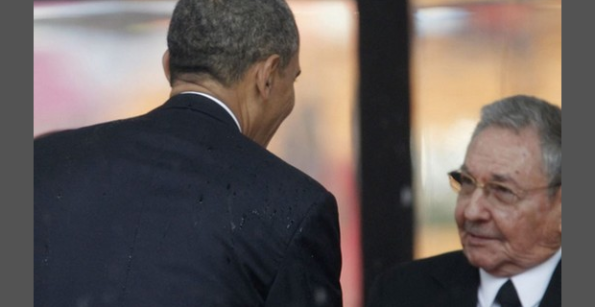
Obama-Raul-castro-SudafricaIn Cuba, most news reaches us via Miami.  Look, given such limited access to the internet where one official hour puts us back a whopping 4.50 convertible pesos (i.e., the equivalent of one week’s pay for a laborer), people resort to foreign short wave radio or whatever illegal cable connection the neighbor down the street managed to set up but charges 10 cuc to let you listen to the news.

Don’t ever think you’ll get any real news about Cuba from local newspapers.  Out of the six pages of dull newspaper made from sugar cane pulp, the national press only publishes Pollyanna stuff and overly compliant economic indicators.

Out on the street, we think of our newspapers as pure science fiction. Good for nothing except to help keep track of the baseball season, to get a peek at the TV guide, or as a good substitute for toilet paper.

The cut and paste ordeal to get information is a lengthy process.  While Barack Obama and General Raúl Castro were shaking hands in the Johannesburg soccer stadium, Rebel Radio a.m. (Radio Rebelde) went on and on about the sugar cane harvest and the great and successful efforts made by our cooperative social service units.

Moraima, a 29 year-old housewife found out about the event because she’d been watching TV through some illegal cable connection.  She comments, “every day, I watch channel 23 News and a few Oscar de Haza programs.  That’s how I get a whiff of unreported local Cuban news ranging from the latest crime, to another dissenter arrest, to the North Korean ship in Panama or to the handshake between Obama and Raúl.”

While the Obama-Raúl thing sent a large part of the exiled Cuban-American community living in Miami into an uproar, in Havana the whole thing was little more than just another bit of news.  Gerardo, a 74 year-old retiree thought the encounter was positive, but his main morning concern was being able to buy a leg of pork.

“Pork meat is sold in agro-markets for 24-25 pesos per pound.  But I was hunting for the 21 peso bargain I’d get if I could find a state slaughterhouse carrying it.  I was in line for an hour and a half, but I finally got my pork leg for Christmas Eve dinner.  Maybe the handshake will bode well for the future — I’m not really certain — but the good news is that I’ll have food to last me for a few days.  Politics is a dirty game.  Government reforms do not benefit retirees.  I don’t have relatives in Yankeeland, so no one sends me dollars. Whether those two shake hands or tell each other off doesn’t really matter to me.”

Common folks in Cuba are just tired, that’s all. Tired of a bunch of stuff.  Of bad government.  Of the now ancient embargo used as a pretext by the regime to justify depriving us of scarce goods and services.  And worst of all, tired of not having any political voice or say.

A 38 year-old teacher, Zoila feels like a pawn for the State.  “Whatever we think about the future we’d like to have is nothing the government cares to take into account.  Any one act like Obama’s handshake can easily morph into cheap and superficial politics. Our government leaders don’t want to change.  All they are doing is stalling for time.”

In Parque Central located in the heart of Havana, people could be seen rushing around stuffing plastic bags with whatever they could find.  A loaf of bread.  Two and a half pound of tomatoes.  Maybe some dry fruit.

On baseball hill just next to the statue of José Martí, countless fans argued over baseball or predicted results for the European Champions League soccer matches.

At the Payret, about fifty people queued up waiting for the movie theater to let them in to see an Argentine flick brought in by the International Festival of New Latin American Film.

Meanwhile, beggars were sorting through garbage cans.  And a pair of very old people begged for money right next to the Inglaterra hotel.  And workers hired to repair the Capitol building were selling their own lunch for 25 pesos.

Obispo street was a beehive of pedestrians swarming in and out of stores.  Some discreet street vendors offered cigars.  Others, girls.  Blondes, mulatto, black. Young men were also an option.

Our bus service is still in crisis.  Bus stops are stuffed to the gills, and people feel antsy and are upset about not being able to get where they need to go.  And even at the cusp of winter, temperatures in Havana still hover at unbearable 86 degrees of Fahrenheit humidity.

When people are forced to live like this, it is logical that a greeting between two heads of State might be overlooked.  That’s a fact even if the two men happen to be Barack Obama and Raúl Castro.

Iván García

Photo Credit: Martí Noticias.

By request, we are resubmitting the article, “Nothing To Do With Mandela” taken from Spain’s newspaper, El País on December 11, 2013.

At Nelson Mandela’s funeral service, more world leaders came together in one fell swoop than world history can recall.  Despite rainy weather, one hundred world leaders collectively sat on bleachers at Soweto’s soccer stadium to pay tribute to a man of principles.

The man had the strength to fight in the name of freedom, the level-headedness to redress his thinking, the courage to disagree among his own rank and file, the empathy to step into his opponents’ shoes, the magnanimity to embrace forgiveness, the brains to build bridges, and finally, the decency to accept a timely retirement.

In light of Mandela’s track record, why would leaders stomping on the core ideals of the South African leader wish to render tribute?  Case in point, the three ogres: Raúl Castro, Robert Mugabe and Teodoro Obiang.  Front-row-center, the fearsome threesome certainly hardened the mood and turned all the magic in the air sour.

Right on cue, Obama drove the point home: “There are leaders here today who praise Mandela but silence protest.”  The words were intended for iron-fisted leaders who gravely overstep to crush human ideals, religious beliefs or the acceptance of gender preference.  Only official protocol could possibly explain how despots were invited to attend and got the opportunity to grandstand for absolution under Mandela’s glow.  Tyrant and apprentices filled the gallery.  Simply review the list of shameful human right violators from anywhere: All were in Soweto.

Well, almost all human rights violators went to the funeral.  A few hardliners stayed at home.  For instance, the President of Sudan, Omar al Bashir was absent, but probably due to the fact that the International Criminal Court is hot on his trail.

Fortunately, Caucasus strongmen ignored the news and the event.  Also absent (for reasons of their own) were big human rights abusers like Russia, China and Iran.

But it was Czech Prime Minister, Jiri Rusnok, whose silent microphone was on long enough to record him saying that a full agenda made going to a funeral out in the “boondocks” inconvenient and something for which he was not in the mood.  No way to save face with mourners after that kind of faux pas.  Rusnok apologized, of course.  But he, at least, certainly expressed an honest opinion.

Translated by: JCD

14 December 2013

Old Lazarus / Yoani Sanchez

Saint Lazarus

At the entrance to the house is a life-size sculpture of a man with a beard and crutches. Everyone crosses themselves before him. Also of wood, there are two carved dogs as his side: skinny submissive strays. The image of Saint Lazarus plays a special role when the festivities for his day approach. He is one of the most venerated saints in our country and generates widespread displays of popular devotion. His sanctuary, in the town of El Rincón, is busy every December 17th with pilgrims, promise payers, flower sellers and police. All around him gather the hurting, the neediest, those who have tried everything to no avail… those abandoned by luck, science, or love.

When I approach El Rincón I feel this energy that comes from pain and faith. The leprosy asylum with its sad stories, the illegal settlements that have grown up on both sides of the railway line and the whiff of the always burning candles. It is not a place for smiles. At times I’ve accompanied some friend bringing an offering promised for a favor that has been fulfilled. Other times, I’ve gone with that curiosity provoked in all of us that we can neither understand nor explain. On at least two occasions I’ve arrived under the roof of the temple at midnight on the 16th and have experienced moments difficult to forget. Someone is crying, screaming, and many are praying, the heat is tremendous and everyone is sweating, it smells of open sores and poverty. There isn’t room for one more soul in the Church.

Today I left the house and very near by they have placed a purple cape and an image of old Lazarus. An old man who passed in front of him leaned over to whisper something in his ear. He had a rough beard and his clothes were from the time of the Soviet subsidy, when the ration market offered manufactured products. Looking from his parched face to that of the saint I noticed a similarity. Both were in the last stages of their lives with only the clothes on their backs and few reasons to laugh. The two of them so close, but one on the altar and the other in the street. One surrounded by promises to keep, the other knowing that all those they had made him are already broken.

16 December 2013

Reinaldo Arenas’ Nest of Suffering and Partying / Jose Hugo Fernandez

An interior room on the second floor was
An interior room on the second floor was R. Arenas’ nest of pain and parties

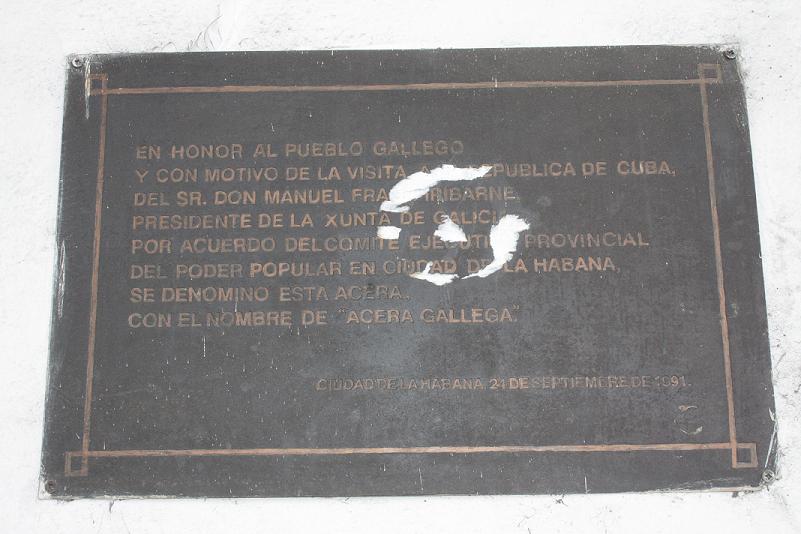
Havana, Cuba, December, http://www.cubanet.org. In Havana, at the corner of Prado and Dragones streets, the regime affixed a plaque to honor the memory of a foreign fascist: Manuel Fraga Iribarne. But not even the tiniest plaque or sign exists in this city that invites us to remember the most notable among those Cuban authors educated during the revolutionary period: Reinaldo Arenas.

Although he was born in the eastern part of the island, Arenas came into his own as a writer in Havana and it was this city that witnessed his most joyful and painful experiences, insofar as he was ingenious, rebellious, Dionysian, irreverent, a rabble-rouser and dead set against obeying any rule that wasn’t that of his free spirit and his insatiable flesh.

Many are the sites through which we could trace the footprints that he left in this city. Someday, in a democratic future, when the cultural authorities decide to honor themselves by revitalizing the memory of this man by means of a tour-homage to the places where he created, reveled, and suffered in Havana, it will be enough for them to use as their guide the descriptions from his book, Before Night Falls, a work as dramatic and simultaneously funny as its author.

Precisely in that book, Arenas dedicates an entire chapter to the Hotel Monserrate (corner of Monserrate and Obrapía Streets), a former whore’s den in whose second story he managed to carve out the tiniest private space in Havana, a room that he was to buy secretly. In that Hotel, according to the author himself, there lived a veritable cornucopia of misfits who lived outside the law. “If the police would come,” he comments jovially, “the only thing they had to do was put up some prison bars across the main entrance to the building, the only door in the place, and everyone inside would be held prisoner.”

A few days ago, curious to know if anything had changed, I visited the Monserrate, more than thirty years after the details described by Arenas.

There are no substantial changes. The building remains as dilapidated as always. The same atrocious front door. The dark hallways, the walls and ceiling with chipped paint, that hasn’t been retouched in more than half a century. The ancient elevator, which inspired in Arenas such great jokes and so many furtive sexual adventures, continues its astonishing balancing act, while contemplating a fall without ever actually falling. The clothes hanging on the lines on the balconies…

My name is Bebita, Reinaldo Arenas’ friend. Photo by José Hugo Fernández.

With respect to the “wildlife” that is the neighbors, the old whores have all died by now, after their conversion to the Communist Party, but it’s still possible to find there several of the recurring characters from Before Night Falls. A few have left (for Hell or God knows where) and others remain the same, stranded in time, only now so much older. But almost all of those that remain couldn’t be photographed because, as if they were Hollywood A-listers, they demanded that I pay them in CUC (convertible pesos) for appearing in any photos or for affording me a brief interview. One exception was Bebita, who not for nothing had also been an exception when she gave her friendship and her generous help to the writer. “I am Reinaldo’s friend,” she told me, while she opened the door to her room to offer me a seat, very willing, and even enthusiastic about the possibility of bringing me up-to-date, for free, on life and miracles in the Monserrate.

Through her I learned that the character who sold the room to the novelist (he calls him Rubén) continues to be as warped as ever and that he charged him for using the bathroom, 50 centavos a pop, according to Arenas, but Bebita clarifies that it was 50 centavos for using the toilet and a peso for taking a bath. With some help from Bebita, who allowed him to put a waste pipe through the middle of her room, Reinaldo was finally able to have his own bathroom. Later, the room would revert back to the aforementioned Rubén.

“On the first floor lived Bebita with her friend; they were two women who played the drums and who would get all caught up in problems caused by jealousy on a daily basis,” wrote Arenas. Well, she still lives there, also with a friend, perhaps not the same one as before, since she is much younger than Bebita. But now peace reigns in Bebita’s room, although her personal saint is still the same: Shangó, the orisha of storms (thunder and lightening).

“Some day if they decide to put up a monument in honor of Reinaldo,” she said to me, “no other place would be more ideal than the Monserrate Building, nest of his suffering and his partying. And I assume that the monument ought to be in the shape of a phallus.”

The ancient elevator of Arenas’ sexual adventures and tricks.


Dark hallway on the first floor of the Monserrate.
They pay homage to a fascist, while they relegate Arenas to oblivion.
If the police would come, the only thing they would have to do would be to place prison bars across the main entrance to the building.

Photos and article by José Hugo Fernández.

Note: The author’s books can be bought here.

Translated by: K. Rauch

Cubanet, 11 December 2013

Mandela: My Belated Personal Tribute / Miriam Celaya

Photograph from the Internet: No Comment.

Time goes on and the funeral of the famous first black president of South Africa, Nelson Mandela, still occupies the pages of the press. Almost everyone feels indebted to praise the infinitely glorious Madiba, re-editing, in countless paragraphs, the deceased leader’s life and seeking to enhance his virtues persistently, to the point that we no longer know for sure if Mandela was a human being or a saint on earth. It is praiseworthy to remember with admiration and respect people who have realized valuable deeds, but I don’t personally react well to icons, paradigms or however they are defined.

Well, then, for all good things Mandela did for his people, for his example of relinquishing power when he could have retained it, due to his charm and charisma, his ability to forgive, so necessary and lacking among us, and all the good things he did throughout his long life, but I prefer to remember him as the man he was, an imperfect individual, as all of us human beings are, which puts him in a closer and more credible position in my eyes.

So, in the presence of so many stereotyped speeches and so much politicking brouhaha deployed at the funeral of a deceased who may have wished less fanfare, I decided to honor him in my own way: celebrating his existence because he lived to fulfill such lofty mission as freedom and justice for his people, during the pursuit of which he suffered repression and imprisonment, just as Cubans aspiring to the same ideals for their people are still suffering, as those who have lived in the confinement and injustices of a dictatorship not just for 27 years, but for over half a century.

But I will allow myself a special tribute to Madiba by modestly imitating him in forgiveness and reconciliation: I forgive you, Nelson Mandela, for the friendship with which you paid tribute to the vilest dictator my people has ever had, and for the many instances on which you exalted him and gave him your support. I forgive you for having been wrong in granting privilege to the oppressor instead of the oppressed, for placing your hand –redemptive for your people- on the bloodied shoulders of the one who excludes and reviles mine. I forgive your accolade to the myth that was built on violence, although you were a symbol of peace for humanity. I forgive you for having condemned us though you hardly knew us, forgetting the tribute in blood that my people made in Africa for which you, like a fickle mistress, thanked the satrap, who has never had the dignity to sacrifice himself for us, for you, or for your kind.

I forgive you, then, and I am reconciled with your memory to keep remembering and respecting the best in you. I know many, with vulgar hypocrisy, will demonize me for questioning you, but they won’t hurt me, because my soul is hardened by virtue of having been attacked and criticized before. It is my hope that this time my detractors will be so consistent with your preaching of kindness they seem to admire so much that they will eventually forgive me. May you also forgive this Cuban’s audacity and irreverence, who believes in the virtue of the good works of men, because she has no gods, but I was not able to resist the temptation to also utter what’s mine in the hour of your death.

And if either you or the mourners of the day won’t forgive me, I don’t care. At any rate, it will be further proof that, deep down, you’re not perfect; at least we’ll have that in common. Don’t take offense, in either case, you were a great person, and I will never match any of your many merits. Rest in peace, sincerely.

13 December 2013

The New Equivocation / Fernando Damaso

Photo: Peter Deel

The violence organized by State Security to repress those who think differently on Human Rights Day, in Havana as well as in other provinces, shows once again the true roots of the repressive regime. While in South Africa the President tried to confuse people by talking about tolerance, respecting differences, dialog and peaceful solutions to problems, here his henchmen did the exact opposite.

The beating of the Ladies in White and L and 23rd streets, the refusal to allow a space to hold the Puños Arriba (Fists High) concert of the Cuban Hip Hop Movement (an end finally achieved in a circus tent), and the harassment outside the Estado de Sats site, quickly reflected on the Net and reported by the foreign press as front page news, show the forces of order, henchmen, enraged people, young pioneers and students with their teachers in the lead, actively participating in these acts of repudiation. What will UNICEF say about the this, about the use of children without permission from their parents, in these shameful and degrading acts? Is this how the Cuban state educates our children?

Despite the visits to people’s homes to sow fear, despite the preventative detentions, the blocking of access, and the statements that we have the strength to stop them, the planned events were held, and although they could have been inconsequential, this government violence elevated their importance and brought them to the world’s attention. One more mistake by an outdated regime used to ignoring the opposition, doesn’t understand that the only way to resolve the national problems needs the participation of everyone, without exclusions.

To suppose that developing messianic formulas in air-conditioned offices by governmental commission will provide viable solutions, shows the stupidity of the principal leaders. If they don’t listen to all the opinions and if they don’t take into account political discrimination, it will only be more of the same which, after being developed, will be submitted to the citizens for their approval without them or their legal representatives participating in its preparation. The old saying that man is the only animal who trips twice over the same stone, can be applied to the Cuban government, affirming that the setbacks have been and are many.

15 December 2013
On Property Rights (VIII) / Cuban Law Association, Mérida de la C. Pastor Masson, Esq.

Mérida de la C. Pastor Masson, Esq.

Following a corresponding written order, in relation to article 168, we will refer to the nature of joint ownership constituted by the participating State or its agencies, organizations, policies, etc., with a participating natural person and, which can be extinguished by a cause such as: Participation and allocation of goods in accordance with its nature.

A purchase by the State or any of its agencies or organizations from participating natural persons.

A purchase by natural persons from the participating State so long as this does not include a farmstead.

The sale of a said property and subsequent distribution of monies shall be allotted to co-owners (State and natural persons) in accordance with corresponding quota allocations.

In all all cases, purchase and selling operations shall —  let us be clear — be carried out at the official price should this be already fixed or, otherwise, shall be appraised and established by the government body empowered to conduct said proceeding.

From this chapter, we only need to mention that pursuant to article 169 which refers to joint co-ownership derived from matrimonial or community property, said communal holding would be in danger of dissolution when, under certain circumstances in case of divorce, the community of marriage had been dissolved by what our Family Codes 29-42 specify as intent to “malign.”  Future updates on this topic are currently under review.

Translated by: JCD

11 December 2013

Rodrigo Malmierca’s Hidden Grudge / Juan Juan Almeida

A veritable media sandstorm blasted away just a few days ago in Brazil when at the IX Plenary Session between Brazil and Cuba, the Cuban Minister of Foreign Trade and Investment, Rodrigo Malmierca openly declared that any political entity without the branding initials of Cuba’s Communist Party — CCP for short — would never be allowed to run in a Cuban election.

In light of Malmierca’s remarks, a group of Cuba savvy and well-informed people who understand Cuba’s reality first hand, countered by producing serious, sensibly-minded, and razor-sharp studies and retorted that Malmierca’s sly words — or threat-in-the-making — could only serve to further isolate Cuba.  On that note, the Brazilian group discretely suggested that a fairly unobtrusive way to avoid widespread buffoonery during future Cuban elections would be to demand all upcoming political parties register under names capable of generating the acronym of CCP.  A sample roundup of CCPs: the Christian Civic Party (CCP), the Cuban Constitutional Party (CCP), the Conservative Cuban Party (CCP), the Cuban Catholic Party (CCP).  (Others variations are possible.)

FYI: Current Minister Malmierca is a big-name, bright individual but more muted and deadpan than a double-blank tile in a heap of dominoes.  Pre-Internet 1980s knew Malmierca as an all out rebellious and non-conformist youth.  No doubt the modern Cuban blogger dissidence movement would have rung true for young Malmierca.  But back then — and about to graduate from the University of Havana with a degree in economics — the early Malmierca shunned the philosophical aesthetics language of the Cuban Revolution in ways comparable to modern protest.

Malmierca’s early life exploits read like a political police thriller of never-ending “demonstrations” known and talked about in every secret inner chamber but carefully concealed in folds of red velvet — the metaphor is a line borrowed from Eliseo Grenet’s lovely bolero, “Your mouth’s pearls” — to protect his family’s background (father was chief founder of State Security, former Vice Minister of the Interior, former Minister of the Interior, active card-carrying member of the Communist Party, and Freemason).

For better or worse, the young Rodrigo originally believed free thinking ideals were worth the effort, and he assumed whatever risks and consequences came in tow.  But out of nowhere, and as if by pure magic, he was recruited by the Cuban Central Intelligence Agency.  A once pure heart turned lethal.  Out came the plainclothesman guayabera shirt as urban camouflage for network spying.  First came ECIMETAL, then a role as advisor to the Cuban embassy in Brazil, later on, as ambassador to Belgium and the EU, next as representative of Cuba at the UN, and finally, as Cuba’s Minister of Foreign Trade and Investment.

Whatever prestigious jobs and assignments were culled for him and despite all the reassurance top appointments bring, Rodrigo Malmierca has never been a loyal pooch obedient to the call of one master.

In public, he is a man of few words and speaks only when necessary to avoid the risk of damaging his administrative legacy.  Seems he also understands that if a political system markets equality as a top shelf product, being different spells mortal sin.  Those in the know claim that deep down he has never forgotten his past.  The story goes that only Malmierca’s innermost circle experiences Pandora’s box unleashing the visceral grudge he holds against general Raúl.  Between these two men, an old adage is key: “Paying tribute to someone like you has merited my own substantial reward.”

Translated by: JCD

5 December 2013

Bedtime / Yoani Sanchez

One more! One more! One more! he demands, while leaning back against the pillow and stretching his legs towards the ceiling. The mother has to quickly make up a new story, weaving the tale that puts her child to sleep. So she mixes the creatures of the Brothers Grimm with others, pulled from national cartoons, to narrate a nice fairy tale, moral included. The bottle falls to one side, the feet relax and the eyes start to close. Finally, the child is asleep. On the other side of the door are several hours of housework. The dishes to wash, the water to be heated for her husband’s bath, and the beans to be softened in the pressure cooker. But at least the child is now asleep.

Despite the speed of modern life and the hardships of housing, many Cuban parents still tell their children stories at bedtime. Some prefer to read them, while others make them up or recall those they heard in their own childhood. Video games and Disney movies have contributed new situations and characters to relate. It’s not unusual for Tom Thumb and Buzz Lightyear to be friends in these stories, or for Harry Potter to fall victim to a poisoned apple. When it comes to mixing the genres, it’s also not surprising for a bit of reggaeton to emerge from the mouth of some kingdom’s wizard or the bad witch of the story. The point it to make the eyelids heavy and sleep to come as soon as possible.

A few days ago a friend told me that his daughter had asked for a new story. “One, papá, that’s not in any book,” she specified. The father, tired out from his workday and unable to invent a new fiction, decided to tell her his own routine. “Once upon a time there was a man,” he started, “who got up every morning at six.” While he was talking his daughter’s eyes were hanging on every gesture, waiting for the protagonist to turn into a hero or a villain. “He went out to get the rationed bread,” he continued, “and then went to work on the bus that sometimes comes and sometimes doesn’t.” A small grimace of impatience started to play across the kid’s face, but the voice didn’t stop. “At the end of the month he would receive a salary that was barely enough to pay the electric bill and buy a little food, so the good man had to do some bad and illegal things to survive…”

A snort of frustration interrupted the monotone narrator. As the girl’s little hands tossed the pillow away from the bed, she shouted, “No, Papi! No! I want a story where the good guys win…!”

15 December 2013

Cuban People and Human Rights / Juan Juan Almeida

Once again, the subject of human rights is polarizing Cuban society.  Many would agree that keeping the topic center stage is an especially meaningful and noteworthy endeavour.

To be fair, we must acknowledge that the Cuban government deploys more than 40,000 doctors, nurses and teachers who volunteer time and expertise in more than 100 countries around the world.  Faraway patients who have lost both the will and the physical ability to smile get beaming Cubans to offer comfort and relief.  But in Cuba, the opposite is true: Basic sanitation is lacking to the extent that some people actually die from otherwise totally preventable illnesses.

Like any other, Cuban society longs for open rights to healthful rather than unhealthful care and wants to experience life in a seamless universe where societal freedoms coalesce with justice.

Good or bad, I am comforted by Article 8 of Cuba’s current Constitution.                I quote: “The State recognizes, respects and guarantees freedom of religion.  The Cuban Republic will enforce the separation between church and state.  Any creed or religion shall be granted the same rights.”

A dismal affair to realize how the Department of Religious Affairs (instituted and overseen by the Communist Party’s Central Committee since 1985) which acts to regulate, control and authorize the existence and/or activities of any current or future religious organization in Cuba, is able to violate the freedom of religion decree and many other legal edicts with total and complete impunity.

But to prove lack of religious freedom in Cuba clearly exists, underground and  timeworn arguments and typically heated debates siding one way or the other seem pointless.  Suffice it to say that what is everywhere missing are basic freedoms that guarantee citizens will not be abused or discriminated against by their own government.

It seems shameful to me discuss how island family rights are said to endure in Cuba when many who are allowed to leave — under the auspices of expatriate charity — unfortunately end up barred from ever returning.  And what pitiful freedom can we speak of when blacks who once rose from their barracks to stake their claim on liberty are today forced to endure marginalized lives in filthy ghettos?

In Cuba, another nearly worn out topic is how apparently irresponsible — or at least misguided — government practices are the root cause of our bottomless and spiraling deficit.  For starters, emigration from Cuba increased while the nation’s birth rate decreased.  Next, our aging population has been systematically depleting whatever small pension system existed so that zero funds are available to cover the tab of average retirement.  That said, just what rights to gaining social security are we talking about?

Cuban television shows are mostly about how average Cuban people face everyday joys and sorrows and the unexpected good or bad twists of fate life throws our way.  What is never unveiled, however, are the intense days of suffering borne by those who are jailed helter-skelter for the sole crime of remembering that in 1950, the UN General Assembly proclaimed December 10 as a day when all member nations and special organizations would reflect on human rights as the standard for all people and all nations to achieve.

Translated by: JCD

12 December 2013

World Human Rights Day in Cuba / Lilianne Ruiz

Camilo Ernesto Olivera, a member of the team of Estado de SATS, was stopped as he left his home on Dec. 7. Most alarming is how these things are happening in Cuba: going from one moment to another in a state of total helplessness before the forces of repression. I always remember Orlando Luis Pardo when he said that you don’t talk to kidnappers because if the higher order were to take you into the forest outside of Havana to shoot you in the neck, no words would persuade them otherwise.

The fact is that after they searched Camilo, throwing him against the police car, they put him in the pursuing car without further explanation. They drove around La Lisa, until a subject on a Suzuki motorcycle approached them. Without taking off his helmet he looked at Camilo and told police: “Take this one to Melena del Sur.” And what Camilo could do to help himself? These people represent the law, illegitimate though it may be. Resisting, trying to escape, all that will get you is to complicate things further. So absolutely passive in his own “legal” kidnapping he saw himself being driven on an interprovincial journey without knowing how it would end. Nor was he allowed to call his family, though it is written in Cuban law among the rights of detainees.

They left him in a jail cell all day; around 7 PM they took him out of there to free him. At that time Camilo, who originally had gone to see Ailer Mena to bring her up to date on the events of 10 and 11 December on SATS, had to look for a car-for-hire to take him to Havana. He told me himself that luckily they hadn’t “confiscated” his money, because everyone knows people who’ve been robbed of everything, all that they had in their pockets.

To ensure he’d be there on the 10th, he had to hide out in Rodiles’ house from the 8th on. We have already seen the videos of the enormous act of repudiation disguised as a “cultural activity” that the political police staged outside Estado de SATS on the 10th and 11th of December. They took elementary school children, junior high school and high school students to make street paintings with the traditional communist insults against Civil Society like “worms”, “imperialists”, and things of that style.

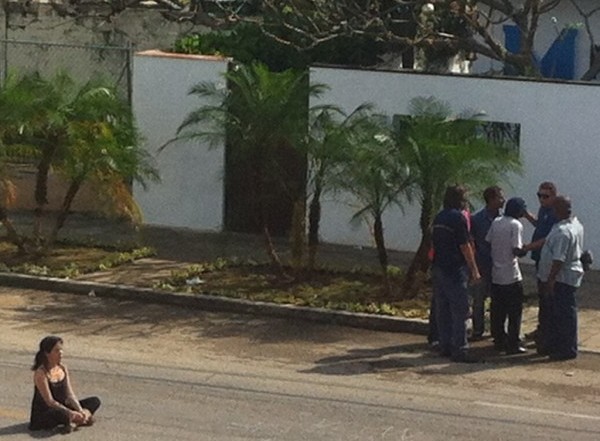
1386954247_ailer-en-protesta-en-medio-de-la-calle1Here we see Ailer Mena in the middle of the street, seated in the lotus position, opposing with beauty the arbitrary detention of her husband, Rodiles, who’d gone out to protect her.

They also took Rodiles by carrying his weight as ants carry a leaf. They hurt Walfrido in the neck because they grabbed him in that area to carry him away. This bothers me a lot; the impunity with which the political police act in Cuba.

We are not going to stop doing what we do because it’s a question of identity. All those I know who oppose with their work, their opinion, or their protest, all do the same thing: exist.

To exist, and that by itself is a demonstration against whichever form of oppression, call it political, religious, ideological, or against the powers that be. But I think that this is of the worst kind because it assumes control of our humanity, and makes people spit on it while placing some sophisticated shackle on their necks, yes, on the neck. For that, to protect mine, I can only be what I am, be who I am.

Everything shows up on the video of Estado de SATS so that to repeat it is foolishness because a picture is worth more than a thousand words. For that they threw Kissie’s camera (Kissie is from Omni Zone Franca) as if to a pack of dogs. But they couldn’t take the camera. All this was carried out in front of the children they’d gathered there to put on the act of repudiation in a fair-like atmosphere for the Day of Human Rights.

We have to endure hatred when you think that the singer known as Arnaldo and his Lucky Charm donated their singing and yelling of revolutionary, fundamentalist slogans; surrounded all the while by the political police. The strangest fair in the world. It’s said that next week this same act will be in Miami to sing there. They’re pigs.

Not only there; they took the Ladies in White, too. Better said, not only did they let them arrive at 23rd and L, where they’d announced they’d start their march for Human Rights Day, protesting for freedom for Cuban political prisoners. But they might have had an idea: María Cristina Labrada and her husband Egberto Escobedo — who was a political prisoner for 15 years — were detained at the same corner as their house and taken to the Granabo police station.

The Sunday before, they’d suffered a similar kidnapping coming out of Santa Rita Church like they had every Sunday, to join with the Ladies and walk down 5th Avenue. They left Cristina in a jail cell filled with mosquitoes and she recalled Martha Beatriz who almost a month ago was under house arrest — some days are harder than others — and it all began for refusing — completely within her rights — to be fumigated with oil, which is forced upon our homes while the city has turned into a garbage dump.

But totalitarians have always regulated our privacy. Cristina was quite uncomfortable all day and at about 7 PM she was also freed along with her husband. But as she told me, the patrol car in which they were put left Guanabo for the municipality of October 10th without headlights or taillights and it was already night time. She doesn’t know if it was to trigger an accident or to intimidate them. Something similar happened to all the Ladies, supposedly including their leader Berta Soler, who was detained with her husband, Angel Moya, in similar circumstances.

Also in the area of 23rd and L, they gathered some children for a fair that very day. But notice how they operate as one body that keeps society held hostage. I don’t know if mothers who gave permission for their kids to be there knew what all this was about. I think that to speak of emotional blackmail, by the fact of using kids as a smokescreen to hide their acts of repression falls short. It is a hell. Cuba is living the fall of the Castros, and everything indicates that he doesn’t want to die without lashing out with calculated but irrational violence (which is self-satisfying, blind) in his pride. They did not succeed in grafting their damned roots into our humanity.

Freedom and change are stronger.

Translated by: JT

13 December 2013