Neither Fresh Milk Nor Diet Milk / Osmar Laffita Rojas

Havana, Cuba, December, www.cubanet.org – Last year 2012, the Ministry of Agriculture reported the production of fresh milk at a level of 516,246,500 litres nationally. Out of this total, the province of Camagüey occupied the first position with 96,299,600 litres. Followed, at a distance, by Villa Clara with 51,794,100 litres; Sancti Spíritus with 49,923,100 and Matanzas with 44,352,800 litres.

As part of a long list of inefficiencies and unfulfilled commitments, the state was not able to fulfill its commitment dated July 26th 2007 to guarantee a daily litre of fresh milk to every child under 7 years.

With a few days to go to the end of 2013, this year’s milk production is not known. That silence is a sign that things aren’t going well.

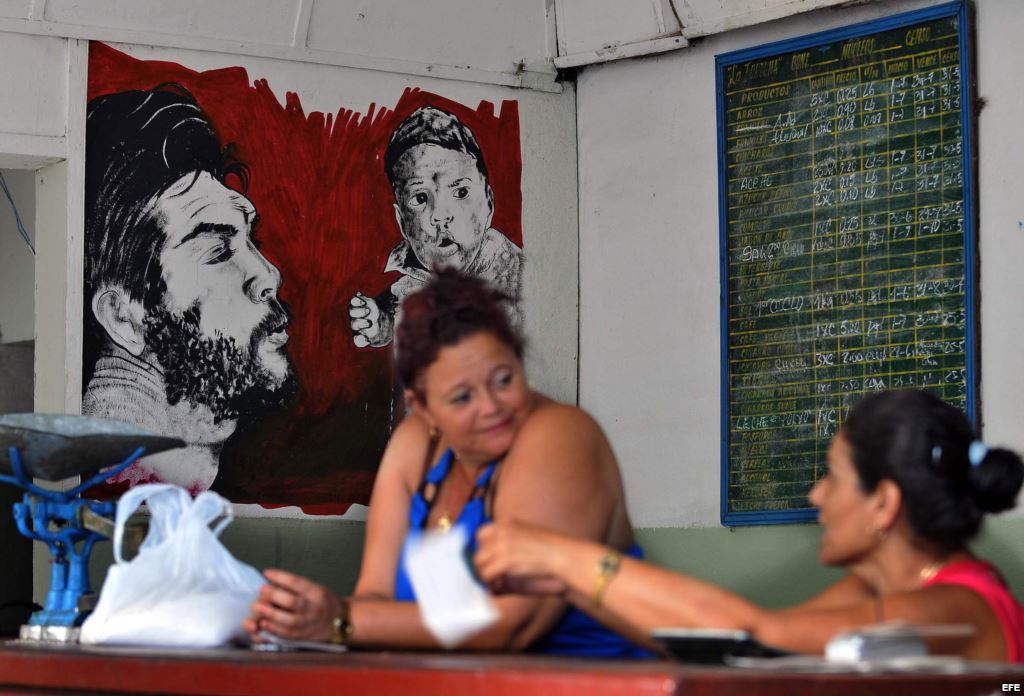
In most of the provinces, they are continuing with the standard sale of 3 kilos a  month of powdered milk, at the subsidised price of 10 cents a kilo. Every 10 days, children under 7 have the right to a kilo of this miik.

Not being able to guarantee the supply of fresh milk and in order to ensure the children get the diet they need, the state had no choice but to import thousands of tons of powdered milk whose price in the international market was over $4,000 dollars a ton.

That imported powdered milk is also for pregnant women and those diagnosed with chronic illness like diabetes, who get a voucher for a kilo of powdered milk a month, whose price is similar to that sold for children.

It seems like the milk production in the past year has not been what was hoped.

Last August 5th, the weekly Trabajadores, official publication of the Cuba Workers Centre (CTC) , announced the construction of a powdered milk factory in the province of Camagüey with capacity to produce 100,000 litres of milk a day, using milk from the dairies in the Camagüey area.

Production testing of the factory in question will be started at the end of September.

They are putting up the new factory in the place where the old factory was to have been in the 90’s, which would have been the first powdered milk factory in Cuba. Construction was held up for lack of funding. Since then, the state has kept on importing powdered milk, thousands of tons, paying tens of millions of dollars.

The powdered milk factory which they are putting up in Camagüey is fitted with Chinese and Italian technology and its cost has reached 528,000 dollars. It should produced 2,350 tons of powdered whole and low-fat milk a year and 1,100 tons of butter.

The newspaper Granma, on 31st August, announced that work on the project was over 70% advanced  and that at the end of September they will start assembly of the machinery and, if there are no holdups, they forecast completion for the end of December. But, up to now, they haven’t given any more information on this.

At the beginning of December, they announced that pregnant women and the chronically sick in the provinces of Mayabeque, La Habana, Artemisa and Santa Clara, who received powdered milk for their diet, by way of an experiment, will, from January, instead of that, receive a new dairy formula made up of casein, lacto-whey, water, and animal or vegetable fat with different levels of protein.

On this point, the Vice Minister of Internal Trade, Bárbara Acosta, said that this measure was taken because of the over-consumption of powdered milk and assured the deputies that it would not be extended past the date indicated

It seems like there was a setback in the production of milk in the second half of this year.

In the Foreign Currency Recovery Stores* (TRD, from its Spanish initials) they have not offered butter or condensed and evaporated milk produced locally for months.

You only find cheese in certain supermarkets, and not always. The price is about $15 a kilo, which is in fact prohibitive for most Cubans, whose salary doesn’t exceed $20 a month.

The official press keeps completely silent about the crisis in the production of fresh milk. It seems like the government has ordered that they don’t touch on such a sensitive topic.

ramsetgandhi@yahoo.com

Translated by GH

*Translators note: This interesting name makes clear the government’s interest in operating stores that sell products only in hard currency; their purpose is to “recover” the remittances sent to Cubans from family and friends abroad. Products in these stores are generally sold at significant markups.

23 December 2013 / Cubanet

Marina Ochoa’s Messages / POLEMICA: The 2007 Intellectual Debate

Before anything else, please forgive me for entering so late into the discussion. My life is very complicated precisely because of the climate of indifference, incapacity and/or corruption that I see confirmed in all the applications to the housing “machine”. I am appalled! I mention it because in my opinion what brought an end to socialism in the countries in the East was the unpunished mixing up of interests on the part of those who became millionaires during the socialism, opportunism, corruption and repression. Criminals who went unpunished because of the absence of opportunity for criticism, debate and for a culture of criticism of course. Gorbachev and Yeltsin only delivered the coup de grace ... we should all think about that and those involved should take appropriate action.

I am not a theorist and am speaking to you on the basis of my principles and experiences.

I think it’s the moment to get to the essence, or rather, to other essences. First I want to talk about the demoralising effect of repression. And the confusion and paralysis it produces. That would partly explain why the response from the culture, on many occasions, did not display the necessary consistency. I know a lot about that. The assemblies for purging the School of Architecture (in the second half of the 60’s), in the middle of my adolescence, truly terrified and confused me. The lack of correspondence between the political debate, full of high-sounding ideas, and the meanness in practice bewildered me. I didn’t understand anything, I couldn’t articulate anything. I tasted the flavour of impotence. Many of the members of the “purification” tribunals are in exile. “Purification”, for God’s sake, seems like something imported from fascism!

Later, in the 70’s, it happened in the School of Journalism. I was a student of Eduardo Heras [Ed. note: Cuban short story writer] and the same thing happened again. In both places the devaluing of the human essence was part of the strategy. Then came a period in which it seemed we had suffered some kind of collective amnesia, from which we didn’t want to awake to avoid going through the story of our weakness? And then, a new low hit with Alicia … frustrated because she was responded to by the film producers and the members of the culture which supported us with principles, unity, coherence and firmness. We manage to sort out the differences between us, which exist, as they do everywhere and we declare a truce in the fighting in order to safeguard our cultural project, which we are still getting on with.

Now I ask those who cite our intellectuals for not answering forcefully at the given moment, is it better to march off into exile, which is anyone’s right, which I don’t question, rather than collect the fragments of our beings, feelings, hopes, and also our revolutionary existence and remain here, fighting in our own way, as best we can, to rescue a cultural project we believe in? We must respect the way each one of us fights, because we are all products of traumatic events which have overwhelmed us. I believe we have to express clearly and coherently what kind of country we want to have and what kind of culture. Therefore I propose we take up again the concepts which were current in the foundation period of the Revolution, later distorted by interpretations which were circumstantial, obtuse, opportunist and convenient for the Palabras a los Intelectuales [Ed. note: Words to the Intellectuals – famous speech of Fidel Castro’s in 1961, setting out his views on freedom of cultural expression] which unfortunately they use because of the lack of conceptual definitions.

Take up again “the inclination of the avant-guard, the freedom of expression, the independence of individual evolutions, the search for the roots of creative feeling and the attempt to make clear the spiritual values of man”, to be found in Origenes [Ed. note: Origins, a Cuban literary cultural magazine] and what Carlos Rafael Rodriguez (Hey! called “the prince of Cuban Marxism”) expressed on March 23, 1982 on the 30th anniversary of the foundation of the Nuestro Tiempo society [Ed. note: Cuban cultural institution in the ’50’s].

I think we have to get the bogeyman of openness away from our cultural and political life.  The permanence of the Cuban Revolution is a symptom of the fact that our “specificities” are stronger than our “regularities”. We can’t delay any longer the culture of exercising opinion and debate, or we will pay dearly, even more so than up to now. Our people are the most defenceless in the world against the avalanche of neoliberal culture. We painstakingly modelled ourselves as passive recipients. As consumers, in all senses of the word of what they give us.

The battle of ideas should be this: a battle and I think this debate illustrates how it never should have been.

I hope I have contributed something to this debate. Big hug.

Marina Ochoa

Another message from Marina Ochoa to Gustavo Arcos Fernández-Brito.

 Dear Gustavo (Arcos Fernández-Brito):

I’ve been filming and I am getting prepared to start editing, and therefore although I have wanted to get in touch I haven’t had the time or the energy, so I end up with dispersed neurons.

The creation of a wailing wall for artists is bad news. They don’t understand anything. We say tweet tweet and they answer quack quack.

The 47 years in which the “vanguard of the proletariat” has been translated as the right to think for us, deciding for us whatever does or doesn’t suit us as individuals, family, nation, has corroded the capacity to use our judgement and has put us in the rearguard, while the thinking of our people has become more complicated, growing, and overflowing the society “designed” from above, which functions less each day; (the other, the underground, parallel or floating society which functions as a diversion, gives the lie to it every minute) but on the screens of our television, which often seems to be directed by Walt Disney, it appears as ideal.

The son of one of my nieces, 9-years-old, sighed while he was watching the national TV news, “I would like to live there!” Childish wisdom … and I swear to you I didn’t make this up.

I was very grateful to receive the intervention of the wonderful Colina and that of Belkis Vega [Ed. note: Cuban film producer]. Indispensable. I think that Criterios [Ed. note: Desiderio Navarro’s magazine, produced by the Centro Teorico Cultural] should collect everything they have expressed and bring out a number of the magazine and include what the 30 will produce. Certainly, knowing professionals of Belkis’ stature, in all senses of the word, professional, moral, humane, revolutionary, I can’t understand how it’s possible that her name does not position her to occupy roles such as the presidency of UNEAC [Cuban Writers and Artists Union], the presidency of ICAIC [Cuban Film Institute], as they are looking at the names of possible substitutes, all machos, men, masculine.

Colina refers to the responsibilities of Torquesada [Ed. note: Armando Quesada, member of the Stalinist National Council of Culture in the 70’s] in the ICRT [Cuban Institute of Radio & Television].

I also know that they made Torquesada adviser to the programme “Open Dialogue” following a negative report about the programme put out by this man, with a recommendation to take it off the air, which shows a very interesting practice: I put you in as adviser to someone you want to destroy and explain the drop in the quality of the debate in the said programme.

I won’t take any more of your time and congratulate you on your honesty and integrity

A hug

Marina Ochoa

Translated by GH

December Again / Yoani Sanchez

Twelve months and here we are again. Days to weigh our accomplishments and to postpone to the new year everything we failed to finish. What has changed in Cuba — and in each one of us — since December 2012 which we also put on the scales? Very little and so much. In the small space of my personal live, it seems that everything has moved at an unprecedented pace; in the life of a nation, however, it is barely a tremor, the blink of an eye. January started with the Immigration and Travel Reform, and in the following months there were many times we said goodbye; now without that sense of no return we had before, of final departure and exile for life, it’s true, but we continue to remove names from the telephone book at a worrying speed. Our condition of an “island in flight” grew, this time within a legal framework that allows and increases it.

Social differences were sharpened. The number of beggars and dumpster divers grew. However, many modern cars began rolling down our deteriorated streets and more than one nouveau riche spent their vacations on the other side of the Atlantic. If anything characterized 2013, it was the polarized stories about it that we hear. Anecdotes of families who opened luxury restaurants in the heart of Havana and of others who can no longer drink coffee because they can’t afford the unrationed price. Of some waiting outside a boutique to buy Adidas sneakers and others waiting outside a dining room to be given the leftovers to take home. We live in a time of high contrasts, days of photos discolored by the laboratory of life. A year, also, in which the ideological discourse distanced itself even further from reality.

Repression, for its part, increased. To the same extent that civil society grew and began to take certain spaces. The battle for the monopoly on information was lost by the government in 2013 and won by clandestine networks of audiovisuals, news and digital libraries. We were better able to learn what was happening, but, with that as a starting point, the power to convene ourselves and come together is still lacking by a long stretch. Life is more expensive for everyone, privileges and perks are concentrated in an elevated elite and the fight against corruption reached some but avoided others. Remittances from family and friends abroad, plus the subsidies from Venezuela, allowed us to avoid collapse, but the red ink proves that the economic reforms have failed. At the very least they have been unable to offer Cubans a better life, a motive for staying here.

The world offered us some lessons, among them the images from Kiev where so many have lost their fear. Fidel Castro faded a little more in his long living-death that has already lasted seven years. And freedom? This, this we are going to see if we win and achieve it in 2014.

24 December 2013

Dear Readers / Regina Coyula

I intend to take a vacation from the until the second week of January. If circumstances permit as everything indicates they will, I will devote myself to putting my house in order, an enormous task for me under the mountain of fabric that has accumulated on the sewing machine, and at night, like grandmothers of old, I will knit while watching television, an almost useless labor in the winter (?!) that we experience.

You can always find me on Twitter (@lamalaletra), reporting whatever happens to me in 140 characters.

I’ve told this anecdote many times, but I don’t remember if I’ve told it here. Just before the start of the Panamerican Games in Havana in 1991, my husband turned on the TV waiting for the news that the government, as we knew it, had fallen. In the face of that obsession, without giving it much thought, I said one day that it wouldn’t happen until 2013. He started laughing at me like a crazy person, he’d look at me, point his finger, and go off into more fits of laughter. When he calmed down he said to me, “You’re crazy.”

Well readers, not even a prediction as conservative as mine has come true. Or perhaps it has, and with that unnatural bureaucracy and the usual secrecy, we’re still doing the paperwork.

I have no plans, so I will enjoy the lovely parties to come.

May 2014 be a better year for everyone.

22 December 2013

Government Orders Added Buildings Demolished / Reinaldo Emilio Cosano

HAVANA, Cuba, December, www.cubanet.org – Many Havanans are confused and outraged that the government is eliminating constructions added without permits from the Institute of Physical Planning. After allowing them for decades, the withdrawal of authorization of thise privately-constructed buildings now is creating a very serious conflict, one more in the severe housing crisis in the capital.

Felix Mengana Franco, 34, an electrician living on the capital neighborhood of San Agustin, where multi-family five-story buildings predominate, states:

“They have demolished buildings and are continuing to do so. It’s unreasonable to dismantle the improvised garages. Neighbors in my building and others in the area are going crazy trying to think about how to protect their cars. They don’t have any other place. Do they take them up to their apartments on the third, fourth or fifth floors? Its absurd that so many buildings have been built in 50 years but they don’t build garages to protect vehicles from the risks of weather and theft.”

Garages, workshops for the repair of cars and motorcycles or the repair of home appliances, shacks for water pumps, bike repairs, living quarters… There is a huge need and lack of renovations of buildings ruined or destroyed, and now, to make it all worse, this plan aggravates the situation.

“I know of a case of a married couple with two children, six and seven, and two grandparents, who live crammed into a little shack,” added Mengana Franco.

Parking outdoors is exposed to the weather and to the plague of thieves. They steal parts off of cars and motorcycles, especially tires and batteries, scarce and expensive. The vehicles they steal from are dismantled piece by piece and sold, taking advantage of the lack of parts of state-run establishments, the only ones, or their astronomical prices.

Rodolfo, a resident of Alamar to the east of Havana, expressed his disagreement:

“Before demolition, the state should adequately resolve the problem created. I sacrificed myself in numerous sugar harvests. I earned the distinctions of “national vanguard” and “millionaire harvester” for the millions of arrobas of cane I harvested, and for this I got the right to buy a Russian Lada car. Now I have no way to protect it if they tear down my garage. I live on the fifth floor.”

Felix Mengana concludes, “If it’s prohibited, why does the government allow people to fool themselves, having their space, their privacy, to late tear down their huts and their dreams?”

cosanoalen@yahoo.com

23 December 2013 / Cubanet

Another Sad Anniversary / Fernando Damaso

Photo: Peter Deel

A few days hence will mark fifty-five years of a political, economic and social phenomenon that in January 1959 completely disrupted the fate of the Cuban nation. The so-called revolution became a devolution.

The results, as seen over time, are not too flattering. As well as the divisions and fractures caused to the Cuban family and its dispersal throughout the world, the loss of values — acknowledged by the current president — represents an account balance of which no one can be proud.

If we add an unproductive and inefficient agricultural system, an outdated and primitive industrial base, lack of transport and poor quality of services, including health and education, building collapses or buildings miraculously still standing, the decline in sports, the lack of environmental cleanliness, repression, lack of individual freedoms and many other evils, on balance the results have been negative.

Nor can we forget the thousands of people who have disappeared — eaten by sharks while attempting to flee across the Florida Straits — or those who have been executed, or those who have been killed and wounded in the overseas conflicts.

All these absurdities can be summed up in ten words written by José Martí — a man who lived nineteen of the most fruitful years of his life in the United States, writing hundreds of unforgettable pages about that country, which he admired and respected — hours before his death in combat: “I have lived inside the monster and know its entrails.”

These words have been manipulated and used as an anti-imperialist banner. The most hare-brained schemes have been hatched and executed in his name, dragging along a fanaticized people.

Rather than the words of Martí, everything has really been based on the writings of the leader of the insurrection* during its final days when he said, “My true destiny is to fight against the United States.” This highly personal and rather egocentric criteria was the basis for everything that came thereafter, everything for which the entire nation was sacrificed.

Today, fifty-five years after this event, we have in many ways regressed, much has been lost, pain and death have been left in its wake, as though this is something to be celebrated, despite the official slogan “Cuban Festivities.”

The lack of a coherent economic policy and other shortcomings, as well as more instability resulting from decisions that have been made, promise to make every day in the future even more dark and gloomy.

Aware of this reality and trying to fight peacefully for change, I wish my readers a very merry Christmas, a happy New Year and a healthy 2014 in which their dreams and wishes might be fulfilled.

*Translator’s note: I.e. the 1959 Revolution and its leader Fidel Castro

23 December 2013

The Continuity of Raul Castro / Miriam Celaya

fidel_raul_castro_JUNTOS-300x195HAVANA, Cuba , December, www.cubanet.org – After more than seven years since Castro I’s famous “Proclamation”, which marked his departure from the management of the government, Castro II’s performance has failed to find a path capable of leading to a happy port to end the cruise of a shipwrecked revolution.

A look at the socio-economic and political Cuban landscape lets us discern a confusing scenario in which no significant economic progress is taking place that allows for overcoming the permanent crisis, while the social sphere continues its decline, reducing the performance and quality of services, particularly in the areas of health and education, while, politically, the totalitarianism of the military elite continues. New regulations are being established that will attempt a “more flexible” system in order to wash the regime’s face and offer a gentler image outward, at the same time as repressive methods are increasing and extending inward, against dissident sectors and the general population.

The failure of the system has been sufficiently demonstrated after 55 years of dictatorship. However, the situation does not seem to point to its finale — in the face of the erratic government policies, the absence of independent institutions capable of influencing the most relevant changes and the lack of freedom of the press and information, among other factors — the reality provides an inaccurate picture in which the urgent need for radical change and the uncertainty about the future coexist simultaneously.

generales-1It is known that social transformations take place independent of the will of governments. However, these can slow or accelerate said processes. In Cuba, the tower of power has convincingly demonstrated its willingness to defer, as much as possible, a transition that would end up snatching its political power, so it is betting on a different type of strategy that will allow for its continuity beyond the changes that the system may undergo. A difficult challenge, but perhaps not so unlikely if -given the weakness of domestic civil society to prevent it- the international scenario feels complacent towards the regime or deems it propitious.

Post Totalitarianism

Many analysts agree in pointing out the unequivocal symptoms of the breakdown of the Cuban socioeconomic system as it existed under Fidelismo. Others, more optimistic, even claim that we are in a stage of post-totalitarianism. Right or not, the fact is that the Cuban reality is not the same as it was five years ago, and there is the impression that we are witnessing the end of a long period that will give way to a new era. For better or worse, Cuba is changing, but the relationship between the regime and society remain despotic and power at the top remains intact. What’s more, the historical gerontocracy seems to have found a way to perpetuate itself as a class by having mutated on itself, while avoiding a social mutation. Thus, two simultaneous and parallel systems are currently presiding in Cuba, wherein the rules of market economies, which benefits only the elite, coexists with a “socialist” distribution, which endangers the rest of Cubans. Such is the “transition” conceived by the government.

generales-2-300x237Now then, in its linguistic meaning, transition is the change from one mode or state to another one which is qualitatively different. In politics, it is the equivalent to the process of transformation from one system into another, and it has been widely used in the definition of a transition towards democracy after dictatorial governments or systems, independent of its duration and its varying repressive signs. Therefore, in the case of Cuba, it would mean a transition towards democracy, whose fruit would be the rule of law, with an inclusive constitution, not governed by political parties of ideologies of any kind, with separate powers and respect for social and individual rights, inasmuch as public power would be subordinate to a set of laws.

Autocracy in Perpetuity

Assuming this definition, it is obvious that the changes implemented based on the roadmap (“The Guidelines) born of the VI Congress of the PCC, don’t point towards a transition, but seek to legitimize the perpetuity of the autocracy. This is really an official strategy for sui generis continuity, where changes regulated by the government do not seek to preserve the system (so-called “socialist”) itself, but the political power and privileges of an elite class.

The success of this strategy would depend on the behavior of several factors, among which stand out, on the one hand, the growth and strengthening of the opposition and of independent civil society groups to the point of representing an alternative to power, and, on the other hand, the policies of democratic nations in their relation with the dictatorship or with the opposition. At present, the wear and tear of the regime and its lack of credibility are undermining its profile, both inside and outside Cuba, while the slow consolidation of the opposition and its related sectors does not indicate that foreign or domestic support will become more effective. This is equivalent to a relative stagnation in the overall situation, reflecting a precarious internal balance consisting in increases in social discontent, the growth of the opposition and its activities, and an increase of repression in varying degrees, from coercion to beatings, arrests and imprisonments.

In a general sense, and with Raul-style power nearing the end of its fifth year, the advances promised by the government have not taken place. Instead, Cubans feel that the grip of the general crisis of the system has worsened, while the government continues to score new failures in its main objectives: stopping and eradicating corruption, creating a strong inflow of hard currency and pushing forward the domestic economy, which not only makes an negotiated transition impossible to attain, but it also seriously undermines the aspirations for the continuity of the dictatorship.

Translated by Norma Whiting

From Cubanet, 17 December 2013

What do Cubans Hope For in the New Year? / Ivan Garcia

b12951-620x330December is a month of epilogues.  2013 brought new things for Cubans.  After the 14th of January, those born on the island could travel abroad without so much government oversight.

Even the dissidents.  Although with exceptions.  Opponents, hostages of the Black Spring of 2003 who are considered by the olive green-autocracy as being on parole, cannot leave Cuba.

In business new legal concepts have emerged.  Service cooperatives have been created and the State leases premises to individuals.  In the Mariel port there will be a special zone with a different wage and tax system.

In 2013 Hugo Chavez and Nelson Mandela died.  The two had repercussions on the island.  If Mandela is on an altar, the death of the Venezuelan leader brought worries.

And if the national industries work and do not produce extensive blackouts, it is thanks to the agreement that Chavez initialed with Fidel Castro, by which Cuba pays with doctors and advisors for more than 10 thousand barrels of oil a day.

And although Chavez does not have even a trace of Mandela’s symbolism and the people on the street are not loyal to that social experiment that the Bolivarian called as 21st Century Socialism, typical human selfishness to not lose benefits make many Cubans, simply to keep the status quo, prefer the unseemly Nicolas Maduro.

Maybe Maduro would get votes in Cuba than in his country.  And when people have lived 12-hour periods without light and someone offers it to them, in spite of Venezuela being mired in chaos and Caracas being a jungle of violence, people are capable of voting for Satan.

In 2013 Cubans continued on their own.  News of the protests in Kiev, the gag law in Spain, the re-election of German Chancellor Angela Merkel, the global electronic espionage by the United States denounced by the analyst Edward Snowden or the apprentice dictator of North Korea executing his uncle, passed almost unnoticed.

Through illegal satellite antennas, SMS or those that pay 4.5 convertible pesos for an hour of internet — finally commercialized in 2013 — people prefer to be up to date on the latest record by their favorite singer, to see Brazilian soap operas, the films that are chosen for the Oscar, to see who will win the Soccer World Cup, to see the games of LeBron James’s Miami Heat or MLB baseball games in which Yasiel Puig or Arnoldis Chapman are playing.

Although for three years Cubans have enjoyed more economic liberties and now can stay in a hotel, buy or sell a house or get a car, in relation to political matters, people prefer to stay on the sidelines.

The ready arrests of dissidents, beatings of the Ladies in White or the acts of repudiation they keep watching from the sidewalk across the street.

The opposition continues being a particular clan.  They say and write things that the majority desire or lack, but the average Cuban sees it from as a great a distance as an Australian tourist.

In the syndicate meetings they get mad about the miserable salaries and ask out loud for a change in the system.  But if you suggest creating an independent syndicate, they look you up and down as if you were a strange insect.

Ask any Cuban what he wants for 2014 and he will tell you a better life for himself and his family.  Earning a decent wage and being able to eat breakfast, lunch and dinner every day.

The workers for their own account want more autonomy, a wholesale market, lower taxes and less State interference.  That 3D cinemas return and cheesy shops re-open.

The dissidents long for the Castro era to end.  For Cuba to enter the ring of democracy.  And that liberties be respected.

They have spent decades demanding it.  But they dedicate very little time to political proselytizing of their neighbors, which is whom they must convince.

Ivan Garcia

Translated by mlk.

20 December 2013

No More “Letters”! / Reinaldo Escobar

Ever since the time, now remote, when dollarization was introduced in the Cuban economy the freebies have been fading away, along with the subsidies and other gifts from the public treasury that our government makes in their inordinate desire — as a poet from the romantic era said — to anticipate the future.

“The invisible currency has disappeared,” we said, surprised and shocked to realize that we could no longer buy refrigerators, washing machines and TVs through merit obtained in our workplaces and that, from then on, it would only be possible to buy those home appliance paying with a currency which, until recently, was known as “the money of the enemy.”

Then came the CUC — the Cuban Convertible Peso — which made the substitution lose some of its obvious symbolic value. The bottom line, however, was not the color of the bills but that, since that catastrophe, it was no longer necessary, in order to acquire useful things, to do voluntary work, attend assemblies, or to participate in a harvest, a microbrigade, or an international mission. Quite the opposite: options include diverting resources, doing things under the table, engaging in some business and in extreme cases selling what one possesses simply because one has a body.

Right now another base (will it be the last?) of the corrosive custom of taming loyalties with privileges is collapsing. The “letters” are over!

Indeed, because when a few years ago the government had “the audacity” to allow Cubans to legally participate in the purchase and sale of private cars, it remained clear that those on display in the agencies, be they new or used, would be sold only to those who could prove that their convertible pesos had been earned in some officially blessed way on some honorable mission backed by the state. Remittances sent from abroad or earnings from a private restaurant or renting rooms to tourists didn’t qualify.

It was then that “the letters” appeared, which at first could only be signed by Carlos Lage — then vice president of the Council of State — and which later were issued by the Ministry of Transport, where the ability of money to be converted into cars rested on a signature.

I’ve been told that there were some seven thousand authorizations to acquire cars that their holders hadn’t yet been able to use, when the order came down from the highest authorities to end this procedure.

Everyone knew that many of the cars bought through this means, at subsidized prices, were immediately resold at market prices, that which a capricious — but not blind — invisible hand, allocated to each commodity; and that the state will now consider it fair to freely sell the vehicles they have in their warehouses.

Those who had the cunning idea of buying the letters before they had been turned into cars have lost their money; those who earned the right to a letter through their diligent work or through flattering their bosses, have lost their illusions. Of what value to them is their noble sacrifice or cowardly silence, their loyal obedience, their abject betrayal?

The next deepening of the Raul reforms could be directed at the buying and selling of home. We are already seeing real estate businesses selling houses and apartments at a competitive or abusive price. But let us have no illusions: those who are waiting in line to receive handouts will not rise up. The old dilemma between applause and desertion will always remain.

20 December 2013

Barriers Because of Indolence / Rosa Maria Rodriguez

Several years ago we often heard talk in the Cuban media about architectural barriers. Eliminating them is a goal injected some years ago in our national actions and lexicon by the teams of town criers from the government, who have tuned their radar pay attention to campaigns undertaken by international agencies like the UN, FAO, UNESCO, WHO, PHO, etc., in order to blow their own horn without muting their propaganda and showing those entities and the world the achievements of the 50-year revolution.

Since childhood I have heard reference to the immodesty of people who praise themselves, using the phrase: “they doh’t have a grandma.”  Such lack of humility corresponds in many respects with the boastful conduct of the Cuban government.

The eradication of architectural obstacles is a consideration that many countries have incorporated into their urban aesthetic and laws, and they quietly implement them out of respect for the mothers who travel the streets with their baby strollers, the physically disabled who cross in wheelchairs and the rights and quality of life of others in general.

Here they made of that project a cloying campaign with which they saturated — among other always present historical-political themes — our communications media and showed it on television with such enthusiasm that it seemed a native initiative. The lack of information is a blindfold that limits the capacity of Cubans to freely think and discern.

The aspiration, in Cuba, of fixing in pitfalls of the streets and sidewalks in our neighborhoods is great, but it advances little and badly.  Of course there are exceptions, but generally the ramps that they put on the corners to climb to the sidewalks constitute an obstruction themselves because of how misshapen and badly made they are.

And don’t mention the number of broken sidewalks that we have seen in different parts of our city for decades!  They symbolize the architectural barriers because of indolence that belie and disprove the good will of the leaders of this subject.

It seems that the authorities quickly grabbed this international baton  to direct the orchestra of bungling and mediocrity, but they noticed later that the project required the investment of great quantities of cement, an important exportable item for the state for years.

In short, that campaign initiated years ago in our country, like so many other matters, became more tall story than movie.  It is regrettable that they have converted all of Cuba into a country of obstacles.  That’s why we don’t stop advocating for the project of eliminating physical, moral and legal obstacles that impede the travel of Cubans through our streets, but also of all those that cloud our senses, blind our comprehension of the world and prevent us from inserting ourselves, in full use of our sovereign faculties, in the concert of the world’s democratic countries.

Translated by mlk.

5 December 2013

Mandela Has Died: Hopefully One Day His Real Thoughts About The Dictator Fidel Castro Will Come To Light / Angel Santiesteban

I always assumed, out of respect and ethics, not to speak disparagingly of the dead. This time I will not. To this I will turn to a literary level suggestion. Nor will I agree to see the stains on the sun, when this African leader has filled pages of heroism for his pacifist stance toward which belonged to him in his own right, and which he demanded for his people; but trying to be consistent with our actions and thoughts, I remember I wrote a post of respect and sorrow to suffering Madiba, because he had not wanted to look at the pain of the Cuban people, and publicly assumed friendship with Fidel Castro, and his sympathy for the “revolution”: “I am a loyal man and I will never forget that in the darkest moments of our country in the fight against apartheid, Fidel Castro was on our side.”

He was also a friend of Saddam Hussein and the then head of state of Libya, Muammar Gaddafi (whom he awarded the highest distinction in South Africa, the Order of Good Hope), which he justified by saying: “I do this because our moral authority dictates that we can not abandon those who have helped us during the darkest moments in the history of our country. They provide us with both resources and instruction to struggle and win. And those South Africans who have scolded me for being loyal to our friends, can literally go to hell. “

We must not fail to recognize that the struggle in Angola, particularly the Battle of Cuito Cuanavale, helped crack the racist regime of South Africa in the last century, hence it is not wrong to say that Cuba influenced the defeat of apartheid, and consequently in the release from prison of which was later the first president democratically elected by universal suffrage in that country, which from that point of view, justified his gratitude to the Cuban leader and his dictatorship.

But ignoring the pains of Cubans and being a personal friend of the tyrant, will be one of the great contradictions that history may be responsible to explain, or make us understand. Arguments may then validate his attitude, particularly when he openly criticized Sani Abacha, a corrupt and brutal Nigerian dictator in the 90s.

What is certain and less understandable is that during his visit to Cuba, just to be consistent with his history and consistent with his thinking, he should have demanded the release of political prisoners and, in particular Mario Chanes de Armas, a former fellow soldier of Fidel, considered the world’s oldest political prisoner, who surpassed, at the time of Mandela’s visit, the time of imprisonment suffered by Mandela. However, he sank into the embrace of totalitarianism, something against which Madiba had fought and risked his life for.

Hopefully one day it will come out into the open, away from the grateful man, his real thoughts about the dictator Fidel Castro, and his decision to keep his criticism silent, because I refuse to think that a man of such magnitude, as was Nelson Mandela, has been honest and approved a process which is devoid of the slightest democracy, going in contradiction to his thinking and way of being: “I do not want to be presented in such a way that whitewashes the darker parts of my life”, he said. So God has taken him to that place which has been earned, and the Cubans too.

“Real leaders should be prepared to sacrifice everything for the liberty of their people”.

“To be free we must not only get rid of the chains but to live in a way that respects and enhances the freedom of others.”

“It is the duty of journalists to examine and bring to light the conduct of public figures”.

“If I am your leader, you must listen to me. If you do not want to listen to me, what you must do is abandon me as a leader”.

“Let freedom reign. The sun has never illuminated a more glorious human achievement.”

“To be free is not only free from one’s chains, but to live in a way that respects and enhances the freedom of others”

“When I left the prison that was my mission: to liberate both the oppressed and the oppressor.”

The great reality, in which must those who supported him and his critics must agree, is that with his continuing struggle he managed to free his people; being selfish, he was interested in nothing else other than the welfare of his own.

Ángel Santiesteban-Prats

Lawton Prison Settlement. December 2013.

Editors note: Difficulties with the internet of our contacts in Cuba have been the reason why this post comes so late and when Mandela is no longer the “theme”. These are the same difficulties which I have mentioned in connection with the allegations published by Dania Virgen García on Cubanet on harassment and threats against Ángel Santiesteban which he has not bowed to.

Translated by: Shane J. Cassidy

19 December 2013

The Electrical Re-Involution / Rebeca Monzo

In 2005, the then president and prime minister of our planet appeared before TV cameras in order to explain to the population the benefits of the hitherto despised home appliances, which from that moment would be distributed in all the country by household through the infamous Ration Booklet.

Refrigerators, air conditioners, “Queen” pots, rice cookers, personal water heaters, energy saving light bulbs, electric burners, in sum, a series of home appliances manufactured and imported from the People’s Republic of China.

I remember that, when in the 1970’s I moved to Nuevo Vedado, I had an electric stove with three burners and an oven, acquired in Paris in my diplomatic years, and each time I went to buy products with the Ration Booklet in the market that I was assigned to, they talked to me about consuming too much electricity.

Three decades later, the same people who reprimanded me came to offer to exchange my old but magnificent 1949 Admiral refrigerator for a Chinese one, which according to them would consume less. Of course I refused, because you had to give up the perfectly functional one you possessed, without getting a cent of its value, as if it were scrap, and pay an exaggerated price for the new one.

Fortunately, I maintained said negative response on repeated occasions, until they got tired and insisted no more. All those people who fell in the trap of the new appliances are regretful, because they broke after a while and there are no parts with which to fix them, but they still have to continue paying for them.

The same thing has happened with all the low quality Chinese equipment: mountains of aluminum and twisted cables fill the shelves and warehouses of the famous consolidated workshops without them being able to be repaired for lack of replacement parts.

It is shameful that some commission from the National Assembly has to spend so much time and saliva talking about “Queen” pots and broken appliances, in a country where there are so many urgent problems, like the bad state of schools and hospitals, the almost non-existent sugar production, the lack of basic necessities in the stores, problems with milk production, potatoes, in sum, with everything that is vital for the population. Gentlemen, certainly it shames the National Assembly that you have to air issues as ridiculous as the broken electric pots, already obsolete.

I believe that the decision I made three decades ago, not to be dazzled by the “electric re-involution” and not to go into debt buying those Chinese products, was most wise. My old Admiral refrigerator, decorated by me, continues cooling like a charm, and I do not owe a cent to the State.

Translated by mlk.

20 December 2013