To the Sound of Canons / Rafael Leon Rodriguez

The new year 2014 was welcomed in Havana by the sound of canons. Twenty-one of them, so that the recent arrival would experience its first fright. In other parts of the globe, the authorities and the citizens welcomed it with fireworks, parties, hymns and songs. But here, to reaffirm that the old soldiers prefer old canons, pointed those from the La Cabaña fort, as always, at the city.

2013 left us in a December marked by the physical passing of Nelson Mandela, the South African Madiba who, after long suffering, finally rested. The official ceremony for his death coincided with the celebration of Human Rights Day. The football stadium in Johannesburg wasn’t big enough for the thousands of compatriots and representatives from all the world who went to pay a well-deserved tribute.

In heartfelt words, the secretary-general of the United Nations, Ban Ki-Moon, said there, “Mandela hated hatred. Mandela loved peace. Mandela showed a great capacity to forgive. It is everyone’s job to keep Mandela’s memory alive in our hearts.”

In Cuba this past month witnessed the unusual first non-unanimous public vote in the National Assembly. Probably responding to a script prepared in advance, but even so, it was interesting. The general-president had repeatedly referred to the need to end the formal unanimity of voting in the Assembly. But it was difficult for some deputy from his or her own free will to take the initiative. And this is because, lamentably, there still do not exist in this Assembly deputies who represent themselves.

The new labor code was approved by this legislature, giving the green light to the 20th Congress of the official Cuban Workers Center (CTC). As always, everything was approved, among which was the budget for the current year, 2014.

Now in this year, during the commemoration of the 55th anniversary of the triumph of the Revolution, celebrated in Santiago de Cuba on January 1, the general-president said in his speech “and I quote”: (…) to directly consult with the population on decisions for the development of society… “end of quote.”

So we ask ourselves: Why not consult with the people in a plebiscite about whether they prefer a multi-party system to the dictatorship of a single political party? And if, as he reaffirmed, this continues to be a revolution of the humble, for the humble and by the humble, presumably, as in al lthese years, some humble will continue being more humble than others, some equals more equal than others.

As so to begin this new year, we have the government declaration that the Revolution continues with more of the same after 55 years and, to ratify it, the police arrested several people from civil society for attempting to give toys to children on Three Kings Day.

What else could we expect after that twenty-one gun salute from the canons of yore.

7 January 2014

Benches For Rent at Bus Stops / Ernesto Garcia Diaz

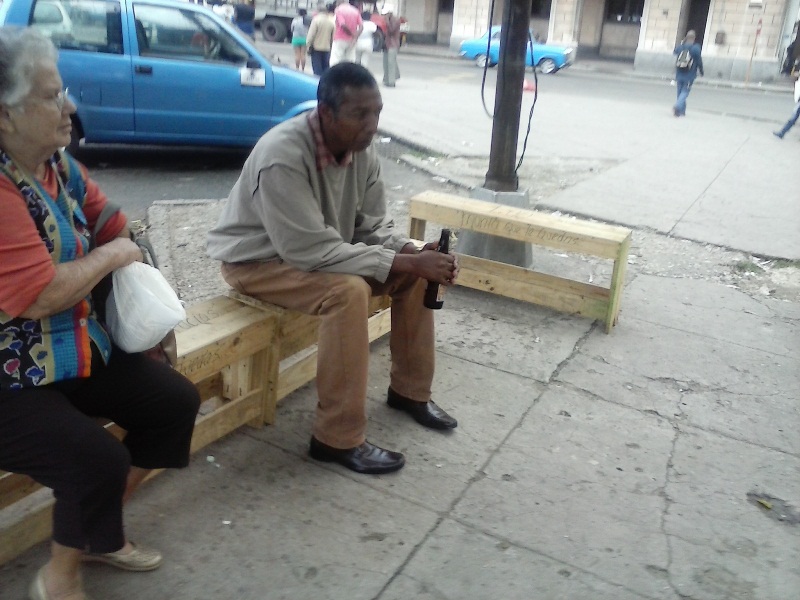
Two passengers waiting for the bus. Author photo.

HAVANA, Cuba, January 6, 2014, Ernesto García /www.cubanet.org.- In Curita Park, located on the block formed by the streets of Reina, Galiano, Águila and Dragones, in Havana, on the initiative a citizen, a seat rental service started  January 3 at the P-12 bus stop (served by articulated buses), for passengers traveling from this site to Santiago de Las Vegas.

The benches were built and designed to seat three people each. The experiment was done with three benches. The charge for their use is 1.00 pesos in national currency (CUP), or one centímino in freely convertible currency (CUC). Now all that’s lacking is for the owner to submit his proposal to the authorities who govern the system of self-employment, to get this activity on the approved list and pay his taxes on it.

The new service relieves the impatience and weariness of passengers who have to wait more than 20 minutes for a bus to take them to their destination, time during which they are exposed to the sun, the rain, the dust and the environmental contamination of toxic gases from traffic and the lack of hygiene and cleanliness in the place. All this given the inability of the appropriate organs, the transport cooperatives and the autonomous shared taxis that could roof the areas at the stops and maintain public facilities.

Ernesto Garcia Diaz

Cubanet | 6 January 2014

The Netherlands Asks to “Update” the Relationship Between Havana and the European Union

The Chancellor of the Netherlands is visiting the Island. The Glasnot in Cuba Foundation, with a site in Amsterdam, asks him to meet with the dissidence.

The Glastnost in Cuba Foundation, with a site in Amsterdam, criticized the Dutch foreign minister’s trip to Havana this Monday, and said that his visit “could only be successful if dialog is established with the whole Cuban society.”

“A dialog without contacts with the peaceful opposition will not be successful over the long-term,” said Kees van Kortenhof, president of Glastnost in Cuba, according to a communication released.

The Dutch NGO said it was surprised because, in association with the trip, the government of the Netherlands classifies Mariela Castro as a “defender of human rights in Cuba and in the world.”

Van Kortenhof said that description is “extravagant and ridiculous.”

“The president’s daughter limits her human rights efforts to gays, lesbians and transsexuals. Bloggers, political opponents, journalists, musicians and the Ladies in White are attacked, but Mariela Castro talks about them as ’despicable parasites,’” explains the Dutch organizations.

The chancellor Frans Timmermans asked in Havana, according to official media, for an “updating” of relations between Cuba and the European Union.

Timmermans cites, among the reasons for the development of ties, the “economic adjustments” implemented by the regime “the business possibilities these bring.”

During his stay, the Dutch minister signed a memorandum for the establishment of political consultations between foreign ministries.

DDC | Havana | 6 January 2014

6 January 2014

Harassment in Prison Simply for Thinking Differently / Angel Santiesteban

When on August 2 last year I was transferred from Prison 1580 and brought to the “Lawton Settlement,” a Ministry of Interior (MININT) enterprise dedicated to building the houses of its officials, they let me know that in this place there would be no visits nor phone calls. They urged me to work as a method of re-education and I would obtain the benefit of being able to get a leave every twenty-seven days. I immediately chose not to accept. Then they made me know that it would be every sixty days. I shrugged my shoulders. We are a group of twenty prisoners, among them are the crimes of “drug trafficking,” “murder,” “scams,” “arms trafficking,” “economic crimes,” “trafficking in persons,” etc.

In the daytime at the site there are a lieutenant colonel, who is the unit chief, and a captain in charge of production, both semi-retired, who perform the activities and with the power corresponding to their grades and jobs.

At five in the afternoon, at the latest, those responsible leave for home and we’re left with a civilian guard who puts a padlock on the barracks at ten in the evening. In a month through brought in another civilian to staff both ends of the establishment. The next month they sent in a sergeant who also stayed until five PM.

I continued to write my denunciations.

Then they placed a uniform who will keep us under guard twenty-four hours. Last night they brought in another. That is, in four months since I came, in addition to those already here, they have quadrupled surveillance on me. Now at night we have two guards and two soldiers, although the other nineteen aren’t in the unit for six days, they’re home. All for me alone!

So, the murderers and arms and drug traffickers have gone home to their families. However, the leadership has decided, unhealthily, to reinforce the surveillance against me obviously. Since the new uniform has come, he looks at me suspiciously. I feel his gaze on my back watching every movement I make, and when I’m in my bed, I see him watching me through the window to know where I am.

Obviously, they see me as a dangerous guy. The fear ideas more than firearms, drug traffickers or financial theft. However, I don’t complain about their sieges. With the cold blood I inherited from my mother I smiled.

This is my place as long as there’s a dictatorship.

Ángel Santiesteban-Prats

Lawton prison settlement. January 2014.

Editor’s note: The 19 prisoners left on six-day passes on Friday, 3 January 2014.

6 January 2014

Living Illusions / Yoani Sanchez

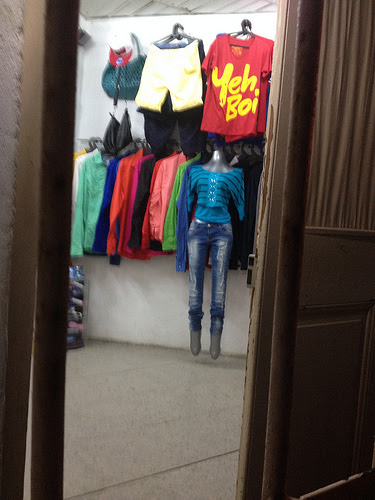
6a00d8341bfb1653ef019b045318a8970d-550wiAt midnight, she closed the door, turned off the lights, and ran her hand over the mannequins. December came to an end and with it her business in imported clothing. Like Helen, dozens of vendors all over Havana waited until the last minute of 2013 for some good news. But it never came.

The government maintained the unpopular prohibition against the sale of imported products. The deadline to liquidate the businesses in clothes and other accessories ended just as the twenty-one gun salute heralded the new year. Meekly, although muttering their annoyance, the proprietors of the so-called boutiques, collect their merchandise, take down their lit signs and advise their clients not to return.

The next day, along with the lethargy that comes after every celebration, the city also woke with a changed face. In the doorways where before the hangers flapped with shirts, pants and children’s clothes, there was nothing left. The rooms converted to dressing rooms had disappeared along with the racks which until last week offered sunglasses or scouring sponges. continue reading

Not a single vendor has challenged the order, not one has kept their stand open.

In parallel, there have not been any union meetings to demand compensation for the lost investments, nor protests demanding a permit that encompasses merchant activity. Not even the frequent buyers have raised their voices in solidarity with those who supplied them with cheaper, more modern and varied products than available in the state stores. All have remained silent.

The explanation for this frightened silence is obtained simply by asking. “Don’t worry, you’ll see that this measure will be rolled back,” some predict. Those believed to be well-informed because they have contacts in the government said, “In a few days they’re going to permit this and much more.”

The underlying message is chilling: “complain and it will be worse,” so “better to wait and not make problems.” Meanwhile, Helen has been left with her mannequins that no one looks at and with a four-figure debt.

The illusion of a possible step forward, slows the reaction to this step back. Those affected want to believe the State will rectify it. However, the real motive for such meekness is the fear of confronting power with their demands.

6 January 2014

The Improbable Recipe / Reinaldo Escobar

“The efforts to disseminate ideas that deny the vitality of Marxist, Leninist and Martí concepts, should be countered, among other methods, with a creative theoretical conceptualization of the possible conditions of socialism in Cuba as the only alternative with equality and justice for all.” Raul Castro, Santiago de Cuba, January 1, 2014

It’s rare that one finds a paragraph with so much substance with which to disagree. I would start by clarifying that what is countered should not be the efforts to disseminate specific ideas — something relatively easy to achieve with the traditional methods of confiscating books at the airports, blocking Internet pages, suspending telephone service or, as a final resort, unleashing the brutality of the rapid response brigades. No, the real challenge would be countering the ideas in question.

But the paradox is that, to reaffirm the vitality of the ideology that has “scientifically” proven the inevitability of socialism, one has to find a creative conception capable of theoretically sustaining the viability of socialism under current conditions in Cuba. Perhaps these paradigms of the century before last have lost their vitality and are now insufficient. continue reading

So as not to be too long-winded, I’ll pass quickly over the affront of equating the poet José Martí with Vladimi Ilych, which is like confusing love with hate or tolerance with resentment. What should not be passed over is that this pig in a poke is trying to set itself up as the only alternative offering equality and justice for all; and knowing the kind of equality and justice we can expect from such a system, we should be even less inclined to ignore it.

This is the second occasion on which the general who rules the country has launched an appeal to the intelligentsia in order to generate a foundation for what is already approved in practice, in this case the Guidelines of the 6th Congress. This should have been the work of the Party Conference (!) which, by the way, should have been held before the Congress.

This is forcing the master chef to swallow a rancid and badly chosen sauce and then asking him to write the recipe, as if it were an innovation, and all this to prevent the diners from enjoying the pleasures of new flavors.

6 January 2014

Happy 2014. And Sin EVAsion Turns Six / Miriam Celaya

Although several days late, I take advantage of a brief opportunity to connect to wish all readers a happy New Year and to wish them every success in 2014. As a special note, this blog is turning six years old around these days, so I intend to renew it in the coming weeks. I have been a bit away from this website due to other work commitments.

I was very busy during 2013 but greatly satisfied, including seeing the book Cuba in Focus published, which was co-edited by my colleagues Ted Henken and Dimas Castellanos and has come out in its English version. We aim to have it published also in Spanish, for better circulation in Cuba.

At any rate, we will continue move forward with our work, hopes and optimism.  I wouldn’t know how to face life in any other way. I will return soon, eager with new passing pursuits. Thanks and a big hug.

Translated by Norma Whiting

3 January 2014

Stuffed Toys / Yoani Sanchez

On the couch there’s a stuffed dog missing an eye and losing an ear. Thirty years ago he was the plaything of a little girl who now has two children. Neither of them is old enough to have experienced the ration market when it offered manufactured products. So when their mother explains that the dog was a “basic category” toy, they look at her as if she’s speaking Chinese.

For them, everything is different. Since they were small they’ve known that toys are only sold in hard currency. Sometimes when they go to the big market in Carlos III Street, they press their noses to the glass in front of a pink pony and a plastic house with a fireplace.

The two distinct generations are united by a similar unease. In her thirties she experienced the era of Soviet subsides and regulated distribution of everything… or almost everything. Her children, for their part, have lived in times of a dual currency system and scarcities. For her, Three Kings Day isn’t celebrated on 6 January, rather it was officially moved to July and given another name, but her children have seen the frantic rebirth of many traditions. continue reading

In the eighties the grandmother of that little girl with the stuffed dog whispered to her the story of Balthasar, Melchior and Gaspar. Once she grew up she taught her own offspring — openly — the ritual of the letter with requests and the water ready for the thirsty camels.

Today that girl of days past greets the dawn outside a toy store very different from those of her childhood. No employee will demand a ration book with coupons to tear out and checkboxes where the number assigned to each product is entered

Now there are convertible pesos — that hard currency she doesn’t receive her salary in — the only money that will give her children access to the dolls, the toy cars, or simply to some marbles.

She manages to buy a plastic flute and the tiniest stuffed dog. He has big floppy ears and blue eyes.

6 January 2014

Three Kings Day in Revolutionary Cuba / Orlando Luis Pardo Lazo

Three Kings
Photo: Waitingfortheword via Flickr.
Ask any Cuban child the question: “What are the names of the Three Kings?”

I still don’t even know them myself. I always forget one of them. Or pronounce their names badly.

Of course, ignorance is far preferable to insanity. Or rather, to the audacity with which I’ve heard more than one young kid (and even some that aren’t so young) say: “The Three Kings are Fidel, Camilo, and Che.”

Even our Catholic traditions seem to begin at that chapter of Genesis 1:1959, marked by the triumphant January of the Cuban Revolution. However, religious persecution on the island wasn’t satisfied with its history of expropriations, prisons, concentration camps, lifelong exile, shootings, and other barbarities. Right from the start, God fought a losing battle against Castroism, which is now in decline. But yet another defining phase is rearing its head: The phase of forgetting. continue reading

In a country without religious teaching in schools, where not a single clergy member has appeared in the media for more than half a century, there’s no point in waiting for a miracle.

In fact, it’s pointed out from time to time that on January 6, 1959 it was Fidel Castro himself who flew in a small plane over the Sierra Maestra, throwing down toys to the poor peasant children like manna from heaven.

“Without magic and without legends, but with struggle and with love, the Revolution will come without star-covered saints,” sang Pablo Milanés in one of the most beautiful ballads of the revolutionary epic.

How long has it been since anyone in Cuba reprinted or imported the Bible, even for profit?

Let’s not ask the Cuban children any of these questions. They are the future, and it’s not their fault that their predecessors have robbed them of so much.

Perhaps Pablo Milanés was right in his forgotten theme song “Día de Reyes” (Three Kings’ Day) when he sang: “Save your laughter for tomorrow and dry your tears, while freedom comes.”

Translated by Alex Higson

From Sampsonia Way Magazine | 6 January 2014

Self-employed Construction Workers: The Next Victims? / Orlando Freire Santana

sanlazaroAt this point few will doubt that in a totalitarian system like Cuba, centralized control of the economy by the state is inherent; and if the leaders agree to allow some space for private initiative, they do it as a tactical maneuver and not with strategic overtones.

This is demonstrated by government repression against certain private activities, especially when they expose the inefficiency of the state bureaucracy. In 1986, for example, the authorities banned the first version of Free Farmers Markets. The reason? Well, in those markets which responded to the laws of supply and demand, people could buy roots, fruits, vegetables and meat products that didn’t exist in the markets run by the all-powerful state.

Moving forward in time, the private owners of 3D cinemas had to close their establishments at the behest of the ruling party directives. According to the government, these cinemas showed films that were inconsistent with the cultural policies of the nation. However, everybody knows that the official Cuban Institute of Cinematographic Art and Industry (ICAIC ) was unable to equip their theaters with the technology used by individuals.

And lately we have seen them end the selling of imported clothing by the self-employed, who supply clothing more attractive than those sold in state shops. continue reading

All these elements give us a preview of what might happen to bricklayers, plumbers and carpenters practicing self-employment. During the most recent session of the National Assembly of People’s Power they reported on the failure of the plan to build homes in the state sector in 2013. In addition to poor planning and diversion of resources, the deputies argued that a major factor that led to the failure was the instability of the labor force in the sector, a instability caused, essentially, by the exodus of state construction workers towards self-employment.

To self-employment, although it is difficult

Giraldo is a bricklayer who left a state position and requested leave to work as self-employed. As stated, the main cause of these movements is the low wages
paid as a result of absurd payment systems that are used.

During his last semester in his contigent, neither he nor his fellow brigade could earn the bonus pay, due to the existence of a payment system that this mason could never understand.

The mechanism in question involves, in addition to the completion of the work objectives by the brigade, the salary bonus would only be paid if there was a positive correlation in the contingent between the increase in the average salary and the growth in productivity; that is, the growth in the second has to be more than the growth in the first.
Giraldo’s brigade met its work objectives, but the correlation described was negative, and with this the salary bonus went up in smoke. Giraldo didn’t conceive that a macroeconomic indicator, which does not always depend on the labor of the workers — in this case, the average salary was inflated due to excess administrative staff on the payroll — prevents the workers from being duly rewarded after such an arduous task.

Moreover, Giraldo mentioned abnormalities affecting other state construction workers, and they come to be discouraged, as the constant transfers between jobs — sometimes they start a new job without having completed the previous one — and so they paralyze their productivity because of the lack of aggregates and other construction materials.

When asked how he’s doing with self-employment Giraldo responded that not everything is rosy. For example, he must pay tax every month, regardless of whether or not he has work. However, as long as the authorities allow self-employment, he thinks he will not return to the ranks of the state construction workers.

However, in light of the information provided in the National Assembly, as well as what has happened to other self-employed people, it is not surprising that the political masters are devising ways to stop the drain of skilled personnel to the private sector. And it is very likely that they will not open pathways that promote the welfare of the builders within state enterprises, either with salary increases or improved working conditions; rather they will use the ways they  know very well: prohibitions or other administrative constraints.

The latter could include increasing the tax burden on occupations in the construction sector, and thus discouraging the move of workers into the ranks of self-employment. We will be watching to see what happens.

Orlando Freire Santana

From Diario de Cuba | 3 January 2014

Happy New Deception / Camilo Ernesto Olivera

55-aniversario-cabezalHAVANA, Cuba, January 6, 2014 / www.cubanet.org – Twelve midnight rang on 31 December, and 2013 ended. Havana said good-bye with its streets half-empty streets in Vedado and the speakers all reggaeton in the indigent heart of Buenavista. Apparently almost no one paid attention to the televised speech, where the government tried to wish Cubans a happy new year.

Nor were cheers for the Revolution heard, nor for Raul, and much less for Fidel. No one responded much to the fireworks on the Malecon, prohibited by law, but traditional, fired into the air.

According to what I was told by friends walking along by the exclusive clubs in the Playa area: “The music stopped, but so that everyone could join the chorus in the last ten seconds of the year. At 12, people burst into applause, hugged, and then went on dancing. continue reading

Throughout the night, a steady stream of small explosions, seemed like the shots of a 22 caliber..dominated the streets of Buenavista. Some “bomblets,” invented by guys who know how.  It was hard and loud. As if they knew what the firing squads sounded like five decades ago…

The tradition of throwing buckets of water into the street was repeated. People don’t lost hope that with the old year the evil will go. For others, the new year smells of new deception. The truth is in the street and not in the meetings of the Council of State: “Any reason is good enough for us to grab a bottle of rum or some beers. Why beat your head against the wall of what can’t be fixed?” So a group of young people, halfway to sloshed, answered me on the first day of 2014. One of them added, “For me, they closed the 3D cinema with which I was earning some pesos, I sold the plasma TV and the chairs, luckily I just stay in Cuba.”

Fin-de-año-2013-2-300x224“My mother gave me the money for the business from France but she warned me. That these people are cheaters, they say one thing today and something else tomorrow. She was always clear. It’s not worth investing a penny in this country, not even a penny, and much less a drop of your time. In the end, they’ll cheat you.”

I comment to them that it’s hard to find someone under forty who doesn’t want to emigrate. “The only people who count here are all those old people who are on Raul’s side in power.” “Aside from them, no one has the right to prosper and have a decent life.”

Someone else in the group said, “When I studied at Lenin Vocational, I learned where “Papa’s kids” went at the end of the year: Cancun Mexico, Punta Cana in the Dominican Republic. And naturally they let you go, because they know that the comedy of their grandparents is over and they live convinced that they’re going to inherit the country.”

Fin-de-año-2013-3-300x224“I asked Ochun for a Yuma (foreign) girl and it seems that she heard me, I’m “trabajando el paño” — he tells me semi-confidentially, one of those hustles that so abound here. He and another guy have hooked two German girls who are enchanted with the grace of the “Cubaniches.” I ask him about the future and what he wants for the new year: “I can sum it up for you in one sentence,” he answers, “that this cute blonde gets me a visa and guarantees my ticket with no return. That my old age doesn’t find me in this country.”

Fin-de-año-2013--300x224The wall of the Malecon is a historical melting pot of parties and lamentations. Walking around I met a group with a small speaker, taking and drinking. I asked them what they expect from the new-born 2014. “Nothing new, we have to continue to struggle with what there is,” one of them told me. “The return of the Five Heroes!” another jokes, and they all busted out laughing.

At that moment Cuba’s top hit came on, in the voice of the Puerto Rican Marc Anthony: “I gonna live, I’m gonna enjoy, live life…” and everyone sang along like a hymn. Perhaps this song sums up, despite everything, what a good part of Cubans expect from the new year.

Camilo Ernesto Olivera Peidro

From Cubanet | 5 January 2014

Pachanga* and Repression / Regina Coyula

vista-desde-la-azotea-de-sats

The schoolchildren brought to “repudiate” the Human Rights Conference at Estado do Sats

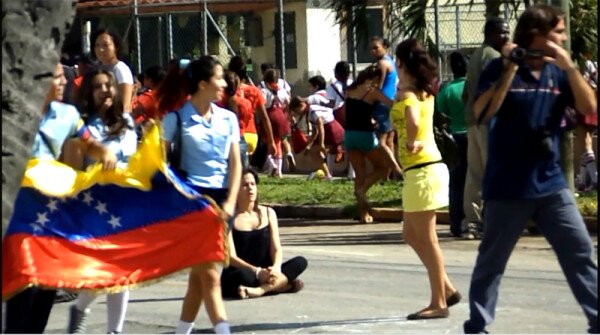
Organizing my version of this two-day International Conference on the UN Covenants, I keep coming back to the final images of the movie Godfather II. Over in South Africa, the world mourns one of the best politicians I’ve ever known. Our General-President, invited to speak at the mournful event, exalts the forgiveness and reconciliation that define the greatness of Nelson Mandela. While in Cuba, an impressive police and vigilante operation conscientiously lends itself to the task of criminalizing differences, of fracturing our broken society a little more.

As I have decided to behave as a free person, and my visitors last week sought to prevent my attending, advanced my arrival at the venue of the Estado de SATS by twelve hours. It might seem exaggerated, but around midnight a perimeter was established with access controls and by the early morning and there were people who could not come. The few who managed to evade controls reported on the numbers of people who had been arrested, and through text messages and other means we learned of more actions and arrests.

On the morning of December 10, the street in front of Antonio Rodiles’ house, the site of Estado de SATS, was closed to traffic for about 25 yards, and elementary, junior high and high school students began to arrive for festive activity on Human Rights Day, a reactive move by the government since five years ago when the opposition gained the initiative for this celebration. continue reading

The government’s ‘celebration’ was as hard-edged as are all such unspontaneous events; the children delighted to be at a pachanga (party) with music ranging from Silvio to Marc Anthony, and not in school. When the moods are warm under the cloudless sky of this December that denies winter, reggaeton or Laritza Bacallao can get the kids moving.

I imagine they were summoned for a celebration, or at best an act of revolutionary reaffirmation, and I wonder how many parents were consulted about the use of their minor children, among those who assumed they were in their classrooms.


Among the blare of the loudspeakers and the concern as reports came in about more arrests, the panel on Journalism and New Technologies was held. All the theory expressed by the panel is what we are living in practice and we also experience the lacks: Communication via text messages with Twitter and with friends and family, contact with media, documenting everything via audiovisuals, doors within and on the street; the lack of internet connections — once again — that tool that will not free us but that allows us to express ourselves freely.

By noon on the 10th, it was clear they would not allow anyone else to arrive, always creative in managing things, but if I left, I would miss Boris Larramendi on the following day.

The night was very peaceful thanks to the absolute closure of the Avenue in front of the house. From dawn on the 11th it was clear they were going to repeat the spectacle in the street. For those who believe in energy, I can assure you that the atmosphere in the house was admirable: some unknown only the day before, heterogeneous from any point of view. Scaling mountains makes men brothers, a Cuban dissident said.

The fright came at 11:00 in the morning when Ailer María González — artistic director of Estado de SATS– left the house to walk among the small children who had been encouraged to paint on the street in front of the house. Camera in hand, Ailer walked among them without distracting or bothering them.

Immediately, to political police paparazzi surrounded here and Antonio Rodiles and Gladys, his mother, approached from one side and a group of plainclothes and uniformed police from the other. They exchanged words in the midst of the music and it seemed everything would be fine, but in front the sidewalk door to the house, Kizzy Macías, from the Omni-Zona Franco artistic project, was filming and a woman dressed in plainclothes came up quickly from behind and snatched the camera.

Like in the movies, everything seemed to slow down. The videos show it better and I hope they have been distributed on the web thanks to the solidarity of five surprised students from the Semester at Sea who were thinking about an art project and came face to face with the face of the wolf disguised as Little Red Riding Hood.

Ailer sat down in the street as a protest and Antonio’s phone rang on the table. I answered the calls from whomever, because of the arrests of Rodiles, Kizzy, the journalist Calixto Ramón Martínez and the computer whiz Walfrido López went viral on the social networks. And then I went to the kitchen to make lunch for more people than I’ve ever cooked for in my life, me, who is a very lousy homemaker. Being busy kept me calm.

The poster exhibition and the concert began under major uncertainty. Arnaldo and his Talisman and Elito Reve with his orchestra threatened a thunderous night and they played with enormous amplifiers from the street. What can I tell you. I must have been in a ridiculous state singing along with Boris on all the songs and rapping with David D’Omni. At my age I don’t often feel myself to be young, but last night I sang for my son and for all who couldn’t be there.

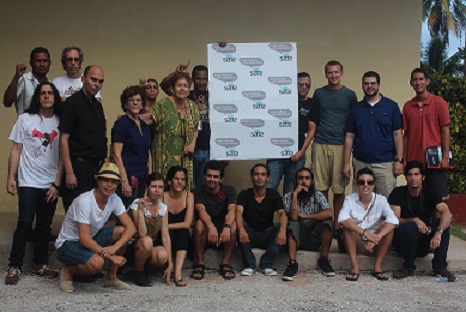
If prayer has any value, it had it last night, because the prayer of many was that the concert would end without incident and a total downpour, what we call a “water stick,” canceled the activity planned for the street. In closing, our arrested friends showed up at 8:00 at night, and I have no idea what time it was when we took the photo that informally closed this eventful meeting.

After the return of those arrested.

I was afraid. Afraid for Ailer advancing against the crowd in an image that will stay with me when I have forgotten many thing, afraid for my arrested friends who had been treated with the violence born of hatred, afraid for Gladys, the owner of the house, a woman of steel but not a healthy one, afraid because that was the preamble of more, and afraid for myself, not even having a phone at that moment to communicate with my family, who knew nothing of the situation.

Afraid because it’s one thing to be told about it and another thing to see it, and something very different entirely to experience it first hand, which was not what happened in my case. I had a glimpse of the dirty face of repression. But just that. This fear set off an enormous rush of adrenaline, which is certainly bad for my physical health; but for my mental health, there has been a before and an after.

*Translator’s note: Pachanga is a “festive, lively style [of Cuban music] and is marked by jocular, mischievous lyrics.” (From Wikipedia). The word also applies to the party itself.

13 December 2013

Booby-trapped Roofs / Pablo Pascual Mendez Pina

It was the evening of November 29, it was still raining in Havana and Rebollar Augustine, a retired 71-year-old resident of Vedado, stood crestfallen covering his face with his hands so no one would see him cry.

His mattress, appliances, clothing, furniture were all wet and to worsen his mood, his neighbor below started to shout insults when her roof also started to leak.

At an impasse in the downpour, Rebollar looked at the sky with the hope that the storm clouds would disappear, but the downpour increased and he furiously began stomping on the floor and yelling obscenities to let off steam.

Manuala, Olimpia, and Barbarita — neighbors of Rebollar — suffered under similar storms, and after the collapse of a connecting wall of their apartment, the police drove them to a shelter in the town of Boyeros, where they remain permanently evacuated.

Unfortunately, Fidel Vega and Pastora Góngora, residents of 619 Campanario Street in the municipality of Central Havana, died after being suddenly crushed when their dwelling collapsed. continue reading

There were countless victims and more than 2,000 evacuated due to the intense rains after the arrival of the fourth cold front of the current season.

In 72 hours the precipitation reached 300 millimeters (11.8 inches) in the northern municipalities of the capital, causing a catastrophic 227 collapses, 201 of which were partial and 26 of which total, according to government figures.

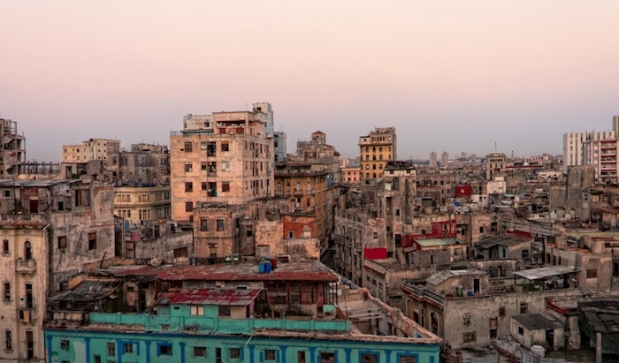
“Our ceilings are booby-trapped,” warned some of the capital’s residents in reference to the possibility that the downpours could cause their roofs to cave in. “Havana is like a sick old man,” noted others, meaning that the city recovers from one slump only to suffer from another.

In the prologue to the most recent edition of The City of Columns by Alejo Carpentier, Dr. Eusebio Leal portrays it as: “The city of the unfinished, the lame, the asymmetrical, the abandoned.”

In an study by María del Carmen Ramón entitled “Havana Is Expensive But It’s Worth It,” published in the online magazine Cuba Now, the architect Mario Coyula, the city’s director of architecture and urbanism, presented a more realistic and frightening image the capital’s future:

“Havana could end up being a Dante-esque vision, a great ring of piled-up trash or an empty crater where a city once was.”

 The solution is the problem

Coyula points out that, if we look at the scale model of Havana, we will notice that the color yellow predominates. This color coding is used to designate areas of urbanization from the first sixty years of the 20th century.

We can therefore surmise that, since then, the socio-economic development of the capital, judging from housing construction, has been poor.

In hindsight, we can see that only Alamar, San Agustín and some areas developed by micro-brigades have been added. The population density increased, however, and with it has come overcrowding, especially in Central Havana, which has about 1,000 inhabitants per hectare*. If we take into account the area’s many low-rise buildings, this suggests that people are practically living on top of each other, like canned sardines.

Coyula notes that Havana still has the same infrastructure it had early in twentieth century, as exemplified by the case of the aqueduct. Now a hundred years old, much of it has collapsed. Its pipes were providing service to 300,000, though it was designed for twice that capacity.

Today the city is home to over two million people and requires heavy investment if it hopes to curtail the sewage spills running through its streets.

Coyula recalled that in a very interesting meeting with a development group in the capital many years ago a specialist from the Ministry of Construction said, “It will cost $3 billion to fix Havana.”

“But the cost is much greater,” claims Coyula. Havana is expensive but worth it and the only way to solve its repair problem is to find a way it can generate money for itself, as Eusebio Leal did with his Historic Center project.**

For 50 years the Ministry of Construction (MICONS) ignored building maintenance of the housing stock. Although the National Housing Institute (INV) created companies to deal with this, its efforts did not meet demand and instead it began shoring up housing in poor condition as a solution to the problem. This solution, however, proved inadequate, confirming that the approach to the problem was misdirected.

“Current home construction is only intended to replace those dwellings that have collapsed,” Coyula points out, “but government cannot be the only sector responsible for solving these problems. People cannot just wait passively for the paternalistic state to fix their house or build a new one.

“Similarly, the new law which legalizes the sale of houses could have a positive effect. It could encourage people to take care of their properties, not just their roofs, because it is an asset that at some point in time could be monetized.”

Coyula’s views are not shared by everyone. Fermín Álvarez, a 52-year-old economist, questions the feasibility of generating more than three billion dollars to fix the city’s problems given the failure of the current economic model and a monetary system made up of two weak currencies, factors which inhibit interest from foreign investors.

Similarly, Alvarez points out that the regime seems more preoccupied with squelching the self-employment sector, which represents a mere 2% of Cuba’s GDP according to official estimates, rather than encouraging individual initiative and development of the non-state sector, which could generate revenues for public services.

An ex-director from the former Ministry of the Materials and Construction Industry (MIMC), who requested anonymity, describes the law legalizing the sale of residences as a subterfuge by the regime to free itself of responsibility.

“For more than 50 years the government was the real owner of all homes, preventing the ’inhabitants who use them’ from selling to other individuals. They could only sell them to the state, which shamelessly took it upon itself determine their value,” he says.

“This situation caused many buildings to deteriorate, especially multi-family homes. After all, if the state was the owner, then it was also responsible for the upkeep.”

The shortages and high prices of construction material in Cuba are a consequence of a decision by the government to set aside most of these products for export and as aid to regional trading blocks while giving lower priority to the domestic market.

A 42 kg bag of cement costs 6.60 CUC (or dollars), the equivalent of half the average Cuban’s monthly salary of 15 CUC. How many people who depend on a salary can make such an investment and still be able to eat?

In addition, there is the purchase of other materials. But the most expensive is the skilled labor to undertake the repairs. “It would be delusional to believe that with the weak credit offered to the most vulnerable people reconstruction costs would be covered, after over 50 years of mistakes and stupid prohibitions by the government,” says the former director of MIMC .

Unexpected

Ninety percent of those affected by the weather event  that occurred on the 28th, 29th and 30th November, say they were surprised by the rains.

They note that the Institute of Meteorology offered a softer forecast, and nothing alerted the public about the possibility of heavy rains, with over 300 mm (12 inches) in the northern municipalities, which would resemble a “bombing” as those regions present the greatest construction problems in the capital. Nor were there any special announcements to keep the population informed.

Nor did the Civil Defense agencies — given their vertical structure — alert anyone nor offer information to support the victims. Hence, 95% of those consulted said there was indolence that caused unnecessary risks and loss of life.

I said “good-bye”

Agustín Rebollar said that on this occasion the downpours never let up so that he could climb to the roofs and sweep our the drains, as he usually does in such cases. He said that to waterproof the roof he’d applied cement aggregates to plug the leaks, but he didn’t know whether or not he did it right.

“If at least they’d show something on educational television to teach us how to do it,” he said, “I myself would do it, despite my 71 years, because with the 270 Cuban pesos (11 CUC), they pay me as a pension, I can’t afford to pay a mason.”

Inside his home, Rebollar shows a beamed and tiled ceiling, arched and covered in slurry for the dampness, which hasn’t come down thanks to a shoring up with wood logs.

“The next time, if there is a next time,” resolves Rebollar, “I will be forced to do what the deceased Álvarez Guedes recommended: Give myself a kiss on the ass and say good-bye.”

Pablo Pascual Méndez Piña | Havana | December 16, 2013

From Diario de Cuba

Translator’s notes:

*According to Wikipedia, Havana overall has a population density of approximately 7,500 people per square mile; Old Havana has a population density of 63,500 per square mile. This is higher than that of Kolkata (Calcutta) India. The density for Central Havana reported here is about 260,000 per square mile; Wikipedia reports the density for this area (possibly for different boundaries encompassing a larger area) as 102,400 per square mile; even at this lower number, of all the cities in the world only Manila has a higher density on a city-wide basis.

** In 1982 the historic center of Havana was designated a UNESCO World Heritage Site and became eligible for funding for its preservation. Tourist taxes are also dedicated to this purpose.

16 December 2013