Children Selling Bread to Survive / Cuban Community Spokespeople Network

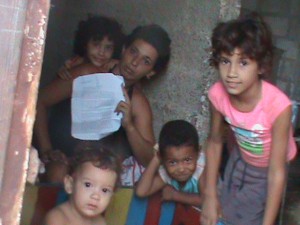
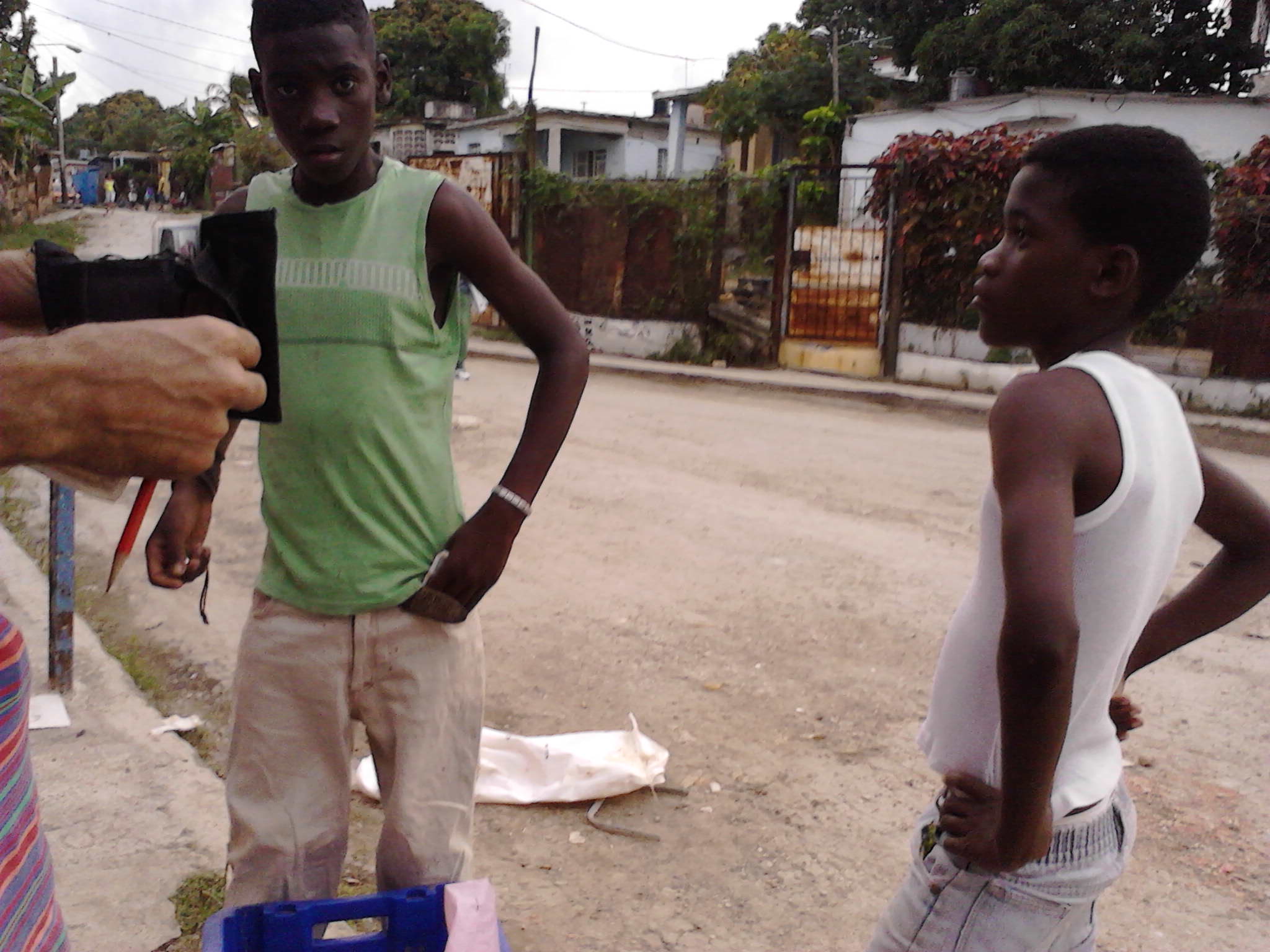
Children selling bread. Photo by author.
HAVANA, Cuba , January 9, 2014 , Michelena Juliet Diaz /  Cuban Community Spokespeople Network / www.cubanet.org.- On the streets of the neighborhoods of Luyanó Moderno, Vista Hermosa, Monterrey and Capitán Núñez, in the municipality of San Miguel del Padrón, children between 10 and 12 years are involved in selling bread for a living.

When asked, “Why do you sell bread,” they said their parents are paid very low wages so they can not afford to buy them what they need: clothes, shoes , food, and other necessities. They explained that after returning from school they go to the bakeries which supply the bread (on the black market) below the State price, for them to sell on the streets.

They say they can’t spend as much time studying as they want, but they sell bread to get what they need, and don’t commit crimes like other children they know.

The children say they often have to hide from the police, because this type of sale is illegal, in the first place because they are minors.

Children often say that they have to hide from the police , because this type of sale is illegal in the first place because they are minors. One of these children, named Pedro and known by the nickname “El Ñao,” explained that many times they are cheated by adults who don’t pay them or who withhold some of the money they should pay.

The business consists of buying 30 bread rolls, 60 grams each, for 15 Cuban pesos, and selling them for a peso each.

Cubanet | 9 January 2014

The “Murderous Law” Which Allows Many Cubans to Eat / Manuel Cuesta Morua

Havana, Cuba,November 2013, www.cubanet.org.– The Cuban Adjustment Act generates a lively controversy on both sides of the Straits of Florida. For the government it is the cause of indiscriminate exodus by Cubans to wherever, and for some of the exiles it constitutes the best escape valve which the regime utilizes to ease its tensions. Another sector inside as much as outside of Cuba considers it a means directed at protecting Cubans from a double abandonment: territorial and by the State.

Curiously this last sector is the only one that demonstrates a nationalist sense when defending the measure. In effect, protecting its nationals in any circumstance shows a vision and foundation that is appropriate for nationalism over ideology and that deserves to be applauded.

This regardless of abuses of the law.  It is true that we Cubans have been taking advantage of this law in two ways: as political refugees, which is not true in a great number of cases, and as a source of economic sustenance for our families, which explains why many Cubans avail themselves of the law to search for an economy that the Cuban regime does not permit to be built. And the effects, it is clear, have been debilitating. continue reading

Here then is a dual judgment: about the responsibilities for the situation created and about the responsibility of States to protect their own nationals. These two responsibilities fall on the Cuban government. The right question should be, in turn, the reasons why Cubans leave the country.

And the appropriate response, on the part of the Cuban government, should be to to applaud a law that protects its own citizens. It should not appear that the United States protects Cubans more than their own State. No national State should protest when its citizens are well received by another nation. Especially when half of the resources with which it operates originate in the United States.

On the other hand, the protests originating in the United States against the law are not consistent. It seems to me that it was always clear that those who avail themselves of the Law are not necessarily political refugees. In any case, one could suffer political persecution for trying to stay in the United States, if one were returned to the island, but very few cases qualified in the strict political sense of persecution by a State. For those cases there exists a political refugee category that the United States grants in Havana.

My analysis ends then with these two ideas: the political refugee category as much as the Cuban Adjustment Act deserve to be discussed but for reasons beyond those offered. The political refuge should be discussed so that it is granted to those who really deserve it. The Cuban Adjustment Law should be revised in light of the immigration changes that both countries have introduced in relation to Cubans.

That dual overhaul can facilitate an immigration regulation that answers the interests of both nations, the reality of family ties on both sides of the conflict and the protection of Cuban nationals in quite difficult economic and social circumstances. But to eliminate the Cuban Adjustment Act would be counterproductive for the legal control of the migratory flow. In the end, for good or bad, Cuba and the United States have shared and it seems will continue sharing a common special destiny. A fact that, paradoxically, the Cuban government itself recognizes when it implores, almost cries, for the elimination of the economic embargo, which is not a blockade.

Manuel Cuesta Morúa

Cubanet, 28 November 2013

 Translated by mlk.

Spanish post
29 November 2013

Canadian Intellectuals for Freedom of Expression Honor Angel Santiesteban

They were ten writers in Quebec who supported ten writers imprisoned and persecuted in their countries and they expressed their solidarity during the 14th edition of the event “Books like air” that is celebrated in the “Montreal Salon of the Book” November 20-25, 2013.

Amnesty International, Pen International of Quebec, and the Quebec Writers Union (UNEQ) joined their voices to denounce those abuses and to commemorate the International Day of Imprisoned Writers, held annually November 15. continue reading

The ten imprisoned writer so honored and the ten Canadian writers who represented them were:

Marie-Célie Agnant avec Dieudonné Enoh Meyomesse (CAMEROUN)

Germaine Beaulieu avec Li Bifeng (CHINE)

Jean-Paul Daoust avec Jabeur Mejri (TUNISIE)

Jean-Pierre Davidts avec Raif Badawi (ARABIE SAOUDITE)

Gaétane Dufour avec Angel Santiesteban-Prats (CUBA)

Karoline Georges avec Dolma Kyab (TIBET)

Pierre Ouellet avec Akram Aylisli (AZERBAÏDJAN) Invité d’honneur du Salon du livre de Montréal et porte-parole de Livres comme l’Air

André Roy avec Somyot Prueksakasemsuk (THAÏLANDE)

Neil Smith avec Vo Minh Tri et Tran Vu Anh Binh (VIETNAM)

Kim Thuy avec Mohammed Al Ajami (QATAR)

Here you can see the complete event:


8 January 2014

The Silence of the Lambs / Angel Santiesteban

After reading “The ’correct’ intellectual of the Revolution” last December 20, by the independent journalist and human rights activists, Roberto Jesús Quiñones Haces,making a tour of the silence of UNEAC (Cuban Writers and Artists Union), which makes it complicit with the dictatorship, the saddest thing is that the majority of its officials who run it, were persecuted, humiliated, censored, and today, although it’s impossible to forget, they pretend that they do, and publicly support the arbitrariness and injustices of the government, the same ones committed against them, with the difference that they think that today they are not the ones who are going to pay with their skins, so they don’t alarm themselves.

In the small circle of injustices that were committed against me on October 30, 2012, at the rigged trial in the First Chamber of the State Security, at their special site at Carmen and Juan Delgado, in Vibora, Miguel Barnet, current president of UNEAC, sent to the lawyer of the artistic institution and “NGO”, and the official and poet Alex Pausides, to attend as witnesses. I couldn’t hide my surprise at his presence on behalf of Barnet. The lawyer and the poet, later at the hearing, leaving the court and in front of family, saying that I could never be condemned because there wasn’t the slightest evidence against me, on the contrary, they had presented five witnesses in my favor, meanwhile the “plaintiff” fell into contradictions and gaps. They were convinced I would not be sentenced.

Then came November 8th, a week after the hearing and I was awaiting sentencing, we protested in front of the Acosta police station, demanding the release of Antonio Rodiles and several opposition attorneys, who had been arbitrarily arrested. continue reading

We were savagely repressed by the henchmen in service to the dictatorship. The beating was captured on a video that made it to the Internet. That day I learned from the mentally ill agent Camilo that I would be sentenced to five years in prison, that it before the sentence had been passed by the court.

My sentence was already decided by State Security, and my presence at the event was just a simulation. It was obvious that the government would not accept the criticisms in my blog, my presence at demonstrations, then the open letter to Raul Castro, and the ultimatum that if they wouldn’t release Rodiles, we would go again to the police station and another confrontation would occur.

It’s true that UNEAC tried to intercede, for which they met with my attorney and my family. The attorney and the poet were surprised by the sentence, no less than five years. But the institution was immediately silenced by the former minister who today is an advisor to the President, Abel Prieto, who made it known that I was a counterrevolutionary and he would do nothing to help me.

In the next visits of my family to the site, the officials and the lawyer, poets nd artists in general who found themselves facing the institution, began to withdraw, “not me,” was their response. The instinct of solidarity disappeared, and they began to show their surly sullen sides and without wanting to found themselves between a rock and a hard place. They preferred to compromise with their conscience. Thanks to these agreements, the regime just celebrated fifty-five years in power.

One day it will come to light, as always happens, how, what and who drove my imprisonment and who shackled the Cuban Writers Union. To support the injustice of the government, Abel Prieto, personally, with the head of the Retamares family, and as the poet says you have to be careful, he prepared “8 women” who worked to get signatures against me, as a political play. They, and some committed and others terrified, from the headquarters of UNEAC, worked to cast more mud on the institution and their lives, before the cowardly gaze of the majority of their members. We expect that history will put each one in his place.
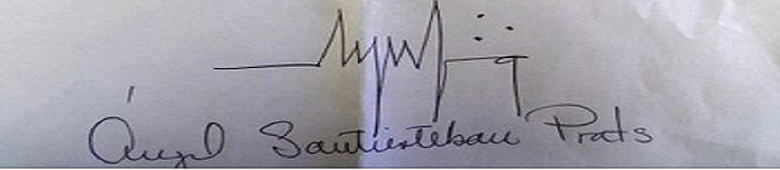
Ángel Santiesteban-Prats

Lawton Prison Settlement, January 2014.

8 January 2014
Armageddon of the Self-employed / Hugo Jose Fernandez

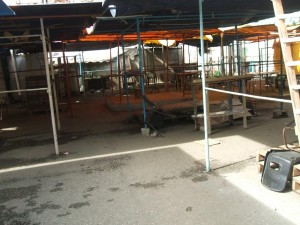
2.-Feria-de-cuentapropistas-de-la-calle-Rayo-300x225HAVANA, Cuba , January 8, 2014 . www.cubanet.org – We’re told that a picture is worth a thousand words. It need not be always true, but it is certainly in the case of Armageddon that has passed over the stands of Havana’s self-employed at the beginning of this year. Furthermore, it’s not about any particular imagine, it’s the sad representation of a new low blow dealt by the regime to ordinary Cubans, people who despite abuse and deception without let up, from birth to death, and still they raise their heads in vain every time they see the slightest reef.

There must be thousands of self-employed who started 2014 without even minimally remunerative formal employment, and without hope of recovering it, after being made to believe that at last they had it. The result of an extensive tour I made last Tuesday through Havana’s streets, looking for photographic evidence of this new regime bungle, leaves me dismayed. continue reading

Hundreds of stands and cubicles, fairs and whole blocks dedicated to proprietary trading in central streets such as Carlos Tercero, Belascoaín, Reina, Galiano, Neptune, Monte … were dismantled overnight in response to official regulations prohibiting selling imported clothes and shoes, and pieces of hardware and equipment, among other items. The spectacle recalls those war movies which show cities after they’ve been invaded and sacked by barbarian armies.

Playing with fire

This, and not the false freeing up of car sales, is the news in Cuba today. Although the official media hasn’t published even a short note, which is the height of submission and proof of their complicity with the “permanent campaign of subversion” and “pessimism about the future,” which according to Raúl Castro, the enemy (ie, themselves) has introduced among us.

They are playing with fire. Just because it’s been it before and nothing happened, we shouldn’t stop repeating it. Knowing that those thousands of now unemployed “self-employed” will again seek financial relief in the the sewers of the black market, does not preclude recognizing the enormous frustration and anger they experienced, not less, certainly, than that felt by their clients, which is almost the entire population of Havana.

The regime should have foreseen it, since they’re strolling now among the dismantled stands of every self-employed marketplace, doing the dead fly, individuals clearly planning to stand permanent guard. Police in plain clothes? Businessmen trying to fish in troubled waters? Militant communists members of the paramilitary troops. A little of everything maybe, and all mixed up. But the truth is that the mood is tense, like high voltage wires.

Cubanet | 8 January 2014

Preface for an Economic Study / Cuban Law Association, Eliocer Cutino Rodriguez

Eliocer Cutiño Rodríguez

As an attorney, to speak in economic terms is a litmus test or a tightrope walk, and which both situations demand respect for a central issue in the lives of other social spheres in which man intervenes.

I will not elaborate further, I will comment as to my views on the new, but limited, economic opening that is being talked of in the country today.

The current environment of small and smaller private Cuban businesses, as we can not speak of medium enterprises, are generally characterized by lack of rights of the owners, higher personal income taxes and sometimes for alleged profits are actually received by the self-employed. continue reading

Similarly, the lack of legal power and along with this, of institutions that guarantee impartiality toward the breach of contractual obligations, require a third party does that not respond to the state interests and serves as a mediator with potential conflicts.

If to this we add that the practice requires efficient and accessible accounting programs, due to the lack of basic training to meet the new challenges and the lack of expertise in performing the activity; elements that objectively hinder the essence of the establishment and management of a business for its development.

Until these constraints are resolved, the platform on which these controversial private forms are erected is born crooked, and to paraphrase the old saying, if one builds on a such a platform it can never be straightened.

23 December 2013

Discordant Note / Cuban Law Association, Eliocer Cutino Rodriguez

Eliocer Cutiño Rodríguez

The issue of development in Cuba goes back and forth between dissimilar solutions, between truths and errors, heading toward new labyrinths that contain new and more complex situations difficult to control with a simple decree.

Last year Decrees 305 and 306 were issued in order to establish as a source of law a rule which itself shelters disadvantages with exclusive principles of new forms of non-agricultural cooperatives.

Centralization for approval undermines the facilities they could count on and sets aside the purely local interests for those they will create, considering that they are also municipal and provincial local bodies, and are evaluated by the Standing Committee and Council of Ministers. continue reading

There are limitations regarding the hiring of workers which could be up to three months and therefore work and wage instability for those who can not continue working under these conditions, limiting to short cycles the work periods without there being a legal justification for this impediment.

Finally I will suggest that possible criminal situations could arise from not guaranteeing the wholesale market inputs for the activity to cushion the difference between the state and private sectors, greatly exacerbating the competition as an intrinsic form of development of productive relationships.

30 December 2013

Disconnection / Rebeca Monzo

The last days of last year and the first of this year, I’ve been in a state of limbo without news from outside, except now and then when, putting my ear to the radio speaker and trying to ignore the screech of the interference, I’ve managed to hear fragments of programs from Radio Marti, plus some news that comes by mail from abroad, like the one that brought me the crazy list of cars and prices that the Cuban government is trying to sell to us, a population with an enormous difficulty in buying a quart of olive oil because the price is so high.

Why don’t they devote resources to solving the great problem of housing instead of bringing cars which, given their brands and prices, make us suspect they’re the result of shady deals, given the craziness of trying to sell them in our country? Where are the auto repair shops and the parts, as well as the personal capacity to maintain them, in case some crazy person decides to buy a car instead of an apartment for the same price?

I’m desperate for our friends — who, in solidarity, give us a few hours of Internet each week — to end their much-deserved vacation so that we can return to connecting to the real world.

8 January 2014

Alchemy and Lies / Yoani Sanchez

“The Alchemist” – Oil by Mattheus van Hellemont

We live in a society of alchemists. They don’t turn iron into gold, but they are skilled at replacing ingredients and adulterating almost everything. Their goal is to cheat every client or to steal from the State itself. To achieve this they use even Mendeleev’s periodic table in search of elements that can be replaced by cheaper ones.

Some of these ingenious formulas deserve an Anti-Nobel in Chemistry, especially for their negative effects on human health. Such is the case with a lengthy recipe for tomato sauce that includes beets, boiled sweet potatoes, spices, cornstarch and red hair dye. When a curious observer asks, “And the tomato?” the inventors respond, almost scolding, “No, there’s no tomato.”

So the streets are full of glue sticks that when you press them only contain air. Bottles of shampoo mixed with clothes-washing detergent. Soap with plastic shavings added by the employees at the factory who resell the raw materials. Bottles of rum that come off clandestine production lines with hospital alcohol and burned sugar to simulate aging. Bottled water, refilled from some tap and offered for sale on the shelves of many markets. continue reading

Needless to say the imitations of Cohiba cigars and other brands are sold to naive tourists as if they were authentic. Nothing is what it seems. A good part of the population accepts these deceptions and feels a certain solidarity with the cheaters. “People have to live somehow,” they justify, with even the most injured treating it like a joke.

Within the long list of what is falsified, rationed bread occupies first place. This is the most adulterated product in our basic food basket, its formula lost decades ago due to standardization and the diversion of resources.

In the bakeries, the “alchemists” have reached the heights of true genius. They add huge amounts of yeast to the dough to make it rise so much that we get “air bread,” which leaves us with sore gums and unfilled stomachs. And don’t even mention the substitution of baking flour for other uses in the making of pasta and noodles. With this process we end up with something in our mouths that is hard, dry and flavorless. Best not to look before you eat, because the appearance is worse than the taste.

If Paracelsus were resurrected, he would have to come to this Island. He would learn so much!

8 January 2014

Strong Surveillance in Prison of Writer Angel Santiesteban / Dania Virgen Garcia

HAVANA, Cuba, January 7, 2014, Dania Virgen García / www.cubanet.org.- From the  Lawton prison settlement belonging to the Interior Ministry (MININT), a center that oversees construction materials for the manufacture of military housing, writer Angel Santiesteban Prats told this reporter that he is being subjected to arbitrary measures, and harassment.
On 4 January, a group of 19 prisoners was released on passes — prisoners who are being punished for crimes such as drug trafficking, murder, fraud, arms trafficking, economic crime, and human trafficking, among others. Santiesteban was alone with two guards and was watched around the clock. Shortly thereafter, in order to reinforce the monitoring, a jailer was sent from the Valle Grande prison, who stood in the doorway of the barracks from four in the afternoon until the following morning.

From the time he arrived, the new jailer watched him with suspicion, and the writer saw him several times, especially in the morning, watching him through the window of the barracks. This continued until the next day .

On the morning of the 6th, this jailer was reinforced with the arrival of another. The two guards are standing next to the third guard at the entrance of the barracks.

With the two mentioned above this is the fifth time the writer has been subjected to this arriving at the prison settlement on August 2nd. The famous artist accused of domestic violence and condemned to five years in prisons, expects to be subjected to an additional guard in a few days.

dania.zuzy@gmail.com

7 January 2014

Hablemos Press Correspondent Arrested

HAVANA, 7 Jan 2014, Hablemos Press / www.cubanet.org — Yesterday the correspondent Luis Ignacio González was arrested by the National Revolutionary Police (PNR) while taking pictures and conducting interviews with passersby in Miramar about the sale of cars.

González was taken to the 5th. Police Unit in Playa, where he was detained several hours under interrogation and threats by an agent who identified himself as Luisito.

It is the second arrest of a Hablemos Press correspondent this month. Pablo Morales Marcán was arrested on 3 January in Obispo Street, in Old Havana, Havana, after offering comments to the Radio Martí.

7 January 2014

The Commander Erased from the Currency / Roberto Jesus Quinones Haces

Hubert Matos does not appear on the bill. Photo by the author

GUANTANAMO, Cuba, January – www.cubanet.org These days, as every year, young activists of the UJC (Communist Youth), FEU (Federation of University Students) and veterans of the rebel army, reenact the trip from Santiago de Cuba to Havana made by the then young and hopeful commander-in-chief Fidel Castro Ruz with other guerrillas.

The entry into the capital on January 8, 1959 which was called the Caravan of Freedom, was an extraordinary historical event that filled the people of Havana with joy, as it had hundreds of thousands of Cubans along the way to whom they promised the restoration of the 1940 Constitution, the civil and political liberties Batista had taken away, and free elections after the tyrant was ousted.

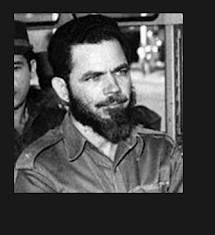
Huber Matos then
Huber Matos then

Also in these days, the TV re-broadcasts a video about Fidel entering Havana and, although the images have been edited, the informed spectator knows that the guerrilla appearing briefly to the left of Fidel is Commander Huber Matos. Today, few young Cubans know who Huber Matos was, perhaps because he was only referred to with the epithet of traitor from October 1959, which the Cuban leaders saddled him with.

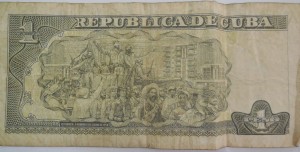
So they ignore that on the back of the One Peso (CUP, not convertible) bill where the screened imaged of Camilo and Fidel appear, there should also be the guerrilla commander in adherence to historical truth, the same one who Fidel mentions in his concept of Revolution. continue reading

These young people are also unaware of the importance Huber Matos had in strengthening the guerrilla struggle in the Sierra Maestra and in organizing the supply of arms and his decisive influence on the guerrilla victory. They ignore the role played by the Column No. 9 in taking Santiago de Cuba, always minimizing it, and that this Cuban who was born in 1918 was the quickest to reach the rank of commander of the Rebel Army.

Huber Matos now, in exile in Miami

Also are also unaware that once the revolutionary triumph was achieved, Huber Matos was perhaps the only commander who requested clarification from Fidel Castro about the direction the revolution was taking, as unmistakable signs of Communist penetration in the military and in all structures power of the revolutionary government were already apparent, which was vehemently denied by Fidel Castro in the trial that began in late 1959 against Huber and a group of rebel officers, a few days after the mysterious disappearance of Camilo Cienfuegos.

For the young people today are reenacting that journey of that Caravan of Freedom, they are also unaware how difficult life has been for the former members of the Column No.9 who decided to stay in Cuba, many of them discriminated against for the mere fact of having fought for the restoration of democracy in Cuba under the direction of Huber Matos.

Some day, when all sources are consulted and analyzed and the people have access to them, the history of guerrilla period and period after 1959 can be written objectively. I am sure that then the name of Commander Huber Matos will not be accompanied by an unfair stigma.

A man cannot be accused of being a traitor when he risked his life for the good of the country, not to mention when he remained consistent with the democratic principles that led to the Cuban Revolution and are reflected in the Moncada program and the Covenants of Mexico and the Sierra Maestra.

Roberto Jesús Quiñones Haces

Cubanet | 8 January 2014

The Eye of Cubanet / Frank Correa

Venus Bustamente and her family

HAVANA, Cuba , January www.cubanet.org – In 2013, I had two clear references to the attention is paying to the allegations of some independent journalists, divulged in the fee media, especially the digital.

The first occurred in October, about the case published in Cubanet about a young single mother named Venus, who lives with her four children, her father and her brother, in total overcrowding and misery, in a small room on 232 Street, in Jaimanitas.

Venus’s father and brother are occupationally disabled — mentally ill — and she has claimed support for her two daughters from a nephew-grandson of the diseased president of Venezuela, Hugo Chavez, a young man who while studying at the Latin American School of Medicine, had a six-year relationships with Venus.

As of today, she has not received a response from the Venezuelan Embassy; in exchange, on three occasions officials of the Cuban government have visited the address that appears in the article and were able to see the misery, the lack of protection and lack of hygiene in which this family lives. continue reading

The first commission came with sabers in hand, dictating that the mentally ill should be admitted; for her, she would get a job and the children would get places in boarding school, but Venus said resolutely but that she would not be separated from her children. Her father and brother were calm, working to seek support, and she would continue waiting for the reply from Venezuela.

The second commission was more consistent. It concluded that the family would go to a shelter, until it could provide a them a house, but Venus and her family opposed this option. They requested materials to fix the room.

The third commission dictated that a People’s Power brigade would start working in December on installing a bathroom, then the walls and roof, to fix the room and make it habitable. And it was true. They have already started with the plumbing and wiring.

The other reference was more recent. In the first week of December 2013 it was published in Cubanet that dentist visits were cancelled in definitely, referring to the complaints of several citizens of Playa, about the lack of paper, anesthesia, amalgam and water in the clinics, which provoked the suspension of service, as well as the collapse of the roof of the water pump in the Primera Street clinic in Santa Fe, which serves patients from Jaimanitas because of the closing of the clinic in Siboney, not under repair.

A friend who became my source of information, told me that on 26 December in the afternoon he was visited from two officials from Public Health — the person responsible for health care and the clinic director — to answer his complaint.

They said that a minister and two vice-ministers were in charge and they had been sent to explain. My friend confirmed that it was true that he had suffered personally the annoyances mentioned on the news, of the closing of the Siboney clinic, and the suspension of service at the Primera Street clinic because of the falling of the pump. He also heard complaints of other neighbors who returned to Jaimanitas upset about not being seen, due to lack of supplies.

The officials reported that all these problems are already solved and he can go to the clinic whenever he wants. The next day I had a second visit, of a doctor on a motorcycle, also sent out of concern for the case. He said he examined his mouth and proposed to take him to the clinic right now on his motorcycle and do the first extraction, but my friend rejected the idea, saying that ow he had to wait to have the courage to again sit in the dentist chair and hopefully by then there won’t be a lack of water, anesthesia, or paper… In addition, he confessed that he didn’t want to spend the new year with more pain than he has every day.

Frank Correa

Cubanet / 8 January 2014

No Commitment / Yoani Sanchez

Photo by Silvia Corbelle

Red and black, these are the colors of the newspaper Granma. But unlike Stendhal’s famous work, in Granma’s pages the reader will not encounter realism, simply proselytizing. When the official organ of the Communist Party chooses a headline, its intentions are to impose an idea, not to report on it.

So it was with the phrase highlighted on the front page of this newspaper last Thursday. Taken from Raul Castro’s speech in Santiago de Cuba, the words stressed that, “The Revolution will continue just the same, without commitments to anyone at all, only to the people!” With this cover page, both the orator and the editors wanted to emphasize something which, in reality, they don’t make very clear. It’s worth trying to decipher its meaning.

Fifty-five years have passed since the start of the so-called Cuban Revolution, so this reference to possible commitments should not refer back to its origins. One imagines that the General wasn’t alluding to the rupture of and ingratitude for certain endorsements and subsidies made to the rebels half a century ago.

It does not sound, then, like an adiós to the former fellow travelers who put their shoulders, and pockets, to the wheel to sustain this system for decades.

Who, then, is this “anyone” whom Raul Castro strips of any chance to make demands? Clearly it’s not aimed at the Miraflores Palace in response to the huge subsidies that Cuba receives from Venezuela. For this economic support has generated more political ties to the government being maintained than the one maintaining it.

To think that it’s an insinuation of a setting aside of the political responsibilities of belonging to the Community of Latin American and Caribbean States (CELAC) would be naive, at the very least. What, then, was this man in his military uniform talking about, with his hackneyed phrases and written speech? What is he referring to? The answer points both to the White House and to Brussels.

Every negotiation or conversation needs a minimum set of obligations to fulfill. Any party involved in an agreement is assured that the other party cedes an equal or greater measure than it does. It’s clear that in 2013, both the United States and the European Union took steps to moderate the diplomatic temperature between themselves and the Plaza of the Revolution.

Winks, relaxations, announcements of a new path, entered the speech of some politicians with respect to the largest of the Antilles. The table was set for a feast of agreement and dialog. In response, the ungrateful guest has come and overturned the table.

“No commitments…” screams Raul Castro, and rushes to frame it in the red letters of the newspaper Granma. We already know to whom the phrase is directed; they can consider themselves warned.

7 January 2014