Opportunities to access decent work, whose international day is celebrated this Wednesday, are shrinking in a Cuba facing a polycrisis.
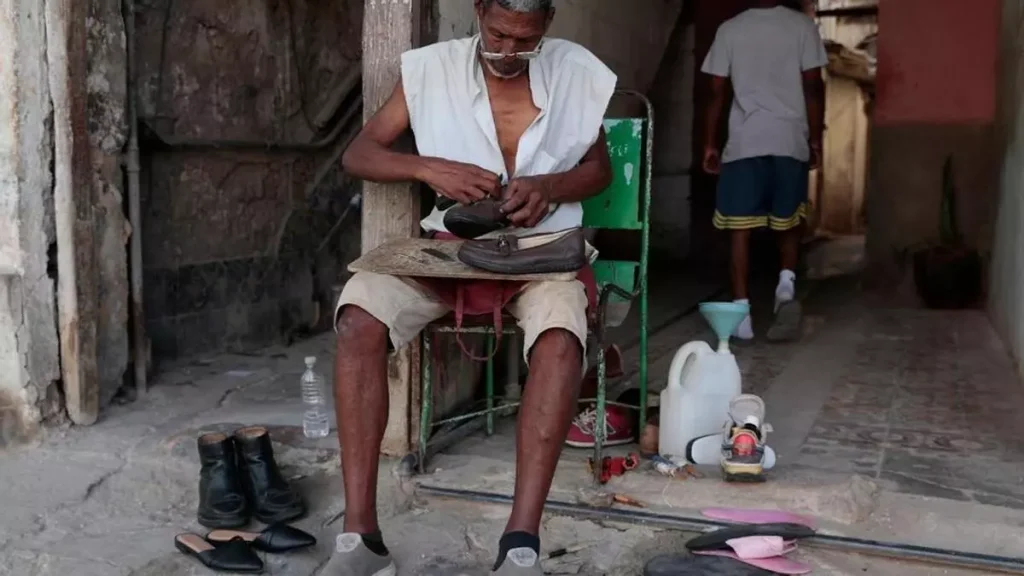
 IPS Cuba (via 14ymedio), Havana, October 7, 2026 – Magalys, 63, sells coffee from a thermos that she prepares at home every weekday outside the Hermanos Ameijeiras Clinical-Surgical Hospital, in the center of the capital, one of the informal and precarious jobs performed by elderly people in Cuban cities.
“Even though I receive a pension, I have to go out and hustle, because the money isn’t enough,” she tells a customer to whom she also sells a cigarette. In the face of the crisis, more and more people like her are seeking other sources of income, often far from the guarantees of decent employment defined by the International Labour Organization (ILO).
The ideal of decent employment, to which every October 7 has been dedicated since 2008, was defined in 1999 by Chilean lawyer and diplomat Juan Somavia, the ILO’s first director-general, and expresses the idea that, globally, work should be a means of self-realization through freedom and not merely a means of subsistence.
“Work is not decent when it is carried out without respect for fundamental labor principles and rights, nor when it does not provide a fair income proportional to the effort made, without gender or any other type of discrimination, nor when it is carried out without social protection and excludes dialogue,” wrote Virgilio Levaggi, deputy regional director of the ILO for Latin America and the Caribbean.
“Work is not decent when it is carried out without respect for fundamental labor principles and rights, nor when it does not provide a fair income proportional to the effort made, without gender or any other type of discrimination, nor when it is carried out without social protection and excludes dialogue”
“Since the university closed in February, I wanted to work at something, but in my town there is hardly anything where they pay fairly,” a 23-year-old university student who lives in a rural community in Artemisa province told IPS Cuba.
“I looked for work at the elementary school, but the salary was very low and I had to go every day. And in the countryside you work a lot and they pay very little,” he continued, describing his search for income since university classrooms closed and classes shifted to a digital format because of the oil blockade imposed on Cuba by the U.S. in January.
The young man opted for an informal activity that is quite common among people who manage to acquire a means of transportation on the Island. “I have an electric motorcycle, and with it I give short rides to people I know,” he said.
As early as 2022, jurist Roberto Rodríguez identified as many as seven challenges related to the Cuban State’s compliance with it. In 2023, researcher Ovidio D´Angelo described how social conditions were creating dilemmas in this regard. The worsening situation in 2026 makes it more difficult to uphold these recently expanded international prerogatives, Cuban Minister of Labor and Social Security Jesús Otamendiz said last June before the ILO.
Today, Cuba’s labor ecosystem is marked by a collapse in the value of wages and deterioration in working hours, staffing, and income in key sectors of the economy that once generated employment, such as tourism and tobacco.
Cuba ended 2025 with a working-age population of 5,606,541, according to the latest available figures from the state National Office of Statistics and Information, which updated the country’s total population to 9.4 million people.
The 2024 National Employment Survey (ENO) placed Cuba among the countries with the lowest employment rates in the Latin American region, with only 49.1% of its working-age population employed. That indicator had an average of 58.9% in Latin America and the Caribbean at the time, according to the ILO.
Magalys, who worked as an accountant all her life, now receives a retirement pension of 5,000 Cuban pesos, equivalent to around six dollars according to the different exchange rates in effect.
“I could go back to my former State job to earn the additional salary, but it isn’t worth it,” she said, referring to what it means today to work for an average state salary equivalent to less than $10, with required working hours and responsibilities, while facing difficulties such as lack of transportation, blackouts, and water shortages.
“I could go back to my former State job to earn the additional salary, but it isn’t worth it”
Salaries in Cuban pesos, which are mostly paid by the State, the country’s main employer, are losing value amid inflation estimated at 25% by the end of this year. Price growth during the first half of 2026 was close to 20% compared to 2025, according to the January-July 2026 report from the Center for the Study of the Cuban Economy.
Many social protections thus lose part of their value, despite Minister Otamendiz’s assertion in June that budgets and social workers had been expanded.
According to a study conducted by the University of Havana in 2025, these vulnerable sectors face, in terms of employability, “systemic barriers such as lack of accessibility and discrimination, where more comprehensive oversight and the standardization of the legal framework are required.”
The above factors make informal employment attractive to sectors that, taken together, without labor guarantees or rights, already represent 25% of the country’s workforce, employed mostly within the private sector, according to the ENO.
Other strategic sectors that once provided employment have been affected by the polycrisis, such as construction, professional services, non-sugar agroindustry, food, pharmaceutical and biotechnology industries, biomedical production, the sugar agroindustry and its derivatives, and light industry.
The National Economic and Social Development Plan through 2030 includes among its objectives “generating sufficient and productive employment.” Among the goals of this task is to provide more opportunities for decent employment.
For specialists, the expansion of mipymes (micro, small and medium-sized enterprises) can contribute to this aspiration. There are more than 16,100 mipymes approved to date, adding to the 1.3 million private-sector employees that existed in 2024.
On the other hand, the State sector has a large number of vacancies. One problem is the low salaries, which many qualified employees consider insufficient, prompting them to move to the private sector or the informal economy, as Ileana Díaz of the Center for the Study of the Cuban Economy explains in an article.
“My greatest motivation is to finish the mandatory social service. If they paid me better, I could practice my profession, but when I finish, I want to devote myself fully to something that gives me money and that I am equally passionate about,” said Ana Fundora, 22, a recent History graduate of the University of Havana.
Translated by Regina Anavy
______________________
COLLABORATE WITH OUR WORK: The 14ymedio team is committed to practicing serious journalism that reflects Cuba’s reality in all its depth. Thank you for joining us on this long journey. We invite you to continue supporting us by becoming a member of 14ymedio now. Together we can continue transforming journalism in Cuba.