Mosquitoes continue to bite near the monument to the scientist who fought yellow fever
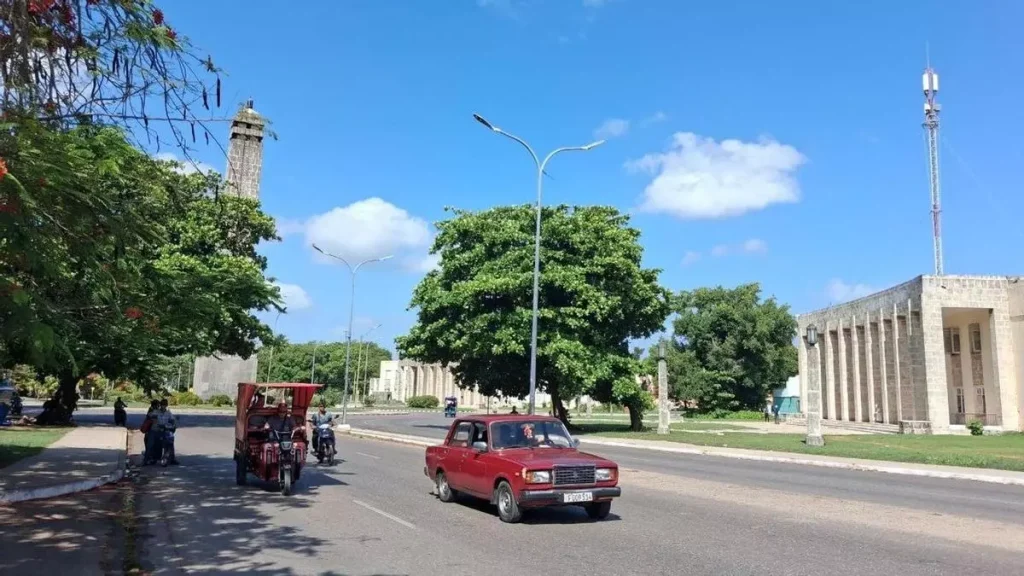
 14ymedio, Yoani Sánchez, Havana, June 25, 2026 / Some monuments take on a different meaning over time. This Wednesday, I was walking near the Marianao Obelisk, that stone needle erected in homage to Dr. Carlos J. Finlay, and I couldn’t help but notice the irony. The structure stands elegantly, with a shape reminiscent of a giant syringe, but in its shadow, in Cuba in 2026, obtaining a simple hypodermic needle or an antibiotic often depends on having relatives abroad or venturing into the informal market.
It was mid-morning when I arrived at that large area where several healthcare facilities are concentrated: the Pando Ferrer Hospital, which many still call the League Against Blindness; a polyclinic; and the popular Workers’ Maternity Hospital. A little further on is also Ciudad Libertad, formerly Camp Columbia. It’s a fragment of the city where the constant flow of patients, their companions, and healthcare workers puts to the test transportation networks that long ago ceased to function normally.
I see a woman with a bandaged eye approach an old Chevrolet that has just stopped to pick up passengers. To take her to Infanta and San Lázaro, in Central Havana, the driver tells her the trip costs 1,000 pesos. The price is enough to dissuade her. She takes a step back and returns to the sidewalk. A few meters away, a young pregnant woman tries to convince the driver of a beat-up Ford to take her to the bridge over the Almendares River. “I can’t give you more than 300,” she explains. The man shakes his head and drives off.
The thieves also took “the yellow outfit the boy was going to wear when he left the hospital, in honor of the Virgin of Charity”
The true protagonists of the avenue are the electric tricycles. They’re so overloaded they can barely move. Their narrow seats carry recently discharged patients, nurses finishing a 24-hour shift, relatives laden with bags of toiletries, doctors trying to make their shift change on time, and elderly people returning home after appointments they waited months for. Some are so tired or so old they can barely manage the high step to get on the tricycle.
A few surviving classic cars and a handful of motorcycles are still circulate. The rest of the traffic seems to have vanished along with the fuel. The nearby bus stop has the aspect of a medical observation room. Exhausted faces, improvised fans fashioned from X-rays, and conversations that inevitably lead to blackouts, gasoline, or hospitals. A woman recounts how her cell phone was stolen while she was caring for her newborn daughter at the maternity ward. “I went to the bathroom, and when I came back, it was gone.” The thieves also took “the yellow outfit the baby was going to wear when she left the hospital, in honor of Our Lady of Charity.”
The line outside the nearby Banco Metropolitano is so long it spills over the sidewalk and almost reaches the roundabout at 31st and 100th streets. Customers crowd together under the flowering flamboyant trees while they wait for the electricity to return so the branch can resume paying out pensions and salaries that will lose much of their value before the week ends. Some elderly people have brought folding chairs; others, bottles of water; one even a book. Waiting has become the activity that occupies most of our time.
A friend says she wakes up every morning gazing at the horizon, convinced that one day she’ll see a huge silhouette approaching from the sea. A neighbor on Tulip Street says he’s been waiting for three years for one of his two sons to send him a package with frozen chicken, oil, and those soda crackers he sees advertised online but hasn’t tasted in decades. My old history teacher lives anxiously awaiting her email, hoping one day she’ll get the news that her visa has been approved, allowing her to travel to one of those countries that serve as the first step on the journey south, the same route thousands of Cubans continue to travel every month.
It’s not just the mosquitoes. The relentless heat during the blackouts bites; the endless lines bite; the prices bite, the uncertainty bites, the shortages bite, and that unmoving clock that seems to have settled over the country bites.
We have become a country of waiting, a nation of suspended rhythm. Some wait for the electricity to return; others, for water to flow through the pipes; many await the bus that never arrives, the medicine that never reaches the pharmacy, the call from abroad, the permit, the package, the money, the news that will change the course of their lives. We wait so much that the verb has ceased to be an action and has become a place we inhabit.
From the sidewalk, I look anew at the obelisk and think of Finlay, the scientist who dedicated his life to fighting mosquito-borne diseases. As I walk past the monument, I feel a couple of bites on my ankles. I hop around to shoo the insects away, hit my legs with my closed umbrella, and scold myself for forgetting to put on insect repellent before leaving home.
A nurse witnesses my outlandish dance and laughs. “Mosquitoes don’t just bite anymore, they sting now,” she jokes.
She’s right. It’s not just the mosquitoes. The relentless heat during the blackouts bites; the endless lines bite; the prices bite, the uncertainty bite, the shortages bite, and that unmoving clock that seems to have settled over the country bites. Reality as a whole has become an insatiable mouth that tears away small pieces of us every day. We are fragments of people trying to get somewhere while we long for the vaccine against so much national paralysis to finally appear.
Previous Havana Chronicles:
The Time For Reforms Has Passed
Surrounded by Garbage, Miramar Is No Longer the Glamorous Neighborhood It Once Was
A Circus Facing Off Against Power, and a City Growing Increasingly Lonely
Chronicle of a Monday That Feels Like Wednesday
“We Used to Complain About the ‘CUC’, But Now We Miss It”
The Roar of Despair of a Cuban Woman Returning to Her Country After Many Years
The Tulipán Market Closed: “They’ve Given the Order To Go to the March for Raúl”
Along Carlos III Street and towards Ethiopia
Sleeping Is Also a Privilege in Havana
A Desperate Plea in the Middle of the Dark Havana Night: ‘Light!’
Under a Picture-Postcard Blue Sky, the Country is Crumbling
Fatigue Barely Allows One to Enjoy the ‘Lights On’ in Havana
Dollars, the Classic Card, and a Havana Without Tourists
A Journey Through the Lost Names of Havana
The Shipwreck of a Ship Called “Cuba”
Havana Seen From ‘The Control Tower’
In Havana, the Only Ones Who Move Are the Mosquitoes
Reina, the Stately Street Where Garbage is Sold
Searching for Light Through the Deserted Streets of Havana
The Death Throes of ‘Granma’, the Mouthpiece of a Regime Cornered by Crisis
The Anxiety of the Disconnected Cuban
One Mella, Three Mellas, Life in Cuba Is Measured in Thousands of Pesos
It Is Forbidden To Leave Home in Cuba Today Because It Is a “Counter-Revolutionary Day”
Vedado, the Heart of Havana’s Nightlife, Is Now Converted Into a Desert
_________________
COLLABORATE WITH OUR WORK: The 14ymedio team is committed to practicing serious journalism that reflects Cuba’s reality in all its depth. Thank you for joining us on this long journey. We invite you to continue supporting us by becoming a member of 14ymedio now. Together we can continue transforming journalism in Cuba.