On a street in Sancti Spíritus, solar panels at $320 each put a price on the dream of escaping blackouts.
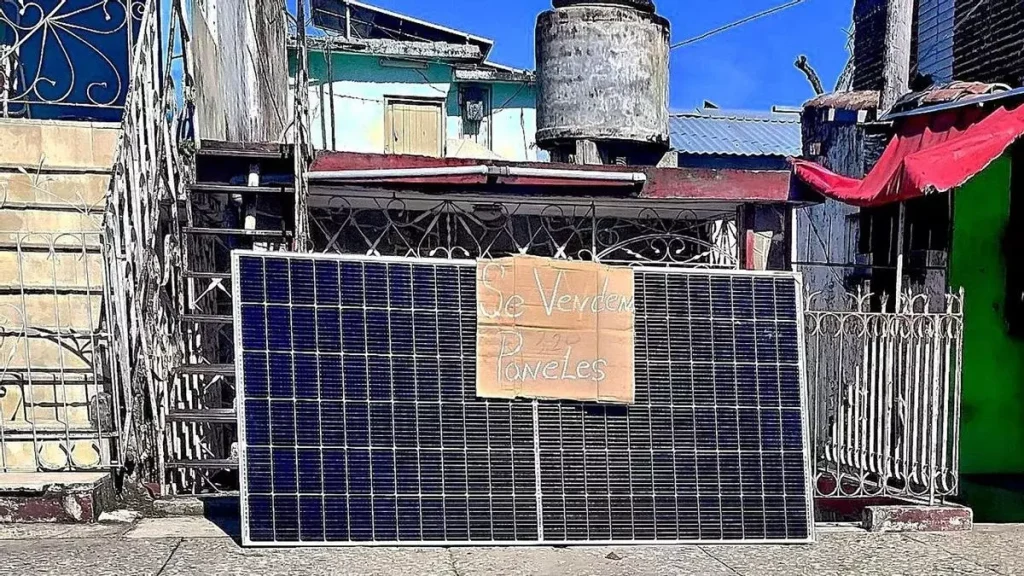
 14ymedio, Mercedes García, Sancti Spiritus, August 9, 2026 / On a street in Sancti Spíritus a solar panel is on display. It is not behind a shop window, nor under the lights of a specialized store. It rests directly on the sidewalk, leaning against the facade of a house, with a piece of cardboard in the center that announces, in improvised calligraphy: “Panels for sale.”
In a country where every day people have to calculate the cost of rice, eggs, oil, transportation, and even phone credit, Cubans now have another figure to add to their mental calculators. How much does it cost to escape, even partially, the blackouts? The answer starts, in the case of Sancti Spíritus, with a price that this Saturday reached $320, but it can continue to rise with batteries, inverters, controllers, cables, and other components needed to convert a rectangle of sunlight into a few hours of domestic autonomy.
“Soon they’ll be more expensive than batteries,” a neighbor complains as she walks past the panel. She doesn’t linger. She glances, asks a question, and continues on her way with that familiar expression of someone who has just confirmed that something they need is far beyond their budget.
The energy crisis has even changed the landscape of Cuban cities.
Others slow down. They examine the dark panels the way people used to look at an electric motorcycle or an air conditioner behind a shop window. Each person seems to place their own wish list before them: keeping the refrigerator running so the food doesn’t spoil, recharging a fan to relieve the sweltering nights, turning on some lights, or making sure their cell phone still works the next morning.
The energy crisis has even changed the landscape of Cuban cities. Electric generators, so-called power stations, batteries, and solar panels have gone from being specialized equipment to becoming part of the domestic vocabulary. Watts, amperes, and storage capacity are discussed with the same naturalness as discussions about pounds of rice or shared taxis. Necessity has resulted in a crash course in electricity nationwide.
But learning the theory doesn’t mean being able to afford the practics. The $320 per panel represents a huge fortune for someone who earns their salary in Cuban pesos. And they don’t even solve the problem on their own: they’re just one piece of the puzzle that allows for some independence from an increasingly unstable national energy grid.
______________________
COLLABORATE WITH OUR WORK: The 14ymedio team is committed to practicing serious journalism that reflects Cuba’s reality in all its depth. Thank you for joining us on this long journey. We invite you to continue supporting us by becoming a member of 14ymedio now. Together we can continue transforming journalism in Cuba.