The Island has won seven gold medals, well behind first-place Mexico and just ahead of Colombia.
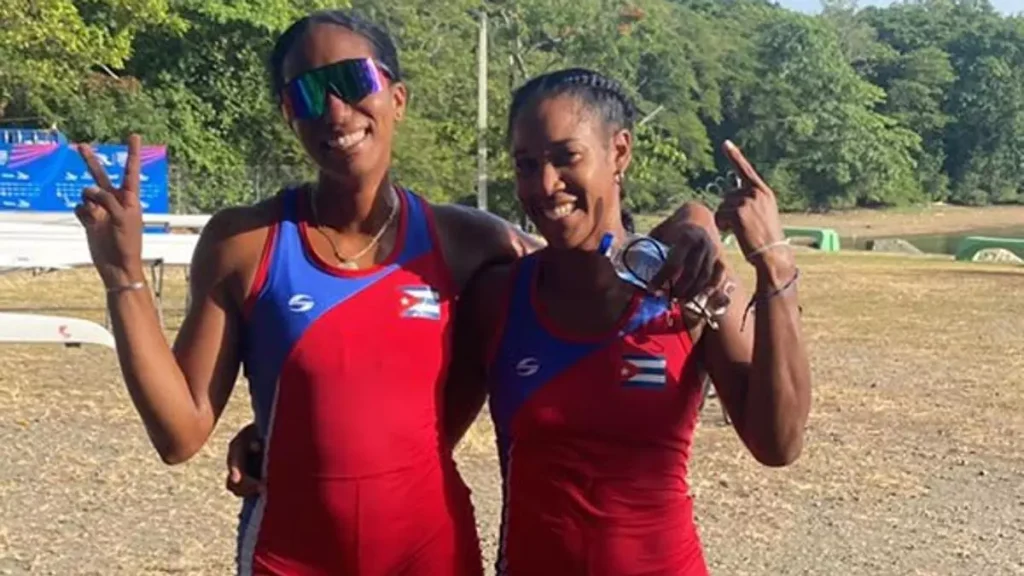
 14ymedio, Havana, July 27, 2026 – The vague objective set by Cuban sports authorities for the Central American and Caribbean Games in Santo Domingo is being met so far: finishing among the top three in the medal standings. With the gold medal won early this Monday by the pair of Rayma Ortiz and Natalie Morales in the women’s coxless pair rowing event, the Island sits in second place overall with seven gold medals, behind Mexico, which leads with 16.
The Cuban rowers dominated the race from start to finish and crossed the finish line in 7:33.70. The silver medal went to the Mexican crew of Maite Arrillaga and María García, who finished in 7:40.68, while the bronze went to Guatemala’s Nicolle González and Dulce Samayoa, who posted a time of 7:43.45.
This is the second gold medal won in rowing by the Island’s delegation at these Games. The first was claimed by the duo of Reidy Cardona and Leduar Suárez on Sunday morning, when they won the men’s double sculls event with a time of 6:32.80.
Judo has been the other discipline that has served as the backbone of Cuba’s medal haul in these opening days. The Island’s team dominated Saturday’s judo finals by capturing four gold medals in the men’s and women’s divisions. Marlon Herrera claimed the title in the 73-kilogram division, along with Jonathan Charón (60 kg), Orlando Polanco (66 kg), and the young Dali Sentmanat (52 kg). The other gold medal came in cycling, where Marlies Mejías won the women’s 30-kilometer individual time trial.
The Island’s team dominated Saturday’s judo finals by capturing four gold medals in the men’s and women’s divisions
On Monday, the Island will compete in badminton, archery, track cycling, gymnastics, taekwondo, judo, racquetball, field hockey, beach and indoor volleyball, chess, and softball, so its medal count could increase by the end of the day.
With 504 athletes competing in a total of 42 sports at the Central American and Caribbean Games in the capital of the Dominican Republic, Cuba is seeking to return to the top of a competition it has historically dominated. Of the 24 editions of the Games, the Island has won 12. It also leads the all-time medal table with 1,926 gold medals, including those already won at this edition, well ahead of second-place Mexico with 1,539.
However, the last time Cuba finished first in the regional competition was in 2014 in Veracruz. The last two editions, Barranquilla 2018 and San Salvador 2023, were won by Mexico, leaving the Island in third place, matching its worst-ever performance in the competition, comparable to Panama 1938 and Kingston 1962.
The last two editions, Barranquilla 2018 and San Salvador 2023, were won by Mexico, leaving the Island in third place
The defection of athletes from the Island, which has totaled more than 1,000 over the past decade, along with the lack of international competition for Cuban athletes, has plunged the country’s sports system into crisis. At the last major event in which Cuba competed, the Paris 2024 Olympic Games, the country won nine medals with a delegation of 61 athletes, while the Cuban diaspora earned the same number with just 21 Cubans representing other countries.
Since the collapse of the Soviet Union, which had provided resources for athlete development, Cuban sports have gone into steep decline. The Barcelona 1992 Olympic Games, where the Island won 30 medals, marked Cuba’s peak. That success was followed by strong performances in Atlanta 1996 (25 medals), Sydney 2000 (29), Athens 2004 (27), and Beijing 2008 (30), but from that point on, the situation only worsened. Twelve athletes reached the podium in London 2012, 11 in Rio 2016, and 15 in Tokyo 2020.
Translated by Regina Anavy
______________________
COLLABORATE WITH OUR WORK: The 14ymedio team is committed to practicing serious journalism that reflects Cuba’s reality in all its depth. Thank you for joining us on this long journey. We invite you to continue supporting us by becoming a member of 14ymedio now. Together we can continue transforming journalism in Cuba.