Users will have to change the clocks on their smartphones manually.
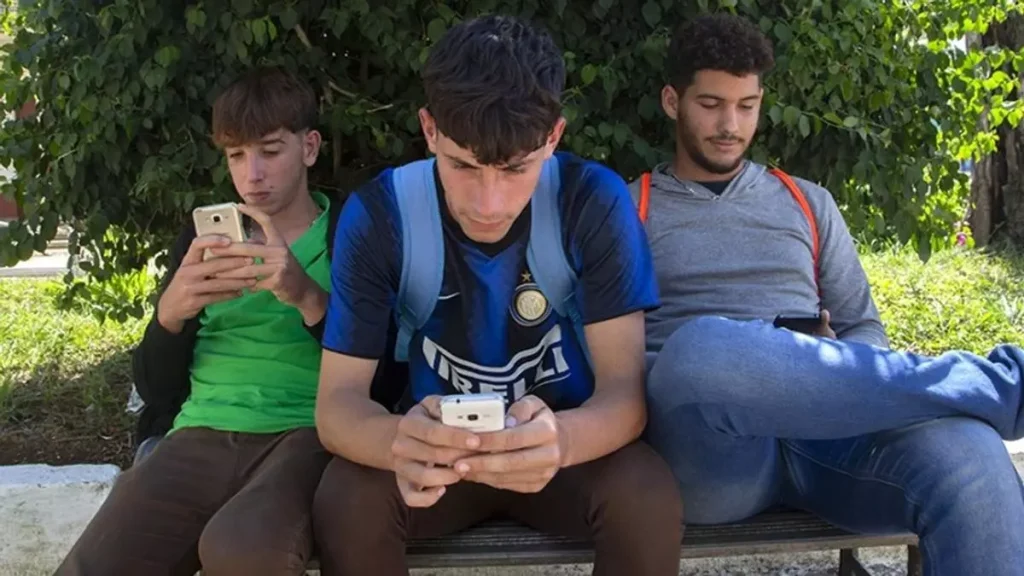
 14ymedio, Madrid, October 30, 2026 – When Cubans wake up this Sunday, the time displayed on their mobile phones will be one hour behind the official time. The Government’s decision to maintain daylight saving time came too late for the technology, and most users who have the automatic time option enabled by default will have to make a manual adjustment on their phones.
The official media have warned that smartphones have a manufacturer’s instruction based on historical data and programmed for each country, so Cuba’s will be updated on November 1 from UTC-4 to UTC-5, regardless of the political decision. Until the manufacturer updates the tzdata rule, or IANA time zone database, the phone will follow the instruction stored in its system.
In this situation, the authorities remind users that the first step is to check whether the phone has updated as expected. If it has, they should go to the Date and Time section, usually found under Settings > System. From there, they must manually enter the time established by the Government (UTC-4). Afterward, it is advisable to make sure the “automatic time” function remains enabled, since manufacturers are expected to update the database soon, although this will have to be verified over time.
Afterward, it is advisable to make sure the “automatic time” function remains enabled, since manufacturers are expected to update the database soon, although this will have to be verified over time
Last week, the Ministry of Energy and Mines and the Ministry of Labor and Social Security agreed that electricity consumption could be reduced by approximately 126 megawatts if daylight saving time were maintained at least until November of next year. In addition, it was decided to delay the start time for schools and workplaces by half an hour between November 1, 2026, and March 14, 2027, the period during which winter time would normally have been in effect.
According to the authorities, 76 MW of the projected savings would come from making better use of natural light, while the remaining 50 MW are attributed to the photovoltaic solar power available during those hours. However, no details have been provided about how these calculations were made.
The decision comes at a very critical time for power generation, with the Antonio Guiteras thermoelectric plant, the largest in the country, out of service because of a series of breakdowns even more extensive than usual at this major facility. In any case, it is not the only cause of the situation. This Thursday, the Carlos Manuel de Céspedes thermoelectric plant in Cienfuegos also went offline because of a failure whose cause remains unknown.
Also out of service due to breakdowns are Unit 5 of the Mariel thermoelectric plant, Unit 1 of the Santa Cruz del Norte plant, Unit 2 of the Felton plant, and Units 3 and 6 of the Renté plant. Units 3 of Santa Cruz del Norte, 5 and 6 of Nuevitas, and 5 of Renté are undergoing maintenance.
This Thursday, the deficit was forecast to reach 1,910 megawatts during peak hours, as projected generation was only 910 MW, against peak demand of 2,820 MW. The blackouts no longer distinguish between regions, and the capital is experiencing very long hours without electricity. The 14ymedio newsroom is in this situation, having now endured 37 consecutive hours without power.
Translated by Regina Anavy
______________________
COLLABORATE WITH OUR WORK: The 14ymedio team is committed to practicing serious journalism that reflects Cuba’s reality in all its depth. Thank you for joining us on this long journey. We invite you to continue supporting us by becoming a member of 14ymedio now. Together we can continue transforming journalism in Cuba.