A second shipment landed in Santa Clara with 1,400 food and hygiene kits that Cáritas will distribute in rural communities in Sancti Spíritus.
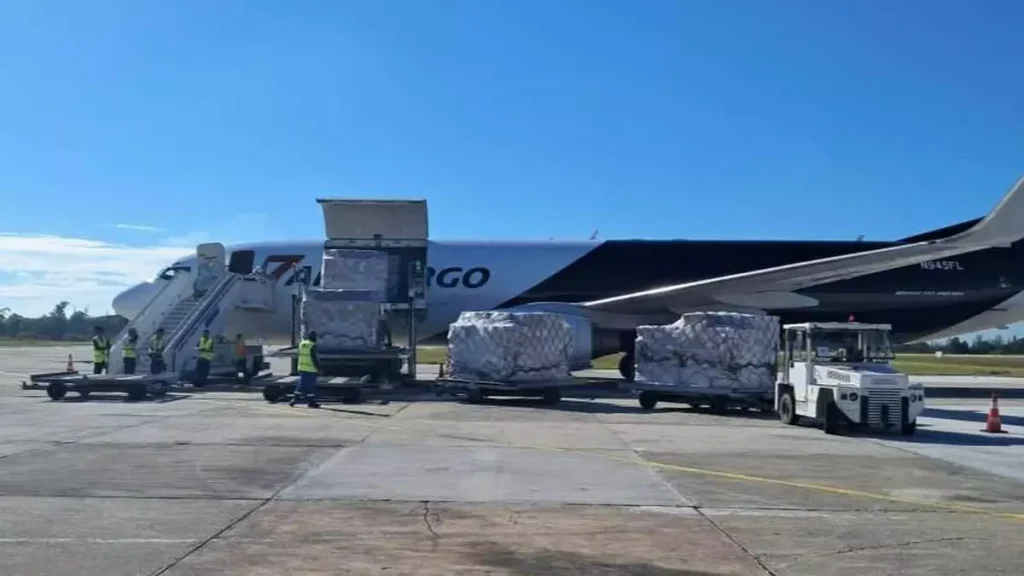
 14ymedio, Madrid, October 29, 2026 – A second shipment of humanitarian aid from the United States Government arrived this Thursday at Abel Santamaría International Airport in Santa Clara, carrying 700 food kits and another 700 hygiene kits intended for poor families in Guasimal, a rural community in the municipality of Sancti Spíritus, in the province of the same name, according to information published by the Diocese of Santa Clara on its social media accounts. The aid will be delivered by the Catholic Church through Cáritas, as part of the $100 million assistance program announced by Washington last May.
The director of Cáritas Santa Clara, Vanesa Hernández Toledo, received the supplies on the airport runway. Bishop Arturo González Amador specified that the shipment is intended for the parish of La Purísima Concepción in Guasimal, where the Sisters of Jesús Verbo y Victima work. Although it belongs to Sancti Spíritus, this locality falls under the Diocese of Santa Clara, which encompasses Villa Clara and much of the neighboring province.
Bishop Arturo González Amador specified that the shipment is intended for the parish of La Purísima Concepción in Guasimal
The nuns will receive the supplies that same afternoon to distribute them among “the poorest families in the various towns within the parish territory,” with the assistance of Cáritas and local volunteers. The diocese stated that those responsible for the deliveries had already organized the work for the coming days.
González Amador drew attention to the difficulties facing an area “so geographically distant from urban centers” and urged those participating in the distribution to stop and attend to “the poor and those who suffer,” offering them “human closeness and assistance.” The bishopric did not specify how many families would receive the donations.
The first shipment to Santa Clara arrived on September 11, with a similar quantity of supplies intended for Quemado de Güines and Rancho Veloz, in Villa Clara. On that occasion, González Amador acknowledged that needs were far greater than the available resources and that only the most urgent cases could be addressed. He also warned that this was a one-time aid delivery, not a permanent social assistance program.
The shipments are part of the $100 million in humanitarian aid offered by U.S. Secretary of State Marco Rubio. Of that amount, $60 million is being channeled through the Catholic Church, with the participation of Cáritas Cuba and the U.S. organization Catholic Relief Services. The remaining $40 million is allocated to independent humanitarian organizations.
The shipments are part of the $100 million in humanitarian aid offered by U.S. Secretary of State Marco Rubio
The launch of the program was preceded by a confrontation between Washington and Havana. On May 8, when Rubio stated that the United States had offered the assistance and accused the Cuban Government of rejecting it, Foreign Minister Bruno Rodríguez dismissed the announcement as a “fable” intended, according to him, to deceive both peoples.
Six days later, Havana was no longer denying the existence of the proposal but continued to question Washington’s intentions. Rodríguez then stated that Cuba was willing to study it, while describing the offer as “apparent generosity” and demanding that the assistance be provided without political conditions.
The United States stipulated that the donations be delivered directly to the population by religious and humanitarian organizations, without going through the Cuban authorities. Havana, for its part, has accused Washington of using the assistance for political purposes while maintaining sanctions that worsen the Island’s crisis.
The program began to be implemented in July, with a shipment intended for Havana. Since then, the dioceses of Santa Clara, Cienfuegos, Camagüey, Ciego de Ávila, Pinar del Río, and Matanzas have also received supplies. The latter received a second shipment on October 22, while Pinar del Río received its shipment on the 27th, intended for the communities of Guanajay and Bahía Honda, in Artemisa, which belong to that diocese.
Translated by Regina Anavy
______________________
COLLABORATE WITH OUR WORK: The 14ymedio team is committed to practicing serious journalism that reflects Cuba’s reality in all its depth. Thank you for joining us on this long journey. We invite you to continue supporting us by becoming a member of 14ymedio now. Together we can continue transforming journalism in Cuba.