Amid warnings that there will be no bread, gas leaks, blackouts, and deaths, a group of neighbors in a building writes the chronicle of a Cuba in ruins.
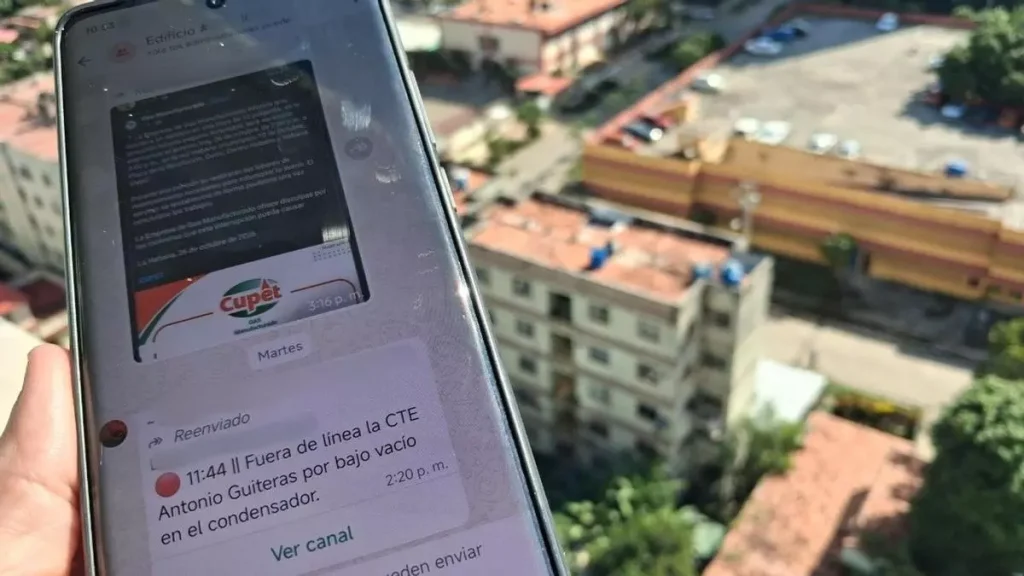
 “There will be no bread tomorrow.” I read the phrase on my phone screen. It has the force of a judicial sentence. It needs no explanations, nor exclamation marks, not even emojis. In the WhatsApp group for our building, a complex of over a hundred apartments in Nuevo Vedado, bad news comes in the format of old-fashioned telegrams. Each message is a chapter in a daily novel where adjectives and embellishments have no place.
The group administrator is the only authorized narrator. The rest of us just read. The literature of our community is a monologue where the plot unfolds amidst news of breakups, shortages, and farewells.
“There will be bread tomorrow,” I see on an ordinary afternoon in the instant messaging thread. Every now and then, the chronicler surprises us with a hopeful twist. The bakery at the rationed market on Hidalgo Street finally has flour, and the news takes on the air of a major event. For a few seconds, I revel in such unexpected prosperity, but then I remember the small size and sour taste of that bread and temper my expectations.
Behind those words are the unlit stoves, the rice that never softens, and the neighborhood cafes with their pizzas still in the oven.
The next installment of this digital saga could arrive at any time. “Due to a break, the manufactured gas service will be interrupted.” Behind those words are the unlit stoves, the rice that never softens, and the neighborhood cafes with their pizzas still in the oven.
Our involuntary novelist also masters the apocalyptic genre. “There was a total blackout of the National Power System,” he reports at the stroke of noon. Sometimes the outage is partial. Only a part of the country is without power, and a sigh of relief sweeps through the building, as if darkness would admit degrees and we should console ourselves with the fact that this time the disaster wasn’t complete.
Between one interruption and the next, a different message occasionally appears. A neighbor has died. The tone changes, but not the brevity. Just a name and some information about the wake. That’s how we learn that someone with whom we share elevators, hallways, and complaints about the leaky roof that’s been dripping from the lobby entrance for decades has died.
I never delete the contents of this peculiar chat. It reminds me a lot of Dangerous Liaisons, that novel constructed through letters that reveal, amidst confidences and silences, the true relationships of a society. Our building also has its correspondence, although here no one is trying to seduce anyone. Our messages don’t uncover love intrigues, but rather the details of a nation disintegrating piece by piece.
Someday, when this era is the subject of archaeologists and doctoral theses, perhaps someone will find our WhatsApp thread. Then they won’t have to read official speeches or endless statistics. Scrolling through these notifications will be enough for them to understand how a country crumbles, while its inhabitants receive, day after day, the news of a new loss.
______________________
COLLABORATE WITH OUR WORK: The 14ymedio team is committed to practicing serious journalism that reflects Cuba’s reality in all its depth. Thank you for joining us on this long journey. We invite you to continue supporting us by becoming a member of 14ymedio now. Together we can continue transforming journalism in Cuba.