Lawmakers from both parties point out that a congressional resolution adopted in 2022 prohibits the importation of hydrocarbons from Russia.
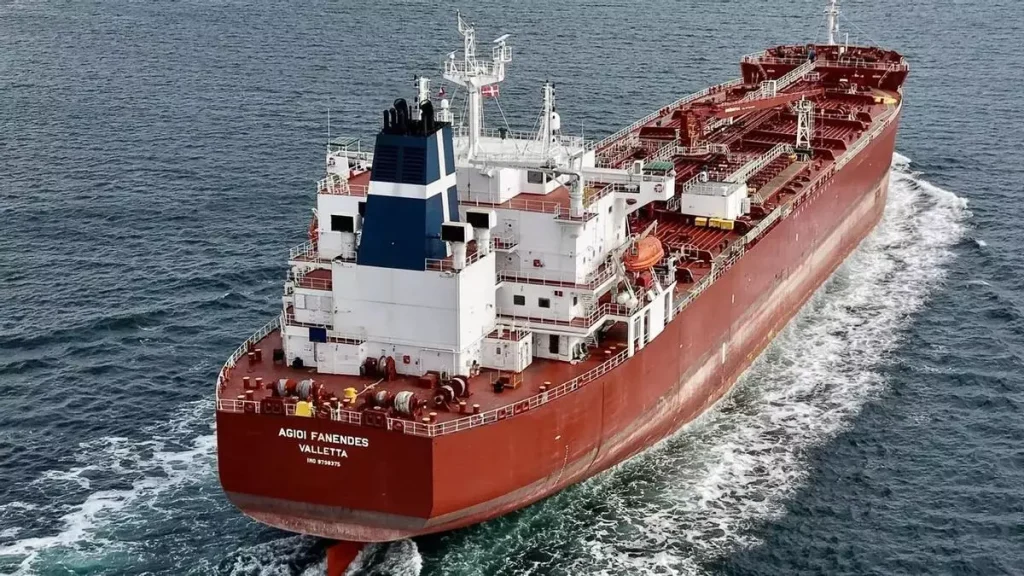
 14ymedio, Madrid, October 29, 2026 – The oil tanker Agioi Fanendes, which was carrying 40,000 tons of Russian diesel fuel to the U.S., no longer lists New York as its destination and appears to be stranded while awaiting orders. The surprising situation has led the energy-focused website Oilprices.com to speculate that the product could end up in Cuba.
The arrival of the Maltese-flagged tanker, which departed Primorsk on October 22, was scheduled for November 7, but after briefly passing through Skagen, Denmark, on October 26, it was left without a declared port of destination. Its shipment was part of an agreement between Russian President Vladimir Putin and U.S. President Donald Trump, who discussed the situation in a phone call on October 9.
That conversation, which was very poorly received by European allies and Ukraine, among other reasons because it bypassed sanctions on Russian energy sources, established that Russia would send more than 300,000 tons of diesel fuel to U.S. and global markets, another 500,000 tons during November, and 1,000,000 tons thereafter.
On October 27, Democratic Senator Richard Blumenthal of Connecticut demanded that the tanker turn around because it was violating federal law
The plan was intended to alleviate rising fuel prices, which stood at $102.78 in the U.S. this Wednesday (Texas crude oil per barrel). The war in the Middle East has driven gasoline prices to levels that make everyday life difficult for American citizens and threatens to seriously hurt Republicans in the midterm elections scheduled for November 3, hence Trump’s agreement with Putin.
On October 27, Democratic Senator Richard Blumenthal of Connecticut demanded that the tanker turn around because it was violating federal law. He addressed his demand directly to Thanassis Martinos, managing director of the tanker’s owner, Eastern Mediterranean Maritime. The senator added that the company should refrain from any future agreements to send Russian diesel to a U.S. port.
According to Blumenthal, the 2022 Ending Importation of Russian Oil Act prohibits this type of cargo, and its legal authority supersedes that of General License 135 issued by the Treasury Department, which authorizes transactions involving Russian diesel through April 7, 2027. “The president may have issued a license to facilitate this transaction, but only Congress can make it legally valid,” he wrote.
In his letter, the senator gave the company until October 31 to identify the seller, buyer, charterer, insurer, and terminal operator, as well as to disclose any other details received from the Treasury Department or another federal agency.
The outlet bases its argument on Donald Trump’s statement last March regarding the Anatoly Kolodkin, which brought 730,000 barrels of Russian crude oil to the Island without the president raising any objections
According to Oilprices, a bipartisan group of lawmakers has warned all parties involved, including port authorities in Houston, Corpus Christi, Beaumont, and New York/New Jersey, about the civil and criminal consequences of accepting this cargo.
But there are also two other oil tankers, the Leruo and the Talismán, transporting Russian diesel to the United States, with the added complication that both are subject to sanctions. Maritime data company Kpler puts the total cargo aboard the three vessels at 924,000 barrels. They would be joined by another vessel, not yet identified but announced by Russian Deputy Prime Minister Alexander Novak, whose departure was scheduled for yesterday, Wednesday.
In the U.S., in addition to the Ending Importation of Russian Oil Act, there is the Graham Act, named after Republican Lindsey Graham, the late senator from South Carolina who championed it. This law imposed tariffs of 500% on Russian imports and 100% on countries purchasing both oil and gas from Moscow, particularly its main buyers, which helped circumvent sanctions.
The objective of both laws was always to cut off Russia’s main source of funding for its war in Ukraine, but Trump has now not only provided relief through the authorized exemption but has also described the lawmakers who criticized him as “not serious people.”
According to Oilprices’ speculation, “with no declared destination, and with U.S. banks and ports having been warned, the Agioi Fanendes could be redirected to Cuba.” The outlet bases its argument on Donald Trump’s statement last March regarding the Anatoly Kolodkin, which brought 730,000 barrels of Russian crude oil to the Island without the president raising any objections. “They have to survive! I have no problem with it,” the U.S. president said, despite having signed an executive order preventing oil from reaching Cuba from any country.
That has been the only exception he has made, however, since the Sea Horse, a Hong Kong-flagged vessel carrying Russian oil, had to change course while discreetly heading toward the Island.
Translated by Regina Anavy
______________________
COLLABORATE WITH OUR WORK: The 14ymedio team is committed to practicing serious journalism that reflects Cuba’s reality in all its depth. Thank you for joining us on this long journey. We invite you to continue supporting us by becoming a member of 14ymedio now. Together we can continue transforming journalism in Cuba.