Trump’s Tariffs Also Affect the Cuban Informal Market

Uncertainty and fear of rising prices are growing among Cuban mules traveling to Panama.


Candonga at 100 and Boyeros, one of the markets in Havana where they sell products ’made in China’ / 14ymedio

14ymedio bigger14ymedio, Natalia López Moya, Havana, 8 April 2025 — The earthquake of tariffs announced by Donald Trump, which this Monday sank the stock markets and caused an uncertainty unprecedented since the Second World War, is also felt in Cuba. Although because of US sanctions Cuba is not on the list of countries affected by tariffs, the fear of price increases and shortages in the informal market keeps businesses and buyers in suspense.

Magda, a 56-year-old woman from Havana who became a Spanish citizen a decade ago, learned of the announcements made by the US president last Wednesday while having lunch at a small inn in the Colón Free Zone in Panama. “I still do not know how it will affect my business, but I have already had calls from several contacts who had agreed to make deliveries, to tell me that I had to wait.”

Magda, who imports clothing and footwear from Panama, is among thousands of Cubans who travel to Panama every year to buy products that they will then sell on the Island. continue reading

“I buy sportswear, tennis shoes, hair accessories, caps, sunglasses, backpacks – everything for sale that can enter Cuba with no trouble”

“I buy sportswear, tennis shoes, hair accessories, caps, sunglasses, backpacks – everything on offer that can enter Cuba with no trouble,” the woman tells 14ymedio. “As I have been doing this for many years I now have my contacts and agreements with Panamanian and Chinese business people who know what I am looking for. They give me a price for the quantities that I need and are people I trust.”

“Every year I come to Panama up to five times,” she says. ” I have learned some phrases in Chinese because there are areas where the intermediaries speak neither Spanish nor English.” Her previous trip, at the end of last January, coincided with Trump’s declarations showing his intentions for the US to take over the management of the Canal, with five main ports, two of them managed by China.

Finally, after multiple pressures, the Hong Kong giant CK Hutchison sold its ports to the American fund BlackRock, a transaction that is in progress and which has badly hurt Beijing and has “enraged” the Chinese president, Xi Jinping, who considers that the operation will go “against the interests” of the nation. But beyond the government palaces, chancelleries and stock exchanges, doubt has already settled among the traders who feed the Cuban mules in that country.

“The first thing I noticed is that many do not want to close deals in the medium term because you do not know how prices will be tomorrow”

About 3% of world trade passes through the Panama Canal. Its main customer is the United States, which accounts for two-thirds of the tonnage crossing it, followed by China and Japan. “This is the best country to come to buy because it has a lot of variety, prices are very good and plane tickets are not so expensive, but if everything starts going up they won’t give me the accounts.”

“The first thing I noticed is that many do not want to conclude agreements in the medium term because we do not know how prices will be tomorrow,” says Magda. “Some products have gone up, such as hearing aids, smart watches and accessories from China that sell very well in Cuba. Before they were cheaper, but we still don’t know if everything will go up, and we must wait for the waters to calm down.”

Any increase, however, will end up being paid by the client. ” I have my regular clientele, who ask me by catalogue also or that their family pays for the products from the United States and I make the delivery in Havana. I have already told them that I can not guarantee I will maintain current prices,” she explains to this newspaper. ’There are those who have already told me that they will stop shopping because food and basic products have gone up a lot in Florida, and they can no longer pay for clothes and shoes for their relatives.”

Others have started their business with goods that come directly from the United States, even though they are also from the far-off continent of Asia. ” I have women’s dresses, girls’ dresses and men’s sportswear,” says El Pury in its catalog, updated up to three times a day, which is disseminated through a WhatsApp group with more than 3,000 subscribers. “It’s all Shein and Temu, nothing else,” he writes accompanied by colorful emojis.

“I lost some money because, although I explained to the customers that they had to be patient, many withdrew their order due to the delay”

El Pury is part of a growing group of Cuban traders who bring goods to the Island that their contacts in the United States buy through fast-fashion giants like Temu and Shein. The mechanism is simple: “the client chooses what he wants in the application, passes me the code of what he selected, gives a part of the money in advance, or, if he is very trustworthy, he does not have to pay anything before, and I tell my sister in Miami to buy it online.”

When they have a certain amount of products selected on demand by the buyers, the woman sends the goods through mules, takes them herself on a personal trip or uses one of the parcel agencies to Cuba that have multiplied in recent years in southern Florida. “I don’t sell only clothes but also home accessories, appliances and lots of makeup.”

El Pury’s business is now in the middle of a tariff war between Washington and Beijing. Among the highest taxes imposed by Trump are those applied to goods from China and that reach tariffs of up to 25% on technological products, machinery and textiles, among others. The tone of confrontation has risen in recent hours, and China has warned that it will “fight to the end” if the US imposes additional tariffs of 50%.

The result of this confrontation began to be noticed in February when Temu and Shein, the two largest Chinese e-commerce platforms operating in the US, started to raise prices. Digital stores also removed some products from their websites, and delivery times were extended. ” I lost some money because, although I explained to the customers that they had to be patient, many people withdrew their order because of the delay,” the businessman acknowledges.

“The truth is that we don’t even know what’s going to happen. Not even Trump himself knows what’s going to happen”

“Before all this I could guarantee that from the time the customer placed the order until he had the product in hand would be only 25 to 30 days, but now that has changed, and I have to tell them that it can take up to 45 days,” she says. “I can’t even guarantee that those deadlines will be met. A few days ago my sister was waiting for a purchase of more than ten items she had bought on Temu to send me. Every time I checked the application the day of delivery was revised: one week became three.”

Despite the economic crisis on the Island, fast fashion has carved out an increasingly large place in the wardrobe of Cubans. In the middle of the ruins, the mountains of rubbish and the sewer waters, it is frequent to see people dressed in new clothes and shoes, mostly Chinese copies of famous brands. The years of austerity and uniformity imposed by the rationed market for industrial products seem to have led to a great appetite to dress well according to world trends.

Cuban sites that promote themselves as intermediaries of Shein have also proliferated a lot in recent years. Some promote their services as a way to “buy easily” from Cuba and even allow payment in national currency. They have the option of express shipment of the goods from the US to the Island or the possibility to pay less because the package is sent by boat and takes longer.

An employee at one of these digital stores has told 14ymedio, anonymously, that they are having many inquiries from customers who fear that the goods already purchased will not reach their hands. “We are trying not to panic and tell them that everything will continue as before but the truth is that even we ourselves do not know what will happen. Even Trump doesn’t know what’s going to happen.”

Translated by Regina Anavy

____________

COLLABORATE WITH OUR WORK: The 14ymedio team is committed to practicing serious journalism that reflects Cuba’s reality in all its depth. Thank you for joining us on this long journey. We invite you to continue supporting us by becoming a member of 14ymedio now. Together we can continue transforming journalism in Cuba.

The US Requires Migrants Who Entered With CBP One To Leave the Country ‘Immediately’

A campaign is launched in Miami against Cuban-American Republican politicians, whom they call “traitors.”

Billboard criticizing Republican Cuban-American politicians, located in the parking lot of the Palmetto subway station in Miami / 14ymedio

14ymedio bigger14ymedio, Havana/Miami, April 8, 2025 — “Do not try to stay in the US, the Federal Government will find you.” With this Orwellian phrase, the US authorities concluded their warning to migrants, including many Cubans, who came in through Mexico and, using the CBP One application, obtained Humanitarian Parole for one or two years to regularize their situation.

The measure particularly affects Cuban citizens, since migrants from other nationalities who used this application mostly opted for asylum or temporary protection status, while Cubans, with the intention of availing themselves of the Cuban Adjustment Law, decided to wait a year and a day (the period required before opting for this law), and did not request asylum.

The message, to which this newspaper had access, urges its recipients to self-deport themselves and emphasizes, with threats, that the migration police have the means to locate those who hide from them and avoid the request. Through their email, which migrants provided upon entering the US, the “notice of termination of probation” has stoked concern for the umpteenth time since last January 20, when Donald Trump took office.

“It’s time for you to leave the United States,” the text says bluntly from the beginning. “You are here because the Department of Homeland Security (DHS) has granted you an entry permit for a limited period.” Invoking section 1182 of the US Code and Title 8 of the Code of Federal Regulations, DHS informs that it will “immediately” exercise its right to revoke permission. continue reading

If work or a travel permit has been obtained during that time “it shall also be cancelled”

“If you do not leave the US immediately,” it stresses, “you will be subject to possible police action that will result in your expulsion from the country, unless you have obtained a legal basis for remaining here.” If work or a travel permit has been obtained during that time, “it shall also be cancelled,” adds the warning, as well as any other benefit resulting from humanitarian parole.

The mail also threatens “possible criminal proceedings, fines and civil penalties, and any other legal options available to the Federal Government.”

The authorities’ recommendation is to leave “immediately” – the third time the document uses the expression- and “on your own.” Self-deportation, recommended by the Trump administration as a method to leave US territory “by any means necessary,” is carried out through the CBP Home application, launched several weeks ago.

It also repeats what the migrants knew since March: that this application has a mechanism to prove, through satellite data, that the migrant is now outside the country. This measure, which many have seen as a means of tightening surveillance on migrants, even outside the country, has also been controversial.

The measure is already causing tension and anxiety in the community of Cuban emigrants. In Florida, where it is raining hard this Tuesday, Jorge, a 49-year-old construction worker, says that one of his colleagues had to go to the hospital because of the emotional impact the news had on him.

The measure already arouses tension and anxiety in the community of Cuban emigrants

He explains to 14ymedio that they never check their mobile phones while at work, but that because of the rain, they had time off. “He read his mail, his blood pressure shot up and he ended up in the ER.” He is not alone, says Jorge: he knows at least three work colleagues in the same situation.

“I’m at a friend’s house in another state,” says Amanda, alarmed. The 35-year-old entered the US almost at the same time as Trump entered Washington. “When I came in, they did a whole check, scanned my documents and looked at my criminal record in Cuba,” she adds, to illustrate that the American government has access to all her information.

The raids managed to frighten her, and this email gave her the impetus to leave Florida, where many migrants – Cubans, but also Venezuelans, Haitians, Nicaraguans and other nationalities – feel abandoned by the authorities.

This Monday, an unequivocal sign of this nonconformity surprised drivers passing under the billboard on the Palmetto Highway in Miami. “Traitors to immigrants, to Miami-Dade, to the American dream,” said the poster in white on red, next to the faces of Cuban-Americans Marco Rubio, U.S. Secretary of State, María Elvira Salazar, Carlos Giménez and Mario Díaz-Balart, members of Congress.

“Temporary Protection Status,” says a smaller sign, accompanied by the Venezuelan flag. The billboard is funded by the Miami-Dade County Hispanic Democratic Caucus, an organization affiliated with the Democratic Party. Congresswoman Salazar, in statements to El Nuevo Herald, called the sign “cheap propaganda in the style of Castro.”

On Tuesday, Reuters reported Trump’s plans to fine, up to $998 per day, each migrant who does not voluntarily leave the US, as directed by his government. In case they do not have the money, he has threatened to confiscate their properties, according to documents from the White House consulted by the British agency.

The measure, which Trump used in 2018 during his first term, is backed by a 1996 law that, if applied retroactively to the last five years, could force more than $1 million in fines for migrants. Reuters asked Washington for explanations, and a DHS spokesman responded with a formula: anyone who entered the US illegally should “self-deport and leave the country now. If they do not, they will face the consequences, and this includes a fine of 998 dollars per day.”

Translated by Regina Anavy

____________

COLLABORATE WITH OUR WORK: The 14ymedio team is committed to practicing serious journalism that reflects Cuba’s reality in all its depth. Thank you for joining us on this long journey. We invite you to continue supporting us by becoming a member of 14ymedio now. Together we can continue transforming journalism in Cuba.

With Eight Solar Parks and More Fuel, Cuba Remains on the Verge of Total Blackout

This Monday, the impact exceeded 1,800 megawatts due to “demand above the forecast,” according to UNE.

People are desperate at the prospect of the national energy system collapsing again / 14ymedio

14ymedio bigger14ymedio, Havana, 8 April 2025 — The energy deficit forecast by the Electric Union of Cuba (UNE) for this Monday, 1,636 megawatts (MW), with a consequent impact of 1,706 MW, was already serious, but ended up being even more so. The lack of MW reached 1,801 at the time of peak demand, reported the State this Tuesday, due to a “demand above forecast.”

This is an unprecedented situation, because although the authorities have announced similar figures before – like on February 12 – the impact has ended up being less. When they first announced a 1,800 MW deficit last October, the country plunged into a total blackout from which it took several days to recover.

In Havana, this Tuesday, there are multiple power cuts due to heavy rains, and people are desperate at the prospect of the national energy system (SEN) collapsing again. This would be the fifth time in half a year that the country has been plunged into total darkness.

The profusion of devices designed for moments without electricity does not stop growing

For this reason, the profusion of devices designed for moments without electricity does not stop growing. Light bulbs that come on just when the power goes out; batteries that are charged with sunlight; refrigerators with reinforced closure so that not a drop of cold can escape during blackouts; fans with backup included that provide a few minutes of breeze before shutting down; and gasoline generators that promise an energy backup in the hours without supply are some of the devices that Cubans resort to, faced with the inability of the State to provide continue reading

a basic electricity supply.

As in so many other public services before and now, Cubans have chosen to pursue life with electricity. Just as they close the windows to avoid flies coming in from the nearest mountain of garbage not picked up by the Municipal Enterprise, or take a syringe they need to receive an injection with them when they visit the hospital, everyone also tries to find a way to recharge their mobile phone, run the electric coffee machine or sleep with a fan.

This is the case when there are already eight solar parks in operation, generating 1,010 megawatt-hours, which is an indication of how insufficient the plan for the “energy matrix change” is.

The big problem these days is not, as on other occasions, the lack of fuel. In March, Venezuelan oil exports to Cuba continued to rise. From the historic low of 10,000 barrels per day (bpd) in January, it went up to 42,000 bpd in February and 50,130 in March. Also, the various tankers that arrived on the Island last month offered a break in that regard.

The big problem these days is not, as on other occasions, the lack of fuel

The main drawback is failures in thermal power plants (CTE), most of which are well past their 30-years of useful life. The units out of service include: two units of the CTE Máximo Gómez de Mariel, in Artemisa; two others of the Carlos Manuel Céspedes de Cienfuegos; one at the Lidio Ramón Pérez, of Felton, in Holguín; and another at the Ernesto Guevara plant in Santa Cruz del Norte, in Mayabeque.

Due to lack of lubricants, there is a 186 MW deficit in distributed generation plants

For this Tuesday, the forecast is a maximum demand of 3,500 MW for an availability of 1,927 MW, with a deficit of 1,573 MW. The actual peak-hour output is expected to be 1,643 MW.

Some private businesses benefit from this scenario, like the restaurant Cerdito House, which delivers food to homes and prides itself on offering “the best Creole food with courier to all of Havana.”

Along with the wide range of products advertised on their networks -pork in pieces, whole, roast, chicken, meat with peppers and tomatoes, yucca with mojo garnish, congrí, salad, soup, croquettes and ice-cream- they indicate: “No matter the blackout, we cook!”

Translated by Regina Anavy

____________

COLLABORATE WITH OUR WORK: The 14ymedio team is committed to practicing serious journalism that reflects Cuba’s reality in all its depth. Thank you for joining us on this long journey. We invite you to continue supporting us by becoming a member of 14ymedio now. Together we can continue transforming journalism in Cuba.

José Daniel Ferrer and Rosa María Payá ask the European Parliament to Rethink EU Relations with Cuba

The leader of the Patriotic Union of Cuba participated this Tuesday in a public hearing before the European Parliament’s Subcommittee on Human Rights.

José Daniel Ferrer Ferrer said that Cuba “remains one of the nations where freedom of the press, expression and peaceful demonstration are least respected” / 14ymedio

14ymedio bigger14ymedio/EFE, Havana, Brussels, 8 April 2025 — “The European Union must analyze and rethink its relations with the Cuban regime,” opposition leader José Daniel Ferrer told 14ymedio after participating on Tuesday at a public hearing before the European Parliament’s Sub-Committee on Human Rights.

The event addressed the situation of human rights and fundamental freedoms in Cuba, and both Ferrer and activist Rosa María Payá, founder of Cuba Decide, spoke via telematics. The former political prisoner hopes that his message has been “clear, precise and forceful” and will help the European Union to revise the Agreement on Political Dialogue and Cooperation that it maintains with the Cuban authorities.

“A stronger stance must be taken towards the main repressor of freedom in the Americas,” Ferrer told 14ymedio. ” We are talking about a regime that is the main violator of human rights on the American continent and the ally, precisely, of the main enemies of freedom and democracy on the planet.” Havana, the opponent recalled, is an ally “even of Vladimir Putin’s Russia, continue reading

which invaded Ukraine.”

“This regime cannot continue to be treated as it has been treated in recent years by the European Union,” the dissident insisted

“This regime cannot continue to be treated as it has been treated in recent years by the European Union,” the dissident insisted to this newspaper, on a day when his home was also subject to a strong police operation. Nevertheless, Ferrer warned of the ambivalences that mark the European position towards Havana.

“We have seen for years that the European Parliament ends up adopting resolutions of solidarity in favor of human rights in Cuba and in favor of the release of political prisoners. However, at the same time, we have seen the European Commission maintain the same relations and the same rather lukewarm, rather pallid stance in the face of serious human rights
violations in Cuba,” explained the leader of UNPACU, referring to the lack of powers of the European Parliament vis-à-vis the Commission, which is the executive body of the Union.

At the hearing, Ferrer indicated that Cuba “remains one of the nations where freedom of the press, expression and peaceful demonstration are least respected.” The opponent also argued that the country’s prisons “resemble the concentration camps of Nazi Germany.”

“We need stronger policies towards the greatest enemy of democracy and human rights on the American continent. We need solidarity with those who fight to make Cuba a prosperous nation, friend of the European Union and the West,” he concluded.

For more than a week, the headquarters of UNPACU, located in the neighborhood of Altamira, in Santiago de Cuba, has been besieged by State Security, to prevent Ferrer from distributing food among hundreds of vulnerable people who come to his home in search of something to eat and for medical care by his wife, Dr. Nelva Ortega.

For his part, the deputy director for the Americas of the Human Rights Watch initiative, Juan Pappier, considered that “the European Parliament and the European External Action Service have a fundamental role to play: they must lead. We call upon the Parliament to strongly condemn the violations of human rights in Cuba and to oppose comprehensive sanctions that harm the population.”

The leader of the project, which investigates and reports on the abuse of vulnerable people in the world, explained the limits to freedom of expression and press on the Island at the hearing

The leader of the project, which investigates and reports on the abuse of vulnerable people in the world, explained the limits to freedom of expression and press on the Island at the hearing.

“According to data for February, Cuba registered 1,150 political prisoners under house arrest or other forms of probation. In March, the release of 550 was negotiated after the intervention of the Vatican, but according to human rights groups, only 200 were political prisoners,” he said.

The first vice-president of the Inter-American Commission on Human Rights, Andrea Pochak, defined Cuba as a country with a “worrying context” that “continues to face structural human rights challenges that stem from the absence of essential rights in any representative democracy.”

He warned of the absence of political pluralism, the prohibition of association for political purposes, the criminalization of protests and “worrying” patterns of criminalization of social protest present in the country.

In her speech, Payá stated that Cuba is going through a “deep” human rights crisis. “Hunger is the main complaint of the citizenry. Health services have collapsed; cancer patients report not getting medicines, and medical care is increasingly poor,” she said .

Translated by Regina Anavy

____________

COLLABORATE WITH OUR WORK: The 14ymedio team is committed to practicing serious journalism that reflects Cuba’s reality in all its depth. Thank you for joining us on this long journey. We invite you to continue supporting us by becoming a member of 14ymedio now. Together we can continue transforming journalism in Cuba.

The US Cancels Visas for 14 Athletes To Attend a Cuban Athletics Federation Event

The refusal “destroyed the aspirations of those who prepared for that competition,” Cubadebate reported.

A total of 12 Cuban athletes, a delegate and a journalist from the Cuban Athletics Federation were denied visas / Jit

14ymedio bigger14ymedio, Havana, 6 April 2025 — The Cuban Athletics Federation (FCA) reported that the United States denied visas to 14 out of 16 athletes on the Island. The FCA stated that this “unacceptable action” prevented Cuba from having a full delegation at the 2025 World Indoor Athletics Masters Championships, which took place in Gainesville (Florida) between March 23 -30. The lack of a visa “crushed the aspirations of those who prepared for this competition,” Cubadebate reported.

The official State newspaper Granma accused the US of “again disrespecting the world sports movement by not fulfilling the obligations of a venue and preventing all athletes from participating with equal rights.” Moreover, according to Margit Jungmann, president of the World Athletics Championships, “it is a celebration of the passion, dedication and camaraderie that define Master Athletics.”

Granma indicates that on January 27, the process for obtaining visas began at the US Embassy in Havana, but almost a month later, on February 25, the diplomatic headquarters “called for interviews and denied visas to four of the applicants.”

It further noted that on March 31, when the event had already concluded, they were notified that the other 10 visas had also been refused. continue reading

The two Cubans who did not have visa problems live in the United States. The official media even resorted to the poem “Ode to Sport” by Baron Pierre de Coubertin to insist that the United States once again ignored the sacred foundational concepts of the Olympic movement.

In the last week of March, the jazz group at Clark College in Washington was also denied a travel permit

Last February, the US government suspended “the application mechanism for a group of visa categories” used by Cuban state officials and their agencies to travel to the United States.

The decision directly affects “bilateral exchanges that were taking place in areas of mutual interest and benefit for the peoples of Cuba and the United States, such as culture, health, education, science and sports,” said the Deputy Minister of Foreign Affairs, Carlos Fernández de Cossío.

Among those affected at the time was the basketball team that was to participate in a qualifying match in Puerto Rico. The last week of March, the jazz group at Clark College in Washington was also denied a travel permit. A letter sent to Clark College by the Office of Foreign Assets Control (OFAC), indicated that the presence of the group in Havana is “incompatible” with the policies of the US government, and, therefore, the travel permit was denied.

In mid-March, The New York Times published a draft that included Cuba on a red list of citizens who would be banned from entering the US. The US special envoy for Latin America, Mauricio Claver-Carone, avoided commenting on the issue. “I neither affirm nor deny,” he said. “It is still being discussed; I have nothing to add.”

However, he defended the immigration policy of the Donald Trump administration: “We’re going to be more surgical, more effective.”

Translated by Regina Anavy

____________

COLLABORATE WITH OUR WORK: The 14ymedio team is committed to practicing serious journalism that reflects Cuba’s reality in all its depth. Thank you for joining us on this long journey. We invite you to continue supporting us by becoming a member of 14ymedio now. Together we can continue transforming journalism in Cuba.

Matanzas Residents With Family Abroad Dream of a Dollar Store

A few days ago, paying by card was once again a fantasy in Plaza Milanés and Ayllón de Matanzas / 14ymedio

14ymedio bigger14ymedio, Julio César Contreras, Matanzas, 7 April 2025 — The debate has changed focus. Just a year and a half ago, the discussion was why the government had raised an “eyesore in MLC” [Freely Convertible Currency] – as a well-known journalist of the official press called it- out of harmony with the historical environment and heritage of the center of Matanzas. Now, the question among residents with family abroad is when will it start charging in dollars to save them from ruin.

The business, belonging to the military corporation Cimex, was inaugurated in May 2023, and only four months later the official press listed it as part of the “vanguard in the implementation of electronic commerce within the currency trading network of the province.” The decline, however, arrived suddenly. “The last time I came, all operations were paralyzed because there was no electricity and not much to buy,” Melissa tells 14ymedio.

The young woman approached the establishment a few days ago willing to spend the recharge made by her mother from abroad on her card in freely convertible currency (MLC), but to get there she had to spend 500 pesos in transport. From the outside she could see a line of about a dozen people, which led her to believe that the offer of products was substantial.

“I thought they had something special to sell, but there’s a line because the connection for electronic payment was lost, and there’s no way to pay at the checkout counter. They say that the problem started about 20 minutes ago and is still not solved.” The butcher shop had nothing to sell, and the refrigerators looked thawed and empty. continue reading

The customers, after a short walk through the business, ended up in the Cubita Cafeteria, with offers in national currency. But there, too, a decline was evident. If until recently the menu board showed coffee, sandwiches and ice cream, this time it had on sale, for 35 pesos, only an espresso with a strong taste of roasted peas.

Melissa was lucky enough to have the right amount of money on her, because there was no connection at the coffee shop and it was impossible to pay with any debit card.

“It seemed that this was what was coming, that these markets were going to be in more places with more variety,” recalls Moisés, a retired neighbor of the Plaza. He saw the arrival of the MLC store as an opportunity to buy products “nearby and with better quality” and now has hope only in the dollarization of the business.

“I got credit right away on a card in MLC that my kids top up for me every month, but right now it doesn’t help much,” he says. “Although I live right here and am in a WhatsApp group where people are notified when something is available, the truth is that the offers have been declining, and meat is the product most affected.”

The position on dollarization, more than an economic issue, is political. While those who live on their wages or pensions in national currency, and a good number of those who still support the regime reject the emergence of the dollar into national life, the population that benefits from the remittances of their emigrant relatives is betting on the comfort of being able to pay with the same greenbacks they receive from Miami.

“It is true that if they do this it will be for just a few, but at least they will be making use of a part of these premises that is currently practically unused.” The desolation that is currently visible inside the complex contrasts with the assertions of the Cuban authorities that sales in MLC will be maintained.

“There are many ways to end something: you can stand in front of a microphone and announce that the stores in MLC will continue or you can kill them little by little,” reflects the retiree. In his opinion, the Plaza Milanés y Ayllón Shopping Center is doing the latter. ” There are deteriorated stores that are disgusting to see that could again provide service in dollars.”

Standing on one side or the other of that thin red line is quite an ideological statement. The most strict militants of the Communist Party see the markets in dollars as a necessary evil to collect foreign exchange, but that has a cost by increasing social differences and dependence on the United States. Others perceive the process of expanding the US currency as an opportunity to improve their lives that will also, says Moisés, “carry over to everyone, even if they do not receive remittances directly.”

Translated by Regina Anavy

____________

COLLABORATE WITH OUR WORK: The 14ymedio team is committed to practicing serious journalism that reflects Cuba’s reality in all its depth. Thank you for joining us on this long journey. We invite you to continue supporting us by becoming a member of 14ymedio now. Together we can continue transforming journalism in Cuba.

Russians Aspire To ‘Increase Investment Projects’ While Cubans See Only ‘Obstacles’

Delegations from both countries in a session of the Russia-Cuba Intergovernmental Commission / Cubadebate

14ymedio bigger 14ymedio, Havana, April 6, 2025 — On one side of the long table, the Cuban delegation, chaired by Ricardo Cabrisas and several key ministers; on the other, the Russians, clinging to their headphones and consulting data on modern Mac computers. The photo published this Saturday by Cubadebate – in which Russian Deputy Prime Minister Dmitri Chernichenko smiles with satisfaction – is that of two countries in total synchrony.

“The exchange highlighted the intensity of our strategic links and the existing opportunities to continue consolidating bilateral relations in all areas,” Cuban President Miguel Díaz-Canel insisted in a publication on X.

The reality, however, is that once again the Kremlin offers and Havana takes, a dynamic that Chernichenko himself recently criticized, despite signing 13 agreements beneficial to the Cuban regime this Friday.

The information published about the Russia-Cuba Intergovernmental Commission, which met for the 22nd time this week, is diverse and incomplete, but it reveals important data about the bilateral agenda. The first thing is that Moscow, according to Chernichenko, gave Cuba a “state loan” of 60 million dollars in the form of 100,000 tons of Russian oil that continue reading

arrived in February, aboard the Akademik Gubkin.

That credit is part of a Kremlin plan that, according to the Russian side, aims to “minimize the consequences of the energy crisis”

That credit is part of a Kremlin plan that, according to the Russians, aims to “minimize the consequences of the energy crisis that Cuba has been experiencing since last year,” which, however, has not prevented four widespread blackouts in the last six months. There are three Russian companies, they said, evaluating the Cuban electricity debacle through “integral reviews.”

Last January, an investment by the Kremlin financed the start-up of the exploitation of several oil wells in Boca de Jaruco. The process – given the low quality of Cuban crude oil – is extremely cumbersome and unprofitable, but Chernichenko expressed his hope that these facilities, directed by the Russian oil company, Zarubezhneft, will allow Cuba “to obtain oil and reduce its dependence on the import of this fuel” (national crude oil cannot be refined on the Island and is used only for thermoelectric plants).

The high-ranking official also stated that about 160,000 Russian tourists had arrived in Cuba in 2024, “which coincides with the record of 2023.” The figure does not coincide with what was proclaimed by the Cuban authorities, who had raised the number of visitors from Russia to 185,800, a “record” that exceeded 184,000 in 2023.

The number provided by Chernichenko casts even more doubt on the credibility of Cuban statistics and removes reasons for optimism this year. The number has fallen by almost 50% in January and February: from 43,859 Russian visitors last year to 22,306 this year.

Moscow has focused on the transport sector, with several Russian companies having just participated in the sector’s international fair held this week in Havana. “Soon,” Chernichenko said, they will send 50 Moskvitch cars to the Island to operate as taxis in the capital.

The Russians also promised to “resume” the shipment of vehicles (last year they sent 180 spare vehicles and parts). Now, in addition, they will open an assembly complex between UAZ – the legendary Russian brand – and a Cuban company. There are other minor projections in the field of wheat milling, the impoverished sugar sector and the construction of at least one hotel only for Russians.

The high Russian official highlighted that he had stayed in the Northern Keys of Ciego de Ávila, to experience “Cuban nature” firsthand

The request that Chernichenko made to parliamentary leader Esteban Lazo in Moscow, a week ago, was repeated personally before Cabrisas. “We aspire to increase investment projects,” he stated. However, everything has remained in projections, promises and invitations to more meetings. The senior Russian official highlighted that he had stayed at the Northern Keys of Ciego de Ávila, to experience “Cuban nature” firsthand.

The only quote that Cubadebate picked up from Cabrisas, architect of the rapprochement with Moscow, says everything about Havana’s vagueness and lack of will: “The obstacles we face are clear.” Neither Prime Minister Manuel Marrero, who was later photographed with Chernichenko and Cabrisas, nor President Miguel Díaz-Canel, who met with the Kremlin envoy this Friday, had a voice or vote in the meeting.

There is another trip on the horizon: Díaz-Canel’s to Moscow next month, at the invitation of Vladimir Putin himself – as Chernichenko stressed – to attend the parade for the 80th anniversary of the victory of the Soviet Union against Nazi Germany. At that time, the president will pose again with other Putin satellites, such as the Belarusian Aleksandr Lukashenko, the longest-serving dictator in Europe.

“Respect, trust and transparency” is the mantra that, according to its organizers, governs the meetings between the Kremlin and Havana. The three values have been more than denied by reality: Cuba seems not to have much respect for its creditor, nor does Russia have confidence in its “favorite partner,” and neither of the two Governments is transparent about where their alliance is going.

Translated by Regina Anavy

____________

COLLABORATE WITH OUR WORK: The 14ymedio team is committed to practicing serious journalism that reflects Cuba’s reality in all its depth. Thank you for joining us on this long journey. We invite you to continue supporting us by becoming a member of 14ymedio now. Together we can continue transforming journalism in Cuba.

Seven Years in Prison for ‘Sabotage’ Given to an Employee Who Stole 30 Liters of Diesel in Ciego De Ávila

The worker attempted to cover up the theft by pouring water into the tank of a generator that eventually failed during a blackout.

The theft occurred in the Ciego 1 generator unit /Granma

14ymedio bigger14ymedio, Havana, 5 April 2025 — The Cuban press has become a fan of the thriller. This week, along with the catalog of exemplary trials for drug trafficking, it published a case of “sabotage” against the Ministry of the Interior, which it describes as “extremely serious.” The crime, for which an operator of a generator unit in Ciego de Ávila was sentenced to seven years in prison, was the theft of “30 liters of diesel” in 2024.

Following the custom of the state press, Invasor does not offer the exact date of the trial but reports that the theft occurred before April 29 last year, when, in an audit of the Ciego 1 generator unit, the authorities noticed the lack of fuel. “Perhaps overcome by nervousness,” he says, the worker poured water into the tank to cover up the theft.

The media does not explain why, despite having noticed the lack, the apparent replacement of fuel was not investigated. But it didn’t happen until a blackout – “which is part of everyday life” – forced the generator to enter the national electrical system around 10:00 pm on Monday. With water in the tank, “after about 20 minutes the Ciego 1 slowed down and stopped working,” it reports dramatically. continue reading

The number of problems that were triggered from the failure of the generator is what led a worker of “impeccable and outstanding social and labor behavior” to appear in criminal court against the Security of the State of Camagüey and not in a civil court.

With the blackout, the Ministry of the Interior communications center was disconnected, as was the territory’s surveillance cameras

With the blackout, the Ministry of Interior communications center was disconnected, as was the surveillance cameras of the territory, “the flow of information in the province and the nation,” and the telephone services of the police and firefighters. It also caused “an economic impact on the Telecommunications company (Etecsa) of 5.74 pesos for the value of the two filters that it was necessary to replace to restore the unit,” emphasizes Invasor.

The court asked for seven years in prison for the worker, with the right to request a cassation appeal to reduce the sentence, and the “blue jug” he used to pour water into the generator was confiscated.

The media reports the confession of the accused: “It was the time when the electricity went out every day, and I thought they were going to blame me for that. I got nervous, and the solution that I came up with was to pour in liters of water so that when they measured… My intention was never to harm anything; I am quite sorry and quite ashamed, because I am not a person who commits a crime, much less one who commits sabotage.”

The career of the employee, who had worked in Ciego 1 for 10 years, and the fact that he had no criminal record were mitigating

The career of the employee, who had worked in Ciego 1 for 10 years, and the fact that he had no criminal record were mitigating, Invasor clarifies. But “the seriousness and harmfulness of the acts committed” determined that he was charged, in addition to theft, with sabotage. “The crime of sabotage affects the public good and the internal security of the State,” the Prosecutor’s Office argued.

The energy crisis on the Island, impossible to detach from the shortage of fuel, has prompted the State to launch a hunt against those who steal the product. Last February, 14ymedio reported the arrest of the mayor of Manzanillo (Granma), along with other officials, for doing business under the table with oil destined for services and state companies.

However, the case of Osvaldo Antonio Incencio Piñeiro, contrary to that of the accused of Ciego 1, was carried out with the utmost discretion because he was a leader. “Everything was done behind closed doors in the offices of the municipal Communist Party and the government,” a source close to the investigation told this newspaper.

Translated by Regina Anavy

____________

COLLABORATE WITH OUR WORK: The 14ymedio team is committed to practicing serious journalism that reflects Cuba’s reality in all its depth. Thank you for joining us on this long journey. We invite you to continue supporting us by becoming a member of 14ymedio now. Together we can continue transforming journalism in Cuba.

A Former High-Ranking PCC Official, Who Arrived in the United States With Humanitarian Parole, Self-Deports to Cuba

Misael Enamorado Dager returned to the island with his family after arriving in the United States approximately a year ago through the humanitarian parole program.

Misael Enamorado Dager served as first secretary of the Communist Party in Santiago de Cuba between 2001 and 2009 / Facebook

14ymedio bigger14ymedio, Havana, 3 April 2025 — Misael Enamorado Dager, former first secretary of the Communist Party (PCC) in Santiago de Cuba, self-deported from the United States to Cuba at the end of last March, as confirmed on his digital site by journalist Mario J. Penton. The former official returned to the Island with his family after arriving in the United States a year ago through the Humanitarian Parole Program.

Enamorado, who was also part of the Central Committee of the PCC, was harshly criticized for his initial link with the Havana regime and his subsequent departure to the United States. “The former communist leader made the voluntary decision to return to Cuba after receiving multiple legal notifications and an increase in public scrutiny,” Pentón explains.

Pressures on Enamorado became more intense after Republican Congressman Carlos Giménez included his name on a list of 100 Cuban repressors who were to be deported to the Island. In a letter sent to DHS Secretary Kristi Noem, the Republican said these individuals represented “a threat to national security.”

These agents of the Cuban regime must be identified, investigated and deported immediately, stressed the congressman. Giménez was born in Cuba and become one of the most recognized faces against the Castro regime in southern Florida as mayor of Miami-Dade county between 2011 and 2020.

Enamorado, who was also part of the Central Committee of the PCC, was harshly criticized for his initial link with the Havana regime

In the time he spent in the United States, Enamorado could not obtain permanent residence (green card) despite having taken advantage of the Cuban Adjustment Law. His past as a collaborator of the Cuban regime was continue reading

an insurmountable obstacle to legalizing his situation in Houston, Texas, where he lived.

The former official held the position of secretary of the PCC in Santiago de Cuba from 1995 to 2009, and in 1997 he was promoted to the Political Bureau. In 2009 he moved to Havana and was part of the Secretariat of the Central Committee of the party organization, until he was dismissed in 2013 by order of Raúl Castro.

According to Pentón, the Enamorado family owns a luxurious residence that they rent to tourists in Cuba, “presumably a personal gift from the Castro family,” a detail that further fueled his rejection by Cuban exiles.

The voluntary return of Enamorado to the Island sets a precedent that could be followed by other former officials of the Cuban regime who are currently in the United States. Among them are members of Cuban State Security and prosecutors linked to trials against opponents.

The former official held the position of secretary of the PCC in Santiago de Cuba from 1995 to 2009, and in 1997 he was promoted to the Political Bureau

In August of last year, the former first secretary of the Communist Party in Cienfuegos, Manuel Menéndez Castellanos, arrived in Miami. After accumulating merits on the Island, where his political career and affiliation to the regime top a substantial list of positions and distinctions – including that of “coordinator of the Coordination and Support Team of Commander-in-Chief Fidel Castro” – the official decided to spend his retirement in the United States, where part of his family resides.

Many before him have tried to achieve the “American dream” and have done so with impunity, as happened with Yurquis Companioni, a counterintelligence agent in Sancti Spíritus. In other cases, they have clashed with the US justice system. This happened to Liván Fuentes Álvares, former president of the National Assembly on the Isle of Youth, who – after the procedure was approved and he was about to travel to the United States – was denied humanitarian parole.

More recently known was the case of Judge Melody González, who sentenced four young people from Villa Clara to prison – without evidence and by order of State Security, according to her own statements – for allegedly throwing Molotov cocktails at regime officials. González is now facing a legal process in the United States, where she arrived requesting political asylum last May, after being denied entry with the humanitarian parole she had obtained. The former judge, currently detained at the Broward Transitional Center, in Florida, will have to prove, after a first failed attempt, that she is eligible for international protection.

Translated by Regina Anavy

____________

COLLABORATE WITH OUR WORK: The 14ymedio team is committed to practicing serious journalism that reflects Cuba’s reality in all its depth. Thank you for joining us on this long journey. We invite you to continue supporting us by becoming a member of 14ymedio now. Together we can continue transforming journalism in Cuba.

A Cuban-American Congressman Asks That Remittances and All Trips to the Island Be Banned

“China is prepared to capitalize on its diplomatic, economic, and military initiatives with Cuba’s support,” says the head of the Southern Command.

Republican Congressman for Florida Carlos Giménez / EFE

14ymedio bigger14ymedio, Madrid, 3 April 2025 — Cuba-born US congressman Carlos Giménez sent a letter to Donald Trump’s government on Wednesday to formally request that all trips to the Island be banned and all remittances be eliminated, with humanitarian exceptions approved by the State Department. “I have sent the formal request to the White House to eliminate all remittances and all flights to the murderous dictatorship in Cuba,” the politician, a Republican member of the House of Representatives for Florida, wrote on his social networks.

And he argued: “President Trump has been the best ally that the people of Cuba have had, and now it is time to eliminate all the channels of income that the regime has to continue repressing and massacring our people.” In his letter, addressed to the Secretary of the Treasury, Scott Bessent, Giménez states that the Cuban regime “is listed as a state sponsor of terrorism, shelters fugitive criminals from US justice and represents a clear threat to the security of the United States and our citizens.”

This, he explains, is “of great importance” for the Cuban-American community, which, he says, received the tightening of restrictions on travel and remittances during Donald Trump’s first term as “a very necessary measure to limit the regime’s access to resources and foreign exchange to continue exploiting and oppressing the Cuban people.” continue reading

“President Trump has been the best ally that the people of Cuba have had, and now it is time to eliminate all the income channels of the regime”

The congressman also applauds the recent measures of “prohibiting the arrival of boats from Cuba,” although what was approved consists of enabling the Coast Guard to inspect any ship that reaches the US coast that had the Island as one of its last five destinations. And he urges the secretary: “we need to do more.”

Since Trump assumed the presidency two and a half months ago, Giménez has shown himself to be one of the most active supporters of tightening the policy towards the Island. On March 20, he sent the Department of Internal Security a list with the names of more than 100 people whom he asked to investigate and deport for having alleged links to the Castro regime.

Giménez represents a district with a large Cuban population in particular and Hispanic in general in South Florida and was mayor of Miami-Dade County between 2011 and 2020. He concluded his message this Thursday with a warning to the regime: “The time has come. You have little left.”

Also this Thursday, Martí Noticias reported Giménez’s speech in a
hearing before the Armed Services Committee of the House of Representatives in which national security challenges were evaluated. To the Republican’s question of whether Cuba, Venezuela and Nicaragua were a threat to the security of the United States and, if so, how serious it would be, the head of the Southern Command, Alvin Holsey, replied that the Island remains a “very challenging” threat, but that they have aircraft and ships to “block those maneuvers.”

The congressman also asked him if he considered Cuba to be “the head of the snake,” by facilitating the presence of Russia, Iran and China in Latin America, to which the officer replied in the affirmative.

“The time has come. You have little left”

“Instead of addressing the economic disaster that [Cuba] created with its failed policies, it is strengthening its ties with US adversaries,” said Holsey: “Cuba’s evil actions weaken our relations in the region, encourage irregular migration and threaten the security of the United States.”

Likewise, he said that “China is prepared to capitalize on its diplomatic, economic and military initiatives with the support of Cuba” and added that Havana receives telecommunications infrastructure built by Huawei, TP-Link and ZTE, “used to spy on its population and discourage political dissent.”

Cuba serves, he said, as a place “for the collection of intelligence and the deployment of force by our adversaries, which is particularly worrying given its proximity to the United States.”

In the same hearing, Republican Congressman Joe Wilson referred to Vladimir Putin’s “resurrection of the failed Soviet Union,” which includes “maintaining the few murderous allies they have in the world,” starting with Cuba.

Translated by Regina Anavy

____________

COLLABORATE WITH OUR WORK: The 14ymedio team is committed to practicing serious journalism that reflects Cuba’s reality in all its depth. Thank you for joining us on this long journey. We invite you to continue supporting us by becoming a member of 14ymedio now. Together we can continue transforming journalism in Cuba.

The Cuban Regime Celebrates That Trump Has Not Included It on the List of Global Tariffs

Russia, North Korea and Greenland are also not included, while the rest will be charged between 10% and 54%, although Mexico and Canada will have special treatment.

Experts predict a significant disruption in the global economy / EFE

14ymedio bigger14ymedio, Havana, 3 April 2025 — “This time Cuba is not on the list of countries penalized by the United States. It is perhaps the only punitive list of the imperial government which doesn’t include Cuba. Is this a miracle?” Cubadebate wonders this Thursday, in a celebratory tone, in the face of the news that the Island – along with Russia, Belarus and North Korea – will not be affected by the imposition of Donald Trump’s tariffs on almost all countries of the globe.

At the moment, no senior Cuban official – including Miguel Díaz-Canel and Foreign Minister Bruno Rodríguez – has reacted to the news.

According to a senior White House official interviewed anonymously by The New York Times, the regimes excluded by Trump already have “extremely high tariffs,” which are a death blow for any “significant” commercial possibility.

This Wednesday, Trump held up a poster with a list of countries and announced global tariffs of 10% to 49%, as reciprocity for countries that, he considers, pose a trade obstacle for American products.

The highest tariffs are for Vietnam and China – the economic enemy par excellence of the United States – with 46% and 34%, respectively, followed by India, with 26%, and the European Union, with 20%. Vietnam, where continue reading

Chinese factories moved to avoid U.S. tariffs, was only surpassed in the region by Cambodia (49%) and Laos (48%). The three are key partners of China.

Washington’s allies are not spared either, since Taiwan is punished with 32%, South Korea with 25%, Japan with 24% and Israel with 17%. The Taiwanese Government described the new tariffs on Thursday as “deeply irrational” and stated that it will present a formal protest to Washington.

On the other hand, Latin Americans are saved with 10%, except Venezuela (15%) and Nicaragua (18%). This Saturday the base tariff of 10% will come into force, and, on April 9, the additional tariffs by country.

According to Trump, these restrictions will pressure companies to move their factories to the United States

According to Trump, these restrictions will pressure companies to move their factories to the United States and will generate jobs. For the experts and the affected governments, however, the news could not be more catastrophic, and they foresee a significant disruption in the world economy.

Reactions across the planet have been virtually unanimous. China declared its “firm opposition” to Trump and promised reprisals. “The encumbrances ignore the rules of international trade and seriously undermine the rights and legitimate interests of the parties involved,” said a trade official. The country already had tariffs of 20%, so that imports from China will total 54% from this month.

Beijing declared that the White House violates the “balance of interests” in which both countries have been working for decades and described the measure as “intimidation.” At the beginning of March, China responded to the United States with reciprocal tariffs on its agricultural products.

Japan reacted similarly, and its Minister of Economy warned that the interest of Japanese investors in the US will fall after Trump’s announcement. Yoji Muto stated that the North American country will be the first loser in this scenario, since Tokyo is one of its main business partners and thousands of Americans are employees of Japanese companies, especially in the manufacturing sector.

Europe claims to have prepared a “solid plan of firm countermeasures.” The president of the European Commission, Ursula von der Leyen, stressed that the bloc is interested in a “negotiated solution,” but said that Washington had left no other option to the European Union. “Today, no one needs this: neither the United States nor Europe,” she said.

“Tariffs are taxes that will be paid by the people. Food and medications will be more expensive for Americans. Tariffs will only boost inflation. Exactly the opposite of what we want to achieve. American factories will pay more for components produced in Europe. This will cost jobs,” she added.

Central America, a region that exports bananas, coffee, tobacco, textiles and other goods to the United States, will receive tariffs of 10%, except Nicaragua, which will have an 18% tariff. These governments have reacted cautiously and asked for “more information” before giving an opinion, although Guatemala considers the measure a violation of its rights.

The reactions in South America have varied in their criticism of Washington. Brazil – with exports to the US of 40 billion dollars in oil, planes and coffee – for example, has already approved a trade retaliation bill, while other governments “are studying” the impact that tariffs will have on their economy.

Gustavo Petro, president of Colombia, said that Trump had made “a big mistake for believing that raising tariffs on imports in general can increase U.S. production, wealth and employment.” As for Chile, its president, Gabriel Boric, celebrated the fact that its main exportable product – copper – is exempt from tariffs.

Venezuela has mocked the news, despite the fact that it will have tariffs of 15% imposed, the highest in the region after Nicaragua and Guyana

Venezuela has mocked the news, despite the fact that it will have tariffs of 15% imposed – the highest in the region after Nicaragua and Guyana (37%) – and the president of its Parliament, Diosdado Cabello, said that Trump intended to impose tariffs “even on Mars.”

In the US business sector itself, there are reactions of concern and uncertainty. The Business Round Table, which brings together executive directors of large companies, said that the measures will have a direct impact on factories and their employees. “The damage to the U.S. economy will increase the longer tariffs are maintained and could be exacerbated by retaliatory measures,” they added. They also foresee a significant increase in prices.

The two great absentees from Trump’s list – in addition to the authoritarian regimes – have been Mexico and Canada, neighbors of the United States with whom the Republican has maintained a commercial tension since the beginning of his mandate. Nor does Greenland appear, an autonomous territory that is part of Denmark and which Trump intends to annex to the United States.

Mexican President Claudia Sheinbaum said she had met with her cabinet to reinforce the Mexico Plan, an initiative for the economic restructuring of the country. Canadian Prime Minister Mark Carney said the tariffs preserve “important elements” of the bilateral relationship. However, he promised to be on guard against tariffs on steel, aluminum and other metals.

One of the mining giants of that country, Sherritt International, has a close relationship with Cuba, where it exploits nickel and cobalt deposits.

Copper and gold, pharmaceuticals, semiconductors, wooden articles, energy and minerals not available in the United States are excluded from the tariffs, along with other products subject to the trade treaty with Canada and Mexico. These exclusions are based on a section of U.S. federal law for cases of war and national defense, and the Trade Expansion Act of 1962, which empowers federal departments and agencies to request the Department of Commerce to investigate the national security implications of certain imports.

Translated by Regina Anavy

____________

COLLABORATE WITH OUR WORK: The 14ymedio team is committed to practicing serious journalism that reflects Cuba’s reality in all its depth. Thank you for joining us on this long journey. We invite you to continue supporting us by becoming a member of 14ymedio now. Together we can continue transforming journalism in Cuba.

Since Their ‘Parole’ Is Revoked, Activist Lázaro Yuri Valle Roca and His Wife Will Ask for Asylum in the United States

Both have contacted a law firm to begin the process and have requested the support of Secretary of State Marco Rubio.

Lázaro Yuri Valle Roca, upon his arrival at Miami International Airport, last June / Screen capture

14ymedio biggerEFE (via 14ymedio), Miami, 31 March 2025 — Cuban activists Lázaro Yuri Valle Roca and his wife, Eralidis Frómeta, have initiated asylum application procedures in the United States and have requested the support of Secretary of State Marco Rubio, after the revocation of their Humanitarian Parole.

Frómeta explained this Monday, in statements to EFE, that she and her husband, who worked in Cuba as an independent journalist, have contacted a law firm to start the asylum process to avoid having to return to Cuba, which they left last June.

“We are now in contact with some lawyers and are waiting for them to send us the document that we need to apply for the asylum process. We have to try,” said Frómeta, who added that after almost nine months in the United States they continue to recover “physically and psychologically.” continue reading

The activist explained that they have already contacted “several influential people” to try to generate support in their favor

This weekend the couple received the official communication informing them of the revocation of their humanitarian parole by executive order and their obligation to leave the United States before April 24.

Frómeta indicated that the lawyers were confident that the implementation of the political asylum procedure will suspend the self-deportation order, although she acknowledged that uncertainty is currently high.

The activist explained that they have already contacted “several influential people” to try to generate support for them and that their case has already reached “congressmen and senators,” in addition to the Secretary of State, Marco Rubio, and the Cuban activist Rosa María Payá, founder of the NGO Cuba Decide.

Valle and Frómeta left Cuba for the United States last June under humanitarian parole. Valle was sentenced to five years in prison in 2022 for contempt and sharing enemy propaganda and was released on the condition that he leave Cuba. His state of health had deteriorated significantly.

Translated by Regina Anavy

____________

COLLABORATE WITH OUR WORK: The 14ymedio team is committed to practicing serious journalism that reflects Cuba’s reality in all its depth. Thank you for joining us on this long journey. We invite you to continue supporting us by becoming a member of 14ymedio now. Together we can continue transforming journalism in Cuba.

Cuba and Iran Advocate Closer Economic Ties in Response to US Sanctions

Cuban Foreign Minister Bruno Rodríguez and Iranian Deputy Foreign Minister Saeed Jatibzadeh met in Havana.

Iranian Deputy Foreign Minister Saeed Jatibzadeh met with Cuban Foreign Minister Bruno Rodríguez on Tuesday / Islamic Republic of Iran

14ymedio biggerEFE (via 14ymedio), Havana, 1 April 2025 — Cuba and Iran rallied this Tuesday against US sanctions on both countries and reiterated their willingness to continue promoting bilateral relations and cooperation in economic and commercial areas. The governments of these two allied countries presented their positions during a meeting in Havana between the Cuban Foreign Minister, Bruno Rodríguez, and the Iranian Deputy Foreign Minister, Saeed Jatibzadeh, according to a statement from the Cuban Ministry of Foreign Affairs.

“During the meeting, which took place in a cordial atmosphere, the brotherhood and solidarity between both peoples and the positive progress of bilateral ties were highlighted,” the article said.

In the meeting held at the headquarters of the Foreign Ministry in Havana, both diplomats also addressed “the unilateral coercive measures and other aggressions that the government of the United States and its allies apply against various countries.” continue reading

“The brotherhood and solidarity between both peoples and the positive march of bilateral ties were highlighted”

They also spoke about “the situation in the Middle East, the escalation of attacks by Israel and the dangers to regional and international peace, stability and security.”

Iran is one of Cuba’s closest allies in the world. Both countries established relations in 1975, which were interrupted in 1976 and re-established in 1979, after the triumph of the Islamic Revolution.

Two years ago, during the visit to Cuba of then Iranian President Ebrahím Raisí (who died in 2024), the two countries signed a total of six agreements for comprehensive cooperation between governments, political consultations between Foreign Ministries and cooperation in telecommunications, information technology and computer services.

In addition, they signed two memoranda of understanding in customs matters and another between both Ministries of Justice.

Translated by Regina Anavy

____________

COLLABORATE WITH OUR WORK: The 14ymedio team is committed to practicing serious journalism that reflects Cuba’s reality in all its depth. Thank you for joining us on this long journey. We invite you to continue supporting us by becoming a member of 14ymedio now. Together we can continue transforming journalism in Cuba.
The Multiplication of Solar Parks in Cuba Fails To Reduce the Energy Deficit

Nine units of the country’s seven thermoelectric plants are shut down due to breakdowns.

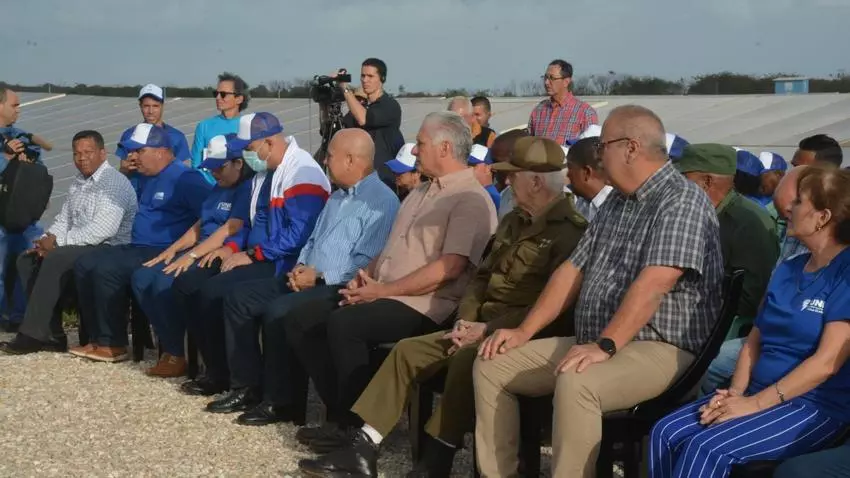
René Díaz, worker at the Ciego Norte solar park in Ciego de Ávila / Invasor

14ymedio bigger14ymedio, Havana, 31 March 2025 — With the Government’s accelerated commitment to photovoltaic energy, a new hero has been born in Cuba: the solar panel installer. The official press sings his praises, like this bit from Invasor: “It’s almost 12:00 noon on a Wednesday in March, but René doesn’t care about the date or time. Since the beginning of January his routine is the same. He wakes up at 5:00 in the morning, has breakfast, takes a bus from the Moronse town of Nereida to Grego, in Ciego de Ávila, and works from sunrise to sunset.”

This worker, an employee of the Ciego Norte park, one of the six connected last Friday to the national electricity system (SEN), reflects on the Herculean task that lies ahead: to alleviate the unending energy crisis. “Behind his glasses, his eyes reflect a concern inappropriate for his daily work, although in his hands lays, perhaps, part of the solution itself. René is distressed to know that last night his relatives had a bad night because of the blackouts in Santiago de Cuba, more than 400 kilometers from where he is trying to restore light to the country,” the pompous report continues.

This Monday the generation deficit again approaches 1,500 megawatts. The epic stories, for the moment, solve little. The forecast of the Unión Eléctrica continue reading

de Cuba (UNE) for peak hours is, specifically, a deficit of 1,360 MW (there is 1,990 MW for a demand of 3,350 MW) and a real shortage of 1,430 MW.

The daily report of the UNE includes, as always, the list of damaged thermoelectric power plants (CTEs) and those shut down for maintenance, a total of nine: two from CTE Mariel, one from Nuevitas, another from Felton, one more from Santa Cruz del Norte, two from Cienfuegos and two from Renté, in Santiago de Cuba.

Due to “thermal limitations” there are 341 MW absent, and due to fuel shortages, 485 MW, corresponding to 75 distributed generation plants, which run on [imported] fuel oil and diesel, while most CTEs use national [crude] oil.

Other thermoelectric workers are no less heroic. Thus, in Sierra Maestra they praise the employees of the Renté, “who perform feats every day to keep an obsolete machinery in operation, on which the life of the country depends.”

Miguel Díaz Canel, Ramiro Valdés, Vicente de la O Levy and other authorities at Friday’s inauguration of the Remedios park, in Villa Clara / Vanguardia

The report doesn’t hide, in fact, the antiquity of the ailing plant in Santiago de Cuba, built 59 years ago and whose useful life was estimated at almost 30 years less. Energy in general and the construction of new solar parks – with Chinese technology and funding – mainly occupy the pages of state newspapers.

In addition to Ciego Norte, four other facilities have recently been “synchronized” to the SEN, as advanced by the Minister of Energy and Mines, Vicente de la O Levy, in the long serialized interview published last week: Mango Dulce, in Artemisa; La Corúa, in Holguín; Jovellanos II, in Matanzas, and Remedios, in Villa Clara.

The latter was inaugurated by a prominent native of the province, the hand-picked president Miguel Díaz-Canel, who was accompanied by De la O Levy himself and other high authorities, such as Ramiro Valdés. Remedios is the first park of this type to be installed in Villa Clara, and the governor, Milaxy Sánchez Armas, said that it will save about 9,000 tons of oil per year.

Ramiro Valdés was also present at the debut of the Mango Dulce, in Artemisa, and the Jovellanos II, in Matanzas

Ramiro Valdés was also present at the debut of the Mango Dulce Photovoltaic Park, in Artemisa, and the Jovellanos II, in Matanzas.

These facilities, all with the same generation capacity, 21.8 megawatts (MW), are added to the School of Nursing, in El Cotorro (Havana), Alcalde Mayor, in Abreus (Cienfuegos) and La Sabana, in Granma.

The government’s plan for 2025 is to enlist 55 photovoltaic parks, out of a total of 92 that they expect to end up providing more than 2,000 MW of generation in 2028. The goal for 2030 is to reach 24% of renewable energy, including wind power.

Although the authorities assure that photovoltaic energy is an “undying hope,” they have also admitted that solar parks will not solve the energy crisis.

If the country has 1,500 MW of deficit, as the Minister of Energy calculated a few days ago, with the 1,000 MW of photovoltaics planned for this year, a third of what is needed will still remain unresolved.

Translated by Regina Anavy

____________

COLLABORATE WITH OUR WORK: The 14ymedio team is committed to practicing serious journalism that reflects Cuba’s reality in all its depth. Thank you for joining us on this long journey. We invite you to continue supporting us by becoming a member of 14ymedio now. Together we can continue transforming journalism in Cuba.

Despised in His Country, Andy Díaz Triumphs for Italy While Cuban Sport Sinks

Three Cubans on the triple jump podium at Paris 2024, and “the credit goes to other countries who trusted them more than their own. A joy, but what a shame for the country.”

His most recent medal was the gold as world champion on an indoor track in Nanjing (China) / Instagram

14ymedio bigger14ymedio, Havana, 28 March 2025 — “You have no talent to be an athlete,” managers and coaches told triple jumper Andy Díaz in 2014 in Cuba. Then 19 years old, Díaz, from Havana, had come in fourth place in the U20 World Championship. “Many insisted that I was not good and would never get anywhere,” the naturalized Italian athlete told the sports newspaper Relevo. He won the bronze medal at the Paris 2024 Olympic Games and, this year, the gold in the indoor world championship in Nanjing (China) and the European event in Apeldoorn (Netherlands).

Despite the constant ostracism suffered on the Island, the athlete says he never stopped believing in his abilities. Thus, he recalled that in 2015 he joined the national team and repeated being in fourth place in the World Cup of the U20 specialty. In those days the world champion and Olympic medalist Yoelbi Quesada was training him.

“I wanted to win an Olympic medal for Cuba, my country,” but the disdain of the federations led him to look for other horizons. “I knew that there [in Italy] it would be difficult, that I had to start from scratch, far, very far away,” he said about his decision.

His success in Paris 2024 not only earned Díaz the bronze but also gave evidence of the sports debacle on the Island. In the event, the three medals were taken by exiled Cuban triple jumpers: the gold went to Jordan Díaz representing Spain and the silver to Pedro Pablo Pichardo with Portugal.

“I hope the managers realize what they lost,” he said. “It’s a shame, but I don’t regret anything. Even if things hadn’t turned out well at a sports level, there were three Cubans there, and the credit goes to other countries that trusted us more than our own. It’s a joy, but what a shame for Cuba. In my case, I am happy to give that medal to Italy,” he stressed. continue reading

Díaz attended the Tokyo 2020 Olympic Games in discomfort. The regime knew that he was injured and still took him, counting on the fact that in some sports it is possible to participate with injuries. “You grit your teeth, and nothing happens.” However, his case was complex, and he was determined not to participate. “I didn’t want to and I couldn’t,” he said. The reality is that he had already planned to escape during his stay in Europe.

In Cuba they told him that he would never make it big, which forced him to flee to Spain- / Jit

Back in Cuba, Andy Díaz took advantage of a stopover in Spain and ran away. He says that he decided to settle in Rome, because Italy is the most Latin country in Europe. “I had nothing and I lived on nothing,” he recalled. For a long time, he says, he questioned whether he had made the right decision. “It’s not easy to leave a country. I didn’t know if everything I was doing was right. My mother, my family and I, all crying. Then I thought there was no turning back. I couldn’t go back to Cuba for eight years,” and he still has five left.

Díaz asked for asylum. The documents arrived in mid-2022, but it took eight months to give him nationality. He mentioned that to be one of the first in line, he slept “on the street several times in front of the immigration office in Rome. Then they moved the office and I also went to the other side. I had to sleep nearby so as not to lose priority in the document appointments.”

While going through the procedure, Díaz contacted the Italian Fabrizio Donato, bronze medalist at the London Olympic Games (2012) and world gold indoor in Turin (2009), as well as European outdoor champion in Helsinki (2012). The athlete was fundamental in helping the Cuban achieve Italian nationality in February 2023.

Translated by Regina Anavy

____________

COLLABORATE WITH OUR WORK: The 14ymedio team is committed to practicing serious journalism that reflects Cuba’s reality in all its depth. Thank you for joining us on this long journey. We invite you to continue supporting us by becoming a member of 14ymedio now. Together we can continue transforming journalism in Cuba.