Ten Cuban Players Attend the European Baseball Championship

Spain, the current tournament champion, has seven Cuban players among its ranks


Ernesto Martínez Jr. joins the roster of France (Facebook)

14ymedio bigger14ymedio, Havana, September 22, 2025 —
The European Baseball Championship, which began last Saturday in Italy, Belgium and the Netherlands, has a strong presence of Cuban players. Ten players born on the island represent four different teams, including Spain, the current champion of the event, whose roster is more than 50% Cuban.

The Spanish team, which won 15-0 against Sweden last Saturday, has seven players in its ranks: catcher Omar Hernández, outfielders Frank Hernández and Félix Stevens, and pitchers Pablo Luis Guillén, Carlos Sierra, Royd Hernández and Rubén Menes. In addition, there is William Escala, born in Miami but with a Cuban father. Also, on the coaching team is Néstor Pérez Jr. from Matanzas, who played seven seasons in the minor leagues with Tampa Bay.

Spain, which seeks to defend the title won two years ago in the Czech Republic, lost its second game 9-1 this Sunday, precisely against the Czechs. William Escala, whose father is Cuban, played in this game. In Spain’s last game this Monday, they won 2-1 against Germany and are waiting to know their future, once all the games have concluded. continue reading

Noel González is on the Italian team, which began with a resounding 18-0 victory against Switzerland

Noel González, from Holguín, is on the Italian team, which began with a resounding 18-0 victory against Switzerland; he will play his second European tournament with them. After finishing ninth in the disputed edition two years ago, the Italians intend to return to the podium, something they have not achieved since 2021, which is an outstanding debt for the second team to win more times in the history of the competition with 10 championships, only behind the Netherlands, which has 24.

Another Holguín player will be part of the contest, but with the colors of France. Ernesto Martínez Jr. leads the roster and will have his second participation in a European tournament with that team. In the past, in the Czech Republic, he hit .286, with a home run and three RBIs. He is also the only player of his team with a contract in the major leagues, since the rest of the players are part of teams from the Netherlands, Italy and France.

Finally, Raxon Martínez Miranda from Pinar del Río is playing with Belgium and experiencing his first international event with that country. He was not in his team’s debut on Saturday, which lost 16-8 to Austria, although he played on Sunday against Hungary (19-9 victory) and is playing this Monday against Croatia (game in progress).

Raxon Martínez Miranda, from Pinar del Río, is playing with Belgium, experiencing his first international event with that country

Raxon left Cuba after marrying a Belgian citizen about five years ago. He has played for Belgium in the first division of baseball in the 2022 to 2025 seasons (in the first three championships with the club Brasschaat Braves and in the last one with Deurne Spartans). The 29-year-old pitcher played in Cuba’s U23 National Championship in the 2019 sixth edition and had 60 turns at bat; he scored 10, with 11 hits, two triples and four RBIs.

If Spain manages to win, it would be the third European Baseball Championship in their showcase. For this edition, the tournament — which opened in 1954 — has the participation of 16 countries. The final round will be played from September 25 to 27 in Rotterdam. The semi-finals are scheduled for Friday, September 26, followed by the bronze medal match and the final next Saturday.

Translated by Regina Anavy
____________

COLLABORATE WITH OUR WORK: The 14ymedio team is committed to practicing serious journalism that reflects Cuba’s reality in all its depth. Thank you for joining us on this long journey. We invite you to continue supporting us by becoming a member of 14ymedio now. Together we can continue transforming journalism in Cuba.

The Unusual Speed of Catching the Alleged Murderer of a Police Officer Causes Astonishment Among the Population

The suspect was arrested in Remedios with a knife and the victim’s service pistol, allegedly used to commit the crime.

Images of the captain’s funeral circulated on social media. / Facebook/Henry Omar Pérez

14ymedio bigger14ymedio, Havana, September 21, 2025 — The Cuban police have captured in record time the alleged murderer of Captain Leonel Mesa Rodríguez, chief of sector in Caibarién, Villa Clara, who was found dead on a road on Friday morning. The arrest occurred just one day after the crime, at 4:45 pm on Saturday in the city of Remedios, as confirmed by the Ministry of the Interior in a post on social networks. It was also reported that the detainee was carrying the officer’s pistol and a knife, both used in the murder.

The authorities did not give details about the detainee’s identity. Initially it was said that he was a “butcher and trafficker of cattle,” which generated suspicion among citizens. “They don’t give his name and surname like they usually do, it’s very strange,” one reader wrote in the comments at the foot of the official post on Facebook. Other users expressed their bewilderment at the speed of the process: “How fast! And for the ordinary Cuban they spend years, and nothing.”

Many of the comments called for a severe penalty or even capital punishment for the aggressor, an expectation that the authorities have shown themselves willing to meet. “The detainee will be subjected to the appropriate criminal proceedings, with the rigor established by revolutionary justice and according to the magnitude and gravity of the act committed,” said the ministry in its official note.

The rapid and severe justice for the murderer contrasts with the slowness and indifference of the authorities when confronting less conspicuous crimes against ordinary citizens. The disparity did not go unnoticed: “I am shocked to see how quickly they arrested this guy when there are other crimes that are just as cruel that are still unresolved.” “What a surprise!” another internet user mocked. continue reading

The death of the captain has been an opportunity for the regime to close ranks around its police forces

The death of the captain has been an opportunity for the regime to close ranks around its police forces and send a message of unity and strength. Mesa’s coffin, aboard a military vehicle, travelled the streets of his hometown, Taguasco (Sancti Spíritus) with a guard of honor, in a solemn ceremony that is interpreted as a warning to the internal enemy.

Numerous photos of the funeral circulated on social media. A Cuban flag was draped on the coffin, and each floral offering had the name of someone with ties to Army General Raúl Castro and President Miguel Díaz-Canel.

Senior officials from the Communist Party of Villa Clara and Sancti Spíritus, as well as from the Ministry of the Interior, also attended the funeral.

The official spokesman Henry Omar Perez, of Villa Clara, who has been one of the most active in disseminating information about the murdered policeman, as well as one of the most “combative” in his messages, described Mesa as a “colossus” of public order, a man who “day and night traveled to the most remote parts of the city of Caibarién in the effort to effectively fulfill the missions assigned to him.”

Mesa, who joined the Ministry of the Interior in 2004, was recognized with multiple distinctions; 12 medals were displayed at the funeral. Among them were the “Internationalist Fighter in Ethiopia” and more recently, the “Praise of Virtue,” awarded last June. At 62, he was still patroling his assigned area without relief, the official press points out. According to Colonel Eddy Sierra Arias, head of the General Directorate of the National Revolutionary Police Force, Mesa was an “example of values, commitment, sense of belonging, hours of wakefulness and the tireless fight against crime.”

https://www.facebook.com/henryomar21/posts/2626961970977300?ref=embed_post

“There is no doubt: if he were not a police officer, he would not have moved a finger,” said a reader in the face of the flood of praise that officialdom has dedicated to the captain. Just hours after the crime, the official narrative was already clear: it was a “vile act, an infamous outrage,” as Henry Omar Perez, known for having access to insider information from the police, wrote in a second publication, where he described the killer as “a coward unable to face the greatness of Leonel.”

However, unofficial reports have also emerged that offer different nuances and refer to him with the nickname “Quick Lime,” alluding to his alleged abusive methods as head of sector.

Leonel Mesa Rodríguez was found on the morning of Friday “with six stab wounds and a shot in the head,” allegedly with his own firearm, at the Popular Council La Reforma of the municipality of Caibarién. Videos circulating on social media showed his body lying on the road, while several officers diverted traffic.

Within a few hours, his death generated an avalanche of reactions between those who ask for a tough hand on the aggressor and those who fear that the murder of a police officer will return Cuba to the dark times of the executions. The tension of the case is concentrated in a sentence by Raúl Castro that supporters of the regime have revived on social networks: “He who kills by the sword, dies by the sword.”

Translated by Regina Anavy

____________

COLLABORATE WITH OUR WORK: The 14ymedio team is committed to practicing serious journalism that reflects Cuba’s reality in all its depth. Thank you for joining us on this long journey. We invite you to continue supporting us by becoming a member of 14ymedio now. Together we can continue transforming journalism in Cuba.

Cuba Extends the Tariff Exemption for Medicine and Food Until January

The measure is renewed because food and commodity shortages “persist”

The regulation entered into force in 2021 and has since been postponed several times. / Cubadebate

14ymedio bigger14ymedio /EFE, Havana, September 20, 2025 — The Cuban government extended for another four months, until January 31, the duty exemption on food, medicines, toiletries and power generators that enter the country without commercial purposes, the official press reported this Saturday. The regulation had already been extended once this year, in April.

According to the Gaceta Oficial, “limitations in the supply of food and other goods in the country persist.” This initially led to exemption from customs duties on basic necessities. However, the text blames the “hardening of the economic, financial and commercial blockade and the impact on the economic sphere of the measures taken during the Covid-19 pandemic for the gradual recovery of the country.”

The customs value limit of $200 to $500 is maintained for imports made by people through shipments

The regulation entered into force in 2021 and has since been postponed several times. It maintains the limit of the Customs value from 200 to 500 US dollars for imports made by people through shipments. As for those brought to the Island by travelers themselves, the authorities state that the articles must be presented to customs by natural persons in packages separated from personal baggage in order to receive the tariff benefit.

According to an official press report published at the beginning of the year, in 2024 there were 118 violations by “people who use these benefits for profit and not to satisfy personal and family consumption,” a warning that Customs released again this Friday. At the end of the first quarter of 2025, the figure was already 104 violations, and the confiscation of  8,978 kilograms of medications, food and toiletries .

The importation of food and medication without tariff limits was a measure adopted following the  Island-wide anti-government protests of July 11, 2021 (’11J’), which had among its main causes the shortage of basic products and the prolonged electricity cuts.

Translated by Regina Anavy

____________

COLLABORATE WITH OUR WORK: The 14ymedio team is committed to practicing serious journalism that reflects Cuba’s reality in all its depth. Thank you for joining us on this long journey. We invite you to continue supporting us by becoming a member of 14ymedio now. Together we can continue transforming journalism in Cuba.

Cuban President Díaz-Canel, the Dissonant Note in Silvio Rodríguez’s Concert in Havana

When the artist sang “when the revolution comes down,” shouts of “hopefully” were heard in the audience

The concert, which began with Ala de colibrí (Wing of the Hummingbird), was followed by a medley of the musician’s classics. / 14ymedio

14ymedio bigger14ymedio, Darío Hernández, Havana, September 20, 2025 — Silvio Rodríguez returned to the steps of the University of Havana this Friday afternoon after more than 20 years without singing in that emblematic place, and he did it with a concert full of emotion, uncomfortable silences and a display of lights that crudely contrasted with the reality of the country’s blackouts. The opening of his new Latin American tour ended in a deployment of police, who guarded, in addition to the tense tranquility of the public, Cuban President Miguel Díaz-Canel and his wife, Lis Cuesta.

From early on it was clear that this would not be just any night. “There was a lot of security for an audience of young university students. Everyone was checked at the entrance before they could go in.”

The president went up on a side of the stage and greeted the audience two or three times. Very few returned the greeting. On the rooftops of adjacent buildings, agents were present within a wide cordon of security.

Díaz-Canel and Cuesta were at one side of the stage, protected by security agents. / 14ymedio

Dressed in blue and olive green, agents of the Ministry of the Interior hovered around the entire perimeter of the university. They were also among the public dressed in civilian clothes, in keeping with the regime’s tradition of infiltrating its agents, which did not prevent some shouts of disagreement with the authorities of the country.

Some of them booed Díaz-Canel, and when the time came for Silvio to play El necio (The Fool), one of his most emblematic songs, tension reappeared and some daring cries of “hopefully” were heard in response to “when the revolution comes down.”

The whole family of actor Jorge Perugorría and several musicians like López Gavilán were seated in the VIP area, including Carlos Alberto Cremata, director of La Colmenita (The Little Beehive, a Cuban children’s theater company), among many others.

Along with the students, who enjoyed the music that is part of the DNA soundtrack of several generations, there were also those who could not resist the temptation to turn the concert into a political act. Among the stands were several Palestinian flags and, near the end, Silvio himself sang with a Palestinian scarf around his neck, placed by his daughter Malva. This was before singing La era está pariendo un corazón (The Age is Giving Birth to a Heart), another of his most famous themes. He used the moment to harshly criticize Israel for its actions in Gaza: “I think about you and fail to understand how you have so soon forgotten the breath of hell,”he said quoting the Cuban poet Luis Rogelio Nogueras.

Silvio sang with a Palestinian scarf around his neck, placed by his daughter Malva. / Cubadebate

There were Latin American tourists on the steps, attracted by the music and the tumult of students, and in the center of the crowd, a small group of spectators waved a July 26 flag.

The concert began with Ala de colibrí, followed by a medley of the musician’s classics. The crowd sang along, despite the fact that most were born when the New Trova movement was already history. Many 50-year-olds were also seen in the audience.

In an interview with EFE days before the concert, Rodríguez, now 78, explained that he wanted to start the tour in Cuba, and specifically at the University of Havana, because the students had given him hope: “They gave me hope when I saw their attitude,” he said in reference to the protests against the tarifazo [massive of rate increases] of Etecsa, the State telecommunications company, at the end of May.

The university was, without a doubt, a mirage of light and music last night, from which one then returned to the darkness of Havana. / 14ymedio

Also present was the memory of the national blackout just a week ago, from which much of the country still hasn’t recovered, especially when the play of lights dazzled the staircase thanks to two gigantic generators placed carefully hours before. Interviewed briefly by 14ymedio before the concert began, a neighbor said sarcastically: “That’s so you can see the blue color of the unicorn.” (Silvio has a song entitled Blue Unicorn.)

Last night the university was, without a doubt, a mirage of light and music that later was returned to the darkness of Havana. When the concert ended, people started running in the streets looking for a bus to return to their homes and the blackouts.

Police and Interior Ministry agents were stationed around the entire perimeter of the university. / 14ymedio

Translated by Regina Anavy

____________

COLLABORATE WITH OUR WORK: The 14ymedio team is committed to practicing serious journalism that reflects Cuba’s reality in all its depth. Thank you for joining us on this long journey. We invite you to continue supporting us by becoming a member of 14ymedio now. Together we can continue transforming journalism in Cuba.

Powerful Generators Guarantee Silvio Rodríguez’s Concert has Electricity

In the midst of blackouts affecting the entire country, the artist will have his island of light tonight at the University of Havana

Cuba expects a deficit of 1,760 megawatts today. / 14ymedio

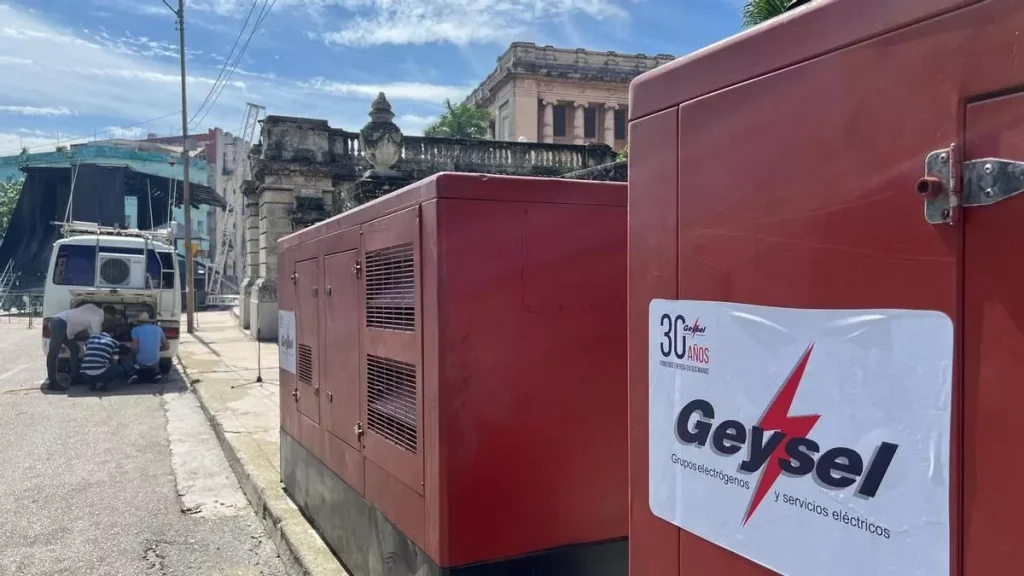
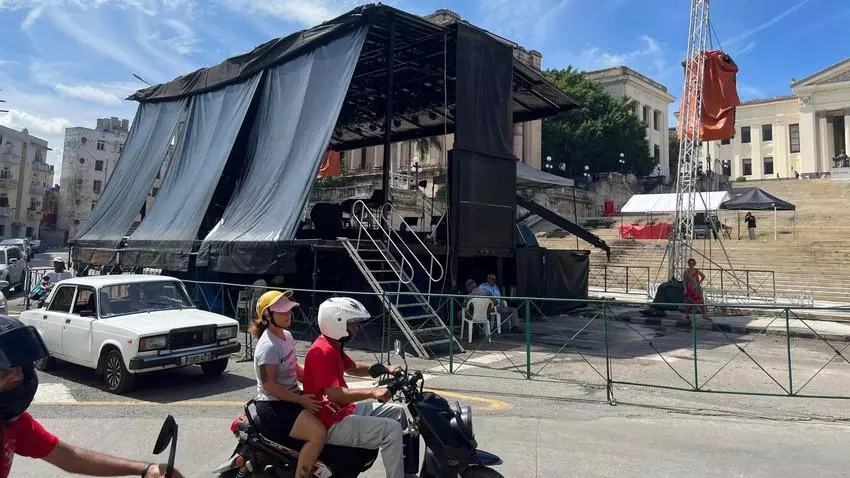
14ymedio biggerHavana, Darío Hernández, September 19, 2025 — Two red mastodons stand out in front of the University of Havana this Friday. Although the stage for the concert that Silvio Rodríguez will offer tonight is visually more striking, passers-by only have eyes for the generators that will prevent the show from being interrupted due to the lack of electricity. With a greedy look, some with gestures of bewilderment, others with resignation, and the great majority, those who approach, cannot help but say something about the robust power plants.

“This is so you can see the blue color of the unicorn,” said a woman with a bag of groceries who crossed the street just to read the signs on the devices. “Geysel, 30 years of putting energy in your hands,” stands out in a poster on the generators, which are remarkably well-kept compared to the rust-eaten and often broken devices that you see outside some polyclinics and public offices. “It seems that these are the ones they have for political events,” pointed out a woman who joined the visual inspection.

The singer-songwriter claims he chose the place because he recently saw “very positive attitudes” among the students. / 14ymedio

In a city that since last week has suffered the longest blackouts, when the national energy system collapsed and left the entire nation in darkness, a generator sets off a frenzy of desire. “With one of those I could sleep several full nights without having to scare off the mosquitoes,” speculated a young man who, laughing, agreed to meet up with his friends later to try to get continue reading

into the performance. A few meters away, most of the lights, scaffolding and sound equipment were now placed at the foot of the wide staircase of La Colina.

Rodriguez started to sing amidst the glow of lamps that are a strong symbolic charge in a country where even baseball games must be suspended for lack of power. Cuba expects a deficit of 1,760 megawatts today, so it is unlikely that El Vedado and the surroundings of the concert will not be affected. “If the light goes off I’ll come here,” said an elderly woman who was waiting for the bus a few meters away.

The singer-songwriter says he chose the place because he recently saw “very positive attitudes” among students of the Federación Estudiantil Universitaria in their protest against the increase in State telecommunications company Etecsa’s massive rate increased, known as the tarifazo. But his intention to approach the younger generations, consumers of other musical styles away from the New Trova, could include a very contradictory message. Used to doing their homework by the light of a candle while fanning themselves in the heat, these boys will see before them a display of lights and generators that only the powerful can enjoy in Cuba. The composer of Ojalá will create an island of electricity within the Island of shadows.

Translated by Regina Anavy

____________

COLLABORATE WITH OUR WORK: The 14ymedio team is committed to practicing serious journalism that reflects Cuba’s reality in all its depth. Thank you for joining us on this long journey. We invite you to continue supporting us by becoming a member of 14ymedio now. Together we can continue transforming journalism in Cuba.

Thousands of Cubans Respond to a Job Offer in Granada for $200 per Week

Requirements include knowledge of English and availability for one year

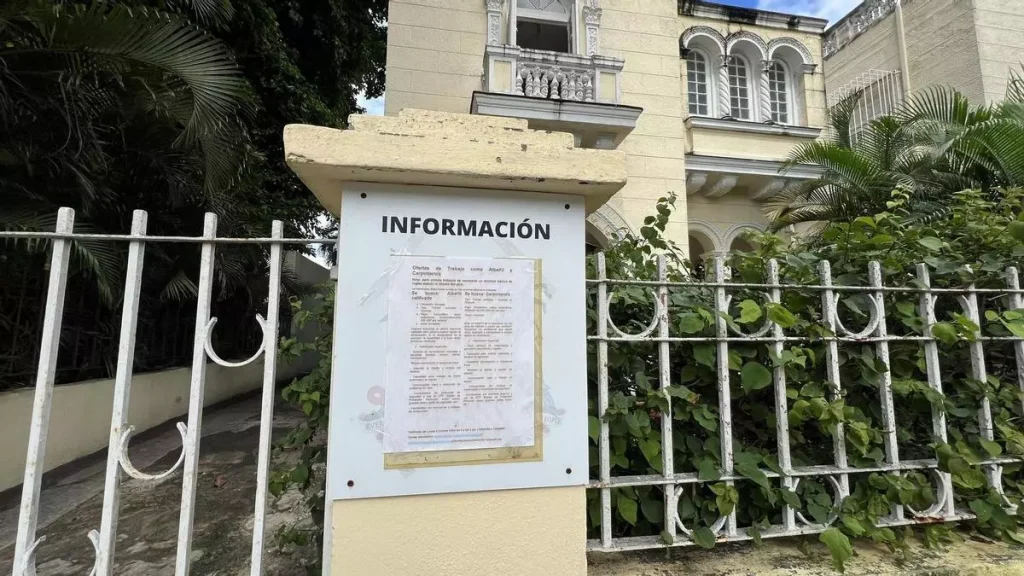
Job offers posted outside the Embassy of Granada in Havana / 14ymedio

14ymedio bigger14ymedio, Havana, September 17, 2025 — The response to Grenada’s recent offer of masonry and carpentry jobs for Cubans has been overwhelming. According to the offer spread by the Embassy of Granada through Instagram, the project offers a weekly salary of 200 dollars for one year. “We can’t respond,” acknowledged the diplomatic headquarters, which asks the thousands of interested parties to consult its list of requirements and send an email.

The offer is attractive when the average monthly salary on the island is $16. Participants are required to have a certain command of the English language in order to facilitate communication at their workplace. In return, Grenada promises those chosen an “immediate start” and coverage of the costs of paperwork and work permits.

The selected participants will be provided with accommodation and transport throughout their stay. Return tickets are also provided by the small island.

The selected participants will be provided with accommodation and transport throughout their stay. Return tickets are also provided by the small island

Without being a compulsory requirement, it is preferred that the bricklayers have some knowledge of finishes. The tasks to be carried out involve the construction of walls, columns, insulation and waterproofing, as well as a knowledge of plans.

Carpenters must have skills for the manufacture and assembly of wood infrastructure in constructions, the development of continue reading

“furniture, doors, windows” and a knowledge of roofing and wall planking.

Between this Thursday and next Thursday, interviews will be held at the Embassy of Granada in Havana, located on Quinta Avenida 2006 between 20 and 22, in Miramar.

Diplomatic relations between Cuba and Grenada were formalized on April 14, 1979, one month after the triumph of the revolution led by the Granadian Maurice Bishop.

Both countries have agreements on environmental protection, education, aquaculture and fisheries, and especially in the area of health, with the presence of 300 Cuban specialists in Granada and the granting of scholarships to students from Granada.

The present call brings to mind the Cuban presence in Granada at the time of the American invasion on October 25, 1983

During the so-called Operation Urgent Fury, “the invading forces confronted 1,500 Granadian soldiers and 700 Cubans, who were listed as construction workers, engineers and some military personnel,” the Miami-based media Café Fuerte recalled on the 40th anniversary of the event.

The Cuban builders were working mainly on the construction of a new airport. Grenada’s official media announced that with the arrival of the U.S. military, and after engaging in difficult battle, the last Cuban fighters “immolated themselves wrapped in the flag.” The truth is that most were made prisoners, and colonel Pedro Tortoló Comás, at the head of the Cuban troops, sought asylum with other officers at the Soviet Union embassy.

Translated by Regina Anavy

____________

COLLABORATE WITH OUR WORK: The 14ymedio team is committed to practicing serious journalism that reflects Cuba’s reality in all its depth. Thank you for joining us on this long journey. We invite you to continue supporting us by becoming a member of 14ymedio now. Together we can continue transforming journalism in Cuba.

Cuba’s Tabacuba Offers a Way out of the Devalued ‘Freely Convertible Currency’ That It Pays Tobacco Producers

The first store in Cuba in freely convertible currency for tools and supplies opens for tobacco producers

The store is located on Carretera Las Ovas. / Tabacuba/Facebook

14ymedio bigger14ymedio, Havana, September 19, 2025 –The first freely convertible currency (MLC) tobacco supply store opened this Thursday in Pînar del Río. The store, which the authorities presented as just one of many that they want to open so tobacco producers can use the virtual currency they get as a stimulus after harvest, comes six years after the implementation of the MLC and at a time when its value has plummeted.

Marino Murillo, president of Tabacuba, inaugurated the store, which the official press says has more than “100 tools and products necessary to guarantee tobacco production and improve the producers’ living conditions.” The shared images mostly show common hardware items such as brushes, hammers and screwdrivers, more useful for the machinery than for the harvest itself, and that easily fill a list of 100 products.

The most attractive offers, for which users who saw the publication on social networks now begin to show interest, are water turbines and, above all, power generators – almost essential in Cuba if you want to have electricity most of the day. However, the models on display are diesel, a fuel that is very difficult to obtain, rather than being rechargeable with solar panels. continue reading

The official press also mentioned that kits of solar panels, cement and household appliances that were previously sold in another location will also be marketed.

https://www.facebook.com/GTabacuba/posts/815736041020721?ref=embed_post

Located in the Tobacco Logistics Base Business Unit on Las Ovas Road, the shop is almost exclusively stocked with products from the Chinese brand Total Tools, including the power generators. However, it is unclear whether they have been donated by Beijing or purchased by the island.

The store opens at a time when tension has risen among farmers over the devaluation of the MLC, which barely buys anything in an economy now turned to the dollar. The inconveniences in a sector that produces so much income is precisely the reason behind the opening, according to Murillo himself: “It is a way for them to reinvest in their land as long as they do not have debts with the company, and to ensure that the MLC paid has purchasing power.”

The company president also assured that there are plans to open similar shops in the municipalities of San Luis and San Juan y Martínez, tobacco producers par excellence, as well as in Vuelta Arriba, in the central provinces that also produce cigars.

The authorities did not clarify prices either, although they claimed that they are “between 25% and 30% less expensive than in the current domestic market as a result of negotiating directly with the supplier while avoiding intermediaries.”They also stressed that “after-sales” service and “transport facilities” will be provided to customers if necessary.

It is not the first time that Tabacuba offers tobacco growers a way to use the MLC, which is losing value

It is not the first time that Tabacuba offers tobacco growers a way to use the MLC, which is losing value, now worth only 205 pesos, compared to the record of 310 in May 2024. At the end of August, the company delivered six modern Mercedes-Benz to Cuban farmers to “encourage tobacco production.”

According to what a tobacco dealer from Pinar del Río told 14ymedio, the offer to manage the purchase of vehicles – paid for in MLC by the farmers themselves – was made to about 300 producers, six of whom chose a Mercedes-Benz. Some 15 opted for Chinese tillers of the Foton brand and semi-trailers.

Tabacuba, he then explained, offered to pay for the cars in dollars abroad and charge the farmers the amount at the exchange rate of one MLC to a dollar, while in the informal market the American currency is worth two times more than the virtual one. For farmers, the business initially appears to be beneficial, especially given the dizzying devaluation of the MLC. But there is a catch: although it is a sector that generates many currencies and profits for the State, producers are still forced to manage their crops in the devalued MLC, without access to the dollars they generate.

Translated by Regina Anavy

____________

COLLABORATE WITH OUR WORK: The 14ymedio team is committed to practicing serious journalism that reflects Cuba’s reality in all its depth. Thank you for joining us on this long journey. We invite you to continue supporting us by becoming a member of 14ymedio now. Together we can continue transforming journalism in Cuba.
Between Two Blackouts, They Recorded Their Music and Got a Grammy Nomination

Cuban economist Juan Triana suggests that the government involve the private sector in energy production

Creators of the award-nominated album Girafas/ Instagram/@belkis_proenza

14ymedio bigger14ymedio, Madrid, September 18, 2025 — Rita Rosa Ruesga, from Santiago, was nominated this Wednesday by the Latin Academy of Recording Arts and Sciences for the Grammy Award for Best Children’s Music Album by Jirafas. It is a story of musical theater that the artist defines as “full of hope for those who have to go in search of a dream beyond their homes.” The music, a mixture of styles as national as son, danzón, rumba and marchas, is also “for mothers who, at some point, must let our children fly away.”

It is the fifth time that the artist, based in Miami for years and dedicated to writing books and children’s music, will vie for the golden gramophone, but this time, she says, there is something that distinguishes the nomination from previous occasions. “There is something unique about my project, which is that the musicians who recorded from Cuba did it when the power came on, on an empty stomach, but with the ideas and the illusion of this project as a real injection of life,” she explained in a press release.

Cuban artist Iris Fundora created the illustrations that accompany the album. Her contribution is closely related to the reality of the island. “She painted the illustrations of the giraffes by candlelight in the evenings,” adds Rita Rosa, who dedicates the nomination — in words sent to 14ymedio — to the Cuban part of the musical team and to Fundora herself, for their effort in the midst of a national crisis. “They are the real honorees.”

Details such as this perfectly illustrate the transversality of the energy emergency, which is a constant event in all areas. Last night, just 40 kilometers from the hometown of Rita Rosa Ruesga (Palma Soriano), in the province’s capital city, Santiago de Cuba, another blackout occurred with the cut of 110 kilowatts, which shut down the continue reading

substations Héctor Pavón, Santiago Norte and Este. Although the technicians repaired the breakdown in just one hour, the population is almost indifferent to these events, which barely affect the long hours they spend without electricity.

“Here in the district today, the power has not returned since it left, at 6 am,” said a resident 24 hours later

“Here in the district today the power has not returned since it left, at 6 am,” said a resident 24 hours later. “What’s the story? It’s that the Government, which is really the one that should leave, doesn’t.” This was one of more than 150 comments to the post of the provincial electricity company announcing the fix of the fault. Most spoke of a daily average of 17 hours without electricity. This Tuesday, more than 2,000 megawatts (MW) were cut, and yesterday (Wednesday), a deficit of 1,990 MW was expected, although finally the amount remained at a not-negligible 1,885 MW, similar to the 1,830 planned for this Thursday.

Energy Minister Vicente de la O Levy again appeared before the press to “update” the situation of the national electrical system, although he said absolutely nothing new, beyond the renewal of a date for solving the problems.

This time, the next horizon has been set for the weekend, when Felton 1 and Renté 5 should return, and the following days, when oil — whose absence has caused a more pronounced electricity deficit than gasoline, he said — should arrive. The next is in October, with the incorporation of units 4 of the CTE Carlos Manuel de Céspedes (Cienfuegos) and 2 of the Santa Cruz del Norte. But there is a shadow that clouds everything, and it is the exit of the Guiteras unit, in Matanzas, which will occur “in December, taking advantage of the period of lower electricity demand.” The increase in solar energy, during daylight hours, does not compensate for the loss; even though the electricity is now at 650 MW, it is still very low.

“According to United Nations data, renewable energies accounted for 30 per cent of electricity consumption at the beginning of this decade. In Cuba at that time, it barely reached 4% of the generation,” reports economist Juan Triana Cordoví in an article published this Wednesday in OnCuba. Although he concedes that the new data show a rapid escalation in photovoltaics, the lost time takes a toll.

“The expert claims the urgent need for the private sector to enter energy production, citing the positive “generation experience with a 100%-foreign thermal power plant on the Isla de la Juventud”

The expert claims the urgent need for the private sector to enter energy production, citing the positive “generation experience with a 100%-foreign thermal power plant, now state owned, on the Isla de la Juventud.” Triana Cordoví reviews all the attempted strategies, including the failure of bioelectric pipes, the zero investment in wind energy, the millions in non-refundable expenditures on Turkish floating power plants and the unsustainable subsidy to the electricity bill, which is paid in pesos when the system needs dollars.

“I don’t think there is a one-size-fits-all solution, excepting luck, and that rarely happens,” he says after considering that any contribution, including support for single-family solar, is good, but a new comprehensive strategy is needed. “It is time to innovate with business models that contribute to the increase of generation and improvement of service, apart from the centrality of State regulation,” he states, since “having electricity and drinking water is by no means a ‘petty-bourgeois’ aspiration or an aristocratic banality.”

The economist’s article points out that two centuries have passed since the industrial revolution and that two simple elements were essential for this. “Access to water and energy has been a basic requirement for the Homo sapiens herdsman to be radically different from the other herdsmen,” he says. Cuba lacks both and therefore cannot prosper.

Water scarcity, caused by the weather and aggravated by the blackouts, affects more than 3.1 million people -30% of the population-, who suffer a total or partial lack of supply.

The situation is getting to the point where Cienfuegos now depends on Villa Clara for its supply. This Wednesday, both provinces announced an agreement to transfer water from the Hanabanilla reservoir to Paso Bonito, whose levels are seriously low.

“The situation is complex and requires innovative measures,” said Cienfuegos Governor Yolexis Rodríguez Armada. It is expected that tomorrow the water will begin to arrive through the use of pumping systems, and the population is asked not to waste it, which begs another question: “What about the leaks in the water pipes; when will they be fixed?”

Translated by Regina Anavy

____________

COLLABORATE WITH OUR WORK: The 14ymedio team is committed to practicing serious journalism that reflects Cuba’s reality in all its depth. Thank you for joining us on this long journey. We invite you to continue supporting us by becoming a member of 14ymedio now. Together we can continue transforming journalism in Cuba.
Synthetic Drugs Like the ‘Chemical’ are Diversifying and Expanding in Cuba

The Ministry of the Interior claims that this is due, among other causes, to the “growing flow of travelers”

Firearms and 18 million pesos in different currencies have also been seized in the country. / 5 de Septiembre

14ymedio bigger14ymedio, Havana, September 16, 2025 — During Monday’s broadcast of the program Mesa Redonda, the authorities acknowledged that in Cuba, drug consumption is expanding and diversifying, especially towards synthetic substances, which are “cheaper and less risky for the trafficker.” And among them el químico -the “chemical”- remains the king of narcotics on the island. 

Beyond the concrete data demonstrating a worrying spread of drugs, the television program was a reiteration of the usual arguments: the blame is outside, mainly on the U.S., and the country is a passive victim of external forces that have managed to infiltrate the national territory. Juan Carlos Poey Guerra, head of the Anti-Drug Directorate of the Ministry of the Interior, stated that the “main effects” on the country are due to the “increasing flow of travelers and the settlement of Cubans in highly complex countries that have drug trafficking and organized crime.”

Regarding the data, Poey stated that more than 6,000 people have been prosecuted, and there have been 1,500 seizures with 81 kilograms of confiscated drugs, which Cubadebate described as “a very high volume of potential consumption.” in addition, they have confiscated five firearms, 11,000 plants and 23,000 seeds -allegedly of marijuana- and 18 million pesos in different currencies.

A speedboat carrying 36.8 kg of cocaine was also intercepted off the coast, a fact that Poey used to highlight the work of the Ministry: “For other countries, the volume is insignificant. For us any volume continue reading

is important.”

Another pillar of the speech was, as usual, the emphasis on the responsibility of the U.S. for the arrival of drugs on the island. According to Poey, who further described the country’s current military presence in the Caribbean as a risk to national sovereignty and regional stability, the U.S. is the world’s largest consumer of drugs, and Cuba is on the drug route to its borders.

However, he himself acknowledged at another time that the island “is not a country producing, storing or transiting drugs to third countries.” He also overlooked the fact that, although the U.S. has always been a great consumer, it was not until a few years ago that the presence of drugs began to grow in Cuba to the point where even the official press, previously silent on the subject, now considers it an undeniable reality.

Poey remarked that ‘el químico’ is the narcotic “of greatest impact in our society at present,” something he associated with the rise of synthetic drugs

Poey remarked that ‘el químico is the narcotic “of greatest impact in our society at present,” something he associated with the rise of synthetic drugs made in laboratories, which are “a big and lucrative business. There is less money invested, they get it faster and sell it.” Natural drugs, like marijuana, he said, take longer to produce.

Despite this, he continued, many programs have been carried out to prevent and detect consumption, starting with the national campaign against drug trafficking, “which has run monthly throughout the country since January, with operations extended in the capital because of its complexity.”

Although he did not mention it in its report, Cuba has also made sure that the severe penalties it imposes on drug traffickers and users are exemplary. Both Cuban Television and the official press have devoted numerous reports in recent months to exposing drug-related trials, and Cubans have noticed this. Communities, said Poey, “demand, in the broad sense, more public judgment and more prosecution.”

On the positive side, he said, “We can officially certify that there is no fentanyl in our country, “although the presence of other substances leaves its mark on consumers. A month ago, Poey himself stated on Cuban Television that 45 types of cannabinoids can be found on the island, of the 250 that circulate globally. Some of them are up to 50 times more potent than heroin.

Translated by Regina Anavy

____________

COLLABORATE WITH OUR WORK: The 14ymedio team is committed to practicing serious journalism that reflects Cuba’s reality in all its depth. Thank you for joining us on this long journey. We invite you to continue supporting us by becoming a member of 14ymedio now. Together we can continue transforming journalism in Cuba.
One and a Half Years Later, in the Middle of Record Blackouts, the Bayamo Protesters Are Being Tried

  • The protestors of March 17, 2024 shouted “we want electricity,” homeland and life” and “freedom”
  • This Tuesday there was a 2,052 megawatt deficit of electricity, the second largest recorded
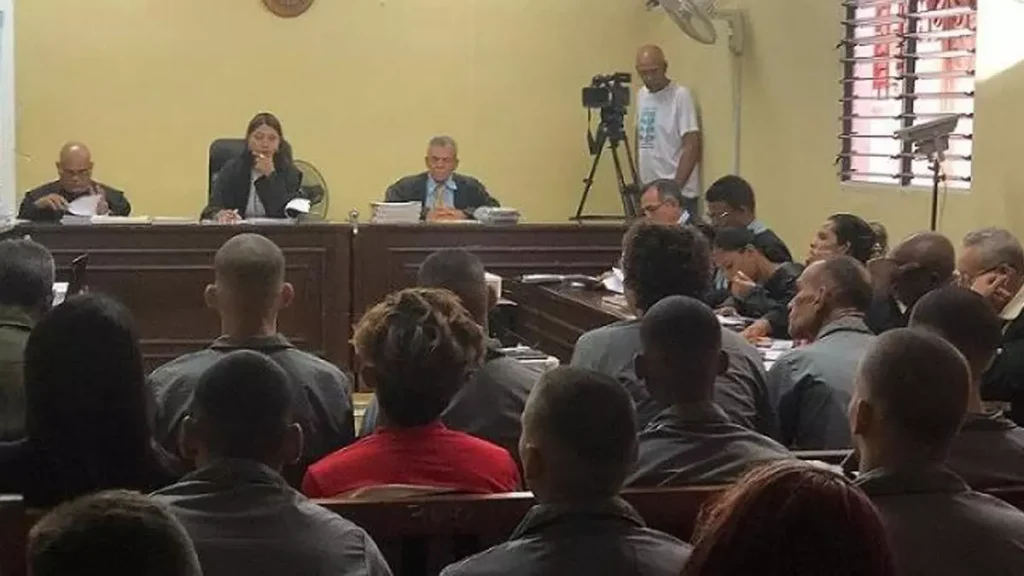
Photo of the trial that began this Tuesday in Bayamo, Granma, published by the official press / Granma

14ymedio bigger14ymedio Havana, September 17, 2025 — On Tuesday, the Municipal Court of Bayamo, in Granma province, held trial proceedings for 15 of the 16 Cubans arrested for the protests that occurred in this eastern city on March 17, 2024. According to a brief article published in the official press, they are charged with the offenses of “public disorder, attack, resistance, contempt of court, illegal carrying and possession of weapons, disobedience” and “incitement to delinquency.”

A total of 13 of them are being held in pre-trial detention, and the remaining three are “under non-custodial measures of record and prohibition to leave the country.” Although the State newspaper Granma does not explain the reasons, it reports that this is a “partial” trial against 15 of the 16 accused. It also does not indicate the prosecution’s request for sanctions.

As is customary in this type of article, the government clarifies that the Constitution and the penal laws in force guarantee that “the procedural guarantees and the right to defense of the accused are respected during the proceedings,” although there are numerous organizations inside and outside Cuba that have systematically denounced the irregularities in the trials of demonstrators, such as those of 11 July 2021 [’11J’]. continue reading

Last year’s Bayamo protest was not the only one that took place on March 17, and they resembled those of ’11J’.

Last year’s protest in Bayamo was not the only one that took place on March 17; there were also demonstrations in Santiago de Cuba and Holguín that resembled those of ’11J’. They took place on a Sunday and also began with shouts of “we want electricity,

The photos disseminated on social networks also showed the participation of hundreds of people.

That day, in an unusual gesture, Cubadebate offered explanations of what was happening in Santiago de Cuba in a Facebook post. “As a result of long hours of power cuts due to the unavailability of fuel and other situations resulting from the current economic crisis, several people took to the streets and a demonstration occurred,” admitted the official press.

According to the same publication, “the people who were demonstrating asked for electricity and food,” and, it conceded, “isolated cries of Patria y Vida were also heard from small groups within the mass of people,” although it immediately qualified that “they were not followed by the majority.”

Cubadebate also acknowledged the presence of Security Forces but said that “no police intervened, as can be seen in the photos. They are only guarding the demonstration and talking directly with citizens, in the exercise of duty, but allowing the demonstration to take place in complete freedom.” It also reported the presence of Beatriz Johnson Urrutia, governor of the province, and other officials “to dialogue with the population and pay attention to the complaint.”

Just this Tuesday, once again there was an electricity deficit of more than 2,000 megawatts (MW) in the country, specifically 2.052 MW.

At the time, there were reports of police repression only in Bayamo. A video of the protests in that city recorded, on Sunday night, a group of citizens struggling with several policemen while others ran to avoid the blows. Other videos, shared by La Hora de Cuba, showed, in earlier hours, a protest with hundreds of people chanting “homeland and life.” This independent media reported that the whole city was militarized. A third video showed several patrols blocking a street to prevent demonstrators from continuing the march.

The next day, President Miguel Díaz-Canel made it clear that the regime’s position would be the same as on other occasions. In a follow-up to messages on the social network X, he commented on the demonstrations saying that they had “destabilizing purposes” and had been carried out by “terrorists based in the U.S.”

Unlike the official reaction after the 11J protests, the Cuban authorities kept a cautious tone in their statements, and, in fact, during this year and a half, nothing had been known of these detainees until now. But now is not just any moment.

Just this Tuesday, the country again exceeded 2,000 megawatts (MW) of electricity deficit, namely 2,052 MW — the previous record of 2,054 MW was on July 21 — and for this Wednesday, the Electric Union of Cuba again predicts a high deficit for the afternoon-night peak hours. At that time, the demand will be 3,500 MW and the availability only 1,580 MW, so there will be a shortage of 1,920 MW and an actual effect of 1,990 MW; that is to say, there will not be 57% of the energy required.

For Cubans, the numbers translate into stress, lack of sleep and despair. The trials are a warning to citizens of what can happen if they are go massively into the streets to protest.

Translated by Regina Anavy

Mexico Sent More Than Three Million Barrels of Oil and Derivatives to Cuba Between January and June

Compared to the first half of 2024, the value of shipments grew by 6% to $289 million

The oil tanker ‘Sandino’ is one of the ships that transport crude from Mexico to Cuba. / Shipspotting.com

14ymedio bigger14ymedio, Madrid, 16 September 2025 — A new report from Gasolinas Bienestar, the subsidiary used by the Mexican state-owned oil company Pemex to ship fuel to Cuba, certifies that crude exports to the island increased during Claudia Sheinbaum’s mandate compared to that of her predecessor, Andrés Manuel López Obrador.

In the first half of 2025, the value of the oil increased by 6% over the same period last year, from 5 billion pesos (about US$ 272 million) to 5.3 billion pesos (US$ 289 million). Based on these data, it can be estimated that the total number of barrels was 3,257,800.

According to the document that the company must deliver this month to the U.S. Securities and Exchange Commission, which it is obliged to do as a listed company, the growth is due to crude oil, whose shipments increased by 2.8% in volume. In the first half of 2024, exports were quantified at 17,400 barrels per day (bpd), while in the same period of 2025, they rose to 17,900 bpd.

Meanwhile, derivatives declined, a trend already reflected in the first quarter data. From 1,800 bpd in 2024, it has risen to 1,700 bpd. In volume, “these sales represented 3.3% of total crude oil exports continue reading

[from Pemex] and 1.8% of total exports of petroleum products, respectively,” the report said, according to the Mexican newspaper El Universal on Tuesday.

“The company emphasizes that “the sales of Gasolinas Bienestar are made through contracts denominated in pesos at the rates prevailing on the market”

“Bienestar is the intermediary for contracts denominated in pesos at prevailing market rates” and insists that it has “procedures to ensure that such sales are made in accordance with applicable law.” The clarification, which is noteworthy because Pemex tries to make it clear that it complies with U.S. legislation as far as the embargo on Cuba is concerned, repeats the word “sale” twice.

Since mid-2023, when Mexico started shipping fuel to Cuba, payments have remained a mystery. Initially the possibility of donations was contemplated, an extreme denied by the president of Pemex, although the statement of then chancellor Alicia Bárcenas on studying how to charge Cuba for the shipments generated doubts. Two years have passed, and it is still not known if the island receives oil as barter or as part of some triangulated agreement with Venezuela, which, for more than a year, has been in breach of the agreement to export at least 55,000 bpd to Cuba.

In Mexico, skepticism about the nature of these exports is high, not only because of an ideological issue but also because of the risk that it will lead to confrontation with the U.S., its main trading partner. In addition there is concern about the debts that are piling up for the State oil company.

“Anything that the Mexican government does against the interests that President Trump has put on the table is dangerous, because it can affect expectations or agreements that have already been achieved,” Ana Lilia Moreno, the Coordinator of the regulatory program in Mexico Evaluates, told El Universal.

The expert adds that it is a complex issue, because helping Cuba stay afloat may be considered necessary for the population, but the Government still does not guarantee human rights. “The problem is that the Cuban regime does not give in to the pressure of the people themselves and continues to repress them. For President Claudia Sheinbaum, it is difficult, but it can really have a serious impact. There is even talk that Cuba could not be paying for this entirely,” she says.

The newspaper has reviewed the total exports of Pemex and concludes that, although they have generally decreased, the volume destined for Cuba is increasing

The newspaper has reviewed the total exports of Pemex and concludes that, although they have generally decreased — almost by half in the first half of 2025 in comparison to the same period of 2020, with 628,000 bpd compared to 1,142,000 — the amount destined for Cuba is increasing, as is the value.

Gonzalo Monroy, director of the energy consultancy GMEC, who was also interviewed by the newspaper, says that this occurs at a time when the State has $23 billion in debt to suppliers and $98 billion in financial debt.

“Now, in Trump’s second term, the Mexican government must be careful with these operations, since they can’t conduct commercial relations with companies that are on the list of the embargo imposed by the United States,” he says

A peculiarity of this report is that Pemex announces that it will allocate 130 million pesos in financial investment to Gasolinas Bienestar.

The Mexican Organization against Corruption and Impunity (MCCI) has received different estimates from oil exports. Based on numerous ship movements between May and June, it puts the value of crude oil shipments to Cuba in the first half of 2025 at $850 million or more.

Translated by Regina Anavy

____________

COLLABORATE WITH OUR WORK: The 14ymedio team is committed to practicing serious journalism that reflects Cuba’s reality in all its depth. Thank you for joining us on this long journey. We invite you to continue supporting us by becoming a member of 14ymedio now. Together we can continue transforming journalism in Cuba.

Millions of Dollars in Debt to Sugar Cane Producers Augurs for Another Disastrous Harvest in Cuba

Farmers complain about repeated non-payments, another factor for the shipwreck of the industry that was once a symbol of Cuba

Planting of cane in Artemisa, where they try to arrive on time despite non-payments / Trajabadores

14ymedio bigger14ymedio, Madrid, September 15, 2025 — Everything indicates that the next sugar harvest will once again snatch the title of “worst in a century” from its predecessor. This was warned last July by the Minister of Economy, Joaquín Alonso Vázquez, who said that the delays in the planting of sugar cane were persistent, and if they continued, it would not be possible to “achieve significant increases in the 2026 and 2027 harvests.” The official blamed it on the shortage of raw material, but it is thanks to a report published this Monday in Trajabadores that the shortage of cane is better understood.

It is well known that the lack of fuel and inputs for planting has repercussions, but the State still owes millions of dollars to producers. “For the 2024-2025 harvest, I delivered 2,080 tons of seed between April and May, and I have not received a penny of the more than 4 million pesos from that sale,”says Joel Collazo Apaceiro, an Artemis producer who emphasizes that the situation has nothing exceptional. “The default for the harvest is the same. Contracts are violated, but we continue planting despite dissatisfaction,” he adds.

“Although the industry has not paid for the cut cane, the planting campaigns of the winter and cold seasons do not wait for bureaucracies,” adds another producer. The secretary of the National Union of Sugar Processors, Yrrael Rouseaux Mansfarroll, says that this delay in 33 Basic Units of Cooperative Production affects no more and no less than 4,700 producers.

“It is the boards’ responsibility to seek an alternative to protect the wages of their workers,” he claims, although he states that Deputy Minister Jorge Luis Tapia Fonseca is finding a way to solve the problem with Azcuba. continue reading

This delay in 33 Basic Units of Cooperative Production affects no more and no less than 4,700 producers

Elba Peña Rojas, president of a cooperative located in Banes, Holguín, expresses the same reproach. “It is harmful to have cane stalks from three years ago, which we have stopped cutting for one reason or another. The contract to pay tax to the Fernando de Dios plant is violated, and today the Agroindustrial Azucarera owes us 22 million pesos. This affects the payment to the sugarcane growers and the distribution of profits to the cooperatives.”

Peña claims that this is not the only thing missing. The lack of fertilizers, herbicides, fuel and other resources — which have reduced the cane yield from 100 to 45 tons per hectare — is compounded by malicious fires, which have left great damage in their territory.

To the pile of misfortunes, producers add one more: the theft of wire used to fence the fields, which allows livestock from surrounding areas to enter the land and destroy the cane. “We have 210 hectares. Once again, cattle are being raised in the area, and we have put fences around the cane fields, but it is not enough because the wire is stolen and the animals kill the plants. We report it and no one acts to stop the crime,” he complains.

Trabajadores interviewed Antonio Viamontes Perdomo, director of the only mill that met the targets of the sugar plan of the last campaign, the Melanio Hernández of Sancti Spíritus. “In the last four years, fuel restrictions have affected the planting of seeds and limited the amount of cane grown. The idea is to stop the decline in June 2026,” he says. Despite honorably fulfilling their targets, the territory that supplies them does not have good news. “There, 75% of the land used for cane cultivation is empty.”

More examples: The Carlos Manuel de Céspedes plant, in Camagüey, milled 21% of burnt cane and transported 70%, which took more than 12 hours to arrive, affecting efficiency, which was only 20% of the plan. In Artemisa, the company 30 de Noviembre had a fuel shortage. It took 34 days to move the cane, so only 1,762 tons were processed.

The Antonio Guiteras of Las Tunas remained at 16% of what was projected, 7,200 out of the planned 45,000 tons. The figure is very worrying because this is the mill that agreed to deliver more sugar to the state, but everything bad that could happen, happened, including a shortage of staff, which is increasingly pressing.

The Ciro Redondo, in Ciego de Avila, has gone seven consecutive years without fulfilling the order, aggravated this year because it milled more than half, but 70% was cane from previous harvests, which gave worse results. The same goes for the neighboring bioelectric, which adds up to “millions of kilowatts left to contribute since the launch in 2020, although this press team did not have access to official information on that subject,” the text says.

Trabajadores repeats the complaint by referring to the Uruguay sugar mill, closed for years when it was planned that the Russians would renovate it. “Some obstacles have also made it necessary to grasp first-hand what is happening in the Uruguay industry of Sancti Spíritus. However, through other legal channels it was known that its machines were shut down in 2022, due to the decrease of cane and the lack of resources to revitalize factory equipment,” says the article, which highlights the government’s failure to comply with its own Social Communication Law, refusing to give data required by the official press.

The Urban Noris, in Holguín, had its last harvest in 2023, says the management of the sugar business group in the province, since “it needed a capital repair that was not possible, because it depends on an investment”

The Urban Noris, in Holguín, had its last harvest in 2023, says the management of the sugar business group in the province, since “it needed a capital repair that was not possible because it depends on an investment.” Planting has been another problem. The cane needs to grow, but if it did there would be no industry to process it. “In the fields there is evidence, with large quantities of stalks left and requisitioned,” says José Luis Jomarrón Cera, president of another las Tunas cooperative.

“They subtracted from us for harvesting 14,000 tons of cane with approximately 28 million pesos to collect. On the other hand, non-payments for raw material, which has now been provided and processed, hampers the delivery of advances and the purchase of the inputs necessary for production. In addition, costs are altered, since by not paying off the loans granted by the banks, the interest goes up and substantial amounts of money have to be paid.” The few measures taken, he adds, have come too late, as the sugar industry is dying.

The latest harvest data have not been officially disclosed, but it is known that it did not reach 150,000 tons and that the quantity may even be much lower. Fifteen sugar mills participated in this campaign, of which 10 have contributed their results to the official media, totaling 95,584 tons. The remaining five have not disclosed their production, but it is known precisely that among all of them they targeted 52,068 tons of sugar. That is, if they had met it, the harvest would amount to 147,652 tons. However, only one, in Sancti Spíritisdid did so. Forty years ago, a record was reached with 8.5 million tons of sugar. Since then, the drop is like a bottomless pit.

Translated by Regina Anavy

____________

COLLABORATE WITH OUR WORK: The 14ymedio team is committed to practicing serious journalism that reflects Cuba’s reality in all its depth. Thank you for joining us on this long journey. We invite you to continue supporting us by becoming a member of 14ymedio now. Together we can continue transforming journalism in Cuba.

Seizures of Cuban Cigars: 4,500 in Havana, 133 in Spain

For the second time in a week, Customs at José Martí Airport has detected “fake goods,” but the Spanish courts ruled in favor of a passenger who was fined for bringing Cuban cigars for a birthday party.

Cigars seized by Cuban Customs. / Wiliam Pérez

14ymedio bigger14ymedio, Madrid, 15 September 15, 2025 — Several workers in Cuban Customs and the Ministry of the Interior received diplomas this weekend for attending a five-day course about handling drug trafficking, given by French Customs at facilities in the José Martí International Airport in Havana. 

Cooperation between Cuban and French Customs goes back a long way. The two countries signed an Agreement on Mutual Administrative Assistance for the Prevention, Investigation and Combating of Customs Fraud in 1996, which was renewed in 2022. The pact includes collaboration between customs training schools in several matters, one of them being the Single Window of Foreign Trade. The most important part concerns drug trafficking in ports and airports, which these seminars and visits address.

The course, with theoretical and practical exercises, started on Monday and ended on Friday, coinciding with the detection of a smuggling operation involving 4,500 Cuban cigars, brought in by two passengers. The incident was reported by Wiliam Pérez González, first deputy head of the General Customs of the Republic, who reported on X that once the goods were found to be fake, the complaint was made to the police and the case expanded.

Bruno Margarite, an official of the French Embassy in Cuba, participated in the closing event and stressed the importance of these workshops to “consolidate ties of cooperation and strengthen the fight against illicit drugs.”

It was the second time in a few days that the official had been alerted to a similar event, also in terms of quantity. On September 2, nine days earlier, Pérez González also raised the alarm about the detection of 4,400 loose cigars with rings that were packed to leave the country without being declared. “The smuggling of this item brings large profits,” he said, adding that it had been duly reported.

Operations of this type, or at least their disclosure, have accelerated in recent times. In July last year, Pérez González showed photos of another large seizure of cigars detected by Customs. Although on that date he did not give the number of cigars that had been recovered, the images showed another large amount of Cuban cigars, as well as cigar bands and labels of all kinds. “Authorizations of recognized brands that people try to introduce into the country from the United States and significant quantities of cigars are seized at the exit, violating the established regulations for illicit trafficking operations,” he warned.

A very similar message was posted on the last day of May 2024, warning of more cigar detections. “Those who try to profit from one of the main exportable products of Cuba will collide with the defense of our borders,” he said.

A batch of cigars is now also the subject of an article in the European press, although for very different reasons. In this case, it is a Balearic Islands court that has ruled in favor of a man against the regional delegation of the Spanish Customs responsible for excise taxes.

In January 2020, the complainant traveled with two friends to Cuba and brought 133 cigars from the island to Ibiza, where they resided. Since the exemption limit is 50 cigars per person, the group left the airport without declaring the product. However, once they were in their homes they collected the product and packed it to send to the neighboring island of Mallorca, where a friend was going to have a birthday party. At that time, the man indicated to the shipping company what was in the box.

In January 2020, the complainant traveled with two friends to Cuba and brought 133 cigars from the island to Ibiza, where they resided

The technicians of the Risk Analysis Unit seized the package and contacted the sender to inform him that he would be penalized for having concealed this import. The file included the valuation of the cigars, worth 3,710 euros and a fine that multiplied them by three, exceeding 11,000 euros. According to the Diario de Ibiza, in addition to the money, the product never arrived at the party and remained in the Customs warehouse.

The tourist complained before the administrative courts, claiming that there was no “concealment precisely because the cigars in question were legally introduced into Spain. No offense was committed, so there was no need to conceal any information.”

The Court found that, in effect, there was no intention to hide or deceive. “Contrary to the foregoing, it is established that no fictitious addresses or names were used in the consignment and that the appellant, from the outset, although unaware that the consignment had been intercepted, stated how he had acquired the cigars, which did not belong exclusively to him, and made it clear to the carrier that the package contained cigars,” the judge wrote in his ruling.

“Therefore, the fine of 12,245 euros plus interest generated and the 133 cigars seized are to be returned to him.”

Translated by Regina Anavy
____________

COLLABORATE WITH OUR WORK: The 14ymedio team is committed to practicing serious journalism that reflects Cuba’s reality in all its depth. Thank you for joining us on this long journey. We invite you to continue supporting us by becoming a member of 14ymedio now. Together we can continue transforming journalism in Cuba.

continue reading

Protests in Gibara, Cuba Against the Blackouts to the Cry of “Turn On the Current”

Officialdom plays down “nonconformities” and speaks of dialogue “on the basis of empathy and respect”

Demonstrators took to the streets in Gibara / Screen capture

14ymedio bigger14ymedio, Havana, 14 September 2025 — Banging on pots and pans and with cries of “Turn on the current, dick” and “Díaz-Canel, motherfucker,” the inhabitants of Gibara, in the province of Holguín, took to the streets on Saturday night after a long day without electricity. With the noice from the pots and pans accompanying their slogans, the demonstrators demanded “the current.”

In a video, despite the darkness, you can see dozens of people outside their homes and hear the sounds. “All day without power, they put it on for 30 minutes and nothing,” says a man. In another film, several protesters are seen defending young people from being arrested by a police officer: “Not the people!” they shout. “This is what we need here,” says a female voice in another video. The scene takes place in one of the main streets of the town, which is surprisingly illuminated while the rest of Gibara remains dark. “The people united will never be defeated” was another of the slogans chanted by the neighbors, recorded and spread on Facebook.

In another video in the shadows, broadcast by the journalist Mario J. Pentón, another Cuban who is defined as “elderly” describes her ordeal without electricity, with a mosquito allergy that keeps her locked in and afraid to be stung by the swarms of insects lurking everywhere. “It’s time to go out on the street like in Nepal,” says the woman, who does not specify from which province she sends her message.

The local media Gibaravisión has been one of the few to cover the protest, although they have downplayed it by saying that it was a dialogue between neighbors and authorities “on the basis of empathy and respect.” In its report, the local channel claims that “a group of residents of Güirito in continue reading

Gibara, affected by the complex energy situation, left their homes to express their nonconformity from a position of respect and dialogue.” The authorities responded to “questions” and “the population returned home.”

“Currently the white village remains calm and with its usual tranquility,” said the media, which shared images and videos of the town to show that the streets were empty, although still dark.

It also denounced the “politicization” and “manipulation” of events on social networks and called on Cubans to obtain information from “reliable sources.”

Since the national electricity system (SEN) collapsed on Wednesday morning, the hours of electricity for Cubans have been scarce. Although the authorities soon celebrated the “recovery” of the country, many households remain in blackout or with an unstable service.

Tempers have flared throughout the island after the energy collapse, and the tension is palpable. The closure of many private businesses, the cancelation of medical appointments, the suspension of classes in numerous schools and the spoiled food in refrigerators have put an end to the patience of Cubans.

In early August, Holguín staged another protest. In the village of Cajimaya, in the municipality of Mayarí, residents took to the streets to demand water, food and other essential services. Several images and videos then shared on social networks recorded the moment when the police arrested several of the protesters. 

Shortly before, in June, something similar happened in Guanabacoa, in the capital. Then, the neighborhood protest ended with a fire and a dozen detainees. The trigger was a blackout, coupled with the lack of water, which pushed residents of the neighborhoods Barreto, Teguete and Potosí to go to the streets among cries of “Freedom!” and the noise of bottles smashing on the pavement.

Police quickly charged several of the protesters. Among them was Sunamis Quintero Garcia, a young mother who, according to witnesses, did not participate directly in the protest. “She was sitting in the doorway. When she saw the police coming, she started shouting ‘Freedom! Long live a free Cuba!’ and right there three agents went after her,” said her mother, Moraima García, in a video broadcast from Florida.

Also in May, protests were reported in Granma, Cienfuegos, Ciego de Ávila and Santiago de Cuba. In all demonstrations, including the one this Saturday, the Cubans are only demanding their most basic rights.

Translated by Regina Anavy

____________

COLLABORATE WITH OUR WORK: The 14ymedio team is committed to practicing serious journalism that reflects Cuba’s reality in all its depth. Thank you for joining us on this long journey. We invite you to continue supporting us by becoming a member of 14ymedio now. Together we can continue transforming journalism in Cuba.
Sources in Holguín, Cuba, Report the Arrest of ‘At Least Seven People’ in Gibara

Police patrol the streets of the municipality where there was a massive protest last night against the blackouts.

Image of demonstrators who took to the streets of Gibara /Screen shot /14ymedio

14ymedio bigger14ymedio, Havana, September 14, 2025 — After the protest that filled the streets of Gibara, in Holguín, on Saturday night, the authorities decided to go out and look for the demonstrators. According to residents of the province, “at least seven people” have been arrested in that municipality by police and State Security agents.

“The people of Gibara only came out to demand their rights, but the police are stopping them,” a resident of Holguín tells this newspaper. He says he has managed to communicate with acquaintances in that municipality, where the International Festival of Poor Cinema is held every year. The fate of the demonstrators is not clear, but reports on social networks indicate that they have been transferred to the capital city or the Gibara police station itself.

“People are saying that there are special forces (also known as black berets) on the street, but in reality it is swarming with police and security agents,” says the man.

On social networks and Facebook groups, several users have reported the arrests and even circulated images of patrols roaming the neighborhoods in search of protesters. The events contradict the official version of the protests, which according to the authorities in Gibara were nothing more than peaceful demands from citizens tired of the blackouts.

The protests in the municipality began after nightfall, when dozens of residents took to the streets shouting “Turn on the current, pinga [dick],” “Díaz-Canel, singao [motherfucker]” and slogans like “The people united will never be defeated.” continue reading

A few hours later, Gibaravisión released its own version of what happened. “A group of residents of Güirito in Gibara, affected by the complex electroenergetic situation, left their homes to express their dissatisfaction from a position of respect and dialogue,” said the official media in an attempt to downplay the protests.

A few hours later, Gibaravisión released its own version of what happened.

“The authorities went to the site to answer questions and exchange views. Everything happened on the basis of empathy and respect,” they insisted, assuring that after the dialogue all the residents returned to their homes, and the atmosphere was calm. They also accused people of being “mostly from outside” and wanting to “manipulate and politicize” what happened by posting videos of dark streets that were empty.

Later, the secretary of the Communist Party in Gibara, Nayla Marieta Leyva Rodríguez, posted this message on Facebook: “Let us trust in the tremendous revolution that we have, which never abandons its children and is glorious in the search for solutions.”

Since the collapse of the national electricity system (SEN) on the morning of Wednesday, September 10, the tension from the long blackout hours has soared, and many homes are still in a blackout or with very unstable service.

At the beginning of August, another protest took place in Holguín, in the village of Cajimaya, in the municipality of Mayarí. On that occasion, residents took to the streets to demand water, food and other basic services. Several images and videos then shared on social networks recorded the moment when the police arrested several of the protesters.

Translated by Regina Anavy

____________

COLLABORATE WITH OUR WORK: The 14ymedio team is committed to practicing serious journalism that reflects Cuba’s reality in all its depth. Thank you for joining us on this long journey. We invite you to continue supporting us by becoming a member of 14ymedio now. Together we can continue transforming journalism in Cuba.