In Cuba State Operators Can Steal Up to 30,000 Liters of Fuel per Day

Managers, custodians and neighbors of the facilities are involved in numerous cases of oil theft


One of the fuel theft cases shown on Hacemos Cuba this Wednesday. / Canal Caribe/Screen Capture

14ymedio bigger14ymedio, Madrid, October 23, 2025 — Most of the fuel stolen in Cuba is the responsibility of workers in state-owned enterprises. This follows from the litany of examples presented this Wednesday, in a special program of Hacemos Cuba, by regime spokesman Humberto López, aimed at curbing a bleeding that doesn’t seem to stop.

One of the guests, Yarianna Guerra González, director general of the fuel marketing company Unión-Cuba Petróleo (Cupet), under the Ministry of Energy and Mines, explained that in this entity, oil is mainly subtracted from “large storage capacities” and is then transported in tank trucks to all corners of the country.

“There are several flaws in the process,” acknowledged the official, who explained how the theft is carried out. The tanks must maintain a certain temperature, and when it is higher the fuel evaporates. The “people aware of this activity” manipulate the temperature on paper, indicating that it is higher and therefore some fuel evaporated, when in reality they appropriate it.

With this system, “you could lose up to 20,000 or 30,000 liters of fuel” a day, she said, pointing out that the procedure is not simple and that it continue reading

“fundamentally” involves not only operators, but also brigade directors, managers and even custodians present at the site.

Up to ten years in prison for 17 people accused of stealing and reselling more than 800,000 liters of jet fuel

This was the case in one of the show trials mentioned on the program, held in Havana earlier this year. Up to 10 years in prison was the sentence for 17 people accused of stealing and reselling more than 800,000 liters of aircraft fuel that the Hydrocarbon Transport Company had stored on a farm belonging to the Havana Agroforestry Company, in the municipality of Guanabacoa. The events involved managers of the entity, as well as custodians, residents in the vicinity and drivers for other state enterprises and the private sector.

Accused of “robbery with force in a continuous manner,” “embezzlement,” “bribery” and “receiving,” those involved caused an economic gap of almost 18 million pesos, which the sentence obliged them to “repair.”

Thefts of fuel from the Berroa generator group in Havana and from a similar facility in Güines, Mayabeque, were also presented in the program. They revealed a similar modus operandi: State workers, including bosses, act “in collusion” with residents in the immediate vicinity to commit the crime. For all this, there are still “four or five” trials in progress that have not yet concluded.

The crime they face is not minor, repeated López and his guests, but is very serious and can carry prison sentences of up to 30 years for sabotage. They said that “tackling fuel crime” is a “priority” due to the “energy crisis situation.” The People’s Supreme Court already stated last May that “acts of vandalism to strategic infrastructures” in the country are considered sabotage, “even when they don’t have that intention.”

However, once again, threats do not seem to be of much use. Authorities did not provide the overall figures, but the amount of stolen fuel recovered between January and August 2025, 350,000 liters, gives a measure of what was actually lost. That figure, they said, would be enough to “provide electrical service to 5,500 houses for one month.”

“We must establish tighter control of the technology, a vulnerability that we have today”

“What are we going to do to prevent it from happening?” Lopez asked those present. “We must establish tighter control of the technology, a vulnerability that we have today,” replied Guerra González, referring to the reinforcement of cameras and other surveillance equipment. The announcer insisted that “the main problem here is not equipment but people.”

To that they answered: “People are also being treated preventively. We try to talk with them and explain to their families all the things that could happen if they break the law.”

In addition, said Mario Pedroso Caballero, director general of the Electric Power Plant and Services Company of the Electric Union of Cuba, “we are doing better in the selection of staff,” but not just focusing on this, “because at that moment someone can seem to be very good, but in the course of time they can deviate.”

In fact, explained the official, such organizations are governed by Decree 200, which does not allow employees with criminal records. “We haven’t had people come in with criminal records, the key is after,” he said, referring to those possible “deviations.”

Before launching a new program on the same topic next week, “What must be made clear is that this all-out war will not go unpunished.”

Translated by Regina Anavy

____________

COLLABORATE WITH OUR WORK: The 14ymedio team is committed to practicing serious journalism that reflects Cuba’s reality in all its depth. Thank you for joining us on this long journey. We invite you to continue supporting us by becoming a member of 14ymedio now. Together we can continue transforming journalism in Cuba.


Mexican Experts Suspect That Pemex Is Giving Cuba Low Quality Diesel That Won’t Work

The product does not meet the country’s regulations to be considered ultra low in sulfur, but it is suitable for power plants.

Between January and September of this year, the daily average number of barrels leaving Mexican state oil refineries was 199,000 per day. / Onexpo

14ymedio bigger14ymedio, Madrid, October 22, 2025 — Days after 14ymedio denied, through sources in the oil sector, the assertion of President Claudia Sheinbaum that Mexico has a surplus of diesel, the US media La Silla Rota confirms the thesis based on statements by another expert. In this case it is Ramsés Pech, an energy analyst, who also suspects that the diesel that Pemex sends to Cuba is the kind that Mexico doesn’t want.

As far as diesel is concerned, the maximum sulphur content that must be contained in order to have the official NOM-016 certificate–the official regulation of Mexico that establishes the quality parameters that oil products must meet–is 15 milligrams per kilo (called DUBA), but Pemex doesn’t have It.

“This is a very big structural problem. The crude oil that is extracted in Mexico is very heavy and has a lot of sulphur. Pemex has not been able to get it certified for market entry under the NOM-16 requirements. They have gone from one extension to another since 2009,” said Gonzalo Monroy, director of a consulting company specializing in the renewable energy sector.

However, this “surplus” does not serve the country and has to be exported, so it is expected to end up in Cuba, where it is useful for electricity generation

During the administration of Andrés Manuel López investments were allocated to the Dos Bocas Refinery in Tabasco, with its promise to be able to produce diesel that was very low in sulfur, but construction remains bogged down. Between January and September of this year, the daily average for barrels leaving Mexican state oil refineries was 199,000 per day, something not seen since 2016. continue reading

However, this “surplus” does not serve the country and has to be exported, so it is expected to end up in Cuba, where it is useful for electricity generation.

“Daily demand for diesel fluctuates between 400,000 and 420,000 barrels. The US makes up the difference. In addition, Pemex produces only 35% of the country’s diesel. If this is what it is sending to Cuba, it is a low quality diesel for use in the electrical system,” added Pech.

On October 16, Sheinbaum sounded proud of the high production of this petroleum derivative. “There is now a particular surplus of diesel, and it is being exported (to Cuba).”

However, almost 200,000 barrels are imported daily from the US, which means that 50% of the country’s needs come from abroad. This type of fuel is needed for the transport of cargo, buses, agricultural and construction machinery, and electric power generation, although it may have a higher sulphur content. However, the Mexican diesel has less of this element than what is extracted from the wells in Cuba.

This newspaper published, based on Sheinbaum’s words, that Mexico has a fuel deficit, since it relies mainly on the US to cover its needs. “Thanks to these imports from the US, Mexico can afford to export diesel to Cuba,” said Jorge Piñón, a researcher at the University of Texas in Austin.

Mexico imported from the US 61% of its gasoline, diesel and jet fuel, about 787,000 barrels per day in 2024. “A portion of Mexico’s imports come from the Pemex refinery located in Texas City, one of the largest on the Gulf coast, with a daily production of 275,000 barrels,” added Piñón.

“Part of Mexico’s imports come from the Pemex refinery located in Texas City, one of the largest on the Gulf coast, with a daily production of 275,000 barrels”

The specialist denied, however, the data published by the civil society organization, Mexicanos Contra la Corrupción y la Impunidad (MCCI), which days before had stated that “the value of hydrocarbons sent by Mexico to Cuba between May and August 2025 exceeded US$3 billion, equivalent to about 60 billion pesos, according to records on foreign trade platforms consulted by the MCCI.”It also stated that Mexican customs had recorded 58 shipments of hydrocarbons to Cuba in those same months.

The MCCI has misinterpreted the data of Mexican Customs. On the contrary, Pemex has problems with the production of light crude oil,”said Piñón, who claims to have no record of recent shipments from Mexico to Cuba.

According to official data from Gasolinas del Bienestar, a subsidiary of the Mexican state-owned company that exports to Cuba under unknown economic conditions, in the first half of 2025 the value of shipments rose by 6% compared to the same period last year, from 5 billion pesos (about US$272 million) to 5.3 billion pesos (US$289 million). Based on this data, it can be estimated that the total number of barrels was 3,257,800.

Translated by Regina Anavy

____________

COLLABORATE WITH OUR WORK: The 14ymedio team is committed to practicing serious journalism that reflects Cuba’s reality in all its depth. Thank you for joining us on this long journey. We invite you to continue supporting us by becoming a member of 14ymedio now. Together we can continue transforming journalism in Cuba.

Cuban Player Liván Moinelo Brings His Team to the Japan Series

He is the first pitcher to win the MVP in a Japanese championship series, since Masahiro Tanaka in 2013

Liván Moinelo earned his place as starting pitcher after seven years of being middle relief / Instagram

14ymedio bigger14ymedio/SwingCompleto, Havana, October 20, 2025 — Cuban pitcher Liván Moinelo led the SoftBank Hawks of Fukuoka on Monday to compete for the Japanese Professional Baseball League title. His performance in the decisive duel against Hokkaido’s Nippon Ham Wrestlers to qualify for the final led him to win the most valuable player award (MVP) of that series.

In his second appearance in seven games, with only four days of rest, he completed seven innings — as in his first appearance — and allowed three hits and a single run, in addition to giving a base on balls and six strikeouts, to take the 2-1 victory against the team from Hokkaido.

His two appearances against the Wrestlers, with 14 innings pitched and a 0.64 ERA, allowed Moinelo to be the first pitcher to win MVP in a championship series since Masahiro Tanaka in the 2013 campaign.

Now the challenge will be to maintain dominance in the Japan Series from next Saturday, when the Hawks seek the throne of Japanese baseball against the Hanshin Tigers.

Now the challenge will be to maintain dominance in the Japan Series from next Saturday

In what was just his second season as the starter of the Fukuoka franchise, the 29-year-old from Pinar del Río led the ERA with an average of 1.46 runs per game, which was a remarkable improvement continue reading

from what he achieved a year ago, with another great figure, 1.86. He struck out 155 opponents last year and exceeded that figure this season with 172 strike-outs, while reducing his number of bases per ball, from 47 to 42 between both campaigns.

Moinelo earned his place as starter after seven years of being a middle reliever. Now as opener in the last two campaigns, he has registered a record of 11-5 and 12-3.

Last year’s numbers allowed him to win the Golden Glove, which made him the first Latino pitcher to earn the ERA title during the regular tournament in the second best league in the world.

That campaign had 25 starters, and he pitched 163 innings. From the mound, he struck out 155 opponents, allowed only 34 runs and allowed 47 bases per ball, for 68.8% of wins.

That campaign had 25 starters, and he pitched 163 innings. From the mound, he struck out 155 opponents

Moinelo, one of the strong cards of the Cuba team, has found in Japan an option to have important income — he is the highest paid of the whole league, together with the Mexican Roberto Osuna, with $26.4 million for four seasons — and to compete at a high level. Other competitions in Asia have also received Cuban players, who have been highlighted recently, such as Guillermo Heredia, who plays in the South Korean league with SSG Landers.

In three seasons, the pitcher from Matanzas has established himself as the player with the best average, .342, among the batters, with at least a thousand at-bats in the last three seasons in that league. With a past in the major leagues with the Atlanta Braves, the outfielder has managed to sign a $1.6 million contract, with a $200,000 bonus.

Translated by Regina Anavy

____________

COLLABORATE WITH OUR WORK: The 14ymedio team is committed to practicing serious journalism that reflects Cuba’s reality in all its depth. Thank you for joining us on this long journey. We invite you to continue supporting us by becoming a member of 14ymedio now. Together we can continue transforming journalism in Cuba.

Cuba Has Reported 71 Cases of Severe Dengue to the Pan-American Health Organization

The Ministry reported a rate of 24.3 suspected cases of arbovirosis per 100,000 inhabitants, which rises to 59.6 in the specific case of dengue

The authorities warn that contracting a serotype other than the current one aggravates the condition. / Archive/Granma

14ymedio bigger14ymedio, Madrid, October 23, 2025 — The Cuban authorities explained yesterday that the health crisis, far from improving, is getting worse. And not just a little. Carilda García Peña, Deputy Minister of Public Health, said on Wednesday that there is a “significant increase in the rate of suspected cases of fever, with 24.3 cases per 100,000 inhabitants. The Ministry has not broken down the data by disease and merely points out that dengue is the “most dangerous” one, but data from the Pan American Health Organization (PAHO) show that the rate in this case reaches 59.6 per 100,000.

García Peña warned that the regional context is bad and that the situation of the Island is not exclusive. The PAHO figures, which are provided by the authorities of each country, coincide. There are rates much higher than the Cuban one, from 6,191 in Guyana to 1,629 in Brazil and 333 in Panama. If divided by regions, the Island is not the champion either, since Puerto Rico, with 81.2 cases per 100,000 inhabitants, has worse numbers.

There is, however, one very striking fact, which is the difference in ratio between global and severe cases. This figure gives clues about the effectiveness of the health system, since a country could have many registered patients but few that develop badly, as is the case of Brazil, whose proportion is only 0.07% of serious cases in total. Cuba is among the countries with the worst proportions, since a large majority have rates well below 1% and the Island reaches 1.09%. What is worrying is that the US, with only 0.21 dengue patients per 100,000 inhabitants, has a proportion of 1.78% cases that develop badly. continue reading

Cuba is among the countries with the worst proportions, since a large majority have rates well below 1% and the Island reaches 1.09%

According to the numbers provided by the authorities to PAHO, 71 cases of severe illness have been recorded on the Island, out of a total of 6,519 affected. This figure refers to suspected cases, not just confirmed ones, but they must have been reported to the authorities to be included in the count. Therefore, the actual figures must be much higher, since not all patients report their symptoms or seek out medical services because of the lack of personnel and medicines and the unsanitary conditions.

García Peña said yesterday, as OPS also stated on its social media, that Cuba has more circulating cases of dengue type 2, 3 and especially 4. Although all are considered potentially dangerous, types 2 and 3 are most commonly associated with serious developments, according to the scientific community. The deputy minister pointed out that an infected person who has a serotype different from the one he contracted is more likely to get worse, to have hemorrhagic dengue, or even have increased chances of dying.

The official focused on this disease because, as is warned, when viewing the incidence of dengue separately, the one that is most in circulation is the most serious of the four types. In addition, there are also chikungunya, Zika, yellow fever and oropouche, the latter in slight decline.

By province, there are more cases of dengue in Las Tunas, Ciego de Ávila, Matanzas, Sancti Spíritus, Villa Clara and Havana, not necessarily in that order. The minister did not indicate the number of cases by province, nor which one has the most. Meanwhile, chikungunya, which began its expansion through Perico (Matanzas) in July, has spread to almost the entire Island, with Havana and Matanzas being the most affected.

By province, there are more cases of dengue in Las Tunas, Ciego de Ávila, Matanzas, Sancti Spíritus, Villa Clara and Havana, not necessarily in that order

The authorities insisted yesterday that a massive fumigation campaign is underway against the Aedes aegypti mosquito that spreads the disease, although the population signals it is already too late. There are 26 fumigation carts and 2,334 backpack bazookas with insecticides, and they are guaranteed, said the official, to wipe out the larvae in water containers.

The main challenge is making sure people do not get to the point of having serious illness and avoid fatal outcomes,” added Reinol Delfín García Moreiro, Deputy Minister of Public Health, who supported his colleague’s call to be aware of the disease and seek medical attention. Cuba has, he argued, more than 10,700 medical offices and 451 polyclinics with emergency services, despite the fact that the authorities themselves recognize the delicate situation in which they find themselves.

Translated by Regina Anavy

____________

COLLABORATE WITH OUR WORK: The 14ymedio team is committed to practicing serious journalism that reflects Cuba’s reality in all its depth. Thank you for joining us on this long journey. We invite you to continue supporting us by becoming a member of 14ymedio now. Together we can continue transforming journalism in Cuba.
Shovels Make Little Headway Against the Monstrous Piles of Garbage in Havana

With each movement, the flies return, and the stench sneaks through the shutters of a nearby building

A few meters away, the door of a warehouse where food for the rationed market is stored remains open. / 14ymedio

14ymedio bigger14ymedio, Havana, Natalia López Moya, October, 23, 2025 — It was Wednesday, and at the corner of Factor and Conill, two workers from Communal Services are facing an enemy that already seems mythological: one of the many mountains of garbage in Havana, this time in Nuevo Vedado. Armed with shovels, they try to reduce what the blue containers can no longer contain: bursting bags, wet cartons, food scraps and even an old flip-flop poking through the blanket of flies.

The truck, which is older than the employees themselves, waits with its door open like a tired mouth. One of the men sighs before throwing in another shovelful, but the mass of waste is barely reduced on the asphalt. “This is hard,” he says, while the other one tries to scare away the flies buzzing around the debris. A few meters away, the door of a warehouse, where food for the rationed market is stored, remains open.

Translated by Regina Anavy

____________

COLLABORATE WITH OUR WORK: The 14ymedio team is committed to practicing serious journalism that reflects Cuba’s reality in all its depth. Thank you for joining us on this long journey. We invite you to continue supporting us by becoming a member of 14ymedio now. Together we can continue transforming journalism in Cuba.
“For Spanish Nationality, If You Don’t Do It Today, It All Ends” Announces the Embassy in Havana

On the last day to apply for the Democratic Memory Law, an official counseled the unsuspecting in front of the Embassy in Havana

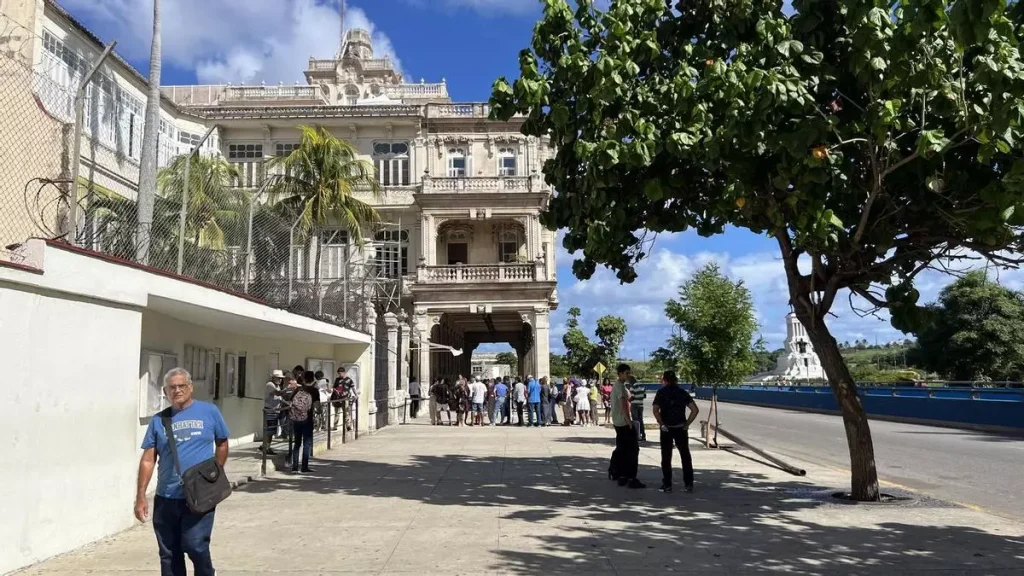
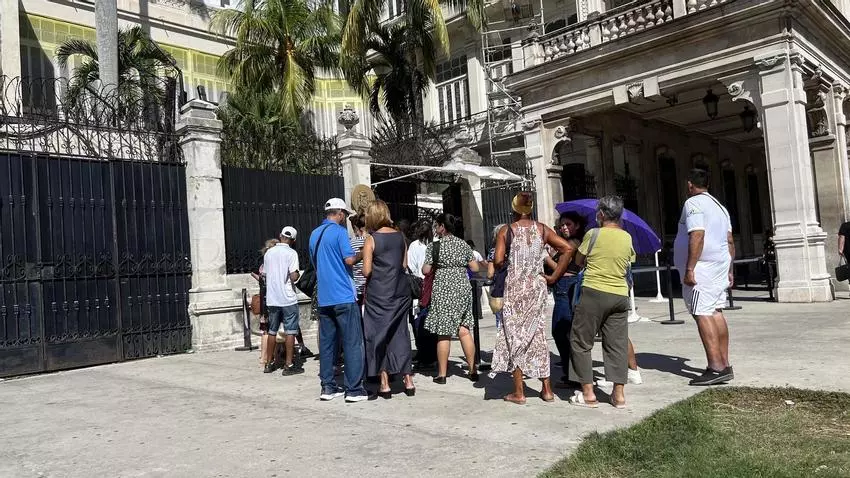
Lines at the Spanish Embassy in Havana, this Wednesday October 22. / 14ymedio

14ymedio bigger14ymedio, Darío Hernández, Havana, October 22, 2025 — In front of a frantic crowd divided into several lines, the custodian at the Spanish Embassy in Havana kept repeating this Wednesday that it was the last day to apply for Spanish citizenship through the Democratic Memory Law (LMD). “For Spanish nationality, if you don’t do it today, it all ends,” he warned, waving his hands decisively.

The man patiently explained to the clueless that they should consult, on the Embassy’s website, the section corresponding to the rule for making the request. “Forget about your brother, this or that other person,” he urged them. Just follow the instructions, “or you won’t be able to do it.” The questions showed how, almost three years after the law came into force and hours before the deadline for accepting applications, there are still doubts among Cubans.

One of the concerns raised by those inquiring was related to the waiting time before being called upon to review documents and continue with the process once the request has been made and the file number has been received by e-mail. As this newspaper was reminded by sources from the Spanish Ministry of Foreign Affairs, processing all of them “could take years.”

As this newspaper was reminded by sources from the Spanish Ministry of Foreign Affairs, processing all of them “could take years”

Published in October 2022, the LMD offered, in principle, the possibility of obtaining Spanish nationality for descendants of Spaniards exiled by the civil war and Francoism, to those born of Spaniards who had lost their nationality by marrying foreigners continue reading

before the entry into force of the 1978 Constitution, and for the adult children of those who had acquired it under the previous grandchild law – the Historical Memory Act of 2007 – but who had remained excluded because they were over 18 years old.

However, the instructions for applying, published a few days later in order to remove “any questions that may be raised by the Officers of the Spanish Civil Registry Offices as to the scope and interpretation of this eighth additional provision,” were interpreted to mean that not only the descendants of exiles from the civil war could be eligible but also all those “born outside Spain to originally Spanish parents or grandparents.” This led to a huge volume of applications, especially from Cuba, the second largest number of requests after Argentina.

Spanish Foreign Ministry sources told 14ymedio that up to the beginning of October, there were about 400,000 requests for the LMD in Havana, and every day they estimated they were receiving between 5,000 and 6,000 more, so they expected to reach 500,000 requests or even exceed this number.

One of the lines in front of the Embassy was exclusively for questions. / 14ymedio

For all countries, by the end of July, 876,321 people had made the request; 414,652 have now been approved, and 237,145 have obtained passports.

“We are not interested in your problems; what interests us is that you enter the system before the deadline expires,” said the custodian to those who were waiting in a line that was exclusively for questions.

In another line, people were coming and going, running, trying to resolve a needed copy or some forgotten document.

Many Cubans have criticized the “chaos” they found at the Spanish diplomatic headquarters for the LMD procedures. Asked about it during an official visit to Chile and Argentina, the Spanish minister of Territorial Policy and Democratic Memory, Ángel Víctor Torres, revealed that in Havana there had been difficulties in speeding up the process. “We have tried to set up mobile offices but it’s complicated,” said Torres, referring specifically to Cuba and Venezuela.

In line this Wednesday, a man from Havana who hoped to enter to legalize and deliver documents for several relatives, was denied: “This is the only well-organized line in all of Cuba”

The Spanish Embassy in Havana, on the last day to apply for citizenship with the LMD / 14ymedio

Translated by Regina Anavy

____________

COLLABORATE WITH OUR WORK: The 14ymedio team is committed to practicing serious journalism that reflects Cuba’s reality in all its depth. Thank you for joining us on this long journey. We invite you to continue supporting us by becoming a member of 14ymedio now. Together we can continue transforming journalism in Cuba.
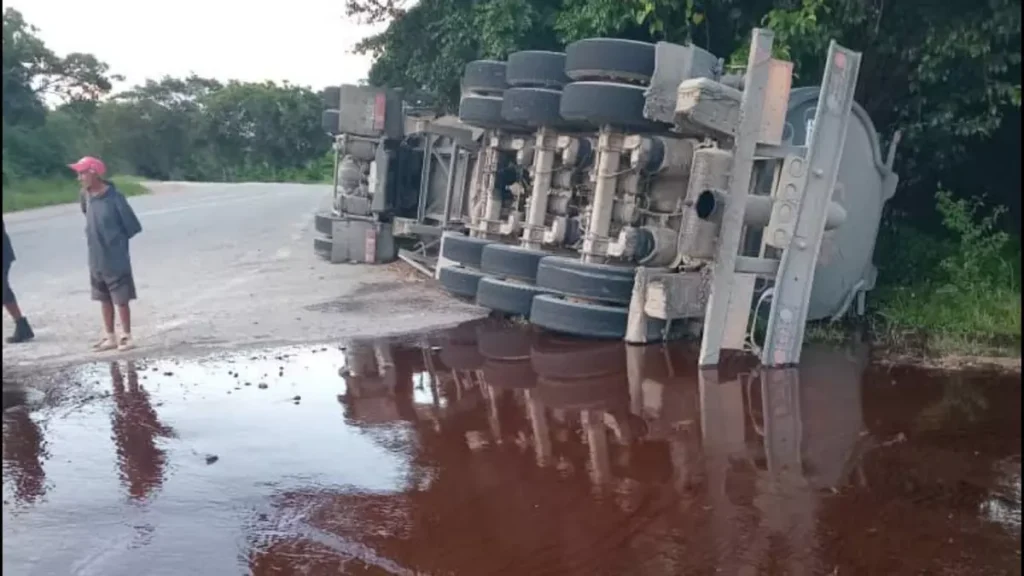
Cupet Tanker Truck With 31,000 Liters of Crude Oil Overturns on the Vía Blanca in Mayabeque, Cuba

The accident occurred around 6:40 p.m. this Monday, when the vehicle overturned in a dangerous area according to residents.

La carga procedía de los pozos y se dirigía a Puerto Escondido. / Cupet

14ymedio bigger14ymedio, Madrid, October 21, 2025 — The accident of a tanker truck caused a spill of part of the 31,000 liters of crude oil that it was carrying, around 6:40 pm this Monday. The vehicle of the Transportación Crudo Occidente company overturned on the Vía Blanca on the way to Puerto Escondido (Mayabeque).

The driver was taken to the town of Santa Cruz, where he was treated for his injuries, which were not life-threatening, according to the Cuba-Petróleo Union (Cupet), which announced the news on its social networks around midnight.

The vehicle was on its way from the oil wells to the processing plant at Puerto Escondido. Specialized teams went to the site trying to recover as much of the fuel as possible, in addition to mitigating “the consequences caused by the spill.” So far it is unknown how much oil has been lost definitively and the causes of the accident, although among the comments to the post, attention has been drawn to the dangers of the road on which it occurred.

“Accidents are common in that area. I worked for the company and saw that we lost colleagues in the same way,” wrote a user, identified as Carlos Manuel Martínez Peña. Another comment mentions the “huge pothole there,” and although some point to the possibility that the driver was speeding, road conditions and worn truck tires are among the most cited causes by users, who celebrate that at least nobody died this time. continue reading

“Accidents are common in that area. I worked at the company and saw that we lost colleagues in the same way,” wrote a user, identified as Carlos Manuel Martínez Peña

The accident occurred on the same day that an elevated power deficit, exceeding 1,800 megawatts (MW) at peak hours, had been forecast. According to the daily report of the Electric Union of Cuba, most of the power outages are due to the shortage of crude oil, responsible for the lack of at least 651 MW in the average hour, compared with the 395 MW of the thermal power plants. The loss of power in that time frame was almost 1,000 MW. The data, finally, must have been worse than expected, since, according to a State update, unit 1 of the CTE Ernesto Guevara De La Serna, in Santa Cruz, left the system because of a problem with the speed control valve.

The oil lost yesterday was predictably destined for any of the thermoelectric power plants, since it belonged to Cupet, which uses the highly corrosive national crude in these plants.

The most recent oil spill, albeit for very different reasons, occurred in Matanzas last May. The tank contained 500 cubic meters of fuel stored ten years earlier in two tanks of the old José Martí thermoelectric facility, and it was never known how much was recovered.

Another major loss occurred in a railway accident in Sancti Spíritus last December, when two trains collided. One was coming from Ciego de Ávila with a load of crude oil that would have been processed in the small Sancti Spíritus refinery, Sergio Soto.

Translated by Regina Anavy

____________

COLLABORATE WITH OUR WORK: The 14ymedio team is committed to practicing serious journalism that reflects Cuba’s reality in all its depth. Thank you for joining us on this long journey. We invite you to continue supporting us by becoming a member of 14ymedio now. Together we can continue transforming journalism in Cuba.

An Audit in Mexico Highlights Irregular Payments by the Government of López Obrador to INDER in Cuba

The Office of the Prosecutor has received three complaints for unsubstantiated payments in excess of $32 million

Ana Guevara during a visit to Cuba in 2019, the year of the reported audit in which the island appears. / Jit

14ymedio bigger14ymedio, Madrid, October 22, 2025 — Cuba is again involved in possible irregularities committed by the Mexican government of Andrés Manuel López Obrador (2018-2024). The former director of the National Commission for Physical Culture and Sports (CONADE), Ana Gabriela Guevara, accumulated several complaints from the administration itself, which does not manage to square the accounts. The Supreme Audit of the Federation has already filed three complaints with the Office of the Attorney-General of the Republic, finding unjustified payments, undocumented purchases and unsupported direct contracts. Among those involved is the National Institute of Sports, Physical Education and Recreation (INDER).

The finding belongs to the third (and most recent) complaint, filed because of lapses in the 2019 audit. That year, CONADE hired 29 Cuban coaches to train Mexican athletes, but it has not been proven that it complied with the law, since it was signed by the Deputy Director of Sports Quality of the organization, who did not have the power to do so. In addition, according to TV Azteca — which has put the focus on this point — the signed agreement did not go through the Ministry of Foreign Affairs for authorization, and the date when the coaches from Cuba arrived in the country could not be proven.

CONADE hired 29 Cuban coaches to train Mexican athletes, but it has not been proven that it complied with the law

The audit indicates that neither documentation of their stay in Mexico nor a report on their possible qualifications and activities were provided. No evidence has been found that the 1,200 anti-doping tests included in the agreement with INDER were carried out in a Cuban laboratory. Payments of 15 million pesos (more than $815,000 at current exchange rates) to the Cuban Embassy in Mexico were found, which were made through five bank transfers. According to TV Azteca, the audit considers that these facts caused damage to the public purse if they can’t be proven during the investigation, which is now underway. continue reading

The audit for 2019, in which this information appears, has prompted the third complaint about alleged commission charges and contract simulations against several CONADE officials. The unsubstantiated amount for that year is 60 million pesos (currently about $3.2 million), but there are two more complaints that in total now reach 524 million pesos ($28.5 million) between that year and 2022.

The complaint is based on evidence that bribes and commissions were collected to manipulate bids and award contracts to companies that did not have the technical or material capacity to provide the services. Among the most notorious cases is the hiring of a food service company for 17 million pesos, in which representatives of the company awarded the contract revealed that they had paid to secure the tender, a 15% commission demanded by the officials on the total amount invoiced and an increase in the tariff, so that the final price -and thus the commissions- were higher than expected.

The collaboration agreement and program of sports cooperation activities between Mexico and Cuba was signed in 2012 and resulted in the sending of a multitude of Cuban coaches to Mexico during the term of Enrique Peña Nieto

Before entering politics, Ana Guevara was an elite Mexican athlete, famous for track and field events. She was world champion in athletics in 2003 and Olympic silver medalist in Athens 2004 for the 400-meter race. Her work as director of the CONADE, which took place between 2018 and 2024, has been punctuated by various controversies. The most serious one has been her involvement in this possible case of corruption.

Last June, President Claudia Sheinbaum denied that there was an investigation into the former management. “What happens, as always, is that when there is a new year, the audits of previous years are decided, both of the Supreme Audit of the Federation and in this case of the Secretariat, which today is called Anti-Corruption and Good Government. Then the audits are done. If comments are found, the owner or owners of the entities have time to respond to those comments,” she said.

The collaboration agreement and program of sports cooperation between Mexico and Cuba was signed in 2012 and resulted in the sending of a multitude of Cuban coaches to the North American country during the term of Enrique Peña Nieto. What is currently in question is the so-called “supplement” to that contract, signed under the direction of Guevara, during the presidency of López Obrador, who was affiliated with the Cuban regime.

Translated by Regina Anavy

____________

COLLABORATE WITH OUR WORK: The 14ymedio team is committed to practicing serious journalism that reflects Cuba’s reality in all its depth. Thank you for joining us on this long journey. We invite you to continue supporting us by becoming a member of 14ymedio now. Together we can continue transforming journalism in Cuba.

Why Are There Sugar Mills in Operation if There Is No Cane To Process? Asks Cuba’s Official Press

  • The planting program in all the Las Tunas companies “is delayed”
  • In Sancti Spíritus, only 20 of the 106 planned “cage cars” are available for transport ahead of the next harvest, which begins next December.
“Cage cars” for transporting sugarcane by rail at the Melanio Hernández sugar mill in Sancti Spíritus. / Escambray

14ymedio bigger14ymedio, Madrid, October 21, 2025 — The provincial press is once again providing most of the clues to the disastrous state of Cuba’s sugar industry, once a jewel in the crown of the country’s economy. This Monday, Escambray reveals that of the 106 “cage cars” that take the cane by rail to the sugar mills, only 20 have been repaired of the ones planned for next December, when the harvest begins.

Of these, 14 are in the Melanio Hernández sugar mill in Tuinucú, and six are in the Uruguay, located in Jatibonico. The repairs in the workshop of this last mill, says the report, “have been slowed down by electricity problems associated with the lack of a transformer and the power blackouts that occur on work days.”

The Sancti Spíritus provincial newspaper reports that Ferroazuc, the State company in charge of transporting the raw material to the mills, “intends to get about 130 cars ready,” an effort which it recognizes is “challenging in the midst of limitations and the time remaining before the start of the harvest.” Escambray warns that “Ferroazuc’s efforts in Sancti Spíritus need to advance further.”

Periódico 26 is more direct about the outlook for sugar in Las Tunas, with an article entitled “Besides cane, planting needs greater willingness,” which directly questions why there are mills in operation if there is not enough cane to process and the industry is “totally obsolete.” “Why are there sugar mills and factories if their raison d’être — the cane itself — is in crisis?” This is the dilemma with continue reading

which the author, Juan Soto Cutiño, concludes the article.

“Given all the complexity of a harvest, it is not feasible to mobilize all that equipment”

The article explains why the provincial government put the Antonio Guiteras mill at the head of the campaign instead of the Majibacoa mill. The Guiteras is “in better technical condition and easier to repair, with a competent labor force and a history of producing that is recognized by the country.”

Eddy Felipe, a representative of Azcuba in the province, added that it was also because of the low availability of cane to harvest for the Majibacoa mill.” There are only 130,000 tons of cane considered “fit to be processed,” the article continues, a quantity that at a rate of 4,550 tons per day and with 70% of the potential capacity of the mill, “would last for only 24 days of operation.”

“Let’s face it,” says Periódico 26. “Assuming all the complexity of a harvest — from the preparations to the start-up of the large agro-industrial chain that it belongs to — it is not feasible to mobilize all this equipment with the high cost involved, just to work a few days and produce a little sugar.”

In addition, the Majibacoa is carrying out two campaigns in which it is not even producing sugar but cane syrup, the same as the Colombia mill, which has survived four campaigns on the basis of this unrefined mixture. Cane syrup is used to produce rum, says the newspaper, and with a classification that is very much in demand and well-priced. Considering current conditions, this is very healthy for the economy of this sugar company.”

The fourth sugar mill in Las Tunas, the Amancio Rodríguez, is, according to Periódico 26, “the most critical and worrying case. It has been completely inactive for several years, and as can be seen on the ground, this situation could last for who knows how long.”

Therefore, it proposes to establish as a priority the planting of sugarcane. But the progress of this activity is also a disaster. The program, which includes 97.8 hectares of the Colombia, 143.8 hectares of the Amancio Rodríguez, 562.6 hectares of the Majibacoa and 1,092.5 hectares of the Guiteras, “is experiencing delays, to a greater or lesser extent, in all these companies.”

Juan Soto Cutiño recalls with nostalgia “those times when the Sugar Union organized competitions on weekends, even in Boyeros, and there were frequent mobilizations in support of the planting. The political and administrative directors of the municipality demanded concrete figures from the agencies of the areas to be planted, and the Union of Young Communists took up the challenge as a shock task.” But he is not deceived: “I recognize that present circumstances are in no way similar to those in the past.” Then he concludes by referring to the US embargo: “It would be a mirage to imagine great results amid the circumstances aggravated by the blockade*.”

“It would be a mirage to imagine great results amid the circumstances aggravated by the blockade”

That there wasn’t enough cane was something the residents of Artemisa warned about last month. If “the routines” do not change there will be no sugar, they asserted. Then, the official press of the province found that “history repeats itself. A panoramic view in any municipality with the cane tradition of Artemisa shows hectares of weeds where yesterday there was cane, so that only 47% of the cane expected for this period has been planted, 814 hectares of a plan for more than 1,700,” detailed the report.

The 2024/2025 harvest turned out to be the worst in Cuba’s history, although the real figures are unknown because the regime does not provide them. Last August, the Spanish agency EFE made a count based on the provincial press and concluded that, at best, they are more than 10,000 tons below the terrible harvest of 160,000 tons produced the previous year.

Fifteen sugar mills participated in the campaign, and 10 reported their results to the official media: a total of 95,584 tons. The remaining five did not disclose their production figures, but it is known that they all targeted 52,068 tons of sugar. That is, if they had complied with the plan, the harvest would have amounted to 147,652 tons.

This is far from the 8.5 million tons that the Island produced in the mid-1980s, when there were Soviet subsidies and sugar was still considered an economic engine and its main export.

President Miguel Díaz-Canel’s late August meeting with Zhang Anming, deputy general manager of the giant Guangxi State-Controlled Capital Operations Group Limited — the leader in sugar production in China — with the goal of exploring “joint projects,” indicates that Cuba is also counting on China for the recovery of the sugar industry.

However, the officials have published nothing else about this.

______

*Translator’s note: There is, in fact, no US ‘blockade’ on Cuba, but this continues to be the term the Cuban government prefers to apply to the ongoing US embargo. During the Cuban Missile Crisis the US ordered a Naval blockade (which it called a ‘quarantine’) on Cuba in 1962, between 22 October and 20 November of that year. The blockade was lifted when Russia agreed to remove its nuclear missiles from the Island. The embargo had been imposed earlier in February of the same year, and although modified from time to time, it is still in force.

Translated by Regina Anavy

____________

COLLABORATE WITH OUR WORK: The 14ymedio team is committed to practicing serious journalism that reflects Cuba’s reality in all its depth. Thank you for joining us on this long journey. We invite you to continue supporting us by becoming a member of 14ymedio now. Together we can continue transforming journalism in Cuba.

The New York Mets Hire Cuban Baseball Player Roberto Peña and Give Him a $350,000 Bonus

The pitcher, who emigrated to the Dominican Republic in 2023, is part of the U15 team that qualified for the World Cup in 2022

In late September, the New York Mets approached Roberto Peña and offered to consolidate his dream of becoming a major league player. / Facebook/Francys Romero

14ymedio bigger14ymedio, Havana, October 19, 2025 — The US Major League team, the New York Mets, signed Cuban pitcher Roberto Peña. As part of the deal, the club awarded him a $350,000 bonus, the “highest incentive for a pitcher in the organization during the current period of international signatures 2024-2025,” journalist Francys Romero revealed.

Peña is part of a generation on the run. The athlete participated with the U15 team that qualified for the World Championship in 2022. More than 90 per cent of that team emigrated in 2023.

The player from Granma had outstanding performances on first base and as an outfielder with the Cuban national team. At the time of leaving the Island “he was among the top five batters in his class.” According to the reporter, he had gained in stature, muscle mass and physique, and had the attributes of a “power hitter.”

Peña arrived in early May in the Dominican Republic and after settling in was hosted by the Ray Baseball Academy of Edwin Castillo. For more than two years, he was followed by several talent scouts. At the end of September, the New York club approached the Cuban and offered to cement his dream in the major leagues. In an effort to formalize their relationship, they offered him $300,000 as an initial bonus but saw that other teams were interested and added another $50,000. continue reading

The ball player arrived in early May in the Dominican Republic and after settling in was hosted by the Ray Baseball Academy of Edwin Castillo

“The official signature will be for this international period, before December 15,” said Francys Romero on his social networks. At this time, the player has recorded straights of 93 miles per hour, change-ups of 83 miles per hour, a curve ball of 81 miles per hour and a sinker (fast ball) of 91 miles per hour.

Roberto Peña joins the Cubans who have previously played with the New York Mets, including Ed Bauta, Rey Ordóñez, José Candelita Iglesias, Yoenis Céspedes and the brothers Orlando El Duque Hernández and Livan Hernández, Raúl Valdés, Eli Marrero, Jorge Toca, Guillermo Heredia, Alay Soler, Yoan López and Adeiny Hechavarría.

Last Friday, a two-year contract extension was confirmed for Brayan Peña with the Detroit Tigers. The Cuban will return as a Minor League manager. “In 2025 he served as coordinator of the organization’s catchers, working with prospects like Thayron Liranzo and Josue Briceño.”

Francys Ramirez noted that “it is still unknown at which level Brayan will lead, and he currently is a bench coach for the Toros del Este in the Dominican Winter League.”

Translated by Regina Anavy

____________

COLLABORATE WITH OUR WORK: The 14ymedio team is committed to practicing serious journalism that reflects Cuba’s reality in all its depth. Thank you for joining us on this long journey. We invite you to continue supporting us by becoming a member of 14ymedio now. Together we can continue transforming journalism in Cuba.

Tropical Storm Melissa Forms in the Caribbean and Puts Eastern Cuba on Edge

Preventive evacuations have already begun in the Dominican Republic

Some forecasts warn that it could reach hurricane status if it stays above the open sea long enough. / Insme

14ymedio bigger14ymedio, Havana, October 21, 2025 — The Cuban Meteorological Institute (INSMET) confirmed this Tuesday at 11 a.m. the official formation of tropical storm Melissa over the Caribbean. INSMET recognizes that there is “great uncertainty” about its trajectory. According to Tropical Cyclone Warning No. 1, the system was organized during the early morning from an activated tropical wave and already shows signs of strengthening.

“During the last few hours, the tropical wave action over the central-eastern Caribbean Sea has become better organized, concentrating areas of heavy rain and electrical storms, and becoming tropical storm Melissa, the thirteenth of the current hurricane season, says the alert.

At that time, the eye of Melissa was located at 14.3 degrees north latitude and 71.7 degrees west longitude, which is about 480 kilometres south of Port-au-Prince, Haiti.

The storm has sustained maximum winds of 85 km/h, with higher gusts and a central pressure of 1,003 hectopascals. It is moving westward at 22 km/h, although, according to Cuban meteorologists, its speed will begin to slow during the day as it gradually turns northwestward. continue reading

Official meteorologists say they are keeping “a close eye on the evolution and trajectory of this system”

The report adds that in the coming days, Melissa will move slowly over the central Caribbean Sea, south of the Greater Antilles, and that oceanic and atmospheric conditions will become more favorable for its intensification, making the phenomenon “a potential danger for the region.”

However, the fact that the system moves slowly and remains for several days in the central Caribbean increases the possibility of it affecting directly or indirectly the eastern half of Cuba, as previously warned by the Provincial Meteorological Center of Ciego de Avila.

Official meteorologists say they are “keeping a close eye on the evolution and trajectory of this system,” and have announced that the next official announcement will be issued at 6:00 in the evening this Tuesday.

The Dominican Republic has already begun evacuations: “First responders are activating their contingency plans to the maximum,” said Juan Manuel Méndez, director of the Center for Emergency Operations (COE).

This means that “preventive evacuations have been initiated” in vulnerable areas, added Méndez at a press conference with the meteorological and emergency authorities. According to what was said at that meeting by the director of Civil Defense operations, Delfín Rodríguez, the country has shelters for 600,000 people.

International sources, like the US National Hurricane Center (NHC), agree that Melissa could intensify in the coming days, with an erratic or almost stationary pattern south of Jamaica and Haiti, and a possible shift to the northwest as a mid-level trough strengthens over the western Caribbean.

Although there is not yet a forecast that places the center of Melissa over the national territory, the specialists stress that the associated rains, waves and coastal tides could be felt in coming days in the provinces of Guantánamo, Santiago de Cuba, Granma and Holguín.

Most models show that the system could be maintained in the central Caribbean for at least five days

In these regions, the structural vulnerability of rural dwellings and roads, together with problems accumulated from the lack of maintenance for dams, levees and drains, aggravates the risk.

International forecast models suggest that Melissa will move over very warm waters (between 30 and 31°C), with relatively weak wind shear, conditions that are conducive to further development. Most scenarios of the European model (ECMWF) and the American model (GFS) show that the system could be maintained in the central Caribbean for at least five days, with a gradual increase in intensity. Some forecasts warn that it could even reach hurricane status if it stays over the open sea long enough.

The NHC has warned that the indirect effects -tidal waves and heavy rains- will already be felt in the next 48 hours over Jamaica, Haiti and eastern Cuba, while surf and riptides could spread to the northern coast of Cuba during the weekend.

The lack of resources to repair roofs, reinforce housing and secure crops puts pressure on communities that face hurricanes every year with deteriorated infrastructure and few alternatives.

The experience of previous hurricanes in October -such as Sandy (2012) and Matthew (2016)- reminds us that tropical systems at this time are often treacherous. They advance slowly, discharge prolonged rains and cause more damage by flooding than by wind. Therefore, specialists recommend activating preventive measures now, even if the storm still remains far from the Island.

Translated by Regina Anavy

____________

COLLABORATE WITH OUR WORK: The 14ymedio team is committed to practicing serious journalism that reflects Cuba’s reality in all its depth. Thank you for joining us on this long journey. We invite you to continue supporting us by becoming a member of 14ymedio now. Together we can continue transforming journalism in Cuba.
An Umpire Offers Apologies to a Journalist He Called ‘Frigid’ and ‘Impertinent’

Luis Felipe Casañas told Brita García that he was “dismayed” and “sorry”

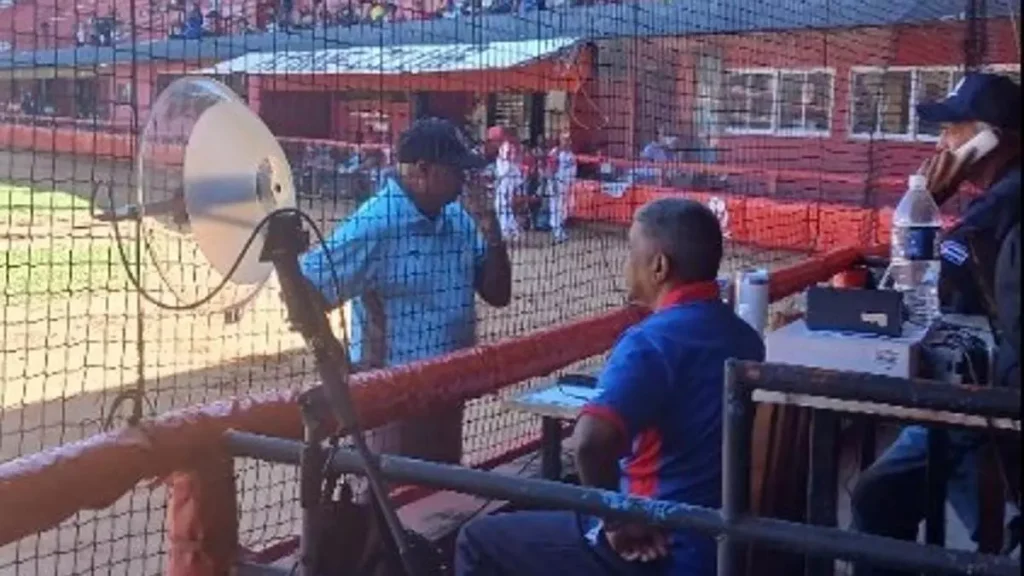
Umpire Luis Felipe Casañas told journalist Brita García that he was dismayed by what happened. / Brita García

14ymedio bigger14ymedio, Havana, October 19, 2025 — Among the indiscipline and penalties happening in Cuban baseball, umpire Luis Felipe Casañas offered an apology to journalist Brita García. The apology came after she reported on her social networks that he called her “frigid” and “impertinent,” and he said that she “didn’t know anything” about baseball.

According to García, the umpire insulted her “in front of the Game Commissioner and all those present in the lower boxes of the Guillermón Moncada Stadium,” in the fifth inning of the game between Santiago de Cuba and Las Tunas.

García said that Casañas requested a meeting in which the rest of the umpires, the supervisor and the Game Commissioner were present. “Casañas was dismayed and sorry for his behavior,” she said. “The rest of his teammates showed respect for her work. All say that they work with respect and in order to to strengthen Cuban baseball, the Heritage of the Nation.”

The journalist said that she denounced the situation “in order to stop this type of behavior, which I have faced throughout my professional life.”

The journalist said that she denounced the situation “in order to stop this type of behavior, which I have faced throughout my professional life.” Machismo remains enthroned, and all the gender committees and other organizations for this purpose must be maintained and act with rigor,” she said.

Casañas’ annoyance was due to a Facebook post by the journalist. García considered excessive the seven-game suspension imposed by the continue reading

Commission on Santiago native Jeison Martínez for protesting two of the judges’ decisions.

News of the matter spread like wildfire. “Some of us showed solidarity with Brita, because we are her colleagues and know her, and others because these topics ‘sell’ well,” wrote the specialized media on Facebook, DPorto Sports LLC. “Between posts and comments, you could say that it was the ‘most clicked on’ in Cuban baseball this Friday,” it added.

The same post regretted the absolute silence after the apology. “This is more than a criticism, it is a call to attention about our reality and what we have become,” it said.

“We’re more interested in the problem than the solution. We look at and react more to an offense/mistake than when the one who is wrong recognizes what he did and repents. We are at a point, I think, where we prefer confrontation to understanding. Or the personal banalities and controversies rather than physical or virtual acts that highlight our ethical and moral principles. Which, unfortunately, fade more every day.”

The National Baseball Series has been plagued by scandals in recent weeks. The National Institute of Sports Physical Education and Recreation announced that the following were suspended for five games for indiscipline: manager Vicyohandri Odelín and players Yordanis Samón Matamoros and Eglis Eugellés Antunez, all from Camagüey, in addition to the provincial Commissioner, Roger Jesús Montada Feria.

Penalties were also given to the manager, Vicyohandri Odelín, and to players Yordanis Samón Matamoros and Eglis Eugellés Antunez, all from Camagüey

From the game between Mayabeque and Las Tunas last Sunday, Yoelkis Cruz and Deismel Hurtado were suspended for five games.

Rigoberto Hernandez, a coach for the Mayabeque team, was suspended for five games”for addressing an umpire with bad words” after a decision on first base. The manager of Granma, Jorge Miranda, received 10 suspended games for “protesting in a very rotten way over an arbitrated decision.”

Eriel Sánchez, manager of the Los Gallos de Sancti Spíritus team and former manager of the Cuba team, was penalized for hitting with a “wooden object” (in the first version it was a bat, but Sánchez denied it) Miguel Rojas Rodríguez, a National Baseball Commission official and Cuban sports celebrity in late September.

The National Baseball Commission suspended Eriel Sánchez and Miguel Rojas for five and three years, respectively.

Translated by Regina Anavy

____________

COLLABORATE WITH OUR WORK: The 14ymedio team is committed to practicing serious journalism that reflects Cuba’s reality in all its depth. Thank you for joining us on this long journey. We invite you to continue supporting us by becoming a member of 14ymedio now. Together we can continue transforming journalism in Cuba.

Repairing the La Coloma Disaster in Cuba Will Cost at Least 110 Million Pesos, Mostly in Foreign Currency

The lobster processing plant in Pinar del Río is still on a prioritized circuit and receives electricity all day despite its closure

The plant was reduced to ashes, and so far no one has explained the origin of the fire. / ACN]

14ymedio bigger14ymedio, Madrid, October 20, 2025 — There is unrest in La Coloma, Pinar del Río, after the fire that broke out on Saturday, October 11, in the facilities of the Industrial Fishing Company of the municipality, responsible for 45% of the lobster caught in Cuba and 80% of the tuna, both high-value products in the national and international markets. Despite the fact that at this time most of its employees cannot work, the entity has not lost its status of prioritized electricity and receives power constantly, complain residents in the area.

“I want to ask the director of the Electric Company, since he’s not facing up to it, why they are giving power to La Coloma if there is no lobster,” asks an anonymous person on the Facebook page of Ventas Pinar. The author accuses the director of the entity, Yordan Nogueira Tapia, of corruption, although he provides no other evidence than the strangeness of wasting electricity on a circuit that does not need it.

“Even being corrupt you must know and be smart. Now that’s enough, making us beg for a few hours of power that belongs to us by right. Electric power is not a luxury, it’s a necessity, so give us circuit P961,” he demands, adding that this same Saturday the entire city spent 16 hours in a blackout. “I’m not interested in your business, but do it on our behalf, okay? Face it, you ball of corruption, and do an analysis.”

“Electric power is not a luxury, it’s a necessity, so give us circuit P961”

According to the official press, “dozens” of employees are working on the company’s administrative tasks in an attempt to reorganize the reconstruction. Preliminary estimates indicate that some 110 million pesos — approximately $231,578 at the black market exchange rate — will be needed to clean up the mess, “much of it in foreign currency.” Nogueira Tapia, however, does not rule out a future increase in the amount as continue reading

demolition and waste collection progress.

At the moment, all production lines are affected, from preselection, peeling, cooking and packaging to precooking. The latter, which had already progressed, had the “latest generation machines” acquired in 2022: an automatic sorter and three bagging machines with their respective heat tunnels. The list of damages is never-ending, since not just the machines were affected. Also damaged were tables, stainless steel shelves, air conditioning equipment, walls and false ceilings, zinc covers and even some of the tanks. None of this was saved, and now efforts are being made to get the 44 working lobster boats to fish non-stop.

“That is the only way to overcome this situation, because most of the resources we need are imported, and today a considerable percentage of the currency generated by our business group and our Ministry comes from the lobster,” the director told the State newspaper Granma this weekend, saying that it shifted the responsibility to the fishermen. “They will have to spend more days away from home, because the transfer of what they catch will be to other territories. But we have explained to them that the recovery depends largely on what they are able to do,” he said.

There are 175 workers whose jobs are hanging by a thread: some of them will go to another plant — not specified — which is responsible for the processing of fish, conch and sea cucumber, as well as the preparation of some products not much appreciated by Cubans, like fish croquettes, fish medallions and chopped fish. Some employees will be engaged in the recovery of the burned plant and the rest will be “interrupted,” receiving 60% of their basic salary, which in practice leaves them in a very bad situation despite the fact that this plant was paying salaries far above the company average, 20,000 pesos versus Epicol’s 9,000.

According to a report published by the provincial newspaper Guerrillero, there is only one reason for optimism: “The freezing chambers did not suffer great deterioration, only the hinges and doors,” and three days after the fire they were already in operation, protecting part of the production.

“The freezing chambers did not suffer great deterioration, only the hinges and doors,” and three days after the fire they were already in operation.”

The destroyed plant was about to receive an online European inspection, thanks to the technology implemented, from wifi to ammonia detectors for water quality and temperature controllers monitored from the ice plant.

However, the fishing was no longer going well. Of the 2,700 tons that should have been fished up to the date of the disaster, at least 600 were missing, which the director attributed to such disparate causes as climate change and lack of fuel availability.

This weekend, workers got bogged down in the recovery of materials as some debris could be reused, even if it is in other places. The director, despite the drama, remains optimistic: “Now’s the time to have a better plant design. The one we had was very good, but the new one would be more in line with the latest requirements of the international market,” he said.

Lobster production, one of the most profitable sectors for the State, is already in sharp decline. In 2019, the fishermen of Isla de la Juventud obtained an average of 19 kilos (42 pounds) of lobster per boat, a quantity that fell to 5.8 kilos (13 pounds) in 2024.

As for the country, in the last five years, production has fallen by 84%, from 6,900 tons in 2019 to 1,100 last year. In addition, over five years the production of lobster tail also decreased by 45% (248,600 tons compared to 136,000) and by 9.2% for frozen whole lobster.

Translated by Regina Anavy

____________

COLLABORATE WITH OUR WORK: The 14ymedio team is committed to practicing serious journalism that reflects Cuba’s reality in all its depth. Thank you for joining us on this long journey. We invite you to continue supporting us by becoming a member of 14ymedio now. Together we can continue transforming journalism in Cuba.
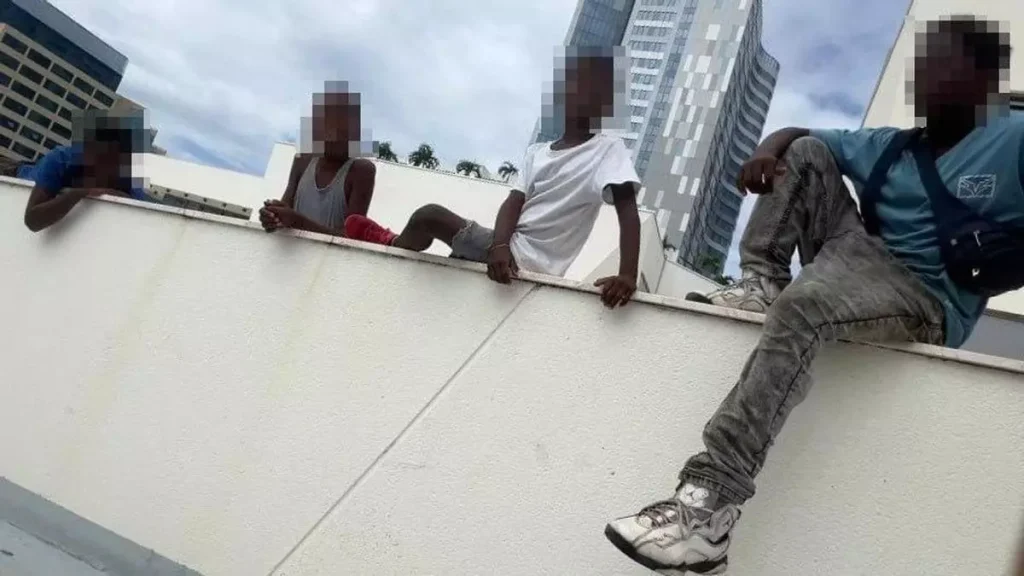
A Conviction for Child Abuse in Order To Hide the Scandal of Street Children

A court in Havana sentences a couple to eight and ten years in prison for corruption of minors and sexual abuse

The well-timed coincidence with the scandal about children sleeping under the stairs of the dollar supermarket at 3rd and 70th does not go unnoticed. / 14ymedio

14ymedio bigger14ymedio, Havana, October 19, 2025 — The recent publication of a judicial report in official Cuban media, with full names of the defendants in a case of corruption and child abuse, breaks with the usual pattern of opacity by the authorities. While the country still comments on the scandal of children sleeping under the stairs of the supermarket on 3rd and 70th, the news reported by Canal Habana and reproduced by Cubadebate seems to respond to the need of the State to control the story about abandoned children with a carefully chosen show trial.

The official report says that on September 29, 2025, the People’s Municipal Court of Arroyo Naranjo held a hearing and public trial charging Daima Rodríguez Núñez and Carlos Díaz González with crimes of corruption of minors, acts contrary to the integral development of minors and sexual abuse.

In this case, four girls, aged 10, 7, 4 and 1, had been abandoned by their mother and abused by her partner. The court sentenced Rodríguez Núñez to eight years in prison and Díaz González to ten, as well as suspending the mother’s parental rights.

What is unusual about this news is not only the judicial process, but how it was communicated. The State media do not usually publish the names of defendants in such cases, even less when they involve minors. Nor do they usually give such specific details about the victims or the family dynamics. continue reading

This time, however, the report bears the institutional signature of the People’s Provincial Court of Havana and mentions without reservation the full names of those involved.

The response of the official apparatus has been to publish this court case as proof that “the system does act”

The well-timed coincidence with a scandal about children sleeping under the stairs of a dollar supermarket at 3rd and 70th does not go unnoticed. That story, published by this newspaper just a few days ago, highlighted the existence of minors abandoned in plain sight in the Cuban capital, sleeping between pieces of cardboard, asking for food and money, without visible intervention of child protection institutions. The image of these children, without official name or face, became evidence of an absent State in one of its most elementary duties: protecting children.

In the face of this media coup, the response of the official apparatus has been to publish this court case as proof that “the system does act.” The implicit message is that when a case of neglect and abuse is detected, the authorities respond firmly. But the reality on the streets of the Island contradicts the institutional narrative.

The communication strategy also seeks to shift responsibility for the tragedy of Cuban childhood to “deviant” or “antisocial” individuals, rather than recognizing a structural problem. The official speech portrays Daima Rodríguez Núñez and Carlos Díaz González as monstrous exceptions in a society where children are supposedly protected.

The mass exodus has aggravated the situation of thousands of children throughout the country, following the emigration of their parents

The emphasis on “due process” and application of the law “most beneficial to the accused” seems less directed at national public opinion, which has little access to real appeal mechanisms or judicial transparency, than at international observers. In other words, it is not just a matter of punishing two people, but of projecting an image of institutional legality.

In addition, the publication coincides with a context of increasing visibility of the phenomenon of abandoned children and extreme poverty in Cuba, an issue that for decades was swept under the rug of propaganda. The mass exodus has aggravated the situation of thousands of children throughout the country, following the emigration of their parents.

The visibility of the sentence in the official press — eight and ten years in prison — contrasts with the silence on dozens of other cases that never go to trial or remain in administrative obscurity. It also differs from the lack of effective public policies to prevent children from ending up living on the street. State abandonment is not a criminal offense under the Cuban Penal Code, but its consequences are visible and daily.

Translated by Regina Anavy

____________

COLLABORATE WITH OUR WORK: The 14ymedio team is committed to practicing serious journalism that reflects Cuba’s reality in all its depth. Thank you for joining us on this long journey. We invite you to continue supporting us by becoming a member of 14ymedio now. Together we can continue transforming journalism in Cuba.

The Cuban Regime Calls the Doctors Who Criticize the Medical Missions “Ungrateful, Resentful and Treacherous.”

“Do not spit on the dish that nourished you,” reads the headline in the Ministry of Public Health text disseminated on social networks

Cuban doctors assigned to the Vícam Switch rural community hospital in Sonora. / Facebook/IMSS Bienestar Health Services

14ymedio bigger14ymedio, Madrid, October 20, 2025 — There is no right to criticize according to the Cuban Ministry of Public Health. In a statement published on Facebook, it makes clear its thoughts about Cuba’s free education system: more than a citizen’s right is a mechanism to silence the population, it follows from the text. It states that the health workers who were trained on the Island say the most bitter things about the system. “They insist on insulting the medical education that made them doctors. It is not criticism; it’s ingratitude. It is not testimony: it’s treason.”

The post, originally taken from the profile of the Public Health Union in Santiago de Cuba, is signed in the name of the Ministry and has been disseminated by various social media accounts, including that of Santiago’s television. The title is forceful: “Do not spit on the dish that nourished you,” reads the headline. The text calls the doctors who criticize their working conditions “resentful,” among other things.

The publication recognizes that there is a lack of resources, workers are tired and many things need improvement, “but this does not erase the fact that the Cuban doctor is trained with excellence, ethics and vocation.” The main reproach includes that of having emigrated, an act which it considers “legitimate,” with a but. “Using your freedom to spit on what has educated you is wretched,” the text says, a phrase particularly striking by implying that only in exile is this freedom achieved. continue reading

“Not all who stay are accomplices. Not all who leave are brave.”

“Not all who stay are accomplices. Not all who leave are brave,” adds the message, which also deplores the accusation that weighs on the Cuban State of enslaving doctors on international missions based on these testimonies, although it does not do so clearly, but with hints.

In addition, it insists that those who speak against “Cuban medicine” –which they say “does not need propaganda” — “denigrate” it. “Do not destroy that which gave you the tools to be who you are. Be proud. Change it. But do not trample on it,” adds the text. It ends with: “Cuban medicine is a beacon, and the light is not extinguished by the poison of those who forget where they came from.”

The publication of this message occurs without an apparent reason to justify the unexpected attack, although doctors who decide to leave medical missions have been despised for decades by the official discourse. Not for nothing, all of them are subject to criminal proceedings, which may result in up to eight years’ imprisonment and a ban on returning to the country.

Cuban doctors who have worked abroad have for years been denouncing the practices of the Cuban regime, which, in addition to keeping the money that can reach 90% of their salary, confiscates their passports in order to prevent them from fleeing, prevents them from engaging with residents in the the country where they are working, and compels them to engage in government-friendly propaganda. To all this is added increasingly complex economic conditions, as the officials have tried to deposit the dollars owed the doctors on a Classic card instead of delivering the currencies in cash, as they expected.*

Because of these practices, the US government has considered for years that Cuba enslaves its doctors, and in recent months, the Trump administration has pressured several countries to modify their agreements with Havana and hire the doctors directly, something that has already been achieved with the Bahamas, Grenada and Jamaica.

*Translator’s note:In 2022, the Human Rights Foundation issued a report calling the Cuban doctors on international medical missions “victims of human trafficking.”

Translated by Regina Anavy

____________

COLLABORATE WITH OUR WORK: The 14ymedio team is committed to practicing serious journalism that reflects Cuba’s reality in all its depth. Thank you for joining us on this long journey. We invite you to continue supporting us by becoming a member of 14ymedio now. Together we can continue transforming journalism in Cuba.