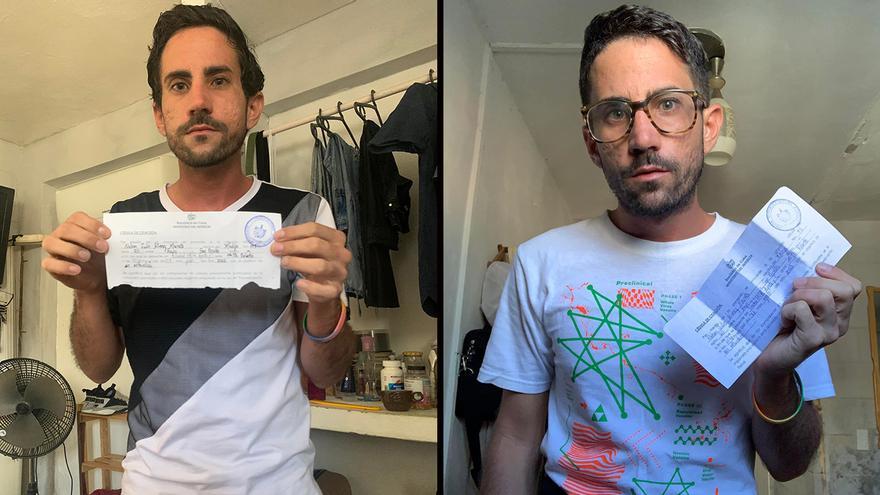
Carlos Miguel Mateos Rosaenz clarifies that “the petition is not addressed to the Cuban authorities.” (Facebook)
14ymedio, Havana, 12 August 2022 — 14ymedio, Havana, 12 August 2022 — He left Cuba in 2019 after suffering pressure for opposing the new Constitution and now, from Colombia, he leads an online petition calling for an end to compulsory military service on the island. Carlos Miguel Mateos Rosaenz talks to 14ymedio about the reasons that led him to promote an initiative that has already collected more than 2,000 signatures.
The death of at least four young recruits in the fire at the Matanzas Supertanker Base gave this 49-year-old émigré the final impetus to publish the petition, but he was also motivated by the concern of many mothers he knows on the island “whose children are about to enter compulsory military service.”
His experience in military service marked him very negatively, and now he regrets that these young people have died because of “the irresponsibility and mediocrity of dictators.” In the request on Change.org, he also describes the regime as in great need of “maintaining an army that only serves to perpetuate a corrupt and murderous mafia in power by repressing the people.”
Mateos Rosaenz clarifies that “the petition is not addressed to the Cuban authorities,” to whom he does not even grant any authority. “Rather, it’s aimed at raising awareness among Cubans inside and outside [the island] about one of the many problems we have.” He wants the initiative to reach as many people as possible and to support parents so that they “don’t send their children to die or to repress the people in rebellion.”
“I don’t think it will lead the dictators to do anything, as if they weren’t dictators, but at least it will create pressure, it will inform, it will move wills.” But even if he has only discreet results, Mateos Rosaenz will be happy: “If I manage to get a single boy in Cuba to save himself from these things, I will be satisfied.” continue reading
For this man, who considers himself a political exile in Colombia, his collection of signatures was something that was going to arise at any time. “I have no more merit than that I came up with the idea of the petition. If I didn’t do it, some other Cuban would have done it.” Since he published the application, “cyber attacks on the networks” have rained down on him, but he is not intimidated. “There attacks are praise for me, and they show me that I’m right.”
Now, while continuing to give massages, do acupuncture therapy and teach martial arts, Mateos Rosaenz keeps his eye on the page where every hour the number of people who sign his petition increases. At the bottom of the text he published, a signatory left a brief message: “We don’t need an army. We have no enemies; the real enemy is the Cuban regime.”
Translated by Regina Anavy
____________
COLLABORATE WITH OUR WORK: The 14ymedio team is committed to practicing serious journalism that reflects Cuba’s reality in all its depth. Thank you for joining us on this long journey. We invite you to continue supporting us by becoming a member of 14ymedio now. Together we can continue transforming journalism in Cuba.
The NS Laguna was notified of the change of course and will be diverted to the port of Antilla, in Holguín. (ACN)
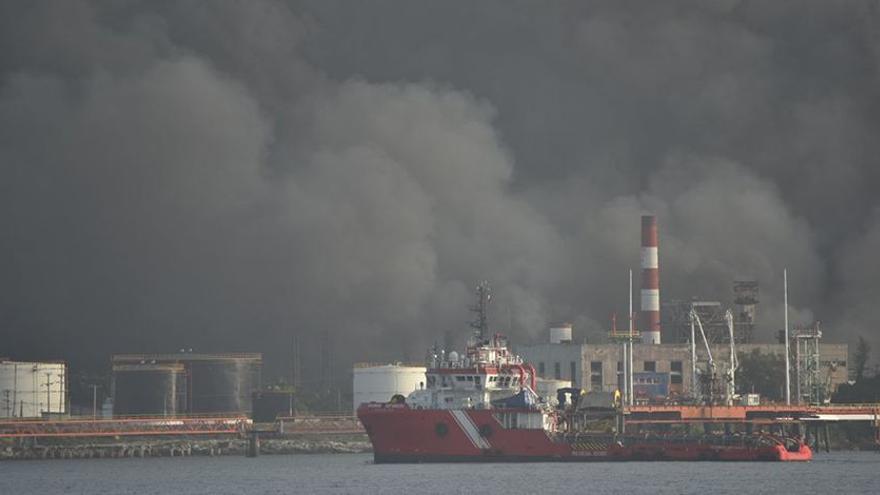
14ymedio, Havana, 12 August 2022 — The fire at the Matanzas Supertanker Base, not yet fully extinguished, has had a considerable impact on the port activity of that city. Ships carrying oil usually dock there, and their cargo is transported to other parts of the island by land or pipeline.
However, the destruction of 50% of the Supertanker Base has limited the possibility of fuel storage in Matanzas and has forced the redirection of the ships that were headed there.
On Wednesday, the ship NSLaguna, 249 meters long and 44 meters wide, sailing under the flag of Liberia (Africa) with a shipment of 700,000 barrels of Russian oil, was diverted. According to the VesselFinder nautical application, the ship left the port of Ust-Luga, in Russia, on July 26, for the Matanzas terminal, where it was expected to arrive in mid-August.
The NSLaguna was notified of the change of course and will be diverted to the port of Antilla, in Holguín, of lower capacity than that of Matanzas. It is expected to dock this Saturday at 11:00 p.m. and discharge the fuel there.
A similar situation occurred on Wednesday, when two Cuban-flagged oil tankers, transporting crude oil from Venezuela to the island, were diverted by the company Petróleos de Venezuela, S.A. (Pdvsa) to smaller terminals.
The oil tanker MaríaCristina sailed from the Venezuelan port of La Cruz, arrived briefly in Havana and had to interrupt its unloading in Matanzas, where it was docked during the explosion. It had to go to Santiago de Cuba and deliver the rest of the crude oil there. continue reading
The ship Vilma also advanced from the port of José, on the Venezuelan coast, to the Antilla terminal. Lourdes and Esperanza, while the usual ships of the “oil fleet” between the two countries are still in Venezuela.
The shutting down of the port of Matanzas represents a notable difficulty for the transport and processing of crude oil on the island. The delay will affect electricity generation, one of the most critical problems facing Cuba, where long blackouts have led to popular protests.
According to VesselFinder maps, the only ships anchored in Matanzas Bay are the Mexican BourbonArtabaze, specialized in firefighting, with technicians and military personnel on board and sent by President Andrés Manuel López Obrador, in addition to the tugboat Hurricane1, under a Cuban flag.
The data also reveal that, since the accident, the Cuban tugboat Tormenta1, the oil tanker CaribbeanAlliance, under the Panamanian flag, and the two aforementioned ships have frequented the Havana port.
It is hoped that the Cuban Government, in order not to interrupt the flow of crude oil that the island urgently requires from its Venezuelan, Russian, Iranian and other allies, will redirect other ships in the coming weeks and improve conditions in the ports of Havana, Santiago de Cuba and Antilla.
These terminals have proven to be the only ones capable of processing the oil shipments that, before the Supertanker accident, Matanzas administered.
Translated by Regina Anavy
____________
COLLABORATE WITH OUR WORK: The 14ymedio team is committed to practicing serious journalism that reflects Cuba’s reality in all its depth. Thank you for joining us on this long journey. We invite you to continue supporting us by becoming a member of 14ymedio now. Together we can continue transforming journalism in Cuba.
Elier Correa, 24, had been presumed dead at first, but was found to have been hospitalized since Friday. (Facebook)
14ymedio, Havana, 11 August 2022 — Although it recognizes that risks still persist, the Cuban Government declared the fire at the Matanzas Supertanker Base extinguished on Wednesday, five days after it began as a result of a lightning strike, according to the official version.
In the four affected storage tanks, out of a total of eight 50,000 cubic meters each (50 million liters) and their surroundings, some active points remain, where emergency teams are located, EFE reports.
In statements by the second head of the Cuban Fire Department, Daniel Chávez, the work is focusing on cooling the area, where “minor” flames may persist for days.
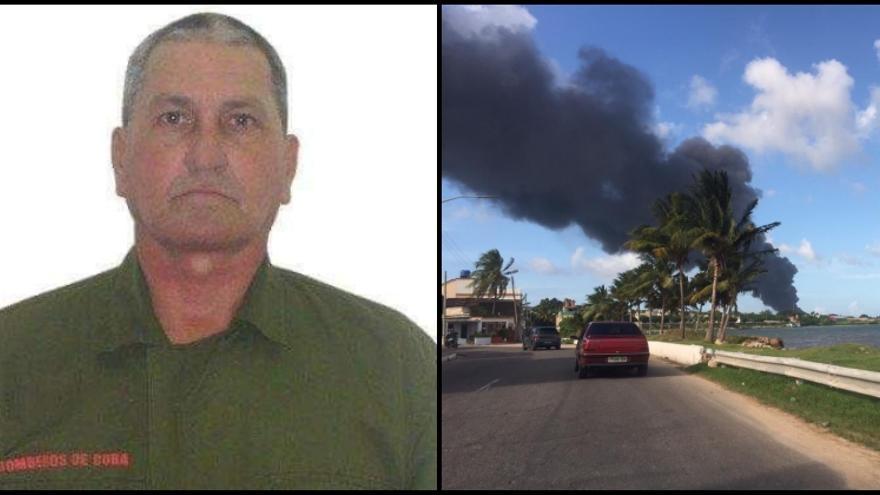
The images shown by the official media that accessed the site of the accident, unprecedented in the history of Cuba, are devastating. Next to the completely melted tanks, fire trucks and other burned vehicles are observed. This is where 14 people went missing while fighting the flames.
The authorities still haven’t provided data on the missing persons, mostly young people who were going through military service and were sent to fight the fire without any experience. Only one person was mentioned: the firefighter, Juan Carlos Santana Garrido, 60, who has died.
In its last statement, the Ministry of Public Health raised the number of injured to 128, of which 20 are hospitalized: 5 critical, 2 serious and 13 “under care.”
Far from offering information, not only about the fatalities but also about the cost of the incident for the perpetually diminished Cuban economy, the official press focused this Thursday on extolling President Miguel Díaz-Canel for visiting the destroyed facilities. continue reading
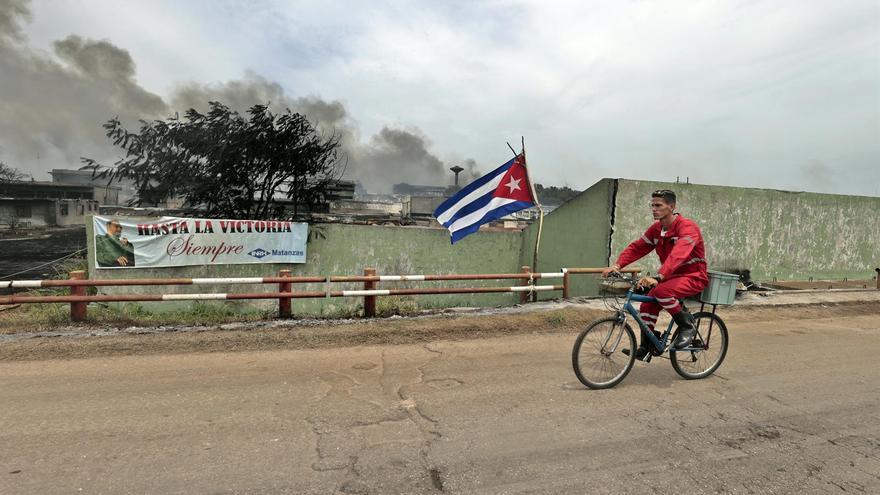
A man rides a bicycle while observing the smoke that remains from the fire in the industrial area of the port, this Wednesday in Matanzas. (EFE/Ernesto Mastrascusa)
Thus, they pick up the words of the hand-picked president: that “what happened in the last few hours didn’t paralyze the country, because many things have been done to continue improving the situation” and that “there was serenity, an ability to reach consensus on how to work.”
Roberto Morales Ojeda, a member of the Political Bureau and Secretary of Organization of the Central Committee of the Cuban Communist Part (PCC), goes so far as to describe as a “feat” the “integrated, coordinated work, deployed with extraordinary effort.”
The article from the State newspaper Granma, with the pompous title “The five days that shook Cuba, and the lessons gained forever,” devotes only half a sentence to the “25 flights from Mexico and Venezuela,” countries whose help to extinguish the fire was fundamental.
These nations contributed 127 specialists, 45,000 liters of retardant foam and 8 breathing air tanks with armor, in addition to other materials.
Regarding the missing, it simply refers to the statements of the Minister of Health, José Angel Portal Miranda: “The experts who will be in charge of the rescue and identification of the bodies have come prepared.”
About the environmental pollution, which concerns both the residents of Matanzas and those of other neighboring provinces, even Havana, the Cuban Prime Minister, Manuel Marrero Cruz, said that the indicators “are below danger figures” and that “there are no patients with pollution-related symptoms at the hospitals.”
Another unanswered question is what could have caused the tragedy. The Matanzas Supertanker Base, the product of an agreement signed between Cuba and Venezuela, is a facility that is barely ten years old.
Some specialists, such as Alexandr Gofstein, rescuer and former head of the Russian Rescue Preparedness Center, explained that “the fact that the fire spread from one tank to the others shows that there were defects in the very structure of the base, which led to a disaster of such a proportion.”
However, hydraulic engineers Eric Cabrera Estupiñán and Alejandro Alomá Barceló, who worked on the design of the fire system of the facilities, which were inaugurated in 2012, said in an interview with PeriodismodeBarrio that the Base had been built with “the necessary security measures of the highest international standard,” including a fire station.
Despite the fact that, as Cabrera said, “a lot was invested,” the troops who were sent to fight the fire initially included boys who were doing their military service at Fire Command number 3 of Varadero airport, 25 kilometers from the accident.
“Apparently what happened is that the lightning generated very strong energy,” the engineer speculated, and hit the top of the first tank. “At the top there is a cooling ring, which didn’t work,” he explained, although he did observe that “the cooling system of the neighboring tanks was working.”
Alomá, for his part, pointed out that the tank where the accident began “was practically destroyed from the first moment, at least the top, due to the many gases that had accumulated there.”
Both specialists stated that they have no way of knowing if the fire detection system, which automatically starts cooling measures in the facilities, worked correctly. “We have no idea if the pumps managed to move the amount of water required for cooling,” Alomá said.
Nor did they see that the necessary chemicals were used in this case — a kind of detergent with foam that eliminates oxygen in contact with the fire and, therefore, extinguishes it — but they didn’t venture any reason.
In a 2020 publication, some specialists warned of the danger of storing fuel for more than two months, referring to the conditions in which the reserves stored by Petróleos de Venezuela are located, in tanks similar to those of the Matanzas Base.
Chemical engineer Fernando Morales, for example, explained that “stopping the production of an oil well causes damage to it,” and Eudis Girot, executive director of the United Federation of Oil Workers of Venezuela, assured that the “structural composition” of the tanks is not designed to house oil for a long time.
Translated by Regina Anavy
____________
COLLABORATE WITH OUR WORK: The 14ymedio team is committed to practicing serious journalism that reflects Cuba’s reality in all its depth. Thank you for joining us on this long journey. We invite you to continue supporting us by becoming a member of 14ymedio now. Together we can continue transforming journalism in Cuba.
“The young man with the placard” remains incarcerated in the prison of the Combinado del Este. (Collage)
14ymedio, Havana, 11 August 2022 — The Inter-American Commission on Human Rights (IACHR) issued a resolution in which it considers the situation of Cuban opponent Luis Robles as “at serious risk.” Robles, known as “the young man with the placard,” was arrested in December 2020 for demanding the release of musician Denis Solís, on San Rafael Boulevard in Havana.
In the document, the IACHR, an organization belonging to the Organization of American States, describes several precautionary measures that are necessary to protect the rights and integrity of the imprisoned.
“He continues to be deprived of liberty in the circumstances described and may be further denied his rights,” adds the Commission, which proposes that the 29-year-old inmate get access to adequate medical care and receive medicines for his chronic gastritis. In addition, his relatives and lawyers must be allowed to visit him in prison.
The Commission asks that some “alternative to the deprivation of his liberty” be evaluated and that action be taken against the threats and harassment suffered by Robles in the Combinado del Este prison, in Havana, where he is serving a five-year sentence for the crimes of enemy propaganda and disobedience.
The Cuban State must inform the Commission within 15 days if it has adopted the proposed precautionary measures; however, since the organization Prisoners Defenders, based in Madrid, initiated this request, there has been no continue reading
government response on the case.
Among the background and reports that the Commission used to document its resolution were the contributions of the Working Group on Arbitrary Detention of the United Nations, which asked the Cuban State to release Robles “immediately” during its 91st session.
Returning to the complaint of Prisoners Defenders, the Commission reported that Robles has been held incommunicado with his family and that he survives in “inhuman conditions.” It adds that on February 12, 2021, Robles asked for medicines and that “they didn’t give them to him so that he could just die there.” In addition, he has suffered beatings by State Security agents during his detention. The document also reports that “the young man with the placard” remained naked and slept on the floor for two nights, in punishment cells, on the orders of the prison authorities.
“The Commission considers that the proposed beneficiary, deprived of liberty since December 2020 after a demonstration on public roads, would be in severe conditions of detention in the Combinado del Este prison and has not received access to the necessary medicines for his chronic illness to date, after 1 year and 8 months of detention,” the resolution states.
In June, Yindra Elizastigui, Robles’ mother, reported that her son has been maltreated constantly, such as being photographed without clothes, against his will.
The mother, after filing the relevant complaints at the request of the Ministry of the Interior, received as a response from the regime that the photographs were taken for “an investigation into a newspaper report saying that Luis Robles had been beaten,” so they took those images “to show the world that my son had no traces on his body of physical abuse.”
On July 23, Robles’ mother revealed that the head of the prison unit where her son is being held said that he will not be granted the benefit of “the minimum,” that is, the transfer to a labor camp upon serving a year and three months of sentence. “Given that he has not behaved well, because he has made some calls abroad denouncing the abuses to which he has been subjected,” she reported on Facebook.
Yindra Elizastigui has filed complaints about violations of the rights of prisoners and recalls that Luis Robles is the father of a two-year-old boy. “They love to remind the prisoners that they must fulfill their duties, but they forget that they also have rights.”
Translated by Regina Anavy
____________
COLLABORATE WITH OUR WORK: The 14ymedio team is committed to practicing serious journalism that reflects Cuba’s reality in all its depth. Thank you for joining us on this long journey. We invite you to continue supporting us by becoming a member of 14ymedio now. Together we can continue transforming journalism in Cuba.
Greater Aston, located on 1st and D Streets, very close to Malecón Avenue. (Courtesy)
14ymedio, Juan Izquierdo, Havana, 10 August 2022 — In the midst of an almost absolute blackout in Havana’s Vedado, the Grand Aston Hotel Havana seemed to have fallen from another world, less precarious and underdeveloped. All its lamps, windows, spotlights, reflectors and even humble light bulbs were at their maximum capacity, without any attention to the ominous reports of the Electrical Union.
Energy conservation is not an issue of interest to the directors of the Greater Aston, located on 1st and D streets, very close to Malecón Avenue. “The newest and most elegant” hotel in the city, according to its website, also doesn’t seem to concern the Cuban Government too much, which juggles to attract investment from foreign companies in the tourism sector.
It’s not the first time that state hotels and establishments seem to enjoy special “isolation” in the cities of the island, safe from power cuts, the misery of the people, police repression, hunger and protests provoked by all these factors.
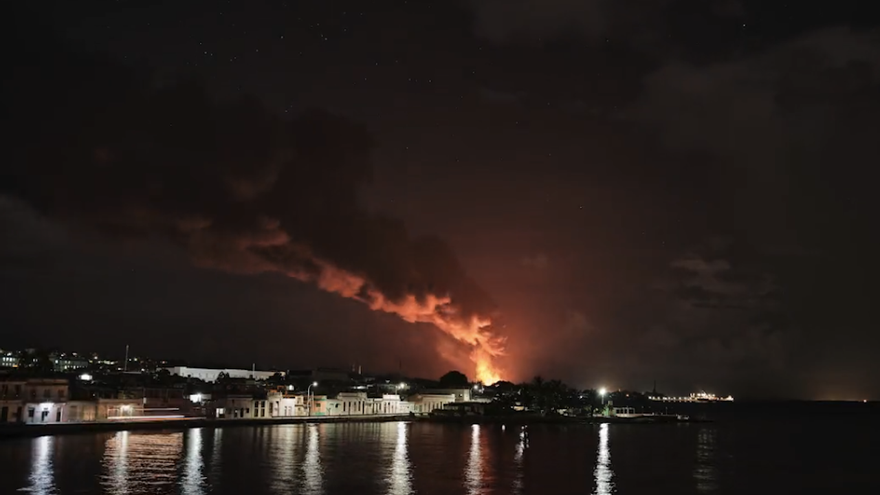
On the same day that the Grand Aston threw its luminous aura over the darkened capital, Habaneros watched the sinister glow of the fire at the Supertanker Base in Matanzas.
The torment for the Cuban people doesn’t end there. A few days before the explosion in Matanzas, the Minister of Economy formally declared war on the informal currency exchange and provoked the usual question: “If we don’t have electricity, food, well-being or a future, what are they doing with our dollars?”
Neighbors looking at the incandescent tower of the Grand Aston had to think that, perhaps, the hotel was the only place in Havana where those questions referred to a distant reality.
It is not for nothing that managers say that anyone who can afford a room at the Grand Aston will access “a refuge where they can relax and recharge their batteries, while experiencing its glamour.”
The price of the only illuminated Eden in Havana ranges between $179 and $244 per night, tropical and truly luxurious, not like the accommodations of the rest of Havanans.
The Grand Aston, as seen in the photograph, scandalously happy about a Cuba extinguished by the death, exile and hard lives of its citizens, is the most eloquent symbol of how the darkness of the country feeds the government businesses.
Translated by Regina Anavy
____________
COLLABORATE WITH OUR WORK: The 14ymedio team is committed to practicing serious journalism that reflects Cuba’s reality in all its depth. Thank you for joining us on this long journey. We invite you to continue supporting us by becoming a member of 14ymedio now. Together we can continue transforming journalism in Cuba.
Yusleidis Miranda and Anay García participated in three games of the Monsignor Romero Municipal League team before leaving for the United States. (Collage)
14ymedio, Havana, 10 August 2022 — Cuban basketball players Yusleidis Miranda and Anay García made their best play, but it was not in a game; it was against the regime. Both were hired last June through the National Institute of Sports, Physical Education and Recreation (INDER) to play for three months with the club Liga Municipal Monsignor Romero of El Salvador. The athletes have broken that link, and this week they arrived in the United States.
In a video shared on social networks, Miranda documented her journey through El Salvador, Guatemala and Mexico, until she reached the southern border of the United States, which she described as a “country of freedom.”
The three months she had to be with the Salvadoran team were reduced to three matches. Her goal since she left the island, like that of her friend, was to emigrate, as she explained in a post of gratitude to her family: “Thank you to all the people who trusted me and reached out to me. One more goal accomplished, and let’s go for more.”
In her brief stay with the Monsignor Romero Municipal League, Miranda scored 49 points with a success rate of 44% and recorded 41 rebounds. García scored 58 points with 47 rebounds. Both were recognized on the island as athletes of the year in 2018.
Her level of play led Miranda to be hired for a month in 2018 by the Dominican team Santiago de Los Caballeros. “Following that contract we returned, and I was selected to play in Colombia at the Central American Championship in Barranquilla, where I obtained a silver medal,” the athlete told the reporter.
According to journalist Daimir Díaz Matos, Miranda dreamed of “being part of the National Team and being an athlete recognized by Cuba.” continue reading
Miranda’s next move was to leave for El Salvador. She was hired by the same team from which she resigned a few days ago: the Monsignor Romero Municipal League, but with the permission of INDER. The institution allowed her to establish the contacts and procedures necessary to emigrate.
Anay García’s experience, for her part, was different. This 6’4″ athlete was one of the members of the Pinareño team that consecutively won four titles in the Superior Basketball League, the last of them in 2016.
With gaming experience in the leagues of the Dominican Republic and Argentina, García went through the COVID-19 pandemic in isolation, training alone in the gym of San Juan and Martínez. The contract in El Salvador represented the opportunity to leave the island and break her dependence on INDER. The basketball player now sees her sporting future in the United States.
The exodus of Cuban athletes has also generated a notable vacuum in athletics. After three retirements and a failure at the XVIII World Athletics Championships, which were held in Eugene, OR, USA, where no medals were won, the National Athletics Commissioner herself, Yipsi Moreno, was removed from her position.
The Olympic champion in Beijing 2008 and silver in Athens 2004 was accused of privileging athletes close to her, while harassing others who ended up leaving athletics or leaving the country.
The abandonment of Yusleidis Miranda and Anay García adds to the bleeding of Cuban athletes in recent months, including that of the Olympic medalist and world record champion, Yaimé Pérez, who escaped after Cuba’s sports failure in Eugene.
During that championship, the physiotherapist Carlos González Morales and the javelinist Yiselena Ballar Rojas, who left the delegation in Miami, also defected as soon as their plane landed.
Translated by Regina Anavy
_______________
COLLABORATE WITH OUR WORK: The 14ymedio team is committed to practicing serious journalism that reflects Cuba’s reality in all its depth. Thank you for joining us on this long journey. We invite you to continue supporting us by becoming a member of 14ymedio now. Together we can continue transforming journalism in Cuba.
The storage tanks at Cuba’s only Supertanker Base caught fire and burned for days. (Cubadebate)
14ymedio, Elías Amor Bravo, Economist, 9 August 2022 — The communist state press collects statements by Díaz-Canel in which, in relation to the Matanzas fires, it bets on a new line of communication, according to which “we have confidence that we are going to recover.” And that’s what Cuba needs most right now: trust. At all levels. As much as Díaz-Canel takes advantage to change the focus, this hell that is happening at the Matanzas Supertanker Base is a hard blow that erodes the confidence that Díaz-Canel demands of the Cuban people, which is already at a minimum.
This is not the time for grandiloquent messages but to show that the communist state can act and do so efficiently when such an event occurs. There are too many references to revolutionary values and “revolutionary work” that don’t catch on. What people want are answers. A good way to start, because they have all the cards on the table, is to avoid responsibility.
And, of course, they will say that this fire can’t be attributed to anyone in particular, seeing what they see, but it’s time for someone in the powerful state sector created by the Cuban communists to assume the failure of what is happening. Even while the confrontation of the selfless firefighters, the army and civil protection takes place, we must begin to identify the culprits and set a precedent.
In Cuba, any dissident is put in prison for much less than what is happening in Matanzas. It’s time to start with the arrests of public officials or leaders who have been unable to foresee a scenario like the one that is transmitted to the world on television, and even those who are watching while others die, showing how little they are doing in the face of such an event. I am referring to the representatives of the party in the province, who are looking for media appearances to get something out of this event.
Díaz-Canel’s references to trust only make sense if responsibility is taken and the people see that the state acts not only against defenseless dissidents and opponents, but also against those who, out of indolence, don’t live up to the requirements of the jobs they occupy, undoubtedly well paid and with numerous perks. This is where we have to start if Díaz-Canel wants to regain the trust he says people have in him.
He is close to those responsible: starting with himself, followed by Prime Minister Manuel Marrero; Morales Ojeda in the Party; the head of Transport, Rodríguez Dávila; the Minister of Science, Technology and the Environment, Elba Rosa Pérez Montoya; the head of Health, Portal Miranda; even the memorable Susely Morfa, who is now a provincial delegate of the party; or the governor of the territory, Mario Sabines. There are plenty to choose from. continue reading
And then there is international trust, and this is more difficult to manage. Citizens of all countries of the world are seeing in the news, several times a day, the scenes of the consecutive fires at the Matanzas base; the dedication of those who fight the fire; the fears of the population; the toxic clouds that soar in all directions; the economic and social collapse. And what no one understands is that still, at this point, and despite the offer made from the beginning, the Cuban communist regime still will not request help from the neighbor to the north.
And so, while Díaz-Canel says that the fire should be extinguished in the shortest possible time, the days go by, and there are already several tanks that have burned, without the fire services having managed to stop the disaster. Perhaps because they lack the necessary experience and, above all, the means: more effective and modern instruments to fight the fire and thus put an end to the feeling of uncertainty and loss of confidence in Cuba, worldwide.
And for all these reasons, there is a certain contradiction in the communication strategy that is easily perceived.
On the one hand, there is the impression that the regime wants to bet on success depending on one more fire, which can occur at any time, due to a natural, inescapable phenomenon. The explanation of lightning has been questioned with the statistical indicators of last Friday when it all began, but the most serious thing is that feeling of calm that they want to transmit to the population, while the media show a dense layer of smoke projected more than 100 kilometers away, which cannot have beneficial effects because of what it contains. But the regime doesn’t want to “alarm” the population and takes its time with decisions; for example, mass evacuation, which should have already happened. The communiqués insist that they have control of the area in which the fire is developing, but the facts show just the opposite.
And, on the other hand, the second line of official communication is to present the fire as “a really intense and complex accident,” “a natural and ecological disaster with a high social and economic impact,” pointing out that these opinions are shared with the “friendly” specialists who have come from Mexico and Venezuela to work together with the Cubans. The “enemies” aren’t there and are not expected to be. Big mistake, because they are probably the only ones who know the most about all this. If it’s so serious, then why are the effects on the population minimized? And then they complain about trust.
While the fire remains out of control, other issues on the agenda are waiting for concrete solutions, such as the evacuation and movement of necessary equipment and the electro-energy situation of the country with reference to the water supply to the “Antonio Guiteras” thermoelectric power plant. There is also the issue of air pollution from the toxic cloud that runs through the western territory that has not yet begun to be measured, or the 125 people treated as a result of the fire, including one deceased and 24 hospitalized (of which 5 are in critical condition, 2 in serious condition and 17 under care).
Things are not going well. The phrase left to us by the ineffable Sucely Morfa, of sad memory at that Latin American summit, reads like this: “Here we can be exhausted; what we cannot be is defeated” and to end with that combination that Raúl Castro likes so much: “order and discipline to face any manifestation of despair in the population.” This is what worries them the most, and they are right.
Translated by Regina Anavy
____________
COLLABORATE WITH OUR WORK: The 14ymedio team is committed to practicing serious journalism that reflects Cuba’s reality in all its depth. Thank you for joining us on this long journey. We invite you to continue supporting us by becoming a member of 14ymedio now. Together we can continue transforming journalism in Cuba.
The “YouTuber” Nelson Julio Álvarez denounced systematic harassment by State Security. (Facebook)
14ymedio, Havana, 8 August 2022 — The systematic harassment of the Cuban regime, acts of intimidation and threats by State Security, including a summons to his mother, forced reporter Nelson Julio Álvarez Mairata to “resign from his profession” and his position as a collaborator in the digital media Cubanet.
An agent of the political police, whom he identified as First Lieutenant Roberto, warned him that if he didn’t resign he would be subject to legal proceedings once the new Criminal Code was approved, and Roberto demanded that he make a video talking about his link with Cubanet and “his funding,” which he categorically refused to do.
Álvarez also denounced through his Facebook account that, since 2019, he has been subjected to “exhausting hours of interrogations, arrests, warning letters, even the search of the home where I was living, just for practicing journalism.”
The journalist explained that as part of the hate campaign against him, the regime hacked his social media profile to “expose his private life” and mock his sexuality and gender identity. “My family has been affected; my mother is being summoned for interrogation” and intimidated by prohibiting her from leaving the country, as is Álvarez’s sister, a 17-year-old teenager.
This siege led Álvarez to fall into an episode of burnout, an emotional exhaustion that affected him physically. The harassment he has suffered from the regime, he said, is part of their strategy. “The government has the resources to repress people individually.” continue reading
Police repression and the severity of the legislation against freedom of expression on the island are obstacles faced by journalists, and some have had to emigrate. This situation could increase in the face of the new Criminal Code, which provides for stricter punishments for independent newspapers and magazines that receive funding from abroad.
Similar to Álvarez’s case was that of independent journalist Cynthia de la Cantera, who on July 24 denounced the harassment of State Security. In a Facebook post, agent Manuel gave her three options: “Collaborate with them, abandon journalism or suffer the consequences and face criminal proceedings.”
“I’m deciding to give up journalism because I’m not willing to accept either of Manuel’s other two options,” said De la Cantera. “It was a decision that I had to make in a matter of a few minutes and, I reiterate, under threats. I just say, and I trust, “La Noche No Será Eterna” [The Night Will Not Be Eternal].
Translated by Regina Anavy
____________
COLLABORATE WITH OUR WORK: The 14ymedio team is committed to practicing serious journalism that reflects Cuba’s reality in all its depth. Thank you for joining us on this long journey. We invite you to continue supporting us by becoming a member of 14ymedio now. Together we can continue transforming journalism in Cuba.
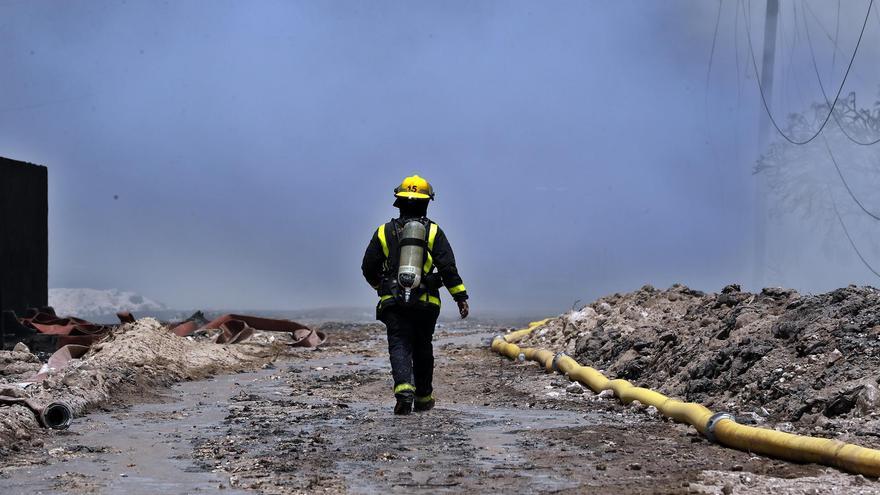
A firefighter at the site of the fire at the Matanzas Supertanker Base (Cuba). (EFE/Ernesto Mastrascusa)
14ymedio, Havana, 10 August 2022 — The official information is that the fire that has been devouring the Matanzas Supertanker Base since Friday began to subside this Tuesday. The Cuban Fire Department confirmed that the fourth tank, which exploded on Monday night, collapsed completely, and the state press itself published images of the four melted tanks.
Despite the fact that the authorities insist that “successful work is being done on extinguishing the fire” and that the spread of fire to the rest of the port facilities was prevented — there are four other tanks similar to those destroyed — they warn that “there are still flames” on the surface of the tanks and that “the risk continues.”
“It’s still a big fire, but we see a different situation than yesterday,” Alexander Ávalos Jorge, Assistant Chief of the National Fire Department and Firefighter Team said at a press conference on Tuesday.
President Miguel Díaz-Canel showed up at the site to evaluate the progress of the work and said that there are still “possibilities that the fuel will catch fire again.”
Support teams from Venezuela and Mexico, EFE reported, were able to start the hydraulic pump that they had installed and hadn’t been able to operate. On Tuesday, in addition, two ships with the Mexican flag arrived: the Liberator, of the Ministry of the Navy, with a helicopter to help, and the Bourbon Artabaze, a private ship hired by the state-owned Petróleos Mexicanos (Pemex), specializing in putting out fires in marine oil facilities.
The Mexican delegation, which began arriving on Saturday night, has sent almost 45,000 liters of retardant foam and two specialized irrigation pumps to the island on 13 flights.
The images disseminated show that the black smoke from the accident has turned gray, since the fuel from the tanks has been consumed. Each tank has a capacity of 50,000 cubic meters (50 million liters) and was filled with an indeterminate amount of fuel. continue reading
The government’s version is that lightning struck one of the warehouses on Friday afternoon and, in circumstances not yet explained, since that type of facility must have protection against that natural event, it lit a fuel tank with 25,000 cubic meters of national crude oil. In the following days, the fire reached the neighboring tanks one by one, between explosions that were broadcast live not only by private users but also by state television.
While working on extinguishing the first fire, the explosion of the second tank caused the death of firefighter Juan Carlos Santana Garrido, whose body was found on Saturday, and the disappearance of 14 others, most of them young people aged 18 and 19 who were going through military service, as witnessed by the desperate calls of relatives on social networks.
The Government has not published the list of these missing persons or acknowledged any more deaths and has already announced that the recovery of the bodies will not begin until the flames are extinguished. This lack of transparency results in the dissemination of contradictory information.
Relatives of one of the missing, Leo Alejandro Doval Pérez de Prado, only 19, wrote messages on social networks considering him dead, but this newspaper is waiting for confirmation from the family. Likewise, official journalists reported that Michel Rodríguez Román, 20, had died, but later deleted the information. Both boys were in military service.
In its latest report, Cuba’s Ministry of Health pointed out that of the total of 125 injured in the accident, 19 are hospitalized, 5 of them critical, 2 serious and 12 with “care.”
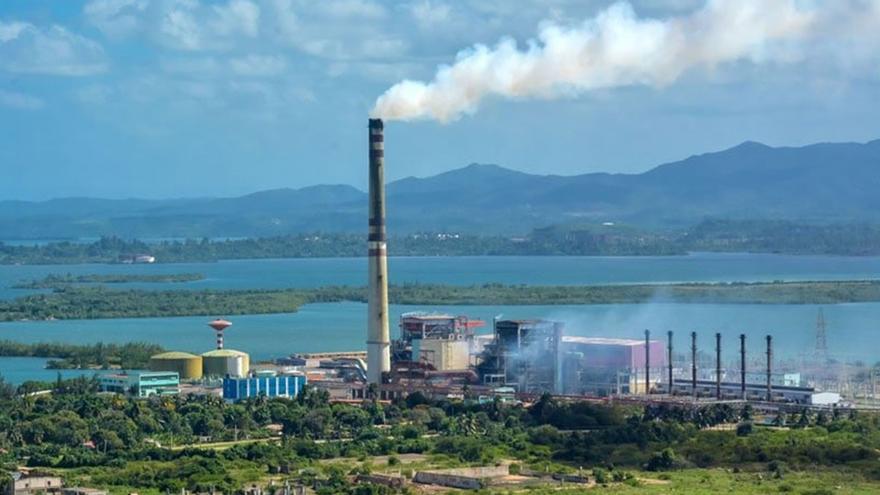
Another effect of the accident was the shutdown, on Monday, of the largest thermoelectric power plant in Cuba, Antonio Guiteras, located almost five kilometers from the Supertanker Base.
Although the Electric Union of Cuba (UNE) reported that it had begun to get the plant back in service, an attempt was thwarted on Tuesday night. “Just a few minutes after synchronizing with the national electrical system, the Antonio Guiteras thermoelectric plant went down again, as a result of a shot,” official journalist Lázaro Manuel Alonso posted on Facebook, without giving more detail about what he was referring to. The UNE, for its part, indicated that it was “for unknown reasons” that are being investigated.
In any case, a new day of blackouts presented itself. On Tuesday, only 60% of the island’s energy demand was met.
Translated by Regina Anavy
____________
COLLABORATE WITH OUR WORK: The 14ymedio team is committed to practicing serious journalism that reflects Cuba’s reality in all its depth. Thank you for joining us on this long journey. We invite you to continue supporting us by becoming a member of 14ymedio now. Together we can continue transforming journalism in Cuba.
The Antonio Guiteras thermoelectric plant is located in the province of Matanzas and is the largest in Cuba. (Yurmuri TV/Facebook)
14ymedio, Havana, 8 August 2022 — The Antonio Guiteras Thermoelectric Power Plant, which operates in the city of Matanzas, left the National Electricity System, as confirmed by the authorities, Monday afternoon, causing a loss of 1,246 MW and ensuring the programming of more blackouts. “The unit ran out of sufficient water supply to stay in operation,” the Matanzas government reported on its social networks.
Local authorities also explained that “water is supplied by pipe to the plant and pumped,” but still “it’s not enough to keep it running, so it had to be shut down.” The Guiteras thermoelectric plant has been affected by the fire that began this Friday in the industrial area of Matanzas, after a lightning strike, according to the official version, started a fire in one of the fuel tanks and has already spread to two other tanks.
“Its return to the grid isn’t expected for the hour of maximum demand,” the Electric Union of Cuba (UNE) warned, while insisting that the recovery of the thermoelectric plant “will depend on the disposition of water levels,” although in another statement it said that “about 12 hours are needed for it to start up again. However, actions are already being taken to reduce this time.”
However, the supply of water will take longer than expected, the authorities acknowledged, due to the taps in the thermoelectric plant, which demand a greater supply than usual.
The UNE also reported that due to the exit of the Matanzas plant “it was necessary to decrease 200 MW to Havana, and the restoration of this load will depend on the conditions of availability of the National Electricity System.”
Last Saturday, 12 hours after the explosion, the Government had announced that the thermoelectric plant, located about 10 kilometers from the Matanzas Supertanker Base, had fuel to operate for two days, since pumping from there had been suspended to the largest Cuban power plant.
The UNE predicted blackouts that day due to a deficit of 35% of demand, which was maintained until Monday when the Guiteras plant had to shut down.
Power outages, due to failures and breaks in outdated thermoelectric plants and lack of fuel and scheduled maintenance, are increasingly frequent in Cuba. In July, blackouts were recorded in 29 of the 31 days, according to UNE data. continue reading
The situation, which weighs down all areas of the economy and significantly affects daily life, has fueled social discontent, and several protests have been reported throughout the island.
Cuba relies heavily on foreign oil to produce energy (thermolelectric plants generate two-thirds of the electricity), and its main supplier, Venezuela, has significantly decreased its shipments.
Translated by Regina Anavy
____________
COLLABORATE WITH OUR WORK: The 14ymedio team is committed to practicing serious journalism that reflects Cuba’s reality in all its depth. Thank you for joining us on this long journey. We invite you to continue supporting us by becoming a member of 14ymedio now. Together we can continue transforming journalism in Cuba.
Moment when the fire reaches the third tank of the Matanzas Supertanker Base, on Sunday night (@SantanaMiriel/Capture)
14ymedio, Havana, 8 August 2022 — “The fire has taken on a greater magnitude; four tanks are already compromised,” Lieutenant Colonel Alexander Avalos of the Cuban Fire Department said at a press conference on Monday afternoon. The military said that they’re working to prevent the spread of fire to other areas of the Matanzas Supertanker Base, such as a nearby depot that contains reserves of other fuels. Extinguishing the fire can take days.
The fire that has been devouring the Supertanker Base since Friday worsened on Sunday night when it reached a third fuel tank after explosions in the second. The provincial governor himself, Mario Felipe Sabines Lorenzo, confirmed on Monday morning that the third tank collapsed.
Official media, as well as private users, broadcast live through social networks the moment when, before midnight, a gigantic flash emerged from the affected tanks and, instantly, a column of fire reached several tens of meters.
A few minutes earlier, announcer Humberto López, a member of the Central Committee of the Communist Party of Cuba, welcomed the fact that the first tank set on fire, as a result of lightning, according to the official version, was “without flames,” only emanating “white smoke.” That fire was extinguished when all the national crude oil contained in the tank was consumed.
The strategy to combat the flames, which included cooling the tanks with sea water with the help of Mexico and Venezuela, was unsuccessful.
This morning, Cubadebate reported, a Venezuelan rig arrived at the scene of the accident to pump a chemical agent over the fire. On Sunday, 35 firefighters, specialists and PDVSA technicians arrived from the Caribbean country with 20 tons of foam and other chemicals. Likewise, a Boeing 737 of the Mexican Air Force also landed on Sunday with 60 rescue soldiers and 16 technicians from Petróleos Mexicanos (Pemex).
Sabines Lorenzo admitted that the fire was revived when the second tank collapsed and the fuel it contained was spilled. Neither authorities nor official journalists mentioned the word “explosion” at any time.
Nor have they made public the list of those who are missing in the accident. Only one body, that of firefighter Juan Carlos Santana Garrido, 60 years old and originally from Cienfuegos, was found and identified. The Government has already warned that the recovery of bodies will not begin until the flames are extinguished. continue reading
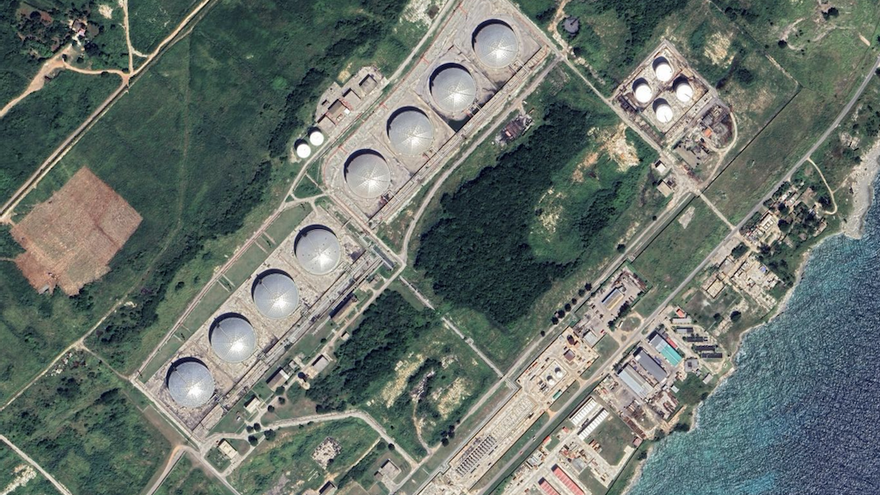
The Matanzas Supertanker Base, in Cuba, near the Antonio Guiteras Thermoelectric Power Plant, before the fire started on Friday. (Google Earth)
Despite all of them being called firefighters by government sources, many of them are 18- and 19-year-olds who were fulfilling their military service, as evidenced by the desperate calls of relatives on social networks.
Among the names of the missing are Fabián Naranjo Núñez, Osmany Blanco Sosa, Andy Amarilys Ramos, Adrián Rodríguez and Leo Alejandro Doval Pérez de Prado.
For its part, this Sunday, the Ministry of Public Health reported that there are 122 injured, of whom five remain in critical condition, three are in serious condition and 16 are receiving care. The others were discharged.
About 5,000 people have been evicted from villages near the industrial complex, which houses a total of eight tanks of 50,000 cubic meters (50 million liters) each. Stored in one of the eight tanks in the port of Matanzas, are 700,000 barrels of fuel oil were sent by Russia in June.
Russia is one of the countries which the Cuban government asked for help. “Cuba requested national assistance after the disaster that hit the country,” María Zajarova, spokesperson for the Russian Ministry of Foreign Affairs, said in a statement, adding that “the competent entities are in constant contact with the Cuban side to coordinate possible joint actions and provide the necessary assistance.”
The United States declared on Saturday that its law “authorizes U.S. entities and organizations to provide aid and response to disasters in Cuba” and that it is “in contact” with the Cuban authorities.
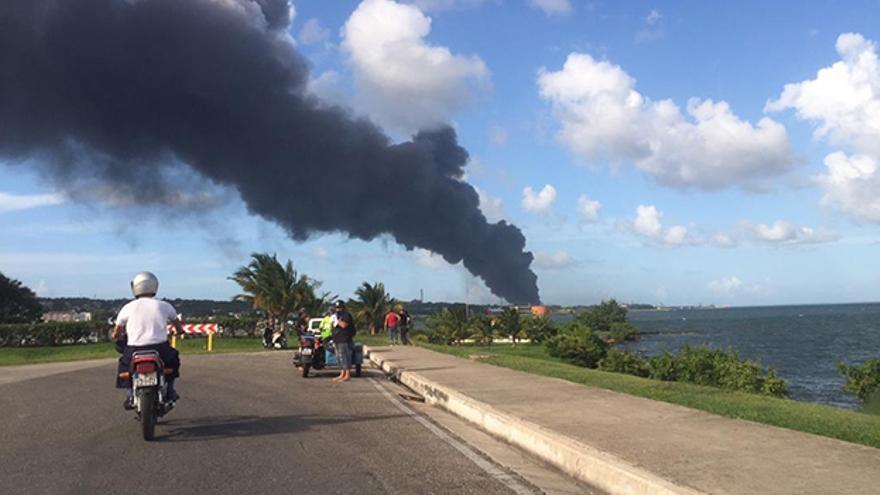
The smoke from the fire reaches not only the entire province of Matanzas, but also Pinar del Río and Havana, more than 100 kilometers away, where, since Friday, the air clearly smells of oil.
Translated by Regina Anavy
____________
COLLABORATE WITH OUR WORK: The 14ymedio team is committed to practicing serious journalism that reflects Cuba’s reality in all its depth. Thank you for joining us on this long journey. We invite you to continue supporting us by becoming a member of 14ymedio now. Together we can continue transforming journalism in Cuba.
The authorities urged teleworking during the pandemic, but the option was never consolidated. (Prensa Latina)
14ymedio, Havana, 3 August 2022 — The Ministry of Labor and Social Security of Cuba announced labor measures to reduce electricity consumption ranging from working remotely, in the field, vacations, adjustments in hours and job relocation.
The package of measures seeks to reduce energy consumption in the state sector and contemplates work interruption, although this “must be applied as a last option,” according to a press release from the Ministry.
The text indicates that, if a reduction in working hours is determined, the salary will be paid in correspondence with the real time worked, not one hundred percent.
It’s also specified that workers who cannot be relocated are entitled to a wage guarantee equivalent to one hundred percent of their basic daily salary for a period of one month, counted consecutively or not, within the year.
Cuba already adopted alternatives such as teleworking during the COVID-19 pandemic to avoid contagion, although it wasn’t widely applied, and face-to-face attendance returned quickly.
The measure comes in the midst of the country’s energy crisis, with daily power cuts and scheduled power outages for the residential sector. Industries had already been progressively reducing their work time during peak hours, but nothing seems to be sufficient.
The blackouts were one of the causes of social discontent that provoked last year’s massive anti-government protests, as well as the minor but increasingly frequent demonstrations in recent days.
Translated by Regina Anavy
____________
COLLABORATE WITH OUR WORK: The 14ymedio team is committed to practicing serious journalism that reflects Cuba’s reality in all its depth. Thank you for joining us on this long journey. We invite you to continue supporting us by becoming a member of 14ymedio now. Together we can continue transforming journalism in Cuba.
The column of smoke from the fire extends for kilometers over the island. (14ymedio)
14ymedio, Havana, 7 August 2022 — Firefighter Juan Carlos Santana Garrido, 60, is the first identified fatality of the fire that still continues at the Matanzas Supertank Base. His body was found this Saturday, and he was one of the 17 missing.
The Cuban authorities have not reported information about the other 16 people. On Saturday, the Cuban Presidency reported that in addition to the injured, there is also a group of missing people, without specifying who they are. In a morning report, the EFE agency said that they are firefighters.
According to the newspaper Girón, family members who ask about people who aren’t on the lists of those injured or those who are still fighting the fire must go to the Velasco Hotel. “In the hotel there is a care center for the families of those who aren’t listed,” said psychologist Laura María Hernández, who is in charge of mental health specialists at the Faustino Pérez hospital.
Meanwhile, the Ministry of Public Health said on Sunday that 122 more people were injured. Of these, 24 remain hospitalized, including five in critical condition and three in serious condition, and the rest have been discharged. Also, 4,946 people have been evacuated from the area of the accident. continue reading
The official press released a photograph of the firefighter who died in the fire, Juan Carlos Santana Garrido. (Collage)
So far, the official press is reporting that firefighters continue with the work of extinguishing the fire, which started around 7:00 pm last Friday, allegedly due to the lightning strike on the structure of tank 52, which held national crude oil. The fire spread to a second tank of imported fuel oil and threatens to spread to a third.
The work of putting out the fire has been joined by delegations of experts from Mexico and Venezuela. The first of three Mexican planes arrived last night at the Juan Gualberto Gómez de Matanzas airport in an aircraft of the Mexican Air Force, a Boeing 737-700.
The Mexican delegation is composed of 60 members of the Armed Forces and 16 technicians from the state company Petróleos Mexicanos (PEMEX) “with experience in cooling this type of disaster,” said Cubadebate. The other two planes will transport chemicals and materials to fight the fire, according to statements by the Mexican ambassador to Cuba, Miguel Díaz Reynoso.
During the early hours of Sunday, an A340-600 aircraft also arrived from Venezuela, at Juan Gualberto Gómez de Varadero International Airport, with 35 firefighters, specialists and technicians from the state company Petróleos de Venezuela (PDVSA) to help extinguish the flames.
In addition, the United States offered technical advice to help put out the fire. Yesterday, the Deputy Minister of Foreign Affairs of the Island, Carlos Fernández de Cossío, said that they were coordinating the aid. Nicaragua and Chile have also offered help, in addition to the European Union, which expressed its willingness to collaborate.
On Sunday morning, Matanzas Radio 26 reported that some trucks are already moving material to extinguish the fire. In addition, the ship María Cristina arrived in the bay of the province to evacuate 6,000 tons of fuel from the tanks.
Translated by Regina Anavy
____________
COLLABORATE WITH OUR WORK: The 14ymedio team is committed to practicing serious journalism that reflects Cuba’s reality in all its depth. Thank you for joining us on this long journey. We invite you to continue supporting us by becoming a member of 14ymedio now. Together we can continue transforming journalism in Cuba.
Cubans are increasingly turning to the black market to get cigarettes. (ACN)
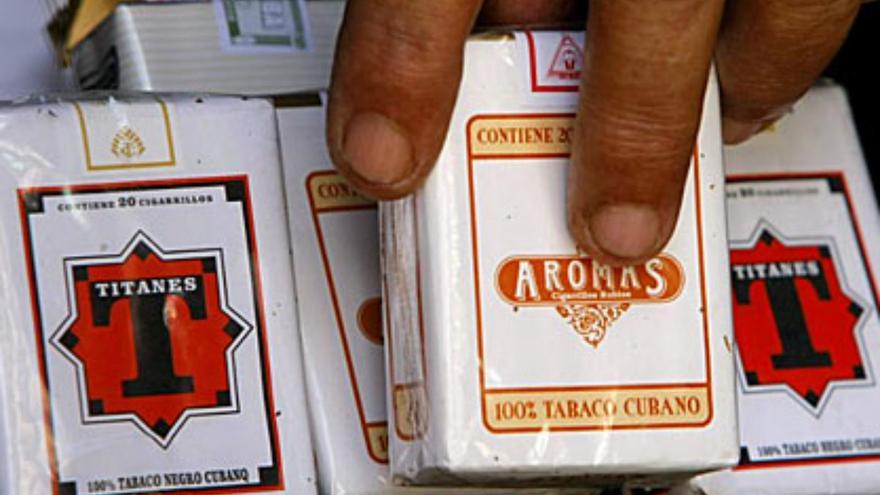
14ymedio, Madrid, 2 August 2022 — When Marino Murillo was appointed president of Tabacuba in November 2021, many Cubans reacted with irony. “I hope he won’t ‘Re-order’ Tabacuba, or we’ll run out of cigarettes,” one reader wrote, joking in reference to the so-called ‘Ordering Task’* which is affecting broad elements of the Cuban economy. The joke has come true, and the worst omens have been more than fulfilled. The state tobacco company, which then warned that the lack of cigarettes would continue until the first quarter of 2022, announced on Monday that the amount planned for the first half of the year doesn’t even reach half of the original goal.
“The production plan of the state factories from January to June 2022 is fulfilled at 47%,” explains the official newspaper Granma in a note dedicated to the scarcity of the product and its causes. The delay “is mainly due to the lack of raw materials used in the cigarette industry, such as cigarette paper, boxes and wrapping paper (wheel or cigarette package), which caused the factory to be paralyzed in January, March and May,” sources of the business group said.
Tabacuba has four state factories in the country: Segundo Quincosa, in Havana; Ramiro Lavandero, in Villa Clara; Juan D’ Mata Reyes, in Sancti Spíritus; and Lázaro Peña, in Holguín. The first three have been operating normally since the last halt in May, although the article already warns that materials are guaranteed only until September. Then, we’ll see.
The fourth, in Holguín, stopped in August and will continue to be halted, at the very least, all month, due to the lack of packaging. “The paper used in their manufacture will arrive in the country in the first half of August and must be processed in the printing presses before arriving at the factory,” the managers add.
In addition to the problems caused by the lack of liquidity, the international context hasn’t helped due to the lack of available ships and delays in maritime traffic. Other causes were the increase in the price of raw materials and the distance from the supplying countries. Also, the lack of energy has a lot to do with the drop in production, since factories must stop between 11 and 1 to save electricity. continue reading
Faced with such an outlook, Tabacuba has established some measures to try to recover manufacturing levels, although the very low level they have reached complicates the objective. Work shifts, for example, have been increased to two per day and on some Saturdays, and vacation times have been reduced.
Tabacuba also aspires to find suppliers on the island to avoid the costs and difficulties of importing, but so far it’s nothing more than a wish expressed out loud, and it’s hard to believe that, if such an option exists, it hasn’t been used before.
Meanwhile, Brascuba Cigarrillos, a joint venture in the Mariel Special Development Zone, is helping to alleviate the situation. The company’s production plan, which manufactures H. Upmann, Popular with filter, Rothmans, Dunhill and Cohiba, meets the target at 86% and has three work shifts seven days a week, says Granma.
“Brascuba not only sells directly to the store chains but also to the Tobacco Marketing Company in Rama La Vega, and they, in turn, to the Wholesale Marketing Company of Food Products (EMPA), which is in charge of distribution and marketing to units of the retail trade network,” say the directors, who specified that Tabacuba must subsidize the dollar cost of production so that they can sell in Cuban pesos. An unusual public investment in a product harmful to health.
Problems with the domestic production of cigarettes date back at least to 2020, when there was no money to buy wrapping paper and other materials indispensable for manufacturing. In 2021, breaks in machinery, the pandemic and the lack of transport fuel increased the problems.
Due to the shortage of the product, cigarettes became rationed at the territorial level, and consumers had to present their ration book to purchase them. The objective was, the authorities argued, “to prevent the hoarding and resale of this product,” but the end hasn’t been achieved and has unleashed subterfuge for the umpteenth time. With the beginning of the sale in the bodegas (ration stores), many have not hesitated to use other people’s ration books to buy them.
Sales on the black market continue. Cigarettes that are rationed cost 10 pesos a pack, but on the black market the price exceeds 100 pesos, and some like the Rothmans are even more than 200, a price similar to that of stores that only take payment in freely convertible currency and where, in addition, you have to line up.
Meanwhile, and despite the fact that cigars continue to report significant dividends in exports for the country, the fall this year was 13%. In recent days, the Government has announced its intention to launch a luxury tourism project linked to cigars. It is a high-end hotel that will open in September to promote the tourist-focused Cigar Trail in the Pinar del Río area that will have, in addition to lodging, an information center, a smoking room and a specialized shop.
But at the same time, the provincial newspaper Guerrillero revealed that the harvest is expected, as is customary in almost everything, to be bad. “There are limitations due to energy, humidity in the raw material, a deficit of covers for packaging and an excess of unbound tobacco in warehouses and selected by companies, which affect profit flow,” Pedro Rafael González Lorenzo, coordinator of the production programs, said last Thursday.
Of the 5,945 tons planned until July 22, only 5,000 could be collected, due to the lack of diesel and electricity. In addition, there are delays in the construction of tobacco cure rooms, which are at 29% of what is scheduled, and also delays in the repairs of those that already exist, which are at only 50%.
*Translator’s note: The “Ordering Task” is a collection of measures that include eliminating the Cuban Convertible Peso (CUC), leaving the Cuban peso as the only national currency, raising prices, raising salaries (but not as much as prices), opening stores that take payment only in hard currency which must be in the form of specially issued pre-paid debit cards, and a broad range of other measures targeted to different elements of the Cuban economy.
Translated by Regina Anavy
____________
COLLABORATE WITH OUR WORK: The 14ymedio team is committed to practicing serious journalism that reflects Cuba’s reality in all its depth. Thank you for joining us on this long journey. We invite you to continue supporting us by becoming a member of 14ymedio now. Together we can continue transforming journalism in Cuba.
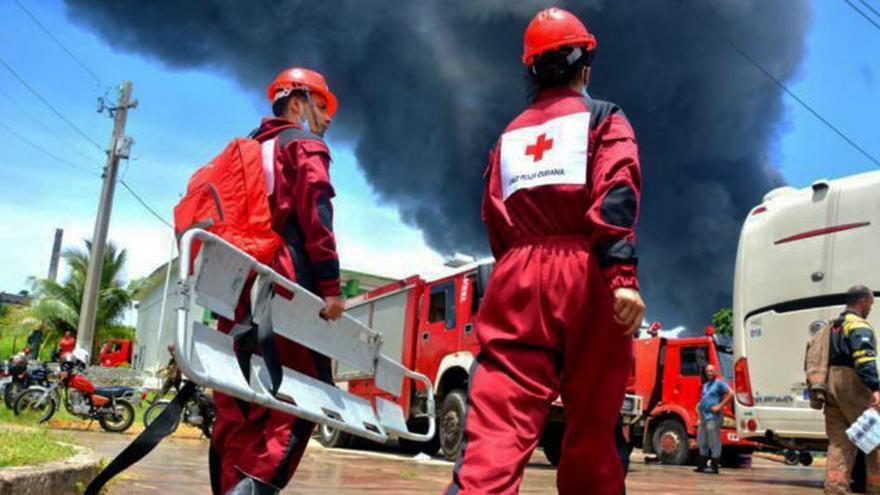
Red Cross personnel in the vicinity of the Matanzas Supertanker Base. (Granma)
14ymedio, Havana, 7 August 2022 — “A failure in the lightning rod system, which couldn’t withstand the power of the electric shock,” is the official version that the Cuban Government has given so far on the cause of the gigantic fire that began at the Matanzas Supertanker Base on August 5.
The official version that has added another element this Saturday was unconvincing. “The First Secretary considered that the fire system apparently failed, something previously recommended,” the State newspaper Granma published. “This issue needs to be reviewed to avoid similar events in the future, especially in thermoelectric plants and fuel facilities,” it added.
Faced with questions as to whether the lightning rod system was certified by the Fire Protection Agency (AFP), the official argument focused on pointing out that “the energy of lightning can be very destructive, as it clearly was in this case.”
Danger Ricardo, a 37-year-old welder who works there, contacted by the AFP agency, said that there is no explanation for how the tank’s lightning rod system failed. Videos regarding the fire began to be shared on social networks, including a graphic uploaded to the Twitter account of an Internet user, who identifies herself as Yanetsis, about security protocols at the time of a fire.
The healthcare emergency technician based in Spain, Joaquín Alberto Reyes Franc, indicated that with this type of accident you need to “cool the affected tank. Large volumes of water and huge amounts of foam are needed.” continue reading
Reyes Franc explained that this represents “an advanced technique of attack and patience” and recalled that “in Spain we have suffered at least three accidents of this type, and it was very hard work. Especially the Escombreras fire in 1969 (8 days of combat).”
The accident, which according to official reports has so far caused the death of firefighter Juan Carlos Santana Garrido and injuries to 122 people, of whom 24 are hospitalized. But the regime still doesn’t offer details about 16 people who were fighting the flames and were close to a second tank in the complex that exploded.
At seven o’clock at night on August 5, lightning struck tank 52, which at that time was at 50% of its capacity, which is 50,000 cubic meters. “The most important thing is to maintain strict control of the temperature” of the damaged tank, rescue teams explained to the official newspaper, Girón.
The “strict temperature” control was carried out through water discharges. This has been the main way to try to control and put out the fire. A day after the catastrophe, on August 6, Prime Minister Manuel Marrero Cruz highlighted the “feat” of the firefighters and reiterated the strategy to confront the accident, while moving away from the fire.
“We are now leaving the site of the fire in Matanzas. The fuel tank remains, and the nearest tank is being cooled with water, which reduces the possibility of the fire spreading,” Marrero shared through his Twitter account. In addition, the discharge of water from a helicopter over flames that soon reached a second tank was observed.
In support of Cuba, this Sunday, 60 rescue soldiers and 16 technicians from Petróleos Mexicanos (Pemex) arrived from Mexico with equipment and chemicals, while 35 firefighters, specialists and technicians from Petróleos de Venezuela arrived with 20 tons of foam and other chemicals.
“We’re here to help prevent risks and put out the fire with water and foam,” said Brigadier General Juan Bravo, the head of the Mexican expedition.
Translated by Regina Anavy
____________
COLLABORATE WITH OUR WORK: The 14ymedio team is committed to practicing serious journalism that reflects Cuba’s reality in all its depth. Thank you for joining us on this long journey. We invite you to continue supporting us by becoming a member of 14ymedio now. Together we can continue transforming journalism in Cuba.
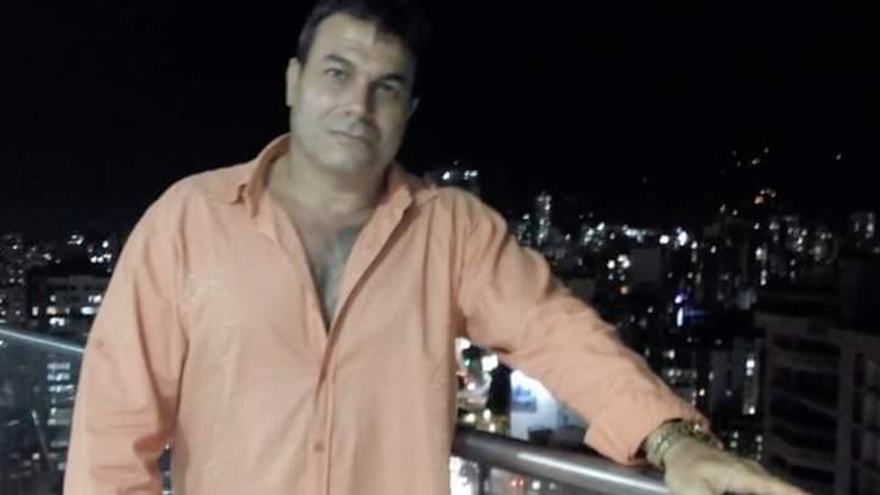
 14ymedio, Havana, 12 August 2022 — 14ymedio, Havana, 12 August 2022 — He left Cuba in 2019 after suffering pressure for opposing the new Constitution and now, from Colombia, he leads an online petition calling for an end to compulsory military service on the island. Carlos Miguel Mateos Rosaenz talks to 14ymedio about the reasons that led him to promote an initiative that has already collected more than 2,000 signatures.