It will take 30 hours for the boiler to cool down before repairs can be made at the plant. (Cubadebate)
EFE/14ymedio, Havana, 13 September 2021 — The state company Unión Eléctrica de Cuba (UNE) announced on Tuesday that the energy deficit will be around 41% of the maximum generation capacity in the afternoon-night schedule of highest consumption.
The high deficit occurs a day after the departure from the national electricity system of the country’s main thermoelectric plant, Antonio Guiteras, located in the province of Matanzas. According to the UNE, the plant suffered a new “blowout” in one of its boilers. It will take 30 hours for the boiler to cool down, before performing any repair of the breakdown.
With this scenario, a day is expected with power cuts, a situation that has affected the entire national territory for several months, including Havana.
The blackouts can exceed 10 consecutive hours, which has a negative impact on Cuba’s economic and social life, in the midst of the crisis it is experiencing. The UNE calculates for today a generation capacity of 2,206 megawatts (MW), a maximum demand of 3,100 MW and a deficit of 894 during peak hours. continue reading
The company, which reports to the Ministry of Energy and Mines, also estimates a maximum impairment during the evening of 964 MW. Power cuts, due to breaks and failures in outdated thermoelectric plants, lack of fuel and scheduled maintenance, are increasingly frequent in the country.
In 60 of the 62 days of July and August, blackouts were recorded on the Island, according to UNE data collated by EFE. The Cuban government has expressed its intention to reduce them before the end of the year, through repairs and new investments, but it’s not the first time that they have planned improvements that they do not meet once the date has arrived.
The blackouts affect all areas of the economy and notably the daily life of Cubans, which is increasingly inciting social discontent. This was one of the main causes of the protests on July 11, 2021, the largest in decades, and also of those that have occurred this year throughout the national territory.
Cuba relies heavily on foreign oil to produce energy (thermoelectric plants generate two-thirds of electricity), and its main supplier, Venezuela, has significantly decreased its shipments.
Translated by Regina Anavy
____________
COLLABORATE WITH OUR WORK: The 14ymedio team is committed to practicing serious journalism that reflects Cuba’s reality in all its depth. Thank you for joining us on this long journey. We invite you to continue supporting us by becoming a member of 14ymedio now. Together we can continue transforming journalism in Cuba.
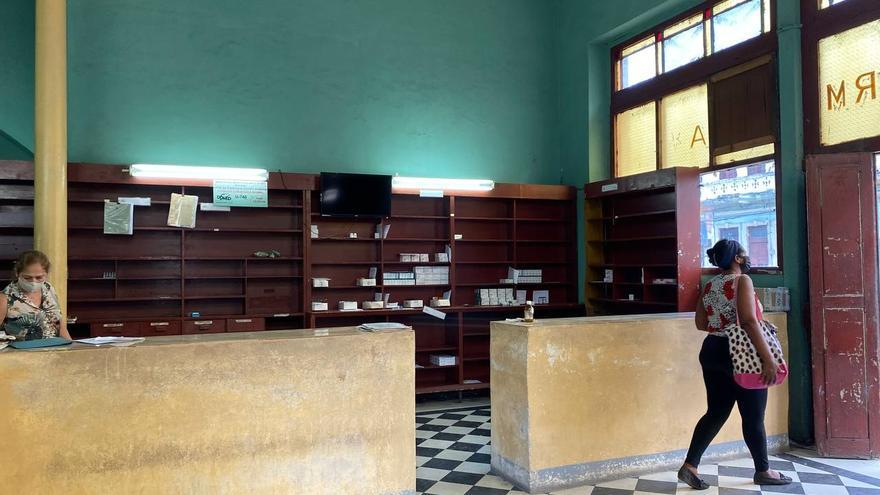
Cuban pharmacies have looked like this image for a long time, but in the last two years the situation has worsened. (14ymedio)
14ymedio, Madrid, September 15, 2022 — The directors of BioCubaFarma said, on Wednesday, that the state-owned company hasn’t been able to collect most of the $200 million profit allegedly obtained from the sale abroad of the Soberana and Abdala vaccines. In 2021, BioCubaFarma said, it spent half of its resources on the production of COVID vaccines but so far has been unable to recover its investment.
“At the end of last year. we managed to export a good quantity of vaccines, for more than $200 million. Today, nine months later, we haven’t been able to receive much of that income, because there is no way for the money to get here. The income was intended for buying medicines,” Eduardo Martínez Díaz, president of the pharmaceutical business group, said on Wednesday.
The doctor did not give details about the countries where the vaccines were sold or at what amounts, although it’s known that Vietnam bought five million doses. Mexico announced the acquisition of nine million Abdala doses, which would not yet enter the account. The Island also exported Soberana to Iran, the country with which it jointly developed the serum, and Venezuela, in addition to a small batch to other Central American countries. Finally, Nicaragua bought seven million doses at a unit price of seven dollars, according to a document released by the newspaper Confidencial that referred to the request for a loan to the World Bank to pay the amount.
The origin of the “retained” money, according to the Cuban authorities, was not revealed, although the president of BioCubaFarma indicated that the banks refuse to transfer money to the Island due to the U.S. embargo and Cuba’s inclusion in the list of countries that sponsor terrorism.
This is another of the reasons that the official pointed out as a fundamental cause for the shortage of medicines on the Island, discussed this Wednesday on State TV’s Roundtable program. continue reading
Martínez Díaz explained that BioCubaFarma manufactures 996 products, of which 369 belong to the ‘basic table’ (composed of a total of 627 items). He calculated that this saves the country, 1.5 billion dollars. However, the accounts still don’t balance, because that production is in serious trouble.
The situation, according to the pharmaceutical directors invited last night, has been aggravated by the scarcity and increase in the prices of raw materials and logistics in the international market, which also affects, they said, other countries, such as Mexico and Brazil. In addition, they assert that the embargo makes some raw materials more expensive because of the distance from which they must be brought, although that explanation is misleading since the U.S. also imports from China and India the same active ingredients that it uses in its pharmaceutical industry.
Among the missing medications, the list provided was extensive. Antihypertensives, which are taken by up to three million Cubans, antiarrhythmics, cytostatics, contraceptives, antibiotics, antiparasitics, psychopharmaceuticals and antiallergenics were cited.
The situation is such that the vice president of BioCubaFarma, Tania Urquiza Rodríguez, indicated that priority levels have been established for the 369 drugs manufactured by the pharmaceutical company (MediSol takes care of the rest): 262 with level 1, 81 with level 2 and 26 with level 3.
“However, the situation is so complex that we have had to establish a priority within priority 1, which is the majority of medicines. We are giving priority to hemodialysis, because it”s a medicine that, if the patient who needs dialysis doesn’t get it, he loses his life,” said the official, who added serums, dextrose, sodium chloride, Ringer with lactate, and control card products to the list, which are the ones that guarantee the treatment of chronic diseases.” To produce these 63 medicines, it takes $43 million a year,” about 10 or 12 million quarterly, and if a component is missing, manufacturing is impossible.
If the situation has been complex so far, it was clear last night that it can get much worse. Urquiza Rodríguez said that there are almost six million people registered on cards with one of the 12 most widely used drugs in Cuba (five antihypertensives, two diuretics, one anticoagulant, metformin for diabetes, isosorbide dinitrate for heart failure and two aerosols for asthma: salbutamol and fluticasone).
“An attempt has been made to maintain the stability of these 12 medicines during the year, but we worry that by the end of the year the raw materials will be running out. We are working hard with suppliers to ensure the arrival of raw materials in the country,” he said.
Meanwhile, the biopharmaceutical industry is still engaged in a new research task: the dengue fever vaccine. Eduardo Martínez explained that the process has been going on for ten years. “It’s a very complex vaccine, and today there really is no effective and safe immunogen, in addition to the fact that there are four dengue serotypes,” he said.
In Cuba, work is being done on a serum aimed at inducing a cellular response against one of the dengue variants, although he did not specify which one. “We have a vaccine possibility with which we plan to move forward quickly, although we don’t yet have a prognosis of when we could be evaluating it in humans; but we are progressing fast,” he said.
The only vaccine approved against dengue, with the trade name of Dengvaxia and manufactured by the French company Sanofi Pasteur, began to be sold in 2021, after approvals in 2018 and 2019 by international regulators, including from the U.S. and Europe. The vaccine is only recommended in countries with a high prevalence of the disease or for people who have already had dengue before, and is suitable for all four variants, but it is not available in Cuba.
Translated by Regina Anavy
____________
COLLABORATE WITH OUR WORK: The 14ymedio team is committed to practicing serious journalism that reflects Cuba’s reality in all its depth. Thank you for joining us on this long journey. We invite you to continue supporting us by becoming a member of 14ymedio now. Together we can continue transforming journalism in Cuba.
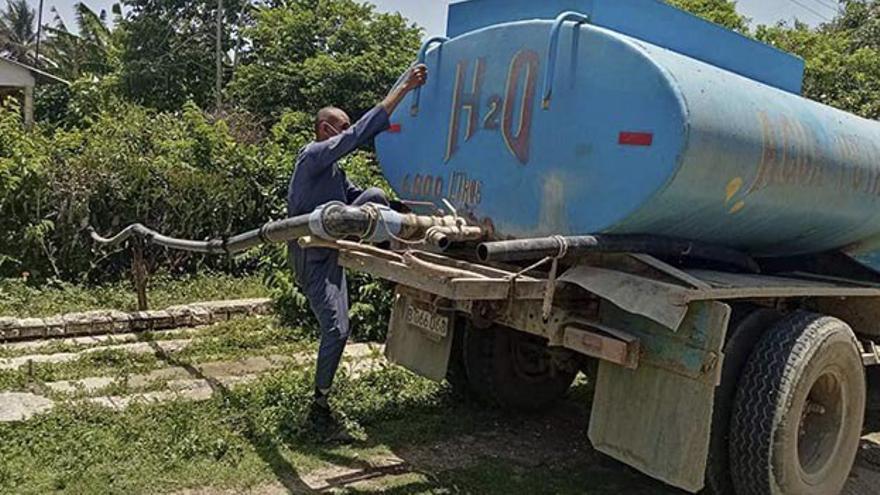
On September 13, workers from Communal Services in Las Tunas brought tanks of water to the affected families in the province. (Periódico26)
14ymedio, Havana, 15 September 2022 — Some 100,000 inhabitants of the province of Las Tunas face a severe drought. The water deficit affects 450 communities, especially the municipality of Manatí, which is located in the northwest of the area.
Faced with this situation, the inhabitants have had to be supplied with tanker trucks sent by the Provincial Directorate of Communal Services. Jorge Luis Cruz Cuello, spokesman for the institution, told Periodico26 that in the urban area alone, the lack of water limits them to filling 7 to 10 tanks a day, instead of the 30 required to cover the basic needs of the inhabitants.
Every day, he said, 27 tank shipments are held for Las Tunas with 130 teams contracted to cooperatives and state organizations. Railway line workers have also been called on to transport water by train to 31 towns in the municipalities of Puerto Padre and Manatí.
The supply is delivered two or three times a month, to cover areas up to 60 miles away. To make it all more complicated, this depends on the availability of fuel, which is increasingly scarce at this time.
Cruz Cuello said that in the communities of the province that don’t have aqueduct service, they can only manage to supply water every 15 or 16 days. continue reading
Las Tunas is one of the driest provinces in Cuba, and the rains don’t usually fill the basins and reservoirs. A 2017 article published in the CaribbeanJournalofSocialSciences revealed that since 1960, there have been 20 cycles of rainfall deficit in the area, which has harmed agriculture and livestock.
About 75 miles from the city of Las Tunas, the Camagüey reservoirs, the largest in Cuba, were below their historical average on September 5.
The Cuban News Agency reported that the reservoirs of this province stored 42.3% of a capacity of a little over 135 billion gallons of water. Five of those destined for the water supply of the population were more than half full, and in seven the water didn’t reach 50%.
In March of this year, some 400,000 Cubans had no water due to a severe drought that mainly affected the provinces of Guantánamo, Santiago de Cuba, Holguín, Camagüey, Havana and Las Tunas. At that time, the National Institute of Hydraulic Resources predicted that the rains would be below average until May.
Translated by Regina Anavy
____________
COLLABORATE WITH OUR WORK: The 14ymedio team is committed to practicing serious journalism that reflects Cuba’s reality in all its depth. Thank you for joining us on this long journey. We invite you to continue supporting us by becoming a member of 14ymedio now. Together we can continue transforming journalism in Cuba.
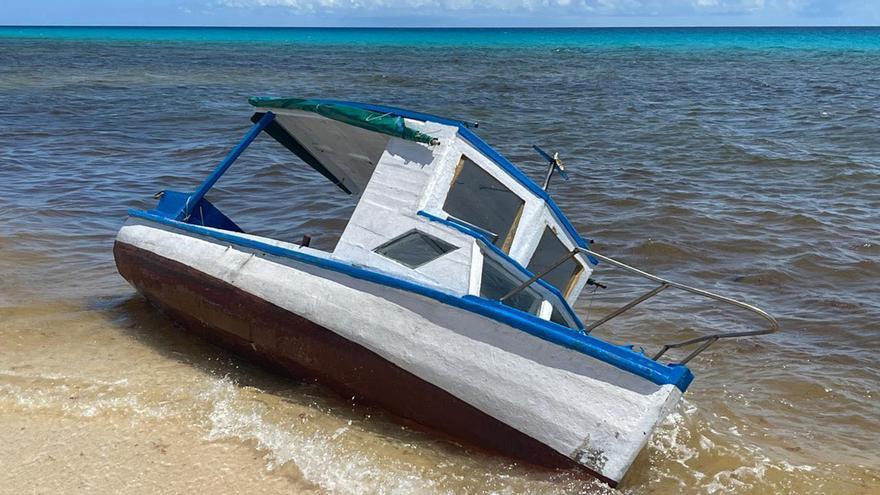
In this fishing boat, several Cubans arrived at Delfines beach in Cancun. (Facebook/Goal Journalism)
14ymedio, Ángel Salinas, Mexico, 9 September 2022 — The escape route for Cubans through Cancun, in the Mexican state of Quintana Roo, has been reactivated. In 15 days, Navy personnel “rescued” 27 rafters and handed them over to the National Institute of Migration for deportation. In the same period, two boats were abandoned in the Caribbean, the last one this Thursday on Defines Beach, a tourist area with close surveillance.
“The Cubans who arrived at Mirador beach were brought by coyotes,” Javier Robles, a fisherman who rents a catamaran to tourists to snorkel, explains to 14ymedio. “It’s an area monitored day and night by tourist and municipal police, and if no one detected a motorboat, there’s no other explanation.”
Robles, who knows the area, was informed by his friends on patrol before five in the morning on Thursday that “by that time the boat was already on the beach,” but it wasn’t until after 7 a.m. that the tourist police showed up. “They arrived, saw and left, and several hours later naval personnel arrived to secure the boat.”
At the place they found some tennis shoes, life jackets, a large empty plastic bag with the “Mary” brand, which migrants normally use to protect something like food or documents, and two drums of fuel. “In Cancun there are many Cubans with legal residence who have set up businesses, so I doubt that these rafters will be found by the authorities,” explains the fisherman. continue reading
Up to the first half of August, local authorities recorded 53 rescues of rafters, and with those reported in the last 15 days, there are already 80. “They’re desperate to leave Cuba; at this point many people are going to start coming here,” says Graviel García, a Cuban originally from Havana who is waiting for a response to his asylum request in Mexico.
Before the pandemic, says García, “there were departures through Pinar del Río”, which is 220 miles from Cancun and 211 miles from Isla Mujeres, two of the points that coyotes use and that are mentioned in the report Maradentro, migrants and shipwrecked at sea, prepared by the United Nations. “I never contacted the coyote; I do know they charged $7000, a lot for that danger.”
In November 2020, a group of 22 Cuban rafters, including three minors, decided to leave the Island and take the Cancun route. They left for Isla de la Juventud, and their whereabouts were never known, nor were the three boatmen who carried them ever found.
Robles, who has been fishing for 27 years, knows that people can quickly transfer from a fishing boat to a speedboat. “We’re hurried, and if we do it, we’re not going to confess, but there are guys who fish at night, right? Needless to say. Suddenly fishing boats from Cancun appear in Cuba, and no one knows anything.”
At the end of June, the captain of the port in Cancun reported as missing a fishing boat called LaPerruna, whose destination was Playa del Carmen. Ten days after the report, the boat and its crew appeared on the Island, as confirmed by Captain Daniel Antonio Maass Michel in a nautical report, 019/2022, but no details were given.
Robles showed another point of arrival for rafters in Quintana Roo: “The mafia is exploiting the route through the Sian Ka’an Biosphere Reserve. There’s no surveillance in that area.”
Meanwhile, the sea route most used by Cubans to reach the United States is Florida. On Friday, the Coast Guard returned 163, including three minors, who were trying to illegally reach Florida by sea.
The Cuban Ministry of the Interior confirmed that the migrants were returned through the port of Orozco, in Bahía Honda, Artemisa, last Sunday, “as a result of a group of illegal departures through the maritime border.” Since the beginning of the fiscal year in October 2021 to date, 5,421 rafters have been repatriated.
This Friday, the Coast Guard reported that a raft with five people was intercepted before reaching Key West, and the Border Patrol reported that 15 Cubans were placed in custody after landfall in Islamorada.
Translated by Regina Anavy
____________
COLLABORATE WITH OUR WORK: The 14ymedio team is committed to practicing serious journalism that reflects Cuba’s reality in all its depth. Thank you for joining us on this long journey. We invite you to continue supporting us by becoming a member of 14ymedio now. Together we can continue transforming journalism in Cuba.
Vladimir Solovyov, right, with Russian President Vladimir Putin. (Kremlin)
14ymedio, Havana, 15 September 2022 — Russian television presenter Vladimir Soloviov, one of Vladimir Putin’s “unconditional” friends, considers it essential to form an “international coalition” of Russian allies to fight against Ukraine. Cuba, Nicaragua, Venezuela and Iran were some of the nations to which Soloviov alluded.
“I don’t understand why Americans, even if they’re fighting in Grenada, always improvise an international coalition,” he said on Wednesday in his program “Night with Vladimir,” alluding to the US military intervention on the small Caribbean island to reverse a coup d’état supported at that time by Cuba and the then-Soviet Union.
During the landing in Grenada, the Americans were backed by Barbados, Jamaica and other Caribbean nations.
“Why do we deny ourselves that pleasure?” he added, while assuring that the “allies” would be willing to send their troops to support Russia in a counteroffensive against Ukraine in Donetsk. “There are units in Syria very well trained by us, there are people in Africa who support us, there is Venezuela, there is Nicaragua, Cuba, Iran and North Korea,” said the man, whose program is broadcast by the state television station Russia-1. continue reading
Soloviov said that the “coalition” method was being practiced by Ukraine, which now has help and troops from other European countries and the United States.
“If volunteers from all over the world go and fight in Donetsk, why shouldn’t we give them the opportunity to organize and create an international body?” he said, before referring to the International Brigades made up of fighters from several countries, including Cuba, that supported the Republican side during the Spanish Civil War.
He added that “our Serbian brothers” are already in Donetsk anyway, so he saw no impediment to “people who want to take up arms” and join them.
Considered one of the main propagandists of Putin’s government, Soloviov is one of the people sanctioned by the European Union after Russia’s invasion of Ukraine.
In his call for a coalition for Russia’s “allies,” the ideologue forgot to mention that Cuba, unlike North Korea, Belarus, Syria and Eritrea, didn’t vote against the UN resolution condemning Putin’s aggression, but only abstained.
In the face of the advance of the Ukranian forces from Kiev, which claim to have liberated over 5,000 square miles, 388 localities and 150,000 people since September 6 in the eastern region, Russian troops have hastily withdrawn from dozens of villages in eastern Ukraine, abandoning large quantities of military equipment on the ground.
According to data provided by the United States, the Russians have suffered 75,000 combat casualties in seven months. The war, described by Putin as a simple “military operation,” has not gone as the Kremlin expected, and there are more and more voices critical of the lack of preparation of the Russian Army.
Translated by Regina Anavy
____________
COLLABORATE WITH OUR WORK: The 14ymedio team is committed to practicing serious journalism that reflects Cuba’s reality in all its depth. Thank you for joining us on this long journey. We invite you to continue supporting us by becoming a member of 14ymedio now. Together we can continue transforming journalism in Cuba.
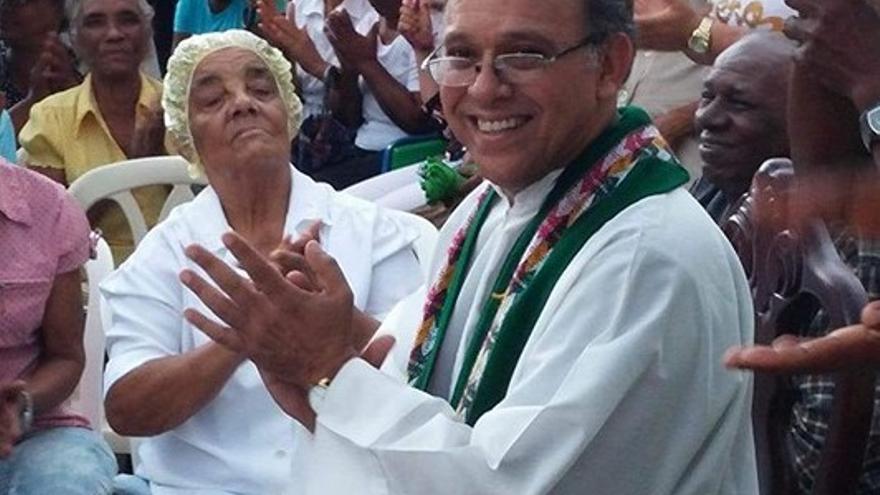
14ymedio, Juan Izquierdo, Havana, 13 September 2022 — The Dominican priest David Pantaleón, a superior of the Jesuits in Cuba, left the island on Tuesday due to the Government’s refusal to extend his residence permit. The Jesuit is already in his own country, according to a source.
The also former president of the Cuban Conference of Religious Men and Women was known for his critical assessment of the Regime and for promoting solidarity initiatives with the artists of the San Isidro Movement and, later, with those arrested during the July 11, 2021 protests.
The community celebrated a farewell mass for Pantaleón this Sunday. One of the nuns participating in the ceremony, Ariagna Brito Rodríguez, lamented on Facebook that the priest suffered in his own flesh the “faculties of dictatorial power, without principles or values.”
“They fear the truth; they fear the faces of good and get rid of what bothers them,” denounced Brito, who also said that “those who must be expelled from the country” are those who make up the government, who govern with a heavy hand a people who are “enslaved, punished, whipped and forced to flee.” continue reading
The source consulted by this newspaper specified that, as was said during Mass, Pantaleón was forcibly withdrawing from Cuba, due to the impediments of the Government, which made it clear that “he was no longer well received” on the Island.
He adds that, following, the directors of the Society of Jesus and other ecclesiastical authorities will issue a statement about the situation, which they have wanted, out of respect for the priest and his faithful in Havana, to handle with discretion.
The repression against members of the Cuban clergy has intensified in recent months, through surveillance, blackmail and regulation of travel permits.
From Camagüey, the Catholic priest Castor Álvarez confirmed to this newspaper that he had received the news that a group of nurses from that city had been summoned by State Security, after having taken a photograph with Pantaleón after the Mass of the Virgin of Charity, last Wednesday.
“One of the nurses is a neighbor of the priest,” Cuban layman Osvaldo Gallardo said on Facebook. “At the end of the mass she went with her colleagues to greet him. He blessed them, and then they took a picture.”
Gallardo adds that the headquarters of the political police in that city is located in front of the sanctuary of the Virgin of Charity, where Álvarez celebrated Mass. In addition, it provides an image where you can see an agent recording the procession from the second floor of the building. The priest is still waiting for information about the outcome of the meeting.
The statement, which opposes several traditionally problematic points between the Church and the State in the family sphere, also contains a criticism of the Regime’s propaganda.
“The information, flowing in one direction without other checks and balances, operates as a conditioning factor, and the vote that derives from it will express, necessarily and inevitably, a conditional will,” the prelates said.
Translated by Regina Anavy
____________
COLLABORATE WITH OUR WORK: The 14ymedio team is committed to practicing serious journalism that reflects Cuba’s reality in all its depth. Thank you for joining us on this long journey. We invite you to continue supporting us by becoming a member of 14ymedio now. Together we can continue transforming journalism in Cuba.
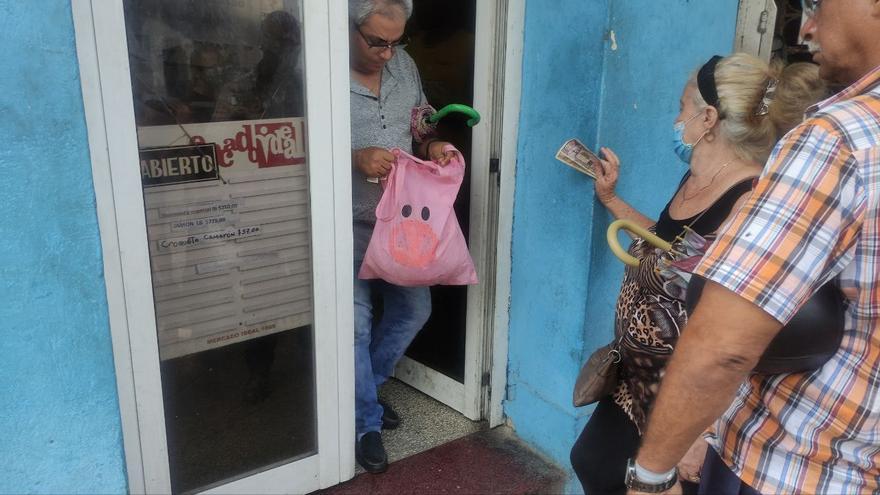
Customers who lined up at the doors of the state fish market in San Lázaro, in Central Havana, could barely believe the product that had been put out for sale. (14ymedio)
14ymedio, Juan Diego Rodríguez, Havana, 7 September 2022 — “Shrimp croquettes at 57 pesos a pound!” Customers who lined up at the doors of the state fish market in San Lázaro, in Central Havana, could barely believe the product that had been put out for sale this Wednesday.
Since crustaceans have been a luxury at Cuban tables for decades and their production — ironically controlled by the State — is mostly destined for export, the supply immediately aroused suspicion.
“This is enchanted shrimp, because you need to know what it is,” a man commented sarcastically as he left the establishment with his pound of croquettes. Another woman preferred to pass by: “At 57 pesos? That’s just broth that they add to the flour. Show some respect!”
She wasn’t wrong, as those who have had the misfortune to taste them can testify. “They’re pure flour; they absorb oil like sponges, and from time to time you have to take things out of your mouth that don’t seem to belong to a shrimp,” says a resident from Central Havana. “They look like water in which they boiled some shrimp heads and at best threw in a little flour to hold it together.”
The woman was given the croquettes by a relative and at first she was excited, but the joy lasted only until as she took a bite: “I ended up giving them to the cats, but even they wouldn’t eat them.” continue reading
You don’t need to put them in your mouth to see that they’re not even fit for animals. Their color is grayish brown, similar to the play dough used by preschool children, in part because of the cornstarch they seem to contain.
However, many did buy the croquettes, especially older people. “Aren’t you going to take them?” the clerk insisted to a young man who looked disgusted: “No, thank you.”
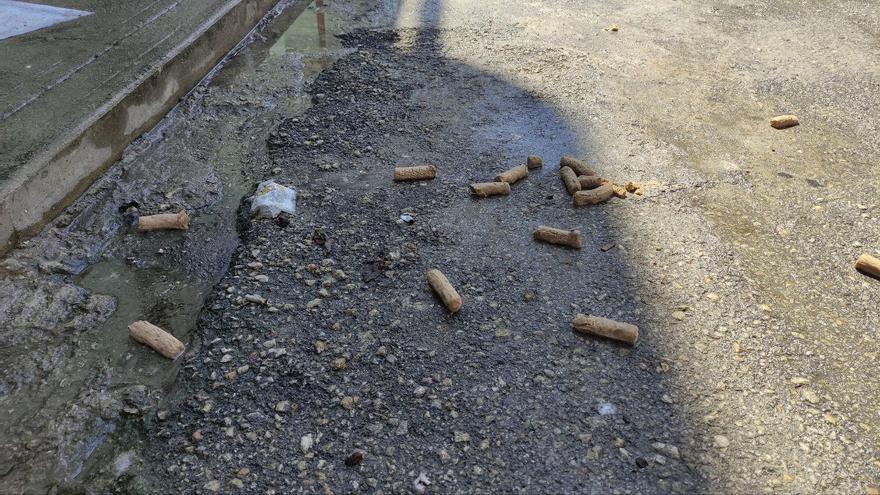
Just around the corner, another refusal was presented in the form of a movie scene. From a balcony, an old woman stretched out her arm and threw all the contents of a nylon bag into the street. On the asphalt was what she had rejected categorically and with rage: a dozen shrimp croquettes.
On the asphalt was what she had rejected categorically and with rage: a dozen shrimp croquettes. (14ymedio)
Translated by Regina Anavy
____________
COLLABORATE WITH OUR WORK: The 14ymedio team is committed to practicing serious journalism that reflects Cuba’s reality in all its depth. Thank you for joining us on this long journey. We invite you to continue supporting us by becoming a member of 14ymedio now. Together we can continue transforming journalism in Cuba.
The fines increase in percentages approaching 40,000%. (Vicente Brito/Granma)
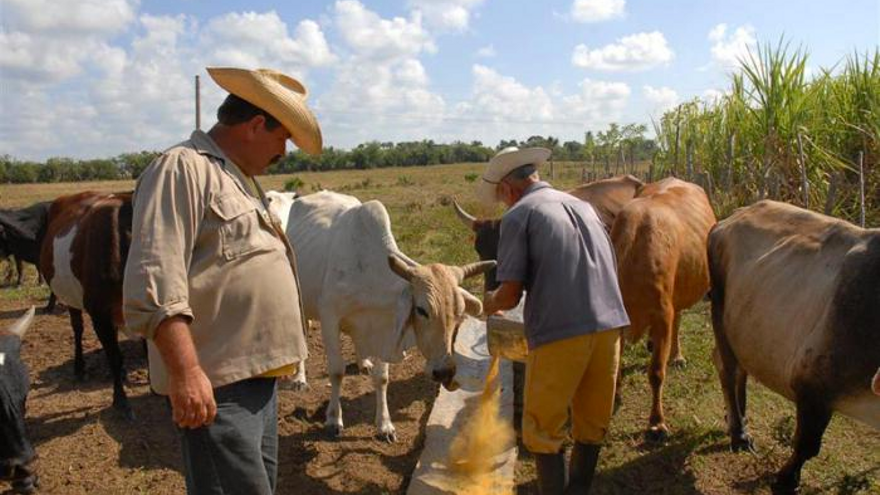
14ymedio, Havana, 30 August 2022 — Farmers who don’t declare their large livestock face much higher fines than the current ones, since the sanctions rise sharply, increasing from a 50 peso fine for not declaring an animal, to 20,000 pesos. The amount had been stagnant since the approval of the 1997 decree that regulated the control and registration of cattle and horses. The authorities said that the fines currently were too low and “didn’t fulfill the purposes for which they were planned.”
The new decree, which updates the previous one, includes up to 15 types of violations that must be punished. Among them, the 10,000 pesos fine stands out, compared to the current 20, in case of not identifying an animal and its confiscation, if it’s demonstrated that the information has been doctored. For years, many Cuban ranchers have declared males and not females to avoid recording milk production and births.
Failure to update deaths, births or shortages of livestock is also penalized with 10,000 pesos, while sales, transfers and other unrecorded operations that involve a change of ownership involve a fine of 5,000 pesos per animal.
The highest penalties, of 20,000 pesos, are intended for those who allow the presence of livestock of any kind on the roads. In this case, the confiscation of the animal is included, another sanction intended for the cases of owners who drive their cattle onto roads or railways so that they are killed, apparently accidentally. This allows them to eat the meat, without having to give explanations to the State.
Giving false information and hiding it, or not counting their animals also carries a 20,000-peso fine. continue reading
Fines of 10,000 pesos will be applied to those who buy or receive large livestock without State authorization, as well as to those who sell or transfer it. The same applies to those who, having authorization to slaughter the cattle, don’t do so in accordance with the rules of execution and the destination of the meat. Allowing grazing on other people’s land is also fined with this amount plus the confiscation of the animal in the case of recidivism.
In addition, there will be fines of 5,000 pesos for those who move livestock from one farm to another if they belong to different livestock registers and don’t have permission to do so. Also for those who have more livestock than what is authorized and those who “are forced to buy animals in excess from landless livestock holders, not to do so.”
The decree was published on August 24 and released by the official press on Monday. Although, according to the authorities, the purpose is to promote agricultural production, it’s still a mere increase in the sanctions that already exist and have been flouted with a subterfuge on the Island for decades.
The obligation to declare cattle was established in Cuba in 1964, and the results have not been exactly successful. Beginning in 1967, a drop in beef production began that has been unstoppable. That year there was 7.1 million head of cattle and since then the fall has been sustained. Since 1986, it hasn’t reached 5 million, and in 2021 only 3.7 million were declared.
The 63 measures launched in April of that year to stimulate food production included the liberalization of the slaughter, consumption and sale of beef, in addition to milk, but few have obtained the required permit, and most prefer to continue selling on the black market, since the dividends are higher.
The authorities also announced the payment in foreign currency for those who exceeded the deliveries over the contracted amount, but the banking problems and the lack of foreign currency, which producers need to buy supplies, have made it practically impossible for them to collect what was promised.
Translated by Regina Anavy
____________
COLLABORATE WITH OUR WORK: The 14ymedio team is committed to practicing serious journalism that reflects Cuba’s reality in all its depth. Thank you for joining us on this long journey. We invite you to continue supporting us by becoming a member of 14ymedio now. Together we can continue transforming journalism in Cuba.
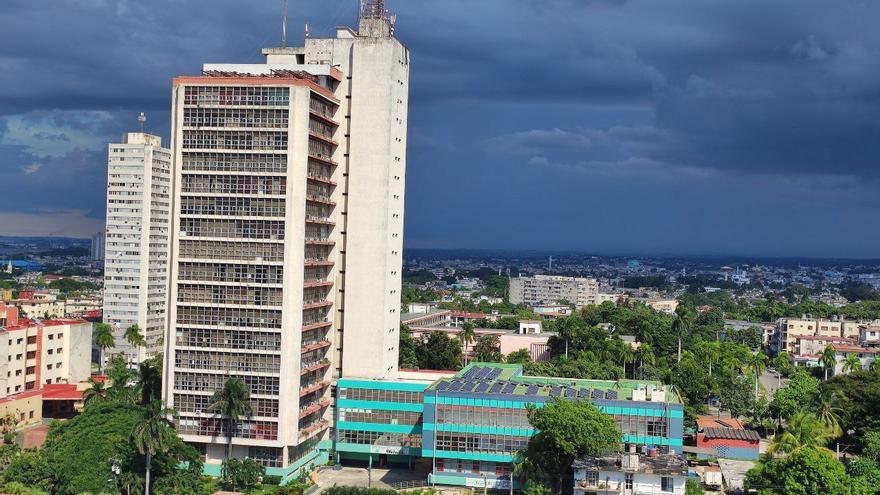
Ministry of Agriculture, located on the corner of Conill and Rancho Boyeros, in Havana. (14ymedio)
14ymedio, Natalia López Moya, 13 September 2022 — “We spent days eating saltines because there’s no rice or food,” complains an employee of the Ministry of Agriculture. The man is considering leaving his job if “lunch continues being so bad” in the institution that governs state production of the Cuban farms, located in a 17-story building on the corner of Conill and Rancho Boyeros, in Havana.
“People believe that since this is the Ministry of Agriculture we must be swimming in abundance here, but there is none,” advises one of the entity’s workers who prefers to remain anonymous. “The last few months have been very difficult, and the cooks have to be inventive in order to serve something.” The greatest deficit is from the products that arrive from the fields.
Although from 2009, then-president Raúl Castro promoted a process of eliminating lunch in state centers, many of the ministries and institutions of the major hierarchy maintained that practice. At a subsidized price, but with little variety and low quality, the employees of these entities receive a daily portion of food to continue their working day.
Now, the economic crisis, which has deepened in recent months, together with inflation and the low productivity of Cuban farms, have put at risk the lunch of these workers, who, until recently, were privileged within the state sector. Guillermo was a cook for many years in a unit of the Union of Young Communists in Havana, and he confirms it.
“When the shortage was already affecting everyone, in my workplace the UJC cadres were still allowed to have a snack, coffee in the mornings and lunch with a protein every day,” he tells this newspaper. “But since the beginning of this year, everything has gone downhill.” continue reading
“Sometimes I thought that they invented meetings, even if they had nothing to say, in order to justify the consumption of rolls, coffee and soft drinks as a snack,” Guillermo explains. “The same day I found out that no more lunch was going to be served, I asked for leave, because what’s the point of being a cook in a place that isn’t cooking.”
In the Ministry of Agriculture, the rigors of the employees’ canteen reached the ears of the head of the branch, Ydael Pérez Brito. “He said that this had to be solved, and how was it possible that there wasn’t any cassava, malanga or sweet potato here to give to people who go to the canteen,” says an employee of the security area of the institution.
The canteen, located on a side wing of the building, which faces Santa Ana Street, is a huge room that for years has been large for a Ministry that has seen its workforce decrease as the state salary is devalued and the prices of basic products rise. “This was built at the time when the Soviet Union sent money, a lot of money,” the source says.
“In this place, food was served that was the envy of any restaurant. The food, vegetables and fruit were plenty, not to mention pork and chicken.” But those trays with varied food options remain only in the memory of the workers who have been in the institution for more than three decades.
“Most people now bring something from home to last all day because many times it’s not worth going down to the canteen,” the worker explains. “But with the bread situation, there’s no guarantee of bringing a snack, so the only choice is to go and see what they serve.”
In recent weeks, the huge room has been emptier of diners and food. “This looks more like a funeral home than a Ministry of Agriculture, because lunch is dead, dead.”
Translated by Regina Anavy
____________
COLLABORATE WITH OUR WORK: The 14ymedio team is committed to practicing serious journalism that reflects Cuba’s reality in all its depth. Thank you for joining us on this long journey. We invite you to continue supporting us by becoming a member of 14ymedio now. Together we can continue transforming journalism in Cuba.
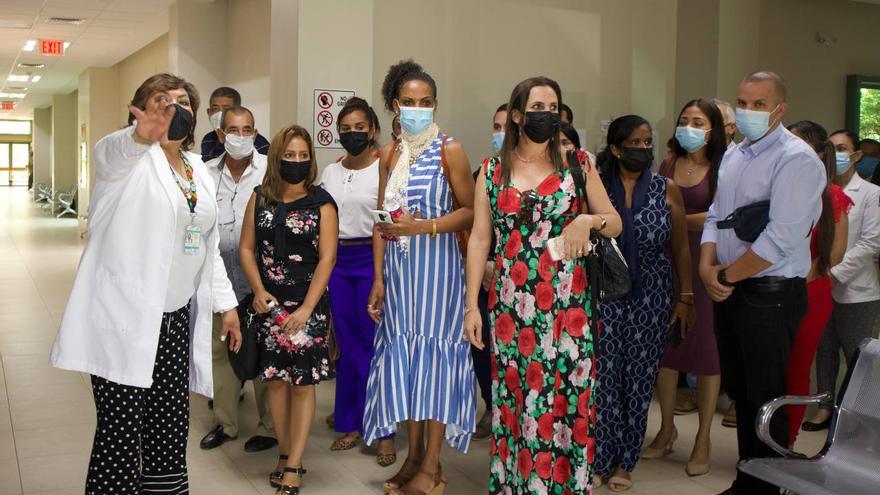
A group of Cuban health workers already in the Mexican state of Sonora. (Facebook/ValledelMayo)
14ymedio, Havana, 13 September 2022 — The Mexican Government published on Tuesday a list of the specialties into which the 277 Cuban doctors are divided from the more than 600 that it intends to import to fill places in remote areas of the country. Of these, 20 don’t appear with a specialty, but with the word “other.”
There are many denunciations claiming that part of the Cuban ’missions’ are composed of agents of State Security, who monitor compliance with the rules to which the rest of the delegation must follow, considered as forced labor by various international organizations.
According to the list released by the director of the Mexican Social Security Institute (IMSS), Zoé Robledo, the 277 doctors are distributed in medical units in seven Mexican states, and “this month another 333 will arrive.”
The Mexican official did not detail the reason why 20 of these health workers don’t have a defined specialty. He only showed an image in which it was indicated that 75 are internists, 73 pediatricians, 59 general surgeons, 14 emergency intensivists, 8 gynecologists, 8 specialists in imaging, 5 anesthesiologists, 5 nephrologists, 5 ophthalmologists and 5 orthopedic specialists.
The former deputy and director of the magazine Siempre, Beatriz Pagés, agrees, and she says that doctors’ mission is “more political, more military and more indoctrination than health,” and is based on the objective of Mexican President Andrés Manuel López Obrador, “to consolidate his autocratic project and guarantee the presidency in 2024.”
About the 277 health workers, on Tuesday the director of the IMSS said that they are already “providing services in 35 municipalities in the states of Nayarit (92), Colima (57), Campeche (49), Baja California Sur (10), Zacatecas (11), Sonora (15) and Oaxaca (43).”
Of the 333 that remain to arrive, he mentioned that they will be incorporated into hospitals located in the states of Oaxaca, Veracruz and Guerrero. The sum would be 610 health workers; that is, 31 doctors would still be missing, since on August 9 he announced the hiring of 641 “specialists in high demand.”
Sources from the Institute of Health for Wellbeing (INSABI) told 14ymedio that Mexico would pay the Government of Cuba $1,308,922 per month, managed by the Cuban Medical Services Marketer.
On Monday, the president of Prisoners Defenders, Javier Larrondo, returned to the attack against the Cuban missions and reiterated, in an interview with CNN, that the regime was left with 94% of the salary of each of the doctors who traveled to Mexico during 2020. “Andrés Manuel López Obrador paid $10,750 for each of the doctors hired for three months,” Javier Larrondo said.
Translated by Regina Anavy
____________
COLLABORATE WITH OUR WORK: The 14ymedio team is committed to practicing serious journalism that reflects Cuba’s reality in all its depth. Thank you for joining us on this long journey. We invite you to continue supporting us by becoming a member of 14ymedio now. Together we can continue transforming journalism in Cuba.
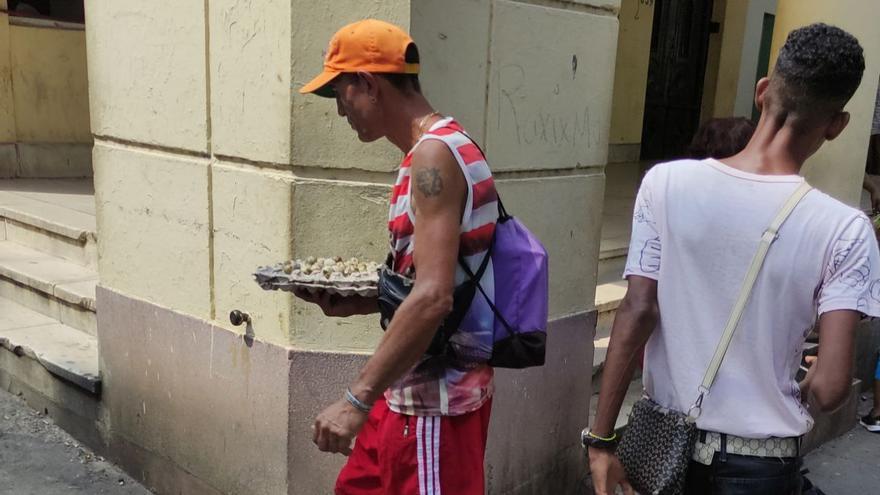
Informal seller of quail eggs in Havana. (14ymedio)
14ymedio, Havana, 12 September 2022 — The Cuban government intends to “incorporate” quail meat and eggs into the Cuban diet, according to official television on Monday. The goal, in its words, is to achieve “food sovereignty,” the euphemism that they usually use as a synonym for scarcity, which is growing every day.
A few days ago, a report on Perlavisión announced that the production of this bird is increasing in Cienfuegos. Specifically, in the First of January Base Business Unit, in the Cienfuegos municipality of Palmira, they claim to have 39,000 quails at the moment, and they expect to reach 60,000 before the end of this year.
Employees of the provincial Poultry Company explain that each quail lays between 280 and 300 eggs a year, while a hen lays between 240 and 250 eggs in the same period.
Likewise, they emphasize that quails grow quickly and can lay eggs from 45 days of age, while for chickens you have to wait six months. “They are easy to breed, with a good temperament,” and feeding them is cheaper: for one hen that is fed, three quail are satisfied. continue reading
Cubans have been seeing for some time, not without surprise, that both on the black market and on online home delivery sites these eggs are being sold, while the chicken eggs disappear. “Small but tasty, ideal for boiling and placing in a salad, but of course impossible for a tortilla,” says a neighbor of Centro Habana who has bought them at 300 pesos a carton with 30 quail eggs.
The official media praise the product: “Although a third smaller, it has the same kilocalories, the same fat and more protein.” In addition, it has lower cholesterol, “more nutrition, greater digestibility and increases hemoglobin.”
In the face of this, Cubans on the street continue to object. A young man from Havana decided: “It doesn’t produce enough; it’s very small.”
Translated by Regina Anavy
____________
COLLABORATE WITH OUR WORK: The 14ymedio team is committed to practicing serious journalism that reflects Cuba’s reality in all its depth. Thank you for joining us on this long journey. We invite you to continue supporting us by becoming a member of 14ymedio now. Together we can continue transforming journalism in Cuba.
Poster by the Cuban artist Armando Tejuca published by the US Embassy.
14ymedio, Madrid, 12 September 2022 — The Cuban artist Armando Tejuca has designed a poster entitled You five nine, Me double two, sixty years of deadlocked domino in reference to one of the phrases of the song Patria y Vida [Homeland and Life]. In it you can see the poster with the five-nine dark and cracked, while the double two has the colors of the Cuban flag and rises brightly over the other. The image, disseminated by the Facebook and Twitter accounts of the U.S. embassy on the Island, has generated a wide debate among detractors and defenders of the regime.
“Diplomats of the United States, I feel bad for you, you continue to highlight four cats that meow from exile, but without taking them… to come and fight here. On the other hand, your government bets on another group of losers, the dissidents. Here, Revolution takes a while. Homeland or Death, we will win,” writes one user. “It would be an excellent idea for every free Cuban to post and replicate this work so that it can be seen as the wonderful song that inspired it,” another responds.
Among those who have commented from the regime are Oni Acosta Llerena, a very popular music critic on national television, who has asked the embassy to “improve and elevate” its tastes “as soon as possible.” Eduardo Palomares, Granma’s correspondent in Santiago de Cuba, has urged the diplomatic headquarters to give its opinion on the deaths of children by firearms produced in the U.S., the secret documents that Donald Trump had at his Florida residence in Florida or “the imprisonment of Latino children in cages,” among other things.
Many comments accuse the U.S. of being guilty, however, of “boxing in” the Island, which has provoked many responses as well. “Everything comes from the U.S; do you ever see online stores with products from [Cuba] and other countries? Equipment and items of all kinds enter through the shipping agencies, shipments of dollars, the chicken that the people eat is American…. Don’t deceive us anymore. Marxist-Leninist demagoguery is over. Communism is a utopia,” says one reader. continue reading
And although some think it’s wrong for a diplomatic seat to position itself like this in front of the government of the country where it’s located, others have thanked the opposition for its support, as they leave messages like this: “That’s right, that song is an anthem for the vast majority of Cubans who fight for a Cuba free of dictatorship.”
Translated by Regina Anavy
____________
COLLABORATE WITH OUR WORK: The 14ymedio team is committed to practicing serious journalism that reflects Cuba’s reality in all its depth. Thank you for joining us on this long journey. We invite you to continue supporting us by becoming a member of 14ymedio now. Together we can continue transforming journalism in Cuba.
Cuban baseball players Reilandy González, Tony Guerra and Lázaro Emilio Blanco will no longer continue with the Vegueros team. (Collage)
14ymedio, Havana, 12 September 2022 — Players Reilandy González, Tony Guerra and Lázaro Emilio Blanco resigned from Cuban baseball for various reasons. According to journalist Ernesto Amaya Esquivel, the three athletes were key in the results obtained by Pinar del Río, and “they always stepped up; they showed commitment and dedication to their people.”
González’s absence as a player in the Elite League, which is expected to begin on October 8, was the preamble to a farewell marked by the lack of opportunities. “I decided not to play anymore. I’ve been having results for three years, sacrificing myself, and they didn’t even take me to Curaçao,” the reliever said last Friday.
This player experienced his best moment in the 60th National Series with a balance of 3-1: he saved six games, struck out 45 batters (49 innings), and his clean average was 1.82. With these numbers, González told the reporter, they didn’t call him for any of the pre-selections that year. “I’m not going anywhere to launch the Elite Series or the other National Series,” he lamented.
Another factor that discouraged González was the low salary and the limitations. “We looked at the figures, and in a pre-selection we win more than in the series,” the athlete said. continue reading
Tony Guerra lives in a similar situation. The 24-year-old pinareño formed the team that won the bronze medal in the First Junior Pan American Games that took place in Calí, Colombia (2021). The decision of this athlete, who made a difference with his home runs and gave several victories to the Vegueros team, is surprising.
“We looked at the figures, and in a pre-selection we win more than in the series,” said Reilandy González.”
González and Guerra were joined by the veteran Lázaro Emilio Blanco, the 37-year-old outfielder, who with this decision seems to end his career as a player. In addition to being an active athlete, Blanco has studied automotive mechanics and has a bachelor’s degree in Physical Culture.
These players’ request to leave baseball comes while others continue to leave the island. That exodus to the U.S. doesn’t stop. “In this phenomenon, more than thirty players have arrived in the U.S. from the Mexican border during 2022,” said journalist Francys Romero.
On Saturday, Matanzas’ natural right-handed pitcher, Alain López, arrived in the U.S.. The reporter said that this young man was able to achieve his dream thanks to the fact that he resorted to the “family claim” option and will set himself up in Florida.
López was then “leader in effectiveness of the 2019-2020 National Youth Championship with Matanzas. He participated in nine victories of his Matanzas team in the last National Youth Championship,” according to the portal Béisbol FR!
One day before López set foot on U.S. territory, it was confirmed that the Cuban Juan Carlos Hernández had arrived in Miami. The former Mayabeque player left the Island and took the route of Nicaragua, from where he began his journey until he reached the Mexican city of Piedras Negras, in Coahuila, where, after 25 days, he was able to cross the Rio Bravo.
Translated by Regina Anavy
____________
COLLABORATE WITH OUR WORK: The 14ymedio team is committed to practicing serious journalism that reflects Cuba’s reality in all its depth. Thank you for joining us on this long journey. We invite you to continue supporting us by becoming a member of 14ymedio now. Together we can continue transforming journalism in Cuba.
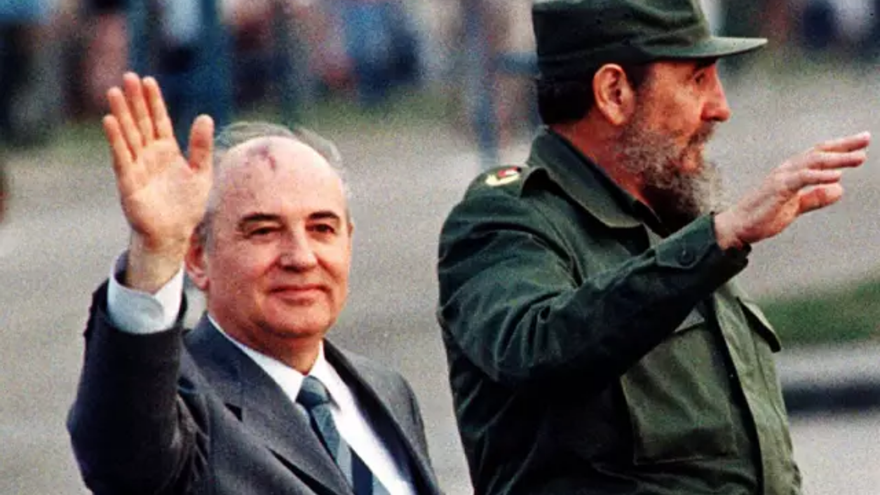
During his trip to Cuba in 1989, despite the show of diplomacy, Gorbachev and Castro couldn’t hide the abyss that separated their ideas. (EP)
14ymedio, Madrid, 31 August 2022 — “We have seen sad things in other socialist countries, very sad things.” In 1989 Fidel Castro used these words to refer to the process he didn’t want to name: perestroika. More than 30 years later, the official Cuban press has once again ignored, in its report about the death of Mikhail Gorbachev, the word that marked the political trajectory of one of the most relevant men in the history of the twentieth century.
Granma, the official newspaper of the Communist Party of Cuba, reduces the news of the death of the last president of the USSR to a short 14 lines on page two of its printed edition. On its website you have to scroll up to five times to find a brief obituary in which Gorbachev is defined as “the last president of the Soviet Union,” “supreme leader of the country” and “secretary general of the Central Committee of the Communist Party of the Soviet Union.”
There’s no space for the mere mention of his role as a promoter of the reforms that changed the Soviet system and ended up putting an end to the USSR. Just one line to call him a “notable and at the same time controversial” figure of the last century. Are there reasons? They must be sought in Prensa Latina, the only state media that mentions the banished word and affirms that the Soviet leader “has legions of supporters and detractors. The former consider him a reformer who brought freedom and democracy to a hermetic country and created the concepts of glasnost (transparency and freedom of expression) and perestroika (reconstruction, reform). For the latter, he is simply responsible for the end of a superpower.”
In Cubadebate, the version is even shorter than Granma’s, although readers have taken charge of stoking the debate. “A great statesman, of enormous courage and honesty, who tried the impossible: to reform the system in the direction of pluralism of opinion and freedom of expression and the press,” says a user of the group, one of those who believe that the USSR was already beyond salvation when perestroika arrived, or point out that it avoided a third world war.
In the face of these, there are contrasting opinions that describe Gorbachev as naive for trusting the United States or — directly — as a traitor. “He forcefully collaborated to stab socialism in the back. May he not rest in peace. He doesn’t deserve it.” continue reading
The division that is reflected today in the media is a mirror of what happened in 1989, when the then-leader of the USSR visited Cuba, his first destination in Latin America. At that time, several opponents received the man of the reforms in Moscow with hope. Elizardo Sánchez, of the Human Rights Commission; Samuel Martínez, of the Pro Human Rights Party; and Hubert Jerez, of the Martí Committee for Human Rights issued a letter in which they described Gorbachev as “one of the great social reformers” of their time and said that “the vast majority of the Cuban people also want democratic changes.”
The Cuban authorities had taken great care in a visit that was as uncomfortable as it was necessary. Castro despised the Soviet change of direction, but he couldn’t afford to snub the head of the Island’s main economic support. Gorbachev was in a similar situation: although he was bothered by the Cuban’s orthodoxy, he was aware of the influence he maintained throughout Latin America, and his enormous symbolic and real power throughout the region.
Gorbachev spoke of the pressure to which the Island was subjected by the “imperialist neighbor,” but he didn’t hesitate to praise the benefits of the reforms carried out in his own country. With “the democratization of all aspects of national life, people feel freer; they want to participate more directly in political problems,” he said.
“We don’t see our approaches as a universal recipe,” he added, a few words that were a respite for Fidel Castro, whose defense against those who insinuated that following in Moscow’s footsteps was a good idea was to say that the same solutions don’t work everywhere.
In the presence of Gorbachev, the commander-in-chief proclaimed that “the unrestricted principle of the sovereign will of each people and country is a golden rule of Marxism-Leninism” and called it “arbitrary, capricious, absurd” to be asked to “apply in a country of 10 million inhabitants the formulas that are applied in a country of 200 million. It’s crazy,” he said.
Despite the evident abyss that separated them, Castro affirmed that “Our relations are going extraordinarily well,” while Gorbi nodded.
In November 2016, when Castro passed away, the Russian was full of praise. “Fidel stood up and strengthened his country during the cruelest moments of the American blockade and with colossal pressure on him. Even so, he was able to get his country out of this blockade to guide it on the path of independent development,” he said. And although he acknowledged that the restructuring of the USSR made Castro “suffer,” he added: “He was an exceptional, unique personality. We have been friends and we remained friends until the end.”
For now, at the hour of Gorbachev’s death, the Palace of the Revolution keeps silent.
Translated by Regina Anavy
____________
COLLABORATE WITH OUR WORK: The 14ymedio team is committed to practicing serious journalism that reflects Cuba’s reality in all its depth. Thank you for joining us on this long journey. We invite you to continue supporting us by becoming a member of 14ymedio now. Together we can continue transforming journalism in Cuba.
The La Julia cooperative, which must now assume all the local production for the harvest in Villa Clara, is also in full decline. (14ymedio)
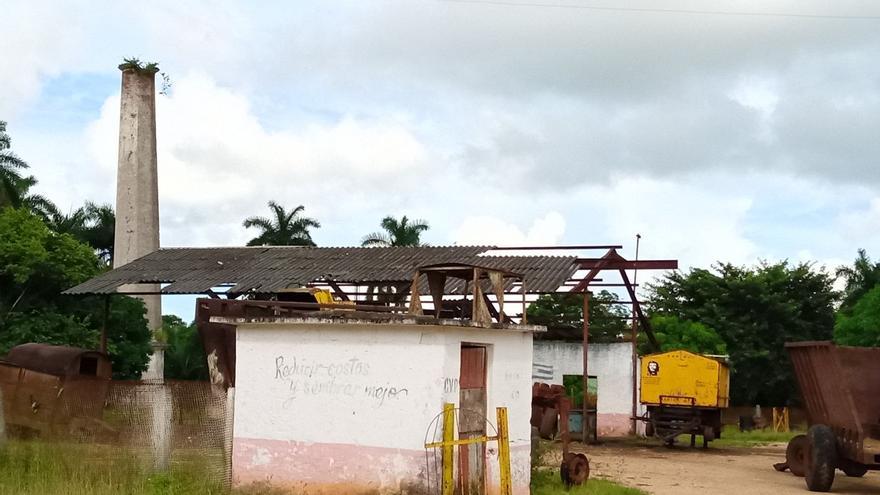
14ymedio, Yankiel Gutiérrez Faife, Camajuaní (Villa Clara), 10 September 2022 — The inhabitants of the Camajuaní valley, in the province of Villa Clara, have known better times for the intensive cultivation of sugar cane. Today, many of the characteristic towers of the sugar mills that gave prosperity to the settlements of Carmita, Fe, Rosalía, La Julia and Vega Alta are in ruins.
A few continue to barely produce, and the workers don’t receive their salaries for months. This is the case of Rosalía’s macheteros, the cane cutters, who saw their cooperative close fifteen years ago. There, enough cane was cleaned and cut to fill a dozen wagons, and it was then transported for processing to the Fe sugar mill, officially renamed in 1960 as the José María Pérez Sugar Agroindustrial Complex.
Now, in Rosalía, the ruins of the old collection center are piled up, and the government has ripped out the railway line. The locals have been taking everything, from fiber cement tiles to metal beams. There were only the walls left, but the neighbors also chopped up the concrete blocks to take them away.
The sugar plantations of La Julia, which must now assume all the local production for the harvest, are also in full decline. The cows and horses of the farmers continually enter their fields to feed.
The damage further delays the poor cultivation of the cooperative, which, of the 20 tons that it cut before 2018, will only be able to contribute five this year. continue reading
About 320 people work in the La Julia cooperative. Mechanical engineers receive a salary of 5,000 pesos; technicians earn a little less; and workers, who must use their machetes in the heat under deplorable conditions, earn only 2,500 pesos a month, equivalent to about twenty dollars at the official exchange rate.
“The Fe mill buys the cane from us at 700 pesos a ton, but the cooperative must maintain its autonomy,” José Luis, a worker at La Julia who prefers to use a fictitious name, tells 14ymedio. “That means that our salary depends on the income we can get.”
They are rarely paid on time. The sugar cane bureaucracy is indebted to the max to the Central Bank of Cuba, and that delay is directly reflected in the payment of workers.
Margarita, a worker who is transported by cart every day, from Taguayabón to La Julia, explains to this newspaper how the counterpoint of credits and debts works. “The industry has been a disaster for years,” she says.
The credit offered by the bank, she explains, “has an expiration date,” so that, if it’s not paid back on time, there’s no way to pay the macheteros. The possibility of offering land to the workers is being analyzed, but these individuals will face the same problems as the cooperative: shortage of fuel, lack of supplies, machetes, gloves, clothes, shoes, water backpacks.
“If there’s no pay for the workers there, there will be much less for the individual,” she adds.
It’s a vicious circle, José Luis clarifies. The mill also has debts, “which three million pesos must go to,” he calculates, “and without a detailed report of what is going to be done, the bank won’t provide the necessary credit to start the operation.”
Ruined by bureaucracy and malfunctions, no one could imagine today that the Island’s sugar industry was once the first in the world. (File, Archive)
Each step hinders the next, and the most affected is always the humble worker, who has no other remuneration. “On more than one occasion they stopped paying me,” laments Eliecer, a machetero from La Julia. “They told us that there was no money that month, but the truth is that it happens all the time. That’s why many have asked for leave, but life is very hard and we’re all stuck with whatever we get,” he says.
“Not to mention that workers waste a lot of time trying to get to the cooperative,” adds José Luis. When there’s no fuel to bring them from home, the work day is lost, or the worker himself has to figure out how to get there.
“Last week only 160 liters of fuel were available for transporting the workers,” he says. When they were used up, we had to wait and declare the work as “interrupted.” Nor is there enough fuel for the tractors, the plows or the cultivators. Insecticides and fertilizers are in the same situation.
The man admits that “when things are under private administration, people respect it.” However, “when it’s from the state, no one cares.” That explains why the local farmers bring their animals, day or night, to eat the cane. “Fines have been imposed on them,” he says, “but it’s no use at all. It doesn’t stop anyone.”
In addition to the precariousness with which the macheteros of La Julia live, there are several rumors, which are passed on by word of mouth in the workers’ settlements. Although no one has confirmed it yet, the farmers believe that the mills will no longer produce sugar for export, and will be able to provide barely a portion of the sugar needed for the island.
They believe that, instead, the government intends to sell the molasses to China, at a very high price. In that country, they say, they will use it to manufacture alcoholic beverages and purgative honey, which has a medicinal use, in addition to using it as fertilizer and feed for livestock.
Ruined by bureaucracy and malfunctions, no one could imagine today that the Island’s sugar industry was once the first in the world. This year, the government has reduced the number of mills that grind sugar during the harvest to 23. Small but “efficient,” as Miguel Díaz-Canel described it, this season’s production will not reach even half a million tons of sugar.
Translated by Regina Anavy
____________
COLLABORATE WITH OUR WORK: The 14ymedio team is committed to practicing serious journalism that reflects Cuba’s reality in all its depth. Thank you for joining us on this long journey. We invite you to continue supporting us by becoming a member of 14ymedio now. Together we can continue transforming journalism in Cuba.

 EFE/14ymedio, Havana, 13 September 2021 — The state company Unión Eléctrica de Cuba (UNE) announced on Tuesday that the energy deficit will be around 41% of the maximum generation capacity in the afternoon-night schedule of highest consumption.