
Cuba: The Economic Consequences of Hurricane Ian (Part 1)

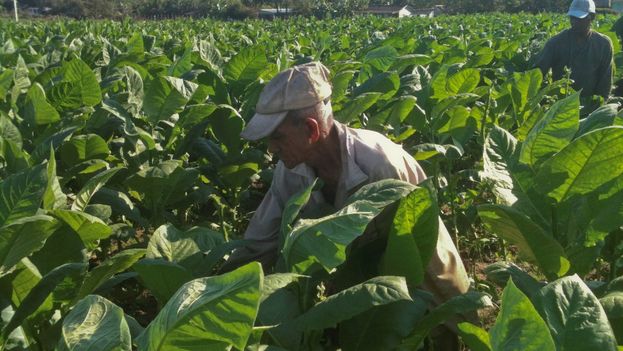
Justo García Hernández working in his tobacco field. (14ymedio)

14ymedio bigger14ymedio, Elías Amor Bravo, Economist, 28 September 2022 — At the moment, there is no doubt that the most worrisome news for Cubans is the damage caused by the passage of Hurricane Ian through Pinar del Río. With its proverbial propagandist efficacy, the official newspaper Granma has referred to the consequences in the important region of Vueltabajo, where a hasty meeting of Cuban President Diaz-Canel has been held with the highest authorities.

Apparently, Díaz-Canel must have been concerned about the state of the area and the fact that an assessment of the damage hadn’t yet been carried out and the operation of the procedures offices hadn’t been established for the allocation of resources needed for recovery. Are there no defined protocols in these situations that have to be improvised every time there is a hurricane? Why is Díaz-Canel walking around Vueltabajo when he should be in his office in Havana coordinating the aid, if any? Cubans are less and less accustomed to these propaganda exercises, and in this case they see only unexplained delays, because at the moment there is nothing that points to greater speed.

Díaz-Canel, seeing the state of the Havana-to-Pinar del Río highway, with large amounts of debris and trees on the road, pointed out the need to clear it as soon as possible, using “the communal forces,” together with those of other agencies, since it’s a strategic route for sending aid. As if “the communal forces” that have lost everything or almost everything don’t have to first deal with their own problems. How many bulldozers are needed for that job, and, above all, how many does the regime have for it? continue reading

In a snowfall scenario, the snow removal machines, pushed by tractors of private agents, arrive and solve everything with salt. Why does Díaz-Canel think that this problem can be solved by resorting once again to the inefficient collectivism of “communal forces”? Is it that in the communist regime there are no agencies in the budgeted sector that dedicate themselves to these activities in a professional way? They insist that it will be enough with several “brigades” from Havana and Mayabeque mobilized for these operations, but we are very afraid that things will go on for a long time.

On the other hand, it seems that there is a serious hygiene problem, and, therefore, to support the sanitation work, Díaz-Canel will have resources from the Revolutionary Armed Forces and the Azcuba Business Group. With all the hurricanes that have passed through Cuba in 63 years, there should be an emergency force in the army, equipped with the means and competitive training to face this type of scenario. I hope they don’t turn to the young recruits again, as in they did in the case of the recent fire at the Matanzas supertanker base.

But that said, what really mattered to Díaz-Canel was to find out what happened to the more than 33,400 tons of tobacco from previous crops that were still in the drying sheds and warehouses, and he indicated he would be visiting the main producers of the leaf in the area to provide them with support. Careful: That’s money, and, almost certainly, it’s already committed.

Tobacco continues to be one of the main products of Cuban foreign trade, and losing that harvest could be a real misfortune for the foreign currency it provides and which the regime so longs for in order to fill the state coffers. Fortunately, the hurricane has passed at a time when the tobacco production cycle is in the seed phase, although it will almost certainly have damaged the fields, which will have to be prepared again. This will entail extra costs for producers who, in the absence of private insurance or government support, will have to pay for it out of their own pockets.

Granma has recognized that Ian’s passage over the municipalities that make up the Vueltabajo tobacco massif, in which there are more than 7,900 natural (dry) curing sheds made of board and light covering, has caused serious harm to the infrastructure of the principal export of Cuban agriculture. And once again, the only thing that emerges from the news is that we will have to wait to know the extent of the economic damage.

Díaz-Canel has encountered more problems, such as the supply of water to the population and the eternal blackouts, and for this reason, he asked Granma to “raise spirits and recover again from all the building collapses.” Accompanied at the meeting of several ministers, according to Granma, he also received a detailed explanation of the actions that will be taken for an alleged return to normality in the shortest possible time.

Ian’s passage through Cuba has once again highlighted the fragility of the communist economic model that exists in the country, in the face of this manifestation of nature. No one has the slightest doubt that the traces of this hurricane will take a long time to be erased. It doesn’t occur to anyone, except Díaz-Canel, to call on “a popular mobilization to support the collection of debris, recover the organoponics and promote short-cycle crops that provide food in the shortest possible time.” The people aren’t interested in these things. He instills more discouragement with this disorder, and, above all, he should take into account the warning of Sunday’s referendum: the Cuban people have said “enough”!

Translated by Regina Anavy

____________

COLLABORATE WITH OUR WORKThe 14ymedio team is committed to practicing serious journalism that reflects Cuba’s reality in all its depth. Thank you for joining us on this long journey. We invite you to continue supporting us by becoming a member of 14ymedio now. Together we can continue transforming journalism in Cuba.
Nicaragua Received Only Half of the Vaccines Promised by the Cuban Government for 2021

According to Confidencial, the unit cost of each Cuban vaccine was seven dollars, if the amount of a loan requested by the Ortega government from the World Bank is taken as a reference. (TeleSur)

14ymedio bigger14ymedio, Havana, 27 September 2022 — Nicaragua has received only half of the COVID-19 vaccines promised by the governments of Cuba and Russia since 2021. A monitoring by the independent Nicaraguan newspaper Confidencial revealed that, although Daniel Ortega paid his allies the joint figure of $102 million for 11.2 million doses, double what the British vaccine AstraZeneca would have cost, not all of the planned batches reached the country.

The shortage refutes the promise made by Rosario Murillo, Ortega’s partner and the vice president of Nicaragua, that Cuban vaccines would be received and used by December 2021.

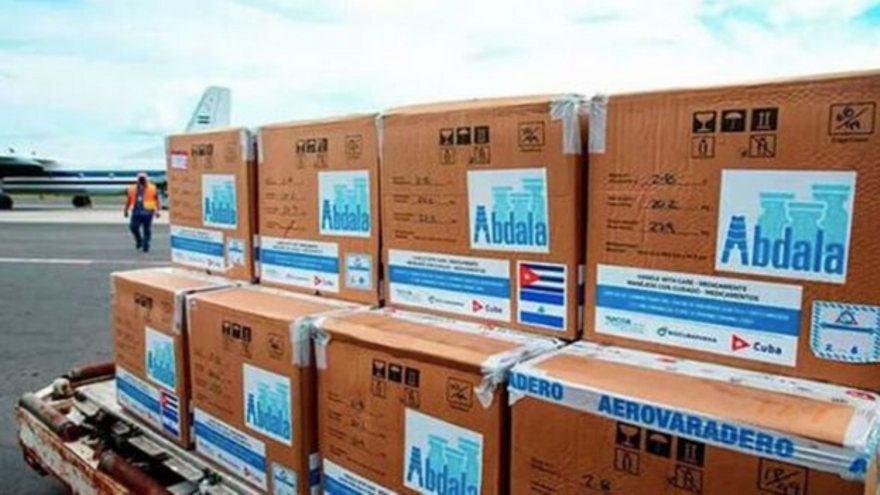
Russia had to provide the Central American country with 1.9 million doses of Sputnik V, while Cuba had negotiated the sale of 7 million of Sovereign 02, Sovereign Plus and Abdala. Although both nations have sold or donated these drugs, none of them have the authorization of the World Health Organization (WHO).

However, the Confidencial report, documented with the official press releases, found that between October and December only 3,162,970 doses were received from the Island, just 45.1% of the amount that Ortega bought to immunize the children and teenagers of Nicaragua. continue reading

As for Russia, of the almost 2 million expected injections, only 726 thousand were received, 38% of the stipulated amount.

During 2021 and the first months of 2022, government information on the purchase of medicines became more murky. The thank you notes that Daniel Ortega usually published also ceased to appear. According to Confidencial, it’s unknown, since the beginning of the year, whether Cuba intends to comply with its part of the agreement.

From the Island it’s also not possible to calculate how much has been sent to Nicaragua and whether the export of any other lot is planned. In January 2022, the Finlay Vaccine Institute said it had sent a new shipment to Ortega, but without revealing how many doses.

According to Confidencial, the unit cost of each vaccine was seven dollars if the amount of a loan requested by the Ortega Government from the World Bank for payment to Havana is taken as a reference.

For its part, the price of Sputnik V was almost ten dollars, and the total amount received by Russia amounted to 5.4 million, although Ortega knew that other buyers of the drug had filed complaints about Moscow’s delays in delivering the orders.

The deficit of vaccines and the impact it has caused on children, who were unable to complete their immunization schedules, has forced Ortega to accept donations. This was the case last July, when the United States sent a batch of the Pfizer vaccine. The Confidencial report adds that children from three to eleven years old are receiving the Chinese Sinopharm vaccine.

In total, about ten types of vaccine have come into circulation in the Central American country, and it’s estimated that 85% of the population has already completed the vaccination schedule.

For Ortega and his allies, including the Havana regime, the purchase and sale of vaccines during the COVID-19 pandemic has had a high geopolitical importance. For Cuba, the sale of its drugs reached regional governments such as Venezuela, Mexico and Argentina, but it also served to strengthen relations with Russia and Iran.

In addition, the sale or donation of Abdala, Mambisa and the different ranges of Sovereign led to an international medical propaganda campaign, on the part of the Government, which has tried, in the midst of the pandemic, to whitewash the regime after the repression of the demonstrators in the July 11 protests.

Translated by Regina Anavy

____________

COLLABORATE WITH OUR WORKThe 14ymedio team is committed to practicing serious journalism that reflects Cuba’s reality in all its depth. Thank you for joining us on this long journey. We invite you to continue supporting us by becoming a member of 14ymedio now. Together we can continue transforming journalism in Cuba.
A Blackout is Recorded Throughout Cuba, the National Electroenergy System Collapses

“So far, the causes are unknown and are being investigated to work immediately on their solution,” says the official press. (EFE)

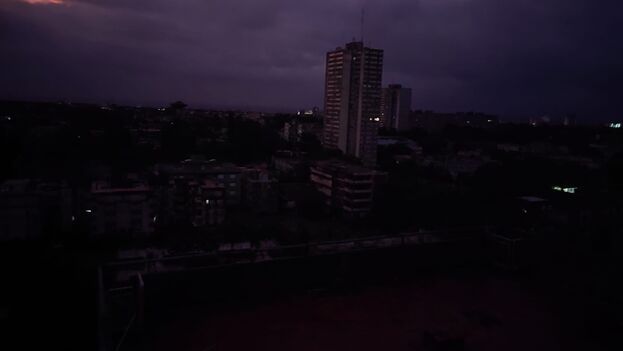
14ymedio bigger14ymedio, Havana, 27 September 2022 — A power outage throughout Cuba was recorded around 6:00 p.m., and the country remains in darkness. Official media reported the collapse of the National Electroenergetic System (SEN) from provinces such as Holguín, Las Tunas, Granma, Guantánamo, Villa Clara, Sancti Spíritus and Cienfuegos.

“At the moment there is a breakdown in the National Electroenergetic System, confirmed by the Technical Directorate of the Guantánamo Electrical Company. The circuits of the province are turned off, similar to what is happening in other provinces of the country,” the newspaper Venceremos published on its social networks. “So far, the causes are unknown and are being investigated to work immediately on their solution.”

“There’s an impact on the networks of the central region of the country, which has caused a lack of service throughout the territory. Work is being done to restore it gradually. We are waiting for official information for more details,” the Perlavisión telecenter published.

Translated by Regina Anavy

____________

COLLABORATE WITH OUR WORKThe 14ymedio team is committed to practicing serious journalism that reflects Cuba’s reality in all its depth. Thank you for joining us on this long journey. We invite you to continue supporting us by becoming a member of 14ymedio now. Together we can continue transforming journalism in Cuba.

The Two Hurricanes That Threaten the Cuban Economy

14ymedio bigger14ymedio, Elías Amor Bravo, Economist, 26 September 2022 — The goal of this blog is to focus on economic matters in Cuba. But from time to time, it’s necessary to pay attention to events that arise in reality, due to their immediate impact on the economy.

And so, while Cubans were summoned by the regime, last Sunday, to a referendum with an easy-to-anticipate result, which also has a total and absolute insignificance for what we are dealing with, two other events should worry communist leaders about the effects they will surely have on the national economy in the short and medium terms.

The first one is called Ian. A hurricane that has worried the Civil Defense authorities and the Institute of Meteorology, because they haven’t yet been able to anticipate its hitherto erratic evolution in the national territory. It’s known that Cuba will be hit from south to north, but it’s not clear where, and that is why, this Monday, there will be a report on State TV’s  Roundtable program on Ian’s impact on the national territory and the preparation in each of the affected provinces to face it.

And by the way, in an informative note from the State’s official newspaper Granma, they say that the same program will offer information about the official closure of the referendum on the family code, as if it were a matter of little importance. As if the result hasn’t already been on a shelf in some office of Díaz Canel’s for days. It’s announced that all the communist state press — Cubavisión, Cubavisión Internacional, Canal Caribe, Radio Rebelde, Radio Habana Cuba, the YouTube channels of the Roundtable and the Presidency and the Facebook pages of the Roundtable, Cubadebate and the Presidency — will cover the program live at 6:30 pm. continue reading

So we have to wait until that time to know what result the communist regime has made up for the referendum vote, which, in advance, will show the support of the population, although with doubt about the exact number. Making a fool of yourself has some costs.

In any case, one has the impression that the result of the referendum will concern Cubans much less than Ian’s evolution. As it should. Depending on where Ian hits, it can lead to the destruction of the productive base, the housing and the infrastructure, which then won’t receive any attention because there’s no money for it. And worst of all, the crops may be lost, so there will be even less food for the population.

Ian could be a serious threat to the regime. The referendum on the family code will go to a better life as soon as the focus of attention is on the hurricane, and above all, the ones that may come later. There’s nothing to rejoice about, but plenty to worry about and take care of, especially the latter, which will be a task for the communist leaders in the very short term.

But there’s another hurricane that has just arrived and is at the gates of the Communist Island. I’m referring to the result of the democratic elections held this Sunday in Italy, which have had a winner in the far right of Mrs. Meloni, whom Díaz-Canel has not yet congratulated for her success. And we are very afraid that he will not do so, which is political clumsiness on the part of the Cuban communists that can lead to a progressive cooling in the economic, commercial, tourist and investment relationship of Italy with Cuba.

Let no one believe that a defiance of Díaz-Canel, however inconsequential it may seem, will be left unanswered. But there is something that should worry Díaz-Canel and his regime about this result in Italy, which won’t be understood in Cuba because they lack a sense of democracy. But it can be explained to them.

It’s simple: 44% of Italians aligned themselves politically with a party or coalition of parties that is at the antipodes of the Cuban communist regime, and those that are closest didn’t reach even a quarter of the electorate. The Italian earthquake supposes that the society of this country has turned politically in a direction that feels, in a majority way, disgust with Cuba’s ideological communist positions. That is, Italy has turned its back on the left, and if Cuba vindicates that position, at the global level, it will suffer the consequences.

The Italian hurricane is going to be felt in Cuba. That’s for sure. Italy represents for the Island, in the trade of goods, about 8% of the total, and in terms of tourists, 3%, although this has seen better times. Cuba recognizes that Italian foreign investment, although no official information is available, is important. There was even a commercial transaction by Cuban doctors recently. Let’s see how all this continues in the face of the next legislature if, as expected, Mrs. Meloni and, in a broad sense, the new Italian society that emerges from these elections, will not be in favor of Italians or the investment capital of their country going to the communist Island. They are warned.

Translated by Regina Anavy

____________

COLLABORATE WITH OUR WORKThe 14ymedio team is committed to practicing serious journalism that reflects Cuba’s reality in all its depth. Thank you for joining us on this long journey. We invite you to continue supporting us by becoming a member of 14ymedio now. Together we can continue transforming journalism in Cuba.
Hurricane Ian’s Winds Leave Havana in the Dark and More Depleted of Supplies

On the afternoon of Tuesday, September 27, there were many fallen trees in the capital. (14ymedio)

14ymedio bigger14ymedio, Juan Diego Rodríguez, Havana, September 27, 2022 — Havana woke up this Tuesday with the rains and winds that Ian had been leaving in the Cuban territory for hours, but people on the street seemed not to have heard that the hurricane that was coming and was of considerable intensity.

The food shortage in the capital was worse than the threat of the hurricane. “Nothing prevents people from going out to stand in line for bread in any event,” said an old woman from Central Havana, who hadn’t been able to buy a single piece the day before.

In this same neighborhood of the capital and in the rain, street vendors were still promoting a few goods, mainly cart-pushers, who remained on the corners dispatching some fruits and vegetables before leaving.

In other areas such as the Plaza de la Revolución, the howl of the wind frightened residents, especially when, in addition to the shocking noise caused by the force of the hurricane, they began to see zinc tiles, palm leaves, pieces of plastic and some trees falling to the ground.

“There was such a strong and sustained gust that all of us, humans and pets, ran to hide and take shelter under a table,” says a young man from Nuevo Vedado. continue reading

Power outages began early in the morning and still keep much of the capital in the dark. There was also the sound of sirens heading to Central Havana and Old Havana, two of the most populated municipalities with a lot of housing deterioration. “I hear a siren, they’re firefighters, I just saw them go to Reina Street. There must be a collapse,” a woman told this newspaper by phone.

And before the sound of the sirens and the wind, many took note of the severe economic crisis that plagues the island, worse than a hurricane like Ian: “There is nothing here for these events: no tape to protect glass windows, no rechargeable lamps, no kerosene for  ’gossiping,’ stovetops or candles,” complained a man in Havana. “Well, we’re plagued by dengue, and there aren’t even any mosquito nets, so what could we expect!?”

In the afternoon, when the water and air finally made a truce, the disaster in the city could be witnessed. Tree after fallen tree, as well as ceilings, facades and some furniture that flew away were the general picture.

In this part of western Cuba, “people are very upset about the delays in preparation and also in the caution of the first forecasts of the hurricane,” some reproached. “Yesterday, several residents of El Vedado were surprised when we warned them of Ian.”

While in Florida, where Ian is heading on Tuesday night with intense growth, the authorities have been preparing the population about the possible ravages of the storm since last week on the Island, where the hurricane left Pinar del Río in a disaster zone. The Government’s messages in recent days were exclusively focused on the referendum for the Family Code, which came into force on Wednesday. “A law passed by water,” Cubans ironize on the street.

Translated by Regina Anavy

____________

COLLABORATE WITH OUR WORKThe 14ymedio team is committed to practicing serious journalism that reflects Cuba’s reality in all its depth. Thank you for joining us on this long journey. We invite you to continue supporting us by becoming a member of 14ymedio now. Together we can continue transforming journalism in Cuba.
Nearly 80,000 Migrants Have Entered Honduras in 2022, Most of Them Cuban

Most irregular migrants to Honduras have been Cuban. (INM Honduras)

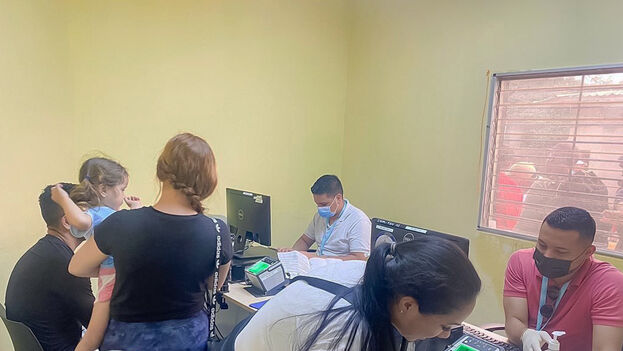
14ymedio bigger14ymedio/EFE, Tegucigalpa (Honduras), 27 September 2022 — About 80,000 irregular migrants traveling to the United States have arrived in Honduras so far this year, mostly of Cuban nationality, according to figures from the National Institute of Migration (INM), consulted this Friday by EFE.

Between January and August 19, 79,667 migrants entered the Central American country, trying to advance north with the aim of reaching the United States, according to official data.

The report didn’t give details about the approximately 400 migrants of various nationalities, mainly Cubans and Venezuelans, who gathered this Saturday at one of Guatemala’s borders to try to enter the Central American country from Honduras.

Nor was the complaint made in recent days by Cubans, who accused Honduran Migration agents of demanding payments of 20 dollars, regardless of whether the migrants have an official safe conduct pass.

The INM detailed that this year, 44,535 Cuban migrants, 19,222 Venezuelans, 4,795 Ecuadorians and 3,051 Haitians have entered Honduras irregularly. continue reading

They follow, in order, 642 from India, 636 from Colombia, 592 from Senegal, 569 from Angola, 470 from Bangladesh, 478 from the Dominican Republic, 446 from Brazil, 423 from Ghana, 423 from Nicaragua, 329 from Cameroon, 278 from Somalia, 256 from China, 239 from Nepal, 209 from Eritrea and 2,094 from other nations, it adds.

According to INM statistics for January through August 19, 2021, a total of 10,032 irregular migrants entered Honduras. Of these, 4,294 were from Haiti and 3,622 from Cuba, the predominant nationalities in this group.

Of these immigrants, 54.8% (46,676) are men, 28.5% (22,728) are women and 16.6% (13,263) are children and teenagers, the INM added.

Of the total number of irregular migrants this year, 52.5% (41,847) were between 1 and 30 years old, and 47.5% (37,820) were over 30.

The INM also indicated that 77.3% (61,556) of the migrants entered Honduras through the municipalities of Danlí and Trojes, department of El Paraíso, on the border with Nicaragua.

In recent months, El Paraíso has become a new route that migrants, mainly from Cuba, Venezuela and Haiti, are using to get to the United States.

At the beginning of August, a legislative decree entered into force exonerating irregular migrants passing through Honduras from the payment of an administrative fine of more than $200.

The immigration amnesty was published on August 3 in the official newspaper, La Gaceta, three months after its approval by the Honduran Parliament.

Most irregular immigrants who enter Honduras are transported through “blind spots” by human traffickers, known as “coyotes,” who don’t always take them to the border with Guatemala.

Translated by Regina Anavy

____________

COLLABORATE WITH OUR WORKThe 14ymedio team is committed to practicing serious journalism that reflects Cuba’s reality in all its depth. Thank you for joining us on this long journey. We invite you to continue supporting us by becoming a member of 14ymedio now. Together we can continue transforming journalism in Cuba.
Candles and Prayers in Havana for the Patron Saint of Prisoners: The Virgin of Mercy

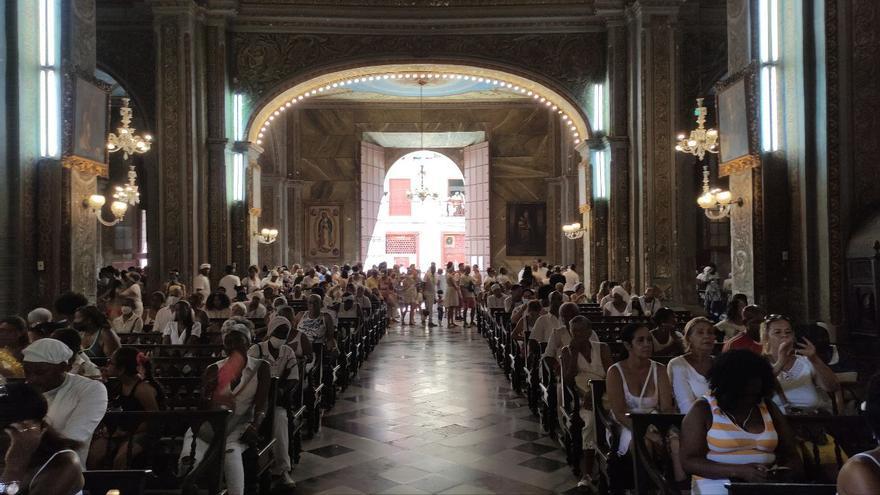
The priest, who accompanied the prayer in the Church of the Virgin of Mercy in Havana, asked for a plea “for the future of the Cuban homeland and the children.” (14ymedio)

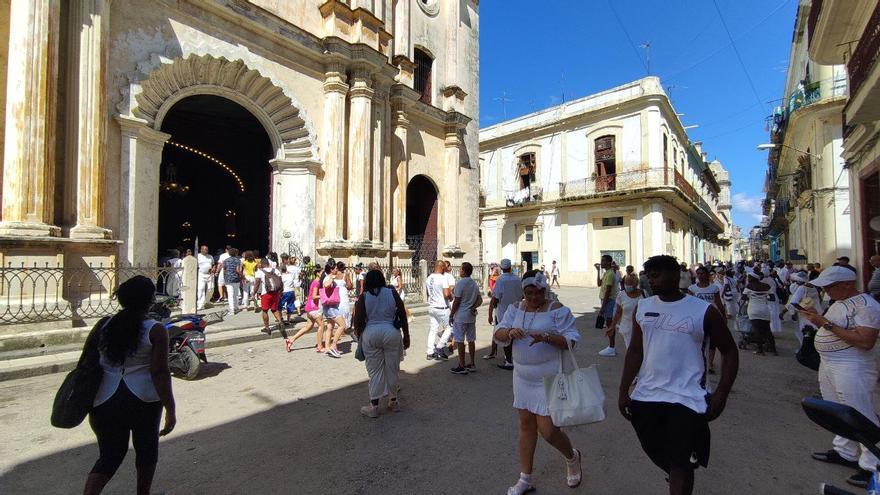
14ymedio bigger14ymedio, Juan Diego Rodríguez, Havana, 24 September 2022 — On an island with more than a thousand political prisoners, the patron saint of prisoners has become the image before which countless Cuban families pray. On September 24, the patron saint of inmates received flowers and candles in her parish on Cuba Street, in Old Havana, under the watchful eye of a police operation with uniformed and civilian agents.

Dressed mostly in white, in honor of the Virgin and the great orisha Obbatalá, with whom the Virgin is syncretized in the Santeria religion, residents from the vicinity arrived throughout the day and also others who traveled from distant municipalities. Most of them were united by a special reason: to pray for people locked up in prison, in a country with more than 90,000 prisoners.

From early in the morning, several tables were placed outside the temple for the private sale of prints, religious accessories, flowers and other offerings dedicated to the Virgin. But inflation hurt the enthusiasm of buyers, who widened their eyes when they heard that each candle cost 50 pesos. Many decided to retrace their steps and enter the temple empty-handed.

Dressed mostly in white, in honor of the Virgin and the great orisha Obbatalá, with whom the Virgin is syncretized in Santeria, they arrived throughout the day at the temple. (14ymedio)

The flowers also were more expensive, and the small bouquets, with only a few butterflies, cost 100 pesos, while others a little more elaborate and with more variety cost about 400. For residents of the poor neighborhood of San Isidro, where the church of Nuestra Señora de la Merced is located, paying such prices means a choice between putting something on the table and spending a good part of their salary on stems and petals. continue reading

The priest who accompanied the prayer requested a plea “for the future of the Cuban homeland and the children.” The request was followed by entreaties and hands that came together to pray. There was also no shortage of those who brought an image of a relative sentenced to prison to accompany them inside the church and at the time of approaching the altar with the image of the Virgin.

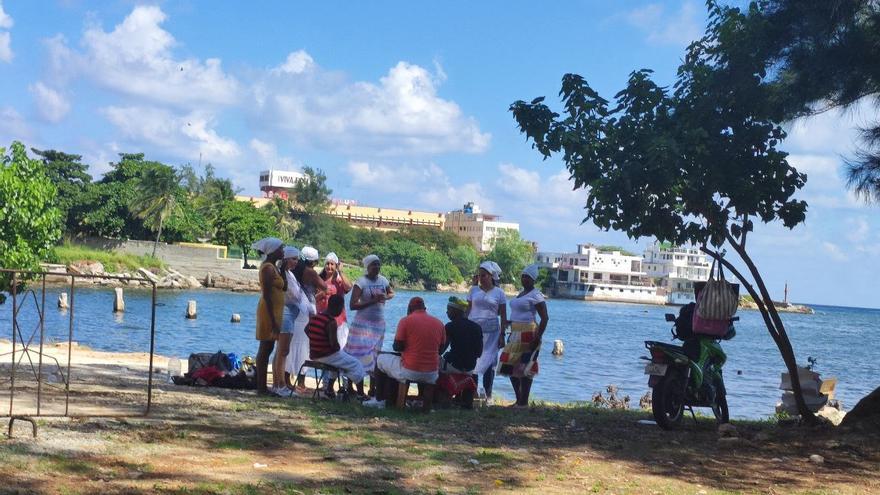
In other parts of Havana, such as the mouth of the Almendares River, a group of practitioners of Santeria also joined in a ceremony to remember the orisha as the “creator of the earth and sculptor of being.” White clothes were more common in the city throughout the day, and there was no shortage of domestic ceremonies with prayers for Cubans imprisoned in the hands of traffickers and coyotes during their migratory route.

In other parts of Havana, such as the mouth of the Almendares River, a group of practitioners of Santería also joined in a ceremony for Obattalá. (14ymedio)

The numerous Cuban women, especially those over 50, who were named “Mercedes” or “Mercy,” in honor of the Virgin, also celebrated, although on this occasion white meringue cakes — so characteristic of these syncretic celebrations — were scarce due to the lack of flour and eggs. The economic crisis forced Cubans to celebrate more modestly but just as emotionally as in other years.

Translated by Regina Anavy

____________

COLLABORATE WITH OUR WORKThe 14ymedio team is committed to practicing serious journalism that reflects Cuba’s reality in all its depth. Thank you for joining us on this long journey. We invite you to continue supporting us by becoming a member of 14ymedio now. Together we can continue transforming journalism in Cuba.
The Investments Made by the Cuban Regime Don’t Activate the Economy

Like the false villages that Gregorio Potemkin raised along the river to make Catherine the Great believe a fiction of prosperity, Cuban statistics are formed by a daring of lies and exaggeration. (ONEI)

14ymedio bigger14ymedio, Elías Amor Bravo, Economist, 25 September 2022 — The recent publication of the Cuban National Office of Statistics and Information (ONEI) entitled “Investments, selected indicators” in  the first half of 2022 concludes that investments reached 31,726.2 million pesos, an increase of 41% compared to the same period in 2021, when investments stood at 21,823.2 million pesos.

This significant growth, however, has to be pondered and discussed, which is the purpose of this post. It should be borne in mind that  the “ordering task” of 2021 disrupted monetary variables with the disappearance of the CUC, the unification of the Cuban peso and the corresponding price and wage adjustments. This means that the ONEI publication is the first one that allows a comparison of the two periods and the various issues that deserve to be analyzed.

For example, with the inflation that has shaken the Cuban economy in recent years, monetary amounts have to be deflated, that is, corrected, to show the effect on prices, in order to determine their real value. Before 2021, inflation in the Cuban economy was low, but the Ordering Task* increased the rate that year by 77.2%, something unknown in the historical records.

This means that 2021 pesos didn’t have the same value as those of 2022, if annual inflation in the first half of 2022 stood at the CPI indicator (the only available) at 30%. Therefore, in order to obtain the real value of investment growth in the first half of 2022, the nominal growth, 41%, has to be divided by the increase in prices, 30%, so then investments increase compared to the previous year, but just over 10%. That is still a significant number, but lower than that offered by ONEI, and of course, insufficient to meet the needs of the Cuban economy. continue reading

Failure to provide the real value without the corresponding deflation is a mistake. ONEI should include nominal and real data in its estimates, as other statistical services do in countries affected by high inflation.

Taking into account this 30% increase in consumer prices, as a measure of the conversion of the nominal variables into real, when comparing the evolution of investment in different components, such as construction and assembly, equipment and others, it turns out that in the first, the nominal increase was 38% (7% in constant values).

In the second component, the nominal increase was 50%, which, corrected for the effect of inflation, was really 20%; and in the third case, the nominal increase of 48% becomes 18%.

This behavior of the three components of the investment results in their distribution or weight in the total to remain almost stable, with an increase in construction and assembly and other components; but the investment in equipment is reduced in terms of participation in the total. This design doesn’t meet the needs of the Cuban economy.

Another surprise comes from the territorial distribution. The data indicate a notable reduction in Havana’s participation in the total, which fell from 63% in 2021 to 56% in 2022. The significant loss of investments in Havana was channeled to other provinces such as Mayabeque, where investment multiplied by five, or to Santiago de Cuba and Holguín, where the increases were lower, but with higher levels. In general, most of the provinces increased their participation in the total, except Havana, where this adjustment took place. It seems that the authorities have wanted to carry out an investment policy that compensates for the deep territorial mismatches that exist.

The publication also offers investment data by economic activity, and again, concentration is highlighted, but with downward and upward trends. This is the case of business and real estate services, which with 33.8% of the total again occupies first place in the regime’s investment preferences. But as happened in Havana, it presented a downward trend, since in 2021, the percentage reached 40.6% of the total. What business services lost was gained by the manufacturing industry, which went from 13.4% to 18.7% of the total, and investment in electricity, which went from 6.9% to 8.3%.

Investment in mining and quarries decreased from 12.7% to 7.5%. Health and education, culture, administration and defense services seem stable in the two-year comparison, and the same is true of agriculture, which still doesn’t attract investment.

The investment design that emerges from this ONEI report points to a scenario of continuity in which little is innovated and what is reversed follows rigid and bureaucratic formats adapted to the interventionist nature of the regime. There is nothing suitable for what the Cuban economy needs in order to prosper.

*Translator’s note:  *The “Ordering Task” [tarea ordenamiento] is a collection of measures that include eliminating the Cuban Convertible Peso (CUC), leaving the Cuban peso (CUP) as the only national currency, raising prices, raising salaries (but not as much as prices), opening stores that take payment only in hard currency, which must be in the form of specially issued pre-paid debit cards, and a broad range of other measures targeted to different elements of the Cuban economy.

Translated by Regina Anavy

____________

COLLABORATE WITH OUR WORKThe 14ymedio team is committed to practicing serious journalism that reflects Cuba’s reality in all its depth. Thank you for joining us on this long journey. We invite you to continue supporting us by becoming a member of 14ymedio now. Together we can continue transforming journalism in Cuba.
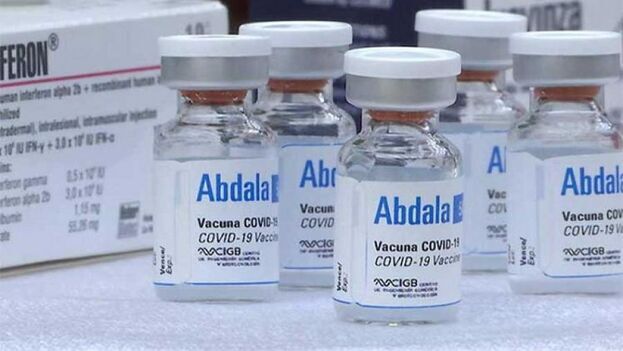
Cuba Receives a Loan to Produce 200 Million Vaccines Against COVID

The Cuban government proclaims, without the endorsement of the WHO, that Abdala has an effectiveness of 92.28% against the coronavirus. (CIGB)

14ymedio bigger14ymedio, Havana, 24 September 2022 — The United Nations Development Program (UNDP) will grant a loan of 46.7 million euros ($45.25 million) for the purchase of protective equipment and the production of 200 million coronavirus vaccines in Cuba.

This agency will channel a credit granted by the Central American Bank for Economic Integration (BCIE), the main financier of the governments of Nicaragua and El Salvador, to strengthen the infrastructure of the Cuban industry in the development of injectable antibiotics, parenteral solutions (serums), generic drugs and biosimilars, UNDP reported in a statement on Thursday.

This loan is expected to achieve the production of 200 million vaccine doses, as well as to increase the economic productivity of the national biopharmaceutical industry with the development of “innovative medicines and the modernization of technology.”

“This operation, in particular, will contribute to facing the health crisis through the development of vaccines that will reduce the risk of people becoming infected with the COVID-19 virus and will also contribute to the economic reactivation of the country,” said Dante Mossi, president of the BCIE, last January, when the bank approved the financing. continue reading

Part of the money will be used for the purchase of diagnostic medical equipment, health supplies and protective materials used by professionals in the treatment of people infected with coronavirus and other communicable diseases.

The BCIE, created to finance Central American integration in 1960, accepted Cuba as an “extraregional partner” and became the first multilateral organization in the area to incorporate the Island into its members after the triumph of the 1959 Revolution. The institution has not detailed the terms of the operation, but its credits are usually granted on “soft” terms, with interest rates of 3-4%.

The new resources come at a time when BioCubaFarma is in financial trouble because it hasn’t been able to collect most of the $200 million in profits allegedly obtained from the sale of the Soberana and Abdala vaccines, confirmed Eduardo Martínez Díaz, president of the pharmaceutical business group, on September 14.

In 2021, the state-owned company spent half of its resources on the development of drugs against COVID-19 but has not been able to recover the investment from its exports. Although it hasn’t revealed which countries bought its products, this newspaper published in 2021 that Vietnam bought five million doses and lots of Sovereign were sent to Iran, although in that case the serum was made in conjunction with Tehran. There were also shipments of one million vaccines to Venezuela last January.

Cuba also sent seven million doses of Soberana 02 and Abdala to Nicaragua in 2021, at a unit cost of seven dollars per dose, for a total of 49 million dollars, according to a document presented last June by the regime of Daniel Ortega, when it sought to access a loan of 116 million with the World Bank.

Translated by Regina Anavy

____________

COLLABORATE WITH OUR WORKThe 14ymedio team is committed to practicing serious journalism that reflects Cuba’s reality in all its depth. Thank you for joining us on this long journey. We invite you to continue supporting us by becoming a member of 14ymedio now. Together we can continue transforming journalism in Cuba.
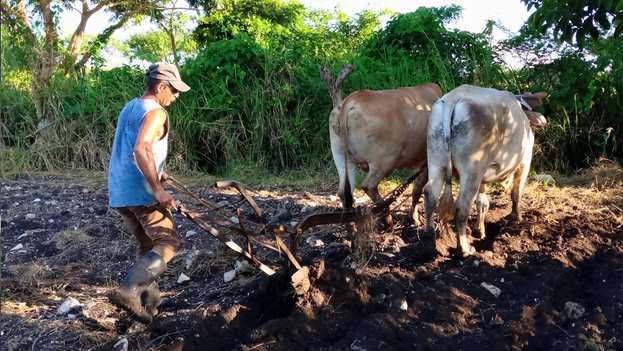
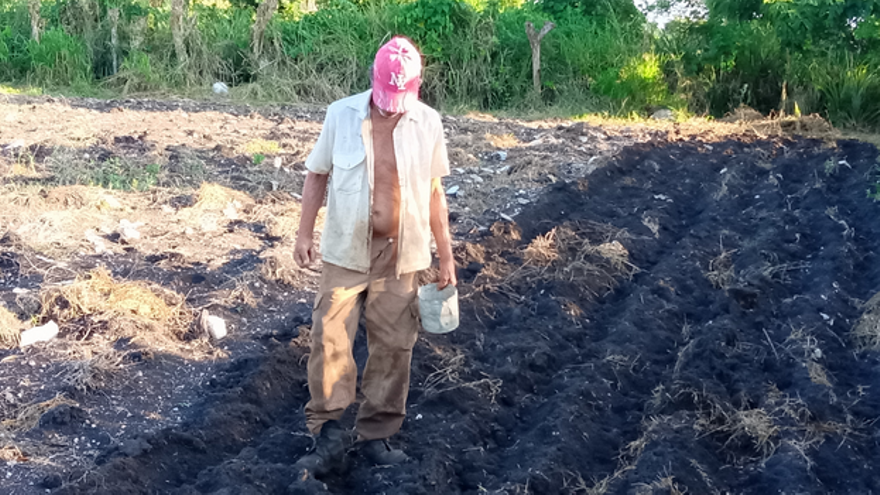
In Camajuani, the Cuban State Leaves the Majority of Farmers in Poverty

Despite the poverty and the impossibility of making profits in dollars, the Government continues to sell agricultural inputs in foreign currency. (14ymedio)

14ymedio bigger14ymedio, Yankiel Gutiérrez Faife, Camajuaní (Cuba), 24 September 2022 — Like most Cuban farmers, Ernesto gets up before dawn and has coffee. Half of his house is made of boards; the other is covered with fiber cement. He isn’t poor, but the money he earns has to be reinvested in crops.

His land, located on the outskirts of Camajuaní, Villa Clara, used to be fertile and welcoming. But it has been dry for years and doesn’t produce unless it’s fertilized with expensive fertilizers, sprayed with insecticides and weeded. “When you can’t get these resources,” the farmer tells 14ymedio, “the harvest is lost.”

Ernesto wants to grow 15 bean plants. Between the payment of the workers, the plow and the liquids, he has to spend 25,000 pesos on planting. A small fortune that took him three months to gather, in addition to getting used to remote management through Revolico, the buying and selling website where he got six liters of the herbicide glyphosate, for 1,675 pesos each.

The driver of the tractor that had planned to drag the plow charged him 6,000 pesos, plus fuel money, another 2,200. “All I have been able to achieve has been with my money, without credits or loans,” says Ernesto. “And I haven’t even been able to start planting with that.”

“What’s lucky is that I sell almost everything from what I produce,” he concludes, “and I also have something left for my house. If not, I have nothing.” continue reading

Rarely does the State pay attention to them when they complain to farm agencies, and the resources never arrive on time when bought. (14ymedio)

A few kilometers from Camajuaní, on a farm in the town of La Sabana, Armando grows mangoes and guavas that he then sells to Acopio. This State company distributes them to the Los Atrevidos canning factory, in Remedios. “The people of Acopio seemed serious,” he says, “until one day they really let me down.”

Armando planned to send six boxes of ripe mango, and they kept waiting for him all weekend. Under the heat of August, some mangoes began to rot. “I couldn’t wait any longer,” says the guajiro, who had to sell the lot to a merchant from Camajuaní, who quickly dispatched it.

“When I called Acopio to complain, they shamelessly explained to me that without fuel for the trucks they couldn’t buy the mango,” he says. “With that level of instability, how can you trust the State to do business?”

Miguel also lives and works in Camajuaní but, unlike Ernesto and Miguel, his resources are very scarce to keep his crops in good condition. Lately he doesn’t even sell what he harvests, but dedicates it to the consumption of his own family.

Old and with ailments, Miguel depends on his squalid checkbook. “It  doesn’t give me enough for insecticides,” he laments. He has tried to thrive with other alternatives: earthworm hummus, animal feces and a mixture made with tobacco wedges and rotten vegetables, “but even so the pests don’t give up.”

An attempt is made to eliminate pests with earthworm humus, animal feces and a mixture made with tobacco and rotten vegetables, but they don’t even give up. (14ymedio)

Bordering on extreme poverty, Miguel’s house doesn’t even have a bathroom, just a toilet of boards in the courtyard. Despite the poverty and the impossibility of making profits in dollars, the Government continues to sell agricultural inputs in foreign currency. Most farmers don’t have or don’t know how to apply for a freely convertible currency account. These are very new processes, modes of payment to which they aren’t accustomed and a suffocating bureaucracy that turns marketing into a nightmare.

Some of them, the wealthiest, have been able to hire laborers and equipment. Others follow the tradition of facing the countryside alone, from sunrise to sunset, and resign themselves to austerity and the departure of the children, who rarely remain in rural villages.

Ernesto, Armando and Miguel are not affiliated with any cooperative. Rarely does the State pay attention to them when they complain to farm agencies, and the resources never arrive on time. “What there is goes to State producers,” they’re told.

Díaz-Canel has a special affection for Camajuaní, and it’s not enough for him to pave the way for the well-shod mafia, omnipotent in the territory; now he also supports his “chosen” farmers. (14ymedio)

It’s not strange that these three men, accustomed to difficulties and bureaucracy, have been perplexed by a recent headline in the the Communist Party newspaper Granma, which spoke of another Camajuaní producer: “If Yusdany can, why can’t others?” said the paper, citing none other than Miguel Díaz-Canel.

The plump president, on an official visit to the town of Villa Clara, had gone to the brand-new private “slaughterhouse” of Yusdany Rojas, a 31-year-old farmer. Rojas feeds the huge amount of 800 pigs on his farm, while he sows tobacco to sell to those who remove the veins of the leaves. In addition, he grows cane and other crops on its land and has space for a “small” sausage factory.

Díaz-Canel is portrayed with the young Yusdany, fascinated by the growth of the pigs and the “self-management” of the farm, where problems don’t take their toll. “He needs land,” says Granma, so that the local bureaucracy feels pressured in the face of the dilemma: the five pieces he owns are no longer enough.

“We were used to the State giving us everything for a long time as if we were pigeons,” he says, and his words almost sound ironic, “but now they have freed our wings and what we have to do is learn to fly.”

Yusdany sells his products to tourism and State-owned companies. The bank is lavish when it comes to granting loans, and the pigs are in good health. “Very soon I will have 3,800 pigs,” Rojas promises, and no one doubts it.

Almost 4,000 pigs, 86 employees, 5 pieces of land that will soon multiply and the personal blessing of Díaz-Canel. The president has a special affection for Camajuaní, and it’s not enough for him to pave the way for the well-shod mafia, omnipotent in the territory. Now he also guarantees that “chosen” farmers, such as Rojas, will prosper and entertain them in the official media.

Ernesto, Armando and Miguel ask themselves the same question, which becomes a complaint: If Yusdany can do it, why can’t we?

Translated by Regina Anavy

____________

COLLABORATE WITH OUR WORKThe 14ymedio team is committed to practicing serious journalism that reflects Cuba’s reality in all its depth. Thank you for joining us on this long journey. We invite you to continue supporting us by becoming a member of 14ymedio now. Together we can continue transforming journalism in Cuba.
Cuba Confirms its Third Case of Monkey Pox

The third case of monkey pox is a 27-year-old woman from Cienfuegos province. (General Hospital Calixto García/Facebook)

14ymedio biggerEFE (via 14ymedio), Havana, 25 September 2022 — The Ministry of Public Health confirmed this Saturday the third case of monkey pox in Cuba in a 27-year-old woman who is hospitalized, isolated and under medical care.

The patient, a Cuban resident in the central province of Cienfuegos, has no connection with the other two cases confirmed in August, the institution reported. They were a 60-year-old Cuban resident in the United States and a 50-year-old Italian tourist, who died days after testing positive for the disease, according to the Cuban government.

Regarding this third case, health authorities indicated that it was through contact with a Cuban citizen residing in the United States who had suspicious symptoms of the disease.

He “arrived in Cuba on September 3 of this year and returned on the 13th of the same month,” they added. The diagnosed young woman started with symptoms on September 15, went to the doctor a week later, and the next day the infection was confirmed. continue reading

“The established focus control actions and epidemiological surveillance are being carried out,” said the Ministry of Health. “In relation to the contacts of the previously reported cases, they are already discharged, and there is no transmission of the disease in the focus checks,” the source added.

The World Health Organization (WHO) declared this disease — also called “simian smallpox” — a “global health emergency” on July 23, when more than 16,000 infections had been reported in 75 countries.

The disease is caused by a virus and can be transmitted from animals to humans or through direct contact with people who have the symptoms, according to specialists.

WHO reports that the symptoms include fever, headache, muscle pain, low energy, inflammation of the lymph nodes and rashes or lesions on the skin.

Patients can spread the disease to other people while they have symptoms, and the virus is transmitted through body fluids (pus or blood from skin lesions), scabs and objects used by the sick.

Translated by Regina Anavy

____________

COLLABORATE WITH OUR WORKThe 14ymedio team is committed to practicing serious journalism that reflects Cuba’s reality in all its depth. Thank you for joining us on this long journey. We invite you to continue supporting us by becoming a member of 14ymedio now. Together we can continue transforming journalism in Cuba.
Cuba: The Last Place for Home

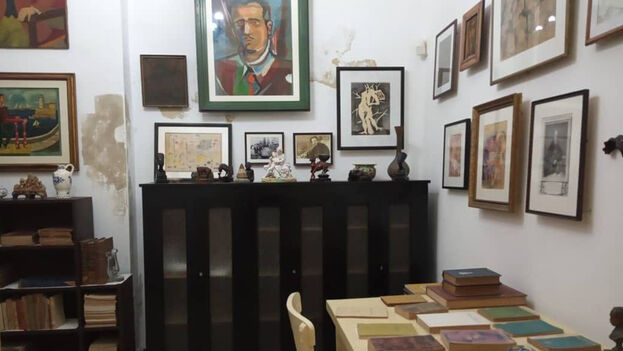
Image of the interior of the José Lezama Lima House Museum, located at 160-162 Trocadero Street, in Central Havana. (José Lezama House Museum)

14ymedio bigger14ymedio, Xavier Carbonell, Salamanca, 25 September 2022 — Although we are wandering creatures, we are always looking for a home. For no one is a house enough; we must affirm our domain with small ornaments, paintings, touches, ashtrays, scratches on the wall, even breaks. That’s why hotels — no matter how luxurious they are — have something sterile and prostibulary  that expel us to welcome the next one.

The trip exists to get home, no matter if it’s real or imaginary. The young people make lists and draw maps, and symbolically anticipate that coming home through small talismans: a lamp, a portrait, a book to which they cling. If these objects represent anything, it is loyalty to ourselves, the confidence that there will be a future and it will be — even in poverty — warm and welcoming.

Nothing is frivolous inside a house; everything has its meaning. Cuban mothers — for whom all junk is a treasure — were enraged when, carelessly, we broke a plate. Or if the cat we raised with care and civility knocked down a vase with its tail.

The secret space between the wall and the door was the favorite hiding place of childhood, as was the interior of the closets, where the jackets and ties of the old people made us sneeze. On the hallway boards, my brother and I marked our height with pencil: our whole life is contained in those lines of graphite, year by year, inch by inch, until we stop growing. continue reading

Inside the home there are free spaces and forbidden regions. The first time I opened a drawer, I did it with fear. The wardrobe, formidable, threatening, had three doors. I took hold of the handle and looked, on tiptoe, at the contents of the drawer.

There is no way to list what I saw — what we all saw at some point — because already the memory, treacherous as it is, populated it with false artifacts, invented by me. However, the only thing I clearly distinguish is a pair of gold-mounted mirrors, which belonged to a deceased relative.

Even now I remember the effect they caused on me, when I put them in front of my face: vertigo, dizziness, the terror of looking with the eyes of the deceased. From then on I was more suspicious of drawers.

“The dead should die with their things,” García Márquez wrote with disgust. Nothing worse than looting the memory of those who left. One feels — and rightly so — that he is disrupting the portion of existence that it took others a lifetime to accumulate. However, it’s natural that books, statuettes and lead soldiers don’t hinder the flow of the lives to come. We have to make room for them.

Sentimentality leads me to make only one exception: libraries.

Every reader of Lezama has embarked on the pilgrimage to the house at Trocadero 162, in Havana. There, library and home are one thing. The forgetfulness of the bureaucrats has been good for the place. They haven’t removed the figures that he had on his shelves and that acquire so much meaning in his work. Their gravity remains in the pictures and seats, and it could not be destroyed even by the cyclone that flooded the house a few years ago.

His friends, who still live and remember him, return to that time and to that library. Dislocating the showcases and disrupting the order of the specimens would mean, in a way, burning a fragment of their legacy.

Libraries, therefore, have to survive us.

The last station in the home, the one we have left when we have left or are far away, is the void. It was the master of Trocadero himself, heir to the Chinese dragons and the Japanese sages, who taught us how to taste it. The word is tokonoma, the empty creator of the house, a refuge made of nothing and silence where we can enter and rest.

The emptiness is the “unsurpassed company, the conversation in a corner of Alexandria,” which “surrounds our whole body with a silence full of lights.” There is nothing abstract about this. In fact, it is the only real thing when — in the cold and waiting for the train at the station — we look for the lukewarm interior of our pockets. In the background, intact as a ghost, is the promise of home.

Translated by Regina Anavy

____________

COLLABORATE WITH OUR WORKThe 14ymedio team is committed to practicing serious journalism that reflects Cuba’s reality in all its depth. Thank you for joining us on this long journey. We invite you to continue supporting us by becoming a member of 14ymedio now. Together we can continue transforming journalism in Cuba.
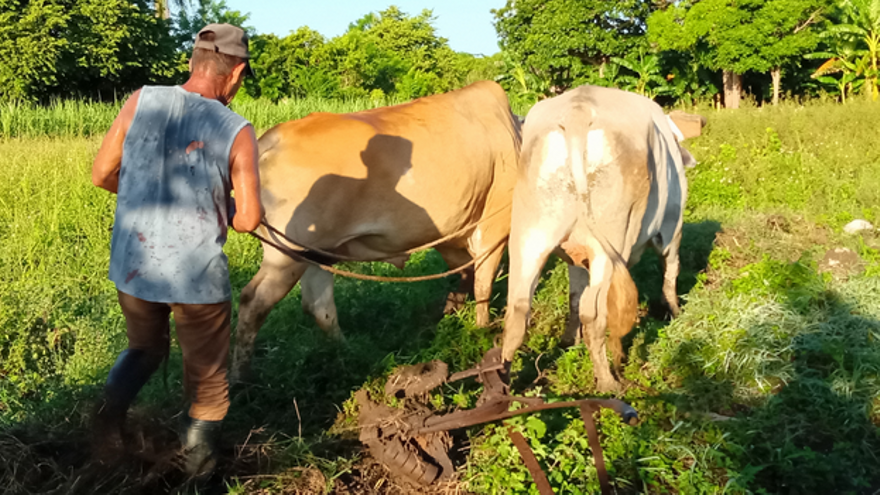
Cubans Are More Concerned About Hurricane Ian Than About Voting in the Referendum

Cuba holds a referendum on September 25 to approve the new Family Code. (14ymedio)

14ymedio bigger14ymedio, Juan Diego Rodríguez and Herodes Díaz, Havana/Santiago de Cuba, 25 September 2022 — In the early hours of this Sunday morning there was a notably small turnout in the voting centers for the referendum on the Family Code, and the majority of the voters were elderly, according to 14ymedio reporters in Havana and Santiago de Cuba.

About eight and a half million Cubans have been called to participate in this referendum, the third that is being held under the current political system. The referendum will approve or reject a text that in recent months has generated intense controversy about equal marriage, adoption by homosexual couples and surrogacy.

According to the National Electoral Council (CEN), at 11:40 in the morning, almost five hours after the opening of the polls, 37.03% of registered voters had gone to vote.

Voters are divided among more than 24,000 polling stations, which will be open from 7:00 am to 4:00 pm on this day, a Sunday of uncertainty with the advance of Tropical Storm Ian that is expected to reach the status of hurricane in the coming hours and to hit western Cuba.

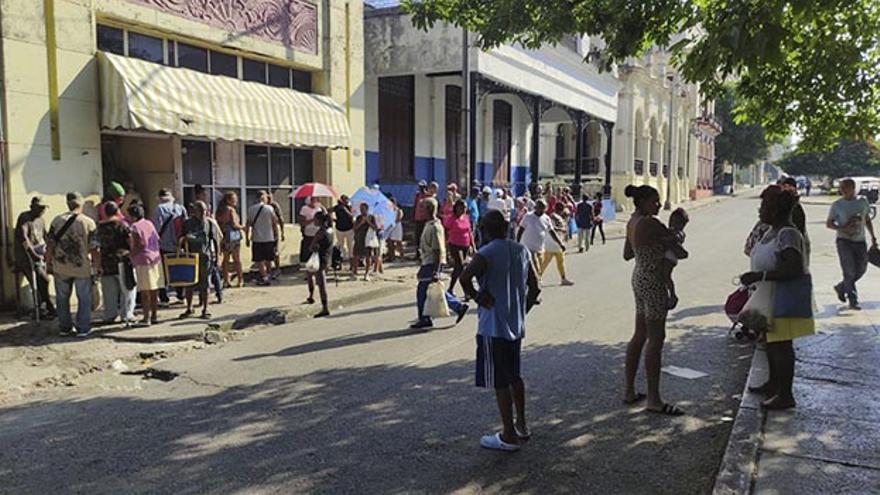
The proximity of the storm has launched Cubans into the streets in search of canned food, bread, cookies, candles and other products that will allow them to handle confinement in their homes when the winds and rains become stronger. However, shortages have worsened in recent hours, causing longer lines in front of bakeries and markets. continue reading

“It’s very early Sunday and on the eve of a hurricane, said the official in charge of reviewing the voters’ identity cards, trying to justify the low turnout. Voters were picking up their ballots at a school polling place in the neighborhood of Cayo Hueso in Havana. A few meters away, a line to buy bread summoned more people than the referendum for the Family Code.

“I came early so I could leave,” said Missy, a 28-year-old who cast her vote in a school in the Pueblo Nuevo neighborhood. “My daughter is in elementary school and for a few days she was called on to take care of the polls. She didn’t want to come, but the teacher told her that even if it was two hours, she had to fulfill that commitment.”

“It was early and she came back done in. She told me that very few people had gone to vote so far and that the snack they gave to the students who guard the ballot boxes is terrible: a cold roll with bad picadillo and a bag of hot Coral soda,” the mother complains.

At Missy’s same school, her mother and grandmother voted. “Even if they don’t believe me, they marked the yes and I marked the no,” the young woman explains. “Because they are immersed in Party militancy, but although I’m a lesbian and the issue of equal marriage suits me, I prefer to wait to have other rights first.”

Nearby, in Los Sitios, Dalmar and Julito have been placing the multicolored flag that identifies the LGBT+ community on their balcony for days. This Sunday they went to vote early and both marked yes. “We want to get married as soon as possible and appeal to solidarity motherhood to be able to have a child together,” they tell this newspaper. “We have struggled a lot to get here, and although it’s not an ideal situation, our rights cannot continue to be postponed.”

“Between the dead and those who have emigrated, we have 54 people on the registry who aren’t going to come to vote,” one of the organizers of a school in Cerro, near Ayestarán Avenue, explained loudly, through the telephone line. “When we’re done, we’ll know how many people are no longer in Cuba,” he said.

The exodus of recent months, the largest that the Island has suffered in its entire history, estimated to be close to 200,000 people, has taken away part of the electorally active population. So emigration also marks an election where the expectation of leaving the country soon has made many desist from approaching the polls.

“Why should I go, if I plan to leave this country?” explained a 19-year-old boy this Sunday morning on an improvised basketball court located in an open field in Nuevo Vedado. “Let those who stay decide. When I take the plane, I will no longer have to be governed by any of these laws; I will already have those of the country wherever I go.”

Along with him, other young people of similar ages repeat a similar speech. “I already have everything to leave for Nicaragua, so it’s like I’m not here,” adds another of the players, who from early morning preferred scoring a basket to dropping a ballot in a box.

“I haven’t seen young people,” emphasizes Manuel, a man from Havana who went to vote early and marked the no box. “When I entered school, it was around nine in the morning and there was only one old man. Then I took a tour of other schools in my neighborhood and only saw other elderly people.”

The presence in the early hours of voters over 60 years old may be due not only to the fact that among young people sleeping on Sunday morning is a more widespread habit, but also that the militants of the Communist Party and active members of organizations such as the Committee for the Defense of the Revolution are mostly people who exceed five or six decades of life.

One person who did arrive with the first light of Sunday and was surrounded by cameras and microphones at his polling place in the municipality of Playa was Miguel Díaz-Canel. The ruler took advantage of the moment to qualify the enthusiasm he had shown in previous days: “The expectation is not that it will be a unanimous vote, but I do believe that it will be a majority on the part of our people.”

According to the official press, Díaz-Canel assured that “against the Code there is a whole platform that starts from the demonization and discrediting of the Cuban Revolution,” and described the call for a referendum as courageous “in the conditions that the country is going through: shortages, blackouts, scarcity, with an important part of the economy paralyzed.”

Even Díaz-Canel didn’t rule out that there could be a “protest vote” and explained that, “in such complex issues where there is a diversity of opinion and in the midst of a difficult situation there can even be people who vote in order to protest.”

The official press also showed the former Cuban ruler Raúl Castro in the moment of voting, although his presence in the official campaign to promote the yes vote for the Family Code was very scarce.

Translated by Regina Anavy

____________

COLLABORATE WITH OUR WORKThe 14ymedio team is committed to practicing serious journalism that reflects Cuba’s reality in all its depth. Thank you for joining us on this long journey. We invite you to continue supporting us by becoming a member of 14ymedio now. Together we can continue transforming journalism in Cuba.
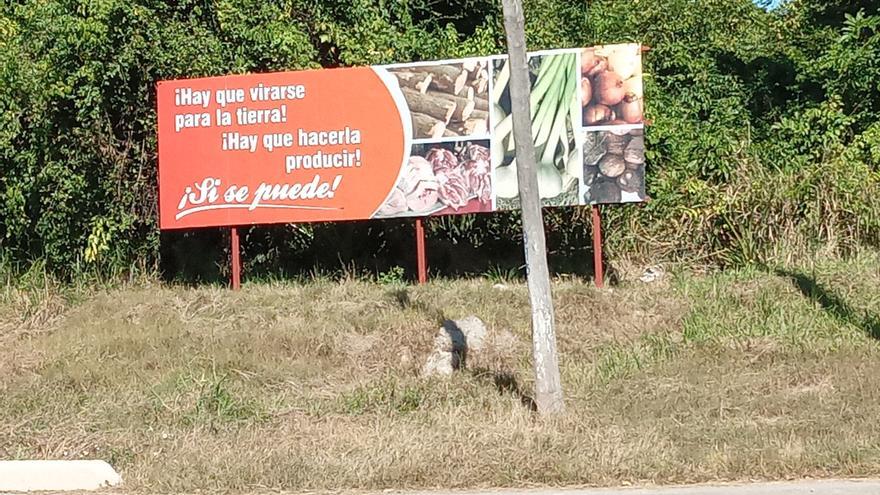
Cuba: Are You Voting on the Family Code?

The Cuban Government is facing the closest vote in its history. (Granma)

14ymedio bigger14ymedio, Havana, 22 September 2022 — The Cuban government has called on the population to vote yes in the referendum on the Family Code held this Sunday. Far from the monolithic opinion that has been imposed in the official discourse — and maybe in private — voting is like a Russian doll for those who are outside the institutional fold. Pluralism, rich in nuances and diverse, is immersed in the middle of debate. Going to vote or not? And, in that case, yes or no?

The Spanish politician and professor of Constitutional Law, Diego López Garrido, warned years ago of the risks involved in some referendums: “People, many times, don’t respond to the issue in question, but to who makes it or how they do it,” he commented on the relevance of this type of voting. The expert agreed with the opinion of many political scientists who point out the dangers of minorities being unprotected by a referendum. “The issues that concern individual rights or rights that affect a minority are legislated, but they are never decided with a popular consultation,” he said.

Some Cubans agree with this, such as the journalist Reinaldo Escobar, from this newspaper. “Rights, no matter how long they have been violated, should not be submitted to a referendum. Neither the abolition of slavery nor the vote for women nor the use of public services without racial discrimination, to give just three examples, have had to wait for to be approved at the polls.” continue reading

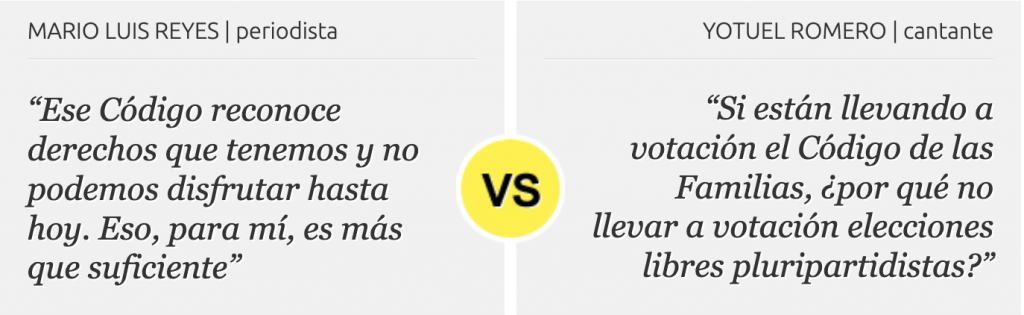
“This Code recognizes rights that we Cubans have and cannot enjoy until today. That, for me, is more than enough.” / “If they’re putting the Family Code to the vote, why not take multiparty free elections to the vote?”

In a similar sense, although more clearly in favor of abstention, the Cuban artist and co-author of the popular song Patria y Vida, Yotuel Romero expressed himself on Tuesday. “If you can’t elect your president, how can you expose your children to a Family Code chosen by someone you didn’t vote for? If they’re putting the Family Code to the vote, why not take multiparty free elections to the vote?” he said on his social networks.

The DemoAmlat organization, which has promoted the vote of the diaspora — deprived of this right despite having Cuban citizenship in perpetuity — through an electronic voting platform, doesn’t hesitate to describe the operation of a referendum on the Family Code as “pinkwashing, after decades of repression and forced labor as a state policy against the LGBTIQ+ community.”

“If the project means an extension of rights, and there is no provision that obliges a totalitarian regime like Cuba to consult with citizens, why submit it to a referendum?” asks this institution.

The playwright Yunior García Aguilera has also unequivocally expressed his opinion against submitting an issue like this to consultation while everything else is imposed from the leadership of the Communist Party. “The embarrassing thing here is having to submit common sense to a referendum, after we were impaled by the worst Penal Code on the continent, without consulting anyone.” However, he also points out that rejecting the dictatorship doesn’t mean “putting anyone’s rights on hold.”

Among those who consider that voting and doing it in a positive way is the least of all evils in this context is the independent journalist Mario Luis Reyes. “This Code recognizes rights that we Cubans have and cannot enjoy until today. That, for me, is more than enough,” he admits with sadness, adding: “I understand that the rejection of the dictatorship causes many people, out of pure reaction, to want to vote no so that the regime suffers a symbolic ’defeat,’ but if the ’no’ wins, the most defeated ones will be ourselves.”

Also from activism, Manuel de la Cruz, a member of the San Isidro Movement and a former political prisoner, promotes the positive vote and asks those who think differently that abstaining or rejecting the Family Code will not bring any democratic improvement. “To the people who will vote no so that their children aren’t taken away, come up with a strategy that includes more than that, because under the old code, they will also be able to take children away,” he says.

Few surprises exist in the religious sphere, where the opening of marriage, gender self-determination or surrogate wombs are enough to raise hives. The clergy has demonstrated in all countries of the world in which similar rules have been approved and have raised their voices with all the means at their disposal, managing to mobilize many from the temples. Although their room for maneuver in Cuba is more limited, they have not had any problems circulating their clear commitment to voting, but in a negative direction. “We see with disappointment that these and other proposals that were notoriously questioned by society are still intact in the Code that is now presented for a referendum,” the Cuban bishops said in an institutional statement.

Far from the voices of the Government or the communicators and intellectuals with greater capacity to raise their message, popular opinion is more divided than ever. People aren’t afraid to express the meaning of their vote, even if it’s not the one promoted by the ruling party, and the Government could see its strategy of closing ranks endangered.

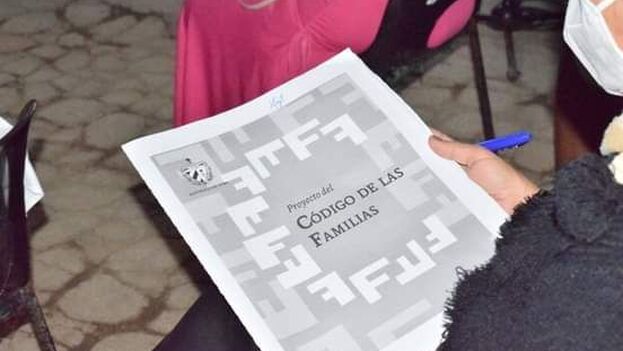
The content of the Family Code is prolific and extensive. It addresses some of the topics that have generated the most controversy, from the issues of equal marriage and adoption by people of the same sex, “solidarity management” or parental authority, to other less commented ones that entail guaranteed and important improvements: the end of child marriage, care of the elderly, care of children, the right to an economic regime for both parties in marriage and the fight against domestic violence.

In these last issues, very diverse organizations from the Church to YoSíTeCreo in Cuba agree that it’s already late for the assumption of rights that are more than consolidated in many parts of the planet, and that they can be derailed because they’re included in the same legal corpus as other issues that generate a notable dissent, in addition to punishing the regime by a predictably high abstention as a method of protest.

Four days from the referendum, the Government is facing the first election that it may lose but, as some analysts point out, even that has been guaranteed “life insurance.” Suffice it to say that  reactionary, conservative and counterrevolutionary ideas will win. Even if that means admitting that the Government’s power has decreased.

Translated by Regina Anavy

____________

COLLABORATE WITH OUR WORKThe 14ymedio team is committed to practicing serious journalism that reflects Cuba’s reality in all its depth. Thank you for joining us on this long journey. We invite you to continue supporting us by becoming a member of 14ymedio now. Together we can continue transforming journalism in Cuba.
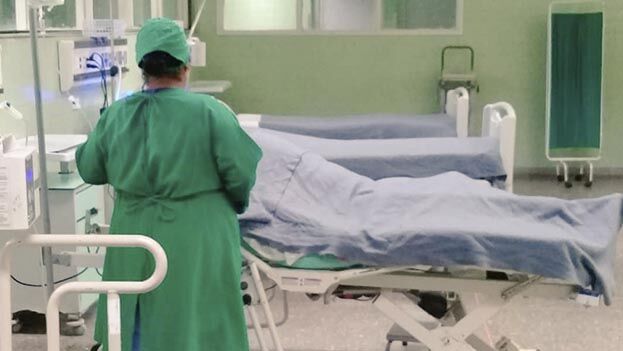
Little Enthusiasm and Expensive Food at an Official ‘March’ in Support of the Family Code in Havana

Schoolchildren concentrated in La Piragua, in Havana, for the official concert in favor of the yes on the Family Code referendum. (14ymedio)

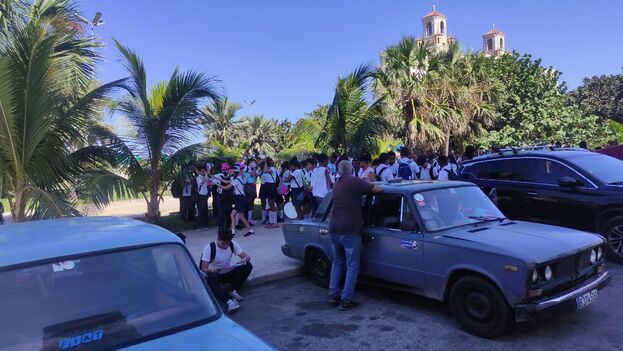
14ymedio bigger14ymedio, Juan Diego Rodríguez, Havana, 23 September 2022 — In its desperate struggle for the yes to win in the referendum on the Family Code this Sunday, the Cuban Government has mobilized not only workplaces but also schools.

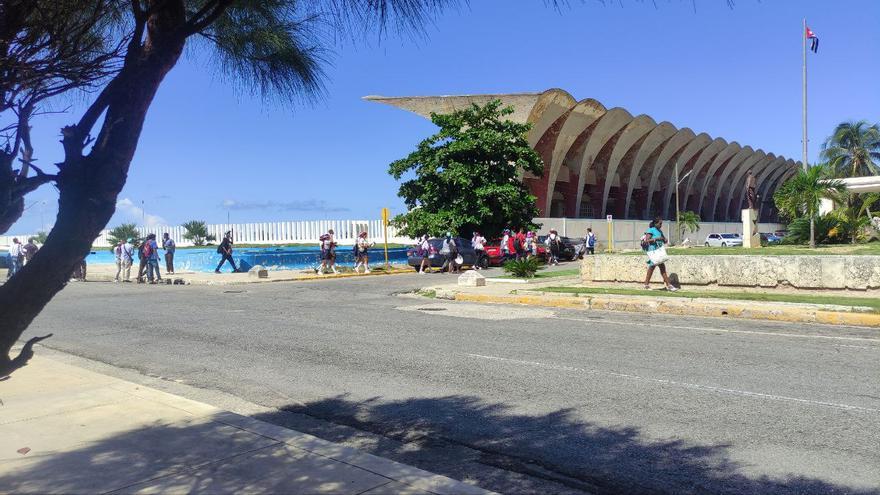
Barely thirty kids, from nearby schools, arrived this Friday at the corner of G and Malecón, in El Vedado, Havana, where a march was called for 3 pm that would be enlivened, as they pompously announced, with “dancing and congas.”

Dragging their feet, accompanied by teachers who walked with the same reluctant step, they received a cap and fans, all made of cardboard, with the colors of the rainbow and the slogan “Code Yes” from the hands of officials stationed in front of a car of the Union of Young Communists (UJC).

Some of them, after receiving these, didn’t hesitate to flee the place. “We’re going to stop by — there’s a camera — so they know we were there,” a teacher told a group of teenagers while they deserted the activity before it even started. continue reading

Another group followed in the footsteps of a UJC official who harangued them with a whistle, to walk to the next point of call, La Piragua. This esplanade, located on the Malecón at the heights of the National Hotel, has recently moved to the Anti-imperialist Tribune, in front of the United States Embassy and a few feet from there, as the center of propaganda events organized by the Communist Party of Cuba.

Barely thirty kids, from nearby schools, arrived this Friday at the corner of G and Malecón, in El Vedado. (14ymedio)

In the evening, a concert will take place, the official press explained. Los Van Van, Haila María Mompié, Arnaldo and his Talisman, the La Colmenita Children’s Theater Company and actors of the Teleseries Calendario will participate.

Around 3:30, La Piragua was observed guarded by a huge police operation, with parked patrols and agents stationed on every corner. Immediately several buses arrived with more students, all dressed in their uniforms.

“We’re going to stop by — there’s a camera — so they know we were there,” a teacher told a group of teenagers while they deserted the activity. (14ymedio)

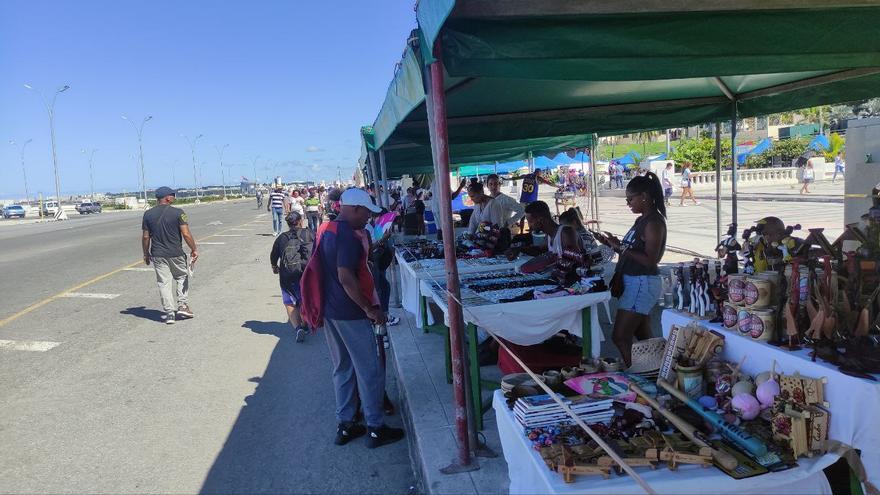
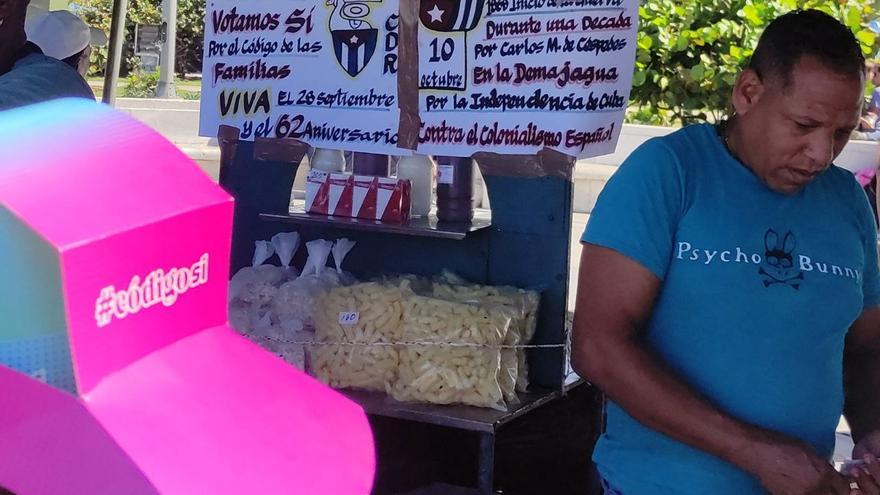
As part of the event, the authorities established stalls for the sale of handicrafts and food. The prices were high: for example, bread with pork, at 250 pesos, and bread with ham, at 200. To drink, they offered Coca-Cola and Mahou brand beer, something striking if one of the propaganda posters that “decorated” the stalls is taken into account: “Against Spanish Colonialism.”

“In no way is this a voluntary event. It’s a forced concentration of students where they are taking advantage to sell food, drinks and handicrafts at unpayable prices,” lamented a passerby who stopped for a moment hoping to buy something to eat.

As part of the event, the authorities established stalls for the sale of handicrafts and food. (14ymedio)

Around 4:30, many among the crowd of young people began to scurry away, little by little, under a harsh sun and in the face of the impossibility of spending so much on a drink.

The schools in the capital have been wallpapered with posters containing the slogan “Code Yes,” and students have already been warned of the obligation to “take care of the ballot boxes” [i.e. observe the voting in person] on Sunday, “for at least four hours,” according to a high school student from Nuevo Vedado.

To drink, they offered Coca-Cola and Mahou brand beer, something striking if you take into account one of the propaganda posters that “decorated” the stalls reads: “against Spanish colonialism.” (14ymedio)Translated by Regina Anavy

____________

COLLABORATE WITH OUR WORKThe 14ymedio team is committed to practicing serious journalism that reflects Cuba’s reality in all its depth. Thank you for joining us on this long journey. We invite you to continue supporting us by becoming a member of 14ymedio now. Together we can continue transforming journalism in Cuba.