The opposition candidate accused the Cuban regime of keeping the profits of the health workers sent to Mexico
Gálvez leads a coalition of parties against the Government of López Obrador / 14ymedio/Courtesy
14ymedio, Adyr Corral, Mexico, 6 May 2024 — The main candidate of the opposition for the presidency of Mexico, Xóchitl Gálvez, said that if she wins, she will not hire more Cuban doctors, as the Government of Andrés Manuel López Obrador has been doing.
“We are not going to continue to bring Cuban doctors! In Mexico, we have enough capacity and talent!” she said on Monday during the presentation of her Health Plan 2024-2030, ahead of the elections on June 2
The standard-bearer of the Fuerza y Corazón [Strength and Heart] coalition for Mexico, which brings together the PAN, PRI and PRD parties, said that in recent years the hiring of doctors from the Island has been a screen to camouflage López Obrador’s support of the Cuban dictatorship.
On April 29, the Mexican Government confirmed the arrival of another 123 Cuban doctors, totaling just over 800 specialists, of the total of 1,200 that López Obrador promises to have before the end of his six-year term.
Gálvez complained that the Cuban doctors who have been imported are not well paid for their work in Mexico and that the Cuban regime itself receives most of the economic profit. continue reading
“Hiring the Cuban doctors has only served to finance an authoritarian regime, because they don’t pay them well; it’s the Cuban government that keeps the money,” she emphasized at an event held in Guanajuato, in the center of the country.
Instead of bringing more doctors of Cuban origin, the opposition candidate proposed the construction of a comprehensive health system in which public, social and private services are united.
Translated by Regina Anavy
____________
COLLABORATE WITH OUR WORK: The 14ymedio team is committed to practicing serious journalism that reflects Cuba’s reality in all its depth. Thank you for joining us on this long journey. We invite you to continue supporting us by becoming a member of 14ymedio now. Together we can continue transforming journalism in Cuba.
Tamara Segura presented in Canada the film in which she reveals how the regime ended up destroying the life of her father and his relatives
Tamara Segura, designated by the regime as the youngest militiawoman in Cuba, experienced the ’honor’ as a heavy burden / EFE
EFE (via 14ymedio), Toronto, 6 May 2024 — When she was born on December 2, the anniversary of the arrival in Cuba of the yacht “Granma” on which Fidel Castro, Ernesto Che Guevara and others traveled to initiate the Revolution, Tamara Segura was named by the Cuban authorities as a soldier of the Revolution, which made her the youngest soldier in the country. Segura, who defined herself in an interview with EFE as a girl who was always very shy and “who didn’t want that kind of attention,” experienced the “honor” as a heavy burden.
The filmmaker discovered a violent encounter with a police officer, which earned her father a two-year prison sentence and plunged him into the alcoholism that would end up destroying him
Now, turned into a filmmaker based in Canada, Segura presented in Hot Docs – the most important documentary festival in North America and among the most prominent in the world – “Seguridad” (“Security”), a film in which she tells the story of her family and reveals how the regime destroyed it.
Her father’s alcoholism and violence caused her parents to divorce, and Segura distanced herself from him. When she moved to Canada in 2010, the rupture was total.
Four years later, the filmmaker tried to reconnect with her father and went to Cuba However, her father passed away a few days after her arrival in 2014, exactly 10 years ago, without them being able to speak.
Among his belongings was a box with old family photographs that showed him as a young, cheerful man, with no trace of the alcoholism and violence that would mark his life.
In the film, Segura reveals a secret that she had not known until that moment. Through conversations with her mother and her paternal grandmother, as well as documents, she discovered a violent encounter with a police officer, which earned her father a two-year prison sentence and plunged him into the alcoholism that would end up destroying him. continue reading
“My first instinct to make the movie was right after my father’s death, when I discovered that heritage of photos. And in those photos there is clearly a family story that was a blow to the gut,” Segura explained.
“The process took a long time, and I finally realized that it was something I wanted to do because it was a story that was going to haunt me for life if I didn’t tell it,” she added.
Segura describes the moment when she discovered the police brutality that condemned her father, and the impunity of the regime that sent a man who until then had been a model citizen to jail, as “a punch in the face.”
“You look back and it explains absolutely everything. That was something I couldn’t ignore,” she said. It was at that moment that she decided she had to make a documentary.
“I had no intention of talking about the economy, politics, ideological or sociocultural reality. I really wanted to talk about internal life and what that violence does to you psychologically
“I had no intention of talking about the economy, politics, ideological or sociocultural reality. I really wanted to talk about internal life and what that violence does to you psychologically,” she explained.
The filmmaker adds that knowing the role that the regime played in the destruction of her father was “like a reaffirmation of something that is already intuitively abstract. But of course it is very different to see it in its own flesh.”
“I had a lot of emotions, a lot of anger, a lot of pain, a lot of regret of having ended the relationship with him, without an apology, without really understanding who he was and without being able to say the things I wanted to say. Making the film has been a way to correct those mistakes,” she concluded.
Translated by Regina Anavy
____________
COLLABORATE WITH OUR WORK: The 14ymedio team is committed to practicing serious journalism that reflects Cuba’s reality in all its depth. Thank you for joining us on this long journey. We invite you to continue supporting us by becoming a member of 14ymedio now. Together we can continue transforming journalism in Cuba.
In addition to the limited availability of cash, customers complain about the long hours of waiting, not understanding the working hours, fatigue and hunger
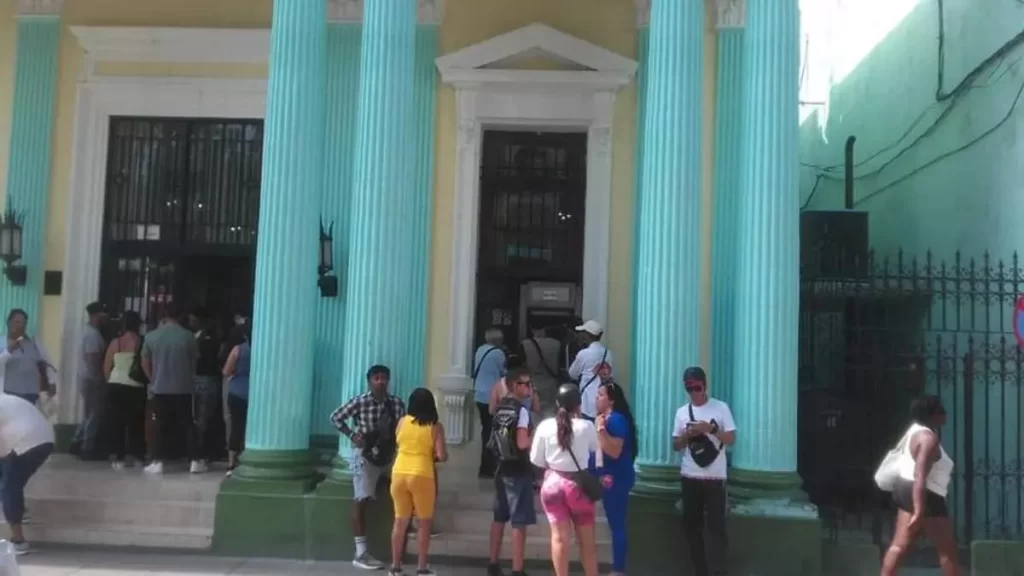
The ATM of the Banco Popular de Ahorro on Medio Street does not always have cash / 14ymedio
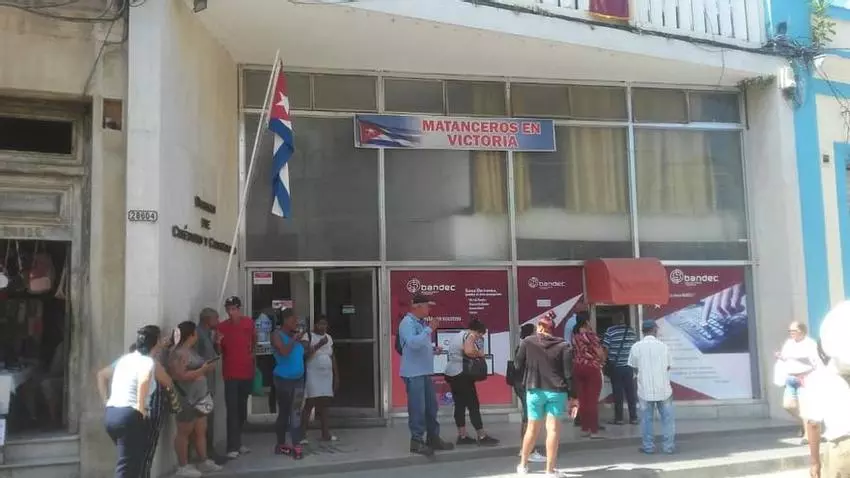
14ymedio, Julio César Contreras, Matanzas, May 5, 2024 — Getting up early in the morning, making a coffee and leaving for the Banco Popular de Ahorro on Calle Medio, in Matanzas, has become a routine that Magda repeats between three and four times a month. Before 5:00 am, the 47-year-old is already at the branch standing in line to withdraw money from the ATM. The entity, however, does not open its doors until three and a half hours later.
“When I have to come to withdraw money I always arrive very early, but it doesn’t matter when I get up, there are always people there: coleros* [people being paid to stand in line for someone else] or people who are willing to wait from earlier,” Magda tells 14ymedio. “I immediately sit on the stairs and wait.”
Magda lives near the bank, but customers from several miles away walk to that branch from, for example, Peñas Altas. As she explains, arriving early does not guarantee that she can withdraw what she wants. “When the bank opens, the coleros have already left and those who hired them arrive – sometimes more than one – and replace them. By the time you arrive, the number of people in front of you has doubled,” she says. “The other thing is that this bank doesn’t always have money and coming here is a game of chance.” continue reading
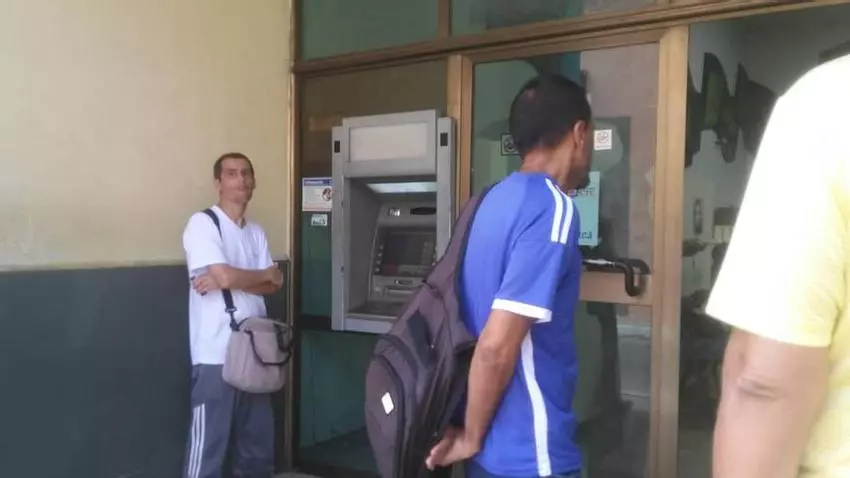
ATM located on Contreras Street, belonging to the Banco Popular de Ahorro. Sometimes, several days pass without it delivering cash / 14ymedio
At 8:30 am a branch worker opens the doors to the anxious crowd and repeats his speech of every morning: “Soon money will be put in the ATM; each customer will be able to extract only 10,000 pesos and insert a maximum of two cards. Keep the line organized,” he warns.
With the wait for the money, the discomfort begins. “None of those people were here at 7:00 am, when I arrived,” a woman complains. “Oh, daughter, don’t you realize that that man made a line for them? Everything here is fixed,” another replies.
In addition to the low availability of cash, customers complain about the long hours of waiting, the working hours, fatigue and hunger. “I already warned them at work that I was going to be late. The boss will scold me again, but there is no remedy. If they want us to be early, then don’t pay us by card,” grumbles a young office worker.
With the difficulty of the task, Cubans have devised several “tricks” to extract the money or do it faster. “That man there came early with his wife, and she went to another ATM in case the cash runs out here,” says Magda. Others, she says, have contacts in several banks and call to find out if they will have cash. “I myself have a friend at the ATM of El Naranjal, who told me that today there would be no cash there, nor in the ATMs of the funeral home and Contreras Street,” she says.
ATM located on Medio Street, belonging to the Banco de Crédito y Comercio / 14ymedio
“The problem is that, with inflation, anything you buy costs 1,000 pesos, and therefore you need to take large amounts out of the bank. That’s what they charge, for example, the coleros, but I can’t give them that pleasure. Anyway, at 10,000 pesos per head, there are times when the first five people clean out the cash,” she says.
The hours pass slowly and the line doesn’t seem to move forward. “Who is the last of the disabled?” asks a woman without any visible disability. Immediately, suspicion in the line skyrockets. “Right now two people from a private business passed by and took out a lot of large bills. Now you appear with a physical disability. When we get to the front of the line, the money is gone, and those of us who have been here since early morning are left without anything,” a man growls at the indifferent gaze of a woman, who inserts her card into the ATM.
The same employee who hours before gave instructions to the customers now leaves, looks at the line and enters the branch again without saying a word. “Is the money going to run out?” The question makes everyone’s hair stand on end. “It not even ten,” says an old man.
ATM belonging to the Banco de Crédito y Comercio, located on Milanés Street. In general, it only has money available from Monday to Saturday in the early hours of the morning, although sometimes it also has cash for one or two hours in the afternoon / 14ymedio
“There’s a lot of banking and everything, but nowhere do they accept payment by transfer. The other day I needed to urgently buy some medication and I had to go to Varadero to get money,” complains a young man.
“Who is the last one?”** asks a man who arrives by bicycle, but there is no answer. The young office employee, whose turn had now arrived and who was extracting cash, gives the bad news: “There’s no more money. I could only get 2,500.” Many of the clients get annoyed and begin to protest, but most, for whom that situation is routine, pick up their things and leave. It’s 10:30 in the morning.
The employees of the branch don’t say a word. Only the custodian of the bank clarifies the doubt – otherwise well known – to an old woman: “They won’t put in one more peso until tomorrow.”
Translator’s notes:
*A line or queue in Cuba is called a ‘cola’ (literally ‘tail’) and ‘coleros’ are people who others pay to hold their place in lines that can be hours, or even days, long.
**Each person who joins the line asks “who is last” and then they themselves become the new “last person” until the next arrival. In this way Cubans don’t have to stand strictly one-behind-the-other, and can still maintain their positions in the line.
Translated by Regina Anavy
____________
COLLABORATE WITH OUR WORK: The 14ymedio team is committed to practicing serious journalism that reflects Cuba’s reality in all its depth. Thank you for joining us on this long journey. We invite you to continue supporting us by becoming a member of 14ymedio now. Together we can continue transforming journalism in Cuba.
So far this year, 104,000 adults have crossed, of which 35% are women
A migrant with her child rests at a reception station after crossing the jungle / EFE
Moncho Torres/EFE, Bajo Chiquito (Panama), 4 May 2024 — Migration has long ceased to be something only for men. Women alone, with children or with their partners, leave their homes behind and cross through the “hell” of the Darién jungle, where they are victims of rape and robbery even while carrying their children. “¡Let’s go, we’re almost there!”
At the checkpoint of Bajo Chiquito, the first indigenous town that migrants come to after crossing the Darién, which is the jungle border between Panama and Colombia, the Panamanian authorities collect data from the hundreds of newcomers who, exhausted, are waiting patiently to take their turn. Behind the officials, apart, sits a girl. Suddenly, it seems that she has identified someone in the line.
“Do you know this girl?” the officer asks a woman. “Is she 12 years old?” she replies. They ask the girl and she nods. The officer then asks her if she knows where her mother is. “Yes, she’s coming further back.”
Venezuelan Karely Salazar, 31, travels with her 7-, 10- and 12-year-old daughters. They have gone to the village outpatient clinic. “The smallest one has a fever and a cold from spending two days in the river,” the woman explains to EFE, exhausted. “Their father is in Venezuela,” she adds. continue reading
“The smallest one has a fever and a cold from spending two days in the river”
“Thank God we crossed the jungle, but it really wasn’t easy, very difficult for the children,” she says. “Did your eldest daughter get lost?” “Yes,” the mother nods, and her face changes. She says that on the second day of walking her leg hurt and she couldn’t move, and the little girl walked into the crowd and “lost her way.”
“Last night I cried and cried because I didn’t know where she was,” says the mother. Hundreds of migrants, or thousands, pass through that jungle every day.
According to data from the Panamanian authorities, after the historic record of more than 520,000 migrants who crossed the Darién in 2023, so far this year more than 130,000 have crossed. Of the 104,000 adults, about 35% are women, and of the more than 28,600 minors, 47% are girls.
The Panamanian authorities generally issue strong warnings against migration, since the Colombian side is controlled by the Gulf Clan, a criminal organization that in 2023 received 68 million dollars for the passage of migrants, in addition to other gangs that steal from and attack those who pass by.
The director of Migration of Panama, Samira Gozaine, goes further: “There are stories that some mothers leave their children to drown in the river because they are too heavy to carry; they abandon them to their fate,” she told EFE a year ago.
“It’s a total hell,” says the young woman, but the crisis in Venezuela gave her no other option; working 12 hours a day in a supermarket gave her only 20 dollars a week
For the international lawyer and human rights activist Iván Chanis, these stories”dehumanize” the migrants and deny the reality, because, as he explains to EFE, “what mother wants to leave her daughter behind?”
Luisannys Mundaraín, 22 years old, carries her baby in her arms and breastfeeds him. She tells EFE that when she crossed one of the rough parts with the baby he slipped, but she was able to hold onto him at the last moment. To this were added the snakes, spiders, rivers, and “those thieves who rob and rape women.”
Mundaraín then recounts how her group was intercepted on a hill by a group of armed men wearing hoods, who asked them for “100 dollars for each person. Those who did not give them money had to hand over their phones, or if it was a woman she had to stay for you know what.”
Doctors Without Borders (MSF) reported, before the Panamanian authorities banned them from continuing to provide medical care in the country, that they treated more than 1,300 people for sexual violence in the Darién between April 2021 and January 2024.
“It’s a total hell,” says the young woman, but the crisis in Venezuela gave her no other option, with 12-hours of work in a supermarket for 20 dollars a week, when “a package of diapers cost 5 dollars and food was even more expensive.”
Thus, when in the middle of the electoral campaign some Panamanian politicians say that they are going to close the 165 miles of border in the Darién, the young woman sighs. “It’s impossible to close it, because even if there are thousands of dangers, migrants will always try to cross because of the poverty they suffer in their countries.”
Translated by Regina Anavy
____________
COLLABORATE WITH OUR WORK: The 14ymedio team is committed to practicing serious journalism that reflects Cuba’s reality in all its depth. Thank you for joining us on this long journey. We invite you to continue supporting us by becoming a member of 14ymedio now. Together we can continue transforming journalism in Cuba.
The official press confirmed that two subjects accused of the crime of receiving stolen goods were sentenced to minor penalties
The case began with the investigation of the death of a man in the capital municipality of Boyeros /Televisión Cubana/Capture/Archive
EFE (via 14ymedio), Havana, 5 May 2024 — A Cuban court sentenced a man to 30 years in prison for murdering a person in a case linked to an attempt at illegal exit to the United States by sea, official media reported on Saturday. In addition to the one convicted of murder, the Provincial Court of Havana punished four other people with sentences of between 10 and 13 years of deprivation of liberty for the crime of human trafficking, the Cuban state television reported.
The report confirmed that two subjects accused of the crime of receiving stolen goods were sentenced to minor penalties. The case began with the investigation of the death of a man in the capital municipality of Boyeros.
The investigation showed that he was killed with knives when he refused to hand over a car that would be used to transport four people to the point where they would illegally leave Cuba in a rustic boat. continue reading
In Cuba there are no public and periodic data on crime, especially with violence, although the state media publicly expose some cases
All those involved were arrested, even one who had fled by sea and was captured by the United States Coast Guard and handed over to the Cuban authorities. They all confessed to their participation in the events.
In Cuba there are no public and periodic data on crime, especially with violence, although the state media publicly expose some cases.
The independent media in Cuba, as well as social networks, have reported in recent months on different criminal acts such as robberies with violence. In the middle of last year, the newspaper Granma — the official organ of the Communist Party of Cuba — stressed that violent crimes in the country represent 8.5% of the total number of crimes recorded in the first six months of 2023.
However, the text did not specify the number of total crimes in 2023, did not contrast them with those of the same period in 2022 and did not specify whether the accusations ended in convictions.
Translated by Regina Anavy
____________
COLLABORATE WITH OUR WORK: The 14ymedio team is committed to practicing serious journalism that reflects Cuba’s reality in all its depth. Thank you for joining us on this long journey. We invite you to continue supporting us by becoming a member of 14ymedio now. Together we can continue transforming journalism in Cuba.
Last Wednesday, in Caracas, the XXIII Summit of Heads of State and the Government of Alba-TCP / Prense Latina
14ymedio, Yunior García Aguilera, Madrid, 27 April 2024 — Alba-TCP, the alliance created by Hugo Chávez and Fidel Castro, has reached 20 years with the vitality of an “almendrón,” a 1950s American car, without spare parts. The high price of oil during those founding years was the viagra that unleashed the social-imperialist fantasies of both leaders. But with the subsequent fall in crude oil prices, as well as the death of its ideologues, the organization experienced a stage of flaccidity that they are now trying to shake up with motivating speeches and new agendas.
Josefina Vidal leaked a few words to show the early detumescence of the Bolivarian Alliance. In an interview with Prensa Latina, the Deputy Minister of Foreign Affairs of Cuba talked about affectations, lack of economic resources, programs on a smaller scale, coercive measures and blockades. Of course, she did not refer to the political and economic crisis that Venezuela is experiencing, nor to the crisis of attractiveness suffered by the Cuban regime. Thus, without a pipe gushing petrodollars and charismatic leadership, Alba offers less light than a night without a moon.
The idea of this “alternative” emerged as a counterpart to Alca. Since the time of Bush senior in 1988, the United States had tried to create a free trade area that ran from Alaska to Tierra del Fuego, with 34 nations and a market of 800 million people. The asymmetry between the countries of the hemisphere aroused suspicions around the project, but many saw more benefit than danger in its concretization. In 1993, Bill Clinton signed the agreement, to take effect in 1994. However, when the IV Summit of the Americas arrived in 2005, Bush junior received a “No” in response, and Hugo Chávez mounted a parallel organization with a slogan that went viral: Alca, Alca, go to Hell!” continue reading
In 1994 Bill Clinton rounded out the idea a little more and planned to implement it in 2005
Fidel Castro, from his bunker in Havana, rubbed his hands and smiled sarcastically. His purpose was never for Latin America to win anything, but for the United States to lose. In addition, he was dying of nostalgia for those years of the Comecon where it was enough to stay in the nest with an open beak, chirping like an eagle in heat. That’s why the bearded man needed something like Alba. It would not be necessary to produce competitively, something in which he did not have the slightest experience or any enthusiasm. Its purpose was to establish a ritual of charitable exchanges, with a whole propagandistic and demagogic apparatus behind it. He was an expert at that. It was always an ideological alliance with subsidies, never a regional cooperation and development project. About the small Caribbean States and their role in this soap opera, we will have to write later.
Alba failed to reduce poverty or inequalities, despite its “mission” and its paraphernalia. On the contrary, both Cuba and Venezuela suffer worse rates of poverty today than in 2004. Nor was it an alternative for “the people,” since decisions have always been made from the hierarchies of these regimes, where civil society cannot even look out.
Last Wednesday, in Caracas, the XXIII Summit of Heads of State and the Government of Alba-TCP took place. Twenty-three summits in twenty years – that’s typical of our tireless bureaucrats! The host, Nicolás Maduro, for whom originality is an unknown concept, presented the Alba 2030 agenda. Don’t expect to find anything new, much less verify results within six years. It’s a diet of bombastic ideas like that of the Petro cryptocurrency*, which the dictator sold as the most solid and stable in the world. Now he sells us a septet of “great goals,” including the resurrection of Petrocaribe**, the University of the Peoples, a “fair” trade zone and other pretty things.
The host, Nicolás Maduro, for whom originality is an unknown concept, presented the Alba 2030 agenda
Díaz-Canel, the front man for the Castros, awkwardly read his flash cards. His dyslexia prevented him from distinguishing between “vecino” (neighbor) and “destino” (destiny), “precedent” and “president.” Which prankster thought of writing the word “consolidation” in his speech? At the conclusion, he made his characteristic grimace of dry swallowing, picking his nose and going from robotic seriousness to a childish smile, looking for a friendly face in the crowd, like a bad student after an uncomfortable oral presentation. Sympathizing with his ineptitude, Maduro released one of his pearls: “Together we are invincible. And together with the women, even more invincible.” That’s Alba, a group of idiots.
Alba, Alba, to the trash!
Translator’s notes: *Petrocurrency was launched by President Maduro six years ago to sidestep US sanctions but was shut down in January, 2024, due to corruption. **Petrocaribe was a 2005 agreement between Venezuela (under Hugo Chávez) and Caribbean nations for selling and buying oil.
Translated by Regina Anavy
____________
COLLABORATE WITH OUR WORK: The 14ymedio team is committed to practicing serious journalism that reflects Cuba’s reality in all its depth. Thank you for joining us on this long journey. We invite you to continue supporting us by becoming a member of 14ymedio now. Together we can continue transforming journalism in Cuba.
Cuban President Miguel Díaz-Canel criticized the repression of student protests in several American universities
Wearing a Palestinian “keffiyeh” (traditional scarf) around his neck, Díaz-Canel said he felt like a “father” to all Palestinian students on the Island / Presidencia Cuba
14ymedio, Havana, May 3, 2024 — The Cuban regime is clear about its loyalties in the war in Gaza: Israel is an “occupying power” involved in a “brutal Zionist escalation”; Palestine, a “brother people,” which has sent “hundreds of students” to Cuba and with whom, since the time of Fidel Castro, the Island “has always stood in solidarity.”
These are the words of Cuban President Miguel Díaz-Canel this Thursday, during a speech in which any mention of the terrorist attack by Hamas on October 7 was omitted. The president, who has offered his unconditional support to the Palestinian side, appeared before more than 1,100 delegates in a “meeting of solidarity” for Cuba and Palestine, “against the imperialism” of the United States and Israel. The highest point of his speech has been, however, his criticism of the repression of student protests at several American universities. As hundreds of Cuban activists have reminded him, his Government applies at home the violence it attributes to other police forces.
Wearing a Palestinian “kiffeyeh” (traditional scarf) around his neck – which he has worn in public since last October – Díaz-Canel said he felt like a “father” to all Palestinian students on the Island and gave the floor to Fernando González Llort, one of the five Cuban spies imprisoned in the United States in 1998, currently the president of the Cuban Institute of Friendship with the Peoples.
Since 2017, González Llort has been the regime’s man when it comes to organizing the groups of foreigners who participate in the mass celebrations, such as the May Day parade. During his speech, he said that the delegates invited to the congress “will be able to convey the truth of Cuba to their communities” and condemned “in energetic terms” the “Israeli genocide against the Palestinian civilian population.” He did not allude to Hamas. continue reading
During the meeting, a declaration of support for Palestine was signed demanding that the United Nations recognize a Palestinian State “with the borders prior to 1967 and East Jerusalem as the capital.”
This Wednesday, Cubadebate put on its front page an extensive account of the student protests in the United States signed by the spokesman of the regime Randy Alonso. The journalist argues that this movement is similar to the one that, in the 1960s, demanded the end of the Vietnam War.
Alonso celebrates that, despite being “the main ‘foundations’ of the empire,” universities such as Columbia also host groups that disagree with Washington. These are the people who oppose the “Christian Zionists and fundamentalists” who support Israel, creating an “obscurantist atmosphere.” He also criticizes the fact that several organizations, such as the Wexner Foundation, have broken ties with several faculties that received their funding for the anti-Semitic acts that have taken place in them.
“Either Israel’s Yankee protectorate is defended or you can go to jail,” Alonso concludes, without realizing the irony of writing paragraphs in Cuba in which he lashes out at those who “beat young people, spray them with pepper spray and arrest them.” This Wednesday, in the same line of argument, Díaz-Canel published in his X profile a message of “solidarity with students in the United States who have taken the side of justice, have come out to support the cause of the Palestinian people and are brutally repressed.”
The flood of reactions was not long in coming, and they revolved around the fact that, a few days earlier, the sentence of up to 15 years in prison was announced for those who demonstrated peacefully in Nuevitas, Camagüey, in the summer of 2022.
In Cuban universities, on the other hand, students avoid giving a frank opinion about the conflict
In Cuban universities, on the other hand, students avoid giving a frank opinion about the conflict. On the Island there are no large Jewish communities – and those that exist have already spoken out about the war – but there are many Christian students, especially evangelicals, who feel linked in some way to Israel.
This is the case of Manuel, an evangelical pastor from Villa Clara who listens with concern to what several young university students in his community tell him. They feel “marginalized” for their support of Israel and their opinions about the war, although there has been no “persecution” against them. “The accusation that is repeated in the classrooms is that those who support Israel are religious fanatics, and they are discriminated against for their opinion,” he tells 14ymedio.
“Some time ago they took children and young people to the streets for a kind of act of repudiation against Israel.” The Cuban media does not present “both sides of the conflict; everything is a deception and the information is manipulated,” he adds. The most serious thing, Manuel emphasizes, is that for the Cuban media “there is no longer clarity about who started the conflict and the wave of violence.” In a word, he says, “it is as if Hamas didn’t exist.”
Translated by Regina Anavy
____________
COLLABORATE WITH OUR WORK: The 14ymedio team is committed to practicing serious journalism that reflects Cuba’s reality in all its depth. Thank you for joining us on this long journey. We invite you to continue supporting us by becoming a member of 14ymedio now. Together we can continue transforming journalism in Cuba.
More than 1,500 foreign participants attended the FITCuba, held at the tourist center of the Jardines del Rey Islands / Ministry of Tourism of Cuba
EFE (via 14ymedio), Havana, 5 May 2024 — The 42nd edition of the International Tourism Fair of Cuba (FITCuba), the main event for the tourism sector on the Island, closes its activities this Sunday with the announcement that China will be the guest country in its 2025 edition, according to state media. The FITCuba, held at the tourist center of the Jardines del Rey Islands – Cuba’s second destination for sun and beach after Varadero – was attended by more than 1,500 foreign participants, including 437 travel agents, to explore and do business, according to the Ministry of Tourism.
The Minister of Tourism, Juan Carlos García Granda, explained that the special invitation to China for the next FITCuba is part of the promotion of relations and tourism between the two countries.
He highlighted the resumption of direct flights between Beijing and Havana, operated by Air China, with its inaugural trip scheduled for May 17, with a stopover in Madrid. continue reading
García Granda also announced at the closing of the event the decision of the Cuban authorities to establish a visa exemption for Chinese citizens with ordinary passports.
China’s ambassador to Cuba, Ma Hui, participated in the FITCuba 2024 / Cubadebate
“FITCuba has been the right time to show the renewal of our tourism product, the digitization of processes to improve the customer experience, the expansion of renewable energy sources, the transformation of our products with more accessibility, respectful of the environment and in line with the country’s commitment to the fulfillment of the Sustainable Development Goals,” he said. On the eve of the Fair, the official media celebrated the arrival of the first million foreign visitors to the Island in 2024.
They also confirmed the goal of reaching 3.2 million tourists at the end of the year with the aim of achieving a resurgence in a key sector for the national economy that is going through a critical situation.
The tourism sector is the second highest contributor to Cuba’s gross domestic product (GDP) and the third source of foreign exchange, after professional services and remittances, according to estimates by various independent experts.
Cuba received 2.4 million tourists in 2023, a figure that represented a growth of more than 800,000 visitors compared to 2022, when it did not achieve its goal of hosting 1.7 million, according to official data.
Tourism does not escape the deep crisis that has impacted Cuba for four years due to the confluence of the pandemic and design and implementation errors in national economic policies.
Translated by Regina Anavy
____________
COLLABORATE WITH OUR WORK: The 14ymedio team is committed to practicing serious journalism that reflects Cuba’s reality in all its depth. Thank you for joining us on this long journey. We invite you to continue supporting us by becoming a member of 14ymedio now. Together we can continue transforming journalism in Cuba.
A Cuban rafter supported by municipal police is taken to the hospital / / Tamaulipas Civil Protection
14ymedio, Havana, May 5, 2024 — Cubans Mario Sergio Márquez Ventura, 30 years old, Rogelio Loases Fuentes (50), Yuriesky Romero Hernández (33) and Diosan (26) were rescued this Saturday by fishermen from Laguna Madre, Mexico. The rafters left the Island on April 1, but on the crossing the rudder of the raft on which they intended to reach Florida broke, and they were adrift for more than 30 days.
According to those rescued, four other Cubans died on the way, and their bodies were thrown into the sea. The shipwrecked men, located at the point known as Barra Boca de Catán, were dehydrated and very thin. The rafters told their rescuers that their boat was rammed by strong gusts of wind and waves of up to 17 feet.
One of the Cuban rafters rescued by fishermen at the point known as Barra Boca de Catán / Tamaulipas Civil Protection
One of the Cuban rafters rescued by fishermen at the point known as Barra Boca de Catán / Tamaulipas Civil Protection
The Mexicans transferred the rafters to the island known as Punta de Piedra, where they were treated by members of Tamaulipas Civil Protection and transferred to the San Fernando General Hospital. Their state of health is reported as stable, and the medical report has yet to be released. continue reading
The rescue was informed to the National Institute of Migration, which will take care of the migrants after being medically discharged. Meanwhile, the Cuban Embassy in Mexico has not offered any comments on the rescue.
On April 26, Migración received 28 rafters from the Island rescued 20 miles from Cuba by the Paradise Carnival crew. These Cubans were escorted by sailors to the immigration headquarters of Playa del Carmen. So far, no information has been offered about their condition.
Mexico continues to deport Cubans, despite the fact that last October it announced that the process of “assisted calls” – as they call the expulsions – was paused until further notice. Last January, nine people from the Island were returned on a commercial flight. Last year, the departure of 774 migrants was completed.
Translated by Regina Anavy
____________
COLLABORATE WITH OUR WORK: The 14ymedio team is committed to practicing serious journalism that reflects Cuba’s reality in all its depth. Thank you for joining us on this long journey. We invite you to continue supporting us by becoming a member of 14ymedio now. Together we can continue transforming journalism in Cuba.
U.S. official Brian Nichols accused Nicaragua of using migration as a “weapon” against the countries of the region
U.S. Undersecretary of State for the Western Hemisphere, Brian Nichols, met with journalists in Miami, Florida / EFE
14ymedio, Havana, 1 May 2024 — The United States, in its talks with Cuba, continued to demand the release of political prisoners. This was one of the points addressed by both countries during the meeting last month, as confirmed on Tuesday by the U.S. Undersecretary of State for the Western Hemisphere, Brian Nichols, during a visit to Miami, Florida. “We always insist on the importance of respecting human rights, especially those of the most vulnerable,” said Nichols, who recently used his social networks to describe as “infuriating” the sentences of up to 15 years in prison for “Cubans who demonstrated peacefully in Nuevitas in 2022. The continuous repression of the Cuban government against Cubans who strive to fulfill their basic rights and needs is inconceivable.”
Among those sentenced was Mayelín Rodríguez Prado, the then 21-year-old young woman who transmitted the protests through Facebook, charged with the crimes of “enemy propaganda of a continuous nature” and “sedition.”
Nichols explained that it is “a legal process of analysis within several Government Departments that finally reaches the Secretary of State for his “determination”
Nichols also said that he didn’t have any doubt about the unity of the leadership of the Cuban regime. “I think that instead of speculating about it after 60 years, it is better to focus on the government’s actions.” continue reading
The official told several media in Miami that the Island has been asked to stop the irregular migratory flow through Nicaragua, while it has insisted on ending the sanctions. However, he clarified that Cuba’s removal from the list of state sponsors of terrorism is not on the negotiating table: “it is not something we can negotiate.”
Nichols explained that it is “a legal process of analysis within several Government departments that finally reaches the Secretary of State for his determination,” according to a report by journalist Mario J. Pentón for Martí Noticias.
The inclusion of Cuba on the list in January 2021 was one of the last decisions taken by the Administration of Republican Donald Trump (2017-2021) before leaving power.
The United States then justified the measure by alluding to the presence on the Island of members of the Colombian guerrillas of the National Liberation Army (ELN), who traveled to Havana to start peace negotiations with the Government of Colombia.
“The regime of Ortega and Murillo has taken advantage of migration as a weapon against the countries of the region, including the United States,” Nichols said
During his conversation with journalists in Miami, Brian Nichols also accused the Nicaraguan government of Daniel Ortega of using migration as a “weapon” against the countries of the region, including the United States.
“The Government in Nicaragua, the Ortega and Murillo regime, has taken advantage of migration as a weapon against the countries of the region, including the United States, because there are millions of irregular immigrants throughout the hemisphere, many of them due to the actions of the Nicaraguan regime.”
In the last three years, more than 700,000 Venezuelans, 363,000 Nicaraguans, 342,000 Haitians and 600,000 Cubans have reached the southern border, reported Martí Noticias. “All are favored by policies that promote free visas implemented by Daniel Ortega’s regime after its disagreements with the United States.”
Translated by Regina Anavy
____________
COLLABORATE WITH OUR WORK: The 14ymedio team is committed to practicing serious journalism that reflects Cuba’s reality in all its depth. Thank you for joining us on this long journey. We invite you to continue supporting us by becoming a member of 14ymedio now. Together we can continue transforming journalism in Cuba.
“I just talked to him; they returned him to Camagüey this morning in a bus,” said activist Yamilka Laffita
Cuban journalist José Luis Tan Estrada / Facebook
14ymedio, Havana, May 2, 2024 — State Security released journalist José Luis Tan Estrada on Wednesday after five days of detention in Villa Marista. The CubaNet collaborator had been arrested by the political police last Friday when he was intercepted in Havana. “José Luis Tan Estrada has just communicated with two people. He’s free,” journalist José Raúl Gallego posted on his Facebook page. Gallego, who has been reporting on Tan Estrada’s case since his arrest, added that the young reporter communicated from a “landline in the Camagüey terminal.”
The news was confirmed shortly after by activist Yamilka Laffita (Lara Crofs) on the same social network. “José Luis Tan Estrada is free. I just talked to him; they returned him to Camagüey this morning in a bus.”
“Thank you very much to all those who stood in solidarity with the brother’s cause and supported us. Thank you very much to the person who told him that ’his little friends made a tremendous noise’ out here,” Laffita said.
After the arrest of Tan Estrada became known last Friday, several international organizations, activists and colleagues set off alarms about the “kidnapping” of the independent journalist. Among the NGOs that spoke out was PEN International. PEN’s Americas and Caribbean centers condemned the events on Saturday and called for the immediate release of the journalist, in addition to calling on the Cuban authorities to stop the harassment of critical voices in the country. continue reading
On Tuesday, they were joined by the Committee for the Protection of Journalists, which requested the release of Tan Estrada and indicated that the Cuban authorities must allow “reporters to work without fear of reprisals.”
“José Luis Tan Estrada has just communicated with two people. He’s free”
Although the circumstances of the journalist’s arrest are not known or if he is accused of any crime, the Cultural Rights Observatory reported on Wednesday that it was “following up on the repressive scheme applied by the Cuban State” against José Luis Tan Estrada. It also explained that “it knew the first name of the investigating officer of the case, Lieutenant Yasser,” and recalled that “according to the current criminal procedure law, it is possible to appoint a legal representative from the very moment of detention.”
After six hours of arrest last Friday, the political police allowed Tan Estrada to make a single call, and he asked his activist friend Yamilka Laffita to report his case, La Hora de Cuba posted on Facebook this Sunday. The media then specified that the journalist’s mother had not been able to “communicate with her son” and was unaware of his trip to the capital.
Among Tan Estrada’s colleagues, the hashtags #FreeTan and #InformarNoEsDelito (Information is not a crime) went viral. Journalist Luz Escobar, on her Facebook account, recalled similar cases of Cubans who have been imprisoned in Villa Marista, including the artist Hamlet Lavastida, who spent 86 days in the same prison in 2021, “and that State Security escorted him from Cuba on his way into exile.”
Translated by Regina Anavy
____________
COLLABORATE WITH OUR WORK: The 14ymedio team is committed to practicing serious journalism that reflects Cuba’s reality in all its depth. Thank you for joining us on this long journey. We invite you to continue supporting us by becoming a member of 14ymedio now. Together we can continue transforming journalism in Cuba.
South Korea will open a temporary office in the Cuban capital until the the diplomatic headquarters is completed
A South Korean delegation visiting Havana this April / @cmphcuba
14ymedio, Havana, April 29, 2024 — After re-establishing diplomatic relations last February, Cuba and South Korea have agreed to open their respective diplomatic headquarters in Seoul and Havana. The pact was signed in the capital of the Island, where several officials of the South Korean Foreign Ministry arrived from April 24 to 27, to exchange diplomatic letters. On the page of its Ministry of Foreign Affairs, South Korea also announced the signing of the agreement: “Our Government plans to continue consultations with the Cuban side so that our Embassy in Cuba can be opened as soon as possible. To this end, we will establish a temporary office in Havana as an intermediate step in the opening,” says the portfolio statement, which also announces the sending of diplomatic personnel.
For its part, the Cuban Foreign Ministry published a brief message on its social networks announcing the reception of the Korean delegation, headed by the director general of Coordination and Foreign Planning of that country, Song Si-jin.
The caution of the Cuban authorities around the restoration of relations with South Korea, a potential economic ally, responds to attempts to keep ties stable with North Korea, an important political partner for the Island and an enemy of Seoul, which it has recently threatened to “annihilate.” continue reading
The Cuban Government sees in South Korea an unexplored potential for investments and resources that North Korea hardly offers
The Cuban Government sees in South Korea an unexplored potential for investments and resources that North Korea hardly offers and that, in the current economic crisis, could be a breath of fresh air for the regime.
Suspicion of Havana, however, has not been overlooked by Cubans who, after the announcement of the restoration of diplomatic relations – broken since 1959 by the arrival of Fidel Castro to power – asked the Foreign Ministry for explanations in the comments of the media and social media accounts of the ruling party.
On one hand, users said, relations have been maintained with Pyongyang since 1960, and the country has been a great ally of Havana, a bond that “must be respected.” On the other hand, the most pragmatic asserted, “the Democratic People’s Republic must understand that it is an inalienable right of our country to open up relations with all nations” and, in this case, with one of the most important in the world in terms of technology – something that “perhaps we can take advantage of economically.”
For its part, Seoul has declared its interest in what Havana has to offer. “Cuba is a considerable source of key mineral resources for the production of electric vehicles, such as cobalt and nickel,” the South Korean Presidential Office said last February.
The statement also explained that companies interested in entering the Cuban market would be helped with basic necessities such as appliances and machinery, which have high prices on the Island. Seoul also pointed out multiple business and cooperation opportunities in the energy sector, something that Havana cannot reject in its current situation, when it tries to alleviate the fuel crisis with solar panels and electric vehicles. (South Korea is the headquarters of three of the five companies that dominate the global battery market for this type of vehicle, LG, SK On and Samsung).
Medicine and biotechnology are other areas where the South Korean government sees potential: “Cuba has been an untapped market where direct trade is still very limited due to United States sanctions, but we will take advantage of this opportunity of establishing formal diplomatic relations to lay the foundations for a gradual expansion of economic cooperation,” Seoul said, ignoring the policies of Washington, its closest partner, regarding Havana.
Despite the fact that diplomatic relations were suspended, the rapprochement between Cuba and South Korea coincided, in 2015, with the thaw between Washington and Havana, when several economic exchanges in technological and energy matters began, which were limited by the lack of a favorable diplomatic scenario.
Before the pandemic, about 14,000 South Korean citizens traveled to the Island every year, and another 1,100 descendants of Koreans reside there
In 2022, for example, according to data provided by the Ministry of Foreign Affairs of South Korea, the country exported goods to Cuba for a value of 14 million dollars and imported goods worth 7 million. Likewise, before the pandemic, about 14,000 South Korean citizens traveled to the Island every year, and another 1,100 descendants of Koreans who migrated during the Japanese occupation (1910-1945) reside there. All of them, the Foreign Ministry explained at the time, need “systematic consular assistance.”
Until now, Cuba was the only country on the continent with which South Korea did not maintain links despite the fact that “the two countries have expanded cooperation focusing on non-political fields such as culture, human exchange and development cooperation. In particular, the friendship between the two peoples through recent cultural exchanges has contributed to the establishment of diplomatic relations between the two countries,” said the statement of South Korea’s Foreign Ministry.
Two examples of these relations in “non-political fields” are the purchase by Havana of the Korean-built ferry Perseverancia, which makes the trip between the Isla de la Juventud and the Surgidero of Batabanó (Mayabeque), and the aid worth $200,000 in medicines and health material sent by Seoul after the explosion in 2022 of the Matanzas supertanker base.
Translated by Regina Anavy
____________
COLLABORATE WITH OUR WORK: The 14ymedio team is committed to practicing serious journalism that reflects Cuba’s reality in all its depth. Thank you for joining us on this long journey. We invite you to continue supporting us by becoming a member of 14ymedio now. Together we can continue transforming journalism in Cuba.
The Alhucema Solidarity Initiatives Association also sends medical supplies
The Association members will not only deliver the donations but will also participate in the International Seminar for Peace and for the Abolition of Foreign Military Bases / Cubainformación
14ymedio, Madrid, 30 April 2024 — The Alhucema Association of Solidarity Initiatives in Seville, in the Spanish municipality of Morón de la Frontera, twinned with Morón de Ciego de Ávila since 1995, delivered medical supplies and powdered milk this Tuesday. The items, reports Invasor, were acquired by collection over the last two years in the “solidarity” fair Qué Linda es Cuba. This organization dedicates 20% of its income, says the official press, to “financing the trips and purchasing donations” for the Island, not only for its “twin” city,” but also for other “campaigns,”such as “contributions” of syringes for vaccination against Covid-19 and for “repairing the damage” – it indicates, without details – of the explosion of the Saratoga Hotel in Havana.
The Association members will not only deliver the donations but will also participate in the International Seminar for Peace and for the Abolition of Foreign Military Bases that will be held in Guantánamo on May 4 and 5. There are two military bases in Spain that are shared with the United States: an air force base in Morón de la Frontera and a naval station in Rota. The US ceased to have control over these bases in 1998.
The first container, however, will not arrive until mid-June, so the situation of powdered milk will not improve in the coming days
The organization has helped Cuba on other occasions, the local press reports, although not by much. Two years ago, it delivered health supplies worth 3,000 euros to two hospitals, and four years ago, 1,000 euros worth of supplies together with the Maximiliano Tornet Association, from Huelva, also in Andalusia.
More advantageous for the Island is the donation of the French association Cuba Coopération France, which, according to Prensa Latina on Sunday, raised a total of 63,000 euros to “support vulnerable sectors” and will send a container of powdered milk to the country.
According to the official media, the organization states that the “immediate objective” is to collect 76,000 euros “in order to send a second shipment of powdered milk, aimed at alleviating the impact of the American blockade* on the population, in particular children and the elderly.”
The first container, however, will not arrive until mid-June, so the powdered milk situation will not improve in the coming days. Last March, the Government hurried to reassure the population, saying that the import of a total of 1,750 tons of food from several countries – 500 from the United States – would guarantee its availability until April.
In February, for the first time in its history, the Cuban government formally requested help from the UN World Food Program to obtain milk for children under the age of seven.
*Translator’s note: There is, in fact, no US ‘blockade’ on Cuba, but this continues to be the term the Cuban government prefers to apply to the ongoing US embargo. During the Cuban Missile Crisis the US ordered a Naval blockade (which it called a ‘quarantine’) on Cuba in 1962, between 22 October and 20 November of that year. The blockade was lifted when Russia agreed to remove its nuclear missiles from the Island. The embargo had been imposed earlier in the same year in February, and although modified from time to time, it is still in force.
Translated by Regina Anavy
____________
COLLABORATE WITH OUR WORK: The 14ymedio team is committed to practicing serious journalism that reflects Cuba’s reality in all its depth. Thank you for joining us on this long journey. We invite you to continue supporting us by becoming a member of 14ymedio now. Together we can continue transforming journalism in Cuba.
“I have fulfilled my dream of joining the team of the great Iván Pedroso,” said the athlete himself, who has not competed since 2021
Athlete Juan Miguel Echevarría, who has not competed since 2021, asked in 2022 for his withdrawal from the sport in Cuba for “personal reasons” / EFE
EFE (via 14ymedio), Madrid, 30 April 2024 — Cuban long jumper Juan Miguel Echevarría will compete for the Island again. The sports authorities, Jit reported on Monday, “welcomed the wish expressed by the Olympic long-jump runner-up. Given the absence of elements that disqualify him, his case will be added to the current reintegration policy for Cuban sports,” said National Commissioner Rolando Charró, without naming the 25-year-old athlete, the winner of the silver medal in Tokyo 2020 and indoor world champion in Birmingham (United Kingdom, 2018), and without clarifying where he currently resides.
“I have fulfilled my dream of joining the team of the great Iván Pedroso,” Echevarría himself said on his Facebook page, where he also thanked “my former coaches, to whom I am indebted for being here.” In the same publication he says he will begin working to “first achieve the score required for the Olympic Games in Paris 2024, with the desire to compete and continue to give victories to Cuba.”
Deporcuba reported on its social networks that the athlete was “now in Spain with Iván Pedroso to work for the Olympic dream on behalf of Cuba.” The Echevarría score, 8.68 meters, places him in twelfth place in the world ranking.
In July of last year, the specialized media announced that the Olympic medalist was looking for “a professional contract” in Portugal, where he would have arrived on an indeterminate date. Echevarría, who has not competed since 2021, asked in 2022 for his withdrawal from the sport in Cuba for “personal reasons” and rejoined in January 2023. continue reading
Echevarría’s departure from the Island coincided with the elimination by the National Institute of Sports, Physical Education and Recreation (Inder) of the controversial requirement of “repatriation” so that Cubans living abroad can represent the Island.
His return is vital in the midst of the severe crisis of Cuban sports, marked by escapes. Just last week, the judoka Magdiel Estrada fled the national delegation while it was in Brazil.
That desertion was added to those of soccer defender Lázaro Castro two weeks ago in Nicaragua, athletics champion Osmany Diversent in February and wrestlers Susana Martínez and Santiago “Santiaguito” Hernández that same month.
Translated by Regina Anavy
____________
COLLABORATE WITH OUR WORK: The 14ymedio team is committed to practicing serious journalism that reflects Cuba’s reality in all its depth. Thank you for joining us on this long journey. We invite you to continue supporting us by becoming a member of 14ymedio now. Together we can continue transforming journalism in Cuba.
‘Prensa Latina’ once again remembers the goal of three and a half million travelers, very far from the more than four million in 2019
Tourists on Obispo Street, in Old Havana. (14ymedio)
14ymedio, Havana, 28 April 2024 — A little more than a week after the National Office of Statistics and Information (Onei) reported that Cuba received 809,238 international visitors in the first quarter of the year, the official press celebrates that, last Friday, the Island reached one million travelers since the beginning of 2024.
For Prensa Latina, it is the “element that officially confirms the possibility” of recovery of the sector, which has not raised its head since the Covid-19 pandemic. However, the economic aspiration for this year of 3,500,000 visitors, reported by the official agency, is still far removed from the 4,275,558 that arrived in Cuba in 2019, a year before the pandemic, not to mention that the Caribbean low season is now beginning.
The authorities, in any case, continue to strive to enhance the sun and beach destination of the Island, and the International Tourism Fair will focus on this. It will be held at the Jardines del Rey tourist center, in Ciego de Ávila, between May 1 and 5. continue reading
Canada continues to send the most tourists to Cuba, followed by the Cuban community abroad
The million travelers who have arrived in the country, although it represents twice those who arrived in the same period of 2023, don’t reach the figures for the same period in 2018 and 2019, when in January and April, 1,802,853 and 1,928,561 tourists were received, respectively.
Canada continues to send the most tourists to Cuba, followed by the Cuban community abroad, Russia, the United States, Germany, France, Mexico, the United Kingdom, Spain and Argentina.
Faced with the decrease in the usual markets, Juan Carlos García Granda, Minister of Tourism, has leaned towards new options. In January, he declared at the International Tourism Fair in Madrid that “Russia could still grow much more. We have other countries such as China, Poland, Eastern European countries, Turkey and Arab countries that are growing today, and we undoubtedly have to take a look at Latin American countries.”
García Granda’s intentions coincide with the promises made by the Prime Minister, Manuel Marrero, during his visit to China in December 2023 to make adjustments in hotel facilities to “capture” more Asian visitors. For its part, at the beginning of April, Cubana de Aviación announced the restoration of the Beijing-Havana route in May with Air China.
In 2023, three out of four hotel rooms on the Island were left empty
Attention to the Russians is not neglected either. García Granda expects about 200,000 travelers from that country to arrive in Cuba in 2024. So that they have no problems with payments, MIR cards have been accepted on the Island since November last year. “The Russian MIR card has arrived in Cuba to stay,” he said at a press conference convened by the TASS agency at the beginning of March during his visit to Russia.
The minister did not miss the opportunity to promote the Island as a tourist destination and offered the Kremlin investment opportunities and the inauguration of Russian-managed hotels.
Although the “recovery” of tourism to which the regime aspires does not achieve the numbers that gave the sector the epithet of “locomotive of the Cuban economy,” the Government continues to invest a lot of capital in it. In 2023, 23.745 billion pesos (almost one billion dollars at the official exchange rate) were allocated to business and real estate services and rental, and 8.626 billion pesos or 360 million dollars to hotels and restaurants. Between the two areas, they represent 33.5% of the total investments compared to the little money allocated to sectors such as Education, Health, Agriculture and Science and Technology.
However, in 2023, three out of four hotel rooms on the Island were left empty, according to the annual report of selected tourism indicators.
Translated by Regina Anavy
____________
COLLABORATE WITH OUR WORK: The 14ymedio team is committed to practicing serious journalism that reflects Cuba’s reality in all its depth. Thank you for joining us on this long journey. We invite you to continue supporting us by becoming a member of 14ymedio now. Together we can continue transforming journalism in Cuba.

 14ymedio, Adyr Corral, Mexico, 6 May 2024 — The main candidate of the opposition for the presidency of Mexico, Xóchitl Gálvez, said that if she wins, she will not hire more Cuban doctors, as the Government of Andrés Manuel López Obrador has been doing.