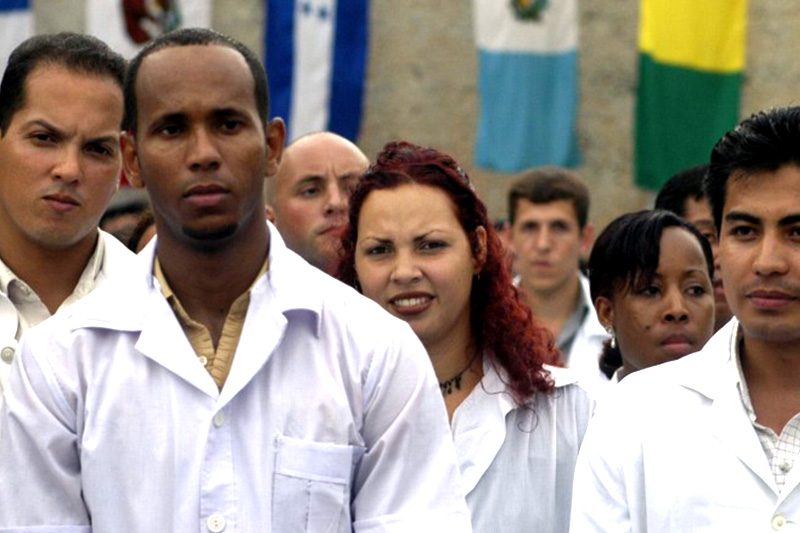
Somos+, Kaned Garrido, 21 September 2015 — Cuban doctors have sustained everybody’s health for decades. The reason Cuban medicine has such prestige is because of the incredible effort of its professionals. The same as Cuban teachers, doctors earn very little. They spend years and years at their careers, and later in service to the country.
That’s the reason we have quality education and healthcare in Cuba. Not by some magical social politics nor because we want to take money away from the rich, like Robin Hood. It’s because of dedicated professionals and the rest of the Cuban workers who finance the expenses, all with pathetic salaries.
But it’s not easy work to sustain such a good health service in a country with such an unproductive economy. This burden ends up falling on the shoulders of Cuban doctors. Some choose the path of the missions in the Exterior to earn a little more. Others prefer to leave the island. So we need to know what they think.
These are the opinions of doctors who presently work in Cuba.
Doctor R. M. earns 1100 pesos (44 CUC, or about US$50) a month. Her specialty is general medicine. She describes her work conditions like this: continue reading
Juan Juan Almeida, 24 August 2015 — More than 500 barrels of fuel disappear daily from the terminals or storage tanks of the Camilo Cienfuegos refinery, located in the province of Cienfuegos on the south-central part of the island.
The theft, in addition to being really ingenious, has an organization that shows even seasonal patterns, revealing that there are fewer robberies in summer than in winter.
The Cienfuegos industrial enclave, after being shut down in 1995 and later materializing in the ALBA accords, with a remodeling and modernization project that cost over $83 million, reopened its doors in October 2007, as part of a large, mixed binational business between Cuba and Venezuela. However, with a processing capacity of over 8,000 barrels a day, the thefts are crippling and, let’s say it, frightening. continue reading
The authorities say that the Cienfuegos Polo Petrochemical project continues being a priority for both Governments, that they are consolidating their methods and doing everything possible to lower the statistics for fuel theft that continue to emerge. It’s known that part of the leakage occurs in “vampire operations,” which are nothing more than premeditated perforations in the pipes, where farmers clandestinely take small quantities of diesel for local farming activities and/or private provincial transport.
But those filterings are minimal and controlled by a systematic cross-checking of plant security, an efficient anti-theft offensive in conjunction with the national police.
The more important, apocalyptic, robbery, which doesn’t seem to interest any authority nor be suspected of being committed by a criminal with a Robin Hood complex, and whose distribution is the result of misdeeds and illegal gains at the service of the community, is centered on industrial quantities of refined gasoline being taken out of the refinery.
With the same notoriety as a polar bear hibernating in a Holguín park, “without anyone seeing anything,” hundreds of daily barrels of gasoline are packed in waterproof bags that normally are used for industrial waste or to guarantee the organoleptic stability of specified products.
There’s nothing discrete about it. The packages continue to mock the sophisticated security system, and they hop, like lice on the heads of babies, until they fall into the channel that flows into the Bay of Jagua.
Gasoline has a less specific weight than water; the packages float and the tide finishes the work. Of course some bags break, and the spill becomes a contaminant that directly affects the ecological equilibrium of the zone. But that, it appears, isn’t important either.
What’s interesting, or at least surprising for an illegal traffic impossible of being executed by a common criminal without having help is that, as in a Spartan task of extraordinary implications, it’s the efficient members of the border troops who finally pick up the floating bundles on the sea.
Who receives so much stolen gasoline? I don’t know; I couldn’t find out, and the more I asked, the more no one wanted to answer. Only one informed person told me:
“It neither returns to the refinery, nor is it lost in the black market.”
Maurice Ferré: The solution for Cuba and Puerto Rico: plebiscites.
From El Nuevo Herald, August 15, 2015 / Reprinted from Orlando Luis Pardo Lazo’s blog
Although both were the booty of war, the results for Cuba and Puerto Rico were different in the Treaty of Paris (1898) at the end of the Spanish-American War.
The Republic of Cuba was established in 1903. As a republic, Cuba prospered for 37 years. With the Constitution of 1940, eliminating the despicable Platt Amendment, Cuba advanced. But by 1959 Cuba was already a corrupt country. After 55 years of Castro-communism, Cuba went from being one of the most prosperous countries in Latin America to place itself, currently, among the poorest. continue reading
Puerto Rico did better. Washington cultivated Puerto Rico as a military base, guarding the Panama Canal. In 1917, the U.S. Congress unilaterally gave U.S. citizenship to Puerto Ricans. In 1922 the Chief Justice of the U.S. Supreme Court, William Howard Taft (before being President of the U.S.), presented the majority opinion in the last Insular Case (about the relationship between the U.S. and Puerto Rico), Balzac v. Porto Rico, concluding that although Puerto Ricans were U.S. citizens, they didn’t have all the guarantees of the U.S. Constitution. Puerto Rico would continue “belonging to the United States but not being part of the United States.”* This infamy of the U.S. Supreme Court in 1922 is still alive in 2015.
In 1952, the North American Congress conceded autonomy to Puerto Rico in local matters, creating the Associated Free State (AFS). In 62 years of self-governing with bad judgments by its governors and responsible financial counselors and with lucrative contracts for friends of the government in attendance, Puerto Rico had an external debt of $73 billion, more than the annual GDP of the island. On August 1, the island, for the first time, failed to comply with a Wall Street bank debt. As a result of the precarious financial situation, Wall Street Hedge Funds and vulture investors bought up Puerto Rico’s junk bonds. Puerto Rico fell into the hands of the “savage capitalists” that Pope Francis has criticized so much.
The President of the United States, Barack Obama, who insists on the opening with Cuba, ignores Puerto Rico’s fatal condition. The North American Congress, presently in the hands of the Republicans, insists that the Cuban political system be modified to one that establishes the consent of the governed, but ignores that in an internal plebiscite in 2012, Puerto Rico, with 78 per cent participation, voted 54 percent to not consent to the system of government presently alive on the island, the AFS.
Among Cuba’s dissidents, Rosa María Payá, daughter of the fallen martyr, Oswaldo Payá-Sardiñas, has created a new opposition entity called “Cuba Decides,” which has numerous followers on the island. Payá, with her group, attended an important meeting of Cuban dissidence in San Juan: First National Cuban Meeting, which met on August 11, 12 and 13.
Cuba Decides presented, in Puerto Rico, a continuation of Oswaldo Payá’s patriotic vision: a plebiscite for Cuba. The questions, although not finalized, ironically are similar to the active questions in Puerto Rico: consent of the governed and the preferred form of government on the island.
Cuba is a sovereign nation where its citizens, internally, don’t have individual liberties.
For its part, Puerto Rico doesn’t enjoy sovereignty, since it’s an unincorporated territory of the United States, whose citizens are governed under the plenary powers of the U.S. Congress under its territorial clause. But Puerto Ricans who reside on the island do enjoy individual liberty.
In order to resolve these incongruencies with the United Nations Declaration of Human Rights and the U.S. Constitution, in the case of Puerto Rico separate plebiscites should be performed. Both plebiscites should entail compliance with conditions, previously agreed upon by the respective governments.
In the case of Puerto Rico, President Obama has recommended and the U.S. Congress has accepted an appropriation of $2.5 million to “educate” voters on the alternative conditions of the plebiscite. Because of the results of the 2012 island plebiscite, in which 61 percent chose federated statehood as a political status, the question of the new plebiscite would simply be: Statehood, yes or no?
The questions for the Cuban process are very complex because they require acceptance by the Government of a future plebiscite in Cuba, without the presence of the Castros.
Cuban exiles and dissidents on the island, some of whom reunited this week in San Juan, should carefully study Rosa María Payá’s presentation and persistently demand of the Cuban Government a plebiscite that determines the consent of the Cuban people. Then Cuban citizens will decide if they want a socialist government or a democratic, pluralist republic and a free market.
“Outbreaks of illness increase and official silence persists.” (YA!@Ya_Venezuela)
Juan Juan Almeida, 11 August 2015 — The suspicious increase in certain inopportune illnesses is now the most sensitive factor for the normal development of the Cuban medical mission in Venezuela.
During the present year, and especially in these last weeks, an alarming and strange increase has been reported in the number of Cubans who get sick while fulfilling their “internationalist” service.
Undisclosed official data reveal that up to week 28 of 2015, there have been 514 cases of Cubans affected by respiratory infections, mainly caused by outbreaks of H3N2 influenza, Rinovirus, Parainfluenza and Metapneumovirus. The states with the highest rate of those affected are the Distrito Capital, Barinas, Monagas, Falcón, Sucre, Nueva Esparta, Mérida, Trujillo, Vargas, Carabobo, Bolívar, Yaracuy, Amazonas, Cojedes and Lara. continue reading
It’s equally noticeable that by the end of week 29, also this year, there were already 33 new cases of dengue fever reported versus 33 in the previous week, bringing to more than 900 the total figure of those affected since January. And much more curious is that during the same time period, 17,391 Cubans have been under quarantine; of these, 12,870 have been in contact with dengue fever, suspected of having contracted Chikungunya fever and other undiagnosed fevers, while 4,184 colleagues were under watch for cholera.
The Party ideologues and the paranoiacs of MINIT do not hold cards without playing them and already have organized a whole novel of pathological persecution. They are taking advantage of the occasion to implement the usual model of fear, blaming such an anomalous situation on the premeditated undercover actions of their everlasting and eternal enemy, the CIA.
In spite of this melodrama, the reality is worrisome. Ever more so when, coincidentally, in the States of Aragua, Carabobo, Zulia, Distrito Capital and Cojedes during the same week, 90 nurses, 23 doctors, 29 laboratory technicians and 20 dentists, through negligence and/or bad manipulation of needles, scalpels and biological waste, suffered what are defined as “occupational accidents through exposure to patients’ blood and bodily fluids,” contaminating themselves with infections that are sometimes diagnosed and sometimes unknown.
The Venezuela medical mission is an important bulwark for Cuban propaganda, and the Cuban authorities, in addition to losing credibility, aren’t acknowledging a failure in this field. Then, in the face of so much going wrong, they developed in Havana in record time a detailed plan that they took to every head of the mission in the different Venezuelan states: a document of alert entitled “Epidemiological Update,” from which I took all these data.
The text orders the reprogramming of biosecurity courses among staff and requires all personnel (doctors, nurses, laboratory assistants, dentists, podiatrists, etc.) to pay special attention to secure methods in treating patients, as well as directing them to maintain constant communication and interchange with the new epidemiology monitoring centers.
In the Cuban health system, like the war in Angola, the casualties aren’t counted; the only thing that matters is victory.
Juan Juan Almeida, 13 August 2015 — The Cuban media today will even use illegal techniques (indoctrination through subliminal means) in order to manipulate the population and oblige it to associate Fidel’s birthday with the opening of the U.S. Embassy.
Somos+, Elizabeth Cruz, 5 August 2015 — We Cubans are chatty, talkative and protagonists of everything whether it’s for good or for bad. Recently arrived in Miami, I heard someone say that we’re like crabs in a pail: when one tries to escape, another one pulls it back to the bottom without needing a lid. The analogy seemed so ingenious to me that, for a long time, it was enough to confuse me about our essence.
In reality, the vast majority of Cubans are noble, brave and full of solidarity, and there are innumerable examples of this. Why delve into despair? Who benefits from our division and mistrust?
Today it’s been more than two decades since the Maleconazo took place. I don’t know if you remember, but in my memory I’m in my apartment facing the Malecón and there is a party feeling. Down the streets comes a lot of excited activity, which at first we confuse with some official act, one of the many that go by unnoticed, even for those who participate. continue reading
From the propped-up balcony, it didn’t take long for us to hear the shouts of “Freedom.” A good neighbor pointed out the little boat from Regla that, facing the Morro, was trying to escape. With binoculars I managed to see it threatened by two Coast Guard boats, and this time they didn’t dare carry out the order to sink it. I like to think that they put on the brakes because of the spontaneous protests. From my roof-top, stones were flying, and the police shot in the air, so that the adults protected us kids. And the fact was that before Fidel made his presence known, now more members of State Security occupied my balcony than members of my family.
The Maleconazo was a popular expression of rebellion, solidarity and dissatisfaction, which didn’t stop with the arrival of civilian militias and Fidel. It reached its conclusion in the so-called crisis of the rafters, where the vote was exercised with rafts. If free and plural elections had existed in our country, neither the violence experienced in those streets nor the loss of the rafters’ lives would have been necessary.
Although I believe firmly in peaceful ways to participate in political activism, what happened shows me that we Cubans aren’t in any way like crabs, but rather are ready to demand what we deserve.
The siege against any political alternative provoked an explosion of this type, disorganized and violent. But it’s elementary that the means and disposition exist so that we Cubans can present different proposals. We should recognize plurality, minimize slogans, flight and blows, and allow dialogue to be the road to keeping peace in our streets, but happily, knowing that the country marches toward prosperity.
*On August 5, 1994 there was a spontaneous uprising in Havana, as Cubans poured into the street along the Malecón and chanted “Freedom.” The demonstrators were dispersed after a few hours by Cuban State Security and police. This event is remembered around the world as “Cuban Resistance Day.”
Disoriented in time like all ex-prisoners, Ángel Santiesteban brings with him a thousand prison demons.
Interview with Ángel Santiesteban after his conditional release – Cuba 2015.
Havana, Cuba, Augusto César San Martín — The writer Ángel Santiesteban Prats suffers with every word he writes. “I classify my work as social,” he declares in an interview given to Cubanet. “It’s always about the environment that surrounds the Cuban,” he adds.
And “suffering” is the best word to describe a people numb with fear, according to the writer who won the Short Story Prize from the National Union of Artists and Writers in Cuba (UNEAC).
“Most of our people pretend; they hope that this will pass and that they don’t encounter that wall. They don’t brave any consequences they might receive for confronting the dictatorship,” he expressed. continue reading
Named by Reporters Without Borders as one of the 100 Information Heroes in 2014, Santiesteban was released from prison under a cautionary measure that can reverse his current limited freedom.
The author of several books of short stories, he received the Franz Kafka Novels of the Drawer Prize for his novel, “The Summer When God Was Sleeping,” where he recounts highlights that mark Cuban society: the participation of Cubans in the war in Africa, prison and the rafters.
Perhaps this last is a reckoning with his past for the 14 months he remained a prisoner at the age of 17, accused of conspiracy for saying goodbye, on the coast, to the family that failed as rafters.
He confessed to Cubanet that he carries fears with him in order to defend his ideas. They are in his blog, The Children That Nobody Wanted, and in the fear of dragging his family along when he’s repressed by the police.
He states that the two and one-half years in prison made him grow as a writer, a human being, and revealed to him the courage of Cuban freemasonry, to which he belongs.
His memory for the offenses he received has the same power as his disposition to reconcile with his adversaries. He suggested that I invite them to a rapprochement, even though conciliation appears difficult.
Disoriented in time like every ex-prisoner, he brings with him a thousand prison demons that will sleep with him for the rest of his days. Perhaps he doesn’t know that they’ll be persistent companions, but he is convinced that they are there, watching over his spiritual damage on the orders of those who imprisoned him.
The writer describes death threats by the police, arrests, insults, psychological damage to his family and imprisonment – a scenario that could well accommodate negative feelings. But in the hour that we share in one of the offices of the Great Masonic Temple, Ángel Santiesteban Prats doesn’t show the least hint of rancor.
Fernando Damaso, 20 July 2015 — The subject of cooperatives in Cuba offers much to talk about. In the first place, it would be interesting to know who had the absurd idea of dividing them into two types: agricultural and non-agricultural.
Owing to this linguistic aberration, a cooperative that is engaged in the repair, scrubbing and lubrication of vehicles is designated non-agricultural, the same as one that makes plastic articles using recycled raw material. The qualifier of “non-agricultural” should precede these peoples’ names as a divine punishment.
But furthermore, the self-employed grouped in these cooperatives, the same as the farmers who make up the agricultural ones, are not independent, but rather find themselves under the control of bureaucratic governmental organizations and institutions, the same that during countless years have been incapable of resolving the problems of production and services, such as the ministries of Agriculture, Transport, Construction, Interior Commerce and others, which now are responsible for the creation, regulation, functioning and auditing of the cooperatives. These inefficient ministries refuse to downsize or to disappear, inventing new mechanisms in order to subsist, now at the cost of the farmers and the self-employed.
Or is it that, in reality, the proclaimed changes are nothing more than simple governmental adjustments, in order to continue exercising power over every facet of society, maintaining an iron control, now without having to answer directly for production and services, tasks that they have transferred to the shoulders of the farmers and the self-employed.
So, the lands that are turned over to the peasants “in usufruct” and the premises that are leased to the self-employed continue to belong to these ministries, which, unsuccessful at performing their principal jobs, now also have the jobs of real estate agents.
From all these economic spawns, as logic dictates, you can’t expect much.
Juan Juan Almeida, 25 May 2015 — To ease the growing popular discontent, soften Petrobras’ recent and resounding scandal and regain credibility, President Dilma Rousseff, taking into account that “improving health” was the principal demand during the June 2013 demonstrations, wants to repeat history. She has asked the Cuban authorities to increase the number of physicians in order to help strengthen the “More Doctors” program and calm the majority who, as always, are the most needy.
According to official figures, up to April 2015, the health project “More Doctors” counted 18,247 professionals in more than 4,000 municipalities. And I celebrate this: healthcare should be the right of everyone without exclusion; it’s a pity that commercialization puts at risk the lives of those who can’t pay for lack of resources. It’s difficult not to consider the Brazilian request, which, although clearly without half-measures, conveys a clear Party intent, requiring the Cuban Government to send only experienced doctors. But the Cuban rulers, using and abusing an effective disloyalty, without consulting the Bolivians, respond without delay to the chords of this samba, even affecting the long-term commitments they have with the Venezuelan health programs. continue reading
So it is, because to earn money, the Cuban State always remains more open than the doors of an airport restaurant. This past Saturday, May 9, from a poorly lit corner in the office of the Cuban Ministry of Public Health, Roberto Tomás Morales Ojeda released a signed circular directed at each manager of ASIC (Areas of Integral Public Health) in Venezuela, and at the managers of the medical missions in the different states, so that through their CENREC and the Centers of Attention (or vigilance) collaborators, they contact, with strict discretion, the first Cuban doctors, who, by the sole fact of having the approval of State Security, already have been selected to travel directly to Brazil without the need to return to the Island or embrace their families.
The doctors selected have the right to say no, since — according to this document — some of them have already fulfilled the time of the “mission” and are waiting for their relief; but, like subliminal blackmail there is a catch: they have to give a written argument explaining the reason for their refusal.
The list of names is extensive. It includes specialty, medical category, passport number, identity card, province of origin and more. But for obvious motives of security and understandable ethics, in addition to protecting my sources, it’s not prudent for me to publish the document in question in total.
Those interested, above all those who have family members working in the Cuban medical mission in Venezuela, can contact me. I have in my hands the list of the Cubans chosen, who, without even knowing it, have already been selected; and during this whole week, from today the 18th up to the 22nd of the current month, they will be convened and ordered to accept transfer to this new mission, “More Doctors for Brazil.”
Juan Juan Almeida, 11 May 2015 — With the relaxation of relations between the United States and Cuba, speculation has been unleashed and is causing mischief. Some experts guarantee that several U.S. companies are ready to buy the famous “almendrones”* on the island. It could be the arrangement is real; there is always some nostalgic person whose passion, need or disinformation makes him confuse reality with desire or imagination.
Absolutely out of focus, Cuba’s automotive heritage has been virtually plundered. Most of what remains – Cadillacs, Chevys, Studebakers, Pontiacs, Thunderbirds and Buicks – which still circulate on the island, had their engines replaced to be used as collective taxis (“boteros”), and upon losing originality, they also lost their exceptionalism. continue reading
In the middle of the ‘80s, the Cuban business, At the Service of Foreigners (CUBALSE, for its acronym) capitalized on the large amount of collectible cars that existed in the country. It acquired them by referring to their technological importance (Spanish-Swiss, 1930 Cadillac V16), 1918 Ford T, 1930 Baby Lincoln), or their universal historic significance.
I don’t think it’s necessary to explain that CUBALSE bought them at laughable prices; for a Mercedes-Benz 300 SL Gullwing, or a Jaguar or Bugatti, it paid with Russian vehicles.
Several of these rolling jewels are found today in the Automobile Museum located on Oficios Street in Old Havana; others, like “The Little Pink Shoes”** are guarded and excellently maintained in the private garages of the upper elite. The rest were sold at very good prices, mostly to Swiss collectors.
At the end of the ‘90s, there were almost no cars on the island of the 100 percent original collection in the hands of the population. CUBALSE stopped buying, and the baton of patrimonial rape passed to an exclusive group of artists, who didn’t sell their works at the prices they do now but knew how to cash in, with more than innate talent, on their government connections in order to buy antique autos, adorn them with four strokes and, under the status of “work of art,” take them out of the country and sell them in the exterior.
Thus, by sea, like rafters but with special permission, American cars left Cuba at the request of a foreign market that demanded, fundamentally, 1946 Chevrolet trucks, 1941 Ford Mercurys, 1956 Buick Roadmasters, Chevrolet Corvettes and 1957 Chevys.
In the craze for antique four-wheelers, Cubans and foreign residents with commercial vision came together. Then, with an economic option, the Government retook the business with companies like Cubataxi, which acquired antique cars with a certain national history, not to sell but rather to rent, at the price of a prostitute, to tourists who would pay to ride a Harley Davidson that Camillo Cienfuegos used, the Chevrolet Impala that belonged to Almeida, and what some say is only a fake version of the Chaika limousine*** that Fidel used for years.
Putting together these simple pieces of the commercial puzzle of the car in Cuba, it’s very easy to understand that, of the almost 60,000 antique cars that still circulate on the island, with certain isolated exceptions, in the possession of some nationals there remain only hybrid autos, armed with the loose criteria of an ingenious mechanic, which of course he could sell, but they are not even approximately the gold mine that their owners believe they are.
Translator’s notes: *“Almonds,” because of their shape. ”**A poem by José Martí that school children learn and that often is satirized. ***A Soviet brand car.
I want to thank my friend and excellent writer, Amir Valle, for this interview for his magazine Another Monday, and for publicizing the book that has just been published and will be presented shortly in Miami.
Amir Valle (AV): Machine for Erasing Humanities is, after Feeding the Dog-Fight, your second book since you went into exile. Although some think that poetry books are simply a collection of poems written over the passage of time, those of us who write know that between one book and another there are always secret threads, pathways that unite or split in two in order to differentiate them. What is the difference then between the two books?
Luis Felipe Rojas (LFR): I believe, without any doubt, in time. What there is between one passage and another is time, and the way in which the two poets have been changed by it: one who arrived as a frightened animal, fleeing from horror, exclusion and suffocation; and the other, who put down his head to rest for an instant and saw his children sleeping in the morning, who no longer expects a kick in the rear, and who experienced many upheavals to live in a developed country. continue reading
The poetry that was expressed in Machine…is the final distillate of almost three years of cleaning up each verse. Generally I write at one stretch but take between three or ten years to publish. I continue feeling like a circus performer before the public, and now I have to pinch myself because my mouth falls open with surprise when they stand up from their seats and ask me to do one or two pirouettes more. There’s no way to write poetry if I don’t do it the way Homer did, if I don’t believe that in every poem the villagers are waiting for me to tell them stories from the neighboring villages; or, as I told you before: like a sword swallower, leaving the spectators pale with each plunge.
AV: Whoever follows your trajectory today would believe that you write only poetry. But I, who knew you first as a story-teller and only later as a poet, ask you: Have you stopped writing stories? Will we sometime have the opportunity to remember the excellent story-teller that you were in Cuba?
LFR: My stories are in a drawer now, ready to be handled. Ten, at the most. Narrative consumes me too much; for me it’s more cerebral than poetry, and, as you know, I’m a guy who’s more unruly than centered. I have to put myself naked in this book of short stories and in the stories that I have already written, but I have to do it differently for each one. I also feel disdain for a novela that I started some years ago, and I know that when we speak it tells me something similar to what you’d say to a bad father. The book is called Black Women Write Love Letters. It’s almost ready, my dear Amir.
AV: Miami, although many continue calling it a “hotbed of Cuban identity” and a “cultural wasteland,” to cite two of the labels it’s earned, is converting itself into a cultural scene of undisputed reference for anyone who wants to establish a serious analysis about Cuban culture. Leaving aside the typical topic of politics, I would like you to say something personal about this intimate and public Miami from a cultural point of view that you, as a creative person, have found.
LFR: I have to laugh at the vulgar labels that come more from the Department of Ideology of the Communist Party of Cuba than from visitors themselves. Look, Miami is full of old-fashioned coffee houses, where they greet you, and you sit and sip slowly and you can stay there all morning. There are a dozen art galleries starting up, the most contemporary that I, myself, could ask for. I speak for the autodidact that I am, not for my academic friends, my ex-comrades from the university. I can lose myself in one of the county libraries and be there all day without it costing me a cent, and, on top of that, they even offer me coffee as a courtesy. Wynwood, the Art District, has been converted into a mecca for graffiti and spontaneous art, a place where you combine viewing with the taste of an artisanal beer, in a peace that Alaska would envy.
In the literary environment there are people who are more refined, well-dressed and educated, who disavow the others. But there are excellent poets like Ángel Cuadra and Jorge Valls, from the old guard, and you can find yourself with the best of the Spanish-speaking ones, as I did, or with one of the most interesting of the young voices, like Tinito Díaz, a guy you have to follow closely for his poetic force. There are literary events that have exhibitions that are worth attending (for Tyrians and Trojans); there’s a book fair, with surprising exclusions, and there’s a literature festival that has united this excluded remnant.
I like the tranquility of the Miami film festival, and the uproar and profusion at Art Basel. I always fall in love with the mini-theater of Miami, where works are put inside containers.
Warning: Tell those who are jealous to stay away from Miami; they might have a heart attack, ha ha ha!
AV: The proof that Miami has become a point of universal reference for Cuban Culture (with capital letters) is that the Regime, seeing a threat to its control over the essential sphere of culture, has decided to conquer it. How do you view these controversial issues of cultural exchange today, the publication on the Island of authors in exile; finally, those outside and inside who don’t stop coming together?
LFR: Your last question is interesting. I like it, and it’s that they don’t have to unite; they never have been. The controversy today is about those who enjoy the privileges of the Castro Regime and the benefits of free expression, who shut up in Cuba before the bad luck of their colleagues and feel their neighbor’s pat on the back, and drop those who are leaving. But there isn’t communion, nor has there ever been. The stabbings of UNEAC were translated into the back-stabbing between those in Barcelona and those in Paris; it’s that simple. Those on that shore, who today remain closer to me than ever, await my embrace, and I have extended it every minute of this short exile. They can attest to my activism for the ones in distress, like Jorge Olivera Castillo, sentenced to 18 years, and my brother, Ángel Santiesteban.
Furthermore, I’m a little pessimistic here, but I believe we can live separately without missing each other. I don’t at all miss the world of literary events they invited me to that were inaugurated by a Party official who hadn’t even read Granma that day. How am I going to miss officials like Alexis Triana, Alpidio Alonso or Iroel Sánchez asking me to leave out a certain verse or to stop printing a magazine or to not include one of my short stories in an anthology — supposedly in order to save the country — and later selling themselves as writers and participating in the book fairs in countries that invited writers, and they go as officials?
What comes from an enslaved culture is a symptom, not a threat. Speaking out and looking at each other directly is no longer fashionable, and you can be taken as a loud-mouth. But why should I give a damn now?
AV: When they aren’t using silence about essential questions, the discourse of hate and division is the tone of the messages that come from some of your colleagues on the Island: “Cuban Culture exists only in Cuba”; There is no genuine Cuban literature outside the Island”; “You have to be in Cuba to write about Cuba.” However, I have seen that your eyes have the look of nostalgia, of respect and affection, not only for many who think differently from you politically (or who appear to), but also for other teachers who might be marionettes, consenting to or directly executing repression. What is your relationship with these writers who you once rubbed shoulders with in Cuba, until you decided to say what you thought about the Government?
LFR: Pal, I respect the guild, if only for being one. My colleagues on the Island know how I think, and my level of tolerance has been bullet-proof. I am friends with many of them, from Oriente to Havana. They write me; I answer them; we exchange literary criticism; and with those who dare, we even discuss politics.
He who has decided to leave from that side of the barracks: Congratulations, I’m an accepting person, and I can’t throw them away as enemies; they know that I’m not one. I read enough of what is written and done in Cuba. I go to lectures and book presentations for those who also publish on the Island and receive the UNEAC officials in Miami, but I’m not one who turns a deaf ear to them.
Now, they know that I’m a mischievous critic, that I will always be blatantly against these things. What relates us is that some accept that I have the right to say what I believe to be my truth. As for the reduced way of thinking that only what is created “inside” [the Revolution] is the truth, that’s not worth keeping me up at night in order to devote even a single sentence to it.
AV: Also, the same as what is happening in Cuba, the Cuban exile in the U.S. (and essentially in Miami), without caring about the market, continues conceding to poetry the value that it always has had for Cuban writers. In your personal case there have been two publishers, NeoClub first, and then Eriginal Books, who have bet on, and I quote: “…that ruined genre that is poetry” (according to that other crazy believer in the genre, the Spaniard, Chus Visor). Poetry, exile, commercial value, along with spiritual courage….how has that milieu been for you?
LFR: There is no homeland other than poetry, to express it in the language of those of us who go with knives in our teeth defending the king of the literary genres. Why do you think that a Regime that has spilled as much blood as that of the Castros would put in prison a guy as angelic and effective — from a literary standpoint — as Jorge Valls?
Could there be any bigger crime than destroying a manuscript of María Elena Cruz Varela or Reinaldo Arenas? I don’t think so. I continue betting on poetry because it always gives more than it demands and because, paradoxically, it has remained outside the failures of the present market. Miami is a paradise for poetry, because it has converted itself into a land of exiles, and the loss of the land where you walked as a child brings suffering, but it gives you refuge in something intimate like lyricism.
AV: By experience I know that journalism can enrich the writer. . . or destroy his talent. Everything depends on establishing an interrelationship that nourishes you and not an unequal dependency that annihilates the weakest part: the writer. I would like you to assess what has changed in your perspective as a creative person after having had to launch yourself into independent journalism in Cuba, first, and now in exile, into the journalist work of that recognized information conglomerate of radio, television and digital press that carries the name of our Martí.
Luis Felipe Rojas Photo: Exilda Arjona P.
LFR: What it has done is enrich me. I wrote that a little time ago, when Radio Martí had its 30th birthday. Writing every day, whether I’m proposing a subject for a report, fixing a cable cord in the office or editing what they send from Cuba is, for me, a school, but it has been the fulfillment of a dream. I was a clandestine listener to Radio Martí. Today I interview people as nice as you; the artist, Tania Bruguera; or the anonymous woman, the mother of a young political prisoner in Guantánamo. In the end it has given me impetus for the prose I write, and I keep the connections between prose, fiction and non-fiction clearly defined.
Now what I see with more clarity is that some problems, by being so close to me, appeared immense or out of focus; getting distance has helped me to be more reasonable in my judgments.
AV: It seems curious to me also that after active participation in the Cuban blogosphere you’ve transferred your work to the phenomenon of Facebook. How have technologies influenced you in your personal and professional life?
LFR: Facebook is more democratic. Although I continue with my blog Crossing the Barbed Wire,, my Facebook account is more active and quicker. I can get feedback and exchange with the reader in a second. I have privacy settings, and I can ethically check everything all the time, all the information coming from different sources. There is everything there, like bad literature, film or television. You can entertain yourself.
In addition, it has allowed me to share what I write every day, at the instant it’s published, without needing permission to post it to the public that I define on this social network.
AV: Our common friend, the writer Ángel Santiesteban, once told me that you are a “sentimental peasant,” and another dear friend, also a writer, Rafael Vilches, told me about everything you had to suffer in Cuba because of the colleagues who turned their backs on you, and he wrote me some time ago that it was more difficult to understand this rejection because you are “more heart than body.” All this is with the goal of asking: poetry and friends? Poetry and family: Exilda, your children? And poetry and your most intimate Cuba? In what sense do you think they’re connected?
All are connected. Sometimes I don’t know how to tell if I suffered more from the unhappiness of those who thought they could save themselves by turning their backs on me, or from those three little persons, whom I believe I saved from the horror and now have with me. I am one of these privileged beings who understands that true friends and family are the homeland. That Cuba can be a table shared among a few, because the others don’t dare to be there.
The poetry that I write is always connected with this feeling I have toward the others: my wife, my children and my friends. That’s Cuba, and I think it’s enough for me to be happy.
AV:Machine for Erasing Humanities won’t be your last book, that’s clear to me. What new literary project are you working on now?
LFR: I have compiled the texts of Crossing the Barbed Wire to give Cubans from the Island, who aren’t able to read me on the Internet, an opportunity. I chose 40 of the texts and used the translations that friends did, volunteers, in the five years I put up this blog.
You interviewed Cuban writers and human rights activists who live in that beyond where our Island remains, and another book is coming out of that also. I told you about the book of short stories, and some nights I write a book of poems that I’m doing based on questions, but I have delayed publishing it for some years. That’s the rhythm that every text takes, every document that I do.
Machine for ErasingHumanities(Eriginal Books, 2015) will be presented June 26 in the workshop “The Word Corner,” led by the poet Joaquín Gálvez, and will take place in the Café Demetrio, 300 Alhambra Cicle, Coral Gables, Miami.
Juan Juan Almeida, 1 June 2015 — In 1984, at the suggestion of Armando Hart and Marcia Leiseca, Lilian Llanes, then the director of the Wilfredo Lam Center, the Biennial of Havana was created, and since then, the dialogue of the Revolution with Cuban culture has seen itself obligated to change, passing from an intense tone to a prudent one, and it’s truly regretful that our opposition hasn’t ever managed to capture the attention of this brotherhood.
The Government knows that no respectable social movement exists without artists in the vanguard, and it also knows that the Biennial is the place where artists get together to promote art.
What’s interesting is that this cultural rendezvous, the Twelfth Biennial, in addition to converting Havana into a world center for contemporary visual arts, and invading Havana with an artillery of paintings, regiments of video art, battalions of sculptures, squadrons of installations and platoons of performance art, is creating a new manner of communication and collaboration among artists residing on the Island and in Miami. continue reading
It’s good to know that the works of Manuel Mendive, Arles de Río, Roberto Fabelo, Rafael Pérez, Osmany (Lolo) Betancourt, Eduardo Abella and Luis Camejo, who these days get the attention of everyone on the Havana Malecón and other seats of the Biennial, were made in Miami, in the studio-casting ASU Bronze (Art & Sculpture Unlimited).
The question is: Why is it practically impossible in Cuba for drawings and sketches of plastic artists to materialize in the art of casting?
There’s a surplus of talent in Cuba. But the quality of production work in other places, the shortage of materials and inefficiency of the State, plus the fatigue from facing the constant complexity of everything associated with the production of a work in Cuba make the elaboration of a piece on the Island an exhausting process that doesn’t make it easy for artists to organize to fulfill commitments or establish deadlines for exhibitions.
Unfortunately for them (the artists) and, hopefully, new entrepreneurs will take note, there is only one business in all of Cuba that is dedicated to these requirements. To cast art is complicated: you need specific machinery, tools that are fabricated for a determined work, special instruments, access to raw material and other gear to complete the structure. Nor does there exist in the country a photography laboratory capable of offering a wide range of services that include printing on metal, wood or methacrylate.
Today Cuban artists make magnificent art that they try to show to the world, but when they leave Cuba and face the mega-exhibitions in New York or Paris – to mention only two examples – they find that the works exhibited have a deadline that they can’t meet on the Island.
To introduce works in international circuits, each time more demanding, requires fulfilling parameters and patrons of artistic production who they can only meet in workshops like the Factum Arte in Spain, which is dedicated to producing art for artists.
Then the Art & Sculpture Unlimited (ASU Bronze) appeared in Miami, which, in addition to being geographically and operationally closer to Cubans, offers solutions, accessible prices and competent completion. It counts on the exquisite supervision of Lázaro Valdés, an excellent sculptor who, by being educated in Cuba, understands perfectly the language of his profession, his nation and his generation.
Author:Juan Juan Almeida
Licensed in Penal Science. Analyst, writer. Awarded a prize in a competition of short stories in Argentina. In 2009, published “Memories of an Unknown Cuban Guerrilla,” a nonfiction work where he satirizes the decadence of the upper elite in Cuba.
Ivan Garcia, 28 June 2015 — Already by noon, Óscar has downloaded two terabytes of audiovisual material from the Internet. Taking advantage of his lunch hour some place nearby, he hands over the flash drive to the person who is in charge of loading the “weekly packet,” a compendium of documentaries, serials, soap operas and sports, which later will circulate clandestinely throughout the Island at the speed of light.
Óscar has worked for a decade in a State organization where he can capture the television satellite signal. “They don’t only hack private businesses. The State is a big pirate; without paying for authors’ rights, under the pretext of the blockade (the embargo), it transmits U.S. programs on public television. I also take advantage of this and sell audiovisuals under the table, and a guy pays me 40 CUCs for two terabytes.” continue reading
Valeria, surreptitiously, also is involved in piracy. “I work in a center where they send the international cable signal to tourist centers. Sometimes they ask me to upload a series or the last part of the NBA play-offs. They pay me well and it’s something I can do without having problems.”
The powerful State control implemented by the olive-green autocracy has for 56 years found multiple fissures with the arrival of new technologies. And like dust, censured news and MLB games with Cuban baseball players spread throughout Cuba.
These information leaks come from anonymous professionals who have set up small businesses that let them get some extra money, five times more than their laughable salaries.
Rogelio works for an Internet distributor in Havana. During the day he uploads Android and Windows applications for mobile telephones, tablets and computers, which he later sells to the owner of a repair workshop for computer equipment.
Taking advantage of the high volume of calls to Florida, some have managed to divert technologies and software from ETECSA, the State telecommunications monopoly, and they have set up telephone booths in their homes for international calls, at 25 cents for one minute, 60% cheaper than what the State offers.
Frequently, forces joined with State Security and the Ministry of Communications and Computer Information unleash operatives in order to dismantle parallel Wi-Fi networks, Internet connections and clandestine international telephone calls.
For every network that is illegal, two new ones show up quickly. “It’s like cutting the head off a snake; several more grow.” As long as the Government controls, prohibits and over-prices the Internet and international calls, clandestine networks will exist,” argues Miguel, who, after several years of designing parallel networks, has become a real expert at camouflaging cables, illegal Wi-Fi connections and satellite television signals.
Orlando, an economist, considers that in addition to the absurd prohibitions typical of closed societies, the Government laws that prevent professionals from doing private work have opened a discrete revolving door that is being used to make money during the work day.
“It happens everywhere. In a hospital, a nurse or a doctor steals medications and sells them on the black market. Or a computer technician uses his work computer to create a web site for the owner of a particular business,” explains the economist.
It’s not news that some doctors consult in their own homes with trusted patients who pay them under the table. “A mutual trust is created. The doctor can take care of you personally. He writes a prescription and gets the medication for you if it’s not in a pharmacy. Or he gives you an exam that you would normally have to wait months for. People give them 20 or 25 CUCs, more if it’s a serious illness. Silently, we have passed from the family doctor created by Fidel Castro, already in low supply, to the private doctor,” says Luís, who goes to a doctor outside the hospital.
For the last six years, Norma takes her son to a dentistry professor. “For each consult, I discreetly give her 20 CUCs. First, it’s the attention. And while they don’t have anaesthetics and equipment in the dental clinics, when you pay a dentist, everything appears as if by magic.”
The low salaries of primary and secondary school teachers are the genesis of the explosion in furtive tutors. Frequently the teachers who give classes during the day, in the afternoon or nights, for 5 CUCs a month, tutor primary or secondary school students in their homes.
“Families that can do it pay for tutoring for their kids. It’s not easy to suspend a kid who is tutored by an active teacher. There are school directors who also are tutors. The lack of money forces them to do it,” says the mother of a child who attends these sessions.”
Cases have been brought to light in Havana of notorious frauds where professors and directors sell exams at prices that fluctuate between 15 and 25 CUCs. Now the fraud is more subtle.
The day before the test, the teacher whispers it into the ears of the students she tutors, so they can pass.
Iván García
Photo: While she rode in a convertible along the Malecón, many Cubans were able to photograph the singer Rihanna (b. Barbados, 1988) with their cell phones. At the beginning of June 2015, Rihanna was in Havana to do a fashion shoot and make a video. Owing to the increase in smartphones, laptops and tablets in Cuba, there is a lot of business under the table for the repair of these devices. Taken from the magazine Trabajadores (Workers).
The document below was obtained and circulated by Juan Juan Almeida.
Following are the first few paragraphs of the document, followed by a downloadable PDF of the entire document.
NATIONAL STRATEGY FOR THE DEVELOPMENT OF THE INFRASTRUCTURE FOR BROADBAND CONNECTIVITY IN CUBA
(Source: Republic of Cuba, Ministry of Communications)
EXECUTIVE SUMMARY
JUNE 2015
INTRODUCTION
The project of National Strategy for the Development of the Infrastructure for Broadband Connectivity in Cuba “constitutes the policy line to follow for the development of the infrastructure that will serve as support for the implementation of an integral policy for perfecting computer access in Cuban society.”
The fundamental objective of the National Strategy is to organize, regulate and trace the lines for the integral development of Broadband in Cuba. Consequently, it will serve as a guide for national entities and the population, in the development, exploration and utilization of communication services. The range of the objectives, features and goals of this strategy will be put into place in the period of 2015 to 2020, in the framework of a projection up to the year 2030.
The vision of this work is to augment the impact of telecommunications/information and communications technology (ICT) on the transformation and modernization of the Cuban economy and society, through the efficacious and intensive use of new technologies for the population, the business sector and the institutions of the State and the Government, within the scope of reasonable security.
Many thanks to Regina Anavy for her translation of it.
Site manager’s note: Through some confusion (normal in dealing with communications from a country with a terrible communications infrastructure), it is not clear whether the document distributed by Carlos Alberto Perez (which was mentioned in an earlier version of this post) is the same as that provided by Juan Juan Almeida. The one Regina translated is the one provided by Juan Juan. Hence this post has been corrected to reflect that.
Juan Juan Almeida, 3 June 2015 — According to official figures, cancer, cerebrovascular illnesses, diabetes and chronic respiratory conditions represent 67.7 percent of the total deaths in 2014 in Cuba. But they leave out the exact number of accidents and suicides.