The Shipwreck of Havana / Ivan Garcia

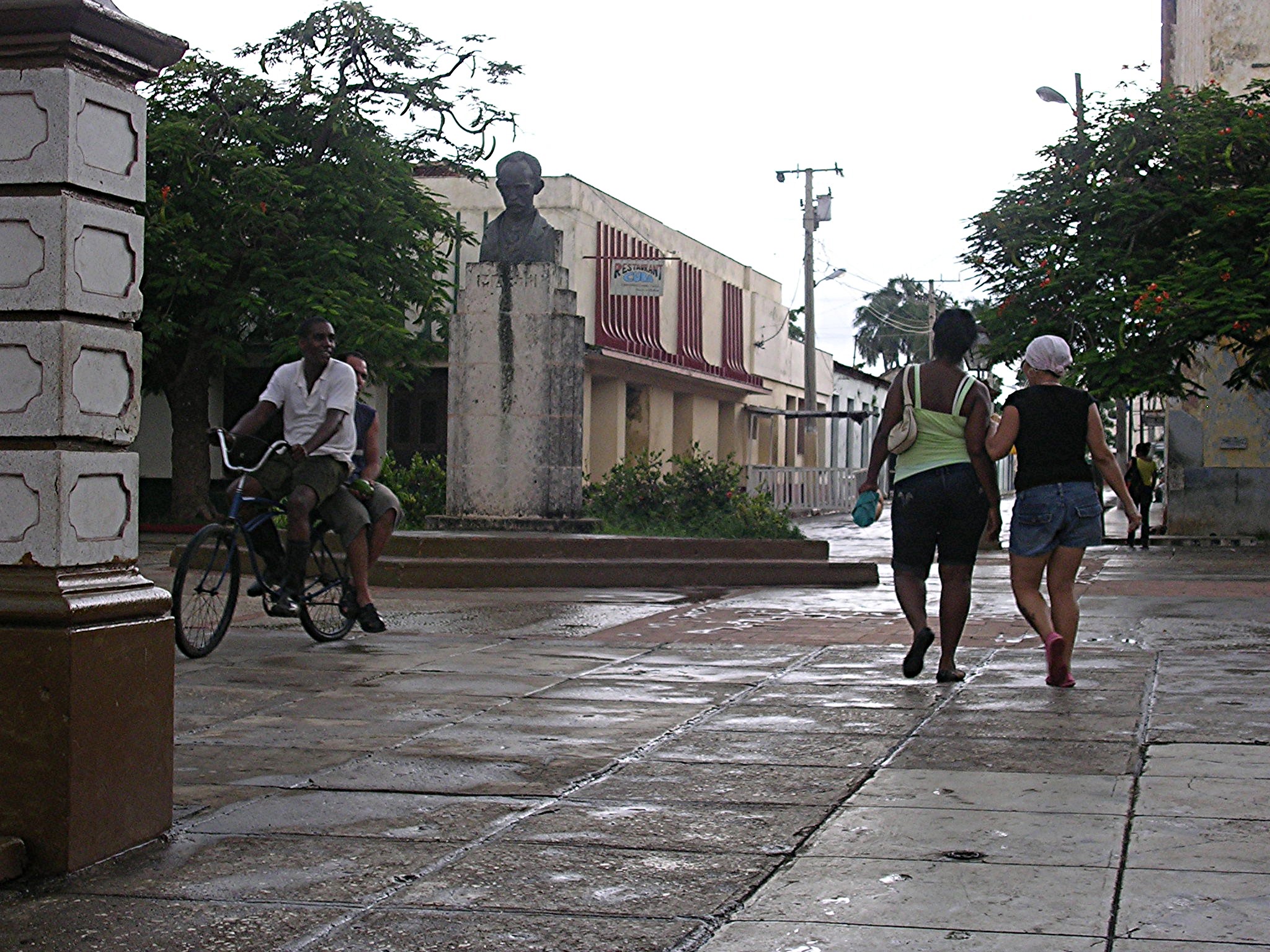
Darth-Vader-en-La-Habana-Juan-Antonio-Madrazo1-_ab-620x330

Ivan Garcia, 19 November 2015 — One hour before noon, the bus stops on Calzada 10 de Octubre are flooded with irritated people who want to transfer to other neighborhoods in the capital.

Hundreds of old cars reconverted into collective taxis full of passengers roll in the direction of Vedado or Centro Habana. The autumn heat and sense of urgency cause those waiting to despair.

Public transport continues to be a popular subject in a magical and flirtatious  city, which, in spite of its grime and ruins, will be 496 years old on November 16.

Orestes, a bus inspector, receives a spout of critical resentment from citizens who are disgusted with the precarious urban transport. continue reading

“I’m the one who has to take the ass-kicking. The directors travel in cars. But I’m on the street having to put up with people’s complaints. The worst part isn’t the poor management of the transport, it’s that you can’t see a short- or long-term solution,” he says.

In a city of two and a half million people, where only one percent own a private auto, there is no Metro and the suburban trains barely function, public bus service is vitally important.

Yoel, an employ of the sector, says that “the demand is double the number of passengers transported every day. The ideal would be to have an allotment of 1,700 to 2,000 buses. But there are barely 670 in circulation. There is a master plan out to 2020 to improve service, but I don’t think it will solve very much. In addition to the deficit in buses, there is the problem of the poor state of the streets and avenues, which cause breakdowns in the city bus service. And the vandalism of Havanans who shred the buses, destroy the seats or break the windows with stones. Ninety-eight buses were out of service because of acts of vandalism.”

Traveling at rush hour on a bus in the capital is an Indiana Jones adventure. Fights, pickpockets and deranged sexual advances. People with their nerves on the point of exploding at the least touch.

Some day they’ll have to erect a monument to the old cars that serve as taxis in the city. For the average worker, making a round trip by taxi costs one day’s wages.

But the cyclical crisis of urban transport has converted the taxis into a remedy. They carry 200,000 people daily, although not always under good conditions. Of the more than 12,000 private cars for rent in Havana, half of them don’t have the required technical specifications.

“The owners put them to work even without painting them or covering the roof. With what they earn they improve them,” says Renán, who owns an old 1955 Ford.

And yes, they all have disk players that they keep on high volume, which assault the passengers with timba or reggaeton music.

But the talkative Cubanos convert them into a permanent chronicle and a rostrum where people unload their disappointment at the state of things and the appalling government management.

Transportation is only one among many problems suffered by Havanans. The list of things that cause stress is long, and solutions are nowhere to be seen. There is a clamorous need for housing.

Just ask Zaida. She’s 23 years old and lives in a state hostel in the department of Miraflores, at the south of the city. “My house fell down after a hurricane. I lost count of the letters and futile steps I took to have access to housing. Everything remained only as promises and lies on the part of the State agencies. Staying in a hostel means living at the limit; it’s like a prison. They give you a rough time for anything. Here a simple discussion can become a matter of blood.”

In Havana, more than 3,000 nuclear families live in propped up buildings in danger of collapse. According to figures from the last Census of Population and Housing, more than 40,000 domiciles in the province are evaluated as being in grave condition. Seventy percent of these houses require total demolition.

Add to this the precarious living situation in more than 10,000 tenements of different types, the existence of 109 “transient communities” — that is, homeless shelters — where 3,285 nuclear families who have lost their homes or fear a collapse are sheltering, as well as 20,644 housing units in unhealthy neighborhoods and precarious places.

Before Fidel Castro came to power, there were two unhealthy neighborhoods in the capital: Las Yaguas y Llega y Pon. [ed. note: notorious shantytowns in Havana]. Now there are around 60. To maintain and repair housing in the capital, the Government dedicates only 86 million pesos ($3.5 million US).

This figure contrasts with the more than one billion dollars that is being invested in the construction of eight golf courses.

While a large segment of people must live under the same roof with three and even four different generations, more than 50 percent of the potable water is lost through breaks in the hydraulic system.

The Regime only refurbishes or constructs buildings in the tourist sector or the State institutions. Like the repairs of the Theater of Havana and the National Capitol: according to engineers in charge of the works, the cost will exceed 200 million dollars.

In the ancient Chamber, where the political representatives of the Republic debate, the monotone Communist parliament is expected to begin its session at the end of 2016, if it is ready on time.

Visually, some 90 percent of Havana has an architectural platform similar to the one of 1959. Only older and more neglected. It’s not hard to figure out who’s guilty.

Iván García

Translated by Regina Anavy

What Can the Opposition Offer to Cubans? / Juan Juan Almeida

Cuba’s National Assembly of People’s Power, voting unanimously, as it virtually always does.

Juan Juan Almeida, 9 November 2015 — Cuba is a country where polemics or its relative, debate, is the daily bread of artists, private entrepreneurs and intellectuals; an island where the majority of the young population are assured of being poor or having no possibility of fulfilling their dreams; a nation where the average professional suffers from a ridiculous salary; and a State where discontent between the politicians and the military is worrisome. Still, the opposition, which works for freedom and the right to establish a democratic government, has been incapable of building a plausible alternative.

Where exactly does our opposition find itself in relation to the other components of the Regime? continue reading

The truth sometimes hurts; but hiding it can bring sorrow. I understand that being marginalized and repressed for so long without pity makes it difficult for many in the opposition to accept that this isn’t the moment to exclude those who have been excluded, but to reconcile and try to cooperate with all the social groups.

I don’t doubt the eagerness or the day-to-day need for mass actions, but being the fact of seeing “securities” (State Security agents) everywhere and having to constantly be ready to defend yourself from being infiltrated by State Security makes them easily fall prey to doubt, internal disputes, the political sin of disconnecting from the people, and the clear lack of the power to put out calls for action.

In the present circumstances, being a dissident and not fighting to be in the National Assembly of People Power, they allege that they “don’t want to play the Government’s game.” I acknowledge that many may like this expression; it arouses curiosity and fascination. But today, it’s a weak statement.

We know that antagonism, in times when anything other than what is voted on is considered violence, is more difficult than war and demands new strategies.

Obviously, social pressure on the Government will increase in parallel to economic growth for Cubans. So instead of predicting both the collapse or the overthrow of the present authoritarian regime, it’s preferable to think about a gradual process of erosion, and to have an accurate and objective analysis of the growing deterioration of relationships inside the governing clan.

Let’s be realistic. What can the internal Cuban opposition offer to those inside Cuba, besides political debate, the need to improve working conditions, schools, housing, health, etc.?

Only confidence. And for that it’s essential to fight to occupy spaces in society and in the parliament, in order to, from the inside, be able to dispute the legitimacy of the governing group.

In addition, among other things, to try, to come and approach the leaders of stone; participate in the debates organized by young, fashionable teachers (in principle, free from suspicion) in places like “El Hueco del Instituto de Periodismo,* about which a well-known professor at the Higher Art Institute says:

“They are important meetings because you hear the judgment of the son who counsels the father, the suggestions of the young who claim to know more than the old, and the incredible proposals of one sparkling part of the people who, by being irreverent, allow themselves to condemn even the ruler himself.

* “El Hueco” (the hole) is a space at the Havana International Institute of Journalism. It’s surrounded by trees on a patio at the back of the school. Every 15 days a group of young trova musicians get together with Ireno Garcia, a Cuban singer, to promote trova music.

Translated by Regina Anavy

The Havana Fair: Hookers, Heat and Beer / Ivan Garcia

Cuba-Feria-de-La-Habana-_ab-620x330Iván García, 12 November 2015 — Liudmila and Sheila are prostitutes and they don’t know about business or cutting-edge technology. But a colleague sent them a text message telling them, “Come here, the yumas (foreigners) are wild.”

They put on stunning high heels, tight clothing and perfume with an anesthetizing fragrance. Their plan was simple: to prowl around the stands for Canada, South Korea, France and Germany, and see how the fishing was at the International Fair of Havana.

“I can speak pretty good English. Let’s go to each pavilion and ask about the products on display or the possibility of working in a company. When we see some foreigner checking us out, we can go on the attack,” says Sheila, who has seven years of experience in prostitution. continue reading

They were in luck. Two Spanish businessmen invited them for drinks and disco dancing that night in Miramar.  “At the least the romance will be only a joke. But it could end in a courtship and a definitive exit from the country,” reflects Liudmila, while she drinks a Bucanero beer in a temporary bar at the recently-concluded Havana International Trade Fair (FIHAV) of November 2015.

Of course prostitutes are a minority among those who visited Expocuba, the site of commercial fairs since 1989 (the first one was celebrated in 1982 with a few exhibits from Spain, Panama and Cuba).

At the end of the ’80s, just as the almost-perpetual economic crisis was beginning, you might think it wasn’t a good idea to waste millions of dollars building a space for a fair 25 kilometers southeast of the center of the capital.

Excited by what he had seen on his trip to Pyongyang in 1986, Fidel Castro wanted Cuba to also have a permanent exposition, where it could exhibit the “achievements of the Revolutionary Process.” And on January 4, 1989, Castro inaugurated Expocuba, a space much too large for an economy that was shrinking.

The disintegration of the USSR caused the loss of millions in subsidies, which pointed out the deficiencies in local industry. Ricardo Ortiz, a retiree who for 10 years worked in a food import business, says that Expocuba was transformed into a children’s amusement park and a place where, in the hard years of the Special Period, people could find products.

“As transport was scarce, you had to go on bicycle, and when you got to Expocuba, they gave you the right to buy two packages of fried chicken, 10 breadfruits and flavored yogurt. This was in the same epoch when, for lack of fuel, oxen were used for plowing instead of tractors,” remembers Ortiz.

In the Cuban autumn of 2015, Expocuba shows an obvious deterioration. On one afternoon, a strong downpour obliged hundreds of people to seek refuge under the pavilion roofing. “It rained more inside than outside,” said a Spanish tourist. Visitors to the Fair complained about the lack of informative posters.

“Everything had been organized in a slapdash way. You walked around disoriented, not knowing where the exhibit you wanted to see was located,”  says Juliana, an English professor, who was looking for the South Korean stand to find the latest version of the Samsung Galaxy.

When the Havana Fair opened its doors to the public on Friday, throughout the neighborhood dozens of private and collective taxis were calling out their services. For Cubans, a round trip could cost 40 CUC (roughly $40 US).

“For a foreigner, 60 CUC or more,” points out Reinerio, the owner of a ramshackle Lada 2105 from the Soviet era. “But I offer a price of 20 CUC, since my car has a gas engine. Fewer people came to this fair than before.”

The suffocating heat invited people to drink cold beer in the bars, cafeterias and restaurants located in Expocuba. At a glance, it was apparent that a lot of attendees were lunching on Creole food or drinking beer, which ran through the pavilions.

According to Marcia, a Fair employee, “the most happening stands were those of South Korea, Canada and Japan. A few businessmen and book publishers from the U.S. exhibited their wares. For 2016 we expect an avalanche of American businessmen.” When you inquire from foreign businessmen about business prospects in Cuba, opinions go from optimism to prudence.

An official from a Swiss tourist agency explained that they now have a permanent office in Havana. “We might not make a big profit right now. But you have to open a way, occupy a space. I’m afraid that when the Americans arrive, the businesses of other countries are going to have to pack their bags.” An investor, also Swiss, is even more bold and claims he’s building a high-class hotel in the Cojimar district.

With more doubts than enthusiasm, Fabian Koppel and Jakub Brzokoupil, from the German firm Optimum, which specializes in industrial machinery, say that in 2012 they did business on the Island. “But because of various difficulties we had to leave. In Cuba everything is very complicated. But our company thinks that now there are better possibilities,” says Fabian.

The perception among businessmen is that 2016 could be a decisive year. A manager of Egyptian origin from Mercedes Benz hasn’t lost hope. In 2014 they sold only 30 multi-purpose trucks to Cuban companies, and in 2015 that went up to 110. As for luxury cars, from 25 in 2014, they hope to sell 200 in 2016.

This is timid growth, but unofficial calculations show that when the State floodgates open, sales can shoot up. Although a Cuban with an average monthly salary of 23 dollars could never buy a car valued at 70 or 80 thousand dollars.

Liudmila and Sheila, the prostitutes from Havana, didn’t lose the opportunity to take a selfie in front of three Mercedez Benz, as if they think it’s possible. “But we would never buy a car in Cuba,” they say, smiling.

Text and photo: Iván García

Translated by Regina Anavy

Cuba: Waiting and Hoping for the Cruise Ships / Ivan Garcia

Crucero-académico-M.V-_ab-620x330Iván García, 9 November 2015 — One warm evening in September, a scrapping brigade arrived from Habaguanex* and, in a little more than two hours, dismantled the aluminum tubes and awnings of three open-air bars on the Avenida del Puerto, where Havanans and tourists drank beer or ate fried chicken among the ambling musicians and prostitutes on the hunt.

The smell of fritanga** combined with the street-sellers’ cries and the nauseating odors from the contaminated Havana Bay. The spillage of waste matter was the pretext for the mandarins, who control the strongbox in the old part of the city, to disassemble the gastronomic shed, a couple of outhouses and, in passing, put some three dozen workers out of work. But the real reasons were something else. continue reading

Let’s call him “Mario,” a bureaucrat from the Habaguanex corporation, and he says: “The businesses adjacent to the port are controlled by military companies, who receive rent and fees from the old warehouse of San José, which has been converted into a handicraft market and even hostels, cafes, restaurants and shops. There is a master plan*** for converting the port into a tourist plaza that would offer recreation facilities and services for the cruise ships.”

In 2014, another old market in the port zone was transformed into a beer hall. And the inauguration of a maritime esplanade just in front of the Alameda de Paula is imminent.

They also have repaired and expanded sections of the road, planted palm trees and put up modern lighting on the street median. The area where the mobile bars were has been cleared to have more space for future tourists.

“They’re going to relocate them to other sites. They don’t want the view of the Bay entrance and the Christ of Casablanca to be obscured. By 2016 they hope to have more than 70,000 tourists from the cruise ships,” pointed out Mario.

The Regime is betting a lot on cruise-ship tourism in Cuba. President Obama, according to his roadmap, is interested in empowering private entrepreneurs and regular Cubans. But to the autocracy, only those businesses where the State is the manager are important.

Or to be more exact, the military businesses. Luis Alberto Rodríguez López-Callejas, Raúl Castro’s son-in-law (although some rumors indicate that he separated from Raúl’s daughter, Deborah), is a kind of tropical Martin Bormann, who handles the treasure of the business network of the Army, which controls the holding company GAESA****.

There is no way to probe into or know the volume of money they handle and how these funds are used: It’s a State secret. The generals, now converted into businessmen, have substituted white guayaberas for their uniforms. Eighty percent of the Council of State and the principal posts in the national economy are controlled by the Armed Forces.

After the U.S. Department of Treasury granted licenses to authorized cruise companies so they can go into Cuban ports, the falcons rubbed their hands together.

Raúl Castro is an expert at camouflaging his intentions. He also has been clever in dismantling, stone by stone, his brother’s pernicious voluntarism. He has changed the furniture, but he keeps up the décor.

Like Fidel Castro, he has boosted parallel mechanisms in the economy and the private reserves where the budgets are not discussed in the docile local parliament.

Castro the First was a staunch enemy of cruise ships, and he prohibited them in 2005. He argued that a horde of drunken tourists with little money would dirty up the Bay (even more than it is) with beer bottles and other garbage.

But Commando Raúl Castro thinks differently. The mid-term plan is for U.S. tourists to become an engine of growth that will catapult Cuba into the greatest tourist spot in the Caribbean.

But the present hotel infrastructure isn’t satisfying demand. “Every time a cruise ship comes into port, the beer, rum and mineral water disappear from the shops in Old Havana. We’re hallucinating if we think that four or five million Americans will come to the island, when we haven’t invested enough in lodging or services,” points out Fernando, a tourism officer.

December 17, 2015 — the day the United States and Cuba announced a resumption of relations — left in shreds Castro’s propaganda apparatus. For decades, it sold the narrative that the Revolution was of the people, by the people and for the people.

But a group of measures dictated by Raúl Castro put it into question. If anyone has been the big loser from the timid economic reforms of the last eight years it’s been the most poor, especially the elderly.

Without blushing, the olive-green autocracy has implemented unpopular measures that harm the population.

The Customs tax rates, the stratospheric assessments on commodities sold in the dollar stores and the favoring of cruise-ship tourism over ferry transport between Havana and Florida, which would permit a large transfer of assets and alleviate the poverty of many Cuban families, are evidence that the Regime governs only by thinking about its corporate benefits.

The White House has issued more than 15 “specific licenses” for passenger ferry service to Cuba, but they can’t operate immediately because of a lack of infrastructure on the island, sources from the Ministry of Transport confirmed at the beginning of October.

In a clear stalling tactic, the authorities allege that they need time to create an adequate infrastructure to receive ferries. José Ignacio, an expert in port services, thinks differently.

“It’s a contradiction that the Government says it doesn’t have the infrastructure to receive ferries and jumps for joy at the future arrival of cruise ships. The reality is simple: the cruise ships constantly leave behind dollars in cash. The ferries, to be more economical and transport up to 200 pounds per passenger, would boost trips for Cubans located in Miami, who would benefit their relatives with their packages. The official strategy is that they send all the money they want, so that people are obligated to buy in the State shops,” says José Ignacio.

Quietly, a State mercantilism is being built in Cuba, governed by silence and the lack of transparency. The worst possible capitalism.

Photo: Academic cruise ship M.V. Explorer from the United States. After a journey through 17 countries, the final destination for the 624 students coming from 248 U.S. universities was the Port of Havana. Taken from Martí News.

Translated by Regina Anavy

Cuban Journalists are in No-Man’s Land / Ivan Garcia

Foto-de-Elaine-Díaz-tomada-de-Periodismo-de-Barrio-_ab-620x330Ivan Garcia, 31 October 2015 — It seems much time has passed since the ’80s, when a stern official from State Security, dressed in civilian clothing, solemnly intimidated us, a group of fresh youngsters, who were studying at La Vibora’s pre-university.

I was 16 years old. I don’t remember having felt more fear in my life than that afternoon, when the agent showed us his document with a red stamp and green lettering: DSE. The initials of the feared Department of State Security.

The guy manipulated our youthful fear like an expert. Perhaps he learned that in a KGB counterintelligence academy, or in the STASI of Marcus Wolf. continue reading

He asked for discretion from the school director, known as “the Fly,” more intransigent than an Afghani Taliban. And he led us half-dozen kids with intellectual airs like a submissive flock toward the school library.

Our crime was watching movies and documentaries not shown in Cuba on Betamax videos, reading the prohibited books of Mario Vargas Llosa and Jorge Luis Borges and brushing up on Herberto Padilla’s poems.

The severe reprimands still resound in my ears. Some of us were crying and others were begging for forgiveness for their “sins.” The man, like someone all-powerful, waited to hear my plea for clemency.

I don’t know how I armed myself with valor before such authority, but with a trembling voice I let out a tirade about personal liberty and reading what one wanted.

“Can you imagine what would happen if your mother heard about this?” (She was an official journalist.)* What you’re reading is counter-revolutionary, and in Borges’ case leans toward Pinochet’s dictatorship,” the political policeman told me.

Before the “evidence” and, fearing that my mother would know, I also called up a mea culpa. Some years later, in 1991, I was detained for 15 days in a walled cell in Villa Marista**. Probably my libertarian sedition cost my mother her job at the Cuban Institute of Radio and Television (ICRT) and in 1995, she left official journalism to write for Cuba Press, an alternative press agency.

She had a catharsis: after 20 years of being an independent journalist in Havana, she knew about the pressure that all those who disagree with the Regime’s narrative suffer.

There are two paths to take: suffer or shut up. And two ways out: continue living in your country like a zombie or scurry off to another nation. One is free to choose. No one has to be a martyr.

In Cuba there are laws that sentence you to 20 or more years in prison for writing without permission. But the times are different, even if the same people are in power.

The Castros’ autocracy has passed from being a totalitarian system, where the State controlled the flow of information, cinema, literature and any other intellectual facet with an iron fist, to an authoritarian nation that is opening slowly, with one foot anchored behind the door.

The Soviet paranoia, the acts of repudiation — veritable verbal lynchings — the wacky accusations and the shameful spewing of insults directed at someone’s integrity still continue.

But the desire of many communicators to express their way of thinking through a blog, a website or a digital newspaper has grown thanks to the new technologies.

When, at the end of the ’80s, ex-State reporters like Rolando Cartaya and Tania Díaz Castro started spreading the news generated by pro-human rights groups, they defined a road that Indamiro Restano, Rafael Solano and Raúl Rivero would follow later.

In an error of calculation, Fidel Castro’s government thought that incarcerating 27 free journalists in March 2003 would curtail the independent press. What happened was the opposite: it multiplied.

Now there are dozens who, on their own and at daily risk, report from every province. Furthermore, official journalists have to take into account the fact that these reporters collaborate with the foreign media. Or they are like Elaine Díaz, who has founded her own weekly, Journalism from the Barrio.

The difference between writing freely and editing boring news about supposed economic growth is abysmal. In their eagerness to head off the alternative bloggers who were led by Yoani Sánchez, the Regime authorized official and professional journalists to open blogs.

The plan was to create on the Internet a sphere for the Battle of Ideas***. It generated a full network of bloggers. There are those who are trained and vitriolic. Others are respectfully obstinate and convinced about the oliive-green Revolution. Or they are critical about the state of things, although their intent is to perfect the System.

But autonomy and liberal thinking engender distrust in a country where the orientation always comes from a central command post. The Government lost focus again.

There is no guided freedom or half-freedom. Binary education of “revolutionaries” against “dissident mercenaries” is very simple. But in the actual panorama of the Island, the “enemy” isn’t the dissident movement. It’s the discontent of a large segment of Cubans because of inefficient institutions, a crazy economy and corruption.

So journalists who are honest take their own pulse on reality. They aren’t official or independent. They work for the people.

Iván García

Photo of Elaine Díaz taken from “Fear of the Rain,” one of the articles with which Journalism from the Barrio had its debut, on October 18, 2015.

Translator’s notes:
*Tania Quintero Antúnez, who has lived in Switzerland as a political refugee since 2003.
**Formerly a Catholic schools for boys, under the Revolution it became (and remains) a prison, known for detaining political prisoners.
***Fidel Castro’s effort to reinforce his ideology and power.

Translated by Regina Anavy

Reimbursement is Important / Fernando Damaso

Fernando Dámaso, 23 October 2015 — In Cuba, unlike other countries, public services are totally centralized by the State through its different companies: electricity, gas, telephone, water and sewer, municipal and other.

Being part of the same thing, these entities are considered untouchable, and they do things and undo them at their own whim, without considering the effect on citizens and businesses, State as well as private. Thus, they connect and disconnect the electricity according to their interests. The same thing happens with the gas service, telephones and drinking water. continue reading

Furthermore, in order to do maintenance and make repairs, they break up the streets and sidewalks; they interrupt transit and create multiple nuisances. Repairing what’s destroyed takes a long time to execute, and, in general, it’s bad quality. All of this causes economic loss to all types of businesses, for which no one answers.

It would be good if these consequences, when they aren’t caused by natural phenomena, were reimbursed economically by the companies causing them, by handing over a sum for the harm inflicted on a factory or a business: the value of what they lost when they had to stop producing or selling.

In addition to being just, this would oblige these companies to be more efficient in their work. Presumably, where they presently take 10 or 12 hours to repair a breakdown, with a brigade in which few work and many talk or lounge about, if they had to make reimbursements, they would see themselves obligated to do the work in less time and with only the minimum, necessary personnel. Furthermore, the result of the work would be better quality, since doing it poorly would affect the companies economically.

It’s something to think about; although, personally, I think that many of these services could be leased out, with less cost, better quality, less time and more efficiency, by private companies that contract for them, a general practice with magnificent results in many countries.

Translated by Regina Anavy

U.S.-Cuba: Obama 3, Castro 0 / Ivan Garcia

Castro-y-Obama-en-Nueva-York-_ab-620x330Ivan Garcia, 7 October 2015 — According to Francisco Valido González, 47, a dissident who works in a transit bus cooperative, his association, in theory, can ask for credit from a U.S. bank in order to acquire new buses.

His cooperative’s buses have more than 200,000 kilometers on them, and 15 years of use. In his narrow apartment, a stone’s throw from Calzada de Güines, in the municipality of San Miguel del Patrón in the southeast of Havana, he keeps the auto parts he bought in the informal market under the bed where he sleeps.

From overuse of the buses, breakdowns are constant. “Almost always, between 10 to 12 days a month, I have to stop because of a breakdown,” he told me in December 2014. continue reading

Taking a page from Barack Obama’s book on “empowering small businesses and private workers,” Validio wrote a missive to the Minister of Transport soliciting authorization for his cooperative to obtain credit, which would permit it to buy 50 new microbuses.

Nine months later, he’s received silence for an answer. Since 17 December 2014, when both nations surprised the world with the reestablishment of diplomatic relations, the opinions of Cubans on the street have gone from exaggerated expectation to lassitude and pessimism.

Hundreds of business owners rubbed their hands in anticipation of the new panorama that was approaching. Noelvis, a mechanic in a bus cooperative on Avenue Santa Catalina, made grandiose plans.

His cooperative had been visited by Thomas Donohue, president of the U.S. Chamber of Commerce. “If the Government approves, our cooperative can request credit from a U.S. bank and buy a couple of car washes and modern tools,” he commented last March.

Six months later, Noelvis isn’t so optimistic. “The game of dominoes is stalled. Up above (the Government), they’re not getting off their high horse. They don’t even answer our questions. Total silence.”

Francisco Valido drives a collective taxi 12 hours a day, and in spite of earning 2,500 Cuban pesos a month (a little more than 100 CUCs — equal to about the same in US dollars), to make ends meet at the end of the month he repairs footwear for the residents of the neighborhood.

In the cooperative, Noelvis earns a salary of 2,000 Cuban pesos (about 80 CUCs). “But it’s not enough. Because of the high cost of living in Cuba, you need at least 400 CUCs a month to be able to have two meals a day and pay the rent, light and telephone.” Outside work hours, he fixes old American and Soviet cars. This extra money allows him to live without big worries.

David, a computer specialist, has been embroiled for the last three months in bureaucratic procedures to open a private cybercafe in Havana.

“My project was to buy 12 computers with credit that my family in Miami was going to arrange with a computer company in the U.S. In the cafe there would be a bar. Everything would be air-conditioned with a space for nightly downloads of jazz and trova music. It would have Wi-Fi, and I’m sure that the people who connected sitting on the sunny sidewalk would appreciate it.”

If you walk around Havana and chat with private entrepreneurs, you will hear more or less the same stories. Even the cooperatives, legal entities that appeared under the mantle of the State and which theoretically can invest with foreign companies, are under the governmental magnifying glass.

Marino Murillo, the obese czar of the island economy, has expressed caution in the approval of new cooperatives. “In fact, the Government put the hand brake on,” says a cooperative member in Havana.

On two occasions, December 17, 2014, and September 18, 2015, Obama released a range of measures to dismantle, brick by brick, the codified financial and commercial embargo toward the government of Havana.

Washington emphasizes the spread of Internet service, telephone calls, construction materials, and sea and air travel. The White House is interested in favoring small businessmen, and in allowing Cubans access to new technologies.

But the Palace of the Revolution is not opening its mouth. The shifty ancients in the Government observe the course of events without opening a door or a window.

The Communist regime is interested only in transactions with State companies, 75 percent of which are administered by the military. After nine and a half months of the new agreement between the two countries, which live their particular Cold War, the harvest is meager.

IDT, a U.S. telecommunications company, negotiates with ETECSA, its Cuban State-owned counterpart; Airbnb allows the rental of houses in Cuba from the U.S., and this has increased the number of flights and American visitors to the Island.

But General Raúl Castro keeps the ramparts fortified. There is no Government strategy for private workers to get credit or buy food and foodstuffs from the neighbor to the north.

On the financial terrain, the field continues clogged with the bizarre double currency system, which complicates any commercial transaction. In an arbitrary manner, the Regime implements an artificial exchange rate with the dollar, which makes it more expensive for travelers from the U.S.

The only move on the chess board that the military Government has is giving bombastic speeches and asking for something without offering anything in return.

Up to now, neither Obama nor Pope Francis has been able to handle it.

PHOTO: Raúl Castro and Barack Obama, during their meeting on Tuesday, September 29, in New York. Photo by Doug Mills, The New York Times.

Translated by Regina Anavy

How Have Cubans Benefited Since December 17? / Ivan Garcia

"Now you are a saint"
“Now you are a saint” (Still from the video below)

Note from TranslatingCuba.com: The video is not translated into English. The gist of message (other than what is obvious from the images) is that things in Cuba haven’t changed for ordinary people since the announcement of the reestablishment of US-Cuba relations.

Ivan Garcia, 16 October 2015 — Seated at the helm of his polished 1958 Impala convertible, Eduardo Colón, a private taxi driver, listens to Adele’s concert on his player, while he waits for the marriage of an American couple outside the Saratoga Hotel, very close to the National Capitol in the heart of Havana.

The couple arrives with relaxed tourist faces, wide-brimmed sombreros, video camera in hand, and before climbing aboard the ancient Chevrolet, they take a selfie with the car in the background. continue reading

If anyone has benefited from the more than 100,000 Americans who have visited Cuba since the December 17 thaw, there’s no doubt that private taxicab drivers are at the top of the list.

“Speaking economically, since the Day of San Lázaro* last year, things have gone better for me. Especially with the Americans. For a couple of hours’ drive around the city, they pay me up to 60 chavitos (65 CUCs, “dollars”), Eduardo pointed out.

The owners of homes for rent and private restaurants in the medium- to high-price range in the usual tourist zones in the capital are earning more money.

“I rent three rooms at 30 CUCs a night. And in 2015, of the 17 people who rented from me, 11 were from the U.S. When the bonanza begins, the infrastructure of hospitality, gastronomy and transport is going to collapse. For me I’m doing well, but I admit that the markets continue to be short on supplies and telephone calls to the U.S. are still very expensive,” said Elsa, the owner of a spacious house.

For Onilio, almost ten months after the Americans, neighbors to the north, stopped being enemy número uno, the balance of positive things is little.

“I work hard at selling illegal cigars to tourists. I notice that there are more Americans, who are cooler and who help the clandestine cigars-and-rum business. But it still isn’t very good,” said a seller in the Hotel Inglaterra vicinity.

Kirenia, a prostitute, doesn’t think that Amercian affluence has caused an increase in prices. “It’s still the same: 50 or 60 bucks for a night. If the client looks like he’s well-heeled, you can ask for a hundred. But up to now the Americans I’ve seen aren’t coming in waves to link up with whores.”

For most of the people interviewed, the scene hasn’t changed too much. “It’s more peel than potato. For those who do business downtown, where the rich foreigners are, things are going better. But for those who live far from the center of Havana, life is the same,” states the proprietor of a private bar.

Still Yasmani has noted benefits. He has a bar that offers tapas, and he rents out five rooms with a spectacular view of the Malecón for 35 CUCs a night.

“I do business with Airbnb, and I almost always have clients,” he affirms. The State hotels, mainly administered by military companies, can’t complain either. “This year we are cheek to jowl (full), comments Eusebio, a receptionist at a hostel in Old Havana.

In restaurants like Los Nardos, a joint venture between home hotels and the State at kilometer zero** in Havana, it’s almost impossible to get a reservation for dinner.

“I notice there are better opportunities. Although at the moment they haven’t fallen into my pocket. I’m still earning 10 CUCs a day, like always,” says Joel, the doorman.

Those who haven’t seen any benefit are the majority of Cubans who own nothing. “I’m still earning the same shit (550 pesos/month, around 23 dollars) as before December 17. And as far as food goes, buying it takes almost my whole salary, and when I need a bottle of cooking oil, I have to save in order to buy CUCs so I can get it in a “shopping”***,” notes Manuel, a bus mechanic.

A wide segment of the population complains about the shortage of food and the sky-high prices. “No one understands that now that we Cubans can buy food from the U.S., the markets are empty,” says Rosa, a housewife who prowls the shelves of Ultra, one of the large dollar stores in the capital.

According to a recent article by Juan Juan Almeida in Martí Noticias, in a journalistic investigation among foreign businessmen in Cuba, the Regime has a silent strategy to reduce the buying of food and merchandise in the U.S. as a way of putting pressure on the U.S. business lobby to force a more energetic campaign for repeal of the embargo.

Almost 10 months after December 17, not too many benefits are felt in Cuba. The olive-green autocracy continues without implementing a road map that would please private workers, to whom, supposedly, Obama’s measures are directed.

The official sinuous politics awakens resentment and mistrust in Cubans on the street. “Before, the Government complained that we couldn’t access the Internet because of the blockade. Now U.S. businesses offer us free Internet, and the State says that they prefer to be in charge. They are interested only in exploiting Cubans with steep prices and abusive taxes,” comments Reinier, sitting on a sidewalk under the sun on Calle 23 in Vedado, while he tries to communicate by IMO**** with his relatives in Florida.

A few meters away, Diosbel waits in a Havana Tour office to buy a ticket to Miami. “We thought that after December 17, the price of airline tickets was going to go down. The flight to Miami is as expensive as the one to Colombia. And the Government doesn’t give us any news about the ferry. They’re saying that the U.S. Post Office is going to negotiate with the Cuban Post Office. What for? Those sons of bitches only permit you to send something that weighs one and a half-kilogram, and if you go over, each kilo costs 20 CUC. The reestablishment of relations hasn’t brought anything that’s good for Cubans,” he says, annoyed.

In Havana opinions are divided. Some believe that in 2016 gaps will inexorably open up, and there will be better conditions for those Cubans who have only coffee for breakfast and who don’t receive hard currency.

Others are more pessimistic. And they’re certain that the Regime won’t move its chess pieces until the Americans lift the embargo. And if the Regime is good at something, it’s inertia.

Translator’s notes:
*One of the more popular saints in Cuba, venerated on December 17.
**The location from which distances are measured and from which you can set your odometer, usually in a capital city.
***Special stores that take only Cuban Convertible Pesos, which can be bought in exchange for Cuban Pesos; these stores carry food items not found in the Cuban Peso shops.
****Popular program for audio and video chat.

Translated by Regina Anavy

The United States Continues Opening the Door to Cubans / Ivan Garcia

Cuban woman watching Obama on TV. Source Galicia

Ivan Garcia, 10 October 2015 — Dressed in black, a young and elegant female officer from the Consular Section of the U.S. Embassy in Cuba, who didn’t want to be identified, met on October 2 with ten Cuban journalists, official and independent, to chat about the new Program of Diversity Visas for 2017.

Beginning October 1 until November 3, an open lottery will remain in effect, administered by the Department of State, which will offer permanent residence to those people who fulfill the strict requirements for qualifying.

The requirements to participate are simple: be a native of one of the eligible countries — among which Cuba is now included — and have an approved baccalaureate or a minimum of two years of work experience. continue reading

The candidates in the program are chosen randomly by computer. Registration for the 2017 Diversity Lottery is carried out only through the Electronic Diversity Visa Lottery.

Although the elegant woman didn’t know the recent statistics of Cubans who arrived in the U.S., legally or illegally (up to September 23, the rough figure was 55,000, including some 20,000 approved for family reunification and close to 34,000 who arrived illegally in the U.S. under the protection of the Cuban Adjustment Act), she indicated that this strategy is promoted by Washington and Havana in order to encourage safe, legal and orderly emigration for people who don’t have family in the U.S.

Friendly, with that innate capacity that some U.S. politicians and managers have for communicating with the media, without giving anything away and smiling at loaded questions, the officer stoically withstood a photo and video session in a salon of the Embassy, flanked by the stars and stripes and a photo of Barack Obama.

Forty-eight hours after the press conference, the news spread like wildfire   throughout Havana. In a short time, I received some twenty phone calls from close friends gathering information.

I left for Old Havana. In a narrow and dusty alley, a group of adults and young people were conversing about the new lottery. “The Americans went back to opening el bombo [The U.S. lottery] although this time it’s a global lottery,” commented Josuán, who learned about it “because now I connect to the Internet every day in the Galiano wi-fi zone.”

Raudel, a private entrepreneur without relatives in the U.S., entered his data Saturday afternoon on the registration form. “They ask for a ton of information. But it’s easy. In the ’90s, I enrolled several times in el bombo, when it was exclusively for Cubans, but I didn’t have any luck. Now we’ll see. I believe it’s a good option for those who, like me, don’t have family on the other side and aren’t so desperate that we would throw ourselves into the sea on a raft.”

Lourdes, an engineer, is waiting to fill out the form until next week. She has access to the Internet at work, but she feels “frustrated and without a future. I’m going to test my luck. It’s like playing the bolita [An illegal lottery, very popular in Cuba]. If I enter the lottery I might win; if I lose I’ll continue trying.”

According to a diplomatic source who requested anonymity, this is the first of programs that, in the future, will be offered by the U.S. Government, so that Cubans can opt for a safe emigration and obtain temporary study or work visas.

Abel, a colectivo* taxi driver, views the good news from another perspective: “Now Obama is moving the island North. It’s painful to see how most Cubans want to leave. If the emigration doors keep opening, Castro and his henchmen will be the only ones left.”

The way we’re going, Cuba will soon be empty.

*Translator’s note: Colectivos (collectives) are shared taxis following a fixed route.

Translated by Regina Anavy 


Camajuani in Suspense over Corruption / Juan Juan Almeida

1443142995_camajuanensesJuan Juan Almeida, 24 September 2015 — Cuba is trying to silence a national “explosion” of great intensity, which implicates officers of the Interior Ministry (MININT), the Ministry of the Armed Forces (MINFAR), the Cultural Goods Fund (a Cultural center promoting and selling art and handicrafts), the National Bank of Cuba, foreign businessmen and artisanal shoemakers in the Camajuaní municipality of Villa Clara.

According to sources inside the National Prosecutor’s office, one of those implicated was surprised overseas by the news, and in order to evade justice, prefers not to return.

Fraud, falsification, bribery, extortion, contraband, abuse of authority, illicit enrichment, tariff violation, tax evasion of the National Tax Administration and influence peddling are among the presumed crimes for more than 50 people in different training centers. continue reading

The estimated amount of bribery charges exceeds five million pesos (US$188,679) and is expected to continue being sniffed out; right now there’s an impasse in the legal process.

By decision at the highest level of Government, the affair acquired a “character of secrecy” in order to not tarnish His Holiness’s visit to the island, to not give a bad impression to possible investors, and, furthermore, because it involves several officials whose names don’t appear on the list of those implicated.

A BIT OF HISTORY

Camajuaní is a small municipality, founded in the 19th century, located in the northeast of Villa Clara, right at a crossroads and railroad lines. This easy public thoroughfare converted it into a settlement for merchants and traders.

Because of this, decades of a planned economy and “revolutionary” experiments (half revolutionary, half communist) didn’t manage to keep the entrepreneurial spirit from passing, like DNA, from generation to generation.

In Camajuaní, the footwear industry is the local engine of growth. So an important number of artisanal shoemakers are members of the Cultural Goods Fund, a State institution that has the peculiarity of permitting artisans to break the State’s monopoly on imports.

The artisans in the Fund can leave Cuba and buy raw material, machines and/or tools to use in production; they can import quantities of material from specified countries by making use of a special document called the “Importation Document;” and they can sell their products to people, businesses and/or ministries.

This may seem simple, but no: This sector of Cuban entrepreneurs also has to face the general corruption in a narrow legal framework and a widespread social prejudice. It’s very easy to offend when almost everything is prohibited.

So, faced with increasing demand, these artisans, in order to expand production, and because State procedures are so cumbersome, falsified the Importation Document.

Others, more astute, began to alter the import permit and their productive capacity by bribing Customs bosses and agents, MININT officials and important executives of the Cultural Goods Fund, who permitted them, in exchange for green bills, to change the classification “artisanal machinery” to “industrial equipment.”

A secure market. The boots bought by the Armed Forces and the Youth Labor Army normally are made by COMBELL, a depressed company that tries to guaranty a supply to the military.

But when this isn’t achieved, a practice that appears premeditated, the Armed Forces impresarios open up a bidding in which the artisans participate.

The Cuban authorities presume that these operators, now in prison, won the bidding after buttering up those in uniform with decision-making power, along with National Bank officers, who, after receiving a commission, gave preference to the Fund.

What’s bad is that the private workshops that gave a living to a good number of people, including former workers from the health industry, who before earned a laughable salary and, today, as private individuals, can earn 100, 150 and even 200 pesos daily, will have to close for lack of raw material; it’s only a question of time.

The Camajuaní municipality has a population of under 60,000 inhabitants. It’s worrisome to know that an important part of them will be left unemployed; and, logically, this will cause major problems.

Translated by Regina Anavy

El Sexto is Free! / Somos+

José Manuel Presol, 21 October 2015 — Yesterday we were thrilled to hear the news. Several media outlets have been in touch with the Cuban citizen, Danilo Maldonado Machado, and he himself confirmed it: He’s free and there are no charges!

Right now Danilo isn’t just any Cuban citizen. He’s known artistically as “El Sexto” (The Sixth), and he just spent 10 months as a prisoner. Ten months for having tried, only tried, to stage a public performance of his art, which someone considered offensive, and for which they detained and imprisoned him without charges. Ten months in a punishment cell, false promises of release and confronting injustice with the only weapon he had: a hunger strike. continue reading

Danilo, we repeat, isn’t just any Cuba citizen. He wasn’t in prison for releasing two pigs with the names Fidel and Raúl on their backs. He was in prison for defending his right of free expression. For defending my, your, our right of free expression. Everyone’s right of free expression.

But Danilo wasn’t alone. Hundreds, thousands of Cubans raised the protest inside and outside Cuba. They demanded freedom with their voices, their letters, the Internet, new technologies, with every means within reach. They got prestigious organizations like Amnesty International to join the petition for release and to name him as a prisoner of conscience.

Finally he’s free. We don’t deceive ourselves: Tomorrow he could still be detained for any reason. Also for any reason, he could be forced to leave Cuba. The tyranny continues, but there are four things we should keep in mind:

He obtained his freedom with words, formal protests, signatures by computer,  the cell phone, and he obtained it peacefully.

He obtained it through a common objective for many, very many, Cubans and, it is known, without the participation of any foreign government.

He obtained it through the strength, even though dispersed but every time more organized, of those thousands of Cubans.

For the first time we, with our struggle, have made the present Cuban Government surrender on something basic. Up to now we have obtained other surrenders: when the Mariel Boatlift crisis happened, during the Maleconazo, etc., but there always have been surrenders of the type, “Let the worms who want to leave go!” said Fidel. Now we got them to surrender, setting someone free inside Cuba, one of our brothers. They, the Marxists, know that this wasn’t a quantitative surrender; it was qualitative!

Can this be a turning point? Let’s hope so! Can this be a sign of weakness? Let’s hope so!

This won’t be the last battle, but it’s one we won. There will be many more. We’ll win some and lose some, but this shows us the path to follow: clear goals, demands through peaceful means, confrontation through words and without violence.

Let’s prepare ourselves since the battles are going to come, are coming, in days, weeks, months and decisive years. Change is nearer every time, but we must keep the words present that our companion, Joanna Columbié, reminded us of a short time ago in this same atmosphere, referring to our Proclamation of Independence on that tenth of October:

“Perhaps the blood we have to offer in this struggle isn’t physical, like that of others, but we also are ready to follow their example and obtain a triumph that, as Martí said, costs the same as all triumphs: “…blood, from the veins or from the soul.”

Translated by Regina Anavy

Holguin: Cholera and Dengue Fever Patients Kept Out of Sight of Pope / Juan Juan Almeida

Juan Juan Almeida, 31 August 2015 — For the Cuban Government, the level of job insecurity, the index of diseases (above all those provoked by the deterioration in the control of hygiene, epidemiology and health) is politically sensitive information that must be hidden or, at the very least, disguised.

For that reason, and because of the epidemiological situation that exists today on the island, all the institutions and organisms of the central administration of the State, the Party and the Government worked tirelessly to ensure that the visit of the Supreme Pontiff would be a success, and this included camouflaging that which couldn’t be exposed. continue reading

His Holiness Pope Francis helped to forge the historic rapprochement between the United States and Cuba. His pastoral visit to Havana, and even more his later travels around the island, awakened special interest in all sectors of the country.

It was, undoubtedly, a delicate moment that was calculated with the precision of a Swiss watch, so that no one, beginning with the head of the sacred Catholic Church, nor any members of the retinue accompanying him, including the foreign press and parishioners, would receive more information than what was previously determined.

The priority was to hide what was ugly and shameful for the Cuban Government’s propaganda. The alarm went off when the Government-Church Commission designed the itinerary for the papal visit.

Immediately after they knew of His Holiness’ plans, on Monday, September 21, to visit the province of Holguín, there was an urgent “flash,” and as required by the Constitution of the Republic of Cuba for disasters, the Council of Defense had a meeting, and in coordination with all the competent authorities in every corner of Holguín, ordered that an exhaustive analysis be done of the health situation in the province.

And later, armed with the evidence of colossal chaos, even more with the need to hide their own responsibility, they elaborated a plan of action with specific guidelines, not to solve the problem, but to cover up that which must not be shown.

Poverty can’t be seen when it’s generalized, but the overwhelming number of those sick with cholera and dengue in Holguín’s Vladimir Ilich Lenin General Hospital, jumped out like dynamite in the middle of hostile terrain.

Controlling that immense truth necessitated something more than whitewashing the facades of the streets through which, presumably, the Holy Father’s caravan would pass. So, not to take any chances, it was also ordered that the patients be hidden by moving them to less accessible and, of course, less visible centers.

It’s been approximately a month since the dengue patients have been returned, without the required antiseptic conditions, to the poorly adapted rooms in the province’s nursing school, and to the classrooms of the ancient school for social workers.

For their part, those infected with cholera found a “new hospital bed” in one of the rooms in the old renal building, in equally bad condition, located next to the surgical clinic.

It’s a Hippocratic cataclysm and an extravagance of governmental hypocrisy; nonetheless, it’s good to know that, miraculously, in none of the cases has the relocation of patients been implicated in the elimination or loss of their records; and, according to information coming from overseas, the provincial health department’s data base from last Wednesday reports a discreet decrease in the population hospitalized for cholera and dengue in Holguín.

Luck or disinformation? I don’t know, because I don’t believe the Cuban Government even when it’s telling the truth.

Translated by Regina Anavy

Something Has to be Done / Fernando Damaso

Fernando Damaso, 16 October 2015 — Some governments declare that they are fighting and defeating the fundamentalists of the so-called Islamic State, but the facts seem to negate their words: The fundamentalists are expanding their territory, expelling the inhabitants, committing horrendous crimes, destroying architectural, religious and artistic jewels, which form part of humanity’s heritage, raping and enslaving women, girls and boys, and committing many more atrocities in an interminable orgy of blood and terror, in the supposed name of religion. continue reading

Now Russia, together with Syria, Iran and other Arab countries, is carrying out a crusade to exterminate them and re-establish peace and coexistence in the affected regions. It’s not easy to fight against an irregular army, especially if it’s made up of extremist fanatics coming from many parts of the world. Russia, when it was part of the now-extinct Soviet Union, in Afghanistan, and the United States in Iraq and also in Afghanistan, have bitter memories of their experiences.

No one doubts that we need to liquidate the Islamic State because of the present danger it represents, and for what it would mean for the world if it triumphed, established itself, and consolidated: No citizen in any country would be secure, nor live peacefully, before their rampant acts of terrorism.

What’s important is to do it well, with the effective participation of the largest number of states possible. Every government must put aside its particular interests of trying to obtain political and economic advantages or conquering zones of influence, because the Islamic State is the enemy of all of them.

Hopefully the definitive defeat will be accomplished for the good of humanity, with the least possible number of casualties.

Translated by Regina Anavy

A New Treaty Between Cuba and the U.S. for the Guantanamo Bay Naval Base / Juan Juan Almeida

Juan Juan Almeida, 3 August 2015 — In redundant speeches, more rhetorical than combative, the Cuban Government has requested — among other things — the return of the territory where the Guantánamo Naval Base is located.

But given present circumstances, since Washington and Havana have decided to stop being best enemies to become respectful neighbors, it’s worth asking if the U.S., by delivering that territory, would lose control of the zone and its regional influence.

History tells us the Naval Base was established in 1898, when the military occupation of the U.S. on the Island took place, after defeating Spain in what many of us know as the Hispano-Cuban-American War. continue reading

Later, the signature of the first President of the Republic of Cuba, Tomás Estrada Palma, on February 23, 1903, granted that unusual and controversial condition of perpetual lease, which also was ratified with the rubric of the Treaty of Relations on May 29, 1934.

It originated as a historic anomaly and, today, now that without Tylenol even the Cold War caught a cold, the Base appears to lose its military meaning. Some need an unequaled gesture of neighborly coexistence: that the Pentagon return to MINFAR the 117.6 sq. km. of territory in dispute and, in passing, savor the opportunity to close the center of detention and its so-questionable reputation.

Seen like that it sounds convincing. However, everything is not as it seems. The moon was smooth and perfect until Galileo appeared. He modified the telescope and let us see a lunar surface chock-full of dark craters and unsuspected irregularities.

Yes, without doubt, for Cuba to recover this space, which geographically forms part of its “Sovereign State,” could mean a political victory that would convert Guantánamo into one of the most attractive national destinations for researchers, film crews and tourists. But the Cuban Government won’t stop at that. Lacking naval resources and potential cash to exploit the installations of a base that includes two airfields, docks, jetties and moorings with the capacity for different types of cargo ships, it would have to solicit bids, and that would bring a pack of wolves.

Sufficient indications reveal the marked interest of Russia and China for grabbing the Caribbean, and experts on terrorism agree on the authentic danger of certain groups — radical Islamists — known for spreading panic in the Middle East, who look for means and ways to extend their regional religiosity into this zone in order to bring it closer to the U.S.

For that reason and much more, I believe that today, strategically speaking, the Guantánamo Naval Base has special importance and should be immovable. But circumstances have changed, and the conditions of the contract could also change. Since July 20 and the reopening of embassies, there is no political, diplomatic or military argument to impede Washington and Havana from conversing and remaking a treaty, beneficial for both (and  for the region), through which the U.S. delivers the occupied territory, and Cuba, with new contractual criteria, would permit the North American soldiers to continue operating the base.

Which is a long way of saying that, by reaching an agreement, the U.S. could augment its influence in the region; Russia, the terrorists and China would remain outside this hemisphere. The internal Cuban emigration would change direction if Guantánamo, as a province, increased its GDP with the rent that today it neither charges nor enjoys, and the up-to-today forgotten municipalities of Caimanera and Boquerón would immediately be converted into the aurora borealis of Cuban entrepreneurship.

I like that idea; I don’t know about you.

Translated by Regina Anavy

San Antonio de los Banos in Uncertainty / Alexander Perez Rodriguez, Somos+

SOMOS+, Alexander Perez Rodriguez, 24 September 2015 — With the new relations between the U.S. and Cuba the hopes of many went skyrocketing in an alarming manner, principally in the Diaspora, where people dream of returning to their country and prospering there in a dignified way. I already imagined my city as totally changed, with new streets, shops full of everything a human being needs and no ration book to restrict them.

Well, finally the moment arrived to go and visit my family on the island. I remember that on this occasion I exited the airport earlier than usual. I only had to enter Calzada de Boyeros to have all my illusions fall away. Everything, absolutely everything, remained the same or worse than when I was there a year ago. continue reading

I left for the outskirts of Santiago de la Vegas Carretera Rincón to go to the municipality where I was born. Those who know San Antonio de los Baños will share with me that it’s a very unusual and attractive town. At least it always was.

This municipality is known as the City of Humor, and those who live there are known as ariguanabenses.*  And we are very funny and talkative. We laugh at everything and everybody. Like, for example, that day when we went to sleep in Havana and woke up in Artemisa, ha ha ha, I’m still laughing about it, ha ha ha.**

We never knew when this change was discussed and who approved it. However, there have been many events in these last few years that have brought the town a pure disaster and wiped the smiles off our faces.

We still remember and bleed for the loss of the 14 young people who left the coast of Mariel to go to the U.S., and their precarious boat sank. This grief today is kept alongside a rage that is on the point of exploding.

However, the events of these last months have put San Antonio in a desperate situation. News like the Computer Science University’s passing into the hands of the Minister of Education has made many of the workers who were from my town believe that things are hopeless. The same thing will happen with the Eduardo Abela School of Art, since the level of deterioration in less than five years is incredible. The Iván Portuondo Hospital is also in critical condition.

When I asked why my town was so deteriorated, they sat me down and explained: Only two months ago, all or almost all of the leaders of my town had fallen victim to an investigation, presumably for embezzling funds.

But in spite of having a new municipal directorship, people don’t seem to have accepted it, at least in fact.

Because no one has given a concrete explanation of what happened. It’s not possible that this not be published by the State agencies when it’s an issue for a whole town. The result: Today San Antonio is a town where nothing works.

Everyone whispers about the problem. I remember when I arrived at the physical planning office to manage my house and they told me the paperwork wasn’t there because the Director’s signature was missing.

I asked where I could find her and, very mysteriously, they informed me that a doctor confirmed she had a psychiatric problem. It seems she was embarrassed about it, and thus all the State agencies in my town couldn’t function.

There’s a lot of sadness and indignation because that president, Tomy, was respected and admired by the town. Everyone concurred that whether or not she ripped things off, in any event this had been happening their whole lives. And everyone agreed that the only time the streets were fixed was under her leadership. When there was a lack of water, she found a solution. She paid attention to many people who were not important and helped them. That’s the Tomy the people remember.

The culprits appear to be others: the upper Government, those who have disengaged from Cuba for more than 55 years, and no one has audited them and called them out for everything the people have suffered.

It’s sad to see the condition of my town. Nothing pretty remains. It’s ugly, very deteriorated and the schools are in the worst condition; the hospital, the hotel, the Cecropia trees, the shops and the bars are very dirty. My god, how it hurts to see my town in this condition.

But I know and am certain that one day, not far in the future, my town will look different. It will return to its youth. Now, we can’t make the many who have perished at sea fleeing a lack of opportunity return. But we can guarantee a more just and equal society where young people don’t have to flee as if they were guilty.

We are more, much more, those of us who every day struggle for this dream and know that it will come true, and soon.

Translator’s notes:
*Those who live by the Ariguanabo River, which runs through San Antonio de los Baños.
**A political-administrative redistribution in Cuba created two provinces for San Antonio de los Baños, and Habana Province became Artemisa Province.

Translated by Regina Anavy