
The Disagreements of Cubans Explode in the Comments Published in the Official Press

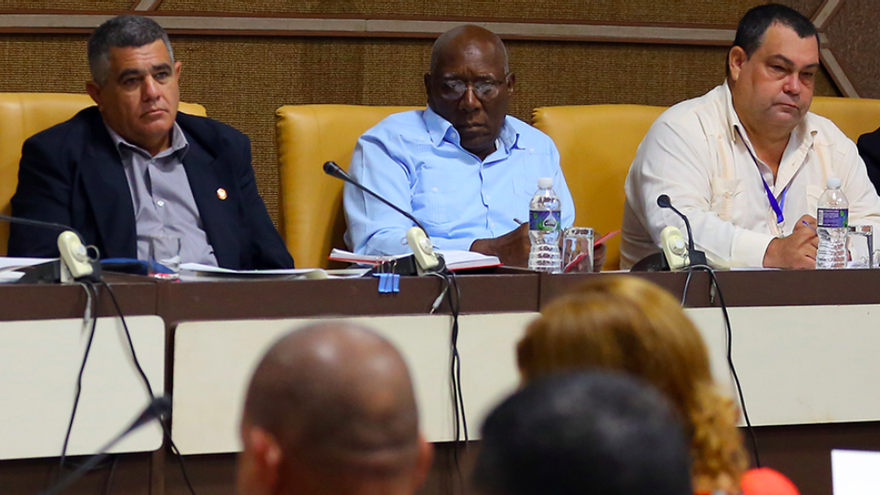
A sleepy Salvador Valdés Mesa chaired the debates on the agricultural and food situation in Parliament. (Cubadebate)

14ymedio bigger14ymedio, Havana, 20 July 2023 — The comments of readers in the official Cuban press have become the sounding board of widespread unrest in a country corroded by inflation and scarcity. Faced with the inability of the authorities to manage the economy, citizens mock the parliamentary debates on price controls, which Cubadebate describes as a “complex but decisive battle for the future of the Revolution.”

“They can no longer continue to justify all their mistakes by mentioning the blockade, while some become millionaires at the expense of the sweat of those who work. If we don’t do something, this socialist revolution has very little left,” says a reader with the pseudonym pjodalr. Like him, dozens of users are expressing their frustrations.

It was no wonder, being one of the most sensitive issues for Cubans, that the voluntarist perspective of the leaders and the absence of solutions caused a flood of disagreements. Vladimir Regueiro, Minister of Finance and Prices, acknowledged to the deputies the lack of control of inflation, but then shielded himself behind the international panorama.

The price index, he said, grew by 39% at the end of 2022, while since the beginning of 2023, it has grown by 18%. If the percentage is compared to that of the first half of 2022, prices have increased by an alarming 45%. The minister indicated that there is a governmental “lack of objectivity” when it comes to prices and acknowledged that many times they were legislated without even knowing if the fixed cost was “real.” continue reading

After the intervention of Regueiro, the president of Parliament, Esteban Lazo, again placed the problem – as he did during the opening of the sessions – in the structural: “If there is no supply and production, we will not achieve effective control of prices,” he said.

The Parliament also discussed on Wednesday the unfortunate state of the agri-food sector. The situation is summarized in two words: “non-compliances and decreases,” says the report presented to the deputies. Without fuels, fertilizers or insecticides, the agricultural production has been catastrophic: 68% compliance with the plan. The production of meat, milk and eggs also failed.

For readers, the leaders live in a “futuristic” world, a “utopia” that never considers the present reality. “The unstoppable dollar and galloping inflation,” summarizes user Gilberto Reyes. “What is the State’s solution for the employee who has no money at all, or for retirees?”

“Pork meat at almost 500 pesos; a pound of rice at 200 pesos; a liter of oil, 700 and 800 pesos; what price controls are we talking about then?” said the reader identified as R. Meanwhile, user José Antonio Ruiz pushes his disgust to the limit: “It’s much ado about nothing. The same issues, the same reasons for the failures, the same explanations to try to alleviate the dissatisfactions of the population, the same justifications for the problems … without even being able to talk about expectations in the short term that give way to hope.”

“The only thing that has gone down in price is beer, and that has been achieved by the private enterprises, not the State,” mocked the reader Pepe, while another described the situation of the informal market as “total anarchy.” Some readers complained about Cubadebate’s censorship of their comments, such as Selma González, who reflected on the uselessness of the police in the face of crime in a comment that was “correct and adjusted to the subject” that the media eliminated.

The conclusion, after several days of parliamentary discussion, is clear: “What a waste! So much uncertainty!”

Cuban economist Pedro Monreal, who has closely followed the talks in Parliament, criticized the “nonsense” of the deputies’ opinions and their inaccuracies.

And he concluded: “It could have been the way the press reports it, but what we read today about the ’discussions’ in the committees of the National Assembly is reminiscent of a sitcom. It’s not clear if it is a problem of technical incapacity or of ’directives’ that have been taught.”

Translated by Regina Anavy

____________

COLLABORATE WITH OUR WORKThe 14ymedio team is committed to practicing serious journalism that reflects Cuba’s reality in all its depth. Thank you for joining us on this long journey. We invite you to continue supporting us by becoming a member of 14ymedio now. Together we can continue transforming journalism in Cuba.

Eighteen Cuban Passengers Are Prevented From Boarding a Condor Airline Flight in Varadero

Main entrance of the Juan Gualberto Gómez de Varadero International Airport. (Facebook)

14ymedio bigger 14ymedio, Havana, 19 July 2023 — This Tuesday, 18 Cubans received some bad news. At Juan Gualberto Gómez de Varadero International Airport, passengers were unable to board the Condor airline flight to Frankfurt. In the German city, travelers would make a stopover to continue to Istanbul and later to Dubai, but they could not even complete the check-in process.

“We were told that the details of our second flight did not appear in the computer system,” one of the Cuban passengers who could not board the plane tells this newspaper. “Our first trip appeared on the computer without a problem, but since they didn’t manage to locate the second one, they didn’t even check us in,” said another traveler, on condition of anonymity.

“We paid more than 1,000 euros per person for a ticket. In my case I came from Santiago de Cuba, and now we don’t know what is going to happen to us, if they are going to return the money or reschedule the flight. Nobody says anything,” laments the man, who had to pay “more than 5,000 pesos for a private room” to stay one night in Varadero waiting for a solution.

Several crew members from the Condor flight, which took off at 10:45 at night, tried to intercede for the 18 Cubans and even  “called Germany directly to solve the problem, but they couldn’t get the details of our second flight so they didn’t t allow us to board the plane,” he explained.

“We don’t understand the reason because we even have the reservation number and all the details of the second and third flights.  Condor’s representatives told us that they couldn’t find the data. They didn’t even take our suitcases, and we never got to the boarding area,” he explains. continue reading

This Wednesday several of these travelers returned to the airport in search of answers, but so far no Condor employee has been able to tell them what will happen to their flights. “We have a 30-day tourism visa for Dubai, so there is no problem with that country. It’s outrageous that we haven’t been allowed to get on that plane.”

It’s not the first time that something like this has happened. Last November, a group of passengers who intended to travel to Belgrade from Varadero was rejected by Condor. Most were migrants who took advantage of the visa exemption that Serbia then provided to Cubans, to embark on the migratory route to countries in the European Union.

“We can confirm that on November 22, a total of 22 passengers were not accepted to board the plane from Varadero to Frankfurt, since we received information that their trip to Serbia was at risk as far as their entry into the country was concerned,” Magdalena Hauser, the airline’s director of communication, told this newspaper.

This year, despite the free visa in force until mid-April for Cubans, the situation of several groups of passengers from the Island who were not allowed to enter Serbian territory was also reported. They remained for days in overcrowded conditions at Belgrade international airport, and many were deported.

At the end of March, the consul and political advisor of the Serbian Embassy in Havana, Jelena Zivojinovic, confirmed to 14ymedio that from April 14, Cubans would need a tourism or work visa to travel to their country. The measure, aimed at containing illegal emigration, may be revoked “in the future” if the citizens of the Island “demonstrate” that they can travel to the Balkan nation and return to Cuba, the diplomat said at the time.

Translated by Regina Anavy

____________

COLLABORATE WITH OUR WORKThe 14ymedio team is committed to practicing serious journalism that reflects Cuba’s reality in all its depth. Thank you for joining us on this long journey. We invite you to continue supporting us by becoming a member of 14ymedio now. Together we can continue transforming journalism in Cuba.

Athletes Who Left Cuba Triumph Defending the Flag of Other Countries

Cuban athletes Roger Valentín Iribarne, Orlando Ortega, Arialis Gandulla, Reynier Mena and Yulenmis Aguilar. Collage (Instagram)

14ymedio bigger14ymedio, Havana, 18 July 2023 — Roger Valentín Iribarne achieved a personal mark this Sunday in the 110 meters in the hurdles with a time of 13.21 seconds in the Diamond League held in Silesia, Poland. The gold medal won by this Cuban for the Portuguese club Benfica is a reflection of the athletes who have left the Island and are achieving their goals in other countries, such as the hurdler Orlando Ortega, the sprinters Arialis Gandulla and Reynier Mena and the javelin thrower Yulenmis Aguilar.

Valentín’s sports development in Benfica has been upward. In the Diamond League he presented himself as the world leader of the 60 meters with hurdles after timing 7.59 seconds in Lisbon last January. In this way, he also surpassed the personal best record that he had achieved with Cuba in the indoor world championship held in Birmingham in 2018.

In September 2021, Valentín Iribarne asked for his dismissal from the Island’s national athletics team. There was no motivation for the 26-year-old, whose best mark had been 13.39 seconds. One of the last students of Professor Santiago Antúnez Contreras, the same coach who prepared the Olympic champions Anier García (Sydney 2000) and Dayron Robles (Beijing 2008), he got tired of the poor training conditions and the delays in state support.

This hurdler found the conditions to develop his potential in the Benfica club, so he made contact with them. In Cuba, the athletics crisis was notorious. “A selection that included two Olympic finalists in Atlanta 1996 and in London 2012 did not present an athlete in Tokyo 2020,” published Play-Off Magazine a few months after Valentín settled in Portugal. “To get an idea of the magnitude of the event, the last time Cuba did not qualify an athlete in 110 meters with hurdles to the Olympics was in Rome 1960. A streak of more than 60 years has been broken.” continue reading

“The club took care of all the procedures for us to get here,” Valentín said about his arrival at Benfica and that of Reynier Mena on the YouTube and Facebook program For Cuba and the World. “We didn’t have to pay anything.” Unlike the Island’s sports authorities, the Portuguese club gave him a home, food and everything he needed for training. The young man recognizes the work of his coach but rules out defending Cuba in an international event.

Orlando Ortega escaped during the Moscow Athletics World Cup in 2013 and prior to the Rio de Janeiro 2016 Olympic Games. This natural athlete from Artemis was considered to be the successor of medalist Dayron Robles, who also left the Island to settle in Monaco.

Ortega closed 2020 with an unprecedented double in the Spanish indoor championships played in Orense, Galicia, after winning both the 60 meters and the 60-meter hurdles. This ranked him as one of the best athletes in Spain that year.

This runner-up in the Rio 2016 Olympic Games, bronze in the Qatar 2019 World Cup and in Berlin 2018, is recovering from an operation for a rupture in his tendon and hopes to be back next year.

Reynier Mena, who in Cuba was a legend, arrived in Portugal at the same club as Roger Valentín. In less than a year he showed his ability on the track. During his July 2022 demonstration at La Chaux de Fonds, this sprinter broke the 10-second barrier in the 100 meters flat with a time of 9.99 seconds, and in the 200 meters he recorded 19.63 seconds.

Mena requested sports leave in 2021 on the Island, and since it was announced, he has confirmed to 14ymedio that his goal was to “continue training in the sport.” Last May he reaffirmed his good level at the Citta Di Savona International Meeting with his best time of the season, 19.95 seconds in the 200-meter test, surpassing Yancarlos Martínez (20.44 seconds).

During an indoor event in the capital of Kazakhstan, Astana, the Portuguese-nationalized Cuban sprinter Arialis Gandulla won the flat 60 meters with a time of 7.18 seconds, making her the third athlete with the best record of the year.

Meanwhile, the javelinist Yulenmis Aguilar was expelled from the Cuban national team in 2018. That was the “prize” she received after obtaining the bronze medal at the Central American and Caribbean Games in Colombia. They simply told her that “they didn’t count on her for the next season.”

Aguilar suffered a lot because of this decision. Her sporting life became “an ordeal,” and the injuries she had in her knees, shoulders and elbows forced her to retire for five months. “I didn’t want to know anything about the sport. I went into a depression and began to gain a lot of weight,” she told La Voz de Galicia.

She contacted coach Raimundo Fernández, who runs the A Coruña School of Javelinists and traveled to Spain. “Her first six months here were an ordeal of physiotherapists, doctors and rehabilitators,” Fernández stressed.

Yulenmis Aguilar recovered and last year set a record for Spain in javelin throwing with 64.17 meters, a mark that placed her as sixth in the world ranking. Her desire is to compete for the country in which she found support to recover.

Translated by Regina Anavy

____________

COLLABORATE WITH OUR WORKThe 14ymedio team is committed to practicing serious journalism that reflects Cuba’s reality in all its depth. Thank you for joining us on this long journey. We invite you to continue supporting us by becoming a member of 14ymedio now. Together we can continue transforming journalism in Cuba.
The State BioCubaFarma Group Recognizes a Deficit of 40 Percent of Medicines in Cuba

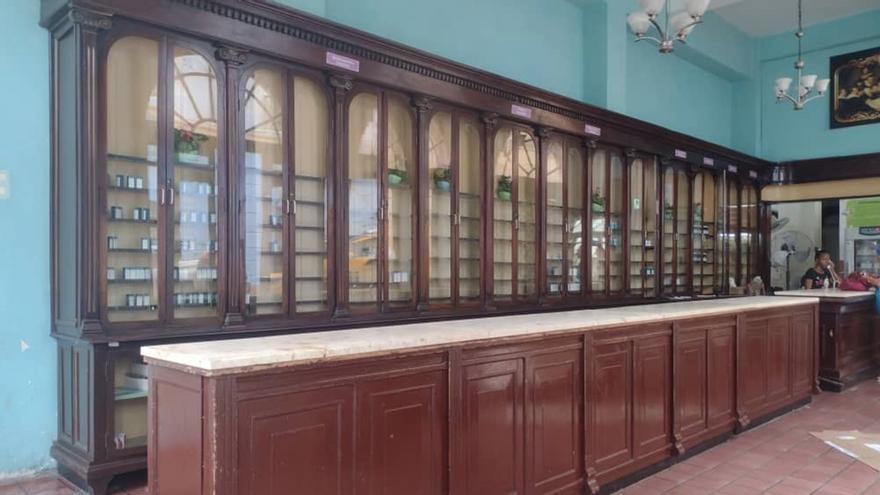
A pharmacy on Enramadas Street in Santiago de Cuba. (14ymedio)

14ymedio biggerEFE/14ymedio, Havana, 18 July 2023 — The State Group of the Biotechnology and Pharmaceutical Industries (BioCubaFarma) recognized, on Tuesday, a deficit of 40% in the basic table of medicines in Cuba.

The president of the business group, Eduardo Martínez, explained in a session in the Cuban Parliament that the deficit currently includes 251 drugs, according to the Prensa Latina news agency.

Martínez said that the insufficiency covers imported and domestically produced medicines and pointed out problems with access to financing due to the direct effects of the United States economic embargo.

He mentioned in this regard that the usual suppliers stopped supplying due to the embargo, to which is added the global deficit of some raw materials and materials for pharmaceutical use.

There are no raw materials or the materials necessary for production, said the director of the pharmaceutical group in charge of supplying 369 basic medicines to the national health system. continue reading

Last May, the director of Operations and Technology of BioCubaFarma, Rita María García, told the official press that the plant – which is allocated 60% of the production of basic medicines at the national level – managed to reactivate some drug production lines of medications in high-demand among the population, with the arrival of inputs purchased by the Government and other “managements,” without specifying whether they corresponded to donations.

Among the drugs that were to be manufactured again are the injectables of aminophylline, labetalol, fenoterol and morphine of 10 and 20 milligrams (mg), of wide hospital use for patients in intensive care. The laboratories dedicated to the manufacture of these drugs were paralyzed for almost four months because they did not have containers — such as ampules, plungers or casings — due to the shortage of glass.

BioCubaFarma has 46 companies, 115 production lines and more than 19,000 workers, according to Prensa Latina.

The shortage of basic products, such as food and medicines, was one of the main economic elements in the anti-government protests of July 11, 2021, the largest in decades.

Translated by Regina Anavy

____________

COLLABORATE WITH OUR WORKThe 14ymedio team is committed to practicing serious journalism that reflects Cuba’s reality in all its depth. Thank you for joining us on this long journey. We invite you to continue supporting us by becoming a member of 14ymedio now. Together we can continue transforming journalism in Cuba.
Cristina Vives, Independent Art Curator in Cuba: ‘What We Do Is Seen With Suspicion’

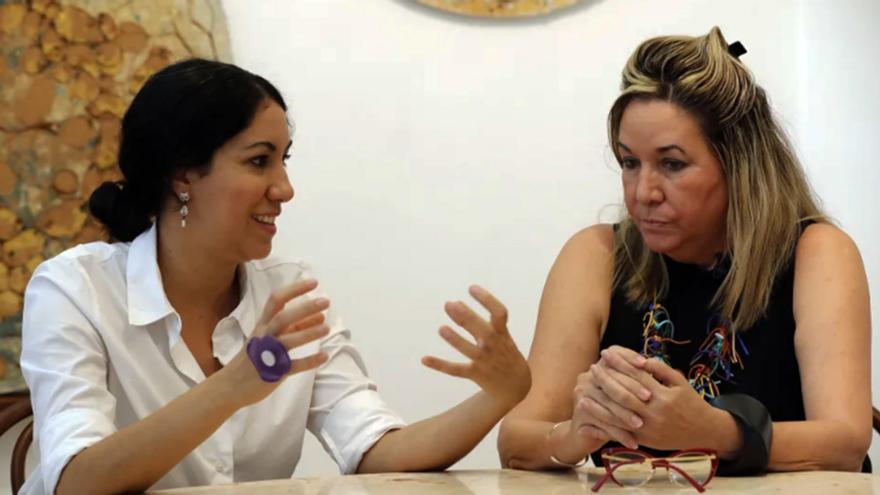
Vives reports that in 2014 they realized that they had to be more “aggressive” publicly and decided to position themselves on social networks. (EFE)

14ymedio biggerEFE (via 14ymedio), Laura Becquer, Havana, 16 July 2023 — – Promoting art independently and privately in Cuba continues to be seen with “suspicion” and leaves those who are dedicated to that activity in a certain situation of “vulnerability,” says curator Cristina Vives, with 30 years of experience in the sector, speaking in an interview with EFE.

“Thirty years after being independent and successful, what we do is viewed with suspicion, and that is directly proportional to being controlled, observed and questioned all the time,” says Vives from her studio in Havana, a magnet in the country’s art world.

This family project, which began with Vives and her husband, the renowned Cuban photographer José Alberto Figueroa, arose in the midst of the deep crisis of the Special Period of the 90s in Cuba. Now it also includes their daughter, Cristina Figueroa.

For Vives, going beyond the framework of state institutions at that time, with the collapse of the socialist bloc in Europe and the economic, political and social bewilderment that it meant for Cuba, was a “suicidal leap.” But she has “never” regretted the decision.

“Since the end of the 80s there was a galloping crisis of cultural institutions in which many of the most prominent artists left the country looking for other paths, avoiding censorship and creative limitations. Everything was in decline,” she recalls. continue reading

It is in that panorama that Vives and Figueroa set up a studio in their apartment in the Havana neighborhood of Vedado, an initiative that is currently a benchmark for the private management of contemporary art on the Island.

“We surround ourselves with the most outstanding, novel, groundbreaking and curious of Cuban art of the 90s, and we fill the space with works of young creators such as Tania Bruguera, Belkys Ayón and Raúl Cordero, among others, who left the Art Institute between 1992 and 1994,” Vives says.

She emphasizes that the studio, later named Figueroa-Vives, also arose from the “frustration of a great attempt to collaborate with the cultural institutions. That’s when we said, ’no more’.”

“The years have passed, and it’s no surprise how we think and act. We can be uncomfortable, but now they’re used to it; there is more tolerance,” she continues.

Her trajectory, with a dozen exhibitions in Cuba and other countries, several explorations and a network of collaborators, does not guarantee anything. “We continue to walk a tightrope,” says this Cuban curator.

“We will always be vulnerable, as long as we are not a recognized, legally respected and supported institution,” laments Vives, who, even so, specifies that “if there is something to defend, it is the ability not to be afraid.”

Despite the three decades that have passed, Vives establishes comparisons between the current situation and that of its beginnings. Now, she points out, there are “sensitive loopholes in cultural leadership and in the strength of the institutions,” something that, together with the “almost massive exodus of a lot of artistic talent,” reminds her of the Special Period.

“Second acts (of a crisis) are impossible to resist,” comments the curator, who talks about the need to reinvent herself and the feeling of continuing to move in a “space of vulnerability.”

Vives feels that now “it is easier” for them to dialogue with the new generations who run some cultural institutions of the Cuban State because “they come with a spirit where ideological guilt does not touch them.”

They are not so contaminated,” says her daughter, who is in charge of the online shows of the family art studio.

In 2014 they realized that they had to be more “aggressive” publicly and decided to position themselves on social networks and manage a website so that their message reached many more people and could connect with more galleries on and off the Island.

“If you believe in art, you support it. And we have done that by trying to unite our ability to curate exhibitions with the help of entities like the Embassy of Norway and that of Spain, which have supported us a lot,” she explains.

This collaboration has allowed them to achieve visibility even outside Cuba and also to maintain the projects, says Figueroa, who points out the recent joint exhibitions between artists from the Island and the Spanish studio Nave Oporto.

Both have a very clear purpose 30 years after throwing themselves into this “suicide”: “To get the (artists) who are (in Cuba) to breathe and produce, and those who have left to return.”

Translated by Regina Anavy

____________

COLLABORATE WITH OUR WORKThe 14ymedio team is committed to practicing serious journalism that reflects Cuba’s reality in all its depth. Thank you for joining us on this long journey. We invite you to continue supporting us by becoming a member of 14ymedio now. Together we can continue transforming journalism in Cuba.
Have Patience, the Part To Fix the Water Pump ‘Is Coming by Boat’ and Will Arrive in Cuba in a Month

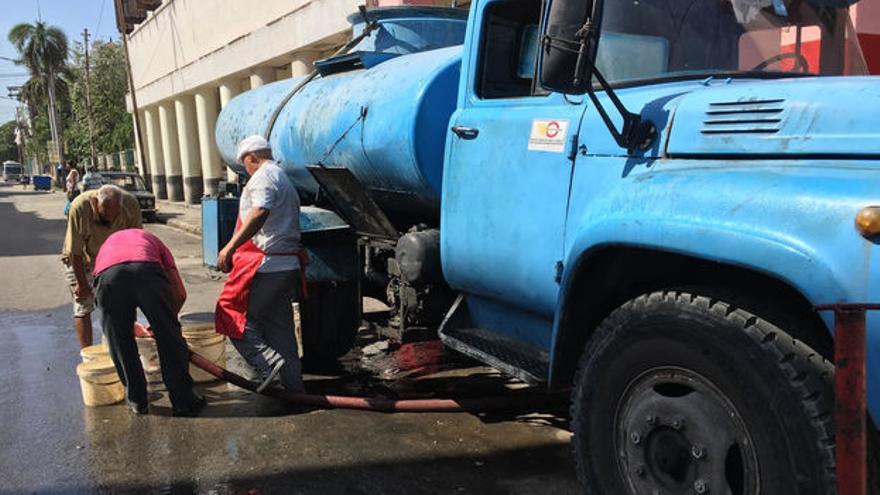
Havana residents in the municipality of Playa expect to be without water for a month. (14ymedio)

14ymedio bigger14ymedio, Havana, 13 July 2023 — Some residents of the municipality of Playa in Havana have spent five consecutive days without water, this newspaper has learned. The suspension of the service adds to the long list of breakdowns suffered by the entire capital, and the government assures that work is being done to offer solutions.

“We have been without water for five days, and not even a single watertruck has made an appearance,” said one of the residents, who attributes the suspension of the water supply cycle to a break in the pump due to lightning. “After almost a week, we have almost no water left in the tank.”

The resident, owner of a private home full of Spanish tourists staying until the weekend, regrets that the restoration of the service will take between twenty days and a month, since the part that the pump needs is not available in the country and its replacement “is coming by boat.”

The discomfort of the residents of Playa, in the absence of ways to solve the water supply problem, contradicts the reports offered this Wednesday by the official media Granma, which says that the Aguas de La Habana Company has already taken charge of the situation. continue reading

“Extending the cycles” of water supply, spacing its distribution and temporarily alleviating the shortage with tanker trucks are two of the main measures adopted, the company reported.

It also recognized the poor situation of water supply services in districts such as Cerro, Plaza de la Revolución, Diez de Octubre, Centro Habana and Habana Vieja, which persists due to the deficit in the central system.

The populations west and south of Havana are recovering thanks to the installation of the necessary equipment, but the company has not been able to offer a solution to the eastern municipalities.

This insufferable situation inspired singer Luis Alberto Vicet Vives, known as “La Crema,” to upload a music video on his YouTube channel on Thursday that criticizes the deficient water and electricity services. He approached the subject matter with his usual humor, claiming that the services are stable and assuring that the hardships are not suffered by “the manager.”

Translated by Regina Anavy

____________

COLLABORATE WITH OUR WORKThe 14ymedio team is committed to practicing serious journalism that reflects Cuba’s reality in all its depth. Thank you for joining us on this long journey. We invite you to continue supporting us by becoming a member of 14ymedio now. Together we can continue transforming journalism in Cuba.
Giving Hotels and National Resources to Foreigners Will Not Pay Cuba’s Huge Debt

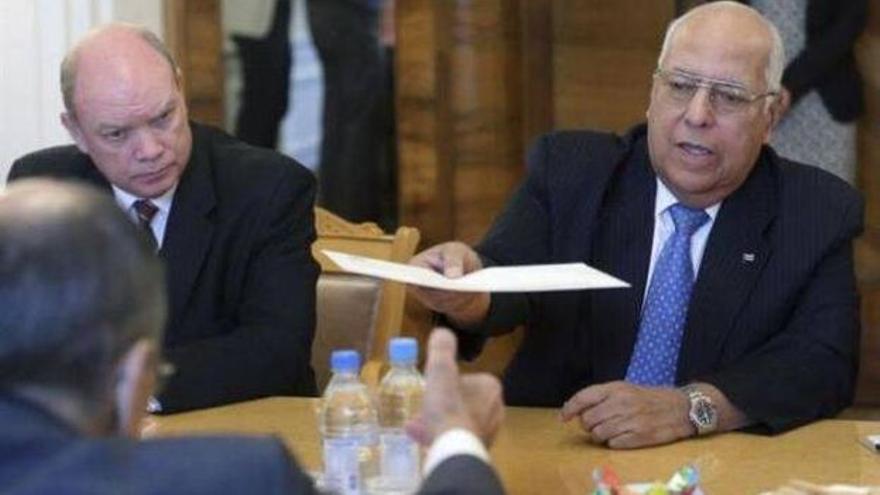
Ricardo Cabrisas, Deputy Prime Minister of Cuba, during the renegotiation of the debt with the Paris Club in 2020. (Cubadebate)

14ymedio bigger14ymedio, Juan Izquierdo, Havana, 15 July 2023 — The option of resolving Cuba’s external debt with the transfer of domestic resources to foreign companies, defended this Wednesday by the pro-government professor Juan Triana Cordoví, has been refuted by economist Pedro Monreal. Triana considers this option a way to refinance and “revitalize” socialism on the Island; for Monreal, it poses the risk of “being insufficient and undermining sovereignty.”

Triana, who teaches Economics at the University of Havana and writes a column in OnCuba, raises the need to renegotiate the Island’s debt and clean up the image of the country, which has become “one of the highest risks in the region” in terms of investment.

To do this, he suggests that, in a hypothetical negotiation, one could make use of the “assets” that in theory belong to the “people of Cuba,” although they are specifically managed by their “administrator”: the State. Triana refers, first of all, to hotels, which he prefers not to deliver completely to foreign companies but to turn them into owners of “part of the shares.”

He also alludes to the 2,417 state companies, of which – he calculates – only 12 (0.4% of the total) are really “strategic” and carry the weight of the national economy. Triana recommends that these companies that “decide the game” do not touch each other, partly because some of them are already shared with foreign entities: this is the case of the Canadian Sherritt International,  whose debt to the Island is paid by the overexploitation of Cuban nickel and cobalt mines; Havana Club, managed together with the French Pernod Ricard; and Habanos, which is partly owned by Spain. continue reading

The negotiation would be done with the rest of the state companies, which could be saved from their financial mediocrity if they are shared with foreign investors, who would work, without intending to, to “save” socialism on the Island.

To these two elements, Triana adds idle lands and idle plots in cities, where there are already “several buildings built by capitalist real estate companies,” such as the Miramar Business Center. The formula of the exchange of assets, the professor acknowledges, could be questioned, but after all, he concludes, “it’s something that began more than thirty years ago when that first contract was signed with a foreign capitalist and in just a few months the first five-star hotel in Varadero was born.”

However, Triana does not place the key to taking the step in the will of the State, which conveniently blocks the economic movements of the country, but in “consensus” with the people, to whom he recommends “explaining” what is intended to be done.

Precisely from this erroneous argument – to assume that the Cuban people have some control over the management of the national economy – Monreal starts to refute Triana’s suggestion. In a series of Twitter threads, the economist explains not only why the massive exchange of assets to pay off the debt is impracticable, but also the serious political risk it entails for Cuba.

Affirming that the people own the state assets is, at the very least, a “controversial” budget when it comes to reasoning the possibility of an economic opening. “Power,” says Monreal, means the ability to “decide a difference” and have a specific “property.”

“It could be difficult to validate the exercise of the power of the people, specifically of the wage earners, within the framework of an economic package such as the ’arrangement’ that has ’compressed’ wages and that disproportionately puts the cost of the adjustment on the workers,” Monreal summarizes. “Explanations to the people are problematic when they are politically treated as a ’clay’ to mold and not as an active subject (citizens) with effective capacity to promote or stop public policy proposals.”

In addition, the Cuban people do not have “effective citizen spaces for criticism of the Government,” which makes it impossible for them to participate in decision-making.

The economic aspect of the problem is even more serious, and to analyze it, Monreal refers to the data that reflect the great “scale” of the Cuban foreign debt, whose “recent worsening” leaves very little room for action, even for the State.

The economist starts from a central and unquestionable argument: “Cuba’s accumulated external debt is today greater than the Gross Domestic Product,” and the hyper-devaluation of the Cuban peso in 2021, after the Ordering Task*, was the final blow to the country’s ability to assume reimbursement in the current situation.

The country had to disburse 1.606 billion dollars to pay for debt service in 2022, at the same time that it recorded a deficit of 1.629 billion in its current account, which reflects a total income (exports of goods and services) lower than expenses. These alarming data point to a “severe contraction of the resources” to confront the debt.

The increasing deterioration of the current account has an impact on the foreign exchange reserves that Cuba has, says Monreal. In addition – and although the official data offered by Havana are outdated – the current crisis precedes the coronavirus pandemic, one of the usual pretexts the regime uses to justify the impoverishment of the country, and it is related to a “sudden increase in short-term debt,” which complicated the conditions of payment to creditors.

That stagnation put Cuba between a rock and a hard place in front of international banks and their suppliers, including the Paris Club. The information published by this last body exposed the different renegotiations that the Havana regime has been forced to undertake with its creditors since 2020.

Looking for a payment solution based on the exchange of assets is dangerous economically, says Monreal, especially because, considering the scale of the problem, what Cuba can offer is “relatively small.” Therefore, he insists, the real balance of such a measure would be paid politically and would not free Cuba from its status as an “international pariah” for its economic discredit.

What is left for Cuba – which has already delivered, as Triana observes, its “crown jewels”: minerals, tobacco and rum – are health services, communications, the domestic market in dollars and its dominance over remittances from abroad. The Cuban State is limited, Monreal maintains, in negotiating these remaining assets, in part because it has always kept them under strict control.

The market remains in pesos, which would have to be “sweetened” to have some attraction for the foreign investor, through tax privileges. However, this process would be an obstacle, the economist considers, if you want to “privatize” state enterprises progressively, a process, Monreal says, that is characteristic of all the reform processes initiated by the communist parties in power, “with disparate results.”

The alternative could be, proposes Monreal, the agricultural sector: to promote private agricultural production to guarantee the supply of food in national currency and allow producers to carry out operations, even with large companies outside the Island.

This transfer of state agricultural assets to the national private sector – a system that Monreal calls “officially approved” – could be beneficial, if accompanied by other measures, to reduce the external debt. The result? A double benefit: to guarantee the food sovereignty that Cubans crave so much and, in short, to protect national sovereignty.

*The Ordering Task is a collection of measures that include eliminating the Cuban Convertible Peso (CUC), leaving the Cuban peso as the only national currency, raising prices, raising salaries (but not as much as prices), opening stores that take payment only in hard currency, which must be in the form of specially issued pre-paid debit cards, and a broad range of other measures targeted to different elements of the Cuban economy. 

Translated by Regina Anavy

____________

COLLABORATE WITH OUR WORKThe 14ymedio team is committed to practicing serious journalism that reflects Cuba’s reality in all its depth. Thank you for joining us on this long journey. We invite you to continue supporting us by becoming a member of 14ymedio now. Together we can continue transforming journalism in Cuba.
The Cuban Film School Rejects the Imposition of a New Director and Asks for ‘Transparency’

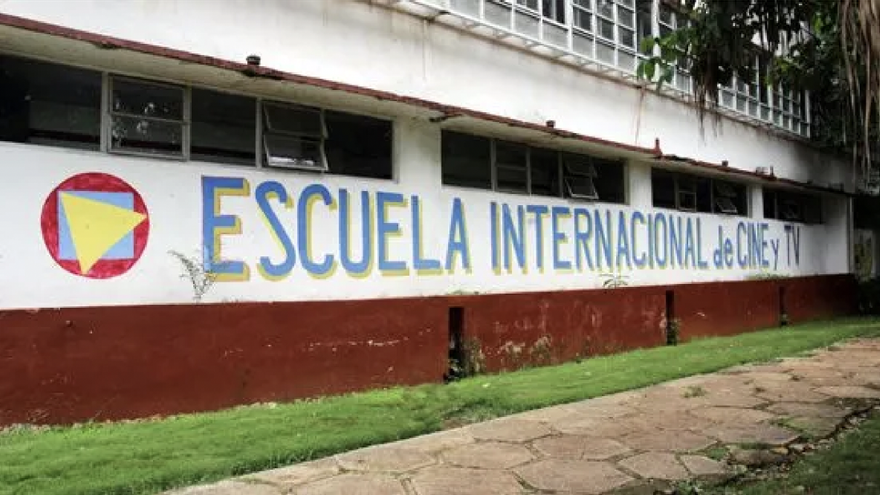
The Academic Council refuses to recognize the new directive and warns about the violation of statutes. (Facebook/International School of Film and Television)

14ymedio bigger14ymedio, Havana, 17 July 2023 — The Academic Council of the International Film and Television School of San Antonio de los Baños (EICTV), in Mayabeque, expressed its disagreement with the imposition, by the Ministry of Culture, of Waldo Ramírez as the new director of the center. The measure, described as “abrupt, arbitrary and silent,” adds to the list of recent clashes between the guild of filmmakers and the cultural authorities of the Island.

“We didn’t know about the appointment because of the way it happened, and we demand a transparent decision-making process,” said the statement, which was signed by 13 members of the Council.

The arrival of Ramírez – founder of Televisión Serrana, in Santiago de Cuba, and representative on the Island of the Venezuelan multinational network Telesur – to EICTV is the indirect consequence of the dismissal of Ramón Samada from the presidency of the Cuban Institute of Cinematographic Art and Industry (ICAIC) and the assumption of the office by the vice president of the Institute, Susana Molina, former director of EICTV.

Numerous filmmakers, teachers and students linked to the school have also expressed personally, on their social networks, their non-recognition of the new directive, protected by the statutes of the institution. They also demand that “the proper selection process” be carried out in a transparent and “consensual” way, with the opinion of the student body – which includes foreign students – and the workers. continue reading

The community of teachers, graduates and filmmakers linked to EICTV also opened a petition, so that all those involved with the School can express their support for the Academic Council with their signatures. “We believe in the possibility of restoring a useful and necessary art for our nations, as well as promoting it in the only way we believe possible: by creating a free cinema,” the statement concludes.

The Cuban Filmmaker Assembly also commented this Sunday on the decisions of ICAIC. In their statement they made it clear that “Cuban cinema does not belong to a ministry or an institution. They [the institutions] have to put themselves at the service of the artists and not the other way around.”

Critic and film professor Gustavo Arcos also shared his opinion regarding the debate on his Facebook account. “It is not Samada, it is the structure that puts and removes Samada that must be reviewed, transformed or, if necessary, deleted. Managers and officials make mistakes; no one is perfect, but there is a system, a model of order and command that has sustained, for too long, that institutional violence that we have once again just perceived.”

It is not the first time that EICTV has caused headaches for art officials in Cuba. Last May, some students, mostly foreigners, had complained about the poor conditions of the school by writing on the walls of the center “Down with the leadership. Thieves.” Cuban writer Wendy Guerra, a graduate of the center and currently residing in the United States, then warned that the film school “is a non-governmental institution” where Cuban students and “some young foreigners” receive scholarships or pay for their training, so it is natural that a “minimum of conditions” is required for their stay.

At the end of June, the discomfort of the filmmakers caused more than a hundred directors, screenwriters and actors to have a meeting with leaders of the Ministry of Culture and the Communist Party to face the controversy unleashed by the censorship and unauthorized dissemination of the documentary La Habana de Fito, by filmmaker Juan Pin Vilar.

Translated by Regina Anavy

____________

COLLABORATE WITH OUR WORKThe 14ymedio team is committed to practicing serious journalism that reflects Cuba’s reality in all its depth. Thank you for joining us on this long journey. We invite you to continue supporting us by becoming a member of 14ymedio now. Together we can continue transforming journalism in Cuba.
Panama Will Give Two-Year Residence Permits to Cubans and Other Irregular Migrants

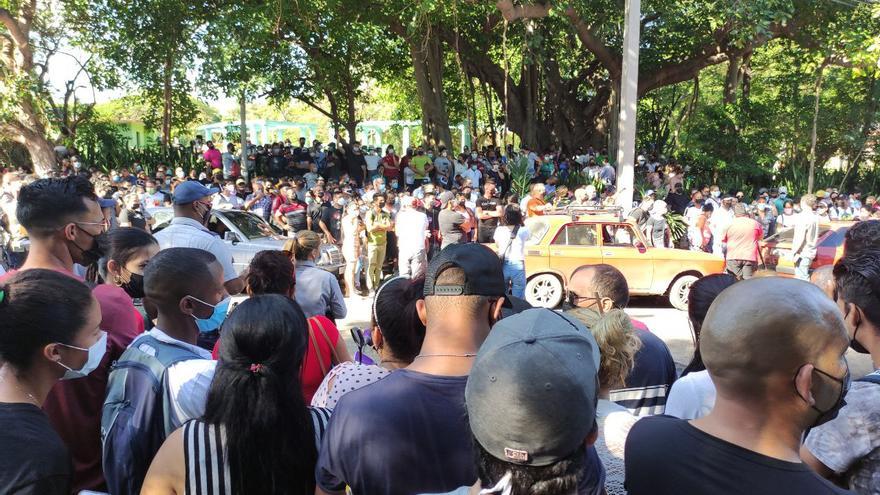
A crowd of Cubans planted in front of the Embassy of Panama in Havana, in March 2022. (14ymedio)

14ymedio bigger14ymedio/EFE, Madrid, July 17, 2023 — Cubans who have been living in Panama irregularly for at least a year can, like other foreigners in the same situation, obtain a “temporary protection permit” beginning on Monday.

As announced by the Panamanian National Migration Service (SNM) on Friday, the permit will give immigration status for a period of no longer than two years.

“This temporary permit is intended to provide protection to the irregular migrant population that is in a vulnerable condition, subject to risks and dangers from the smuggling of migrants and the different forms of human trafficking,” said the SNM.

All foreigners, without distinction of nationality, who have remained in the country for a period of not less than one year will be eligible. Appointments to start the procedure can be requested from this Monday, July 17, through the SNM website.

“People benefiting from this permit will be able to reside in Panama for two years, complying with the tax, social security, health and legal obligations required,” said the official statement, which does not specify the cost of this visa. continue reading

Before the expiration of this temporary permit, beneficiaries must make the change of status for one of the migratory categories in force in the country, the letter added.

The official information also clarified that “every foreigner who maintains a valid passport and meets the requirements required by the rule will be able to opt” for the new permit.

Panama has 4.2 million inhabitants, and there are 249,000 foreigners, about 6% of the population, according to the results of the national census carried out in 2023.

The Central American country, economically strong in the last decade, received thousands of foreigners, especially Venezuelans fleeing the crisis in their country, who were able to obtain a temporary migratory status through the Crisol de Razas program, highly criticized by xenophobic nationalist sectors.

The country allowed the free transit of Cuban travelers until March 2022, when it announced the establishment of visas. In those days, the migratory exodus was beginning its peak, and Panama was one of the trampolines for the citizens of the Island on their route to the United States via Nicaragua, which four months earlier had announced a visa waiver.

Panama’s decision caused strong protests from those who already had purchased their tickets and could not change them without losing their money. After three days planted in front of the Panamanian embassy in Havana, hundreds of them who were traveling up to March 16 managed to be exempted from the visa requirement.

The cost of the visa is 50 dollars and allows a stay of 24 hours in transit.

Translated by Regina Anavy

____________

COLLABORATE WITH OUR WORKThe 14ymedio team is committed to practicing serious journalism that reflects Cuba’s reality in all its depth. Thank you for joining us on this long journey. We invite you to continue supporting us by becoming a member of 14ymedio now. Together we can continue transforming journalism in Cuba.
Customers’ Disenchantment With the ‘State Methods’ of a Privatized Bakery in Havana

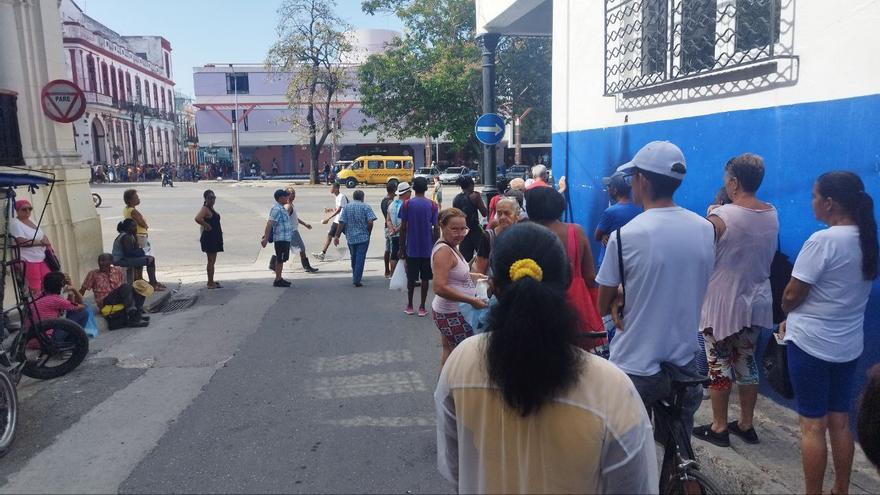
Some customers from other parts of the Cuban capital wait in line at the bakery on Carlos III and Castillejo streets. (14ymedio)

14ymedio bigger14ymedio, Juan Diego Rodríguez, Havana, 15 July 2023 — With a temperature of 33 degrees Celsius, this Friday morning the neighbors in Key West, Havana and customers from other parts of the Cuban capital waited in line for the bakery on Carlos III and Castillejo streets to start dispatching the customers who crowded in earlier.

“Since 4:30 am we haven’t had electricity,” the seller justified to the line, which now was starting to get uncomfortable with the midday sun. Holding umbrellas or taking refuge in the brief shadow projected by a nearby facade, the buyers wondered what had happened with that place.

The bakery, recently repaired, passed from the hands of the state-owned Cuban Bread Chain to a private company, as this newspaper confirmed. “They removed all the state workers and brought their own staff,” said a neighbor who had recently heard about the change in ownership.

The news that the central bakery, which brought customers from several municipalities, had reopened in private hands raised expectations and sparked fantasies. Some neighbors said that the bread was going to be “like before” but didn’t specify what moment in the past they were referring to. True or not, between curious people and buyers, the line on the outskirts of the store was extended in a short time.

A chubby man who blocked the passage of the curious explained that for now only two products were being offered: five small round loaves for a price of 20 pesos and a baguette for 70 pesos. “Soon there will be other varieties,” he said. Meanwhile, in the line,  another seller began to check identity cards, and customers expressed their surprise that in a private store the “revolutionary method of sale” in force in state stores was being applied. continue reading

Rationing the amount that can be purchased, asking for identification to access the counter and regulating how many times a customer can stand in line are widespread practices in state stores. If anything distinguishes, so far, the private ones, it is to have eliminated these mechanisms in their businesses.

“These places have a bad vibe. Although individuals come to work in them, they maintain the state methods,” said a young man in the line who seemed skeptical at the hope that private companies will work better than those of the government. “In the end, they are always the same ideas and the same schemes,” he said.

But every rule has its trick, and the Cuban customer has been training for decades to circumvent the restrictions.

Despite the warnings of the sellers, a lady kept the newly purchased bread in her bag and went back to the end of the line. “Surely now she is calling some relative to come with his card to buy more,” a young woman said with suspicion. “I came thinking that this was going to be different, but it’s the same line, the same five loaves per person and the same socialism,” she added, disappointed.

As soon as we mention the concept of “private enterprise,” most Cubans already imagine a better assortment of products, much higher prices than in official shops, better treatment of employees and the freedom to choose, combine and carry as much merchandise as you want and whatever you want. But that perception could be changing in the face of the reality that is being imposed.

Some passers-by came this Friday to inquire about “the bakery that is now private,” but few overcame the difficulty of having to wait so long to take home a baguette, the so called “good bread.” “I don’t have the patience for this,” said one. Five minutes later, the man who controlled the door announced: “That’s it for the bread. You’ll have to wait another half an hour.”

Translated by Regina Anavy

____________

COLLABORATE WITH OUR WORKThe 14ymedio team is committed to practicing serious journalism that reflects Cuba’s reality in all its depth. Thank you for joining us on this long journey. We invite you to continue supporting us by becoming a member of 14ymedio now. Together we can continue transforming journalism in Cuba.
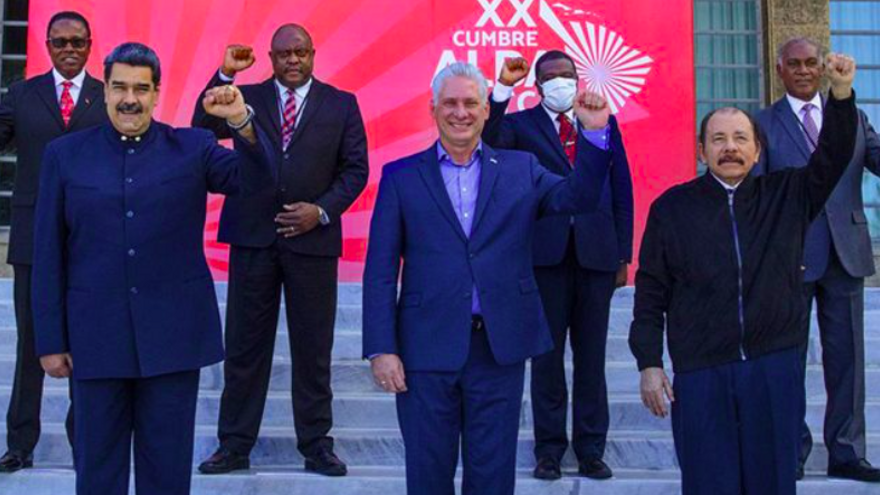
Due to Pressure From Cuba and Its Allies, the EU Decided Not To Invite Zelensky to the Summit With Celac

Zelensky complained that several “regional presidents and dictators had truncated his trip.” (Presidency of Cuba)

14ymedio bigger14ymedio, Havana, 15 July 2023 — The veto of Cuba, Venezuela and Nicaragua will prevent the president of Ukraine, Volodymyr Zelensky, from attending the summit of the European Union and the Community of Latin American and Caribbean States (EU-Celac), which will be held in Brussels on July 17 and 18. According to the Argentine media Infobae, a senior European official announced that the three countries, whose alliance with Moscow has been strengthened in recent months, blocked the invitation suggested by the head of the Spanish Government, Pedro Sánchez.

“President Zelensky is not going to attend,” said the senior official, who hopes that at the EU-Celac meeting – which had not been in session for eight years – the “collateral damage in other parts of the world will be discussed from the Russian aggression, which has caused damage and fragilities, which has created food insecurity and increased inflation.”

“All this will probably be discussed,” added the official, who clarified that “there was already an opportunity to discuss the war and the position vis-à-vis Moscow at the EU meeting in Copenhagen, where Russian special representatives participated with an ’active participation in the discussion.’”

Now, however, Europe aspires for Latin America and the Caribbean to dialogue “on how to end this aggression,” and that means accepting the conditions of countries such as Cuba, Venezuela and Nicaragua, such as the absence of Ukraine, which, he alleged, is not part of the EU or Celac. continue reading

Although Zelensky himself said that Pedro Sánchez, head of the government of Spain – the country that presides over the EU until December – had invited him to the summit, Infobae claims to have had access to anonymous statements from a Brussels spokesman who says that the Ukrainian president never had a formal request to attend.

In a brief press conference, Infobae points out, Zelensky complained that several “regional presidents and dictators had truncated his trip,” although he did not clarify which governments had opposed it.

The president, who leads his country’s resistance against the invasion of Vladimir Putin that began in February 2022, was able to attend the recent NATO summit in Vilnius, Lithuania, although Ukraine was not given entry into this organization.

The suggestion by Celac to invite Zelensky to the summit was also made months ago by the president of Uruguay, Luis Lacalle Pou. At that time, the Argentine government leader Alberto Fernández – then president of the Latin American organization – was ambiguous about the issue but made it clear that the decision to allow Ukraine’s presence at the summit should be a prerogative of Celac.

Cuba, Venezuela and Nicaragua are fully aligned with Russia. The reception of diplomats, the commercial exchange – particularly in the oil sector – and the constant transfer of senior officials from these countries through Moscow have turned the governments of Miguel Díaz-Canel, Nicolás Maduro and Daniel Ortega into Putin’s stalwarts, and they are key points for Russia’s strategy in the region.

In the case of Cuba, the link has occurred at the highest level, and both regimes have starred in an unprecedented rapprochement since the Soviet era. The Island has clearly positioned itself in the international arena in favor of Russia, and the version of the conflict in Ukraine from the official Cuban press follows the dictates of the Kremlin.

Díaz-Canel, who is currently making a state trip to Portugal where he intends to negotiate that country’s hiring of 300 Cuban doctors, will attend the EU-Celac summit after the plenary of the European Parliament approved a resolution on Wednesday for the Government of the Island to put an end to “the policy of repression, intensified in recent times.” In addition, it demanded the “immediate and unconditional release of all detainees solely because of the exercise of their human rights, the withdrawal of abusive criminal charges and that the exiles be allowed to return.”

Translated by Regina Anavy

____________

COLLABORATE WITH OUR WORKThe 14ymedio team is committed to practicing serious journalism that reflects Cuba’s reality in all its depth. Thank you for joining us on this long journey. We invite you to continue supporting us by becoming a member of 14ymedio now. Together we can continue transforming journalism in Cuba.
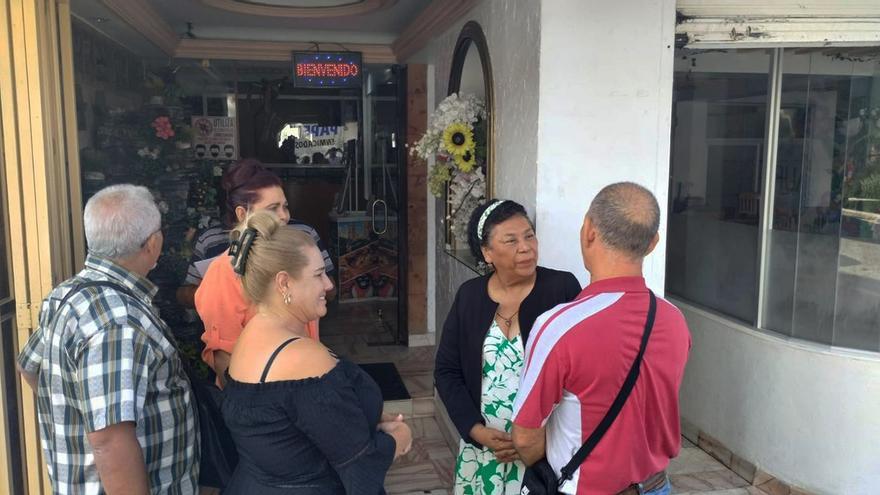
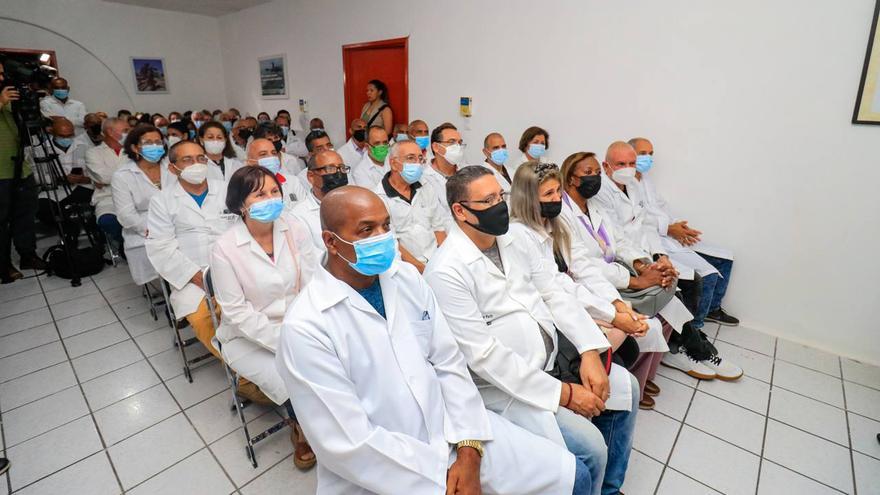
Mexico Has Paid Havana About 10 Million Dollars for 718 Cuban Medical Specialists

Last week a group of Cuban specialists arrived in  Guerrero. (Facebook/Salud Guerrero)

14ymedio bigger14ymedio, Ángel Salinas, Mexico, 15 July 2023 — The Mexican Government paid Cuba $9,667,115 between July 2022 and May of this year for a contingent of 718 doctors, according to a source from the Ministry of Health who requested anonymity. Of the specialists, 128 are still receiving training or processing the necessary documentation to practice, and the remaining 590 have already been distributed in 11 states of Mexico.

Among the 128 Cuban health workers who are in training, there are 18 specialists who were rejected in Morelos for not having a professional card. “These doctors are all in the same state, and their documentation is being expedited to be forwarded to another region.”

According to the official transparency portal – a publicly accessible information platform – the contract, which entered into force in May 2022, requires a monthly disbursement of 1,177,300 euros by Mexico for the services of 610 Cuban health workers. The payment was initially established under the name of the Comercializadora de Servicios Médicos Cubanos, but since September it was redirected to the company Neuronic Mexicana, which is a subsidiary of Neuronic S.A. Cuba.

Since 2018, according to the official, Neuronic Mexicana has been representing the products and services of the Island’s biotechnology and pharmaceutical industry, and the president, Tania Guerra, is a Cuban. The company “is in charge of receiving the salary of the Cuban specialists.” In summary, it has “custody of and administer the funds that the Mexican Social Security Institute (IMSS) allocates to the contingent,” he added. continue reading

In the Mexican state of Colima, Mexican doctors have questioned the fact that Cuban specialists are given accommodation and food. (Facebook/Government of Colima)

The doctors, who arrived in the middle of last year with the intention of establishing a base in the Montaña de Guerrero, one of the most troubled points in Mexico due to its high poverty rates and the presence of several cartels that dispute the drug transport channels, have been relocated to the states of Baja California Sur, Campeche, Colima, Michoacán, Nayarit, Oaxaca, Sonora, Tlaxcala, Veracruz and Zacatecas.

According to official data from the federal Ministry of Health, only 43 specialists in cardiology, otolaryngology and gastroenterology were sent, although they had also promised the arrival of pediatricians. Despite this, the state government, led by an ally of President López Obrador, proclaimed the increase in consultations and the improvement of medical services.

In the Ometepec region, located on the Costa Chica de Guerrero, three Cubans joined the Tomás Molina hospital in the last week of June. These doctors “cannot talk to the media,” a nurse from the medical center itself confirmed by telephone to 14ymedio. “Annel [the cardiologist] cannot attend to them; both she and the dermatologist and the other doctor need authorization from their coordinator,” Alfredo González Lorenzo, the nurse replied when this newspaper requested direct contact with the Cuban specialists.

As part of the Guerrero health project for this year, the deployment of four Cuban psychiatrists in mental health caravans, in addition to offering itinerant services, will collaborate in the hospitals of San Marcos, Tlapa, Coyuca de Catalán and Chilpancingo. The plan for mental health specialists has been questioned, because the main causes of death in the state are diabetes, cancer and cardiovascular diseases.

Translated by Regina Anavy

____________

COLLABORATE WITH OUR WORKThe 14ymedio team is committed to practicing serious journalism that reflects Cuba’s reality in all its depth. Thank you for joining us on this long journey. We invite you to continue supporting us by becoming a member of 14ymedio now. Together we can continue transforming journalism in Cuba.
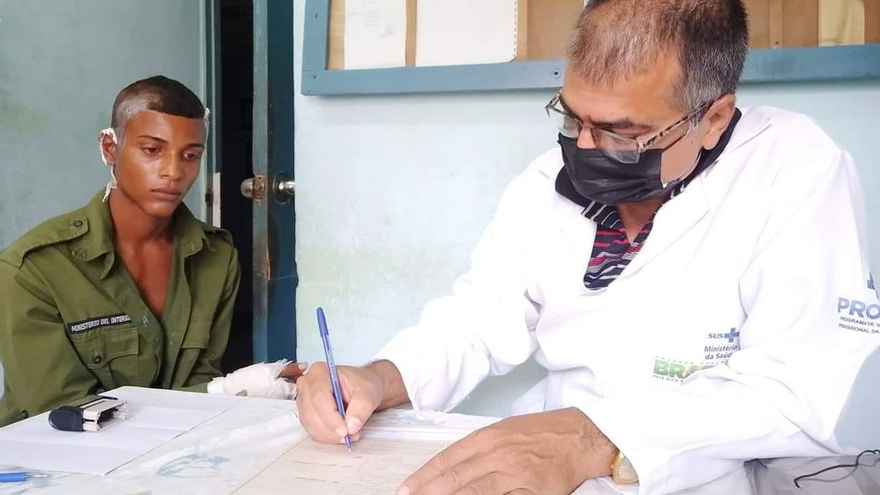
The Cuban Government Once Again Uses Military Service Recruits As Firefighters

The photos published by the provincial media show the youth of the injured, in uniforms with the insignia of the Ministry of the Interior. (Facebook/La Demajagua)

14ymedio bigger14ymedio, Havana, 13 January 2023 — At least five people were injured, one of them seriously, as the result of a fire in a resin warehouse in Manzanillo, in the province of Granma. The accident occurred this Thursday around 5:00 in the morning in a warehouse of the state company Astilleros del Golfo, the official press reported.

By telephone with the Celia Sánchez Manduley Hospital, where the injured are being treated, this newspaper learned that the individual who is in serious condition is the head of the fire command, 35 years old. Of the rest of the wounded, who were also working to extinguish the fire, at least two of them, age 19, were recruits from compulsory military service. The other two were 20 and 21 years old, respectively.

The head of service for burn victims, Francisco Andrés Pérez Suárez, told La Demajagua that the patient in serious condition has 15% of his body affected. “We are assessing his progress due to the characteristics of the injuries, but vigilance must be maintained to avoid any complications. It all depends on the local evolution of the burns.” The article also clarifies that “the necessary supplies and resources are available for the care of patients.”

The provincial newspaper, which does not explain how the fire started, says that in the warehouse there were “more than a hundred tanks with resin, catalyst and over 88 pounds of cobalt, products with flammable characteristics that are used in the manufacture of boats.” Some social media commentators said that several explosions were heard in the vicinity and that the flames reached a considerable height. The depot is located in an industrial area where it was necessary to evacuate several work centers that store chemical materials such as ammonia. continue reading

The Gulf Shipyards, the text highlights, turned 60 in April, and “their collective is considered among the six most important in Cuba.”

The photos published by the provincial media show the youth of the wounded, in uniforms with the insignia of the Ministry of the Interior.

It iss not the first time that the Cuban government has used recruits to extinguish fires, a job that is highly specialized. The most tragic precedent is the disaster of the Matanzas Supertanks. Several of the fatalities, 17 in total, were young people who were on compulsory military service.

Translated by Regina Anavy

____________

COLLABORATE WITH OUR WORKThe 14ymedio team is committed to practicing serious journalism that reflects Cuba’s reality in all its depth. Thank you for joining us on this long journey. We invite you to continue supporting us by becoming a member of 14ymedio now. Together we can continue transforming journalism in Cuba.
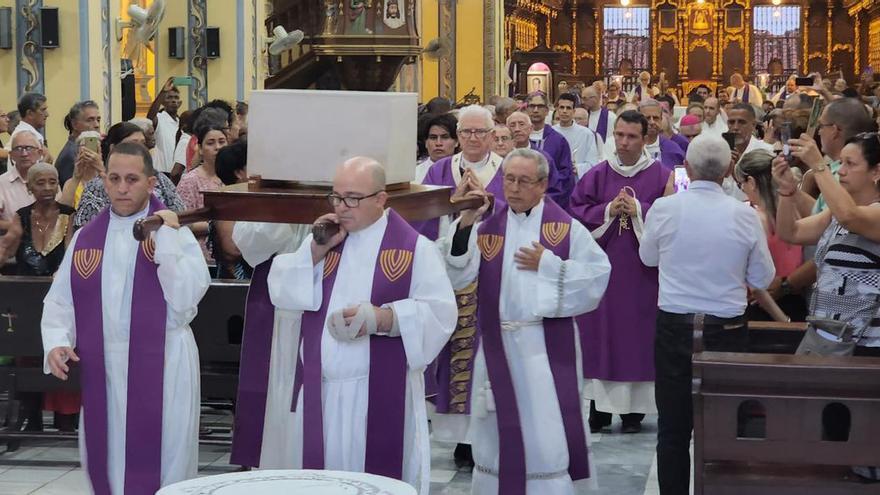
The Cuban Police Prevent ’14ymedio’ From Accessing the Burial of the Bishop Who Challenged Raul Castro

Funeral rites for Pedro Claro Meurice Estiú, former archbishop of Santiago de Cuba. (Facebook/Archbishopric of Santiago)

14ymedio bigger14ymedio, Havana, 1 July 2023 — Reporter Francisco Herodes Díaz Echemendía, a collaborator of 14ymedio, was prohibited from entering the cathedral of Santiago de Cuba to attend the funeral mass of Pedro Claro Meurice Estiú, who was archbishop of that city. The remains of the priest, who died in 2011 in Miami, were transferred this Wednesday to the parish in a ceremony that summoned hundreds of people.

“You can’t enter because it’s behind closed doors and you need a credential to be invited,” two agents of the political police told Díaz Echemendía when he tried to approach the church. A strong police presence, with agents in uniform and in civilian clothing, surrounded the church, although the invitation issued by the religious authorities invited the “secular, religious, priests and  people of Santiago de Cuba.”

The two agents, who called themselves Noel and Camilo, told the reporter to return home and not insist on accessing the cathedral. When Díaz Echemendía retraced his steps, in the direction of his home, another policeman pressured him not to take the road through central streets. “I felt very harassed and threatened,” he tells this newspaper.

This Thursday, Díaz Echemendía went to the archbishopric and was able to talk with Prelate Dionisio Guillermo García Ibáñez, who was surprised by what happened and said that no other person had been required to show a credential to access the church on Wednesday afternoon.

After the mass, the remains of Meurice Estiú, born in 1932 in the eastern town of San Luis and nicknamed “the lion of the East”, were placed in an open cavity on the floor of the Holy Metropolitan Basilica Cathedral Church of Santiago de Cuba, covered with a tombstone on which was written that he was the fourteenth archbishop of the city. The ceremony was broadcast through social networks. continue reading

After Meurice’s death in 2011, his remains were transferred from Miami and buried in the Santa Efigenia cemetery in Santiago de Cuba. That funeral was surrounded by a strong police operation, and numerous members of the opposition organization Patriotic Union of Cuba attended, along with its leader José Daniel Ferrer, who is currently in prison.

Many moments and anecdotes are remembered about Meurice Estiú, but none exceeds the mark left by his words on the morning of January 24, 1998 in the Plaza de la Revolución in Santiago in front of thousands of people. There he spoke to Pope John Paul II, visiting the Island, and the then Minister of the Armed Forces, Raúl Castro.

“I also present to you a growing number of Cubans who have confused the homeland with a party, the nation with the historical process that we have experienced in recent decades and culture with an ideology,” said Meurice Estiú in front of a Castro who showed great annoyance on his face at the words of the archbishop, then 66 years old.

At the end, the priest also alluded to the exodus: “They are Cubans who, by rejecting everything at once, without discerning, feel uprooted, reject what is here and overestimate everything foreign. Some consider this to be one of the deepest causes of the internal and external exile.”

With that speech, Meurice Estiú consecrated himself as the most critical voice of the regime at that time within the Cuban Catholic Church, in addition to honoring his career since he was ordained in 1955 and studied canon law at the Pontifical Gregorian University of Rome. Upon his return, he was appointed vice chancellor and secretary to Archbishop Enrique Pérez Serantes, who saved Fidel Castro’s life after his failure in the assault on the Moncada barracks in 1953.

In 1967, Meurice Estiú was appointed auxiliary bishop of Santiago de Cuba by Pope Paul VI, and, after the death of Serantes, he was appointed apostolic administrator of the diocese of Santiago.

Translated by Regina Anavy
____________

COLLABORATE WITH OUR WORKThe 14ymedio team is committed to practicing serious journalism that reflects Cuba’s reality in all its depth. Thank you for joining us on this long journey. We invite you to continue supporting us by becoming a member of 14ymedio now. Together we can continue transforming journalism in Cuba.
Two More Femicides, and the Official Federation of Cuban Women Remains Silent

Rosmery Ponce Peña was murdered in Güines, Mayabeque, by her ex-partner, who shot her in the head. (Facebook)

14ymedio bigger14ymedio, Havana, 13 July 2023 — The independent feminist platform Yo Sí Te Creo en Cuba [Yes I Do Believe You] (YSTC) confirmed on Thursday the murder of two women, with which the number of femicides so far this year rises to 52. The new cases have triggered the alarms of the gender observatories because, with a growth of 52.9%, they already threaten to double those of 2022.

The organization verified the murder of Rosmery Ponce Peña, 23, perpetrated on July 10 in the municipality of Güines, Mayabeque. The second case is that of Adela Verdecia, 30, who was murdered in Jovellanos, Matanzas, on June 26. Both women were victims of their ex-partners, whose identities are still unknown, as is whether they have been arrested by the authorities.

On his social networks, independent journalist Alberto Arego had reported on Wednesday about the death of Ponce, the mother of a two-year-old boy. According to sources consulted by Arego, the woman was in her home in the company of some friends when her ex-partner, a 50-year-old man, shot her from the window.

“A single shot straight to the head. Nobody saw the person, but it is believed that he was her ex-partner and the father of her child because he constantly threatened to beat her up,” said one of the sources who also declared his support for the approval of the death penalty against “abusive and murderous men.”

The victim’s aunt, Yesmely Peña, warned on social media about the alleged murderer. According to her account, Rosmery Ponce denounced her aggressor on several occasions to the police, but “they never did anything to him and look what happened: he killed my niece.” continue reading

“We draw attention to the previous complaints made by Rosmery and neglected by the Güines Police, in addition to the use of a homemade firearm in this irreparable crime,” YSTC wrote in a publication that was also shared by Alas Tensas [Tense Wings].

According to the record of femicides compiled by observatories and independent media, at least 13 women were murdered in June, making it the most violent month of the whole year. In most cases, the culprit is a spouse or a former life partner, from whom the victims had separated for mistreatment and had complained to the authorities.

The feminist platforms also record two attempts at femicide this year, in addition to four cases in which access to police investigations has been requested without result. YSTC said that it closely follows the death of Anna Hernández, known as Teudy, a Cuban trans woman who took refuge in Atenas, whose murder has fueled the struggle of the LGTBI community.

While the number of femicides skyrockets, the Cuban government assures that the crimes do not go unpunished, and even the official Federation of Cuban Women (FMC) presented its own Cuban Observatory on Gender Equality last June. This new unit would be responsible for keeping the statistics of “women who have been victims of intentional homicide as a result of gender violence in the last 12 months,” but to date it has not made anything public.

Translated by Regina Anavy

____________

COLLABORATE WITH OUR WORKThe 14ymedio team is committed to practicing serious journalism that reflects Cuba’s reality in all its depth. Thank you for joining us on this long journey. We invite you to continue supporting us by becoming a member of 14ymedio now. Together we can continue transforming journalism in Cuba.