506 years of Havana, Between Suffering and Contrasts / 14ymedio

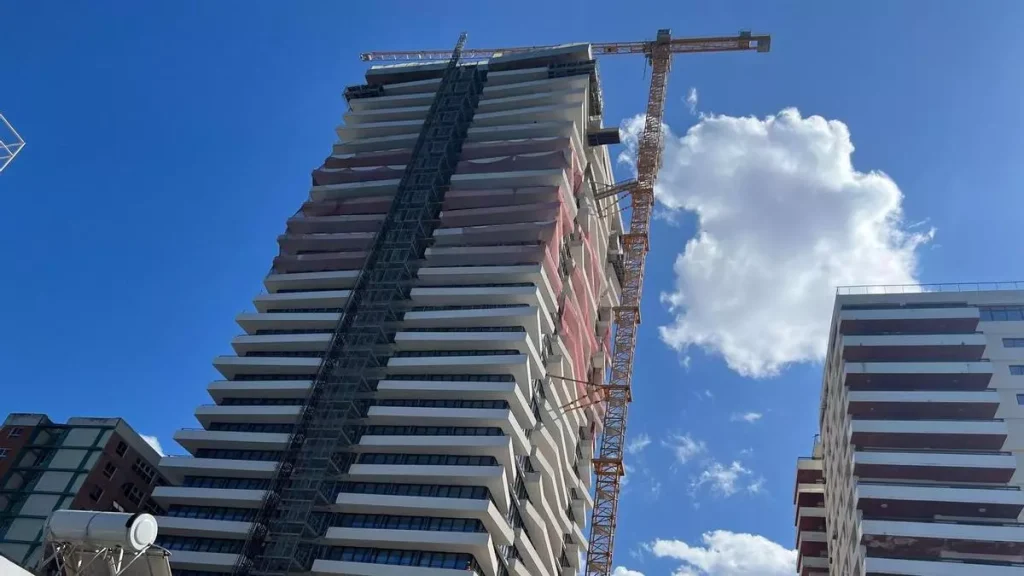
Havana turns 506 today. Founded on 16 November 1519, the city celebrates a birthday that does not hide its age: there are cities that age gracefully, and then there is Havana, marked by the wrinkles of neglect and the harm from continuing abandonment. / 14ymedio
1/12 The rains expose the cracks in an exhausted infrastructure. Streets that flood in minutes and entire neighbourhoods trapped under water are a reminder that urban drainage has been crying out for help for decades / 14ymedio
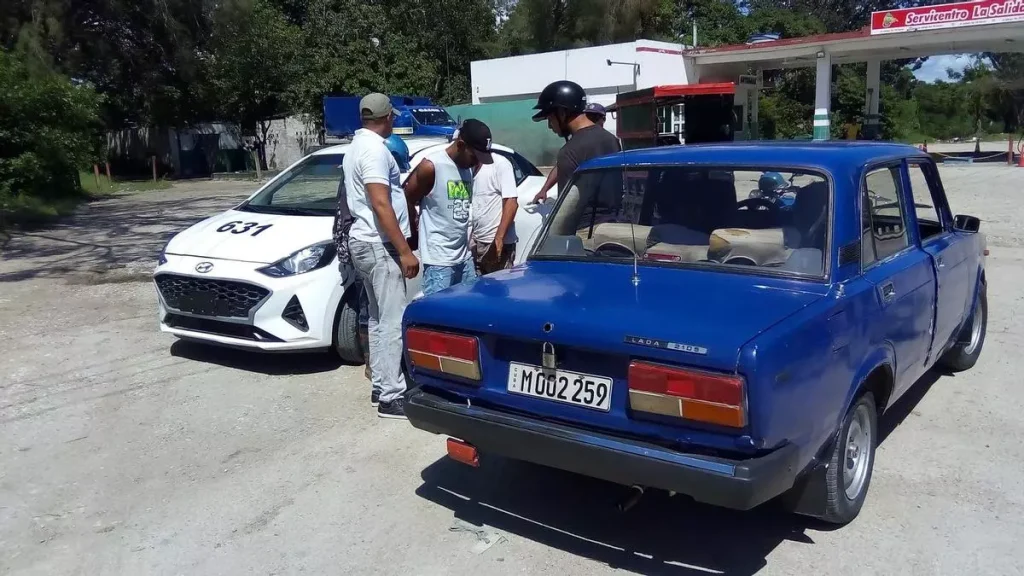
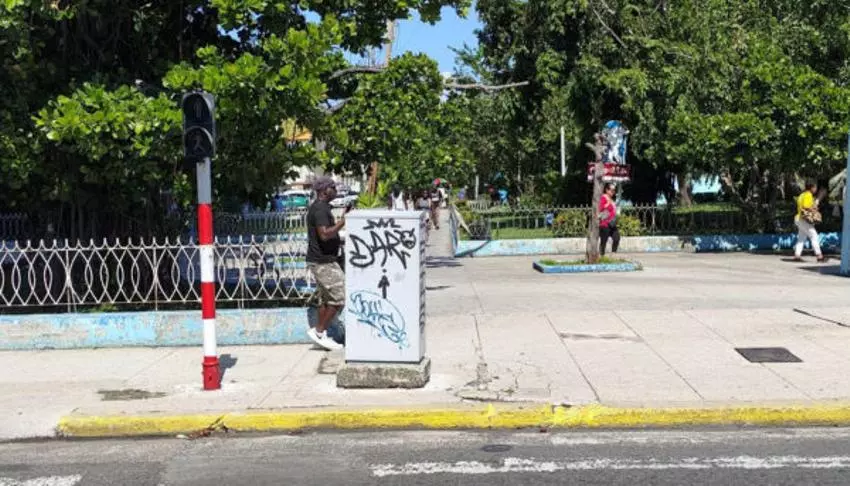
2/12 Getting around the city has become an odyssey. Fuel shortages and the collapse of public transport have emptied even the most well-known places. The iconic Calle 23, with its Coppelia ice cream parlour, is now quiet rather than than bustling. / 14ymedio
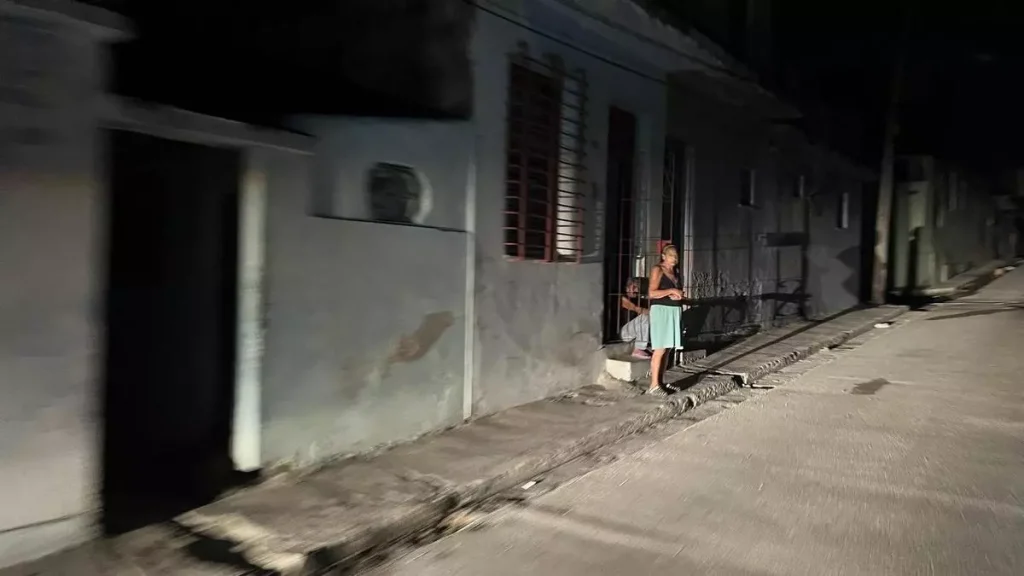
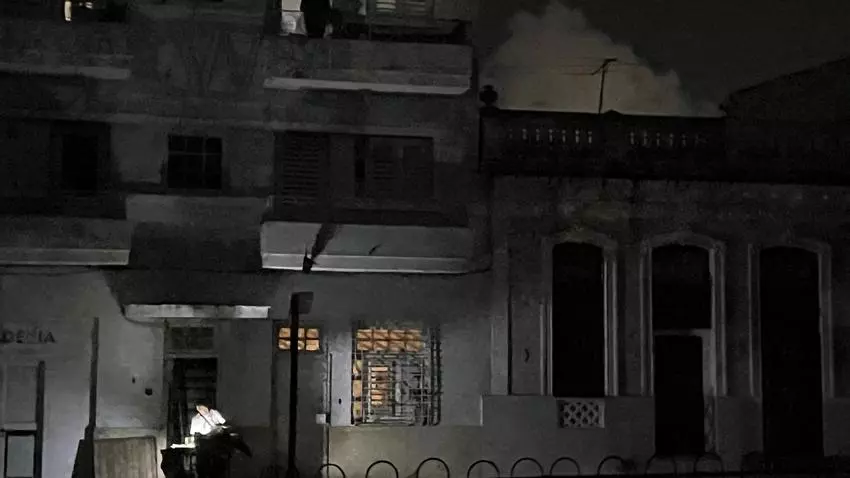
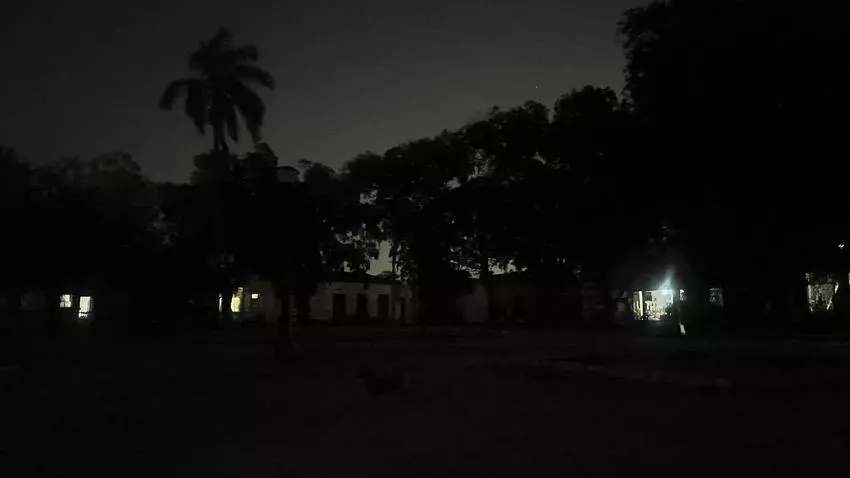
3/12 Long and frequent power cuts have shaped daily life in Havana. On the horizon, the column of smoke from the Turkish tankers anchored in the bay has become a permanent feature of the landscape, casting a shadow over the city. / 14ymedio
4/12 Since the protests of 11 July 2021, Havana has been under tighter surveillance. Arbitrary arrests and increased patrols are a reminder that the country’s largest city has also become subject to increased control. / 14ymedio
5/12 Begging is growing at an alarming rate. Tired faces, broken bodies and outstretched hands seeking coins reveal the depth of the economic and social deterioration in the capital. / 14ymedio
6/12 The decline in tourism shows very clearly. Streets that were once bustling now look dull, with businesses looking forward to a high season that will never come and a city that misses the sound of multiple languages. / 14ymedio
7/12 The dollar has reshaped Havana. In the last year, shops and markets that only accept foreign currency have proliferated, erecting an invisible wall between those who can buy and those who can only watch from the outside. 14ymedio
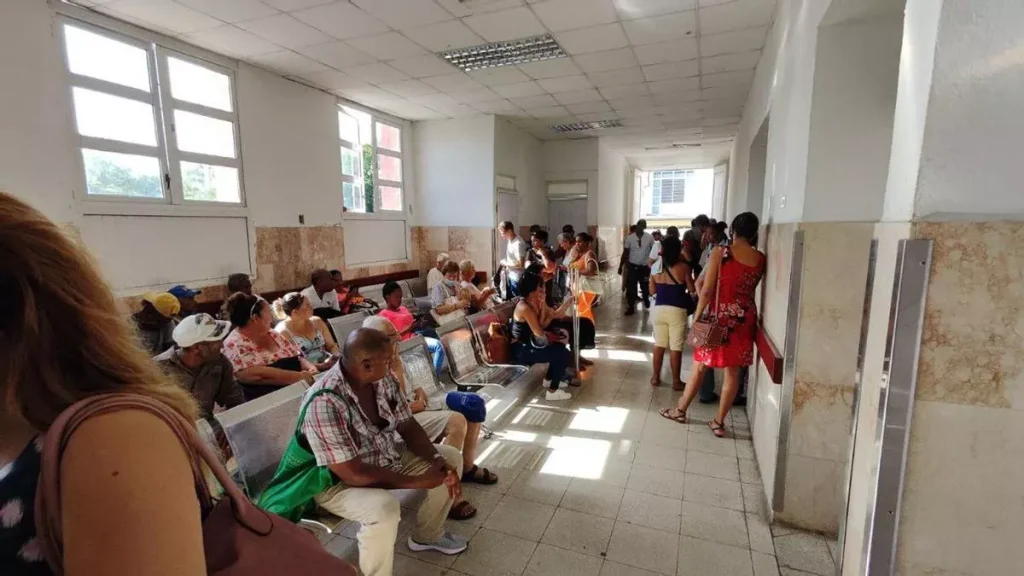
8/12 The lack of cash and the banking collapse are causing long lines at ATMs every day. People wait for hours to get money that often doesn’t appear. 14ymedio
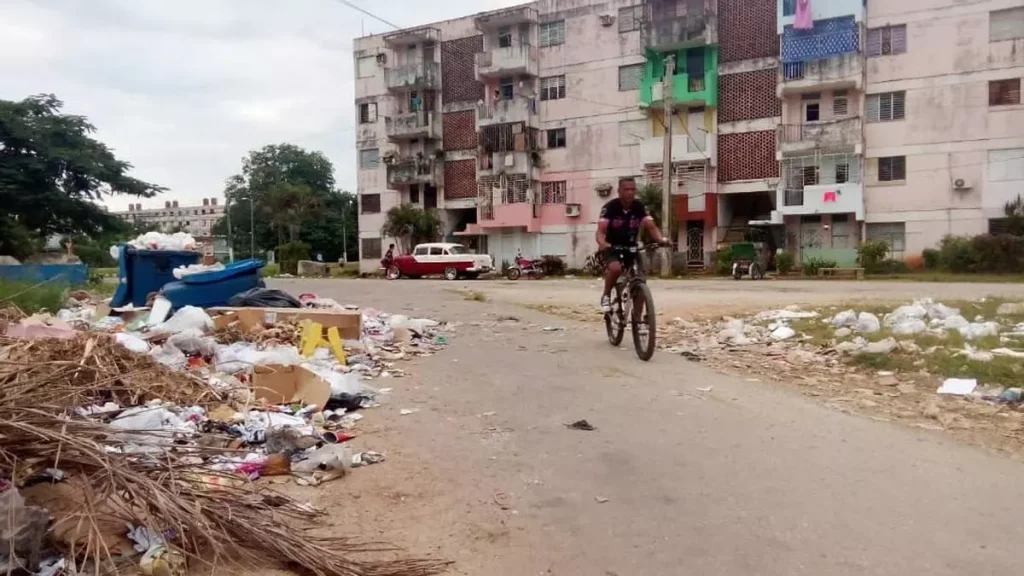
9/12 Nothing, however, reflects the decay quite like the mountains of accumulated garbage. Entire street corners transformed into makeshift dumps speak volumes about a garbage collection service that ceased functioning long ago. 14ymedio
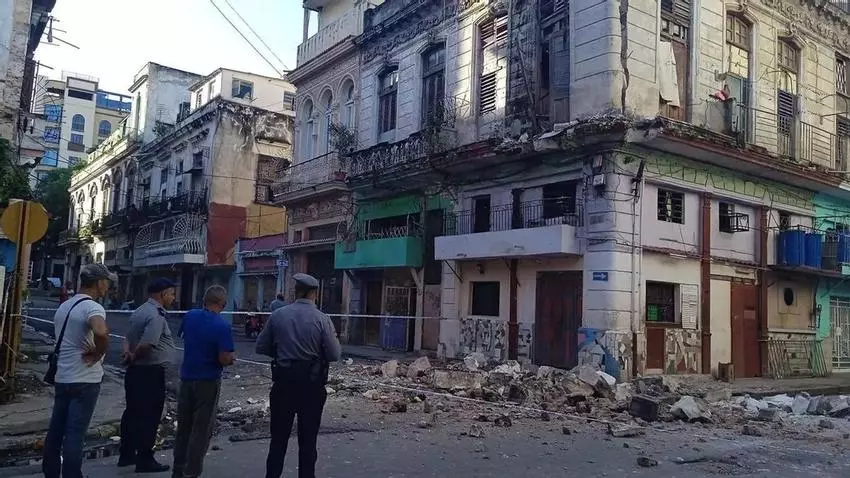
10/12 Building collapses are now part of everyday urban life. Every week, a building gives way, a balcony falls, a family is displaced. The city ages through a combination of gravity and neglect. 14ymedio
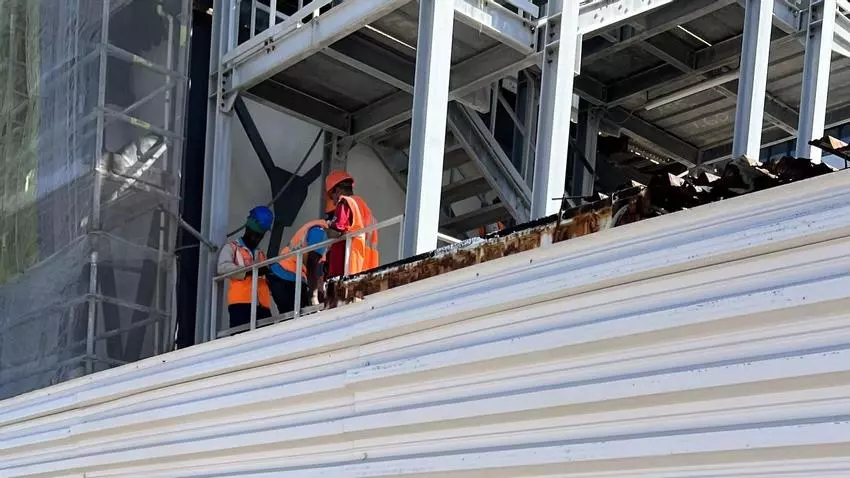
11/12 Housing insecurity is an open wound. Despite the mass exodus, thousands of families continue to live amidst leaky roofs, shoring up structures, and the constant fear that their roofs will give way. 14ymedio
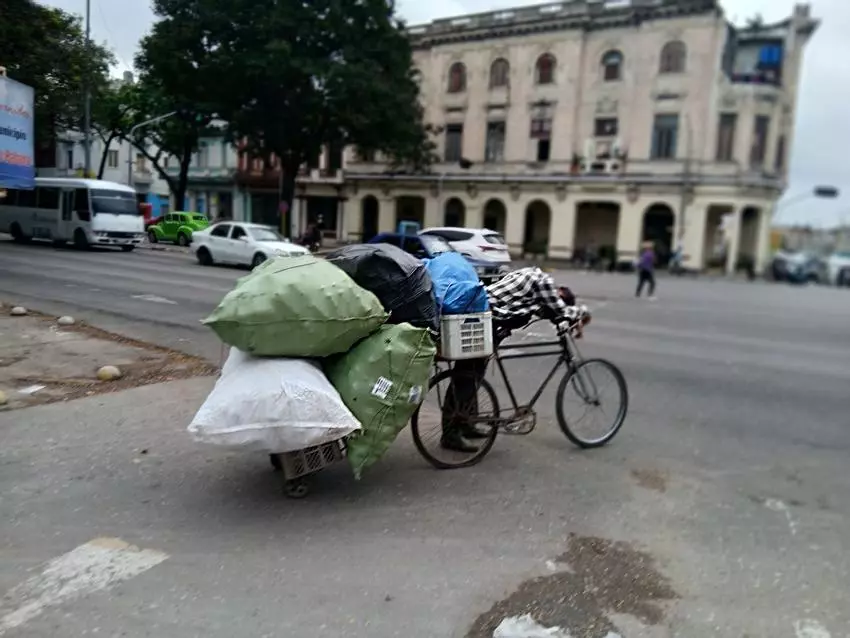
12/12 Havana is also this exhausted man, stopped on his bicycle. We don’t know if it’s work fatigue or the virus—the one that stiffens muscles and routines—that immobilizes him. But his posture perfectly encapsulates a city that reaches its 506th year exhausted, yet still clinging to the hope of moving forward. 14ymedio

14ymedio, 17 November 2025

Translator: GH

____________

COLLABORATE WITH OUR WORK: The 14ymedio team is committed to practicing serious journalism that reflects Cuba’s reality in all its depth. Thank you for joining us on this long journey. We invite you to continue supporting us by becoming a member of 14ymedio now. Together we can continue transforming journalism in Cuba.

The Chinese Prefer To Do Business With Cuba’s Private Sector

The state owes them a lot of money and lacks production capacity, unlike MSMEs, says entrepreneur Wu Han

Chinese products stand at Fihav 2025. / Xinhua

14ymedio bigger14ymedio, Madrid, 28 November 2025 — Chinese businesspeople attending the Havana International Fair (Fihav 2025) have set their sights on Cuba’s private sector. Tired of non-payments, the only thing that currently unites them with the state is almost a feeling of compassion. “We have had a lot of problems and are looking for solutions. It’s not that we want to abandon state-owned companies; we have cooperated over many years. Cuba is going through a difficult situation right now, and we don’t want to put pressure on them,” says Wu Han, representative of the Auto Caiec company on the island.

IPS’s entry into the Expocuba exhibition centre has been a breath of fresh air. The regime only allows accredited press to access Fihav, making it difficult to obtain more than official information about what goes on there. But news agency reporter Dariel Pradas has found a goldmine of Chinese companies in Hall 10 that export from their country to the island, a business niche they have no intention of passing up.

“The situation here is different from other countries. They don’t have the capacity to produce things, and everything has to be brought in from continue reading

outside, almost always from China. Now MSMEs* are buying a lot of things. It’s an opportunity for all foreign firms,” said Wu Han.

“The situation here is different from in other countries. They don’t have the capacity to produce things, and everything has to be brought in from outside, almost always from China.”

His company has been on the island for decades, arriving in 1995 to sell generators. Now, he says, the business includes cars, lorries, agricultural machinery, raw materials, food and fertilisers, among other things. Wu Han says that the main customer was always the state, which was logical during the years when private enterprise was prohibited, but since its creation was approved, things have changed radically and there is now almost no trade with the state sector.

The article points out that the state hardly has any ability to pay, and his company demands payment in advance, “like other Chinese companies”. According to the businessman, things have changed on this, and, with a few exceptions, no goods are now unloaded unless they have been paid for. Ten years ago, however, the Chinese accepted payment terms of between one and two years.

Patience has run out for China Auto Caiec, to which the state owes some £140 million since 2015, meaning that concessions are no longer available. However, they do not plan to leave for two reasons: they hope to recover the debt one day and, in the meantime, they are negotiating with private companies. “The Cuban market is unique in the world,” said Wu Han.

The article, published on Friday by IPS, highlights the debt owed to two other companies from the Asian giant. Zhaoke, on the island since 2004, and Liaoning Mec Group, since 1998, are owed approximately $40 million and $58 million, respectively. Their situation is, however, worse, as they are private companies that do not receive any state aid for the promotion of bilateral economic cooperation, said Layda García, a sales representative for Zhaoke for more than a decade.

As he puts it, when the brand established itself on the island, everything ran smoothly, with revenues reaching as high as $23 million, but now they barely reach $1 million. “Working in Cuba for so long also creates a strong sense of belonging,” he said, justifying the company president’s decision to remain there.

At the opening of Fihav, President Miguel Díaz-Canel gave a speech in which he acknowledged the situation. He admitted that “There are business people here whom we owe money, where we have not been able to fulfill all our commitments, and yet they are still in Cuba.”

The president said that among them there is “a sense of commitment” and confidence in change. “Many of these businesspeople have been in Cuba for decades, they have invested in Cuba, they have made it part of their lives and also part of their business results in Cuba, and that is the most important thing,” he said.

“There are businesspeople here we owe money to, where we have not been able to fulfil all our commitments, and yet they are still in Cuba.”

Miguel Díaz-Canel visited China in early September as part of his Asian tour, which also took him to Vietnam and Laos. In Beijing, in addition to marching behind a powerful troika formed by Russia’s Vladimir Putin, North Korea’s Kim Jong-un and the host, Xi Jinping, he held meetings with senior leaders – including the president – and business people from the region. He promised them, as he had previously promised the Russians and Vietnamese, that Cuba would be more open for doing business.

During Fihav, the Minister of Foreign Trade and Investment, Óscar Pérez-Oliva Fraga – who since yesterday is also the new Deputy Prime Minister – announced a package of measures to encourage the inflow of foreign capital. Among the changes is the option of greater freedom in hiring – currently very limited, since it is authorised on an exceptional basis, case by case, and the selection process through state-authorised employment agencies remains the general rule – as well as facilities for operating in foreign currency, foreign bank accounts and access to underutilised structures in the country.

In addition, any investor will be able to wholesale their products and services to “any national economic actor with the capacity to pay, without any restrictions. There are no obstacles, there is nothing to prohibit it,” said Pérez Oliva. A possible reason is, beyond just the rhetoric of sister nations, to retain the Chinese.

*MSME Literally, “Micro, Small, Medium Enterprises.” The expectation is that it is also privately managed, but in Cuba this may include owners/managers who are connected to the government.

Translated by GH

____________

COLLABORATE WITH OUR WORK: The 14ymedio team is committed to practicing serious journalism that reflects Cuba’s reality in all its depth. Thank you for joining us on this long journey. We invite you to continue supporting us by becoming a member of 14ymedio now. Together we can continue transforming journalism in Cuba.
Thirteen People Arrested in Cuba for Handling Remittances ‘Illegally’

The regime warns of a crime that is, in reality, the entry point into the island for almost all money transfers from abroad.

File photo of dollars seized by Cuban Customs. / Cubadebate

14ymedio bigger14ymedio, Madrid, 22 November 2025 — A total of 13 people, including four private business owners, were arrested last October and are currently under precautionary measures for what the Cuban regime describes as “remittance theft”. Razones de Cuba reported on this on Thursday, in an article that aims to raise awareness about a crime that is, in reality, the scheme used to bring almost all money transfers from abroad into the island.

“Large cash flows that previously entered the country are now being held abroad, in the hands of a controversial figure: the financier,” whose role, according to the pro-government media outlet, is to “capture money from remittances sent from abroad, mainly from the United States.” Part of the income he obtains, the article continues, is used “to purchase imports that require non-state forms of management to carry out their commercial operations in Cuba.”

In turn, private businesses deliver the equivalent amount within the country, “based on the cash acquired from their collections,” and the “financier” charges a percentage of the profits.

This mode of operation, says Razones de Cuba, is “results from the intensification of the blockade against Cuba.” The text refers, without explaining it as such, to the suspension of Western Union (WU) money transfers earlier this year, following the addition of Orbit S.A. to the US List of Restricted Entities in Cuba. The company was created to take over the continue reading

management of remittances from Fincimex, which was sanctioned in 2020 for its connection to the Cuban military, but which in reality also depended on this state-owned company, belonging to the Gaesa conglomerate – which is also on the US List of Restricted Entities in Cuba.

After the educational introduction, they present, as an example, the “criminal network” that led to the arrest of the 13 individuals.

The measure was related to the Donald Trump administration’s goal of eliminating the military’s role in sending money to Cuban families. Even before that, but intensified since then, the island’s citizens had already devised another way to receive remittances informally, so that, according to various studies, they took 95% of those financial transactions away from Gaesa.

Although it is a widespread modus operandi on the island, which Cubans prefer to other official channels, Razones de Cuba protests that it is “a lucrative business, where the Cuban people lose out the most”.

After the educational introduction, they present as an example the “criminal network” uncovered by the Ministry of the Interior, which led to the arrest of 13 individuals. The ringleader, identified by full name, is Humberto Julio Mora Caballero, a Cuban from Camagüey residing in Miami, from where he “directed” operations.

Humberto has set up a criminal network that has allowed him to establish a system for collecting remittances sent by relatives of Cubans living in the United States,” said Yisnel Rivero Crespo, head of the Economic Crimes Department at the Ministry of the Interior. Once the money has been received in the United States, he emphasises, Mora Caballero “mobilises his employees in Cuba to collect the proceeds from private businesses in various provinces of the country”.

According to this military official, it is a “broad, strong and diverse network with a high level of material resources” that “has moved more than 1 billion pesos and a quarter of a million dollars between February and September 2025 alone”.

However, they clarify that this is not the first time they have taken action against this “network”: “Last July, assets and cash associated with criminal activity were seized, but the leader’s continued presence in the United States allowed him to set up another scheme, very similar in its operation, against which action has been taken now in October.”

Similarly, they claim that they notified the US authorities “on more than one occasion” of the existence of this network, “without any concrete action being taken to neutralise it”. The “theft of remittances”, they warn, “is also illegal under US law. The continuous violations force the financier to use front men to mask tax evasion through third-party bank accounts.

The text also takes a jab at El Toque, which the regime blames for the devaluation of the peso, describing its actions – that is, providing daily data on the dollar exchange rate on the informal market – as “economic terrorism” in the service of the United States. Lamenting the scams that can occur due to the “involvement of criminal networks in the import process” because of the “lack of official backing for transactions”, they add: “Add to this the instability of the exchange market, where a pseudo-scientific exchange rate, manipulated from abroad, prevails.”

To resolve this “direct attack” on “sovereignty,” Razones de Cuba asserts that the government has a foolproof solution: “Macroeconomic stabilisation measures are underway, with an official exchange rate that reflects the reality in Cuba.”

Translated by GH

____________

COLLABORATE WITH OUR WORK: The 14ymedio team is committed to practicing serious journalism that reflects Cuba’s reality in all its depth. Thank you for joining us on this long journey. We invite you to continue supporting us by becoming a member of 14ymedio now. Together we can continue transforming journalism in Cuba.

Another Enigmatic 25-Storey Hotel Rises on Havana’s Malecón

It is being built by the French company Bouygues and will have 520 luxury rooms.

“This is incredible, man,” says a passer-by, faced with the paradox of seeing another hotel spring up while the rest of Havana crumbles. / 14ymedio

14ymedio bigger14ymedio, Darío Hernández, Havana, November 29, 2025 — After more than three years of construction, the tower rising at 1st and B in Havana’s Vedado neighbourhood continues to grow like a foreign body in the middle of a neighbourhood that is falling apart. The 25-storey building is visible from several blocks away and already dominates the coastal strip near the Malecón. The structure appears to be practically finished on the outside, but its interior is still under construction.

A technician at the site assured 14ymedio that “the foreign part is French,” and that Indians are also working on the project, although, according to him, “more as labourers.” “They are leaving in December because their work is done,” added the expert. The project’s architectural dossier confirms that the French construction company Bouygues – the same company that has built most of the luxury hotels in Cuba – is listed as the main developer of the building. This explains the presence of French and Indian workers on the site, as well as the high standard of the finishes.

The structure seems to be practically finished on the outside, but is still in progress on the inside. / 14ymedio

The French company Bouygues Bâtiment International, a discreet player in Cuba’s hotel boom, has a history of controversy. The most recent episode was documented by this newspaper after Hurricane Melissa struck. While more than 76,000 homes remain damaged and thousands of families are still without assistance, the Antilla Modular Plant, operated by Bouygues, continues to operate at full capacity to manufacture complete room modules for luxury hotels. This was compounded by official censorship, when even state media were warned to “forget” about the plant after attempting to investigate its activities. continue reading

Unlike other hotels openly promoted by the Gaesa military conglomerate, this tower has no advertisements, billboards or any public indication identifying its investor, builder or future operator. The architectural project, disclosed a few years ago by the studio that designed it, describes a four-star hotel with some 520 rooms, common areas distributed over a three-level base, and high-standard services, including a swimming pool and panoramic terrace.

The technician interviewed by 14ymedio estimates that the work still has “a year or so” to go. Workers are now in the process of tiling bathrooms and floors, although “all the technology, electricity and lifts are still to be installed”. If there was one thing he repeated several times, it was that the building will have “state-of-the-art technology, like the Torre K“, one of the flagship projects of state investment. In terms of “modernity”, he assures us, “there is the Torre K and then this one”.

The French company Bouygues, a discreet player in Cuba’s hotel boom, has a history of controversy. / 14ymedio

When asked what the hotel would be called, the answer was as predictable as it was disturbing: “The name is not yet known; it will be revealed when it is finished.” It is striking that, despite its size and visual impact on the area, no official media outlet has published any updates, deadlines or details about the property.

Aware of the contrast, a neighbour passing by the building commented with a laugh: “This is incredible, man.” The man, who gave no further details, was referring to the paradox of seeing a luxury hotel spring up while the rest of Havana is falling apart. The tower at 1st and B is being built with cranes, foreign labour and no shortage of materials, but the houses surrounding it have crumbling facades and shored-up balconies. A few metres from the building, the structures have noticeable leaks and cracks. In a nearby garden, two men slept on the dry grass. The stark, everyday scene reflects the gulf between the official reference to the “blockade*,” supposedly responsible for the destruction of the national economy, and the unstoppable rush to build luxury tourist projects, precisely when the hotel occupancy rate is barely 20%.

The skyscraper at 1st and B rises up in front of a neighbourhood that is unable to maintain its basic infrastructure. A construction project that brings in Indian and French workers, while many Cubans are looking around for ways to survive. Modernity is coming, but not for everyone.

Translated by GH

Note: There is, in fact, no US ‘blockade’ on Cuba, but this continues to be the term the Cuban government prefers to apply to the ongoing US embargo. During the Cuban Missile Crisis the US ordered a Naval blockade (which it called a ‘quarantine’) on Cuba in 1962, between 22 October and 20 November of that year. The blockade was lifted when Russia agreed to remove its nuclear missiles from the Island. The embargo had been imposed earlier in February of the same year, and although modified from time to time, it is still in force.

____________

COLLABORATE WITH OUR WORK: The 14ymedio team is committed to practicing serious journalism that reflects Cuba’s reality in all its depth. Thank you for joining us on this long journey. We invite you to continue supporting us by becoming a member of 14ymedio now. Together we can continue transforming journalism in Cuba.

The Cuban Regime Is Increasingly Concerned About US Preparations To ‘Overthrow’ Maduro

Avianca, TAP and Gol follow Iberia’s lead and cancel their flights to Caracas

File photo of Cuba’s Deputy Minister of Foreign Affairs, Carlos Fernández de Cossío, during an interview with EFE in Havana. / EFE/Ernesto Mastrascusa

14ymedio biggerEFE (via 14ymedio), Havana, November 23, 2025 / Cuban Deputy Foreign Minister Carlos Fernández de Cossío warned this Saturday about the “danger” of a possible US military aggression to “violently overthrow” the government headed by Nicolás Maduro in Venezuela.

“The danger of military and terrorist aggression against Venezuela is growing, with the aim of violently overthrowing the government of that sister nation. A United States coup against Our America and its long road to independence,” the Cuban Deputy Minister of Foreign Affairs said on social media.

For the past two months, the United States has maintained a large-scale military deployment in Caribbean waters near Venezuela under the pretext of fighting drug trafficking.

The US campaign began in September and, to date, has consisted of bombing civilian boats allegedly linked to illicit drug trafficking. These attacks have spread to Pacific waters and have so far left more than eighty people dead. continue reading

Cuba, a historic ally of Chavismo, has warned since the beginning of the tensions that what it considers Washington’s “pretexts” for a possible attack on Venezuela “cannot be accepted legally or morally”.

Several airlines in Europe and America cancelled their flights to Venezuela on Saturday after the US Federal Aviation Administration issued an international advisory the day before urging “extreme caution” when flying over the South American country and the southern Caribbean Sea.

The Spanish airline Iberia was the first to make the decision to cancel its flights to Venezuela — the first of which was scheduled for next Monday – and to announce that it will assess the situation to decide when to resume operations. Sources at the company told EFE that Iberia made this decision in line with what other airlines are doing in response to the situation in Venezuela.

Iberia operates five commercial flights to Venezuela each week. Friday and Sunday are the only days on which there were no scheduled flights to that country, according to the sources consulted.

For its part, the Portuguese airline TAP cancelled a flight scheduled for today and another for next Tuesday bound for Venezuela. A TAP source told EFE that they had taken this measure to ensure the safety of passengers and crew, “in accordance with international recommendations”.

TAP confirms that flights TP170, scheduled for 22 and 25 November to Venezuela, have been cancelled. This decision is based on information issued by the United States aviation authorities, which indicates that safety conditions in Venezuelan airspace are not guaranteed, especially in the Maiquetía flight information region,” he explained.

The source from the airline, which is state-controlled and in the process of reprivatisation, assured that all passengers were informed of the cancellation of these flights and will be able to request a refund, while expressing regret for “the inconvenience caused”.

“We have not cancelled flights for the next two days; we are assessing the situation depending on security conditions.”

Similarly, Colombian airline Avianca cancelled its flights on Sunday, while Wingo said it was continuing to operate normally in the neighbouring country. “We have cancelled today’s flights due to operational adjustments and are assessing the situation like all airlines,” a source at Avianca, which has two daily flights from Bogotá to Caracas, told EFE.

Wingo, another Colombian airline that also flies to Venezuela, has not cancelled its flights at this time and is monitoring the situation closely. “We have not cancelled flights for the next two days; we are evaluating the situation depending on security conditions, etc.,” a company spokesperson told EFE.

In addition, Brazil’s Gol announced that it has cancelled its flights to Caracas scheduled for this weekend.

Gol had scheduled a flight this Saturday from Guarulhos International Airport, in the São Paulo metropolitan area, to the Venezuelan capital, and another on Sunday, but both were cancelled, according to sources at the company who spoke to EFE.

The airline informed passengers with tickets for those flights that they can “reschedule their trips, request a credit or ask for a refund directly”.

Cuba, a historic ally of Chavismo, has warned since the beginning of the tensions that what it considers Washington’s “pretexts” for a possible attack on Venezuela “cannot be accepted legally or morally”.

This Saturday, Venezuelan Foreign Minister Yván Gil shared a letter sent by Cuban President Miguel Díaz-Canel to Maduro on the eve of his birthday, in which he stated that Caracas “will emerge victorious” against what he described as “new imperial threats”.

Translated by GH
____________

COLLABORATE WITH OUR WORK: The 14ymedio team is committed to practicing serious journalism that reflects Cuba’s reality in all its depth. Thank you for joining us on this long journey. We invite you to continue supporting us by becoming a member of 14ymedio now. Together we can continue transforming journalism in Cuba.

At the San José De Las Lajas Bus Stop, No One Shouts ‘Havana, Havana!’ Anymore

The ‘almendrones’ that used to travel the 30 kilometres to the capital have almost disappeared since prices rose from 20 to 500 pesos.

The boss doesn’t care how many trips have been made… he just wants to see the money / 14ymedio

14ymedio bigger14ymedio, Julio César Contreras, San José de las Lajas, Cuba, 27 November 2025 — Virginia is surprised by the silence. It is not complete silence—in Cuba it never is—but it is a strange silence, unfamiliar, uncharacteristic of the San José de las Lajas station. In front of the old train terminal, the building that seems to resist falling down while it is losing bits and pieces, there are hardly five or six people waiting. No one shouts “Havana, Havana!” or fights over seats as they did in the past. Even the parking attendants seem to have been struck dumb.

The woman asks who is last in line for the capital, with that tone that is half resignation, half urgency that you put on when you have a sick mother on the other side of the road. The wind carries the smell of stale fried food from the fast food kiosks, which are half empty today. On the street, oil stains form dark circles around the almendrones*, as if marking the territory of an endangered species. A silver one — perhaps a 1950s Dodge with customised wheels — gleams sadly under the cloudy sky.

“Before COVID, when the fare was 20 pesos, there was one car after another,” recalls Virginia. It is a simple, direct nostalgia that does not idealise the past but compares and concludes: this is worse, much worse. “First they put it up to 100, then to 200… and so on until it reached 500 pesos today.” She does not know all the reasons behind the increase, but she knows what hurts. “It is the people who pay for it,” she repeats.

Before COVID, when the fare was 20 pesos, there was one taxi after another.” / 14ymedio

Some 30 kilometres separate San José from Havana, but today they seem like a world apart. Inflation not only empties pockets: it also empties spaces. The taxi rank shows it. Passengers are scattered, in no hurry, knowing that rushing is pointless when there are hardly any continue reading

private taxis. On a corner, a tall man in a cap and blue jumper leans against the door of a car.

“Many of the drivers are not owners,” says a man of medium height, arms crossed and weather-beaten face, who claims to be first in line. “My cousin has to pay the owner 15,000 a day. The boss doesn’t care how many trips have been made… he just wants his money.” The phrase hangs in the air like a dry echo, a reminder that even a struggle has to be rented.

A few metres away, a blue truck adapted for public transport roars into life. Inside, people travel crammed together, their bodies trained to balance without falling. For many, this is the only option. Manuel, a self-employed worker, sums it up bluntly: “Here you spend an hour or two waiting for a vehicle, if it shows up. And when it does, there aren’t enough people to fill it and finally get it going.” He knows that for those who travel several times a week, paying 500 pesos is almost an insult.

Inside, people travel crammed together, their bodies trained to balance without falling. For many, this is the only option. / 14ymedio

A young man wearing a star-patterned cap checks his watch, while another man puts his backpack in the back seat of an old private taxi, waiting for more passengers willing to pay the high price for a trip to the Cuban capital. According to Manuel, after midday things get worse: taxis to Güines, if they show up at all, go up to 600 or even 700 pesos. And if you want to hire a whole car, the figure can reach 10,000. “Who can understand that?” he asks aloud, but no one answers because everyone understands, and that’s the problem.

Desperation begins to set in when a Chevrolet pulls into the forecourt. It is light blue, old but elegant. “Come on! Go and find 500 pesos!” shouts a parking attendant coming out of a kiosk, as if the mere presence of the car justifies rushing to pick up their bags. “Come on, taxi to Havana,” he adds, knowing that before the car is full, he will have already collected his commission.

Virginia sighs. The initial silence is gone: now it is filled with murmurs, impatience, the sound of the lorry driving away, the car park attendant repeating his line, the rattling of the old car as it revs its engine, the faint hope that the journey will start before midday.

In San José de las Lajas, the bus stop has always been a crossroads: of routes and of lives, but today it is also a hub where rising prices and the urgency to travel collide.

*Translator’s note: Many classic American cars continue to provide taxi service in Cuba, and are known as “almendrones”, a reference to their ‘almond shape.”

Translated by GH

____________

COLLABORATE WITH OUR WORK: The 14ymedio team is committed to practicing serious journalism that reflects Cuba’s reality in all its depth. Thank you for joining us on this long journey. We invite you to continue supporting us by becoming a member of 14ymedio now. Together we can continue transforming journalism in Cuba.

The Increase in Chikungunya Cases Is Creating a “Dangerous” Situation, Cuban Authorities Admit

Infections have risen by 23.2% in a week and the number of patients in intensive care, including many minors, has grown from 96 to 156.

Cases have increased by more than 23% this week, although there is optimism for December. / Archive/ 14ymedio

14ymedio bigger14ymedio, Madrid, 25 November 2025 — Data on the arbovirus epidemic that Cuba has been experiencing in recent months is alarming health authorities, who on Monday warned of a 23.2% increase in chikungunya infections compared to the previous week. Carilda Peña García, Deputy Minister of Public Health, said that at the end of last week, 7,700 new cases of this disease had been recorded and, although she did not provide specific figures for dengue, she also confirmed an increase in the incidence rate.

In total, the country has recorded 39,760 people with “non-specific fever syndrome”, 15.8% less than the previous week. The official was optimistic about the future, stating that “historically, November is the most complex month for arboviruses, with dengue fever being hyperendemic.” This data led her to believe that there would be an improvement in the first or second week of December, also in the case of chikungunya, which is transmitted by the same mosquito.

At the moment, with 156 patients in intensive care – 96 more than the previous week – there is little cause for celebration. The Deputy Minister acknowledged that the situation “is considered dangerous” because there are many serious and critical cases. Of the latter, 34 (out of a total of 35) are under the age of 18. As for the seriously ill, the figure rises to 121, 96 of whom are minors.

There are 35 critical cases, 34 of whom are under 18. As for serious cases, the number rises to 121, 96 of whom are minors.

Peña García explained that he is aware that there is underreporting because many people do not go to medical centres. However, he added that all suspected cases are counted, even if they have not been diagnosed in laboratories, which is common in epidemic situations. On Monday, of the 7,700 cases, 137 were confirmed by PCR, a test reserved for identifying and characterising serious cases or the onset of outbreaks.

As for dengue fever, transmission is widespread, with cases still present in 14 provinces – Sancti Spíritus, Villa Clara, Havana, Guantánamo, Ciego de Ávila and Santiago de Cuba leading the way – and the incidence rate has risen to 22.6%. The figures have not yet been updated in the World Health Organisation (WHO) documentation, so people do not know how many infections there are. At the end of last week, three deaths and 9,602 infections had been reported, which is a high rate of 87.79 per 100,000.

Although Peña García insisted on the importance of seeing a doctor, especially for vulnerable population groups, many cases are not counted officially. “All of us who don’t go to the doctor and heal ourselves at home are not included in this figure. Conduct a block-by-block survey to see how many of us there are,” said a Cubadebate reader in response to the news. Another user asked the authorities to be more specific about the cases of deaths circulating on social media.

“Could you clarify whether there have been any deaths from this cause and, if so, how many? There are all sorts of rumours circulating about hospitals and funeral homes being full, the virus spreading for several weeks, and not a single death? Something doesn’t make sense, and I do not believe that any deaths are a crime or the fault of the Ministry of Health, as is the case anywhere else on the planet in similar situations. Thank you. We await your response,” he asked. The only deaths known to date directly associated with dengue fever are three, announced in October. Since then, rumours have been spreading like wildfire.

The authorities claim that the procedure has not been widespread because there are “limitations on fuel and insecticides, but priority was given to areas with the most active transmission.”

The deputy minister explained that the Aedes aegypti infestation is considered high, with 8,545 outbreaks. The municipalities with the worst indicators are Camagüey, Pinar del Río, Sancti Spíritus and Havana. In the latter, as in Santiago de Cuba and Granma, fumigation targets are being met, another fact that is highly questioned on social media, where hundreds of voices claim that no action is being taken. The authorities admit that the procedure has not been followed everywhere because there are “limitations on fuel and insecticides, but priority was given to areas with the most active transmission in order to reduce the vector population and break the chain of transmission”.

The situation has prompted the Dominican Republic to take action. On Monday, it announced the intensification of epidemiological surveillance and vector control measures throughout the country, “as part of the ongoing prevention and response strategy to the chikungunya outbreak reported in Cuba and other Caribbean countries”.

The country’s Ministry of Health said there will be intensive fumigation campaigns, scrap metal removal and community education, as well as active screening for fever and surveillance at airports, ports and border crossings. The minister asked citizens for their cooperation, especially in keeping yards clean and removing water tanks that encourage mosquito breeding.

Translated by GH

______________________

COLLABORATE WITH OUR WORK: The 14ymedio team is committed to practicing serious journalism that reflects Cuba’s reality in all its depth. Thank you for joining us on this long journey. We invite you to continue supporting us by becoming a member of 14ymedio now. Together we can continue transforming journalism in Cuba.

Cuba: Mosquitoes, Garbage, and Chikungunya Are Rampant in the Military Neighborhood of San José De Las Lajas

The municipality of Mayabeque is experiencing one of its worst hygiene crises in decades

In the streets—if you can even call these shreds of torn-up asphalt streets—the garbage forms mountains that seem to have taken root. / 14ymedio

14ymedio bigger14ymedio, San José de las Lajas (Mayabeque),  Julio César Contreras, November 22, 2025 — At five in the afternoon, when a reddish light falls on the crumbling buildings of the Military Housing Complex in San José de las Lajas (Mayabeque), the same ritual occurs: doors close, windows are boarded up with cardboard, and neighbours hurry inside before the swarm of mosquitoes takes over the neighbourhood. There’s no need to look at the clock. The buzzing announces it.

In the streets—if you can even call these shreds of torn-up asphalt streets—trash forms mountains that seem to have taken root. Plastic bags, used diapers, food scraps, pieces of wood, and even broken furniture accumulate for days and weeks. A dog rummages through the garbage as if searching for an improbable treasure, while a neighbour rides by on a bicycle, dodging green puddles where the stagnant water reeks of feces and neglect.

San José de las Lajas is experiencing one of its worst sanitation crises in decades, but in the Military Housing Complex—an aging complex with inadequate infrastructure—the situation has reached unbearable levels. According to the official press in Mayabeque province, the province is seeing an increase in cases of fever associated with chikungunya and dengue, which has prompted “intensive fumigation efforts” in several municipalities. But these “efforts” have not reached their area, according to residents.

“The press says they’re using bazookas all over the city, but they haven’t come to my building.”

Orlando, a mechanical engineer and father of two, speaks to 14ymedio with a weariness evident in his eyes. “The press says they’re using bazookas [mosquito sprayers] all over the city, but they haven’t come to my building. Everyone in my house got it: first the boys, then my wife, and finally me. This virus finished us off.” continue reading

The neighbourhood, built decades ago by small groups of low-ranking officers, has changed drastically. “There’s hardly anyone left from those days,” says Orlando. “The military left, and now the civilians who remain get a garbage truck from the municipal services every three or four months. They come, empty a container—if it hasn’t been stolen—and leave. The rest of the garbage is left lying on the ground. Nobody picks up anything.”

The images tell the whole story: an improvised garbage dump stretching for meters, an overflowing container, and buildings whose facades have long since lost their color. On the ground, water forms puddles that resemble breeding grounds for the Aedes aegypti mosquito. The breeding grounds, say the residents, aren’t just outside. “Rotten pipes, cisterns without lids, rooftop tanks full of filth… that’s where they breed,” explains Orlando.

The disease is advancing like a shadow. “At least five buildings are sick. In mine, almost all of them,” the engineer estimates. “It’s a fence you can’t escape.”

The elderly woman claims that the delegate of People’s Power “is just a figurehead.”

Lucía, a retired woman who lives alone, displays a mixture of annoyance and resignation. She has called the local Communist Party headquarters, the government, and the municipal and provincial Public Health departments. “The answer is always the same: they’ll fumigate when the fuel arrives. I’ve been hearing that since August.” Finally, sick and exhausted, she opted for a paid solution: hiring a fumigator herself.

“I found him on Revolico, 600 pesos per visit. He came two days in a row with the bazooka. He told me himself that first he had to fumigate two blocks that were his responsibility near the East Polyclinic, and then he could come here. You can see how we are. I spent 1,200 pesos out of the 3,200 in my checkbook.”

The elderly woman asserts that the representative of the People’s Power “is just a figurehead.” She says it without anger, with the voice of someone exhausted from waiting for official solutions that never come.

Meanwhile, life in the Military Housing Complex is a succession of fevers, joint pain, vomiting, and sleepless nights. Every day, news breaks of someone else who has fallen ill. Outside, the children no longer play. The adults walk as best they can, their steps almost robotic due to the joint pain caused by chikungunya, their eyes fixed on the ground.

“The country that boasts of its medical prowess can’t even handle a mosquito.”

Authorities, for their part, report on television a decrease in cases and “greater vector control.” In practice, the epidemic remains out of control. Cuba’s Ministry of Public Health reported this Friday that 6,597 new cases of fever were registered the previous day, in addition to confirming 847 cases of dengue and 753 of chikungunya in a single day. Meanwhile, Durán explained, in his daily television address, that chikungunya, the main illness affecting the country, has now reached a total of 31,513 cases, including both confirmed and suspected cases.

“You feel embarrassed for them,” says Lucía. “A country that boasts of its medical prowess can’t even handle a mosquito.”

In the distance, a woman hangs a sheet out onto the balcony to dry. The wind carries a sour smell from the garbage. A truck drives by without stopping. The dog starts rummaging through the trash again. The neighbourhood settles into its routine of survival.

In the Military District, the only thing that moves with constant frequency is disease.

Translated by GH

____________

COLLABORATE WITH OUR WORK: The 14ymedio team is committed to practicing serious journalism that reflects Cuba’s reality in all its depth. Thank you for joining us on this long journey. We invite you to continue supporting us by becoming a member of 14ymedio now. Together we can continue transforming journalism in Cuba.

Havana Is No Longer Spared From Eight-Hour Power Cuts

“From 6:00 pm onwards, the most central area of Regla seems like a pitch black hole.”

“Perhaps a few lights here and there, from a café with plants, but the rest of us have to go out onto the pavement.” / 14ymedio

14ymedio bigger14ymedio, Darío Hernández, Havana, 22 November 2025 — “Chico, here in the neighbourhood we’re used to darkness at this time of day,” says Rodolfo, a 64-year-old man sitting at the door of his house on Martí Street, the main avenue in Regla. “By 6:00 pm, the most central area looks like a pitch black hole. Maybe there’s a light here and there, from a café with a generator, but the rest of us have to go out onto the pavement with chairs or sit on the walls and wait for the power to come back on.”

Yaima has already become accustomed to power cuts disrupting the schedule. “You more or less go by what the company says,” she says, although lately they have been lasting up to 20 or 30 minutes longer than announced. “I’m used to it now, but this week, as has happened on other occasions, the schedules have been completely off.”

Havana residents are the least affected by the Electric Union, while the rest of Cubans protest, but the energy crisis is already hitting so hard that no one is spared. “With the utmost calm, they send the message that certain blocks have had to be affected due to a generation deficit, and they ruin your plans,” he protests. On Wednesday, my children went to bed with a piece of bread because at 10 p.m., when the power came back on, they weren’t going to eat.”

Power cuts during the early hours of the morning last more than three to four hours.  / 14ymedio

On that day, several units at the Felton, Santa Cruz del Norte, Renté and Cienfuegos thermoelectric power stations were out of service or undergoing maintenance, and 91 distributed generation plants were out of service due continue reading

to a lack of fuel. The drop in supply from the main partners, Mexico and Venezuela, is – so far this year – 35% compared to 2024, a year in which there had also been a sharp cut in oil imports. The scale of this crisis has reached an unsustainable point and has simultaneously affected the six “blackout blocks” several times. Power cuts during the early hours of the morning are more than 3 or 4 hours.

The endless explanations from the authorities about the state of the national energy system and how it will be fixed – announcements that have been made for at least five years, during which time it has only gotten worse – fill minutes on TV’s Round Tables and prime-time news programmes that will not reach those who might be interested. “Here, for more than a week, it has not been possible to watch television from approximately four to eight or nine o’clock. This is bloody awful. Oh, and that’s not to mention the water, which arrives here every other day at that time. When the power comes on, all that’s left is a trickle of water,” Rodolfo continues in a very alarming complaint given the current health context on the island.

“Imagine, with these blackouts I can only work three or four hours a day” / 14ymedio

To make matters worse, the telephone and internet signals are lost when the power is cut. “On other occasions, the power went out here and there was no connection, but you could go out onto the roof and more or less access WhatsApp or Facebook during the four hours of the power cut,” says Yaima, whose work as a sales manager for a micro-SME [small business] is also affected. “Now it goes out, and the next second you lose the signal completely. You can’t call your mother, you can’t entertain yourself or, worse, as in my case, you can’t work. I get paid on commission, per customer I serve. Imagine, with these power cuts I can only work three or four hours a day,” she complains.

To top it off, the telephone signal and internet are lost with the blackouts. “There were times when the power went out and there was no connection, but you could go to the roof and more or less get on WhatsApp or Facebook during the four hours of blackout,” says Yaima, whose work as sales manager for a small group of people is also affected. “Now the power goes out, and the next second you lose the signal completely. You can’t call your mother, you can’t entertain yourself, or worse, as is my case, you can’t work. I charge a commission for each customer, and imagine, with these blackouts I can only work three or four hours a day,” she laments.

The winter chill is also absent from the island this year, and after a few days of milder temperatures at the beginning of the month, the heat is keeping demand for fans and air conditioning high. This Friday, authorities estimate that 3,200 megawatts will be needed during peak hours, but the system can only generate 1,494, much less than half. Meanwhile, the authorities will continue to be embroiled in their war against El Toque and in the new “programme to correct distortions and boost the economy”, which will be discussed today at a round table that neither Rodolfo nor hundreds of thousands of Cubans will be able to see.

Translated by GH

____________

COLLABORATE WITH OUR WORK: The 14ymedio team is committed to practicing serious journalism that reflects Cuba’s reality in all its depth. Thank you for joining us on this long journey. We invite you to continue supporting us by becoming a member of 14ymedio now. Together we can continue transforming journalism in Cuba.

Almost 50,000 Cubans Are Bedridden With Arbovirus Infections, and the Number of Critical Cases Continues To Rise

Dr Francisco Durán admitted on Cuban Television that this is a “fairly high figure” that “reflects the complexity of the disease”

Health clinic closed in Cárdenas, Matanzas, the epicentre of the epidemic. / EFE/Ernesto Mastrascusa

14ymedio bigger14ymedio, Havana, 21 November 2025 — In just one day, from Wednesday to Thursday, the number of patients in intensive care units due to chikungunya rose by 21 in Cuba. In total, there are now 81 cases, of which 61 are in serious condition and 20 are in critical condition. Of these, 48 are minors. In the same 24 hours, 4,708 patients with “non-specific fever syndrome” were also registered, which is how they enter the system, said Dr Francisco Durán García, director of epidemiology at the Ministry of Public Health, in a programme launched two days ago on Cuban television to report on the serious health situation facing the island.

The Cuban Ministry of Public Health reported on Friday that 6,597 new cases of patients with feverish symptoms were registered the previous day, in addition to confirming 847 cases of dengue and 753 cases of chikungunya in a single day. For his part, Durán explained in his television appearance today that chikungunya, the main disease affecting the country, now has a cumulative total of 31,513 cases, including confirmed and suspected cases.

On Thursday, the official released the total figures for the first time, which were very worrying. Currently, there are 47,125 patients bedridden with arbovirus, most of them in their own homes, he said. This is, he said, a “fairly high figure” that “reflects the continue reading

complexity of the disease”.

On Wednesday, Durán said, 620 new suspected cases were reported. “In just one day,” he emphasised. “You see how bad it is”. This, he went on, “without taking into account a significant number of patients who do not go to see the doctor.” There are 2,216 patients in hospital with this arbovirus.

This Wednesday, 107 cases of dengue fever were diagnosed in different provinces, bringing the total to 2,098.

As for dengue fever, the situation continues to get worse. On Wednesday, 107 cases of dengue fever were diagnosed in different provinces, bringing the total to 2,098. Regarding this disease, Durán said that “although it does not cause symptoms as severe as chikungunya – I say severe because of the discomfort it causes in people – it is very risky because it tends to become complicated at a certain point, and if the person does not have something as simple as hydration, they can die.”

Dr. Durán emphasised that people should see a doctor if they have a “persistent fever” or appear “dehydrated”. “In that case, you really need to do that quickly,” he warned.

He also spoke at length about the continuing “high infestation of the Aedes aegypti mosquito”, which is linked to “the rain that has fallen and is still falling” and “the piles of rubbish around here”. He warned: “While fumigation is important, sanitation is also important”.

Also on Thursday, what he did not talk about was people dying. On social media, however, they are increasingly reported. A few days ago, Cuban writer José Félix León, who lives in Barcelona, Spain, reported the death of a cousin in the Pinar del Río hospital due to COVID-19. “The ICU at that hospital is not big enough for the number of patients there, but those in power insist that there is no COVID in Pinar del Río,” he said. “Cuba is in a situation unlike anything it has ever experienced in its recent history. The diseases transmitted by the Aedes aegypti mosquito are killing and incapacitating people, and the government of El Fatso is not declaring a state of emergency.”

“How long are they going to keep denying reality?” says a driver from Holguín who for weeks has been transporting relatives of those who died from a virus. At the Mayabe cemetery, he says, “they confiscated a young woman’s phone for taking pictures showing the number of burials and coffins that came in a single day.” State Security was guarding the cemetery.

The document, published just three days ago, confirms that the first outbreak of this arbovirus occurred last July in Perico (Matanzas)

As this newspaper has confirmed, simple visits to funeral homes and cemeteries demonstrate that activity there is higher these days. So much so, that, at least in Havana, they are using vehicles from the telecommunications company Etecsa as hearses.

The space Dr. Durán now occupies—similar to what he had during the COVID-19 pandemic five years ago—reveals the extent of the regime’s concern, which ignored the situation for months. The Ministry of Health ‘s brand-new “management and research protocol for patients with chikungunya” reveals the degree to which this concern is exposed.

The document, published just three days ago, confirms that the first outbreak of this arbovirus occurred last July in Perico (Matanzas), and from there it spread throughout the island. In September, when infections from an unidentified virus had multiplied, local health authorities simply reprimanded the alarmed population. “There is no mysterious disease in Cárdenas,” declared Andrés Lamas Acevedo, director of the Matanzas Provincial Center for Hygiene and Epidemiology, at the time.

The epidemiological alert in that territory was of little use : the arbovirus had already escaped.

The protocol provides detailed information on the symptoms, stages of the disease, and risks for children, pregnant women, and those with other conditions, including co-infection with dengue or COVID-19. It also recommends medications to relieve fever and pain, such as paracetamol or metamizole, and, if these are ineffective, opioids, while avoiding aspirin and steroids.

“While chikungunya has a low mortality rate and is therefore generally considered non-fatal, deaths frequently occur in cases with comorbidities or with rarer but more severe symptoms of the disease,” the text warns. “Death is primarily due to pre-existing health problems or severe clinical manifestations in the elderly, infants, or immunocompromised patients.”

In the final pages of the protocol, the use of “natural and traditional medicine” is recommended. These, they indicate, “based on an integrative model of care, can be combined with the rest of the preventive measures and conventional treatment” and include herbal medicine, homeopathy, acupuncture or “related techniques” and ozone therapy, all of which lack any scientific basis.

Added to this is the sudden start in the production of natural repellent made with extracts of neem and caña santa [lemongrass], as reported by Venceremos, by the Medilip Oral Liquids Pharmaceutical Laboratory Company in Guantánamo, even though this type of mosquito repellent is not effective against the persistent Aedes aegypti.

The lack of medicine, on the other hand, means that Cubans don’t need this “encouragement” from the government to seek alternative remedies . Also in Holguín, a vendor recounts that, faced with the spread of chikungunya and the resulting limitations in movement and fatigue, “people are resorting to energy drinks to stay afloat.” The result, this small business owner assures, is that sales of these “anti-zombie products” have skyrocketed.

Meanwhile, Mexico’s Ministry of Foreign Affairs recently issued a travel alert for the island, following a similar one issued two months ago by the U.S. State Department, due to the “worsening health situation resulting from the spread of arboviruses.” The anticipated decline in tourism, coupled with recent economic measures against foreign companies , whose accounts have been frozen, threatens to create an apocalyptic situation in Cuba.

Translated by GH
____________

COLLABORATE WITH OUR WORK: The 14ymedio team is committed to practicing serious journalism that reflects Cuba’s reality in all its depth. Thank you for joining us on this long journey. We invite you to continue supporting us by becoming a member of 14ymedio now. Together we can continue transforming journalism in Cuba.
Ciego De Ávila, Cuba, Suffers Power Cuts Lasting up to 24 Hours at a Time

Priority circuits, such as the hospital and the dairy plant, are also affected.

Cargo Dispatch Office of the Ciego de Ávila Electric Company. / Invasor
14ymedio

14ymedio bigger14ymedio, Havana, 21 November 2025– The electricity situation is critical, and only solar parks provide a “daytime respite.” With these words, without sugar coating it, and right from the headline, Invasor paints the picture in Ciego de Ávila this Friday. According to Lester Arencibia Bacallao, director of the Provincial Load Office of the Electricity Company, the territory is suffering from “maximum blackouts”, i.e. power cuts that last up to 24 hours a day.

For this reason, they are prioritising the circuits that supply power to “essential services”, such as the Provincial Hospital and the Dairy Plant. However, even these are not immune to power cuts: three and a half hours of blackout for every three and a half hours with power.

Arencibia responded to a “frequent concern among the population” – “Why are these circuits so extensive and not segmented to free up energy for more areas?” – without providing much clarification. “These circuits have been physically like this for many years. This is how they have been configured,” he explained to the provincial newspaper (which comments in a final note that the text was generated by artificial intelligence based on information provided by the official).

Making changes “requires very costly investments, such as laying 33-kilovolt lines and installing substations, resources that are not available in the current economic situation.”

Making changes, Arencibia explained, “requires very costly investments, such as laying 33-kilovolt (kV) lines and installing substations, resources that are not available in the current economic situation.”

As for the “non-priority” circuits, the aim is to ensure that power cuts do not exceed 12 consecutive hours, but the official acknowledged that with the current deficit “this is impossible”. He explained: “Sometimes, the circuits even exceed 12 to 14 hours. They have even reached 19 and 20 consecutive hours without power.” continue reading

He also addressed the extent to which solar parks alleviate the situation. Although he said that photovoltaic generation is “the main palliative” – in Ciego de Ávila there are three 21.4 MW solar parks and four smaller ones, with a total capacity of more than 76 MW – he pointed out that this type of energy “is intermittent”.

The greatest contribution they can make, between 10:30 and 14:30, is also fragile, simply caused by a cloud. “This volatile nature, coupled with the lack of storage systems, prevents this energy from being available in a stable manner and for the critical night-time peak hours,” says Invasor. Arencibia adds: “During the day, solar parks save many tonnes of fuel… and if we do the maths and didn’t have any of those parks, the situation would be much worse.”

Although the interview focused on the province of Ciego de Ávila, the official went on to draw conclusions about the rest of the country: until the “structural problems of national thermal power generation” are resolved, the situation “will continue to be complex”.

One of the damaged facilities was the Hermanos Díaz Oil Refining Company, which is responsible for fuel supplies throughout the east.

On the subject of energy, if there is any news in the official press, it refers to the effects of Hurricane Melissa, which almost a month later are still being felt in eastern Cuba. One of the damaged facilities was the Hermanos Díaz Oil Refining Company in Santiago de Cuba, which is responsible for fuel supplies from Las Tunas to Guantánamo. “Diesel, fuel for electricity generation, kerosene for mountainous areas, lubricants and other derivatives depend on its stable operation,” Juan Jesús Alfonso López, director of Refining at Cupet, told Sierra Maestra.

At the refinery, the newspaper reports, “work is continuing around the clock to restore the plant to full operation.” Hurricane-force winds – reaching speeds of up to 200 kilometres an hour – caused “severe damage to internal electrical networks, thermal insulation, sea containment barriers and other systems critical to the refining process.”

This Thursday, President Miguel Díaz-Canel, once again dressed in olive green, visited areas in the provinces of Santiago de Cuba and Granma, the hardest hit by the cyclone. He noted that 96.43% of electricity service has been restored. “There are still 9,000 customers in remote areas, which we are working on,” he said.

Meanwhile, the daily deficit is returning to its pre-hurricane levels, once again approaching 2,000 MW. On Wednesday, the Cuban Electric Union recorded a shortfall of 1,964 MW during peak demand hours in the late afternoon and evening. For the following day, 1,494 MW were expected to be available for a demand of 3,200 MW, meaning that the deficit would be 1,706 MW, although the actual impact was expected to be 1,776 MW.

Six thermoelectric power plants (CTE) are out of service due to breakdowns or maintenance: one in Felton, three in CTE Renté, another in Santa Cruz and one more in Cienfuegos, as well as the gas plant in Puerto Escondido, Varadero.

Translated by GH.

____________

COLLABORATE WITH OUR WORK: The 14ymedio team is committed to practicing serious journalism that reflects Cuba’s reality in all its depth. Thank you for joining us on this long journey. We invite you to continue supporting us by becoming a member of 14ymedio now. Together we can continue transforming journalism in Cuba.

Mexican Press Exposes Record Oil Shipments to Cuba Worth $850 Million

Despite everything, the population continues to suffer from endless power cuts.

The oil tanker Ocean Mariner is scheduled to arrive in Cuba this Sunday from Mexico. / 14ymedio

14ymedio bigger14ymedio, Havana, 16 August 2025 (delayed translation) — The Mexican press woke up on Saturday to inflammatory headlines questioning the management of Petróleos Mexicanos (Pemex). Between 29 May and 27 June 2025, the company carried out 39 export operations aboard 20 ships bound for Cuba, including 10.2 million barrels of crude oil and 132.5 million litres of refined products (jet fuel, diesel and petrol). And yet Cubans continue to suffer endless blackouts: this Saturday, the Unión Eléctrica forecasts a deficit of 1,675 megawatts during peak hours.

These products, valued at $850 million, were shipped through Gasolinas Bienestar S.A., the Pemex subsidiary created, among other “solidarity” objectives, to export fuel to the island. These deliveries even included jet fuel, which Havana was all but begging for, last December when flights had to be cancelled for several hours at the capital’s airport.

Mexico has even replaced Venezuela in terms of the amount of fuel sent to the island. In June, Caracas sent just 8,000 barrels per day (bpd), instead of the monthly average of 50,000 bpd in previous years, although in July it increased its exports to 31,000 bpd. In contrast, Mexico delivered 333,000 bpd of crude oil alone to Cuba in June, in addition to fuel.

The amount is almost equal to the value of the oil that Pemex sent to Cuba over more than a year, between July 2023 and September 2024: nearly $1 billion. Deliveries have continued since last June, with the Ocean Mariner, continue reading

scheduled to arrive in Cienfuegos tomorrow, 17 August, and the Sandino, which is currently loading crude oil in the Mexican port of Pajaritos-Coatzacoalcos, in the state of Veracruz, where it arrived on 28 June.

Of the total shipments in 2025, 19 departed from Coatzacoalcos and one from Tampico, in Tamaulipas, with 6.8 million litres of diesel. The importing company was Coreydan S.A., a Cuban state-owned company about which little is known, but which in 2023 imported hydrocarbons from Gasolinas Bienestar worth $60 million between July and another unknown date, according to Bloomberg. According to the Mexican press, the state-owned company shares its headquarters in Havana with Unión Cuba-Petróleo (Cupet), at 552 Amistad Street, in Centro Habana. 14ymedio was able to verify on site that no neighbour in the building had heard of Coreydan.

Of the shipments from May to June this year, all but one are registered as having been imported by Coreydan, with the exception of one dated 19 June, in which 8 million litres of regular petrol were shipped on behalf of the Mexican Ministry of Foreign Affairs.

Cupet and Coreydan, the state-owned company that imports Mexican oil, share headquarters at 552 Amistad Street in Havana. / 14ymedio

Other vessels involved in transporting crude oil between Mexico and the island include the Ocean Mariner, which arrived in Havana in July with 13,000 tonnes (approximately 91,000 barrels) of fuel from the Ciudad Madero refinery, after having made at least two previous trips during the year. The tanker is scheduled to arrive at the port of Cienfuegos on Sunday.

In previous years, according to Mexican media reports, there have also been frequent trips by the Bicentenario, owned by Pemex Logística, which made four visits to Havana and one to Matanzas in 2023. In addition, Cuban vessels such as the Delsa (eight trips), the Esperanza (six trips) and the Vilma (17 trips) made trips between 2023 and 2024, all from the Coatzacoalcos-Pajaritos terminal.

In a report to the US Securities and Exchange Commission in 2024, Pemex had already acknowledged that, since July 2023, its subsidiary Gasolinas Bienestar S.A. had been purchasing crude oil and petroleum products from its own companies for export to Cuba. In that same report, the company stated that it had exported products worth $400 million between July and December 2023 and another $600 million in 2024.

As for 2025, in the first quarter, Mexico sent 19,600 barrels of oil per day (bpd) to the island, worth more than $166 million, according to Gasolinas Bienestar S.A.’s own reports. In the absence of data for April and May, it is already a fact that Claudia Sheinbaum’s government has delivered more than $1 billion in oil and derivatives to its Cuban ally.

However, this million-dollar support has not been free for Mexico. On 25 February, the association Mexicans Against Corruption and Impunity (MCCI) revealed that Pemex has become even more indebted as a result of these shipments, which were subsidised at least until the last years of Manuel Andrés López Obrador’s term in office (2018-2024). It is currently unknown whether Havana pays anything for these deliveries, whether it is a barter in exchange for services (although Cuba already receives a very high payment for its health missions) or whether it is a donation from Mexico.

Pemex has become even more indebted as a result of these shipments, which were subsidised at least until the final years of Manuel Andrés López Obrador’s term in office.

Last July, the Mexican Employers’ Confederation (Coparmex) warned that Pemex’s accumulated debt to its suppliers, mostly SMEs, threatens thousands of businesses across the country, especially in key regions of the energy sector. 

According to a statement from the organisation, which represents more than 36,000 companies responsible for 30% of the national gross domestic product (GDP), although Pemex reduced its debt to suppliers by 20% at the end of the first quarter of the year – placing it at around $20.2 billion – the amount remains “unsustainable”.

Mexico is also unable to export such large quantities of crude oil, local media criticised on Saturday. With headlines such as “Pemex prioritises Cuba over Mexico in petrol shortage”; “Petrol shortages… and Cuba benefits from Pemex”; and “While Mexico suffers petrol shortages, Pemex sends million-dollar shipments to Cuba”, the press reported that petrol supply problems have been reported in Mexico City, the State of Mexico, Nuevo León and Chiapas.

14ymedio note: The data provided by the Mcci is the result of an erroneous interpretation of Mexican Customs statistics.

Translated by GH

____________

COLLABORATE WITH OUR WORK: The 14ymedio team is committed to practicing serious journalism that reflects Cuba’s reality in all its depth. Thank you for joining us on this long journey. We invite you to continue supporting us by becoming a member of 14ymedio now. Together we can continue transforming journalism in Cuba.
Cuba Received 35% Less Oil and Oil Products From Mexico and Venezuela Between January and October

The documents cited by Reuters contradict the record export figures published by the Mexican press and explain the deep energy crisis affecting the island.

Vilma is one of the tankers Cuba sends to Mexico in search of oil / Tomasz Nadolnik-Marinetraffic

14ymedio bigger14ymedio, Madrid, 20 November 2025 — The fuel deficit is affecting Cuba more than ever this year, when exports from its two regional benefactors are already down a third compared to the previous year. The collapse in oil shipments from Venezuela, which has been evident throughout the year, is now compounded by those from Mexico, whose deliveries between January and October 2025 fell by 73% compared with the same period last year. The collapse contrasts with data from the first half of the year, which showed a 2.8% increase in shipments, excluding derivatives.

Exports from state-owned Pemex to the island averaged 5,000 barrels a day (bpd) in the first ten months of the year, not very much compared to 18,800 in the same period in 2024, according to cargo dispatch data obtained by Reuters.

Figures from the British agency show that Mexico is reducing its cooperation with the island, spurred on by its own economic and productive limitations.

The figures from the British agency show that Mexico is reducing its cooperation with the island, spurred on by its own economic and productive limitations, after having become a new and important energy partner for the Havana regime in July 2023. That year, the country – then governed continue reading

by Andrés Manuel López Obrador – sent an average of 16,000 barrels of oil and derivatives a day to the island (equivalent to some £250 million, that no one knows how it was paid for).

Throughout 2024, collaboration rose to 20,100 bpd, up 20% (although derivatives fell by 18%), with an estimated combined value of $600 million. To get the global comparison, we will have to wait until the end of the year, as after months without receiving anything from Pemex, the Ocean Mariner arrived on the island on Monday with some 70,000 barrels of diesel (valued at approximately £12-18 million).

The Reuters data also casts doubt on the figures provided by the organisation Mexicans Against Corruption and Impunity (MCCI), which on 13 October published a report revealing extraordinarily high amounts. According to the document, the value of hydrocarbons sent by Mexico to Cuba between May and August 2025 exceeded $3 billion, delivered in 58 shipments.

“I understand that Mexico is not currently sending oil to Cuba,” Jorge Piñón, a researcher at the University of Texas at Austin, told this newspaper at the time, adding: “The MCCI has misinterpreted the Mexican Customs data and, in fact, Pemex has problems producing light crude oil (Istmo).”

So far this year, according to Reuters figures, the decline is 15% compared to 2024, when they had already fallen by 42% compared to 2023.

Added to this problem is Venezuela’s failure to comply with the 2000 agreements signed between Fidel Castro and Hugo Chávez, under which Caracas would deliver PDVSA crude oil to Havana in exchange for resources in various sectors, ranging from doctors to intelligence agents. So far this year, according to Reuters’ figures, the drop is 15% compared to 2024, when they had already fallen 42% compared to 2023.

In the first ten months of 2025, Venezuela’s average export volume was 27,400 bpd, and the product that declined the most was fuel oil, which is necessary for power generation.

Reuters puts the total impact at 35%, taking into account both sources and all products – crude oil, liquefied petroleum gas, and residual and motor fuels. The figure fell from 69,400 bpd to 45,400. According to the agency, both Mexico and Venezuela have little surplus to sell to Cuba – despite what President Claudia Sheinbaum claimed last October, which was denied by sources at 14ymedio – which adds to Havana’s problems in paying cash. This has led to a cap on imports, the agency notes, although the payment mechanism to Gasolinas Bienestar, the front company created by Pemex for this type of opaque business, is still unknown.

Two further problems compound all these difficulties. On the one hand, the Olmeca crude oil that Pemex used to supply preferentially to Havana is now being sold – according to Reuters – to solvent customers. Meanwhile, production of the residual fuel oil from PDVSA that the island requires for its electricity generators has fallen, according to internal company documents. Finally, Cuba’s lack of fuel storage capacity – following the 2022 fire at the Matanzas Supertanker Base, where 17 people died – was the final nail in the coffin.

Cuba’s lack of fuel storage capacity – following the 2022 fire at the Matanzas Supertanker Base, where 17 people died – was the final nail in the coffin.

For its part, Russia has only sent two shipments to Cuba – similar to 2024 – one in February and another in September. On the most recent trip, the Akademik Gubkin brought 740,000 barrels of Ural crude oil (valued at about £48 million) to the island, while the first shipment of the year brought 790,000 barrels, valued at £55 million.

On Wednesday, the Cuban Electric Union estimated the deficit at 1,775 megawatts (MW) during peak hours. The system was only capable of generating 1,375 MW during peak demand hours, which exceeded 3,000 MW.

The energy production of the 31 new photovoltaic solar parks was 1,659 MWh, with a maximum power of 392 MW, but the lack of batteries prevents this energy from being stored for times when there is no sun, and breakdowns in five thermoelectric units, together with the two that are out of service for maintenance, makes the situation worse. However, the real problem lies in distributed generation, where 91 plants are out of service, resulting in a loss of 731 MW.

“I’m just reporting this so you’ll publish it. Callejón de los Perros, in Santa Marta, Matanzas, today at 8 a.m. we had been without power for 27 hours straight and counting, because it still hadn’t come back on. And not a word,” complained one on-line commenter.

Translated by GH

____________

COLLABORATE WITH OUR WORK: The 14ymedio team is committed to practicing serious journalism that reflects Cuba’s reality in all its depth. Thank you for joining us on this long journey. We invite you to continue supporting us by becoming a member of 14ymedio now. Together we can continue transforming journalism in Cuba.

A 28-Year-Old Mother Is the Fourth Victim of Gender-Based Violence in November in Cuba

Diosdeisis Sandoval Damas was attacked and then dragged into the street, where an elderly neighbour tried to help her.

Diosdeisis Sandoval Damas vivía en el popular barrio de La Güinera, en Arroyo Naranjo. / Facebook

14ymedio bigger14ymedio, Havana, 19 November 2025 — Diosdeisis Sandoval Damas, 28, is the latest victim of femicide reported by the independent platforms Alas Tensas and Yo Sí Te Creo en Cuba. The woman, a resident of La Güinera, in the Havana municipality of Arroyo Naranjo, was allegedly murdered by her ex-partner on 13 November.

According to witnesses, the woman was attacked by the man, who then dragged her into the street, where an elderly neighbour tried to help her. The attacker stabbed her fatally in the groin, and when the man tried to intervene, the attacker started throwing stones to stop him. The victim had a young daughter.

According to 14ymedio’s tally, this case is the 37th femicide in Cuba so far this year and the fourth in November. Before this incident, the newspaper had reported on the murder of Liena de la Caridad Reinoso Ramos, a 23-year-old nurse stabbed by her ex-partner in Pinar del Río on 6 November.

The assailant allegedly stabbed her fatally in the groin, and when the man tried to intervene, the attacker started throwing stones to stop him.

Independent organisations that keep these records compile and verify femicides based on community reports, social media complaints and testimonies from family members, due to the lack of detailed official data.

With less than a month and a half left until the end of the year, 14ymedio’s records show 15 fewer femicides than at the end of 2024, when 52 were documented. However, it it is still impossible to know the true extent of gender-based violence in Cuba: many cases are never reported on social continue reading

media, and the government only releases data related to certain legal proceedings.

Last year, the authorities held 76 trials for gender-based crimes, but the dates on which the murders took place are unknown. In the trials held in 2023, 110 victims were recorded.

The Attorney General’s Office, the Ministry of the Interior, the Supreme Court and other institutions announced this year that they would create a computerised administrative registry to collect data on femicides, but shortly afterwards confirmed that it would not be made public.

Translated by GH

____________

COLLABORATE WITH OUR WORK: The 14ymedio team is committed to practicing serious journalism that reflects Cuba’s reality in all its depth. Thank you for joining us on this long journey. We invite you to continue supporting us by becoming a member of 14ymedio now. Together we can continue transforming journalism in Cuba.

Eight Arrested in Guantánamo for Fraud in Sale of Dollars

In Camagüey, several workers were arrested for the illegal sale of burial vault spaces.

Image of the arrest of one of the individuals accused of fraud, published by ‘Héroes de azul’ (Heroes in Blue) / Héroes de azul

14ymedio bigger14ymedio, Madrid, November 19, 2025 — Eight people – five men and three women – have been arrested in Guantánamo for fraud in the sale of US dollars. The network had been operating in the province since at least July, but its operations extended to Havana, Villa Clara and Las Tunas, according to official police reports.

The news was reported by the Héroes de Azul account, an official profile dedicated to praising the successful operations of Cuba’s Ministry of the Interior’s forces. According to the publication, 100,000 Cuban pesos, mobile phones and lines used to carry out the fraud were seized during the operation. The economic impact of their activities is six million pesos and $1,000, according to the police.

The fraudsters used currency trading groups on social media to select their victims, agreed on a meeting point to hand over the currency, and fled the scene after receiving the money. “The authorities urged the public to report similar incidents in order to contribute to justice and public safety,” the post said, noting that this crime carries prison sentences of between six months and one year for those found guilty, as well as additional measures ranging from confiscation of illegally obtained assets to disqualification from certain functions. continue reading

The economic impact of their activities is six million pesos and 1,000 dollars, according to the police.

Héroes de azul echoed much less accurate information on the same day about the arrest of workers at the Camagüey cemetery for allegedly participating in the illegal sale of burial vault spaces. According to police details, those involved “obtained illegitimate financial benefits through these practices, which affect the transparency and dignity of funeral services.”

It is not known how many people are being investigated for these incidents, but just hearing about it has made Camagüey residents aware that the funeral home is acting illegally by prioritising burials in exchange for money. “The day I went to bury my mother, one of the gravediggers offered me a grave for her alone for 10,000 pesos. It was disrespectful,” one user reported. “And then there are the funeral home workers, who charge 5,000 dollars to prioritise transfers,” another one mentioned.

In recent years, the ruling party has created an ecosystem of affiliated accounts that publicise numerous crimes, always after they have been detected or the cases have been resolved. Mostly, these are relatively small matters: minor scams and drug seizures, or cases of corruption which, although they have an impact on citizens’ lives, are not particularly significant.

Readers often criticise these profiles for not providing information on major cases of corruption and crimes involving senior government officials.

Translated by GH

____________

COLLABORATE WITH OUR WORK: The 14ymedio team is committed to practicing serious journalism that reflects Cuba’s reality in all its depth. Thank you for joining us on this long journey. We invite you to continue supporting us by becoming a member of 14ymedio now. Together we can continue transforming journalism in Cuba.