“There are always cars belonging to civil servants who come here every day for meetings; they don’t achieve anything, but they never stop having meetings.”
On the way to the hospital, a series of potholes, puddles reflecting tired-looking buildings, crumbling kerbs. / 14ymedio
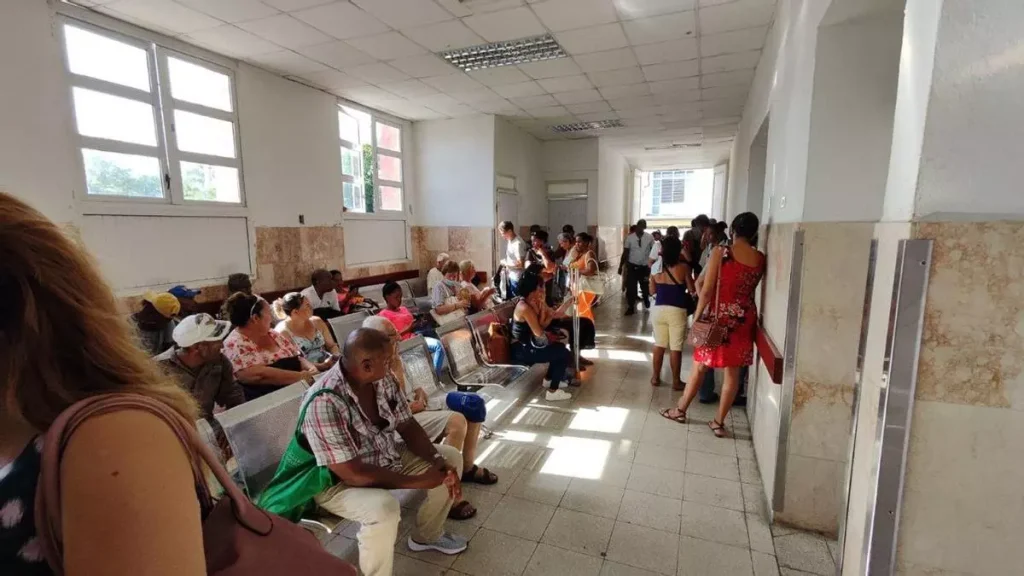
14ymedio, Miguel García, Holguín, December 16 2025 –In the morning progressing along Valle road with an unforgiving rattle. Every pothole forces us to slow down, every puddle – thick, greenish – reminds us that last night’s rain found no drainage and no official concern. Electric tricycles, motorcycles, bicycles and private cars arrive here with the same destination: the Lucía Iñiguez Landín Surgical Hospital. People arrive with fevers, joint pains, and the exhaustion of those who have been waiting for days for their bodies to give way.
“This feels like a test before we even get to the doctor,” says a woman holding her sweaty son as she dodges the accumulated water. Arboviruses have once again put this road at the centre of daily life in Holguín: patients from Velasco, Gibara, Calixto García, Cacocum and the city itself cross this stretch of road, ravaged by neglect and lack of investment, in search of diagnosis and relief.
A few kilometres away, the scene changes in colour and texture. At the end of Frexes Street, opposite the Provincial Assembly of People’s Power, the asphalt looks almost perfect. There are no puddles, the cracks have been sealed, and the kerb has been freshly swept. “There are always cars here with officials who come to meetings every day; they don’t achieve anything, but they never stop having meetings,” complains the driver of an electric tricycle as he compares, without raising continue reading
his voice, the smooth pavement he has just left behind. The illusion hardly lasts 200 metres, from Bim Bom to a sugar-cane juice stall: just the stretch visible from the windows of the official building and the busy part for those entering and leaving the offices of power. Beyond that, the city returns to normal.
The photos show what is seen as normal: opposite the government building, a continuous, clean road surface with smooth traffic flow. / 14ymedio
The contrast is not only aesthetic; it is functional and symbolic. On the road to the hospital, puddles become traps for tyres and ankles; dust rises when the sun beats down and the rain stays away, and when the downpour falls, mud spreads. A cyclist slams on the brakes to avoid falling into a makeshift ditch; the driver of an old Lada calculates where to drive without losing half his suspension in the attempt. “No one comes here to inspect,” sums up a neighbour who sells coffee on the corner and sees the procession of sick people pass by every day. “If they did, this would already be fixed.”
The photos show what is seen as normal: in front of the government building, a smooth, clean road with flowing traffic; but on the way to the hospital, a series of potholes, puddles reflecting tired building façades, crumbling kerbs. On peak days for dengue or chikungunya, the road becomes a funnel for emergencies. The noise of engines mixes with coughing, the rubbing of wet sandals, and the hurried complaining of those who are late for an appointment or for the emergency room.
In Holguín, as in so many parts of the island, the roadway also votes. Where there is power, there is paint and tar; where there is pain, there is waiting and damage. The Valle highway does not ask for speeches or ribbon-cutting ceremonies: it asks for drainage, asphalt, maintenance. Meanwhile, the journey to hospital will continue to be an uncomfortable prelude to illness, and the government’s front line will remain a polished postcard for those looking down from above.
Translated by GH
____________
COLLABORATE WITH OUR WORK: The 14ymedio team is committed to practicing serious journalism that reflects Cuba’s reality in all its depth. Thank you for joining us on this long journey. We invite you to continue supporting us by becoming a member of 14ymedio now. Together we can continue transforming journalism in Cuba.
The owner of a local MSME — micro, small, or medium-sized enterprise — laments the exclusion of the most dynamic private companies from an event dominated by bankrupt state-owned enterprises.
The stands, lined up in an apathetic uniformity, offered little more than poorly printed banners. / 14ymedio
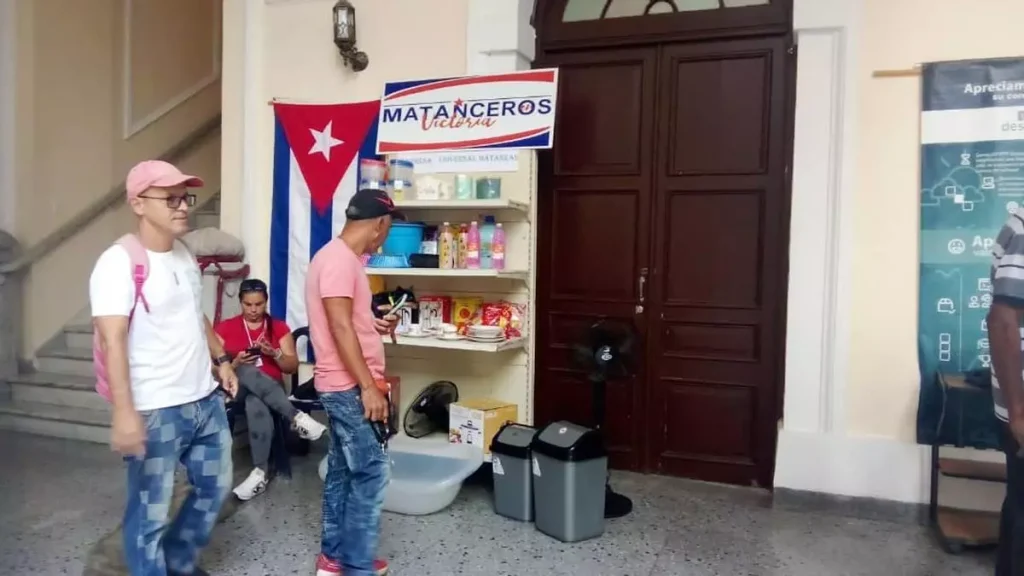
14ymedio, Julio César Contreras, Matanzas, Cuba, December 15, 2025 — The Business Fair opened its doors in Matanzas like almost all official events in Cuba are announced: with institutional enthusiasm, grandiose headlines and promises of productive chains that, at least on paper, seemed capable of boosting the local economy. For three days, the former Palace of Justice – now under the administration of the Office of the Conservator – became the venue for the third edition of a meeting that intended to showcase business muscle and modernity. However, you only had to cross the threshold for the story to begin to unravel.
In the wide corridors, the echo of footsteps was more eloquent than any slogan. The stands, lined up in apathetic uniformity, offered little more than poorly printed banners, bottles of rum placed listlessly on decorative barrels, and tables where representatives sat waiting for an audience that never arrived. The contrast between the official account and reality was difficult to ignore.
“They gave participation to their companies and a few private ones that respond to their interests,” Karel, owner of an MSME dedicated to furniture manufacturing, told 14ymedio. Since the middle of the year, he had tried unsuccessfully to obtain an exhibition space. He submitted documents, described his business purpose, and met every requirement. The final response was a bureaucratic phrase: all capacities were covered. Walking around the fair, however, it was difficult to understand what those capacities were.
The decoration included state-owned companies and entities that survive thanks to the official monopoly on certain sectors. / 14ymedio
The province has 137 state-owned companies, more than 600 micro, small and medium-sized enterprises, almost 300 local development projects and tens of thousands of self-employed workers. That diversity was not reflected in the event. “Who are you supposed to form alliances with here?” Karel asked as he pointed to an empty stand. “I can’t even hang a banner with basic information about my business. This isn’t a fair, it’s a stage set.” continue reading
The decoration included, of course, the state-owned companies and entities that survive thanks to the official monopoly on certain sectors. The Banco de Crédito y Comercio (Bandec) and the Banco Popular de Ahorro occupied visible spaces, although their presence was limited more to promoting digital platforms than to solving specific problems. “I came because I read that they were going to hand out magnetic cards,” says Ania, a resident of the historic centre. “All they do is install Transfermóvil and EnZona. I’ve had those for a long time. There was no need to set up a fair for that.”
The aesthetics did not help much either. The exhibition stands seemed improvised, with no clear visual line or minimal effort to communicate efficiency. “If they give design awards here, they can give them to anyone,” said a university professor who walked around the venue with a sceptical look on her face. The woman gave up on calling her son to get banking advice: “This is not the place to talk about a serious loan.”
The Banco de Crédito y Comercio (Bandec) and the Banco Popular de Ahorro occupied visible spaces, although their presence was limited more to the promotion of digital platforms. / 14ymedio
Initially scheduled for October, coinciding with the anniversary of the founding of the city of Matanzas, the Fair was suspended at least twice. This organisational back-and-forth left a trail of mistrust among those invited. Some gave up on participating; others attended more out of curiosity than real expectations. The result was an event where one could walk around comfortably, something unthinkable in any space that truly connects supply and demand.
Meanwhile, the “window dressing” was evident. State-owned companies with supply problems, financial deficits or impaired services presented themselves as efficient cogs in a moving economy. Not even this self-promotion could hide the fact that many are bankrupt and others survive because there are no alternatives. In key sectors – banking, commerce, paperwork – the customer does not choose: they accept.
At the close, provincial authorities described the Fair as a business success, but for those who walked those aisles, the assessment is different. There was no real variety of services, no effective interrelation between economic actors, and no signs of an expanding productive environment. There was, however, a staging designed for the photo and the report.
The slogan for this edition was “Matanzas, more productive every day.” The phrase hung in the air, without tangible backing. Outside the Fair, the city continued to grapple with power cuts, shortages and businesses that survive in spite of the system, not because of it.
Translated by GH
____________
COLLABORATE WITH OUR WORK: The 14ymedio team is committed to practicing serious journalism that reflects Cuba’s reality in all its depth. Thank you for joining us on this long journey. We invite you to continue supporting us by becoming a member of 14ymedio now. Together we can continue transforming journalism in Cuba.
At Raúl Castro’s request, it was decided to postpone the ninth Congress, hoping to “unite forces” and create “better conditions”.
Díaz-Canel listed problems that the system itself generates and perpetuates. / Cubadebate
14ymedio, Havana, December 14, 2025 — The 11th Plenary Session of the Central Committee of the Communist Party of Cuba concluded on Saturday, leaving behind many slogans, lengthy ideological discussions and an almost total absence of real self-criticism. Miguel Díaz-Canel, first secretary of the PCC and president of the Republic, repeated to the party elite the same recipe that the ruling party has been distributing for decades: unity, resistance, discipline and ideological battle.
All this in a country facing its worst economic deterioration since the 1990s, a health collapse in the midst of a viral epidemic and a civic disengagement of the people that neither the Party nor the Government has managed to reverse.
At the meeting, it was agreed to postpone the organisation’s 9th Congress, originally scheduled for April 2026. The proposal was presented by Raúl Castro and announced by Díaz-Canel in a letter read to the members of the Central Committee. In the letter, Raúl Castro acknowledged the importance of respecting the usual congress schedule – every five years – but considered that, given the current “circumstances of force majeure”, it was more appropriate to devote the next year to addressing economic and social problems and to concentrate resources and efforts on “national recovery”. The decision was approved, as always, unanimously, with the official justification that it would allow for “cohesion of forces” and create “better conditions” for a more fruitful congress in the future.
The president began his speech by announcing the need to “change everything that needs to be changed,” although he immediately returned to placing the nonagenarian Raúl Castro as his ideological compass. “If we want to move things forward, the first thing we have to achieve is to make the Party’s grassroots organisation strong in every place,” he said, in a message that shifts the focus to rank-and-file members and avoids attributing structural failures to the political leadership.
The plenary session devoted much of its time to reviewing compliance with the agreements of the 8th Congress of the PCC, held in 2021, and the accountability of the Political Bureau. According to Díaz-Canel, none of these debates would make sense without a profound change in the internal functioning of the single party. “We cannot allow bureaucracy, formalism and inertia to continue to be obstacles,” he reiterated, as if it were a newly discovered diagnosis and not a historical burden spanning six decades of continue reading
economic and political centralisation.
In the absence of concrete solutions to the economic crisis, the official discourse reinforced the ground where the PCC feels most comfortable: symbolic confrontation. The president insisted on the need to “intensify the ideological, cultural and communicational battle,” repeating the formula of “Cuba’s truth” in the face of “manipulation” and “media warfare.” According to him, each day of the system’s survival constitutes “a victory” against the “most powerful enemy,” even though the most pressing problems—blackouts, inflation, shortages, epidemics—have essentially domestic roots.
Those who were hoping for concrete explanations, verifiable data, or some light on the opacity surrounding the Gil case had to settle for adjectives.
Díaz-Canel dedicated five lengthy and rhetorical paragraphs to Alejandro Gil, recently sentenced to life imprisonment for espionage and other crimes. The president—who was close to the former Minister of Economy and even showered him with hugs and congratulations after his dismissal—stated: “Those who profit from needs and shortcomings appear, those who obstruct progress, those who delay advancement, and those capable of selling out the nation that once elevated them to the highest offices.”
To support that assessment, he used several quotes from Fidel Castro about those who embody “selfishness, ambition, disloyalty, betrayal, or cowardice,” and about the revealing nature of every revolution, where “the altars collapse” and “the great traitors” are exposed.
Díaz-Canel maintained that there were no more accurate words to describe Gil’s “actions” and called his case a “disgraceful” one from which the country must learn lessons. He reiterated that the Revolution maintains “zero tolerance” for behaviors like those attributed to the former minister and asserted that episodes of this kind necessitate strengthening ethical and political oversight in all institutions. However, those who were hoping for concrete explanations, verifiable data, or some clarity on the opacity surrounding the case had to settle for adjectives.
References to the “US blockade” were constant. Díaz-Canel spoke of “enormous pressure” and media intoxication capable of distorting internal perception. But even when citing the health crisis caused by dengue and chikungunya, he again placed the blame on minor organisational issues, such as a lack of personnel to fumigate, monitoring problems and control deficiencies. Not a word was said about the obvious collapse of the hospital system and the mass exodus of health professionals.
Not a word was said about the obvious collapse of the hospital system and the mass exodus of health professionals.
The president called for acting “without improvisation,” promoting “collective leadership,” encouraging criticism and self-criticism, and “confronting corruption more decisively,” even though the country’s political structure continues to lack independent mechanisms for control, transparency, or citizen oversight. In what has become a customary exercise in PCC interventions, Díaz-Canel listed problems that the system itself generates and perpetuates, but without admitting the political origin of these dysfunctions.
The plenary session also addressed the country’s economic situation, which, according to Prime Minister Manuel Marrero Cruz, is marked by a “war economy” scenario. The government’s programme to “correct distortions and revive the economy” includes 106 objectives, 342 actions and 264 indicators, a design that contrasts with the chronic lack of tangible results. The official narrative insists on the need to “prioritise tasks”, “integrate actors” and “mobilise reserves”, but the balance sheet presented confirms that the country is operating with fuel shortages, prolonged blackouts, low production levels and severe foreign exchange restrictions.
The Minister of Energy and Mines, Vicente de la O Levy, admitted that the last few weeks have been “extremely difficult,” marked by loss of generation and the inability to guarantee electrical stability. Not even the new photovoltaic solar parks, hailed as a strategic advance, compensate for the obsolete technology and lack of fuel that continue to cause blackouts of up to 18 hours in several provinces.
The message, identical to the one officialdom has repeated for decades, shifts attention from administrative failure to ideological loyalty.
Another critical issue addressed was the epidemiological crisis. Health Minister José Ángel Portal Miranda acknowledged that Cuba faces an “extraordinary” challenge, with dengue and chikungunya epidemics aggravated by a lack of supplies, fumigation equipment, laboratory reagents and basic medicines. He added that many areas have serious problems with disease-carrying mosquitoes, sanitation and water supply, a structural deterioration that the government has been unable to reverse for years. The official response, once again, insisted on “popular participation” as a solution in the absence of institutional resources.
Amid this panorama, the PCC once again placed “unity” as the cornerstone of the political project. Díaz-Canel stated that unity “is forged through participation” and that it is the guarantee that Cuba will remain “free, independent and sovereign.” The message, identical to the one the ruling party has repeated for decades, shifts attention from administrative failure to ideological loyalty. Participation, however, is limited to consultation mechanisms with no real decision-making power.
The plenary session closed with the confirmation of what had already been anticipated, namely that there will be no structural changes that alter the PCC’s political monopoly or the centralised planning that keeps the economy paralysed. Everything is focused on “correcting distortions” without touching the root of those distortions: the model itself. There is no political openness, no real economic liberalisation, no full business autonomy, and no respect for civil rights. The Party once again proclaims itself the absolute arbiter of the country’s future and the guardian of a unity that is demanded but not built on plurality.
The lack of commentary in official publications is striking, a sign of popular disinterest in this type of meeting. The system insists that the country’s problems will be solved “through our own efforts.” Cubans, who have been hearing the same thing for decades, already know the lyrics to that song, and they are fed up.
Translated by GH
____________
COLLABORATE WITH OUR WORK: The 14ymedio team is committed to practicing serious journalism that reflects Cuba’s reality in all its depth. Thank you for joining us on this long journey. We invite you to continue supporting us by becoming a member of 14ymedio now. Together we can continue transforming journalism in Cuba.
The consulting firm Auge has published a report that compiles the opinions of 175 executives from private companies with up to 100 employees
Seventy-six per cent of the businesspeople surveyed say they feel optimistic about 2026, while 60 per cent predict that the national economy will be much worse./ 14ymedio
14ymedio, Havana, 13 December 2025 — The recently released First Business Climate Study for Cuban MSMEs*, conducted by the consulting firm Auge, reveals a contrast that sums up the current situation of the private sector on the island. The results of the study were presented on Friday during El Break, a meeting held at Nodo Habana.
According to the study, 76% of the business owners surveyed say they feel optimistic or very optimistic about 2026, while 60% predict that the national economy will be somewhat or much worse next year. The apparent contradiction, described in the report itself as a “marked divergence”, shows the disconnect between the individual performance of small firms and the perception of the economic environment in which they are forced to operate.
The study, the first of its kind to be conducted independently in Cuba, gathers the opinions of 175 executives from private companies with up to 100 employees, most of which have been in operation for more than three years. Auge warns that the selection of interviewees was not random and that the results should be taken as a qualitative approximation rather than a statistical generalisation of the country’s business universe. Even so, the consultancy firm highlights continue reading
that this initial map offers a valuable perspective on the experiences and concerns of a representative segment of the current MSME fabric.
One of the most striking elements of the analysis is the coexistence of marked optimism about their own performance with a deep mistrust of the country’s future. For the authors, this tension starkly highlights the lack of security in the regulatory and economic environment and explains why, despite the drive of the private sector, investment remains timid and innovation is geared more towards resistance than qualitative leaps. Although most respondents expect to increase their sales and profits in 2026, they are more cautious when it comes to forecasting increases in investment or staffing levels, a sign of the insecurity caused by regulatory volatility and macroeconomic unpredictability.
The consultancy recommends improving legal predictability, enabling transparent mechanisms for access to foreign currency, institutionalising dialogue between private actors and the government, and adopting firm measures to contain inflation.
Among the most optimistic companies are those engaged in information and communications technology, wholesale and retail trade, industrial and agricultural production, and food and accommodation businesses. These are sectors that, despite operating in adverse conditions, maintain a certain dynamism and adaptability.
However, current obstacles continue to erode their room for manoeuvre. This year, the most frequently cited problems were inflation (mentioned by 60 per cent), poor state infrastructure (43.4 per cent) and difficulty accessing foreign currency (38.9 per cent). Concerns for 2026 are growing in intensity, with 68% fearing greater economic instability, 56.6% anticipating new regulations that will further complicate private activity, and 48% expecting an additional increase in costs due to inflation.
The report sees this set of concerns as a map of systemic bottlenecks that are exacerbated by unstable conditions marked by rising tariffs, prolonged blackouts, persistent inflation, and the absence of a formal and stable mechanism for MSMEs to access foreign currency. Entrepreneurs were explicit in identifying what they consider to be the three priority areas for the authorities: ensuring regulatory stability, opening up real and autonomous access to foreign currency, and formally recognising the private sector’s contribution to the national economy. Without tangible progress in these areas, Auge argues, the country will remain trapped in a dynamic of low investment, low productivity and innovation reduced to survival strategies.
MSMEs have become one of the few actors with the capacity to adapt and generate a certain economic dynamism.
Based on the study’s conclusions, the consultancy recommends improving legal predictability, enabling transparent mechanisms for access to foreign currency, institutionalising dialogue between private actors and the government, and adopting firm measures to contain inflation. In Auge’s opinion, any attempt to boost the Cuban economy necessarily involves offering a more stable and less arbitrary framework for the activity of non-state enterprises.
Between 2020 and 2024, the country’s GDP has contracted by 11%, and no growth is expected in the current financial year. Although no official forecast has been released for 2026, there are no signs of a change in the trend. Failed domestic economic policies and the difficulties faced by the regime’s main allies have exacerbated structural problems that are reflected in food, fuel and medicine shortages, daily power cuts, rampant inflation, fiscal deficits, the deterioration of state services, bank decapitalisation, growing dollarisation and unabated mass migration.
In this turbulent landscape, MSMEs have become one of the few actors capable of adapting and generating some economic dynamism. But their optimism contrasts with the increasingly widespread certainty that the country is sliding into sustained decline.
*Translator’s note: Literally, “Micro, Small, Medium Enterprises.” The expectation is that it is also privately managed, but in Cuba this may include owners/managers who are connected to the government.
Translated by GH
____________
COLLABORATE WITH OUR WORK: The 14ymedio team is committed to practicing serious journalism that reflects Cuba’s reality in all its depth. Thank you for joining us on this long journey. We invite you to continue supporting us by becoming a member of 14ymedio now. Together we can continue transforming journalism in Cuba.
Yinet Labañino Acosta was murdered on Monday, 8 December, in her own home.
“Violence leaves marks, ignoring them leaves femicides.” New murder brings the number of cases of gender-based violence in Cuba to 42. / YoSíTeCreo en Cuba
14ymedio, Havana, 12 December 2025 — A new femicide was added on Thursday to the wave of gender-based murders in recent weeks, bringing the total to 42 in 2025, according to the independent count carried out by 14ymedio, in the absence of official information. On this occasion, according to confirmation from the feminist platforms Yo Sí Te Creo en Cuba and the Alas Tensas Gender Observatory, the victim is a 40-year-old teacher, Yinet Labañino Acosta, who was murdered on Monday, 8 December, in her own home, located in the town of Cabacú, municipality of Baracoa, in the province of Guantánamo.
According to both organisations, the alleged perpetrator not only took Labañino’s life, but also that of her husband, in an incident they classify as “gender-based murder of a man”, motivated by “issues related to machismo and misogyny”. The crime leaves two minor daughters orphaned of both their mother and father.
This is the third gender-based murder confirmed in the country so far this month. On 5 December, teenager Heidi García Orozco was stabbed to death by her boyfriend at her home in Jovellanos, Matanzas.
This was followed on 7 December by the death of Elianne Reyes Gómez, 26, mother of a young girl, who was murdered by her partner in her own home in Madruga, Mayabeque. continue reading
Yinet Labañino’s is the third gender-based murder confirmed in the country so far this month.
The previous weeks were also marked by violence. On 30 November, 46-year-old Rosa Idania Ferrer Pérez was murdered by her partner in the province of Cienfuegos. At the end of that same month, Niyu del Carmen López Morales was admitted to a hospital in Havana after being assaulted by her ex-partner.
Cuba is currently among the countries with the highest rates of femicide in Latin America, according to studies, with 1.4 murders per 100,000 women.
The seriousness of the situation has led organisations and activists to insist on the need for a comprehensive law on gender-based violence, as well as shelters for women at risk, effective protection protocols and transparency from the state regarding its statistics. They have also called for a state of emergency to be declared due to gender-based violence in Cuba.
For the time being, according to specialists, the effective implementation of the Victims’ Care Act could offer clearer tools for the protection, support and redress of those facing situations of serious violence on the island, although feminicide is not classified as a crime in the Cuban Penal Code.
Organisations and activists insist on the need for a comprehensive law on gender-based violence
An office to advise victims of gender-based violence was recently opened in Havana, created by the National Organisation of Collective Law Firms with the support of the Canadian Embassy and the United Nations Population Fund.
A national registration and monitoring system was also approved and an official prevention campaign was announced. However, activists and relatives of victims consider these measures to be insufficient in the face of the sustained increase in cases.
Translated by GH
____________
COLLABORATE WITH OUR WORK: The 14ymedio team is committed to practicing serious journalism that reflects Cuba’s reality in all its depth. Thank you for joining us on this long journey. We invite you to continue supporting us by becoming a member of 14ymedio now. Together we can continue transforming journalism in Cuba.
Elianne Reyes was murdered by her partner at her home in Mayabeque
Cuba is among the countries with the highest rates of femicide in the region. / 14ymedio
14ymedio, December 11, 2025 — Elianne Reyes Gómez, 26, mother of a the young daughter, was murdered on 7 December in Madruga, Mayabeque, by her partner. The crime took place inside her own home. The news, which initially circulated among neighbours and local media, was confirmed on Wednesday by the platforms Yo Sí Te Creo en Cuba and the Gender Observatory of Alas Tensas magazine.
According to the independent count by 14ymedio – maintained in the absence of reliable official data – this would be the 41st femicide of the year, following the murder on 5 December of a teenager in Jovellanos, Matanzas.
In the same context, there was a recent attempt to murder Niyu del Carmen López Morales, who was hospitalised in Havana after being beaten and attacked with acid by her ex-partner. The attack took place in a building in the La Virgen del Camino area, where neighbours heard her screams and called the police, who managed continue reading
to rescue her. The victim confirmed that she suffered serious injuries and that the attacker remains in custody.
The cases recorded in recent weeks have caused concern.
The cases reported in recent weeks have caused concern in various communities, where family members and residents point to the lack of resources and effective means of care to respond to risky situations and prevent further episodes of violence.
Comparative studies on gender violence place Cuba among the countries with the highest rates of femicide in the region, with a ratio of 1.4 murders per 100,000 women, a level higher than that of other countries with greater public visibility on this issue, such as Mexico, Argentina, Ecuador, and Chile. This is despite the fact that in the Cuban case, the available figures do not come from official statistics, but from independent records kept by organisations that do not have access to all the information handled confidentially by the authorities.
Studies place Cuba among the countries with the highest rates of femicide
The persistence of these incidents once again highlights the need to effectively implement the Victims’ Care Act, a legal framework that, according to experts and organisations, could provide clearer tools for the protection, support and redress of those facing situations of serious violence in the country.
The recent opening in Havana of an office specialising in assisting victims of gender-based violence, created by the National Organisation of Collective Law Firms with the support of the Canadian Embassy and the United Nations Population Fund, is part of this same scenario.
Translated by GH
____________
COLLABORATE WITH OUR WORK: The 14ymedio team is committed to practicing serious journalism that reflects Cuba’s reality in all its depth. Thank you for joining us on this long journey. We invite you to continue supporting us by becoming a member of 14ymedio now. Together we can continue transforming journalism in Cuba.
Micro, small, and medium-sized enterprises (MSMEs) and self-employed workers will be able to use these resources to import raw materials and must deliver 20% of the balance to the Central Bank at the official exchange rate.
Private trade in the city of Cienfuegos. / 14ymedio
14ymedio, Madrid, 11 December 2025 — For the first time, the Cuban government will allow private individuals to hold foreign currency accounts and conduct business with them, a measure the sector has long called for, but which will be limited by the amount they must hand over to the state. The regulation establishes a clear difference between foreign investors and national companies, which are subject to an 80% retention coefficient — the amount of foreign currency income that can be retained, while the rest is sold to the Central Bank at the official exchange rate — compared to 100% for the former.
The decision is part of a legislative package published on Thursday in the Official Gazette, through which Cuba is implementing a partial dollarisation, “until economic conditions allow and the Cuban peso is reinstated as the only legal tender in the country”. In total, there are four regulations – a decree-law and three resolutions – that establish “a new mechanism for the management, control and allocation of foreign currency, with the aim of increasing foreign currency revenues and achieving a more efficient use of them.”
The decision is part of a legislative package published on Thursday in the Official Gazette, through which Cuba is shaping a dollarisation that it is reconsidering as partial.
The measures affect all economic actors regardless of whether they are state-owned, private or cooperative, foreign or domestic, but there are some differences between them. One of the most important is continue reading
the aforementioned retention coefficient. There are special circumstances for state-owned companies, as many of them already had approved foreign currency financing schemes, but in the case of private companies there is a special circumstance.
The 80% rate will apply to income from exports, e-commerce with payments from abroad, sales of goods and services to users and concessionaires of the Mariel Special Development Zone (ZEDM), foreign investment modalities, and entities authorised to trade in foreign currency. For all other cases listed in Article 5 of the regulation (dedicated to possible legal sources of foreign currency), 100% may be retained.
According to the government, retained foreign currency can be sold on the foreign exchange market or used for authorised payments, promoting productive linkages and import substitution.
The measure provides a solution to the demands of private individuals, who had been calling for years for a legal currency market in which to operate: its absence prevented them from legally importing the supplies that are so scarce in Cuba, encouraging the parallel market and leaving them exposed to the risk of losing their licences, among other penalties, if they were inspected. Also, if the measure is successful, the state will be able to regain access to foreign currency that was operating illegally and therefore beyond its control. This, in turn, made it difficult for the government to make the payments it needs to finance its own expenses and pay its foreign suppliers, including the essential fuel without which the economy cannot move forward.
The regulations also govern foreign currency bank accounts, authorising private individuals to hold them for the first time, which in turn allows them to pay for imports without having to exchange currency. This also paves the way for payments between different economic actors, facilitating the much-discussed “chain reactions”.
This also paves the way for payments between different economic actors, facilitating the much-discussed “linkages”.
Another element established by the legislation is the so-called ACAD, a purchase authorisation that the Government, through the Minister of Economy and Planning, will grant to companies to purchase foreign currency from the Central Bank. To obtain it, the applicant must have the national currency available. The permit is also non-transferable.
Domestic transactions – internal, as defined by the resolution – will preferably be made in pesos, except when they occur between operators in the Mariel Special Development Zone (ZEDM), between wholesalers and shops (retailers) in foreign currency, and other exceptional cases that may be approved. Exporters and those operating in e-commerce may pay their domestic suppliers in foreign currency provided that this is mutually agreed, a new development that will facilitate the flow of currency without intermediaries.
As for other economic actors, the law states that foreign investors collect and pay in foreign currency and can operate domestically with both currencies. Private individuals must, as a rule, trade in pesos, but if the customer pays in foreign currency, the business owner can receive payment in that same currency, although they may choose to convert it into pesos. Agricultural producers, for their part, will receive income in their foreign currency accounts if they are recognised as exporters or import substitutes.
Translated by GH
____________
COLLABORATE WITH OUR WORK: The 14ymedio team is committed to practicing serious journalism that reflects Cuba’s reality in all its depth. Thank you for joining us on this long journey. We invite you to continue supporting us by becoming a member of 14ymedio now. Together we can continue transforming journalism in Cuba.
In Marianao, rubbish is set alight to block a street; demonstrations in San Miguel del Padrón, Diez de Octubre, Alamar and Regla, as well as Las Tunas and Baracoa, in the east of the country.
The regime claims that peope are just expressing concern about the supply problem and that this is not a protest against the government. / Facebook
14ymedio, Havana, 9 December 2025 — On Monday, the streets of Marianao, in Havana, were crowded with people angry about more than 12 hours of power cuts. A dozen videos have shown unhappy and tired people yesterday facing yet another night of “insufficient generation capacity”, as journalist Bernardo Espinosa described the 61% shortfall in national electricity production for the night (more than 2,000 megawatts for a demand of 3,300 MW).
Omar Ramírez Mendoza, an engineer at Unión Eléctrica, explained on Noticiero Estelar that three of the four largest units in the national electricity system (SEN) were “out of base generation” and a total of ten, which were damaged or under maintenance, were also out of service. Added to this is the unavailability of some 1,000 MW in distributed generation. This situation has been developing on the island for months, but it is affecting the capital, which is especially prone to outages, more than ever before.
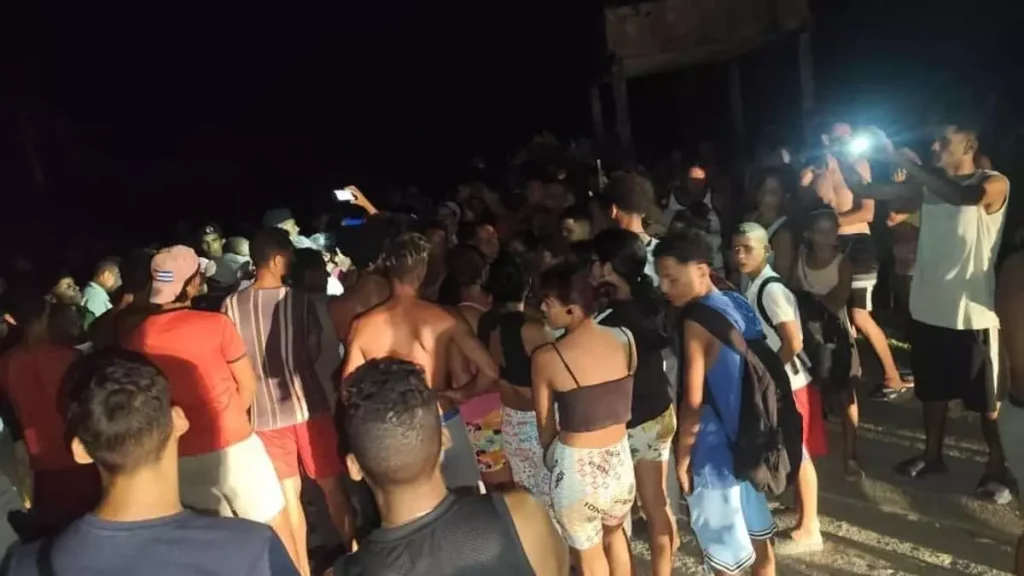
The worst situation was in Zamora, one of the poorest neighbourhoods in Marianao, where not only were they hitting pots and pans, but lighting bonfires in the middle of the street, rubbish bins were being knocked over and people were shouting that they were fed up. The police quickly arrived at the scene of the protests, and although there were no clashes or arrests at first, many assumed that arrests would follow later. continue reading
The worst situation was in Zamora, one of the poorest neighbourhoods in Marianao, where not only were they banging on pots and pans, but lighting bonfires in the middle of the street.
“As normal, the same vicious circle: now they catch three or four ringleaders, [because] the neighbourhoods are full of security forces, and the blackout gives money to the regime, which saves thousands of dollars with the power cuts, and also to the gossipers on social media, shameless people who are profiting from the misfortunes of the poor Cuban people,” wrote one user on social media.
Some videos show how, in the course of the protests, the power eventually comes back on in the area. “It worked,” writes one user who shared images of the moment. “It didn’t work. They know how to keep the slaves happy. Give them a couple of hours of power,” replied another.
The protests spread to other municipalities, including San Miguel del Padrón, Diez de Octubre, Alamar and Regla, where people were also shouting about how nobody cares because not only
was there no electricity, but also no water or sanitation.
People are getting more upset at a time when, not far away, the El Vedado Film Festival is on, where they are trying to keep things normal. Havana residents are unhappy at seeing the lights on in the event’s cinemas while their homes are in a permanent blackout. “In El Vedado there are lights, music, screens. In my house, I can’t even charge my phone,” one resident told this newspaper over the weekend. In reality, it is just an illusion. More than one screening has been cut short by a sudden blackout.
With things as bad as they were in the capital, the east of the country was in an even worse situation. From Bayamo, a social media user claimed that there had been no electricity for more than 20 hours, encouraging theft and the spread of viruses, with mosquitoes everywhere in the darkness. “It should be the whole country, this out and out abuse of the people is too much,” she cried.
The protests also reached Baracoa, in Guantánamo, where it was a pro-government account that gave the most coverage to the event, claiming it was a spontaneous gathering “to express concerns related to water supply and electricity service, both affected by known and objective causes”.
The account claims that the authorities engaged in dialogue with the population, who did not utter “any offensive slogans” and that, afterwards, the residents withdrew “peacefully”.
The information, put out by the Primera Trinchera account, argues that this is not a protest against the government, as “some media outlets and profiles linked to anti-Cuban propaganda have spread” in order to “sow mistrust, foment disorder and create an image of chaos that does not correspond to reality”. The account maintains that the authorities engaged in dialogue with the population, who did not shout “any offensive slogans” and that, afterwards, the residents withdrew “peacefully”. “The people of Baracoa, known for their civic-mindedness and attachment to the Revolution, are not swayed by these smear campaigns or by those who thrive on discrediting others and spreading lies,” they wrote.
In Las Tunas, residents of the El Marañón neighbourhood in Yarigua took to the streets on Saturday, banging pots and pans and shouting, “Electricity schedule! Respect the people!” Those affected, who walked along the Carretera Central, partially blocking the road, said that in the last week they had been getting an average of 25 minutes of electricity per day.
The promises made by the Minister of Energy and Mines for a year in which no great improvement is expected, and Qatar’s recent announcement that it will contribute four and a half million dollars through the United Nations Development Programme (UNDP) to help the situation, come too late for an exhausted population. If they arrive at all.
Translated by GH
____________
COLLABORATE WITH OUR WORK: The 14ymedio team is committed to practicing serious journalism that reflects Cuba’s reality in all its depth. Thank you for joining us on this long journey. We invite you to continue supporting us by becoming a member of 14ymedio now. Together we can continue transforming journalism in Cuba.
The two right-wing candidates – one supported by Trump – are tied and have obtained 80% of the votes according to preliminary data.
Salvador Nasralla and Nasry Asfura (left) lead the provisional results. / Televisión Azteca
14ymedio/EFE, Tegucigalpa, 1 December 2025 — Three days after Prime Minister Ralph Gonsalves’ crushing defeat in the Caribbean islands of Saint Vincent and the Grenadines, Havana loses another ally, this time in Honduras, where elections were held on Sunday with high voter turnout and decisive results.
Conservative candidates Nasry Tito Asfura, from the National Party – for whom US President Donald Trump asked for votes – and Salvador Nasralla, from the Liberal Party (centre-right), are leading the preliminary count early on Monday morning with a narrow margin in favour of the former, signalling the return of the right to power.
With 44.23% of the votes counted, Asfura had obtained 597,184 votes (40.39%), while Nasralla had obtained 579,626 (39.20%), results that mark a change in trend in Honduras, which has been governed by the left during the last term.
The ruling party candidate, Rixi Moncada, from the left-wing Liberty and Refoundation Party (Libre), was relegated to a distant third place with 287,166 votes (19.42%), forcing her leaders to be cautious and asking supporters to remain “ready for battle” until the count is complete.
The first preliminary results took more than an hour to be published by the three councillors of the National Electoral Council.
The first preliminary results took more than an hour to be published by the three councillors of the National Electoral Council (CNE) due to technical problems and the expectant gaze of the hundreds of election observers present in the room.
In a brief and angry message before the first count was known, Asfura demanded that the president of the CNE, Ana Paola Hall, speed up the preliminary report.
“We demand that Ana Paola Hall, I don’t know what she’s waiting for, come out and do her duty. We can’t have a country waiting, on tenterhooks, in darkness. Do it, for the sake of democracy. The law continue reading
says so. Thank you, Honduras. We are here to serve you, and we stand firm,” said Asfura, who told reporters, “With the help of God and the Honduran people, we are going to win this election,” and warned that “this is not over until the last vote is counted.”
The general elections in Honduras took place on Sunday without major incidents, with minor reports of delays, alleged impediments to observers during the count, and damaged ballot boxes, but with a high turnout of more than 2.8 million voters (out of a total of 6 million eligible voters) at polling stations, according to initial data.
This participation has been applauded by the United States, which is “closely monitoring” the electoral process in Honduras.
In addition to asking for votes for the presidential candidate, Trump promised that if he won, there would be “a lot of support” for this Central American country ravaged by poverty and waves of migration of its nationals to the north, considering it to be the “only true friend of freedom in Honduras”.
With Asfura, Trump also stated that he sees the possibility of “working together to fight the narco-communists” and confront Venezuelan President Nicolás Maduro.
This support from Washington, just days before the elections, came in the form of a future pardon for former president Juan Orlando Hernández (2014-2022), convicted of drug trafficking in the United States and from the same political party as Asfura.
The American justified the controversial decision on Sunday and claimed, without evidence, that the previous government had “set up” the Honduran. “The people of Honduras really thought they had been set up (…) a trap by the Biden administration, and I looked at the facts and agreed with them,” he told reporters aboard Air Force One on his way back to the US capital.
Trump did not cite any evidence and did not directly blame Biden, but rather the advisers who worked for the Democrat during his presidential term (2021-2025), despite the fact that the case was tried in court.
Trump did not cite any evidence and did not directly blame Biden, but rather the advisers who worked for the Democrat during his presidential term (2021-2025), despite the fact that the case was tried in court. “If someone sells drugs (in a country), that doesn’t mean you should arrest the president and put him in prison for life,” Trump said of the Hernández case.
Hernández was part of a group of individuals investigated by the Drug Enforcement Administration (DEA) since 2013, the year in which he was elected, for activities “related to the importation of cocaine into the United States.” The document was made public as part of the case against the former president’s brother, Juan Antonio Tony Hernández Alvarado, who was sentenced to life imprisonment on charges related to cocaine trafficking to the United States.
With all this, Asfura leads the vote count by a narrow margin over Nasralla, the conservative who remains “optimistic” and hopeful that the results will be reversed to end 16 years of absence of the Liberal Party, but without the support of the United States.
Following the victory of the current president, Xiomara Castro, of the Libre Party, in the last elections, Nasralla held one of the three presidential appointments (vice-president) until April 2024, when he resigned due to confrontations with the president and her husband, Manuel Zelaya, who is also the general coordinator of the political party.
Translated by GH
____________
COLLABORATE WITH OUR WORK: The 14ymedio team is committed to practicing serious journalism that reflects Cuba’s reality in all its depth. Thank you for joining us on this long journey. We invite you to continue supporting us by becoming a member of 14ymedio now. Together we can continue transforming journalism in Cuba.
Testimonies show that authorities use, among other biases, “the maternal role to try to get women to abandon activism.”
Yenisey Taboada Ortiz, mother of political prisoner Duannis León Taboada, a political prisoner from 11 July, is one of the people interviewed for the AI report. / Facebook
14ymedio/EFE, Madrid, 26 November 2025 — On Wednesday, the human rights organisation Amnesty International (AI) denounced the violence perpetrated by the Cuban regime against women activists, journalists and human rights defenders through gender-based abuse and authoritarian practices.
“It’s not traditional repression,” said Johana Cilano Peláez, AI’s regional researcher for the Caribbean and author of the reportThey Want Us To Be Silent, but we continue to resist: authoritarian practices and state violence against women in Cuba, are documented in the 40-page report,” she told the EFE news agency.
The activists also receive threats of “denial of food, medicine, visits, telephone calls and harsher sentences for their detained children” if they continue their work, explains the researcher.
Many mothers and wives of people imprisoned for political actions have been forced to strip naked in order to be allowed to visit them.
Amnesty also denounces “the subordination of the judicial system to political power,” the lack of mechanisms for reporting and redress, and the absence of a comprehensive law against gender-based violence as “factors that perpetuate impunity.”
Cilano Peláez emphasises that repression does not affect all women equally, given that institutional violence intersects with gender, race and socioeconomic status. continue reading
“Black women suffered more severe treatment, and physical violence occurred earlier than in the case of white women. We also saw that activists from poorer neighbourhoods or those further away from the capital were more vulnerable,” she points out.
For the report, AI interviewed 52 people, 34 of whom were female victims, specifically analysing the cases of five of them. Yenisey Taboada, Luz Escobar, Carolina Barrero, María Matienzo, Camila Lobón and Alina Bárbara López were interviewed and revealed that the pattern of state violence is neither incidental nor isolated, but rather “structural and sustained”.
Furthermore, black women, single mothers and women of diverse sexual orientations face aggravated forms of violence, which requires an urgent intersectional response, warns AI.
Amnesty International points out that these situations occur in an environment of restrictions on the exercise and defence of human rights, where the subordination of the judicial system to political power, the lack of mechanisms for reporting and redress, and the absence of comprehensive legislation against gender-based violence perpetuate impunity.
“The international community cannot continue to remain silent in the face of the differentiated repression suffered by women in Cuba,” stressed Ana Piquer, Amnesty International’s regional director for the Americas. “Women defenders in Cuba are punished not only for speaking out, but also for being mothers, journalists and social leaders. The state uses gender-based violence as a tool of repression: it seeks to break their dignity, their family environment and their collective strength,” she added.
The organisation stresses that the lack of guarantees, the lack of judicial independence and the absence of political freedoms stifle any potential legislation that, on paper, appears beneficial for the protection of women.
The document includes a section analysing Cuban legislation, which was praised yesterday by the official press as a benchmark and model for the protection and integration of women in public life. AI considers, however, that there is a recurring lack of statistical data – specifically on deaths due to gender-based violence, whose announced updated register has been reserved for internal consumption – and an absence of regulations demanded by feminist associations.
What’s more, the organisation emphasises that the lack of guarantees, the lack of judicial independence and the absence of political freedoms stifle any potential legislation that, on paper, appears beneficial for the protection of women.
The report concludes with a specific section calling on the Cuban authorities to end gender-based harassment of women activists. “It is time for States, especially inter-American organisations and the European Union, to demand concrete protection measures. State repression against women activists and defenders in Cuba constitutes a form of institutional gender-based violence that must be made visible and publicly condemned.”
AI calls for specific protection measures for women human rights defenders and sustained monitoring by the international community.
“What we saw is that repression against women is systemic and differentiated. The state exploits motherhood and punishes those who have less visibility or resources more harshly. That is why sustained international action is needed,” concludes Cilano Peláez.
Translated by GH
____________
COLLABORATE WITH OUR WORK: The 14ymedio team is committed to practicing serious journalism that reflects Cuba’s reality in all its depth. Thank you for joining us on this long journey. We invite you to continue supporting us by becoming a member of 14ymedio now. Together we can continue transforming journalism in Cuba.
This has led to the private market taking the place of official provision.
The few state-owned opticians that remain open are just urban decoration rather than a real service. / Screenshot
14ymedio, Guantánamo, 30 November 2025 — In Guantánamo, the word “optician” is now pronounced with a hint of irony or nostalgia. It is as if people were talking about a service that existed in the past—imperfect rather than efficient, but at least it existed—and that today survives only as a sign on a shopfront. In the city centre streets, where the sun mercilessly bounces off the pavements, more and more people walk around squinting, holding their phones inches from their noses or wearing glasses patched up with adhesive tape.
The lack of lenses and frames in state-run opticians affects the quality of life of those who have been waiting for years to get better glasses, or contact lenses or buy prescription glasses that allow them to walk down the street without straining their eyes in the glare.
In front of one of the closed opticians, a woman in her sixties holds a pair of broken frames and says with resignation: “I come whenever I can to see if they’ve got anything, but nothing,” she tells 14ymedio. “Sometimes they don’t have frames, and most of the time they don’t have the prescription I need, as I’m short-sighted.”
A man in a work uniform says he has been trying to replace his glasses for months: “They tell me to come back in two or three weeks to see if any supplies have arrived, but they’ve been saying that since last August.” The scene, repeated in various parts of the city, shows closed shops, empty continue reading
display windows and employees who can only offer apologies.
No lenses, no frames, no screws, no hinges
“There are two in this area where only the guards are there because they have been without materials for so long that even the other employees no longer go to work. One of those premises has even been turned into an apartment,” complains the customer who needs glasses “to read and see up close”. His solution for the moment: to use his wife’s glasses, which, although they aren’t the same prescription, at least “prevent him from cutting his finger with a knife”.
In Guantánamo, the few state-owned opticians that remain open are more urban decoration rather than a real service. The furniture is there, and so are the cases and mirrors, but they don’t have the essentials: there are no lenses, no frames, no screws, no hinges. A woman points to the door of a shop that was once a landmark in the city: “This place has been closed for a long time. They took away the equipment. They tell people to go to another municipality, but there aren’t any there either.”
This has led to the private market taking the place of the official network. Just join any buying and selling group in the area to see an almost endless selection of modern frames, striking colours, children’s designs and lenses “for close-up vision” or “for reading”.
This abundance contrasts with the state’s poverty, but it comes at an exorbitant price: a simple pair of +1.75 glasses costs more than 900 pesos in Guantánamo. If they are of better quality or have a higher magnification, they can cost up to 1,800 or 2,000 pesos. The national average wage is around 6,500 pesos per month, so a worker has to spend between 15% and 30% of their income just to see clearly what is in front of them.
“I perform magic,” says one of these private technicians with a laugh, “but not miracles.”
My work is sewing, how can I do it without glasses?” asks a woman who proudly shows off a pair brought to her by her niece from Jamaica. Others agree: “Everyone depends on those who travel,” “if you don’t have family abroad, you’re lost,” “seeing well is a luxury now.”
For those who can’t afford a new pair, they can go to repairers: artisans of detail, guardians of an almost ritualistic skill. Few remain in Guantánamo, mostly older men who work at tiny tables, surrounded by magnifying glasses, recycled screws and worn tools. They can straighten an arm, put a piece of wire where the hinge broke, or tighten whatever is loose. But making glasses from scratch requires machinery that only the state has. “I do magic,” says one of these private technicians with a laugh, “but not miracles.”
The crisis has consequences that are not always visible. Not being able to use glasses affects productivity, learning and safety. A retired teacher explains that many older adults stop reading or doing other activities because they do not have glasses, and that this “closes them off”. Others mention frequent headaches, stumbling when walking, and difficulty performing basic tasks. In a city where many people work in manual labour, the inability to focus properly becomes an economic barrier.
Meanwhile, on the streets of Guantánamo, people can be seen squinting, enlarging the letters on their mobile phones as much as possible, or wearing frames patched up with adhesive tape. For those who cannot afford the high prices of glasses on the informal market, the city is becoming a blurry landscape.
Translated by GH
____________
COLLABORATE WITH OUR WORK: The 14ymedio team is committed to practicing serious journalism that reflects Cuba’s reality in all its depth. Thank you for joining us on this long journey. We invite you to continue supporting us by becoming a member of 14ymedio now. Together we can continue transforming journalism in Cuba.
Infections have risen by 23.2% in a week and the number of patients in intensive care, including many minors, has grown from 96 to 156.
Cases have increased by more than 23% this week, although there is optimism for December. / Archive/ 14ymedio
14ymedio, Madrid, 25 November 2025 (delayed translation) — Data on the arbovirus epidemic that Cuba has been experiencing in recent months is alarming health authorities, who on Monday warned of a 23.2% increase in chikungunya infections compared to the previous week. Carilda Peña García, Deputy Minister of Public Health, said that at the end of last week, 7,700 new cases of this disease had been recorded and, although she did not provide specific figures for dengue, she also confirmed an increase in the incidence rate.
In total, the country has recorded 39,760 people with “non-specific fever syndrome”, 15.8% less than the previous week. The official was optimistic about the future, stating that “historically, November is the most complex month for arboviruses, with dengue fever being hyperendemic.” This data led her to believe that there would be an improvement in the first or second week of December, also in the case of chikungunya, which is transmitted by the same mosquito.
At the moment, with 156 patients in intensive care – 96 more than the previous week – there is little cause for celebration. The Deputy Minister acknowledged that the situation “is considered dangerous” because there are many serious and critical cases. Of the latter, 34 (out of a total of 35) are under the age of 18. As for the seriously ill, the figure rises to 121, 96 of whom are minors.
There are 35 critical cases, 34 of whom are under 18 years of age. As for serious cases, the figure rises to 121, 96 of whom are minors.
Peña García explained that he is aware that there is underreporting because many people do not go to medical centres. However, he added that all suspected cases are counted, even if they have not been diagnosed in laboratories, which is common in epidemic situations. On Monday, of the 7,700 cases, 137 were confirmed by PCR, a test reserved for identifying and characterising serious cases or the onset of outbreaks. continue reading
As for dengue fever, transmission is widespread, with cases still present in 14 provinces – Sancti Spíritus, Villa Clara, Havana, Guantánamo, Ciego de Ávila and Santiago de Cuba leading the way – and the incidence rate has risen to 22.6%. The figures have not yet been updated in the World Health Organisation (WHO) documentation, so people do not know how many infections there are. At the end of last week, three deaths and 9,602 infections had been reported, which is a high rate of 87.79 per 100,000.
Although Peña García insisted on the importance of seeing a doctor, especially for vulnerable population groups, many cases are not counted officially. “All of us who don’t go to the doctor and heal ourselves at home are not included in this figure. Conduct a block-by-block survey to see how many of us there are,” said a Cubadebate reader in response to the news. Another user asked the authorities to be more specific about the cases of deaths circulating on social media.
“Could you clarify whether there have been any deaths from this cause and, if so, how many? There are all sorts of rumours circulating about hospitals and funeral homes being full, the virus spreading for several weeks, and not a single death? Something doesn’t make sense, and I do not believe that any deaths are a crime or the fault of the Ministry of Health, as is the case anywhere else on the planet in similar situations. Thank you. We await your response,” he asked. The only deaths known to date directly associated with dengue fever are three, announced in October. Since then, rumours have been spreading like wildfire.
The authorities claim that the procedure has not been widespread because there are “limitations on fuel and insecticides, but priority was given to areas with the most active transmission.”
The deputy minister explained that the Aedes aegypti infestation is considered high, with 8,545 outbreaks. The municipalities with the worst indicators are Camagüey, Pinar del Río, Sancti Spíritus and Havana. In the latter, as in Santiago de Cuba and Granma, fumigation targets are being met, another fact that is highly questioned on social media, where hundreds of voices claim that no action is being taken. The authorities admit that the procedure has not been followed everywhere because there are “limitations on fuel and insecticides, but priority was given to areas with the most active transmission in order to reduce the vector population and break the chain of transmission”.
The situation has prompted the Dominican Republic to take action. On Monday, it announced the intensification of epidemiological surveillance and vector control measures throughout the country, “as part of the ongoing prevention and response strategy to the chikungunya outbreak reported in Cuba and other Caribbean countries”.
The country’s Ministry of Health said there will be intensive fumigation campaigns, scrap metal removal and community education, as well as active screening for fever and surveillance at airports, ports and border crossings. The minister asked citizens for their cooperation, especially in keeping yards clean and removing water tanks that encourage mosquito breeding.
Translated by GH
____________
COLLABORATE WITH OUR WORK: The 14ymedio team is committed to practicing serious journalism that reflects Cuba’s reality in all its depth. Thank you for joining us on this long journey. We invite you to continue supporting us by becoming a member of 14ymedio now. Together we can continue transforming journalism in Cuba.
The US Embassy condemns “the abuse and mistreatment suffered by political prisoners in Cuban regime prisons.”
Yosvany García Caso and his wife, Mailín Rodríguez Sánchez. / Facebook
14ymedio, Madrid, 17 November 2025 — Yosvany Rosell García Caso, who has been on hunger strike for 26 days in the Cuba Sí prison in El Yayal (Holguín), has declared that he will also stop drinking liquids. His wife, Mailin Rodríguez Sánchez, told 14ymedio about this after finding out on Monday.
The situation of the political prisoner, sentenced to 15 years in prison for participating in the peaceful demonstrations on 11 July 2021, “is becoming more critical every day,” says his wife, who says she feels desperate. “They are already transporting him in a wheelchair because he cannot stand,” but despite this, she complains, “he has not been transferred to a hospital.” García Caso suffers from several conditions, including heart disease, hypertension and chronic gastritis.
The daily life of Rodríguez Sánchez and his three children is now even more complicated because they have all contracted chikungunya, one of the arboviruses spreading across the island in epidemic form. “We all have the virus and are recovering. This is terrible,” he says. “Here on my block, we are all laid up.”
“They are already transporting him in a wheelchair because he cannot stand”
Various international bodies have spoken out in favour of the political prisoner in recent weeks. On Monday, the US Embassy in Havana did so via its social media accounts, condemning “the abuse and mistreatment suffered by political prisoners in the Cuban regime’s jails”. It is alarming, says the diplomatic headquarters in X, “that 11 July prisoners such as Yosvany Rosell García are on hunger strike to protest against the constant abuses. We join their demand for the release of all political prisoners”.
García Caso announced in a handwritten letter that he would go on hunger strike from 23 October and demanded to be transferred continue reading
to a punishment cell as a “new form of protest” against the “continued imprisonment of all political prisoners”. In his letter, the activist expressed his “unequivocal support for maximum pressure from the United States Government on the narco-terrorist Cuban Government”.
He concluded with a postscript: “What you do only for yourself vanishes when you die; what we do for others is our divine legacy.”
Handwritten letter from prison signed by political prisoner Yosvany García Caso. Courtesy
Several organizations have also spoken out about the prisoner, including the Cuban Observatory for Human Rights, which on Friday issued an alert “regarding the grave risk to his life with each passing minute,” demanding “adequate medical attention and his immediate release.” Cubalex, for its part, noted that hunger strikes are “an extreme measure resorted to by people deprived of their liberty when they are denied effective avenues to report abuses or assert their rights.”
García Caso himself had already staged numerous similar protests to denounce his conviction, which he considers unjust and the result of an arbitrary trial. These hunger strikes—six up to September 11, 2022—are, according to the Justice 11J list of prisoners, what caused the gastritis he suffers from.
Arrested at his home on July 10 for a pot-banging protest, according to the same NGO, García Caso was arrested again for his participation in the July 11 events. Almost a month later, he was transferred to the Holguín Provincial Penitentiary. With alleged prior drug trafficking charges, he was accused of assault, public disorder, spreading epidemics, and incitement to commit crimes, and was initially sentenced to 20 years in prison, and later, on appeal, to 15 years.
The chemical is used to purify domestic drinking water.
The poor quality of piped water has got worse / Aguas Santiago Water and Sewerage Company
14ymedio, Santiago de Cuba, 25 November 2025 — The official journalist Cuscó Tarradell, in a Facebook post quoting the Municipal Assembly’s Communications Department, warned that two people had died in Santiago de Cuba after being exposed to a highly toxic substance sold as “alum bleach”.
According to information released by Tarradell, the two victims were university workers. Meanwhile, those allegedly responsible for marketing the counterfeit product stole a batch of industrial bleach from the Mar Verde warehouses and relabelled it to pass it off as “alum bleach”. The compound circulating on the informal market is a highly dangerous industrial chemical, even if ingested in small quantities.
The compound that is circulating is a highly dangerous industrial chemical.
Authentic alum is a mineral salt that has traditionally been used to help purify water. When added to liquid, it allows dirt and suspended particles to clump together and sink to the bottom, making it easier to filter and improving clarity. The product has been used for decades in basic domestic and community water purification processes, always in small quantities and under controlled conditions.
Authentic alum is a mineral salt that has traditionally been used to help purify water. / Facebook
When reporting the information Tarradell also called for local authorities and the Santiago Water Company, to address the poor quality of the water being distributed, which forces many Santiago residents to seek substances on their own to clarify it. This need, he warned, leaves the population exposed to scams and dangerous compounds such as counterfeit “alum bleach”.
The poor quality of the water supplied through the pipes has worsened following Hurricane Melissa’s passage through the eastern part of the country. Residents in the city of Santiago de Cuba complain that the water supplied to them is earthy in colour, contains suspended particles and often has a bad smell.
Following the incident involving the fake “alum bleach”, the authorities advise against consuming chemicals purchased on the street, even if they are presented as known substances, and to always check the origin and labelling of any compound intended for water treatment or domestic use.
The deaths of two people as a result of exposure to this chemical have not been reported by the official press. The local newspaper Sierra Maestra, both on its website and on its Facebook page, has not reported on the deaths or on the investigation against those accused of marketing the product.
Translated by GH
____________
COLLABORATE WITH OUR WORK: The 14ymedio team is committed to practicing serious journalism that reflects Cuba’s reality in all its depth. Thank you for joining us on this long journey. We invite you to continue supporting us by becoming a member of 14ymedio now. Together we can continue transforming journalism in Cuba.
In a shop in Kilo 12, a carton now costs 3,400 pesos, putting it even further out of reach for many households.
Eggs for sale in a private shop in Sancti Spíritus. / 14ymedio
14ymedio, Mercedes García, Sancti Spíritus, November 27, 2025 — For months, in Sancti Spíritus, they said – with a mixture of resignation and hope – that the price of eggs “could not go any higher”. When a carton of 30 eggs climbed to 3,000 pesos, many Sancti Spíritus residents claimed that the product had reached its ceiling. “It won’t go any higher,” they repeated in farmers’ markets, improvised queues and WhatsApp groups. But this week, in a small private shop in the Kilo 12 neighbourhood, a handwritten sign shattered that illusion of a limit being reached: 3,400 pesos.
The scene in front of the shop seems routine, but something in the atmosphere suggests that it is not. Three people wait in line—a young woman in flip-flops, a woman in very short shorts, and a heavyset man carrying a bag slung across his back—none of them speaking. The stillness has a visible weight. Even the black and white cat prowling near the peeling wall moves with a certain caution, as if it understands that an invisible barrier has been crossed in that corner.
The rough granite counter holds several cartons of 30 eggs each. Each one is an expensive promise, a small privilege for those who can still afford it. In a country where the average monthly wage is less than 6,500 pesos, buying one of these cartons means spending more than half of one’s monthly income. A luxury for some, an urgent necessity for others.
Workers leaving their homes complain loudly, pensioners stop to stare incredulously at the sign, and motorcyclists drive slowly past.
>The seller, safely inside the shop, spends the day repeating the same phrase to those who approach: “Yes, they’re now 3,400.” In the neighbourhood, news of the new price spreads quickly: workers leaving their homes complain loudly, pensioners stop to stare incredulously at the sign, and motorcyclists drive by slowly, as if weighing up whether it is worth stopping. Some even clean their glasses for fear that dust has distorted the price.
In Cuba, eggs have always been a barometer of the crisis. Their price rose with inflation, with the lack of feed for poultry, with the decline in domestic production and with speculation by those who fill the gaps left by the state. But this jump of 400 pesos in a few weeks has another flavour: that of absolute vulnerability. “My pension is 3,000 pesos, which isn’t even enough for a carton,” says a man watching the scene from a safe distance.
In the city, residents make complex calculations, given that many shops only sell whole cartons, not individual eggs. “Do you want to buy half?” one neighbour shouts to another on the opposite pavement. Inflation forces people to resort to increasingly distressing arithmetic.
Translated by GH
____________
COLLABORATE WITH OUR WORK: The 14ymedio team is committed to practicing serious journalism that reflects Cuba’s reality in all its depth. Thank you for joining us on this long journey. We invite you to continue supporting us by becoming a member of 14ymedio now. Together we can continue transforming journalism in Cuba.

 14ymedio, Miguel García, Holguín, December 16 2025 –In the morning progressing along Valle road with an unforgiving rattle. Every pothole forces us to slow down, every puddle – thick, greenish – reminds us that last night’s rain found no drainage and no official concern. Electric tricycles, motorcycles, bicycles and private cars arrive here with the same destination: the Lucía Iñiguez Landín Surgical Hospital. People arrive with fevers, joint pains, and the exhaustion of those who have been waiting for days for their bodies to give way.