It is being built by the French company Bouygues and will have 520 luxury rooms.
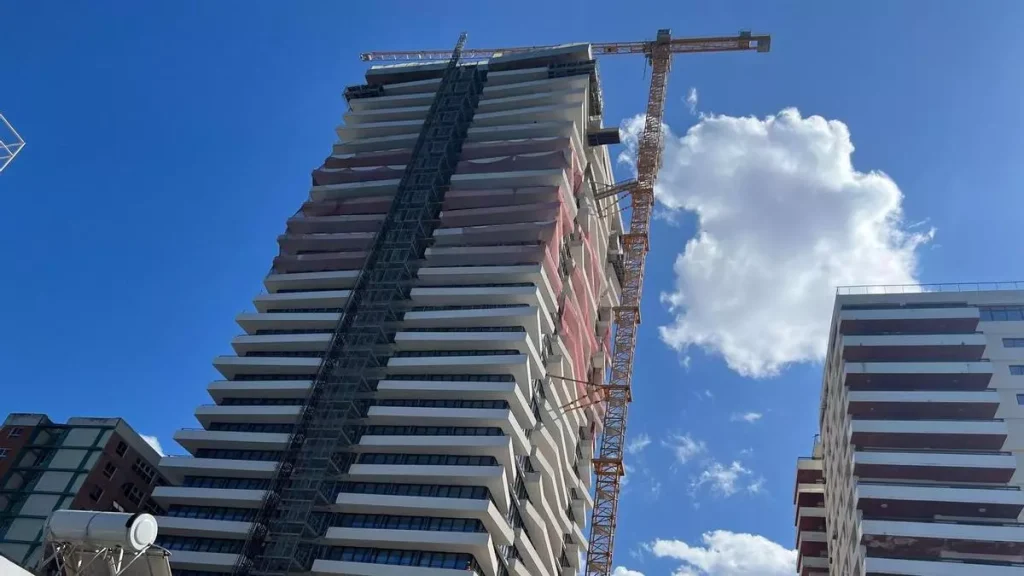
 14ymedio, Darío Hernández, Havana, November 29, 2025 — After more than three years of construction, the tower rising at 1st and B in Havana’s Vedado neighbourhood continues to grow like a foreign body in the middle of a neighbourhood that is falling apart. The 25-storey building is visible from several blocks away and already dominates the coastal strip near the Malecón. The structure appears to be practically finished on the outside, but its interior is still under construction.
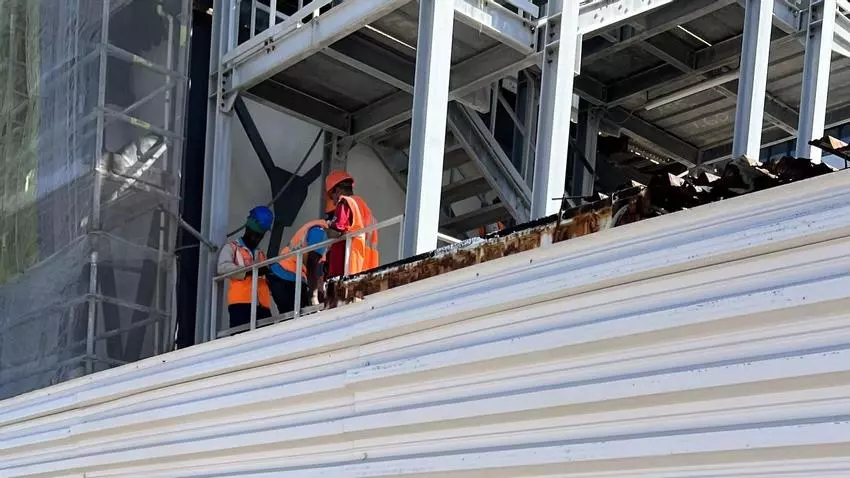
A technician at the site assured 14ymedio that “the foreign part is French,” and that Indians are also working on the project, although, according to him, “more as labourers.” “They are leaving in December because their work is done,” added the expert. The project’s architectural dossier confirms that the French construction company Bouygues – the same company that has built most of the luxury hotels in Cuba – is listed as the main developer of the building. This explains the presence of French and Indian workers on the site, as well as the high standard of the finishes.
The French company Bouygues Bâtiment International, a discreet player in Cuba’s hotel boom, has a history of controversy. The most recent episode was documented by this newspaper after Hurricane Melissa struck. While more than 76,000 homes remain damaged and thousands of families are still without assistance, the Antilla Modular Plant, operated by Bouygues, continues to operate at full capacity to manufacture complete room modules for luxury hotels. This was compounded by official censorship, when even state media were warned to “forget” about the plant after attempting to investigate its activities.
Unlike other hotels openly promoted by the Gaesa military conglomerate, this tower has no advertisements, billboards or any public indication identifying its investor, builder or future operator. The architectural project, disclosed a few years ago by the studio that designed it, describes a four-star hotel with some 520 rooms, common areas distributed over a three-level base, and high-standard services, including a swimming pool and panoramic terrace.
The technician interviewed by 14ymedio estimates that the work still has “a year or so” to go. Workers are now in the process of tiling bathrooms and floors, although “all the technology, electricity and lifts are still to be installed”. If there was one thing he repeated several times, it was that the building will have “state-of-the-art technology, like the Torre K“, one of the flagship projects of state investment. In terms of “modernity”, he assures us, “there is the Torre K and then this one”.

When asked what the hotel would be called, the answer was as predictable as it was disturbing: “The name is not yet known; it will be revealed when it is finished.” It is striking that, despite its size and visual impact on the area, no official media outlet has published any updates, deadlines or details about the property.
Aware of the contrast, a neighbour passing by the building commented with a laugh: “This is incredible, man.” The man, who gave no further details, was referring to the paradox of seeing a luxury hotel spring up while the rest of Havana is falling apart. The tower at 1st and B is being built with cranes, foreign labour and no shortage of materials, but the houses surrounding it have crumbling facades and shored-up balconies. A few metres from the building, the structures have noticeable leaks and cracks. In a nearby garden, two men slept on the dry grass. The stark, everyday scene reflects the gulf between the official reference to the “blockade*,” supposedly responsible for the destruction of the national economy, and the unstoppable rush to build luxury tourist projects, precisely when the hotel occupancy rate is barely 20%.
The skyscraper at 1st and B rises up in front of a neighbourhood that is unable to maintain its basic infrastructure. A construction project that brings in Indian and French workers, while many Cubans are looking around for ways to survive. Modernity is coming, but not for everyone.
Translated by GH
Note: There is, in fact, no US ‘blockade’ on Cuba, but this continues to be the term the Cuban government prefers to apply to the ongoing US embargo. During the Cuban Missile Crisis the US ordered a Naval blockade (which it called a ‘quarantine’) on Cuba in 1962, between 22 October and 20 November of that year. The blockade was lifted when Russia agreed to remove its nuclear missiles from the Island. The embargo had been imposed earlier in February of the same year, and although modified from time to time, it is still in force.
____________
COLLABORATE WITH OUR WORK: The 14ymedio team is committed to practicing serious journalism that reflects Cuba’s reality in all its depth. Thank you for joining us on this long journey. We invite you to continue supporting us by becoming a member of 14ymedio now. Together we can continue transforming journalism in Cuba.