The Presence of a US Drone Deters the Cuban Ilyushin From Landing in Venezuela

Havana keeps this aircraft’s flights secret, using it for special missions.


The Cubana de Aviación IL-96-300 aircraft with registration number CU-T1250, in a file photo. / Flightaware/Gerry Barron

14ymedio bigger14ymedio, Havana, 8 January 2025 — The Ilyushin Il-96-300 with registration number CU-T1250, Cubana de Aviación’s only long-haul four-engine aircraft, returned to the island on Thursday after a failed attempt to land in Caracas. As analysts warned On the basis of movements recorded on flight tracking websites, analysts said the aircraft flew in circles for several minutes in the morning off the coast of Venezuela, probably waiting for permission to land, and then turned around, but towards the east of the island. It had departed from Havana, although the airport did not appear on satellite tracking, which is common for this aircraft.

According to Venezuelan media outlet La Patilla, an MQ-4C Triton reconnaissance drone had been flying over the same area where the Cuban aircraft decided to change course. The “unarmed stealth drone,” the outlet reports, took off from Jacksonville Naval Air Station in Florida and remained over the Caribbean Sea for hours.

Last Monday, the same IL-96-300 took off from Havana, also bound for Caracas, and did not appear on satellite websites. For these, it is often a “ghost plane” because it travels with its radar turned off.

A knowledgeable source revealed to 14ymedio that the flight was “full of military personnel” and assumed that “they are going to stay there.” The same person said that the flight was going to collect the bodies of the agents who died on the island during the US operation that resulted in the capture of President Nicolás Maduro and his wife, Cilia Flores, but this did not happen. According to Flightradar24, the Cubana four-engine aircraft also made a trip to Venezuela yesterday, although the reason for this is unknown. continue reading

The trajectory of the US MQ-4C Triton drone, in red, on the right, in the Caribbean, in front of the Cubana de Aviación IL-96-300. / Flightradar24

Normally used to transport senior regime officials, military personnel and important equipment, it may be being used to repatriate Cuban doctors scattered throughout Venezuelan territory. This Thursday, the Ministry of Health reported that “after a period of logistical disruption, the flow of health professionals providing services in the Bolivarian Republic of Venezuela returning to Cuba has been normalised”.

The note, published in the official press, attempts to “sell” the information as simply the start of a well-deserved holiday. It states that in the last months of 2025, travel was affected “by difficulties in air transport, a situation that was subsequently complicated by the closure of Venezuelan airspace and the consequent suspension of all commercial flights,” and that this led to a “temporary accumulation of employees who had completed their work commitments or were due for their rest period” and had been unable to return to Cuba.

Route taken on Thursday by Cubana de Aviación’s IL-96-300. / Flightradar24

This week, the text continues, “in an organised and progressive manner, flights have resumed, allowing these workers to return to their country,” since “with the re-establishment of international air operations to and from Venezuela, mechanisms were immediately activated to resolve the accumulated backlog.”

Apart from the fact that not all airlines have resumed flights to Venezuela, the article makes no mention of the main change that has taken place in the Caribbean country in recent days, in which the US government, after capturing Maduro, has forced the establishment of a “transitional government” headed by Delcy Rodríguez.

The new situation poses a serious threat not only to the island’s energy survival, which has depended on crude oil donated by Caracas for more than a quarter of a century, but also to the regime itself, which is deeply intertwined with the Chavista government, as demonstrated by the identities of the Cubans who died in the US operation and despite decades of denial by both sides of the presence of troops from the island in Venezuela. Belonging to Maduro’s circle of protection, most of them were senior Cuban intelligence officials.

Translated by GH

____________

COLLABORATE WITH OUR WORK: The 14ymedio team is committed to practicing serious journalism that reflects Cuba’s reality in all its depth. Thank you for joining us on this long journey. We invite you to continue supporting us by becoming a member of 14ymedio now. Together we can continue transforming journalism in Cuba.

Two Dead, Including a Seven-Year-Old Boy, in a Bus Crash In Camagüey, Cuba

The director of the hospital treating most of the thirty injured patients said that one is in critical condition and three others are in serious condition.

Most patients will remain under observation at least until tonight. / Manuel Ascunce Teaching Surgical Hospital

14ymedio bigger14ymedio, Madrid, 8 January 2026 — At least two people have died in a traffic crash that occurred on Wednesday at around 7 p.m., when a bus coming from Holguín and carrying workers from the Mariel Special Development Zone veered off the road in Jimaguayú, Camagüey. The area, at kilometer 595, is known as the Ignacio curve.

At least 38 people were traveling in the vehicle, two of whom died immediately: an elderly man and a seven-year-old child. In addition, the Manuel Ascunce Domenech Provincial Clinical Surgical Teaching Hospital, which is treating most of the injured, has been providing regular updates on the situation. In one of its latest reports, at around 2:30 a.m., it indicated that two patients were undergoing surgery and another 25 were receiving medical attention.

Dr. Rodolfo Emilio Domínguez Rosabal, director of the center, explained that of all the injured people they received, one was in critical condition and three others were in serious condition. The rest of those affected will remain in minimal care for at least the first 24 hours, during which they will be under observation, and a decision will then be made on how to proceed in each case.

The rest of the injured were distributed among other centers: two are at the Eduardo Agramonte Piña Pediatric Hospital, three at the Octavio de la Concepción y de la Pedraja Military Hospital, and two at the Amalia Simoni Surgical Clinical Hospital, all of whom are out of danger. continue reading

Authorities arrived at the scene of the accident or at the hospital, including Walter Simón Noris, first secretary of the Provincial Committee of the Communist Party of Cuba, and Jorge Enrique Sutil Sarabia, governor of Camagüey.

This is the first major crash since the beginning of 2026, and the total number of victims from the previous year is still unknown. The latest global data was released in October, at which time there was an increase in traffic crash deaths, with 502 fatalities between January and August of this year.

The National Road Safety Commission said at the time that the figure was equivalent to 80% of the total number of deaths throughout 2024, confirming an upward trend.

Translated by GH

____________

COLLABORATE WITH OUR WORK: The 14ymedio team is committed to practicing serious journalism that reflects Cuba’s reality in all its depth. Thank you for joining us on this long journey. We invite you to continue supporting us by becoming a member of 14ymedio now. Together we can continue transforming journalism in Cuba.

Havana Is Without Its GAZelle Minibuses Due to Fuel Shortage

“The few that are operational will not be able to carry out all of the planned trips,” authorities say.

Minibus GAZelle in Habana, in an archive photo / 14ymedio

14ymedio bigger14ymedio, Havana, 7 January 2025 — Almost all GAZelle minibuses operating in Havana are currently out of service due to a lack of fuel. This was announced on Wednesday by local authorities in a Facebook post, in which they explained that “only a small number” of GAZelle minibuses are currently operating and “the few that are operational will not be able to complete all of their scheduled trips.”

They will operate, the brief report continues, “as long as fuel supplies allow.” The government in Havana has pledged to keep the population informed, offering “sincere apologies for the inconvenience caused” and rhetorically assuring that it is “working hard to keep them updated as quickly as possible.”

The post was immediately flooded with angry comments. “And where do they get the fuel and resources they are spending on the famous freedom caravan?” asks Jorge Suárez, referring to the demonstrations organized by the ruling party to mark the anniversary of the triumph of the Castro revolution. “Every year, that same caravan wastes the people’s resources, and no one pays attention to these things anymore. How long are they going to force us to live with unpleasant memories of the past?”

Another user, Luis Armando Piloto Pérez, says: “Let’s hope that when the oil comes in, things will return to normal, because since August we know that in the municipality of Cotorro there are 27 gas stations and only 9 or 10 of them are working.” And he continues: “Recently, the oil has been coming in and nothing has gotten better.” continue reading

Sorry, but those are gargoyles, because they only come out at night. If they come out during the day, they turn to stone.

Some make jokes when complaining about the gazelle service, such as Carlos Blet: “Sorry, but those are gargoyles, because they only come out at night; if they come out during the day, they turn to stone.” But most people are angry. “They’re shameless. I travel every day on
routes 22 and 11, which go to Havana, and during the day there are hardly ever any buses because of the fuel problem. At night, route 22 appears as if by magic and charges between 400 and 500 pesos,” complains Gledis Soler Serrano, showing that the problem is not new.

A year ago, in fact, the Minister of Transportation himself, Eduardo Rodríguez Dávila, revealed that there was only enough fuel for just over 60% of the total number of buses in service, 435 at that time. Breakdowns have also reduced the number of these vehicles, rendering these routes useless.

To help with these problems and replace the old Russian GAZelle vehicles, Cuba imported a hundred Chinese Foton minibuses in the middle of the year, which are not mentioned at all in Wednesday’s publication. In any case, these also had numerous faults as soon as they were put into service.

Today’s announcement coincides, however, with growing fears on the island that oil will become even scarcer, following the arrest of Nicolás Maduro in Venezuela and the United States’ attempts to control fuel supplies to the Cuban regime’s main ally.

Translated by GH

____________

COLLABORATE WITH OUR WORK: The 14ymedio team is committed to practicing serious journalism that reflects Cuba’s reality in all its depth. Thank you for joining us on this long journey. We invite you to continue supporting us by becoming a member of 14ymedio now. Together we can continue transforming journalism in Cuba.

The Closure of Havanatur in France Reflects the Crisis in Cuban Tourism

Epidemics, diplomatic warnings, and military operations in the Caribbean are driving away traditional travelers.

The strong military presence in the Caribbean and the unpredictability of the political scene are increasing the perception of risk. / 14ymedio

14ymedio bigger14ymedio, Havana, 7 January 2026 — The closure of the Havanatur office in France on January 1st serves as a clear picture of the collapse Cuba is undergoing. The main state-owned tourism company ceased operations after being unable to pay the mandatory insurance that allowed it to operate in the French market, a basic failure that led it to declare insolvency. From the outside, it is a shuttered business; from the inside, it is confirmation that the Cuban tourism model has run out of steam.

This comes at a particularly delicate moment. The high season is progressing with figures in the red, confirming that tourism is continuing to lose ground. Cuba closed 2025 with around 1.9 million visitors, well below the modest 2.6 million forecast by the government.

This setback was compounded in 2025 by a decisive factor: the widespread epidemic of chikungunya and dengue viruses throughout the country, in addition to COVID-19. The deterioration of sanitary conditions—marked by the accumulation of garbage, shortages of drinking water, and prolonged power outages—has exacerbated an already critical health situation and once again exposed a health system lacking medicines, supplies, and sufficient personnel.

The international response came quickly. On December 12, Spain updated its health alert and recommended not going to the island without prior vaccination against the dreaded chikungunya virus, in addition to warning about the precarious state of medical facilities. Other diplomatic advisories recommended extreme caution, carrying complete first-aid kits, and purchasing comprehensive medical insurance, warnings that for many travelers serve as the final straw in the decision-making process.

The situation has affected Canada, the main source of international travelers to Cuba, which sent 20% fewer tourists continue reading

to the island in 2025. The regional outlook has created a perception among Canadians that it is not a good time to visit this part of the Caribbean.

Canada, the main source of travelers, sent 20% fewer tourists to the island in 2025.

The recent military escalation in Venezuela and the capture of Nicolás Maduro by US forces introduced a new concerning factor in the region. Although official warnings focused on Venezuelan territory, airlines such as Air Canada are offering facilities to modify itineraries to several nearby destinations, and agencies reported travelers rethinking their plans in the face of uncertainty. Regional security experts agree that the strong military presence in the Caribbean and the unpredictability of the political scenario increase the perception of risk, even in areas traditionally considered safe.

Compared to Cuba, places such as the Riviera Maya in Mexico or Punta Cana in the Dominican Republic appear to be safer options. The appeal is no longer just the beach, but the certainty that vacations will not be disrupted by power outages, shortages, or health alerts.

This is how Catalina and Nicolás Méndez, a Mexican couple who spent New Year’s Eve at a hotel in Punta Cana, explained it. Talking to 14ymedio, they said that they considered traveling to Cuba but ruled out the idea. “We checked the prices because we thought it would be cheaper than the Dominican Republic, but it wasn’t. That’s why we decided to come here, because we are a little scared about Cuba, and even more so with all the chaos in Venezuela,” they said.

While neighboring destinations report high occupancy rates and expansion of air routes, in Cuba luxury hotels coexist with cities without a stable water supply, mountains of garbage, and hospitals without resources.

Translated by GH

____________

COLLABORATE WITH OUR WORK: The 14ymedio team is committed to practicing serious journalism that reflects Cuba’s reality in all its depth. Thank you for joining us on this long journey. We invite you to continue supporting us by becoming a member of 14ymedio now. Together we can continue transforming journalism in Cuba.

Cubans Are Worried About the Cut-off in Oil Supply Caused By the Fall of Maduro

Nervous and hoarse, Díaz-Canel addressed an indifferent audience at the Anti-Imperialist Tribune

Miguel Díaz-Canel, during his speech this Saturday at the Anti-Imperialist Tribune in Havana. / 14ymedio

14ymedio bigger14ymedio, Darío Hernández, Havana, January 3, 2026 – The morning dawned somewhat cold in Havana, with clear skies that failed to conceal the power outages in several municipalities and the water supply problems that continue to affect daily life in large areas of the city. Added to this everyday scene, early in the morning, was a last-minute official announcement: a rally at the Anti-Imperialist Tribune, next to the Malecón, to “denounce US attacks against Venezuela,” following the capture of President Nicolás Maduro by US troops.

While the Electric Union warned that the generation deficit for the day would exceed 1,600 MW, at bus stops and doorways people were talking less about the energy report than about what had happened in Caracas. The topic spread quickly throughout the city. At the popular market in La Cuevita, in San Miguel del Padrón, the pulse of the conversation seemed more intense than at the Anti-Imperialist Tribune itself.

Among the stalls selling jewelry, clothing, and household items, the comment was almost unanimous: “Did you see what happened to Maduro?” Some people were boasting: “That wouldn’t happen here, because they’d shoot down at least one or two helicopters,” said a man while offering sneakers and T-shirts for sale. Others preferred sarcasm and emphasized “how easy” it had been for U.S. special forces to capture the Venezuelan president and his wife, Cilia Flores. “It was like a movie,” said a young man, cell phone in hand, scanning the headlines.

Cubans are concerned about the oil supply being cut off due to Maduro’s fall.

There was no shortage of conspiracy theories. One woman claimed that “it was all planned” and that without Havana’s complicity, it would not have been possible for the Venezuelan leader to fall into Washington’s hands. “But we can rest easy because there’s nothing in Cuba that interests the Americans,” she said, as she chose a scouring pad. A few meters away, a household goods vendor told 14ymedio that “there’s sure to be a cut in oil supplies now, and everything here is going to get even more heated,” a concern that resonated more strongly than any slogan.

That restless murmur contrasted with the scene unfolding at the Anti-Imperialist Tribune, in front of the US Embassy in Havana. There, by mid-morning, hundreds of people had gathered with little enthusiasm. Many arrived in groups organized by their workplaces and tried to protect themselves from the sea breeze, which this January is not only laden with salt spray but also with a cold that seeps through coats.

One of the attendees at the rally at the Anti-Imperialist Tribune captured by this newspaper. / 14ymedio

The event began with predictable speeches, laden with references to “imperialism” and the defense of regional sovereignty. Miguel Díaz-Canel took the floor with a tone that sounded nervous. His hoarse voice, attempts to raise his volume, and forced gestures conveyed more tension than firmness. Some in the audience listened in silence; others took the opportunity to check their cell phones or talk quietly. The solemnity of the leaders contrasted with the evident fatigue among those gathered.

A few minutes after Díaz-Canel finished his speech, the stampede began. / 14ymedio

Unlike La Cuevita, where the debate was spontaneous and at times heated, the atmosphere at the Tribune seemed encapsulated, detached from people’s immediate concerns. A few minutes after Díaz-Canel concluded his speech, the stampede began. Entire groups left almost in unison, seeking shelter from the wind, looking for a bus, or simply thinking about getting home before the next power outage.

On the way back, the city was still talking about Venezuela. In a line to buy bread, someone asked if “Venezuelan oil is now really gone.” In a park, two retirees discussed how Maduro would behave before the US judges. “Change is coming,” summed up a bicycle taxi driver who, wearing long sleeves and sunglasses, was trying to convince a couple of tourists to get into his vehicle.

Translated by GH
____________

COLLABORATE WITH OUR WORK: The 14ymedio team is committed to practicing serious journalism that reflects Cuba’s reality in all its depth. Thank you for joining us on this long journey. We invite you to continue supporting us by becoming a member of 14ymedio now. Together we can continue transforming journalism in Cuba.

Actress Adela Legrá Dies in Santiago de Cuba

The star of Manuela and Lucía left a unique mark on national cinema

Adela Legrá was, in her own right, the quintessential Cuban peasant woman. / Excerpt from Lucía (1968)

14ymedio bigger14ymedio, Havana, 2 January 2026 — Adela Legrá’s intense gaze in Lucía (1968) is one of the most recognizable images in Cuban cinema. Early Friday morning the actress, discovered by Humberto Solás in the mid-1960s and who left a unique mark on national cinema, passed away in Santiago de Cuba. She was 86 years old when she died, and her name will forever be linked to two essential films: Manuela (1966) and Lucía.

Humberto Solás found her in Baracoa while preparing a medium-length film for a competition organized by the Cuban Institute of Cinematographic Art and Industry dedicated to the guerrillas. He wasn’t looking for an actress in the usual sense of the word, nor someone capable of “composing” a character. He needed a face and a body that would sustain the story without filters, without learned gestures. That same aspiration would be formulated years later by Robert Bresson, one of the great masters of modern cinema, in his book Notes on the Cinematographer (published in 1975), when he wrote: “What I am looking for is not acting, but presence. Not actors who act, but human beings who are.”

Adela Legrá embodied this idea almost literally. Her performance was not based on psychology or expressive calculation. There was something more direct, more physical about her. There was no clear distance between the woman and the character: the camera simply followed her. The rage, pain, or determination did not seem “acted”; they emerged as part of the same vital impulse. She was, in her own flesh, the quintessence of the Cuban peasant woman. continue reading

Her performance was not based on psychology or expressive calculation. There was something more direct, more physical about it.

This led to the creation of Manuela (1966), a film shot with formal freedom, handheld camera, and a method that allowed for improvisation. In it, Legrá moved with uncommon naturalness. Her energy was raw, sometimes overwhelming, and her direct gaze avoided any complacency.
Two years later, Solás called on her again for the third episode of Lucía. Considered one of the best works in the history of Cuban cinema, it is a classic that has transcended decades and is still studied today.

Throughout her career, Adela Legrá appeared in many other films, including Rancheador (1976), El brigadista (1978), Aquella larga noche (1979), Polvo rojo (1981), Miel para Oshún (2001), and Barrio Cuba (2005).

With her death, Cuban cinema loses an irreplaceable actress. Her gaze remains, and will always remain, present. Her body will lie in state in the coming hours at the El Calvario funeral home in Santiago de Cuba, according to the state-run media outlet Cubadebate.

Translated by GH

____________

COLLABORATE WITH OUR WORK: The 14ymedio team is committed to practicing serious journalism that reflects Cuba’s reality in all its depth. Thank you for joining us on this long journey. We invite you to continue supporting us by becoming a member of 14ymedio now. Together we can continue transforming journalism in Cuba.

Seventeen Cuban Artists Remain Imprisoned, La Crema Leaves, and the Regime Rewards Amaury Pérez

The Observatory of Cultural Rights regrets that “young creators whose personal development has been cut short by political hatred” continue to be punished.

Cuban artists Luis Manuel Otero Alcántara and Maykel ‘Osorbo’ have been in prison for more than four years. / Facebook

14ymedio bigger14ymedio, Madrid, 30 December 2025 — At the end of 2025, 17 Cuban artists remain locked up in prisons on the island and ten more are serving sentences without imprisonment “as a direct consequence of their creative practice, their civic participation or their refusal to give up their own voice,” the Cultural Rights Observatory reported on Monday.

In a brief statement on its Facebook page, the organisation notes that “one of the most serious and persistent expressions of repression in Cuba [is] the imprisonment of citizens for exercising their freedom of expression, specifically young creators whose personal development has been cut short by the political hatred that characterises the Cuban Government”.

The observatory does not disclose the names of the individuals on its list, although on previous occasions it has referred to the most prominent cases, such as visual artist Luis Manuel Otero Alcántara and Maykel Castillo Osorbo, who were sentenced to five and nine years in prison in 2022. The former is due to be released this year, as they were arrested in 2021.

“One of the most serious and persistent expressions of repression in Cuba [is] the imprisonment of citizens for exercising their freedom of expression.”

Previous complaints have also cited the cases of Yasmany González Valdés, an activist and rapper sentenced to four years in prison for painting anti-government posters, and Wilmer Moreno Suárez, sentenced among the 11 July 2021 protesters in La Güinera (Havana) to 18 years in prison, whose stage name is Mister Will D’Cuba.

“Throughout this year, we have accompanied, documented, and denounced cases of artists imprisoned or continue reading

punished for political reasons, updating the situation of those who continue to face institutional violence, medical negligence, isolation, threats, and arbitrary punishments within the country’s prison system,” adds the Observatory.

In its post, it also accuses the authorities of putting pressure on the families of artists – as well as other prisoners – and of disrupting their careers and work.

“We will continue to name each artist, record each abuse and uphold the memory of those who resist from prison and those who do so under harassment in semi-freedom,” the platform claims.

Amid this bleak outlook, one person who has decided to put an end to the mere idea of returning to Cuba is Luis Alberto Viscet Vives, known as La Crema, from Santiago. The artist, who has thousands of followers thanks to his music denouncing everyday life in Cuba, had left for work in the Dominican Republic two weeks ago, leading many to speculate that he was going into exile.

Now, the singer has released his new video, Navidad en libertad (Christmas in Freedom), humorously recounting his change of life: “I left behind the power cuts, mosquito nets and filth. Goodbye, chikungunya,” read

Is There Anyone [in Cuba!] Who Can Exchange Currency?

In the queue at the Cadeca in San José de las Lajas, people just want to collect their meagre pensions in pesos and no one is interested in the new floating dollar exchange rate.

“We are now in a state of tremendous confusion because many businesses are applying an intermediate exchange rate, between the one published by ‘El Toque’ and the state rate.” / 14ymedio

14ymedio bigger14ymedio, Julio César Contreras, San José de las Lajas (Mayabeque). 28 December 2025 — In San José de las Lajas, the new floating dollar exchange rate does not feel like a change, but rather like a number – 410 pesos – that is alien to the real life of the population.

In front of the municipality’s Cadeca [currency exchange], the morning is progressing slowly, with the sun beating down on the pavement and a line where almost no one talks about currency, even though the signs and figures are there for all to see.

Gisela arrived early to collect her mother’s pension. With the recent change in the exchange rate, she wondered if there would be longer lines and if the collection of checks would be separated from foreign currency exchange transactions. She asked the guard at the door and the answer was simple: everyone waiting is there for their retirement. The last to arrive is an elderly man in worn clothes, unhurried and with no intention of exchanging dollars.

“As far as I’m concerned, the government can set the dollar at whatever price it wants,” says the retiree, adjusting his cap emblazoned with the letters USA. “With my pension of 4,000 pesos, the most I can hope for is to eat for a week,” he explains, referring to a payment that is not even equivalent to $10, according to the official exchange rate. “Everything is more expensive on the street,” the man says, without raising his voice.

They want to compete with the informal market, but they don’t do that well either. / 14ymedio

The assistant pokes his head out from time to time and asks the usual question: “Is there anyone here to exchange currency?” No one responds. All morning, no one has stopped in front of the doorway with the intention of selling dollars. “They want to compete with the informal market, but they’re not doing that well either,” says Gisela, leaning against the wall. Her experience is not theoretical. “I signed up in February to buy $60 through the digital queue, and I’m still waiting. So it’s obvious that you have to sort out your dollars on the street.” continue reading

In San José de las Lajas, as in much of the country, you only need to open Facebook or Telegram to see that informal trading continues unabated. Ads appear one after another, rates change several times a day, and transactions are carried out without paperwork or blackboards. “If my brother sends me a few dollars, I’m not going to sell them to the government at a lower price than what others are offering me,” says Gisela. “You don’t have to be an economist,” she points out. For her, the new rate is just another chapter in a series of broken promises, too similar to those of the Tarea Ordenamiento (Ordering Task*).

“To make matters worse, we now have tremendous confusion because many businesses are using an intermediate exchange rate, between the one published by El Toque and the one used by the government, which means that now you have to do a lot of mental calculations to be able to pay directly with dollars or when selling them,” the woman tells 14ymedio.

“All we do is stand here praying that the cash doesn’t run out before we get to the window.” / 14ymedio

The line of pensioners moves slowly. There are no faces of relief, no optimistic comments. The weariness of those who live counting every penny is pervasive. Mario, a retired agricultural engineer, observes the board with irony. “This is a joke,” complains the man who spent most of his professional life in a Cuba “where the dollar was prohibited or frowned upon.” It was in the early 2000s that he first came into contact with the US currency, during a time when he worked in Venezuela and managed to save some money.

Mario doesn’t believe the measure announced by the Central Bank of Cuba will benefit most people. “That’s for a small group, not for ordinary people,” he says, leaning against his old bicycle. “All we do is stand here praying that the cash doesn’t run out before we get to the teller window.” Around him, several elderly people nod in agreement as they try to take advantage of the shade under the doorway.

*Translator’s note: The “Ordering Task” was a collection of measures that include eliminating the Cuban Convertible Peso (CUC), leaving the Cuban peso as the only national currency, raising prices, raising salaries (but not as much as prices), opening stores that take payment only in hard currency which must be in the form of specially issued pre-paid debit cards, and a broad range of other measures targeted to different elements of the Cuban economy. 

Translated by GH

____________

COLLABORATE WITH OUR WORK: The 14ymedio team is committed to practicing serious journalism that reflects Cuba’s reality in all its depth. Thank you for joining us on this long journey. We invite you to continue supporting us by becoming a member of 14ymedio now. Together we can continue transforming journalism in Cuba.
Cuban Doctors in Angola Spend Christmas Without Pay and With No Date Set for Their Vacations

Cuban doctors in Angola spend Christmas without pay and with no date set for their vacations

Late payments, delayed flights and silence from Antex mark the end of the year for health workers and teachers on official missions in the African country.

14ymedio bigger14ymedio, Natalia López Moya, Havana, 25 December 2025 — Christmas once again finds hundreds of Cuban health professionals in Angola caught between family distance, job uncertainty and administrative silence. Hired by Antex, the state corporation that manages these official missions abroad, many doctors and teachers arrive at the end of December without having received their salary for this month and without minimum guarantees to organise a temporary return to the island. The scenario is not new, but it repeats itself with a regularity that erodes any institutional promise.

From Luanda, a Cuban doctor sums up present feelings among his colleagues: “This Christmas will be a little more painful.” In addition to being separated from their children, parents and partners, they cannot afford a dinner that is any different from their daily routine. “It is now usual for Antex to delay payments. Normally, salaries arrived around the 20th, but that’s just a memory now,” he complains, referring to the equivalent of $200 they should receive in Angola, while most of their salary is kept in a bank on the island.

Antex had announced that it would most likely only be able to pay half that amount, but as the days go by, the promise has been reduced to $50. “If that’s the case, they would have to guarantee us a New Year’s Eve dinner, at least, but I doubt they will,” says the doctor.

“If that’s the case, they would have to guarantee us a New Year’s Eve dinner, at least, but I doubt they will,” says the doctor.

In December, as in other months, payment has been delayed and questions remain unanswered: will there be a special end-of-year meal organised by the Cuban authorities, will the pattern of 2023 be repeated — when some went more than two months without being paid — or will we simply have to resign ourselves to another year-end in limbo?

This testimony coincides with other complaints received by 14ymedio in recent days, in which Cuban doctors in Angola report systematic delays in payments, unclear deductions and obstacles to accessing their statutory holidays. Not only does this situation persist, but it is worsening in a context of local inflation, rising food prices and declining purchasing power of wages.

Added to the economic uncertainty is the chronic delay in return trips for vacations in Cuba. Many professionals expected to return between August continue reading

and September, but that schedule was almost completely disrupted. “Antex has not even sent 10% of the teachers who should have travelled during that period,” explains the doctor. The domino effect is evident: mission time is accumulating, holidays for all staff are being postponed, and there are increasing numbers of colleagues who have been in Angola for 15 months with no clear return date. For some, the wait is even turning into a forced extension of their contract.

“There’s always a manager who manages to leave on the scheduled date,” he adds, adding to the perception of privilege.

The official explanation changes depending on the situation, according to those affected. When there are no TAAG Angola Airlines flights, the response is that there are no connections available and that chartering a flight would be too expensive. When there are flights, the argument is reversed: the airline has raised its prices and it would therefore be preferable to hire a charter flight. “But neither is true,” says the doctor. In practice, almost no one travels. “There’s always a manager who does leave on the scheduled date,” he adds, fueling the perception of privilege and arbitrariness.

The impact of these breaches goes beyond just economics. For many, the mission in Angola was presented as an opportunity to improve their income, help their families in Cuba and build up savings. However, wage arrears and travel restrictions have turned that expectation into frustration. Christmas, with its symbolic significance, accentuates the feeling of abandonment. With no money in hand and no certainty of return, even basic gestures—buying a gift, preparing a special meal, connecting with family—become difficult.

From a contractual point of view, professionals insist that the agreed conditions are not being met. Late payments, lack of information and “total silence”, as they describe it, contrast with the official rhetoric on international medical cooperation. Angola is one of the historical destinations for these missions and a significant source of income for the Cuban state, which acts as an intermediary and retains a substantial portion of the salaries. For workers, this intermediation should entail clear responsibilities: punctuality in payments, transparency and guarantees of rest.

Angola is one of the historical destinations for these missions and a significant source of income for the Cuban state.

The institutional response, however, remains elusive. There are no statements explaining the delays or public timetables for regularising salaries and flights. The lack of information fuels rumours and anxiety, especially on sensitive dates. “Will we not be able to have a New Year’s Eve dinner either?” some ask, no longer expecting a formal response.
In a context where medical missions are presented as one of the pillars of Cuban foreign policy, reports from Angola once again bring forward the human cost of the model. For professionals in Luanda, Christmas brings no respite: it arrives with unpaid bills, broken promises and the certainty that, once again, the the solutions are not keeping up wioth the problems

Translated by GH

____________

COLLABORATE WITH OUR WORK: The 14ymedio team is committed to practicing serious journalism that reflects Cuba’s reality in all its depth. Thank you for joining us on this long journey. We invite you to continue supporting us by becoming a member of 14ymedio now. Together we can continue transforming journalism in Cuba.

Mexico Sends 80,000 Barrels of Fuel to Cuba, Without Saying Whether It Is a Sale or a Donation

President Claudia Sheinbaum insists that Gasolinas Bienestar, a private subsidiary of the state-owned Pemex, “was not created solely” to send oil to the island.

The Liberian-flagged tanker Eugenia Gas is about to arrive at the port of Moa, in Holguín. / Marine Traffic

14ymedio bigger14ymedio, Mexico City, December 19, 2025 — A total of 80,000 barrels of fuel will arrive in Cuba in the coming days, loaded onto two ships from Mexico, at a time when power cuts are lasting more than 20 hours a day and Venezuelan crude oil donations are compromised by the US military deployment in the Caribbean. The calculations are by specialist Jorge Piñón of the University of Texas (USA), based on the capacity of the tankers, the Eugenia Gas and the Ocean Mariner, both flying the Liberian flag.

The first is already in the Gulf of Mexico, en route to Moa (Holguín), after loading at the Pemex refinery in Pajaritos, Coatzacoalcos, Veracruz, as can be seen on the ship geolocation pages. The second remains in the same Mexican port, waiting to depart for the island.

The shipments are taking place in the midst of a worsening energy crisis. The electricity deficit, as reported daily by the Electric Union, rarely falls below 2,000 megawatts (MW), which is almost always more than half of the country’s demand. Fuel is vital for distributed generation, which has a daily deficit of around 1,000 MW.

Meanwhile, the operation deployed in the Caribbean by Donald Trump’s government against Nicolás Maduro’s regime is jeopardising oil shipments to Cuba from Venezuela, Cuba’s main fuel supplier for more than a quarter of a century. Last Wednesday, the US seized continue reading

the tanker Skipper, which was heading to Cuba, in what was the first direct seizure of a ship carrying Venezuelan crude oil since Washington imposed sanctions in 2019.

The fact that it is private exempts Pemex from providing information on the contracts that Gasolinas Bienestar has with the island.

The operation revealed something that was already suspected: that the Cuban regime resells part of the crude oil it receives in order to obtain foreign currency. According to details published by The New York Times, for example, the number of barrels transferred by the Skipper to the Neptune 6 tanker bound for Matanzas was 50,000, although Reuters had initially reported 200,000. The rest of the cargo, 1.9 million barrels according to Venezuela’s state-owned oil company PDVSA, went to Asia, more specifically to China, Caracas’ main customer in the oil sector.

Although shipments have fallen this year, Havana continues to receive an average of 27,000 barrels per day from its Bolivarian ally, making Mexico’s intervention providential. This has sparked intense controversy in the North American country.

Last Tuesday, a journalist asked Mexican President Claudia Sheinbaum, during her regular morning press conference, why a private company, Gasolinas Bienestar, was established as a subsidiary of Pemex, with public money, to export oil to Cuba. The fact that it is private (S.A. de C.V., a variable capital limited company), the reporter explained, is what exempts Pemex from providing information on its contracts with the island, in accordance with the transparency law.

These contracts, the journalist explained, “are not held by Pemex, nor by the Ministry of Energy, nor by anyone else,” except for Gasolinas Bienestar, a company “created by former President Andrés Manuel López Obrador in 2022-2023 exclusively to sell oil to Cuba.” Pending the release of data for 2024, this subsidiary reported exports to the island in the last quarter of 2023 totalling some 6.5 billion pesos (more than 360 million dollars).

The subsidiary reported exports to Cuba in the last quarter of 2023 totalling some 6.5 billion pesos (more than 360 million dollars).

“How does a private company operate with public money and public officials, but is not required to disclose information about the resources it obtains?” asked the reporter, after pointing out that Pemex owns 99% of the subsidiary, even though it is private, and another subsidiary of the state oil company owns the remaining 1%. “You’re wrong,” Sheinbaum snapped at the journalist. “It’s not that a private company was created solely for this purpose, but rather that they are part of subsidiaries that have been created within Pemex that have specific objectives.”

In the case of Gasolinas Bienestar, she explained that service would be provided to indigenous communities through the so-called Gasolineras del Bienestar (Welfare Petrol Stations). The president did not mention, however, that some of these service stations – located in Guelatao de Juárez (Oaxaca), Calakmul (Campeche), Cuetzalan del Progreso (Puebla) and other communities in Hidalgo – have been denounced by the local press for offering fuel that is more expensive than Pemex’s own.

“It is not something strange that President López Obrador has created, that is outside the law,” he insisted, without answering the specific question asked by the reporter. To this end, he called on the Secretary of Energy, Luz Elena González Escobar, and the director of Pemex, Víctor Rodríguez Padilla, “so that they can explain it.” And he repeated: “There is nothing that should be hidden in any way.”

In addition, the president recalled that part of the fuel sent to Cuba is “contracts” and another part is “humanitarian aid,” without specifying the amount in each of these categories.

In any case, the 80,000 barrels supplied by Pemex – currently the world’s most indebted oil company – do not go very far. The country needs around 110,000 barrels to meet its basic energy requirements, of which around 40,000 come from domestic production.

Translated by GH

____________

COLLABORATE WITH OUR WORK: The 14ymedio team is committed to practicing serious journalism that reflects Cuba’s reality in all its depth. Thank you for joining us on this long journey. We invite you to continue supporting us by becoming a member of 14ymedio now. Together we can continue transforming journalism in Cuba.

‘It’s a Matter of Life and Death’: Transport Collapse Affects Haemodialysis Patients in Holguín, Cuba

Patients throughout the province are left without transport to receive treatment, while costs, pain and the risk of fatal complications increase.

Haemodialysis is an invasive, painful and exhausting process. / Facebook / Holguín Surgical Clinical Hospital

14ymedio bigger14ymedio, Miguel García, Holguín, December 21, 2025 — The suspension of transport for haemodialysis patients in Holguín province has alarmed family members, patients and healthcare personnel, who describe the current situation as “unsustainable” and “cruel”. Several people affected have told 14ymedio that for two weeks, the transport service managed by the Public Health Department has been paralysed due to a lack of fuel. The measure particularly affects those who live outside the provincial capital and must travel long distances to receive treatment that cannot be delayed or interrupted.

Until the suspension was announced, state buses picked up patients in different municipalities and took them to hospitals in Holguín where the sessions are held: the Lucía Íñiguez Landín Surgical Clinic and the Vladimir Ilich Lenin University General Hospital. But with the buses stopped, transport is now left to the patients and their families. The result is devastating: trips that cost thousands of pesos, journeys lasting over two hours in private vehicles and very difficult situations for patients in a delicate condition, some of whom are recovering from dengue or chikungunya.

“For me it’s a matter of life and death, it’s not something I can put off or leave for another day,” a 30-year-old woman who has been receiving haemodialysis for 12 years told this newspaper. On Saturday, she travelled from Rafael Freyre to Holguín, paying for the journey out of her own pocket. “I have to come three times a week. The transport alone is impossible for me to afford,” she says. The journey from her municipality, in a car with minimal conditions for a patient who leaves treatment in pain, costs more than 3,000 pesos per day with a family member. “I have to come accompanied because I leave with practically no strength. It’s crazy,” continue reading

she adds.

An electric tricycle to your doorstep inside the city is from 1,000 to 1,500 pesos a person.

Haemodialysis is an invasive, painful and exhausting process. It involves hours of connection to machines that replace kidney function and leave the patient in a state of extreme exhaustion. What’s more, many have other common conditions: diabetes, high blood pressure, chronic anaemia or infections. For those who live in the city of Holguín, the situation is not easy either.
Although the distances are shorter, an electric tricycle to your house door is from 1,000 to 1,500 pesos a person. If the patient needs three trips a week, the monthly expense is easily over 12,000 pesos for a single person, and more than 20,000 if you are with a companion.

“You feel completely abandoned,” says another patient who attends the Clínico, a centre that is treating fewer and fewer patients due to the deterioration of equipment at Lenin Hospital. “Many machines are broken, and those that work are practically never given a rest. So when there is also no transport, the whole process collapses.” In Holguín, it is estimated that over a hundred people need regular haemodialysis, according to calculations shared by patients’ relatives.

But fuel is not the only problem. The young woman from Rafael Freyre reports that medical supplies are also scarce and that “almost everything has to be bought outside.” “From needles to gauze and solutions, whatever we can’t find here we have to look for on Calle 13,” she says, referring to a street market in the city of Holguín where there are lots of informal medical supplies sellers.

Many machines are broken, and those that work are practically never given a break.

The most alarming detail concerns the use of haemodialysis needles: according to several reports collected by this newspaper, healthcare workers have had to reuse some needles up to five times per patient due to a lack of supplies. “This is dangerous because it can cause infections and is very painful because the needle is no longer in as good condition as it was the first time,” the woman explained. In a process as critical as haemodialysis, where any inadequate disinfection can lead to serious complications, this information is deeply worrying for patients and their families.

The crisis worsened during December, when hundreds of vehicles weren’t running due to a general fuel shortage in the region. People going to the municipal public health authorities are just told “there is no fuel at the moment” and that the service will restart “when possible”. According to patients, there is no specific date for when it will restart.

“Some people have had to suspend sessions because they have no way of travelling, and that can be fatal, it’s very dangerous,” warns a nursing technician who preferred not to give her name for fear of reprisals. Every session missed increases the risk of complications: poisoning of the body, heart failure, brain damage and even death. “This type of treatment cannot be interrupted, not even for a few days,” she explains.

“There are people selling furniture, clothes, phones, anything they can to pay for the car.”

In some municipalities, such as Mayarí and Banes, several family members are organising group trips in rented cars to share costs, but the financial burden remains enormous. “If it was difficult before, now it’s almost impossible,” summed up the son of a 64-year-old patient who requires three weekly sessions at the Lucía Íñiguez hospital. “My father leaves shaking after each haemodialysis session; he can’t go in just any car. It has to be decent transport that drops him off at home. And that costs money we don’t have.”

Although health authorities have not issued an official statement, medical sources confirmed to this newspaper that “alternatives are being sought” to transfer patients, without specifying when they might be available.

Meanwhile, families live in distress and debt. “There are people selling furniture, clothes, phones, anything they can to pay for the car,” says the young patient. “I don’t know how long people will be able to hold out.”

Translated by GH

____________

COLLABORATE WITH OUR WORK: The 14ymedio team is committed to practicing serious journalism that reflects Cuba’s reality in all its depth. Thank you for joining us on this long journey. We invite you to continue supporting us by becoming a member of 14ymedio now. Together we can continue transforming journalism in Cuba.

The Number of Tourists Visiting Cuba This Year Will Be Under Two Million.

The sector’s revenue will reach $917.4 million, almost 25% less than expected.

Tourism is fundamental to the Cuban government’s economic recovery plans. / 14ymedio

14ymedio bigger14ymedio/EFE, Havana, 18 December 2025 — On Thursday, the Cuban government acknowledged that the tourism sector is facing a complex situation and that it will not meet its forecasts for revenue and international visitors by around 25 percentage points in each case.

The Minister of Economy and Planning, Joaquín Alonso, took stock of the situation of the former engine of the national economy when he addressed the plenary session of the National Assembly of People’s Power. According to his department’s calculations, the sector’s revenue will reach US$917.4 million, 75.8% of the forecast, and the number of visitors will be around 1.9 million, 73.1% of the state estimate for the whole year.

If confirmed, this number of travellers would be the worst annual record for the Cuban tourism sector since 2003, not counting the three years most affected by COVID-19. By comparison, the island attracted some 4.6 and 4.7 million visitors in 2017 and 2018, respectively.

This would be the worst annual record for the Cuban tourism sector since 2003.

The State Office for Statistics and Information recently reported that between January and October, the country received a total of 1,477,892 international visitors, 19.9 per cent fewer than in the same period in 2024.

The weakness of Cuba’s tourism sector, which has been the island’s economic engine for years, is mainly due to the serious economic and energy crisis affecting continue reading

the country – which has an impact on services and the visitor experience – the reduction in air routes and US sanctions.

Tourism is fundamental to the Cuban government’s economic recovery plans, due to its contribution to gross domestic product and the foreign currency it brings in, which is usually among the most important sources of income, along with professional services and remittances.

Tourism is fundamental to the Cuban government’s economic recovery plans.

Currently, the situation of tourism in Cuba contrasts with that of similar destinations in the Caribbean, such as Punta Cana in the Dominican Republic and Cancún in Mexico, which are recording record numbers of visitors following the pandemic.

In this context, the crisis in Cuban tourism coincides with a broader political, economic and social deterioration, marked by prolonged power cuts, shortages of basic services and internal tensions.

In recent weeks, several countries have also issued health warnings that directly affect travel to the island. The Spanish Ministry of Foreign Affairs warned of a serious epidemic with simultaneous outbreaks of dengue and chikungunya, recommending that people refrain from travelling unless they have been properly vaccinated.

Russia, one of the main source markets for Cuba in recent years, issued a similar warning through its Foreign Ministry, advising extreme caution and even reconsidering travel, amid growing concern reflected in the press and by tourists already in the country.

____________

COLLABORATE WITH OUR WORK: The 14ymedio team is committed to practicing serious journalism that reflects Cuba’s reality in all its depth. Thank you for joining us on this long journey. We invite you to continue supporting us by becoming a member of 14ymedio now. Together we can continue transforming journalism in Cuba.

The Cuban Government Denies It Is Negotiating Maduro’s Departure With Washington

With these “blatant lies,” the “warmongering sectors” seek “pretexts to justify their aggression” against Venezuela, says the Foreign Ministry.

Nicolás Maduro surrounded by Venezuelan military personnel trained by members of Cuban intelligence. / VTV

14ymedio bigger14ymedio, Madrid, 9 December 2025 — The Cuban Foreign Ministry has described as “blatant lies” the information published by Reuters this weekend according to which the island’s regime is holding talks with the US to assess possible scenarios in the event of Nicolás Maduro’s departure from power in Venezuela. In a statement, the news is attributed to an attempt to “break the unity of the Venezuelan government and people against external aggression, as well as to involve Cuba in the construction of falsehoods and pretexts to justify its aggression”.

The text was published on Monday on the Foreign Ministry’s website under the title Statements by Deputy Foreign Minister Josefina Vidal Ferreiro, although according to the US news agency Associated Press, it is a response to its request for information regarding the Reuters report. The British agency cited two sources on the matter who said that “some members of the Cuban regime” discussed with their US counterparts what “a world without the Maduro regime” would look like.

“Cuba rejects as absurd and false the press reports claiming alleged contacts between Cuban officials and the United States Government to address internal matters that are solely the responsibility of the Venezuelan Government,” Josefina Vidal emphasises. According to her statements, these are “warmongering sectors” acting in the context of “aggression and threats of war” against continue reading

the “sister” Republic.

“Cuba rejects as absurd and false press reports alleging contacts between Cuban officials and the United States Government to discuss internal matters that are solely the responsibility of the Venezuelan Government.”

The statement also takes the opportunity to refute “attempts to tarnish its clean record of fighting for peace in Latin America and the Caribbean and against drug trafficking”. Without mentioning it, it is clear that it refers to the testimony of Hugo El Pollo Carvajal, the former head of Venezuelan intelligence currently imprisoned in the United States, who in a letter written last week accused the Cuban regime of being involved in a drug trafficking strategy against the United States.

“Specialised US agencies know first-hand how effective Cuba is in combating drug trafficking, as they benefited directly from this until Secretary of State Marco Rubio instructed them to unilaterally cut off dialogue and cooperation on migration and law enforcement,” argues Vidal.

Since Washington and Havana resumed bilateral relations in 2015 during the presidencies of Barack Obama and Raúl Castro, the parties began bilateral talks on drug trafficking, which continued during the first terms of Donald Trump and Joe Biden. This was preceded by the Coast Guard Liaison Office at the United States Interests Section in Havana in June 1999, when cooperation began. Despite disagreements and breakdowns in other areas, exchanges continued until just a year ago, in December 2024.

In his letter addressed to Donald Trump himself, Carvajal accused Chavismo of having organised, together with Havana, decades of narco-terrorism operations, cooperation with guerrilla groups and electoral manipulation, going so far as to claim that the plan “was suggested by the Cuban regime to Chávez in the mid-2000s”. He also claimed that Cuba was key in the creation of the so-called Soles cartel – whose existence Venezuela denies – and said that the island has provided strategic advice, including in the creation of criminal groups such as the Tren de Aragua.

Carvajal fled Venezuela in 2017 and spent several years in Spain, from where he was extradited to face justice in the United States, where he stands accused of four criminal charges that he has admitted to, including narco-terrorism.

As soon as the content of his accusations became known, officials from the Ministry of the Interior and Justice appeared at a press conference before the international media last Thursday to deny any involvement. “Cuba is not a producer or transit country for drugs,” they said, without referring to Carvajal’s letter.

Juan Carlos Poey, head of the Interior Ministry’s anti-drug agency, described the US military presence in the area as “a serious threat to Cuba’s security and sovereignty” and accused the neighbouring country of being responsible for “the synthetic drugs circulating today” on the island.

In a calmer tone, the deputy commander of the Border Guard recalled the years of cooperation between the governments on both sides of the strait. “We exchange information in real time with the US Coast Guard. We give them the position, course and characteristics of the drug-smuggling vessels,” he said.

In this case, the retired general adds nothing new about Cuba, merely stating that its intelligence services have trained Maduro and influenced his activities.

Now, another former Venezuelan military officer imprisoned in the US for drug trafficking, Cliver Antonio Alcalá Cordones, has written a second letter giving his version of events. In this case, the retired general adds nothing new about Cuba, merely stating that its intelligence services have trained Maduro and influenced his activities.

Alcalá Cordones, who in 2024 was sentenced to 260 months in prison for providing material support to the Colombian FARC guerrilla group in connection with arms trafficking and the protection of cocaine shipments, claims that siblings Delcy and Jorge Rodríguez, vice-president and president of the National Assembly, respectively, are the real masterminds behind the Soles cartel.

He adds that conversations and negotiations took place in Venezuelan prisons between senior officials of the regime and gang members, including those from the Tren de Aragua gang. Links with the Lebanese terrorist group Hezbollah, illegal mining to launder drug money, and electoral manipulation are also mentioned in the letter.

The Foreign Ministry’s statement now reinforces what was said at that press conference, which took place in a context of maximum pressure from Washington on Caracas. “Any attempt to use the current situation against the Bolivarian Revolution to cast doubt on the unwavering and firm support of our people and Government in these dangerous circumstances for Latin America and the Caribbean will be futile,” the text concludes.

Translated by GH

____________

COLLABORATE WITH OUR WORK: The 14ymedio team is committed to practicing serious journalism that reflects Cuba’s reality in all its depth. Thank you for joining us on this long journey. We invite you to continue supporting us by becoming a member of 14ymedio now. Together we can continue transforming journalism in Cuba.

Pérez-Oliva, Fidel Castro’s Grandnephew, Is Already a Member of Parliament and Will Be Eligible To Run for the Presidency of the Republic

  • Rubén Remigio Ferro, president of the Supreme Court that tried former minister Alejandro Gil, is dismissed
  • “The outlook for the economy is one of decline,” says Manuel Marrero in his speech to Parliament.
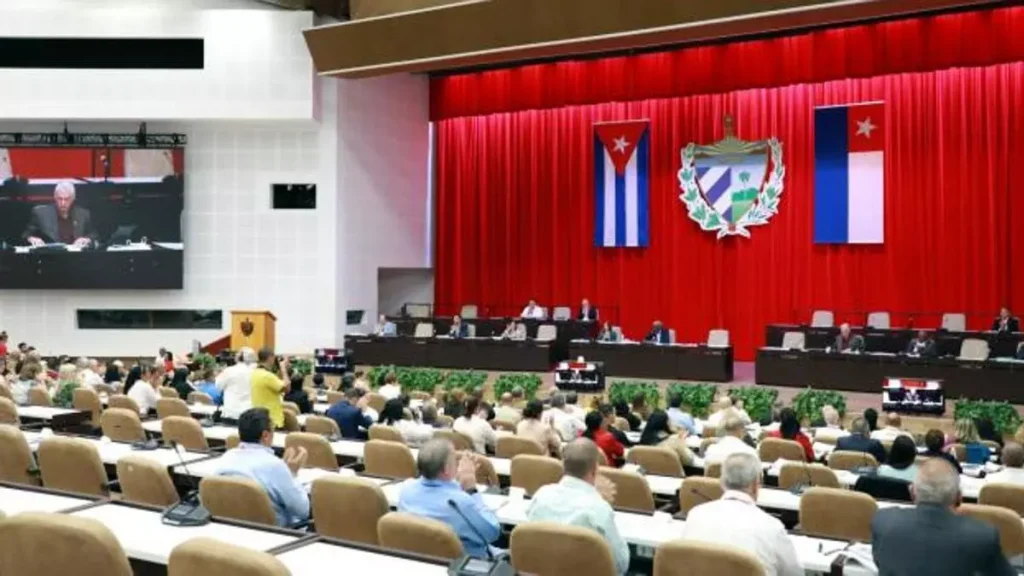
Session of the National Assembly of People’s Power this Thursday. / Granma

14ymedio bigger14ymedio, Havana, December 18, 2025 –The main news from Thursday’s session of the National Assembly of People’s Power (ANPP) is the appointment of Óscar Pérez-Oliva Fraga, Raúl and Fidel Castro’s grandnephew, as a deputy, which makes him eligible to run for the Presidency of the Republic. The decision was to be expected, after the government announced his appointment as Deputy Prime Minister of the Republic on 18 October.

The announcement was made by Esteban Lazo, President of Parliament, as part of the election of vacant seats. He also reported the resignation requests of Homero Acosta, Secretary of the ANPP and the Council of State, and Ulises Guilarte, former Secretary General of the Cuban Workers’ Central Union. With the new deputies, there are now 464, leaving six vacant seats to be filled.

It was, moreover, President Miguel Díaz-Canel who announced the “release” of Rubén Remigio Ferro as president of the People’s Supreme Court, which recently tried former minister Alejandro Gil for espionage and corruption. He will be replaced by Oscar Manuel Silvera Martínez, Minister of Justice, who in turn will be replaced by the first deputy minister of that portfolio, Rosabel Gamón Verde.

Otherwise, the meeting, attended by Raúl Castro via videoconference, focused on the country’s serious systemic crisis, the plan to reverse it, and the difficult outlook for the coming year.

In his lengthy speech, Prime Minister Manuel Marrero reviewed all the measures taken to rectify the situation and made clear the “challenges” ahead. The main one is attracting foreign currency. “The outlook for the economy is one of decline,” continue reading

he acknowledged.

He repeatedly emphasised that the measures are being implemented “under adverse conditions: lack of foreign currency, energy instability, inflation and organisational constraints”.

Nothing he said was new, including the establishment of a new floating exchange rate on Wednesday night, the third to be implemented in the country, aimed at “transforming the foreign exchange market”. Marrero recalled that the government has set 106 “specific objectives” and that of the 90 “directions associated with the 10 general objectives, 51 have been achieved and the rest are in progress”.

He repeatedly emphasised that the measures are being implemented “under adverse conditions: lack of foreign currency, energy instability, inflation and organisational constraints”. And, of course, he framed his words in the global context of “moderate economic growth” and a “regional scenario marked by US policy, the Monroe Doctrine and actions against Venezuela”. The island faces, he excused with the same old argument, “the cumulative impact of US economic, trade and financial policy, with reinforced sanctions and extraterritorial effects”.

Although some indicators improved, such as the budget deficit, he said, “difficulties persist in stabilising the currency and purchasing power”. Inflation, for example, is still above 14.95%, and tourism, the country’s third largest source of income, remains in a “complex situation”.

His assessment was a little misleading. The Minister of Economy and Planning, Joaquín Alonso, when taking stock of the situation in the sector, said that the number of international travellers will be around 1.9 million people, almost 30% less than expected, as will the revenue that will be achieved: 917.4 million dollars. If confirmed, this number of travellers would be the worst annual record for the Cuban tourism sector since 2003, not counting the years corresponding to the COVID-19 pandemic. In 2018, the island attracted 4.7 million visitors.

Alonso also estimated “modest” economic growth of 1% for 2026, the same as was projected for this year and which will not be achieved. The country’s president, Miguel Díaz-Canel, acknowledged this weekend that in the first three quarters of the year the economy had contracted by more than 4%, although he did not provide further details.

Marrero asserted that, “amid complex financial conditions,” $1.15 billion has been invested in energy.

The modest improvement in the outlook is due, the minister argued, to a more optimistic forecast for the tourism and foreign sectors, led by sales of services abroad (mainly in the medical sector).

As for inflation, the minister indicated that the forecast is for a 10% rise in prices in the formal market (the informal market is experiencing higher increases), which would be about five percentage points below the year-on-year rate recorded in recent months.

The productive outlook is also dire, although no new data was provided. Agriculture, industry, and the sugar sector continue to be a mess. The only thing growing, albeit at a slow pace, is the number of small private enterprises. With 816 new MSMEs, there are now a total of 11,866 in the country.

Regarding another pillar of the serious crisis, energy, Marrero claimed that, “amid complex financial conditions,” 1.15 billion dollars have been invested in increasing electrical capacity. Among the “recovered” capacity are the 778 megawatts (MW) provided by the 41 photovoltaic solar parks synchronised to the system, “which manage to produce more than 30% of the country’s total generation during peak hours of irradiation”, i.e. only during the day.

The Prime Minister promised to end the year with an additional 1,000 MW of “renewable capacity”.

The Prime Minister promised to end the year with an additional 1,000 MW of “renewable capacity”, although he acknowledged the 2,000 MW deficit reached in recent weeks, “which is causing 24-hour service disruptions, exacerbating public discontent and damaging the economy”.

The regular end-of-year session, which normally brings together MPs in Havana for two or three days, is being held in a reduced format and by videoconference due to the deep crisis in which the island finds itself.

The country is in a “critical” situation, Cuban President Miguel Díaz-Canel acknowledged on Saturday in his speech to the plenary session of the Central Committee of the Communist Party of Cuba (PCC).

The Parliament’s agenda includes, first and foremost, a review of the implementation of the Government Programme to Correct Distortions and Revitalise the Economy, the Cuban Executive’s anti-crisis plan, consisting of budget cuts, reforms and measures to increase state foreign currency earnings.

In addition, the country’s macroeconomic performance will be reviewed, which between 2020 and 2024 lost 11% of its GDP and will also close this year in negative territory due to the collapse of agricultural and industrial production, the lack of supplies and prolonged daily power cuts of 20 or more hours in large areas of the country.

“Yes, there is a huge material shortage in Cuba,” Díaz-Canel acknowledged before the plenary session of the PCC Central Committee, where he recognised that despite the “fatigue”, “uncertainty” and “irritation in social sectors”, “there are no easy or quick solutions” to the multiple crises afflicting the country.

Translated by GH

Two Cubans Trying To Enter Brazil Die in a Traffic Accident

Seven migrants from the island were injured in the accident that occurred on Monday afternoon in the state of Roraima.

The police reported that the accident occurred in an attempted illegal immigration to Brazil. / Brazilian Federal Highway Police

14ymedio bigger14ymedio, Miami, December 17, 2025 — A serious traffic accident on Monday afternoon in the state of Roraima, in northern Brazil, left two Cuban migrants dead and seven injured, including children, as they tried to enter the South American country illegally, according to the Federal Highway Police (PRF).

It happened on the BR-401 highway, near the municipality of Bonfim, on the border with Guyana, when a PRF patrol detected a Chevrolet Prisma vehicle with ten occupants — nine Cubans and one Brazilian — heading towards Boa Vista. When he saw the police, the driver made a U-turn and drove off at high speed down the road. 

According to the official report, the chase included dangerous manoeuvres and reckless overtaking, as well as driving along the hard shoulder of the road. The vehicle finally turned onto a dirt road, where it lost control and overturned, ending up on its roof. When the police arrived at the scene, they found two of the Cuban migrants dead and the others seriously injured, including two children aged 3 and 8, as well as one person with minor injuries.

The authorities have not revealed the identities of the people killed, but media reports indicate that they are a 26-year-old woman and a 16-year-old boy.

The authorities have not yet revealed the identities of the people killed, but local media reports indicate that they are a 26-year-old woman and a 16-year-old boy. Most of the injured were taken to nearby medical centres, where they are receiving treatment. One of the occupants told the PRF that each Cuban paid $500 to enter Brazilian territory illegally.

The police reported that the accident occurred in an attempted illegal immigration to Brazil. There have been more of these in recent years on the country’s northern border, especially in Roraima, with the increasing number of migrants from different countries in Latin America and the Caribbean.

Although historically the migration crisis in the region has been mainly to do with Venezuelan refugees, the COVID-19 pandemic, the closure of legal border crossings, and difficulties in obtaining documents have led migrants to attempt to enter via informal routes through trails near Bonfim and Pacaraima. Often they use clandestine transport networks, exposing themselves to dangerous conditions.

Many Cubans choose irregular routes in the hope of reaching other regions of the country in search of job opportunities and better living conditions.

Brazil does not have a formal programme for Cuban migrants, unlike its one for Venezuelan citizens, except for certain exceptional naturalisation or reception mechanisms, so many Cubans choose irregular routes in the hope of reaching other regions of the country in search of job opportunities and better living conditions.

Migrant and human rights organisations have highlighted the vulnerability of those who cross Brazilian borders without legal protection and the need for humanitarian mechanisms to reduce exposure to dangers such as the one that claimed the lives of the two Cubans on Monday.

Translated by GH

____________

COLLABORATE WITH OUR WORK: The 14ymedio team is committed to practicing serious journalism that reflects Cuba’s reality in all its depth. Thank you for joining us on this long journey. We invite you to continue supporting us by becoming a member of 14ymedio now. Together we can continue transforming journalism in Cuba.