Great Achievements of the Cuban Woman / Rebeca Monzo

Patchwork by Rebeca
Rebeca Monzo, 8 March 2015 — The year 1931 was the first time that the International Day of the Woman was celebrated.

By 1942, all women teachers in our country were certified, not counting the growing number of women professionals, increasing every year, occupying positions in universities and diverse organizations. By then, also, many women were prominent in the arts, sciences and letters.

But it is not until 1959 that we see Cuban women maximizing their creativity. Forthwith, some of the great achievements of the Cuban woman in these past five decades:

Manage to convert that old dress into a cute blouse; cover her grey hair with the powder from old radio batteries; cover her one pair of shoes multiple times to match her outfits; obtain, after three days of waiting in line and sleeping on a porch, a Soviet-made record player; wearing down her index finger dialing the phone to obtain a reservation at a restaurant; suffer along with her child on Three Kings Day at the toy store where she is assigned, and try to console him, because the toy he wanted was already sold out; figure out how to look “put together,” using shoe polish for mascara; manage, after an hour of waiting at the bus stop, to climb on and get down from the bus in one piece; find a way for her child to grow and flourish without ever having tasted fruit, compote or cereal; create some kind of meal every day for the family table; manage to have survived through all the difficulties, and still give to others with a smile.

I take this opportunity to congratulate those women who emigrated, risking all and dodging innumerable difficulties, and who attained success in a foreign land, where they did not even speak the language.

Translated by: Alicia Barraqué Ellison

Under-Employment Masks Unemployment / Rebeca Monzo

In recent years there have been a number of small properties which have been converted into TRD (hard currency) shops, as well as into small Caracol, Panamericana and CIMEX “container” stores and kiosks, all under the same ownership: the State. Given that there are buildings that remain underutilized, one might ask, What’s behind all this? In those old 1950s supermarkets — now badly deteriorated due to lack of maintenance and repair — there are only four or five products currently available through the antiquated and sadly all-too-famous ration book.

Each of these stores has on its payroll a minimum staff of directors, economists, managers, cashiers and janitors even though the selection of merchandise, which is almost identical all these stores, is very limited. When supplies such as toilet paper, cooking oil or detergent — to name just a few — run out in one of them continue reading

, there is an equally short supply in the others mainly because imported items such as these are sold in the container stores. Only the supplies of electrical appliances for sale at these stores are relatively stable due to their high prices.

Many citizens complain and wonder aloud why the old supermarkets are not being modernized to consolidate all the timbiriches (tiny “mom-and-pop” kiosks) that have been proliferating in their neighborhoods, especially given their lack of basic requirements. This leaves only one small establishment in any given neighborhood to carry the few products still available through the ration book.

Converting architecturally magnificent houses into tiny shops is also an unfortunate practice. The dramatic reuse and inadequate care to which these buildings are subjected leads to deterioration and subsequent damage. One such example is a building located on 47th Street between Conill and Santa Ana in Nuevo Vedado. Designed by the architect Carlos Ferrer Nadal and built in 1956, it is one of the jewels of modern Cuban architecture.

In my very personal opinion, this is a way of disguising unemployment in a country that produces almost nothing. By underemploying the staff of these small stores, where three employees would essentially be enough to provide a decent level of service, the size of the workforce can be increased.

6 March 2015

"A candle in the street…" / Rebeca Monzo

Rebeca Monzo,11 February 2015 — After nearly three months of going to a clinic to set a date for a surgical intervention (outpatient and minimal), good news! Finally I got a date for a month later. I felt happy, because in all the hospitals here it’s normal to have little availability of operating rooms, for many reasons, such as contamination, leaks, damage to ceilings, walls, etc.

And now with everything planned and in order for the moment, yesterday I went to an appointment with the anesthesiologist which was scheduled for 8:00 in the morning. I went to the information desk to find out where the appointment would be. They sent me to the fourth floor, Room G.

Once there, I realized that the room was empty. I checked out the entire fourth floor, from one end to the other, asking every person in a white coat who crossed my path; no one knew where to send me.

Some suggested I go down to the third floor and ask. It was all useless, I went up and down the stairs a couple of times, because there was a line at the only elevator of six that was working.

Back on the fourth floor, I decided to wait for the surgeon who would operate in the morning, to explain what happened. When I saw him coming, I stepped forward to intercept him, as there were several patients waiting for him. It was then that he explained to me, not to keep looking for the  anesthesiologist, because continue reading

he wouldn’t be operating due to an accident in the operating room, and to return to the clinic in 15 days to see what could be done.

I left the hospital surprised and disappointed, because I had already been preparing physically and mentally for the moment. I even had to postpone an exposition abroad and delay the longed-for visit of my granddaughter to Cuba, two things very important to me. In addition, why when I filled out the form for the operation did they ask me for a telephone number where they could find me?

On arriving at the hospital parking lot, where fortunately a car was waiting for me I learned from the parking attendant himself, who had worked there for a few years, that the operating room in question had caught fire a few days before and that’s why it was closed, and also there was only one anesthesiologist for the whole hospital because, normally, the person who come for pre-operative consultations sometimes don’t get done until 3:00 in the afternoon because he is the only one for the room and the consultations.

I left the hospital thinking that, sadly, I myself had experienced a joke that I often used on my friends: if you get sick here, then get a ticket and go to Haiti or Venezuela because there you’ll find a good Cuban specialist to see you with all the necessary equipment, because public health in Cuba is “A candle in the street, darkness in the house.”*

*Translator’s note: A common saying that means you “show off your good works” away from home, bt don’t help your own family. Rebeca is referring to Cuba’s healthcare “missions” abroad; the export of doctors is a major source of hard currency for the country.

Blindness Leads the Way / Rebeca Monzo

Rebeca Monzo, 8 February 2015 — After reading an article from the January 31, 2015 issue of the newspaper Granma  about Cuba and the United Nations Development Program (UNDP) entitled “Cooperation Leads the Way,” a ton of questions came to mind about the subject at hand.

It has been forty years since a UNDP office was established in our country with the objective to collaborate with the island’s government on the promotion of social development and public well-being.

From my meager understanding, the only party to have benefited from this has been the government itself, especially in terms of the favorable publicity it has received. They make up a negligible part continue reading

of the population but the Cubans who work for this and other UN organizations are paid in CUC (Cuban convertible peso), which surpass by leaps and bounds the highest salaries of the most qualified professionals in our society, who are paid in CUP (Cuban pesos).

According to the aforementioned article, Granma “chatted” with Mrs. Jessica Faieta, Director of the UNDP Regional Bureau for Latin America and the Caribbean as well as the Assistant Secretary-General of the UN, who discussed the improvement of the quality of life of our citizens. She recognized the efforts of the Cuban government in regards to food security and the strengthening of the agricultural and non-agricultural cooperatives, pointing out, in addition, that the Cuban healthcare system has been strengthened.

With all due respect, it strikes me that this official had only a limited view of the situation, as is the case with everyone who visits us. Guests are taken only to those organizations that have been prepared in advance by the government and which serve as “display windows” for foreigners.

Perhaps if she had to depend on the ration book for a while or to seek medical help at one of our clinics — those  used by the average citizen — it is quite possible she might think differently. I do not understand how UNDP, based in our country for four decades, has not been given the task of investigating on their own — in closer contact with the population — to verify the “wonderful statistics” provided by the government, which does not at all reflect our reality.

One need only take a stroll through Central Havana, Old Havana (provided one ventures beyond the historic center), Cerro, Tenth of October Arroyo Naranjo, San Miguel del Padron and even Vedadao and other neighborhhoods to see the poor sanitation conditions and overcrowding in which the Cuban people must live. and the lack of specialists in our health centers, for being these missions abroad, being replaced mostly by students, many of them foreigners. There is also the issue of a shortage of specialists in our health system due to the large number of them serving abroad in medical missions. They are being replaced mainly by medical students, many of them foreigners.

In terms of our society’s standard of living, it should be pointed out that the disappearance of the middle class — the very mark of a country’s wealth — has led to the emergence of an impoverished class (with equality for all) with salaries that do not cover even the most basic necessities. The contrast is made even more striking by the emergence of a leadership class with an affluent lifestyle which only accentuates the differences.

However, Mrs. Faieta and I are in full agreement when it comes to the positive steps taken towards normalization of diplomatic relations between the governments of the United States of America and Cuba. Once there is a successful outcome — one hopes sooner rather than later — it will be to the benefit of all Cubans. I believe that it is time to end once and for all the blindness that until now has led the way.

The Art of Tolerance / Rebeca Monzo


Rebeca Monzo, 23 February 2015 — In the Plaza de San Francisco in the historic center of Old Havana there is a traveling art installation, United Buddy Bear, made up of huge bears that surround the square. Each of them represents a country in the western hemisphere and they are decorated by an artist from each nation. Representing Cuba is the work of painter Nancy Torres.

The exhibition is like a cry, like a hymn to tolerance, which has captured the attention of both the Cuban public and tourists alike. Sometimes people even line up to be photographed in front of their favorite bears, especially those of Cuba and the United States, perhaps due to the historic moment in which we now find ourselves.

Besides these beautiful multi-colored artworks, a lovely bronze sculpture recently appeared in the square at the entrance to the Lonja del Comercio building. The sculptor, Vittorio Perotta, has given it a very evocative title: The Conversation.

Something that also caught my attention is the restoration work being done in this area and along the waterfront. It is being carried out by the Office of the City Historian and includes large potted plants, outdoor lighting and date palms, all of which give the place a touch of freshness and elegance. Upon seeing this, there was one thought I could not get out of my head: “When this whole of fifty-six-year nightmare of destruction is over, the only government official whose name will not be on the blacklist will be Eusebio Leal (Havana City Historian).”

23 January 2015

The Notary at 23rd and J, Havana / Rebeca Monzo

1408719803_image009After spending several days trying to remedy errors committed by various officials in the course of officially registering my apartment, as required by the new housing law, I then had to wander between countless locations and offices, not only because of the fragmentation of the main office (a huge, underutilized old house) but to others as well due to misinformation provided to public who access them.

Finalizing the process requires a visit to the notary office in order to legalize all the documents. I went to the best, most famous, most central location: the office at 23rd Street and J Avenue in Vedado, an office through which nearly all Cubans have passed. It is here that marriages, divorces, wills and testaments, powers-of-attorney — in short, all manner of legal proceedings — are handled. continue reading

It has been located here for more than five decades in a beautiful building from the 1950s, which even today serves as a study reference for students pursuing a career in architecture.

The photos below are the most recent images of what was once a beautiful office and residential complex.

There are comfortable seats where you are forced to wait for hours. Fortunately, I was helped by two wonderful professionals and a very pleasant and efficient receptionist.

22 August 2014

1408719803_image010
1408719804_image011
1408719804_image012

Neighborhood Circus / Rebeca Monzo

December has for decades always been a month of circuses, but, in the economically failed regimens, the circus is always present: “If there’s no bread, give them circuses*,” says an old refrain.

The principal actors at this year-end have been the unstocked farmers markets which, upon closing their doors, have given way to improvised fairs where, in place of food, police have abounded.

Yesterday on Monday, when I went to take a turn using the Internet, I took the P3 Bus, at the 26th and 41st stop, the closest to my house. The bus had barely made it past the next two stops when all of us passengers who were traveling to Playa** had to get off at 26th and 25th. The route was detoured due to an agricultural fair that was taking place on 24th and 17th, next to the farmers market at that location — which, by the way, was empty and closed off.

Three trucks filled with sweet potatoes, plantains and tomatoes made up the fabulous offerings at the fair. A line of naive customers waited their turn among dirty puddles, squalid stray dogs, and more law enforcement officials.

A friend and I, due to the absurd diversion of the only route, were returning in the afternoon, walking from the recently-restored iron bridge, searching for the P3 stop so that we could ride the bus back to our neighborhood. Imagine our surprise when we discovered that the morning’s detour was still in effect. We were forced to continue on foot until we reached our respective homes in Nuevo Vedado.***

Upon nearing the trucks that bore the agricultural products on offer, I overheard the following comment: “Such a fuss over a tomato that’s more expensive than at the farmer’s market!”

Translator’s Notes:
*Literally, in this post, “A lack of bread, circus.”
**Playa is a municipality in the city of Havana.
***Nuevo Vedado is a neighborhood in the Plaza de la Revolucion municipality of Havana.

Translated by: Alicia Barraqué Ellison, and others.

31 December 2014

Shameful Distortions / Rebeca Monzo

The big news for all Cubans, without a doubt, has been the reestablishment of relations between Cuba and the United States, which has been a dream for three generations on our captive island, although there are opponents among some fellow countrymen both here and abroad. The other story — the one about the release of the three spies from the Wasp Network who, for refusing to the collaborate with American authorities, became by the grace of the Cuban government “anti-terrorist heroes” even though they had acknowledged their role as spies in courts of law — raises a secondary issue, which is the high economic cost for our country in the form of lawyers, propaganda and family visits.

Of course, the vast majority of Cubans without access to the internet or any other means of information other than Cuban television or Venezuela’s TeleSur (more of the same) has dutifully accepted as true what government propaganda has them led to believe, since the priorities of this long-suffering people are food and day-to-day survival. Others who rely on official media accept it out of fear of being challenged politically. continue reading

If (like me) you wander the streets of Havana, you will hear various expressions of playful joy that reveal the average person’s true feelings. Comments, especially those of young people (who do not have an official microphone under their noses), reflect dreams of a better future: We will soon have the internet, ferry service will return, McDonald’s will be everywhere, we will now be able to go to the “yuma”* without endangering our lives and those of others.

However, some old, recalcitrant members of the Committees for the Defense of the Revolutions (CDR) only talk about the release of the three spies, portraying it as a Cuban triumph over the United States, unaware that it was merely an exchange of three spies for fifty-three political prisoners of interest to the US. Of these details they are ignorant.

This reflects the focus by government-run television (the only kind) which, apparently on orders from above, focused on the return of Gerardo, Ramón and Antonio, who incidentally appeared healthy, well-fed and in superb physical condition, quite at odds with the terrible stories about mistreatment, sweatshops and other falsehoods officially promulgated during their internment.

It also stands in contrast to Alan Gross, who upon his release was anemic, having suffered loss of vision and some teeth. It was a picture worth a thousand words. By continually lying to the Cuban people and unscrupulously manipulating information, the mass media makes it clear that our country does not enjoy freedom of the press.

Now as never before, civil society and the various opposition groups must prioritize this important event, setting aside our personal differences to jointly maintain pressure on the regime so that everyone might find a place in this new, emerging era and that our voices may finally be heard. It is worth remembering that whenever negotiations of any kind take place, one should carry two suitcases: one to give and one to receive.

 *Translator’s note: Slang term for the United States.

22 December 2014

The First Intelligent Step / Rebeca Monzo

In these eight years that have passed since Raul Castro was designated by his brother as his successor, to take up the government of the country, this 17th of December, a date of only religious significance for the Cuban people until now, will go down in the history of our island as the most transcendent act of these last 50 years, by the announcement of the reestablishment of diplomatic relations with the US.

The previous steps taken by him as president, such as the liberalization of travel, selling and buying homes and automobiles, establishing small private businesses and others, are nothing more than the return of usurped rights to citizens, by the same regime that will soon reach fifty-six years in power. continue reading

Among other fundamental factors that may have influenced the Cuban side, I consider: an economy in crisis without real hopes of improvement; little foreign investment; the exodus of young professionals and the wear and tear and aging of the adult population; among many others that are part of an endless list.  We can add to those the low price of petroleum, that has been arriving generously from Venezuela, and that could fail to turn up at any moment.

Two countries that have joined together to come to an understanding, that necessarily should continue to develop further, to get Cuba out of the economic and social abyss that it finds itself.

 Translated by: BW

19 December 2014

Digressions on “With You, Bread and Onions” / Rebeca Monzo

Among the films presented at the Festival of New Latin American Cinema, which began here on the December 4, is one entitled With You, Bread and Onions. In a recent interview on the television program Afternoon at Home, the director Juan Carlos Cremata commented that he had decided not to submit his film for judging because he does not believe in competitions like this. Nor does he believe there are good films and bad films, nor good and bad actors and directors.

If he does not believe in prizes or in what they represent, then why is he making movies? Why did he accept the “crappy housing” he was given in Nuevo Vedado which, according to “wagging tongues,” was a reward for his film Chamaco? I swear I almost had to be tied to my seat just to get through that dark, sordid tale. At least it was not a theater seat; fortunately I made the sacrifice at home, watching it from my armchair on a rented DVD.

With You, Bread and Onions, which I have not yet seen, is based on a play by Hector Quintero, though I doubt much can be expected of this film. The title recalls an old Cuban expression which gained popularity at a time when onions and bread cost only a few cents. It referred to a romance taking place in extreme poverty.

Saying this today would connote something extremely expensive, what with a pound of bread costing 10 CUP (Cuban pesos) and a half an onion at least 70 CUP, much more than the daily wage of the average worker.

So the meaning of the phrase has changed a lot, as have the social values lost during these last 54 years of survival.

 Translated by: BW

9 December 2014

Unidentified Coiled Objects / Rebeca Monzo

To the astonishment and concern of patients, one day there appeared in the ceiling of a surgical recovery room in the old Charitable Clinic (now renamed the Miguel Enríquez Hospital by the government in honor of a Chilean doctor killed during the Pinochet dictatorship) a coiled, yellow animal or vegetable entity that was visibly growing and getting fatter. A few days later another one appeared and then another, exhausting the patience of those confined to the room.

After repeated complaints by patients and family members, two hospital employees finally arrived armed with a ladder, brushes and paint. In one fell swoop they knocked the three unidentified coiling objects from the ceiling, quickly applied a few strokes of paint to the area where the objects had appeared and then left.

No one later came to investigate the cause of these apparitions nor did anyone fumigate. Everything was simply covered up with paint.

Just a few years ago I was caring for a friend who had just had surgery and was in recovery in the Institute of Nephrology Surgical Hospital when I suddenly heard a commotion behind the drop ceiling. To my astonishment the regular patients told me with a striking calm and acceptance, “Don’t worry, ma’am. It’s just the cats chasing the rats!”

According to the United Nations, our country is among the top ten healthiest on the planet. This, as well as daily incidents of sanitation problems and lack of maintenance that affect our hospital facilities — the exception being those exclusively for top government leaders, their family members and foreign patients — demonstrate that both the visitors and the workers of this world-renowned institution, whether there as a guest or working permanently in our country, resign themselves to what the government tells them to do and don’t bother to look for anything more than that.

The patients from the same old hospital, are still waiting to be informed about the cause and origin of those unidentified coiled objects.

 Translated by: BW

1 December 2014

The Usual Suspects / Rebeca Monzo

In Nuevo Vedado — according to popular opinion one of Havana’s best neighborhoods — something has been happening for several years that would have been unthinkable in the past: assaults with firearms, knives and even bare hands. It does not matter who you are; you can be targeted by criminals even if you have only one CUC to your name. Recently, this happened to a friend  of mine, who carelessly answered a call on her cell phone one night. She was attacked, jabbed in the buttocks and stripped of all her belongings by some youths who could not have been more than sixteen-years-old.

Two weeks ago all the outdoor furniture at a house in a neighborhood just outside Herradura was stolen. The owners —  an elderly man in his eighties and his daughter, who was at work at the time — filed a report at their local police station.

A few days after filing the report, the man, who stays home all day — a fact known to his neighbors and friends as well as to the robbers — received a visit from a uniformed police officer. Once inside the house, the officer told the victim that the robbers had been apprehended but that the police were unable to recover the stolen items and gave him a form to sign stating that he was being giving 3,000 CUCs in compensation. The man in question then signed the form and was handed a roll of bills by the officer, who immediately left the premises. Once alone, the man began calmly counting the money and was astonished to find there were only 2,000 CUCs.

How is it possible for an officer of the law, acting on his own, to show up and settle the criminal’s debts without a trial being carried out, a sentence being handed down, and the amount and means of compensation being determined by a magistrate?

Could it be that, out of fear of being discovered or a desire to protect a close family member, the officer decided to handle things himself and in the process stiff the victim?

This remains an open question.

21 November 2014

Fortunate Accidents / Rebeca Monzo

Some of the most spectacular recipes in gastronomy have been the result of accidents that occurred during their preparation.

I remember that during the second half of the 1960s, while fulfilling diplomatic duties in Paris, I would frequently visit the Cuban embassy and there I met and established a lovely friendship with Chef Gilberto Smith, his wife, and children. Smith, knowing my fondness for culinary pursuits, would invite me to participate in the finishing and presentation of his famous dishes.

During one of these exchanges, he shared with me how his exquisite and famous recipe for “Lobster au Café” (coffee-infused lobster) came to be: “Some lobsters I was cooking were sticking to the pot, almost burning, and all I had on-hand was a big jugs of fresh-brewed coffee reserved for guests. I emptied the jug’s contents, firefighter-style, over the lobsters, and from this emerged the famous recipe that I later perfected.”

A few days ago, this story was on my mind as I worked in my kitchen from early morning on, preparing dessert for a luncheon to which I had invited a couple who are friends of mine. My mother always used to tell me that she liked to make dessert first, just in case something came up that interrupted the proceedings.

I had left on the double boiler a very soft pudding I make that many people confuse with flan. I got busy doing other things when suddenly I detected an aroma coming from the kitchen that was like a cake baking. I ran to see what was happening and noticed that all the water in the double-boiler had evaporated. I quickly removed the top pan so that the pudding could cool and, upon turning it over, part of the pudding remained stuck to the caramelized sugar on the pan, ruining the look of the pudding.

I couldn’t serve it that way to my guests, but neither could I discard it. I immediately set to preparing another dessert. This time, using a bit of cornstarch I had in my pantry, I made a type of soft “floating islands” custard. On this go-round there were no problems. It was then that I got the idea to present both dishes together as one.

I found some deep, wide-mouth crystal water glasses. On the bottom of each I placed a bit of the pudding, filled the rest with the soft custard, crowning each with a bit of burnt meringue, a mint leaf, and grinding some cinnamon over the top to give it a more pleasing appearance.

The dessert was a success, enjoyed and much-praised – but when they requested the recipe and asked what the dish is called, I could think of no other name than “Copa Rebeca” (Rebeca Goblet).

 Translated by: Alicia Barraqué Ellison

14 November 2014

Where Is the Anomaly? / Rebeca Monzo

After reading an article, “Not Very Anomalous Anomalies,” published in Granma on November 7 and written by journalist Pedro de la Hoz about Halloween, cheerleading and those little stars-and-stripes flags, I couldn’t wait to get to my laptop to respond and refresh Mr. de la Hoz’s memory.

First of all, it should be pointed out that for some years now a small group of young people — and others not so young, myself included —  have been celebrating, as best we can, not only these but many other dates that have become as intrinsic a part of our culture as Christmas, Christmas Eve and the Feast of the Epiphany — holidays which were  banned for fifty-six years.

Though we are part of a global village, each country manages to keep its own traditions alive without being too worried about adopting new ones from other continents. A good example of this is Japan. Attractive, pleasant and joyous customs are not imposed by decree; they are assimilated spontaneously.

This is not the case with the well-known yellow ribbons, which have been imposed on us in schools and workplaces by the Committees for the Defense of the Revolution, labor unions and the Communist Party, yet which have nothing to do with our cultural heritage. Not to mention that they come to us via that famous enemy country which our media rails against daily in spite of the fact that Cuban artists, intellectuals and athletes continually turn to it in hopes of improving their lives.

College students at CUJAE and even the University of Havana organized their own Halloween festivities. It was also celebrated by the musicians at the Tropical, at the 1830, at the Diablo Tun Tun and at the Hotel Capri’s Salon Rojo, which to my mind is perfectly fine since they were options one could freely choose.* Also, as far as I can tell, none of these locations would be considered sacred, so where is the anomaly?

Translator’s note: CUJAE is a Cuban university that offers a variety of engineering degrees. The Tropical and the Salon Rojo, or Red Room, are Havana nightclubs. 1830 is a Havana restaurant and salsa club. El Diablo Tun Tun is a piano bar and musical venue.

8 November 2014

To Better Illustrate a CNN Report / Rebeca Monzo

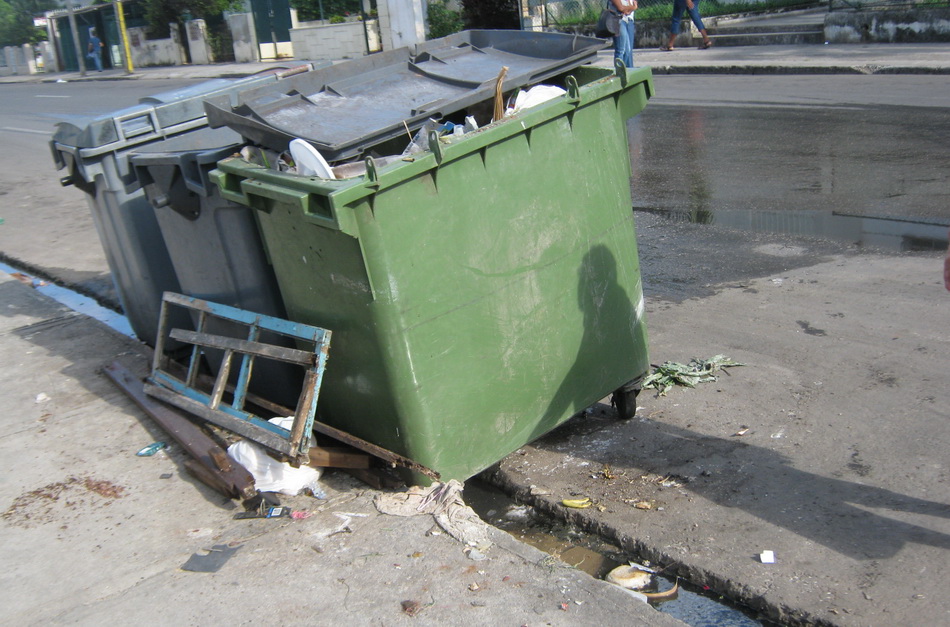
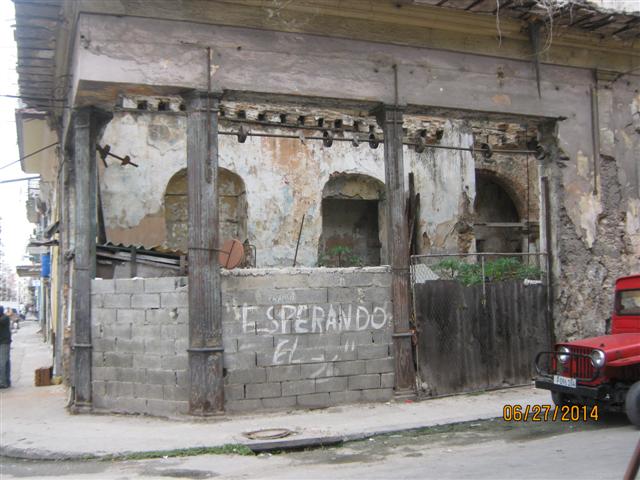
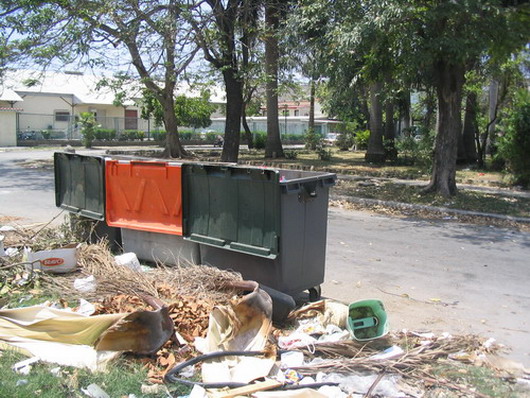
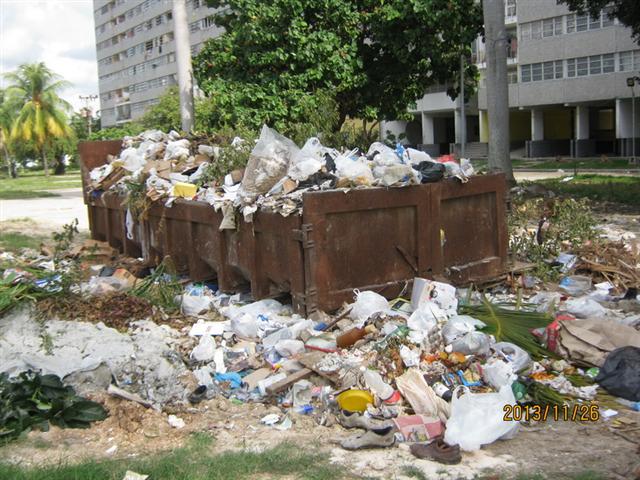
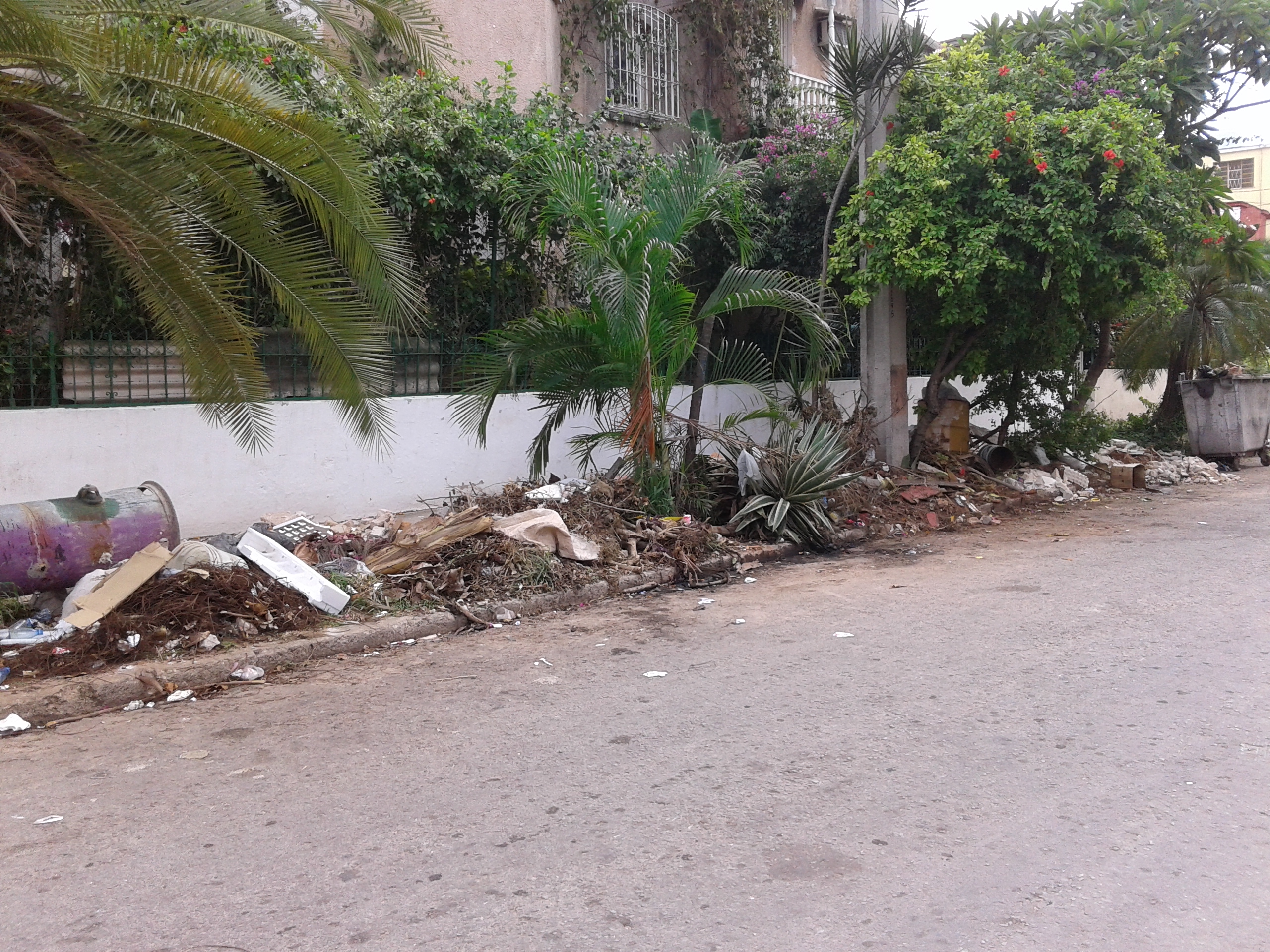
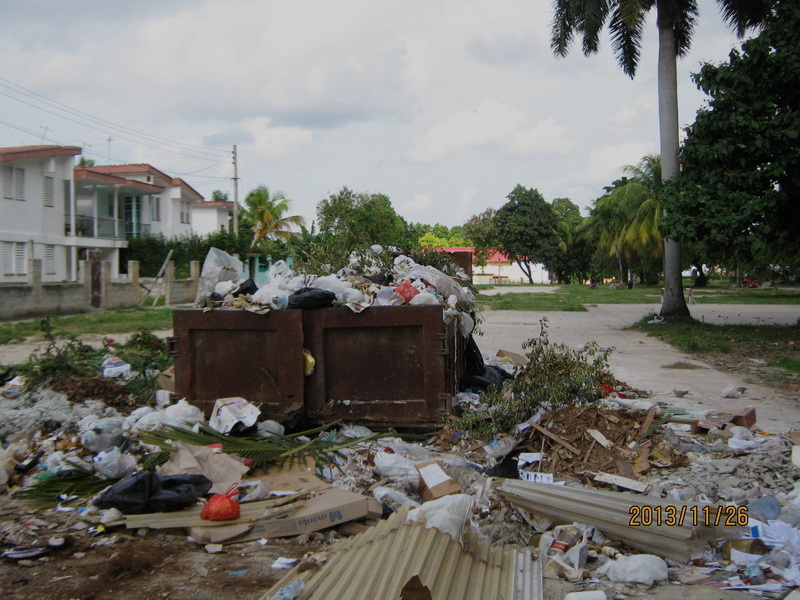
To the Directors of CNN:  I have inserted here just a few photos of our city (Havana). There are many hardships borne by the residents of any neighborhood, including Miramar, with respect to garbage collection. The state-run company, Comunales, which is charged with this task, alleges a lack of trucks and containers.

Neighborhoods that are located far from the city center do not even have garbage cans. Thus, the waste is thrown into the river, on the train tracks, or — in the best of cases — is hung from nails on the trees.

It would be very good if, when you are broadcasting a report based on statistics, that you do this from the location that is the subject of the report, and not just base your information on numbers provided by a totalitarian regime.

Translated by: Alicia Barraqué Ellison

31 October 2014