The OCDH Demands an Investigation Into Irregularities in the Proceedings Against Henry Constantin

The organization alleges that the knife found in his cell could be fabricated evidence to frame him.


Henry Constantín is in pretrial detention at Kilo 7 prison in Camagüey / Facebook

14ymedio biggerThe Cuban Observatory for Human Rights (OCDH) is demanding an investigation into the “serious irregularities” in the case against independent journalist Henry Constantín Ferreiro, who has been imprisoned in Camagüey since September 16. The Madrid-based organization warned of a possible frame-up and called for the intervention of the Supreme People’s Court and the Attorney General’s Office to clarify the facts.

The formal complaint from the Cuban Human Rights Observatory (OCDH) was filed with the Camagüey Provincial Prosecutor’s Office, with a copy to the Military Prosecutor’s Office, requesting clarification regarding the alleged discovery of a homemade knife among the journalist’s belongings during a search at Kilo 7 prison. Constantín, director of La Hora de Cuba, denies any responsibility and suspects the weapon was planted to frame him.

According to the OCDH, there are indications that justify investigating possible tampering with evidence and the involvement of State Security agents. Constantín now faces a sentence of at least 15 days of solitary confinement as a result of these events. He was notified of the sentence this Thursday, which will prevent him from receiving the family and conjugal visit scheduled for Monday, October 19.

The organization also denounces the lack of confirmed location of his criminal case file as another irregularity. The Camagüey Municipal Court reported that it had returned it to the Prosecutor’s Office and later claimed to have sent it on October 9, but none of the judicial and prosecutorial institutions consulted have confirmed receiving it. According to the OCDH, this situation hinders the defense’s work, prolongs the uncertainty of the process , and fuels suspicions of possible political interference in the judges’ decisions. continue reading

There are indications that justify investigating possible manipulation of evidence and the involvement of State Security agents.

The Observatory calls on the Public Prosecutor’s Office to conduct an objective and thorough investigation, free from pressure, that preserves evidence and identifies those responsible. It demands that the Supreme Court clarify the irregularities in the handling of the case and guarantee the independence of the judges. “No authority can influence judicial decisions or cover up illegal activities,” the statement asserts.

The organization also demands protective measures against possible reprisals, threats, or intimidation directed at the complainant, the journalist’s family and friends, their lawyers, and potential witnesses, with a guarantee of confidentiality. If wrongdoing is established, it requests that disciplinary proceedings be initiated and, if there is evidence of a crime, criminal proceedings be pursued.

The OCDH also demands guarantees for Constantin’s physical and psychological integrity, the immediate location of the case file, and an urgent review of his pretrial detention.

The independent journalist marks one month in custody this Friday in Camagüey, accused of disobedience for allegedly failing to appear at a police summons. He maintains that he did go, but that the officers had already left.

“No authority can influence judicial decisions or cover up illegal activities.”

At the beginning of October, the Municipal Court returned the case file to the Prosecutor’s Office without opening a trial , while the journalist’s lawyer requested a modification of the precautionary measure so that he could await trial at liberty. Despite the charge being one of disobedience, which does not carry a prison sentence, Constantín remains in pretrial detention and now faces a new disciplinary measure that further restricts his contact with the outside world.

Constantin’s imprisonment has prompted statements from international press freedom organizations, including the Committee to Protect Journalists (CPJ) and Reporters Without Borders (RSF), which have called for his release. The journalist is also the regional vice president of the Inter-American Press Association (IAPA) and has a long history of arrests and harassment for his reporting.

______________________

COLLABORATE WITH OUR WORK: The 14ymedio team is committed to practicing serious journalism that reflects Cuba’s reality in all its depth. Thank you for joining us on this long journey. We invite you to continue supporting us by becoming a member of 14ymedio now. Together we can continue transforming journalism in Cuba.
Generation Y: The Clock That Only Works When There Is No Electricity

In Cuba, blackouts have turned residents into experts at counting the hours of darkness.

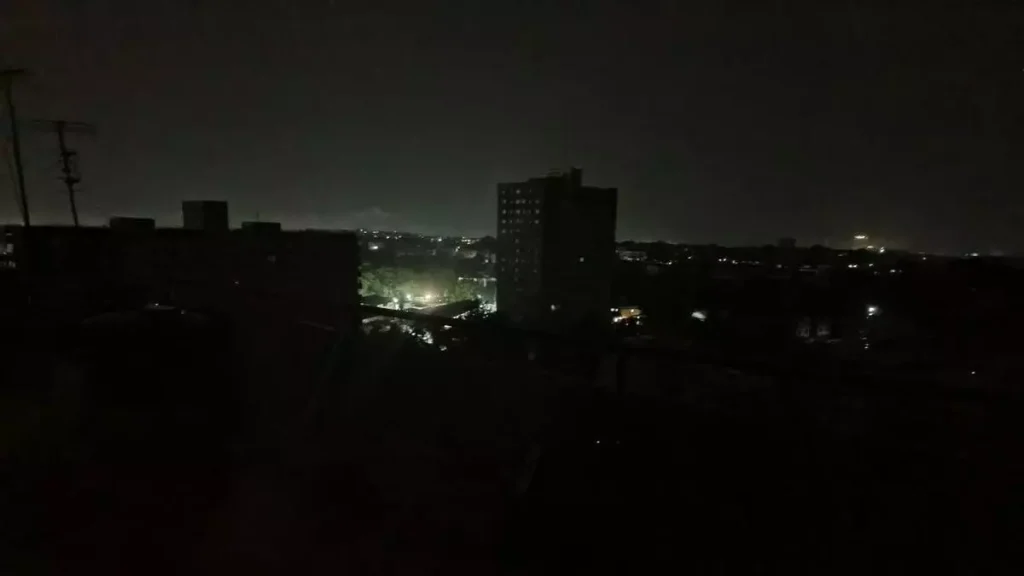
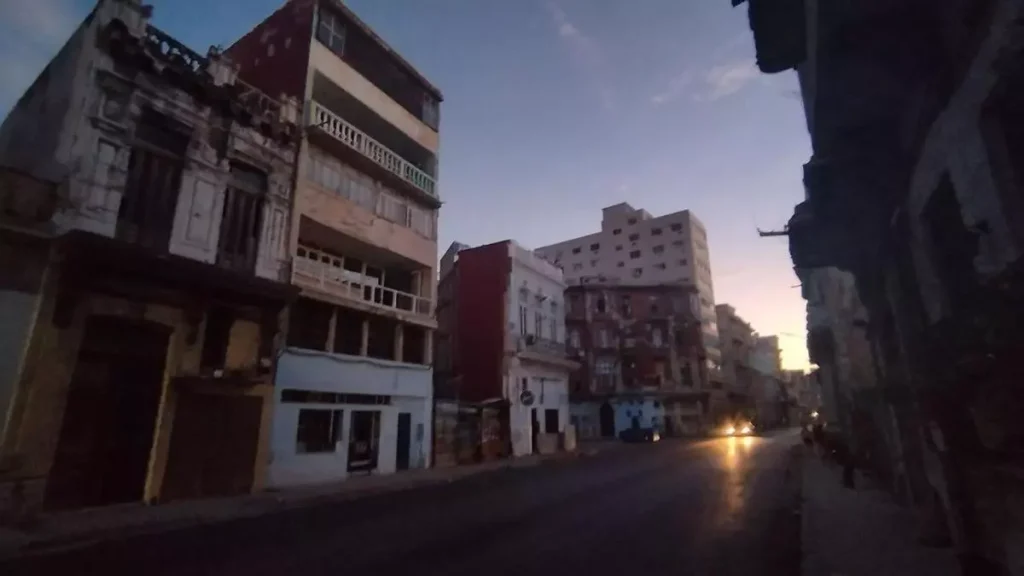
View of the city in darkness from the ’14ymedio’ newsroom during this weekend’s blackout, which lasted 37 hours and 19 minutes. / 14ymedio

14ymedio bigger14ymedio, Yoani Sánchez, Havana, October 18, 2026 / On Friday, at 5:30 in the afternoon, an invisible clock started ticking. It had no hands, made no sound, and no one knew when it would stop. Its mechanism was simple: to count every minute without electricity in our Havana neighborhood. This Sunday, it would finish its journey after ticking for 37 hours and 19 minutes.

During that time, this zone of ​​high-rise buildings was left suspended in a kind of parentheses. Saturday ceased to be Saturday and became “the day entirely without electricity.” Sunday began as “the second daybreak without power” and finally ended with the return of electricity.

The sad thing is that we’ve learned to measure the absence of electricity with a precision we apply to almost nothing else. We don’t know how many hours we lose waiting for a bus, how much time we’ve dedicated to searching for medicine, or how many days of our lives have been spent standing in lines. But we can say, without hesitation, that we’ve been without power for 18 hours and 43 minutes.

We’ve also developed a strange hierarchy of suffering. Someone who’s been without electricity for 12 hours listens with a certain embarrassment to someone who’s accumulated 24 hours. Someone who’s been without it for 30 seems to have the right to interrupt any conversation. And there’s always someone, from another province, like Matanzas, ready to remind us that what we’re going through is nothing, because they’ve been without it for more than 70. continue reading

Each activity depends on an intangible authorization that is granted when the current arrives and is revoked with its subsequent disappearance.

Electricity ends up occupying more space in our minds when it iss absent than when it is present. In addition, a blackout robs us of the ability to improvise. We can no longer freely decide when to read, to cook, to work, or simply to do nothing. Every activity depends on an intangible authorization granted when the power arrives and is revoked with its next disappearance.

That is why, this morning, when the power finally came back on, I didn’t exactly feel relief, but rather urgency. I had to charge the batteries, do the laundry, get ahead on everything that needed energy, make the most of every watt, and prepare for the next blackout. I looked at the clock that only my neighbors and I could see: 37 hours and 19 minutes had passed.

I prepared myself to start counting again.

______________________

COLLABORATE WITH OUR WORK: The 14ymedio team is committed to practicing serious journalism that reflects Cuba’s reality in all its depth. Thank you for joining us on this long journey. We invite you to continue supporting us by becoming a member of 14ymedio now. Together we can continue transforming journalism in Cuba.
Fifteen Years Without Laura Pollán: “We Will Not Erase This Legacy”

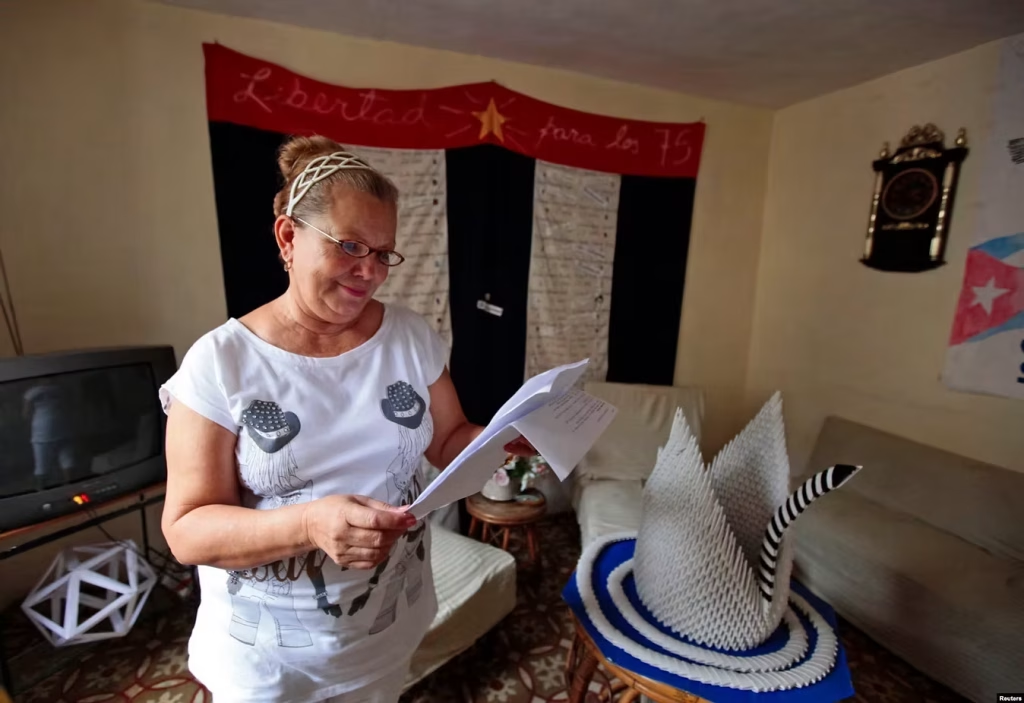
Laura Pollán at her home in Havana, July 7, 2010 | Reuters | Desmond Boylan

October 14, 2026, marked the fifteenth anniversary of the death of Laura Pollán, founder and first leader of the Ladies in White. Berta Soler, the movement’s current leader, commemorated her legacy in an interview published that day by Martí Noticias.

Soler denounced the shortages faced by the population and referred to the existence of more than a thousand political prisoners in Cuba, including people imprisoned for peacefully demonstrating to demand freedom and improvements for the country.

Pollán, a teacher, founded the movement along with other women in 2003, following the imprisonment of 75 opposition members and independent journalists during the Black Spring. Among them was her husband, journalist Héctor Maseda, sentenced to 20 years in prison. The Ladies in White marched peacefully to demand the release of their relatives.

As Soler recalled, Pollán’s home on Neptuno Street in Central Havana served as a refuge for relatives of incarcerated individuals. There, they shared medications and coordinated efforts with institutions and diplomatic missions to demand releases.

Maseda was released in February 2011. Pollán died on October 14 of that year at the Calixto García Hospital in Havana. The group continued to demand the release of other people imprisoned in Cuba for political reasons.

“We are not going to erase this legacy,” Soler stated in the interview, and assured that they will continue working for the freedom of political prisoners and the Cuban people.

Links to prior posts on Laura Pollan

Cienfuegos Seeks Domestic and Foreign Private Capital to Rescue Its Tourist Facilities

Among the seven properties offered for lease are a villa on Cayo Carenas and several buildings in Punta Gorda.

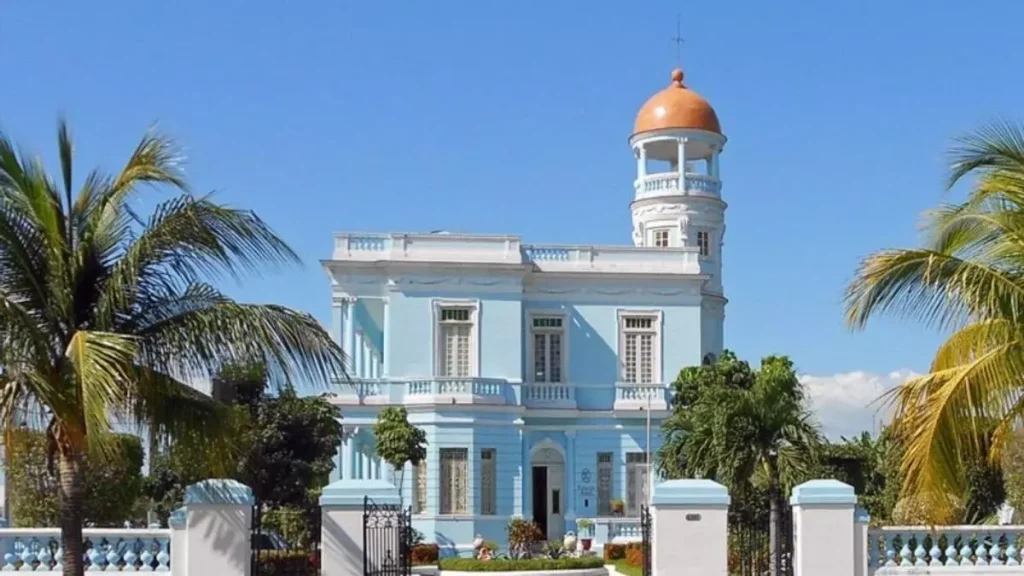
Cienfuegos’s Blue Palace, one of the establishments offered by authorities to private and foreign investors. / 5 de Septiembre

14ymedio bigger14ymedio, Havana, October 18, 2026 – Following the withdrawal of several international hotel chains and with Cuban tourism in free fall, the Government is now looking for someone willing to provide the money to rescue facilities it has been unable to operate. The Cienfuegos Tourism Real Estate Company is offering seven properties to private entrepreneurs and foreign investors, including a villa on Cayo Carenas, an expansion of the Blue Palace, and several buildings in the city’s most coveted areas.

According to the official newspaper 5 de Septiembre, Tourism authorities have decided to expand their leasing options to include new economic actors. Their main clients were the state-owned chains Gran Caribe, Islazul, and the non-hotel company Palmares, but they now intend to bring in micro, small, and medium-sized private enterprises (mipymes), domestic legal entities, Cubans residing abroad, and foreign investors as well.

Pedro Luis Lemus Sorrondeguí, the company’s director, presented the initiative as an opportunity to recover facilities that remain closed or whose projects never came to fruition. “It is a magnificent opportunity to bring these facilities back to life or make them operational, fulfill the dreams we have had for years in our projects, and achieve better economic results,” he said. continue reading

The available properties include the Campomanes guesthouse, located at the corner of Campomanes Street and Paseo del Prado, and the planned Mochilero guesthouse on Avenida 50

The available properties include the Campomanes guesthouse, located at the corner of Campomanes Street and Paseo del Prado, and the planned Mochilero guesthouse on Avenida 50. The offer also includes Palmares’s former warehouses and the Amanecer-La Punta complex, comprising the La Punta guesthouse and the Amanecer building, which previously operated as the Educator’s House.

Most of the properties are concentrated along corridors of considerable tourist value, such as the Prado, the Malecón, and the Punta Gorda peninsula. However, the official information does not detail their structural condition or clearly distinguish between deteriorated buildings, closed facilities, and projects that were never carried out.

One of the most striking cases is Cayo Carenas, a small inhabited island in Cienfuegos Bay. While the Ministry of Tourism is considering its commercial development, residents have depended for years on precarious electrical installations and makeshift solutions for obtaining drinking water.

The French association Cuba Coopération France described a community of 22 homes in 2023 that relied on a deteriorating generator providing electricity for barely a few hours a day. The organization, together with the EDF electricity group’s foundation, promoted a project to modernize the supply system through photovoltaic energy and a new distribution network.

But financial difficulties also affected that initiative. In July 2025, the French organizers acknowledged that three companies had withdrawn their funding commitments, leaving a shortfall of 15,000 euros. The lack of resources forced them to reconsider the stages of the project’s implementation.

The authorities have not publicly identified the signatories of the letters or clarified whether any of those commitments are related to the seven properties offered by the real estate company

The search for capital comes just days after the La Perla del Sur Business Forum, held on October 9 and 10 at the Palace of Valle. During the event, 52 tourism investment proposals were presented and 28 letters of intent were signed, according to figures released by Prensa Latina.

The event brought together more than 240 participants, both in person and virtually, including representatives of five embassies, 35 Cuban and foreign companies, and 22 private ventures. However, the authorities have not publicly identified the signatories of the letters or clarified whether any of those commitments are related to the seven properties offered by the real estate company.

Cienfuegos’s portfolio of investment opportunities is also considerably broader. Yanet González Laso, the provincial official responsible for Foreign Trade and Foreign Investment, explained that the aim is also to restore the former Perla Hotel, located at Prado and Castillo, as well as three mountain hotels, a villa, and three restaurants that are not currently being marketed because of a lack of financing.

The official noted that some services at the future facilities could be charged in foreign currency to recoup investments, while others would be offered in the national currency. This possibility is part of the economy’s partial dollarization process, which has expanded the presence of foreign-currency prices across various sectors.

For now, the State is not announcing the sale of these properties, but rather the possibility of leasing them and allowing third parties to operate them. Nevertheless, the initiative leaves numerous questions unanswered. It remains to be seen how much future tenants will have to invest and what the State will receive in return for placing some of Cienfuegos’s most attractive tourist locations in their hands.

Translated by Regina Anavy

______________________

COLLABORATE WITH OUR WORK: The 14ymedio team is committed to practicing serious journalism that reflects Cuba’s reality in all its depth. Thank you for joining us on this long journey. We invite you to continue supporting us by becoming a member of 14ymedio now. Together we can continue transforming journalism in Cuba.
In Guantánamo, Having Money in the Bank Doesn’t Mean Being Able to Buy Anything

The lack of cash has become an everyday problem that affects consumers and merchants alike

Sacar dinero de una cuenta bancaria se ha convertido en una gestión que puede consumir una mañana entera y terminar con las manos vacías. / 14ymedio

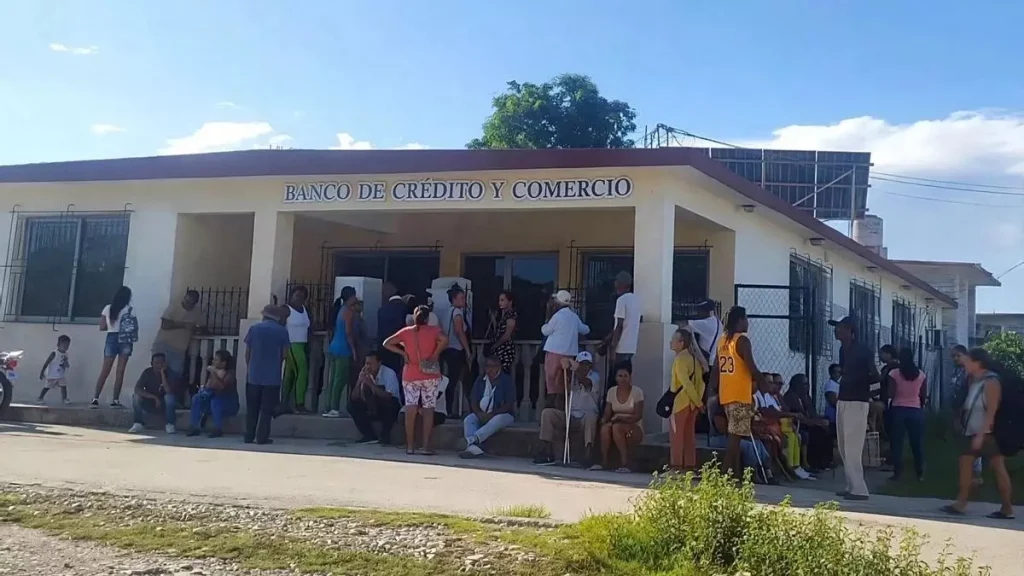
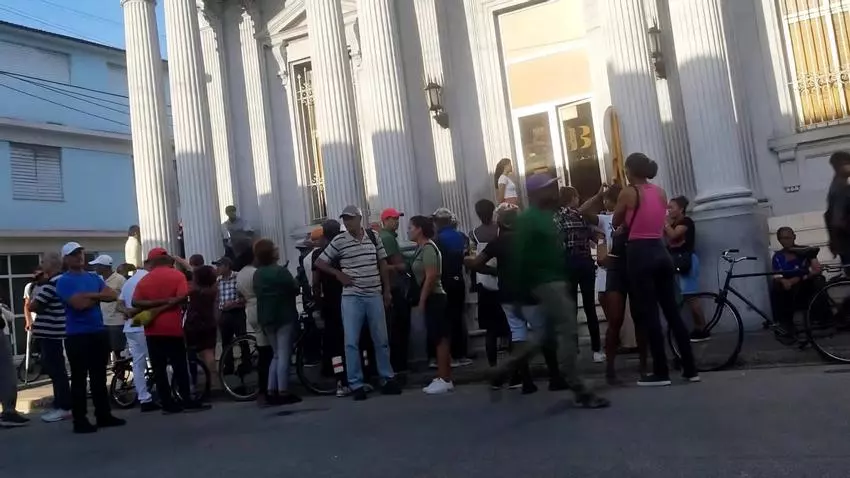
14ymedio bigger14ymedio, Guantánamo, Dayamí Rojas, October 18, 2026 / The line starts before the bank doors open. Some have brought a bag to sit on, others carry a bottle of water, and almost all of them look at their watches with the same worry: that the cash will run out before they reach the window. In Guantánamo, withdrawing money from a bank account has become a task that can take up an entire morning and end with empty hands.

Marcelo, 78, knows that uncertainty well. At his age, collecting his pension should be a simple procedure, but every month he has to calculate how much time he will spend looking for the bills he needs to live. “They made bancarization compulsory, but they didn’t create the conditions for it to work first,” he declares.

The complaint sums up a contradiction that runs through the city. The authorities promoted electronic transfers as a solution to reduce the use of cash, but a large part of everyday commerce still depends on bills. The result is that money can appear on a phone screen and yet be useless at the counter. continue reading

Long lines outside the bank to withdraw cash are now a daily occurrence in Guantánamo. / 14ymedio

A retired woman from Guantánamo describes her pilgrimage through the shops: “I go business by business and one by one they tell me they don’t accept payment by transfer, and when they do accept it, it’s at 40 and 50%. Having money on the card is just for show, it’s no use at all.”

In the streets near the center, where small private businesses, street vendors and state establishments coexist, the question is repeated before any purchase: “Do you accept transfers?” The answer can determine whether someone goes home with food or has to keep walking under the Guantánamo sun.

Niuber sells pizzas and sandwiches on a central street corner. His problem is not a lack of customers, but the difficulty of turning his digital income into usable money. The flour, ingredients and other supplies he needs cannot always be paid for through a bank transaction.

“The fines against private businesses that don’t accept transfers don’t solve the problem. Bancarization has been a failure throughout the country, because they haven’t managed to make it possible for us to withdraw cash from the bank when we need it. My account is crammed with money that’s no use for buying the raw materials I work with,” he explains.

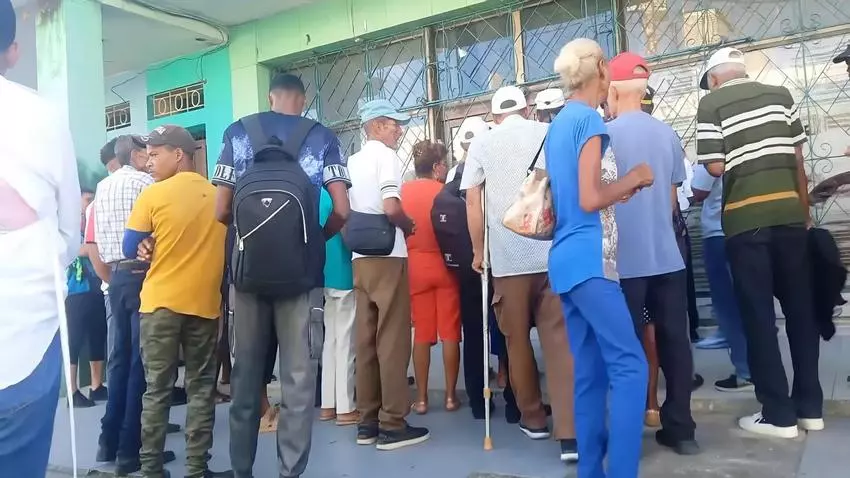
Retirees are among the groups most negatively impacted by the banking reform process. / 14ymedio

The paradox is bitter: the more he sells through transfers, the larger the balance frozen in his account can become. If his suppliers demand bills, his earnings remain trapped in an electronic circuit that does not respond to the needs of small businesses.

The blackouts add another difficulty. When there is no electricity, ATMs can be out of service and digital transactions stumble over dead phones, unstable connections or establishments without the means to process payments. The promised modernization ends up depending on something as basic as there being power.

Nor is it enough to find a working ATM. Most of the time it has no bills or imposes withdrawal limits that force people to come back again. For retirees, especially those who have difficulty walking or live far from the branches, each attempt represents a physical effort and an additional expense for transportation.

In rural areas the impact is more dramatic. The day laborers who sweat over the furrows to plant or harvest food “have to be paid in cash because most of them are very humble people who don’t even have a cell phone,” explains a farmer who owns a small farm where root vegetables and other produce are grown.

The lack of cash has gone from being an occasional nuisance to an everyday problem that affects consumers and merchants alike.

“When I have to hire people, I can’t tell them I’m going to pay by transfer. If I do that, the sweet potatoes stay in the field,” the farmer adds. “What works here is money in your hand,” he declares.

Guantánamo’s official newspaper Venceremos has addressed the difficulties of bancarization and the payment of pensions, a sign that the discontent is impossible to hide even in the state media. The lack of cash has gone from being an occasional nuisance to an everyday problem that affects consumers and merchants alike.

Meanwhile, the bill takes on a value that goes beyond the printed figure. Whoever has it can negotiate, buy and get by; whoever has only a bank balance has to ask, wait and sometimes accept abusive conditions, such as a percentage added to the price of a product.

“The pound of beans that was going to cost you 400 pesos, you have to pay 450 for if all you have is money on your phone,” warns Marcelo. For the retiree, “bancarization is a punishment, and those of us who are poorest and oldest are the ones paying for it.”

Translated by GH

______________________

COLLABORATE WITH OUR WORK: The 14ymedio team is committed to practicing serious journalism that reflects Cuba’s reality in all its depth. Thank you for joining us on this long journey. We invite you to continue supporting us by becoming a member of 14ymedio now. Together we can continue transforming journalism in Cuba.
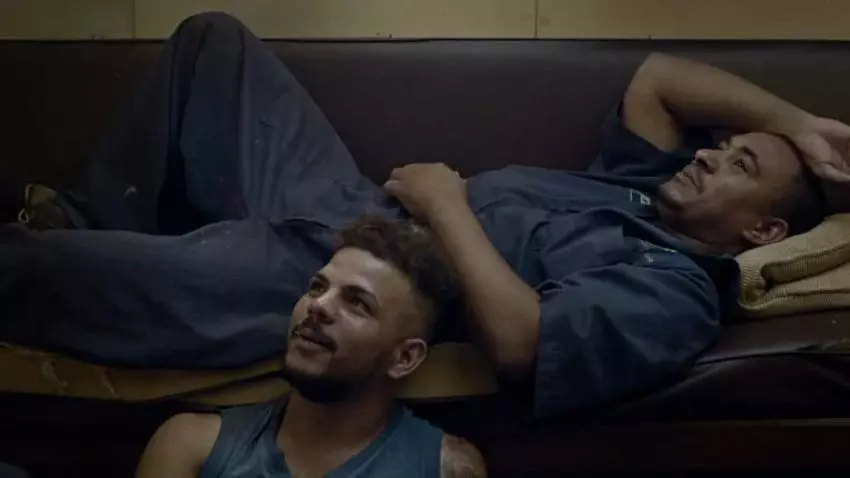
Cuban Filmmaker Alejandro Alonso Will Premiere the Film ‘Bahía Honda’, a Journey Toward Freedom in Broken Ships, in Europe

It will be screened on November 16 at the 39th International Documentary Film Festival Amsterdam, one of the most prestigious in the world

Fotograma de la película ‘Bahía Honda’, cedido por su productora. / Estudio ST

14ymedio biggerBahía Honda (2026), the second feature film by independent Cuban director Alejandro Alonso, will have its world premiere this November 16 at the 39th International Documentary Film Festival Amsterdam (IDFA), one of the most prestigious festivals in the world, which will be held from the 10th to the 22nd of that month.

Produced by Estudio ST, Vega Alta Films and Folk Film, with the collaboration of the Norwegian Embassy in Cuba – one of the great promoters of non-institutional cinema on the island – Bahía Honda was filmed in the ship graveyard and scrapyard of the town of the same name in Artemisa province, and contains the last images the filmmaker shot in Cuba before emigrating to Spain in 2021.

The director conceives of his film as “a kind of journey.” And he tells 14ymedio: “Initially, our first wish was to make a portrait of this place. It was a paradox to have found this place where they destroy ships, and what that meant at a time when, in Cuba, this other great wave of migration was also beginning.”

“This place is a kind of bubble because there are hardly any spaces like this left in the world,” Alonso remarks. The director explains that there are currently very few ship scrapyards because of their environmental impact, but that Cuba “skips all those laws, all those protocols.” The chosen place, he says, “is somewhat left to its own devices when it comes to labor and environmental protection policies.” continue reading

“He’s someone who destroys ships by day and at night, with the parts, tries to put together his own boat. There was something there that seemed very powerful to me”

After the initial fascination with the scrapyard, the filmmaker recounts, what changed his way of looking at the place and relating to it was getting directly close to the workers, in particular Raudel González Cordero, Pitufo, “with all the baggage he brought, all that desire to leave, to escape.” The filmmaker explains that his character is “someone who destroys ships by day and at night, with the parts, tries to put together his own boat. There was something there that seemed very powerful to me.” It is on the basis of that “desire” that Alonso has built the entire story.

“This place is a kind of bubble because these kinds of spaces hardly exist anymore in the world.” / ST Studio

The images filmed in this place, at once so strange, fascinating and gloomy, came to light years earlier in the short film Abisal (2021), which won the Coral Award for Best Short Documentary at the 43rd edition of the Havana International Festival of New Latin American Cinema in December 2022.

But this distinction did not prevent its director from being censored by the Cuban Institute of Cinematographic Art and Industry, when its officials vetoed the screening of a recorded acceptance message that Alonso sent from Spain. The director mentioned the Cuban migratory stampede at the time, and in a way “closed” the protagonist’s story outside the film, revealing that he too had emigrated from Cuba.

These “unwanted” words would have tarnished the spotless image of the regime that was being projected, after the veto of the feature film Vicenta B. (2022) by Carlos Lechuga and some “provocative” words by Cuban actress Andrea Doimeadiós at the opening of the event.

This is one of many examples that explain why filmmakers as key to Cuban cinema as Alejandro Alonso are not recognized by the island’s “general public”

The whitewashing of that edition included, in addition to the censorship of Alonso’s words, the presentation of the Honorary Coral to Silvio Rodríguez, almost the only person authorized to make statements that night (“Down with the blockade!”), since not even the jurors were allowed to approach the microphones during the awards ceremony.

This is one of many examples that explain why filmmakers as key to Cuban cinema as Alejandro Alonso (along with Rafael Ramírez, Luis Alejandro Yero, Miguel Coyula, Marcel Beltrán, Violena Ampudia, Raydel Araoz, Carlos Quintela, Orlando Mora, Josué García, Heidi Hassan, Carla Valdés, Carlos Melián, Armando Capó and so many others that they would make this paragraph extremely long) are not recognized by the island’s “general public” – which depends to a large extent on what the official institution screens, with the proper authorizations and ideological filters, in its already scarce movie theaters.

Still from the film ‘Bahía Honda’, provided by its production company. / ST Studio

“We always conceived of Bahía Honda as an expansion of the universe presented in Abisal,” says Alonso. “They are films that are connected by the protagonist, by the place, but now there is an attempt to take the universe and the imaginary of the ship-breakers somewhat to the limit. I feel that the film establishes a dialogue between that universe of theirs and my own imaginary.”

Alonso is no stranger to film platforms in the Netherlands. In 2021 he won the Hivos Tiger Award for Short Film with Terranova (2020), co-directed with the Spaniard Alejandro Pérez, at the equally important International Film Festival Rotterdam, where shortly afterward he gave the world premiere of his short film La historia se escribe de noche (2024). The latter is an existential reflection on life in the blackouts, with its burden of dread, mystery and anxiety.

As in these other films, two of his most representative titles, ‘Bahía Honda’ subscribes to the sensory cinematic creed that defines Alonso’s style and audiovisual discourse

As in these other films, two of his most representative titles, Bahía Honda subscribes to the sensory cinematic creed that defines Alonso’s style and audiovisual discourse. He always places the expressive force of the image above didactic narrative, impression above description, and the free association of images above “logical” articulation. These are films that must be read and felt like poems, with all their enigmas, challenges and invitation to complex dialogue.

Although this feature film is described by Alonso as “a much more atmospheric film. It’s a bit of a glimpse into that world, into this whole universe.” Alonso explains that Bahía Honda aims to be much more narrative, to explore other resources and to try to paint a much more complex portrait of Pitufo. “Above all, of the imaginary of his desire to emigrate.”

The filmmaker also says that Bahía Honda is a “very participatory” film that was built up from the research, because they had very little time to shoot. “I’d say three or four weeks,” he explains. “And of course, as we discovered the place, as we understood what we wanted to do, as we got to know our protagonists, we kept filming.”

For its director, Bahía Honda “seems like it’s going to be one thing, then it mutates toward another place and finally moves into more fictional territory.” Alonso explains that, although the film starts out “very tangible, very much about texture, very much about metal, very much about the body,” as it progresses “it moves more toward the universe of dreams, of desires.”

Bahía Honda is not an “easy” film. It is not a film to laugh at or to escape from reality. It is the story of an escape, but, thanks to the eye of Alonso and his film crew, the scrapyard becomes an almost monstrous landscape, a circle of Hell in which its protagonist and the other characters seek to survive until a possible escape.

Translated by GH.

______________________

COLLABORATE WITH OUR WORK: The 14ymedio team is committed to practicing serious journalism that reflects Cuba’s reality in all its depth. Thank you for joining us on this long journey. We invite you to continue supporting us by becoming a member of 14ymedio now. Together we can continue transforming journalism in Cuba.
Electricity Shortages in Cuba Trigger a “War of Circuits”

“How long will the benefits for a few continue while everyone else endures this like animals?”

“The UNE thinks we’re born to put up with anything, but everything has a limit” / 14ymedio

14ymedio bigger14ymedio, Havana, October 18, 2026 — When the electricity came back on, after exactly 37 hours and 19 minutes without power, an unusual flurry of activity broke out in the buildings on circuit PZ15, in Havana’s Plaza de la Revolución municipality, even though it was not yet seven o’clock on a Sunday morning. Each resident could hear their neighbors starting washing machines, turning on fans, and rushing around to do everything that requires electricity.

At dusk on Saturday, the sounds of people banging pots and pans and clear shouts could be heard here and there from these Soviet-style buildings, like the one housing the 14ymedio newsroom: “We want electricity!”

According to the authorities, the last time the area had electricity, a breakdown occurred in the main transformer supplying the circuit. Immediately after the protest, a vehicle from the Electric Union (UNE) arrived to try to repair it, something that did not happen until early this morning.

The demonstration was unusual in a neighborhood inhabited mostly by government officials and regime supporters, who are not particularly inclined to protest. “UNE thinks we’re born to put up with anything, but everything has a limit,” a resident who, yesterday afternoon, had neither electricity, water, nor gas, told this newspaper. continue reading

“How long will this shamelessness continue in Nuevo Vedado?” one user asks

Criticism is also multiplying on social media, although behind pseudonyms.
“How long will this shamelessness continue in Nuevo Vedado?” asks user yo27190610, who complains that while her district and the surrounding areas receive only two or three hours of electricity a day, there is a “priority” circuit where the power never goes out. It is precisely the circuit where a 12-story building belonging to the Ministry of the Revolutionary Armed Forces is located.

The so-called llega y pon settlement known as the “San Pedro and Hidalgo favela” is also there, provoking the greatest irritation. “Not only do we have to sleep without electricity, but we also have to sleep with blaring music coming from the favela,” the same source says. “How long will social indiscipline be allowed to continue? How long will the benefits go to a few while everyone else endures this like animals?”

The complaints have even reached areas fortunate enough to have a medical center nearby, giving rise to what is increasingly being called the “war of the circuits.” In Luyanó, complaints from residents on circuits other than those serving the “hospitals”—the Miguel Enríquez Clinical-Surgical Hospital and the Diez de Octubre Gynecological-Obstetric Hospital (Hijas de Galicia), where the power was cut very rarely—had an effect.

A resident of the apartment block benefiting from the hospitals’ priority status explains: “Before, we had electricity and they didn’t, and they’ve been complaining for months. They collected signatures and went to the government, and it ended with them distributing the misery equally, as they usually do. Now they give us one week with electricity and them one week, and vice versa.” There is an additional problem: “The bad thing is that when they don’t have power, we don’t have internet either, because the Etecsa antenna is on that circuit.”

Friday’s fire at the Ernesto Guevara de la Serna thermoelectric power plant in Santa Cruz del Norte, in Mayabeque, was the final blow to the disastrous situation facing Cuba’s power plants

Nevertheless, the capital can be considered privileged. In other parts of the country, blackouts are approaching unimaginable limits, and even the official press is not concealing the situation. In Matanzas, for example, there are areas where power cuts last nearly 70 hours, such as Manuelito and Bolondrón. According to TV Yumurí, the time without electricity is at least 39 consecutive hours, as is the case in the city of Matanzas itself.

By way of explanation, the provincial television station says that when circuits trip in the most remote locations, someone must go there in person to restore them “because they have a manual system.” The “on-call vehicle” is not always available promptly.

For yesterday, the Electric Union forecast a shortfall of 2,072 megawatts (MW) against demand of 2,800 MW during peak hours. In other words, only 26% of the electricity needed was available.

Friday’s fire at the Ernesto Guevara de la Serna thermoelectric power plant in Santa Cruz del Norte, in Mayabeque, was the final blow to the disastrous situation facing Cuba’s power plants. The country’s main thermoelectric plant, the Antonio Guiteras facility in Matanzas, is also still out of service, although the official press predicts that it will be reconnected to the National Electric System this Sunday.

This was the subject of a message circulating in the WhatsApp groups for circuit PZ15, which rebelled on Saturday. The fire has also left insufficient gas supplies. “With the Santa Cruz and Guiteras thermoelectric plants out of operation, the Energas plant has to operate at maximum capacity,” the message argued. “This leads to high gas consumption and makes it impossible to deliver the necessary pressure at the plant’s outlet, resulting in reduced natural gas supplies to the plants in Havana and Marianao.”

The situation will remain this way, the message warned, “until electricity generation in the western part of the country recovers somewhat.”

Translated by Regina Anavy

______________________

COLLABORATE WITH OUR WORK: The 14ymedio team is committed to practicing serious journalism that reflects Cuba’s reality in all its depth. Thank you for joining us on this long journey. We invite you to continue supporting us by becoming a member of 14ymedio now. Together we can continue transforming journalism in Cuba.
750 Tons of Oil Donated by Russia Arrive in Cuba, Along With Food Paid for by Japan

Minister Óscar Pérez-Oliva claims that this aid was held up in Jamaica because of the United States.

Cuban Foreign Trade Minister Óscar Pérez-Oliva Fraga (left) receives the food donation alongside Japanese Ambassador Nakamura Kazuhito. / X/@WFP_Cuba

14ymedio bigger14ymedio, Madrid, October 17, 2026 — In the midst of the worst economic crisis Cuba has experienced since 1959, with the country in darkness, empty shelves, and rampant inflation, the Government received two new food donations this Friday: 750 tons of vegetable oil sent by Russia and the first 425 tons of rice paid for by Japan, part of a food donation valued at one million dollars. Both shipments arrived through the United Nations World Food Programme (WFP).

The sunflower oil is part of the WFP’s emergency reserves on the Island, according to state media reports. The shipment was funded by Russia’s Ministry of Civil Defense and Emergencies through a contribution of four million dollars for 2025–2026.

Russian Ambassador Víktor Koronelli presided over the handover alongside Cuban Foreign Trade Minister Óscar Pérez-Oliva Fraga and Domestic Trade Minister Betsy Díaz. Etienne Labande, the WFP representative in Cuba, was also present. According to the Russian Embassy’s statement, the oil will be distributed to children, the elderly, and pregnant women. continue reading

The Japanese aid consists of a one-million-dollar donation with which the WFP purchased grains, oil, rice, and other products for those affected by Hurricane Melissa. The supplies were received at the warehouses of the Provincial Food Company of Havana. Ambassador Nakamura Kazuhito explained that his country’s WFP Friends Association also participated in the donation.

The Japanese aid consists of a one-million-dollar donation with which the WFP purchased grains, oil, rice, and other products for those affected by Hurricane Melissa

Betsy Díaz stated that the rice will go to people affected by the disaster in the eastern provinces. Each package contains 1.5 kilograms of rice, 0.9 kilograms of grains, and one liter of oil. The remainder of the donation is still awaiting delivery.

At the event, Pérez-Oliva, deputy prime minister and head of Foreign Trade, claimed that the containers carrying the Japanese aid had been held up at the port of Kingston, Jamaica, because of U.S. pressure on international shipping companies. He presented this as part of the tightening of the “imperialist siege” against the Island. However, the Foreign Trade Minister himself, who is Fidel Castro’s great-nephew, recently stated that “the French shipping company CMA CGM resumed services to Cuba exclusively for food, medicines, and medical supplies.”

Pérez-Oliva did not provide details about how long the shipment was supposedly held up or explain why food intended for people affected by a hurricane in October 2025 is arriving a year later. Neither the official media nor the Russian Embassy specified when or how it would reach families, beyond referring to “vulnerable sectors.”

China delivered 80,000 bicycle parts, and the Bahamas donated nearly one ton of medicines to the healthcare system

The shipments coincide with other recent donations: China delivered 80,000 bicycle parts, and the Bahamas donated nearly one ton of medicines to the healthcare system.

In May, Washington offered 100 million dollars in direct humanitarian assistance, which Foreign Minister Bruno Rodríguez dismissed as a “fairy tale.” A first shipment of 18 tons of food and hygiene kits for 700 Havana families arrived later. Of these donations, 60 million dollars is being channeled through the Catholic Church and 40 million through other trusted nongovernmental organizations.

Unlike the donations from Moscow or Tokyo, the state-controlled media have barely mentioned this aid package. With domestic production lacking, the food supply for millions of Cubans increasingly depends on shipments donated by foreign governments and international organizations.

Translated by Regina Anavy

______________________

COLLABORATE WITH OUR WORK: The 14ymedio team is committed to practicing serious journalism that reflects Cuba’s reality in all its depth. Thank you for joining us on this long journey. We invite you to continue supporting us by becoming a member of 14ymedio now. Together we can continue transforming journalism in Cuba.
Havana Protests Because the U.S. Will Use the UN to Denounce Repression on the Island

The Cuban regime fears losing votes in favor of its annual resolution against the embargo.
Ernesto Soberón denounced a meeting scheduled for next Monday, October 19, convened by the U.S. Permanent Mission. / Minrex
/ Minrex

14ymedio bigger14ymedio, Havana, October 17, 2024 / 14ymedio, Havana, October 17, 2026 – The Cuban regime, which for more than three decades has turned the United Nations General Assembly into the setting for its main “annual diplomatic victory,” has now protested because the United States intends to use that same forum to denounce political repression on the Island. The reaction comes on the eve of a new vote against the U.S. embargo, after Cuba obtained its worst result in decades in 2025, despite retaining a large majority in its favor.

Cuba’s Permanent Representative to the UN, Ernesto Soberón, denounced this Friday a meeting scheduled for next Monday, October 19, convened by the U.S. Permanent Mission under the title Free Cuba: The Oppression Havana Hides. According to the diplomat, this is a maneuver intended to attack the Cuban Government and promote a hostile narrative against the country.

“The United Nations is not a platform for political persecution, interference in the internal affairs of states, or campaigns intended to undermine their sovereignty,” Soberón stated, accusing Washington of violating the rules governing the use of the international organization’s facilities. continue reading

In 2022, Beijing responded with a diplomatic protest, almost identical to the one Cuba is now making and called a similar meeting a “political farce”

However, administrative instruction ST/AI/2019/4, invoked by the ambassador himself, states in section 4.4.c that the permanent missions of member states may indeed request venues to organize meetings, conferences, and other events, including those involving outside entities they sponsor.

The regulations require that activities be compatible with the principles of the United Nations and allow administrative authorities to reject requests or cancel meetings. Nevertheless, the Cuban Government has not publicly presented any specific evidence establishing that the event convened by Washington violates these conditions.

Nor is this an unprecedented initiative. In December 2017, Australia, Canada, France, Japan, South Korea, the United Kingdom, and the United States organized a conference at the UN headquarters in New York on the torture, arbitrary detention, and sexual abuse suffered by North Korean women forcibly repatriated to their country. Participants included a defector from North Korea and international experts.

In October 2022, the United States, the United Kingdom, and other Western governments promoted another meeting on the persecution of the Uyghurs in China. Beijing responded with a diplomatic protest almost identical to the one Cuba is now making and called a similar meeting a political farce, accusing Washington of exploiting human rights to harm its adversary.

The seven votes against the resolution represented a record since these votes began in 1992

Venezuela was also the subject of a similar initiative. In March 2019, the United States and ten other governments sponsored an event at the United Nations headquarters in Geneva, featuring testimony about arbitrary detentions, torture, and the persecution of opponents under Nicolás Maduro’s regime.

Havana’s protest also coincides with an especially delicate moment for its traditional diplomatic campaign against the embargo. In October 2025, the resolution entitled Necessity of Ending the Economic, Commercial and Financial Embargo Imposed by the United States of America against Cuba received 165 votes in favor, seven against, and twelve abstentions.

Although the majority once again supported lifting the sanctions, Cuba lost 22 favorable votes compared with the previous year. The seven votes against the resolution represented a record since these votes began in 1992. Argentina, Paraguay, Hungary, North Macedonia, and Ukraine joined the United States and Israel in voting against it. Kyiv, in particular, justified its rejection by citing the Cuban authorities’ attitude toward the recruitment of citizens from the Island to fight on Russia’s side in Ukraine.

Soberón now accuses Secretary of State Marco Rubio of directly pressuring heads of state and government to change their votes at the next session, scheduled for October 27 and 28. Although Washington has pursued diplomatic efforts to reduce support for the resolution, the Cuban representative did not specify what concrete threats underpin his accusations of blackmail.

The resolutions calling for the lifting of the U.S. embargo are nonbinding and have a primarily symbolic impact. Havana has turned every vote into a supposed “victory” for the Revolution, deliberately confusing international opposition to the sanctions with support for its political system. Now, as Washington seeks to put the repression that the regime prefers to keep out of the debate on the table, the forcefulness of Cuba’s protests reveals its fear that this year’s result will deepen the diplomatic setback it suffered in 2025.

Translated by Regina Anavy

______________________

COLLABORATE WITH OUR WORK: The 14ymedio team is committed to practicing serious journalism that reflects Cuba’s reality in all its depth. Thank you for joining us on this long journey. We invite you to continue supporting us by becoming a member of 14ymedio now. Together we can continue transforming journalism in Cuba.
Henry Constantín Denounces That a Knife Was Placed in His Cell To Worsen His Situation

The director of the newspaper ‘La Hora de Cuba’ is imprisoned for a month for disobedience and will be punished at least 15 days being deprived of his family visits.

Constantin’s imprisonment has prompted statements from international press freedom organizations. / Facebook / Henry Constantin

14ymedio bigger14ymedio, Havana, October 15, 2026 / Independent journalist Henry Constantín Ferreiro, director of La Hora de Cuba, reported this Thursday that he will be sent to solitary confinement for at least 15 days after prison officials found a homemade knife among his belongings. The journalist, imprisoned since September 16 in Camagüey, suspects the weapon was deliberately planted to frame him and worsen his situation.

According to La Hora de Cuba, Constantín reported the incident around 10:00 a.m. during a phone call from Kilo 7 prison. Officials searched his cell and found the knife in the pocket of one of his belongings. What aroused the journalist’s suspicions was that the officers went directly to the spot where the weapon was found, as if they knew its location beforehand.

Constantin also learned that the previous day an agent identified as Frank had spoken with Nelson, the prisoner who occupies the lower bunk in his cell. The journalist suspects that the knife was smuggled in among his belongings during the night.

Constantin also learned that the day before, an agent identified as Frank had spoken with Nelson, the prisoner who occupies the lower bunk in his cell.

The head of the prison unit, a major identified as Dany, ordered the disciplinary action and the corresponding procedure for the alleged possession of bladed weapons. As a result, Constantín will lose his scheduled family and conjugal visit for Monday, October 19, as well as his daily authorized phone call. continue reading

The complaint comes as the journalist marks one month in custody this Friday, accused of disobedience for allegedly failing to appear at a police summons. Constantín maintains that he did attend, although the officers had already left by the time he arrived. Since then, his defense has denounced various irregularities in the proceedings.

At the beginning of October, the Municipal Court returned the case file to the Prosecutor’s Office without opening a trial , while the journalist’s lawyer requested a modification of the precautionary measure so that he could await trial at liberty. Despite the charge being one of disobedience, which does not carry a prison sentence, Constantín remains in pretrial detention and now faces a new disciplinary measure that further restricts his contact with the outside world.

The name of Agent Frank, mentioned in Thursday’s episode, had already appeared in another complaint related to the case. On October 9, Alejandra García, the journalist’s partner, visited him at Kilo 7 and, after the meeting, was interrogated by two State Security agents identified as Felipe and Frank.

“I know Henry, he’s not the kind of person who would be close to violence.”

According to García’s later account, both men tried to pressure her, suggesting that the trial against Constantín could be expedited if she agreed to their demands. They also made references to her family. Before parting ways, Frank allegedly warned her that she had the choice between the easy path and the hard one.

The publication in La Hora de Cuba sparked numerous reactions on social media. María Concha Ferreiro, the journalist’s mother, demanded his release and denounced what she considers an abuse of power. “He is innocent. It’s despicable,” she wrote. Other acquaintances of Constantín also rejected the possibility that he possessed a weapon. “I know Henry; he’s not the kind of person who would be close to violence,” asserted Osmanys Sánchez Arano, while Yania Suárez called the discovery of the knife a “fabrication.”

Constantin’s imprisonment has prompted statements from international press freedom organizations, including the Committee to Protect Journalists (CPJ) and Reporters Without Borders (RSF), which have called for his release. The journalist is also the regional vice president of the Inter-American Press Association (IAPA) and has a long history of arrests and harassment for his reporting.

______________________

COLLABORATE WITH OUR WORK: The 14ymedio team is committed to practicing serious journalism that reflects Cuba’s reality in all its depth. Thank you for joining us on this long journey. We invite you to continue supporting us by becoming a member of 14ymedio now. Together we can continue transforming journalism in Cuba.
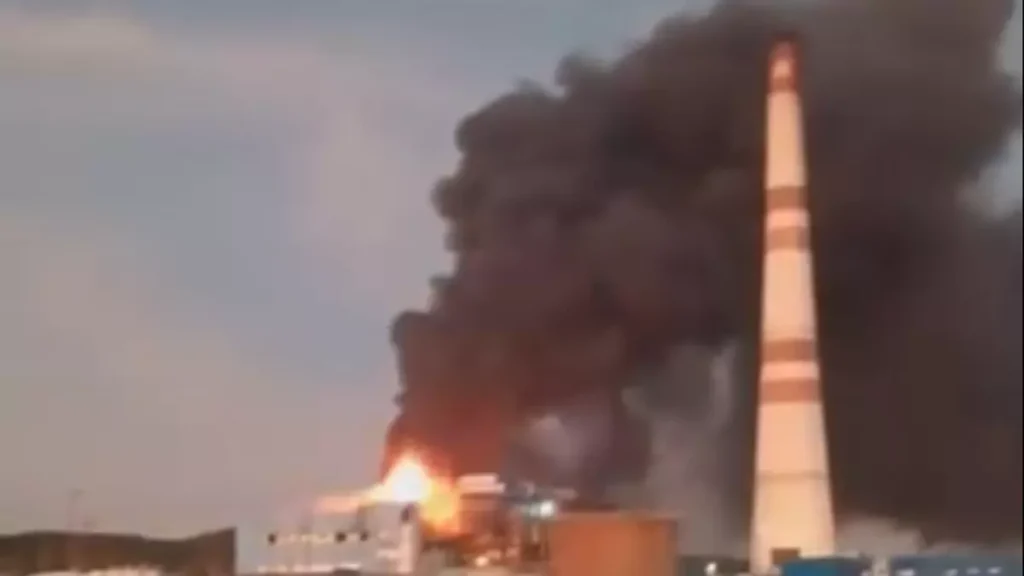
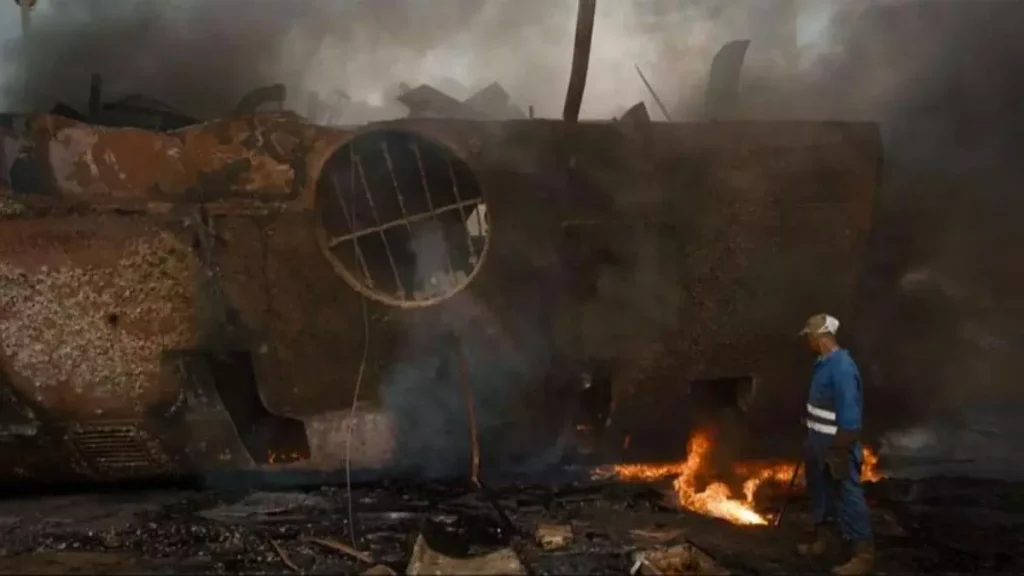
Serious Fire at the Cuban Thermoelectric Power Plant in Santa Cruz del Norte

Firefighters managed to control the fire, which began at 6:55 for reasons still unknown.

Images of the situation at the thermoelectric power plant early Friday morning. / Radio Jaruco

14ymedio bigger14ymedio, Madrid, October 16, 2026 – Cuba’s Electric Union reported early Friday morning (6:55) a fire “of major proportions” in the unit of the Ernesto Guevara de la Serna Thermoelectric Power Plant in Santa Cruz del Norte, Mayabeque. According to the Ministry of the Interior, the incident originated inside the generating unit’s own infrastructure, forcing its operations to be halted as a precaution. Although the fire was brought under control, according to the authorities at around 9 a.m., the plant is offline.

Journalist Amparo Álvarez, director of the Santa Cruz-based radio station La Voz del Litoral, stated that there had been no loss of human life “so far,” since “urgent measures were taken to assure the safety of the workers.”

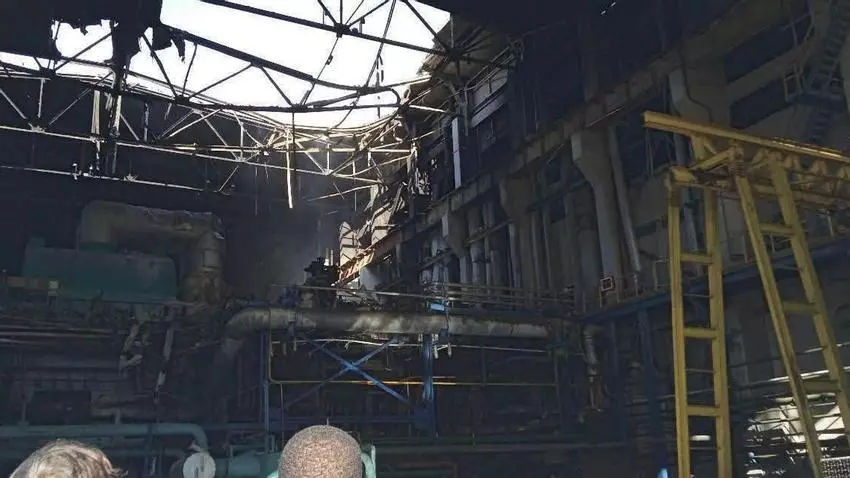
The National Electric Union (UNE) reported that the accident was caused by “an oil leak in the front of the rotor,” which, according to the state-owned company, “was detected promptly by the on-duty operator.” The company announced that the area remains under preventative surveillance while units 2 and 3 of the power plant prepare to resume operations.

Unit 1 of the Ernesto Guevara de la Serna thermoelectric plant after Friday’s accident. / UNE

The fire produced a highly visible column of black smoke, as seen in images released by the official media outlet Radio Jaruco. On social media, some residents reported hearing sirens, which led them to fear the worst. continue reading

The Santa Cruz del Norte fire department, and other rescue teams, were recognized by government authorities for their “professionalism and commitment to the safety of the plant and its workers,” according to the UNE.

The accident was caused by “an oil leak in the front part of the rotor” which, according to the state entity, “was detected in a timely manner by the operator on duty”

The state-owned company had previously indicated that only 740 megawatts (MW) of power were available, while demand stood at 2,260 MW. For the midday period, a shortfall of 1,750 MW is forecast. Furthermore, no improvement is expected at night, with the same level of production but demand reaching 2,900 MW, bringing the deficit close to 2,200 MW.

A few hours later, the UNE reported the disconnection of the Lidio Ramón Pérez thermoelectric plant, known as Felton, so it is expected that generation expectations will be reduced in the deteriorated national electricity system.

Fires and other accidents at Cuban thermoelectric power plants have become part of the problem. The aging facilities and the conditions under which they operate, combined with inadequate safety measures, have turned these giants into powder kegs.

Among the most serious incidents in recent years was the disaster at Unit 2 of the Lidio Ramón Pérez Thermoelectric Power Plant in Felton (Holguín), which sustained considerable structural damage just as it was preparing to resume operations in July 2022. The unit remains out of service, four years after the incident.

Months earlier, in March 2022, another fire of major proportions had occurred at the Máximo Gómez Báez thermoelectric power plant in Mariel, Artemisa. The accident was caused by an explosion in the steam turbine of Unit 7 and triggered an automatic shutdown of the system a few minutes later, although no casualties were reported on that occasion either.

In addition, the Antonio Guiteras Thermoelectric Power Plant in Matanzas, the country’s largest generating unit, has experienced all kinds of incidents, from fires in its fuel tanks to boiler failures and internal collapses during chimney-cleaning operations.

Translated by Regina Anavy

______________________

COLLABORATE WITH OUR WORK: The 14ymedio team is committed to practicing serious journalism that reflects Cuba’s reality in all its depth. Thank you for joining us on this long journey. We invite you to continue supporting us by becoming a member of 14ymedio now. Together we can continue transforming journalism in Cuba.

Midterms: Defending America Against Radical Capture

The Cubanamerican Voice, Julio Shiling, 16 October 2026 / The Constitutional Convention of 1787 and the fierce ratification struggle that followed produced one of the most deliberate acts of political moderation in human history. Alexander Hamilton, James Madison, and John Jay did not write The Federalist Papers to celebrate pure democracy or concentrated power. They wrote to persuade a skeptical New York that a carefully balanced republic—checks and balances, divided government, an independent judiciary, a presidential system rooted in virtue and limited authority—could endure. Their project assumed a citizenry capable of self-restraint and a political culture that rejected absolutism. They never imagined that one of the two major parties would someday be captured by a radical minority determined to dismantle the very architecture they designed.

That capture has occurred. Today’s Democratic Party is no longer the party of Franklin Roosevelt’s New Deal, Harry Truman’s Fair Deal, or Lyndon Johnson’s Great Society—programs that expanded the welfare state while still presupposing a robust private sector, entrepreneurial energy, and a broad middle class. Nor does it resemble Nordic social democracy, which coexists with market dynamism. What now dominates the party’s leadership ecosystem is a revolutionary current: intellectually indebted to Marxism, methodologically shaped by Gramscian cultural strategy and Fabian gradualism, and increasingly comfortable with the civilizational hostility of Islamist ideology. Not every Democratic officeholder is a card- carrying communist. Most are not. But they operate inside a party structure whose commanding heights are controlled by radicals who treat the American constitutional order as an obstacle rather than a inheritance.

The policy wish list makes the ambition plain. Defund or severely constrain the agencies of public order. Abolish the Senate or render it impotent. Eliminate the Electoral College. Expand and politicize the Supreme Court while subordinating it to a unicameral legislature. Draft a new constitution. Redesign the prison system in ways that weaken accountability. These are not marginal talking points; they are recurring proposals from the party’s continue reading

activist core and its intellectual allies. Each would erode the separation of powers that The Federalist treated as essential to liberty. The destination is not “more democracy.” It is democratic centralism—Lenin’s model of a “people’s democracy” in which formal elections coexist with one-party direction of the state and culture. Epistemologically, the same leadership doubles down on the grievance frameworks descended from the Frankfurt School and Critical Theory, treating American institutions as systems of domination rather than imperfect but improvable guarantors of ordered liberty.

Against this project stands the record of Donald J. Trump’s second administration. From the first day, the administration moved to restore civil liberties that had been systematically narrowed. Executive actions protected speech, ended the prior government’s pressure campaigns against social media platforms, and began the work of depoliticizing federal law enforcement. Equally decisive was the rollback of cultural Marxist policies that had been embedded across government, education, and federal contracting: critical race theory, gender ideology, and critical queer theory were stripped from official training, school curricula receiving federal funds, and agency practice. The weaponization of the FBI and the justice system against political opponents was not an abstraction; it was a documented pattern under the Biden-Obama government. Restoring equal application of the law is not authoritarian. It is the minimum requirement of a free society.

On the economic front the administration pursued a deliberate re-industrialization strategy aimed at reducing Western dependence on the Chinese Communist Party’s manufacturing base. Tariffs were the primary instrument. Critics predicted immediate and explosive inflation. The data have not cooperated with the prediction. Average inflation under the current administration has run roughly half the rate recorded during the preceding administration. Manufacturing employment recovered ground. Poverty rates reached historic lows. Targeted innovations—accounts for minors, sustained pressure on prescription drug pricing, and aggressive efforts to reduce fraud and waste in federal programs—produced measurable results without the bureaucratic bloat that usually accompanies such initiatives.

Public safety improved because the administration rejected the class-war apologetics that had excused disorder in too many cities. Criminals were held accountable. The border, left effectively open for years, was brought under control. The scale of illegal entries and the subsequent deportation effort were the direct consequence of prior policy failure. A competent administration would never have allowed the crisis to reach the magnitude that required such a response. Trump resolved the problem Biden and the globalist left engendered.

Abroad, the administration confronted Iran’s nuclear and regional ambitions with a clarity previous governments lacked. The Western Hemisphere was treated as a strategic priority rather than an afterthought. Efforts to reduce the influence of China, Russia, Iran, and North Korea in the Americas—particularly regarding Venezuela and Cuba—marked a sharper break with decades of neglect. Regime change remains the only durable solution for those two dictatorships; the administration has treated it as a live objective rather than a rhetorical flourish. The rise of conservative elected governments across Latin America is not accidental. Power projects culture, and a clear anticommunist posture in Washington has encouraged like-minded forces elsewhere.

No administration is without flaws. The purchase of certain Russian energy products, delays in the Venezuela and Cuba campaigns, and occasional overreaches by immigration enforcement against individuals already navigating legal status and certain erroneous incarcerations waiting deportations are legitimate points of criticism. Perfect politicians do not exist. The relevant comparison is not with an imagined ideal but with the alternative actually on offer.

That alternative is the return of the radicalized Democratic Party to congressional majorities. Committee control determines the agenda. Executive action can only go so far. A Congress dominated by the current Democratic leadership would revive the institutional assaults that the founding fathers sought to prevent. The midterm election is therefore a referendum—not merely on one man, but on whether the American system of moderated power and constitutional restraint will be preserved or further dismantled.

For those who still believe that ordered liberty is preferable to revolutionary transformation, the choice is not subtle. A MAGA-aligned Republican majority, imperfect though its standard-bearer may be, remains the only practical barrier to the consolidation of a political force that views the Constitution as provisional and the American experiment as a problem to be solved. The Federalist authors sought longevity through balance and virtue. The radical leftist project seeks permanence through capture and centralization. In this election, a vote for Republican candidates is the available instrument for defending the former against the latter.

_________________

© The CubanAmerican Voice. All rights reserved.

Julio M. Shiling is a political scientist, writer, columnist, lecturer, media commentator, and director of Patria de Martí and The CubanAmerican Voice. He holds a master’s degree in Political Science from Florida International University (FIU) in Miami, Florida. He is a member of The American Political Science Association, The PEN Club (Cuban Writers in Exile Chapter) and the Academy of Cuban History in Exile.

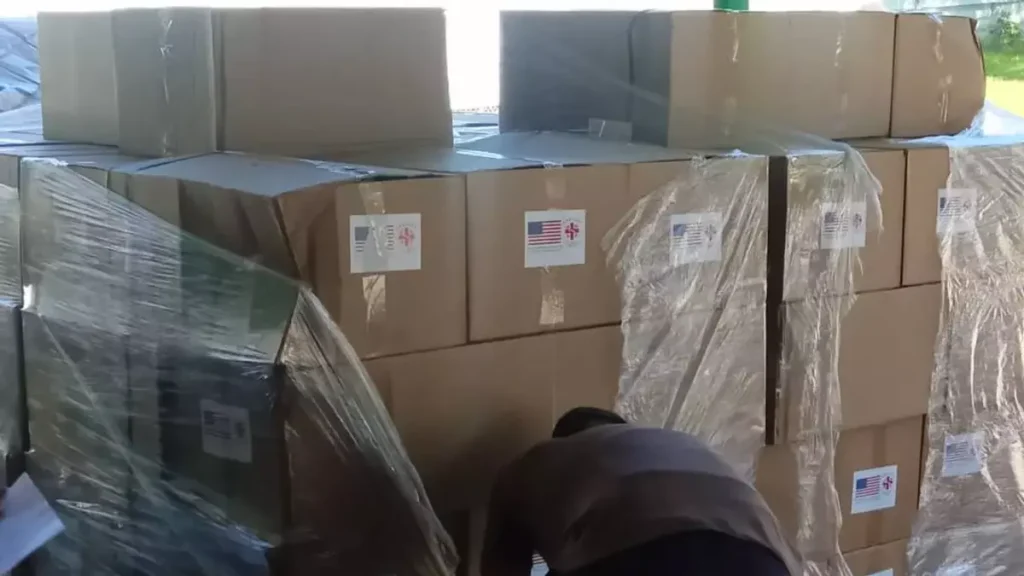
Matanzas Receives Another Shipment of U.S. Humanitarian Aid Through Cáritas Cuba

The package is intended for 700 families out of the 2,100 identified as vulnerable by the organization.

The first shipment intended for the Diocese of Matanzas was received by Bishop Juan Gabriel Díaz Ruiz and the director of Cáritas in that territory, María de los Ángeles Castelo. / Cáritas Cuba

14ymedio biggerEFE/14ymedio, Havana, October 15, 2026 – A donation of humanitarian aid sent by the U.S. Government arrived this Wednesday for distribution in the province of Matanzas, initially, to 700 of the 2,100 selected vulnerable families, the Catholic organization Cáritas Cuba reported.

The first shipment intended for the Diocese of Matanzas was received by Bishop Juan Gabriel Díaz Ruiz and the director of Cáritas in that territory, María de los Ángeles Castelo, upon its arrival at Juan Gualberto Gómez International Airport in Varadero.

Cáritas parish volunteers identified the families most in need and coordinated delivery of the donation in the Nuestra Señora de la Caridad Vicariate, which encompasses communities in the localities of Unión de Reyes, Bolondrón, Güira, Juan Ávila, Alacranes, Puerto Rico, Bermejas, and Cabezas, among others, according to the statement published on social media.

Cáritas parish volunteers identified the families most in need and coordinated delivery of the donation

The beneficiaries were selected according to the donors’ criteria, which focus on food insecurity and difficulties accessing water, the organization said.

It also explained that priority is given to adults over 60, people with disabilities or who are bedridden, chronically ill patients, pregnant or breastfeeding women, and children under five. continue reading

A total of 18,200 households in the Diocese of Matanzas are expected to receive the aid packages, which include a box of essential food products and a box of essential personal hygiene items.

Cáritas has indicated that these donations are part of the $60 million that the Cuban Catholic Church is channeling through the $100 million humanitarian assistance fund approved by the U.S. Government to support the people of Cuba.

The first shipment, weighing 18 tons, arrived in Havana last July, followed by others destined for parish communities in the central provinces of Villa Clara and Cienfuegos in September.

Since early October, the dioceses of Camagüey and the Gaspar parish in Ciego de Ávila have also received shipments.

In May, the U.S. Department of State announced $100 million in aid in the form of “direct humanitarian assistance to the Cuban people, which would be distributed in coordination with the Catholic Church and other independent and trusted humanitarian organizations.”

The conditions had already been negotiated in the previous aid package sent by the U.S. after Hurricane Melissa struck in October 2025

The conditions had already been negotiated in the previous aid package sent by the U.S. after Hurricane Melissa struck in October 2025. Washington and Havana agreed that the Church would channel and distribute these donations, although the organization itself has cited difficulties caused by the oil blockade and has acknowledged that it had to coordinate with the Government to send shipments by sea to Santiago de Cuba.

The arrival of the donations comes at a time of heightened verbal confrontation between Havana and Washington, amid what is considered the greatest tension in their contentious relations in decades.

In addition, the situation unfolds against the backdrop of the profound economic crisis the Island has endured for six years, aggravated by the pandemic, failed domestic policies, and U.S. sanctions, which have caused shortages of food, fuel, and medicine, rampant inflation, prolonged power outages, and growing dollarization.

Added to this, since January, has been Washington’s policy of “maximum pressure,” implemented through an oil blockade and secondary measures targeting vital sectors beginning in May, which have intensified the economic and energy crisis on the Island.

Translated by Regina Anavy

______________________

COLLABORATE WITH OUR WORK: The 14ymedio team is committed to practicing serious journalism that reflects Cuba’s reality in all its depth. Thank you for joining us on this long journey. We invite you to continue supporting us by becoming a member of 14ymedio now. Together we can continue transforming journalism in Cuba.
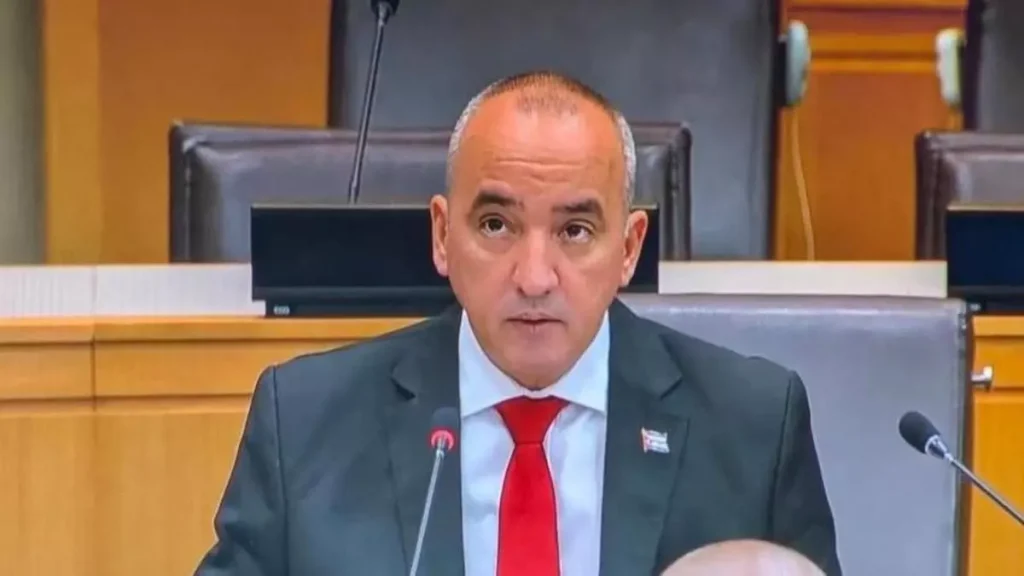
South Africa Orders Suspension of Controversial Agreement with Cuba for the Maintenance of Its Military Equipment

The official end date is still unknown, as courses that have already begun will be completed, said a senior military officer

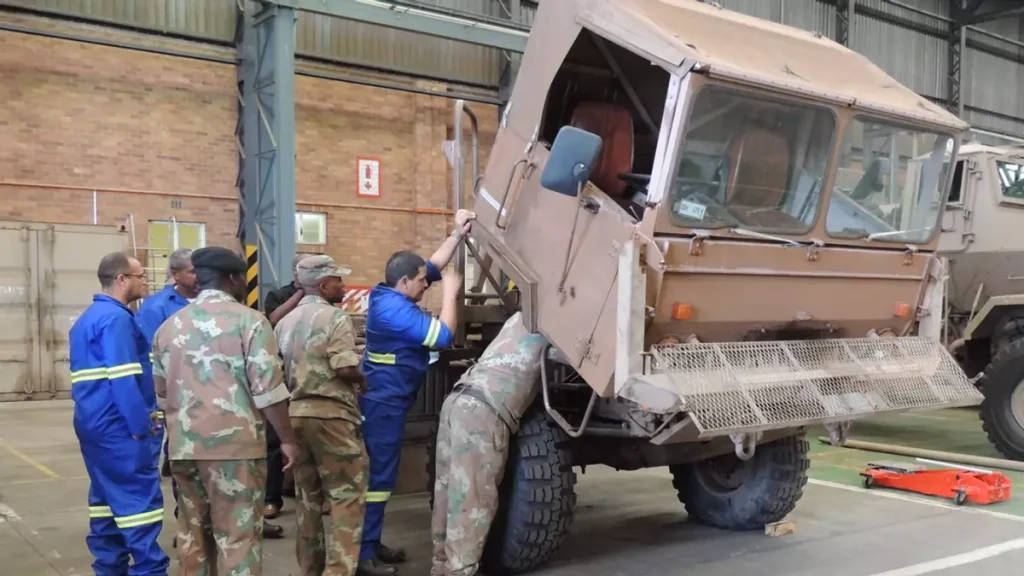
South African military personnel alongside Cuban engineers and technicians from Project Kgala. / defenceweb.co.za

14ymedio bigger14ymedio, Madrid, 15 October 2026 / The South African Army will finally halt Project Kgala, a controversial military cooperation program with Cuba that began in January 2025 and on which some 279 million rand, equivalent to 16.9 million US dollars, has already been spent irregularly. The agreement had been hanging by a thread since South Africa’s Auditor General declared it invalid four months ago.

The news was announced by the local press this Thursday, which quotes a high-ranking officer in the South African National Defence Force (SANDF), Navy Lieutenant James Matshimane. This officer, the Army’s new head of military policy, strategy and planning, told Parliament that “an instruction has already been issued” to stop the Project, in which, in his own words, 119 Cubans have taken part.

With such a fleeting statement, Matshimane left questions unanswered, such as the date for the definitive end of the cooperation, who the order came from, or whether payments to the island will continue while the courses already underway, which “will be allowed to conclude,” are completed.

Project Kgala, which replaced Project Thusano almost two years ago, brings Cuban engineers and technicians to South Africa to help the SANDF with the maintenance and repair of military vehicles, as well as air and naval transport equipment. continue reading

The agreement had been hanging by a thread since South Africa’s Auditor General declared it invalid four months ago

The report produced by the Auditor General’s office last May documented in detail what both agreements have involved. In the 2024-2025 period alone, more than 1.5 million dollars was spent on the Cuban technicians’ upkeep, accommodation, travel and operating costs. The Army documented that during the Thusano years (2021-2024), 18,498 “job cards” – official documents certifying that a task has been carried out – were issued, including more than 10,210 interventions on Army vehicles, 1,067 on aircraft and Air Force (SAAF) vehicles, 107 in the Navy and 4,505 operational and medical interventions in the Military Health Service (SAMHS).

In the little less than a year that it had been in force when the audit was carried out, Kgala had completed 2,502 work orders, with 1,198 component repairs for the Army, 418 on vehicles and aircraft, 196 interventions in the Navy and 659 medical tasks for SAMHS. Although the report considered the volume of work credited to be considerable, that did not justify how the agreement had been reached.

According to the Office of the Chief State Law Adviser, the pact with Cuba bypassed the country’s public procurement rules, which require a tender or, failing that, a special permit (an exemption request) from the Treasury. However, the Department of Defence signed directly with the Cuban side under a memorandum between the two countries. In addition, the program had spent almost a million dollars at the time it was examined, which, lacking a permit, was irregular expenditure. Moreover, as the total value of the agreement was 11 million dollars, that entire amount – not yet delivered – was likewise considered “irregular.”

The military leadership defended the viability of the agreement at the time. Vice Admiral David Mkhonto, the SANDF’s Chief of Logistics, explained to the committee that the cooperation arose from a bilateral government-to-government Memorandum of Understanding (MOU) and that, although it should have been processed by requesting the exemption, it was the right choice.

“The studies revealed excessive costs, prolonged response times and capacity limitations in the domestic industry. Cuban collaboration represented the most cost-effective, sustainable and operationally viable option for restoring the core mission equipment,” Mkhonto said, adding that the Department is already working on an internal delegation framework and oversight mechanisms to correct the irregularities.

The halt now acknowledged by the Army does not necessarily guarantee that South Africa will do without the Cubans. Having already renamed Thusano in 2025, after it had been in the eye of the storm, it could now adjust – and even rename the agreement once again – in order to keep the personnel.

Having already renamed Thusano in 2025, after it had been in the eye of the storm, it could now adjust – and even rename the agreement once again – in order to keep the personnel

Cooperation between Cuba and South Africa, which dates back to the days of Nelson Mandela and Fidel Castro, has accumulated controversial episodes. Among the best-known cases is the sale of Heberon Alfa R for the coronavirus crisis, purchased by Defence – when, at the start of covid-19, it believed it was a bacteriological weapon – without the required authorization from the Health Department. In that operation alone, the island pocketed almost two million dollars, which could have been 17 if the purchase had been completed.

The collaboration also includes the exchange of doctors or engineers between the two countries, which has led to further questionable spending, as well as more than generous donations, including one of 3 million dollars that was ultimately annulled by the courts of the African country in 2023.

Last September a new controversy broke out, when the military trade union South African National Defence Union demanded an investigation into all the details of the complaint by a group of 38 officers who were training on the island and were allegedly pressured to donate money from their salaries to the Cuban side. The donations were to be recorded on a list, next to each officer’s name, with the suggested amount, which, although voluntary, was expected to come to about 940 dollars for officers and at least 188 dollars for those of lower rank.

This month there has also been a flood of complaints from South African students who are doing or completing their studies on the island, in some cases because of the lack of opportunities their country offers them on their return – since, after paying for their training on the island, it has no money to hire them – and in others because of the poor conditions they face in their daily lives as residents in Cuba.

Translated by GH

______________________

COLLABORATE WITH OUR WORK: The 14ymedio team is committed to practicing serious journalism that reflects Cuba’s reality in all its depth. Thank you for joining us on this long journey. We invite you to continue supporting us by becoming a member of 14ymedio now. Together we can continue transforming journalism in Cuba.
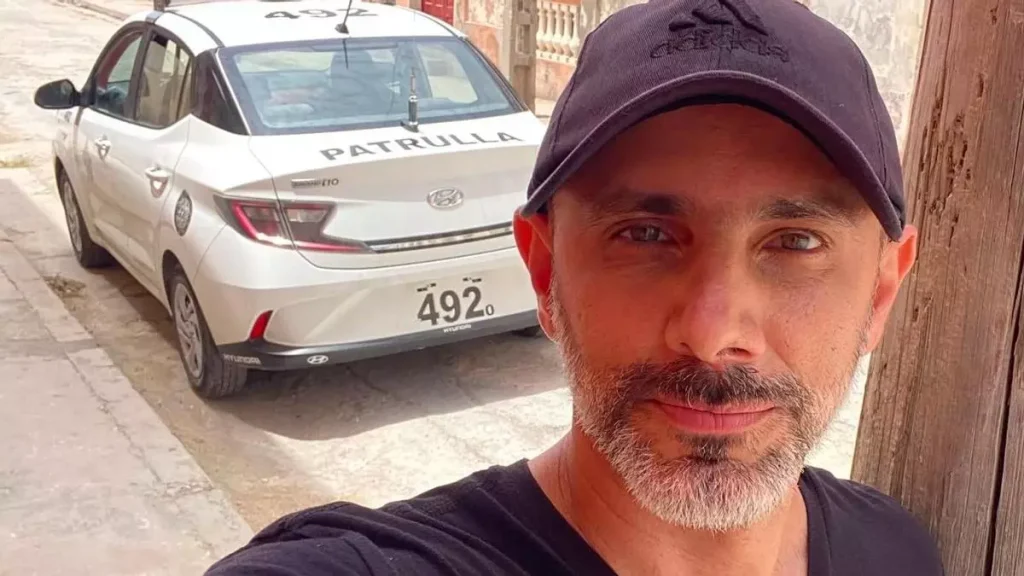
At the Matanzas Pediatric Hospital, There’s Not Even Anyone to Give an Injection

The shortage of nurses leaves children and their families waiting for hours in a hospital hit by the exodus of health workers

La falta de personal sanitario se ha convertido en uno de los agujeros más visibles del sistema de salud cubano. / 14ymedio

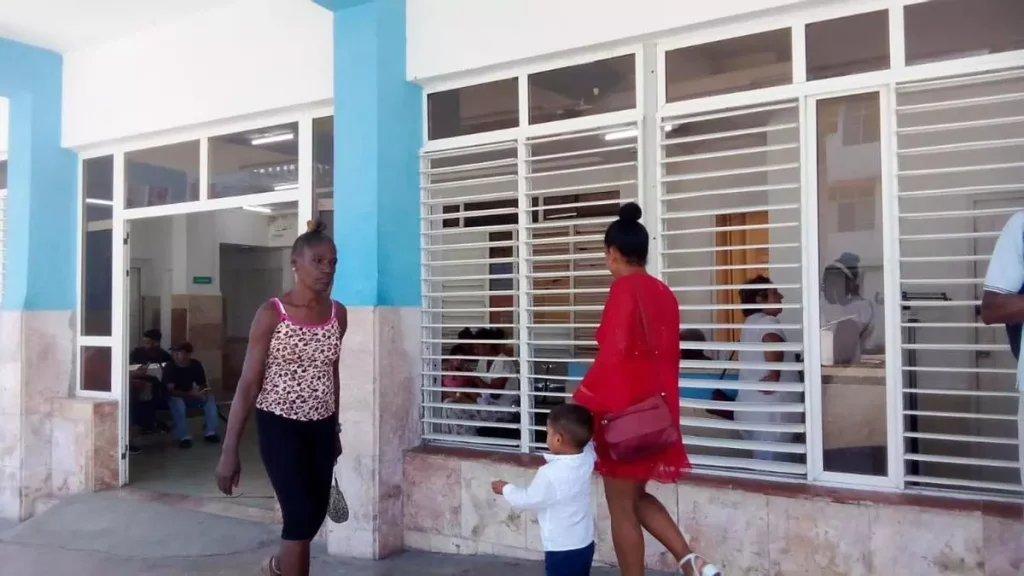
14ymedio bigger14ymedio, Julio César Contreras, Havana, October 15, 2026 / In the emergency room of the Eliseo Noel Caamaño Pediatric Hospital, health workers can hardly be seen moving back and forth anymore. Along the hallway that leads to the inpatient wards, every now and then someone in a white coat comes out of a consulting room, closes the door and hurries off to avoid questions. On the metal benches sit children and their relatives, looking toward the nursing station and waiting for an employee who, they are told, has gone for a snack.

Standing in front of that door, Yanelis has less patience. Her four-year-old son needs an injection to bring down a persistent fever. “First I had to send someone to buy the acetaminophen on the street, because there isn’t any in here. The doctor saw us more than an hour ago and we still haven’t been able to get it done because the nurse has disappeared,” she tells 14ymedio. The young woman threatens to go to the hospital administration.

Her son needs an injection to bring down a persistent fever / 14ymedio

The shortage of health personnel has become one of the most visible holes in the Cuban health system. In December 2024, even a commission of deputies that toured 39 municipalities in the 15 provinces acknowledged that the departure of professionals to other sectors and the migratory stampede had turned the worker deficit into one of the most alarming problems in Public Health. Years earlier, the authorities themselves had admitted that professionals and technicians were leaving for other economic activities, inside and outside the country. The deficit has only grown worse.

At the Matanzas Pediatric Hospital, that statistic takes on real faces. A young mother wipes the sweat from her daughter’s face with a handkerchief. At 8:30 in the morning she asked who was last in line for injections. It is now past ten, and she has seen elderly people selling roasted peanuts and medical students chatting openly about the lack of professors at the University of Medical Sciences pass through the emergency room, but not a single nurse has entered the nursing station. continue reading

“It’s hard to believe that in this hospital there isn’t a nurse to be found to give an injection,” she protests. The syringe and the amoxicillin are still in her bag when the antibiotic should already be taking effect in the girl’s body. What is missing is something that used to be taken for granted: the skilled hand to administer it.

A child bursts into tears and the impatience grows. The receptionist finally looks up from her phone and says someone has already gone to fetch the nurse. Then she offers an explanation that causes more worry than relief: “She’s been working alone for 72 hours and you have to understand that she gets tired, because she’s a human being.” The employee thanks God that no emergency has come in.

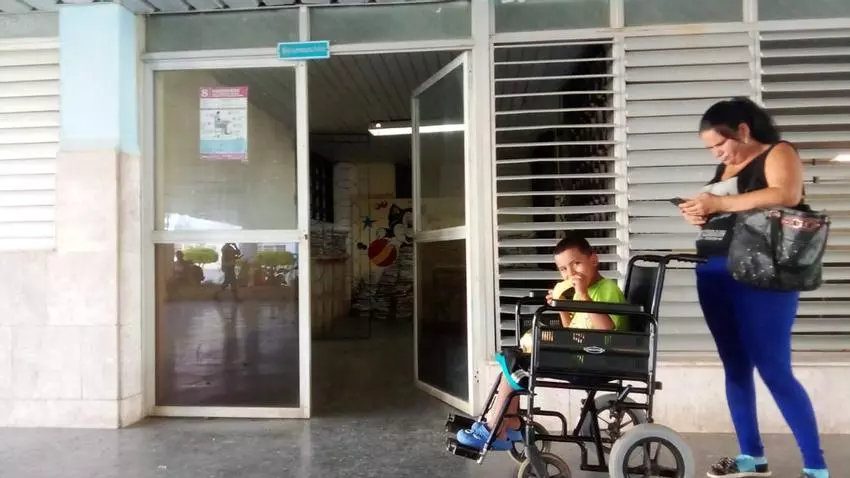
Since the child cannot climb stairs because he is in a wheelchair, she has had to leave him alone while she searches the hospital. / 14ymedio

That remark sums up the problem. It is not just a matter of missing medicines, broken equipment or run-down buildings. In a system that for decades turned its abundance of white coats into a propaganda banner, there is now also a shortage of people who know how to give an injection, take a blood pressure reading or prepare a nebulizer. Last July, several health workers consulted by 14ymedio described a picture of low salaries, a lack of resources and official statistics that, according to their complaints, was driving many to leave the sector.

Another mother walks the second floor of the pediatric hospital looking for help. “I couldn’t find anyone who could see us,” she says. Since her son cannot climb stairs because he is in a wheelchair, she has had to leave him alone while she searches the hospital. She is already thinking of another solution: tracking down a nurse she knows to come to her house. “I’ll surely have to pay him something, but that’s better than spending the week the treatment lasts chasing after these people.”

A man comes in carrying a little girl and asks who is last in line for injections. He has come from the polyclinic assigned to him, where he found a similar situation. He sits down and keeps his eyes fixed on a door, waiting for someone in a white coat to appear.

Translated by GH

______________________

COLLABORATE WITH OUR WORK: The 14ymedio team is committed to practicing serious journalism that reflects Cuba’s reality in all its depth. Thank you for joining us on this long journey. We invite you to continue supporting us by becoming a member of 14ymedio now. Together we can continue transforming journalism in Cuba.