Alquizar, Cuba, Feels Abandoned Since the End of the Year, With No Coffee, Sugar or Oil at the Ration Store

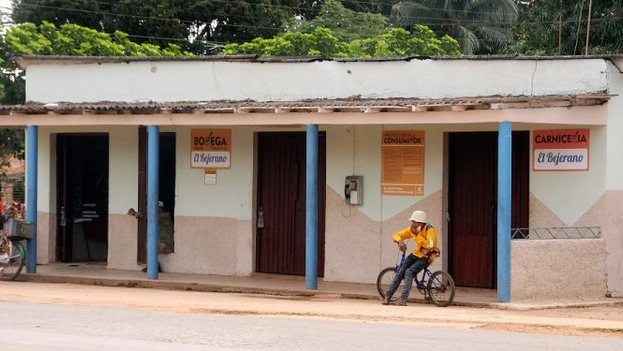
A ‘Bodega’ (Ration Store)  in Alquízar, in the Cuban province of Artemisa. (The Artemisian)

14ymedio bigger

14ymedio, Natalia López Moya, Havana, 1 February 2023 — “Before, here people could use lard to cook, but there is almost no one who raises animals and to make matters worse, since last year they have not sold oil through the bodega [ration store],” complains Liubis Torriente, 32, a resident of the municipality of Alquízar, in the province of Artemisa. “Nor has sugar or rationed coffee arrived, we are about to have to eat red earth.”

In the Liubis bodega, nestled in the center of the small city to the southwest of the Cuban capital, the employee spends her days sitting idly by waiting for the products that do not arrive. “I’m tired of everyone coming and venting their discomfort on me because no merchandise has arrived, but it’s not my fault,” the woman told 14ymedio, on condition of anonymity.

“Here they have forgotten us, we do not have the importance of Havana and nor do we have the emergencies of those affected by hurricane [Ian] in Pinar del Río, so we are in no man’s land, we do not matter,” says Liubis. “My sister lives in Havana, in the Plaza de la Revolución municipality, near the Council of State, and they did sell sugar there,” she says.

The shortage situation fundamentally affects those who live in the urban areas of Alquízar. “At least the farmer who has a piece of land can solve some food with his crops, his laying hens or his cows, but those of us who have a house here in the town don’t even have that,” says this mother of two children at primary school. continue reading

And the three missing products can hardly be produced for self-consumption. “We stocked up on the fat we needed for day-to-day life with the pigs we had, but more than three years ago I stopped farming because we couldn’t get food for the animals anymore,” explains Arturo, a farmer who lives in the town of Pulido, on the outskirts of the urban center.

“Without the pork fat, we are completely dependent on the oil from the bodega or the one we buy off the shelf [in the informal market].” Arturo’s family has been eating “plantain fufú” — fried mashed plaintain — for weeks, he says. “There isn’t even enough fat to fry a little onion and what my wife has done is put the chicken skin in the pan so she can cook with it.”

The vegetable oil that is sold by as a part of the ‘standard basket’ in the ration store is mostly imported or soybean oil, which is refined and bottled on the Island. The rationed coffee and sugar come from national production, which is mostly state-owned, and the marketing of both products constitutes an official monopoly.

“When there is a lack of sugar or coffee, you have to deal one way or another with the black market or with the stores [that only take payment] in MLC [freely convertible currency]”, emphasizes Arturo. “You can use some honey to sweeten, and stretch the coffee by adding roasted peas, but sooner or later you have to end up buying them in hard currency.”

“Before, any house you entered here they would offer you a little cup of Hola coffee, the kind that comes from the bodega. If you were lucky, you would have a Cubita or Arriero colada bought in the mall, but now when people manage to have coffee it’s Bustelo or La Llave that their Miami family sent themor they bought it from a mule, very expensive, by the way.”

The lack of sugar especially outrages the residents of Alquízar, a region that in the past also made cash with typical sweets such as guava bars that were sold on the side of the roads. Now, in the absence of the ingredient, all the private production of sweets, fruit smoothies and preserves has come to a standstill.

According to Leticia Ojeda, commercial director of the Food Group of the Ministry of Internal Commerce, at the end of last year, with the plummeting of the harvest, it was decided to protect the “regulated [rationed] family basket” and social consumption destined for the Education and Health sectors, but the Alquizareñas wineries do not seem to be included among those prioritized.

In mid-January, Ojeda pointed out that four provinces had not been able to finish the distribution in some of their municipalities. He mentioned Artemisa, Matanzas, Pinar del Río and Havana, whose sugar deliveries in February were only 60% guaranteed, up until then. An announcement that makes the residents of Alquízar fear that it will be weeks before the empty bodegas have those products again.

____________

COLLABORATE WITH OUR WORKThe 14ymedio team is committed to practicing serious journalism that reflects Cuba’s reality in all its depth. Thank you for joining us on this long journey. We invite you to continue supporting us by becoming a member of 14ymedio now. Together we can continue transforming journalism in Cuba.

Cuban President Miguel Diaz-Canel, the Man from Moscow at the Celac Summit

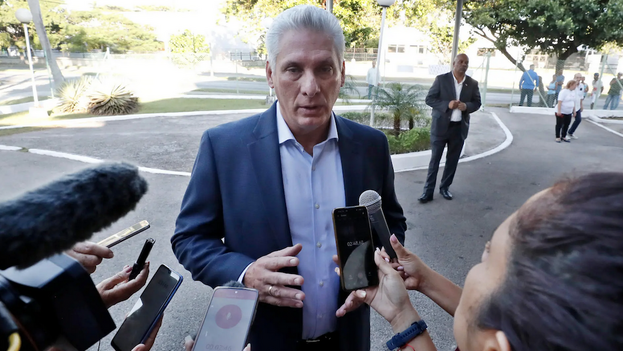
Cuban President Miguel Díaz-Canel, in a file photograph. (EFE/Ernesto Mastrascusa/Pool)

14ymedio bigger14ymedio, Yoani Sánchez, Havana, 23 January 2023 — In recent years, Cuban President Miguel Díaz-Canel has experienced that diplomatic solitude that often surrounds the authoritarians. Except for a recent tour of Russia, Turkey, Algeria and China, in addition to the favors that the Mexican president, Andrés Manuel López Obrador, has given him in public, the 62-year-old engineer has seen how his condition as president not chosen through votes at the polls, and the the repression that he unleashed against the protesters of July 11, 2021 has taken a political toll on him and left him excluded him from red carpets and international events.

His arrival this Monday in Argentina, to attend the summit of the Community of Latin American and Caribbean States (Celac) seeks to bring him out of that loneliness and try to insert him into the Latin American scene. But the Díaz-Canel who arrives in Buenos Aires is a failed president in all respects: with a country experiencing the largest mass exodus in its history, inflation that has plunged millions of Cubans into poverty, and facing a political crisis it only knows how to react to through threats and the imprisonment of its opponents.

Unlike other guests, the Cuban leader has nothing to offer a regional organization that has been in the doldrums for years and in which the citizens of the continent less and less place their hopes. He arrives at the meeting, moreover, after strengthening his alliance with Vladimir Putin’s Russia and accepting the creation of an Economic Transformation Center that, from Moscow, will supervise the Cuban drift towards a “private company” model, marked by vices that have turned the Russia itself into a nation of commercial mafias, complicit oligarchs and businessmen that emerged from the bowels of the old KGB.

Díaz-Canel is the Kremlin’s man at this meeting and will have to be vigilant in case any mention is made at the meeting of the war in Ukraine, a conflict that is decisive for the current continental economic situation. Will the Russian invasion be called a “special military operation” as the official Cuban press does, or will there be talk of an invasion? The man whom Raúl Castro seated in the presidential chair in Havana could influence the event’s final documents to soften criticism of Russia and to obviate, Olympically, the conflict.

It will also correspond to Díaz-Canel to close ranks with Venezuela’s Nicolás Maduro and, presumably, with Nicaragua’s Daniel Ortega, others of the unpresentable autocrats summoned to the summit. But we will have to look closely at the Cuban’s meeting with the Chilean president, Gabriel Boric, who has been very critical of the violation of human rights in Nicaragua and Venezuela, although much more lukewarm when it comes to the island. The handshake with Brazil’s Luiz Inácio Lula da Silva should also be closely watched, because the Brazilian leader does not arrive in the same position that he enjoyed in his previous terms, nor does his closeness to the Cuban regime mean the same as it did a decade ago.

Ruined economically and rejected by a large part of Cubans, Miguel Díaz-Canel knows that after the summit closes and the group photo of the leaders is released, he will have to get on the plane and return to the same country, bankrupt and without hopes, that he saw him go. His calculations, more than towards Buenos Aires, are now focused on Moscow, in which a dangerous and feared bear watches over his back. In exchange, he will continue to be the “comrade of the Kremlin” in Latin America, the man who is willing to cede part of Cuban sovereignty to a distant country rather than allow a democratic opening on the island.

________________________

Editor’s Note: This text was originally published in Deutsche Welle in Spanish.

____________

COLLABORATE WITH OUR WORKThe 14ymedio team is committed to practicing serious journalism that reflects Cuba’s reality in all its depth. Thank you for joining us on this long journey. We invite you to continue supporting us by becoming a member of 14ymedio now. Together we can continue transforming journalism in Cuba.

‘Don’t Quote Me or Publish My Face’, the Fear of Cuban Migrants

Journalism cannot be nourished only by anonymous sources, it needs people to show their faces. (14ymedio)

14ymedio bigger14ymedio, Yoani Sánchez, Mexico City, 5 December 2022 — He has been in Miami for half a year, has two jobs and a suitcase full of fears. “Don’t quote me or publish any photo where you can see my face,” he says emphatically when an independent Cuban media outlet approaches him to take his testimony. He had the courage to cross the Darien jungle, to deal with coyotes and cross the Rio Grande, but when it comes to the Cuban political police, fear does not diminish despite the distance.

It is more and more frequent that a migrant from the Island refuses to appear with their name and surnames in a press report, for fear of being denied entry to their own country, when they decide to travel to visit their family and take the necessary products that will alleviate their critical economic situation. They live in a society where they can express themselves freely, choose what they eat and the newspapers they read, but when it comes to Cuba they continue to be locked behind the bars of totalitarianism.

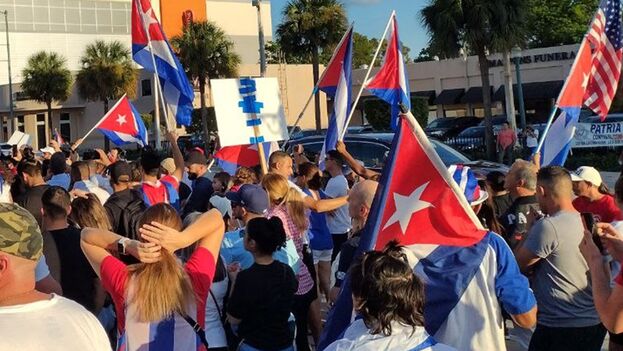
Recently, an article we prepared for this newspaper came across the harsh reality that people who demonstrated in Florida, in the United States, against Castroism, with T-shirts that carried slogans in favor of the freedom of political prisoners and a democratic change on the Island, refused to have their testimonies appear with their names attached. The reason for that refusal is summed up in one sentence: “I am going to return to visit my family and I do not want to have problems.”

Is it their fault that they keep the mask on despite being far from those who pushed them to wear it? No. The fear that spreads among so many Cuban émigrés is nothing more than another example of the long tentacles of totalitarianism and the psychological damage that it causes. They are not cowards, but victims. But understanding them does not fix the problem. How can the vicissitudes of an exiled community be recunted if some of its members prefer to hide their faces and hide their names from a reporter? Journalism cannot be nourished only by anonymous sources, it needs people to show their faces.

The networks are full of anonymous profiles and false photos, but a country cannot be democratically transformed from behind the mask. Dispensing with the mask and vindicating an opinion with an uncovered face seems to be another of the conquests yet to be achieved. The sad thing is that we will not only have to achieve this for those who live on the Island, but also for those who reside in other countries where they should be able to behave as freer beings.

____________

COLLABORATE WITH OUR WORKThe 14ymedio team is committed to practicing serious journalism that reflects Cuba’s reality in all its depth. Thank you for joining us on this long journey. We invite you to continue supporting us by becoming a member of 14ymedio now. Together we can continue transforming journalism in Cuba.

Cuban Civil Society Manifesto

Cuban Civil Society Manifesto

Prominent philosophers of universal history such as Spinoza, Rousseau, and Kant agreed to define Civil Society as a collective body constituted by the individuals of a society, which is positioned outside the limits of the State. The State only makes sense so long as it represents the interests of all its citizens; for this reason, a consensus in Cuban civil society has superior moral force. In any circumstance, it is not civil society that must submit to the State, but the latter to civil society.

Therefore, the undersigned are all well-known for their various Cuban civil society activities at different points in time, past or present, who currently reside inside and outside Cuba, since the Cuban nation extends beyond the Cuban archipelago to any part of the world where there is a Cuban who identifies with the collective aspirations of his compatriots.

The country is facing an alarming situation, which has resulted from governance that is based, on the one hand, on a concentration of business enterprise within the State, a source of inefficiency and corruption of some bureaucratic classes who have dragged down the population for more than six decades to a dire situation.

All the reforms implemented at different times that, as the word indicates, are only changes in form, when what is required is a sustainable economic model that does not depend, in order to survive, on periodic subsidies from external allies.

On the other hand, the systematic coercion of essential rights such as free oral and written expression, as well as artistic creativity, the right to free peaceful association, the right to freedom of movement, in particular the right to be able to leave their own country and return to it, and the right to free economic entrepreneurship of independent citizens, all this exercised by a State whose three main powers, executive, legislative and judicial, are under the absolute control of a partisan elite that no one elected.

We, therefore, declare ourselves in favor of profound and urgent changes that will lead the country out of an unprecedented crisis and avoid a confrontation between Cubans, with tragic consequences.

All convictions and prosecutions of citizens for practicing or defending these and other fundamental rights of human beings must be dismissed, and those who have suffered them, released, in particular all those whose only sin was having publicly expressed their desires and dreams of a better Cuba.

Even those who carried out violent acts only reacted to the brutal repression of which they were victims; therefore, if they deserved to be punished, then, with much more reason, all those pro-government entities that repressed them should have been prosecuted. Public protests are not prevented by applying disproportionate measures of violence and excessive sentences, but rather by taking steps that allow citizens to freely conduct their artistic and productive activities.

Regardless of the pernicious effect that the US embargo may have had on the country’s economy, the excuse of the “imperialist blockade” no longer convinces most citizens who have suffered, in the flesh, the government’s policies which present restrictive barriers to their attempts to satisfy, of their own accord, their pressing needs; these include high taxes, high licensing fees, and extortion by a powerful buyer which forces farmers to sell to it most of their production at a price set by that buyer, and other measures that put the brakes on productive stimuli.

The main blockade, therefore, is not the one imposed by a foreign nation from abroad, but the one imposed, from within, by the governing leadership itself. Lift this and you will see how, in short order, how the resupply of Cuban families will begin.

We must have faith in the Cuban people. When those who are unjustly imprisoned are freed, with the expressed willingness to allow public forums among Cubans–without distinction of race, gender, religion, sexual orientation, and political and philosophical ideas–to reach a national consensus on the future of our country, no one should fear massive protests, because a miraculous light will have been lit in the collective consciousness that has a name: Hope.

August 2022

Translated by Silvia Suárez

Remember Sri Lanka

Takeover of the presidential palace by Sri Lankan protesters. (EFE/EPA/Chamila Karunarathene)

14ymedio bigger14ymedio, Yoani Sánchez, Generation Y, Havana, 15 July 2022 – “What we need here is Sri Lanka,” “Remember Sri Lanka,” and “We’ll see you at the pool… like in Sri Lanka,” are some of the phrases Cubans are using right now to greet their friends. The mention of the Asian nation is not accidental: after several weeks of protests, thousands of people entered the luxurious residence of President Gotabaya Rajapaksa and forced him to flee the country.

For months, the protesters denounced the mismanagement by the Sri Lankan Executive of the economic crisis, long power cuts and inflation, three evils that also fuel outrage on this island. It is enough to read the reports of foreign press agencies accredited in Colombo, Sri Lanka’s major city, to easily find the coincidences between the discomfort of its residents and the weariness that is heard in every Cuban corner.

In our case, the allusions to Sri Lanka are also a form of social self-criticism, recognizing that in the face of inefficiency and crisis there are people who choose to pack their bags and remain silent, while others go to the house of those responsible for so much disaster and force them to resign. Nor is it the first time that we Cubans have made use of the parallels offered by other geographies to denounce our situation and, incidentally, evade censorship.

A few years ago, the monologue The Problems in Cyprus, performed by the humorist Nelson Gudín, alias El Bacán de la Vida, became a sharp metaphor for our Island. Taking the headlines of the official press, given to reporting political problems and economic in other latitudes while silencing the national ones, the artist used that point in the eastern Mediterranean as a synonym for “Cuba.” continue reading

After his excellent performance, which was requested wherever he appeared, it was enough to say “how bad things are in Cyprus” for all of us to understand that he was talking about our own reality. Until today, in the popular speech of this Island there have been several phrases that allude to the Cypriot situation and that feed the surprise of some foreign students who come to practice Spanish in our country and do not understand the reason for this closeness with Nicosia.

Sri Lanka has now been assumed as a dream mirror, as a symbol of the power of a people when united and also as a verbal joke to warn the olive-green hierarchs that no palace full of comforts is safe when the citizen’s anger is overflows. Nor is the water of the presidential pool enough to quench the annoyance accumulated for decades, nor can the stately beds, with their soft pillows, calm a massive protest.

“See you in Sri Lanka,” a neighbor yelled at me yesterday from across the street. “We are all Sri Lankans,” I replied, while some children who passed by on bicycles also repeated the name of a country that a few weeks ago was barely mentioned in Cuba.

____________

COLLABORATE WITH OUR WORK: The 14ymedio team is committed to practicing serious journalism that reflects Cuba’s reality in all its depth. Thank you for joining us on this long journey. We invite you to continue supporting us by becoming a member of 14ymedio now. Together we can continue transforming journalism in Cuba.

Cubans Adrian Lopez Gonzalez, Geandy Pavon, Waldo Perez Cino and David Virelles Win the Cintas Scholarship

The Grupo Matiz de restauradores, whose founder, Adrián López González (on the right), has won one of the Cintas 2021 scholarships. (Screen capture)

14ymedio bigger14ymedio, Luz Escobar, Havana, 15 December 221 — For the first time, the Cintas Foundation has recognized with its annual scholarship, endowed with $20,000, a Cuban resident on the Island, Adrián López González. Founder and leader of the Grupo Matiz de restauradores (Matiz Restoration Group0 in Matanzas, he was the recipient of the award in the architecture and design category.

Matiz was created in 2014 and among the restoration and conservation works that it has undertaken, most notable are those of the Sauto Theater and of the San Carlos de Borromeo Cathedral, in Matanzas. For this group, the award “is the impulse to a work sustained in a city that dreams its best face, our Matanzas.”

“The story behind the Heritage is our foundation and the Cintas scholarship has been the luck to know that we are doing well,” they wrote on their networks after hearing the news.

In addition to López González, the writer Waldo Pérez Cino, the musician David Virelles and the artist Geandy Pavón have received past Cintas scholarships, which is awarded to artists of Cuban origin in different artistic fields.

Pavón, who lives in New Jersey, says that this award has a “very special” meaning for him. “I believe that Cintas is the only award to Cuban artists that is offered in total and absolute freedom,” he told 14ymedio. “In Cuba there are other awards,” he continued, “but all are always subject to ‘good behavior’.” continue reading

The artist is also thankful that the award, “opens up immense opportunities” and exposes both him and his work to “other people, other institutions and specialists in the field of culture and art.”

“It makes me think that what has been done has not been so bad and it is an immense stimulus, apart from being an important economic stimulus to continue doing my work,” said Pavón, who, during the covid pandemic, launched on his social networks an ingenious photographic series entitled Quarantine: 40 days and 40 nights, in which he recreated, together with his partner, Imara López, scenes from classics in art history.

For the writer Waldo Pérez Cino, the scholarship is “a great joy and a great honor.” The latter, he points out to this newspaper, taking into account that “in recent decades the Cintas Foundation has recognized the work of authors such as Cabrera Infante, Reinaldo Arenas, Benítez Rojo and García Vega, along with contemporary authors such as Magali Alabau, Octavio Armand and Carlos A. Aguilera, speaking only about the field of writing.”

“As far as I know, there is no other institution that has been supportive in this way, and with that continuity, of the development of proposals by Cuban artists or authors,” says Pérez Cino, who lives in the Netherlands. In his case, he says, it will serve to support a novel which he has been working on for a long time, “one of those projects that extend more than one would sometimes like and that, precisely because of their breadth, are sometimes overlooked for others more immediate or urgent.”

Among the finalists of Cintas are the artist Luis Manuel Otero Alcántara, who competed in the visual arts category, and who has been in prison since the protests on July 11.

Art curator Claudia Genlui thanked, on behalf of Otero Alcántara, “all the people who made possible his presence in the nomination for the Cintas scholarship… Luis Manuel Otero Alcantara and the political prisoners in Cuba will not be forgotten. We continue working for a Cuba where we can create and work in freedom. Enough censorship for Cuban art and artists that are consistent with our reality,” she stated.

The Cintas Foundation was created with funds from the patrimony of Óscar B. Cintas (1887-1957), Cuban ambassador to the United States and patron of the arts, and has been awarded since 1963. The finalists of the contest are chosen by a jury of experts who enjoy international recognition.

In the last 50 years, this contest has honored the achievements of great Cuban artists in different categories such as Félix González-Torres, Teresita Fernández, Carmen Herrera, María Martínez-Cañas, Oscar Hijuelos, Andrés Duany, María Elena Fornes and Tania León. After receiving the award, the scholarship recipients become part of the Cintas Collection by donating one of their works to the Foundation.

____________

COLLABORATE WITH OUR WORK: The 14ymedio team is committed to practicing serious journalism that reflects Cuba’s reality in all its depth. Thank you for joining us on this long journey. We invite you to continue supporting us by becoming a member of 14ymedio now. Together we can continue transforming journalism in Cuba.

Among the Curious and ‘Restless Boys’ a Norwegian Sailboat Arrives in Havana

Arrival of the Norwegian sailboat Statsraad Lehmkuhl in Havana. (14ymedio)

14ymedio bigger14ymedio, Juan Diego Rodríguez, Havana, 24 November 2021 — With the sails up and her crew singing, the Norwegian sailboat Statsraad Lehmkuhl docked in Havana on Wednesday. “Are you bringing pork?” A Havanan was heard to say, watching the arrival of the boat from the Malecón. “Pork and hotdogs is what it takes,” he insisted.

The three-masted ship, built in 1914, arrived on the island as part of the One Ocean initiative and will remain anchored for five days at the Sierra Maestra Cruise Terminal. Representatives of Central State Administration entities and diplomats from Norway will make official on the vessel the project called NORAD for the production of marine fingerlings.

“The Malecón is full of restless boys,” mused a young man, alluding to political police officers in plainclothes. “Everybody stares at you when they see you with your cell phone in your hand,” he added. “The same old thing: here, there is more State Security than anything else, looking at you as the face of a serial killer.”

Indeed, the event, despite its eye-catching appearance, did not attract many ordinary Cubans.

This sailboat arrived nine days after Cuba reopened its borders. Its crew will speak this Friday in a seminar on sustainability and the environment of the oceans to be held at Cuba’s Hotel Nacional. continue reading

The crew of the Statsraad Lehmkuhl came singing to Havana. (14ymedio)

Large cruises are still expected on the island this season, another of the Government’s hopes to reactivate the tourism sector, currently plunged into a deep crisis. In the first half of 2021, only 141,316 visitors were received, one-seventh as many as in the same period of the previous year, which was already very bad (986,673).

On October 18, the Prensa Latina agency published that the Fidelis sailboat, with the British flag and registered in Grand Cayman, was the first boat to arrive in Havana. The “pleasure” boat, with eight crew members on board, came from the Varadero resort.

Before the covid-19 pandemic, the Spanish Navy training ship Juan Sebastián de Elcano re-staged its first trip to Havana to commemorate the city’s fifth centenary. Ninety years after its first visit, the boat was greeted with 21 salvoes from the old San Carlos de la Cabaña fortress.

From the entrance to the bay, the songs of the crew of the Norwegian sailboat began, and they greeted the few onlookers who were watching them: “buenos días” and with laughter at the responses of the people from Havana they heard: “How are you?” The spirit remained in the boat, waiting for an order to descend.

____________

COLLABORATE WITH OUR WORK: The 14ymedio team is committed to practicing serious journalism that reflects Cuba’s reality in all its depth. Thank you for joining us on this long journey. We invite you to continue supporting us by becoming a member of 14ymedio now. Together we can continue transforming journalism in Cuba.

Havana Cuba, The City and Its Urban Context – 2003 Report / Mario Coyula

This report was prepared by Mario Coyula and Jill Hamburg in 2003 for a project titled: UNDERSTANDING SLUMS: Case Studies for the Global Report on Human Settlements 2003.

It is posted here as an invaluable resource not only for all of its contents, but also a guide to the terminology of urban development in Cuba.

It includes many fully explained terms which often appear in posts on Translating Cuba.

Following is the glossary from the end of the article:

Albergados: Literally “sheltered”. Current or former residents of housing so deteriorated that they registered on special list for replacement housing.

Albergues: Transitional homeless shelters.

Almendrones: Privately owned 1950s American cars that provide group taxi service along fixed routes with a standard fare.

Barbacoa: Makeshift mezzanines or loft-like structures that create an extra floor. [The literal translation is ‘barbecue’.]

continue reading

Barrio de indigentes: Literally “neighbourhood of indigents”. Term for shantytown before the 1959 revolution.

Barrio insalubre: Literally “unhealthy neighbourhood”. Term for shantytown after the 1959 revolution.

Bicitaxis: Bicycle taxis carrying up to two passengers.

Bohío: Thatched-roof shacks that were once common in rural areas.

Calzadas: Wide streets with tall porticoed pedestrian corridors.

Camellos: “Camel”, double-humped buses composed of a truck cab and chassis and bus bodies carrying up to 220 passengers.

Casas quintas: Detached neo-classical villas.

Casa de vecindad: Type of tenement: Smaller subdivided house, generally with 12 rooms or less.

Casetas en azoteas: Makeshift structures built on top of multifamily buildings.

Ciudadela: Type of tenement: consists of a single or double row of rooms built along a long, narrow courtyard.

Comités de Defensa de la Revolución (CDR): Committees for the Defence of the Revolution.

Comunidad de tránsito: Transitional homeless shelter.

Cocotaxis: A taxi-scooter with a bright yellow round plastic body carrying up to two passengers.

Cuartería: Type of tenement: large mansion or older hotel or boarding house subdivided into rooms.

INV: National Housing Institute (begun in 1985).

Pasaje: Double row of small dwellings (similar to efficiencies) consisting of living-dining, kitchenette, one bedroom, bathroom and a small service courtyard, set along a long, narrow alley usually open to streets at both ends.

Plan con las Masas: Plan with the Masses (1960s maintenance and repair programme) involving residents, with State supplying technical assistance, equipment and low-priced building materials.

Programa de Desarrollo Human Local, PDHL: Local Human Development Programme of UNDP (United National Development Programme).

Poder Popular: People’s Power, name of Cuban government structure.

Solar: Popular term to refer to all forms of buildings subdivided into single-room units, usually with shared services.

Talleres de Transformación Integral del Barrio, TTIB: Neighbourhood Transformation Workshops.

Tugurio: Slum.

Unión de Jóvenes Comunistas, UJC: Union of Young Communists.

Usufructo: Usufruct (long-term leaseholding).

Vivienda adecuada: “Adequate” (standard) housing for change of legal status of tenements or shantytown units.

Vivienda de bajo consumo, vivienda económica: “Low consumption” housing that minimises the use of imported energy-intensive materials


Message from Yunior García Aguilera of the Archipiélago Collective

From the blog of César Reynel Aguilera, Montreal, 15 October 2021

Guest post from Yunior García Aguilera

In the year 2022, the country of our birth will mark 70 years without democracy. My parents have never been able to freely choose their ideology, their party, or their president. They have had to resign themselves to the decisions of others and have had to ratify those decisions to avoid trouble. In Cuba, unfortunately, to keep quiet about what we really think is seen by many as a sign of intelligence. They always ask us to wait for the right “time” and “place” — which never really come.

Almost my whole generation grew up hearing the phrase, “For your sake, speak softly.” Most of my friends have already left the country and others dream of doing so soon. I don’t want my phone to be recharged or a pair of shoes to be sent to me.* I want Cuba to be the nation to which everyone can return whenever they want — regardless of how they think — and from which no one, any more, will want to leave.

The Revolution promised rights, justice, freedom and free elections, but instead we turned into a Soviet appendage. It promised to be green as the palms, but instead wrapped itself in a red cloak with a hammer and sickle patrolling the Lone Star.** One sole ideology, censorship, and political persecution have been the daily bread of any Cuban who does not submit to the control of the bosses. And the end of the Cold War only increased our misery. We are survivors of an unfinished war, in which we were neither the victors nor the defeated, only hostages of an obsolete dogma, of a clan of officials clinging to power and its privileges, of a whim propped up with Russian-made rifles.

It is true that there were some achievements and wins — it’s not all gloom and doom. But what good are benefits if they will be used to blackmail me later? What is the value of my education if I am later forbidden to think with my own mind? Many slaves also learned to read. And they did not pay with money for their little corner of the barracks or their lunch, they paid with obedience and the sweat of their backs. If any of them happened to demand a change of regime, the whip, the stocks and the shackle would certainly await them. continue reading

I have already repaid the cost of my studies. Of this you can be sure. I went to all the schools in the countryside, I cut sugarcane, harvested potatoes in Artemisa and coffee in Pinares de Mayarí. I completed two years of social service, receiving the illusion of a salary. I owe a lot to my teachers, but as for the State, I have already paid my debts — stop dredging it up. Also, do not continue to use my work with cultural institutions as blackmail. To work is a right, not a privilege. And I have given as much as or more than what I have received.

I write these words while besieged by a cowardly campaign of lies against me and against the organizers of the march. The baseness is such that they have cut off our Internet services so that we cannot even defend ourselves within our networks. But I am not going to play the victim. Cuban ingenuity also knows how to circumvent these internal blockades. My only concern was for my parents. I know how much this hurts them, I know how much they fear for me. But I also know that they know their son. They have both overcome their fear and called just to tell me to be strong, and to say that they are proud of me.

It is obvious that nobody pays us [the protest organizers] a penny. No one would be such an idiot as to face all this (and the fury to come) for money. We do it out of conviction, and that has a desperate power. Nor does anyone, from anywhere,  give us orders. There are marvelous minds in this country and we are already learning to debate and find consensus, without need for false shows of unity or “maximum leaders”***. What they call “alliances” is nothing more than honest dialogue involving all Cubans, without discriminating against anyone. No regime will ever again tell us which Cuban we can or cannot talk with. We are not going to reproduce their scheme of prejudice, stigma and demonization.

I am infinitely grateful for the enormous solidarity we have received. If there were justice and we had 15 minutes on national television, the entire lie that the power structure has fabricated would collapse instantly. I respectfully ask for a stop to the lynching perpetrated against any Cuban who honestly defends his principles, regardless of political color. When we say “with everyone and for the good of all,”**** we mean it.

On November 15 we will march without hatred. We are assuming a right that has never been respected in 62 years of dictatorship, but we are going to assume it with civility. Everyone will be looking towards Cuba that day. We know that the power structure plays dirty, that it gives combat orders against its own people, that it lies to our faces, that it would even be capable of infiltrating its paramilitaries into the march to generate violence and later blame it on us. Each citizen must be responsible for their conduct and defend the peaceful and firm attitude that we have called for.

November 15 can and should be a beautiful day. Wherever a Cuban lives, we know that his heart will be in Cuba. May the powerful not insist on behaving in a cowardly fashion against their own citizens. Do not repeat the crime of July 11. May officers and soldiers understand that there is no honor in obeying immoral orders. I also hope that no foreign power interferes in an issue that we ourselves must resolve with true sovereignty, that of citizens.

Let us commit to courage, dignity and frankness. It is past time to say what we think out loud.

I send you a hug.

Yunior García Aguilera

Translated By: Alicia Barraqué Ellison

Translator’s Notes:
*Refers to types of material help  commonly provided to Cuban nationals by relatives abroad.
**By tradition, Cubans refer to their country’s flag as “The Lone Star” (“La Estrella Solitaria”)
***Here, the writer alludes to a popular epithet for Fidel Castro, “el máximo líder.”
****An allusion to the title of a tract written by José Martí. The phrase has been deployed as a rallying cry by the Castro regime throughout its tenure.

Attention, This Will be on the Test!

Application for cell phones with “the compendium” emanating from the Eighth Congress of the PCC. (14ymedio)

14ymedio bigger14ymedio, Reinaldo Escobar, Havana, 26 June 2021 — One of the most common practices in the Cuban education system, to guarantee that students pass the grade, occurs a few days before the exams. The teacher writes on the blackboard, or dictates for the students to write in their notebooks, the most important points of their subject. With his eyes open wide, he warns his students: “Pay attention, this is going to be on the test!”

The chemical formulas, mathematical equations, historical facts, literary works, the dark corners of geography that were not lucky enough to appear in that summary, will be condemned to oblivion.

The enthronement of this “pedagogical resource” seems to have extended to the ideological work environment of the Communist Party of Cuba (PCC). The simplification of the summaries makes the task easier for those who only pretend to be aware of what they need to answer to meet approval. continue reading

In the most recent meeting of the Political Bureau of the PCC, Rogelio Polanco, a member of the secretariat and head of its ideological department, released “a document that summarizes the ideas, concepts and guidelines extracted from the Central Report to the Eighth Congress, the closing speech and the documents approved in their work committees.” The compilation is available through an application on the Apliks official portal.

More than 40 days after the end of the communists’ great event, the Guidelines of the Economic and Social Policy of the Party and the Revolution and the Conceptualization of the Cuban Economic and Social Model of Socialist Development, which were supposedly updated in the Congress, still have not been published. Instead, they present a document that “summarizes” what was said in a couple of speeches and the resolutions issued by the working commissions.

The new text was revealed to 2,600 executives throughout the country on May 22 and will be subject to debate, first before the membership and later before the rest of the population. As explained by the first secretary, Miguel Díaz-Canel, this will help each one to interpret what is continuity and what is unity, and how both principles are defended. “If we don’t do it like that, we wouldn’t understand the Eighth Congress,” he concluded.

The presumption that a summary of what happened in the event is necessary to understand what it consisted of, reflects the little confidence that party leaders have in the ability to read their own membership and the people in general, or the little interest of the leadership in which the details that may arouse doubts or suspicions are known.

Is there any reason not to “declassify,” in its final version, the text so often proclaimed as “the theoretical, conceptual and action guide for the construction of socialism in Cuba”? The reading of the resolution on this subject is reduced to a few obvious points, such as that “Cuban society is in the historical period of construction of socialism, which the Communist Party of Cuba – unique, Marti, Fidelista, Marxist and Leninist – reaffirms its leading role,” and others of similar theoretical value.

The same question can be formulated in relation to the updating of the Guidelines for the 2021-2026 period, which were initially prepared at the Sixth Congress and modified at the Seventh.

The resolution on the guidelines informs us that the current version consists of 201 points and that so far 30% have been implemented, 40% are in implementation and the remaining 30% are in the proposal and approval stage. None are quoted verbatim and there is only access to general comments related to the importance of the socialist state enterprise, the need to produce more food and replace imports, in addition to continuing to prioritize the development of science and not neglect social justice.

Could it be that there was no consensus and the update of both documents was not even completed? Or are the people “not politically prepared” to understand certain concepts?

In his speech during the meeting, Miguel Díaz-Canel summarized the catechism in two words: unity and continuity. And in a space-time philosophical acrobatics, he declared: “Generational continuity is a fundamental part of unity.”

In oblivion will remain, as too abstract, the laws of socialist economy, historical materialism, the precepts of scientific communism and even those uncomfortable definitions of property that they do not know how to write in programmatic documents.

What it is going to prove is that: “Everyone, pay attention to the oldest ones,” even if it seems conservative or reactionary.

____________

COLLABORATE WITH OUR WORK: The 14ymedio team is committed to practicing serious journalism that reflects Cuba’s reality in all its depth. Thank you for joining us on this long journey. We invite you to continue supporting us by becoming a member of 14ymedio now. Together we can continue transforming journalism in Cuba.

The Macabre Performance of Cuban State Security

His captors say that he is in good health but they do not yet explain why they have him hospitalized. (Facebook / Otero Alcántara)

14ymedio bigger14ymedio, Luz Escobar, Havana, 22 May 2021 — Since Luis Manuel Otero Alcántara fell into the hands of State Security 20 days ago, the narrative of every second of his existence has been under the power of the Government. Luisma, as his friends call him, likes to turn on his cell phone and go live every time he wants to tell something, he does it without first writing the words that he is going to say, without measuring his gestures, full of life.

Luisma’s gestures are great, when he speaks, when he raises an arm, when he laughs, when he dances or kisses, when he hugs his friends. He is spontaneous, his eyes have body, his gaze is intense.

Since he was forcibly removed from his house on May 2nd, we have not seen that spontaneity again. The only thing that the powers-that-be that have him kidnapped at Calixto García Hospital has done is to show it through edited images, first on national television, then on Facebook pages that are instruments of State Security. continue reading

According to this version, he has been seen walking into the hospital on his own, guarded by several doctors, talking to his doctor, and walking through a courtyard at Calixto Garcia Hospital. During all this time, he has not had access to his cell phone or to a hospital phone to call his relatives. He has been kidnapped, his friends and colleagues inform us.

In the last video, released last Wednesday night, the artist looked much more physically damaged than in the previous ones. He looked thin, very thin, his hands between his thighs, his laughter was nervous, and a tray full of food on his lap, although he could not be seen eating anything. This was part of a macabre scene that State Security insists on showing before our eyes.

In the last video that was released last Wednesday night, the artist looked much more physically deteriorated than in the previous ones

Those of us who know Luisma know of his overwhelming strength and what we have seen here, although he resembles himself at times, is far from the friend, the creator who is Luis Manuel Otero Alcántara. What are they doing with him? What do they want to accomplish with those videos? What treatment is he receiving that he isn’t already out of the hospital?

His captors say that he is in good health but they do not yet explain why they have him hospitalized. They say that they are complying with what’s established, but they display him without shame, even giving details of his medical files in the official media and lying.

They already tried to take Luis Manuel to jail under the accusation of having committed alleged crimes of outrage to national symbols and damage to property but they could not prove it. They released him after 13 days. On that occasion, the authorities pointed out his disrespect for the flag for his Drapeau performance, in which he proposed to carry, like a second skin, the Cuban flag over his shoulders for a whole month, 24 hours a day. He did not soil the flag, he did not throw it to the ground, he did not “outrage” the national symbol as the authorities claim in their smear campaigns.

At 33 years of age, the artist is the most visible face of the San Isidro Movement (MSI). For this reason, the government’s propaganda apparatus has not stopped campaigning to discredit his image, accusing him of leading a “political manipulation” and of receiving instructions and financial support from abroad.

But the government’s boundary on Alcántara has been tightened even more since last November. The problem is no longer whether he uses national symbols or public space for his performances, now they go into his house, tear off the works that the artist has on the walls and take him away by force. In this violent way it was how they prevented him from continuing with the performance that consisted of being in his living room for eight hours and five days, sitting on a vile garrote, which was also taken from him by the authorities.

This time he was not harassed for making unconventional works of art in public spaces, outside the conventional frameworks of art, such as his actions questioning the removal of a bust of the communist leader Julio Antonio Mella from the ground floor of the luxurious Manzana Kempinski Hotel. This time he has been punished with never-before-seen brutality for doing what is supposed to be art within established limits.

This time he has been punished with never-before-seen brutality for doing what is supposed to be art within established limits

After that arrest, when Alcántara returned home he did nothing but go out every day to demand that the surveillance fence surrounding his home be lifted since November 2020 be lifted, that the confiscated works of art be returned to him or that he be compensated for the damages and that the authorities respect the full exercise of artistic freedom for all creators.

The government not only ignored his demands but also ordered him to be detained every time he went out on the street, until he received death threats from another prisoner in the dungeon. That was why he did not come out anymore to continue demanding his rights.

Alone in his home, completely incommunicado and surrounded by State Security, it was then that the hunger and thirst strike began on April 25th until dawn on May 2nd, when he was taken to Calixto García Hospital against his will.

That is how we got to this point, 20 days in which the only news that has been had from Alcántara is filtered through State Security, a macabre filter that, far from alleviating fears, returns an image that is so disturbing it seems designed solely to instill terror and panic.

Translated by Norma Whiting

____________

COLLABORATE WITH OUR WORK: The 14ymedio team is committed to practicing serious journalism that reflects Cuba’s reality in all its depth. Thank you for joining us on this long journey. We invite you to continue supporting us by becoming a member of 14ymedio now. Together we can continue transforming journalism in Cuba.

Padilla’s Shadow: Commemorative Act in Honor of the 50th Anniversary of the Cuban Poet’s Confession

PRESS RELEASE                                               4.21.2021

PADILLA’S SHADOW

Commemorative Act in Honor of the 50th Anniversary of the Poet’s Confession

A virtual performance that will be streamed on the internet and social media (Available now)

(In Spanish with English subtitles)

On April 27, 2021, a choral reading of Cuban poet Heberto Padilla’s legendary confession will be streamed via social media throughout the day and night. Twenty Cuban intellectuals from the island and the diaspora have participated in the project, which is directed by Cuban American artist Coco Fusco. To avoid any attempt by Cuban authorities to block participation from island residents, all readings have been pre-recorded and transmitted via encrypted messaging.

Five institutions in the United States and Europe will be presenting Padilla’s Shadow via their web portals: The Showroom in London, The Kunstlerhaus Bethanien in Berlin, and the Herberger Institute in Arizona, The Perez Art Museum Miami, and Franklin Furnace.

Padilla’s Shadow commemorates the 50th anniversary of one of the defining moments of the Cuban revolution with regard to freedom of expression. In the early 1960s, Heberto Padilla was one of Cuba’s most internationally celebrated poets and a recipient of national awards. Upon his return from an extended stay in the Soviet Union, where he opened Cuba’s first press agency in Moscow and befriended dissident poets, Padilla fell out of favor because of his critical views. He was arrested in 1971, held for thirty-six days at State Security headquarters and subjected to psychological torture. Two day after his release, on April 27, 1971, he made a public confession at the Union of Artists and Writers of Cuba under the watchful eye of State Security agents. continue reading

This ritualized public penance, in which the poet denounced himself, his wife and several close friends as counterrevolutionaries, sent shockwaves through literary circles around the world. The Cuban government tried to use the confessions as proof of its right to imprison the poet. However, the gesture was seen abroad as Cuba’s version of a Stalinist show trial. As a result of the international outcry, the film of the confession was suppressed.

Padilla’s confession served as a harbinger of what was to follow: a period known as the Grey Five Years in which dozens of Cuban artists and writers were banished from public life.  The Cuban government’s treatment of Padilla made its protocol for handling intellectuals and artists visible and has since functioned as a warning to those that seek to challenge the primacy of state authority.

This disturbing chapter of Cuban history is still discussed in the Latin American press, but it has been largely forgotten in the United States, even though prominent intellectuals such as Susan Sontag, Jean Paul Sartre and Italo Calvino defended Padilla in the 1970s. In Cuba today, many artists know something about what happened, but few have had access to the words that were uttered on that fateful day. Many of the project’s participants have told Fusco that they are shocked by the text, that it has provoked bouts of anxiety, sleeplessness and nightmares.

Padilla’s confession is a study in political abjection that is painful to witness and reproduce. But it is necessary, especially now when a new generation of Cuban artists and intellectuals are challenging the state’s authority over them. Fifty years after Padilla’s auto-da-fe, the Cuban government continues to demonize critical voices and characterize intellectuals that challenge the revolution as lackeys of foreign powers.

Padilla’s Shadow is a project of the San Isidro International Movement and 27N.

Performers: Carlos Aguilera, Lupe Álvarez,  Katherine Bisquet, María Antonia Cabrera Arus,  Sandra Ceballos, Armando Correa, Mabel Cuesta, Enrique Del Risco, Néstor Díaz de Villegas, Rafael Díaz-Casas Julio Llópiz Casal, Eilyn Lombard, Martica Minipunto,   Yanelys Nuñez Leyva, Amaury Pacheco, Orlando Luis Pardo Lazo, Alexis Romay, Iris Ruiz, Abel Sierra Madero.

Design: Hamlet Lavastida

Translation: Rialta

For more information contact: coco.fusco@gmail.com

Cuba: Tomatoes and Squash Rot in the Fields Because There is No Fuel

Some 29 cooperatives in Sancti Spiritus reported economic losses at the end of the first quarter of the year. (Bohemia)

14ymedio bigger14ymedio, Havana, 8 April 2021 — Yamile Bombino, an agricultural producer from the municipality of Cabaiguán, in Sancti Spíritus, opted to denounce the incompetence of the state-owned Acopio on April 3. The Sancti Spritus woman has a contract for the delivery of 400 quintals (1 quintal = approx. 100 pounds) of tomatoes with the company, but the harvest is spoiling in the field due to the failures of the State.

“Two weeks ago the two presidents of the cooperatives were notified of the [tomato] harvests,” she wrote on her Facebook profile and the post quickly went viral. Bombino added that currently Acopio has not sought a solution for the fate of the tomatoes. “It is not fair that this quantity of good quality is lost given the need for food that the country is going through and also with the efforts we have had to make to be able to harvest the crop.”

Two days after the first publication on her social network, Bombino said that she had called Acopio again, this time the provincial company, and only received the answer that “tomatoes are a national matter… Please respect the contract and meet it,” demanded the producer. continue reading

The deficiencies in the collection and distribution of agricultural products are not new, but the Government maintains its position of continuing to centralize the work and production of the farmers. A recent meeting of the National Association of Small Farmers (ANAP) of Sancti Spíritus province once again highlighted these problems.

“Today we have products in the fields such as tomatoes and squash that cannot be harvested because there is no fuel,” the president of the provincial ANAP, Pedro Águila, acknowledged at the meeting, quoted this Wednesday by the local newspaper Escambray. This official was blunt: “The resources have not reached the farmers.”

It is not surprising then, that in the face of this scenario that is repeated in other provinces, some 29 Sancti Spiritus cooperatives report economic losses at the end of the first quarter of the year, while more than 140 have presented “cracks” in finances and productive operations, according to the local newspaper.

After a new change in the tariffs for the commercialization of the crops announced by the Government at the end of March, Esteban Ajete Abascal, president of the League of Independent Cuban Farmers, warned that the authorities “are turning around all the situations to not do what they really should: give freedom and decentralize to satisfy the needs of the farmers.”

Meanwhile, complaints from producers are increasingly common. Last month, Héctor González, a worker at the Pedro y Bienvenido Cooperative, in the Minas municipality, in Pinar del Río, lost a cabbage harvest. The state company Acopio, in charge of receiving the harvest, said it had no workforce to process it.

According to the complaint published on Facebook by the user Anadeilys González, the Cuban farmers lost 1,300 cabbages, after Acopio, in the popular council of Sumidero, rejected the merchandise. As a result of the post, several people commented on similar experiences on the island with papayas, sweet potatoes and yuccas.

“The same thing happened to my cousin with some melons in Holguín and Acopio’s response was that they did not have transportation, but the farmers are not allowed to sell them on their own. Conclusion: The harvest was spoiled,” wrote Elizabeth Batista.

Due to these problems with the destination of the crops and in the midst of a great shortage of inputs, many products that farmers need to work the land will now have to be paid for in freely convertible currency, as is the case of agricultural fertilizers .

Last November, to try to alleviate the severe food crisis in which the island is plunged, the Council of Ministers announced provisions that seemed to announce a slight relaxation in the countryside. Among them, that private farmers could sell part of their production on their own, as long as they first meet with the deliveries agreed with Acopio, something that was looked at skeptically by independent farmers.

“The goals that Acopio sets for us to sell to the State are high and the prices are low,” Rolando Villegas, a farmer from the Guane area in Pinar del Río , told this newspaper at the time. “Many times we have more losses than gains to meet those amounts. The little that remains after meeting the standards, often goes to the feed our own families.”

____________

COLLABORATE WITH OUR WORK: The 14ymedio team is committed to practicing serious journalism that reflects Cuba’s reality in all its depth. Thank you for joining us on this long journey. We invite you to continue supporting us by becoming a member of 14ymedio now. Together we can continue transforming journalism in Cuba.