
Cuba: In Search of the Lost Tourist

14ymedio biggerElías Amor Bravo, Economist, June 27, 2023 — Nobody understands how it is still possible that some leaders of the Ministry of Tourism of Cuba, at this point in history, continue to believe that the recovery of the sector on the Island will happen “through their efforts.” It is a way, like any other, of denying reality and imposing political ideology on rationality and economic efficiency. Tourism will only come out of the hole it is in if a solid and powerful private sector directs it at the national level.
If this is not understood and the arguments are not convincing, the necessary recovery of tourism will not occur in the short or medium term, no matter how much the communist leaders believe what the “experts” say.

Specifically, 70 journalists from 10 countries specialized in tourism, spent a week in Havana “with all expenses paid by the government.” What are these guests going to say, entertained in luxury by those who want to hear their opinion? Their assessment leaves much to be desired. Maybe we should ask the tourists who come to the Island and don’t return. That information is, without a doubt, much more useful for making decisions.

The data is eloquent. So far in 2023, Cuban tourism is still 40% below the level reached in 2019, the last normal year before the COVID-19 pandemic. Other destinations in the Caribbean have already far exceeded the records of that year, but tourism in Cuba  has slowed down and does not stand out. There is something that prevents the sector from prospering. The claw of the communist state has a lot to do with it, but attention must also be paid to other issues.

For example, the Regime’s plan for tourism, which has been reported ad nauseam, hopes to close this year with 3.5 million foreign visitors, which could bring the figure closer to the level of 2019 but without reaching it. In reality, no one believes at this point in the year that the plan will be fulfilled, so all the establishments that depend on it are cutting back to avoid major losses.

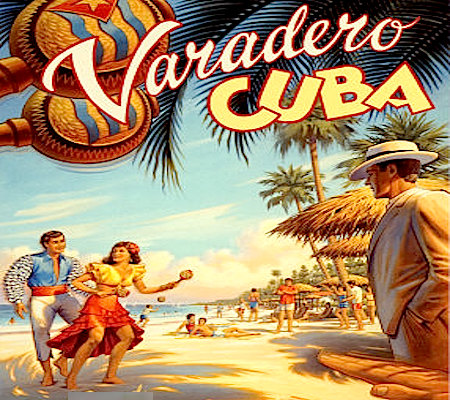
And what about the state’s tourism promotion policy? It’s not enough to stop in Varadero, as the island’s main vacation hub, and in Havana, for the international tourist demand that arrives on the Island. This model worked in the 1950s. It’s true that it was interrupted between 1959 and 1990, when international tourism was reopened, but there is now a repetition of tourist destinations and centers of interest. Shouldn’t we start thinking about other kinds of attractions? continue reading

And what about hotel construction by the communist state? According to official data, Cuba already has more than 300 hotels, some with four and five stars, and 70,000 rooms distributed throughout the archipelago. But the leaders think that this is insufficient to make a real impact on the entry of travelers, so the state continues to build hotels and then transfers their management to foreign tourism companies. As all the money comes from the same place, what is invested in tourism has to be deducted from other social and infrastructure needs, and then hotel occupancy doesn’t increase beyond 16%. The disaster is total and absolute.

And what about the communist state’s reaction to technological challenges? This is even better. The leaders have discovered that “information technologies and their relationship with tourism must be strengthened.” This conclusion was reached during the XVI international seminar on journalism and tourism by the “experts” of the José Martí International Institute of Journalism in Havana. They proposed some “tourist recipes” that should give results in a relatively short period.

The conclusion was that electronic communication networks have to be extended to all hotels in the nation and other establishments that require it. The seminar talked about “tourism 4.0” in the fourth industrial revolution and about digitization. This is an academic topic, undoubtedly interesting for those countries that have experienced the previous stages of tourism 1.0, 2.0 and 3.0, which in Cuba have neither been transited nor expected.

So wanting to skip those phases and go directly to tourism 4.0, where there is supposed to be “a digital traveler who uses these tools before, during and after his vacation (…) who is always connected, informed and requires fast services, along with personalized treatment,” is an absolute nonsense that can end up giving a much worse result than the current one. It can’t be rushed. When the state directs and controls an economic sector – in this case tourism – these things happen that no one can understand.

It is the same as speculating about the future of Caribbean tourism as a global tourism product, which must be prepared for a new era. The Caribbean has been successfully functioning since the 1950s and has been earned prestige on its own merit, but if you want to make a realistic diagnosis you have to forget about the Caribbean as a homogeneous space and verify that there are many Caribbeans, and in that variety is the success of the destination that other areas of the world do not have. The problem, in particular, is how to place Cuba in the context of the successful tourism of the Caribbean, and the conclusion is that it’s not easy.

For example, the real estate sector, which is absent in Cuba, has been one of the strengths of the Caribbean destination that attracts loyal tourists and stable residents, who generate a very solid and effective demand. In fact, the sun and beach as a basic element of the offer is more than surpassed, and no country in the area bets only on that combination. Those who come late, as happens in Cuba, should think of other more sustainable and lasting proposals. But this is what happens when the state directs and controls a sector. Its priority is not profitability and business continuity but to fill the coffers with foreign currency and then allocate it later to unproductive and inefficient activities. And that vicious circle has to be broken so that tourism means something real for Cuba.

State leaders of tourism policy always have the possibility to evade their responsibilities, which are many, and they use the easy argument that the problems of the sector on the Island are due to eternal difficulties: inflation, international trade situations and of course, naturally, the pressures of the United States against Cuba, precisely in economic matters. But in reality, all that affects other countries that have had great success in the recovery of the tourism sector. By the way, in all these countries, the state has no participation, nor does it direct or control tourism.

Translated by Regina Anavy

____________

COLLABORATE WITH OUR WORKThe 14ymedio team is committed to practicing serious journalism that reflects Cuba’s reality in all its depth. Thank you for joining us on this long journey. We invite you to continue supporting us by becoming a member of 14ymedio now. Together we can continue transforming journalism in Cuba.
Tragic Week in Cuba, With the Third Feminist Murder in Five Days Confirmed

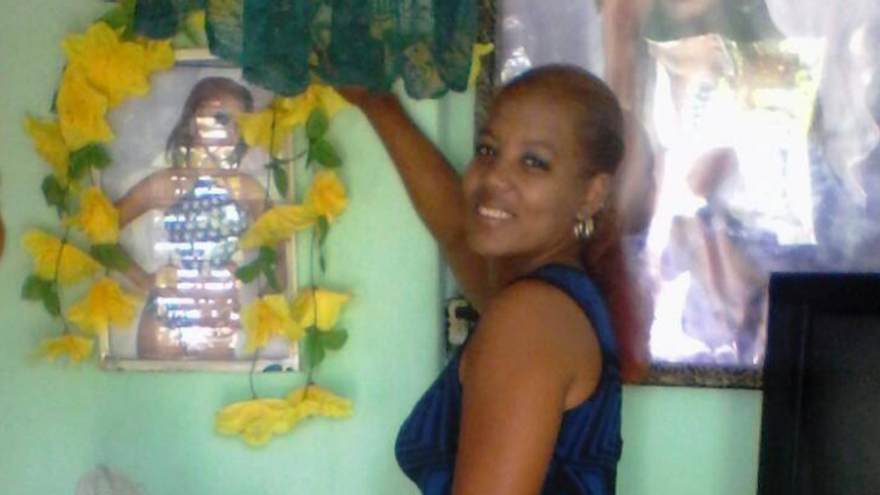
Nelbys Leyva, 37 years old, had a daughter. (Facebook)

14ymedio bigger14ymedio/EFE, Havana, 23 June 2023 — This Thursday, the Cuban independent feminist platforms Alas Tensas and Yo Sí Te Creo raised to 45 the total number of femicides verified so far this year in the country, with the confirmation of a new sexist murder.

The victim was Nelbys Leyva, 37, with a daughter, who allegedly died at the hands of her ex-partner on June 16 in Guanabacoa (west).

The formal complaint comes just one day after both groups confirmed two other victims of sexist violence in Cuba and four days after they registered two other femicides, in one of the most tragic weeks of the year.

So far in 2023, the total number of femicides verified in 2022 (34) has already been exceeded in Cuba, according to the records of the activists and collated by 14ymedio and EFE (in the absence of official public statistics).

In addition, the collectives have counted 163 sexist murders in Cuba since mid-2019, when they began to register them.

The activists called on the Cuban government to declare a “state of emergency” for “gender violence.”

The work of independent feminist collectives and its dissemination in the unofficial media has contributed to putting the focus on the cases of sexist murders and the disappearances of Cubans in recent years. continue reading

These groups also advocate a comprehensive law against gender violence and the implementation of protocols to prevent these events, as well as the creation of shelters and rescue systems for women and their children who are in danger.

Last April, Cuban President Miguel Díaz-Canel assured that there would be “zero tolerance” of sexist violence.

The official Federation of Cuban Women (FMC) gave a presentation at the beginning of June to the Cuban Observatory on Gender Equality, which includes statistics of “women who have been victims of intentional homicide as a result of gender violence in the last 12 months.” However, the data are not clear, based on convictions corresponding to the year.

The Supreme People’s Court reported in mid-May that in 2022 there were 18 convictions for sexist murders, all with penalties above 25 years in prison. However, it did not indicate when they occurred or detail the number of cases investigated that year.

The announcement was published after the court itself confirmed the sentence of life imprisonment for two men previously convicted of sexist violence.

These are the first sentences against perpetrators of femicides for the crime of murder, given that the crime of gender violence does not exist on the Island. They were made public in 2023 and correspond to cases filed in 2022.

Translated by Regina Anavy

____________

COLLABORATE WITH OUR WORKThe 14ymedio team is committed to practicing serious journalism that reflects Cuba’s reality in all its depth. Thank you for joining us on this long journey. We invite you to continue supporting us by becoming a member of 14ymedio now. Together we can continue transforming journalism in Cuba.
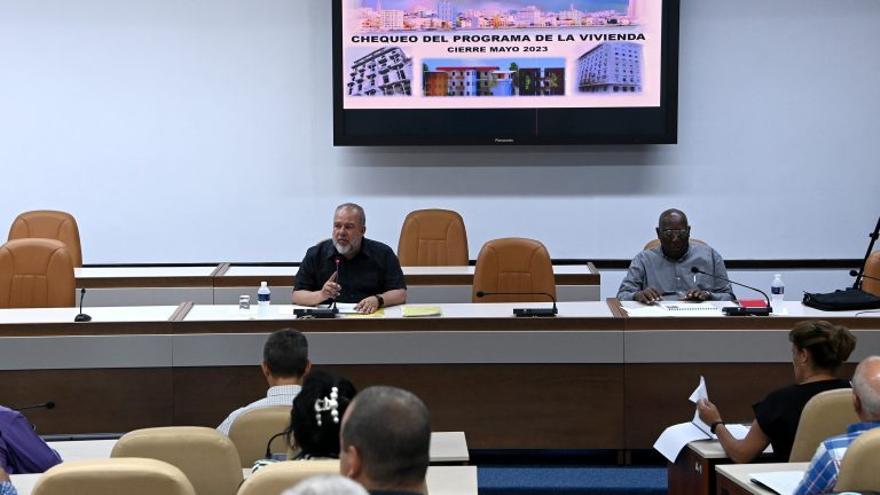
The Cuban Government’s Pace To Rebuild the Houses Destroyed by Hurricane Ian: 13 Percent in Six Months

The Cuban Prime Minister, Manuel Marrero, on the left, during this Thursday’s meeting at the Palace of the Revolution in Havana. (Cubadebate)

14ymedio bigger14ymedio, Madrid, 23 June 2023 — Nine months after the passage of Hurricane Ian through Cuba, 70% of the homes destroyed in Pinar del Río are still not built. That was the central theme of this Thursday’s meeting at the Palace of the Revolution led by the Prime Minister, Manuel Marrero Cruz. They also discussed the effects on the houses in Camagüey, Las Tunas, Granma, Holguín and Santiago de Cuba after the intense rains of two weeks ago.

If you take into account that in December of last year, 83% of families were affected in Pinar del Río, it means that in six months only 13% of the cases have been solved.

“It is inconceivable that we have a material resource and it is not in place,” said the official press, referring to the “constant dissatisfaction of the people with the limited advance of the pace of the recovery of the housing fund.”

Although the article published jointly by Granma and Cubadebate describe a “deep analysis” that “left no gaps for self-indulgent expressions” at the government meeting, the title accounts for the impotence of the State to solve the problem: “We have to find the solutions together.”

Marrero expressed himself again in voluntarist terms, saying that it is necessary to “trace a different strategy to accelerate the recovery, which isn’t going at the pace demanded by the population.” continue reading

Without detailing what that different strategy would be, the prime minister continued in the same tone: “We cannot leave it to spontaneity; we have to control; we have to conduct this process and the search for solutions until we finish.”

Marrero did not specify whether or not the theft of material had occurred but declared: “In all these affected provinces, we must apply the established laws to whoever is caught diverting resources.”

He also acknowledged that “there is a lack of attention, of visiting people, getting inside their homes,” because “it is demonstrated on the ground that things can be done, despite this cruel blockade we are experiencing,” referring, as usual, to the United States embargo.

Among so much vagueness, he gave some discouraging data on the “compliance” of the housing plan for the month of May: only 13% of the subsidy program has been completed and 9% of the eradication of dirt floors.

What is affecting the completion of the homes, says the prime minister, is “the lack of electric cable and carpentry.”

Hurricane Ian, which passed through western Cuba at the end of last September, left the province of Pinar del Río as a “disaster zone.” The tobacco industry, the main one in the province, suffered, in the words of the Government itself, “the biggest blow in its history,” and more than one hundred thousand homes suffered significant damage.

Translated by Regina Anavy

____________

COLLABORATE WITH OUR WORKThe 14ymedio team is committed to practicing serious journalism that reflects Cuba’s reality in all its depth. Thank you for joining us on this long journey. We invite you to continue supporting us by becoming a member of 14ymedio now. Together we can continue transforming journalism in Cuba.
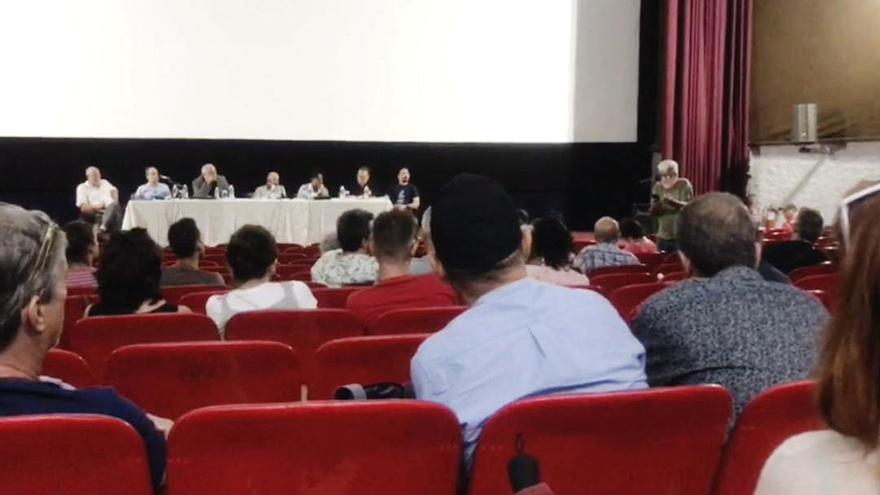
Cuban Filmmakers Meet To Express Their Disagreements With the Cultural Authorities

The meeting took place at the Chaplin cinema in the Cuban capital. (Assembly of Cuban Filmmakers)

14ymedio bigger14ymedio, Havana, 24 June 2023 — More than a hundred Cuban filmmakers expressed their disagreement with the authorities about the decisions made with a documentary about the Argentine singer Fito Páez and his relationship with the Island. The creators, grouped in the Assembly of Cuban Filmmakers — which includes the prestigious director Fernando Pérez and the actor Jorge Perugorría — held a meeting this Friday with leaders of the Ministry of Culture and the Communist Party to face the controversy unleashed in mid-June.

The controversy gained strength when a state television program broadcast the documentary Fito’s Havana, directed by Juan Pin Vilar, without his permission. Faced with that fact, an initial group of 58 creators criticized the cultural authorities for violating “ethical principles again and again.” The list has been increased to 600 signatories of the manifesto.

“This meeting was not as extensive as the one that took place on November 27, 2020, where there were exponents of all artistic disciplines. It was something more like a guild of filmmakers,” director Manuel Alejandro Rodríguez Yong, one of the participants in the discussion, explained to 14ymedio. “I think that even so, the possibility of working together with many of the problems that affect us was raised.”

The meeting was moderated by Ramón Samada, president of the official Cuban Institute of Cinematographic Art and Industry (ICAIC). Present, on behalf of the Government, were Deputy Prime Minister Inés María Chapman; the head of the Ideological Department of the Party, Rogelio Polanco; the Minister of Culture, Alpidio Alonso; the president of the Union of Writers and Artists (UNEAC), Luis Morlote, and the leader of the Hermanos Saíz Association, Yasel Toledo.

According to Rodríguez, logistical problems that depend on the administration of the State were discussed, but also ideological and political issues. “Everything will depend, too, on us (the filmmakers) managing to organize ourselves,” he said. continue reading

“The meeting was first supposed to take place on the ninth floor of the ICAIC, but then the Assembly of Filmmakers asked that it be held in a more open place. That’s why the Chaplin was chosen.”

According to Rodríguez, several creators didn’t attend because they didn’t find out and others because they “don’t trust that type of meeting.” Exiled filmmakers such as Carlos Lechuga and Pavel Giroud were asked to “find a way to attend through digital channels,” says the filmmaker.

“Among the names mentioned was that of Lechuga. What happened to the movie Vicenta B, more than a censorship of the work, was a punishment to the director. There was also talk of other filmmakers who are making movies outside of Cuba, but who are part of Cuban cinema. They have to be part of the discussions,” he said.

According to the EFE agency, Chapman said during the conversation that “there is a willingness to dialogue and work as a team to achieve concrete results in the face of all the demands expressed.”

For its part, a statement from the Ministry of Culture pointed out that “the approaches of the artists deserved the greatest attention of the leaders of the institutions. The artists listened carefully to the arguments of the representatives of the institutions and expressed their opinions in total freedom,” according to the text.

It is not the first time that there has been a confrontation between the artistic sector and the Cuban government in recent years. On November 27, 2020, hundreds of people staged a sit-in before the Ministry of Culture to protest the arrest of the members of the San Isidro Movement, including the artist Luis Manuel Otero Alcántara, who remains in prison.

Translated by Regina Anavy

____________

COLLABORATE WITH OUR WORKThe 14ymedio team is committed to practicing serious journalism that reflects Cuba’s reality in all its depth. Thank you for joining us on this long journey. We invite you to continue supporting us by becoming a member of 14ymedio now. Together we can continue transforming journalism in Cuba.
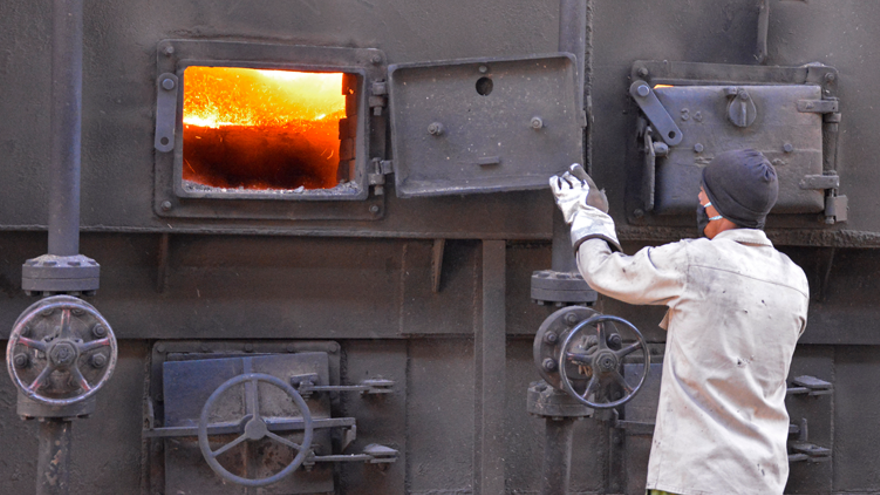
Roundtable TV Program Gives Cubans an Accelerated Course on Basic Capitalism

Archive image of a worker at the Empresa Azucarera de Ciego de Ávila. (Invasor)

14ymedio bigger14ymedio, Madrid, 22 June 2023 — The Cubans who  tuned in to state television last night to watch the Roundtable program were able to listen to a revision of all the socialist economic policies that Cuba has followed in the last 65 years. The discussion was not so surprising, since citizens are seeing for themselves the reconversion of the Island’s system towards a capitalism of oligarchies, as well as the public recognition that what has been done for decades does not work.

Professor Ileana Díaz Fernández, invited this Wednesday to the program to talk about state companies, put on the table concepts until recently almost entirely prohibited: the generation of wealth, layoffs, free wages, bankruptcy, debureaucratization and even the harmful effects of capped prices.

“The mechanism that exists in the country is that when there’s a problem you have to handle it. And when you have to be handling every problem until it’s resolved, another one comes along,” she began. She went on to explain that the economy is distorted, especially the micro enterprises, and she blamed their problems on price controls.

“When you begin administratively to say you can’t raise salaries here and you have to lower them there, and you begin to establish a set of elements, salary scales or whatever, you begin to interrupt the logical and normal process that must be maintained to have a virtuous circle for the company,” she argued. The specialist, who believes that it is the businessman who should make the decisions, enunciated what until now was anathema.

“We don’t have to be afraid of the market (…) You have to access the market, and the market begins to see signs: if you have the money to access the market, you will be able to buy into the market; if you don’t have the money, you will not be able to enter. If a company is more efficient, it will have better conditions for that access,” she added. continue reading

Without departing from the path she had taken, she continued to talk about the relative freedom of wages. “What if I want to increase the salary of my workers? If we’re afraid of that, what will happen?” she said, acknowledging, however, that this situation has limits, due to the resulting increase in prices. Díaz Fernández then continued with another topic that has been such a taboo in Cuba that there are special concepts for workers who are dismissed, calling them “interrupted,” or in the “process of availabiliy.”

“The businessman also has to make decisions about whether he has enough staff, and of course he has to protect that staff, no one can deny that,” she argued. “He has to get the company to create wealth, with a higher percentage of profitability. Why? Because to the extent that he creates wealth, he not only meets the needs of the population but also those of the State, since he will pay more taxes and make greater contributions to the State budget,” she said.

According to this same logic, she considered that it is perfectly admissible for a company to disappear. “Can you go bankrupt? Yes, because some companies are born and others die. In human life it happens and in companies the same,” she concluded.

In the midst of all this ideological introduction to capitalism, the professor finally explained a practical measure that the future Law of Businesses — the reason for the issue to be addressed in the program — will introduce, which is the classification of them into three types.

The regulation will provide for a first group, composed of about a thousand companies with autonomy. “The Constitution of the Republic says that the State company is autonomous and in reality it is not completely autonomous, because many times it has to wait for countless authorizations for the management and search for markets, although it will have to yield results,” she added.

Another type will be the subsidized businesses, fundamentally those that are linked to the ’basic consumer basket’ [rationed goods]. Finally there are the monopolies, strategic sectors that are especially dedicated to supplies such as water, electricity, gas and fuels, among others.

Díaz Fernández wanted to make it clear that the changes will be gradual and that necessary markets will first have to be created, including inputs, labor, and especially foreign exchange. This lowered the expectations of the viewers, but the discursive change was noteworthy. “Changing the rules of the game is imminent, because a macroeconomic stabilization program won’t work if we don’t have a program of structural transformation of the economy,” she emphasized.

Her speech was preceded by that of Johana Odriozola Guitart, Deputy Minister of Economy and Planning, who spoke of the steps that preceded the future law, such as the creation of the SMEs and the transition to a less administrative and more financial economy, and she presented some data about the State sector, the protagonist of the night.

Currently, there are 2,417 State enterprises, of which 1,872 are  “traditional” and the rest are newly created: State SMEs (116) and subsidiary companies (159). The deputy minister said that State companies contribute 92% of sales, 75% of exports and 87% of the Gross Domestic Product (GDP), in addition to employing 1,431,000 workers (compared to the 200,000 of private ones).

The disproportion, generated by decades of exclusivity, does not make them more important, defended Odriozola Guitart, but it does explain that it is urgent to make decisions, because of the weight they pose in the national economy.

Surprisingly, the situation in terms of losses has improved in the last two years, since there are 278 companies with losses, compared to 500 in 2021. In any case, she indicated that in 309 entities the profitability on net sales is less than 2 cents. “They are not at a loss but they really exist in a miraculous static state and are very susceptible to any increase in costs.”

The Round Table was also attended by the director of Aica Laboratories, belonging to BioCubaFarma, Antonio Vallín García, who spoke at length about the difficulties of working at the international level. He praised some of the measures taken to date and called for more progress, including the creation of professional regulatory entities, instead of ministerial ones. “I think the first thing we have to do is deregulate,” he said.

In this context, the ministry plans to launch the new law this year, and although the deputy minister pointed out that it will not be enough, yesterday’s session made it clear that the language, at least, is moving ahead.

Translated by Regina Anavy

____________

COLLABORATE WITH OUR WORKThe 14ymedio team is committed to practicing serious journalism that reflects Cuba’s reality in all its depth. Thank you for joining us on this long journey. We invite you to continue supporting us by becoming a member of 14ymedio now. Together we can continue transforming journalism in Cuba.

‘Soon, Polyclinics in Cuba Will Have To Be Closed Due to Lack of Personnel’

“The surgical residents have not received the necessary training and are already are already working  in the operating room Having graduated these young people is a very risky fraud.” (Arnaldo Milián Clinical-Surgical Provincial Hospital)

14ymedio bigger14ymedio, Havana, 23 June 2023 — Abuse, mass exodus and a slave salary. These three elements encrypt the drama that, every day, decreases the number of medical specialists in Cuba. The loss of high-level professionals in all spheres is one of the dimensions of the labor crisis in Cuba, a sector also affected by aging.

Added to this is the little disposition that young people seem to have for the toughest specialties, according to a doctor from the William Soler hospital, in the Havana municipality of Boyeros, speaking to 14ymedio, who prefers not to be identified. “Nobody wants to be a clinician, a pediatrician, and even less a gynecologist. It’s as if they were ’anemic’ professions today,” he laments.

Two months ago, the doctor continues, 12 young pediatric residents began working at Soler. After several weeks, eight of them deserted in one fell swoop. “They couldn’t stand the pressure,” he said. “In another hospital in Havana, they have just closed the intensive care service because, simply, there are no staff.”

Massive abandonment – especially by young graduates – is even more frequent in polyclinics, where many specialists have also had to assume the tasks inherent to general practitioners.

“Soon, as the crisis continues to worsen, gynecological and pediatric hospitals will have to be closed. Pediatricians, dentists and gynecologists are not being trained in the necessary proportions,” he says. However, what is most alarming is the increasingly frequent tendency to place residents who do not have sufficient preparation to assist the surgeon during a procedure in operating rooms – which also function badly. continue reading

“It also happens that surgical residents have not received the necessary training and are already working  in the operating room. And this is a fraud: how are you going to graduate a clinical surgeon who does not know how to operate!” the doctor says, scandalized.

This newspaper has also known of the case of a young man recently graduated who is in the first year of an obstetrics specialty in Camagüey. He has just requested a license that, he admits, will soon become a leave of absence: he has already bought the tickets to emigrate to Spain with his wife, a Cuban with Spanish nationality whose parents have already left to “prepare the ground.”

“Both obstetrics and gynecology are in crisis,” he says. “Specialists used to be sent in ’normal’ times to oversight duty every three days. Now the conditions are unbearable: the lack of staff means that a specialist sometimes spend 48 to 72 hours without being able to leave the hospital. There is no one to replace you.”

Last February, the AFP agency published a report in which it attributed the labor debacle on the Island to the unstoppable exodus of professionals. The “route of the volcanoes,” which allowed Cubans leaving through Nicaragua to cross Central America to the US border, was a black hole that absorbed a large part of Cuban working people. Despite the restrictive measures taken in 2022 by Washington, the stampede towards the United States has not stopped.

The conclusion of the report was devastating: theoretically, in Cuba there are plenty of jobs, but nobody wants to work in the deplorable conditions established by the regime’s economy. According to the data provided to the international press, the majority of Cuban emigrants are between 19 and 49 years old, in addition to being highly educated.

____________

COLLABORATE WITH OUR WORKThe 14ymedio team is committed to practicing serious journalism that reflects Cuba’s reality in all its depth. Thank you for joining us on this long journey. We invite you to continue supporting us by becoming a member of 14ymedio now. Together we can continue transforming journalism in Cuba.
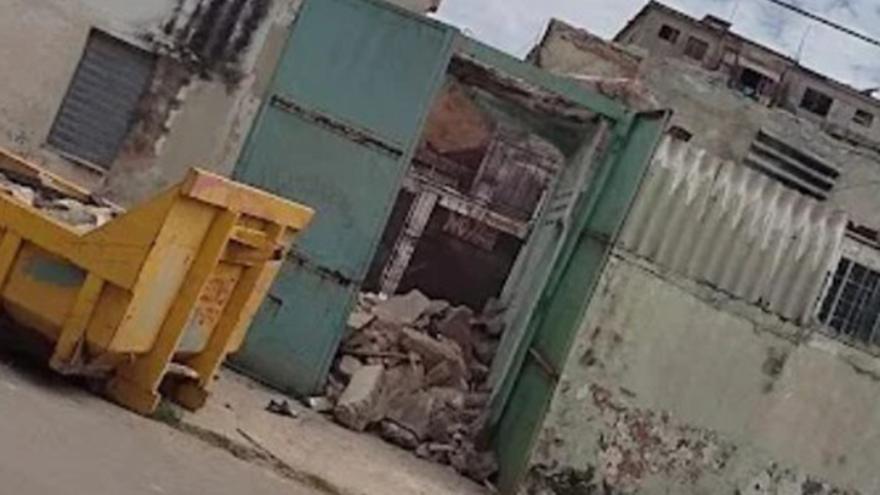
Man Dies After a Building Wall Collapses in Havana

The place where the building collapsed in the Luyanó neighborhood, in the Diez de Octubre municipality. (Facebook/Lilly Fonseca)

14ymedio bigger14ymedio, Havana, 25 June 2023 — One man died and another was injured on Friday by the partial collapse of a building in a construction zone in the Luyanó neighborhood, in the Diez de Octubre municipality. Although there is no official version of the accident, the details published on social networks indicate that both workers were left under the rubble with serious injuries and ultimately one of them died.

In the Facebook group “Solo gente de Luyanó”, Internet user Lilly Fonseca shared photographs of the collapse where the rubble of the old buildings can be seen, which are being demolished to build new homes. According to her version, when the wall collapsed, the slab where the two workers were, whose identities have not been provided, also collapsed.

A nurse who went to the construction zone explained that they tried to revive the worker, but it was impossible due to the severity of his injuries. The medic pointed out that the two men did not have personal protective equipment, so they were more prone to fractures.

“Great care must be taken in the streets of Havana and also in old buildings, like this one. Also, first, an architect or engineer has to go so they can asses the conditions of the architecture,” Fonseca wrote in your post.

The Luyanó neighborhood is one of those with the most deteriorated housing stock in Havana, due to the age of its buildings, the little maintenance they have received and the effects of the tornado that affected the area in January 2019. Its location, outside the tourist perimeter of the Cuban capital, has aggravated the lack of investment in streets and homes.

Building collapses are constant in Cuba due to the lack of maintenance of the oldest infrastructures, which are more vulnerable during the winter due to the accumulation of humidity. Just a month ago on San Miguel street, between Campanario and Manrique streets, in Centro Habana, a residential building collapsed and left a mother and her one-year-old son with injuries. continue reading

Last March, the residents of Zapata street, between Infanta and Basarrate, in Havana, denounced that a facade of an old building threatened passers-by who passed through the area. The infrastructure was barely supported by makeshift sticks, a mockery for the inhabitants of the area who have asked the authorities to demolish it.

The risk of buildings is not only in Havana; in recent months deaths have also been reported in the collapse in other provinces. In February, a man died when a piece of the facade of a building in Camagüey fell on him. Only a month earlier, three high school students were hospitalized in an emergency in Sancti Spíritus because a pieces of a wall mural fell on them while they were walking.

____________

COLLABORATE WITH OUR WORKThe 14ymedio team is committed to practicing serious journalism that reflects Cuba’s reality in all its depth. Thank you for joining us on this long journey. We invite you to continue supporting us by becoming a member of 14ymedio now. Together we can continue transforming journalism in Cuba.

Amnesty International Demands the ‘Immediate’ Release of Otero Alcantara and Maykel ‘Osorbo’

Otero Alcántara and Maykel Castillo in Havana, while they were still free. (Anamely Ramos)

14ymedio biggerEFE (via 14ymedio), Mexico City, 23 June 2023 —  Amnesty International (AI) said Thursday that the Cuban authorities must release the artists Luis Manuel Otero Alcántara and Maykel “Osorbo” Castillo Pérez “immediately and unconditionally.”

It is now one year since they were unjustly sentenced to five and nine years in prison, respectively, in a legal process that did not respect the guarantees of a fair trial.

“The continued arbitrary detention of Luis Manuel and Maykel is part of a pattern of repression based on imprisoning at all costs those who dissent from the authorities,” said Erika Guevara-Rosas, Americas director at Amnesty International in a statement issued today.

“These arrests seek to generate a paralyzing effect on activism and silence freedom of expression in Cuba,” she added.

The AI ​​representative said that both sentences “are an example of the cruelty that the government of Miguel Díaz-Canel is willing to exert on anyone who criticizes the Cuban authorities.”

Given this, she said, “the authorities should abandon the use of the penal system to repress the population, and take the necessary measures to guarantee the independence of the Judiciary and the Prosecutor’s Office.”

Castillo Pérez, known as “Osorbo”, is a musician and human rights activist. He is co-author of the song Patria y vida, which criticizes the Cuban government and has been adopted as a protest anthem. He was arrested at his home on May 18, 2021 by security agents and has been in prison ever since. continue reading

Luis Manuel Otero Alcántara is also a member of the artistic collective San Isidro Movement, which has opposed a law that censors artists.

He was arrested on July 11, 2021 in Havana, after announcing in a video that he would join the protests that same day, in which thousands of people demonstrated peacefully and spontaneously in dozens of cities demanding a change in the laws. living conditions in Cuba.

According to the organization Justicia 11J, as of June 7, 2023, 773 people detained during the 2021 protests were still deprived of their liberty.

In 2021, AI analyzed the facts and the context of the detention of Otero Alcántara and Castillo Pérez and designated both artists as prisoners of conscience, since they have been deprived of their liberty solely for the peaceful exercise of their human rights. Amnesty International considers that “the criminal process and the sentence in which it culminated consisted of a farce, lacking any respect for the minimum guarantees of a fair trial.”

And it added that “the sentences must be reversed and the people affected released immediately and unconditionally. Likewise, the Government must guarantee that neither they nor their families or relatives suffer repression for seeking justice in this case.”

On May 18, the NGO sent a letter to Díaz-Canel two years after Castillo’s arrest “for exercising his right to freedom of expression and criticizing the government,” for which he was sentenced to nine years in prison.

____________

COLLABORATE WITH OUR WORKThe 14ymedio team is committed to practicing serious journalism that reflects Cuba’s reality in all its depth. Thank you for joining us on this long journey. We invite you to continue supporting us by becoming a member of 14ymedio now. Together we can continue transforming journalism in Cuba.

Family Members of Cuban Opponent Jose Daniel Ferrer Are ‘Horrified’ by His State of Health

José Daniel Ferrer está muy mal físicamente y no sabe cuanto tiempo más pueda resistir, se informó en las redes sociales del opositor. (@jdanielferrer)
José Daniel Ferrer is in a very poor state of health, according to what his family was able to confirm. (@jdanielferrer)

14ymedio bigger14ymedio, Havana, 23 June 2023 — After numerous demands to obtain a certificate of life from Cuban opponent José Daniel Ferrer, the authorities agreed to allow his family to visit him this Thursday, after three months without being able to see him. His wife, Nelva Ismarays Ortega Tamayo, and their two children verified that the leader of the Cuban Patriotic Union (UNPACU) is in a terrible state of health, half-naked and confined in an isolation cell in the Mar Verde prison, in Santiago from Cuba.

The account of the family visit, published on Facebook by the opponent’s sister, Ana Belkis Ferrer García, accuses the regime of keeping him in “cruel, inhuman and degrading conditions, under constant physical and psychological torture,” subjected to the bites of “aggressive and dangerous mosquitoes, ants and rodents.”

Upset by a video about Ferrer’s health, published on social networks by a Cuban emigrant, identified as Laura Jusino and with alleged contacts with prison staff who gave her details about the opponent’s condition, the relatives were “alarmed and horrified ” due to the inmate’s situation and redoubled their requests to see him. Ferrer, Jusino claimed, was in the hands of “hitmen” and his whereabouts were a “state secret.”

This Thursday, Ortega announced that she was going to the prison after having access to “a note supposedly handwritten” by Ferrer in which he asked for broad-spectrum antibiotics and various types of pain relievers. This “confirms how poorly his health is, what deplorable conditions he is in,” his wife said.

When she was allowed to enter, Ortega saw him “in his underwear, with difficulty walking, severe pain in his hands, arms and legs, extremely thin, with toothaches and loss of vision.” continue reading

His body, she adds, is “full of lesions” and he refused to hug his son so as not to infect him with “the bacteria that he has had on his skin for months.” The UNPACU leader told his wife that he “could not walk” during the months of April and May, and that he now walks with great difficulty. Thanks to the ibuprofen provided by the family, he now feels “some relief,” but still does not know to what to attribute the “immobilizing pains” he suffers from. Ferrer’s sister, speaking from the US, denounced that he does not have medical attention or adequate treatment for his ailments, his access to water is restricted and he is forced to endure heat. He feeds himself only from the bag of groceries that his relatives bring her every month.

José Daniel Ferrer, the leader of the Patriotic Union of Cuba, was released this Friday after six months in detention. (Courtesy)
José Daniel Ferrer, in 2020, after being released from a six-month incarceration. (Coutesy)

He has suffered torture, he declares, and a few days ago he was taken from the Mar Verde prison to the clinical-surgical hospital in Santiago de Cuba “with the apparent purpose of extracting one of his damaged teeth.” However, the piece removed by the dentists was healthy, while those that were in poor condition were not extracted. “A G2 agent later went to his cell to mock and threaten him, saying that ’everything he was going through was preventable, that he just had to agree to leave the country,’” his sister recounts.

Prison officials have also failed to provide Ferrer with the painkillers and antibiotics that the family brought him. When he demands the medicines, the jailers say that they will be given to him by the prison doctor.

“It is totally confirmed that my brother is being murdered in the slowest, most perverse and cruel way that can exist, in the midst of such a difficult and worrying situation, he sends his message of gratitude to all the supportive people, friends, brothers in struggle and ideas, media, institutions and justice-loving governments,” concludes Ana Belkis Ferrer. “He states that he does not lose hope of getting out of such hell alive, but if he does not, remember that he was always willing to give his life for the freedom of his people.”

Several days ago a campaign began inside and outside Cuba to demand information on Ferrer’s whereabouts. On Thursday, Amelia Calzadilla, a young mother from Havana who has become one of the symbols of discontent in Cuba, demanded respect for the right for the opponent’s relatives to “see him and verify that he is fine even if he is detained.”

Ferrer is one of the more than 700 political prisoners that the Cuban regime has kept in its jails since the massive protests of July 11, 2021, to which dozens of detainees have been added from the demonstrations in recent months. During these almost two years, his family has denounced on several occasions that the inmate has been the victim of torture, beatings and threats.

____________

COLLABORATE WITH OUR WORKThe 14ymedio team is committed to practicing serious journalism that reflects Cuba’s reality in all its depth. Thank you for joining us on this long journey. We invite you to continue supporting us by becoming a member of 14ymedio now. Together we can continue transforming journalism in Cuba.

Cuban Authorities Predict That Dengue Fever Will Enter an ‘Epidemic Phase’ in Guantanamo

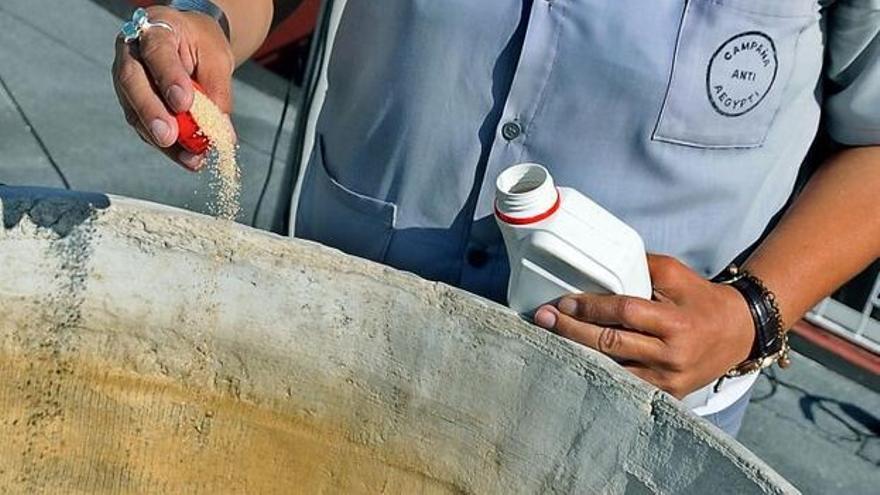
Cases of dengue increase every year due to the lack of the Abate pesticide, insecticides and even fuel to fumigate. (Minsap)

14ymedio bigger14ymedio, Havana, 24 June 2023 — The dengue fever situation in Guantánamo is “in the prelude to the epidemic phase,” the authorities warn in the local press. With a 30% increase in outbreaks of contagion, the level of alarm in the Provincial Center for Hygiene, Epidemiology and Microbiology has now been raised. The director, Leonel Heredia, blames the upturn on the rainy season and foresees an even darker outlook when September arrives.

Guantánamo now registers, in 548 homes, 705 outbreaks of the Aedes aegypti mosquito, the transmitting agent of dengue, Zika, chikungunya and yellow fever. The municipalities most affected so far are Manuel Tames, Guantánamo and Caimanera, while Maisí and Yateras show the lowest rates of infections, according to Heredia. The situation is analogous to that of Santiago de Cuba, where the authorities already describe the development of the disease as “worrying.”

The water tanks in the homes are still the “favorite” place for the proliferation of the vector, Heredia said, and his office has developed an “intensive” plan to control the reproduction of the mosquito, although he considered that families have to do their part with the cleaning of stagnant waters.

As soon as the rainy season began, Santiago de Cuba issued an alarm about the increase in medical care due to febrile syndrome and reactive cases. The provincial newspaper Sierra Maestra warned that the territory had “great possibilities” of moving towards epidemiological events of not controlling the viral infection.

“It is expected that in the coming weeks suspected cases of dengue will continue to appear,” the newspaper warned, also acknowledging that the control of the disease “has slowed” due to the economic difficulties of the Island, which limit “the size and scope of anti-vector and other actions aimed at eliminating environmental conditions favorable to the insect.” continue reading

Last February, BioCubaFarma announced that for this year it expects to have the first vaccine candidate against dengue, after almost a decade of research. Cuba began the studies in 2013, but Eduardo Martínez Díaz, president of the state pharmaceutical group, justifies the delay by claiming that “it is a complex process,” because dengue has four serotypes and each one must be immunized at the same time for the drug to be effective.

The Government publicizes that Cuba will have the first vaccine against the disease, but in reality in 2015, the World Health Organization (WHO) approved a drug with the trade name of Dengvaxia, manufactured by the French Sanofi Pasteur. This serum has been validated in 20 countries but is not available on the Island.

The Guantánamo health authorities also warned of an uptick in COVID-19 infections, with 10 confirmed cases in the last two weeks in the municipalities of Guantánamo, El Salvador and Manuel Tames. Although they said that the patients were not in serious condition or at risk of death, the epidemiologist insisted on using masks at mandatory sites and continuing the vaccination schedule.

Translated by Regina Anavy

____________

COLLABORATE WITH OUR WORKThe 14ymedio team is committed to practicing serious journalism that reflects Cuba’s reality in all its depth. Thank you for joining us on this long journey. We invite you to continue supporting us by becoming a member of 14ymedio now. Together we can continue transforming journalism in Cuba.
A Critique of Cuban President Diaz-Canel’s Speech at the Paris Summit

Cuban President Miguel Díaz-Canel speaking in Paris. (cubadebate.cu)

14ymedio bigger14ymedio, Elías Amor Bravo, Economist, 23 June 2023 — We already know that Cuban President Miguel Díaz-Canel went to the Summit for a New Global Financial Pact in Paris with nothing to offer. At the expense of the meager Cuban budget, basically, he took some souvenir photographs, checked in with friends like Lula and Guterres and said things that could very well have remained unsaid. But of course, as president pro tempore of the G77+ China, he has several doors open to forums like this, and you know, you have to denounce the embargo/blockade wherever and however. Public spending in Cuba finances this kind of thing. There is no investment in housing or infrastructure, but not a penny is spared in propaganda.

After all, attending these conferences does not usually have any benefit other than the media coverage, and one should not expect anything else. The only one who wins from all this is Foreign Minister Bruno Rodríguez, who is seen with a nervous smile behind his boss in all the photographs. He has managed to stick his nose into a conference that has been foreign to Cuba. Welcome!

The whole thing wasn’t much fun. Just a few minutes before it began, not far from the headquarters of the summit, a building had exploded with a gigantic column of smoke, and it was also raining, a typical Parisian day, gray and dark. The inauguration of the event was given by French President Macron who, sitting in shirt sleeves next to Díaz-Canel, did not look very comfortable in the day’s sessions.

And then, when his turn came, Díaz-Canel took advantage of his moment of glory and launched into a speech that can best be described as harsh, diffuse and critical of the central theme of the event, which was the definition of a new contract between the North and the South to face growing challenges related to climate change and development in this context of multiple crises. His  advisers were not wise with the content or the statement. continue reading

According to the Cuban communist press, Díaz-Canel was grateful for the invitation to participate in the Summit for a New Global Financial Pact, which he described as “another starting point towards a broader intergovernmental process of discussion and decision-making within the framework of the United Nations.”

He presented himself as president of the Group of 77+China, which he described as “the most representative group of developing nations and the one that has historically been the flag and spokesperson for the claims that bring us together today.” Sheer propaganda.

Having said the above, he went into the matter, noting, “I do not reveal any secret if I affirm that the most nefarious consequences of the current international economic and financial order — deeply unjust, undemocratic, speculative and exclusionary — have a stronger impact on developing nations.”

Of course, I would not expect much applause when saying this kind of thing, which no longer connects even with the most revolutionary France of all time. Messages of this caliber are not only part of an ideologized analysis of reality, but they no longer serve to define the current scenario of the world economy.

In the crazy and undiplomatic thesis of Díaz-Canel’s speech, he said that “it is our countries that have seen their external debt practically double in the last ten years, that have had to spend $379 billion of their reserves to defend their currencies in 2022, almost double the amount of new Special Drawing Rights allocated to them by the International Monetary Fund.”

But of course, at no time did he say that Cuba’s indebtedness is not mandatory or forced, that no one uses a shotgun to force it into debt. However, the countries that go to the financial markets, get loans and then spend without control, without rhyme or reason, so that the impact of the investment is zero, only get into more debt. As Fidel Castro said, indebtedness is not something bad. What’s bad is the country that receives the money and then wastes it.

And of course, Díaz-Canel said that “in such unfavorable conditions the South cannot generate and access the 4.3 billion dollars annually necessary to achieve the Sustainable Development Goals in the remaining decade of action.” Of course he can’t agree, because Cuba doesn’t pay its lenders, as was proven in the London trial.

But let’s not generalize. There are countries of the South that receive generous investments, loans and financing every year because they are up to date on payments, and thanks to that the South develops and becomes “North.” But Díaz-Canel doesn’t understand this scheme, nor does he share it, and he doesn’t want to and can’t see it. As a reactionary communist, he is anchored in ideological positions unrelated to the world in which we live.

That is why he further hardened his speech by saying, “our people cannot and should not continue to be laboratories of colonial recipes and renewed forms of domination that use debt, the current international financial architecture and unilateral coercive measures to perpetuate underdevelopment and increase the coffers of a few at the expense of the South. It is urgent, like the greatest of all emergencies, to have a new and fairer international order.” This argument is false, and, in addition, those laboratories and recipes are only present in a mind incapable of understanding reality and benefiting from it. That argument of the enrichment of a few at the cost of the South could have worked in the 60s of the last century, but not today.

Díaz-Canel’s recipe, to the misfortune of Cubans, is the same as the one of Fidel Castro, who evaded the current situation and said, “it will be essential to face, as has been discussed here today, a reform of international financial institutions, both in matters of governance and representation and access to financing that properly takes into account the legitimate interests of developing countries and expands their decision-making capacity in financial institutions.” And who is going to be in charge of the reform? Díaz-Canel and those who don’t pay, maybe? What does Díaz-Canel intend to do, perhaps control the lending banks and decide who receives the money?

But then, contradicting his previous allegation, he said that “in the 21st century it is unacceptable that most of the nations of the planet continue imposing on us obsolete institutions inherited from the Cold War and Bretton Woods, far from the current international configuration and designed to profit from the reserves of the South, perpetuate the imbalance and apply interim solutions to reproduce a scheme of modern colonialism.”

The Cold War, if I remember correctly, ended in 1989 with the fall of the Berlin Wall and a year later with the collapse of the Soviet empire and the ideology that sustains the Cuban regime. It’s too bad he didn’t realize it. But the international order of Bretton Woods, which Díaz-Canel mentions, disappeared almost twenty years earlier, when the gold standard was abolished and the free flotation of the dollar was decreed. But it’s okay. Díaz-Canel believes that these institutions are still in force because his regime has been locked in a time capsule that was closed in 1959 and that has not been touched by reality since.

At this point, he devoted himself to saying things he does not know about, such as, “multilateral development banks must be recapitalized to improve their lending conditions and meet the financial needs of the South. This includes the call for countries with unused Special Drawing Rights to redirect them towards these banks and developing countries, taking into account their needs, special circumstances and vulnerabilities.”

Díaz-Canel wants to recapitalize banks with money of dubious origin. If indebted countries do not improve their balance of payments, the only way to increase money to meet financial needs is the international monetary expansion that generates more inflation. He doesn’t know what he’s talking about.

Subsequently, he asked that “official loans be increased for the achievement of the Sustainable Development Goals. Our countries need additional resources that are supported by concrete actions in terms of market access, capacity building and technology transfers.”

Cuba barely produces 5% of its energy from renewable sources. But it should really invest in these projects and not waste money on unproductive current spending. In no case is any clue offered as to who is going to pay off the loans. This does not enter into Díaz-Canel’s perspective.

And then, to close, he asked for measures of progress in terms of sustainable development that go beyond the gross domestic product. Fortunately, he did not dare to cite the “human development index” of the United Nations that places Cuba in an astonishing 77th place out of almost 200 countries in the world. He also referred to climate change and described as “deeply disappointing the goal of mobilizing 100 billion dollars a year up to 2030 for climate financing.” He added non-compliances and the impact of inflation, undoubtedly thinking about the one that currently hits the Cuban economy, a 45.5% year-on-year rate in May, which rises to 66% in the case of food.

And he closed by going into harangues in defense of the 2030 Agenda and its Sustainable Development Goals and of alleged North-South relations and coexistence on the planet. Plus he quoted Fidel Castro in a speech from 10 years ago: “Today it is possible to prolong the life, health and useful time of people; it is perfectly possible to plan the development of the population by virtue of increasing productivity, culture and the development of human values. What are you waiting for to do it?” I repeat, the hermetic time capsule with which Castroism has locked up Cubans since 1959 is impregnable.

Díaz-Canel said goodbye with something like “Let’s not ignore the warnings, let’s not underestimate the emergencies. Let’s act with a sense of being an endangered species. Let’s act with a sense of humanity.” He should take good note of his own harangues. The situation to which his policies have led the Cuban people are very similar to that agonizing description that is difficult to find in the world of the second decade of the 21st century. What Diaz-Canel can be sure of is that, with this type of speech, they are not going to give him money. The cupboard will still be empty. When will he learn?

Translated by Regina Anavy

____________

COLLABORATE WITH OUR WORKThe 14ymedio team is committed to practicing serious journalism that reflects Cuba’s reality in all its depth. Thank you for joining us on this long journey. We invite you to continue supporting us by becoming a member of 14ymedio now. Together we can continue transforming journalism in Cuba.

Alert in Cuba for Two More Femicides and an Assault on Six Trans Women

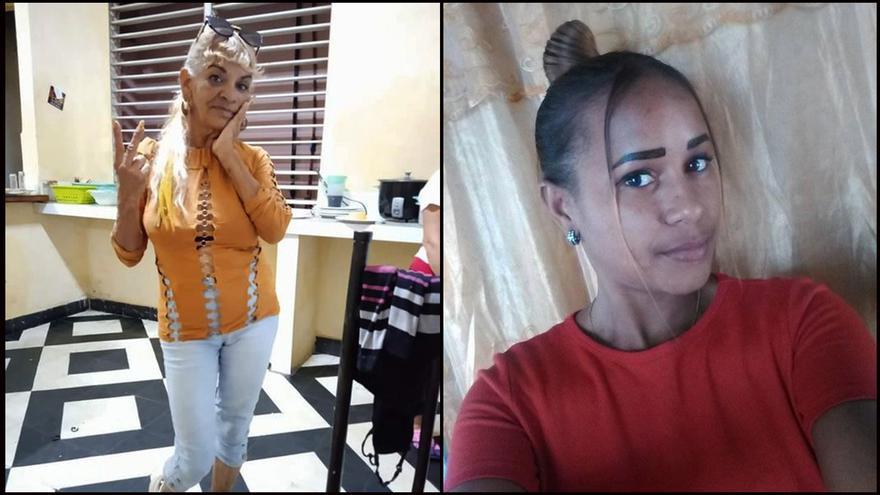
Miriam Isern Mompie and Yanet Mejías González, victims of sexist violence on the Island. (Collage/Facebook)

14ymedio bigger14ymedio, Havana, 21 June 2023 — The femicides of Miriam Isern Mompié in the municipality of Manzanillo (Granma) and of Yanet Mejías González in San Luis de Jagua (Santiago de Cuba), and the aggressions suffered by six trans women in Cárdenas (Matanzas) by a group of five men, raise the alert for the increase in sexist violence in Cuba.

Mompié’s body was found by her son last Sunday. The 59-year-old woman was “killed with a knife,” CubaNet published, along with a blow to the head. Her ex-partner, with a criminal record, was arrested the next day in the province of Camagüey.

Yanet Mejías González was killed by machete blows last Friday. Her former partner and perpetrator of the crime, Michael León, surrendered the same day.

Mirielis Garbán, cousin of the killer, told Radio and Television Martí that the subject “had already been imprisoned.” She also said that Mejías González, 24, worked at the Gustavo Machín Psychiatric Hospital and “had several family problems” after she separated from León.

With these two cases, there are now 44 femicides on the Island so far this year. continue reading

The platform Yo Sí Te Creo en Cuba (YSTCC) reported last Monday on Twitter that they were working on the information received about two alerts of sexist violence in Santiago de Cuba, one in Trinidad, another in Melena del Sur, and one recently reported in Manzanillo.

Violence against women is one of the issues for which there is no official information in Cuba, said the Alas Tensas Gender Observatory (OGAT). “This prevents citizens, civil society and academics from evaluating the extent of this social phenomenon.”

“In a country with more than 40 femicides in just the first six months of the year, the few existing resources are used by the political police to repress, imprison and silence women who want to be an active part of the political life of the country,” OGAT said, alluding to the “short-term” forced disappearance of activist Eroisis González.

This Wednesday, trans actress Kiriam Gutiérrez Pérez said that on the corner of Tenería and Rubí, in the Matanzas city of Cárdenas — a meeting place of the LGBTIQA community — a group of men threw stones and bottles, causing injuries to six trans women. In the police unit at Linea and Velázquez, the complaint was not accepted; the agents argued that “gender-based hate crimes are not processed.”

Those affected presented certified documents of the injuries and were stationed outside the municipal prosecutor’s office. “Enough of hate crimes, impunity, discrimination,” Gutiérrez Pérez demanded. “Cuba is getting worse every day. Women of all ages, boys and girls are raped, and the competent authorities do not act, except to repress those who dissent.”

Translated by Regina Anavy

____________

COLLABORATE WITH OUR WORKThe 14ymedio team is committed to practicing serious journalism that reflects Cuba’s reality in all its depth. Thank you for joining us on this long journey. We invite you to continue supporting us by becoming a member of 14ymedio now. Together we can continue transforming journalism in Cuba.
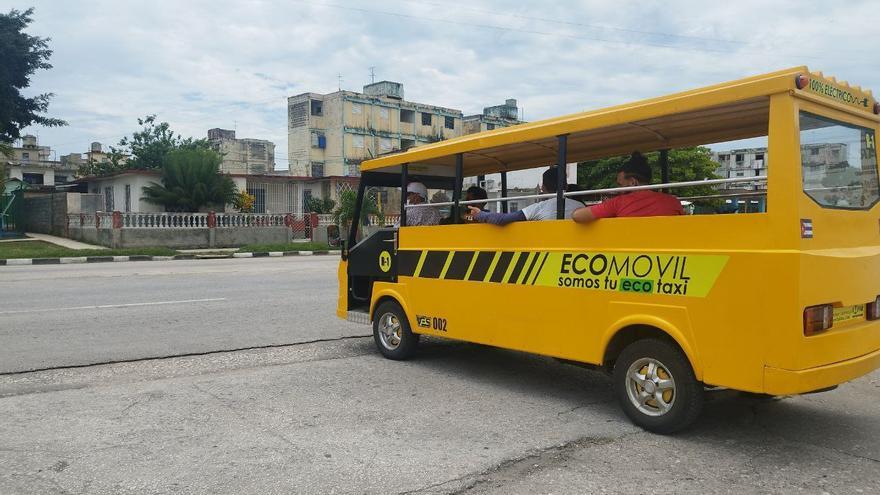
The Electric Minibus of Sancti Spíritus, an ‘Invention’ of the Cuban Military That Does Not Take Off

The vehicle does not have solar panels but a generic charger and a and a mess of cables whose design is a source of jokes for the locals. (14ymedio)

14ymedio bigger14ymedio, Mercedes García, Sancti Spiritus, 21 June 2023 — Almost three months of testing have not been enough for the electric minibus designed by the Armed Forces in Sancti Spíritus to stop being an experiment. The prototype of the vehicle, announced with great fanfare by the official press in April, is about to enter a rough terrain for its operation: the blackout season.

Those who manage to ride the eleven-seater minibus now wonder how the authorities will be able to propel the vehicle in the hottest months, with an overwhelming deficit of electricity and the multitude of passengers waiting to be picked up on the busiest route in the city: from El Chambelón to the hospitals, by way of the Central Highway.

The vehicle does not have solar panels but rather a generic charger — it incorporates energy very slowly — and a mess of cables whose design is a source of jokes for the locals. “They’re more expense than benefit,” one of the drivers complained aloud on Wednesday, while commenting on the sign that the garish yellow minibus has on its chassis: “100% electric.”

It is not known if the military will take the step to mass production. Technically, the bus continues to circulate in test mode, although it does so on a fairly well-paved and straight road. On the Central Highway – which divides Sancti Spíritus into two halves – there are also several key points for the population, such as the bus terminals, the hospital area and the space of the agricultural fair. continue reading

In April, when the local press praised the “clear coherence” of the army and its Military Industrial Company, it predicted that it would not be long before the yellow vehicles filled the streets of the province. It was, they said, a step to alleviate “the depressed state of public transport.”

They asked the authorities, of course, for “financial support” to maximize the potential of the “invention,” whose technical name is VES002. “The project is in the process of technical evaluation in order to know how it functions and the operating parameters that allow defects and problems to be corrected in advance,” said Escambray.

It was planned that, if everything went well, the military would start the production, taking advantage of the import of “five electrical supports,” starting points for the assembly. Once the “small fleet” was built, the Armed Forces planned to delegate the operation of the vehicles to an allied private enterprise. As of now, the business continues without much success.

Translated by Regina Anavy

____________

COLLABORATE WITH OUR WORKThe 14ymedio team is committed to practicing serious journalism that reflects Cuba’s reality in all its depth. Thank you for joining us on this long journey. We invite you to continue supporting us by becoming a member of 14ymedio now. Together we can continue transforming journalism in Cuba.
In the Midst of the ‘Desertion’ Crisis, Cuba Aspires to 70 Gold Medals in the El Salvador Games

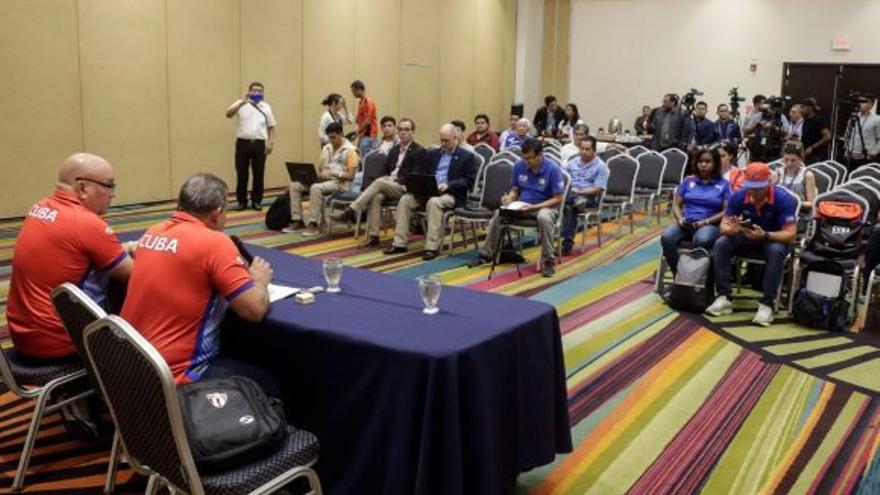
Cuba busca llevarse 70 medallas de oro, afirmó José Antonio Miranda en una conferencia de prensa celebrada en el hotel Crowne Plaza. (JIT)
Cuba seeks to win 70 gold medals, stated José Antonio Miranda at a press conference held at the Crowne Plaza hotel. (HIT)

14ymedio bigger14ymedio, Havana, 21 June 2023 — Despite the unstoppable exodus of Cuban athletes at foreign events, the sports authorities have great ambitions for the next Central American and Caribbean Games, which will be inaugurated next Friday in El Salvador. The Island will compete with 503 athletes in 32 sports disciplines and calculates that it has a chance to get second place in the competition, after Mexico.

According to the Salvadoran newspaper El Mundo, Cuba is one of the big favorites of the competition. The statements of José Antonio Miranda, the official to whom the National Institute of Sports (INDER) assigned the leadership of the delegation that traveled to San Salvador, are equally optimistic: Cuba seeks to take 70 gold medals, he said at a press conference held at the Salvadoran Crowne Plaza hotel.

To achieve the mark, Miranda affirms that the Island — “a world power” when it comes to sports — has an arsenal of athletes who, in total, have won 84 world titles, 69 silver medals and 82 bronze medals. The manager does not resist the temptation to compare his own medal table, with 235 medals obtained in the region: “After the United States, Cuba has won the most medals in the history of the area.”

At the head of the delegation are the judoka Idalis Ortiz, two-time world champion, who won several medals at the Olympic games in London, Rio de Janeiro and Tokyo, and the boxer Julio César La Cruz, winner, also on two occasions, of the Olympic belt, and five times of the World Cup. continue reading

Supporting these already historic athletes is a large number of athletes whose average age, Miranda said, is 23 years old. The official regretted that the Island saw its chances of winning more honors reduced due to the cancellation of several disciplines, such as women’s water polo, in which the Cuban delegation planned to stand out with 13 athletes.

About 380 members of the Cuban group — 75% — have experience in previous international events, while 123 make their debut in this competition. Miranda guaranteed that everyone had received excellent preparation to achieve “maximum performance” and that the contest will be the opportunity to “evaluate” the participation of a group of athletes in the 2024 Olympic Games, to be held in Paris.

Cuba’s strengths continue to be combat sports — boxing, wrestling, judo and fencing — but it has excellent possibilities in chess, canoeing, athletics, men’s volleyball, water polo and handball, and field hockey in both sexes.

On this last sport, Miranda avoided alluding to the escape of several of the members of the women’s and men’s delegations. In the case of the first team, three of its players managed to escape during the team’s training in Spain and now live as refugees in that country. Interviewed by this newspaper, they denounced the terrible living conditions to which they were subjected in their hostels on the Island.

Nor will the table-tennis player Thalia de Armas return to Cuba after her agreement with Club Jerez in Spain, where she traveled last May. According to sources of sports journalist Francys Romero, the habanera will seek to continue her career in Europe.

The decision, Romero said, is a break with INDER, which  managed the contract with Spain. Cases such as De Armas are, along with the abandonment of official delegations, increasingly frequent. Despite the difficulty of restarting her career in another country, the tennis player has something in her favor, says the journalist: her youth.

Thalia de Armas jugó 15 partidos con el Club Jerez y sólo perdió tres encuentros. (Facebook/Thalia de Armas)
Thalia de Armas played 15 games with Club Jerez and only lost three games. (Facebook/Thalia de Armas)

According to the statistics of the 2022-2023 season, in 15 games with Club Jerez, De Armas won 12 games and lost the remaining three, with a productivity rate of 80%.

Between May and so far in June, six Cuban athletes have used Spain as an escape door. Last Sunday, sports-shooting athlete Mitchell Onel Orellana left his team during training in Granada, where he was preparing for the Central American and Caribbean Games in San Salvador 2023. According to the official media Jit, this discipline faces numerous difficulties in achieving a successful training, due to the ” lack of bullets and electronic systems” of counting.

Orellana’s desertion was almost on a par with that of handball players Arisleydi Márquez, Yudisaday Rodríguez, Melisa Arias and Geidy Maceo, who took advantage of their stay in another European country, France, to escape.

Several weeks earlier, the discus thrower Denia Caballero left the Cuban team after winning the silver medal at the Meeting Diputación de Castellón (Spain) with a throw of 63.17 meters. According to Romero, since the beginning of this year the Cuban Athletics Federation “hindered” the athlete’s negotiations with Portugal, “breaching the management agreement with a club” and motivating her dissatisfaction.

Another Olympic medalist and world record champion, Yaimé Pérez, deserted after the Island’s sporting failure at the XVIII World Athletics Championship held in Eugene, Oregon.

Translated by Regina Anavy

____________

COLLABORATE WITH OUR WORKThe 14ymedio team is committed to practicing serious journalism that reflects Cuba’s reality in all its depth. Thank you for joining us on this long journey. We invite you to continue supporting us by becoming a member of 14ymedio now. Together we can continue transforming journalism in Cuba.
Cuba, a Country in Miraculous Static

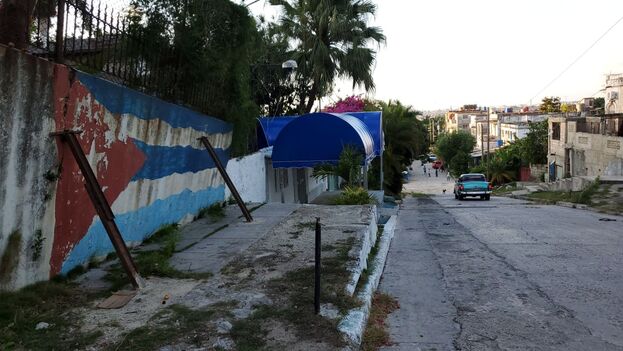
A Cuban flag “propped up” on D’Strampes street, in the Havana neighborhood of La Víbora. (14ymedio)

14ymedio bigger14ymedio, Yoani Sánchez, Havana, 22 June 2023 — The stalls were full of colorful magazines. To my childish mind, the Soviet Union was that place of intense colors, steaming bowls of soup, and smiling peasants seen in the photos of the many publications that came to Cuba in the 1980s. But beyond the propaganda, Moscow was , in fact, like a huge bear that held up the Island. It hugged us roughly: it controlled and propped up the whole country.

Cuban sovereignty has always been the preferred theme of patriotic speeches and the justification for refusing aid, rapprochement and dialogue, but there are few nations on the planet as in need of external support and foreign support as this one. Even the “golden age” of our insular socialism was nothing more than a period of time in which the Russian subsidy made it possible to supply the markets, build schools and finance all the nonsense that Fidel Castro came up with. The Kremlin paid for a showcase in our territory to attract the unsuspecting who believed that this false bonanza was the fruit of the development achieved from the chosen political system.

As soon as the USSR imploded, our bubble also burst. Curiously, the measures that Castro took to prevent social protests and the fall of the regime implied handing over new portions of sovereignty, but, on this occasion, not to Soviet comrades but to foreign investors who wanted to put their dollars on the Island. The cycle of dependency continued and, at the end of the last century, with the rise to power of Hugo Chávez in Venezuela, Havana found an oil patron willing to finance its failed economic model. We return to ‘tick’ diplomacy, that most practiced in the last six decades.

Now, Miguel Díaz-Canel winks at Vladimir Putin so that the Russian bear once again carries our weight and sustains us. The leaders of the Cuban Communist Party have the illusion that money will begin to flow from full hands, oil tankers will bring huge amounts of hydrocarbons from the Eurasian giant, free or at ridiculous prices, and Moscow will assume the costs of keeping this broken island afloat.  The word “sovereignty” will continue to be reserved for official tantrums before international organizations, while Putin’s interference in our affairs will grow every day.

Like a flag, painted on a wall in the neighborhood of La Víbora in Havana, which cannot be stand on its own without crude propping, Cuba is today a country that cannot even provide itself with eggs, sugar or coffee. The force of gravity pulls the wall to the ground with the same force that reality pushes the Cuban political system towards its extinction. The sovereign star is faded and a crack threatens to split it in two. It will end up collapsing and perhaps claiming a few lives in the fall. There is no beam that can withstand such weight, nor ally that can support much failure.

____________

COLLABORATE WITH OUR WORKThe 14ymedio team is committed to practicing serious journalism that reflects Cuba’s reality in all its depth. Thank you for joining us on this long journey. We invite you to continue supporting us by becoming a member of 14ymedio now. Together we can continue transforming journalism in Cuba.