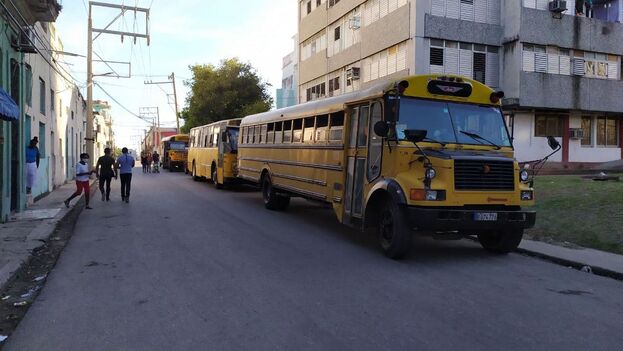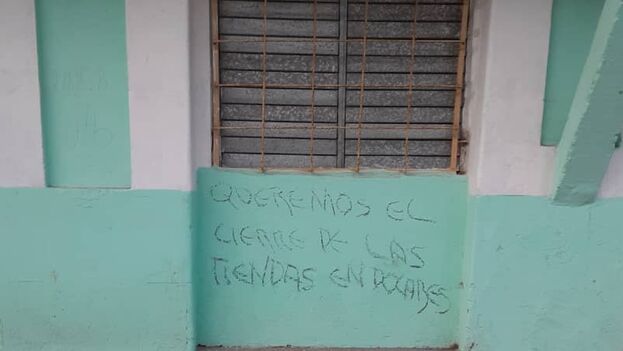

Slogans Against Cuban ‘Dollar Stores’ Painted on Walls in Cienfuegos

“We want the dollar stores closed.” (14ymedio)

14ymedio bigger14ymedio, Luis Daniel Fernández Monzón, Havana, 5 December 2020 — Several graffiti appearing on the walls in the small city of Cruces, in Cienfuegos province, surprised  the town’s inhabitants on Thursday. “Down with the dictatorship,” “We want the dollar stores closed,” and “Long Live Free Cuba, down with Dias [sic… it should be ‘Diaz’] Canel,” were the slogans featured.

The graffiti were painted during the night by unknown people on the facades of three houses on José Luis Robau street, at the corner with Paseo de Gómez (El Prado). The photos to illustrate this article were taken minutes before the authorities removed it.

As a consequence, there was a considerable deployment of police forces throughout the morning, a surveillance similar to the one that took place a few days ago in some commercial centers in Havana. With the difference that there are no dollar stores in Cruces at the moment, although it is said that one will open shortly.

The discontent of the population has increased since the Government determined last July to set up stores that sell food and cleaning products — that is basic necessities — but only take payment in freely convertible currency (MLC for its Spanish initials) — that is, foreign currency such as dollars and euros. In addition, shoppers must arrange through a bank to have a special magnetic card that carries the value of currency. (In this way, the State banks get the money before it is even spent.) continue reading

The closure of the dollar stores is precisely one of the requests of the San Isidro Movement, which considers that the measure divides society in two: those who have access to dollars and those who do not.
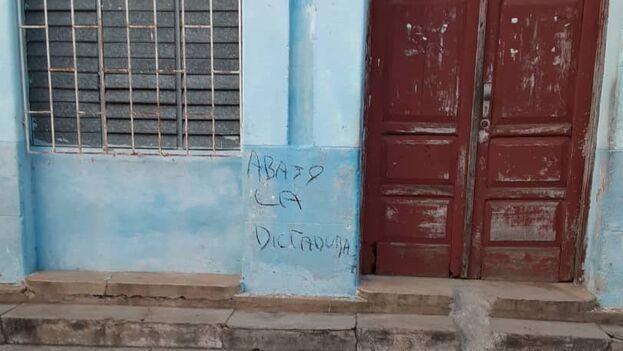
“Down with the dictatorship.” Following the appearance of the slogans there was a considerable deployment of police forces over the whole morning. (14ymedio)

In the afternoon of Thursday, the Cruces authorities organized an “act of redress” in Martí park, “in support of the Socialist Revolution and its leaders” and with songs by Silvio Rodríguez. At no time did the authorities make reference to the graffiti.

“They no longer know what to say, they no longer know what to do,” a resident told 14ymedio. “It is time to make the oppressors tremble. Now it is their turn to be afraid!”

The local media Radio Cruces reported a “revolutionary tángana” organized by the authorities in the municipality after the incidents. “Patriotic voices were raised in the Committee for the Defense of the Revolution number 7, in zone 21, located in the San José Popular Council of the municipality of Cruces,” the station explained.

“The counterrevolutionaries will not have any platform here, the counterrevolutionaries will not have the right to campaign against the Revolution here. It is over,” declared Elianis Sarduy, a student, at the official ceremony.
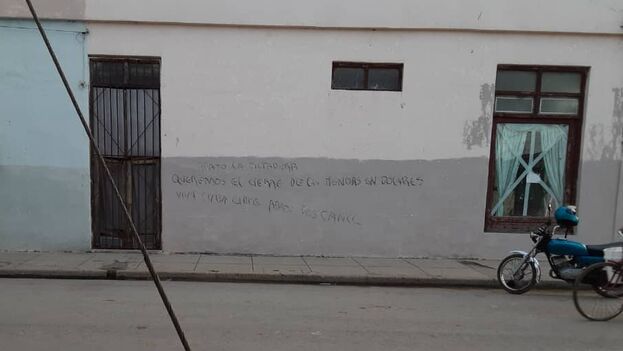
“Down with the dictatorship. We want the dollar stores closed. Long Live Free Cuba, down with Dias [sic] Canel.” (14ymedio)

This type of convocation has been taking place throughout the country after the hunger strike of several members of the San Isidro Movement and the protest of hundreds of artists in front of the Ministry of Culture in Havana, on November 27. The first of these “tánganas” took place in the Trillo Park of the Cuban capital and was attended by president Miguel Díaz-Canel.

The word “tángana” refers to student demonstrations against dictator Gerardo Machado in 1930, fueled by outrage at the death of 20-year-old leader Rafael Trejo. The pickets of young people gathered in the streets and squares to demand Machado’s resignation and their actions led to the end of his mandate.

____________

COLLABORATE WITH OUR WORK: The 14ymedio team is committed to practicing serious journalism that reflects Cuba’s reality in all its depth. Thank you for joining us on this long journey. We invite you to continue supporting us by becoming a member of 14ymedio now. Together we can continue transforming journalism in Cuba.
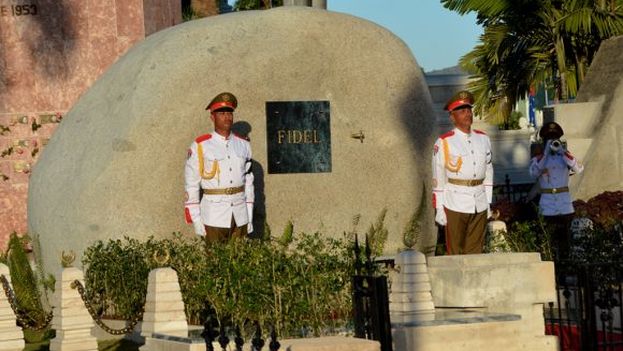
Bringing Fidel Castro Back From the Dead in Havana / Juan Juan Almeida

Mausoleum with the ashes of Fidel Castro, in Santa Ifigenia Cemetery in Santa Clara. (cc)

Juan Juan Almeida — On November 25th, the day on which we commemorate another anniversary of the death of Fidel Castro, a museum in his memory opened in Havana.

Located on Paseo Avenue between 11th and 13th Streets in El Vedado, Havana, the historic gallery shows pictures, gifts, photos, belongings, and other junk the ex-dictator Fidel Castro used in his life; ignoring the last wish of the dead comandante.

It’s worth remembering that on January 3rd, 2016, General Raul Castro publicly announced to the National Assembly that, to show respect for the express wish of his brother, the recently passed-away leader of the Cuban communists, his name would not be used, or any statues or busts put up in any public site, in his memory.

It’s also worth mentioning that — according to sources close to the dead commander-in- chief’s descendants — that the objects exhibited in such an overblown way, were not donated by his family, but sold.

At a cost of over $700m, the museum opened November 25th, and, among the strangest displays in this kind of church where the image worshipped is of the only saint wearing an olive green uniform and spurs, is a little audiovisual showing for the first time, among other things, the favourite cooking recipes of the legendary ex-comandante who moved from living in “Punto Cero” to pushing up the stones in the Santa Ifigenia necropolis of the history of the city of Santiago de Cuba.

Translated by GH

The Cuban Ministry of Culture Breaks the Dialogue By Rejecting the Artists’ Conditions

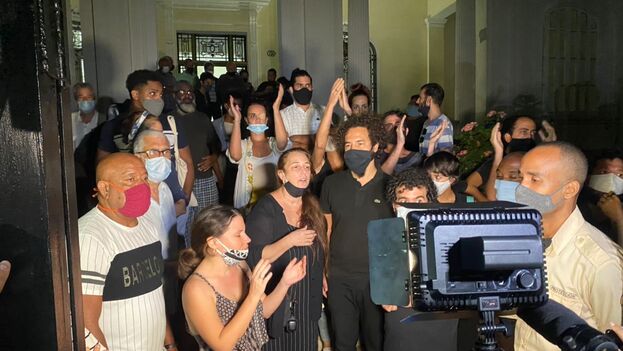
The moment when artists left the Ministry of Culture, after spending almost five hours meeting with Vice Minister Fernando Rojas. (14ymedio)

14ymedio bigger14ymedio, Luz Escobar, Havana, 4 December 2020 – Cuba’s Ministry of Culture announced this Friday in an official note that it will not meet with the artists who, on 27 November, Vice Minister Fernando Rojas promised to open a dialogue with, arguing “that they have direct contact and receive financing, logistical support and propaganda backing from the United States Government and its officials.” Nor will the ministry, he says, speak “with the media financed by US federal agencies.”

Thus, the Government has unilaterally broken the agreements it had reached with the artists, who are now being called by the name “27N” (i.e., 27 November), after a peaceful demonstration in front of the Ministry of Culture demanded to meet with the minister and was finally able to meet with the vice minister.

In its statement, the ministry does not recognize the reasons that led the group to raise the conditions and point out that it lacks “legitimacy and ethics” to address the institutions of Cuban culture. continue reading

The conditions were drafted and agreed upon after several debates between some of the 30 artists and intellectuals who participated in the 27N meeting, as a result, they explained, of the “persecution, harassment and criminalization” directed from the Government towards the participants of that meeting.

Among the conditions, 27N asks for “guarantees of security and protection” for those who are going to attend the meeting and “for those who want to be outside.”

In their document, sent to the Ministry of Culture by email, according to the official statement, the artists emphasized that the list of representatives sent to the Ministry is made up of people who were democratically elected by the 27N protesters and that therefore their presence in the meeting “cannot be negotiable.”

Another of the requests they made was that the lawyer Julio A. Fernández Estrada accompany them as legal adviser at the meeting.

The group noted that, as the topics on the agenda “exceed the powers” of the Minister of Culture, Alpidio Alonso Grau, they requested the presence of President Miguel Díaz-Canel, as well as authorized representatives from the Ministry of the Interior and the Ministry of Justice.

However, they explained that since the “agreements were violated,” and that in many of the official media only Vice Minister Fernando Rojas’ version of the meeting appeared, “with no possibility of our replying in that media,” and so they insisted that the independent press be present at the meeting with the minister, to cover the meeting.

As a last condition, the group requested that at the end of the meeting a joint public statement be made outlining all the agreements that reached between both parties.

“We do not consider it pertinent to appear at the meeting until these guarantees have been publicly given,” the group concluded its conditions.

In its note this Friday, the Ministry of Culture argues that “those who implemented this maneuver” have broken the possibility of dialogue by “trying to include” in the group people “who have excluded themselves” by “their attacks on national symbols, common crimes and frontal attacks on the leadership of the Cuban Revolution, under the guise of art,” without specifying who they are referring to, but clearly alluding to Luis Manuel Otero Alcántara.

In a text published by 27N this morning the group presented itself as a collection of “artists and intellectuals who are committed to demanding our rights through civic and peaceful means” with the aspiration of “an inclusive and democratic society.”

“We do not accept acts of violence or vandalism. We do not respond to the interests of foreign governments. We work solely to meet the demands of many Cuban intellectuals, artists and communicators to speak to the Ministry and the competent authorities,” they declare in response to the official media, which accused them of being in the service of the United States and of promoting violence with attacks on the newly constituted stores in Cuba that take payment only in foreign currencies through specially issued bank cards.

They also urge the national mass media “not to misrepresent the purpose of this negotiation, or hinder the necessary dialogue with half-truths and calls for discord.”

They ask the National Revolutionary Police and the Department of State Security of the Ministry of the Interior to “abide by the fulfillment of their function as guarantors of legality and to stop the persecution and harassment to which we are being subjected.”

Finally, they call on all Cubans, as well as the press and citizen voices, to stand with them at this time.

____________

COLLABORATE WITH OUR WORK: The 14ymedio team is committed to practicing serious journalism that reflects Cuba’s reality in all its depth. Thank you for joining us on this long journey. We invite you to continue supporting us by becoming a member of 14ymedio now. Together we can continue transforming journalism in Cuba.
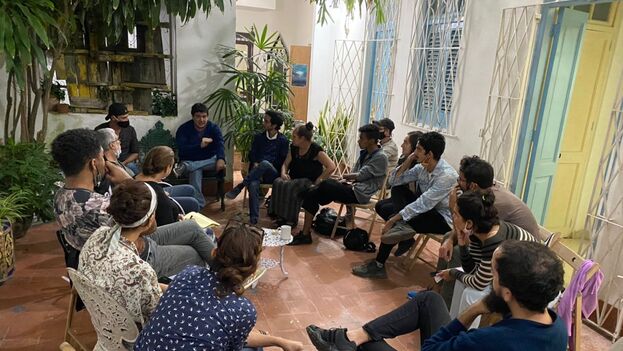
Despite the Arrests and Pressures from Cuba’s Political Police, Independent Artists Gather

Artists gathered at the Hannah Arendt Institute of Artivism to work on the agenda agreed with Vice Minister Fernando Rojas on November 27. (14ymedio)

14ymedio bigger14ymedio, Luz Escobar, Havana, 3 December 2020 — Luis Manuel Otero Alcántara was not the only one to be arrested this Wednesday. The harassment has continued in the last 24 hours against members of the San Isidro Movement and other independent artists.

Tania Bruguera was also arrested on Wednesday afternoon when she was on her way to the Hannah Arendt Institute of Artivism (Instar), which she directs, for a meeting with some of the 30 artists and intellectuals who participated in the meeting on November 27 at the Ministry of Culture, according to a source close to Bruguera.

“The group of 30 hasn’t rested, they’ve hardly slept, [meeting] in a democratic, respectful way, with open hearts,” said the artist in a direct transmission from Facebook, “so that progress can be made on the agenda items requested by the Ministry of Culture that we sent to him for the meeting that he asked us for this week.”

Bruguera claims that while they are meeting their side of the agreement, of the 30 artists who attended the meeting, there are six who have police surveillance at their homes and cannot attend the meetings and some members of the group were suffering harassment through pressure on their families. continue reading

She also said that they asked an “intermediary” to locate the Vice Minister of Culture, Fernando Rojas, “to inform him of what is happening,” since one of the reasons for the meeting on November 27 was “to finish once and for all” with police the harassment.

In another video posted on her networks, Bruguera responded to State Security accusations that she is “working with the United States Department of State” and “following a manual” to provoke a popular revolt on the island: “Never in my life have I communicated with the United States Department of State, I do not need any government to tell me what I have to do for my country, I do not need to contact any country to order me to do anything. I am a Cuban who has a sufficient sense of decency and of her citizens’ rights to demand them from the entities that have to guarantee them.”

Speaking to 14ymedio, the artist explained that it was “Colonel Alberto and agent Mario, as they call themselves,” who went to see her Tuesday night at her home.

“The colonel was the one who spoke the whole time,” declared the artist, “to tell me that I was destabilizing the Government, that I was creating subversion, following someone’s orders, working with the people of the State Department of the United States Government and that I was doing all this because I had read a little book. I asked him the title but he didn’t tell me. ”

Among the threats the officers made against Bruguera was that “they would take the most severe measures” against her. “I replied that I was not going to accept the accusations he was making because not only were they a lie, but they also had legal implications related to Law 88, where the punishments are extremely severe. He insisted on telling me: ‘We are not going to allow you to destabilize the Government or create subversion.”

The officials reproached her that she was doing all this “to gain an endorsement,” “something I did not understand,” she declared. “I told him that he was completely wrong, that he did not understand what was happening and that we were where we were because the Ministry of Culture asked us for an agenda and that is what we were working on.”

In addition, the artist requested that they no longer visit her and that the next time they went, they would take her to jail: “They will not threaten me with these baseless accusations,” she declared.

For his part, the poet Amaury Pacheco also confirmed that he has surveillance on his home “from very early in the morning.” According to the complaint, other members of the San Isidro Movement (MSI), such as Luis Manuel Otero Alcántara, Michel Matos, Aminta de Cárdenas and Claudia Genlui, are in the same situation.

The music producer Michel Matos was also arrested this Tuesday afternoon, according to Iris Ruiz, a member of the MSI, on her Facebook profile. “Michel Matos has just been arrested at the corner of 27th and 8th in El Vedado. Patrol Car 436. Two policemen and a woman,” Ruiz posted.

____________

COLLABORATE WITH OUR WORK: The 14ymedio team is committed to practicing serious journalism that reflects Cuba’s reality in all its depth. Thank you for joining us on this long journey. We invite you to continue supporting us by becoming a member of 14ymedio now. Together we can continue transforming journalism in Cuba.

Otero Alcantara Detained Again in Havana While Giving an Interview to ’14ymedio’

The State Security agent who intervened in the arrests of the independent artist Luis Manuel Otero Alcántara standing next to the curator Claudia Genlui Hidalgo. (Claudia Genlui)

14ymedio bigger14ymedio, Luz Escobar, Havana, 2 December 2020 —  The independent artist Luis Manuel Otero Alcántara was detained this Wednesday when he left the house of the journalist Mónica Baró and while speaking by phone with 14ymedio. A police patrol took him to his mother’s house, where a State Security agent forbade him to go out and “told him to spend his birthday with his family,” said the spokesman for the San Isidro Movement, Michel Matos.

The activist and curator Claudia Genlui Hidalgo broadcast live on her social networks the moment when Otero Alcántara was detained: “The truce is once again broken,” she commented.

While filming, Genlui Hidalgo approached the entrance to Baró’s house, which since the night before had a patrol at the front and where a State Security agent in pink pants and two uniformed women from the Ministry of the Interior remained. The young woman asked if she could access the house and the moment when she was also detained was recorded. continue reading

Shortly after the fact, the journalist Carlos Manuel Álvarez, who was inside the house, denounced the arrests. “They have just taken Luis Manuel Otero Alcántara and Claudia Genlui Hidalgo, who was on her way to see him, from the ground floor of the house on 7th and 32nd,” he wrote on his Facebook profile.

“Luis Manuel slept here yesterday, since [the house at] Damas 955 was uninhabitable, and now he was going to meet his uncle. Just yesterday they had released him and the only thing he has done since then is sleep,” Álvarez said. “It seems that in his dreams he committed a new crime,” the journalist commented sarcastically, before adding: “Today is his birthday [33 years]. The unjustified harassment continues.”

Otero Alcantará was arrested while he was explaining to this newspaper his decision to end his hunger strike after ten days. “When I got to the hospital (Fajardo) I felt that they wanted to leave me there for a long time and I did not want to give them justifications for that; that was one of the reasons why I stopped the hunger strike. The other reason is because I felt that, yes, I was still going to die, and it didn’t make any sense, I had to be in the race, warming up and creating above all, generating those areas of disagreement that they have with me against the system.”

“In every step that the government took against us, I felt that we were winning,” he says. “I am tremendously enthusiastic, I am optimistic, I see the changes, it happened with Bienal 00, Decree 349. I think we are in a context where a civil society is developing that can generate important changes for Cubans.”

“When those people (State Security agents disguised as doctors) went into our house in San Isidro to get us out (which was one of the planned exits and I think it was indisputably the best for us and the most awkward for them) and they didn’t let me go back, I felt that they didn’t know what to do with me, they saw me as a stone that didn’t want to fit where they wanted it and that it was like a snowball that was growing.”

____________

COLLABORATE WITH OUR WORK: The 14ymedio team is committed to practicing serious journalism that reflects Cuba’s reality in all its depth. Thank you for joining us on this long journey. We invite you to continue supporting us by becoming a member of 14ymedio now. Together we can continue transforming journalism in Cuba.

Customers Protest the Seizure of Vendors’ Merchandise in Santiago de Cuba

Customers in Santiago de Cuba protest the seizure of products from private-sector vendors.

14ymedio bigger14ymedio, Francisco Herodes Díaz Echemendía, Santiago de Cuba, November 28, 2020 — Authorities were confronted with outrage, criticism and rage from residents of Santiago de Cuba’s Barrocones neighborhood on Friday after they confiscated a privately owned truck, alleging that vendors were using it to sell meats and vegetables for exorbitant prices.

“They were selling bananas for 20 pesos and avocado for 15. They also had lettuce and tomatoes, none of which are easy to come by these days,” said one outraged resident, who was no longer able to buy what he wanted on the corner of Carlos Dubois and Procesa streets, where the vehicle had been parked.

“The government only sells low-quality products, which are also expensive. And that’s when they have them, which nowadays is not very often,” claimed the customer after the vendors had been shut down. continue reading

Government inspectors and uniformed police officers had tried to convince the sellers to lower their prices. After failing to reach an agreement, however, authorities decided to seize the contents of the truck, which was being used to transport onions, garlic, lettuce, tomatoes, chiles and cabbage.

“Here in the city the only way you can buy food is through the merolicos [self-employed street vendors], so people became angry and surrounded the police who were preventing them from operating,” said the resident.

Food shortages as well as increased prices for the few items that are available have led to a growing sense of despair among local residents. The tension has been exacerbated by a new outbreak of Covid-19 in recent days that put the region one step away from new restrictions intended to control transmission of the virus.

____________

COLLABORATE WITH OUR WORK: The 14ymedio team is committed to practicing serious journalism that reflects Cuba’s reality in all its depth. Thank you for joining us on this long journey. We invite you to continue supporting us by becoming a member of 14ymedio now. Together we can continue transforming journalism in Cuba.
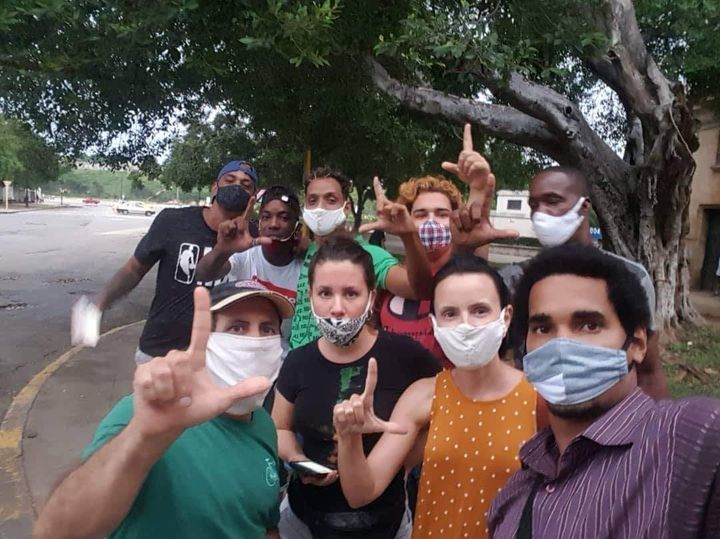
Organizations Speak Out Concerning the Wave of Repression in Cuba / Artículo 19 and Cubalex

Artículo 19 and Cubalex — Article 19 strongly condemns the wave of arbitrary arrests that have been taking place since Thursday, November 12, against independent journalists, human rights activists and political opponents in Cuba. These events have been accompanied by interrogations, threats, seizures of work equipment, beatings, among other assaults.

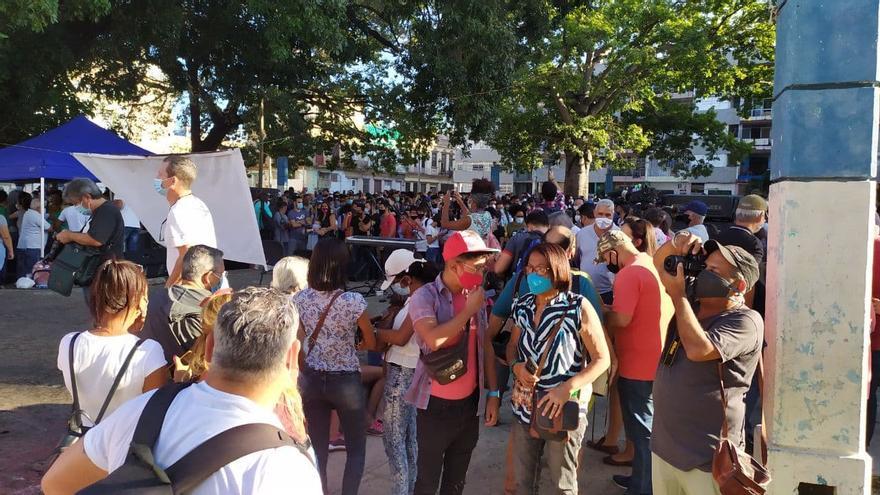
The aggressors have been agents of the Cuban State in their official capacity, belonging to the organs of State Security (Seguridad del Estado), Military Counterintelligence (Contrainteligencia Militar) and the National Revolutionary Police (Policía Nacional Revolucionaria, PNR). As part of the modus operandi of these officials, detainees have been transferred to several police stations in the city and have remained missing on average for more than twelve hours.

Arbitrary arrests began on November 12, when a group of activists, journalists, artists and opponents concentrated in the vicinity of the Cuba and Chacón police station, in the municipality of Habana Vieja, Havana, to demand the release of Denis Solís González. He had been arbitrarily arrested a few days earlier and transferred to that police station. In his detention, the most basic guarantees of due process were violated, and on Friday, November 13, it was said that he was allegedly transferred to Valle Grande prison in western Havana for a summary trial for the alleged commission of a crime of Contempt. continue reading

The people who were arrested during these days were: Iliana Hernández Cardosa, Luis Manuel Otero Alcántara, Héctor Luis Valdés Cocho, Anamely Ramos González, Denis Solís González, Juan Antonio Madrazo Luna, Maykel Castillo Pérez, Oscar Casanella, Omara Ruiz Urquiola, Katherine Bisquet, Adrián Rubio, Jovián Díaz Batista, Jorge Luis Estien Bryan, Alfredo Martínez, Michel Matos, Lázaro Yuri Valle Roca, Eralidis Frómeta, Yunier Gutiérrez and Yasser Castellanos. As of today, Sunday November 15, some of these citizens still persist in their demands in front of police facilities.

These facts constitute a flagrant violation of international obligations for the protection and guarantee of human rights, which the Cuban State has assumed under International Law (Derecho Internacional). It is also a violation of the recommendations made under the universal system of protection of human rights, both by bodies and agencies belonging to it, as well as by other States during the last Universal Periodic Review of the Republic of Cuba (Examen Periódico Universal de la República de Cuba) in 2018. Similarly, the arrests of these persons are violations of inter-American and universal standards concerning the rights of assembly and peaceful demonstration, freedom of expression, the right to individual freedom and security, due process, access to justice, among others.

The article Organizaciones se pronuncian por la ola de represión de Cuba was first published in Cubalex. Indexing topic: San Isidro Movement (MSI)

Translated by: Hombre de Paz


Cuban Authorities Broke the Agreements with Artists, Denounces Tania Bruguera

Tania Bruguera, at the Instar headquarters, accompanied by other artists who were present at the meeting on November 27 with Vice Minister of Culture Fernando Rojas. (14ymedio)

14ymedio bigger14ymedio, Luz Escobar, Havana, 30 November 2020 — Three of the five agreements reached on November 27 between independent artists and cultural authorities — beginning with the release of the young rapper Denis Solís, sentenced to eight months in jail for alleged contempt — did not last 24 hours, Tania Bruguera denounced in a press conference called this Sunday at the headquarters of the Hannah Arendt Institute of Artivism (Instar), which she directs.

Bruguera, who accompanied some thirty artists in a meeting of more than four hours with the Vice Minister of Culture Fernando Rojas, harshly criticized National Television for focusing on discrediting the San Isidro Movement and Denis Solís with alleged links to “terrorist” and “counterrevolutionaries.” In that “special program” they interviewed Vice Minister Rojas, who acknowledged that “it is not usual for us to have to react to a request formulated in this way.”

“There are police in the homes of artists, journalists and art critics,” Tania Bruguera told 14ymedio. Luis Manuel Otero Alcántara was in a hospital against his will, after he asked to go home. In addition, Fernando Rojas gave a distorted image of what happened at the meeting. Conclusion: in less than 24 hours they broke the agreements.” continue reading

Bruguera denounced that Rojas promised them that the government would not “defame and criminalize” the artists, and yet they were branded “mercenaries” in the media. Regarding the case of Denis Solís, the artist said that in the meeting with the vice minister “he was not asked to explain the legal processes of the country,” in reference to the long part of the official program dedicated to “due process,” “but to use his influence and power to intervene in [Solís’s] liberation.”

The artists present at the press conference called for an end to the repression and discrediting of the San Isidro Movement and demanded freedom of expression and association not only for themselves but for all citizens.

The filmmaker Gretel Medina told this newspaper that the demands they expressed “were not met” at the meeting but what happened “was unprecedented” and she considers that the first achievement of that day “was the union.”

“All of us who were before these officials agree, in one way or another, on the need to respect the right for every citizen, whether they belong to the creative community or not, to say what they think without fear of being repressed by State Security,” declared the visual artist Julio Llopiz-Casal.

Bruguera stressed that to decide the next steps, everyone’s opinions must be taken into account, because it is a heterogeneous group that is not only made up of the 30 participants in the meeting with the vice minister, but also others such as Luis Manuel Otero Alcántara and Anamely Ramos, who could not be there: Alcántara because he is hospitalized against his will and Ramos because of a police operation that prevents her from leaving her house.

Rapper Maykel Castillo ’Osorbo’, also under police surveillance, remains on a hunger strike and is in a “very delicate condition,” according to a statement from the San Isidro Movement on Sunday.

In the document, they note that on Saturday Iris Ruiz, Katherine Bisquet, Claudia Genlui, Michel Matos, Yasser Castellanos and Amaury Pacheco were detained for a few hours, when they left a visit to Maykel Castillo, and they ask that the “authoritarian opportunism be stopped in the context of the pandemic to avoid possible contagion as an excuse to isolate the members of this organization.”

In addition, they list other specific requests, among them, that “the Catholic Church” can visit Luis Manuel Otero Alcántara at the Fajardo hospital to “provide him with emotional support” and that “medical personnel proposed by the San Isidro Movement can verify the state of Maykel Castillo’s health.”

The group asserts that they distance themselves from “any violent act that is occurring or may be generated,” and urge the international community to continue “vigilant over the physical integrity of all members of this organization, other artists and activists determined to vindicate our rights to live in a country of freedoms.”

More than 70 students, graduates and former professors of the Instituto Superior de Arte (ISA) delivered a letter to the dean’s office on Saturday in support of Anamely Ramos, who expressed thanks on her social networks for the gesture. “The courage of my students in a moment as hard as this is something that I am still processing,” she expressed on her Facebook wall.

Meanwhile, the collective continues to receive more support from the art world. Figures such as Haydée Milanés, Carlos Varela, Leoni Torres, Yuliet Cruz, Fernando Pérez, Jorge Perugorría have been joined by the musician Cimafunk, who said, in a post on his Facebook wall, he was “proud” of his colleagues “because they are using their voices, their words and their peaceful behavior to share with us their realities and their vision of prosperity, well-being, freedom and peace.”

The recognized Afro-Cuban artist explains that he is not in Cuba at the moment “for family and professional reasons,” but he feels represented by the artists who demonstrated in front of the Ministry of Culture on Friday, “and those who were not there for various reasons, but who have shown us support from wherever they are.”

_______________

COLLABORATE WITH OUR WORK: The 14ymedio team is committed to practicing serious journalism that reflects Cuba’s reality in all its depth. Thank you for joining us on this long journey. We invite you to continue supporting us by becoming a member of 14ymedio now. Together we can continue transforming journalism in Cuba.

Cuban Internet Users Denounce ‘Intermittent Blocking’ of Social Networks

As of last Saturday, the incidents of “intermittent blocking” of the social networks in Cuba have been counted in the hundreds. (14ymedio)

14ymedio bigger14ymedio, Havana, 30 November 2020 — “Facebook isn’t working,” “Twitter can’t be opened,” and “WhatsApp messages aren’t going out,” Cuban Internet users denounced over the weekend. Since last Saturday the reports of “intermittent blocking” of social networks have been counted in the hundreds, in addition to interruptions of mobile data services as well as the State communications company’s home internet service, Nauta Hogar.

“I can only get into Instagram and Signal, to go to the other networks I have to activate the VPN [Virtual Private Network],” Havana resident Igor Medina, 23, told 14ymedio.

“Starting at noon everything got slow, but in the afternoon the blockade came, it was intermittent, sometimes everything worked and sometimes nothing. WhatsApp was impossible, it connected and disconnected, the same with Telegram, Facebook and Twitter,” he added. continue reading

Several users interviewed by this newspaper explained that only by activating a VPN could they access instant messaging services and social networks that are regularly available on the Island.

The strategy of canceling the internet connection from mobile phones or blocking access to online services has been frequently used by the Cuban authorities since internet service on mobile phones was first made available in December 2018.

In these last two years, digital spaces have become a public square for debate and civic convocation, as well as serving as a platform for feminist movements, animal protection, artistic creation and independent journalism, among others. A ferment of proposals and opinions that the ruling party does not seem willing to tolerate.

Several experts consulted by this newspaper point out that the blockades in recent days point to the implementation of a firewall similar to the one implemented by the Chinese authorities. With this, the government can filter content, monitor content sharing, and also create an “internet blackout” whenever it sees fit.

The antecedents in recent weeks have been the censorship against the instant messaging application Telegram and also the blocking of several very popular VPNs on the Island. Now, the fear is that these cuts will extend to other tools widely used to circumvent censorship against digital sites.

The blockade of these tools began a few hours after the protest of more than 300 artists in front of the Ministry of Culture (MINCULT) last Friday, in response to the repression that the Government unleashed the day before against the headquarters of the San Isidro Movement, in Old Havana.

“Since yesterday the WhatsApp application in Cuba has been working intermittently. What could be happening?” Rosalía Viñas, a resident of Pinar del Río and a member of the editorial team of the magazine Convaciónasked in a tweet.

Viñas pointed out that outside of Cuba the above mentioned networks were functioning without any problem, “a fact that I verified with different friends who live abroad,” she said.

“After the peaceful demonstration in front of MINCULT, which had good coverage on the networks and kept many Cubans informed of what was happening there, it made the government very nervous, to the point that once again it violated freedom of expression, and the rights of online users by unjustifiably blocking services,” she added.

For this weekend other calls had also been launched to demonstrate in the streets, one in front of the Ministry of Internal Commerce, in Old Havana. The call sought the closure of stores that since last summer sell food and hygiene products which buyers can purchase only with foreign currency.

The initiatives also included a demonstration in front of the United States Embassy, in El Vedado, with the aim of protesting against the repression unleashed by the Government.

In the Parque de la Libertad in Matanzas several young people decided to sit down on Saturday night in a peaceful way to show solidarity with the San Isidro Movement but some were detained by the authorities. Similarly, a demonstration was called in Santa Clara for this Monday afternoon “for a Cuba of free thought.”

____________

COLLABORATE WITH OUR WORK: The 14ymedio team is committed to practicing serious journalism that reflects Cuba’s reality in all its depth. Thank you for joining us on this long journey. We invite you to continue supporting us by becoming a member of 14ymedio now. Together we can continue transforming journalism in Cuba.

A Not So "Spontaneous" Gathering in Havana’s Trillo Park

The event “Tángana en el Trillo. Youth for Socialist Democracy,” was a demonstration in response to recent criticisms from the Cuban artistic community. (14ymedio)

14ymedio bigger14ymedio, Juan Diego Rodríguez, Havana, 30 November 2020 — To the rhythm of pro-government slogans, with great coverage by the official press and the presence of Cuban President Miguel Díaz-Canel, the event “Tángana en el Trillo. Young people for socialist democracy,” was held this Sunday in Havana, a demonstration in response to recent criticisms from the Cuban artistic community.

Despite the fact that the initial convocation remarked that the participants in Tángana had planned the meeting “spontaneously,” the outskirts of Trillo park were guarded by a strong State Security operation, in addition to buses and state cars that transported many of the attendees.

Among the several hundred people who participated in the event in Centro Habana, there were also some workers in their uniforms of state entities, such as the employees of the Construction Company of Architecture Works (Ecoa), frequently used by the Government for this type of public events. continue reading

The Sunday afternoon had moments with live music, others in which the reading of poetry and the fiery speeches of young communists prevailed. Among the slogans most repeated by the crowd were official slogans such as “Long live Fidel,” “Long live the Revolution” and “Continuity, continuity.”

The gathering was not lacking the support of Miguel Díaz-Canel, who appeared in the middle of the event and gave a speech. “They have put on a media show for us,” said the president without mentioning names, but in clear allusion to the artists who met last Friday in front of the Ministry of Culture and the members of the San Isidro Movement.

Díaz-Canel considered the actions of independent activists and artists as part of “an unconventional war strategy to try to overthrow the Revolution”, originating from “the Trumpistas and the anti-Cuban mafia” in the United States. He also affirmed that in Cuba “there is space for dialogue for everything that is Revolution.”

Díaz-Canel’s statements come two days after some thirty artists, representing several hundred who stood in front of the Ministry of Culture, agreed with sector officials on a list of demands aimed at ending the repression against the creators and the beginning of a dialogue between both parties.

Despite the fact that the initial call for the gathering claimed that the participants in Tángana had planned the meeting “spontaneously,” the area around the park was full of state buses that brought hundreds of people. (14ymedio)

“We are here to democratize socialism,” a young man from the Higher Institute of International Relations who participated in the event told 14ymedio. The young man listed the steps for this process as “eliminating racism and social classes.”

“They say they are the majority but there are not so many people,” a neighbor from a concrete block with balconies facing Trillo Park told this newspaper. “Here whenever they put out a truck to sell beer or rum, more people gather,” says the woman who preferred anonymity. “I’ve seen a lot of those who got away as soon as they had a chance.”

Among those who only stayed for a few minutes was a group of employees from the National Institute of Sports, Physical Education and Recreation (Inder) who at the beginning of the music walked along Hospital Street towards Zanja Avenue, until they left behind the sound of the slogans, and the applause.

____________

COLLABORATE WITH OUR WORK: The 14ymedio team is committed to practicing serious journalism that reflects Cuba’s reality in all its depth. Thank you for joining us on this long journey. We invite you to continue supporting us by becoming a member of 14ymedio now. Together we can continue transforming journalism in Cuba.