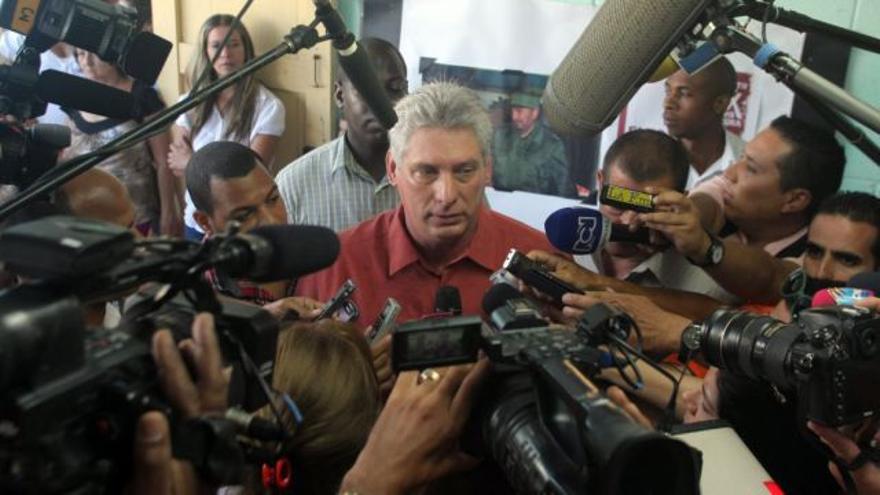
Castro Says Diaz-Canel’s Rise "Was Not the Result of Haste or Chance"

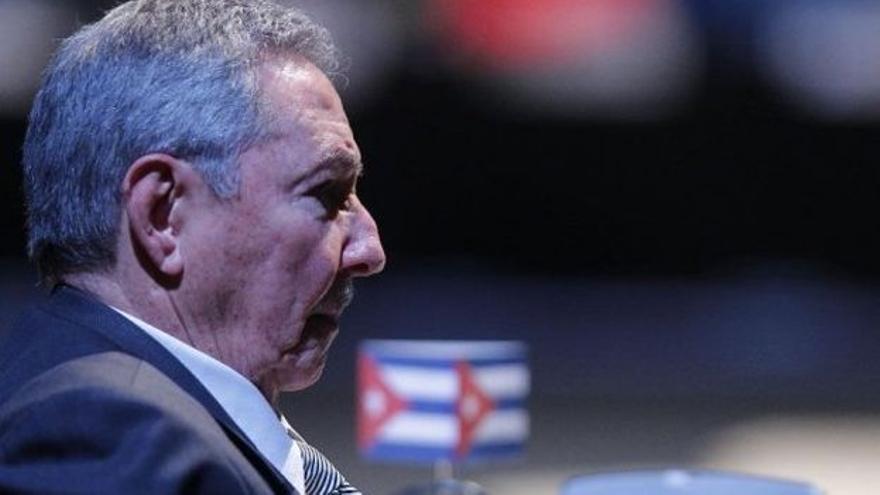
Raul Castro (EFE)

14ymedio bigger14ymedio, Havana, 19 April 2018 — Cuba’s new president, Miguel Díaz-Canel, will not take over as head of the Cuban Communist Party (PCC) until General Raúl Castro’s term as its leader ends in 2021. Castro himself acknowledged this in a speech last Thursday before the National Assembly as he handed the presidency over to his successor.

“This has been long planned,” explained the former president, casting aside any suggestion that spontaneity played a role in the selection of the new president, a 57-year-old electrical engineer.

Castro also referred to a program of constitutional reforms, which he was unable to fully implement. These include, among other things, a maximum of two five-year terms for the head of state. continue reading

Though this particular reform will be ratified, there will be no change to the basic strategic objective: a continuation of the socialist system of government. Article 5 of the Cuban constitution, which provides for the Communist Party to play a leading role in state and government, will be retained.

Another idea floated by the general is the creation of an office of prime minister to attend to matters related to governance. Constitutionally, however, the presidency of both Council of State and Council of Ministers in Cuba are held by the same person.

“We have been having extensive discussions about the formulation to be presented,” said Castro, referring to a future change of command in the Communist Party. He mentioned the possibility that Díaz-Canel might take over as head of the PCC sometime between 2021 and 2031, while in 2028 someone would take over as head of government.

Castro praised his successor’s background, referring to him as a “survivor” of past leadership stuggles. Díaz-Canel is part of a generation of promising younger leaders, others of whom were sacked over allegations of corruption or for being too politically ambitious.

Díaz-Canel “turned out to be the best,” said the former president, who made it clear that he has been grooming his successor for a long time.

“This was not unplanned” and “his rise was not the result of haste or chance,” he added. He emphasized that Díaz-Canel’s “strongly held ideological beliefs, political sensitivity, and commitment and loyalty to the Revolution.”

The former president expressed regret over the slow pace of the reforms begun at the start of his administration. Some of the goals, such as consolidating the country’s two-currency system, eliminating the ration book and increasing foreign investment were never met.

He said that the small private business experiment known cuentapropismo, which began under his leadership, will continue to grow. He regretted, however, that the “lack of attention” to this economic sector which, in his view, has given rise to “more than a few manifestations of impropriety and tax evasion in a country where hardly any taxes are paid.”

The government has suspended issuing licenses to individuals hoping to open their own restaurants or rent out rooms in their homes to foreign tourists. Currently, half a million Cubans are self-employed.

Castro gave special emphasis to the racial composition of the new National Assembly. “Women and blacks in particular have received the best training in this country,” he said, adding that he had faced resistance on this issue. “Now we must place them in decision-making positions.” He gave several examples of how he himself had ordered that some television presenters be black.

“It looks like we already have a big black guy giving the weather report,” he said to laughter and applause from the delegates.

Many human rights activists have been critical that mulattos and mestizos hold few positions of power in Cuba despite the fact that they make up more than 40% of the population according to the 2012 census.

The former president dedicated much of his speech to foreign policy and reaffirmed that he regards the current American administration, notably Donald Trump, as his main enemy.

“Since the current president took office, there has been a calculated deterioration in relations between Cuba and the United States, and an aggressive and threatening tone prevails.” He described as “insulting” the presidential memorandum that Trump signed in Miami in the company of members anti-Castro exile community.

The first secretary of the PCC recalled that “one of the principle tactics of the enemies of the Revolution is to infiltrate, confuse, divide and alienate the youth from the revolutionary process.”

In contrast, Castro again affirmed his loyalty to Russia. “We will never take for granted nor ever forget the support of the peoples who made up the former Soviet Union, especially the Russian people,” he said.

“We will fight all attempts to manipulate the subject of human rights,” added the Cuban leader, who in one decade was responsible for the arrests of at least 52,820 people on political grounds according to figures published by various independent organizations.

_____________________________

The 14ymedio team is committed to serious journalism that reflects the reality of deep Cuba. Thank you for joining us on this long road. We invite you to continue supporting us, but this time by becoming a member of 14ymedio. Together we can continue to transform journalism in Cuba.

Ovidio Martin: Those Were Terrible Months

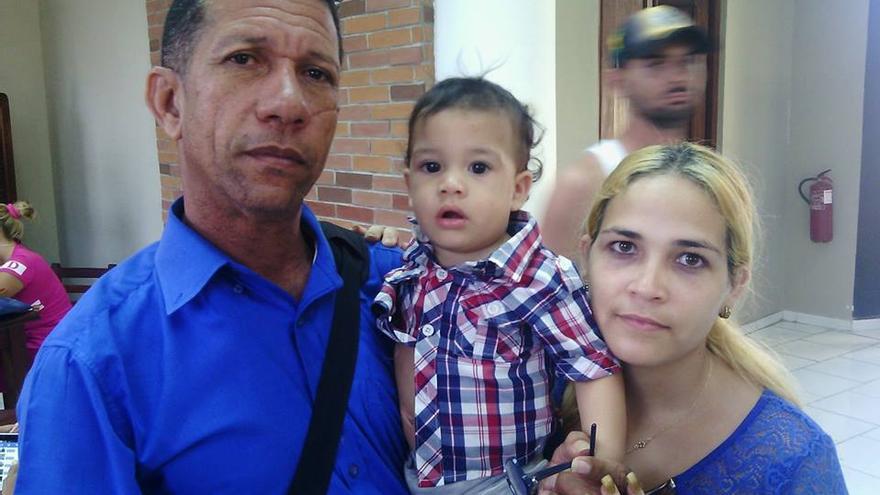
The UNPACU activist, Ovidio Martín Castellanos with his family. (Courtesy)

14ymedio bigger14ymedio, Havana, 23 April 2018 —  Ovidio Martín Castellanos, one of the national coordinators of the Patriotic Union of Cuba (UNPACU), was released this Friday after spending eight months in prison. The activist was accused of the crime of assault, but never came before a court, he says in conversation with 14ymedio.

“Two agents of the political police and an investigator arrived at the prison in Mar Verde where I was detained and they did not explain much before releasing me, only that they were going to convert the measure of preventive detention for one of immediate freedom and that was it,” he recounts. continue reading

Without any formal paperwork being filed, Martín Castellanos was detained in the maximum security prison in Santiago de Cuba, from where he continued to report human rights violations, in this case against the inmates, efforts that earned him reprisals from the prison authorities.

Last March, his wife the activist Zenaida Rams held a public protest at Parque Céspedes, in the city of Santiago de Cuba, denouncing the arbitrary arrest of her husband and demanding his immediate release. State Security then threatened to “worsen” the conditions under which Martin Castellanos was being held in prison.

The opponent was arrested on August 19, while participating along with other members of UNPACU and their families in a recreational activity at the San Luis camping site, near the Ullao river.

The police appeared on the scene and arrested dozens, including Martín Castellanos, who was beaten and accused of assault, according to what several witnesses told this newspaper. His family did not even hire a defense lawyer, since the legal process against him was never started.

During his stay in prison, the 51-year-old dissident refused to enter the so-called re-education program and was taken to a punishment cell on several occasions for his attitude.

“In the prison many needs were not met, there was a lack of medical attention, without minimum conditions, little food, bad and poorly prepared, and often they served rotten food,” he says.

“After eight months in jail for an injustice I remain firm,” he concludes.

UNPACU is the opposition organization with the largest number of political prisoners in Cuba, with almost fifty incarcerated, most of them for alleged crimes such as contempt of authority, assault or the crime of “pre-criminal dangerousness.”

__________________________

The 14ymedio team is committed to serious journalism that reflects the reality of deep Cuba. Thank you for joining us on this long road. We invite you to continue supporting us, but this time by becoming a member of 14ymedio. Together we can continue to transform journalism in Cuba.

’Actuar’ Offers Lynn Cruz a New Contract, Only to Fire Her the Following Month

“Following Orders” Note: Our apologies that this audio file is not subtitled in English

14ymedio bigger14ymedio, Luz Escobar, Havana, 24 April 2018 — The director of the Actuar agency, Jorge Luis Frías Armenteros, acknowledged that irregularities were committed by excluding the actress Lynn Cruz from the catalog of that state entity. Today the actress has posted on the internet the audio of the labor hearing that was held last Friday in Havana, after her protest.

Cruz appealed her exclusion from the agency representing actors and her case reached the body overseeing labor justice. During the oral hearing, Frías accepted that the 30-day period to notify her of the agency’s decision had been violated, but justified the expulsion because of the “critical protests” about the government that the actress publishes on social networks. continue reading

The labor trial lasted more than an hour and a dozen functionaries from Actuar were present, Cruz told 14ymedio. The view reminded her of “the judgments of the parametración* era,” a purge in the artistic sector that took place in the 70s, when homosexual, religious and artists not in sympathy with the regime were sanctioned.

“At times I felt like I was in an asylum, it was insane to see how they tried to bring to 21st century methods of the 70s,” laments Cruz who was the accuser, but ended up being accused of writing on her Facebook wall opinions contrary to the political system from the country.

Recently Cruz was informed all of a sudden that Actuar was not going to continue representing her and that lack of representation was used by the International Film School of San Antonio de los Baños to exclude her from the institution’s workshops.

To free himself from Cruz’s accusation, Frias proposed to the actress during the trial that the agency would hire her again for a month with the sole purpose of expelling her, this time, without violating any clause of her contract.

Cruz refused to support that proposal and says that with her appeal she seeks to obtain a document that records the true reasons for her expulsion. In a recent interview with 14ymedio, she said that after what happened with Actuar she feels “freer” than before. Frías affirmed in the hearing that “by agreement of the [Actuar] Board of Directors…the demonstrations” of Cruz on the Internet have been considered “offensive to a group of leaders and executives of the Government, the Party and the Ministry of Culture.”

Without mentioning specific names or citing a single one of the offenses, the official also said that “these demonstrations do not correspond to the ethics and principles” that the Agency represents and defends.

Born in Havana, in 1977, Lynn Cruz has worked for television in cop shows and also in movies in films such as Larga Distancia oand La Pared.

The attack against the artist began after she participated in several creative projects promoted outside the country’s official cultural institutions. She is also a contributor to some independent media such as Havana Times.

Last November, the harassment of State Security prevented the public from attending a performance of her work, The Enemies of the People in the independent gallery El Círculo.

*Translator’s note: Parametración/parameterization: From the word “parameters.” Parameterization is a process of establishing parameters and declaring anyone who falls outside them (the parametrados) to be what is commonly translated as “misfits” or “marginalized.” This is a process much harsher than implied by these terms in English. The process is akin to the McCarthy witch hunts and black lists and is used, for example, to purge the ranks of teachers, or even to imprison people. See here, and here.

_________________________________

The 14ymedio team is committed to serious journalism that reflects the reality of deep Cuba. Thank you for joining us on this long road. We invite you to continue supporting us, but this time by becoming a member of 14ymedio. Together we can continue to transform journalism in Cuba.

Cuba In Search of Lost Time

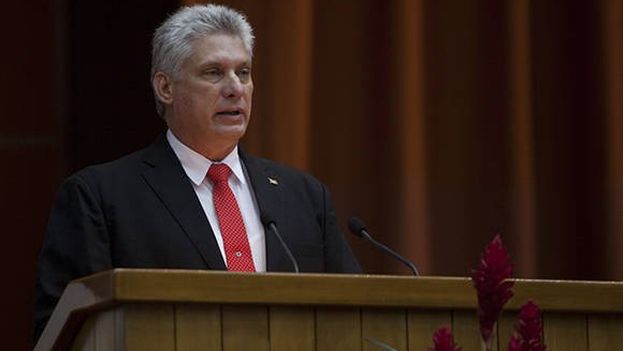
Díaz-Canel during his first speech as president of Cuba. (Screen Capture)

14ymedio bigger14ymedio, Carlos Malumud, Madrid, 23 April 2018 — The transfer of power at the highest level gave rise to a lively debate about the nature and depth of change in Cuba. The predominant Lampedusian* line insists that despite the rise of Miguel Díaz-Canel and the stepping aside by Raúl Castro, little or nothing has changed. A more optimistic version believes that this may be the beginning of relevant transformations. However, along with the magnitude of the share of power effectively ceded by Castro, lies the legitimacy and survival of the revolutionary experience.

The feeling that time has been systematically wasted to end up getting nowhere is an essential element of the daily reflection of many Cubans. The poet Rafael Alcides, still self-exiled, wrote in 1970: “The past and the future have already passed. / Everything we had we lost / and it was more of what we could have.” The troubadour Ray Fernández also insists that in the current context there is no future and he sings in El Bucanero: “Forget the treasure / because we lost the map.” So important is time in Cuba that from the beginning of the official discourse everything positive begins with the Revolution, and before that the island was only a brothel marked by vice, backwardness and exploitation. continue reading

That is why many people inside and outside of Cuba wonder if the fact that a Castro is not leading the government, or that the new president is not a military man and was born after the Revolution, will make a difference. Could Diaz-Canel make up for lost time and lead his people to the Promised Land? Attending to their protests will be difficult, especially if he thinks of political reforms oriented to democratizing the regime.

The new president has recognized the hegemony of the Revolution in line with Article 5 of the Constitution, which establishes the supremacy of the Communist Party, “the highest leading force of society and the State.” He has also emphasized the leadership of Raul Castro in the next stage, who will continue to spearhead “the decisions for the present and the future of the nation.”

The economic situation and the well-being of Cubans will be an essential question in this new stage. In regard to these issues, Diaz-Canel will put into play a good part of his prestige and authority. And here, as on another open front, nothing will be easy, especially since the collapse of aid from Venezuela. The demonstrations in Nicaragua, violently repressed by the Ortego-Murilla couple, are strong proof of this.

The principal alibi of the Cuban government, reinforced by the presence of Trump, is once again the United States. The anti-imperialist rhetoric and the effects of the ‘blockade’ will again justify the lack of reforms or their paralysis. But the only ones responsible for the political policies put at the service of their society are Cuba’s rulers. They must decide and execute even if the price paid is painful and until now the fear of a social reaction has been more a brake than a stimulus. Can Diaz-Canel advance where Raúl Castro did not?

Translator’s note: “In political science terminology, ‘gatopardism’ or ‘lampedusian’ are often used to refer to seemingly revolutionary policies and institutional changes that in practice only superficially alter power structures whilst retaining the primary elements that prompted transformation in the first place.”[Rubén Guzmán-Sánchez and Alejandro Espriú-Guerra] The term is a reference to Giuseppe Tomasi di Lampedusa and his novel The Leopard (“Il Gattopardo” in Italian).

__________________________

Note from the Editor: this analysis has been previously published in El Heraldo de México. We reproduce it with the authorization of the author.

The 14ymedio team is committed to serious journalism that reflects the reality of deep Cuba. Thank you for joining us on this long road. We invite you to continue supporting us, but this time by becoming a member of 14ymedio. Together we can continue to transform journalism in Cuba.

“In Addition to the Truth, They Can’t Stand Beauty”

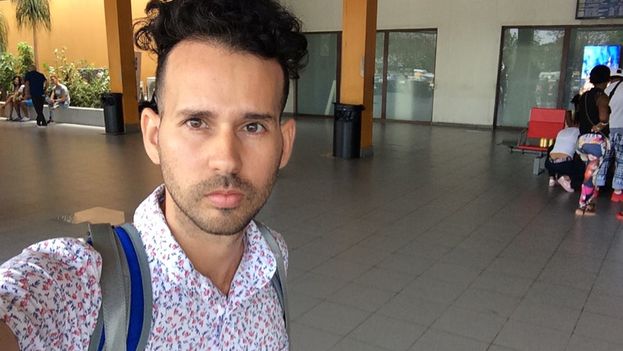
Yaudel Estenoz at the Havana airport before he was forbidden to travel to Trinidad and Tobago. (Facebook)

14ymedio bigger14ymedio, Havana, 24 April 2018 – Calling him a “counterrevolutionary,” Cuban authorities have barred the designer Yaudel Estenoz from traveling. Estenoz, who works with several independent media, and had planned to leave for Trinidad and Tobago last Saturday to arrange a student visa to the United States. “I have been the victim of a violation of human rights,” Estenoz told 14ymedio.

The designer, who lives in Ciego de Ávila, attributes his current migratory status as ‘regulated’ to his contributions to the publications Alas Tensas and Árbol Invertido. In the Unique System of National Identification (SUIN) that manages the Immigration and Immigration Identification Directorate (DIIE), his name appears as under a travel ban. continue reading

“I was going to travel to Trinidad and Tobago to apply for a student visa (J1), at the US consulate, and then go to study in that country thanks to a two-year scholarship I earned,” he says.

Cuban authorities waited until he was at the immigration control window at the airport, to inform Estenoz that he could not board the plane.

In recent days the designer has also suffered intense “harassment by State Security,” he explains. Officials summoned him to several interrogations to learn details of his collaborations with media “which they call counter-revolutionary simply because they can’t control them.”

Estenoz clarifies that he does not write newspaper articles but designs and produces infographics and videos “in pursuit of improving Cuban society.”

The designer, who believes that the authorities “in addition to the truth can’t stand beauty,” has made his complaint public through his profile on Facebook and has asked his friends who “are not afraid or are outside Cuba” to share his posting. “For those who would like to share it but are afraid, don’t worry, I understand,” he writes.

Estenoz, who in his Twitter account defines himself as “computer engineer by profession, empirical graphic designer, programmer by hobby,” has also collaborated with other independent media such as Havana Times and Tremenda Nota.

In the last year, State Security has increased the pressure against activists and dissidents, preventing them from traveling abroad. In most cases the travel ban is not permanent, but arbitrary and circumstantial, which makes it difficult to report to international organizations.

This strategy is in addition to arrests, confiscations of personal belongings, raids on their homes and the imposition of judicial charges.

_________________________________

The 14ymedio team is committed to serious journalism that reflects the reality of deep Cuba. Thank you for joining us on this long road. We invite you to continue supporting us, but this time by becoming a member of 14ymedio. Together we can continue to transform journalism in Cuba.

Cuba: We Have a President (or a Puppet) / Iván García

Miguel Díaz-Canel. Taken from Huffpost.

Ivan Garcia, 23 April 2018 — Lacking the solemnity of a conclave in the Vatican to elect a pope or the white smoke announcing the new Holy Father, on Thursday, April 19, at the Convention Center, west of Havana, the new Council of State and its president were announced, those who will rule the destinies of Cuba in the next five years.

There were no surprises. The script was already written. Raul Castro awarded the position of president of the Councils of State and of Ministers to Miguel Díaz-Canel, an electronics engineer born on April 20, 1960 in the village of Falcón, a rural municipality in Placetas, Villa Clara province, about 200 miles from the Cuban capital. continue reading

Now we’re in a wait-and-see time before the performance of Diaz-Canel. In the history of the Castro dictatorship, camouflaged as a country in a perennial revolution, there were two presidents*: Manuel Urrutia and Osvaldo Dorticós, managed at will by Fidel Castro.

The novelty in this comedy is that there will be a kind of cohabitation. A president of the nation next to the first secretary of the Communist Party.

Who will have greater power? According to the quirky Cuban Constitution, which was reinforced in the summer of 2002 by Castro I with a perpetual Marxist socialism, the lead role is held by the Party.

The brothers from Birán, by-the-book autocrats, performed both functions when they governed.  But now Diaz-Canel has his hands tied.  A kind of Big Brother will supervise him from the headquarters of the Central Committee.

In practice, what has happened is a distribution of powers. An elderly lover of vodka with orange juice like Raul Castro, simply got bored with controlling internal finances, self-employment and the unsettling double currency system with its seven types of exchange rates that distort the national economy.

That disastrous puzzle is now in the hands of Diaz-Canel. To move the economy forward in Taliban mode, there will need to be a magician or a suicide. If the changes upset the most conservative sector of the party, they will pass the bill to Diaz-Canel. He is a disposable politician. He is not untouchable.

But if within five or ten years the economic and social situation of Cuba continues along the same paths or gets even worse, there will be a shot at the target, a culprit, who can pay for the broken dishes.

With the presidential relay, Raul Castro, eternal conspirator, ran out of revolutionary gods. Diaz-Canel and the majority of the current Council of State, with the exceptions of Ramiro Valdés, Leopoldo Cintra Frías and Guillermo García, are dispensable.

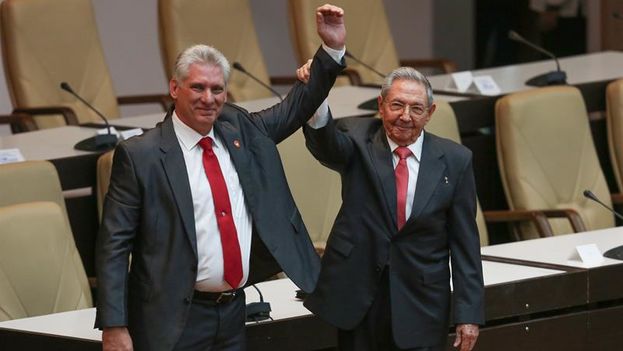
Diaz-Canel appears to be faced with mission impossible, as long as the current economic model is maintained. After nine o’clock in the morning, when he strode into the session at the convention center, along with his political manager Raul Castro, dressed in black suits and red ties, the new president looked like a deer in the headlights.

The ratification of the positions, selected by a mysterious commission, was a piece of cake in a nation like Cuba, where the parliament votes unanimously, or almost, on any election or bill put before it.

Diaz-Canel’s first speech was lousy. Quotes from Fidel Castro and singer-songwriter Silvio Rodríguez. Monotonous pronunciation, a bland tone, no enthusiasm. Fortunately, he does not have the diction problems of the primitive Esteban Lazo, president of the National Assembly, nor make mistakes when reading.

Miguel Diaz-Canel left many Cubans open-mouthed, like the child who was promised an ice cream and then deceived by being given a purgative. To Elier, a taxi driver, the very first words disappointed him. “He said he did not come to promise anything and that he was going to continue to work along the same lines. Wow, everything stays the same. I expected him to make important announcements or at least to talk about what will happen with the self-employment licenses that have been suspended. But nothing, the guy did not talk about that, as if the fact that the economy is a disaster was not important. The kitchen robot should be an actor in a telenovela, not the president of a country that is bankrupt.”

A brigade of bricklayers who are repairing an apartment in Havana’s La Víbora neighborhood listened to the new president’s speech on the radio. “Something else was expected. From what I heard, the man has nothing on the ball. His first speech was pure drool to Fidel and his compadre Raúl, whom he has to thank him for giving him the job without even holding a raffle,” says Manuel, bricklayer.

On a tour of Diez de Octubre, Havana’s most populated municipality, looking for the impressions of ordinary people, a butcher, who was cutting chunks of frozen chicken with an ax and putting them in a refrigerator confesses that he did not have time to see the speech. “What did he say?” He asks. And upon learning that he did not say anything new, he replies: “I imagined it. This isn’t any kind of arrangement. The guy had a reputation in Villa Clara for being a good and liberal person, but then he climbed the ladder and now he doesn’t laugh. One more opportunist who coasts. Who takes advantage, because the opportunities are all bad.”

Carlos, a sociologist, is not surprised by the appointment of Díaz-Canel or his dull inaugural speech. “You can’t get blood from a stone. The self-centeredness of Fidel Castro clipped the wings of Cuba’s political class. Diaz-Canel is not creative and is more accustomed to listening and following directions from ‘above’ than having any autonomy of his own. I would be surprised if he was different, he’s Raul Castro’s private satellite. He’s in his pocket. He will not do what he wants. If he departs from the script, he will find himself in Combinado del Este (prison).”

Everyone interviewed believes Diaz-Canel is a puppet. To Douglas, a seller of online navigation cards, “the guy doesn’t rule on his own, he receives orders from the Padrino. These people (the regime) are like the mafia.”

Luisa, a clerk in a cafe that charges in hard currency, believes that “you have to give him the benefit of the doubt. Maybe the man does things right. What we can say is that we have the best-looking president in all of America.”

Idania, a priestess in the Santaria religion, recalls that one afternoon in 2013, “at the headquarters of the Yoruba Association, Diaz-Canel did a few dance steps from our religion. The man could be stuck in the past or take the country forward. Of course, he will have to change many things and fight with an army of prejudiced bureaucrats.”

Elvira, a teacher, was the only one consulted who mentioned the word democracy. “As long as Diaz-Canel is in the government or Raúl Castro is in the party, they will not implement an openly democratic system. a real one, not a fake one, Cuba will be bogged down in the same swamp. The Cuban problem is economic, but also political.”

The new president is facing difficult times. An economy adrift, an aging population, low productivity, widespread apathy among citizens, especially the youngest, and aspirations to emigrate from an important sector of society.

The demands are multiple. From lowering the prices of food and items sold in stores that deal only in hard currency, raising wages to cover current inflation, improving public transport, expanding private work and small business, stop extorting Cubans living abroad with exorbitant passport fees and allow them to participate actively in national political and economic life.

In baseball terms, Miguel Mario Díaz-Canel Bermúdez, comes on as a relief pitcher with the bases full, no one out, and the best batter in the league at the plate. He does not have easy.

On April 20, the day of his 58th birthday, in his bedroom, next to his wife Lis Cuesta Peraza, the first lady, he will be able to analyze coldly the dimension of the assignment that Raul Castro has left him.

Any mistake can bury the fragile system that his predecessors insist on calling Revolution. There are some gifts that may be poisoned.

*Translator’s note: In the early years of the Castro dictatorship there was the position of “president” — currently the person formally designated as President of the Council of State fills that position.

The Impossible Task of Miguel Díaz-Canel

Raul Castro did not dare to face the problem of having two currencies, leaving Diaz-Canel the poisoned inheritance of unifying them. (EFE / Alexandre Meneghini)

14ymedio bigger14ymedio, Carlos Alberto Montaner, Miami, 22 April 2018 –Finally, Díaz-Canel became the president of Cuba’s State Council.

In Cuba there is not a President of the Republic. Formally, Cuba has a parliamentary system. In fact, it is a one-party dictatorship, hitherto led with an iron hand by the Castros. Diaz-Canel does not have a lever to support his authority, except for the cautious trust that Raúl Castro – an 86-year-old man whose death Diaz-Canel secretly desires to be able to rule on his own – would grant him. The entire structure of power is in the hands of the raulistas (Raúl’s followers) and he knows it.

On Thursday April 19, Raúl retreated to the Cuban Communist Party, the only and unique pillar of the nation according to the fifth article of the Constitution. From there, he will carefully watch the performance of his successor, ready to eliminate him swiftly if he departs from the script. It is very uncomfortable to work with your real boss looking over your shoulder. continue reading

However, the Communist Party has never made any important decisions. It’s just a transmission belt of Castros’ orders and whims. Like the three monkeys of the Chinese fable: it has not seen, it has not heard, it has not thought. Even worse, there is a fourth monkey: it has not even known.

Raúl also controls the Parliament (the National Assembly of People’s Power) through Esteban Lazo, its president. Mariela, Raúl’s daughter, is one of the 605 assembly members known in Cuba as “the singing children of Havana” because of their amazingly fine tuning. They have never played a jarring note. Of these, 31 are members of the State Council, supposedly it is the Sanhedrin who has appointed Diaz-Canel and who can dismiss him easily.

However, the country’s real authority is in the hands of the Revolutionary Armed Forces (FAR) and the Ministry of the Interior (MININT), purged by Raúl in 1989 for fear of a conspiracy. The FAR and the MININT have been filled with raulistas. Raúl Castro was Minister of the Armed Forces from 1959 until 2006, when his brother became seriously ill.

Raúl has formed and deformed the armed forces. He has appointed all the officers in command and filled them with privileges. He has even looked after the economic destiny of retired friends by assigning them to positions in the dollar area, which is the only habitable area.

As often happens with bosses, although everyone says they love him, there are many who hate him. That is why there is a photograph of Raúl giving a talk in a barracks while wearing an armored vest under his shirt. He has always been a distrustful and cautious person.

Raúl expects his successor to square the circle. Raúl wants him to maintain the system and fix or alleviate the problems of Cuban society. That’s impossible. The misery, the lack of productivity, the decadence and the despair of the Cubans are due, precisely, to the system. Nothing can be fixed if that insane asylum is kept.

Cubans want to be free to choose the movies, the books, the ideologies or the politicians that satisfy them. They even want the freedom to be apolitical and not have to repeat the revolutionary chatter imposed by a few dogmatic individuals. That’s what Cuban writer Reinaldo Arenas said after he managed to escape from Cuba and was asked what was the best part of being exiled: “to show my own face for the first time,” he answered with a certain melancholy.

Cubans want to show their true faces. They want to be able to work in activities that allow them to live better, to eat what they want and not what the commissaries decide, to travel and see the world. Cuba is the only country in the world where doctors, teachers, engineers, any professional, do not live at least as middle class, unless they belong to the nucleus of power.

Today, in the economic field, those who receive remittances in dollars from family abroad can live somewhat better, as well as those who rent rooms to foreigners in remodeled houses, the girls who prostitute themselves, some self-employed workers who use their old cars to drive tourists around, and the individuals who have obtained a license to operate family restaurants known as paladares.

That is, those who live and work in the dollar area are better off, but how many people have that privilege: 5% or 10% of a population of 11 million? The Cuban peso lacks purchasing power and 90% of the nation receive their salaries or their pensions in Cuban pesos. Raul Castro did not dare to face the problem, leaving Diaz-Canel the poisoned inheritance of unifying the currency.

How is that done? Floating the Cuban peso and liberalizing prices, which would create terrible inflation and economic chaos that would last between 18 and 24 months.

At that point, presumably, Raul will have died and suddenly the only source of real authority and personal loyalty will have disappeared. Then anything could happen. Then, Diaz-Canel might even show his true face.

Translation from Latin American Herald Tribune

_________________

The 14ymedio team is committed to serious journalism that reflects the reality of deep Cuba. Thank you for joining us on this long road. We invite you to continue supporting us, but this time by becoming a member of 14ymedio. Together we can continue to transform journalism in Cuba.

Opponents Believe Older Generation’s Legacy Is Incompatible with Reform

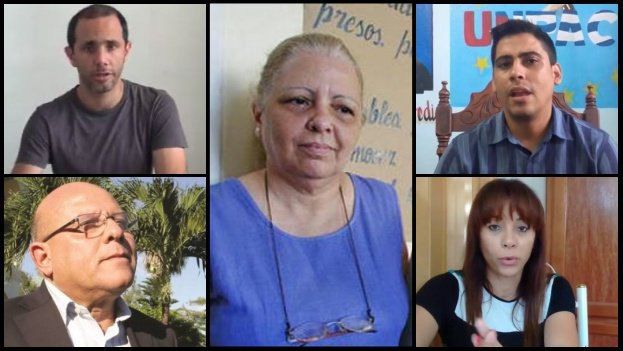
Left: Henry Constantin, Dagoberto Valdez. Center: Martha Beatriz Roque. Right: Carlos Amel Oliva, Ileana Hernandez.

14ymedio bigger14ymedio, Luz Escobar, Havana, April 21, 2018 — Government opponents and human rights activists were not pleased with Miguel Díaz-Canel’s first speech as Cuba’s new president.

Iliana Hernández, director of the independent program Lente Cuban (Cuban Lens) questions whether the Cuban people will accept Díaz-Canel as leader given that he was hand-picked by his predecessor. “On top of that, he has no charisma,” she says.

Hernández believes she has some insight into the new president’s priorities based on a video that was leaked last year in which he can be heard attacking the independent media and defending censorship as a way to protect the Revolution. “He is going to increase repression but the opposition is stronger now,” she says. continue reading

In Santiago de Cuba, Carlos Amel Oliva is also skeptical that the new presidential administration can satisfy the Cuban people’s desire for change. The young activist at the Cuban Patriotic Union believes it is a contradiction “to try to maintain the legacy of the earlier generation” while at the same time “carrying out reforms.”

Oliva believes that access to information is a key item in the growing list of popular demands. “This Cuba is different from the one that existed ten years ago,” when Raúl Castro became president, he points out. “Society is demanding more substantive action,” not only to alleviate the economic situation but also “in the area of human rights.” He acknowledges that it is very difficult to predict the next steps the president might take because “in a totalitarian system everone engages in double talk… No one can be sure if what he said on Thursday in front of the National Assembly is really what he thinks.”

The director of the Center for Coexistence Studies (CEC), Dagoberto Valdés, believes that Díaz-Canel’s first speech after being named president “was ideological in order to signal continuity. But reality is more obstinate and more forceful than ideology or any ruler’s intentions.”

For years Valdés and his team have been subjected to constant pressure, prohibited from leaving the country and forced to undergo a legal trial which ended with the confiscation of his home in Pinar del Río, where the group members used to meet. His think tank recently held a conference on agriculture, the press and the island’s  future.

It is a future that the country’s new administration cannot build “with the same bricks  that didn’t work in the past,” he believes. In other words, with the same methods, the same economic model, the same political model. “New bricks are needed for new construction,” says Valdés.

Though he applauds the generational change at the Council of State, the CEC director believes that “just recruiting younger people is not enough.” What is needed, he believes, is a change in mindset, in the methods and in the models.”

Independent journalist Henry Constantín believes that the commitment Díaz-Canel made to the so-called “historic generation” in his speach before the new Council of State will be “a major impediment” to his success.” For economic changes to have the desired effect,” he says, “changes must be made in the political arena, especially with regard to freedom.”

The reporter, whom the authorities have barred from leaving the island, believes the appointment of Salvador Valdés Mesa as first vice-president is not a good sign. “There are bad memories in Camagüey from his time as first secretary of the provincial Communist Party,” he recalls, pointing out that Valdés Mesa, who acquired a reputation as an inefficient bureaucrat, has now been placed in a position to “counter” any slip-ups by Diaz-Canel.

The opposition figure Martha Beatriz Roque, sentenced to twenty years in prison during the Black Spring of 2003, believes the historic generation has handed the SantaClara born engineer “a very big, hot potato because the country is in a very difficult situation.”

The economist is convinced that the new president “”will not make any changes. On the contrary, he will make politics tougher.”

_____________________

The 14ymedio team is committed to serious journalism that reflects the reality of deep Cuba. Thank you for joining us on this long road. We invite you to continue supporting us, but this time by becoming a member of 14ymedio. Together we can continue to transform journalism in Cuba.

Preliminary Assessment of an Announced Succession / Cubanet, Miriam Celaya

Raul Castro salutes Diaz-Canel (EFE)

Cubanet, Miriam Celaya, Havana, 20 April 2018 — The first question regarding the succession of power in Cuba, that is the one about who would be elected, was finally clarified on April 19th with the confirmation of the selection of Miguel Díaz-Canel Bermúdez as the new president of the State Council of the Castro regime. He will assume the dubious privilege of inheriting the address of the hacienda in ruins.

Contrary to the announcements of the darkest of soothsayers proclaiming the eventuality of a dreaded dynastic succession by Raul’s son, Alejandro Castro Espín, who would have been designated by purely consanguineous motives, the election of Díaz-Canel, far from surprising anyone, coincides with signals from the cupola that marked him as a favorite for the position. Castro Espín, for his part, isn’t even among the members of the Council of State (CE). continue reading

If the fissures and struggles between two tendencies of the Power cupola – one “Raulista” and the other “Fidelista”— are true (and certain signs suggest that they are), it is certain that such discrepancies were not reflected in the results of the ballots voted by the 604 deputies who participated in the “election” of the CE. But by themselves, these results do not deny the existence of such a crack, rather they suggest the possibility of agreements between both tendencies in order to safeguard economic, political, and even personal interests and privileges which are common to them, since they are a class that has held power for six decades and that has direct responsibility in everything that happened during that time and in the deep socio-economic crisis that suffocates the nation.

The election process initiated in the month of October 2017 culminates in these two days of sessions of the Ninth Legislature of the National Assembly. However, they were not exempt from surprises, among which stands out – with differences – the strange and unexplained exclusion of Marino Murillo, a member of the Political Bureau and Head of the Implementation and Development Committee of the new CE.

His absence seems all the more confusing because in his inaugural speech the new Cuban president expressed the will and commitment to continue with the implementation of the Guidelines and the Economic and Social Development Plan until 2030, drawn up by his mentor and predecessor, Raúl Castro, to whom – by the way – he dedicated an exaggeratedly laudatory segment.

Murillo should be, at least in theory, an important player with regards to the “continuist” economic policy announced by the incoming president, so his elimination from the CE – without any announcement of his transfer to “other important functions,” as explained in the case of Mercedes López Acea, following the official jargon’s cryptic style – opens the door to speculation about this high official’s possible fall from grace.

Another curious fact in the composition of the new CE is the almost nonexistent presence of any active military. Beyond the symbolic olive-green uniforms of the historical old commanders Guillermo García and Ramiro Valdés – ratified among the five vice-presidents of the CE – General Leopoldo Cintra Frías has been the only minister of the Revolutionary Armed Forces who was ratified as a member.

No less notable was the postponement of the election of the Council of Ministers until the next ordinary session of the National Assembly, scheduled for July 2018 as proposed by the president himself, Díaz-Canel, taking into account the country’s complex current circumstances. The proposal was approved unanimously, in accordance with the tradition of the Assembly.

In general, and contrary to what one would expect from these momentous days, when after almost sixty years the departure of the Castro clan from the presidential armchair has finally happened, there are more unknowns left to unravel in times to come than there are certitudes that the new Cuban president had to offer.

His speech held no promises, certainties or proposals for a more promising course for the millions of the governed, who – for their part – lack hopes or expectations for the “new” government. Perhaps the only miniscule novelty of the presidential discourse was the mention, on two occasions, of the word “prosperity,” towards which, according to the “young” ruler, socialism must lead us.

Nevertheless, in spite the heir’s manifest orthodoxy, his language of the barricades and his frequent attacks against anything that differs from the path marked by the leaders of the “Revolution,” we will have to carefully watch his next steps. Rehashing old speeches is not the same as facing the reality of a country in urgent need of deep changes or refusing to take the necessary steps to reverse the calamitous legacy he has just been handed. Because changes in Cuba are not just an option, but a requirement, beyond the interests of the Power claque, its tendencies, its interests or the desires of the brand-new, freshly unveiled, president.

Going forward, what Raúl’s dauphin “says” will not be as important as what the Cuban president “does.” Without a doubt, the shadows of the two Castros – one a ghost, the other a phony reformer – will continue to perniciously influence his mandate for a time. Unfortunately, “time” is not what this new honcho has a lot of, and betting on continuity and pauses, he could end up as the scapegoat of the Castro regime. His only options are to leap forward or bear the entire responsibility for the bad works and ineptitude of his predecessors, while maintaining the balance between the factions of the old power. He won’t have it easy, but this is what he wished for. Meanwhile, for ordinary Cubans, the horizon continues to be as gloomy today as previously, but, at the end of the day, April 19th was the first day of a government without Castros. And only that minutest circumstance is, in itself, good news.

Translated by Norma Whiting

Almagro Laments the Illegitimate Transition of Cuba’s Dictatorship

Luis Almagro, Secretary General of the Organization of American States (OAS)

14ymedio bigger14ymedio via EFE, 20April 2018 —  The Secretary General of the Organization of American States (OAS), Luis Almagro, lamented on Thursday what he called the “illegitimate transition” of Cuba’s “dictatorship” with now former Cuban president Raúl Castro replaced by his chosen successor, Miguel Díaz-Canel.

“Revolution is not defined as the triumph of dictatorship over freedom. The presidential succession that we have just witnessed is an attempt to perpetuate an autocratic, dynastic regime,” says Almagro in a written statement.

“It represents decades without democracy and the violation of human rights and fundamental freedoms.” continue reading

The fifty-eight-year-old Díaz-Canel was proclaimed president of the Council of State and Council of Ministers by Cuba’s National Assembly after being voted into office by 603 of its 604 deputies, an electoral margin of 99.83%.

Díaz-Canel replaces eighty-six-year-old Raúl Castro, who left office after two terms.

Almagro claims that Díaz-Canel was chosen by the National Assembly “without the free expression of the Cuban people,” noting that “when a people’s sovereignty is ignored, it deligitimizes of the authority of its rulers.”

“A regime that imprisons and silences opponents and dissidents, which has eliminated freedom of expression, which has carried out selective executions of political prisoners, is not a system which can be assimilated or whose political practices are acceptable in this hemisphere in 2018,” says Almagro.

“Our hemisphere,” he added, “must continue to demand democracy, freedom, human rights, accountability and that dictators be brought before Inter-American and international courts of justice.

Cuba was suspended from OAS in 1962 after the triumph Cuban revolution, led by Fidel Castro. Although the organization’s member states lifted that suspension in 2009, Cuba has so far declined to rejoin.

___________________________

The 14ymedio team is committed to serious journalism that reflects the reality of deep Cuba. Thank you for joining us on this long road. We invite you to continue supporting us, but this time by becoming a member of 14ymedio. Together we can continue to transform journalism in Cuba.

Goodbye to the Castros

Fidel and Raúl Castro have left their surname branded in blood and fire on the history of Cuba of the last sixty years (EFE)

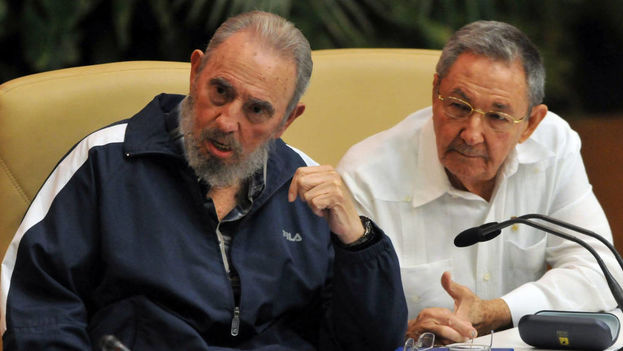
14ymedio bigger14ymedio, Yoani Sanchez, Havana, 22 April 2018 – One impulsive and the other pragmatic, one charismatic and the other lacking any magnetism, the brothers Fidel and Raúl Castro have left their surname branded in blood and fire on the history of Cuba of the last sixty years. This week the generational relay knocks on the door of the powerful family clan that plans to leave the spotlight but not to let themselves get too far from power.

There was a time when Cuban children calculated how old we would be when the new century arrived. We imagined becoming adults in a millennium dyed red with the Communist flag, where money and misery did not circulate. However, the Berlin wall fell, the illusion broke into a thousand pieces and our personal arithmetic shifted to counting how old we would be when Castroism fell. continue reading

That day has arrived, but not as we thought. Instead of an epic overthrow with people waving flags in the streets, the Cuban regime has been fated to fade away like an old photograph: without grace or romance. That process began twelve years ago when Fidel Castro fell ill and transferred the command of the country through his bloodline to his younger brother.

Raúl Castro had to contend with the complex inheritance he received. A nation in numerous reds, with an increasingly apathetic citizenry, an exodus that rejected the supposed socialist paradise narrated by the official propaganda, a network of prohibitions suffocating daily life and a deficient institutional framework languishing under the whims of the Commander-in-Chief.

“Without haste but without pause” was the motto chosen by Raulismo to attempt to fix some of those wrongs. The General came to win the ironic moniker of “gradual revolutionist” because in the face of most of the country’s pressing problems he revealed himself more in the style of a cautious and rancid conservative than someone with the urges of a former guerrilla.

The first thing he did was dismantle Fidelismo, that personal system his brother built in his own image and likeness: capricious, violent, adamantine and vociferous. Without lifting the repressive hand, the second brother put an end to several “absurd prohibitions,” as he called them then, which left the bars of the national cage more visible and rigid.

Oriented in the right direction, but with the speed of tortoise and only skin deep, Castro II authorized the sale of homes, frozen for decades; he allowed Cubans to contract for cellphones, until then a privilege enjoyed only by foreigners; and launched travel and immigration reform on the prison island.

Under the euphemism of self-employment the private sector was encouraged by his hand; the country opened to foreign investment and thousands of acres of land, left fallow for years, were leased to those who would work them. Even public ideological demonstrations lessened, the mass political campaigns to which his brother was addicted were buried, and a process of comptrollership was launched to try to stop waste, corruption and inefficiency in state enterprises.

In those years, between July 2006 and January 2013, Raúl Castro spent all of his political capital, exhausting a government program that had very clear limits: maintain the socialist system, avoid increasing social inequalities at all costs, and stop any attempt toward political plurality.

As Raulism began to languish, on 17 December 2014 came the news of the diplomatic thaw between the White House and the Plaza of the Revolution. For almost three years the world believed that the “Cuba problem” was solved, when it saw Chanel parading on the Paseo del Prado, Madonna dancing in a Havana restaurant, and the Kardashian family driving around the island in an old car.

But the dream of normalization was short-lived. Raul Castro was afraid of losing control and did not respond to the measures taken by Barack Obama with the necessary complement from the island. After the official visit of the US president, the official media intensified criticism of Washington and the honeymoon ended. A divorce was inevitable with the arrival of Donald Trump to the White House.

Fearful of the thousand-headed hydra he had unleashed with his ‘capitalist’ reforms, Castro backed down or froze several of the flexibilizations that had earned him the label of “reformist.” As of August of last year the issuing of most private sector licenses is frozen, travel bans decreed against opponents have increased in recent months, and the official discourse has turned its criticism against local entrepreneurs.

The ruling octogenarian could not solve two of the biggest problems: unifying the two currencies circulating on the island and increasing the paltry salaries paid to the majority of the population. He also failed to stop the exodus of Cubans from the island, or to implement effective policies to raise the birth rate, a serious problem for a nation that is expected to be the ninth oldest country in the world by 2050. Nor did he manage to clean up the state sector corroded by corruption and the lack of efficiency.

However, the greatest failure of the General during the decade of his two terms was his inability to push the necessary political reforms needed to deliver a more orderly house to the generational change. Faced with the dilemma of keeping all power or ceding a part to avoid a dramatic fracturing in the future, the younger Castro was not very different from his brother; he chose absolute control.

He knows that although he methodically planned the succession and chose a docile and manageable heir in first vice president Miguel Diaz-Canel, the personal system he inherited from his brother does not lend itself to a division of responsibilities.

As long as he maintains control over the Communist Party, which the Constitution establishes as the leading force of the country, Raul Castro will be able to keep an eye on this technocrat, who was raised in his shadow and is well aware that any attempt at autonomy could mean his fall. But the old guerrilla knows that the end of his life is approaching and that favored sons become unpredictable when their mentor no longer breathes.

The successor inherits a country in crisis and a society discouraged, an unfavorable international context whose clearest signs are the shift in the ideological course across Latin America and the almost unanimous rejection of his Venezuelan ally, Nicolás Maduro. It is up to him to end the dual currency system, deepen the economic reforms to attract investors and expand the private sector.

Unlike his predecessors, he did not participate in the conflict waged in the Sierra Maestra or in the assault on the Moncada barracks. He will have to build his legitimacy on the results of his management and the realization of real and broad political reform. The myth has ended and for the historical generation, which prevailed with terror and charisma, the days are numbered.

The Castro era concludes and we children of yesteryear are in the maturity of our lives. Many of us fell along the way without knowing another system. Now we return to our personal arithmetic: how old will we be when Cuba is truly free?

__________________________

This article was originally published in the Spanish newspaper El País.

The 14ymedio team is committed to serious journalism that reflects the reality of deep Cuba. Thank you for joining us on this long road. We invite you to continue supporting us, but this time by becoming a member of 14ymedio. Together we can continue to transform journalism in Cuba.

What Has and Has Not Changed in Cuba Since Raul Casto Came to Power

Raúl Castro leaves to his successor some of the promised changes that he never made, including the constitutional reform and a new electoral law. (EFE)

14ymedio bigger14ymedio, Mario J. Pentón/Reporting Team, Miami, 17 April 2018 — On the last day of July 2006 Cuba’s prime time news program broke with its usual monotony. Carlos Valenciaga, Fidel Castro’s chief of staff, announced to Cuba and the world that the hitherto invincible Commander-in-Chief had temporarily ceded power, after suffering intestinal bleeding. Raúl Castro, his younger brother, took the reins of the Island.

Two years later, as a surprise to no one, the second Castro was elected by Parliament to the presidency of the Council of State and undertook a series of reforms to the socialist model to “make it sustainable.” Today 14ymedio presents an assessment of what happened in the “Raulista era,” a decade of very limited advances and of stagnation:

1. The battle against “absurd prohibitions”

On arriving in power, the general presented himself as pragmatic and promised to end the “absurd prohibitions.” In March 2008, he allowed Cubans to stay in hotels, restricted, until then, to international tourists. That same year the limitations were ended on Cubans contracting for cellphone service and buying computers and DVD players. continue reading

2. Leasing of idle lands to farmers

In 2008, the Government authorized the delivery of idle state lands to farmers and cooperatives under a form of limited term leases known as usufruct. More than 50% of the country’s arable land was not in productive use and, even today, Cuba spends more than one billion dollars a year on imported food for the “basic market basket.” A decade later the results have been mediocre due to the lack of equipment and necessary inputs, such as seeds and fertilizer, and excessive controls on the marketing of crops.

3. Expansion of the private sector

In 2010, Castro gave a boost to self-employment and expanded the list of occupations that could be practiced outside the state sector. However, large sectors of the economy, including the exercise of professions, remain reserved to the State. The flexibilizations promoted, in particular, renting rooms to tourists, food services and passenger transportation. At present, the number of private workers exceeds half a million, but the absence of a wholesale market, high taxes and the prohibition of importing products hampers the development of this type of work.

 4. Cubans embark on the internet

Until 2009, only a small fraction of the population, in addition to tourists, had the privilege of surfing the internet on the island. In 2013, the Telecommunications Company of Cuba (ETECSA) installed the first wifi browsing areas, with prohibitive prices and with dozens of censored sites. Today there are 635 of these wireless areas on the island and the cost of one hour of access is 1 CUC (the equivalent of about a day’s wages). A year ago the state monopoly took web browsing to some homes, but Cubans still wait for internet access from cellphones and the unblocking of censored sites, which include this newspaper.

5. So long to the “gratuities”

Raúl Castro undertook a campaign against “gratuities,” or perks, which he blamed on the legacy of Soviet paternalism. Under his mandate he reformed the Social Security Law and raised the age of retirement by five years, to 60 years for women and 65 years for men. In addition, he cut the number of pensioners and eliminated a good part of the additional perks, such as beach house vacations and the routinely handed out bags of food and toiletries that thousands of state employees received.

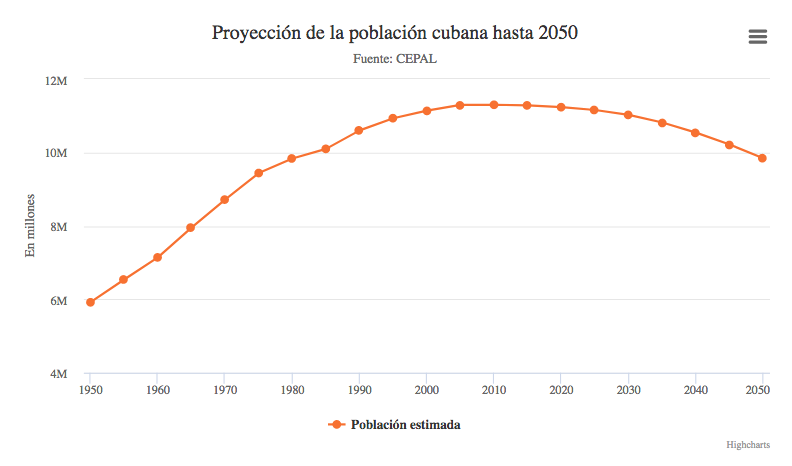
The First chart below compares the proportion of the population that is age 60 and older projected out to 2050 among a group of Latin American countries; only Barbados is projected to have a population older than Cuba’s. The second chart reports past data and future projections for the total population of Cuba between 1950 and 2050.

6. Cuts in health and education

The number of hospitals has fallen by 32% in the last decade and the medical staff in family clinics barely fill 40% of the positions. These cuts are more alarming given that 20% of the population exceeds 60 years of age and the population is one of the oldest in the Americas.

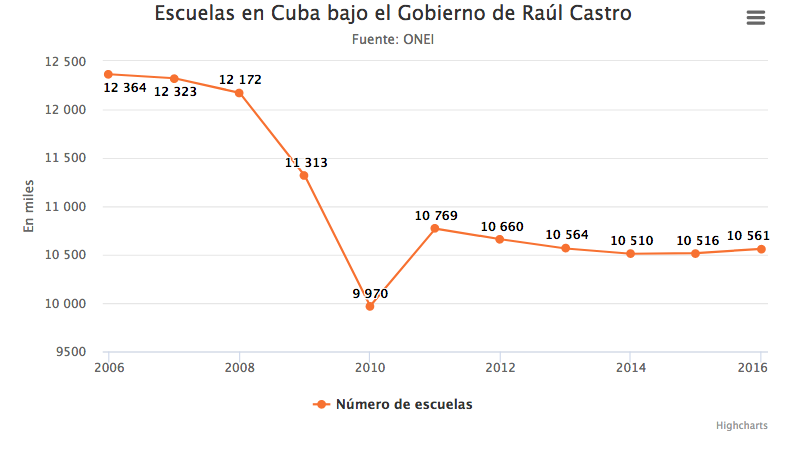
The chart below shows the total number of schools in Cuba under Raul Castro’s government, between 2009 and 2016.

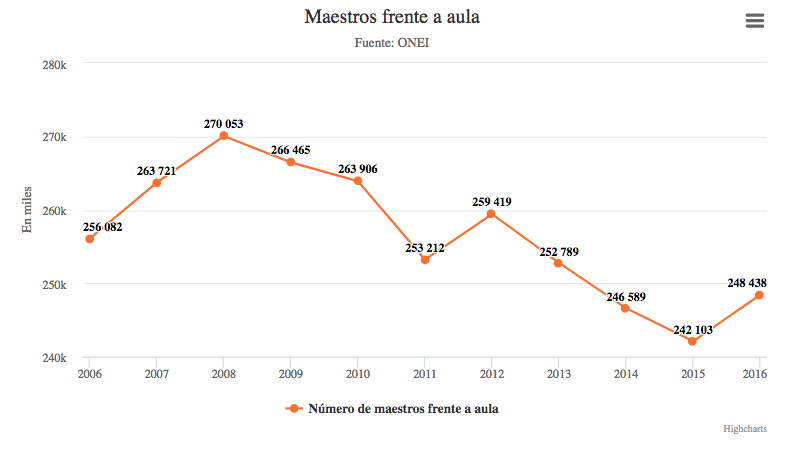
Raúl Castro eliminated the program of boarding schools in the countryside for high school students, one of the “jewels of the crown” under Fidelismo. During his term he has had to deal with the deficit of teachers that at the beginning of the school year 2017-2018 amounted to 16,000 vacancies. Enrollment decreased by 32% in high schools and even more in university education, which registered a fall of 78%. Many young people do not want to continue studying for careers that offer them miserable salaries. Furthermore, certain professions, such as the medical field, have come with restrictions on the ability to freely leave the country.

The first chart below shows the number of schools in Cuba and the second the number of classroom teachers in Cuba between 2006 and 2016, based on statistics collected by the Cuban government.
7. The ration book survives

Since 1961 Cubans have a ration card that gives each citizen a minimum quota of products subsidized by the State. Every year the Government allocates some two billion dollars to a bureaucratic structure that distributes products ranging from a piece of daily bread to rice, beans, sugar, salt and coffee.

One of the most emblematic promises of Raulism was to eliminate the ration book, but it never came to fruition. Although the rationed distribution system has fewer and fewer products, a good part of the population depends on this support to survive due to low wages, with salaries averaging about $29 per month. Today, the real purchasing power of Cubans is just 51.1% of what it was at the end of the 1980s, before the end of the so-called Special Period in a Time of Peace — the devastating aftermath of the collapse of the Soviet Union and the loss of its economic support for Cuba.

8. The lifting of the prohibition on the sale of houses and cars 

For decades in Cuba, the sale of houses was forbidden, private construction was limited and the ability to rent out one’s dwelling was suppressed. In 2011 Raúl Castro surprised the nation with one of his most important social measures: opening the real estate market, an important step in a country with 3,824,000 houses, of which 39% are in a regular or bad state, according to the 2012 census.

Three years later, the authorization to sell vehicles to private individuals was achieved, a privilege reserved up until then to government leaders and Party members. Although the second-hand private vehicle market has behaved with great dynamism, sales by state dealerships has not been successful due to the high prices. A Cuban living only from their official salary needs to work 189 years to buy a 2006 Audi from an official dealership, which would be priced at 70,000 dollars.

9. The end of the exit permit

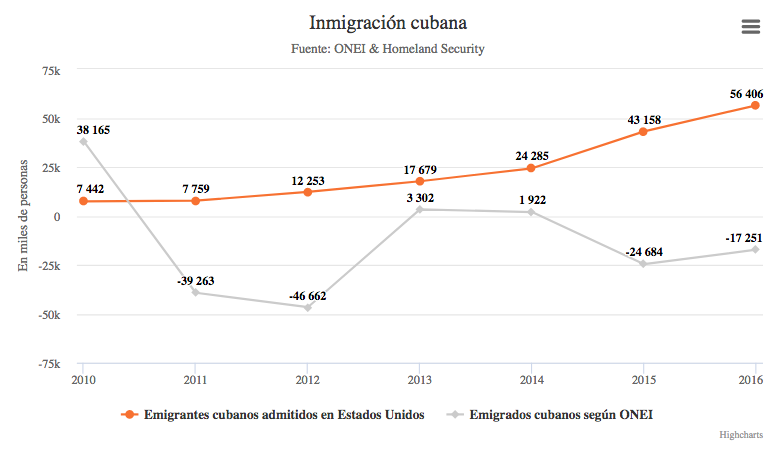
In January 2013, Castro eliminated the so-called “white card,” the permit required to leave the country, and allowed nationals to travel freely. Since then more than 779,000 Cubans have gone on a trip, 79% of them for the first time, according to official figures. The elimination of obstacles to leaving the Island led to a new migration crisis and in seven years, until the end of the wet foot/dry foot policy in 2017, the United States welcomed more than 235,000 Cubans.

The authorities, nevertheless, continue to refuse to allow Cubans residing abroad who have been publicly critical of the government to visit the island. In addition, hundreds of activists and leaders of the opposition have been blocked from abroad; the government advises them that they are “regulated,” as a reason to deny them the right to leave.

The chart below shows Cuban emigration to the United States between 2010 and 2016. The orange line is the figure of Cubans admitted to the United States according to the US Department of Homeland Security, and the grey line is the number of Cuban emigrants according to the Cuban government.
10. Institutionality

Raúl Castro’s two terms as president have been characterized by a greater institutionality. After almost half a century of Fidelista voluntarism — the idea that willpower alone can overcome social and economic challenges — the youngest of the brothers tried to strengthen the Council of Ministers, which now meets more frequently.

After a gap, under Fidel Castro, of 14 years without a Congress of the Communist Party, the only legal party in Cuba, under Raul the 6th and 7th Congresses were held. In these meetings the so-called Guidelines were approved, a road map to dismantle the structure of the Soviet system and open the economy to foreign capital, tourism and the replacement of imported products for those of national origin.

11. Restoration of relations with the United States

After more than five decades of enmity, the Cuban and American governments astonished the world on 17 December 2014 by announcing the restoration of diplomatic relations. The US president, Barack Obama, returned three spies imprisoned in his country to Havana and Castro did the same with two American prisoners. The Catholic Church, at the initiative of Pope Francis, played a central role in the secret conversations between the nations that led to the thaw.

Obama relaxed the embargo against the island, which allowed a notable increase in the number of Americans and Cuban Americans visiting Cuba. Flights between both countries and direct postal service were also resumed. Remittances from Cubans abroad to families on the island, one of the fundamental pillars of the Cuban economy, have grown to 3.444 billion dollars in 2017.

12. Renegotiation and forgiveness of external debt 

Between 2013 and 2016, Cuba renegotiated its old external debt, which had been unpaid since Fidel Castro urged developing countries to put aside their credit obligations in the 1980s. Raúl Castro managed to cancel 90% of the debt that Cuba had taken on during time of the Soviet Union and still owed to Russia.

After one negotiation, the debt of 8.5 billion dollars owed to the Paris Club was reduced to 2.6 billion payable in 18 years. Mexico forgave 70% of the 487 million dollars it had lent to the Island and in 2014 Japan forgave almost one billion dollars of an old debt. Vietnam and China also part of the debt owed to them, but some amounts have not been set aside.

13. Monetary unification, a pending issue

With the opening to tourism and the Soviet collapse Cuba created a new, second, currency that within the Island has parity with the dollar: the convertible peso (CUC), which coexists with the Cuban peso (CUP). One CUC is worth 25 CUP. Since his arrival to power, Raul Castro has tried to unify the currencies because of the economic distortions that they cause, especially in the state business sector, which benefits from an unrealistic exchange rate.

The government announced that the currency that will survive is the Cuban peso (CUP), but until now the exact date for monetary unification is not known nor what the exchange rate will be relative to the dollar once there is only one currency.

14. The country does not attract enough foreign investment or grow at an adequate pace

Cuba needs an injection of capital of at least 2.5 billion dollars every year, and growth at a sustained rate of more than 4% of GDP, according to some economists. Ten years after assuming the presidency, Raúl Castro leaves the country without achieving these minimums. The mega-project at the Port of Mariel, in which Brazil invested more than 600 million dollars, has been slow to develop. The country has also developed various catalogs of opportunities to encourage foreign investment but without much success.

Under Raúl Castro’s presidency, Cuba grew 2.4% as an annual average, according to official figures. The average monthly salary has also been raised from 414 (16.5 dollars) to 740 pesos (29.6 dollars), although the purchasing power of Cubans is still lower than it was in 1989. The Government announced a growth of 1.5% of GDP in 2018, but most scholars of the Cuban economy without links to the government do not believe that figure.

15. Raúl Castro before the death of his brother and the Venezuelan setback

On the night of 25 November 2016, on a national television broadcast, Raúl Castro announced the death of his brother, who had ruled Cuba’s destiny for almost 50 years. Although Fidel Castro had been away from power for a decade, he continued to actively comment on national and international politics in articles called ’Reflections’ that were published the few pages of the official newspapers.

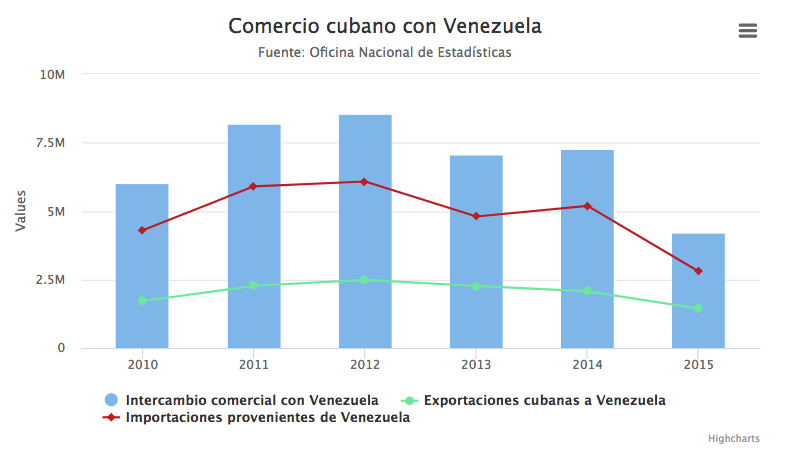
The death of Fidel Castro coincided with the end of leftist movements and governments in the region that proliferated under the umbrella of the so-called Bolivarian Revolution of Hugo Chávez (1954-2003), often at the expense of Venezuela’s oil bill. The political turns in Brazil, Ecuador, Chile, Paraguay and Uruguay have left only Nicolás Maduro, Havana’s main ally, and the crisis that Venezuela is going through has destroyed commercial relations between both countries. Shipments of oil from Venezuela to Cuba, one of the island’s largest sources of aid, have fallen from 100,000 barrels a day to less than 40,000 according to Reuters, forcing the island to look for other fuel suppliers.

The chart below shows Cuban trade with Venezuela between 2010 and 2015. The blue bars are commercial trade with Venezuela. The green line is Cuban exports to Venezuela. The red line is Cuban imports from Venezuela.
16. Critical changes, pending

At the beginning of 2015, Raúl Castro promised a new Electoral Law (the current one dates from 1992), but this reform did not materialize during his term. Something similar happened with the constitutional reform that has been expected for more than five years. The new constitution being prepared will maintain the role of the Communist Party of Cuba (PCC) as “leader in Cuban society” and socialism will continue to be “irrevocable,” according to a recent plenary session of the party.

17. Repression against dissidents and opposition leaders continues

Arbitrary arrests, confiscation of the means of work, and permanent destruction of the reputation of activists and opponents continued in the Raulist era. Since 2010, the Cuban Commission for Human Rights and National Reconciliation has recorded at least 52,829 people temporarily detained or prosecuted for political reasons. The number of political prisoners in the country exceeds one hundred.

State Security has also used technologies as a repressive weapon to monitor the whereabouts of dissidents, block their mobile phone lines or create digital sites to defame independent projects.

18. No progress in civil rights

Since the enactment of the 1976 Socialist Constitution until today, most of the civil rights of Cubans remain violated. Freedom of expression, press, assembly, demonstration and association are all subordinated to “the aims of the Socialist State,” which in practice limits them. In Cuba, political parties are forbidden and candidates for the Assemblies of Peoples Power are not allowed to campaign or to propose their programs for the country.

Thanks to new technologies, independent digital spaces have emerged from the Island, such as Periodismo de Barrio, El Toque, El Estornudo and 14ymedio, but the government does not recognize press freedom and repressive forces often arrest and threaten journalists. Many websites critical of the system remain blocked on national servers.

 _______________________

The 14ymedio team is committed to serious journalism that reflects the reality of deep Cuba. Thank you for joining us on this long road. We invite you to continue supporting us, but this time by becoming a member of 14ymedio. Together we can continue to transform journalism in Cuba.


The Relationship between the United States and Cuba Could Worsen under Díaz-Canel

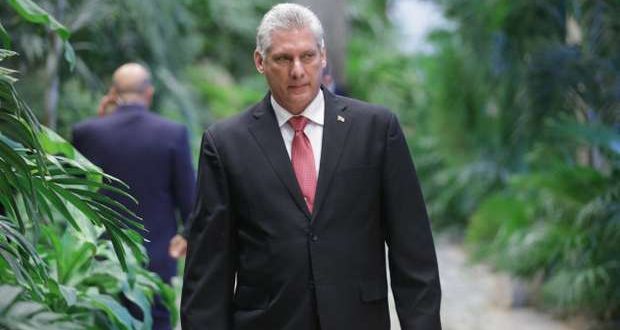
The new Cuban president, Miguel Díaz-Canel in an archive photo. (EFE)

14ymedio bigger
14ymedio, Lucía Leal (writing for EFE, in conjunction with 14ymedio), April 19, 2008 — The United States has no plans to alter its antagonistic policy towards Cuba now that Miguel Díaz-Cane is president. In fact, relations between the two Cold War enemies could even get worse in the next three years according to experts interviewed by EFE.

Díaz-Canel became president of Cuba on Thursday and will remain in office at least until the next Cuban Communist Party Congress in 2011, the same year the first term of the US president Donald Trump ends. continue reading

The first Cuban leader whose last name is not Castro in six decades, Díaz-Canel must manage a complex relationship with Trump, who has halted the normalization process begun by former President Barack Obama, restricting trade and travel to the island.

“We love Cuba. We are dealing with Cuba,” Trump said during a visit to the Florida Keys today.

A White House source told EFE that he “doubted” Trump planned to congratulate Díaz-Canel on becoming president, adding that Washington held out little hope of seeing any change in Cuba under the new leader and that it would maintain a hard line towards Havana.

“We don’t anticipate changing our policy of directing resources to the Cuban people and away from the Cuban military, security and intelligence services,” said the official.

Those who follow the bilateral relationship closely believe that it could become even more tense in the coming months due to the presence in the Trump administration of a new national security adviser, John Bolton, along with the current CIA director and nominee to be Secretary of State, Mike Pompeo.

Both have adopted a hard line towards Cuba. Bolton went so far as to falsely accuse the island in 2002 of having a biological weapons program of mass destruction and his arrival at the White House this month has caused alarm in Havana.

The combined effect of this new foreign policy team and the influence of Marco Rubio, a Republican senator with Cuban roots and a staunch defender of the US embargo, could lead to new hostile actions by the White House.

“The chances of a hard line [towards Cuba] are better than ever,” says Peter Hakim, president emeritus and senior fellow at the Inter-American Dialogue think tank.

“Both Pompeo and Bolton have been extremely critical of Cuba, so we could very well see a US policy even more hostile towards Cuba in the coming months,” says William LeoGrande, a specialist in Latin American politics at American University and author of a book on the normalization of relations between Cuba and the United States.

Marguerite Jiménez, director for Cuba at the Washington Office for Latin America (WOLA), believes that Bolton could “fill the White House National Security Council” with officials who think like him, opening up the possibility of greater antagonism.

The degree of influence these two officials exert will be decisive considering that Trump’s policy towards Cuba is a response to a firm promise he made to hardcore anti-Castro supporters during the final stretch of his 2016 electoral campaign in Florida — a key state — to be tough on the Castros.

Trump signaled this week that, although it makes up a small percentage of the overall American electorate, he still considers Florida to be an important base of support. Recently, he granted an interview in southern Florida to a local affiliate of the Spanish language television network Univisión and to Miami-based Radio Mambí.

“We are being very hard with respect to Cuba because we want the people to have freedom. We have great support for the Cuban people,” said Trump in the interview on Monday.

Even taking into account Trump’s concern for his electoral base and the negotiations he has held with Rubio to gain the senator’s support on other issues, the attention his government has paid to Cuba — a country of little geostrategic value to the United States — is hard to explain.

“Last year the island received a level of attention that was disproportionate given the pressing challenges the US faces in other parts of the world,” says Robert Braga, a Cuba expert at the Atlantic Council.

WOLA’s Jiménez does see one reason for hope, however: Pompeo’s hint during his Senate confirmation hearing last week that the United States might strengthen its diplomatic presence in Havana.

According to press reports, only ten officials remain at the vast American diplomatic compound in Havana after Trump decided to reduce the embassy staff to a minimum in response to alleged sonic attacks on US personnel there.

__________________________

The 14ymedio team is committed to serious journalism that reflects the reality of deep Cuba. Thank you for joining us on this long road. We invite you to continue supporting us, but this time by becoming a member of 14ymedio. Together we can continue to transform journalism in Cuba.

Free Education with Clowns and Reggaeton / Lynn Cruz

Lynn Cruz, Havana Times, 19 April 2018 — People here have been talking about reggaeton lyrics for a long time. I remember the famous video which a grandfather uploaded to YouTube, where his trendsetting grandson was grinding on top of a girl like an adult to a raucous reggaeton beat.

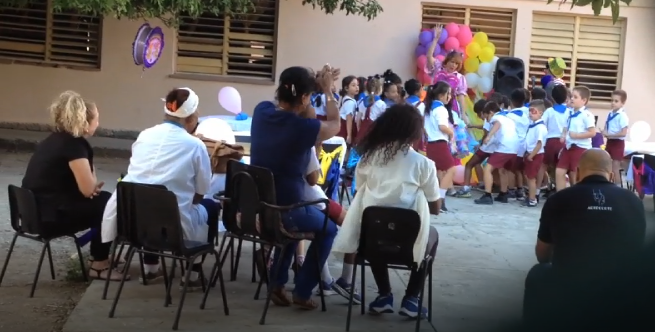
In front of my house, and also in front of the Ministry of Culture, is the “Union Internacional de Estudiantes” Primary School (UIE) which ironically has a huge photo poster of Che Guevara laying bricks during the school’s construction in 1961: “The Year of Education.” Today, two or three Fridays every month, birthday parties are held at this center in school hours, where better-off parents hire clowns, decorate the yard and even rent out bouncy castles, sometimes. continue reading

As well as rubbing luxury in the faces of those less advantaged financially-speaking, it is a distortion bearing in mind socialist schools still indoctrinate children with collectivism. On the other hand, lewd and violent reggaeton music doesn’t only bother the community, it also forms a part of these parties at primary schools.

Recently, a neighbor from my building called Xiomara Vazquez, the principal of the school to complain about noise. Vazquez defensively answered, arguing that children were holding a Pioneer (communist kids) activity and that they don’t put reggaeton on. That’s to say she lied outright, which you could confirm for yourself just by going out onto the balcony, and she went so far as to ask my neighbor: And you can hear it from the fourth floor?

The interesting thing is that these celebrations generally start off with children’s songs which compete in bad taste with the monotony of reggaeton music, as if you couldn’t educate children listening to classical music, for example. Clowns hired for these events don’t seem professional either. They look like buffoons and still shout even when they are speaking into a microphone. All of this anachronism provokes a distortion, as well as a strange reading about what the educational foundations are at socialist schools here in Cuba, today.

It’s very contradictory. The government’s efforts to uphold itself as the great righteous one (in appearance only), ultimately ignores or abuses the essence of teaching values. Children spend most of the day at school, therefore, the government has a great responsibility when it comes to the future, but they don’t seem to be too bothered by it.

Of course, if everything that needed to be censored was censored, instead of just artists and the press, the country would probably collapse. Art can’t change anything by itself but it can make people reflect upon certain subjects, which dissociate themselves from their context, that are perceived to be represented.

The recent rise in censorship is due to the government having seen its darkest side portrayed by independent journalism and artists. So many views can’t be wrong. They can gag artists, but they can never silence art. They can arrest journalists, but they will never silence the truth.

In the censored documentary Nadie,” by Miguel Coyula, poet Rafael Alcides, the lead character, talks about double standards in Cuba, about how children are taught to be fake from a young age, thereby losing their innocence very quickly.

Ever since the ‘90s and the euphemism of calling those years of great crisis (unnecessarily too) the “Special Period,” began this journey of social deterioration, which the country is currently facing today.

Maybe teachers’ inertia and Vazquez’ own, not knowing how to deal with economic differences or because teaching staff don’t earn enough to make it to the end of the month, but rather receive extras from well-off parents, or because of the lack of opportunities to relax and have access to entertainment, are some of the reasons why they adopt this permissive and deforming behavior. Where does education stand today as a priority, as the driving force behind future generations?

Translation from Havana Times

Recipes to Reconstruct a Country in Ruins

Buildings in Cuba, like this one in Havana, have routinely been allowed to collapse, during decades of state control of the economy.

14ymedio bigger14ymedio, Mario J. Pentón, Miami, 20 April 2018 — The almost unanimous support received in Parliament by Miguel Diaz-Canel, who assumed his duties as head of state on Wednesday, has not been accompanied by a concrete commitment to rebuild the country left in ruins by almost six decades of state control of the economy under the directions of Fidel and Raúl Castro.

With a stagnant economy dependent on Venezuelan oil, and a Soviet-style state apparatus that consumes the nation’s scarce resources, the new president faces a monumental challenge: to continue and deepen the economic reforms undertaken by Raúl Castro and to avoid the floundering of the political system, as several experts explained to 14ymedio. continue reading

“Miguel Diaz-Canel’s biggest challenge is to direct the economy along the path of economic growth,” says Emilio Morales, president of Havana Consulting Group, based in Miami.

Díaz-Canel, who will turn 58 this Friday, received power from Raúl Castro after a decade of slow reforms and must “rekindle the thaw with the United States,” he adds. Morales sees as the main obstacle to this “the shadow of the octogenarian generation” that, in his opinion, will continue to hold power from its control the Cuban Communist Party (PCC). If he reaches the end of his term, Raúl Castro will continue at the head of the PCC until 2021.

In order to “rekindle the thaw” with the United States (the process initiated by President Barack Obama in 2014), Morales says the new Cuban leader would have to solve the problem of the confiscations of American companies in the early 1960s, free Cuba’s productive forces through a law that allows free enterprise, and authorize the private investments of Cubans of the Island and the diaspora. These measures have been a historical demand from the opposition, but Havana has always responded with more economic centralization.

“The decade of Raúl Castro’s presidency has been a lost decade,” he says, although he points out that opening up to small private companies was a step forward. More than half a million Cubans have moved to employment outside the state since 2010, when Raúl Castro promoted self-employment as a way to alleviate the burden on public finances.

Morales adds that the government should let the laws of supply and demand operate in a free market, allow the direct hiring of Cuban personnel by foreign companies without requiring that they can only do so through contracts with the state, revitalize transport and deepen structural reforms in agriculture.

“It is necessary to eliminate the monopoly in agriculture of Acopio — the state procurement and distribution agency — and let the farmers who are leasing unproductive land decide what to produce, whom to sell it to, and set their own prices, without state intervention, in addition to extending the lease contracts indefinitely,” he says.

Cuba spends around two billion dollars every year to import products for the domestic market that could be produced on the island. The inefficiency of the state, owner of all the large and medium-size companies in the Island, has been recognized by the authorities themselves, but they continue to rely on “socialist state enterprise” as the backbone of the economy.

Elías Amor, a Cuban economist and human rights activist based in Spain, believes that it is “nonsense” to maintain the current economic system. He recently published a list of 50 urgent actions that the country’s executive must take to reactivate the economy.

“Cuba must move towards a market economy socialism, where the axis of the economy is private enterprise and the state recovers its role as a distributor of income, allocator of resources and promoter of economic development,” explains Amor, who urges the Government of the Island to abandon its regent role.

“The so-called Guidelines have to be reviewed in depth because they are unattainable within the current economic system. I think it is vital that public accounts are balanced and the (system of two) currenc(ies) is unified,” the expert added.

The system proposed by Amor includes a privatization policy that allows farmers to own the land and reduces the weight of the state sector in the economy by substantially reducing the number of personnel in the Army and State Security apparatus. “In Cuba, 85% of employees are work for the State, which should be reduced to no more than 15% to make the country prosper,” he explained in a telephone conversation.

For the Cuban professor Carmelo Mesa-Lago, the election of Diaz-Canel rests on his loyalty to the Communist Party. “The party chose him because they see him as a loyal person, who will not change anything,” the economist told Bloomberg Businessweek.

Mesa-Lago stressed that on the island “there is a stagnant bureaucracy that clearly sees the private sector as a threat,” in reference to the glacial winds blowing over Cuban entrepreneurs after the government backtracked and decided to freeze the issuing of licenses for the most profitable private sector businesses.

Last year Mesa-Lago and other experts presented Voces of change in the Cuban non-state sector, a study on the incipient private sector in the Cuban economy. At that time, the self-employed were asking for more opportunities to invest in their businesses and fewer bureaucratic obstacles. They also demanded the opening of wholesale markets and the free importation of merchandise, but so far the Plaza of the Revolution has remained deaf to their needs.

With regards to the challenges facing the new president, Mesa-Lago is not optimistic. The crisis, he says, is not as severe as when the Soviet Union disappeared, but the challenges are greater since 1990.

 ________________________

The 14ymedio team is committed to serious journalism that reflects the reality of deep Cuba. Thank you for joining us on this long road. We invite you to continue supporting us, but this time by becoming a member of 14ymedio. Together we can continue to transform journalism in Cuba.