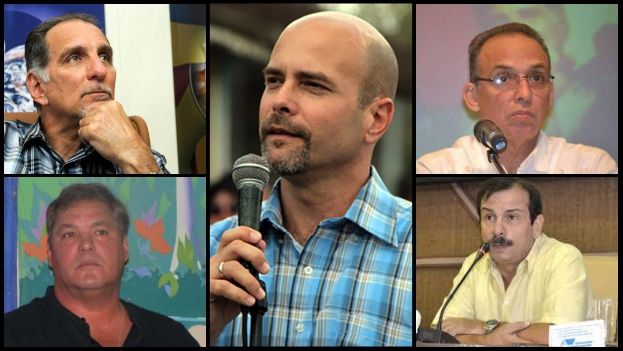

Three of the Five Cuban Spies Are Out of Parliament

The five Cuban spies were arrested in 1998 in Florida when they engaged in intelligence work for Havana. (14ymedio)

14ymedio bigger14ymedio, Havana, 26 January 2018 — The recent publication of the list of deputies to Parliament has begun to generate controversy among the ranks of officialdom. The wife of one of the five Cuban spies who were convicted in the United States has lamented on her Facebook page that three of them have been left out of the National Assembly of People’s Power.

Olga Salanueva, wife of the Wasp Network spy René González, expressed her disagreement on the social network because her husband is not included in the list of 605 parliamentarians revealed on Wednesday by the official press. continue reading

“I do not see any reason for the five not to be deputies,” complained Salanueva, after discovering that only two of the spies had been included in the list of parliamentarians. “It has been like an explosion of opinions have come to us and I assure you that I have no answer to many of the questions,” she says.

In addition to Gonzalez, Ramón Labañino and Antonio Guerrero were excluded from the National Assembly, while the names of Fernando González and Gerardo Hernández do appear on the list of parliamentarians.

“Three of the five were ignored… Which represents, in my opinion, a new and great injustice against the five heroes,” criticized Salanueva, who believes that González, Labañino and Guerrero “deserve [to be parliamentarians]” because Cuba “needs them too.”

Salanueva’s post on Facebook expressing her displeasure is an unusual event in an electoral process that is characterized by unanimity, conformity and lack of surprises.

Of the 605 parliamentarians that make up the legislature, 50% are elected from among the delegates from the different districts across the country, while the other half are proposed by mass organizations through their candidacy commissions. Included in this share are figures from the spheres of culture, sports and the history of the Revolution.

The five Cuban spies were arrested in 1998 in Florida when they undertook intelligence work for Havana and, after their arrest, the government of former President Fidel Castro deployed an intense and costly propaganda campaign for their release.

For 15 years Cuban officialdom launched a full-scale crusade that included political acts, images of their faces placed in every school, songs, poems, collections of international signatures and a repetitive television advertising campaign for the return of the “Five Heroes.”

René González was released from prison in the United States in 2011 and three years later Fernando González also completed his sentence. Both returned to the Island.

In December 2014, following the diplomatic negotiations between the governments of Raúl Castro and Barack Obama, the three who continued to serve sentences in the US were released and deported to Cuba. In return, the Plaza of the Revolution handed over contractor Alan Gross imprisoned on the island for providing satellite connection devices to Cuba’s Jewish community.

When the released men returned to Cuba on 17 December of that year, they were received immediately by Raul Castro in his office, but Fidel Castro did not meet them until February of 2015, a fact that aroused many suspicions.

Salanueva revealed that her husband, who currently serves as vice president of the José Martí Cultural Society, received some forms to fill out with his details as part of the process to be a possible parliamentarian. After that moment he heard nothing more about the process to reach the National Assembly.

“He was never consulted again, nor called, nor did anyone approach him to ask for his opinion or anything else,” says his wife, who took the opportunity to lament that González’s current job responsibility “has nothing to do with his vocation” and “he can not even exercise the profession he loves.”

After they returned from the United States, each spy was placed in an official institution. Gerardo Hernández works as vice-rector of the Higher Institute of International Relations and Fernando González is president of the Cuban Institute of Friendship with the Peoples.  Ramón Labañino, meanwhile, is vice president of the National Association of Economists of Cuba and Antonio Guerrero is vice president of the Superior Organization of Business Management of Design and Construction Engineering.

Salanueva suggests that the decision to exclude three of them from Parliament came from the highest levels of power in Cuba. “I doubt that any candidacy committee has excluded them, because those commissions are made up of good people and I suppose there must be some other reason…”

The Cuban population has a very polarized view of the five men, whom some describe as heroes but others label as “agents” of the Ministry of the Interior or “informers.”

_______________________________

The 14ymedio team is committed to serious journalism that reflects the reality of deep Cuba. Thank you for joining us on this long road. We invite you to continue supporting us, but this time by becoming a member of 14ymedio. Together we can continue to transform journalism in Cuba.
Authorities in Cabaiguan Suspend More than 50 Cart Vendor Licenses

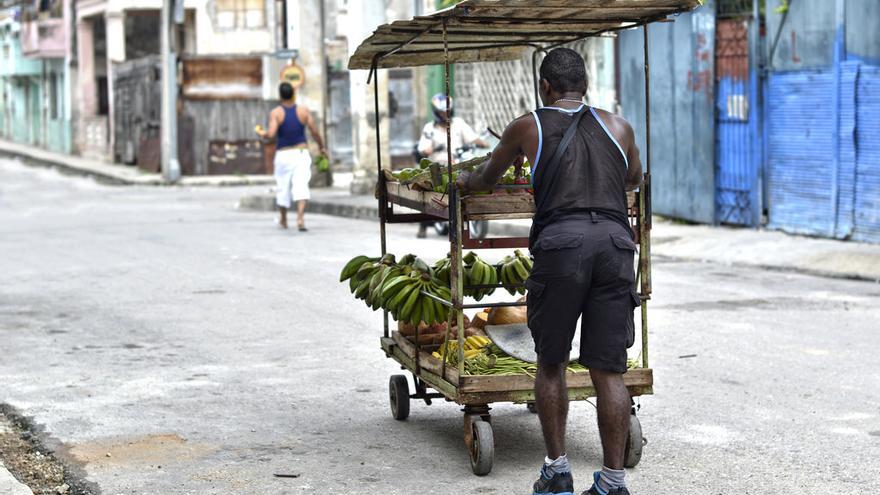
The Municipal Administration Council (CAM) also encourages buyers to denounce operators who break the rules. (DC)

14ymedio bigger14ymedio, Havna, 23 January 2018 — The local authorities in Cabaiguán, Sancti Spíritus Province, have become serious about sales from ambulatory cart vendors. Since the end of last year, more than 50 contracts with the carretilleros have been rescinded for violating the regulated prices imposed by the State, according to the official press. In addition, the carts that have remained have been moved away from the State’s “Red Tent” farm market, and an undetermined number of pounds of merchandise for sale (“not just a few,” according to the press) has been confiscated.

The newspaper Escambray put on the table, in its notice this Monday, the complaints of the carretilleros, who argue that it is impossible to sell at the regulated price if they want to earn something, contrary to the municipal authorities, who claim nonpayment to the State business, Acopio, for stolen produce or abuse of the consumer. continue reading

According to the local publication, in spite of efforts to control the imports of basic foods, the laws have been continually violated in the face of the laxness of the authorities and the citizens. For this reason, the Council of Municipal Administration (CAM) also encourages the buyers to denounce the carretilleros who break the rules.

“In December we made the decision, coordinated with Urban Agriculture, to not have any more contracts with the mobile points of this organism and to leave only the fixed points that have been a local investment. This was owing to price violations, fundamentally, and because they weren’t complying with the regulations of Urban Agriculture, which establish that they are mobile cart vendors, who can’t be within at least 200 meters of a State entity — and they were in front of the Red Tent — and that they should be linked to an organopónico*, because their purpose was to sell the production from those places,” Carlos Puentes Molina, Vice President of the CAM that manages the distribution of goods and consumption, told Escambray.

The text also said that they took measures against the ambulatory vendors who violated “the scope of the activity,” meaning that they cannot eastablish themselves in a fixed area. “Just in this area there were six who were reprimanded and preventive measures were taken,” says Elianni Silot López, municipal director of Work and Social Security.

The official press maintains that when the food was at the market in Cabaiguán, “at payable prices” (i.e. regulated), it sold in barely one hour. In addition, the police intervened in three stores and confiscated enough merchandise to fill two trucks.

The local police continue to monitor “every Sunday at the fair (…) to verify that it is selling in accord with the list of prices.”

In the whole province, the Integral Supervision Direction had imposed, at the end of 2017, 84 fines for price violations (a total of 9,000 pesos) and collected another 25,000 pesos in sanctions against cuentapropistas, self-employed persons, who were engaged in business without a license.

Since the end of 2016, the enforcement of controls on prices was extended from the province of Artemisa to the rest of the Island. Most consumers celebrated the much lower prices, but now they lament the decrease in quality and supply after the arrival of regulated prices in the markets.

The measure, which put producers and intermediaries on alert, was taken after a session of the National Assembly that took place in December 2016, in which the subject of the price of food provoked numerous discussions. In answer to the claim by several deputies, Raúl Castro said that measures would be taken to close the gap between prices and salaries.

Translator’s note:

*Cuban system of urban agriculure using organic gardens. It first arose as a community response to lack of food security during the Special Period after the collapse of the Soviet Union.

Translated by Regina Anavy

__________________________

The 14ymedio team is committed to serious journalism that reflects the reality of deep Cuba. Thank you for joining us on this long road. We invite you to continue supporting us, but this time by becoming a member of 14ymedio. Together we can continue to transform journalism in Cuba.

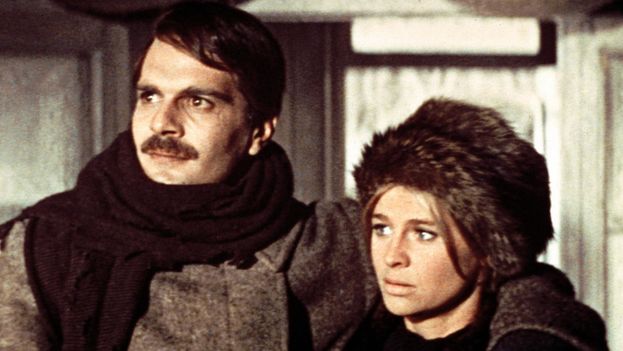
‘Doctor Zhivago’, An Old Acquaintance Opens In Cuba

Screenshot of ‘Doctor Zhivago’, inspired by Boris Pasternak’s novel. (CC)

14ymedio bigger14ymedio, Yoani Sanchez, Generation Y, 25 January 2018 — The book was part of the private collection of a writer who went into exile and even though the title did not appeal I chanced it, bored in the midst of the publishing drought of the ‘90s. Its pages narrated a country I knew, but described a different place, convulsed, unjust and harsh. Doctor Zhivago came into my hands when the Soviet Union had disappeared and in it I found a part of the answers to explain that disaster.

A quarter of a century later, Cuban television finally broadcast the well-known film inspired by the novel, directed by British director David Lean. Released in that long ago 1965, the movie was absent from the screens of the island until 22 January of this year, though before the airing the program’s commentator warned about the picture’s ideological distortions. continue reading

An unnecessary clarification, because the story of Yuri Zhivago is well known on this island thanks to the infallible formula “there is nothing more attractive than the forbidden.” For decades, the work written by Boris Pasternak circulated from hand to hand – its cover wrapped in the boring state newspaper Granma to avoid indiscreet eyes – or, in recent years, in that elusive digital format that easily mocks the thought police.

Unlike George Orwell’s 1984Doctor Zhivago was not banned for predicting a totalitarian future that lined up along many points with our socialist Cuba, but because it described an uncomfortable past for those who wanted to present Russia as a country where the proletarians had achieved a Parnassian state of equality, comradeship and justice.

Instead of the Manichean vision taught in Cuban schools, Pasternak’s work focused on a tormented individual, shaken by social vagaries and more concerned with emerging unscathed from his circumstances than in sacrificing himself for a cause. He was an antihero far-removed from the “New Man” and the Soviet ideal.

The adventures the book had to circumvent also served as an argument to those who wielded the scissors at the Island’s publishers. Its publication in Italy 1957, the Nobel Prize it won Pasternak and the official pressures that forced him to reject the award contributed to the denial of Cubans’ right to read it.

The “camaraderie” in the Communist Bloc was filled such actions. An author censored in one of the countries that made up the vast red geography also made the blacklist in the other nations orbiting the Kremlin. Havana did not ignore that maxim and was faithful to its national stepmother, depriving its citizens of one of the twentieth century’s anthological works.

They censored it in Cuba not only out of ideological complicity with the country that economically sustained all the eccentricities of Fidel Castro, but because in its pages the Great October Socialist Revolution came out badly; it was a mass of informers, police, pressures of all kinds and lies. A suffocating scenario where the individual could barely protect her privacy and herself.

They say that when he was expelled from power, in 1964, Nikita Khrushchev read Pasternak’s novel. “We should not have banned it. I should have read it. There is nothing anti-Soviet in it,” he acknowledged then.

The Cuban censors, however, have not drafted an apology, nor is it necessary. History sounded the vigorous trumpet: the country they tried to protect from the supposed calumnies of the writer ceased to exist almost three decades ago; but Doctor Zhivago remains a vibrant and unforgettable novel.

______________________________

The 14ymedio team is committed to serious journalism that reflects the reality of deep Cuba. Thank you for joining us on this long road. We invite you to continue supporting us, but this time by becoming a member of 14ymedio. Together we can continue to transform journalism in Cuba.
Cuba Harvested 200 Tons Of Cocoa In 2017, The Lowest Figure In 70 Years

Baracoa’s chocolate farmers expect to harvest 800 tons of the fruit this year. (EFE)

14ymedio biggerEFE via 14ymedio, Havana, 25 January 2018 — The cocoa harvest in Baracoa, the chocolate capital of Cuba on the eastern end of the island, fell “dramatically” in 2017. Only 200 tons of the fruit were collected, the worst result in more than 70 years, after the damage left in that area by the powerful hurricanes Matthew and Irma.

The current figures contrast with the 1,600 tons collected two years ago, when a historic peak was reached, subsequently affected by Matthew, the hurricane that devastated that portion of eastern Cuba in October 2016 and damaged the almost 9,000 acres dedicated to the crop, according to an article in the state newspaper Granma published on Thursday.

The hurricane spread its rage across the vegetation of the area, taking out the trees that gave shade to the cacao, a requirement for the optimal development of these plants. continue reading

The cocoa crops in Baracoa were beginning to recover slowly with the help of agricultural collectives from other territories, when Hurricane Irma arrived last September and “gave the coup de grace” to the 2017 harvest.

However, producers in the region expect to reach 800 tons this year and by 2020 to recover the level of production that existed prior to the hurricanes, says the official report.

Baracoa, the first village founded by the Spanish in Cuba, is located in the province of Guantanamo, about 600 miles east of Havana, and is the most isolated city in Cuba.

Known as the chocolate capital of Cuba, 85% of the cocoa that is consumed nationally comes from this area, which houses the only chocolate factory on the island, inaugurated by Ernesto Che Guevara in 1963.

Hurricane Matthew, the third most devastating hurricane to have passed through the island, hit that eastern territory on October 4, 2016 and caused damages worth 97.2 million dollars, especially in agriculture.

Almost a year later, in September of 2017, Hurricane Irma left 10 dead and great destruction as it passed along the northern coast of the country.

____________________________________

The 14ymedio team is committed to serious journalism that reflects the reality of deep Cuba. Thank you for joining us on this long road. We invite you to continue supporting us, but this time by becoming a member of 14ymedio. Together we can continue to transform journalism in Cuba.
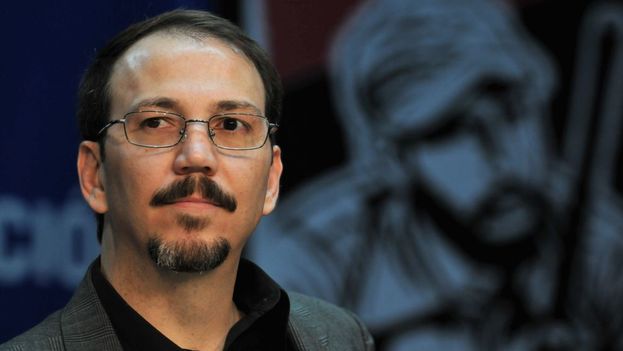
Alejandro Castro Espín Can Not Be President Of Cuba

Colonel Alejandro Castro Espín, son of Raúl Castro, is considered the true head of the Ministry of the Interior without holding the title. (EFE)

14ymedio bigger14ymedio, Havana, 25 January 2018 — With the publication, on Wednesday, of the list of candidates for the National Assembly of People’s Power, one of the great unknowns of the transfer of power in Cuba was clarified: the current president’s son, Alejandro Castro Espín, is not on the list and thus is automatically unable to legally rise to the Presidency of the Republic.

Castro Espin was identified by numerous analysts and opponents as a possible successor to his father, Raul Castro, who will leave his position as head of State on April 19. However, only members of parliament may occupy the presidency. continue reading

The 605 candidates listed in the official newspaper Granma must still be ratified in an electoral process convened for March 11. At this stage in Cuban elections there is a single candidate for each seat and voters may only choose whether or not to approve them. No names may be added or deleted.

If Raul Castro decided to make his son his successor as president, he would be violating the Electoral Law, the reform of which, announced in February 2015, has not yet been undertaken. According to Article 10 in paragraph F of the current law, to be eligible for the Council of State it is necessary to have been “previously elected as a Deputy to the National Assembly of People’s Power.”

The most recurrent hypothesis among analysts is that Raul Castro’s son, Alejandro Castro Espín, exerts the power behind the throne, acting as a “gray eminence” who, without sitting in the nation’s highest position, controls the country from the shadows.

Castro Espín, 52, is a colonel of the Ministry of the Interior (MININT) and is Raúl Castro’s only son. He is seen as a hard-liner and someone who would continue the politics practiced by his father. For the last five years he has been considered the true head of MININT, although he does not formally hold the title of Minister.

Speculation about the appointment of a “puppet president,” who will act in accordance with the interests of the family clan, has gained strength as the finalization of the new Parliament approaches.

One of the president’s daughters, sexologist Mariela Castro Espín, is included in the list of candidates for deputies of the National Assembly of People’s Power.

The list was published ten days after each province completed consultations on the proposed list of ‘pre-candidates’ for provincial delegates and deputies for each province. The national and provincial candidacy commissions previously prepared these lists, a method that allows them to politically filter the parliamentarians and to choose like-minded people who support the government.

The Electoral Law stipulates that roughly 50% of the 605 parliamentarians that make up the National Assembly are elected from among the constituency delegates, while the other half are proposed by mass organizations through their candidacy commissions.

___________________________

The 14ymedio team is committed to serious journalism that reflects the reality of deep Cuba. Thank you for joining us on this long road. We invite you to continue supporting us, but this time by becoming a member of 14ymedio. Together we can continue to transform journalism in Cuba.
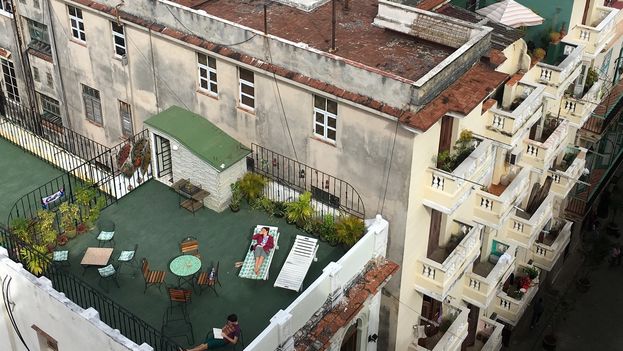
Rooftops That Look To The Sky

Havana’s rooftops are far from the intrusive stares in the streets below. (14ymedio)

14ymedio bigger14ymedio, Zunilda Mata, Havana, 25 January 2018 – Rooftops with flimsily-covered wooden ‘houses.’ Rooftops with improvised pigeon coops and the sound of fluttering throughout the day. Rooftops in litigation where the neighbors fight over a place to stretch their clotheslines. Rooftops with water tanks where the water floods when it comes at all and moss grows in the corners. Rooftops that extend Havana to the sky and seen from Google Earth reveal more than they hide.

The city grows upwards and not with new skyscrapers. Building on the roofs, extending our housing over our heads, has prevented more than one divorce in this capital where housing problems drive creativity and the opportune use of any space where a bed can be laid out, a kitchen can be set up, or a newborn’s cradle can be tucked away. Rooftops are also far from the prying eyes that haunt the street.

Private and discreet, they can become a solarium for lightly dressed tourists above the houses where rooms are rented to foreigners, a place for teenage love with the stars as a coverlet, or a territory where you can fire up certain forbidden cigarettes. If the rooftops of Havana could speak they would tell stories of survival and eroticism, of colossal fights and of mirahuecos (voyeurs) who peek out from above. They would betray the hidden life of this city.

____________________

The 14ymedio team is committed to serious journalism that reflects the reality of deep Cuba. Thank you for joining us on this long road. We invite you to continue supporting us, but this time by becoming a member of 14ymedio. Together we can continue to transform journalism in Cuba.
Three Priests Ask Raúl Castro For Real Elections To “Avoid Violent Changes”

The signatories recall that the the Government restricts the manner in which religion is practiced on the Island, and mentions by way of example that public processions or masses must have the express permission of the authorities (14ymedio)

14ymedio bigger14ymedio, Havana, 24 January 2018 — Three Catholic priests have addressed a letter to President Raul Castro in which they ask the president to let Cubans “choose in freedom,” not vote. In this way, the priests warn, the island will have “different” political options to “prevent that one day, given whatever circumstances, Cuba is submerged in violent changes.”

The signatories of the letter, written on the occasion of the twentieth anniversary of the “Mass of the Homeland” presided over by Pope John Paul II, and reproduced in full in a public letter, are Castor José Álvarez de Devesa, of Camagüey; José Conrado Rodríguez Alegre, from Trinidad, and Roque Nelvis Morales Fonseca, from Holguín.

“We want to choose in freedom. In Cuba there are votes, not elections. It is urgent to have elections where we can decide not only our future, but also our present. Now we are invited to ‘vote,’ to say ‘yes’ to what already exists and there is no willingness to change. Choosing implies, in itself, different options, choosing implies the possibility of taking several paths,” say the priests. continue reading

The three priests note that, “Since the institutionalization of the Communist Party as the only party authorized to exist, this people has never been allowed to raise a different voice,” and emphasize that all criticism has been silenced.

According to the authors of the letter, the political changes they defend must be accompanied by the creation of a “Rule of Law” in which there is a clear distinction between the executive, legislative and judicial powers, and their independence is guaranteed.

“We want our judges not to be pressured, for the law to be order, for illegality not to be a way of subsisting or a weapon of domination,” argues the letter, which at the same time demands that the Capitol be filled with legislators who represent the interests of their constituents.” The letter denounces “the lack of religious freedom” since “the Church is tolerated, but it is constantly monitored and controlled.”

The letter also states that the Government restricts the manner in which religion is practiced on the Island, and mentions by way of example that public processions or masses must have the express permission of the authorities, and if this is not granted no explanations are given.

The legalization of private and independent media is another of the demands of the letter, whose signatories note that the Church does not have free access to the mass media in Cuba and argue that the “monopoly and control of communication media means that nobody can access public media freely.”

“Cubans have the right to participate as investors in the economy and in our country’s negotiations,” demands the publication, which blames the “lamentable economic helplessness” that Cubans experience on the lack of opportunities for citizens to invest in the island on an equal basis with foreigners.

Nor has education been left out of the epistle, which notes that although education is a guaranteed right on the island and schooling is compulsory, there is a “teaching of a single way of thinking.” The letter defends young people’s right to “educational alternatives” and “options for the teaching of thought” and goes on to say that parents should have the right to choose “what kind of education they want for their children.”

In recent years several calls for attention from Catholic priests to the Government have had a great impact on national and international public opinion. In September of 1993, when the country was immersed in a deep economic crisis, the Cuban bishops released the pastoral “Love endures all things.”

Twenty years later, in 2013, another pastoral titled “Hope does not disappoint,” signed by 13 active bishops and Cardinal Jaime Ortega Alamino, addressed 43 points of the national reality that, from the perspective of the Cuban Catholic Church, should be improved.

Now, the three priests have chosen to publish their letter on a date to pay tribute to Archbishop Pedro Meurice Estiú, of Santiago de Cuba, who on January 24, 1998 gave a homily during the visit of Pope John Paul II to the island, an event at which Raúl Castro, then Minister of the Armed Forces, was also present. During the mass the Pope defined the Cuban people in a memorable way.

A growing number of Cubans “have confused the homeland with a party, the nation with the historical process we have experienced in recent decades and the culture with an ideology,” said the Archbishop at that time.

_________________________

The 14ymedio team is committed to serious journalism that reflects the reality of deep Cuba. Thank you for joining us on this long road. We invite you to continue supporting us, but this time by becoming a member of 14ymedio. Together we can continue to transform journalism in Cuba.
Letter to Raul Castro from Three Cuban Priests

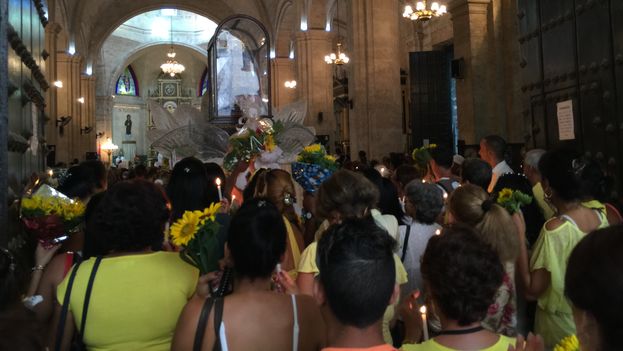
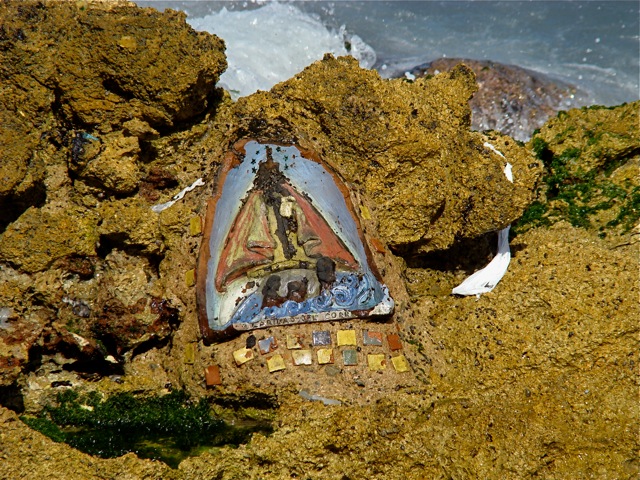
A makeshift shrine to Cuba’s Patroness, The Virgin of Charity of Cobre, on Havana’s Malecon

To Raúl Castro Ruz on the 20th anniversary of the Mass for the Homeland celebrated by Saint John Paul II and the words of Bishop Pedro Meurice at Antonio Maceo Plaza in Santiago de Cuba, on January 24, 1998.

On the first of January, the 59th anniversary of the triumph of a Revolution was commemorated. A Revolution necessary in the face of the atrocities committed with impunity by a power that had turned against this people. Many fought and many died to give their children a Cuba where they could live in freedom, peace and prosperity.

Today, almost six decades later, we have sufficient arguments to evaluate what we have experienced in our land.

Since the institutionalization of the Communist Party as the only party authorized to exist, this people has never been allowed to raise a different voice, rather, every different voice that has tried to make itself heard has been silenced. continue reading

This totalitarian style has permeated every layer of society. Cubans know they have no freedom of expression, they are careful in saying what they think and feel, because they live in fear, often even in fear of those with whom they live every day: classmates, coworkers, neighbors, acquaintances and relatives. We live in a web of lies that runs from the home to the highest spheres. We say and do what we do not believe or feel, knowing that our interlocutors do the same. We lie to survive, hoping that some day this game will end or an escape route will appear in a foreign land. Jesus Christ said: “The truth will set you free.” We want to live in the truth.

The monopoly and control of communication media means that nobody can access public media freely. Similarly, there is no alternative education. Every Cuban child has a right to education and access to a school, but to a single model of education, to a single ideology, to the teaching of a single way of thinking. Cubans have the right to have educational alternatives and options for the teaching of thought, Cuban parents have the right to choose what kind of education they want for their children.

The economic helplessness in which this people lives is lamentable, forced by circumstances to beg for help from relatives who managed to go abroad or from foreigners who visit us; to ask for fair compensation or to steal everything they can, renaming theft with delicate words that help the conscience so as not to show it in all its harshness.

Many families lack a minimally stable income that allows them to acquire the basics of living without worry. Feeding, clothing and providing shoes for children is a daily problem, public transport is a problem, even access to many medications is a problem. And in the midst of a people that struggles to survive, the unspoken suffering of the elderly, often silently unprotected, is inserted.

How can it be said that capital belongs to the people, when the people do not decide what is done with it? How can the necessary public institutions be maintained if there are not the necessary resources? Why are foreigners invited to invest their money and Cubans are not allowed to invest theirs in an equality of opportunities? Cubans have the right to participate as investors in the economy and in our country’s negotiations.

And to all this is added the lack of religious freedom. The Church is tolerated, but it is constantly monitored and controlled. Full religious freedom is limited with controlled freedom of permission to worship. Christians can come together to share their faith, but they are not allowed to build a temple. The Church can hold processions and even public Masses, but always on the condition of an express permission from the authorities which, if it is not granted, is not subject to appeal or explanation. The Church can raise its voice in the temples, but it does not have free access to the mass media and, in the few moments when this does happen, it is always under censorship. The laity are censored when they try to apply their faith to political and social practice.

This social dynamic that has resulted in Cuba has forgotten the person, his dignity as a child of God and his inalienable rights; almost 60 years after this people believed in an ideal that is always postponed and never realized. When someone questions, when someone raises their voice, they find only vulnerability and exclusion.

We want a country where life is more respected from conception to natural death, where the union of the family is strengthened and marriage between a man and a woman is cared for; in which pensions are enough for our elders to live on; in which professionals can live with dignity on their salaries; where citizens can become entrepreneurs and there is more freedom of work and contracts for athletes and artists. Young Cubans should find work opportunities that allow them to develop their talents and skills here and not see leaving Cuba as the only way out.

We have a legality subject to power, the absence of a “Rule of Law.” The clear distinction and independence of the three powers is essential: executive, legislative and judicial. We want our judges not to be pressured, for the law to be order, for illegality not to be a way of subsisting or a weapon of domination. Let our Capitol be filled with legislators who, with full power, represent the interests of their constituents.

Our people are discouraged and tired, there is a stagnation that can be summed up in two words: survive or escape. Cubans need to experience the joy of “thinking and speaking without hypocrisy” with different political opinions. We are tired of waiting, tired of running away, tired of hiding. We want to live our own lives.

This letter also has a purpose, which is a right: We want to choose in freedom. In Cuba there are votes, not elections. It is urgent to have elections where we can decide not only our future, but also our present. Now we are invited to “vote,” to say “yes” to what already exists and there is no willingness to change. Choosing implies, in itself, different options, choosing implies the possibility of taking several paths.

If we write this letter is to prevent that one day, given whatever circumstances, Cuba is submerged in violent changes that would only add more useless suffering. We still have time to follow a progressive process towards a plurality of options that allows a favorable change for everyone. But time is running out, it is urgent to open the door.

There is no use hiding the truth. It is useless to pretend that nothing is happening. It is useless to cling to power. Our Master Jesus Christ tells Cubans today: “What does it profit a man to gain the whole world, if he forfeits his life?” We are in time to construct a different reality. We are in the time to create the Cuba Martí desired: “With all and for the good of all.”

We entrust ourselves to the intercession of the Virgin of Charity, Patroness of Cuba. She, Mother of all Cubans, intercedes before the Lord of history who, as His Holiness Benedict XVI said in Cuba: “God not only respects human freedom, but seems to need it,” so that we can always choose the greater good for all.

Father Castor José Álvarez de Devesa, Cura del Modelo, Camagüey

Father José Conrado Rodríguez Alegre, Pastor of San Francisco de Paula, Trinidad, Cienfuegos

Father Roque Nelvis Morales Fonseca, Pastor of Cueto, Holguín

Prices are Prohibitive for Direct Flights from Cuba to Trinidad and Tobago

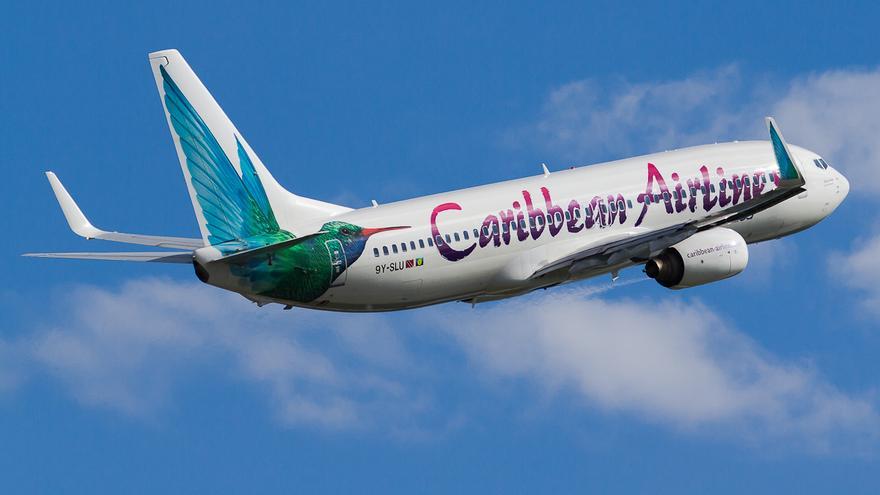
Caribbean Airlines will connect Cuba with the small Caribbean island twice a week. (EFETurAmerica)

14ymedio bigger14ymedio, Zunilda Mata, Havana, 17 January 2018 — The new air route that connects Cuba with Trinidad and Tobago, inaugurated last Saturday, began while both countries are negotiating new immigration regulations for Cubans, who currently do not need visas to visit that country.

After the round of negotiations between the governments of both countries in the middle of last year, and with this new direct connection by air, the Cuban community on Trinidadian territory is worried that new requirements will be imposed on their relatives who wish to visit them. continue reading

For now, the new Caribbean Airlines schedule, with a frequency of twice a week, fills a vacuum of direct flights between both nations. Previously, travelers had to make a stopover on the small Dutch island of Aruba or in Panama City and fly the flagship company of that country, Copa Airlines, with fares over $500 per ticket.

“It is now possible that Copa will lower prices because previously it had no competition for travel to Cuba,” predicts Kenia Montes de Oca, a Cuban living in Port of Spain who is hoping to regularize her residence there with refugee status.

Although the authorities of Trinidad and Tobago do not require visas for Cubans, at the airport immigration officials can deport anyone they suspect of wanting to stay illegally, a practice that has been increasing after the immigration talks held in August of last year, according to complaints from travelers compiled by this newspaper.

Montes de Oca remembers that before the direct route existed, trips through Aruba or Panama sometimes presented problems, diversions or delays.

The new service will make the trip between Cuba and Trinidad and Tobago shorter and faster, although Caribbean Airlines fares are still high compared to other destinations in the region, 14ymedio was able to confirm.

A round-trip ticket with no additional baggage fees for trips before the end of January costs roughly $752, while making the reservation for a trip nine months in advance yields a savings of only $50.

Flights to Cancun or Miami from Havana can often be purchased for under $200, but with the drawback that both Mexico and the United States require arriving Cubans to have a visa.

“I traveled to Trinidad and Tobago for the first time at the end of last year,” says Pavel, a 28-year-old Cienfuegos resident who explores shopping malls for purchases that he later resells in Cuba. “I didn’t make any money because at that time there were no direct flights and the ticket was very expensive.”

Pavel also points out that the exchange rate (1 triniteño dollar is equivalent to 0.14 US dollar) “is not favorable.” In addition, in Cuba the dollar is subject to a 13% tax, which makes the operation even more expensive.

“Obtaining a Mexican visa is very complicated for me because I was once deported from that country when I was trying to reach the border with the United States,” the merchant says. “So I have to continue with this route even if I don’t get that much business,” he adds.

________________________________

The 14ymedio team is committed to serious journalism that reflects the reality of deep Cuba. Thank you for joining us on this long road. We invite you to continue supporting us, but this time by becoming a member of 14ymedio. Together we can continue to transform journalism in Cuba.
One Dead and 14 Injured in Sancti Spiritus Crash

Traffic crashes are the fifth leading cause of death in Cuba (Escambray)

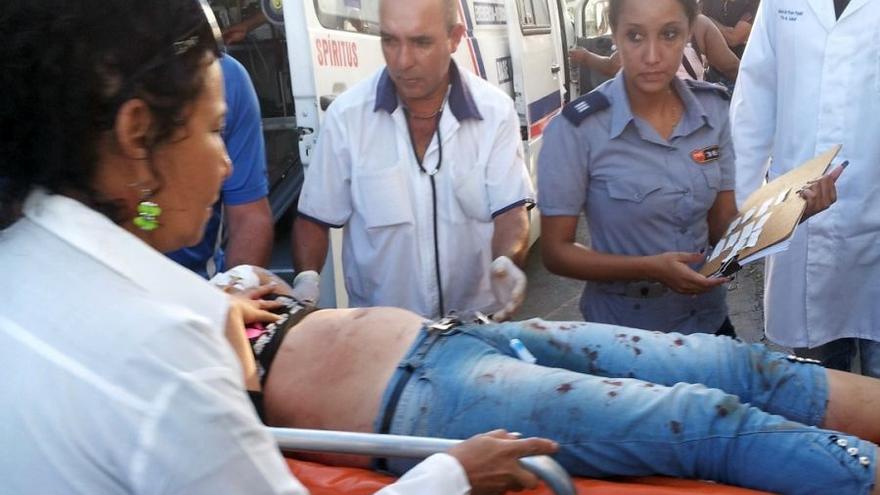
14ymedio bigger14ymedio, Havana, 12 January 2018  — One person died and 14 others were injured in a crash on Thursday afternoon on the highway that connects with city of Sancti Spiritus with the town of Guasimal. A truck from the state company Acopiobeing used as public transport overturned on the curve known as El Fiel, according to a report aired in the Buenos Dias TV program.

The truck, loaded with passengers the back, overturned after meeting a jeep on the curve and taking maneuvers to avoid a collision. Aramís Macías Rodríguez, 42, a resident of Paredes, lost his life in the crash and among the 14 injured there are three minors. continue reading

The injured adults are being treated at the Camilo Cienfuegos Provincial Hospital in Sancti Spíritus and at least three of them are in critical condition with life threatening injuries, a doctor from the hospital center told national television.

“The rest of the patients have less serious injuries and are under observation, and in the next few hours we will determine how to proceed with them,” the doctor added.

The children who suffered injuries in the accident are being treated in the José Martí Pediatric Hospital in the same city.

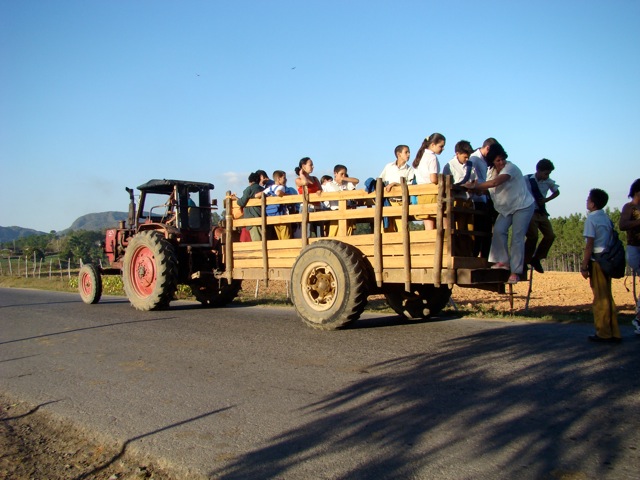
“Makeshift” buses are common in Cuba; here a cart pulled by a tractor is used as a bus in Pinar del Rio. (MJ Porter)

Traffic crashes are the fifth leading cause of death in Cuba. In the last five years crashes have also caused monetary losses estimated at 2.5 billion Cuban pesos, about 100 million dollars, which is between 1% and 5% of the island’s GDP.

_______________________________

The 14ymedio team is committed to serious journalism that reflects the reality of deep Cuba. Thank you for joining us on this long road. We invite you to continue supporting us, but this time by becoming a member of 14ymedio. Together we can continue to transform journalism in Cuba.
Dual Currencies: Before 1959 and Today / Dimas Castellano

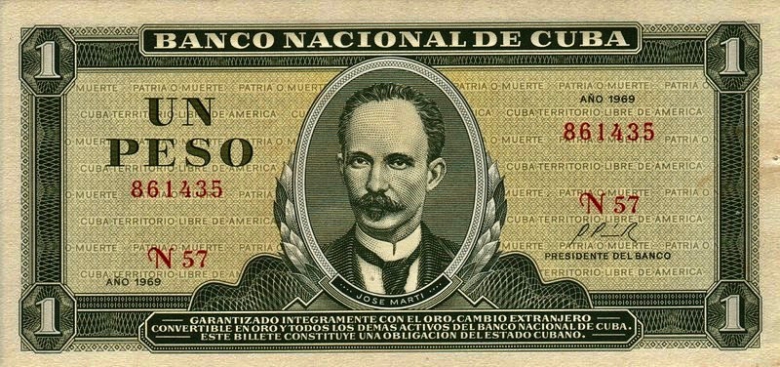
One peso note, Cuba, 1969

Dimas Castellanos, 22 January 2018 — The reform measures implemented in Cuba in 2008 failed: voluntarism, statism, centralized planning, and subordination to policy and ideology dashed them. The coexistence of two currencies confirms this.

In 2011 monetary unification formed part of the Guidelines approved at the Communist Party’s 6th Congress. In 2013 a timeline was announced to implement it, and there was talk of a prompt solution. In 2016 its elimination was said to be urgent.

In 2017 buying with Cuban pesos was authorized for use at retail establishments, and bills of 200, 500 and 1,000 pesos were placed in circulation to facilitate transactions. Then, in December, President Raul Castro stated: “the elimination of the dual currency system constitutes the most pivotal process to make progress on the updating of our economic model. Without solving this, it will be difficult to advance correctly.” He concluded by saying: “I must recognize that this issue has taken us too long, and its solution cannot be put off any longer.” (Granma, 22 December 2017)

In this article I limit myself to the historical background of the dual currency system; that is, its past and present. continue reading

Dual currency in Cuba before 1959

In the period between 1878 and 1895 two key events took place.

First: the explosion of the sugar industry and the export of more of 90% of Cuban sugar to the U.S.A. allowed the American Government to impose the Bill McKinley agreement on Spain, a commercial reciprocity treaty that allowed the free flow of Cuban raw materials to the American market, including sugar, which accounted for 94 of every 100 pesos the island took in.

The second: the important role of American investments in the structures of agrarian holdings, sugar plants, and mining facilities.

Both developments, after Spanish domination, facilitated the introduction of the dollar into Cuba as a monetary resource.

The Spanish centén and the French luis continued to circulate in Cuba until 1914, but official payments were made according to the exchange rate established by the dollar. In order to diminish dependency on it, in October of that year the Government of General Mario García Menocal created the National Monetary System, whose first measure was the “Economic Defense Law,” which gave rise to a national currency based on the gold standard, with the same weight and law as the American dollar.

Although it arose subordinated to the dollar, which was legal tender, after the Economic Defense Law the peso began to prevail.

In 1924 86% of the currency in circulation consisted of dollars. In 1934 an acute depreciation made it necessary to devalue the peso, which continued to function as a measurement of value, but the means of circulation was assumed by the peso de plata (silver peso) and certificados de plata (silver certificates), legal tender as of 1935.

In 1939 the Currency Destabilization Fund was founded, and in 1948 the National Bank of Cuba was created, which replaced the peso de plata with notes from the National Bank, obligatory and unlimited legal tender.

In The Monetary Unification of 1914 Elías Amor sums up the results with just a few words: “The introduction of the National Monetary System created a reliable, modern and well-built system that allowed the national currency to become a store of value, on the basis of which commercial and financial transactions and operations ensued that made possible a remarkable dynamism and growth of the economy under the Republic.”

Dual currency in today’s Cuba

The revolutionaries who rose to power in 1959, imbued with high doses of subjectivism, and believing themselves to be immune from the laws that govern economic and financial phenomena, moved to eradicate mercantile relationships and money. They nationalized the national and foreign banks, and placed these responsibilities in the hands of “loyal” people.

An example was the case of the economist Felipe Pazos Roque – founder and first president of the National Bank of Cuba, in 1948 – who, opposed to the coup d’etat of 1952, resigned his post. Pazos, who participated in the civic struggle against the Government of Fulgencio Batista, in 1959 was again assigned this responsibility, but his ideas were found not to be “loyal.” Months later he was replaced by Commander Ernesto Guevara.

Eighty years after the advent of the Cuban peso, with a deficient economy, but buoyed by Soviet subsidies, extended for ideological and geopolitical reasons, and as socialism was crumbling in Eastern Europe, Cuba was in the throes of a severe crisis, dubbed with the euphemism  “Special Period During Peacetime,” during which, between 1990 and 1994, the country’s GDP contracted 34.8%.

The Government limited itself to implementing measures to subsist, but without really changing. After 35 years of revolution and confrontation with the U.S.A., it decided to introduce, for the second time in the history of Cuba, the enemy’s currency.

To erase the negative image of the greenback, the CUC was created, a convertible peso assigned a value similar to that of the dollar, but without its attendant backing. A 10% tax was placed on the dollar, the CUC appreciated in relation to it by 8%, and ultimately achieved a one-to-one value, but the 10% tax on the dollar was maintained. In summary, Cuba features the peculiarity of having two currencies, neither of which is based on gold or on the GDP to be truly convertible.

The monetary duality exacerbated social differences and accelerated the loss of the Cuban peso’s already scant value. Its effect was evident in the inflation of prices in the black market, and meager wages and pensions. It frustrated production, reduced productivity, and lost or diminished its functions as a value of measurement and instrument for the acquisition of goods, savings, settling debts and making payments.

Monetary unification stands, along with the restitution of citizens’ liberties, as an inescapable necessity, one that cannot be put off, despite challenging conditions, particularly because the entity that must enact this unification, the Government, is the same that introduced the dual system, and until now has not demonstrated the political will necessary to carry out a critical analysis of itself and implement the only possible solution. The fact is that 60 years in power make it responsible for both the good and the bad.

The Cuban peso lacks support for the payment of goods and services sufficient to recover its functions and for it to be comparable to other international currencies. Monetary unification, by itself, will not solve the crisis. The solution calls for efficiency and an increase in production, which is impossible without major investments. Foreign because the monetary duality is an obstacle; national because the power refuses it.

A project is pressing, headed by this Government or that which replaces it, that features the decentralization of the economy, restitutes citizens’ rights and liberties, allows for the development of a middle-class, and removes the obstacles that restrain production and productivity. But none of this is possible under statization and a planned economy subordinated to the interests of those in power.

Note: Translation from DiariodeCuba.com

"I’ll Die As I Lived: Standing in Line"

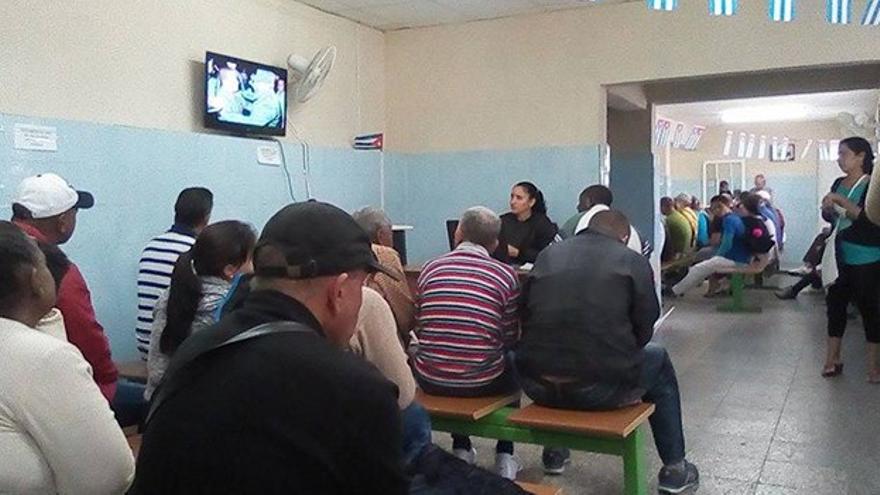
The Cienfuegos “Municipal Procedures Unit” with images of Fidel Castro playing in a look while people wait for hours for their turn. (14ymedio)

14ymedio bigger14ymedio, 23 January 2018 — It’s two o’clock in the morning and on San Carlos Street in Cienfuegos all you can hear are the crickets. For Jesús, it’s a late night like any other. He retired from his job as a bus driver almost a decade ago, and at 75 he has enough energy to take the first shifts in the line for dealing with government paperwork, places he will resell later in the day.

“The line is an art. You have to learn how to master it so you can go on living,” he says, while having a cup of coffee near the bus terminal.

For each place in line he manages to sell he charges 50 pesos in national currency, about $2 US or a fifth of his monthly pension. “This is a country for retirees because they are the ones who can stand in these long lines for everything,” he says. “If I lived on what the State pays me for working for them for years, I would be in misery.” continue reading

By six in the morning there are already more than 20 people outside the Municipal Procedures Unit and Jesús has the first two places in the line. “There are two lines,” he explains. “The longest is to request an identity card, passport and address changes, the other line is for foreigners, for non-Cubans who want to reside on the Island and for Cubans living abroad who wish to repatriate.”

Two hours later the line begins to become a crowd. There are already around 60 people who forcefully cram themselves against the doors of the official building, which remains closed.

“When do they open, at 8:00 or at 8:30?” says an annoyed woman. There is no visible sign showing the office hours.

The murmurs and complaints increase. “It’s always the same with these people, they treat the people as if they were sheep,” says someone.

“This is nice, you just have to understand it,” replies another person sarcastically. “We’re going to see when Cuba Dice (Cuba Says — a program on state television that talks about irregularities and negligence) is going to do a program on this,” adds a third voice.

At about 8 o’clock in the morning the door opens and a Major of the Ministry of the Interior addresses the crowd that has been waiting for hours. “Good morning, compañeros, we are going to have one line to enter the office, foreigners and Cubans who live abroad make one line, and the rest make another,” he says.

The officer makes it clear that it is not his task to organize the line. “You are making the line and if someone sneaks in, it is not our problem, you should be alert and disciplined so that the line can proceed,” he adds.

For Jesús this is the worst moment. The retiree finds it difficult to have to squeeze together with several dozen people in the entrance hall to the government office. He has had to endure several nudges, pushes, stomps, and even fights to secure one of the first places in line. His food depends on it.

“After I get past the line, when I’m already inside, I wait for the person who will come to take their turn. Payment is always made in advance, it’s hard work, but it’s better than standing guard at a kindergarten,” he explains. The business arrangements are made days in advance and he finds his customers through the recommendations of others who were satisfied with the way he handled himself.

The Paperwork Unit waiting room is “torture,” in the words of Jesús.

“It occured to some official to set up a television set with images of Fidel, so for the whole time you’re waiting (it could be four or five hours), you listen to songs dedicated to the comandante and see his image,” he says.

The sequence with images of Castro includes episodes from his childhood, the struggle in the Sierra Maestra, the battles of the Bay of Pigs, his work as president from the ’70s to the ’90s and several images of his convalescence after his abdominal surgery.

Every six seconds or so the images of the former president alternate with classic themes of the revolutionary repertoire: “Singing and weeping of the earth, singing and weeping of the glory,” sings the now deceased Sara González. Pablo Milanes follows her with songs like It has not been easy or If the poet is you. Nor is the sequence missing Silvio Rodriguez with The Fool, and Riding with Fidel, by Raul Torres. The Buena Fe duo is also part of the slideshow with songs dedicated to the Revolution.

Fidel with Evo Morales, Fidel with the boy Elián, Fidel with Rafael Correa, Fidel with Hugo Chávez, Fidel with Maduro, Fidel with Raúl, Fidel with Cristina Fernández, Fidel with Ortega, Fidel at the Bay of Pigs, Fidel with the ’White Udder’ cow, Fidel pushing his jeep during the Special Period … In five hours waiting for a turn to complete some paperwork those who wait are exposed to at least 3,000 images of the former president.

“And this with the deceased having said he didn’t want people to worship his personality. The officer who sits next to the television must dream of Fidel every night,” Jesús says sarcastically.

The retiree considers himself “a paperworkologist ” and gives great importance to his work. “People need to work, study, take care of their lives, not spend hours in line, that’s why my work is so well paid,” he says.

Around nine o’clock in the morning, he turns over his place in line to the person who needs to complete some paperwork and goes home to the San Lazaro neighborhood.

According to the old man, in a week he can charge the equivalent of his monthly pension. “It’s the way I can help my family, my grandchildren, in the end, the old ones like me, all they have left is this,” and he jokingly paraphrases one of Silvio Rodríguez’s classic themes: “I’ll die as I lived: standing in line.”

__________________________________

The 14ymedio team is committed to serious journalism that reflects the reality of deep Cuba. Thank you for joining us on this long road. We invite you to continue supporting us, but this time by becoming a member of 14ymedio. Together we can continue to transform journalism in Cuba.
Public Health in Cuba / Rebeca Monzo

Waiting for healthcare in Cuba.

Rebeca Monzo, 7 January 2018 — First of all, to be properly treated in any hospital, you have to have a friend who is a doctor or a friend who is very close to the doctor you are going to see, in addition to bringing a gift — something already established — to be able to enter the office at all, without asking where the end of the line is and to “set a good precedent.”

The journey to be seen in the normal way is long and tedious: first you must go to the family doctor, where you are probably seen by a student, or a recent graduate without experience. They will ask you questions and fill out paperwork, without listening or paying attention, and will give you a referral to go to the polyclinic you are assigned to, where there are always long waiting lines and you will almost never find a specialist, so you will need to return constantly until there is one, as they work in hospitals and from time to time come to the polyclinics to practice. continue reading

If your case is serious, they will send you to the hospital, where a foreign student may attend you, because almost all of our best Cuban doctors and specialists are out of the country, serving on a “mission” in Haiti, Brazil, Venezuela or any other place in the world, which has contracts with the Cuban government to supply doctors and health specialists, who receive only a small percentage in foreign currency of the money that these countries pay to the government of the island for these “missions.” This exchange, which benefits the government greatly and the health professional very little, is called “solidarity.”

In our polyclinics and hospitals, at the moment, the most visible characteristic is the lack of hygiene and medicines and, in some cases, even a lack of professionalism, except for honorable exceptions that prove the rule.

The employees in charge of cleaning do not have the necessary products and resources nor do they receive decent salaries to promote good hospital hygiene.

Lamentably, as in all agencies and service centers in the country, politics is the priority and not hygiene, nor good service, nor professionalism. Where this is painfully more notable is precisely in polyclinics and health centers, where the sick population has to face all kinds of difficulties that threaten good hospital service.

This is true even in some of the newly restored hospitals such as the Calixto García, where the last generation stretchers are in precarious and depressing hygienic conditions, as is the furniture of the waiting rooms, and the bedside tables in the wards full of cockroaches, dehulled and dried out, bathrooms with broken facilities, leaks and puddles of water, where patients must walk at risk of slipping and falling.

When patients are admitted, the doctor who sees them informs the patient’s companion that they must bring sheets, pillows and pillow cases, a fan, soap and other hygiene items, as well as plastic bags to store belongings, so that the cockroaches do not crawl all over those items owned by the patient.

Despite the lack of hygiene and medicines, we must recognize that our doctors are excellent people, but how can it be said in the media that our country is a world benchmark for healthcare, when there is no protection of life here and medical errors ‘cover the earth’.

More Than 15,000 Cubans Spend 100 Million Dollars a Year in the Colon Free Zone

With their individual purchases, Cubans are helping to make up for the decline in business in the Colon Free Zone. (14ymedio)

14ymedio bigger14ymedio, Havana, 18 January 2018 — Ordinary Cubans are helping the Colon Free Zone (CFZ) to make up for the decline in purchases from Venezuela, whose profound economic crisis is having a strong negative impact on the largest free zone in the world, located on Panama’s Atlantic coast.

According to the CFZ’s manager, Manuel Grimaldo, more than 15,000 Cubans arrive annually at Colon and spend some 100 million dollars. To feed this business, the Panamanian Government grants 1,000 visas a month to residents of the Island.

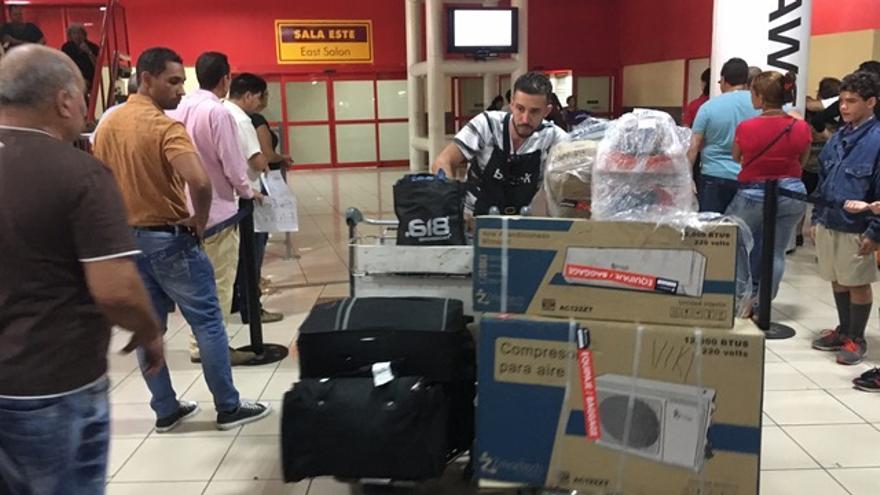
Jorge, 39, is one of the Cubans who participates in this small-scale trade. When he discovered the “mother lode” of importing merchandise, he quit working for himself as a carpenter and got his first visa at the beginning of 2017. Since then he has traveled to Panama every month to buy appliances, clothing and footwear. A few days ago, arriving by ship through the company CubaPack, were an air conditioner and a semi-automatic washing machine, some of the equipment most in demand in the informal Cuban market. continue reading

“I took advantage of the fact that January began and that I am entitled to a new annual import paid in national currency* to bring these things, but the rest of the year I keep selling medicines, sports shoes, clothing and packaged foods,” says Jorge.

His wife, a graduate in chemical engineering, hopes to obtain a visa soon to accompany him to Panama. “Two carry more than one,” he says. In the letter that she presented to the Panamanian consulate in Havana, she explains that she wants to know that country because of its “vibrant culture and its many commercial options.”

This Cuban market is one of the objectives that Panama intends to focus on, in addition to electronic commerce, to overcome the crisis. The total commercial activity of the CFZ in 2017 was 19.7 billion, just 0.3% more than in 2016, and below the 21.7 billion dollars of the previous year.

“With those figures, the free zone will continue to be maintained, it will never disappear, so we want it to be more competitive with a modern image and the electronic [commerce] implementations planned,” said the administrator.

The poor results are attributed to poor planning on the part of the Zone and the crisis in Venezuela and Colombia. Of the more than 3,200 companies involved in 2011, just over 2,600 are still operating. Grimaldo declared that he had to deal with the payment of debts in the amount of 400 million dollars to collaborators when he assumed his position.

The debt of Venezuelan importers, close to 600 million dollars according to official data, and an extraordinary duty applied by Colombia to the re-exports of footwear and textiles, have hurt the merchandise distribution center.

Another of the business strategies is to increase electronic sales, which so far represent a very small margin. Only 70 companies in the CFZ are currently engaged in e-commerce.

Recently the CFZ established an Institutional Committee to prevent money laundering, the financing of terrorism and the proliferation of weapons of mass destruction, among other measures, and Grimaldo said the entrepreneurs welcome this but more training is needed.

“Before the business was to buy goods and take them back to their countries, with the transactions always in cash and there was no mystery to it (…), I can’t say that there has been money laundering in the CFZ, our entrepreneurs have always been serious, it’s just that they need adapt to a new business model and comply with international regulations, which they are now doing and it’s working better,” he said.

“The Free Zone, which is about to be 70 years old, remains the most important tax-free center in the world. It is the only one with three ports that move almost 3.2 million containers, the Panama Canal, a freight train and the Enrique A. Jiménez Airport, located in Colón, which offers flights to Panama City and other destinations,” explained Grimaldo.

He said that imports in 2017 totaled 9.17 billion dollars in household appliances, jewelry, bedding and linens; and re-exports amounted to 10.54 billion dollars for pharmaceutical products, alcoholic beverages and cigarettes.

In October of last year, a case came to light of a ghost company located in the Colon Free Zone that conned dozens of ‘mules’ who paid them for their shipping services to the island. PC-Cargo, the company responsible for the fraud, offered parcel service to those who wanted to send heavy loads such as washing machines, televisions, refrigerators and other appliances to Cuba.

At that time, an official of the Free Zone administration confirmed to 14ymedio that the incident was being investigated but that they could not “give details of the inquiries made.”

“Cubans who have lost their money are receiving legal aid,” and the case is in the hands of the Prosecutor’s Office, the source said.

*Translator’s note: Cuban customs sets very high fees for imports, but Cubans resident on the island are allowed, once a year, to pay the import fees in Cuban pesos instead of the usual Cuban convertible pesos, which means that they pay 1/25th of the usual fee.

___________________

The 14ymedio team is committed to serious journalism that reflects the reality of deep Cuba. Thank you for joining us on this long road. We invite you to continue supporting us, but this time by becoming a member of 14ymedio. Together we can continue to transform journalism in Cuba.