Cuba Nominates Candidates for Parliament Who Will Elect Castro’s Replacement

This video, unsubtitled, is of Miguel Diaz-Canel, Cuba’s first vice-president. The text before the video begins reads: “More censorship and fewer entrepreneurs is the message Miguel Diaz-Canel delivered to Party cadres last February at special conference.”

14ymedio biggerEFE via 14ymedio, Havana, 22 January 2018 — On Sunday, the 168 Municipal Assemblies of Cuba’s People’s Power nominated their candidates for the National Parliament. The candidates will be elected in the March 11th general elections and will be responsible for choosing the new president that will replace Raúl Castro.

Raúl Castro, 86, was nominated to be a deputy to the 2018 National Assembly of People’s Power by delegates of the Second Front Municipal Assembly, in the province of Santiago de Cuba, the official press reported. continue reading

Also nominated as a candidate to parliament, in the Santa Clara Municipal Assembly, was current first vice-president, Miguel Diaz-Canel, who is predicted to rise to the presidency of Cuba this coming April, when the new Parliament is constituted.

At the Santa Clara meeting Diaz-Canel, 57, emphasized the high numbers of young people in this electoral process and said that among the nominees there is a “perfect” social composition, including a similar share of men and women, candidates of all races, as well as people of all ages.

“There is a certainty that they will represent their constituents with dignity, since the people choose them because of their ability to defenthe common interests in higher instances,” he said.

On the same day, also approved were the candidacies of the 1,265 delegates of the Provincial Assemblies of People’s Power, who will also be elected at the polls on March 11th for a period of five years, like the national deputies.

The Cuban Electoral Law establishes that up to 50% of national deputies can be nominated to participate in elections by municipal delegates, while the rest of the members of Parliament are proposed by social organizations, all of them pro-government.

To be approved, candidates for deputy must receive more than half of the favorable votes from the delegates of their constituency.

According to the electoral timetable, between Monday and March 10, the eve of the elections, the nominees will visit their communities, workplaces and service centers, while the municipal electoral commissions will post their photos and biographies so that they will be recognized by the population.

The electoral process that will culminate in the replacement of Raúl Castro began on November 26 with the holding of municipal elections, in which about 7.6 million people voted, a participation rate of just under 86%*.

The new Parliament that emerges from the March elections will be officially seated on April 19, when the deputies must propose and elect the primary positions of the incoming government, including the president of the country who, for the first time in almost six decades, will not carry the surname Castro.

The Cuban electoral law establishes that the members of the Council of State are elected from a proposal prepared by a Nominations Commission, made up by deputies elected in the general elections, which is then put to a vote in the Parliament.

*Translator’s note: A record low rate in a country where voting is mandatory.

_______________________

The 14ymedio team is committed to serious journalism that reflects the reality of deep Cuba. Thank you for joining us on this long road. We invite you to continue supporting us, but this time by becoming a member of 14ymedio. Together we can continue to transform journalism in Cuba.

Twelve Years Later, Cuba Receives 344 Modern Russian Ladas

The Lada, the leading car brand in Russia, has been operating in Cuba for more than forty years. (Youtube)

14ymedio biggerEFE, via 14ymedio, 20 January 2018 — Three-hundred-and-forty-four modern Ladas manufactured by the Russian car company Avtovaz arrived today at the port of Havana, which means a return of the importing of these vehicles to the Island after a twelve year hiatus.

The new vehicles, Vesta and Largus Cross models, manufactured by Russia’s largest automobile company, will be destined for the service with the Cubataxi company, explained the General Director of Transport of Havana, José Conesa, according to the state-owned Cuban Agency News (ACN). continue reading

The Lada, the leading brand in the Russian market, has been operating for more than forty years on the island, with thousands of the old 1200 and 1500 models, and the Samara models from the eighties and nineties.

“Cuba is one of our preferred export markets,” Avtovaz president Nicolas Maure said this week, ACN reported.

Maure highlighted the great tradition that Lada has in Cuba and assured that the company is committed to guaranteeing the availability of spare parts and the training of Cuban technicians in the after-sales service.

The sale of these Russian vehicles to Cuba is part of a transportation agreement signed between the governments of both countries in December 2016, which also includes the modernization of the island’s rail system, for which an investment of some one billion euros (about 1.054 billion dollars) is planned.

In recent years Cuba and Russia have given a boost to their bilateral relationship to reactivate the close cooperation they maintained before the demise of the Soviet Union (USSR) in 1991, with the signing of new economic cooperation agreements in several sectors.

 _________________________

The 14ymedio team is committed to serious journalism that reflects the reality of deep Cuba. Thank you for joining us on this long road. We invite you to continue supporting us, but this time by becoming a member of 14ymedio. Together we can continue to transform journalism in Cuba.

Article on the Situation of Farms in Cuba Wins First Economic Rights Contest

The winner also received one of the mentions in this first contest of economic rights in Cuba. (OCDH)

14ymedio bigger14ymedio, Madrid, 22 January 2018 — Germán M. González, author of The Current Situation Of The Farmer In Cuba, Usufruct And The Social Security Of The Small Farmer, is the winner of the First Economic Rights Contest in Cuba convened by the Cuban Observatory of Human Rights.

In the article, González details the failed agrarian policy carried out on the island since 1959 and proposes a list of urgent measures aimed at reversing the bad situation in the sector. Among these measures are freedom of association, the elimination of the state’s monopoly on purchase of farm products, rationalization of procedures to access land leases under the structure known usufruct, and several measures aimed at improving access to credit and social security for workers. continue reading

The contest jury, made up of Marlene Azor Hernández, a PhD in Social Sciences and Humanities, and the outstanding economists Énix Berrio Sardá and Elías Amor Bravo, commented on the quality and the critical proactive thinking of most of the 21 articles submitted.

Four additional articles obtained a special mention: Are There Real Agricultural Cooperatives In Cuba?, by Osmel Ramírez Álvarez; The Legal-Labor Insecurity Of Workers In The Non-State Sector In Cuba, by Rainer Pérez Castillo; Actions To Reactivate The Cuban Economy, by José Raúl Batista Rodríguez; and Legal And Fiscal Framework Of Self-Employment In The New Context Of Cuba, also by Germán M. González.

Germán M. González has a degree in Accounting and Finance and has worked as an economist, especially in the agricultural sector. He was the senior manager in large Cuban state companies and International Associations and he taught as an adjunct professor at the University of Havana. He has also written and published articles in media such as Palabra Nueva y Vitral; Blondín; the Somos+ blog; Cubaencuentro; laislaperdida.wordpress (’The Forgotten Island’); and other digital publications.

____________________________

The 14ymedio team is committed to serious journalism that reflects the reality of deep Cuba. Thank you for joining us on this long road. We invite you to continue supporting us, but this time by becoming a member of 14ymedio. Together we can continue to transform journalism in Cuba.

Cuba Looks to Peru to Solve Potato Shortage

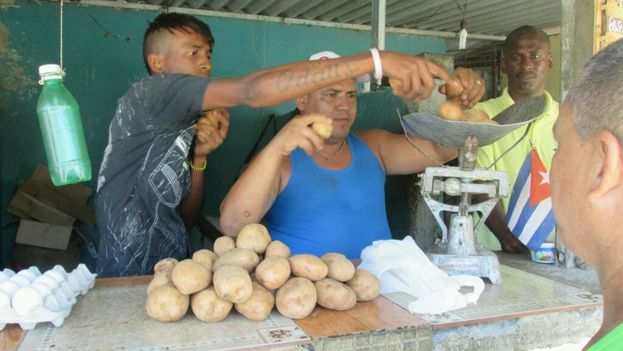
The sale of potatoes in Santiago de Cuba. (Yosmani Mayeta / 14ymedio)

14ymedio biggerZunilda Mata, Havana, 22 January 2018 — Cuba is intending to buy Peru’s surplus potatoes, if and when they meet the the phytosanitary requirements for export. Peru’s Minister of Agriculture, José Arista, reported on the efforts made by the Cuban embassy in Lima during a meeting with local producers last Wednesday, which was reported in the newspaper La República on Sunday.

The information comes to light in the midst of the “cold season,” the period during which most of the Cuban potato harvest takes place, which ends more or less in March. This year the crop forecasts are not optimistic due to the intense rains of recent months and the damages caused by Hurricane Irma. continue reading

In the provinces of Matanzas, Villa Clara, Cienfuegos and Ciego de Ávila, among the most affected by the hurricane, the Agricultural Business Group (GAG)  had planned to plant 7,942 acres of potatoes during the month of October so that the product would arrive in state agricultural markets in January and February.

However, by mid-December, only 10% of the target acreage had been sown, according to the official press, due to the rains and the wetness of the land that affected the sowing of the crop.

Fabian Lozano, a farmer from Artemisa, has been engaged for five years in the harvest of the tuber but is about to surrender due to the difficulties involved in growing it. “It is a crop that demands a lot of care,” the farmer tells 14ymedio by phone. “It is not just a matter of climate but it is necessary to have a stable technological package,” he laments.

An efficient irrigation system and the availability of fertilizers and insecticides supplied on time are essential for this product to succeed, given that it is not native to the Island. Access to the seed, which is mainly imported from the Netherlands and Canada, can also become a headache.

A national variety known as Romano is more resistant to pests and is an option to ease these demanding requirements, but its performance leaves much to be desired. “It is a more resistant potato but when it comes to harvesting or reproducing, a lot is lost,” says Lozano.

Specialists expect the Romano variety to yield 600 to 660 tons (US measure) per 33 acres when the conditions are ideal, but imported specimens yield 716 tons, according to sources of the Ministry of Agriculture consulted by this newspaper.

The Artemiseño municipality of Alquízar, where Lozano lives, produces one of the largest potato crops in the country. With fertile and flat land, the growers planned to plant nearly 620 acres this season, but the authorities have not yet revealed whether the initial goal was achieved.

“We have had many problems with the seed because there is a lot of loss due to theft,” the administrator of a Basic Unit of Cooperative Production in the area, who preferred anonymity, tells this newspaper. “We work with imported seeds but we lose up to a third of it because of the diversion of resources,” he reveals.

In Cuba the potato is sown mainly through pieces of the tuber itself, which is called “seed,” a practice that helps to maintain the genetic makeup of the plant without alterations. Proper storage of the seed is crucial for the subsequent quality of the harvested food.

“Sometimes we have to guard the potato seed more closely than the cows,” laments the administrator. “When we are sowing we always have to have a group of workers bending over the furrow and another group watching so that they do not take the seed.”

In the informal market in the area, private farmers value the foreign seed greatly because “it yields more and the final product is more marketable,” Lozano says. “Here there are many producers who sell directly to the owners of private restaurants who want a nice, big, meaty and healthy potato,” he points out.

“The customer can choose between these three side dishes: rice, fried potatoes or mashed potatoes (not instant),” clarifies a letter from a private restaurant in the Havana municipality of Playa. The owners of these restaurants often have to turn to the precooked or powdered product to make up for shortages of raw potatoes.

“We have many diners who are diplomats in the area of the city where we are located, as well as tourists who know very well what a potato is in its natural state,” explains Miguel Ángel, a waiter at a private restaurant a few yards from the coast with a spectacular view of the sea.

Maintaining the supply of fresh potatoes is “more difficult than buying lobster or shrimp,” says the employee. “For years we have established an agreement with several producers to buy directly all their production and then we have to refrigerate it ourselves so that it lasts for the better part of the year.”

Potato production has plummeted on the island since 1996, when 384,000 tons were produced and the country exported the tuber. In 2015, amidst the increase in consumption due to the growth of tourism and the private sector, barely 137,000 tons were collected and the Government was forced to import 17,000 tons, almost twice as much as in 2014, according to data from the Statistical Yearbook.

The potato is a product with a strong symbolic importance for Cuban families. Until 2009 its distribution was exclusively through the rationed market at a price of 0.45 Cuban pesos (roughly 2¢ US) per pound and its cultivation was a monopoly of state entities.

In 2009, one year after Raúl Castro formally assumed the presidency, the government de-controlled the tuber and allowed — for the first time in decades — it to be planted in plots that were not under the control of the State or a cooperative. This “liberalization” of the potato became an emblem of the so-called “Raulist reforms.”

However, the official calls to achieve elf-sufficiency in potato production and the delivery of lands to private formers in a form of leasing known as usufruct as a way to cut imports did not yield the expected results. By the end of 2017, the country was importing more than 80% of the food it consumes, at an annual cost exceeding two billion dollars.

In 2017, the potato was once again regulated, although the authorities maintain that this was not a return to rationing. Each Havana consumer can only buy 14 pounds of the product spread over three months and must show their ration book, but the price per pound has risen to 1 Cuban peso (roughly 4¢ US).

The potato is the star of the black market from the middle of the month of February until well into the spring. For 1 Convertible peso (24 Cuban pesos) you can buy a bag of potatoes with about five pounds of first quality and totally clean tubers (that is you are not paying for any dirt clinging to them), just outside the same markets where potatoes are offered in a regulated manner.

Miguel Alejandro Figueras, 2007 winner of the Cuban National Economy Prize, says that “per capita potato consumption in Cuba in 1985 was about 60 pounds” annually. In 1985, “the production exceeded 330,000 tons, accounting for 44% of all the tubers consumed in the country.” Of every 10 pounds of tubers eaten at domestic tables, almost half were potatoes.

Currently per capita consumption “is, at most, about 10-11 pounds, one-sixth of thirty years ago,” says the specialist. In 2014, the potato only accounted for 3% of the total production of root vegetables and tubers.

As of 2007, the number of areas dedicated to the cultivation of Solanum tuberosum was reduced. For Miguel Alejandro Figueras the prognosis is not promising: “Every season we plant less.” The economist notes that in the VI Congress of the Communist Party of Cuba where “the 313 Guidelines” were approved for economic policy, among them 37 specific to the agricultural sector, “the potato is not mentioned in any.”

Importing potatoes from Peru can be a solution that addresses demand while the national production remains in a slump.

____________________

The 14ymedio team is committed to serious journalism that reflects the reality of deep Cuba. Thank you for joining us on this long road. We invite you to continue supporting us, but this time by becoming a member of 14ymedio. Together we can continue to transform journalism in Cuba.

We Are All Norwegians

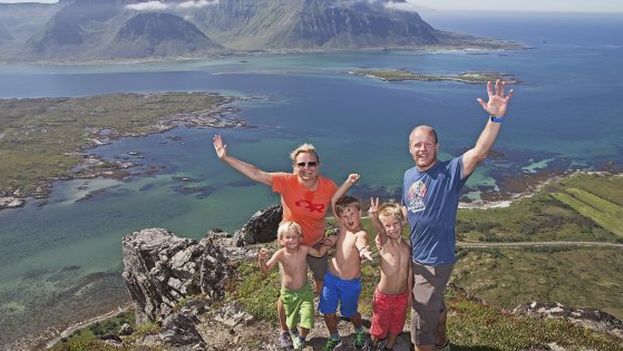
The president of the United States, Donald Trump, wants only blond, tall, orderly, hard-working, educated and clean people, like the Norwegians, to emigrate to the US. (EFE)

14ymedio biggerDonald Trump would like Norwegian immigrants. Blond, tall, orderly, hard-working, educated and clean people. Successful people with whom he shares physical features and certain traits. But it’s unlikely that he’ll have any luck. Today, Norwegians enjoy a standard of living higher than Americans and find that in their democratic, free and peaceful homeland there are plenty of opportunities to improve themselves by their own efforts. They have no reason to emigrate. Almost no one likes to depart for destinations unknown.

In contrast, fate (or geography, which is almost always the same) has delivered to Trump Mexican, Brazilian, Guatemalan, Cuban, Puerto Rican, Dominican, Honduran, Haitian, Colombian and — lately — Venezuelan immigrants and other “shitty people” who flee from their failed societies in search of security and progress. (“Shithole” people is the denigrating and unfair term put into service by the president of the United States himself in a conversation that allegedly was private.) continue reading

In reality, two thirds of the world’s population are much closer to the “shitty” people than to Norwegians. A lax description of the societies in India, Pakistan, the Philippines, Indonesia, China, the Arab and sub-Saharan nations, a part of Europe, Russia and Latin America would elicit from Trump the same offensive definition he utilized for Salvadorans, Haitians and Africans.

In any case, it is absurd to think that the solution to problems is in social homogeneity. Sharing a single race, a single religion, a single language only guarantees us boredom, monotony and abuse. That’s the road to Nazism and the extermination of different people. The glorious message of republican ideas and parliamentary monarchies is that diversity is not only inevitable but also very convenient.

The 1790 census in the United States tallied roughly 4 million white Americans, almost all of English and Irish origin, and half a million black slaves. Only a handful of native Americans remained, and they weren’t even counted. In 2018, we have 325 million people, of whom 72 percent are white, 13 percent black and 16 percent Hispanic, a strange definition that is attributable to the European colonizer.

This enormous leap has been achieved while the country rose to the head of the planet. In 1890, the United States already was the world’s largest economy. After more than a century, it continues to be, although it grows at the rate of only 2 percent a year. This means that, at least until today, the machine that turns “shitty” people into productive and wealth-producing citizens has worked splendidly, an extreme that should not surprise us. The species is the same. What changes is the circumstances, the incentives and the institutions.

The children of the Polish or Russian peasants, in numerous cases born in tiny Jewish villages, or shtetls, became renowned doctors, lawyers and scholars of all kinds. The Indians, fragmented into 200 castes in their homeland, were the segment with the highest level of income in the United States. The second generation of Cubans, whose fathers had turned their island into an unproductive collectivist disaster, attained a high degree of education and economic performance.

What I mean to say is that the United States does not need Norwegians. It needs institutions, fair laws, opportunities for newcomers to develop, and moral and material incentives for individual enterprise. If that holds, the Haitians will slowly become Norwegians, even though they’ll keep their ethnic features.

After all, today’s admirable Norwegians were once fierce Vikings, crass and brutal, who had a bad habit of spitting into the bathtub where they washed off the blood and mud that covered them after they exterminated their adversaries. That’s when the Norwegians were shitty people.

Note: Translation from El Blog de Montaner

___________________________

The 14ymedio team is committed to serious journalism that reflects the reality of deep Cuba. Thank you for joining us on this long road. We invite you to continue supporting us, but this time by becoming a member of 14ymedio. Together we can continue to transform journalism in Cuba.

Cuba Recognizes Immigration Advance with U.S. But Requests End to Cuban Adjustment Act

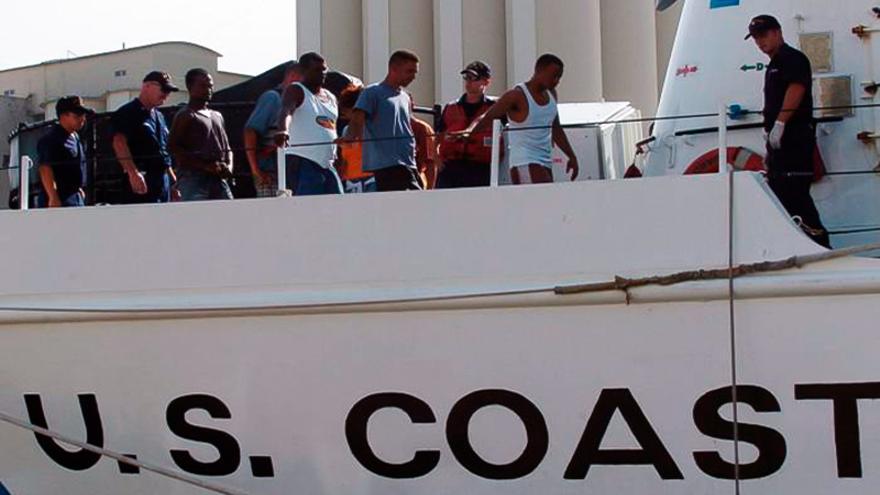
Cuban rafters being repatriated by the United States Coast Guard. (EFE)

14ymedio biggerEFE, via 14ymedio, 12 January 2018 — Cuba has recognized the advance that was made for immigration connections with the U.S. with the repeal, a year ago, of the “wet foot/dry foot” policy, which offered preferential treatment to Cuban citizens, but insisted that “normalization” would not take place while the Cuban Adjustment Act continues in effect.

The end of “wet foot/dry foot” was “one of the most transcendental steps” in the new stage that both countries are going through after the official reestablishment of relations after more than a half-century of staunch hostility, according to an article published this Friday in the state newspaper Granma in a supplement dedicated to the anniversary of the development.

The official organ of the governing Communist Party of Cuba (PCC) recognized that the end of “wet foot/dry foot” policy has reduced “almost to zero” the “illegal exits by makeshift means.” continue reading

Introduced in 1995, this policy was the result of an agreement between the administration of U.S. ex-President Bill Clinton with Havana, and the revision of the Cuban Adjustment Act, in effect since 1966, which authorizes Cubans to receive permanent residence after one year of their stay in the U.S.

“Wet foot/dry foot” guaranteed refuge to all Cubans who managed to step foot on the territory of the U.S., either in a regular or irregular way (“dry foot”), but committed the U.S. to send back those detained at sea (“wet foot”).

This was, for years, an incentive for thousands of Cubans to launch themselves into the sea on fragile boats with the hope of crossing the Straits of Florida and touching land.

An article in Granma about the “convulsive history” of migration between the two nations, separated by 90 miles of sea, recalls that the Cuban State considers this policy as “a stimulus for irregular emigration, the trafficking of migrants and irregular entrances to the U.S. from Third World countries.”

“Upon admitting them (Cubans) automatically on their territory, [the U.S.] gave them preferential and unique treatment that citizens from other countries don’t receive, so that it was also inciting illegal exits,” said an official communication of the Cuban Government released on January 12, 2017 and cited this Friday by the newspaper.

Its implementation “caused an immigration crisis, the hijacking of boats and planes and the commission of crimes, like human trafficking, slavery, immigration fraud and violence, with a growing destabilizing extraterritorial impact on other countries of the region used as transit points.”

It also mentioned, as an advance in bilateral immigration relations, the end to the program of Parole for Cuban Doctors, which incentivized the abandonment of medical missions in third countries, principally in Latin America.

In spite of this, for the Island, “it is impossible to think about the normalization of immigration relations between the two countries without the North American Congress putting an end” to the Cuban Law of Adjustment.

Together with the end of the U.S. embargo, or “blockade,” the repeal of this law is one of the principal demands of the Cuban Government for normalizing all its relations with its neighbor to the north.

The article also mentions the present tension in bilateral relations owing to the shift in policies of President Donald Trump’s administration, that try to reverse the advances of the “thaw” accomplished by his predecessor, Barack Obama, and the Cuban leader Raúl Castro.

Faced with this position, Cuba has expressed its desire to continue communication and has affirmed that “the solution is up to the U.S.”

More than 896,000 Cubans have come legally to the U.S., of a total of 2.6 million who have left the Island since the immigration reforms  were put into effect in Cuba five years ago, abolishing the requirement for an exit permit.

Since January 1, Cuba has eliminated the residence requirement for children of Cubans born in the Exterior to receive citizenship, eliminated the requirement for a passport stamp from a Cuban consulate abroad for Cuban citizens to re-enter their country and authorized the entrance via yachts for Cubans who have emigrated, although this restriction is still in effect for those who live on the Island.

Translated by Regina Anavy

__________________________________

The 14ymedio team is committed to serious journalism that reflects the reality of deep Cuba. Thank you for joining us on this long road. We invite you to continue supporting us, but this time by becoming a member of 14ymedio. Together we can continue to transform journalism in Cuba.

A Curious Fact about Bachelet’s Visit to Cuba / Juan Juan Almeida

Juan Juan Almeida, 19 January 2018 — As part of President Michelle Bachelet’s recently concluded visit to Havana, a Chile-Cuba Business Seminar was held.

During the activity, celebrated Monday, January 8, in a room at the Hotel Nacional, the Chilean president met with several businesspeople of her country who reside on the island. Among those present were Ángel Domper, Manuel Tomás Gahona, Guillermo Leiva and others.

Note that Ángel Domper was married to the Cuban veterinarian, Celia Guevara, one of deceased guerrillero Che Guevara’s daughters.

Translated by Regina Anavy

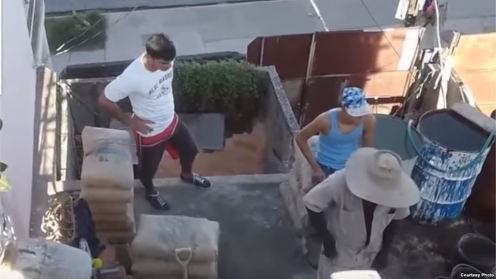
Cuban Government Plans Blow Against Management of Non-Agricultural Cooperatives / Juan Juan Almeida

Juan Juan Almeida, 12 January 2018 — The Cuban Government is preparing a new blow to restrict the rights conceded to non-agricultural cooperatives of production (CNAs), specifically those devoted to the construction sector.

According to information obtained by Martí News, the Executive Committee of the Council of Ministers is developing a set of new judicial regulations with a view to controling the boom in this type of non-agricultural production association. One of the steps would be intended to complicate the process for the forming of these consortiums.

“The CNAs didn’t appear on the Cuban scene as a natural phenomenon regulated by the laws of the market, but rather as a result of an emergency strategy to attenuate the effects of the constant national crisis,” said a source from Havana who is linked to criminal proceedings against the owner of one of these private associations. “But some members of these associations drive around in rented autos, and the Government is trying to put the brakes on them by means of legal instruments that asphyxiate this enterprise.” continue reading

The source noted that the Council of State implemented, as an experiment, Decree Laws No. 305 and 306, No. 309 of the Council of Ministers, and another series of regulations for the forming, registration, functioning and termination of the non-agricultural production cooperatives and the services of 222 private activities.

The poor profitability and lack of autonomy of State businesses, among other factors, allowed the private entitites to achieve a real importance in the business system in a short time. They work efficiently, but they constitute an impediment to State businesses, because they show they do well, and they fearlessly exhibit the wealth they acquire.

On December 12, 2017, there appeared in the Gaceta Oficial Extraordinaria No. 58, a group of laws that intended to improve the business system by conceding a larger autonomy to State businesses. Even so, State production has not responded in the manner expected, because even with their increase in strength, they are incapable of guaranteeing service, quality and delivery times, according to the State authorities themselves.

However, the non-State sector continues to visibly increase productivity and labor discipline, which is why they have publicly received important contracts for the design and remodeling of tourism hotels, winning out over the now-stagnant State businesses.

“These corporations have better builders, do better work and, in certain cases, get permission to import machinery from China and other countries. However, the form in which they were originally designed and the experimental character of the whole legal basis mean they are badly limited,” argues an attorney who requested anonymity.

The lawyer explained that no legal way exists for two private cooperatives to join together to organize complementary activities to add value to their products or services. They have to acquire everything through the State businesses, and this doesn’t work.

“They have to violate the rules if the Government doesn’t expand the legal framework. How can you buy the necessary raw material like cement, sand, gravel, marble for the floors or wood for the formwork?” asked the lawyer.

“In this fradulent way,” he added, “they control the people in the cooperatives by submitting them to constant fiscal audits, which are practically impossible to pass. They now have closed some, and their members are in court.”

“We hope this will change, or we shall soon see the end of the private initiative,” the witness concluded.

This past August, the Ministry of Finance and Prices revoked the formation conceded to the Scenius Cooperative, an accounting service, and approved its termination for “repeated violations committed by the cooperative in its fulfillment of the approved social reach.”

The CAN experiment began in 2013, and presently there are only 429 of them in existence in the whole country, according to official figures.

Translated by Regina Anavy

Bachelet Kicks Off Her Official Visit to Cuba With a Gathering of Artists / 14yMedio

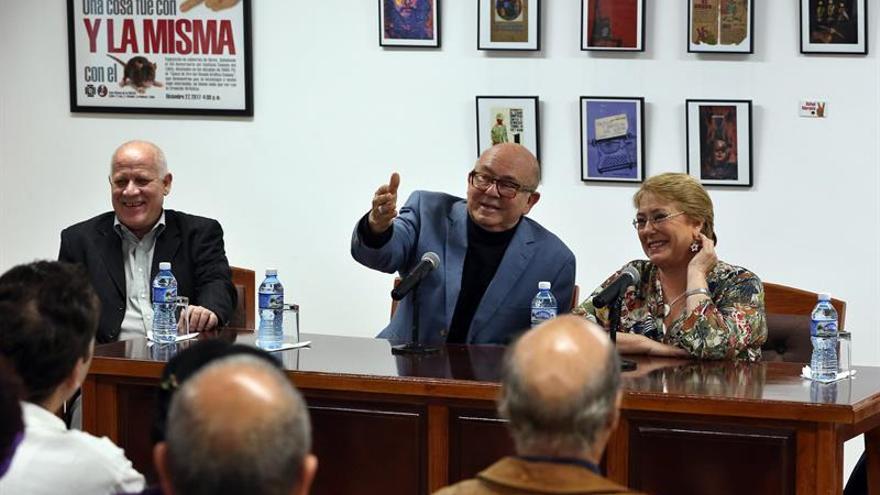
The president of Chile, Michelle Bachelet, attended a meeting with Cuban intellectuals at the headquarters of the National Union of Writers and Artists of Cuba (UNEAC) where she was hosted by its president, Miguel Barnet. (Alejandro Ernesto / EFE)

14ymedio biggerEFE via 14ymedio, Yeny García, Havana, 8 January 2018 — Chilean president Michelle Bachelet began her official visit to Cuba on Sunday — her penultimate trip abroad as head of state — with a gathering of the island’s leading artists and the signing of a collaboration agreement in film restoration and promotion.

Bachelet arrived in Havana in the early hours of Sunday and later visited the headquarters of the official Union of Writers and Artists of Cuba (UNEAC), where she met behind closed doors with its president, the writer Miguel Barnet, and the famous actor Jorge Perugorría.

Barnet, author of the acclaimed Biography of a Cimarron (1966), had a short private meeting with the union president, who showed her the gardens of the house occupied by the organization in Havana’s Vedado neighborhood. continue reading

Later, at the Villa Manuela Gallery, Bachelet attended the signing of a collaboration agreement between Chile’s National Council of Culture and the Arts and the state-run Cuban Institute of Cinematographic Art and Industry (ICAIC).

Chile and ICAIC agreed to collaborate in the identification of patrimonial films to be restored, in addition to promoting the exhibition of Cuban films in Chile, ICAIC president Roberto Smith explained to the press.

Smith highlighted the “historic links” between the cinematographies of both nations, especially the Viña del Mar Film Festival of 1967, to which Havana’s New Latin American Film Festival “declares itself indebted.” Strengthening the alliance between both countries’ filmmaking is “an old aspiration” of Cuba, stressed the official.

This Monday Michelle Bachelet will start her second and last day of her official visit to Havana with the inauguration of a business forum at the Hotel Nacional de Cuba.

Businessmen traveling in the presidential delegation in search of new opportunities for Chilean investments in the Island, which currently amount to 52 million dollars, will participate in the bilateral meeting.

Bachelet will also visit a school of education named after the former Chilean president Salvador Allende (1970-1973), where the signing of a bilateral collaboration agreement in the healthcare sector will take place.

The Chilean president will meet Monday afternoon with her Cuban counterpart, Raúl Castro, who will receive her at the Palace of the Revolution, the seat of Government.

Before that meeting, the Chilean president will offer the traditional tribute at the monument to José Martí, in the emblematic Plaza de la Revolución.

Cuba is the penultimate country to which Bachelet will travel as head of state; her final trip will be to Japan. In March she will hand over her office to former president Sebastián Piñera, the winner in the most recent Chilean presidential elections.

Bachelet’s trip to Cuba has generated criticism among both the opposition and government sectors in her country, who do not see the reason for it and demand that the outgoing president reject “the violation of human rights” on the island.

The Chilean government’s spokesperson, Paula Narváez, disagreed with the reproaches, saying that Bachelet “is exercising her faculties as president of the Republic visiting a country where there is a bilateral agenda to be addressed which has been clarified by the foreign minister.”

Cuba and Chile have relations dating back to the 1960s, when Cuba sent doctors to help the victims of the tsunami and earthquakes in the Chilean town of Valdivia.

Cuban emergency brigades also traveled to Chile after the earthquakes of February 27, 2010, in Rancagua, and April 24, 2017, in Valparaíso.

The visits in the 1970s of Cuban President Fidel Castro to Santiago, and from Chilean President Salvador Allende to Havana, are among the milestones of the bilateral relationship.

Michelle Bachelet visited the Cuban revolutionary leader, now deceased, in his retirement during her trip to Havana in 2009, the first by a leader of her country to Cuba since 1972.

The president of Chile also attended the signing of the historic bilateral ceasefire between the Government of Colombia and the FARC guerrillas in June 2016, which took place in the Cuban capital.

 __________________

The 14ymedio team is committed to serious journalism that reflects the reality of deep Cuba. Thank you for joining us on this long road. We invite you to continue supporting us, but this time by becoming a member of 14ymedio. Together we can continue to transform journalism in Cuba.

The ’Vision’ of Antonia Eiriz and The Curse of the Beard

It was not unusual, at that time, that Fidel Castro would occasionally step into some ball game that he ran across in his travels.

14ymedio bigger14ymedio, Ernesto Santana, Havana, 4 January 2018 —  Last year, while the national baseball team was finishing the World Classic with one of its most disastrous international performances, at the Havana Gallery there was an exhibition Cuba in Baseball, by Reynerio Tamayo, which was an inflamed artistic confession that got into the fiery debate about the crisis of this sport.

In addition to playing with the sense of stripping bare the national passion or the passionate nation, Tamayo’s title was a parody of Antonia Eiriz’s Death in Baseball, a 1966 painting that is among the most disturbing, and even enigmatic, that the great artist painted before being censored and marginalized.

In the midst of the colossal media campaign of these past months that tries to demonstrate that Fidel Castro is alive physically and chemically — as his grandson Fidel Antonio Castro Smirnov insists, as he visits every month “the rebellious stone [Fidel Castro’s mausoleum] that teaches and illuminates” — our attention is called to this painter’s picture. continue reading

The Senior Sportsman (one of Fidel Castro’s many monikers) practiced several athletic disciplines and, on taking power, tried to give sports to the masses and destroy professionalism, especially in baseball. Fifty-six years ago, in January 1962, he went down to what was then called the Latin American Stadium to hit the first ball and inaugurate the first National Baseball Series.

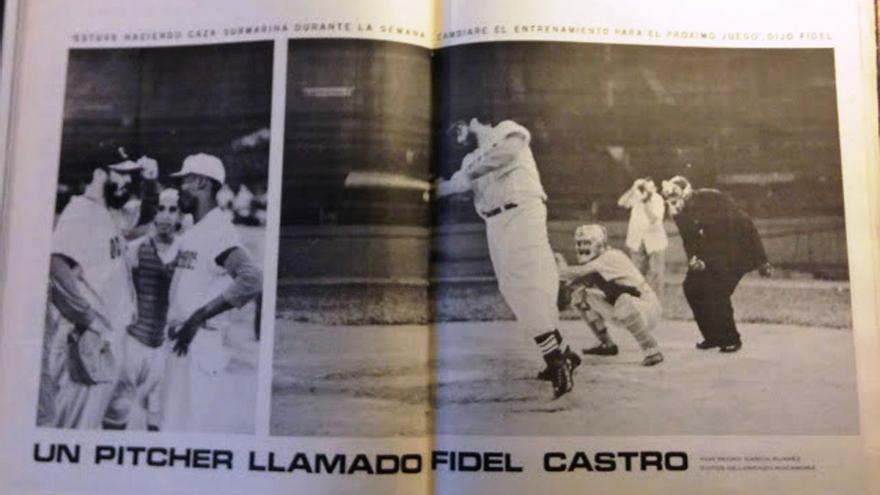
It was not unusual, at that time, that the One — as his friends called him — would occasionally join in some ball game that he ran across in his travels. He would step in and pitch for one of the teams, or both, and, of course, no one dared to contradict his decisions, regardless of the consequences for the game.

In an issue of the magazine Visual Arts: Art Experience New York City, of which he was then editor-in-chief, the critic Ernesto Menéndez-Conde published a short commentary about the article Fidel plays Baseball, which appeared in Cuba magazine in August of 1964 with photos by Lorenzo Rocamora.

Based on one of those photos, with some modifications, writes Menéndez-Conde, Antonia Eiriz painted her canvas. “She eliminated the figure of the photographer who appears at the back and approached the stands around home plate, so that the audience could also be seen.” It is possible to recognize the beard of the leader, even if the face of the batter was abruptly cut off and unfocused on the top margin of the canvas.”

The critic adds that “it was up to the spectator to decide which of the characters could be death: if it is the umpire, with his black uniform and protective mask, that appeared to be an allegorical representation, or the player at the plate who, with his hit, dazzled a crowd of blurred faces and expressions so exalted as to be monstrous.”

Although in Cuba the players don’t tend to wear a mustache or a slight goatee, it is not uncommon to see a bearded player in other leagues today, but in the early ’60’s it must have been very striking to see the bearded ruler spending his time in a baseball game.

In a way, we can see in Eiriz’s Death in Baseball as an augury of that later disaster. Those appearances of the bearded commander on the field — while hand out the maximum penalty for what he considered “slavery baseball” — marked the beginning of a new era whose death throes in the present seem interminable.

Many centuries ago, a ball game was practiced in Mesoamerica very different from the one played today in the continent and beyond, especially since it was, in fact, a complex ritual that sometimes culminated with the sacrifice of the participants. As it was symbolically related to the very cycle of life, the ball game was an important state issue.

That a ruler is involved in the nature of a simple sport, in our time, is the worst thing that can happen to it. In a picturesque way we could talk about the “curse of the beard,” but the fact is, from that time baseball began to stop being a popular entertainment and began to become a serious state issue. The title of the painting was a diagnosis. Death in Baseball, the death of the game.

 ____________________

The 14ymedio team is committed to serious journalism that reflects the reality of deep Cuba. Thank you for joining us on this long road. We invite you to continue supporting us, but this time by becoming a member of 14ymedio. Together we can continue to transform journalism in Cuba.

’Letter of the Year’ Sets Off Controversy Among Cuba’s Babalaos

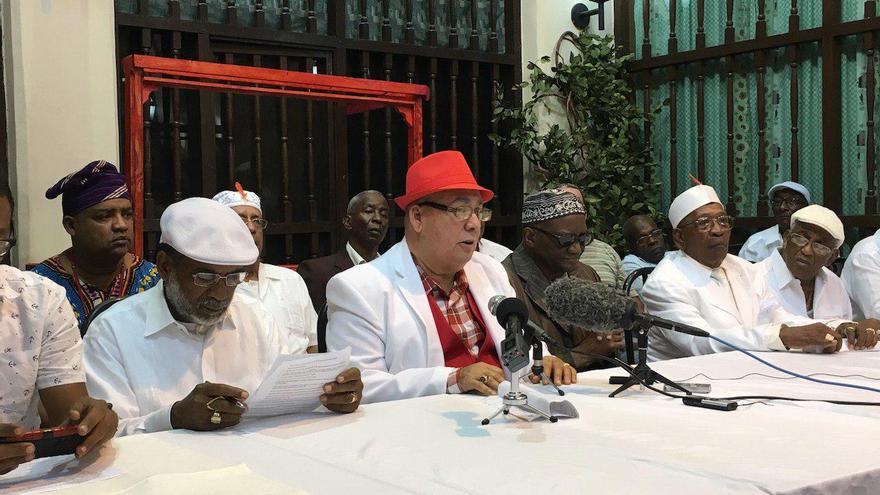
The annual predictions were disseminated after a sequence of ceremonies held jointly by the Yoruba Cultural Association of Cuba and the Miguel Febles Padrón Commission. (Archive)

14ymedio bigger14ymedio, Zunilda Mata, Havana, 3 January 2018 —  The controversy broke out after the publication of the 2018 Letter of the Year. The series of predictions — provided every January by the priests of the Yoruba religion — has raised a cloud of criticism expressed in calls to “not conspire” and to respect authority, something that several babalaos ignore as taking the side of the Government.

The annual predictions were released on January 1 after a sequence of ceremonies held jointly by the official Yoruba Cultural Association of Cuba and the independent Miguel Febles Padrón Commission, at the headquarters of the former on Prado Street in Havana.

For two years now, both entities have collaborated to produce the Letter of the Year — unlike previous years when competing Letters were issued — and this time they recognize the orisha Yemayá, goddess of motherhood, as the ruling deity and as a companion to Elegguá, represented as a child who “opens the roads” and has many followers on the Island. continue reading

This year’s controversy did not emerge from the differences between predictions that characterized the years in which two Letters were published, but by the content of the consensual document. The unusual enthusiasm shown by the official government press to spread the predictions has also generated misgivings.

One of the most controversial points has been the recommendation “not to conspire or to be part of any conspiracy in any way,” a point to which is added not to fall into “talk against anyone to avoid being exposed to great misfortunes and end up being ridiculed.”

“This is not the same as before because now it looks like a ‘Letter from the Police’ instead of a ‘Letter of the Year’,” lamented Lucinda, a practitioner of African religions living near the Plaza de Cuatro Caminos, an area where products used in Santeria rituals are sold.

Lucinda insists that for years she followed the predictions made by the Miguel Febles Padrón Commission and that they were made public in the first days of the year in their headquarters in the neighborhood of Lawton. “Since they joined the Yoruba Association, they only know how to make you afraid so you’ll keep quiet.”

The Letter includes bad omens for agriculture, news that plays very badly among those who waited for a more promising forecast for food production, after a year characterized by shortages and high prices of agricultural products.

The recommendation “not to be rushed to accomplish achievements or successes” also makes some uncomfortable, in the midst of a national context characterized by the slowdown in the economic reforms promoted by Raúl Castro after his arrival to power, a slowdown that has led to a pause in the issuance of numerous licenses for self-employment.

“At ONAT (National Tax Administration Office) they tell me that right now I can’t get a permit to rent a room and now the babalaos recommend that I don’t rush into business,” lamented Marcial, 28, this Wednesday as he waited to buy flowers for his orishas at the market on San Rafael street.

The controversy has reached the Free Yorubas Association, an independent group made up of priests of this religion, who have called the Letter “totally manipulated and in tune with the interests of materialistic atheist tyranny.”

The entity insists that the babalaos who prepared the Letter of the Year “lack religious moral authority to speak on behalf of the Yoruba or to publish predictions that affect the present and future” of the country.

 __________________________

The 14ymedio team is committed to serious journalism that reflects the reality of deep Cuba. Thank you for joining us on this long road. We invite you to continue supporting us, but this time by becoming a member of 14ymedio. Together we can continue to transform journalism in Cuba.

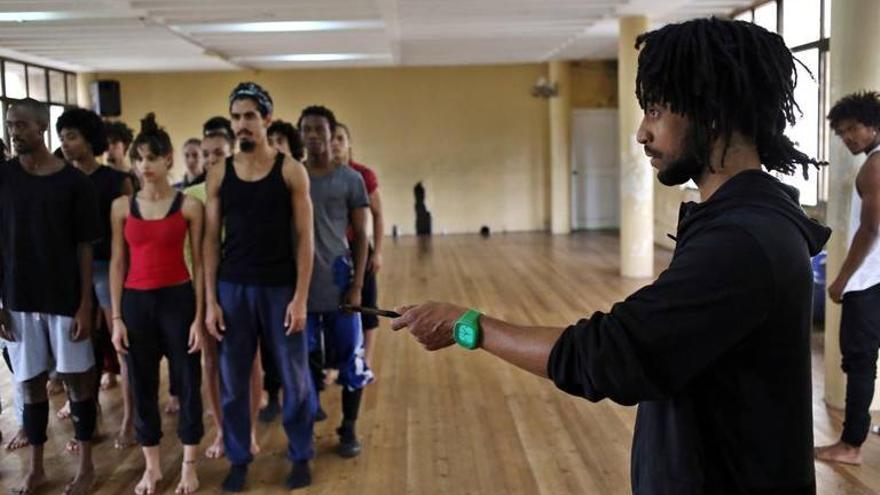
Miguel Altunaga, a Cuban Modern Dancer Who is a Prophet in his Own Land

Miguel Altunaga (right) was trained in the Cuban art education system and after seven years with Contemporary Dance of Cuba left the country to join the prestigious British company Rambert. (EFE)

14ymedio biggerEFE via 14ymedio, 18 January 2018 — After ten years of successes and ovations on British stages, the Cuban dancer Miguel Altunaga proves that he can be a prophet in his own country, and even in his former company Contemporary Dance of Cuba (DCC), to which he returns as choreographer with a world premiere that speaks of longing, distance and roots.

Nominated for the third time for the United Kingdom’s National Dance Award, now in the category of Best Dancer, Altunaga has become the most important name internationally in modern Cuban dance, a field dominated almost exclusively by classic artists such as Carlos Acosta and José Manuel Carreño.

For the young Havanan it is a “point of pride” to be considered an “ambassador” of the rich Cuban culture, and among his “goals” is to “show that classical ballet is not the only source of great dancers, but that Cuba also has a lot to offer to contemporary dance.” continue reading

“I feel like an ambassador who is in constant motion and constantly learning, also enriching Cuban culture,” he told EFE before resuming auditions at the headquarters of DCC, the most important company of its kind in the country.

With the recognition also comes the “obligation to be an example” for new artists and to return to teach the new dance trends on the Island, where despite the “shortages and problems,” the “desire and passion for art” continues, he insisted.

Miguel Altunaga was trained in the Cuban system of artistic education, and after seven years with Contemporary Dance of Cuba he left the country to join the prestigious British company Rambert, as a member of which he has received awards and applause inside and outside the United Kingdom.

To his successes of interpretation he has added a rising career as a choreographer, with works that make up the repertoire of the still young Acosta Danza, the company that Carlos Acosta created in Havana.

A decade later, Altunaga arrives to set up a world premiere entitled Beyond the Dust that draws from his personal experience and delves into the feelings of distance, longing and nostalgia, with a “little sense of humor.”

“I don’t expect viewers to see a linear, traditional story, where you know what is happening step by step, but to live an experience, to relax and enjoy it, which is very important,” he explained.

For this, Altunaga uses emblematic musical themes such as Aquí el que baila gana (Here the dancer wins) from Los Van Van orchestra, danced by the young cast of the DCC.

Beyond the Dust also serves as an appreciation and tribute to Danza Contemporánea de Cuba, to which he has always felt “close” despite the distance.

“I feel like I didn’t leave. (…) To come to Cuba and present my work in the Sala García Lorca — the largest in the Gran Teatro de La Habana — is a dream, and to see it already realized (…) one of the greatest things that is happening to me in my artistic career,” he said.

This return is “very special” for Altunaga, who tries to minimize the “pressure” on him and “enjoy the process” of assembling the piece, which will premiere on 9, 10 and 11 February.

The biggest difference for the artist is in working with an ensemble that is not as “cosmopolitan” as the cast of companies from outside of Cuba; a place where the artistic collectives are composed exclusively of locals, with a shared way of seeing art.

However, being on the island for so long has made Altunaga “feel again” that sense of “Cubanness” that he will take with him back to Rambert.

“I will return [to the UK] a completely different artist, because I have reconnected with my homeland. I think this is the first time I’ve spent so much time in Cuba since I left ten years ago. Cubanness is entering me again,” he joked.

 ________________________

The 14ymedio team is committed to serious journalism that reflects the reality of deep Cuba. Thank you for joining us on this long road. We invite you to continue supporting us, but this time by becoming a member of 14ymedio. Together we can continue to transform journalism in Cuba.

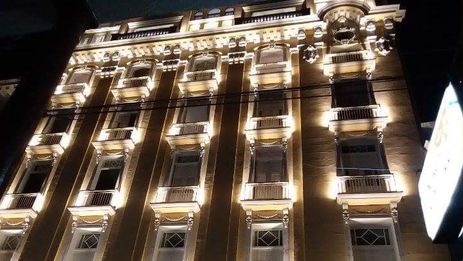
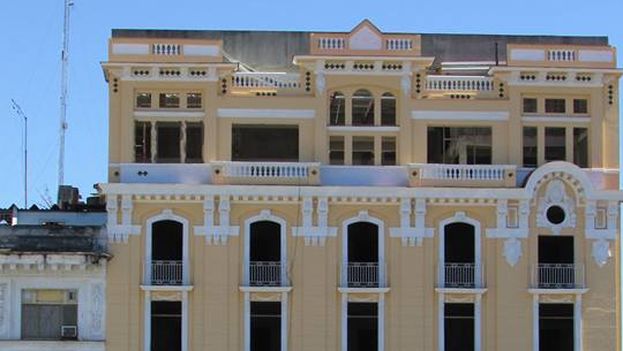
From a Public Urinal to a Luxury Hotel, The San Carlos is Reborn in Cienfuegos

Last Sunday, the renovated San Carlos Hotel was reopened with a four-star rating, after almost 21 years of neglect.

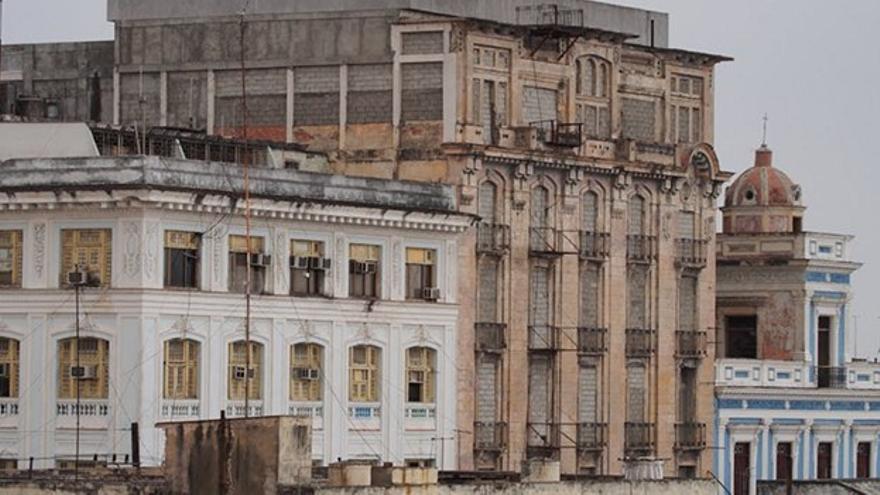
14ymedio bigger14ymedio, Mario Penton, Miami, 19 January 2018 — Every night during the ’90s there were knocking sounds from the abandoned hotel San Carlos, which borders the market in the historic center of Cienfuegos where Joaquín Rodríguez worked as custodian. There were hardly any vestiges left of the navy blue of the façade and fragments of the cornices on the roof threatened passers-by on one of the busiest roads in the city.

“People took the tiles, the slabs on the walls, the toilets, they took out the rebar and even the bricks to use in building other things. The hotel became a ruin and the first floors were turned into a public bathroom and a place for all kinds of indecencies,” says Rodríguez, now retired.

Last Sunday, the renovated San Carlos hotel was reopened with a four-star rating, after almost 21 years of neglect. The property has been restored after an agreement signed in 2005 between the Cuban State and the Spanish hotel company Meliá, the terms of which are unknown. continue reading

San Carlos Hotel before the renovation. (14ymedio)

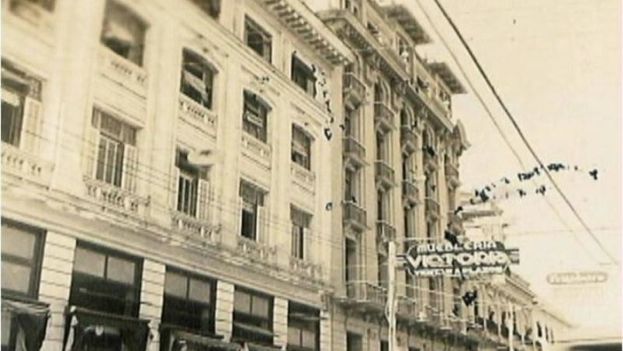
“The San Carlos Hotel dates from 1924. Its owner, Antonio Mata, who also owned the now-destroyed Hotel Ciervo de Oro, decided to invest 60,000 pesos at that time to provide the then-prosperous city one of the most modern buildings in the province of Las Villas,” explains Alicia, a local historian, speaking to 14ymedio.

The architect who completed the building, José Joaquín Carbonell, gave it the eclectic touch that characterizes the city by mixing various architectural styles. Later the property grew with the construction of another two floors, the last of which was the Roof Garden, a social club ofCienfuegos’ Republican.

For a long time, the San Carlos was the tallest building in the city. In the Roof Garden, a large room with large windows and excellent views of the bay “exquisite social meetings were held,” explains the historian.

Photograph from before the Revolution of San Carlos street, where the hotel is located in Cienfuegos. (DC)

The hotel had a total of six floors and 48 rooms when it was confiscated by Fidel Castro’s government at the beginning of the Revolution. Thereafter it became the property of the State, which did not allocate sufficient resources for its maintenance.

In the 1980s, a reconstruction process began that was scheduled to be completed on 26 July 1984. At that time, every province was completing some project to commemorate the assault on the Moncada barracks on that day. In the case of The San Carlos, the reconstruction was halted and the hotel closed its doors forever.

In July 2005, the historic center of Cienfuegos was declared a World Heritage Site. “Since that year, interest in knowing about our city has increased, as it is the first of the cities built in the nineteenth century to achieve this recognition,” emphasizes the historian.

That same year, recalls Joaquín Rodríguez, a state-owned construction company fenced off the busy San Carlos Avenue (it stayed that way until last month) and began to repair the building. Cimex, the state company that assumed responsibility at that time, was engaged in safeguarding the essential elements of the structure to prevent it from collapsing. In 2009, the Ministry of Tourism ordered a work stoppage “due to the economic difficulties of the country,” according to local press reports. In 2017, the state company Gran Caribe restarted the project under a collaboration agreement with Meliá.

View of The San Carlos Hotel in Cienfuegos and its once renowned Roof Garden. (skyscrapercity)

Yuri Quevedo Pupo, investment director of the Real Estate Tourism Company in Cienfuegos, explained to the local press that the hotel has begun to operate with just 20 of its 56 planned rooms. The central lobby, the lobby-bar and the bar service in the Roof Garden are also open.

According to official data, the province of Cienfuegos has 1,497 rooms in the private sector (in some 703 guest houses), plus 861 rooms in 11 state hotels.

The price of one night in the newly-opened Cienfuegos hotel starts at $182 for the simplest rooms. A bedroom with views of the city costs $191, while a suite reaches $216. None of the rooms have wifi service.

Meliá manages all of the hotels in Cienfuegos: Jagua, Palacio Azul, Perla del Mar, La Casa Verde and La Unión. According to González Garrido, only one site has been granted to another operator, Iberostar. Meliá, which has been in Cuba for 25 years, manages 40 hotels on the island overall.

The old Educator’s House, which was falling apart in the gorgeous Tureira peninsula, will become the Amanecer hotel and what was once the School of Hospitality and Tourism will be transformed into La Punta Hotel.

According to Joaquín Rodríguez, this weekend in Cienfuegos “dozens of painters” tried to embellish the building that functions as the municipal headquarters of the Communist Party next to the San Carlos hotel. “They are painting just the facades of the houses on the routes where tourists walk from the beach, but nobody looks inside.”

“I do not understand how they have money to build hotels, while a retiree who worked their whole life for the Revolution has a pension of just 253 [Cuban] pesos a month [about $10 USD],” complains Rodríguez, a victim of Hurricane Dennis that hit Cienfuegos in 2005.

________________

The 14ymedio team is committed to serious journalism that reflects the reality of deep Cuba. Thank you for joining us on this long road. We invite you to continue supporting us, but this time by becoming a member of 14ymedio. Together we can continue to transform journalism in Cuba.

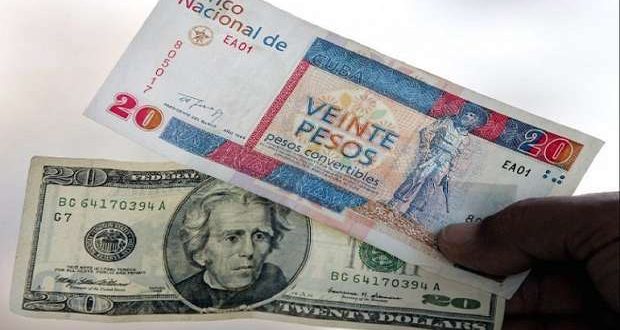
The Dollar Strengthens In Cuba In Anticipation Of Currency Unification / Iván García

Source: América Tevé.

Ed. Note: This article talks about Cuba’s two currencies, the Cuban peso and the Cuban convertible peso, and the potential ‘unification’ of the two currencies. The Cuban peso is also called “national money” and by the acronym “CUP.” The Cuban convertible peso (“CUC”) only came into use in 1994. It is not convertible outside the country and so has no ‘market-based’ exchange rate in world currency markets. The CUP is officially pegged at 24 per CUC. The dollar/CUC exchange rate is officially one-to-one but the actual official exchange rate varies according to exchange fees and taxes applied to the transaction, as discussed in the article; the unofficial exchange rate varies according to the vagaries of the underground market. The Cuban government has promised, for years, to unify the currencies, but has not yet done so.

Iván García, 18 January 2018  — In the illegal world of the foreign exchange market on the Island, any rumor or leaking of information rings alarms. In addition to taking advantage of the gaps that cause the artificial state exchange rate for the U.S. dollar, an astute loan shark is always attentive to fluctuations in the exchange rates.

Ignacio, a guy who wears retro sunglasses, tight jeans and low-cut sports shoes, is one of those who takes advantage of the most minimal information.

“I’m romancing the manager of a bank. And some days ago she told me that there are movements in the bullpen. Probably before April 19 — the supposed date of Raúl Castro’s retirement — the government will execute the unification of the currency. continue reading

The girl told me that already there have been several meetings, and in them it was said that people with bank accounts wouldn’t lose money after the financial adjustments. Nor would those who prefer to keep their money at home. For them they would pay 24 Cuban pesos for every convertible peso, but only up to a certain amount (it’s said 7 million CUC). Those who have their deposits in dollars can exchange them at two pesos per dollar.”

With this unconfirmed information, Ignacio, along with several friends involved in clandestine exchange operations, started to buy the dollar at 0.97 CUC. The Central Bank of Cuba pays 0.87 CUC, justifying the Castro brothers’ tax under the pretext of the U.S. embargo.

But it’s a longer story. After the arrival of the bearded Fidel Castro, the exchange of the dollar and other hard currency was converted into an absurdity that distorted the national economy.

Before 1959, the dollar had an exchange rate of one for one with the Cuban peso.

“It was supported by a growing productivity, a vigorous economy and a powerful private empresarial elite. Fidel took this exchange rate as a reference and kept it for a time. Meanwhile, the Cuban economy was stumbling, because of the “blockade,” bad strategies of the managers or systemic failures caused by an economic plan that was copied from the Soviet Union. If they would have let the dollar float against the peso, in 1970, for example, a dollar would have been worth 50 Cuban pesos, at least. The illegal exchange market, in an empricial way, moves in accord with the law of supply and demand of the dollar. With greenbacks being prohibited until 1993, these financial operations were very dangerous: If the police caught you, you could go to jail for three to five years,” says Hiram, an ex-officer of the Central Bank.

Julio Antonio, an older gentleman who has spent four decades in the business of buying and selling hard currency, above all the dollar, adds more details:

“In the ’80s, they called the money changers jineteros (hustlers). On the streets of Vedado, and on beaches like Varadero and Santa María del Mar, east of Havana, we were buying dollars directly from the few tourists who came to Cuba. At that time, a peso was worth four dollars. The State was buying them one for one. And many foreigners, so that their money would go further, weren’t selling them to us. When the Special Period arrived in the ’90s the dollar shot up and was selling at one dollar for 150 pesos. Later, the government fixed it at 24 pesos. But we were paying under the table one or two on top of that, because the people going on internationalist missions in Venezuela, Ecuador and South Africa, among other countries, needed dollars to buy stuff cheap and then resell it in Cuba. We have always been two steps ahead of the State’s exhange rate.”

In the autumn of 2005, Fidel Castro, punched a table in anger, because the U.S. Treasury Department had detected a Cuban account with 5 billion dollars in the Swiss bank UBS, supposedly for exchanging old bills for new ones, and he resolved to decree a “revolutionary” tax on the money of Enemy Número Uno.

The tax rate was 20 percent, lowered to 10 percent when Raúl Castro began governing.

“If a dollar cost 80 cents, on the street it was being bought at 90. Now that the government buys it at 87 cents, under the table it’s bought at 90, at least [on the street]. It depends how many dollars are in circulation. But the stable non-official rate is 95 cents, although at certain times, it goes up to 97 and 98, since there is a strong demand from the “mules” who travel to Central America, Mexico or Russia. With the rumor that is being spread, I assure you that when the two monies are unified, the dollar will be worth 10 or 15 pesos. And I might be short,” Ignacio analyzes.

Dagoberto, licensed in tourism, considers that “this exchange rate, in addition to being false, is counterproductive. This is reflected in expenditures by tourists. The ones who come to Cuba spend on average $655 [USD]. Those who go to Punta Cana in the Dominican Republic spend more than $1,200, almost double. One reason is that they drive up the prices for tourists. To this, add the fact that in Cuba’s hard currency shops everything is too expensive, with taxes between 240 and 400 percent. The ideal, to attract more dollars, euros, pounds or Swiss francs, is to adjust the money to a real reference.”

According to a source at a branch of the Banco Metropolitano, “Since July they have been postponing the contracts with State enterprises, whether they are in hard currency or the national money. It’s a sign that monetary unification is on the way. At the latest, before 2018 is over. It’s noticeable in the current private accounts. Many clients are keeping their money in pesos, since even though they’ve been told that they won’t be affected by the unification, there are always fears and prejudices in the population.”

For experienced loan sharks, “the best way to keep savings or monetary earnings of a private business is in dollars or euros, jewels, preferably of gold, and works of art. What’s coming looks ugly. An increasing inflation and more money than products to buy. The Cuban economy is in a bad way,” predicts Julio Antonio.

Financial experts say that if you want to apply a reasonable economic strategy, the distortions caused by the dual currency ought to come to an end. What’s not clear is what will happen afterwards.

Translated by Regina Anavy

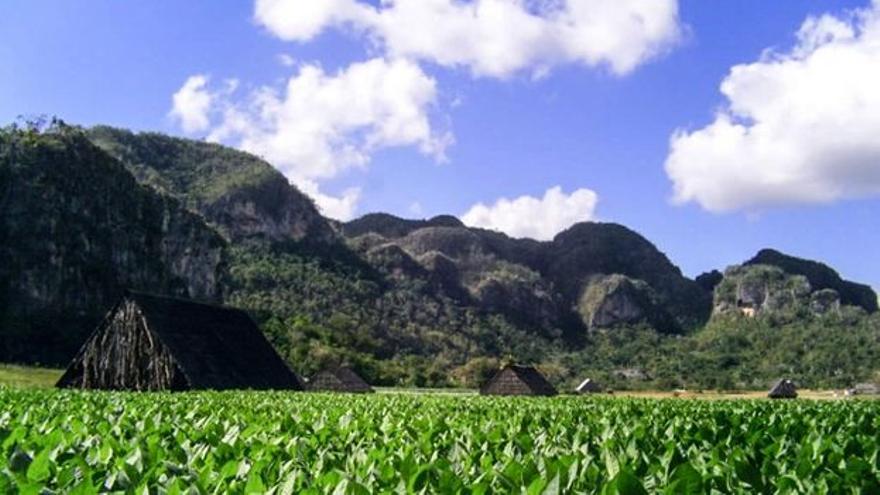
Intense Rains in Cuba Force Delay in Tobacco Sowing to February

With around 65% of the country’s production, the Vueltabajo area, in the province of Pinar del Río, is the largest supplier of the leaf. (DC)

14ymedio biggerEFE  / via 14ymedio, Havana, 18 January 2018 —  The intense rains in Cuba in recent months have forced the island’s farmers to extend until February the sowing of tobacco for the 2017-2018 season. During the season, they plan to sow over 73,000 acres in tobacco, the raw material of the famous Havana cigars.

Rainfall damaged nearly 1,500 acres already planted and several areas used as seedbeds, causing delays that have led to the extension of the plan’s target dates, according to the head of the state group Tabacuba, Gonzalo Rodríguez, speaking to the official news agency Prensa Latina.

Rodríguez insisted, however, that the “situation is encouraging and the producers are optimistic,” having already planted more than 64,000 acres. The current season’s sowing of the leaf began last October. continue reading

Tobacco is the fourth largest contributor to the country’s gross domestic product; it accounted for some 445 million dollars in 2016 from the sales of the Cuban-Spanish joint venture, Habanos.

With around 65% of the country’s production, the Vueltabajo zone in the province of Pinar del Río is the largest supplier of the leaf in the country. The central territories of Sancti Spiritus and Villa Clara also have large plantings of tobacco.

In 2018, Cuban tobacco farmers hope to deliver more than 32,000 tons of leaves to the cigarette and cigar industry, one of Cuba’s major sources of exports.

The intense rains in the last three months have affected other agricultural sectors on the island as well, including damaging 70% of the cane plantations destined for the sugar harvest now underway.

 _____________________________

The 14ymedio team is committed to serious journalism that reflects the reality of deep Cuba. Thank you for joining us on this long road. We invite you to continue supporting us, but this time by becoming a member of 14ymedio. Together we can continue to transform journalism in Cuba.