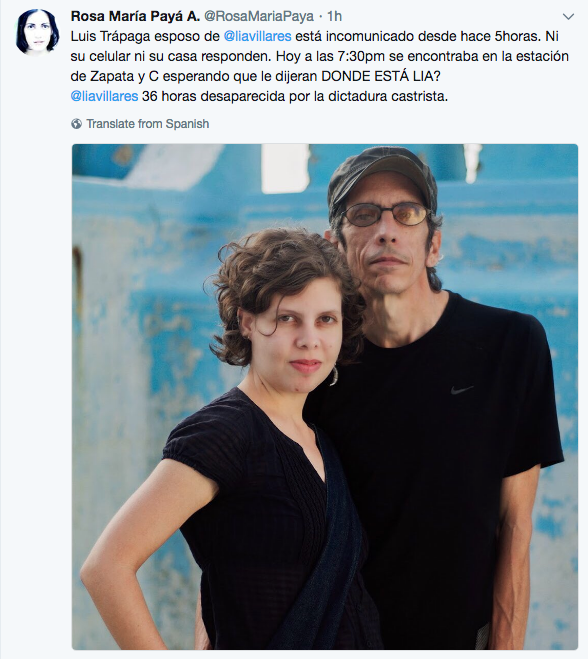
Lia Villares’ Husband Luis Trapaga Also “Disappeared”
English Translations of Cubans Writing From the Island
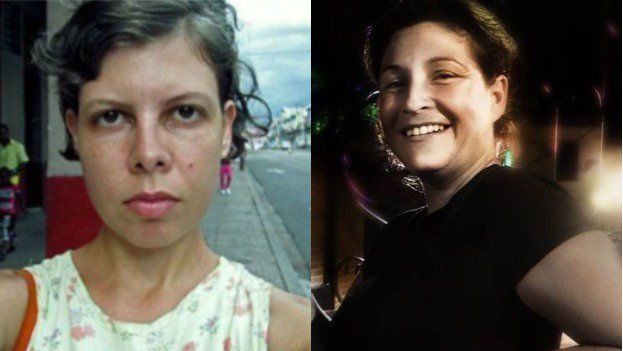
 14ymedio, Havana, 20 December 2017 — At least five artists have been released in recent hours after being detained by the police on Wednesday while trying to attend a performance at the independent art gallery El Círculo, as a part of the Endless Poetry Festival promoted by the Group Omni Zona Franca, which is celebrating the nineteenth edition of the event this year.
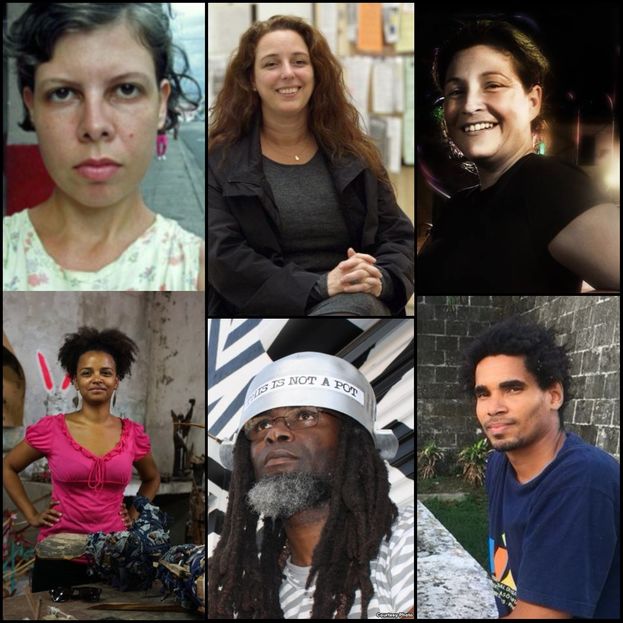
Among the people detained and later released are the artist Tania Bruguera, the actress Iris Ruiz, protagonist of the monologue entitled Psychosis that was going to be performed, Adonis Milan, director of the work, Amaury Pacheco and Yanelis Nuñez.
In statements to EFE, the Cuban regime opponent Rosa Maria Payá said that the whereabouts of the artists Lia Villares and Luis Manuel Otero were unknown. However, in a recent post on Otero’s Facebook page, Tania Bruguera reported that the activist is in “the 11th [police] unit in San Miguel.” continue reading
The presentation of Psycho was planned for this Wednesday night, based on a text by the British playwright Sarah Kane and under the direction of Cuban playwright Adonis Milán. The piece is one part of the concerts, talks and poetry readings making up the independent event.
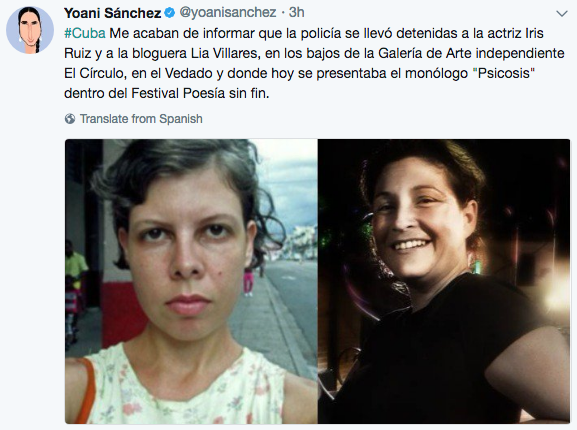
From early hours “the whole gallery was surrounded” by the police, according to Milan, speaking via telephone with 14ymedio. The actress Iris Ruiz tried to access the premises but the officers and agents did not allow her to do so, and Lia Villares went down to clarify the situation. “In the end the two detainees were taken away in a patrol car,” confirmed the young director.
State Security agents surrounded the gallery and threatened those who remained inside the building. “Come out, we did not beat them, but we’re going to beat you,” the officers shouted, according to witnesses.
Hours earlier Milan and the plastic artist and curator of El Círculo Luis Trápaga, was “shoved” by police officers stationed in the vicinity while trying to enter the house-gallery, as reported to this newspaper.
At another time this week Milan was also blocked from entering the house to prevent his participation in the rehearsals for tonight.
El Círculo house-gallery has been subject, in recent months, to frequent operations by the police and State Security to prevent cultural activities ranging from film presentations to exhibitions and plays.
The most talked about incident occurred at the end of November when State Security blocked the premiere of the theater play The Enemies of the People, which only two people were able to attend. On that occasion, the police siege mounted around the gallery functioned as a method of pressure to intimidate the would-be audience members.
Under the motto “freedom, the helm towards poetry / poetry, the helm towards freedom” — verses from the recently deceased poet Juan Carlos Flores — the organizers of Endless Poetry seek to “create a space where poetry mixes with reality” and serves to know “where Cuban society is going.”
The members of the Omni Zona Franca group initially had their headquarters in the House of Culture in the Alamar neighborhood, east of Havana, but in 2009 they were evicted. Since then, most of them have had to deal with arbitrary arrests, threats and defamation campaigns launched from official institutions.
The Festival, which began as an alternative and independent event, has gone underground over the years, opting for venues in friends’ houses or in galleries far from the institutional circuit, as is the case of El Círculo.
—————
The 14ymedio team is committed to serious journalism that reflects the reality of deep Cuba. Thank you for joining us on this long road. We invite you to continue supporting us, but this time by becoming a member of 14ymedio. Together we can continue to transform journalism in Cuba.

14ymedio, Reinaldo Escobar, Havana, 20 December 2017 — Although from the legal and theoretical point of view the concept of “independent candidate” is inappropriate in the context of the current Cuban electoral processes, this designation has been imposed on those men and women who attempted to be nominated as candidates for the position of Delegate to the Municipal Assemblies in 2017 who did not enjoy the support or acceptance of the Communist Party of Cuba.
In democratic countries, where the multi-party system works and people with political inclinations present platforms to win over the electorate, an independent candidate is one who attempts to be elected without representing a partisan grouping and who competes for votes as an individual. continue reading
The current Electoral Law makes it clear that “the party does not nominate candidates” and that it is the Area Assemblies within the districts that propose and, by show of hands, nominate those who “possess sufficient merits.” In practice, however, it was not even possible to nominate a single one of those who were proposed from alternative initiatives.
The only time it has been possible to take a few steps in this direction was in April 2015 when, in two districts of Havana, Hildebrando Chaviano and Yuniel López managed to appear on the ballots. The corresponding electoral commissions in charge of writing their biographies – the only legal campaign materials – wrote that they were “counterrevolutionary elements.” Obviously, neither was elected at the polls.
In the recently concluded nomination process, it was expected that more than one hundred non-conforming candidates would be proposed at these Area Assemblies. The repertoire of obstacles interposed was vast and even imaginative.
There were arbitrary arrests of candidates and the presumptive voters willing to propose them, sudden modification of the dates of the assemblies and a last minute summoning of voters without informing the interested parties, changes in hospital shifts to admit close family members, and even unexpected offers to perform desired — but previously postponed — surgeries .
But above all, in each of the places where “the independent” managed to get someone to propose them or proposed themselves, a picket of indignant voters gave free rein to their revolutionary intolerance and, with the approval of those who directed the activity, they mocked with all kinds of insults those who had dared to make such a challenge.
It is no secret to anyone that, if one of these would-be candidates had been nominated, they most likely they would not have obtained the majority in the voting or, if that miracle happened, they would not have had any chance to be a candidate for the Provincial Assembly, let alone the Parliament. From all this comes an inevitable question: What is the point, then, of so much effort, so much risk?
The yardstick to measure the success or failure of these initiatives is not, as might be supposed, the number of seats won, but, even if it seems too metaphorical, the amount of unmasking that occurs in the discourse that the Cuban elections are trying to present as the most democratic in the world
Before an audience, made up of cadres from the PCC, and referring to the initiatives to promote independent candidates, the first vice president, Miguel Díaz-Canel, presumed replacement for Raúl Castro in February 2018, confessed the following: “Now we are taking all the steps to discredit that, so people have a perception of risk.”
With that statement, he violated Article 171 of the electoral legislation that states that “every elector, to determine which candidate he will cast his vote for, will consider only [the candidate’s] personal conditions, prestige and capacity to serve the people; every kind of electoral campaign (for or against) is prohibited.”
All the uniformed members of the National Revolutionary Police, the civilian agents of State Security and the hundreds, perhaps thousands of Party militants and cadres of mass organizations involved in these maneuvers, no longer have the right to say that they unaware of the trick. They may invoke obedience or the discipline required of them, but not innocence.
Those who designed these strategies ignored the fact that having just accepted (even manufactured) an elected opponent, they could have been more convincing about the supposed cleanliness of the process without the clumsy demonstration of arrogance and intolerance that they felt forced to unleash in order to prevent the nomination of people not committed to the Communist Party.
The closing down of peaceful methods only serves to open the doors to violence, if the most abject submission cannot be ascertained.
———————
The 14ymedio team is committed to serious journalism that reflects the reality of deep Cuba. Thank you for joining us on this long road. We invite you to continue supporting us, but this time by becoming a member of 14ymedio. Together we can continue to transform journalism in Cuba.
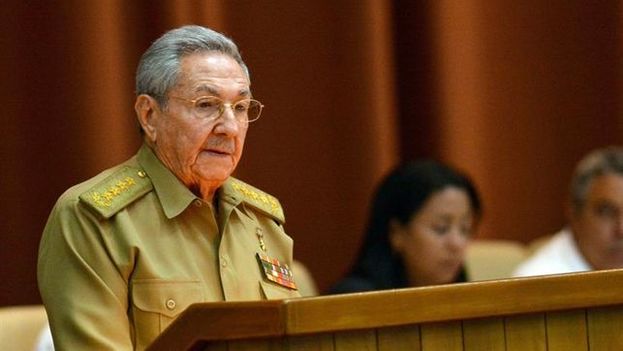
14ymedio, Havana, 21 December 2017 — In a last minute turn of events, the Cuban Parliament extended Raul Castro’s current mandate for two months, a decision that extends his presidency beyond February 2018, when he was expected to leave power. The “serious effects of Hurricane Irma across the entire national territory,” has been used to justify the decision, which was proposed to the National Assembly of Peoples Powe (ANPP) by the Council of State.
The National Assembly agreed to modify the schedule of general elections in Cuba, which will allow Raúl Castro and the current Council of State to remain in power until April 19 of next year, two months later than the 8th legislature was supposed to conclude. continue reading
“The State Council proposed to the ANPP to extend the mandate of the provincial assemblies until March 25, 2018, and of the current legislature of the ANPP until April 19, when its president and vice president will be elected, as will be the Council of State and its members,” reported a note published on Thursday at 10:21 AM Cuba time in the official newspaper Granma.
The ANPP noted that the Constitution of the Republic, in Chapters 72 and 111, establishes the election of Parliament for a term of five years and its extension can only be approved by the Assembly itself “in the case of war or under exceptional circumstances.”
Since the National Assembly of People’s Power was established in 1976, it is the first time that these Chapters have been used to delay the timetable for the inauguration of the parliamentarians and the subsequent appointment of the State Council.
The announcement coincides with the call made by Raúl Castro himself in his capacity as First Secretary of the Communist Party of Cuba (PCC), to hold a plenary session of the Central Committee of the PCC in March. The agenda of the meeting includes “delving into the experiences gained during the implementation process of the Guidelines” and a “strategic projection for the coming years,” according to the official press.
The Cuban constitution endorses the PCC as the “force superior to society and the State,” so that decisions that significantly impact the political life of the Island could emanate from the plenum. Analysts have speculated for months on a possible “separation of powers” that makes Cuba’s current government structure bicephalous.
For the first time in the institutional history of the last decades of Castroism there is the possibility that the person appointed to the head of the State Council might not be the same person who leads the party ranks.
On February 24, Raúl Castro was scheduled to leave the presidency if he delivered on the promise he made several times in recent years. His announced departure from power was viewed with suspicion by some and seen as an inescapable fact by others, but almost no one argued that his departure put an end to six decades of the mandate of the so-called historical generation.
In 2011, during the VI Congress of the Communist Party, Raúl Castro outlined the limitation of the mandates of “fundamental” political and state offices to a maximum of two consecutive periods of five years each.
During a state visit to Mexico in November 2015, Castro reiterated his decision: “As I said at the last Congress of our party,” he recalled, “on February 24, 2018 I will finish and I will retire,” he emphasized before Mexican journalists and the international press.
The same idea was repeated during the 7th Congress of the PCC in which he emphasized the need to deploy a plan to “rejuvenate” the island’s government, while maintaining a one-party system.
“In my case, it is not a secret that in 2018 I will conclude my second consecutive term as president of the councils of State and Ministers, and I will assign those responsibilities to whomever is elected,” he stressed on that occasion.
Mariela Castro, daughter of the president and a deputy to the National Assembly, said in an interview with Radio Euskadi in June of this year that “many people” do not want her father to leave power and that they are “pressuring him not to do it.”
She said that the process of succession has been being prepared in Cuba “for a long time” and that her father will leave office “because of age.” Raúl Castro is 86 years old and José Ramón Machado Ventura, second secretary of the Central Committee of the PCC, is 87.
On that occasion, Mariela Castro also mentioned several candidates for the presidency of the country and said there could be “surprises” before the expected transfer of power takes place in the Plaza of the Revolution.
The succession of Castro in power generates few speculations on Cuban streets, where most citizens assume that the next president will be someone elected by the highest spheres of power, an heir appointed by the historic generation.
_________________
The 14ymedio team is committed to serious journalism that reflects the reality of deep Cuba. Thank you for joining us on this long road. We invite you to continue supporting us, but this time by becoming a member of 14ymedio. Together we can continue to transform journalism in Cuba.
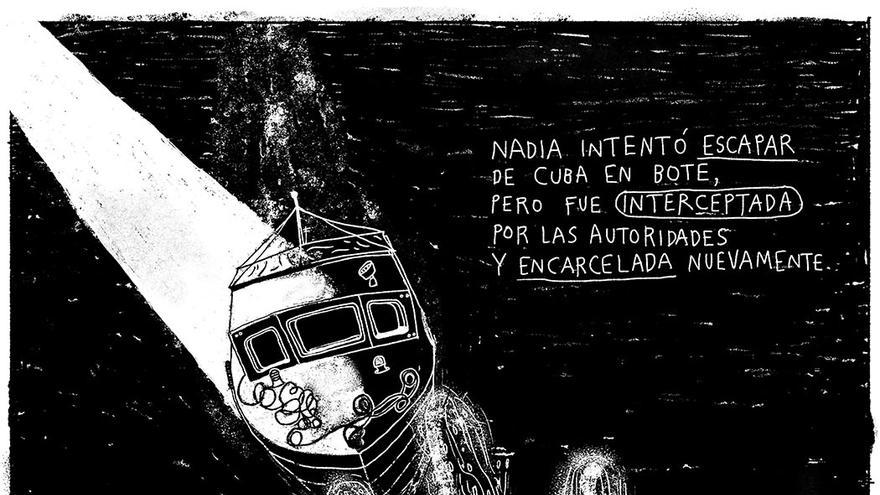
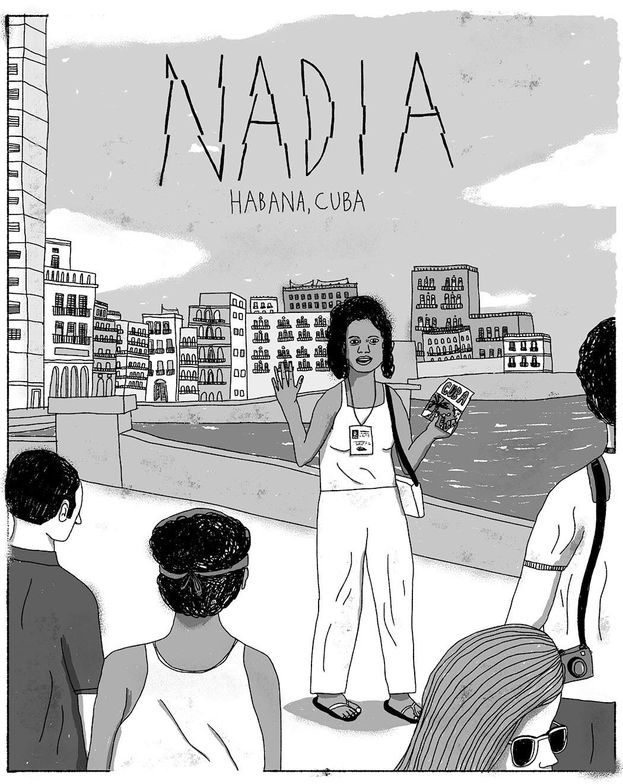
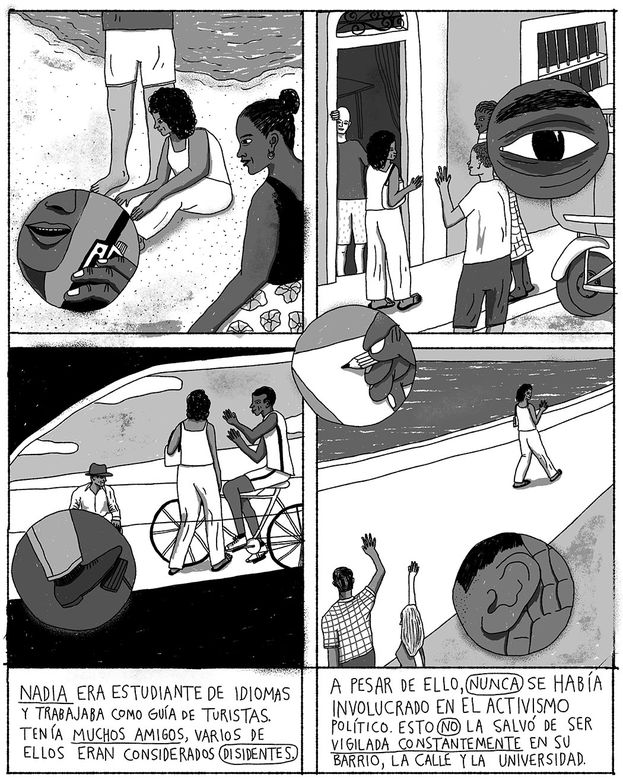
14ymedio, Havana, 17 December 2017 — The Mexican illustrator Joan X. Vázquez has created a series of comics produced by the human rights organization Amnesty International entitled Cuban Lives. These pages illustrate the lives of Cubans and the continuous restrictions to which they are subjected in their day to day existence.
The second issue is dedicated to Nadia, a language student who worked as a tour guide and who, because of having friends considered dissidents, was expelled from the university, threatened and arrested.
We reproduce here some pages shared by Amnesty International.
continue reading
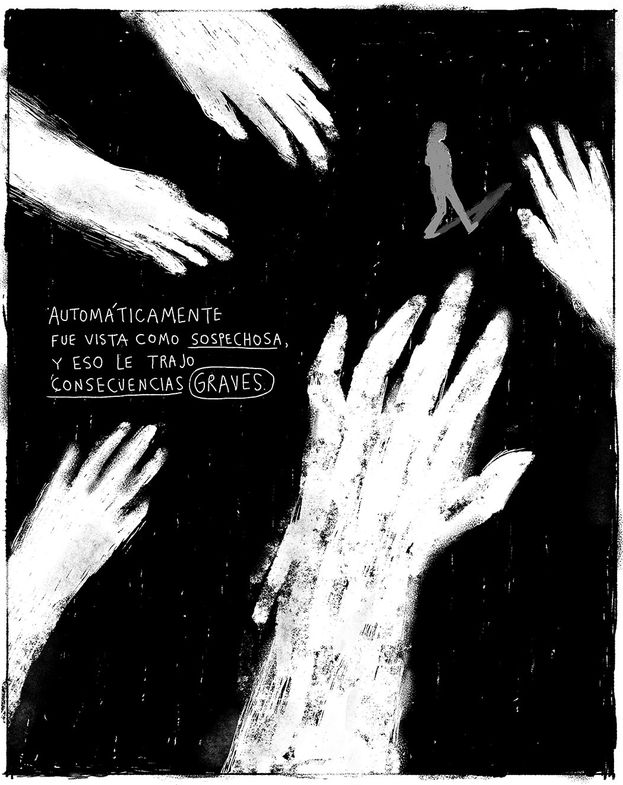
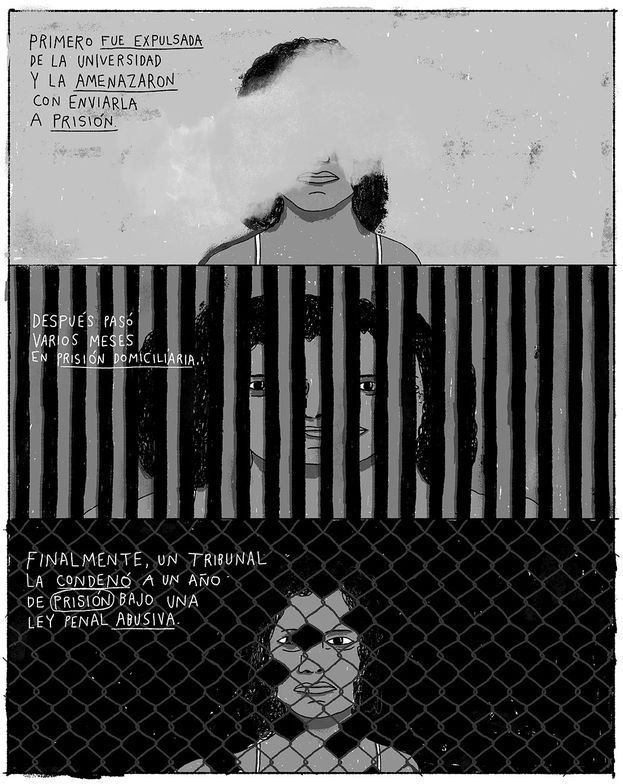

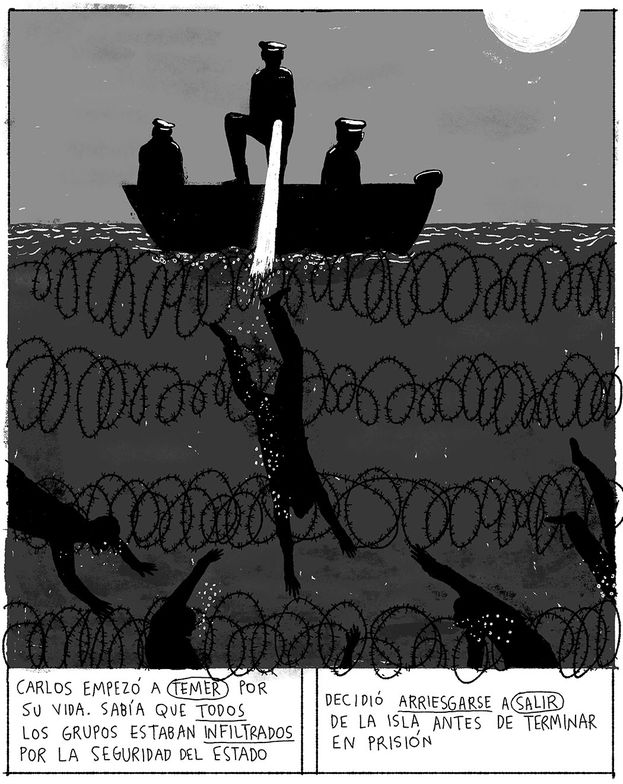
In the third issue, the author focuses on the story of Carlos, a young man recruited by State Security services to monitor his fellow students and report on their lives and political ideas.


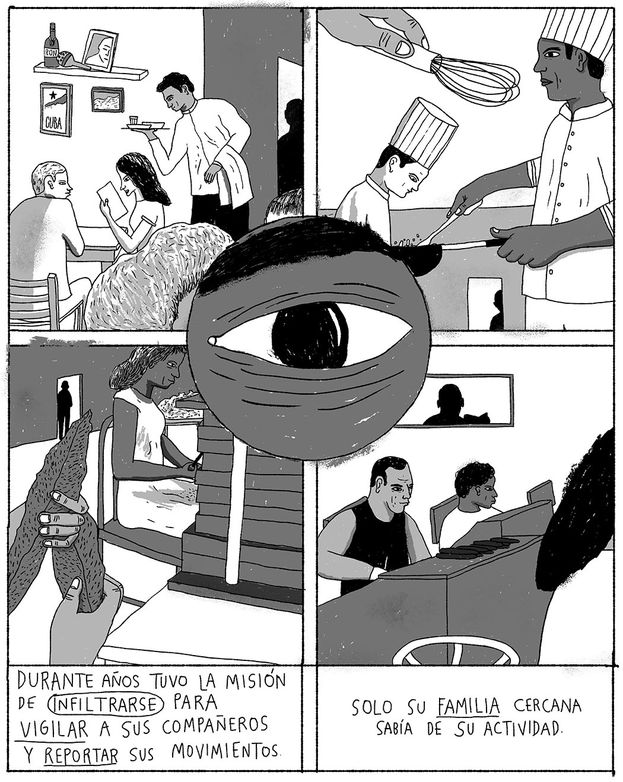

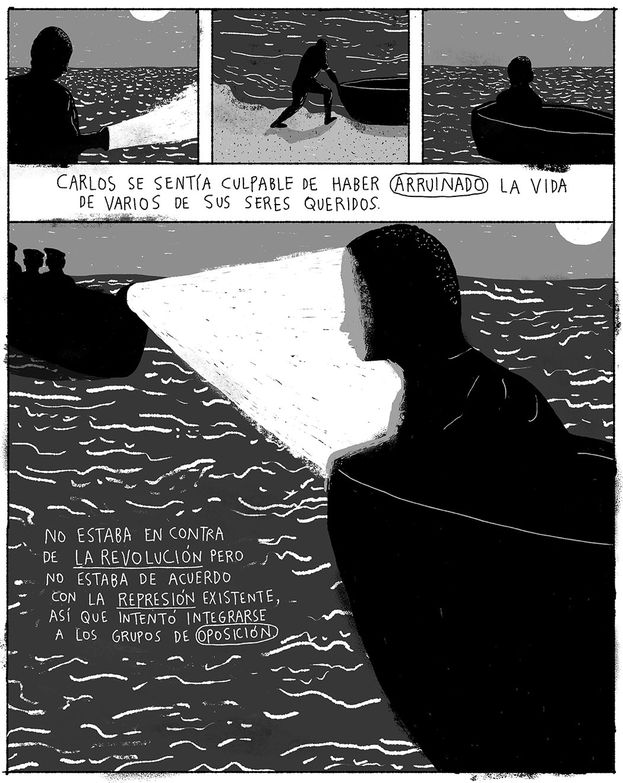
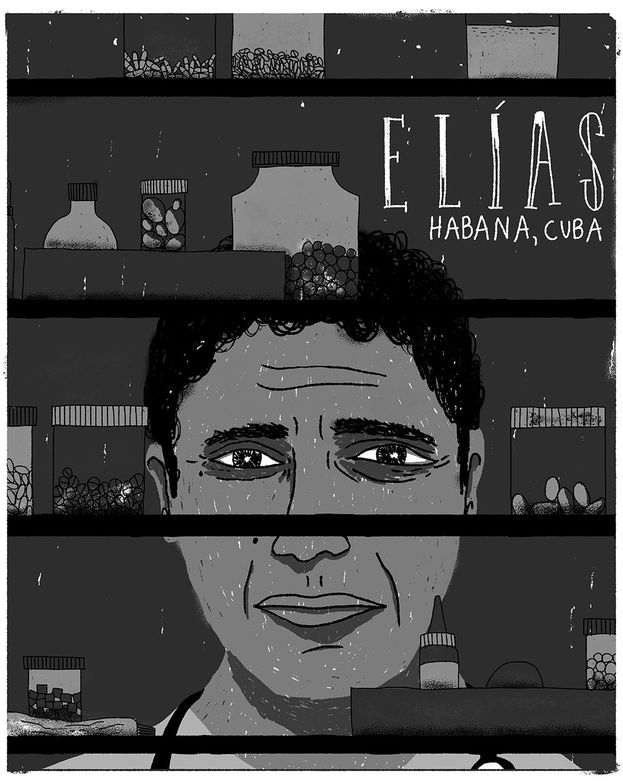
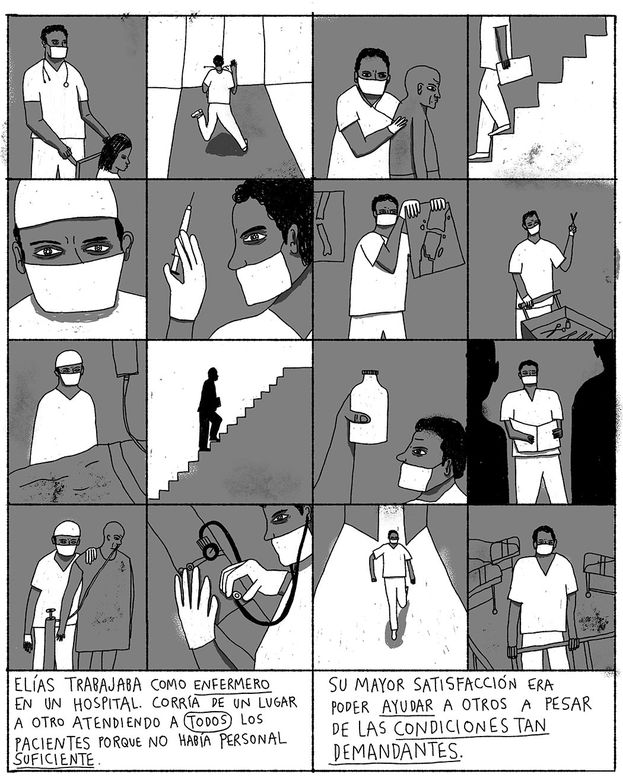
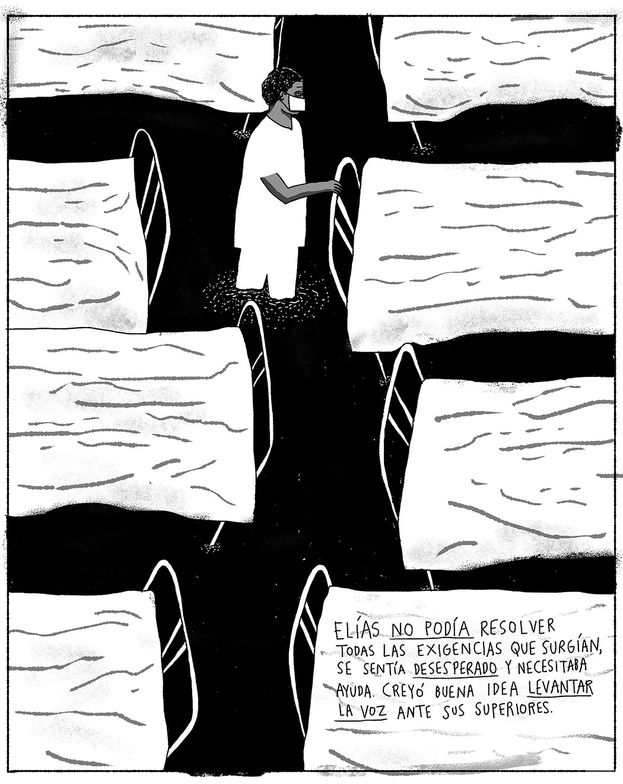
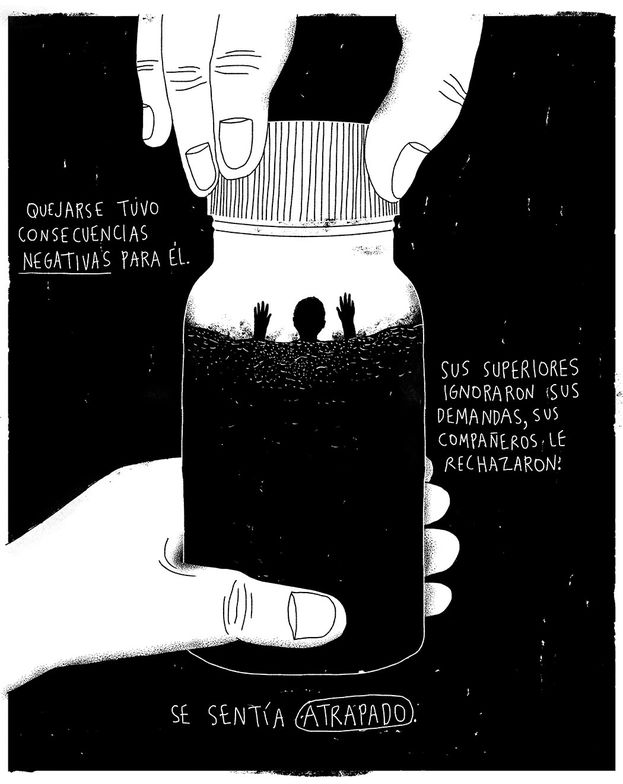
The fourth issue is dedicated to Elias, a nurse who began to be harassed by his employers because he complained about the lack of support to carry out his work. As a result he was forced to leave his profession, and despite moving to another city he was denied the position of nurse because he was considered “unreliable.”


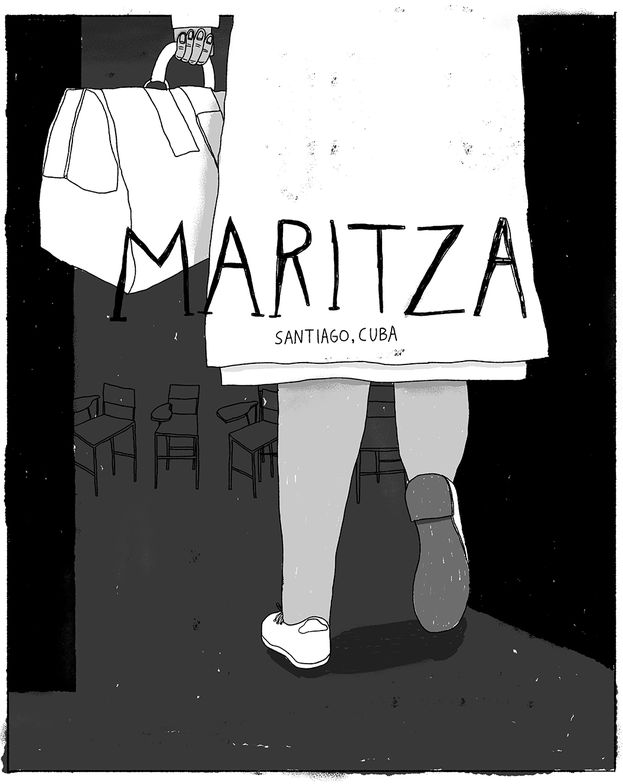
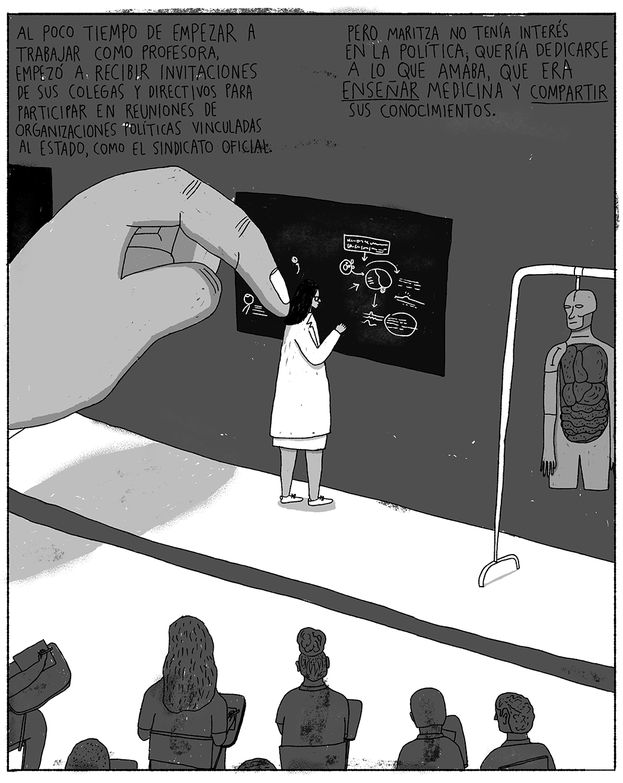
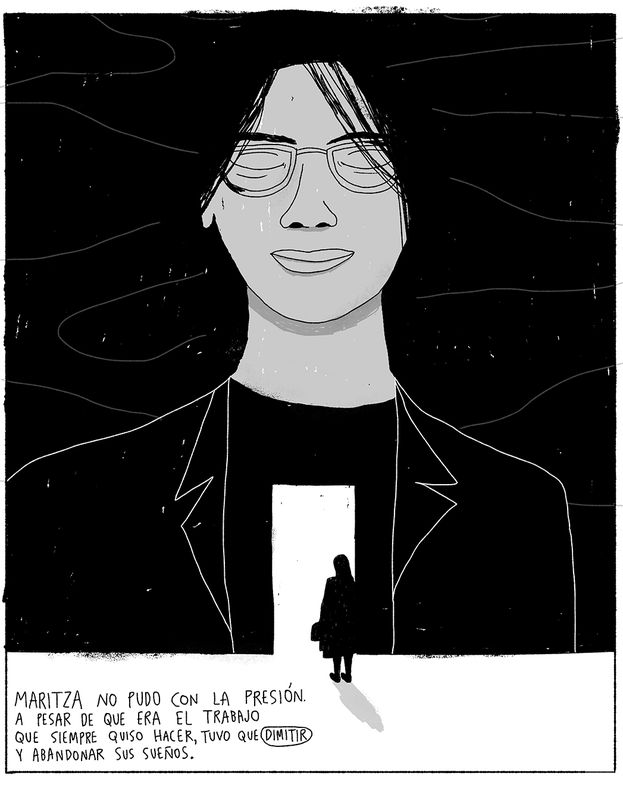
The fifth comic represents the story of Maritza, a university professor of medicine with no interest in politics, who was soon pressed to propagandize her students and join the state’s mass organizations. Due to this pressure, and despite having the work of her dreams, she resigned after one year.



——————
The 14ymedio team is committed to serious journalism that reflects the reality of deep Cuba. Thank you for joining us on this long road. We invite you to continue supporting us, but this time by becoming a member of 14ymedio. Together we can continue to transform journalism in Cuba.
See also: Police Arrest Actress Iris Ruiz and Blogger Lia Villares in Havana
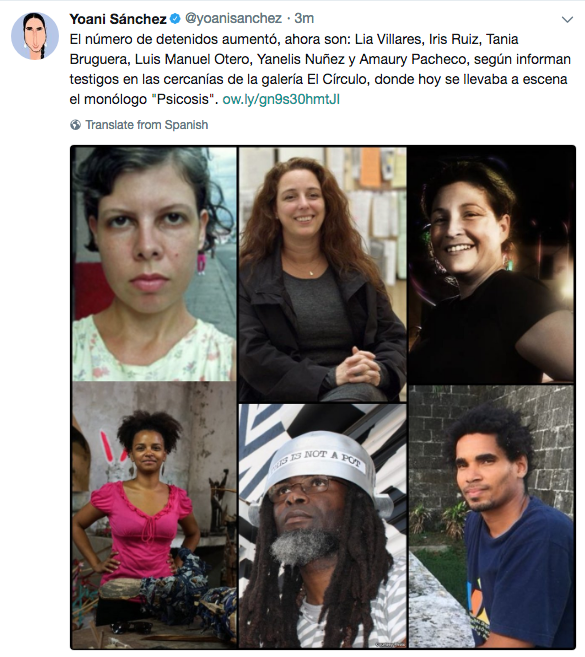
14ymedio, Havana, 20 December 2017 — Actress Iris Ruiz and blogger Lia Villares were arrested Wednesday around five in the afternoon at the independent gallery El Círculo. The arrest of both occurred during a police operation to prevent a performance scheduled as a part of the Endless Poetry Festival.
A presentation of the monologue Psychosis was planned, based on a script by the British playwright Sarah Kane and under the direction of the Cuban playwright Adonis Milán. The piece is a part of the concerts, talks and poetry readings taking place this year at the independent event.
From the early hours “the whole gallery was surrounded,” Milán told 14ymedio. The actress Iris Ruiz tried to access the premises but the police and State Security agents did not allow her to do so and Lia Villares went down to clarify the situation. “In the end they were arrested and taken away in a patrol car,” confirms the young director. continue reading
So far it is unknown to which police unit the two women have been taken. Members of State Security surround the gallery and are making threats against those who remain inside the building. “Come out, we did not beat them, but we are going to beat you,” the officers shouted, according to witnesses.
Hours earlier, Milán and Luis Trápaga, a plastic artist and curator of El Círculo, were “pushed” by police officers stationed in the vicinity while accessing the dwelling which houses the gallery, as reported to this newspaper.
Earlier this week Milán was also prevented from entering the house in order to prevent his participation in the rehearsals prior to tonight’s performance.
In recent months, the gallery-house El Círculo has been subject to frequent police and State Security operations to prevent cultural activities ranging from film presentations to exhibitions and plays.
The most talked about incident occurred at the end of November when State Security blocked the premiere of the theater play The Enemies of the People, which only two people were able to attend. On that occasion, the police siege mounted around the gallery functioned as a method of pressure to intimidate the would-be audience members.
_______________
The 14ymedio team is committed to serious journalism that reflects the reality of deep Cuba. Thank you for joining us on this long road. We invite you to continue supporting us, but this time by becoming a member of 14ymedio. Together we can continue to transform journalism in Cuba.
Fernando Damaso, 12 December 2017 — Attuned to the recently concluded so-called “general elections,” which did not really interest anyone or represent any change in the political life of the country, different articles have appeared in the written press comparing these elections with those held in Cuba during the era of the Republic, as well as others that continue to be carried out in most democratic countries. Among other points of discord, one article compares the candidates of then and now.
The article asserts that candidates of that time were corrupt and opportunistic and that they did not represent citizens, dedicating themselves to getting rich at the expense of the State’s resources. What if they did! continue reading
However, they all had a full name, a record of their service, proposals for the government and followers. The ones we have now are totally gray, lack names and surnames, are only known in their own homes, if at all, at lunch or dinner time, they lack a record of service, have no proposals and no followers. They are, in short, simple strangers, who pass through their offices without sorrow or glory, they agree unanimously and are lost, when they leave, among the population.
The article also says that the bourgeoisie and the wealthy were criminals, and that they had obtained their riches by exploiting the workers and the peasants.
Before these assertions some questions arise: Who built our towns and cities? Who developed the country? Who built all the valuable things we have today? We must assume that it was not the workers or the peasants who were exploited.
If everything happened that way when everyone was bad, why, now that everyone is good, does nothing work and the country, instead of advancing, has retreated?
Perhaps we can find in this trend the current reluctance and apathy of most Cubans. We have stopped believing in the storytellers and their stories.
Translated by Alberto
Fernando Damaso, 6 December 2017 — We have always considered Carlos Manuel de Céspedes as the Father of the Nation and José Martí as the Apostle. Recently a Mother of the Nation has been imposed on us. It would not be unreasonable to assume that soon they will also impose a female Apostle. Along that absurd path, grandparents and grandmothers, aunts and uncles, brothers and sisters and even male and female cousins “of the Nation” could also appear.
Recently that indigestible Cuban Television program ’The Roundtable’ decided to address the subject, with the theme: “The Granma … is the Nation.” [Ed. note: This “Granma” is not a grandmother but rather the name of the yacht that the Castro brothers and their compatriots sailed from Mexico to Cuba, to launch the guerrilla actions that ultimately triumphed as the Revolution. The previous owner of the yacht had named it after his grandmother, and so it remained, ultimately giving its name to a Cuban province and the Communist Party’s daily paper.] Thus, if we follow this idea, even a soccer ball could be the nation, regardless of being kicked by everyone. The same could be said about a baseball.
When the sacred symbols are manipulated so festively and disrespectfully, we must seriously concern ourselves as citizens. It is something that should not be allowed or accepted, no matter who it comes from.
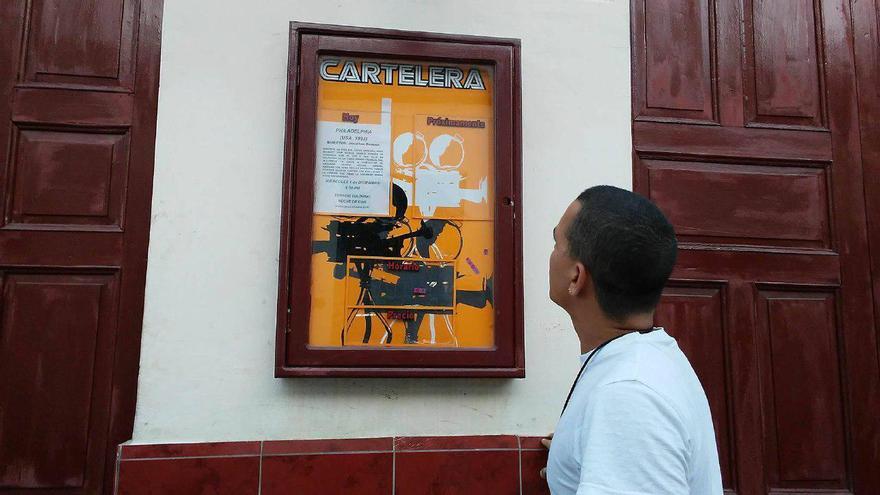
14ymedio, Leonardo del Valle, Holguin, 13 December 2017 — Alfredo was 35 in 2000, when he was diagnosed HIV seropositive. Two weeks ago this 52-year-old homosexual man and his mother attended the presentation of The Normal Heart, the film that opened the cycle of gay cinema that will run in the Holguin Provincial Film Center until 20 December. It was 1 December and the cultural space was one of the few public places that paid tribute to those who work to eradicate the AIDS virus or improve the quality of life of those who have contracted the disease.
Judging by the opinions of the workers in the room, the audience reception was excellent, with an attendance that far surpassed that of previous editions. The Normal Heart details the uncertain onset of a disease, which at that time was linked exclusively to homosexuals, and it does so through truly moving images and a frank awareness of the ignorance about AIDS in the decade of the 80s. continue reading
Alfredo and his mother, like so many others in the audience, shuddered during the hardest scenes of the film, supported by an excellently constructed script.
“I drove the nurse crazy, I went every day to the municipal Hygiene and Epidemiology Office, I suspected it, I was waiting for the final test result, the one that says if you really do or do not have HIV,” he says, about the days before he received his diagnosis.
On 6 June they gave him the result. “That morning I arrived and the nurse was busy, but she came out immediately to help me, I will never forget look on her face, I did not let her talk, I said, ’Your face tells me everything.’ ” That echoed in his ears like a hammer blow.
“I asked when I had to go to the sanatorium and she told me that same day.” Alfredo asked the nurse for two days to prepare, but the nurse barely gave him one.
“I can see clearly, right now, Alfre with his sister,” recalls Nelda, his mother. “She said, ’I need to talk to you, mommy,’ and she took me to the bedroom, I thought she was going to tell me something about my granddaughter, but that wasn’t it.”
“I do not know how the news came out in the block,” says Alfredo, who didn’t realize how much his neighbors loved him, until he saw them saying goodbye, crying, when he went to the Aguas Claras sanatorium. “It was very painful, it was like I would never come back,” he recalls.
The hardest moment of those interminable 24 hours, after learning that he had contracted the virus, was when his mother turned her back to him as she prepared to leave the sanatorium.
“I remember that I felt as if they were taking my life, when I was leaving, I did not have the courage to look back. From that moment on, I started going to the sanatorium every day, until I joined him there. I was learning about the disease and I was acquiring more spiritual strength,” says Nelda.
Alfredo remembers that time with terror. “One felt that death was behind the door, I was in the sanatorium for three months,” he recalls. “Actually that stage prepared me to know how to coexist with the disease, although I never agreed with that system in which we were practically prisoners without committing any crime.”
Alfredo relates that in the sanatorium he lived with good people, but also with others who came from prison. Even so, he gradually accepted his situation and spent his time sewing, a skill he learned from a very young age. He sewed for the patients, for the workers and even for the neighbors who lived nearby.
During the viewing of the film, Alfredo recalled the moment he tried to commit suicide, something very common among patients who have been diagnosed with the virus and who fall into a severe depression.
“When I left the sanatorium I went to look for my life, the one I had before the results,” says Alfredo, referring to his work in a primary school. The marginalization to which he was subjected led him to leave the school shortly afterwards and he devoted himself to sewing at home.
Alfredo noted the ignorance of the doctors themselves about the disease when they found he had kidney cancer. “To get them to operate on me, I had to break down walls of ignorance and that was not very many years ago.”
His eyes are lost in infinity and he is agitated when he remembers those difficult moments. He does not hide that The Normal Heart affected him. “Thanks be to God I am alive, and also to the scientific advances, but I saw many patients die. That uneasiness that the characters in the film showed, that sudden pain, I felt it, Mom felt it,” Alfredo adds.
“Today youth see AIDS as something very normal, like a cold, and it is not,” he warns.
___________________
The 14ymedio team is committed to serious journalism that reflects the reality of deep Cuba. Thank you for joining us on this long road. We invite you to continue supporting us, but this time by becoming a member of 14ymedio. Together we can continue to transform journalism in Cuba.
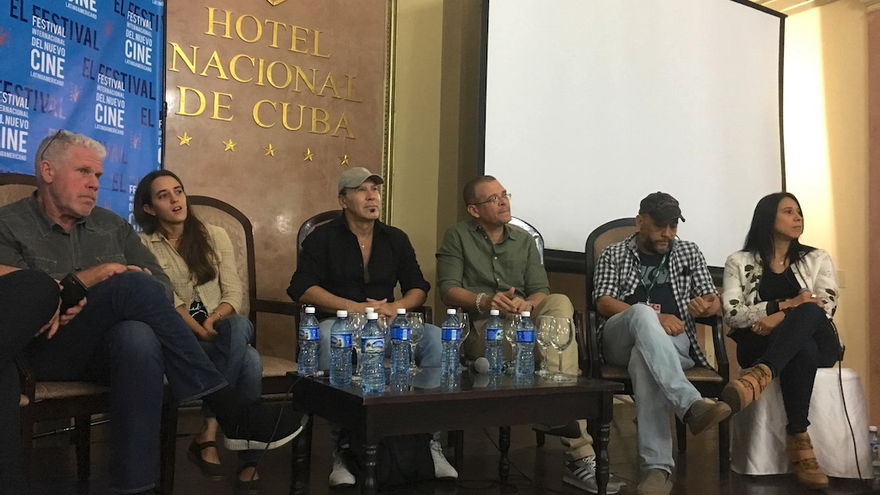
14ymedio, Luz Escobar, 15 December 2017 — On Thursday, Ernesto Darana’s film Sergio & Sergei was finally shared with a Havana audience and the full room of the Yara cinema eruped with applause, laughter and tears. The exhibition of the Cuban director’s work, presented at the International Festival of New Latin American Cinema, had been frustrated last Sunday by a projector breakdown at the Chaplin Cinema
The filmmaker, whose previous film Conducta (Behavior) received many awards, attended the screening and regretted that the Yara Cinema did not have “optimal quality” technology for both the image and the sound.
This “is a film to smile [and] to think,” said the producer about the work on the film, which was presented worldwide in the official section of the latest edition of the Toronto International Film Festival. The film reflects “a crisis that has not yet ended,” in reference to a not too distant past whose echoes still resonate in today’s Cuba. continue reading
Sergio & Sergei communicate by radio, helping each other despite the adversities they experience and the complex circumstances of their respective nations. On Earth, the brutal economic crisis provoked in Cuba by the collapse of the USSR — a time Fidel Castro labelled “The Special Period in Time of Peace” — sharpens Sergio’s paranoia, as he flees from his persecutors to the service of State Security.
For Mario Guerra, the actor who plays the vigilante Ramiro, the work done by the political police in Cuba is “castrating” and he confesses that he likes that people laugh at “such a moronic person” as Ramiro.
“There are things that do not deserve to be taken seriously,” said Daranas, referring to the tone of farce in which the character of the security agent is approached. During the press conference the director also mentioned that the film still has no release date in Cuban theaters, but it will be released in 2018 in Spain, as confirmed by the co-producer Mediapro.
In developing Sergio & Sergei, the director said he was inspired by those “operetta characters” who constantly break into everyday life and people’s dreams, and took advantage of the press conference to say that he refused to take seriously “the permanent extremists” and “the controllers.”
The film achieves highly worthy special effects that the team may well be proud of, as well as having excellent sound design along with credit for having hired an actor of the caliber of Ron Perlman to play Peter. Peter, an American journalist who lives in New York who is interested in investigating the propaganda of his country’s space program, ends up contacting Sergio.
The veteran American actor describes his character as “a quasi-revolutionary Jewish journalist living in New York” who reveals “the different forms of corruption of the US government.” Perlman had to sign “more than three thousand papers” to obtain permission from the United States Actors Association and work on a Cuban production.
However, beyond the fiction recreated or the amalgam of nationalities in the film’s cast, the most certain thing one can say about the film is that it manages to connect with a Cuban audience on a plane of complicity, recognition and identification.
“I do not want my daughter to grow up seeing this,” Sergio says on the screen, and the phrase generates a tremor in the room full of parents and grandparents who lived through those years. The teacher of Marxism sees how the world he knows falls apart and how he must set aside his principles to support his family, a story known by those who from the seats who fought tooth and nail in their daily struggle.
For Daranas, the film is a story “about friendship” and “about good people who deserve better.” Although in reality it is a film about unburied ghosts that run through the national life and lead us to wonder: What good were so many sacrifices to get to today’s disaster?
___________________
The 14ymedio team is committed to serious journalism that reflects the reality of deep Cuba. Thank you for joining us on this long road. We invite you to continue supporting us, but this time by becoming a member of 14ymedio. Together we can continue to transform journalism in Cuba.
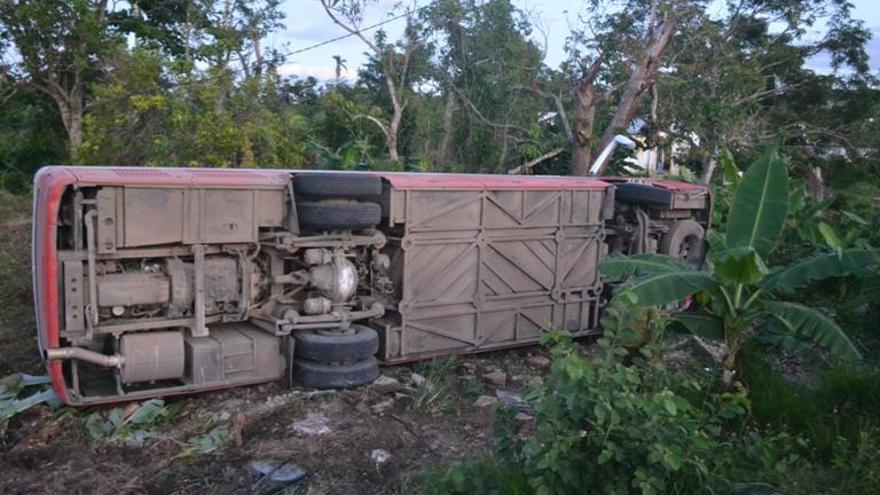
14ymedio, Havana, 11 December 2017 — A traffic accident in the town of Yaguajay, in the province of Sancti Spíritus, has left three people dead and two injured, according to the local radio station The Voice of Yaguajay.
The crash, which occurred around three in the morning, involved a bus from the Villa Clara Urban Bus Company, and a horse-drawn vehicle which was hit by the state vehicle.
The bus driver, Elier Mederos Lopez, 44, died as a result of the crash, as did Denis Iglesias Granados, 21, along with one other person. All three were residents of the municipality of Yaguajay. continue reading
Daniela Rodríguez García, just 17 years old, was admitted to the Intensive Care Unit of the Joaquín Paneca Hospital for back injuries and an ankle fracture, according to Dr. Yovisley Ruiz García, speaking to the local press.
The doctor also reported that the second injured, Jorge Ramón Cubilla Claro, 53, was sent to Camilo Cienfuegos Hospital for throat injuries and multiple rib fractures and is in critical condition with life-threatening injuries.
In August of this year another traffic crash took place in Yaguajay, on the Caibarién road, leaving one man dead and ten injured when the driver of a Dodge vehicle lost control and hit a house, dying instantly and causing significant damage to the property.
In the last five years there have been 56,605 traffic crashes on the Island that left 3,696 dead, which places it as the fifth cause of death in Cuba and the first among the age group of 15 to 29 years, according to official statistics.
More than 42,100 people were injured in these crashes which also caused an estimated loss of 2.5 billion Cuban pesos.
___________________
The 14ymedio team is committed to serious journalism that reflects the reality of deep Cuba. Thank you for joining us on this long road. We invite you to continue supporting us, but this time by becoming a member of 14ymedio. Together we can continue to transform journalism in Cuba.
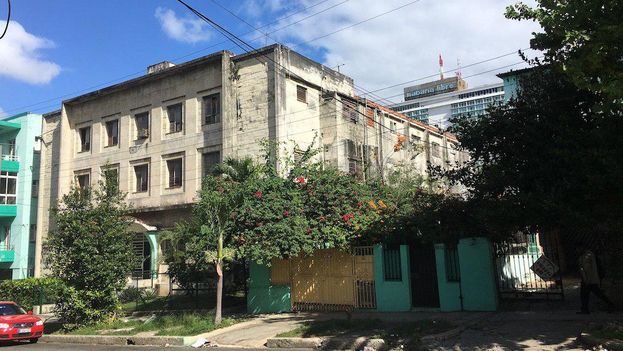
14ymedio, Havana, 11 December 2017 — The Baptist Church, through the pastor and coordinator of the Patmos Institute, Mario Félix Lleonart, has denounced the occupation of one of its buildings since last July by individuals acting in a personal capacity. The building is the site of the Office of the Board of Missions of the Association of Baptist Convention of Western Cuba, located in Havana’s Vedado district.
The Church has denounced that the authorities are not fulfilling their obligation to restore the property to its legitimate owners and has requested the intervention of the Southern Baptist Convention (SBC) in the United States along with the support from the US Government. The demand has its origin in fact that the building belonged to the SBC’s Home Mission Board until, in 1967, to avoid a potential confiscation because of its being an American-owned property, it was transferred to the Baptist Convention Association of Western Cuba. continue reading
According to Lleonart, who details the complaint in a statement posted on the Patmos Institute website, the church was installed on the ground floor of the building, but little by little the upper floors were filled with people who occupied the building in the face of the apathy of the religious community and the Government’s disinterest. The authorities have taken a special interest in stripping the Baptists of this property located in an area of preferential interest next to the University of Havana.
The Convention denounced those early phases of the occupation and in the early 1990s the courts ruled in their favor, but the authorities alleged that they could not force the illegal residents to leave, since they had no place to relocate them to. In spite of everything, the Convention recovered several floors and decided to locate the Office of the Board of Missions there, which opened this past July 6.
The Patmos Institute denounces that all the movable property that was inside the building, “including safe, computers, and documents,” is in the hands of the occupants and it is unknown what they have done with it.
Apparently the illegal residents of other apartments on the third floor broke through the dividing wall and occupied the area. Pastor Karell Lescaille, director of the Board, came to the site a day later and was unable to open the door of his office, which was obstructed from the inside. The neighbors refused to let the pastor pass on the grounds that they had occupied the apartment because it was being used by the Convention for “non-pertinent purposes.”
The occupants were warned that they should return the property and restore the wall after the Convention alerted the police and filed a complaint, but they refused to withdraw.
The Convention regrets that despite these measures and their having contacted the Office of Attention to Religious Affairs, they have not been able to recover the property. In their view, this is due to the lack of interest from the Cuban Government, which they believe intends to disrupt the task of the Mission Board and, at the same time, to control the building.
“Since the national mechanisms, far from giving any result only protect impunity, we call on all the national and international bodies that can to cooperate with us,” the Convention stated.
________________________________
The 14ymedio team is committed to serious journalism that reflects the reality of deep Cuba. Thank you for joining us on this long road. We invite you to continue supporting us, but this time by becoming a member of 14ymedio. Together we can continue to transform journalism in Cuba.

Regina Coyula, 8 December 2017 — According to the World Intellectual Property Organization (WIPO), intellectual property is “any property that, by mutual agreement, is considered to be of an intellectual nature and worthy of protection, including scientific and technological inventions, literary or artistic productions, trademarks and distinctive signs, industrial designs and geographical indications.”
The protection umbrella covers both the most traditional works and those associated with new technologies: multimedia productions, databases or computer programs. It is assumed that the protection of copyright encourages creativity and favors cultural and social development. The absolute character of this assertion is stubbornly defended by those who defend free culture. continue reading
We will leave aside trademarks, patents and everything related to the protection of industrial property to place the focus on the artistic creation protected by copyright. In particular, we will look at the way in which this creation is disseminated and/or shared, as this is a current issue that has peculiar characteristics in Cuba.
Cuba is a signatory to the Berne Convention amended in 1979. The Cuban copyright law dates back to 1977 with modifications through decree-laws that continue into the first years of the past decade. Intellectual property and copyright issues are taught not only in the School of Law, but in the Higher Institute of Art (ISA), the Higher Institute of International Relations (ISRI) and the School of Social Communication. The updating of the law is an imperative to adapt it to the changes of the digital age.
In practice, there is an exemplary zeal for the protection of Cuban intellectual property in the international arena, which contrasts with the laxness in respecting the intellectual property of others that has prevailed within our borders.
Restrictions on access to quality information in the scientific-technical field meant that in the 60’s publications such as Scientific American, Science or Science & Vie were reproduced without consultation to be sent to the archives of the documentation centers of different organs of the State including its education and research centers.
In the 80s, with the rise of videos in Betamax format, now obsolete, Omnivideo, a company affiliated with the CIMEX Corporation, sold unauthorized copies of film in hard currency stores. On the other hand, it is usual practice for Cuban television to reproduce materials while hiding the logo of the channel from which they were taken.
All these practices have tried to justify themselves ethically with the argument of “breaking the blockade,” but leave out the deeper discussion that reveals the illogical contrasts already discussed. Copyright is not only the protection of the right of the owners, it is also the creation of a favorable scenario for art, knowledge, science and culture to circulate. The legal framework should reflect that balance, a only then can a society exploit and take advantage of technological advances.
The rights of copyright holders and the fight against piracy
There are many groups that defend piracy for having been the instrument for knowledge, culture and science to be democratized. It is argued that the United States only became protective of copyright when it developed its own cultural industries after having widely pirated British works.
However, during the last decades, international treaties reflect a protectionist regulatory trend that pressures countries to strengthen their legal protection mechanisms. As Cuba enters into the logic of the market economy, record sellers, who fill their devices with all kinds of material protected by copyright, will be up against the awareness that they are encouraging an illegal activity.
It is important to recognize that, as in most underdeveloped economies, pirated discs and other digital media, both outside legal distribution networks, continue to be the largest form of access to recorded music and movies.
While the prices of legitimate CDs of Cuban music vary between 15 and 25 convertible pesos, the same CD in an alternative market costs no more than three. In the Cuban case, the knowledge of how The Weekly Packet works and is distributed , serves to understand the internal dynamics.
The internet is practically non-existent in Cuban society. Few people can have a home connection and public ones are irregular and still very expensive. This favors the coexistence of recorded discs, USB memories and portable discs due to the high number of CD/DVD players that still exist in the country.
Everything points to the fact that this model must change. If bilateral relations with the United States are regularized and/or the trade embargo laws against Cuba are weakened, the unrestricted use of protected material is put into perspective.
Those who manage the aforementioned Weekly Package, increasingly, have been including commercial advertising from the island’s the emerging private sector. This could allow them a relatively smooth fall when it becomes a punishable offense to transfer products protected by copyright, giving them the option of converting into cpmpanies supported by companies.
For those who sell discs, the road will be different. The desire to legitimize will generate initiatives such as agreements with local artists to function as distributors of their material. Thus they may become like their peers in Ecuador or Bolivia, former sellers of pirated production, many of whom reconverted due to the joint effort of the interested institutions and the Government, thus becoming merchants that pay taxes and pay national artists for sales. As a result, the costs of music CDs have been lowered and there is support for the promotion of the national market and a legal status of the vendor, previously nonexistent.
Cuba must start thinking about the transition. How can an internal market be supported by keeping the jobs and income that are being created and allowing the owners to receive income from the exploitation of their work? This is the commercial edge.
However, as in the rest of the countries, no legislation could foresee the change that the popularization of the information and knowledge through the Internet would bring, with both the positive and negative aspects it would entail. It is inevitable to rethink this given the new way in which information travels, while the right to access protected content is permeating popular consciousness.
Free Culture
The spread of knowledge that uses digital technology where the cost of reproduction is close to zero, translates into a jump in the level of access to information and culture never before seen in a proportion never imagined. It is inevitable that people affect others and are affected by the opinions and knowledge that, in massive quantities, are shared in social networks, and in digital publications 2.0, where anyone can leave a comment.
The internet, but above all the philosophy of free software, have led to the appearance of categories such as copyleft (a word game xpressing the opposite of copyright), or Creative Commons, both related to free culture . The popular Wikipedia is a collaborative creation par excellence.
This ability of the Internet and digital technology to widely distribute content clashes with the central premise of copyright, which requires asking to ask permission to use it. In the search for legal mechanisms that allow people to take advantage of these characteristics, the philosophy of free software that rests on copyleft licenses and modifies the effect of the legal model of copyright is reasserted.
In copyleft licenses, ownership is used to grant very broad permits to other people in the use of the protected material with only one condition: if what is done with the material is to modify it for a derivative version, the license must be maintained in the new material, so that the broad reuse effect is perpetuated.
Inspired by these ideas, Creative Commons licenses emerged at the beginning of the 21st century, presented as a series of six licenses, a kind of menu from which creators can choose, giving more or less permission to reuse their work.
The development and promotion by the state by these open licenses that are associated with the idea of free culture promotes a series of initiatives where the commercial aspect is displaced. Instead, the role is to take advantage of technology to widely distribute the contents. For example, open educational resources, an initiative of important educational institutions to share all of their teaching materials endorsed by UNESCO, has been adopted by many academic institutions and promoted by governments such as those of Poland or the USA.
On the other hand, at the economic and political peripheries, in this arena, piracy has a very well established role as a development strategy that facilitates the circulation of knowledge goods. Piracy also has a clear political role as a counterweight to the centralized control of information, either by the State or by private interests.
The flexibilities of copyright, science and culture
The issue of the broadest access to protected works cannot be left only to the will of the people. Copyright, in its own architecture, has weights and counterweights. As a balance mechanism for the privileges of those who create works, the copyright rules provide that, once the term of protection expires, the works enter the public domain and the author can no longer control commercial exploitation (moral rights are perpetual). Thus, anyone can reuse the works without asking permission.
Additionally, during the term of protection (in Cuba it is 50 years), the law recognizes exceptional cases. Given conditions that are often very restrictive, people can reuse protected works without asking permission, because the knowledge and culture of society is considered to navigate through them. That is why works can be “quoted, parodied or used for academic purposes.”
International treaties have effectively generalized the protection of owners, but have left it up to the States to legislate exceptions. This has led, especially in developing countries, to lists that tend to be limited and very restrictive. Contrast, for example, the United States, where, beyond closed lists, there is an open clause that allows courts to use broader criteria to analyze if the use of a work without authorization of the owner can be considered as fair, and, therefore, does not violate the copyright.
As Cuba enters the international market, the pressures will be to comply with the protections. If it does not do so in balance with the right of people, there will be serious problems of access to knowledge, science and culture, as well as other rights. Cuban law has very little flexibility and does not even meet the needs of the pre-Internet age.
Let’s look at a single example to demonstrate the problem. It is usual in the laws of copyright to contemplate exceptions to use current news without it being considered a violation of copyright. The news media in the world reproduce, for example, the images of the last terrorist attack without fear of being sued by the local newscast that obtained them. This is not possible in Cuba and forces information providers into illegality. Current information is exceptional and any law must recognize its use beyond copyright.
In sum, the debates about the limits between sharing knowledge and protecting intellectual property have only just begun. Discussing, analyzing local effects and proposing a balanced legal framework is an obligation that can not be postponed by the interested parties in Cuba.

14ymedio, Mario Penton, Miami, 7 December 2017 — Ernesto Machado will never forget a cold morning in 1968 at José Martí airport in Havana. A migration officer removed her parents’ gold wedding rings while annulling her passport. “This is the property of the revolutionary government,” the woman dressed as a soldier told her, before she left Cuba to never return.
On coming to power in 1959, Fidel Castro’s government imposed severe measures to prevent money and valuable goods from leaving the country. Almost sixty years later, although the international situation is different, the customs controls remain rigorous on this issue.
“I travel to Cuba every 15 days and I take medicines, food and money to any part of the island,” says a Cuban who resides in Miami, whom we will call Juan to protect his identity. continue reading
“Everyone wins with this business, the person, because he goes to Cuba to see his family members or, if he lives on the island, he gets a little trip, and the agency because that is our business, sending things and money to the island,” he explains
In the case of money, an agency like Juan’s can charge up to 6% commission on amounts over 20,000 US dollars. He says that he makes several shipments a month because “there are many people buying properties in Cuba.” Areas like Old Havana and Miramar are quoting very well, he says.
On revolico.com, the largest online sales platform on the island, houses sell for from 10,000 or 20,000 dollars in popular areas, and for up to $270,000 in the Havana neighborhoods of Miramar and Siboney or in the colonial city of Trinidad.
Cuban laws stipulate that you can freely import up to 5,000 US dollars per person and that for larger amounts you must fill out a declaration in Customs, without this necessarily requiring the payment of taxes. In most countries you can import up to 10,000 dollars without having to give a statement.
Juan does not care about the origin of the money he sends to Cuba nor does he follow the mechanisms to declare that cash in Miami or Havana. “Normally we send it with several people, we distribute the money to stay under the $5,000 barrier, and sometimes I send some trusted person to take in a little more, taking a risk, of course,” he says.
A report published in the official press reported that, so far this year, the General Customs of the Republic has registered 384 violations of the entry and exit of foreign exchange.
The newspaper recounts some of the cases, like a woman who hid 5,000 Swiss francs in condoms inserted in her vagina, or a man who had 32,550 euros tied to his body.
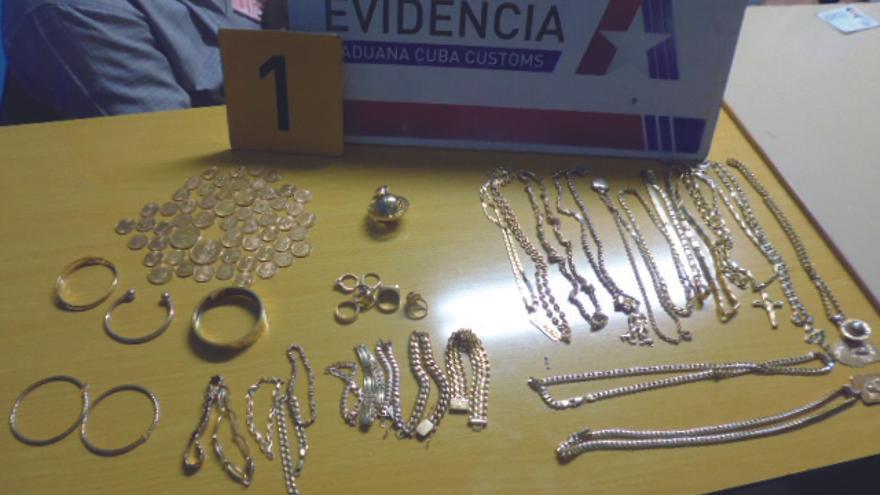
“Many are beginners in this business or try to do things without helping others, you have to live and let live,” says Juan, who according to his own testimony frequently bribes customs officials.
“I have been in business for a long time, my people are always known because we share codes. Usually when someone arrives at the airport, they offer to help you and if you accept it, things will always go well for you,” he says.
“In Cuba, there are businesses that need to take money out of the country. It’s a secret to no one that most of the products bought by the paladares [private restaurants] come from the black market. If the owners fall [in a police operation] they want to have a little piece of land on the other side, to keep something,” he explains.
According to official data, this year Customs has seized 165,816 CUC (Cuban convertible pesos), 61,660 CUP (Cuban pesos), 875 euros, 15,150 rubles, 73,822 dollars and 386 valuables (crucifixes, coins and silver bars), which travelers were trying to get out of the country.
The Central Bank of Cuba (BCC) allows each person to freely take up to 5,000 dollars out of the country. For higher amounts, an authorization from the President of the BCC is needed after verifying that the money has been lawfully earned on the island.
Buying foreign currencies inside Cuba before traveling abroad is a complicated task, although the law allows it. The banks require the customer to show a visa and an airline ticket linked to the country of the requested currency and, even so, only small amounts of foreign currency are sold.
You can always resort to the informal market but there the dollar is sold at a price that ranges between 92 and 97 cents in CUC, well above the official rate of 87 cents. On the other hand, it is strictly forbidden to remove from the country any amount of CUCs, the so-called convertible peso, which in fact has no value outside the island. The Cuban peso also has no value abroad, but it is possible to take out up to 2,000 CUP.
A few weeks ago, the American blogger Jaime Morrison, travel correspondent for BravoTV’s digital site, was arrested by the Cuban authorities, who confiscated the approximately 800 CUC he was carrying when he was about to leave the country.
“I broke this rule and I almost got sent to jail, do not let it happen to you,” the journalist said, telling the story about her experience in Havana. After a long interrogation she was able to leave the country, but without the chavitos.
___________________
The 14ymedio team is committed to serious journalism that reflects the reality of deep Cuba. Thank you for joining us on this long road. We invite you to continue supporting us, but this time by becoming a member of 14ymedio. Together we can continue to transform journalism in Cuba.