Life in Numbers

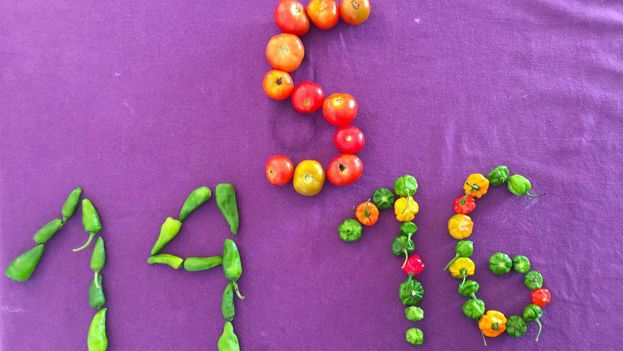
The tomatoes make the shape of a five and the tiny peppers used to season the beans come together to form a scandalous 16. (14ymedio)

14ymedio bigger14ymedio, Yoani Sanchez, Havana, 7 December 2017 – She pauses to think in front of a stand at the market. My mother is not evaluating the size of the tomatoes or the quality of the garlic, but making calculations. A mathematical operation where subtraction and division are the stars. With a pension of 250 Cuban pesos a month (roughly $10 US), she can’t lose sight of a single centavo and is an expert in daily calculations.

For the majority of Cuban retirees, the cost of living, that concept that connects the value of goods and services to the material quality of one’s existence, is an equation that yields a higher figure every day. Those who come out worst with these price increases are those who do not receive help or remittances or – because of their health – cannot engage in any informal work, such as selling cigarettes at retail.

In stores and markets they are known by their gaze. They are those who pause, attentively observing the price lists, while only a few coins appear in their hands. They usually wear clothes more than two decades old, the same amount of time that has passed since the smile was erased from their faces and they wait for evening to fall so they can “catch” the products at reduced prices.

Throughout the day they calculate their accounts, living surrounded by digits and breathing sums. When they unpack the contents of their shopping bags, the 14 Cuban pesos for a pound of chili peppers appears between their eyes and the merchandise. Tomatoes make the shape of a five, and the littlest peppers used to season the beans come together to form a scandalous 16.

In just one visit to the market, retirees like my mother spend a seventh part of their pension. The numbers do not lie and they are there, on the table, to remind them.

__________________________

The 14ymedio team is committed to serious journalism that reflects the reality of deep Cuba. Thank you for joining us on this long road. We invite you to continue supporting us, but this time by becoming a member of 14ymedio. Together we can continue to transform journalism in Cuba.

The Castro Regime’s Biggest “Electoral” Farce / Miriam Celaya

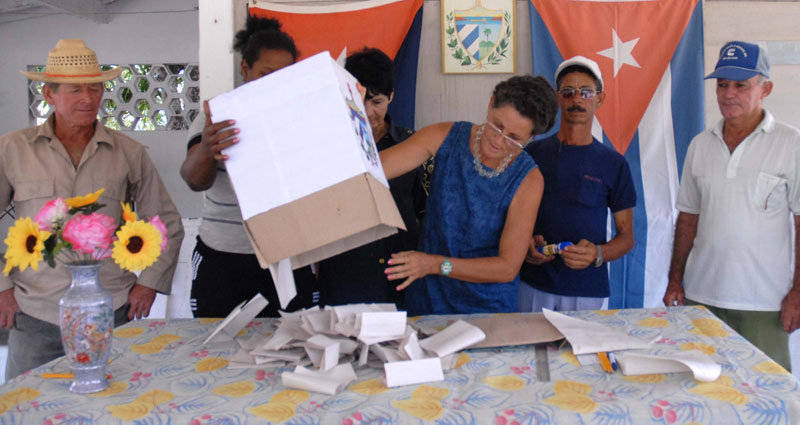
Counting the votes at the Cuban election

cubanet square logo

Cubanet, Miriam Celaya, Havana, 7 December 2017 — In recent days, “political analyst” Daisy Gómez – one of the faithful among the most faithful deans of the Castro press – offered a commentary on the primetime Cuban television news program, questioning the legitimacy of the results of the controversial Honduran elections, based on suspicions that “in that country there is no separation of powers,” and that this was the reason the current president, Luis Orlando Hernández, was able to manipulate the final figures of the Supreme Electoral Tribunal (TSE).

Such a cynical statement was made with the enviable composure of one who has trained for decades in this complicated exercise of (dis) informational prestidigitation, by virtue of which it is assumed that what is bad for other countries -in this case, the lack of separation of powers – constitutes a strength in the case of Cuba, since it demonstrates the solid unity between the government and the governed. continue reading

Therefore, and in spite of that fact that in Cuba the separation of powers between the executive, legislative, and judicial branches doesn’t exist either – because these are concentrated in the most holy trinity Government-State-Party, legal representative of that ambiguous and intangible body that has been called “the people” – Cubans should not have any reason to question the electoral results that the National Electoral Commission reports, however surprising the figures may seem.

It is worth remembering, in advance, that it is Law 72 (the electoral law) itself, which, when establishing the functions of the National Electoral Commission (CEN), certifies the subordination of the latter to the Council of State inasmuch as it determines that it is to “it” – and not to the “people” – that it must report the results of the national polls in the referendums and the corresponding computations, as well as rendering a “detailed report of the unfolding of each electoral process” (Chapter II, Article 22, paragraphs k and m) .

Thus, the possibility remains that the totalitarian power might be (as it is, in fact) the one that ultimately determines the electoral results and, eventually, manipulates the figures, according to its own interests.

A very peculiar feature of the Cuban electoral law that allows for tricks by the governing class is the number of registered voters, never known publicly in advance of the referendums, even though every Cuban citizen since birth is rigorously registered in the Management Registers of each municipality where he or she resides on the Island. Perhaps the only efficient ministry in Cuba, the Ministry of the Interior, controls the Registry, which in turn appears, duplicated, in each Committee for the Defense of the Revolution, so it should be relatively simple to monitor the voter’s location and update the electoral roll whenever it is required.

Thus, the updating of the register should result in an almost automatic task, since Article 5 of the Electoral Law establishes that the right to vote belong to all Cubans “who have reached the age of sixteen (16), who are in full enjoyment of their political rights “…; while Article 6 specifies the requirements that must be fulfilled in order to exercise the right to active suffrage, among which is “to be recorded in the Register of Voters of the Municipality and in the the electoral district corresponding to the voter’s established place of residence…”

For this reason, there is no logical explanation how it is possible that, after the voter registries have been updated in each constituency and after having had a “successful dynamic test” on Sunday, November 19th, prior to the elections, when it was supposedly demonstrated that “everything was ready and arranged for a triumphant electoral day,” the CEN has “updated” for the first time the national electoral register precisely on the day of the elections. And it is even more incomprehensible that in the five days following the elections, the final numbers of this registry have varied, not by a few tens of thousands, but by hundreds of thousands of voters.

Let’s review the facts: in the press conference behind closed doors, offered by the president of the CEN, Alina Balseiro, on the afternoon of Monday, November 27th, to provide information about the “preliminary results” of the elections, this official stated that the voter registration update had yielded a total of 8.8 million voters. This implies a colossal increase in relation to the 8.4 that, according to official data disclosed at that occasion – was the initial estimate.

As if by magic, in just the two and a half years that had elapsed since the last elections, 410,158 new voters appeared, almost half a million more, in the national register. This, in spite of the waves of emigration abroad realized by tens of thousands of Cubans, most of them of voting age, in the same period – and in frank challenge to the many desertions, deaths, dissidences and other adverse factors. Who would have imagined it!

Such an exaggerated number allowed the authorities, in just 24 hours, to increase to 85.9% the embarrassing 82% registered at the polls just one hour before the official closing of the polling stations, but also to declare that the attendance of the electorate had surpassed that of the elections held in April 2015.

The impressing avatars of the electoral numbers of the registry did not stop there, however. Because not even that surprising and already fat attendance at the polls satisfied the inflated official expectations. No matter what anybody says, public opinion tends to internalize percentage figures more easily than the numbers of voters, so the collective memory would have archived 85.9% of voters: a result lower than the 88.30% reached in 2015. The authorities were not going to allow such an unacceptable blunder, because the so-called “Fidel’s Elections” had to be, at least, superior to the previous ones. Those were the orders and they had to be carried out.

And this is how the CEN reapplied its twisted sense of mathematics and worked the new “miracle” of inflating to an impressive 89.02% the number of people attending the polls, with a total of 7,610,183 voters. Thus, the final “compatibilization” of the results with the Register of Voters was published last Friday, December 1st by the official press.

How did they achieve this new phenomenon? Easy, with the impudence of those who believed to be above punishment, the scribes of the geriatric palace returned to “update” the voter registry, and, as a result, it contracted again, this time by almost a quarter of a million voters. More nonsense, whose sole purpose was to allow the percentile result. If they couldn’t bring it up to the ideal number, at least they would bring it up to reach a higher number than on previous elections. And so, what appears to be the most unquestionable fraud in the 40 years of Castro’s electoral practices to date, was achieved.

Finally, the CEN certified that the final electoral roll for these newly held elections was 8,548,608 voters, which means a whopping 251,392 fewer than those reported in the preliminary results.

With so much inflating and deflating the registry and the polls over decades, the abundance of many flabby cheeks among the lords of Power are justified. However, all this overwhelming saga of numbers and implausible percentage figures undoubtedly point the finger at a gross manipulation of the election results, although we have no chance to prove it, which is another trick which the conspirators counted on.

Nothing new, of course, only that on this occasion the Cuban authorities have shown a rampant disregard for national and international public opinion. Not coincidentally, the journalistic note that reports the “official results” of the Cuban democratic party appears, not on the cover, but just on the third page of Granma, the most official of the official newspapers. They know that they need to lower the profile of even the biggest lies, otherwise, it is way too big a pill to swallow.

Interestingly, as an additional fact, these meticulous back-and-forth “compatibilizations” that favored the regime so much did nothing for the 4.12% of blank ballots or the 4.07% of canceled ones, so that we must accept – because this is what the CEN and its leaders, who (no sarcasm) are the only ones who know the truth – that in a few days the number of voters that swelled the ranks of those who went to the polls to exercise their right to vote, but additionally, their ballots became valid.

And since in Cuba the decisions “from above” cannot be appealed, the olive-green gerontocracy and its conga lines, with their proverbial triumphalism, will have scored this burlesque farce, not as the desperate play that it actually was, but as another “victory.” If so, it will be them and not us who are truly deceived.

Translated by Norma Whiting
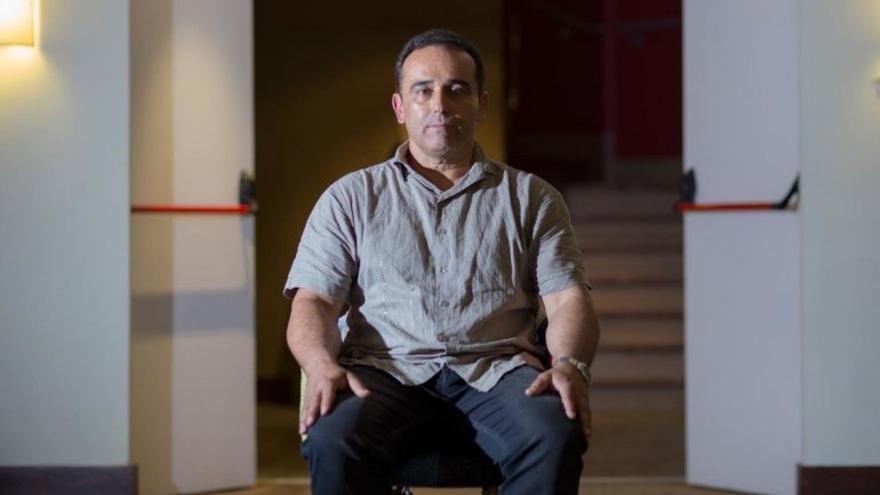
Eduardo Cardet, a Year in Prison for "Political Reasons"

14ymedio bigger14ymedio, Havana, 5 December 2017 — Dissident Eduardo Cardet received a visit from his wife Yaimaris Vecino on Monday, in the Holguin prison where has already served a year, after a trial that his family believes was manipulated by Cuban State Security.

Cardet, a doctor by profession and national coordinator of the Christian Liberation Movement (MCL), was sentenced on 20 March to three years in prison for a crime of assault on the authority, but he had been in prison since 30 November 2016 while awaiting trial.

After being violently arrested in front of his children at the entrance of his house in the town of Velasco in Holgin province, his appeal for bail was denied three times. continue reading

The opponent has suffered from a respiratory infection since his imprisonment, caused by his condition as a chronic asthmatic, and does not receive adequate medication despite the fact that prison officials assured his wife that treatment was guaranteed.

“My husband told me that this is not true because it is difficult for prisoners to access medications,” Vecino tells 14ymedio.

A neighbor says she saw her husband in a good mood, but uneasy about being away from home while his family has recently gone through difficult times. “He regrets not being able to help us and take care of us.”

“When I ask about his transfer [to another prison] they tell me that I will only know when it is carried out,” explains his wife.

Several international human rights organizations have denounced the Cardet case. At the end of last January, Amnesty International called for his “immediate and unconditional” release, saying that the national coordinator of the MLC was “imprisoned solely for the peaceful exercise of his right to freedom of expression.”

It also considers him a prisoner of conscience and states that he was violently arrested a few days after the death of Fidel Castro.

Cardet was a key figure in the Varela Project, promoted by opposition leader Oswaldo Payá. After the death of Payá, Cardet continued his work and in 2014 he was appointed national coordinator of the MLC.

Last Thursday, the movement announced a manifesto signed by international personalities to ask the Government of Cuba for the freedom of prisoners of conscience and in particular that of Eduardo Cardet.

“His arrest a year ago was very wicked, because he was arrested and beaten in front of his children,” said the document, which also claims that it has been a long process “controlled at all times by State Security” and originated “for political reasons.”

The announcement criticizes that Cardet is being subjected to “a severe regime in open violation of the penitentiary laws themselves” in force on the island.

Among the signatories are a former mayor of Madrid, José María Álvarez del Manzano, the President of the Peace and Cooperation Foundation, Joaquín Antuña, and the former president of the European Parliament, Enrique Barón Crespo, among others.

The manifesto asks that the Spanish authorities, “in keeping with the principles of defense of human rights and democracy, do whatever steps are in your power for the quickest release of Eduardo Cardet and other prisoners of conscience in Cuba.” ___________________

The 14ymedio team is committed to serious journalism that reflects the reality of deep Cuba. Thank you for joining us on this long road. We invite you to continue supporting us, but this time by becoming a member of 14ymedio. Together we can continue to transform journalism in Cuba.

With Yailin and Yoerky, ‘Generation Y’ Arrives at the Head of ‘Granma’ and ‘Juventud Rebelde’

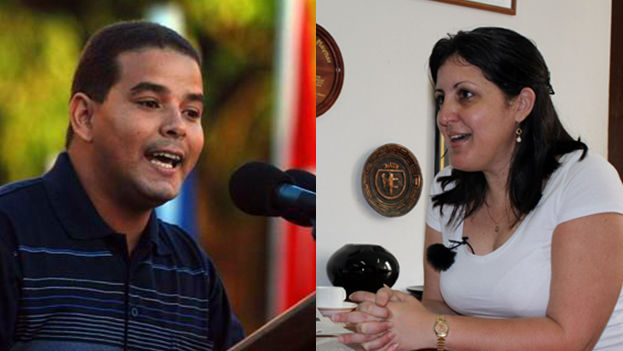
Yoerky Sánchez Cuéllar, new director of ‘Juventud Rebelde’ and Yailin Orta Rivera, new director of ‘Granma’. (CC)

Both directors were born during the years of the Soviet presence on the Island, grew during the Special Period and have lived much of their lives under the dual currency system

14ymedio bigger14ymedio, Havana, 6 December 2017 — After several weeks without someone formally in charge, the job of director of Granma, official organ of the Communist Party of Cuba (PCC), was entrusted on Tuesday to Yailin Orta Rivera, who held the same position on the newspaper Juventud Rebelde.

The Political Bureau of the Central Committee of the PCC issued a brief press release in which it states that Orta graduated in 2006 with a degree in Journalism from the University of Havana and began her work as an editor. At 34, the young woman’s career was on an upward trajectory within Juventud Rebelde, where she “was promoted successively to head of department, assistant director and director.”

Orta is a member of the PCC and a member of the National Committee of the Young Communists Union. Her name and photo still do not appear in the Who are we? section on Granma’s digital site. As of Wednesday, the section still includes the fired director Pelayo Terry Cuervo, even though he was removed from office almost a month ago. The reasons for his sudden removal were not stated, then or now, though speculation abounds.

Orta has been replaced at Juventud Rebelde  by Yoerky Sánchez Cuéllar, a 2007 journalism graduate from the Central University of Las Villas, who started his career as an editor for the Vanguardia newspaper in Villa Clara.

Sánchez, also 34 years old, formerly directed Alma Mater magazine, is a member of the Central Committee of the PCC and a deputy in the National Assembly. In several parliamentary sessions in which he has participated he has recited décimas – sonnet-like poems – dedicated to Fidel Castro, José Martí and socialism.

With the arrival of Orta and Sánchez, the two main newspapers of the country are now led by members of Generation Y, young people in Cuba who were born during the years of the Soviet presence on the Island, grew up during the Special Period, and have lived a good part of their lives under the dual currency system. The name of the generation comes from the tendency of at that time to give their children names beginning with “Y.”

___________________

The 14ymedio team is committed to serious journalism that reflects the reality of deep Cuba. Thank you for joining us on this long road. We invite you to continue supporting us, but this time by becoming a member of 14ymedio. Together we can continue to transform journalism in Cuba.

Manipulation in Santa Efigenia Cemetery / Fernando Dámaso

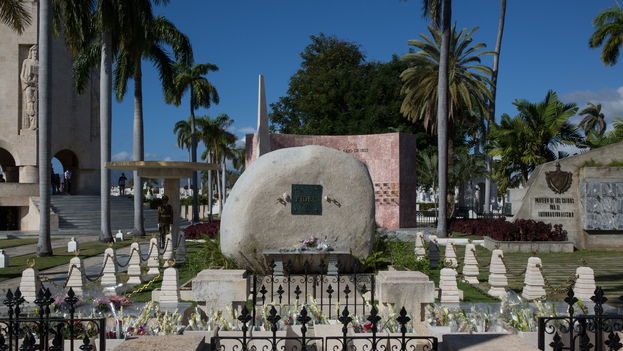
Going forward, the remains of Céspedes and Grajales will be next to those of Fidel Castro and José Martí (Christian Pirkl – Eigenes Werk/Flickr)

Fernando Damaso, 23 October 2017 — The moving of the remains and mausoleums of Carlos Manuel de Céspedes, the Father of the Nation, and Mariana Grajales, the mother of Maceo, from their original locations to the area near the mausoleum of José Martí, whom we Cubans call the Apostle, and the monolith of the “historical leader” (Fidel Castro), continues to be a topic of discussion among Cubans.

If this transfer had been made before placing the anachronistic monolith in place, when the area belonged mainly to José Martí and other heroes, it might have been acceptable, although this idea of relocating remains, according to the political conveniences of the moment is reprehensible and carries overtones of outdated totalitarianism and socialism. continue reading

It recalls the game with the remains of Stalin in Moscow’s Red Square, which were first located next to Lenin inside the latter’s mausoleum and, years later, when the dark side of Stalin’s character was publicly revealed, they were removed and buried near the entrance, with a simple pedestal without a bust.

This move now, whatever they say about it, reflects deep manipulation, perhaps with the aim of attracting visitors to the site and, therefore, as a collateral gain, towards the monolith.

And as if the manipulation was not enough, Dona Mariana is also supposed to be granted the title of “Mother of the Nation,” something that no Mambí (fighter for Cuban independence) gave her nor did any of the veterans of the War of Independence, as if it happened with Carlos Manuel de Cespedes. The greatest title of Doña Mariana’s is that of being the mother of the Maceo, and that of having accompanied them in the first independence struggle: she does not need another.

They justify this by saying that when she died José Martí sent a wreath of flowers in whose ribbon said “Mother,” is too farfetched like something from the Historian of Havana, who,for a long time. became the historical oracle of the authorities. It would be good to remind him of an opinion from our Apostle: “There is no spectacle, in truth, more odious, than that of servile talents.” (Volume 13, page 158 of his Complete Works).

Although, according to what we were told then, the “historical leader” asked that his name not be given to any public establishment, institution, avenue, street, etc., what is being done now is worse: they are trying to place it, in importance, next to Céspedes and Martí. The Fathers of the Homeland deserve respect.

As if that were not enough, a white stone coffin, with bones brought from the Pantheon of the Veterans, dedicated to the Unknown Mambí Soldier, has now been located in the Hall of the Lost Steps of the National Capitol.

Everything seems to indicate that this funerary addiction will continue.

Marxism Professor is Cuba’s Social Networks Czar / Juan Juan Almeida

Juan Juan Almeida, 19 October 2017 — A Marxism professor who is also an official of the Ideological Department of the Communist Party of Cuba (PCC) is responsible for implementing the Cuban government’s strategy for the use of social networks from the island.

Joaquín Suárez González , 52, a graduate of Marxism, Leninism and History at the  “Félix Varela” Pedagogical Institute in Santa Clara, and an official of the Ideological Department of the Central Committee of the PCC, is in charge of organizing the propaganda maneuvers through the social networks, and distributing among an army of netizens the tasks approved and supervised by the Council of State, the Council of Ministers, the National Defense Council, and the National Defense and Security Commission, Martí News has learned. continue reading

Engineers, programmers, designers, specialists in Support and Information and Communication Technologies (ICT), make up this small elite group led by Suárez González, who, upon the conclusion of the elections and the installation of the National Constituent Assembly (ANC) in Venezuela, won the recognition of President Nicolás Maduro for working actively and without rest for more than 24 hours in the rapid dissemination of the campaign and the hashtags for use in different platforms.

Social networks are the most active and dynamic phenomenon in the world today, so the tactic that the Cuban government manages is not to impose the benefits of the communist system and its doctrine, but to reach as many users as possible, and try fascinate them by showing the most attractive and unique side of the so-called “revolution.”

To carry the message of the Cuban government through social networks, all the state administration agencies, ministries and the press are subordinated to this commando of technologists and ideologues.

The Cuban Institute of Friendship with the Peoples (ICAP), Intelligence and the Ministry of Foreign Affairs (MINREX), are responsible for transmitting “when and how to act” to the different embassies, consulates, collaborators, and “Friends of Cuba” so that all of them, in unison, can activate profiles on Facebook, Twitter and Instagram and support each entrusted mission, whether it be to ask for help for the destruction caused by a hurricane, to enhance the firmness of a people that provide solidarity to a needy nation, to discredit dissidents and/or influence, with the help of cyberspace, the opinion of thousands of young people everywhere in the world.

The most recent action took place during the “Networks Operation for the 149th anniversary of the Beginning of the War of Independence,” on October 10, when the remains of the hero Carlos Manuel de Céspedes and the outstanding patriot Mariana Grajales were buried in the Santa Ifigenia cemetery of Santiago de Cuba (where they joined the remains of José Martí and Fidel Castro).

According to Joaquín, on that occasion, the hashtags #VivaCubaLibre, #Cuba, #10deOctubre, #CubaEsNuestra and #SantiagodeCuba were the most significant.

Currently the cybernetic troop is training on the networks to launch incentive politics with the purpose of collecting opinions to design strategies and hashtags, and to “viralize” the last stage of the nomination process of candidates with a view to the elections for Cuba’s presidential turnover in 2018.

Excesses Do Not Generate Respect / Fernando Dámaso

Fernando Damaso, 3 December 2017 — Human beings are born and they die. Before being born they never existed and, after death, they cease to exist. In their honor monuments can be erected and their names given to streets, avenues, plazas and public establishments, but they are not there. Depending on their deeds, good or bad, they will be remembered with love or with hate.

José Martí died on 19 May 1895 and on that day his life cycle ended. What has endured afterwards are his thoughts and his ideas, but he did not live another day after that date.

For Antonio Maceo, what endured after his death on 7 December 1896, is his military exploits and for Máximo Gómez, after 17 June 1905, it was his brilliant strategy of war.

Other Cubans who are closer in time live on in their music, like Ernesto Lecuona, in their painting, like Wifredo Lam, in their theater, like Virgilio Piñera, or their poetry, like Nicolás Guillén. None of them accompanies us on a day-to-day basis nor do they go back to the places they visited during life, or greet or embrace those who shared with them the days of their existence, because it is impossible.

Lately we have been spectators of an absurd and grotesque phenomenon: trying to present as a living being someone* who died a year ago. To do this, they have used all possible means, including overflowing masses, amazing expressions and even special mourners, in a real circus show. Something truly shameful, which should embarrass the organizers.

Remembering is good, but excesses do not generate respect, rather they generate repudiation. This lesson should be well learned by politicians.

*Translator’s note: Fidel Castro

Cubans Eat the Most Expensive Eggs in the World / Juan Juan Almeida

Juan Juan Almeida — The lack of planning on the part of the Ministry of Agriculture has been the main trigger for the fact that hundreds of poultry farms have generated a crisis now experienced by Cubans as the absence of eggs, along with the high cost of such an important food when it can be found.

Low egg production, allegedly caused by severely stressed hens after the passage of Hurricane Irma, has forced the black market importing of this essential food from the beach resort of Cancun, in Mexico. The whole thing seems like a plot invented by some filmmaker for a science fiction movie, but no, it’s real news, coming from the island.

Cuban TV national and provincial news programs are showing repeated images where some producers in the national assembly debate the steps necessary to rescue the production of eggs, and attribute the scarcity of the product to the indisposition of the birds, in addition to the destruction of more than 615 poultry houses by Hurricane Irma. continue reading

But the main trigger continues to be the lack of planning by Cuba’s Ministry of Agriculture, such that hundreds of poultry farms have generated the crisis that Cubans suffer today for the lack of this food source that is such a staple for ordinary Cubans.

A note published on October 1 in the newspaper Juventud Rebelde (Rebel Youth, the official voice of the Cuban Communist youth) announced that as an emergency measure to meet the needs of the people, the government will sell “more than one million eggs, five per consumer, at a price of 1.10 pesos each.”

I do not know the psychology of birds; but it is crazy that within the Cuban fauna, the hens belonging to the State are the only ones stressed out. The private farmers are, according to all reports, “raking it in,” selling eggs from small producers at 4 pesos each.

The origin of this crisis, which is not the first and I suspect will not be the last, is not found in avian tension, anguish or depression, but in other elements that affect the production of the most popular of all the foods that make up the essential diet and the basic Cuban food basket.

The hurricane is not the culprit. The poultry industry in Cuba has had a continuous and acceptable development, has good breeding stock, mainly in layers, and has achieved a production per bird of 280 eggs per year, with a weight of 3.2 pounds per ten eggs produced. However, by not respecting the living space requirements of these animals, plus the low availability and quality of water, causing a high incidence of prolapse, along with the lack of adequate food, has caused the layers to acquire the vice of picking at each other’s feathers, and harassing their companions, especially when they are in their nests. All this has a very negative effect on egg production.

The egg crisis on the island has no quick solution, and it also affects self-employed workers in restaurants that survive between the desire to hide, the need to trade and the frenzy of the market.

“We have a partner who supplies us with flan, custard, pudding, cakes and other desserts that we offer in the restaurant; but they aren’t selling because if the police grab them in the street with any product that contains eggs in the recipe, they charge them with receiving stolen goods,” explains the owner of a small paladar (private restaurant).

But that small group of restaurant owners who, cautiously and shrewdly, have managed to scale the ladder and break, in plain sight, although invisibly, the egalitarian aesthetic imposed by the Revolution, managed to find harmony in the contradiction and devised the solution (quite expensive, by the way). They travel as a group and import, without formal permits, cartons of egg that accompany them as luggage from Cancun to Havana. No doubt, André Breton (author of the Manifesto of Surrealism), lacked imagination.

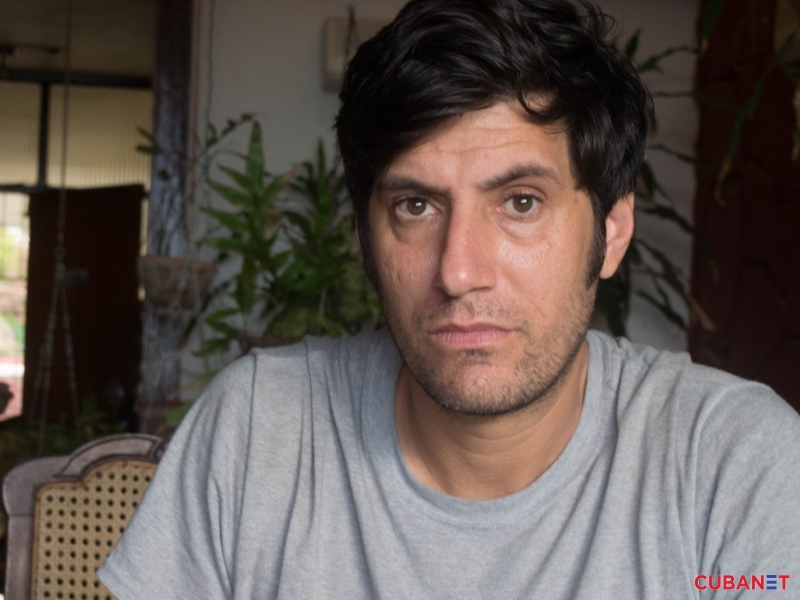
Claudio Fuentes: "I Do Not Want to be an Opponent One More Day"

Claudio Fuentes (Photo: María Matienzo)

cubanet square logoCubanet, María Matienzo, Havana, 23 November 2017 — According to Claudio Fuentes, photographer and human rights activist, he’s started doing something like ten interviews and they haven’t published any of them. Maybe it has to do with that mania he has to be always behind the camera, pointing the lens at the Ladies in White, other activists and even his own friends.

“It’s a simple attraction to photography and nothing else,” he says, justifying himself. “I’ve always had a kind of leadership in the shadow of the people I’m interested in working with, where I know my opinions are heard, but I do not have the imperative need to be making decisions,” and he offers the example of his work with Estado de Sats together to Antonio Rodiles and Ailer Mena.

“I always say that the one who knows the most about something is the one who should have the last word. If I was in a group working on Biology, which was what I studied, or with art, maybe I would have a voice of the first rank. But here I have come last and I am always learning about civil and political rights.” continue reading

However, he does not always assume the role of student.”It’s whatever is needed,” he says. “In the video of the electoral farce in Cuba, Ailer did a test, I did another test, and Antonio said: ’No, man, no, that’s fine’. If it works, they choose me if I’m not behind the cameras.”

The combination of photography and political activism started in 2008, when they tried to imprison Gorky Águila, director of the punk rock band Porno for Ricardo.

“Suddenly and without thinking twice I was an activist for his cause. It was like a fury that I did not care about anything.All that time I had been against the system but without having expressed myself,” recalls the photographer. “I put aside my individual artistic tendencies and contributed everything I had as a tool available to the cause of democracy in Cuba.”

He confesses that he is “crazy for communism in Cuba to end because I do not want to be an opponent one more day. This field fills me with pride,” he says, referring to the time he has spent working with the opposition and the privileged position he has in the history of contemporary Cuba that allows him “to have an overview of what has happened in the opposition starting some years ago, or knowing who is who, who is really in this fight with authentic democratic goals and who are not so much.”

“But I want to make movies,” he adds.

His political position shows a Claudio Fuentes before 2008, a skilled photographer who jumps to the moving image or video in a self-taught way or in courses at the San Antonio de los Baños International Film School; and with that comes the second Claudio, punk and oppositional, who still engages with the fixed image, but who begins to radicalize towards the Civil and Political Rights movement and towards a minimalist documentary image, black background and interview style, with barely any traditional artistic values, supported only in the focus and the denunciations of the actions of the powers that be.

As a photographer and activist, he believes that his process has been organic. “In all the circles in which I have been I have belonged to those that are seen as the most radical. I see radicalism as a necessary thing. I am increasingly radical because in this totalitarianism there is no chance for the path of civic action and I do not enter into any moral questioning, the Universal Declaration [of Human Rights] is there and the whole Western world recognizes it.”

He also talks about the image as passion. “The image impacts me. All the poetics that are behind it, even the crappiest, the most mediocre, I am always reading things there. But if I try now to be a successful artist with my work, I will have to put aside the activism,” and he enumerates what he would abandon and that it would cost him more than “the feeling that my work is still waiting.”

“It would leave many people unprotected, a lot of information would not reach them, or the documentaries that we do that contribute to the civic education of the people or inform exiles and others outside of Cuba of where this is going, and these are my priorities now.”

Although he does not believe that this is his work, he talks a little about the documentary by Olac Garmendia where he was the director of photography and one of the three scriptwriters, or of the shared experience in the documentary Gusano, where he worked as a photographer and editor.

In the latter, he says, “the discussions were exquisite, rude, strong, and I made important decisions in making that film, but with all this what I have learned is to work as a team and not be the artist locked in his ivory tower or the peacock. There are many I have deep differences with even though they are friends of mine, who do not engage in any work from their art to improve the situation in Cuba or have a separate work as activists.”

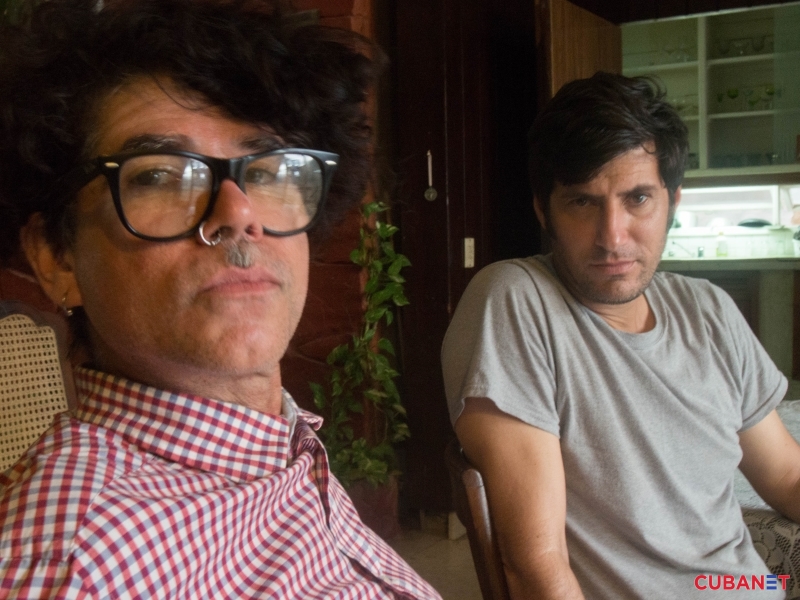
Gorki Águila (left) with Claudio Fuentes (Photo: María Matienzo)

He has a list of things that he could do with others without “immolating himself” because he does not want anyone to tell him, when “castroism falls” that, “I didn’t do anything, but you didn’t tell me what to do.”

In a list that ranges from recharging the phone cards of political prisoners so that they can make calls, to collecting universal literature to distribute among those same prisoners, to telling his local Committee for the Defense of the Revolution (CDR), “I’m not participating in that,” to “things that have to do with kindness, with generosity,” because, like he told a friend who “didn’t want to get into the political game”: “Look, compadre, life gifted us with a dictator who is a tremendous son-of-a-bitch so we’d do things against that; they gave us a lack of freedom so that we could conquer it, it is very simple, you have to sign on.”

He analyzes a phenomenon that artists don’t escape: “What happens is that the majority here is alienated. You don’t participate because the street doesn’t belong to you, you don’t have property, or businesses, and people have a convulsive tendency to complain, and I am up to my eyeballs in complaints. They are people conquered by Castroism  long ago.”

As an artist who has dedicated himself to putting a face to politics, he describes what a Cuba without Castros will be like.

“The change I imagine is very similar to what has happened in Eastern European countries, that first there is a turnaround so big that millions of people are going to have to be literate,” dreams Claudio. “There has to be a revolution of learning, in addition to 18 months of transition where new political actors will appear, intelligent people who have prepared in the shadows for fear of repression, who will compete with others who have achieved their legitimacy in the opposition.”  He adds to his list of candidates the political exile: “Luckily we have an exile 90 miles away that demonstrated not only its economic capacity but its political capacity. We have Marco Rubio, Carlos (Díaz) Rosillo, Carlos Trujillo, the two Díaz-Balarts, Carlos Curbelo, Ted Cruz.”

His hope includes that, along with the changes, “there are measures of protection for all those who try to compete with this new thing that comes, because nobody is to blame for our being out of control. And the reality is that we are all in the ditch here. ”


Author: Maria Matienzo Puerto: I once dreamed that I was a butterfly coming from Africa and I discovered that I had been alive for thirty years. From then on, I built my life while I slept: I was born in a magical city like Havana, I dedicated myself to journalism, I wrote and edited children’s books, I gathered around art with wonderful people, I fell in love with a woman. Of course, there are points that coincide with the reality of the vigil and I prefer the silence of reading and the hullabaloo of a good movie.

Where the Influential Are Above the Law / Juan Juan Almeida

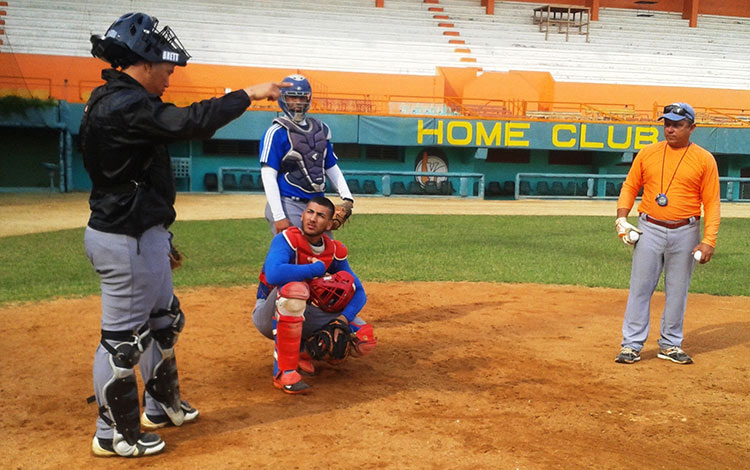
Ariel Pestano Jr. crouching in catching position. His father played on the Cuban National team and won silver and gold medals in the Olympics. (Foto: Mayli Estévez Pérez)

Juan Juan Almeida, 25 October 2017 — Pressured by the influential and under the protection of a superior command, a Cuban court imposed a prison sentence on a young self-employed worker who, acting in legitimate self-defense, caused minor injuries to the son of a well-known Cuban sports figure, Ariel Osvaldo Pestano.

On July 1, Renny Ferrer Suárez, 31 years old, with no political or criminal background, the son of a math teacher, freely turned himself in to the authorities in the town of Caibarién [a coastal municipality in the center of the island] , after having had an altercation with Ariel Pestano Jr. and a friend, who assaulted him. The reaction of Ferrer Suárez caused slight injuries to the son of the Cuban baseball star. continue reading

“No one arrested him, he showed up at the local police station and after taking statements, they released him; but the [former] star receiver of the Cuban team and deputy to the National Assembly of People’s Power (the Cuban Parliament) [father of the injured], used his influence beyond the borders of this small town. He spoke with Raúl Castro’s grandson in Havana and, without anyone expecting it, a counter-order appeared that ended up imprisoning Ferrer for 49 days until the day of the trial,” explains Leonardo Rodríguez, resident of the town of Camajuaní.

During the time that Ferrer Suárez was detained, his family was harassed, threatened and even stoned.

Ferrer says that the people who harass him are taking advantage of the prestige that Ariel Pestano has in the area. Several members of the police, lawyers who know the case and even Lieutenant Colonel Soto, a delegate of the Ministy of the Interior in Caibarién, know that they have been vicious toward Renny, but they cannot act against the power of Pestano and his powerful friend from Havana.

“Maria del Carmen, Renny’s mother, is terrified. She is a person who maintains an irreproachable behavior and, as a worker, there are no complaints about her. She is a selfless teacher who stayed to fight against all odds, facing difficult periods like the mass exodus of workers in the education sector. This is a small town, everyone knows each other and we all know that Renny is a quiet boy who worked as a self-employed person in the shoemakers’ guild. But the Pestano family are boasters who function as modern chieftains. Here in Camajuaní, as in any other small town, being a player on the national team is more important than being mayor,” the source adds.

The trial for Case 42/17 was held on September 6 in the municipal court of San Juan de los Remedios, in the province of Villa Clara. The Pestano family attended; but the boy who was next to the alleged assailant when the altercation took place did not appear at the hearing. Instead, the prosecution put a pair of false witnesses on the stand who were dismissed because the judge could not hide that they did not know the defendant and that the testimony they gave was riddled with inconsistencies. However, Renny Ferrer Sánchez was sentenced to serve one year in prison, with the additional sanction of being restricted from visiting the beach of Caibarién for three years.

“They denied my appeal, I filed a complaint for harassment, but they did not take it into account. I am ready to serve a year in prison, but I am also willing to denounce what happened. Not only for justice, but also so that no one else has to suffer what is happening to me,” Renny Ferrer concluded in a telephone conversation.

Ciro Díaz: “Musician In The Morning, Mathematician In The Afternoon, Activist In The Evening”

Ciro Díaz, the guitarist of the group Porno para Ricardo, is a dissatisfied Cuban who is doing a PhD in mathematics in Brazil. (14ymedio)

14ymedio bigger14ymedio, Luz Escobar, Havana, 2 December 2017 — It is risky to define someone in brief strokes, but if it is Ciro Díaz we are talking about it is even more so because the same person contains a mix of the activist, the musician and the mathematician.

The guitarist of the group Porno Para Ricardo is a dissatisfied Cuban who is doing a PhD in mathematics in Brazil. This week he was visiting Havana and spoke with 14ymedio.

14ymedio. What attracts you most about life in Brazil?

Díaz. Freedom. At the University of Havana I felt persecuted. If you did this you were thrown out, if you said that you were thrown out, if you did not behave in a certain way, they would throw you out, if you did not go to an activity you got into trouble. In Brazil, the opposite is true, because universities are epicenter generators of political problems. continue reading

14ymedio. Have you had encounters with that part of the university left that supports the Cuban Government?

Díaz. In Brazil there is everything, both the liberal left and the conservative left, the funny thing is that many people of the liberal left are very ill informed about Cuba. They think that the government of Havana is liberal when in fact it is ultraconservative and for the most extreme Brazilian left that is difficult to digest.

14ymedio. Activist, musician and mathematician. Aren’t they occupations that are too disparate?

Díaz. I’m a jumbled mixture of all that: musician in the morning, mathematician in the afternoon and activist at night.

14ymedio. But does one predominate over the others?

Díaz. Sometimes I turn more toward one thing than for another. Now I’m recording a new album with La Babosa Azul. When I finish it I’ll put it on the internet and forget about music for a while to concentrate on mathematics. Meanwhile I am an activist in my free time, when I have to face an ill-founded opinion about Cuba and help people to see our reality in a different way.

14ymedio. You mentioned the musical project La Babosa Azul, but some thought that was over…

Díaz. La Babosa Azul is a submarine: we record a record and then we submerge until the next one comes out. Between one thing and another maybe we do a concert or we record a video clip. The previous album was called El último (The Last). I called it that because I thought there was not going to be another album, but next year there will be one released in English.

14ymedio. Has the fact of living in Brazil separated you from the punk rock group Porno Para Ricardo?

Díaz. Never in my life have I played as much with Porno for Ricardo as since I’ve been in Brazil. In the Czech Republic we have played four times and whenever a concert is organized I join. It is very fun to play live and I love festivals that are full of people. A tremendous experience that here in Cuba is difficult to have, at least with so much publicity.

14ymedio. Than in those times of clandestine concerts?

Díaz. Yes, there were for fewer people, at the most 100 showed up. However, the most enthusiastic audience we have had is in Cuba because the songs speak them more and there is more interaction.

14ymedio. Will you return to the Island soon?

Díaz. I will continue coming every two years so as not to lose my (right of) residence and I will look for a job in Brazil when I finish my doctorate. It does not make sense to study six years to get a doctorate and come to live in Cuba, where I can not even work. What I will never lose is my residence here.

14ymedio. Have you thought about working with record companies?

Díaz. It is very difficult and I do not want to spend time on those efforts, not to mention all the concessions that have to be made. In Cuba it is particularly pathetic, you have to be a bootlicker to be broadcast on TV and radio, something I am not willing to do.

________________________

The 14ymedio team is committed to making a serious journalism that reflects the reality of deep Cuba. Thank you for joining us on this long road. We invite you to continue supporting us, but this time becoming a member of 14ymedio. Together we can continue to transform journalism in Cuba.

Three Points to Solve the Embargo / Dimas Castellano

A bicyclist in Havana. (MARTINOTICIAS)

Dimas Castellano, 20 November 2017 — On November 1, 2017, Cuba presented to the UN General Assembly the project entitled “Need to end the economic, commercial and financial blockade imposed by the US against Cuba.”

In his speech, Cuban Foreign Minister Bruno Rodriguez criticized the policy contained in the Presidential National Security Memorandum on the strengthening of the US Policy towards Cuba, issued on 16 June 2017.

He criticized the prohibition of economic, commercial and financial transactions with Cuban companies linked to the Armed Forces and the Ministry of the Interior; the elimination of individual travel in the category of people-to-people exchanges; the prohibition of travel to Cuba outside the framework of the 12 authorized categories; the opposition to actions that promote the lifting of the “blockade”; the repeal of the Normalization of Relations Policy issued by President Obama in October 2016, and the conditioning of the suspension of the “blockade” to changes within Cuba. continue reading

Likewise, he criticized moving the issuance of visas services from Havana to US consulates in third countries; the warning to American citizens to avoid visiting Cuba; the expulsion of Cuban personnel from the Consulate General in Washington and the reduction of US personnel in the embassy in Havana.

Finally, the Cuban foreign minister said: “The blockade is the biggest obstacle to the economic and social development of Cuba.”

In 1992 only 59 countries voted in favor of the Cuban resolution and in 2016 — with the exception of the US and of Israel which abstained — all voted in favor, without affecting the US embargo in any way, because the resolutions of that body constitute recommendations and, therefore, compliance with them is not mandatory. Therefore, when obtaining the maximum possible result in the UN, action in that forum was exhausted.

From that moment on, the atmosphere of detente generated by the restoration of diplomatic relations recommended directing the solution through bilateral negotiations.

Three points to consider are the following:

The Internal Causes

As the resumption of diplomatic relations did not emerge from victory, but from the failure of both contenders, each party was obliged to change to move towards normalization.

This was what General expressed in a conversation held in 1977 with two American senators: “Our organizations are like a bridge in time of war. It is not a bridge that can be easily built, nor as quickly as it was destroyed, but if we both rebuild parts of the bridge, each one its own part, we will be able to shake hands, without winners or losers.” Inthese words the Cuban leader recognized the bilateral character of the conflict and its solution.

For these words to become relaity, the normalization of relations with the US had and will have to be accompanied by the empowerment of Cubans, with the restoration of rights and freedoms for their effective participation in national problems. And this is not at all to cede sovereignty to an external force, but to give the Cuban people the participation that belongs to them in said sovereignty.

It is a matter of retracing the road traveled since the nationalization of US property in Cuba led to the rupture of diplomatic relations and the enactment of the Embargo Law. In this confrontational context, the Cuban government dismantled the existing institutions, disarmed civil society, laid on inefficiency and avoided any commitment to human rights.

Beginning in 2008, General Raúl Castro implemented a package of measures whose main result was to reveal the exhaustion of the model and the depth of the crisis. Therefore, it is now a matter of abandoning the grasp of state control, centralized planning and the absence of freedoms that, without ignoring the negative effects of the embargo, are the main causes of the crisis in which Cuba finds itself.

Cuba-United States Relations

The policy of the Obama Administration provided an opportunity for change that was wasted by the Cuban side to remove obstacles within the country.

This policy, by not demanding the democratization of Cuba as a premise to reestablish relations, contained a danger for the conservation of power: the external contradiction would gradually shift towards internal contradictions, which explains the insoluble contradiction of the Cuban government: to change and at the same time to preserve power.

President Barack Obama issued six sets of modification: the first extended general travel permits, offered commercial facilities to Cuban private companies and small farmers, increased the amount of remittances and donations, expanded commercial exports of goods and services from the US, increased Cuba’s access to communications, and provided commercial telecommunications and internet services with lower prices.

These sets of measures were reflected in the increase of authorized trips to Cuba, the arrival of the first cruise ship from the US to Cuban ports, the resumption of flights, the start of direct mail and transportation between the two countries, the establishment of agreements with several American telecommunications companies. The measures facilitated negotiations with other countries and revived expectations and hopes for change.

If these measures — including the Presidential Directive of October 2016, aimed at trying to make the progress achieved irreversible — did not produce a greater result, it is because the corresponding measures on the Cuban side were missing, which limited itself to allowing Cubans to stay in Cuban hotels previously reserved for tourists; to buy computers, DVDs and mobile phone lines; to sell their houses or cars; to leave the country without having to ask the State for permission and to stay abroad for up to 24 months without losing their right to return; and established public WiFi access points. Measures that, more than advances, clearly denote the point t which rights in Cuba had regressed.

The Example of Vietnam

As the suspension of the Embargo is the prerogative of the US Congress and not of the UN, the practical thing since the vote in 2016 would have been to introduce in Cuba internal changes in the style of those introduced in Vietnam.

The United States dropped three times as many bombs on Vietnam as those used during the Second World War; 15% of the population was killed or injured; 60% of the villages in the south were destroyed and, after the war ended, the country faced an economic blockade and border attacks. In spite of this, after the victory, the implementation of the system of a planned economy plunged the country into hunger and superinflation until, in 1986, the “Vietnamese Renewal” was launched under the slogan of “Economic reform, political stability.”

Instead of dedicating itself, year after years to presenting UN resolutions or developing ideological campaigns against imperialism, Vietnam undertook a systematic program of reforms, based on the introduction of market mechanisms, autonomy of producers, the right of nationals to be entrepreneurs and delivery of land to the peasants who developed the initiative, interest and responsibility of the Vietnamese.

Because of the results of these measures, the US suspended the embargo on Vietnam. In 2008 the country focused it efforts on leaving the list of underdeveloped countries, in 2010 it set itself the goal of entering the group of middle-income countries, in 2014 it ranked as the twenty-eighth largest exporter in the world, and in 2016 it approved measures to move it toward becoming an industrialized nation.

Not So Revolutionary Nor So Fidelista / Miriam Celaya

Cubans go to vote as robots, out of sheer annoyance or fear of being labeled as the black sheep of the flock (photo EFE)

cubanet square logoCubanet, Miriam Celaya, 29 November 2017, Cuba – This past Sunday, 27 November 2017, the “maximum exercise of Cuban democracy” took place, namely, voting to select, among the candidates proposed by the masses in each constituency of the country, the ones who would be picked to process the frustrations of their respective “electors” during the following two and a half years.

For the ordinary Cuban it was the probably the usual cyclical rite, by virtue of which millions of registered voters in the electoral system go to the polls as robots, a large part of them, out of sheer annoyance or fear of being identified as the black sheep of the flock.

However, in truth, this time the eternal pantomime was nuanced by two very specific signs: they are the first elections held after the death of Fidel Castro – exactly one day after the first year of his death – and constitute the beginning of a process that will continue with the election of the new Parliament, suffrage to be held between the months of December and January. continue reading

The members of the Parliament, in turn, will have the mission of electing the next president of the Cuban government (from a candidacy previously approved by the current government), as established in the current electoral law (Law 72 of the year 1992). A president who, probably, will not be a descendant of the Castro Ruz branch, was not present at the Moncada barracks, was not an expeditionary on the Granma yacht, did not “fire a shot” in the Sierra Maestra and has not ordered anyone to be shot. Admittedly, the events are interesting.

Another suggestive fact has been the curious handling of official data by the National Electoral Commission (CEN) after the closing of all polling stations. In the prolonged primetime broadcast of the national television news program (NTV), aired at 8:00 p.m., the president of the CEN, Alina Balseiro, explained that not all data had been compiled at the national level and that “preliminary results” would be announced at a press conference at 3:00 p.m. on Monday, 27 November.

She also reported that until 5 o’clock in the afternoon of the same day – barely an hour before the official closing of the polls – attendance at the polls was recorded as 82.5% of registered voters. A figure “very preliminary,, but alarmingly low by usual Cuban standards, which Balseiro justified by stating it was “due to the rains that have been affecting mainly the eastern and central regions of the country,” which had an effect on attendance at the polls, so the CEN had decided that a group of voting places would extend their closing hours to 7:00 pm.

The aforementioned press conference took place, in effect, but it developed behind closed doors, behind the backs of the people who had starred the night before in what the triumphalism of the government press had described as a “successful election day,” a “formidable tribute” to the historic leader on the first anniversary of his departure, and a “demonstration of the people’s unity” around their revolution.

It was not until the NTV’s main broadcast on Monday (27 November) that the president of the CEN, in an interview with journalist Thalía González, finally let us know that “the preliminary results” of Sunday’s election day. She said that 7,608,404 Cubans went to the polls, or 85.9% of the total electoral roll.

That means that 14.1% of the electorate did not vote “For Cuba and for Fidel,” despite the intense campaign that had spread through the media in the previous weeks, against the pressures exerted on the voters in numerous polling locations – at least in the capital – from early hours, to go out and vote.

We would have to add to that 14.1%, the 4.12% who left their ballots blank and the 4.07% who voided theirs, for total 22.29% of voters who did not align themselves with the call “for the revolution”; that is, a large number of non-revolutionaries. And it is known that, in Cuba, all abstention is equivalent to denial, ergo, just over 22% of Cuban voters have rejected, in some way, the alleged fidelity to the political system.

In spite of that, Alina Balseiro, whose face showed deep fatigue, stated before national public opinion that “these results are superior to those achieved in the 2015 elections.” She asserted that not only was there greater attendance at the polls, but also “a higher vote quality,” and the decisive participation of the people, which made this electoral success possible, had its best results in the provinces of Santiago de Cuba, Guantánamo, Las Tunas, Granma and Sancti Spiritus. Exactly the same few that she had singled out the day before as “the most affected by the rains” and the ones with most difficulties in poll attendance.

But the lie is short-lived.  Review of the very official numbers held in previous years is enough to verify the deceptiveness of such victorious claims, and the markedly decreasing trend of poll attendance: from 95.8% in 2010, it went down to 91.9% in 2012, and to a shocking 88.30% in 2015, when, for the first time, the decline took the number below 90%.

Such a trend, without doubt, has sown concern among the authorities. Especially when the attendance figure of the recently held elections, far from responding to the call for an meeting with the memory of the Deceased-in-Chief and his “legacy,” has decreased by almost three percentage points compared to the previous ones.

We will have to wait for the next few days, when the authorities get over their hot flashes and the president of the CEN has had enough rest and, therefore, has achieved the miracle of conveniently collating the data, to know the final figures of these controversial elections.

For now, everything seems to indicate that the hopelessness, the poverty, the lack of expectations and the constant stumbles and setbacks of the “Castro Administration” are portraying the immaculate image of Cuba that the General and his court want to sell to the world as “a socialist people, faithful to the revolution and Fidel.” The moral of the story: If the lords of Power aspire to better electoral results in the immediate future, they will have to offer Cubans something other than slogans, the deceased, or the politically correct biographies of “the representatives of the people.”

Translated by Norma Whiting

Cuba Converts Cultural Venue to State Business / Juan Juan Almeida

Juan Juan Almeida, 16 November 2017 — The Cuban authorities decided to close a private cultural venue that revolutionized the Matanzas nights, place its employees in front of a court, and then reopen the place as a state disco.

Located on General Betancourt Road, in the residential area of Peñas Altas in Matanzad, and under the slogan “A universe to be discovered,” the modern Galaxy club became the most famous private audiovisual iniciative for young people with fat wallets.

Customers had to book in advance if they wanted to enjoy the shows or theme nights, among which were parties with different themes: beach, Brazilian, Hawaiian, gym, fitness shows, or the attractive “semaphore parties” (where those who dress in green are single, yellow means looking for a couple, and red signals committed). The club was attended by more youth from the capital than from the city of Matanzas itself. continue reading

Things go well in Cuba, until one day they go badly. Galaxia was a busy club until it ceased to be a successful ship and became the Titanic. The raids and arrests were carried out in mid-August, but in early November, local authorities decided to reopen the site using the same equipment and furniture as before. They just changed the name; now it’s called La Bella Atenas.

“For the municipal council, the club had a culture of drug consumption and pimping practices that neither the police nor any of its employees were able to control; but as the space left by the Galaxia club was an essential part of the local income and the cultural landscape that the province devotes to the recreation of youth, it was decided to reopen, change the name to clean up the image and make it work as part of the state company that operates nightclubs and luxury restaurants,” says a municipal party official who prefers the prudence of anonymity, saying that there is a fine line between telling the truth and forced silence.

“The officers of the Anti-Corruption Unit of the DTI (Technical Research Department — i.e. State Security) said they found elements indicating that drugs were trafficked there, foreign capital was laundered, and paid sexual acts were directed, controlled and performed to the benefit of the managers,” said sources close to the case who can not explain why the owners of the place and most of the employees, without even being military, were all put before the Western Military Court of Matanzas.

Part of the popular rumor says that due to the gravity of the case and the evidence collected of the illegal activity that took place in Galaxia, the prosecution determined that the acts constituted a threat to the well-being and the security of the area. The other part of the proclamation says that the whole scandal is a dirty plan orchestrated by someone with influences who wanted to close the place to appropriate an established business. The Cuban authorities, for a change, have not offered any version of their own.

It is appropriate to remember that during the extraordinary session of the National Assembly of People’s Power [Cuba’s single unicameral parliament], held on May 30, Cuban Vice President Marino Murillo said that in the new socialist model of the island “the concentration of the property and wealth, even under the existence of private forms of management is promoted.”

Translated by JR