
The Economic Crisis Explained Through A Leg Of Pork

A leg of pork marks social difference sin Cuba, but also in its near neighbor, Venezuela, the story repeats itself. (EFE)

14ymedio bigger14ymedio, Yoani Sanchez, Havana, 31 December 2017 — The young man knocks on the door, having arrived from the distant town of Güira, sweating buckets. He doesn’t have to mince words, just display his merchandise consisting of fresh milk, cheese and a leg of pork. This informal vendor has cheaper deals than those in the state markets, in days when the city’s pallets are empty or the quality of what is available has collapsed.

In a country where the Gross Domestic Product grew in 2017, according to official data, by 1.6%, things continue to go badly for Cubans who do not have contacts in the informal market. It does not matter if the man is among the new rich, or the woman is a state worker who scratches every penny of her salary or the person is a retiree with both a pension and remittances from family living abroad. Without that furtive seller who knocks at the door, everyone has fewer chances to make ends meet. continue reading

The complex underground network that supplies the national tables, and which becomes essential on holidays, is one of the many evidences of the dysfunctionality of the economic system that rules the island. Along with their ABCs, political slogans and ideological simulation, islanders learn to buy and sell “under the table.” Anyone who does not master this vital subject is lost.

The first lesson of the clandestine school is simple: few questions, a lot of complicity and no “slips of the tongue,” because “no one sells to” the informers. Once this basic class is passed, all you need is to have a contact who makes a first connection with “the source” for you. To obtain a serious supplier, who does not cheat or adulterate the merchandise, is equivalent in these parts to finding a four-leaf clover. Whoever finds one doesn’t let it go.

On the other hand, the black market vendors who take the most risks are those who move “delicate” merchandise, such as shrimp, lobster, milk and all its derivatives, in addition to the very tightly controlled beef. However, by the end of the year, a leg of pork rises to the category of “the most wanted” by the police, especially after the government is forced to cap the prices of many agricultural products.

This piece of meat that will roast in the ovens of innumerable houses on the last day of the year is a symbol of status. A leg of pork on 31 December is not the same thing as a pork shoulder, a rack of ribs, or the least valued pork chops. Like a Cuban Dow Jones, this cut of meat draws the clean line of the social abyss that divides the country.

This Sunday, when the smells rise from thousands of kitchens on this island, not only will the economic contrasts be there with all the rawness that mark the dishes, but the degree of contact with the black market will make the difference in what each family puts in its mouth.

For those who do not belong to the ruling class and who at this time of year receive a gift package with nougat – a traditional holiday treat – liquors and cuts of meat, there are only two ways to get ready for the festivities: stand in the long lines in the markets for a piece of pork that’s worth the hassle, or appeal to a clandestine vendor.

Those who have someone who knocks furtively on their doors will eat with more variety; those who immerse themselves in the illegality can bite into something closer to the “ideal” of the Cuban New Year; and those who move most adeptly in these informal frameworks with celebrate 31 December, Saint Sylvester’s Day, with less pain.

In Cuba, a leg of pork marks the difference.

In the island’s near neighbor, Venezuela, the story is repeated. A system that promotes political patronage and wants to control every detail of the economy is put to the test at this time. The economic crisis that the country is experiencing due to bad administration, corruption and the political blindness of its leaders, reached painful heights this week.

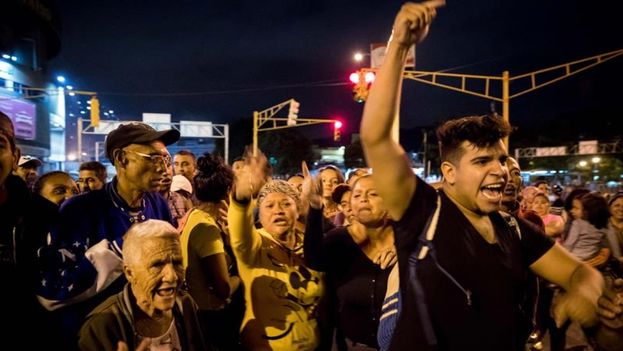
The Venezuelans are throwing themselves into the street because of the daily hardship. Even the poorest and those most loyal to Chavism demand to be able to eat the traditional twelve grapes at the end of the year and insist that Nicolás Maduro fulfill his promise of a mass importation of legs of pork for Christmas. In the face of a frustrated family dinner, slogans are not worth much.

Miraflores Palace blamed Portugal for not having fulfilled its commitments and leaving thousands of poor without their traditional Christmas dinner, which triggered a new wave of street protests.

There too, a piece of pork has become more eloquent than any antigovernment slogan. The contents of the tables anticipated in 2018 speaks more of privileges, crisis and illegality than the best economic treatises that can be written about the collapse of a system.

____________________

The 14ymedio team is committed to serious journalism that reflects the reality of deep Cuba. Thank you for joining us on this long road. We invite you to continue supporting us, but this time by becoming a member of 14ymedio. Together we can continue to transform journalism in Cuba.

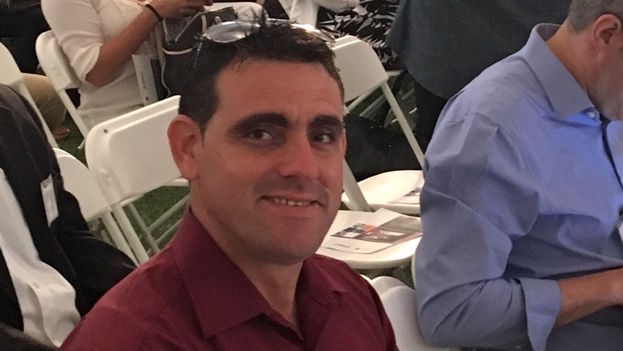
Cuban Faces 2017: Sol García Basulto, Journalist

Sol García Basulto, reporter. (14ymedio)

14ymedio bigger14ymedio, Havana, 28 December 2017 — The reporter and designer of the independent magazine La Hora de Cuba has experienced a series of intense months throughout 2017. Last March, Sol García Basulto (b. 1988, Camagüey) was charged with the alleged crime of “usurpation of legal capacity” for exercising independent journalism, for which she faced a penalty of between three months and one year of deprivation of liberty.

The young reporter was warned by the police for conducting interviews and collecting information on public rights-of-way, a task that, according to the authorities, she undertook to “distort and write against the Government.”

In July, the journalist suffered new restrictions on her movement after the police imposed “a precautionary measure of house arrest” after an interrogation in the city of Camagüey. The accusation and the measures against García Basulto are the same as those received by her colleague Henry Constantín, who is the regional vice president of the Inter-American Press Association (IAPA) in Cuba.

The IAPA believes that the accusations for which she is being prosecuted are contrary to international provisions that support “the right to seek, receive, disseminate information and express opinions.”

____________________

The 14ymedio team is committed to serious journalism that reflects the reality of deep Cuba. Thank you for joining us on this long road. We invite you to continue supporting us, but this time by becoming a member of 14ymedio. Together we can continue to transform journalism in Cuba.
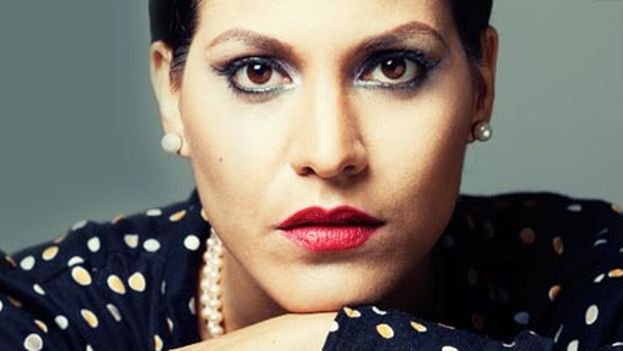
Cuban Faces 2017: Alexei Gámez, Computer Scientist

Alexei Gámez, computer scientist (Courtesy)

14ymedio bigger14ymedio, Havana, 27 December 2017 – A resident of Jagüey Grande in Matanzas, Alexei Gámez (b. 1981, Matanzas) has contributed to enabling a locality where almost three hundred residents connect to each other through wireless networks to exchange content, chat and enjoy audiovisual material without having to be connected to Internet.

This computer engineer specializing in cybersecurity jumped into the public realm this year thanks to his videos on YouTube in which he promotes the use of devices such as Nanostation and Mikrotik to manage Wi-Fi networks, an important task in a country where thousands of users access alternative virtual communities each day, among which SNet stands out as the most powerful of the networks not connected to the internet.

The Youtuber was arrested after an intense police search at his home and was threatened by an officer who accused him of the crime of “illegal economic activity” because he allegedly charged for the service, something that the computer expert denies outright. Hours after his arrest he was released and the property seized from him was returned in part, but he must still sign in at the police station every week.

Gámez was one of the candidates who recently vied for the presidency of the Somos+ (We Are More) Movement, which Eliécer Ávila finally won when he was elected to a second term through the internal elections of the organization. The Somos+ Movement is a political group not recognized by the government, which, since 2013, is committed to a peaceful change in the political system and relies on new technologies to promote its proposals.

____________________

The 14ymedio team is committed to serious journalism that reflects the reality of deep Cuba. Thank you for joining us on this long road. We invite you to continue supporting us, but this time by becoming a member of 14ymedio. Together we can continue to transform journalism in Cuba.

Cuban Faces 2017: Haydée Milanés, Singer

Haydée Milanés on the cover of her album ‘Palabra’. (Album cover)

14ymedio bigger14ymedio, Havana, 27 December 2017 — At just 37 years of age, Haydée Milanés (b. 1980, Havana) is one of the best voices on the national scene and the singer who has received the most praise for her work in the last year. The artist has achieved success with her album Amor, in which she takes on the repertoire of her father, Pablo Milanés, with great authenticity. These songs were presented in the middle of last year in a concert jointly offered by father and daughter at the Karl Marx theater in Havana, followed by an international tour.

She grew up surrounded by music and began her piano studies at the age of six at the Manuel Saumel Conservatory, where she also studied choral conducting; she later completed that training with more theoretical knowledge at Amadeo Roldán middle school. Her voice was enriched by her independent studies of popular music and her stay at a Swiss school of early music.

She turned professional before turning 20 , at the hand of the pianist Hernán López Nussa, although the first time she sang on stage was with her father when she was just a girl.

His performances have been immortalized on albums by important artists such as Descemer Bueno, which was a turning point in her career. Her discography includes a total of six albums of her own, with both studio projects and live performances. She has also collaborated with artists such as Gema Corredera and Pavel Urquiza, Pedro Guerra, Julieta Venegas, Omara Portuondo and Leo Brouwer, among others. ____________________

The 14ymedio team is committed to serious journalism that reflects the reality of deep Cuba. Thank you for joining us on this long road. We invite you to continue supporting us, but this time by becoming a member of 14ymedio. Together we can continue to transform journalism in Cuba.
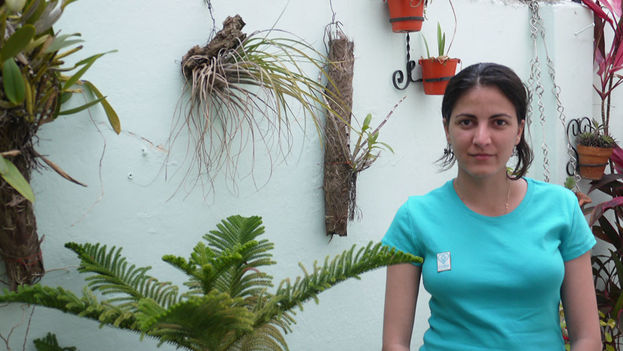
The Cabalistic Exercises of the Managers of the Cuban Economy

The only visible balance of the Cuban economy is the eternal continuation of the wait for better times. (14ymedio / Silvia Corbelle)

14ymedio bigger14ymedio, Miriam Celaya, Havana, 27 December 2017 — An essential feature of the Cuban socio-political and economic system is the reluctance of the ruling class to offer exact and reliable figures and data about the performance of the economy and finances at the end of each year.

December is, for Cubans living in Cuba – as for any society founded on the tradition of Judeo-Christian heritage – a month of festivities and good wishes, but also a time full of uncertainty after almost 60 years of a social experiment, fertile in promises of economic development and financial recovery, whose only visible balance is the eternal continuation of waiting for better times.

As usual, the ambiguity of the reports presented by the corresponding officials in the framework of the recently concluded ordinary session of the National Assembly does not allow ordinary mortals to have an accurate idea of what the economy’s behavior has actually been. continue reading

What specific strategies does the State-Party-Government intend to use to overcome the countless obstacles that continue to arise in the unbearably long path of “socialism” or, very specifically, what kind of calculation was used by experts in the field to announce the 2017 final results as a miraculous growth of the Gross Domestic Product, despite the negative results of the first semester, the contraction of oil subsidies from Venezuela, the increase in pressure from the US embargo and the devastating effects of natural events such as the severe drought in the first half of the year and the intensity of the September hurricane, which caused considerable economic damage.

However, like it or not, official reports are required to reflect at least some figures. And it is precisely at this point that the seams of the system come to light

However, like it or not, official reports are required to reflect at least some figures. And it is precisely at this point that the seams of the system come to light, the slips jump out here and there and the nakedness of the king is exposed. The making of a show of imagination deployed from the official quackery is one question, and it is quite another, very different, to synchronize those speeches with the stubbornness of numbers, which have no commitments to ideologies or policies.

In this sense, the project of the State Budget presented to the Assembly by deputy Lina Pedraza Rodríguez, also Minister of Finance and Prices, is perhaps the most difficult of the cabalistic exercises of the administrators of misery.

Pedraza has the unpleasant task of not only declaring the very questionable results of the fiscal yearend in relation to the budget assigned – revenues exceeded forecasts by 2.3% – but also announcing other equally contestable figures, such as the quantities that will be assigned to the so-called Economic Plan. All this must be done without ever declaring the amount of the aforementioned Budget, and to do this, the ruling party often uses a simple trick: some figures are offered in percentages, while others correspond to exact numerical quantities.

Thus, for example, Cubans are up to date on 2018’s budget, which will be 6% higher than that of the year now ending – whose amount we never knew – and that the sectors of the Health and Education, as a “paradigm of social justice and protection of human rights” will have priority over 55% of the resources.

Cubans are up to date on 2018’s budget, which will be 6% higher than the year ending -whose amount we never knew- and that the Health and Education sectors will have priority over 55% of resources

We also know that 8.18 billion pesos will be allocated to “education in general” – which includes 1,960,000 students at all levels of education – and that Public Health will receive a total of 10.56 billion pesos for all its services, from medical consultations and expenses for patients admitted to the “development of specialized rooms” and dental services, among others.

Social Security will have 6 billion pesos for its expenses (5% growth in relation to the previous year) to guarantee the pensions of more than 1,700,000 people and “short-term benefits,” such as maternity leave and other benefits.

As a sample key of “the measures that the country is adopting to face the aging of the population,” the budget has allocated an amount (not declared) “for the care of more than 13,000 elderly people who attend grandparents’ and nursing homes, which confirms the humanistic character of our system.”

Now, if the simple mathematics “rule of three” is applied, it can easily be calculated that those 13,000 elderly people attended to in specialized state institutions – since there is no approval for this type of service in the private sector – constitute only 0.76% of the country’s retirees, a ridiculously insufficient figure that contradicts the spectacular humanistic character of the political system, in a country where the only indicators that are undoubtedly increasing every year are poverty and the number of elderly.

“More of the same”, some may have muttered to themselves, but they are wrong.  It is the same, yes, but with much less

Also note that the reference numbers correspond to what in Cuba is usually called “Cuban pesos,” that is, currency that cannot be converted into foreign currency, and, since there are two different rates of exchange – 1×1 for legal persons; 1×25 for natural persons** – a vagueness is created that prevents knowing exactly what amounts are involved.

However, it can be assumed with almost absolute certainty that the figures provided by the State Budget are not reported in the Cuban convertible peso or any equivalent to foreign currency, so it is a ridiculously small amount, just to alleviate some of the numerous and pressing economic and social problems that they must face.

“More of the same,” some of us few Cubans who had enough mental health and stoicism to immerse ourselves in the dark labyrinth of official reports must have said to ourselves. But we are wrong: it is the same, yes, but with much less, although they are trying to convince us otherwise.

 Translator’s notes:

*Roughly $308 million USD.

**In jurisprudence, a natural person is a person (in legal meaning, i.e., one who has its own legal personality) that is an individual human being, as opposed to a legal person, which may be a private (i.e., business entity or non-governmental organization) or public (i.e., government) organization.

Translated by Norma Whiting

___________________________

The 14ymedio team is committed to serious journalism that reflects the reality of deep Cuba. Thank you for joining us on this long road. We invite you to continue supporting us, but this time by becoming a member of 14ymedio. Together we can continue to transform journalism in Cuba.
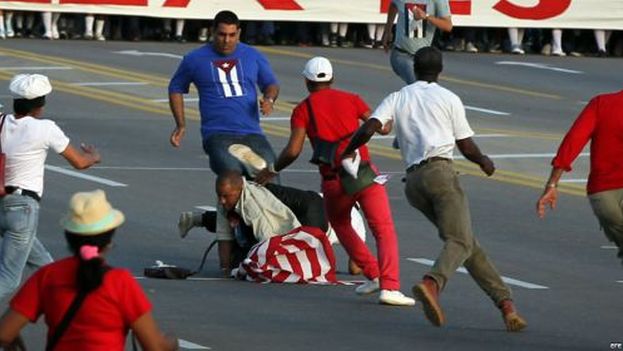
Cuban Faces 2017: Rosa María Payá, Activist

Rosa María Payá, activist. (14ymedio)

14ymedio bigger14ymedio, Havana, 28 December 2017 — The activist, who divides her time between Havana and Miami, directs the Cuba Decides initiative that proposes the holding of a plebiscite to initiate a transition to democracy on the Island. With a degree in Physics, Payá (b. 1989, Havana) has had an intense year in which she has appeared in a growing campaign against her in Cuba’s official media.

Last February the activist organized the “Oswaldo Payá: Freedom and Life” award ceremony in Havana, in honor of her late father, founder of the Christian Liberation Movement. The authorities blocked the event and prevented Luis Almagro, secretary general of the Organization of American States (OAS), one of the first honorees of the award, from entering the country.

Former Mexican President Felipe Calderón and Mariana Aylwin, daughter of the late Chilean president Patricio Aylwin and former Minister of Education in her country, were unable to board a plane to Cuba to attend the tribute.

During the People’s Power municipal elections, held last November, Payá called on voters to annul their ballots by writing the word “plebiscite” or the name of her organization in it. The opposition denounced the harassment against the promoters of the initiative and described the election process as a “farce.”

__________________________

The 14ymedio team is committed to serious journalism that reflects the reality of deep Cuba. Thank you for joining us on this long road. We invite you to continue supporting us, but this time by becoming a member of 14ymedio. Together we can continue to transform journalism in Cuba.
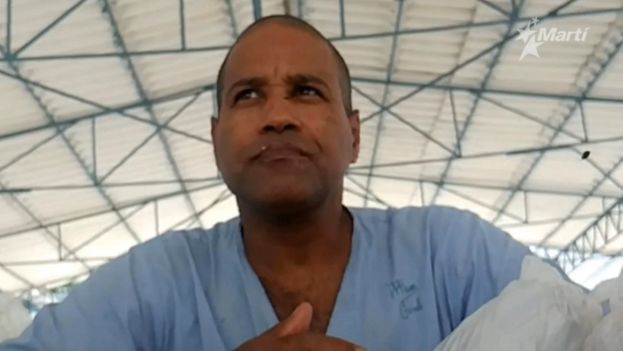
Cuban Faces 2017: Daniel Llorente, The ‘Man With the Flag’

Llorente was tackled during the May Day march when he broke into the parade with the American flag. (Screen Capture)

14ymedio bigger14ymedio, Havana, 27 December 2017 — Known as the “man with the flag,” Daniel Llorente (b. 1963, Havana) is a “freelance” opponent who has stood out for his activism after the diplomatic thaw between Cuba and the United States.

His image made the rounds of the social networks and the covers of many international newspapers when he hoisted the American flag at the beginning of the last May Day parade in Havana’s Plaza of the Revolution.

A few yards from the platform and in front of the accredited press on the island covering the event, Llorente shouted for freedom for Cuba. His spontaneous action broke the uniformity of a rehearsed choreography but lasted only a few seconds, because Llorente’s path was interrupted by seven security agents who rushed in and tackled him by force.

With a degree in engineering from the former German Democratic Republic (GDR), this Habanero ended up making a living working as a bricklayer, electrician, plumber and private taxi driver.

Daniel Llorente. (Martí News)

Prior to that May Day action Llorente could be seen waving the US flag upon the arrival of President Barack Obama in Cuba in March 2016, as well as welcoming the Adonia cruise ship in the Bay of Havana.

Since then, Llorente has been deprived of his freedom. He spent the first weeks of his imprisonment in the 100 y Aldabó prison but at the end of that same month of May he was transferred to the Commander Dr. Bernabé Ordaz Ducungé Psychiatric Hospital, popularly known as Mazorra.

From there he started a hunger strike and sent several letters asking for his release. He has also given interviews to various independent media to denounce a confinement that he describes as “unfair.” As of 1 January of the coming year, he will have been detained for eight months.

__________________________

The 14ymedio team is committed to serious journalism that reflects the reality of deep Cuba. Thank you for joining us on this long road. We invite you to continue supporting us, but this time by becoming a member of 14ymedio. Together we can continue to transform journalism in Cuba.
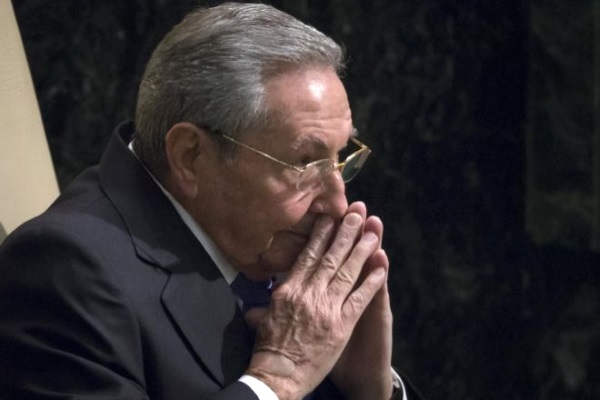
Castro Suspects / Cubanet, Miriam Celaya

Cuban President Raul Castro (Cubanet)

cubanet square logoCubanet, Havana, Miriam Celaya, 22 December 2017 — On the morning of 21 December 2017, it became known in the international media that “the Cuban Parliament” – whose most outstanding feature is not having decided anything at all in its more than 40 years of existence – has “just decided” to extend the presidential mandate of General Raúl Castro until 19 April 2018.

The real reasons for making a decision that implies another unfulfilled promise on the part of the elderly General – who had promised to leave the country’s Presidency on 24 February 2018 – is a mystery, given that the supposed difficulties introduced in the electoral process for Hurricane Irma, which hit the island in early September, is too precarious a pretext to be taken seriously.

But, in any case, we are not facing an exceptional situation either. It is known that any governmental disposition in Cuba, especially the best and the most transcendental ones, can be (and usually are) postponed as the power god wishes. Other previous promises of the General, with greater effect on the population, such as monetary unification, the decrease in food prices or the new Electoral Law, were also arbitrarily postponed with no explanation whatsoever. continue reading

However, some signs point out that in the background of this sudden date change for the departure of Castro II from the Presidency lies the urgent need to make certain readjustments in the power machinery, in order to ensure their own interests and those of their beneficiaries, which reinforces the hypothesis of some analysts who sustain the existence of significant cracks in the once monolithic structure of the Cuban Communist Party (PCC) and of the leadership, based on alleged struggles between the most conservative and orthodox sectors (supposedly “Stalinist” or “Fidelista”) and those most prone to the pseudo-changes introduced in the last decade (“reformists” or “Raulistas,” as they are called). Struggles that would have arisen after the forced retirement of Fidel Castro from the government, and made deeper through the 11 years that followed.

Perhaps the Raulistas are waging a strategic battle in order to guarantee their own continuity at the head of the country, and especially the safeguarding of their economic interests, so everything must be tied and re-tied before the presidency’s transfer to the hands of a loyalist who does not belong to the Historical Generation, avoiding unforeseen and unwanted events.

The truly surprising thing is the impression of urgency and instability that is being transmitted, trying to consolidate, in a matter of three months, something that should have been achieved in a decade, that is, to avoid any danger, which, at the same time, belies the discourse of “unity of all Revolutionaries” wielded by the totality of the leaders and high officials interviewed while standing by the ballot boxes during the municipal elections of this past November.

Of course, the cryptic style of (dis)information in Cuba forces us to decipher hidden codes, with the risk of erroneous interpretations and inaccuracies. However, it does not seem accidental that the most important information published on the front page of the official press this Thursday, 21 December,  was the previous day’s celebration of the 4th Plenary of the Central Committee (CC) of the PCC – parallel to the parliamentary debates – within the framework of which the First Secretary of the Party, Raúl Castro, announced the celebration of the next Plenary, which will take place in March 2018, a fact that cannot but be related to the coming election of the new Cuban President.

It is possible speculate that this next Plenary of the CC of the PCC could be, above all, the occasion introduced by the general-president and his most faithful acolytes, not only to “expand on the experiences obtained during the implementation process of the Guidelines and in the projection of the coming years, according to the official press statement, but to strengthen commitments and strategically prop up the one that will later be officially “elected” by the State Council to occupy the presidential chair, and perhaps to also secretly agree among the ideological elite who will be the next First Secretary to be elected in the framework of the VIII Congress.

But the current constraints of Raulism, in a December that has had more haste than pauses*, are not confined to the political plane, but began instead to affect the economic plane. Just a few days ago, on 13 December, untimely “new legal norms” appeared and went into effect over the Cuban business system.

In other words, the “improvement” experimentally initiated by the general-president during the 1990’s to (gradually) metamorphose the high command of his army into civilian entrepreneurs – who now direct all the strategic lines of the country’s economy – and later endorsed in the Guidelines, are now legitimized in the legal body through decrees and decree-laws, which gives the future President a legal tool that not only protects the changes implemented until now by the general-president against real or potential internal adversaries, but will allow an extension of their future scope in the interests of the elite and their favored ones.

But beyond all speculation we must recognize that the Cuban political landscape is at least confusing. In any other country where the predominant characteristics of the government are hesitation, setbacks, failure to comply with all its promises and, finally, the postponement of the presidential elections, the situation would be described as a “political crisis.” Not so in Cuba. At least not explicitly. Four generations of Cubans on the island have survived for six decades under conditions of dictatorship, suffering crises of all kinds without even internalizing them as such. How would they perceive the crises that are resolved within the bosom of the olive-green Olympus?

In any case, we will have to follow closely the political events that come our way in 2018. Meanwhile, in the midst of so much murkiness something is clear: the proclaimed unity of the power cupula is just another myth of a worn out and outdated gerontocracy that today seems to doubt even the survival of its bleak legacy.

*Translator’s note: “Without haste, but without pause” has been a catch phrase for Raul Castro, in speaking of economic reforms in Cuba.

Translated by Norma Whiting

When The Labor Union is the Employer

Workers of the state company Cimex in the May Day parade, in Havana. (14ymedio)

14ymedio bigger14ymedio, Reinaldo Escobar, Havana, 28 December 2017 — Anyone who knows the Cuban reality even partly knows the role of “drivetrain” played by the so-called mass organizations. Instead of representing the interests of their members before the State, they function as watchdogs of the government’s interests in each of their sectors.

The Federation of Cuban Women (FMC) is more concerned with showing women’s emancipation in occupations than in gender rights; The Federation of University Students (FEU) acts as a hitman to expel “troublesome” students under the principle that “the university is for Revolutionaries”; and the National Association of Small Farmers (ANAP) watches over the farmers to ensure they deliver their products to the Ministry with greater zeal than it demonstrates in ensuring that the Ministry pay its debts to the farmers.

The union leaders take the prize for docility, especially in the national organizations. As the true foremen at the service of the patron-state, they are more concerned with productivity than with protection measures; they demand from the workers strict compliance with the imposed discipline, but they fail to protest before the administration when someone is unfairly dismissed. continue reading

During a recent press conference, the Secretary General of the Cuban Workers Center (CTC), Ulises Guilarte de Nacimiento, surprised everyone when he warned about the importance the issue of salaries should have at the next Congress of the pro-government entity he leads.

Those who expected a complaint about the difficulties of putting food on the table given the monthly wages, ran up against Guilarte’s assertions that the problem of low wages is “much more damaging today with regards to the effects of the permanent fluctuation, which is also increasing, that we have in the work force” and he added to his list of concerns “the apathy, the demotivation” that these low wages generate.

The general secretary is irritated that people do not earn sufficient resources from their work to acquire goods and enjoy services not because of the low quality of life this condemns them to, but because they then fall into the “moral weakness” of “finding in theft, in the diversion [of resources], in misappropriation, the so-called alternative sources to satisfy their needs.”

Instead of demanding compliance with the sacred law of socialism that insists each person be paid according to their work, the leader of the only union allowed in the country regrets that low wages have caused in just four years “a loss of more than 30,000 (…) workers with the highest qualifications,” referring to the migration of the most talented to the non-state sector of the economy.

Later, as he boasted of being a close associate of the highest spheres of power, he confessed that Raul Castro had indicated to him that “the most concrete contribution that the trade union movement in Cuba can make is to continue mobilizing the workers to call on greater reserves of efficiency,” another of the many calls that have been repeated for decades to make a greater effort and sacrifice, but without any hint of improving working conditions in the state sector.

Beyond these exhortations, the most significant thing to highlight from Guilarte’s statements is his role standing next to power rather than to the working class. The union leader does not tremble when he makes demands on and criticizes those he should defend and support.

This happens because the eyes of those who find themselves holding “the right end of the stick” are incapable of seeing the permanent emergency situation in which they have plunged the country. As in any other shipwreck, it is inappropriate to demand rights; they will only listen to the captain’s orders while the official media continues to repeat that the ship of socialism is sailing the seas towards sustainable prosperity.

______________________

The 14ymedio team is committed to serious journalism that reflects the reality of deep Cuba. Thank you for joining us on this long road. We invite you to continue supporting us, but this time by becoming a member of 14ymedio. Together we can continue to transform journalism in Cuba.

Rehearsal for a Civilized Divorce

The secession of any Spanish region would have to be a rational and consensual decision within a law that took into account a measure that would affect future generations. (EFE)

14ymedio bigger

14ymedio, Miami, Carlos Alberto Montaner, 17 December 2017 — On Dec. 21, the residents of Catalonia will vote again. Few international news have generated so much interest among Latin Americans as those emerging from Spain. I don’t say “the Catalans” because (as it should be) all the Spanish citizens living in the four Catalonian provinces — Barcelona, Lérida, Gerona and Tarragona — have been summoned to the polls. And I’m talking about a territory of 32,000 km2 similar to that of Belgium, with a population of 7.5 million similar to that of Israel and a First-World GNP measured in a purchasing power of 43,000 dollars, approximately like Canada’s.

My interest in this subject transcends journalism. In addition to having spent the best 40 years of my life in Madrid, I aver that a substantial part of my family comes from the Leridan Pyrenees, including Andorra or Lloret de Mar (Gerona). Four sisters of my maternal grandfather inaugurated genital nationalism in Havana. They remained spinsters in Cuba, lamenting (in Catalan) that they couldn’t find Catalonian men to marry, even though they made periodic trips to Barcelona for the purpose of kidnapping them and taking them back to the island. They failed. They died virgins and martyrs (I believe) many decades ago. continue reading

The surveys show pro-Spain voters in a slight majority, generally contented with liberal democracy (which, I admit, pleases me) dispersed in a broad framework that ranges from the conservative right of the Popular Party to the leftist Socialist Workers Party of Spain, which occasionally is vegetarian and social-democratic, although sometimes it experiences carnivore spasms and bites in radical hunger. Add to this the liberal center of Ciudadanos (Citizens), the group that might earn the most votes, which in no way guarantees that it will be able to form a government. The right is inconvenienced by its existence and the left detests it.

Although the purpose of the elections is to give a legitimate government to a region whose bosses have been ousted for violating the existing legality, Tyrians and Trojans (though they will not officially admit it) will interpret the outcome as if it were a nonbinding plebiscite on independence and we’ll go back to the starting point. Childish though it may seem, there is no emotion more powerful and tenacious than nationalism. Trying to decapitate it is futile; it always reappears. So, the wisest course is to learn to coexist with the phenomenon and keep the blood from spilling into the river.

That is why I believe the reasonable thing to do is to open a Constitutional door to the pro-sovereignty crowd so they can leave, if they ever manage to permanently build a majority decisive enough to achieve their separatist objective.

I see Catalonia as part of an unequal Spain, created in olden days with different contributions, so I’d love to see it remain inside the common nation, but — because it’s a sentimental, not a legal issue — the most important factor is how the Catalans see themselves, not how we see them from the outside.

It’s like a divorce. It took the Spaniards (and some Latin Americans) far too long to admit that the decision to remain together belongs to the married couple, not the family. Any region of Spain should be given the chance to separate from the whole of the government to which it belongs. (Five regions are essentially differentiated: Catalonia, the Basque provinces, Galicia, the Canary Islands and the vast Spanish zone that includes the rest of the country.) Most likely, that “open door,” far from exacerbating the recurring calls for independence, will tone them down.

Because I know the history of Cuba, I know that Spain’s refusal to replicate the relaxed relationship between the United Kingdom and Canada sparked the final and definitive War of Independence. Perhaps a larger dose of self-government for Cuba might have prevented the war, the sinking of the U.S.S. Maine and the disaster of 1898.

Cuba — especially Havana — was and felt reasonably Spanish, but the politicians in Madrid made that relationship impossible, perhaps because of the uncontrollable turbulence of a nation that in a few years went through the trauma of the end of the Bourbon dynasty, the enthronement of a luckless Italian prince, the chaos of the First Republic, and the shady deals of the Restoration. There wasn’t enough tranquillity to act wisely.

Of course, the secession of any Spanish region would have to be a rational and consensual decision within a law that took into account a measure that would affect future generations. That would require a pro-independence majority of 60 percent, the approval in two consecutive plebiscites held during two separate legislative sessions to prevent conjuctural and insufficiently pondered reactions, and the economic consequences of any rupture, which must be previously analyzed. The parties must determine how the common goods will be divided and who will pay for the onerous cost of separation. Exactly the same as happens in any civilized divorce.

 _______________________

The 14ymedio team is committed to serious journalism that reflects the reality of deep Cuba. Thank you for joining us on this long road. We invite you to continue supporting us, but this time by becoming a member of 14ymedio. Together we can continue to transform journalism in Cuba.

Cuban Faces 2017: Aimara Pena, Independent Candidate

Aimara Peña

14ymedio bigger14ymedio, Havana, 24 December 2017 — As a child, Aimara Peña (b. 1989, Sancti Spíritus) dressed in her impeccable primary school uniform to guard the polls in the People’s Power elections. At that time she felt a special emotion as she said “voted” every time a voter put their ballot in the ballot box. She did not suspect that twenty years later she would be involved in the electoral process as a possible candidate, but this time independently.

When Peña decided to try to represent her community as a delegate she knew that the entire political and police apparatus of the government would go against her, but she did not get discouraged and went to her area’s assembly in the 23rd district of Las Tozas town, in the municipality of Sancti Spíritus. The young activist was convinced that if she could be nominated at that meeting she would have many opportunities to win the favor of the voters.

The attacks against this spirited woman were excessive: she was summoned to a police interrogation and at the nomination assembly, in front of her neighbors, she was branded a mercenary, a salaried employee of imperialism, along with other expletives. On top of that, violating the provisions of the electoral law, the organizers of the meeting allowed her nomination to be annulled and did not even put it to a vote.

Although emblematic, the case of Peña was just one of hundreds of independent candidates who in provinces all across the country were boycotted by the authorities, in collusion with the organs of the State Security and local branches of the Communist Party.

All she did was try to listen to the demands of the voters and become their voice in the face of power. Now, the young woman continues with her work reporting violations of human rights and exercising journalism.

 _______________________

The 14ymedio team is committed to serious journalism that reflects the reality of deep Cuba. Thank you for joining us on this long road. We invite you to continue supporting us, but this time by becoming a member of 14ymedio. Together we can continue to transform journalism in Cuba.
Cuba: ’The Human Rights People’ / Iván García

The independent journalist Augstín López is silenced by plainclothes policemen while shouting “Long Live Human Rights.” Taken from Martí News.

Ivan Garcia, 12 December 2017 — On 28 January 1976 in Havana, Ricardo Bofull founded the Cuban Committee For Human Rights, along with Edmigio López and Marta Frayde. Forty-one years later, the independent journalist Tania Díaz Castro, in her house in Havana’s Jaimanitas neighborhood, west of the capital, surrounded by dogs and books, recalls that era.

“I joined in 1987. Bofill said that he and his small group were founded on 28 January in homage to the birthdat of the Apostle (José Martí). The place chosen was Dr. Marta Frayde’s house, in Vedado. By ironies of fate, this unforgettable and courageous woman had been a personal friend of Fidel Castro.

A short time later, almost everyone went to jail, for long years and for different accusations — invented ones — as was and is the custom of Castroism: Marta Frayde, Adolfo Rivero Caro, Elizardo Sánchez, Edmigio López, Enrique Hernández, and of course Ricardo Bofill. Thus, Fidel responded to the request of those intellectuals to review the situation of human rights in Cuba,” says Díaz Castro and adds: continue reading

“At one point, I was a kind of secretary for Bofill. In my house in Centro Habana I received eight or ten denunciations a day from citizens where the institutions of the regime had transgressed their rights. In 1987, Samuel Lara, Adolfo, Ricardo and I went to the Comodoro Hotel to meet with a UN commission, which the dictatorship authorized to enter the country, so that we could express our complaints. Spontaneously and despite the fact that repression was fierce at the time, outside the hotel more than a thousand people came to deliver their accusations.”

The journalist adds that Ricardo Bofill and Armando Valladares “were key players so that the issue of human rights violations by the regime became known around the world. They and others, planted the seed that has then germinated in hundreds of journalists, activists and independent groups in the current civil society.”

The Castro brothers’s Cuba has not changed its absurd political system and still maintains the dysfunctional planned economy. But, little by little, Cubans have been losing their fear. In any corner of the city you can hear openly anti-government comments, anti-Castro jokes and ridicule of the leaders.

Osviel, 43, an engineer, is committed to democracy and says he would like to earn a six-figure salary in a private company.

“Like most college graduates after the Revolution, I was indoctrinated. But the repeated deficiencies of the system have opened my eyes. The first time I had doubts was when I read the Universal Declaration of Human Rights. I realized that this government shamelessly violates some precepts that are part of individual rights. I understood that we are far from living in a democratic society. ”

Although the Republic of Cuba was a signatory on the 10 December 1948 Universal Declaration of Human Rights, the authorities on the Island consider the brochure that expresses these rights to be subversive.

The military autocracy persists in its delirious narrative that Cuba is the most democratic nation in the world. Without blushing, in the 8 December edition, an article published in the Party newspaper Granma said that “Cuba is an international symbol in the field of human rights.”

“They don’t even believe it themselves. There is a group of precepts, especially those of a political nature, which are violated in Cuba. The government thinks that by guaranteeing universal healthcare, the right to work and education it has already done its duty. But human rights go much further,” says Odalys, a lawyer.

Raúl Castro himself, in a press conference during Barack Obama’s visit to Cuba in 2016, acknowledged that “as in any part of the world, all human rights are not fulfilled here.”

On the commemoration of the 69th anniversary of the Universal Declaration of Human Rights, Martí Noticias asked fourteen people, seven of each sex between the ages of 18 and 74, their opinions on the respect for human rights by the authorities in Cuba.

Ten responded that, in one way or another, several precepts are violated or rights that are not crimes in other countries are considered illegal. Two said it is “a US campaign” and two claimed ignorance of the matter.

Outside the survey, a Social Sciences student comments that “the most worrisome is the deficit of political rights. Cuba is one of the few countries in the world where it is illegal to found an opposition party or movement.”

For his part, a retired former military man believes that “the issue of human rights is a manipulation by the United States to attack Cuba. That is why the government should allow other parties and not imprison those who think differently. But always he who commands sets the rules of the game.”

Rigoberto, a taxi driver, is clear that “here elementary rights are violated, not only those of a political nature. For example, people from eastern Cuba who migrate to Havana are considered illegal [residents], and according to the Universal Declaration of Human Rights and the Cuban Constitution, that regulation is illegal.”

Carlos, a sociologist, mentions specific cases. “Look at the disrespect of a broad set of human rights in Cuba: until seven years ago it was illegal to buy or sell a house or car, to be a tourist in your own country, or to be able to travel freely abroad. Now others are still not being met. Cubans can not board boats with motors, create a party or found a newspaper in a legal manner.”

René, a lawyer, states that “where rights are violated the most is in the legal field. In the absence of tripartite powers, the majority of the population is defenseless against the legal machinery. Legal irregularities are numerous and people have nowhere to go to seek justice and impartiality.”

Although in recent years, I must clarify, hundreds of citizens who consider themselves harmed by legal rulings have received advice from independent lawyers or offered their testimonies to alternative journalists.

“It’s the last shuffle of the cards. When I see that the State blocks all paths, I will see an independent journalist to tell my to story online,” confesses Senén, a bank employee.

Within the expression ‘the human rights people’, ordinary Cubans include a political activist, a dissident lawyer, and a free journalist. Increasingly they go to opposition groups. For any reason. If their house falls down, or they are subject to a criminal penalty that they consider unfair, or they want to denounce embezzlement in a state company.

And the Cuba of 2017 is not the Cuba of the 1980s. For some, the Island is making no progress. For others, they can see the light at the end of the tunnel. It is the theory of the glass half full or half empty. According to how you perceive it.

Cuban Faces 2017: Dayana Chavez Victoria, ‘La Senorita Dayana’

Dayana Chavez Victoria, ‘La Senorita Dayana’ (14ymedio)

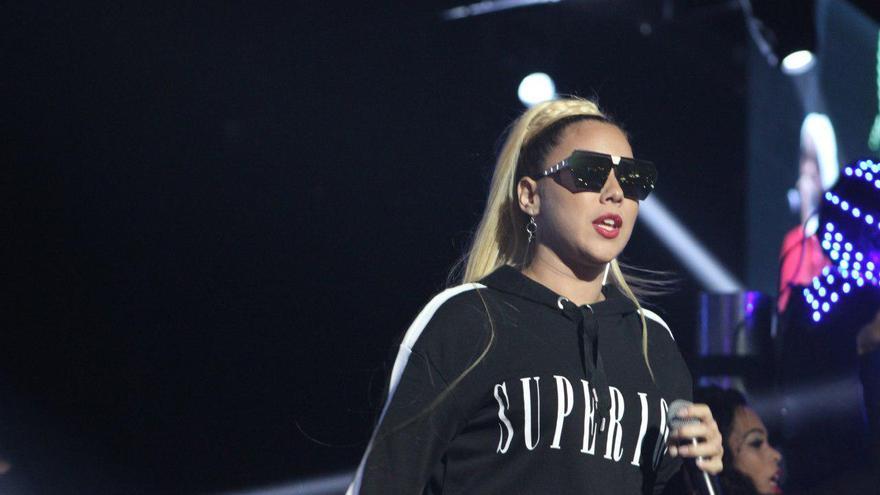
14ymedio bigger14ymedio, Havana, 24 December 2017 — Young, daring and feminist, La Señorita Dayana (b. 13 January 1984, Las Tunas) vindicates the figure of women in urban music. The author of songs such as A Ti Lo Que Duele and La Mentira is opposed to the role assigned to women as simple objects of mens’ sexual desire.

Born in a town in the interior of Las Tunas, Dayana Chávez moved with her family to Siboney, in Camagüey province, when she was very young. There she took her first steps in life and art.

Chávez grew up as an artist and trained to enter the National School of Art (ENA), from which she later graduated as a dancer. However, what launched her to fame was her work with Adriano DJ on the Havaneando project.

In 2016, La Señorita Dayana won Havaneando’s Top Ten award for the popularity of her songs. Now, La Señorita Dayana’s musical career  in Cuba is experiencing its best moment. Widely listened to throughout the Island, she has shared the stage with artists such as Zenaida Armenteros, El Chacal, Gente de Zona, Mayda Mitchel and Héctor Téllez.

She recently sparked a controversy in Miami when she left an interview in which she was called upon to take a position on the the Cuban government’s practice of selling donated items to the victims of Hurricane Irma. Chavez said on that occasion that she was on the television program to talk about her music, not about politics.

Her songs are also among the most listened to on the station Ritmo 95 Cubatón Y Más, in Miami, a station that promotes the urban genre of the Island.

________________________

The 14ymedio team is committed to serious journalism that reflects the reality of deep Cuba. Thank you for joining us on this long road. We invite you to continue supporting us, but this time by becoming a member of 14ymedio. Together we can continue to transform journalism in Cuba.
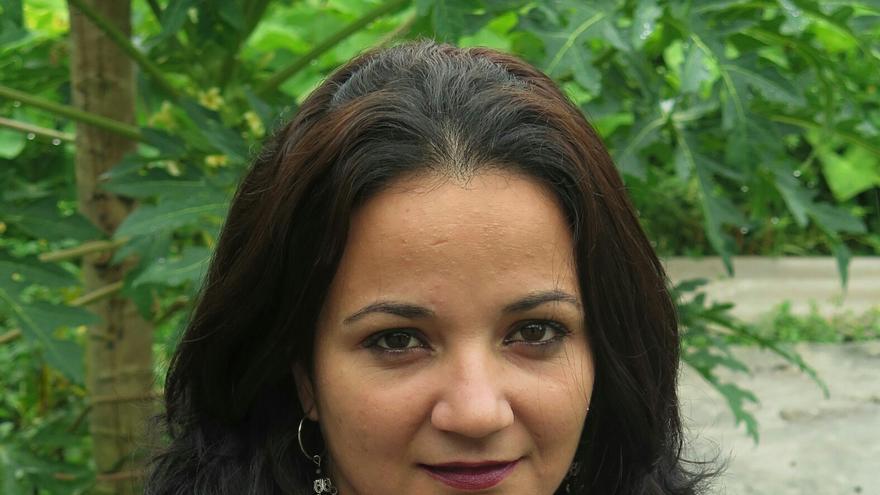
Cuban Faces 2017: Luis Manuel Otero Alcántara

Luis Manuel Otero Alcántara

14ymedio bigger14ymedio, Havana, 25 December 2017 — Restless, hyperactive, media-focused and irreverent, Luis Manuel Otero Alcántara (b. 1987, Havana) turned 30 this year in the midst of an unstoppable and controversial artistic work.

With his proposal With All And For The Good Of A Few he created three artistic interventions centered on the luxurious hotel Manzana Kempinski. In the first of them, he questioned the disappearance of the bust of the communist leader Julio Antonio Mella, who had previously been placed on the site of the hotel development; in the second he brandished a sledgehammer a few centimeters from the window of an exclusive store on the ground floor of the building; and in the third he held a raffle with the prize being a night in the only five-star hotel in the country.

In each case, Otero Alcántara sought to denounce the enormous economic gap that separates Cubans from foreign visitors who stay in these luxury hotels.

Born in the Havana municipality of Cerro, the artist is currently awaiting trial after being accused of the alleged crime of “receiving” for possessing construction materials without the correct documentation, according to the authorities. Bags of cement and other aggregates were confiscated during a search of his home.

This year Otero Alcántara and other artists began a campaign to hold the Havana #00Bienal, scheduled for May 2018, in response to the decision of the Ministry of Culture to postpone for one year the most important plastic arts event in Cuba “because of the damages caused by Hurricane Irma.”

The initiative earned a wake-up call from the Cuban Writers and Artists Union, expressed in a note distributed through institutional emails, which warned its members about “some unscrupulous people” who are organizing an independent Biennial.

This December the artist was arrested while making a pilgrimage to the Sanctuary consecrated to San Lázaro in El Rincón, south of the Cuban capital. After being detained for 72 hours, he was released and resumed his pilgrimage to demand democracy and freedom for the Island, which ended successfully on December 20.

 _____________________

The 14ymedio team is committed to serious journalism that reflects the reality of deep Cuba. Thank you for joining us on this long road. We invite you to continue supporting us, but this time by becoming a member of 14ymedio. Together we can continue to transform journalism in Cuba.
Cuban Faces 2017: José Rubiera Torres, Meteorologist

José Rubiera Torres

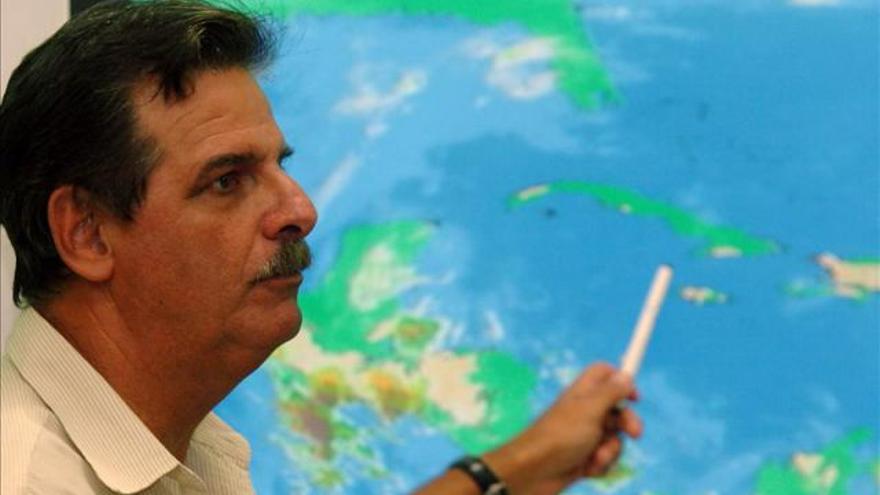
14ymedio bigger14ymedio, Havana, 26 December 2017 — Everything pointed to the fact that Hurricane Irma would be the first in many years that Cubans would experience without the company of José Rubiera. Born in San Antonio, Jaruco in 1946, and for many years Director of the Cuban Institute Forecast Center, Rubiera has often commented that hurricanes fascinate him. He returned from a trip abroad to be with the island’s TV viewers during the passage of Irma in September.

Rubiera was missing during the first days when the storm was approaching the island, but was finally seen again facing the map with the pointer in hand and his deliberate way of speaking, a return that generated great stir in social networks and a certain relief in an audience accustomed to his warnings and his measured comments, so different from the tense attitude of political discourse on the Island.

In addition to being a tireless researcher, he is passionate about photography. For his work, he received the title of Doctor Honoris Causa in Physical Sciences granted by Marta Abreu de Las Villas Central University. He is the author of numerous scientific articles, a textbook and brochures related to tropical meteorology.

Since the end of this year’s hurricane season, the experienced meteorologist continues to appear on the small screen giving the routine weather report without major shocks and transmitting to the public the confidence he has gained. However, for many people, the name “Rubiera” is synonymous with the word “hurricane.”

_________________

The 14ymedio team is committed to serious journalism that reflects the reality of deep Cuba. Thank you for joining us on this long road. We invite you to continue supporting us, but this time by becoming a member of 14ymedio. Together we can continue to transform journalism in Cuba.